
Australia
Court Records in South Australia: How to Search, Inspect and Access Court Files
Independently fact-checked against primary sources (last audited August 19, 2026). · 11 primary sources cited on this page. How we verify our legal content

South Australia's Uniform Civil Rules 2020 rule 13.10 sets the Registrar's search and inspection procedure, but the actual right to inspect a Supreme, District, Magistrates or Environment, Resources and Development Court file comes from each court's own Act, and a search or inspection request currently costs $30.75.
Which South Australian Court Holds What
For an overview of how court records access works across every state and territory, see court records in Australia.
South Australia's courts share one administrative body, the Courts Administration Authority, which runs the registries, case lists and fee schedules for the Supreme Court of South Australia (its General Division and the Court of Appeal, created by the 2016 Court of Appeal reforms, sit inside the one Supreme Court registry structure), the District Court, the Magistrates Court (Adelaide plus suburban and regional locations), the Youth Court, the Environment, Resources and Development Court, the Coroners Court, and the Wardens Court. Each court has its own registry under that umbrella, and the Coroners Court registry specifically holds inquest files and findings.
The South Australian Civil and Administrative Tribunal, SACAT, is not part of this court family. It runs its own separate website and registry, and it does not appear on the Authority's own list of courts. SACAT is a tribunal, with jurisdiction over tenancy, guardianship and administration, mental health, advance care directives and reviews of certain government decisions, among other matters, and it should be treated as a separate access channel rather than a division of the Authority's main portal, CourtSA.
Searching Online Through CourtSA
CourtSA is the Authority's one online portal, used for lodging and defending criminal, civil and probate cases, for a case-list search, for accessing case documents and notifications, for viewing orders and judgments, and for ordering transcripts of Supreme, District, Environment, Resources and Development, or Coroners Court proceedings. The portal's welcome page pushes every visitor toward creating an account before showing case-search results, and it does not itself state whether a basic case-list or party-name search is free without one. What is confirmed is the fee for a formal search-and-inspect request, covered below; whether CourtSA's own search screen has a free public tier short of that formal request is not settled by the portal's public pages, so treat it as an open question rather than an assumption either way.

Daily court lists sit on a separate part of the Authority's site, split by court and list type: all criminal cases, all civil cases, a warning list, and dedicated lists for the Supreme Court, the Court of Appeal, the District Court's civil and criminal divisions, and the Adelaide Magistrates Court's civil and criminal divisions.
Inspecting a Court File: The Rule, Who May Apply, and the Fee
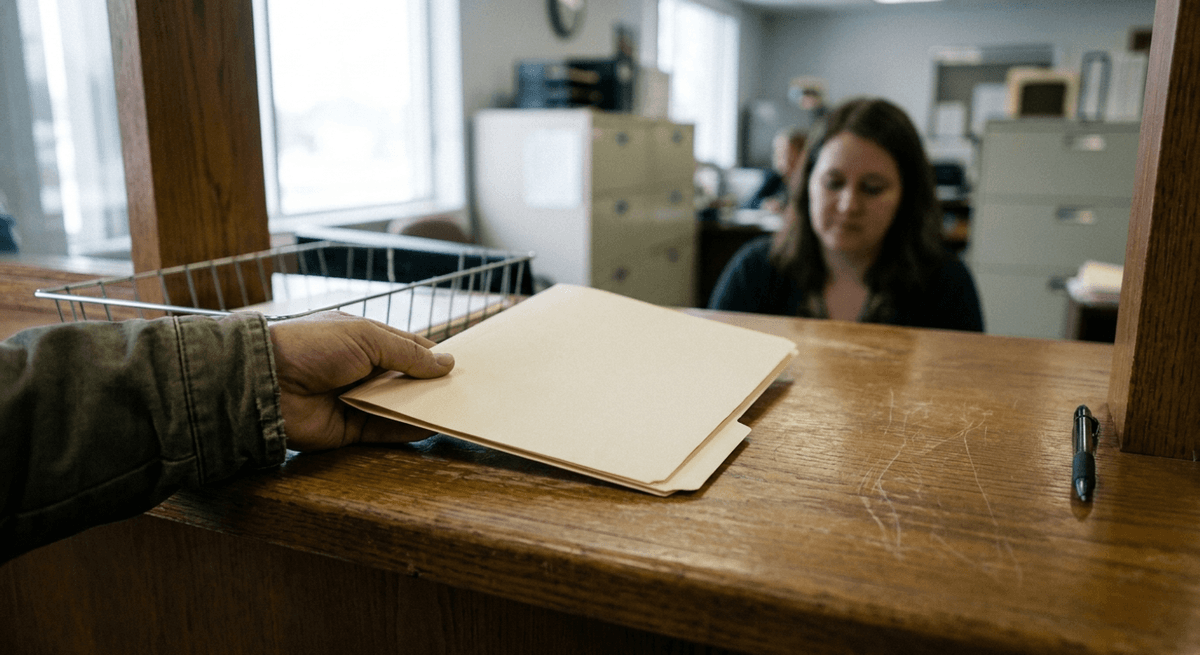
Uniform Civil Rules 2020 rule 13.10 is the number most often quoted for South Australia's access rule, but it is a procedural rule, not the source of the access right itself. It requires the Registrar to set practices for what information is accessible to parties, lawyers, members of the public or other classes of person, and for how someone requests access or copies, including any fee. The compiled Rules print an explanatory note pointing to where the real, substantive access right lives: section 131 of the Supreme Court Act 1935, section 54 of the District Court Act 1991, section 51 of the Magistrates Court Act 1991, and section 47 of the Environment, Resources and Development Court Act 1993. Each of those sections follows the same two-part pattern. Section 131(1) of the Supreme Court Act, for example, requires the court, on application by any member of the public, to allow inspection or copying of listed material including process, transcripts of evidence and judgments or orders, while section 131(2) allows material not taken or received in open court, suppressed material and regulation-prescribed classes to be inspected only with the court's permission; section 131(5) lets the court charge a regulated fee.
A search or inspection of a court record currently costs $30.75, the same figure on both the Supreme Court's and the Magistrates Court's fee schedules, as at 1 July 2026.
| Item | Fee |
|---|---|
| Search and/or inspect a record of the Court | $30.75 |
| Unsealed copy of a court record | $30.75 |
| Sealed copy of a court record | $96.50 |
| Judgment reasons, per page (first copy to a party is free) | $10.40 |
| General document copy, per page | $6.20 |
The Supreme Court's own fee schedule states that no fee applies to a criminal-proceedings search request made by, or on behalf of, a defendant or a crime victim.
Judgments and Daily Lists
South Australian judgments are published on two channels. The Authority's own judgments page carries downloadable copies of recent judgments from the Supreme Court (including the Court of Appeal), the District Court and the Environment, Resources and Development Court, and the page itself directs readers to AustLII for the fuller historical archive; how far back AustLII's South Australian coverage runs, or how it compares in currency, was not independently confirmed in researching this page. Sentencing remarks and Coroners Court findings are published as their own separate feeds on the same site, not folded into the general judgments page. The judgments page does not state a publication lag, describing itself only as carrying recent judgments handed down in court.
Suppression and Non-Publication Orders
Evidence Act 1929 section 69A gives the Court a discretionary power to clear the courtroom or suppress publication of evidence, names or other identifying material, with a right of review under section 69AB and a right of appeal under section 69AC. Breaching a suppression order made under this Division is an offence under section 70, carrying a maximum penalty of $10,000 or 2 years' imprisonment for a natural person and $120,000 for a body corporate.
This discretionary suppression power is separate from a standing statutory restriction in the same Act: section 71A restricts reporting on sexual offences generally, protecting a complainant's identity by force of the statute itself rather than by a case-by-case court order. The two provisions cover related but distinct territory and should not be cited as if they were the same rule.
Records Closed by Default
A young person's identity in Youth Court proceedings is protected by the Young Offenders Act 1993 section 13, which stops a report from identifying, or being likely to lead to the identification of, a youth involved in Youth Court proceedings, or a victim, without consent. This is a different Act from the Youth Court Act 1993, whose section 24 governs only who may physically be present in the courtroom, and which actually permits a genuine representative of the news media to attend proceedings involving an alleged offence. The two Acts are easy to conflate but do different jobs.
Sexual-offence complainant identification is covered above, under Evidence Act 1929 section 71A.
Adoption proceedings are closed by default under the Adoption Act 1988. Section 24 states that adoption applications cannot be heard in open court, and that court records of adoption proceedings are not open to public inspection except as the Court authorises. Section 36 separately restricts anyone administering the Act from disclosing information about an adopted person or their birth or adoptive parents, subject to narrow exceptions, with a maximum penalty of $10,000 under section 36.
Family law matters, including divorce, parenting arrangements and property division under the Family Law Act 1975 (Cth), are federal jurisdiction, heard by the Federal Circuit and Family Court of Australia, not any South Australian state court. See family court process in Australia for how that federal process works.
South Australia's own Freedom of Information Act 1991 does not reach a court's judicial functions. Section 6 provides that neither a court nor a judicial officer is regarded as an agency for the Act's purposes when acting judicially, and Schedule 1 separately exempts any document that relates to a court's judicial functions. Freedom of information law is not a channel for reaching a court file.
What a South Australian Court Record Is Not
A court record is not a criminal history check. A police check is a police-held summary of a person's conviction history, filtered by South Australia's own Spent Convictions Act 2009 (the lowest spent-conviction threshold in Australia, at 12 months for an adult sentence) and by the Commonwealth's Crimes Act 1914 Part VIIC scheme; a court's own file, and a published judgment, are not affected by a conviction later becoming spent. See the background checks hub, national police check in Australia, and police check in South Australia for how that separate system works, and spent convictions in South Australia for the spent-conviction rules themselves.
A court record is also not a birth, death or marriage certificate. Those sit with South Australia's registry of Births, Deaths and Marriages, covered on the vital records hub, not with the courts.
Frequently Asked Questions
Can I search South Australian court records online for free?
CourtSA is the state's one online portal for case search and access, but its own pages do not state whether a basic case-list search works without creating an account. A formal search-and-inspect request, submitted in writing to the Registrar under Uniform Civil Rules 2020 rule 13.10, currently costs $30.75.
How much does it cost to inspect a court file in South Australia?
$30.75 for a search or inspection request, the same figure on both the Supreme Court and Magistrates Court fee schedules as at 1 July 2026. A sealed copy of a record costs $96.50, and copying a document runs $6.20 a page.
Who can get a suppression order in South Australia?
The Court itself, under Evidence Act 1929 section 69A, has a discretionary power to suppress publication of evidence, names or identifying material in a case before it. Breaching an order is an offence under section 70, with a maximum penalty of $10,000 or 2 years' imprisonment for a natural person and $120,000 for a body corporate.
Can I look up a young person's case in South Australia's Youth Court?
No. Young Offenders Act 1993 section 13 stops a report from identifying, or being likely to identify, a youth involved in Youth Court proceedings without consent. That restriction sits in a different Act from the Youth Court Act 1993, which only governs who may attend a hearing.
Can I find someone's AVO through a South Australian court record?
An intervention order matter runs through the Magistrates or Youth Court like other proceedings, subject to the same access rules and any suppression order made in the case. See [avo laws in Australia](/australia/avo-laws/) for how these orders work generally.
Is a South Australian court record the same as a police check?
No. A court record is the file for a specific case, held by the court; a police check is a police-held summary of someone's conviction history, filtered by spent-convictions law. See the background checks hub and spent convictions in South Australia for that separate process.
Updates
Independently fact-checked against the cited primary sources
The Law Behind This Article
This article rests on the statutory provisions below, held in our own legal record and retrieved from the official source. Tap a section to read the operative text.
Evidence Act 1929 (SA)
s 69ASuppression ordersIn force
(1) Where a court is satisfied that a suppression order should be made— (a) to prevent prejudice to the proper administration of justice; or (b) to prevent undue hardship— (i) to an alleged victim of crime; or (ii) to a witness or potential witness in civil or criminal proceedings who is not a party to those proceedings; or (iii) to a child, the court may, subject to this section, make such an order. (1a) Without limiting subsection (1), a court may, subject to this section, make a suppression order in relation to evidence given by, or relating to, a defendant if— (a) the defendant asserts that an offence with which the defendant is charged occurred in circumstances of family violence; and (b) the evidence relates to those circumstances of family violence; and (c) the evidence is of a humiliating or degrading nature (whether to the defendant or another person).
Official text (excerpt) · last checked 2026-09-28 · Read the full text in our law library · Verify at legislation.sa.gov.au
Cited in 1 court opinions in our collectionLatest citing opinion in our collection: 2011
Opinions citing this section in our collection:
- Hogan v Hinch (High Court of Australia 2011, [2011] HCA 4)
Identified automatically from the court opinions citing this section — not a ranking of which case controls.
Freedom of Information Act 1991 (SA)
s 6Act not to apply to judicial functions of courts and tribunalsIn forcecited in 2 of our articles
(1) For the purposes of this Act— (a) neither a court nor a judicial officer of a court is to be regarded as an agency or part of an agency; and (b) neither a registry or other office of a court nor the members of staff of such a registry or other office are, in relation to matters relating to the court's judicial functions, to be regarded as an agency or part of an agency. (2) For the purposes of this Act— (a) neither a tribunal nor an officer vested with power to determine questions raised in proceedings before a tribunal is to be regarded as an agency or part of an agency; and (b) neither a registry or other office of a tribunal nor the members of staff of such a registry or other office are, in relation to matters relating to the determination of proceedings before the tribunal, to be regarded as an agency or part of an agency.
Official text (excerpt) · last checked 2026-09-28 · Read the full text in our law library · Verify at legislation.sa.gov.au
Also relied on in: Freedom of Information in South Australia: Fees, Deadlines and Review
Search our full record of US law — 2.1 million sections, every state + federal →
Sources and References
- Courts Administration Authority of South Australia, homepage (court hierarchy and registries)(courts.sa.gov.au).gov
- CourtSA, online portal homepage(courts.sa.gov.au).gov
- Uniform Civil Rules 2020 (SA), rule 13.10 (Registrar's access procedures) and the rule 32.2 explanatory note on the Act-based access rights in each court's Act(courts.sa.gov.au).gov
- Courts Administration Authority, Supreme Court General fees schedule(courts.sa.gov.au).gov
- Supreme Court Act 1935 (SA), section 131 Accessibility to court records(legislation.sa.gov.au).gov
- Evidence Act 1929 (SA), sections 69A-71C, suppression and reporting restrictions(legislation.sa.gov.au).gov
- Young Offenders Act 1993 (SA), section 13 Limitation on publicity(legislation.sa.gov.au).gov
- Youth Court Act 1993 (SA), section 24 Persons who may be present in Court(legislation.sa.gov.au).gov
- Adoption Act 1988 (SA), sections 24 and 36(legislation.sa.gov.au).gov
- Freedom of Information Act 1991 (SA), section 6 and Schedule 1 judicial-function exemption(legislation.sa.gov.au).gov
- Courts Administration Authority, Judgments page(courts.sa.gov.au).gov