
Australia
Court Records in Queensland: How to Search Court Files, eCourts and Judgments
Independently fact-checked against primary sources (last audited August 19, 2026). · 9 primary sources cited on this page. How we verify our legal content

Queensland's eCourts service is for parties. A non-party who wants to inspect or copy a Supreme, District or Magistrates Court file applies through the court's own online request process, governed by rules 975G to 975I of the Uniform Civil Procedure Rules 1999 and Practice Direction 7 of 2025.
Which Queensland court holds a case
This page covers Queensland's own layer of the wider Court Records in Australia picture, including what is public by default and what is not. Queensland's Magistrates Court handles summary criminal matters and committals, plus civil claims up to $150,000 (minor civil disputes up to $25,000). The District Court hears most indictable criminal trials, civil claims between $150,000 and $750,000, and appeals from the Magistrates Court. The Supreme Court's Trial Division hears the most serious indictable crime, including murder, and large civil claims and judicial review matters, while its Court of Appeal hears appeals from the District and Supreme Courts. Several specialist courts sit alongside this structure: the Childrens Court of Queensland, the Coroners Court of Queensland, the Planning and Environment Court, the Land Court and the Mental Health Court.
The Queensland Civil and Administrative Tribunal, QCAT, is administered separately from the courts.qld.gov.au registry network. It handles tenancy, minor debt, guardianship, discrimination and health and legal practitioner discipline matters, among others, and a request touching one of those matters is routed to QCAT rather than a court registry.
Searching online: eCourts, daily lists and the criminal case lookup
eCourts is Queensland's party search facility for Supreme and District Court civil files, at apps.courts.qld.gov.au. The court's own description is specific about who it is for: parties to Supreme and District Courts civil proceedings can access their court files online through it, searching by party name, file number, date range or court location. It is not a general public case-search tool.
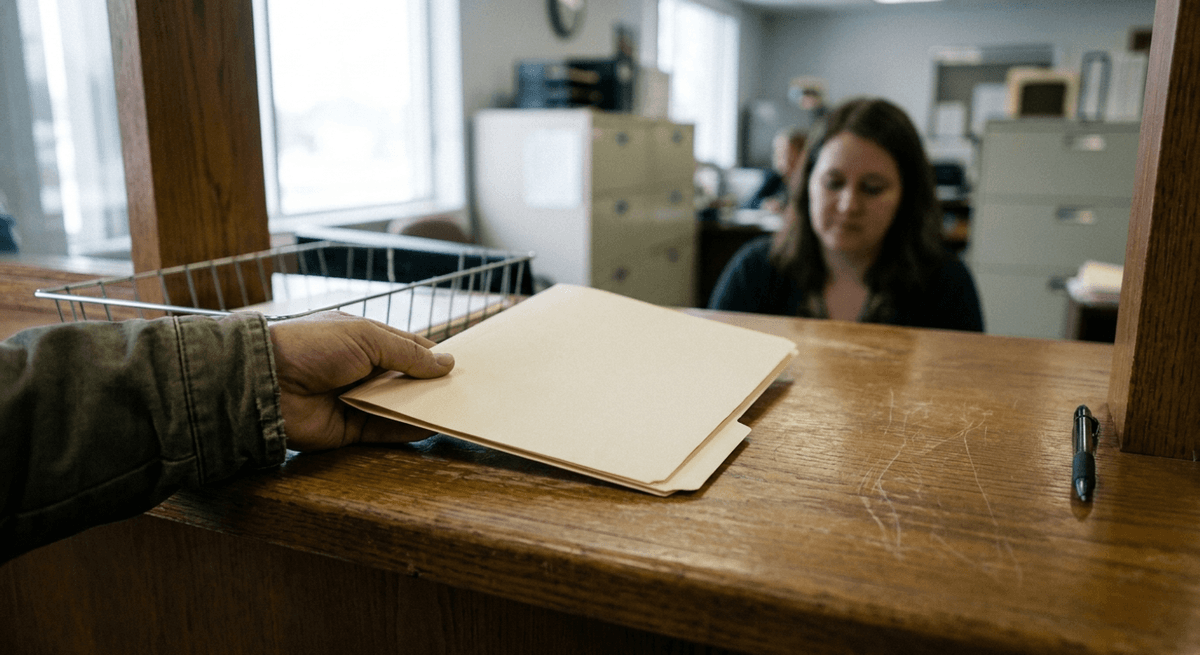
Daily law lists for the Supreme, District, Land and Magistrates Courts are published separately, updated daily by location, with no login required. A separate criminal case lookup tool covers upcoming criminal or traffic court events.
One tool that does not exist, despite sometimes being searched for, is a Queensland Sentencing Information Service. What actually exists is the Queensland Sentencing Advisory Council's Sentencing DataHub, which publishes sentencing statistics by offence type, trend reports and research briefs. It is a policy and research resource, not a way to look up an individual defendant's sentence or case file.
Requesting a Queensland court file: the rule, who may inspect, and the fee
For civil proceedings in the Supreme, District and Magistrates Courts, the relevant rules are 975G, 975H and 975I of the Uniform Civil Procedure Rules 1999. Rule 975H(1) sets a default of open inspection: any person may inspect a document filed in a proceeding. Rule 975H(2) then narrows that default for a non-party, blocking inspection of an originating process (unless a notice of intention to defend, a notice of address for service, or an application under rule 16 has been filed), an affidavit, an exhibit to an affidavit, a witness statement, subpoenaed material, an expert report, or written submissions, unless that document has already been read or relied on in open court. Rule 975H(4) adds an absolute bar: nobody may inspect a document the court has ordered confidential or otherwise restricted. A non-party who wants something on the carve-out list applies under rule 975I, which requires an affidavit stating the reason for the request and the intended use, including whether the applicant intends to publish the document.
Practice Direction 7 of 2025, signed by Chief Justice Bowskill on 19 November 2025, sets the process for that application. A non-party completes an online request form, and a Registrar decides within two business days whether the document is already inspectable under rule 975H or needs a rule 975I court order. If an order is needed, the non-party files an Application to Inspect with a supporting affidavit, served on the parties, and usually listed before a judge unless a decision without a hearing is requested. There is no filing fee for the application itself, but the order is stayed until the prescribed inspection or copying fee is paid. If every party consents, a simpler consent-order request can go to the Registrar instead.
Criminal court records follow a different set of rules: the Criminal Practice Rules 1999 for Supreme and District Court criminal documents, and section 154 of the Justices Act 1886 for Magistrates Court criminal documents.
Queensland's fees are expressed in fee units, not dollar amounts, under the Uniform Civil Procedure (Fees) Regulation 2019. The fee unit value for 2026-27 is $1.133. Parties usually pay no search fee; non-party searches and copy requests are charged, but this page could not confirm the exact dollar figure for a specific search or copy line item. Check the court's current fee schedule before applying.
Judgments and case law
Queensland courts do not primarily publish their own judgments on courts.qld.gov.au. The site's own judgments page instead points readers to Queensland Judgments, a joint service of the Incorporated Council of Law Reporting for Queensland and Supreme Court Library Queensland, which the court's own page describes as covering most decisions, while stating plainly that not all court decisions are published. AustLII can be used as a secondary, free mirror for Queensland judgments, but it is not Queensland's own primary publication channel.
Suppression, closed proceedings and the Childrens Court
Queensland has no single, general suppression-orders Act comparable to New South Wales' Court Suppression and Non-publication Orders Act 2010 or Victoria's Open Courts Act 2013. Instead, non-identification and closed-court powers sit in specific, offence-based provisions scattered across individual Acts, for example the Criminal Law (Sexual Offences) Act 1978, which restricts identifying a sexual-offence complainant. This page could not confirm the exact current section number or penalty for that Act, so treat any specific figure with caution and check the Act's current text before relying on it.
The Childrens Court Act 1992 adds a different layer for proceedings involving a child. Section 20 sets out who may be present in the courtroom, excluding anyone not on an explicit list that includes the child, family members, victims or their representatives, a person the court finds has a proper interest, media holding accreditation, and various official representatives. Notably, media are on that presumptive allow list rather than automatically excluded. On records rather than courtroom attendance, the Act contains no general public inspect-and-copy provision like rule 975H for adult civil files. The only affirmative access route is section 28A, a narrow research-access pathway that the chief executive may authorise only where the record will not be used or published in a way that could identify the individuals involved.
Family law matters in Queensland, divorce, parenting and property, are federal jurisdiction under the Federal Circuit and Family Court of Australia, not a Queensland court or registry matter. See Family Court Process in Australia for how that federal process works.
The Coroners Court of Queensland is one of the registries covered by the same online file-search portal used for the other courts listed above, though its own procedures and the coroner's discretion over inquest material are distinct from the civil rules described here.
Adoption records fall under the Adoption Act 2009, whose specific confidentiality provisions this page did not independently verify. Anyone with an adoption records question should contact Queensland's adoption information service directly rather than relying on the general rules above.
Right to Information does not reach any of this either way. The Right to Information Act 2009 excludes a court, and a registry acting in its judicial capacity, from RTI requests relating to the court's judicial functions, under section 17 and Schedule 2, Part 2. The same exclusion extends to QCAT and its registry for the tribunal's own judicial or quasi-judicial functions. The court's own inspection process described above, not RTI, is the actual pathway to a case file.
What a Queensland court record is not
A court file is not the same thing as a criminal history. A criminal history or National Police Certificate is compiled by police and the national checking system, not held in a court registry, and it is filtered through Queensland's own spent-convictions rules over time in a way a court's own file is not. See Police Check in Queensland, Spent Convictions in Queensland and National Police Checks in Australia for that separate system.

A court record is also not a birth, death or marriage certificate. Those are held by Queensland's registry of births, deaths and marriages, covered on Vital Records in Australia, not by a court.
Frequently Asked Questions
Can I search a Queensland court file online myself?
Only if you are a party to a Supreme or District Court civil proceeding, through eCourts. A non-party uses the separate online request-to-inspect process under Practice Direction 7 of 2025 instead.
What is Practice Direction 7 of 2025?
It is the current Queensland Courts practice direction setting the process for a non-party asking to inspect or copy a civil court document. A Registrar decides within two business days whether the document is already open under rule 975H or needs a court order under rule 975I.
How much does it cost to search or copy a Queensland court file?
Queensland's fees are set in fee units rather than fixed dollar amounts, with a fee unit value of $1.133 for 2026-27. The exact dollar figure for a specific search or copy request was not confirmed for this page. Check the court's current fee schedule before applying.
Is there a Queensland Sentencing Information Service I can use to look up a case?
No. That name does not correspond to any real tool. The Queensland Sentencing Advisory Council runs a Sentencing DataHub, which publishes aggregate sentencing statistics rather than individual case or defendant information.
Can I get a Queensland court file through Right to Information instead of the court's own process?
No. The Right to Information Act 2009 excludes a court from access requests relating to its judicial functions, so RTI cannot be used to reach a case file. The court's own inspection process is the actual pathway.
Can I look up someone's domestic violence order in Queensland?
Queensland calls this a domestic violence order rather than an AVO. For how these protection orders work generally and what shows on a record, see [AVO Laws in Australia](/australia/avo-laws/).
Updates
Independently fact-checked against the cited primary sources
The Law Behind This Article
This article rests on the statutory provisions below, held in our own legal record and retrieved from the official source. Tap a section to read the operative text.
Right to Information Act 2009 (Qld)
s 17Meaning of entity to which this Act does not applyIn force
In this Act, an entity to which this Act does not apply means— (a) an entity mentioned in schedule 2 , part 1 ; or (b) an entity mentioned in schedule 2 , part 2 in relation to the function mentioned in that part.
Official text (excerpt) · last checked 2026-09-28 · Read the full text in our law library · Verify at legislation.qld.gov.au
Search our full record of US law — 2.1 million sections, every state + federal →
Sources and References
- Queensland Courts, Supreme and District Court civil file searches (eCourts): party-only scope and search fields(courts.qld.gov.au).gov
- Queensland Courts, About court file searches and copying: the rule table for Supreme, District and Magistrates Court documents(courts.qld.gov.au).gov
- Uniform Civil Procedure Rules 1999 (Qld), Chapter 22, Division 6: rules 975G, 975H and 975I on inspection and copying of filed documents(legislation.qld.gov.au).gov
- Practice Direction 7 of 2025 (Qld), Non-Party Requests to Inspect or Copy Documents Filed in Civil Proceedings, signed 19 November 2025(courts.qld.gov.au).gov
- Queensland Courts, Supreme Court fees: the fee unit value of $1.133 for 2026-27 and the fee-unit basis of court charges(courts.qld.gov.au).gov
- Queensland Sentencing Advisory Council, Sentencing DataHub: aggregate sentencing statistics, not a case-lookup tool(sentencingcouncil.qld.gov.au).gov
- Right to Information Act 2009 (Qld) s17 and Schedule 2 Part 2: the judicial-function exclusion for courts, registries and QCAT(legislation.qld.gov.au).gov
- Childrens Court Act 1992 (Qld) ss20, 28, 28AA and 28A: courtroom attendance and the narrow research-access pathway for records(legislation.qld.gov.au).gov
- Queensland Courts, Court decisions, findings and judgments: Queensland Judgments as the primary publication channel(courts.qld.gov.au).gov