Lane Splitting Laws by State (2026): Where Is It Legal?
Independently fact-checked against primary sources (last audited October 10, 2026). · 43 primary sources cited on this page. How we verify our legal content
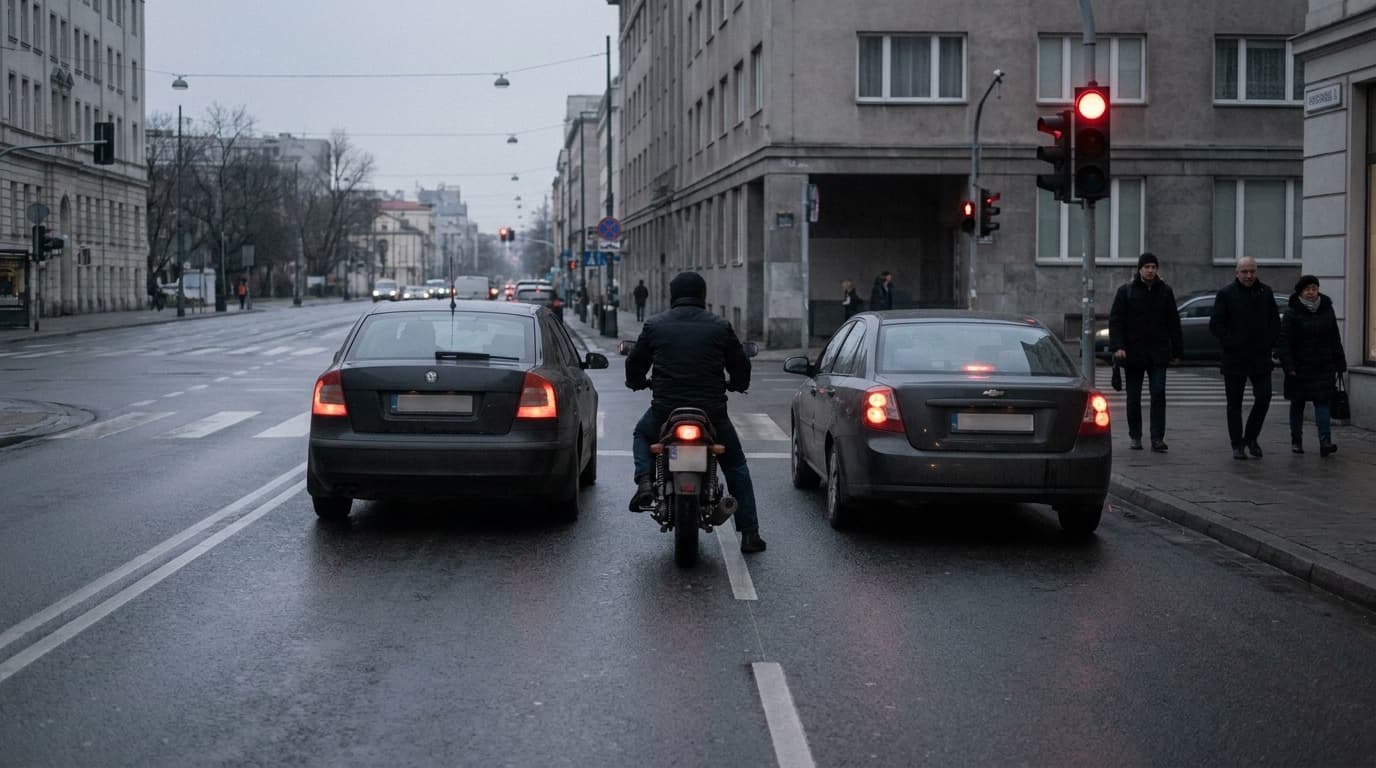
Lane splitting is legal in California, and Minnesota allows it within set speed limits. Four more states, Arizona, Colorado, Montana and Utah, allow a narrower, low-speed move, usually called lane filtering, under conditions each statute lists, such as a rider speed cap and, in most of them, stopped or slow traffic. Everywhere else in the states our guides cover, riding between lanes is either banned by name or not authorized by any statute, and the general single-lane and passing rules apply.
We found no federal statute or regulation that addresses lane splitting; the rules come from state traffic law. The table below gives each state's rule for splitting, filtering and shoulder riding, the basic penalty, and a link to the full state guide with the statute text and citations.
Information last verified on 2026-10-10. This article has not been reviewed by a licensed lawyer.
Jurisdiction scope: This guide compares the state statutes and regulations on motorcycles riding between lanes, filtering through stopped traffic, riding on the shoulder and riding two abreast in 49 states and the District of Columbia; each state's text, exceptions and citations are on its linked guide, and the New Jersey guide is not yet published. It also covers the federal layer and the 2015 California safety study. It does not cover city or county ordinances, court costs and surcharges beyond those the state guides list, insurance consequences, or fault in a crash.
Lane splitting, lane filtering, lane sharing and shoulder riding: what the terms mean
Riders, police and lawmakers use several words for different maneuvers, and the difference decides the answer in several states.
Lane splitting means riding a motorcycle between lanes of moving traffic, usually along the lane line. Utah's Traffic Code, for example, defines it as riding between clearly marked lanes "while traffic is in motion." California's Vehicle Code 21658.1 uses a broader definition: driving a two-wheeled motorcycle "between rows of stopped or moving vehicles in the same lane."
Lane filtering means moving a motorcycle between vehicles that are stopped or nearly stopped, for example to reach the front of a line at a red light. Montana's statute defines it as overtaking and passing a vehicle that is stopped or traveling at no more than 10 miles an hour in the same direction and the same lane. The states that allow filtering attach speed caps and road conditions to it.
Lane sharing usually means two motorcycles riding side by side in one lane, also called riding two abreast. Most of the state codes covered here allow two motorcycles abreast in one lane but not three. Idaho State Police use the phrase more broadly, for sharing a lane with other vehicles.
Shoulder riding means using the paved or unpaved shoulder to get past traffic. It is not lane splitting. The California Highway Patrol says "Riding on the shoulder is illegal; it is not considered lane splitting," and most states bar passing on the right by driving off the main traveled part of the road.
A state that bans splitting does not always ban filtering in the same words, and a state that allows filtering may still ban splitting. Utah draws that line expressly: 41-6a-704.1 says "An individual may not engage in lane splitting," while 41-6a-704(6) allows filtering past a stopped vehicle under seven conditions.
Is lane splitting legal? The answer in groups
The 49 states and the District of Columbia covered here fall into three groups.
Splitting or filtering allowed under conditions (6 states). California treats lane splitting as legal and sets no speed limit in statute. Minnesota allows passing at up to 25 mph and no more than 15 mph over traffic. Arizona, Colorado, Montana and Utah allow filtering or low-speed riding between lanes on conditions their statutes spell out. Colorado's and Utah's permissions are scheduled to end in 2027 unless their legislatures extend them.
Express ban on riding between lanes (27 states). Alabama, Alaska, Connecticut, Florida, Georgia, Hawaii, Iowa, Kansas, Louisiana, Maine, Maryland, Michigan, Nebraska, Nevada, New Hampshire, New York, North Dakota, Oklahoma, Oregon, Pennsylvania, South Carolina, South Dakota, Tennessee, Texas, Vermont, Washington and Wyoming have a statute, or in Alaska a regulation, that bars a motorcycle from riding between lanes. None of these has an exception for stopped traffic, so filtering at a light is covered too.
No express rule (16 states and DC). Arkansas, Delaware, Idaho, Illinois, Indiana, Kentucky, Massachusetts, Mississippi, Missouri, New Mexico, North Carolina, Ohio, Rhode Island, Virginia, West Virginia, Wisconsin and the District of Columbia have no section that authorizes riding between lanes and none that names it. That silence does not make the practice legal: the general rule to stay within a single lane, and the limits on passing on the right, apply to motorcycles the same way they apply to cars.
Lane splitting laws by state: comparison table
Each row summarizes the linked state guide. "Banned" means a statute or regulation bars riding between lanes of traffic or rows of vehicles. "Not authorized" means the state has no lane splitting statute, so the general single-lane and passing rules govern. The penalty column gives the base amount or class for the lane rule itself; points, court costs and heavier charges such as reckless driving are covered on each state's guide.
| State | Splitting (between moving lanes) | Filtering (past stopped traffic) | Shoulder to get past traffic | Basic penalty |
|---|---|---|---|---|
| Alabama | Banned (Ala. Code 32-5A-242(c)) | Banned; no stopped-traffic exception | Barred for passing (32-5A-83(b)) | Misdemeanor; first conviction up to $100 or up to 10 days (32-5A-8) |
| Alaska | Banned by regulation (13 AAC 02.427(b)) | Banned; no stopped-traffic exception | Passing on the right only on the roadway, which excludes the shoulder (13 AAC 02.055) | Infraction; $50 on the bail schedule, doubled in work zones and safety corridors |
| Arizona | Banned (A.R.S. 28-903(C)) except under 28-903(F): two-wheeled motorcycle, 2 or more same-direction lanes, speed limit 45 mph or less, 15 mph or slower, safely | Passing a stopped vehicle allowed under the same 28-903(F) conditions | Barred (28-724(B)) | Outside 28-903(F), reckless driving since Sept. 12, 2026: class 2 misdemeanor, up to 4 months and $750 |
| Arkansas | Not authorized; single-lane rule (Ark. Code 27-51-302(1)) | Not authorized; no stopped-traffic exception | Barred for passing (27-51-308(b)(2)) | No penalty of its own; unlisted moving violation up to $100 |
| California | Legal, per the CHP; Veh. Code 21658.1 defines it and sets no speed limit | Covered by the same definition (stopped or moving vehicles) | Illegal, per the CHP; 21755(a) | 21658.1 sets no penalty; general rules such as 21658(a) and 22350 are infractions |
| Colorado | Banned (C.R.S. 42-4-1503(3)(a)) | Allowed for two-wheeled motorcycles past stopped traffic at 15 mph or less, until Sept. 1, 2027 (42-4-1503(3)(b)) | Barred, including filtering on the right shoulder | Class A traffic infraction; $30 plus $6 surcharge |
| Connecticut | Banned (Conn. Gen. Stat. 14-289b(b)(2)) | Banned; no stopped-traffic exception | Not unless lane designations, signs, signals or markings provide for it (14-233) | Infraction; $50 fine, $117 total due |
| Delaware | Not authorized; single-lane rule (21 Del. C. 4122(1)) | Not authorized; no stopped-traffic exception | Only in two listed cases, neither a motorcycle exception (4117(c), (d)) | General penalty $25 to $75 for a first offense (4205(a)) |
| District of Columbia | Not authorized; single-lane rule (18 DCMR 2201.6(a)); DMV manual says lane sharing is usually prohibited | Not authorized | Barred (18 DCMR 2202.6) | $100 for failure to keep in proper lane |
| Florida | Banned (Fla. Stat. 316.209(3)) | Banned; no stopped-traffic exception | Barred (316.084(2)) | Noncriminal moving violation; $60 plus surcharge, fees and court costs |
| Georgia | Banned (O.C.G.A. 40-6-312(c)) | Banned; no stopped-traffic exception | Barred for passing (40-6-43(b)) | Misdemeanor (up to $1,000 and 12 months) unless handled as a traffic violation; 3 points |
| Hawaii | Banned (HRS 291C-153(c)) | Banned; no stopped-traffic exception | Barred for passing (291C-44(b)); a temporary 2018 change ended in 2020 | Violation; up to $250 for a first offense |
| Idaho | Not authorized; single-lane rule (Idaho Code 49-637(1)); State Police say splitting and filtering are not permitted | Not authorized; no stopped-traffic exception | Barred (49-633(2)) | Infraction, capped at $300; schedule lists $33.50 ($90 with costs) |
| Illinois | Not authorized; single-lane rule (625 ILCS 5/11-709(a)) and an 8-foot rule for 2-wheeled vehicles passing on the right (11-704(b)) | Not authorized | Barred (11-704(c)) | Default: petty offense, $75 to $1,000, on a first or second conviction |
| Indiana | Not authorized; single-lane rule (IC 9-21-8-11.5) | Not authorized; no stopped-traffic exception | Barred (9-21-8-6(b)) | Class C infraction; judgment up to $500 |
| Iowa | Banned (Iowa Code 321.275(4)) | Banned; no stopped-traffic exception | Barred when passing (321.302(3)) | $50 scheduled fine plus court costs |
| Kansas | Banned (K.S.A. 8-1595(c)) | Banned; no stopped-traffic exception | Barred (8-1517(b)) | $75 on the uniform fine schedule plus court costs |
| Kentucky | Not authorized; general passing rules (KRS 189.340) | Not authorized | Off-roadway pass only if the vehicle passed is at a complete stop and the pass is safe (189.340(4)) | $20 to $100 per offense (189.990(1)(a)) |
| Louisiana | Banned (La. R.S. 32:191.1(C)) | Banned; no stopped-traffic exception | Barred (32:74(B)) | First violation up to $175, 30 days, or both (32:57(A)(1)) |
| Maine | Banned (29-A M.R.S. 2062(6)) | Banned; no exception | Barred (2070(1)) | Traffic infraction; $152 when not contested |
| Maryland | Banned (Transp. 21-1303(d)) | Banned; no stopped-traffic exception | Barred (21-304(c)(1)), except a paved-surface pass of a left-turning vehicle | Preset fine $110 and 1 point |
| Massachusetts | Not allowed: the single-lane and same-lane passing rules in G.L. c. 89, s. 4A rule it out | Not allowed under the same section | Breakdown lane only where signs permit (c. 89, s. 4B) | Civil infraction; $100 plus $5 surcharge |
| Michigan | Banned (MCL 257.660(5)) | Banned; no stopped-traffic exception | Barred (257.637(2)) | Civil infraction; civil fine up to $100 plus costs |
| Minnesota | Allowed at up to 25 mph and no more than 15 mph over traffic (Minn. Stat. 169.974, subd. 5(g)), with listed exclusions | Allowed under the same limits, per the Department of Public Safety | Barred (169.18, subd. 4) | Petty misdemeanor; up to $300 |
| Mississippi | Not authorized; single-lane rule on roads with 3 or more lanes (Miss. Code 63-3-603(1)(a)) | Not authorized | Barred (63-3-613(2)) | Misdemeanor; first conviction up to $100 or up to 10 days |
| Missouri | Not authorized; single-lane rule on roads with 3 or more lanes (RSMo 304.015.5(1)) | Not authorized | Barred (304.016.2) | Class C misdemeanor (up to $750 and 15 days) under 304.015 and 304.016 |
| Montana | Not authorized when traffic moves faster than 10 mph; single-lane rule (MCA 61-8-328(1)) | Allowed for two-wheeled motorcycles past traffic stopped or at 10 mph or less, at up to 20 mph (61-8-392) | Barred (61-8-324(2)) | Misdemeanor; $10 to $100 for a first conviction |
| Nebraska | Banned (Neb. Rev. Stat. 60-6,308(3)) | Banned; no stopped-traffic exception | Shoulder driving barred (60-6,142) | Infraction; up to $100 for a first offense; waiver schedule $25 |
| Nevada | Banned (NRS 486.351(1)) | Banned: the statute covers moving or stationary vehicles | Barred (484B.210(3)) | Civil infraction; up to $500 and 2 demerit points |
| New Hampshire | Banned (RSA 265:121, III) | Banned; no stopped-traffic exception | Barred; driving into a divided-highway breakdown lane is a separate $150 offense (265:26) | Non-criminal violation; DMV schedule $62 for a first offense |
| New Jersey | Guide coming soon | |||
| New Mexico | Not authorized; single-lane rule (NMSA 66-7-317(A)) | Not authorized | Barred (66-7-311) | Penalty assessment misdemeanor; $25 |
| New York | Banned (VTL 1252(c)) | Banned; no stopped-traffic exception | Barred except at posted, authorized locations (1123(b), 1131) | Traffic infraction; first conviction up to $150, 15 days, or both, plus surcharge |
| North Carolina | Not authorized; single-lane rule (G.S. 20-146(d)(1)) | Not authorized | No section authorizes it; the roadway excludes the shoulder (20-4.01(38)) | Infraction; up to $100 |
| North Dakota | Banned (N.D.C.C. 39-10.2-03(3)) | Banned; no stopped-traffic exception | Barred (39-10-12(2)) | Noncriminal moving violation; $20 fee and 2 points |
| Ohio | Not authorized; single-lane rule (R.C. 4511.33(A)(1)) | Not authorized | Barred (4511.28) | Minor misdemeanor; up to $150 for a first offense |
| Oklahoma | Banned (47 O.S. 11-1103(D)) | Banned; no stopped-traffic exception | Barred (11-304(b)) | Misdemeanor; first conviction $5 to $500 or up to 10 days |
| Oregon | Banned (ORS 814.240(1)(b)) | Banned; no stopped-traffic exception | Passing off the paved portion is unsafe passing (811.415(1)(b)) | Class B traffic violation; $265 presumptive fine |
| Pennsylvania | Banned (75 Pa.C.S. 3523(c)) | Banned; no stopped-traffic exception | Barred (3304(a)) | Summary offense; $25 fine (6502(a)) |
| Rhode Island | Not authorized; single-lane rule (R.I. Gen. Laws 31-15-11) | Not authorized | Barred; break-down lane travel barred (31-15-16) | Civil violation; $100 on the schedule |
| South Carolina | Banned (S.C. Code 56-5-3640(c)) | Banned; no stopped-traffic exception | Barred (56-5-1850) | Misdemeanor; up to $100 or up to 30 days |
| South Dakota | Banned (SDCL 32-20-9.3) | Banned; no stopped-traffic exception | Barred (32-26-27, 32-26-28) | Class 2 misdemeanor; schedule $54 fine, $132.50 total |
| Tennessee | Banned (T.C.A. 55-8-182(c)) | Banned; no stopped-traffic exception | Barred (55-8-118(b)) | Class C misdemeanor; up to $50, 30 days, or both |
| Texas | Banned since Sept. 1, 2023 (Transp. Code 545.0605(a)(3)(B)) | Not excepted: no stopped-traffic exception | Improved right shoulder only for listed purposes, including passing a slowing or stopped vehicle, when necessary and safe (545.058(a)) | Misdemeanor; $1 to $200, plus a $50 state traffic fine |
| Utah | Banned (Utah Code 41-6a-704.1) | Allowed past a stopped vehicle under seven conditions (41-6a-704(6)), until July 1, 2027 | Barred (41-6a-705(3)) | Infraction (up to $750); a splitting conviction brings a 90-day endorsement suspension |
| Vermont | Banned (23 V.S.A. 1115(c)) | Banned; no stopped-traffic exception | Barred (1034(b)) | Civil violation; $220 waiver penalty and 2 points |
| Virginia | Not authorized; driving abreast of another vehicle in one lane is reckless driving (Va. Code 46.2-857); single-lane rule (46.2-804) | Not authorized | Barred unless signs permit paved-shoulder driving (46.2-841(B)) | 46.2-804: $100 fine; 46.2-857: Class 1 misdemeanor |
| Washington | Banned (RCW 46.61.608(3)) | Banned; no stopped-traffic exception | Barred (46.61.115(2)) | Traffic infraction; $48 base, about $150 with add-ons |
| West Virginia | Not authorized; single-lane rule (W. Va. Code 17C-7-9(a)(1)) | Not authorized | Barred (17C-7-4) | Misdemeanor; up to $100 for a first conviction |
| Wisconsin | Not authorized; single-lane rule (Wis. Stat. 346.13(1)) | Not authorized | A paved-shoulder pass only in three listed situations, when safe (346.08) | Civil forfeiture, $20 to $40 for a first offense; 4 points |
| Wyoming | Banned (W.S. 31-5-115(g)) | Banned; no stopped-traffic exception | Barred (31-5-206(b)) | Misdemeanor; up to $200 for a first conviction |
States that allow lane splitting or filtering
Six states give motorcycles some legal room to move between vehicles. Their rules differ in what traffic must be doing, how fast the rider may go, and which roads qualify.
California
The California Highway Patrol tells drivers: "Lane splitting by motorcyclists is legal in California." Vehicle Code 21658.1, effective January 1, 2017, defines lane splitting and lets the CHP develop educational guidelines. It does not set a speed limit, limit splitting to stopped traffic, or state a penalty.
The CHP's current safety tips carry no numeric speed limit. They warn that "The risk of death or serious injury during a lane splitting collision increases as speed and speed differential increases," that it is typically safer to split between the far left lanes, and that riders should avoid splitting next to large vehicles. General rules still apply to a rider who splits, including the basic speed law and the rule that a vehicle may leave its lane only with reasonable safety. The California guide has the full text.
Minnesota
Since July 1, 2025, Minn. Stat. 169.974, subd. 5(g) lets a motorcycle overtake and pass another vehicle going the same direction if it travels at not more than 25 mph and no more than 15 mph over the speed of traffic in the relevant lanes. Both limits apply at once.
The exception does not apply at a roundabout, in a school zone, in a work zone with only one travel lane, or on a freeway or expressway on-ramp where vehicles are queued. Outside those conditions, the ban in subd. 5(f) applies. Paragraph (g) speaks of passing "within the same traffic lane," and the Department of Public Safety reads the law as making both splitting and filtering legal; the Minnesota guide explains that wording question. Drivers may not intentionally impede a motorcycle operating within these conditions (169.18, subd. 13).
Arizona
A.R.S. 28-903(C) bans riding between lanes, but subsection F, added in 2022, lets the operator of a two-wheeled motorcycle pass a vehicle stopped in the same lane and ride between lanes of traffic if the movement may be made safely. The street must have at least two adjacent lanes in the same direction and a speed limit that does not exceed 45 mph, and the rider may travel no faster than 15 mph.
Arizona raised the stakes in 2026. Laws 2026, chapter 261 (House Bill 2941) made riding between lanes outside subsection F the crime of reckless driving under A.R.S. 28-693(B), effective September 12, 2026. Three-wheeled motorcycles get no exception. Details are on the Arizona guide.
Colorado
C.R.S. 42-4-1503(3)(a) bans splitting, and subsection (3)(b), added by Senate Bill 24-079 and effective August 7, 2024, allows two-wheeled motorcycles to filter. All five conditions must be met: the vehicle being passed is stopped, same-direction vehicles in the adjacent lanes are stopped, the lanes are wide enough to pass safely, the motorcycle is going 15 mph or less, and conditions permit prudent operation.
The rider must stop filtering once the vehicles being passed begin moving. Filtering is never allowed on the right shoulder, to the right of a vehicle in the farthest right lane of a highway that is not limited access, or in a lane of opposing traffic. The permission is repealed effective September 1, 2027 unless the General Assembly extends it; see the Colorado guide.
Utah
Utah keeps splitting and filtering apart. Utah Code 41-6a-704.1 bans lane splitting, and 41-6a-704(6) allows lane filtering only when seven conditions exist: a motorcycle; a roadway or off-ramp with two or more adjacent same-direction lanes; a speed limit of 45 mph or less, or an off-ramp; not on an on-ramp; the vehicle being overtaken is stopped; a motorcycle speed of 15 mph or less; and a safe movement.
The filtering provisions are scheduled to be repealed on July 1, 2027 under Utah Code 63I-1-241 unless the Legislature acts; the splitting ban is not on the repeal list. A lane-splitting conviction requires a 90-day suspension of the rider's motorcycle endorsement, or of the driver license if the rider has no valid endorsement (41-6a-704.1(3)). The Utah guide lists every condition.
Montana
MCA 61-8-392, enacted as Senate Bill 9 of 2021, lets the operator of a two-wheeled motorcycle overtake and pass a vehicle that is stopped or traveling at no more than 10 miles an hour in the same direction and lane. The rider may go no faster than 20 miles an hour, the lanes must be wide enough to pass safely, and conditions must permit continued reasonable and prudent operation.
Montana has no statute that names splitting at speed. Riding between lanes of traffic moving faster than 10 miles an hour falls outside 61-8-392, so the single-lane rule in MCA 61-8-328(1) governs it. See the Montana guide.
States with an express ban
In 27 states, a statute or regulation names the act and bars it. Twelve use the same sentence, word for word: "No person shall operate a motorcycle between lanes of traffic or between adjacent lines or rows of vehicles." That is the wording in Alabama, Florida, Georgia, Hawaii, Kansas, Louisiana, Nebraska, New York, Pennsylvania, Tennessee, Washington and Wyoming. South Carolina's differs only by a comma. Iowa, Maine, Maryland, New Hampshire, North Dakota, South Dakota and Vermont use close variations.
That sentence traces to the 1968 revision of the Uniform Vehicle Code, a model code published by the National Committee on Uniform Traffic Laws and Ordinances. Its section 11-1303(c) reads: "No person shall operate a motorcycle between lanes of traffic or between adjacent lines or rows of vehicles." Wyoming's 31-5-115 tracks that model text nearly word for word. The 1968 text is the original model; later editions of the code are not covered here.
Several states wrote their own version:
- Texas. Transportation Code 545.0605(a)(3)(B), in effect since September 1, 2023, says a motorcycle operator may not "operate the motorcycle between lanes of traffic moving in the same direction."
- Nevada. NRS 486.351(1) bars driving a motorcycle or moped "between moving or stationary vehicles occupying adjacent traffic lanes," so stopped traffic is covered in the text itself.
- Michigan. MCL 257.660(5) says a motorcycle operator "shall not pass between lines of traffic" and allows passing only in an unoccupied lane.
- Oklahoma. 47 O.S. 11-1103(D) bars the driver of a motorcycle, motor-driven cycle, motorized scooter, motorized bicycle or electric-assisted bicycle from passing other vehicles between lanes of traffic traveling in the same direction.
- Oregon. ORS 814.240(1)(b) covers mopeds as well as motorcycles.
- Connecticut. Conn. Gen. Stat. 14-289b(b)(2) bars operating a motorcycle "between lanes of traffic."
- Alaska. The ban is a regulation, 13 AAC 02.427(b), adopted under the commissioner of public safety's authority in AS 28.05.011.
None of these 27 rules has an exception for stopped or slow traffic. Most exempt police officers performing official duties. Florida also exempts firefighters on duty, Tennessee exempts motorcycle escorts of funeral processions, and Wyoming exempts motorcyclists in an officially authorized parade. Iowa's only exemption is for a parade authorized by local permit, Oklahoma's is for the operator of an authorized emergency vehicle, and Maine's between-lanes subsection has no exception at all.
States with no lane splitting statute
Sixteen states and the District of Columbia have no section that authorizes or names riding between lanes. In those places, a ticket would rest on the general rules that bind every vehicle. The state guides quote the rules that apply:
- The single-lane rule. Most of these states require a vehicle on a road with clearly marked lanes to be driven as nearly as practicable (in some codes, practical) entirely within a single lane and not moved from it until the move can be made safely. Examples are Ark. Code 27-51-302(1), 21 Del. C. 4122(1), Idaho Code 49-637(1), 625 ILCS 5/11-709(a), IC 9-21-8-11.5, NMSA 66-7-317(A), G.S. 20-146(d)(1), R.C. 4511.33(A)(1), R.I. Gen. Laws 31-15-11, W. Va. Code 17C-7-9(a)(1), Wis. Stat. 346.13(1) and 18 DCMR 2201.6(a).
- Three-lane wording. In Kentucky, Mississippi and Missouri, the single-lane rule as written applies on roadways with three or more marked lanes (in Kentucky, three or more lanes in one direction) (KRS 189.340(7)(a), Miss. Code 63-3-603(1)(a), RSMo 304.015.5(1)), so on smaller roads the passing rules carry more of the weight.
- Passing on the right. The state guides quote rules that limit passing on the right to listed situations, and most bar doing it by leaving the roadway or pavement.
A few of these states add something specific:
- Massachusetts. G.L. c. 89, s. 4A requires driving "entirely within a single lane" and bars motorcycle operators from passing any other motor vehicle within the same lane, except another motorcycle. The RMV Motorcycle Manual says riders "are prohibited from riding alongside motor vehicles within a marked travel lane."
- Virginia. Va. Code 46.2-857 makes it reckless driving, a Class 1 misdemeanor, to drive "so as to be abreast of another vehicle in a lane designed for one vehicle," while allowing two two-wheeled motorcycles to travel abreast.
- Illinois. 625 ILCS 5/11-704(b) bars a 2-wheeled vehicle from passing on the right unless the unobstructed pavement to the right of the vehicle being passed is at least 8 feet wide.
- Idaho. Idaho State Police stated in a May 30, 2025 release that lane splitting, lane filtering and lane sharing with other vehicles are not permitted under Idaho law.
- District of Columbia. The DC DMV Motorcycle Operator Manual tells riders that "Lane sharing is usually prohibited." The manual is guidance, not a regulation.
Riding two abreast and sharing a lane with a car
Two motorcycles side by side in one lane is a separate question from splitting. In most states covered here, two motorcycles may share a lane and three may not. Examples include Alabama (32-5A-242(d)), Florida (316.209(4)), New York (VTL 1252(a) and (d)), Texas (545.0605(a)(2)) and Washington (RCW 46.61.608(4)).
Some states add a consent requirement. Alaska (13 AAC 02.427(a)), Indiana (IC 9-21-10-6), Minnesota (Minn. Stat. 169.974, subd. 5(e)), Montana (MCA 61-8-359(6) and (7)), Nevada (NRS 486.351), Wisconsin (Wis. Stat. 346.595(1)) and Wyoming (W.S. 31-5-115) allow two abreast only with the consent of both riders.
Vermont stands apart. 23 V.S.A. 1115(d) bars operating a motorcycle in the same lane with, and alongside or closer than 10 feet ahead of or behind, another motorcycle or other motor vehicle, and the section has no exception for riding two abreast. Illinois's motorcycle sections have no full-lane or two-abreast rule, and in Delaware the only two-abreast rule in Chapter 41 applies to bicycles.
Sharing a lane with a car is a different matter. The model text and many state statutes entitle every motorcycle to the full use of a lane and bar other drivers from crowding it out. Most of the same statutes bar a motorcycle from passing a vehicle within the lane that vehicle occupies.
Can motorcycles ride on the shoulder?
In nearly every state covered here, no. Most traffic codes bar passing on the right by driving off the pavement or main traveled portion of the roadway, and most define the roadway to exclude the shoulder. Georgia, New York, Tennessee and Utah are examples; the table cites each state's section. In California, the CHP says shoulder riding is illegal and Vehicle Code 21755(a) bars passing on the right by driving off the paved or main-traveled portion of the roadway.
A handful of states draw the line differently:
- Texas lets any driver use an improved right shoulder for seven listed purposes when necessary and safe, including passing another vehicle that is slowing or stopped on the main traveled portion of the highway (Transp. Code 545.058(a)). That is not a general right to ride the shoulder past traffic.
- Wisconsin allows a pass on the right while remaining on the roadway or a paved shoulder, but only in three listed situations and only when safe (Wis. Stat. 346.08).
- Kentucky bars passing on the right by driving off the roadway unless the vehicle being passed is at a complete stop and the pass can be made safely (KRS 189.340(4)).
- Virginia bars passing on the right by driving on the shoulder unless lawfully placed signs permit paved-shoulder driving (46.2-841(B)).
- Maryland allows any driver to move onto a paved shoulder to pass a vehicle that is turning left, without leaving the paved surface (Transp. 21-304(c)(2)).
- Delaware lets a driver pass on the right using the shoulder, if necessary, only to get around a vehicle that is making or about to make a left turn (21 Del. C. 4117(c)).
- Colorado's filtering law expressly excludes the right shoulder.
Washington considered a bill, HB 1367, that would authorize motorcycle use of the right shoulder of limited access roadways; it was retained in the House Transportation Committee.
What happens if you are cited for lane splitting
The consequence depends first on how the state classifies the lane rule. Across the state guides, the pattern looks like this:
- A civil or noncriminal ticket. In some states, a lane violation is an infraction or civil violation with no jail, such as Michigan (civil fine up to $100), Massachusetts ($100 plus a $5 surcharge), Nevada (up to $500), Washington ($48 base) and North Dakota ($20 fee).
- A low-level misdemeanor. In others, the lane rule falls under a general traffic penalty that is classed as a misdemeanor, often with a small fine and a short jail maximum, such as Alabama, Mississippi, Oklahoma, South Carolina, Tennessee, Texas and Wyoming.
- Points and conviction records. Several states put points on the record or count payment as a conviction. Maryland's preset fine carries 1 point, Nevada assigns 2 demerits, Vermont and North Dakota 2 points, Georgia 3 points and Wisconsin 4 points for deviating from a lane. In Maryland, Massachusetts and Wisconsin, paying the fine counts as a conviction.
A few states tie riding between lanes to heavier consequences by statute. Arizona now treats riding between lanes outside its filtering exception as reckless driving (A.R.S. 28-693(B)). Virginia makes driving abreast of another vehicle in a single lane reckless driving (46.2-857). Maryland lists riding between lanes among the offenses that can add up to aggressive driving under Transp. 21-901.2. Utah suspends the motorcycle endorsement, or the driver license of a rider with no valid endorsement, for 90 days on a lane-splitting conviction, and Iowa Code 321.482A allows an added fine, a license suspension, or both when a violation of 321.275(4) causes serious injury or death.
Reckless, careless and aggressive driving are separate charges with their own elements; whether a particular ride meets them depends on the facts. Each state guide quotes those elements, for example the "willful or wanton disregard for the safety of persons or property" standard in Michigan's reckless driving statute (MCL 257.626(2)) and the three-part test for aggressive driving in Nevada (NRS 484B.650). Work-zone doubling applies to the lane rule in some states, including Iowa, Kansas and Michigan.
Sunsets, recent changes and pending bills
Lane splitting law has moved in both directions in recent years, and two state permissions are on a clock.
Scheduled to end.
- Colorado: the filtering authorization in C.R.S. 42-4-1503(3)(b) is repealed effective September 1, 2027 unless extended. The Colorado Department of Transportation must report to the General Assembly on its safety effects by January 1, 2027.
- Utah: the filtering provisions in 41-6a-102(39), 41-6a-704(6) and 41-6a-710(1)(c) are scheduled to be repealed on July 1, 2027 under Utah Code 63I-1-241.
Recent enactments.
- Arizona: riding between lanes outside 28-903(F) became reckless driving on September 12, 2026 (Laws 2026, chapter 261).
- Minnesota: passing within the subd. 5(g) limits became legal on July 1, 2025.
- Colorado: filtering became legal on August 7, 2024 (SB 24-079).
- Texas: the express ban took effect September 1, 2023 (HB 4122).
- Arizona: subsection F was added in 2022 (SB 1273).
- Montana: the filtering law was enacted as Senate Bill 9 of 2021.
Pending or recently introduced.
- Michigan: 2025 Senate Bill 365 would allow a 2-wheeled motorcycle to pass between lines of traffic stopped or moving at not more than 10 mph, at up to 15 mph. It was referred to committee in June 2025 and is not law.
- Ohio: House Bill 776 of the 136th General Assembly would enact R.C. 4511.551 to regulate lane filtering and ban lane splitting. It remains in House committee.
- Missouri: 2026 Senate Bill 1369, substantially similar to the 2025 filtering bill HB 705, was referred to a Senate committee.
- Rhode Island: bills to allow lane splitting (2025 H 5658) and lane filtering (2025 S 540, 2026 S 2732 and 2026 H 7354) were filed. None is law.
- West Virginia: House Bill 4972 (2026) would expressly prohibit lane splitting and lane filtering. It was referred to the House Judiciary Committee and did not pass in the 2026 regular session.
Bills that did not pass. Virginia's Senate Bill 435 passed the Senate 32 to 8 in 2026 but was left in the House Transportation Committee. Oregon's 2021 filtering bill, SB 574, passed the Legislature and was vetoed, and later bills in 2023 and 2025 stalled. Oklahoma's House rejected HB 3582 by 33 to 62 in 2024. Filtering or splitting proposals also did not become law in Texas (HB 2957, 2025), New Hampshire (HB 239-FN, voted inexpedient to legislate in 2025), Idaho (RS 32400, 2025), Connecticut (SB 1083, 2025, referred to committee with no later action), Arkansas (HB 1755, 2023), Tennessee (HB 1454 and SB 298, 2023) and Mississippi (HB 854, 2016).
Federal law and lane splitting
We found no federal statute or regulation that addresses lane splitting; the rules come from state traffic law. The federal motorcyclist safety grant rule, 23 CFR 1300.25, sets criteria for state training, motorist-awareness and impaired-riding programs and says nothing about lane use.
NHTSA's motorcycle safety page does not mention splitting or filtering. Its lane advice is general: obey "lane markings," ride with the flow of traffic, and "always check behind you and signal before you change lanes." The same page reports that, per vehicle mile traveled in 2024, motorcyclists were almost 27 times more likely than passenger car occupants to die in a crash.
A study of lane splitting and filtering in live traffic, sponsored by NHTSA and the Governors Highway Safety Association, is listed in the Transportation Research Board's research-in-progress records as proposed, with a start date of October 1, 2026, so it has no results to report.
What the safety research says
The main U.S. study is from the UC Berkeley Safe Transportation Research and Education Center (SafeTREC), published May 29, 2015 and hosted by the California Office of Traffic Safety. It looked at 5,969 motorcyclists involved in crashes in California from June 2012 to August 2013, of whom 997 (17%) were lane splitting at the time.
The study's findings:
- Lane-splitting riders were less likely to suffer head injury (9% vs 17%), torso injury (19% vs 29%) and fatal injury (1.2% vs 3.0%) than other riders in the study.
- They were less likely to be rear-ended (2.6% vs 4.6%) but more likely to rear-end another vehicle (38% vs 16%).
- The authors concluded that "Lane-splitting appears to be a relatively safe motorcycle riding strategy if done in traffic moving at 50 MPH or less and if motorcyclists do not exceed the speed of other vehicles by more than 15 MPH," and that "A significant number of motorcyclists lane-split in fast-moving traffic or at excessive speed differentials."
These are study findings, not legal limits. The study covered only riders who had crashed, in one state, and had no data on riders who split without crashing. Several state statutes use a 15 mph figure of their own: Arizona, Colorado and Utah cap the rider's speed at 15 mph, and Minnesota caps the speed over traffic at 15 mph. NHTSA funded the project through a California Office of Traffic Safety grant.
Riding across state lines
The rule can change at the state line, and the state guides show how sharply. California treats splitting as legal, while its neighbors Nevada (NRS 486.351) and Oregon (ORS 814.240) ban it outright and Arizona allows only the narrow movement in 28-903(F). Utah and Colorado allow filtering, while Wyoming (W.S. 31-5-115(g)) bans riding between lanes and Idaho has no statute allowing it. Minnesota allows low-speed passing, while Iowa (Iowa Code 321.275(4)) bans riding between lanes and Wisconsin has no statute allowing it.
The conditions in the permission states also differ. The rider speed cap is 15 mph in Arizona, Colorado and Utah, 20 mph in Montana (where the traffic being passed may be moving at up to 10 mph), and 25 mph in Minnesota (with no more than 15 mph over traffic). Colorado requires the adjacent lanes to be stopped as well, and Arizona and Utah limit the movement to roads with a speed limit of 45 mph or less, with Utah also allowing off-ramps. Check the guide for each state on the route.
After a crash
Whether a rider was splitting or filtering lawfully can come up after a collision, but it is one fact among many in a fault and injury claim. For how fault, insurance and filing deadlines work, see our motorcycle accident laws by state. For electric scooters and similar devices, which some lane statutes cover, such as Oklahoma's, see our e-scooter laws by state.
Related pages
- Motorcycle accident laws by state
- E-scooter laws by state
- California lane splitting laws
- Texas lane splitting laws
- Minnesota lane splitting laws
This article provides general legal information about state lane splitting laws, not legal advice. Statutes, fine schedules and session laws change; the information here was last checked on 2026-10-10. For advice about a specific situation, contact a lawyer licensed in the state where you ride, or the state's motor vehicle or highway safety agency.
Last updated: 2026-10-10.
Frequently Asked Questions
Is lane splitting legal in any state?
Yes. The California Highway Patrol says lane splitting is legal in California, and Minnesota allows a motorcycle to pass at up to 25 mph and no more than 15 mph over traffic (Minn. Stat. 169.974, subd. 5(g)). Arizona, Colorado, Montana and Utah allow narrower lane filtering under conditions their statutes list.
What is the difference between lane splitting and lane filtering?
Lane splitting is riding between lanes of moving traffic. Lane filtering is moving between vehicles that are stopped or nearly stopped, such as at a red light. Utah, for example, bans splitting in 41-6a-704.1 but allows filtering past a stopped vehicle under 41-6a-704(6).
Is lane filtering legal in Texas?
No. Texas Transportation Code 545.0605(a)(3)(B), in effect since September 1, 2023, bars riding a motorcycle between lanes of traffic moving in the same direction, and the section has no exception for stopped traffic. A 2025 filtering bill, HB 2957, did not become law.
Is lane splitting legal in Florida?
No. Florida Statutes 316.209(3) bars operating a motorcycle between lanes of traffic or between adjacent lines or rows of vehicles. A violation is a noncriminal moving violation with a $60 civil penalty under 318.18(3)(a), plus a surcharge, fees and court costs.
Is there a federal law on lane splitting?
We found no federal statute or regulation that addresses lane splitting; the rules come from state traffic law. The federal motorcyclist safety grant rule, 23 CFR 1300.25, says nothing about lane use, and NHTSA's motorcycle safety page does not mention splitting or filtering.
Can two motorcycles ride side by side in one lane?
In most states covered here, yes, but not more than two abreast. Alaska, Indiana, Minnesota, Montana, Nevada, Wisconsin and Wyoming require the consent of both riders, and Vermont's 23 V.S.A. 1115(d) bars riding alongside another motorcycle in the same lane.
Can a motorcycle ride on the shoulder to get past traffic?
Generally not. Most states bar passing on the right by driving off the roadway or pavement. Texas allows an improved right shoulder to pass a slowing or stopped vehicle when necessary and safe (545.058(a)), and Wisconsin allows a paved-shoulder pass in three listed situations (346.08).
What is the fine for lane splitting?
It depends on the state. Examples from the state guides: $25 in Pennsylvania, $50 plus court costs on Iowa's schedule, $75 on the Kansas schedule, $110 and 1 point in Maryland, a $265 presumptive fine in Oregon, and up to $500 in Nevada. In Arizona, riding between lanes outside the filtering exception is now reckless driving, a class 2 misdemeanor.
Is lane splitting safe?
The main U.S. study, by UC Berkeley SafeTREC in 2015, looked at California motorcyclists involved in crashes and concluded that splitting appears relatively safe in traffic moving at 50 mph or less when riders do not exceed other vehicles' speed by more than 15 mph. That is a study finding about crash-involved riders in one state, not a legal limit.
Will Colorado and Utah keep their lane filtering laws?
Both are on a clock. Colorado's filtering authorization in C.R.S. 42-4-1503(3)(b) is repealed effective September 1, 2027, and Utah's filtering provisions are scheduled to be repealed on July 1, 2027 under Utah Code 63I-1-241, unless each legislature extends them.
Can a driver block a motorcycle that is lane splitting?
In California, the CHP says intentionally blocking or impeding a motorcyclist in a way that could cause harm, or opening a door to impede one, is illegal. In Minnesota, 169.18, subd. 13 bars drivers from intentionally impeding a motorcycle operating within the subd. 5(g) conditions.
Updates
Independently fact-checked against the cited primary sources
State-by-state comparison
Each state guide below is paired with the governing statute our editors adjudicated for it, held in our own legal record and verified against the official source.
Each statute shown is the same adjudicated anchor its state guide renders, independently verified against primary sources. A dash means not yet adjudicated in our record — never that no law exists.
Sources and References
- California Highway Patrol, California Motorcyclist Safety (lane splitting safety tips and text of Vehicle Code 21658.1)(chp.ca.gov).gov
- Cal. Veh. Code 21658.1, Lane splitting(leginfo.legislature.ca.gov).gov
- Minn. Stat. 169.974, Operation of Motorcycle; Motor Scooter; Motor Bike (subd. 5)(revisor.mn.gov).gov
- Minnesota Department of Public Safety, Minnesota Motorcycle Safety Center(dps.mn.gov).gov
- A.R.S. 28-903, Operation of motorcycle on laned roadway; exceptions(azleg.gov).gov
- C.R.S. 42-4-1503, Operating motorcycles and autocycles on roadways laned for traffic; C.R.S. 42-4-1004, When overtaking on the right is permitted; and C.R.S. 42-4-1701 penalty schedule (Colorado Revised Statutes Title 42, 2026)(olls.info).gov
- MCA 61-8-392, Lane filtering for motorcycles, definition(mca.legmt.gov).gov
- Utah Code 41-6a-704.1, prohibition on lane splitting, penalty(le.utah.gov).gov
- Utah Code 41-6a-704, overtaking and passing vehicles proceeding in same direction (lane filtering)(le.utah.gov).gov
- Ala. Code 32-5A-242, Operating Motorcycles on Roadways Laned for Traffic(alison.legislature.state.al.us).gov
- Fla. Stat. 316.209, Operating motorcycles on roadways laned for traffic(leg.state.fl.us).gov
- Tex. Transp. Code 545.0605, operation of motorcycles on roadway laned for traffic (Chapter 545)(tcss.legis.texas.gov).gov
- NRS 486.351, Unlawful passing; driving abreast(leg.state.nv.us).gov
- MCL 257.660, operation of motorcycles, mopeds and low-speed vehicles (passing between lines of traffic)(legislature.mi.gov).gov
- Oklahoma Statutes Title 47, 11-1103 (motorcycles, motor-driven cycles, motorized scooters and motorized bicycles)(www.oklegislature.gov).gov
- ORS 814.240, motorcycle or moped unlawful passing; penalty(www.oregonlegislature.gov).gov
- 13 AAC 02.427, Driving motorcycles and motor-driven cycles on roadways laned for traffic(akleg.gov).gov
- Uniform Vehicle Code and Model Traffic Ordinance, Revised 1968, sections 11-304 and 11-1303(law.resource.org)
- Ark. Code 27-51-302, Driving on roadways laned for traffic; 27-51-308, Conditions when overtaking on right; 27-20-101 to 27-20-120, Motorcycles; and penalty provisions 27-50-301, 27-50-302, 27-50-308, 27-51-104 and 5-4-201 (Arkansas Code, official access via the Arkansas General Assembly)(arkleg.state.ar.us).gov
- Idaho Code 49-637, Driving on highways laned for traffic(legislature.idaho.gov).gov
- Idaho State Police, Lane Splitting is Illegal in Idaho (May 30, 2025)(isp.idaho.gov).gov
- G.L. c. 89, s. 4A, Driving vehicles in a single lane; motorcycles, riding and passing(malegislature.gov).gov
- Massachusetts RMV Motorcycle Manual (2015 edition)(www.mass.gov).gov
- Va. Code 46.2-857, driving two abreast in a single lane(law.lis.virginia.gov).gov
- DC DMV Motorcycle Operator Manual (2019), Lane Sharing(dmv.dc.gov).gov
- KRS 189.340, Overtaking vehicles, bicycles, or electric low-speed scooters; traffic lanes(apps.legislature.ky.gov).gov
- Wis. Stat. 346.08, when overtaking and passing on the right permitted(docs.legis.wisconsin.gov).gov
- District Court of Maryland, DC-CR-090 Schedule of Preset Motor Vehicle Fines (Rev. 10/2026)(mdcourts.gov).gov
- 75 Pa.C.S. 6502, summary offenses(www.legis.state.pa.us).gov
- Laws 2026, chapter 261 (HB 2941), amending A.R.S. 28-693 (motorcycles; reckless driving)(azleg.gov).gov
- Md. Code, Transportation 21-901.2 (aggressive driving)(mgaleg.maryland.gov).gov
- MCL 257.626, reckless driving(legislature.mi.gov).gov
- Colorado Session Laws 2024, chapter 40 (SB 24-079), enrolled act(leg.colorado.gov).gov
- Utah Code 63I-1-241, repeal dates, Title 41(le.utah.gov).gov
- Texas Legislature, HB 4122 (88th Legislature) bill history(capitol.texas.gov).gov
- Michigan Legislature, 2025 Senate Bill 365(legislature.mi.gov).gov
- Ohio General Assembly, House Bill 776 (136th GA) bill page(www.legislature.ohio.gov).gov
- Missouri Senate, SB 1369 (2026) bill information(www.senate.mo.gov).gov
- West Virginia Legislature, HB 4972 (2026 Regular Session) bill history(bills.wvlegislature.gov).gov
- Virginia Legislative Information System, 2026 SB 435 bill history(lis.virginia.gov).gov
- Oregon Legislature, SB 574 (2021 Regular Session) measure overview(olis.oregonlegislature.gov).gov
- 23 CFR 1300.25, Motorcyclist safety grants(ecfr.gov).gov
- NHTSA, Motorcycle Safety(nhtsa.gov).gov
- Transportation Research Board, BTS-50, Assessing Traffic Flow and Motorcyclist Safety Outcomes Associated with Lane Filtering (research in progress)(rip.trb.org)
- Rice, Troszak and Erhardt, Motorcycle Lane-splitting and Safety in California, UC Berkeley SafeTREC, May 29, 2015 (hosted by the California Office of Traffic Safety)(ots.ca.gov).gov