
South Carolina
Is Lane Splitting Legal in South Carolina? (2026 Law)
Independently fact-checked against primary sources (last audited October 10, 2026). · 13 primary sources cited on this page. How we verify our legal content
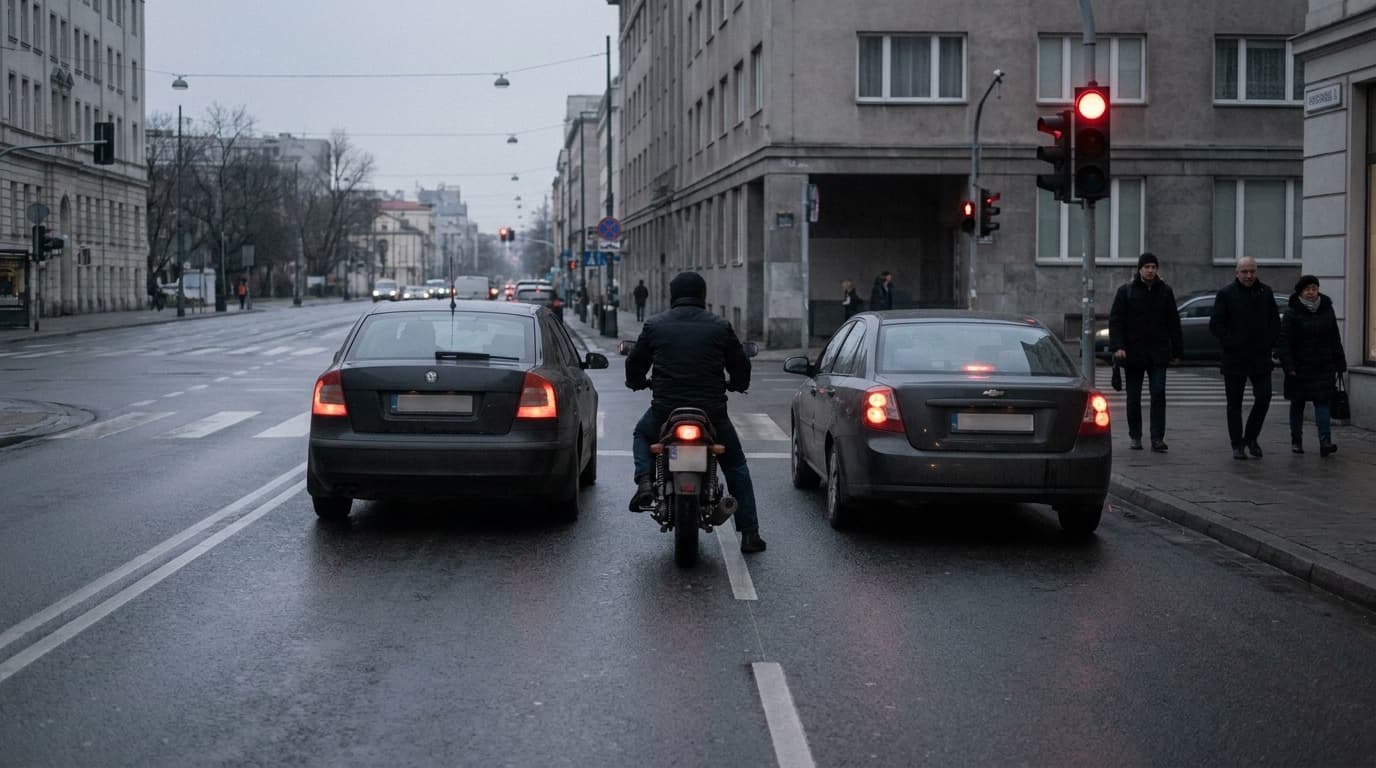
Lane splitting is illegal in South Carolina. Section 56-5-3640(c) of the South Carolina Code of Laws says "No person shall operate a motorcycle between lanes of traffic, or between adjacent lines or rows of vehicles," which covers both riding between moving lanes and filtering between rows of stopped cars; only police officers performing their official duties are exempt. Because the section sets no penalty of its own, a violation is a misdemeanor punished under S.C. Code 56-5-6190 by a fine of not more than $100 or imprisonment for not more than 30 days. For how other states compare, see our guide to lane splitting laws by state.
Information last verified on 2026-10-09. This article has not been reviewed by a licensed lawyer.
Jurisdiction scope: This article covers South Carolina state law in Title 56 of the South Carolina Code of Laws: the motorcycle rules in 56-5-3610 and 56-5-3640, the lane and passing rules in 56-5-1840, 56-5-1850 and 56-5-1900, the definitions in 56-5-460 and 56-5-470, the speed rule in 56-5-1520, reckless driving in 56-5-2920, the work-zone rules in 56-5-1535 and 56-5-1895, the general penalty and conviction rules in 56-5-6190, 56-5-6220 and 56-5-6230, and the point system in 56-1-710, 56-1-720 and 56-1-740, plus the court assessments and surcharge in Title 14 (14-1-207, 14-1-208 and 14-1-212). It does not cover municipal ordinances, insurance consequences, or the law of other states.
What South Carolina's motorcycle statute says
South Carolina is one of the states whose code names the practice and forbids it. The rule sits in the motorcycle article of the traffic code, S.C. Code 56-5-3640, headed "Motorcycle entitled to full use of lane; riding two or more abreast; overtaking and passing; operation in other instances":
"(a) All motorcycles are entitled to full use of a lane and no motor vehicle shall be driven in such a manner as to deprive any motorcycle of the full use of a lane. This shall not apply to motorcycles operated two abreast in a single lane. (b) The operator of a motorcycle shall not overtake and pass in the same lane occupied by the vehicle being overtaken. (c) No person shall operate a motorcycle between lanes of traffic, or between adjacent lines or rows of vehicles. (d) Motorcycles shall not be operated more than two abreast in a single lane. (e) Items (b) and (c) shall not apply to police officers in the performance of their official duties."
The section's history line shows it dates from 1969 with no later amendment. The motorcycle article (56-5-3610 through 56-5-3700) contains no exception for stopped traffic, slow traffic or the shoulder; the only exemption is the one for police in subsection (e).
| Maneuver | South Carolina rule |
|---|---|
| Lane splitting (riding between lanes of moving traffic) | Prohibited, 56-5-3640(c) |
| Lane filtering (riding between rows of stopped vehicles) | Prohibited: "between adjacent lines or rows of vehicles," 56-5-3640(c) |
| Passing a vehicle within its own lane | Prohibited, 56-5-3640(b) |
| Riding on the shoulder to pass | Passing on the right may not be made by driving off the roadway, 56-5-1850(b); the roadway excludes the shoulder or berm, 56-5-460 |
| Two motorcycles side by side in one lane | Allowed; not more than two abreast, 56-5-3640(a), (d) |
| On-duty police | Exempt from (b) and (c), 56-5-3640(e) |
Riders otherwise follow the same rules as other drivers. Under 56-5-3610, every motorcycle operator "shall be granted all of the rights and shall be subject to all of the duties applicable to the drivers of motor vehicles, except as to special regulations or other provisions of law which by their nature would not apply."
The general lane and passing rules
Three general rules in Chapter 5 of Title 56 apply alongside the motorcycle section.
Staying in one lane. On a laned roadway, defined in 56-5-470 as "a roadway which is divided into two or more clearly marked lanes for vehicular traffic," 56-5-1900(a) provides that "A vehicle shall be driven as nearly as practicable entirely within a single lane and shall not be moved from the lane until the driver has first ascertained that such movement can be made with safety."
Passing on the left. Under 56-5-1840(1), a driver overtaking a vehicle going the same way "shall pass to the left thereof at a safe distance and shall not again drive to the right side of the roadway until safely clear of the overtaken vehicle."
Passing on the right. S.C. Code 56-5-1850 reads:
"(a) The driver of a vehicle may overtake and pass upon the right of another vehicle only under the following conditions: 1. When the vehicle overtaken is making or about to make a left turn. 2. Upon a roadway with unobstructed pavement of sufficient width for two or more lines of vehicles moving lawfully in the direction being travelled by the overtaking vehicle. (b) The driver of a vehicle may overtake and pass another vehicle upon the right only under conditions permitting such movement in safety. Such movement shall not be made by driving off the roadway."
Can you ride on the shoulder?
Not to get past traffic. The answer turns on what the roadway is. Under 56-5-460, "A roadway is that portion of a highway improved, designed or ordinarily used for vehicular travel, exclusive of the shoulder or berm." Since 56-5-1850(b) says passing on the right "shall not be made by driving off the roadway," passing on the shoulder falls outside what the statute allows.
What happens if you are caught
The fine and jail range
Section 56-5-3640 has no penalty clause of its own, and neither do 56-5-1850 and 56-5-1900. The general penalty for Chapter 5, S.C. Code 56-5-6190, therefore applies:
"It is a misdemeanor for any person to violate any of the provisions of this chapter unless such violation is by this chapter or other law of this State declared to be a felony. Every person convicted of a misdemeanor for a violation of any of the provisions of this chapter for which another penalty is not provided shall be punished by a fine of not more than one hundred dollars or by imprisonment for not more than thirty days."
Those are maximums: up to $100, or up to 30 days in jail. The statute sets no minimum. The fine is not the whole bill. In magistrates or municipal court, a conviction, guilty or no-contest plea, or bond forfeiture adds a mandatory assessment equal to 107.5 percent of the unsuspended fine (S.C. Code 14-1-207 and 14-1-208) and a $25 surcharge on fines for misdemeanor traffic offenses (14-1-212). None of these may be waived, reduced or suspended. On a $100 fine, that is $100 plus a $107.50 assessment plus the $25 surcharge, or $232.50; the court named on the ticket can confirm the total due.
Paying the ticket counts as a conviction
Under 56-5-6220, "the entry of any plea of guilty, the forfeiture of any bail posted or the entry of plea of nolo contendere for a violation of the traffic laws of this State ... shall have the same effect as a conviction after trial." A bail forfeiture does not take effect until ten days after the date of arrest. Under 56-5-6230, the magistrate's or municipal court "must notify the Department of Motor Vehicles" when a person charged with a traffic violation has paid the fine or forfeited the bond. For the point system, 56-1-710 likewise defines "conviction" to include a guilty plea, a no-contest plea and "the forfeiture of any bail or collateral deposited to secure a defendant's appearance in court."
Points on your license
The point schedule in S.C. Code 56-1-720 has no item that names 56-5-3640 or riding between lanes. Its nearest items are:
| 56-1-720 item | Points |
|---|---|
| Passing unlawfully | 4 |
| Shifting lanes without safety precaution | 2 |
| Driving in improper lane | 2 |
| Reckless driving | 6 |
The code does not say which of these, if any, the Department of Motor Vehicles assigns to a between-lanes conviction. Points matter because of 56-1-740(A): "a total of twelve points" brings a suspension, and twelve to fifteen points means "three months' suspension."
Work zones
Two work-zone rules can apply. Under 56-5-1895, "No vehicle may be driven so as to overtake and pass another vehicle in a highway work zone where road maintenance or construction work is underway and passing would be hazardous to the highway worker," punished under 56-5-6190. Separately, a person commits endangerment of a highway worker under 56-5-1535(A)(1) by operating a motor vehicle in a highway work zone while workers are present and in proximity, and driving "through or around a work zone in any lane not clearly designated for use by motor vehicles traveling through or around a work zone." The fine is mandatory and "may not be waived or reduced below the minimum" (56-5-1535(D)):
| Result | Fine, 56-5-1535(B) | Points, 56-5-1535(C) |
|---|---|---|
| No worker injured | $500 to $1,000 | 2 |
| Worker injured, violation the sole proximate cause | $1,000 to $2,000 | 4 |
| Great bodily injury, violation the sole proximate cause | $2,000 to $5,000 | 4 |
Speed for conditions
S.C. Code 56-5-1520(A) is the basic speed rule: "A person shall not drive a vehicle on a highway at a speed greater than is reasonable and prudent under the conditions and having regard to the actual and potential hazards then existing." Subsection (G) makes violating "the speed limits established by this section" a misdemeanor with first-offense fines tied to how far over the posted limit the driver was:
| Over the posted limit | First-offense penalty, 56-5-1520(G) |
|---|---|
| Not more than 10 mph | Fine of $15 to $25 |
| More than 10 but less than 15 mph | Fine of $25 to $50 |
| More than 15 but less than 25 mph | Fine of $50 to $75 |
| More than 25 mph | Fine of $75 to $200, or imprisonment for not more than 30 days |
The statute does not say whether a citation under subsection (A) alone, for driving too fast for conditions, is punished under subsection (G) or under the general 56-5-6190 penalty. The 56-1-720 point schedule lists "Driving too fast for conditions, or speeding" at 2 points for no more than 10 mph over the posted limit, 4 points for more than 10 but less than 25 mph over, and 6 points for 25 mph or more over.
Reckless driving
S.C. Code 56-5-2920 defines reckless driving as driving "any vehicle in such a manner as to indicate either a wilful or wanton disregard for the safety of persons or property." Reckless driving is a separate charge with its own elements; whether a particular ride meets them depends on the facts.
The penalty, upon conviction, a guilty plea or forfeiture of bail, is "a fine of not less than twenty-five dollars nor more than two hundred dollars or by imprisonment for not more than thirty days." For a second or later offense within five years, the Department of Motor Vehicles must suspend the license for three months. The point schedule lists reckless driving at 6 points.
Chapter 5 of Title 56 contains no careless-driving, inattentive-driving or aggressive-driving offense; reckless driving and the speed-for-conditions rule are its general charges.
Federal law and lane splitting
We found no federal statute or regulation that addresses lane splitting; the rules come from state traffic law.

If a crash happens
A 56-5-3640 violation can matter after a collision. How a lane or passing violation bears on fault and an injury claim is covered in our guide to South Carolina motorcycle accident laws. For the rules that apply to every driver after a crash, see South Carolina car accident laws.
Related pages
- Lane splitting laws by state
- South Carolina motorcycle accident laws
- South Carolina car accident laws
- North Carolina lane splitting laws
- Georgia lane splitting laws
This article provides general legal information about South Carolina law, not legal advice. For advice about a specific situation, contact a lawyer licensed in South Carolina or the court named on your citation.
Last updated: 2026-10-09.
Frequently Asked Questions
Is lane splitting legal in South Carolina?
No. S.C. Code 56-5-3640(c) says no person shall operate a motorcycle between lanes of traffic, or between adjacent lines or rows of vehicles. Only police officers performing their official duties are exempt.
Is lane filtering at a red light legal in South Carolina?
No. The ban in 56-5-3640(c) covers riding between adjacent lines or rows of vehicles, and the section has no exception for stopped or slow-moving traffic.
Can two motorcycles ride side by side in one lane in South Carolina?
Yes, up to two. Under 56-5-3640(a) and (d), motorcycles may be operated two abreast in a single lane but not more than two abreast.
Can motorcycles ride on the shoulder in South Carolina?
Not to pass. S.C. Code 56-5-1850(b) says passing on the right shall not be made by driving off the roadway, and 56-5-460 defines the roadway as exclusive of the shoulder or berm.
What is the penalty for lane splitting in South Carolina?
It is a misdemeanor punished under the general penalty in 56-5-6190: a fine of not more than $100 or imprisonment for not more than 30 days. In magistrates or municipal court, a mandatory assessment of 107.5 percent of the fine and a $25 surcharge are added (14-1-207, 14-1-208, 14-1-212). Paying the fine or pleading guilty counts as a conviction under 56-5-6220.
How many points is a lane splitting ticket in South Carolina?
The 56-1-720 point schedule has no item that names riding between lanes, and the code does not say which item applies. Its nearest items are passing unlawfully (4 points) and driving in improper lane or shifting lanes without safety precaution (2 points each).
Updates
Independently fact-checked against the cited primary sources
The Law Behind This Article
This article rests on the statutory provisions below, held in our own legal record and retrieved from the official source. Tap a section to read the operative text.
South Carolina Code of Laws, Title 56: MOTOR VEHICLES
§ 56-5-3640Motorcycle entitled to full use of lane; riding two or more abreast; overtaking and passing; operation in other instancesIn forcecited in 2 of our articles
(a) All motorcycles are entitled to full use of a lane and no motor vehicle shall be driven in such a manner as to deprive any motorcycle of the full use of a lane. This shall not apply to motorcycles operated two abreast in a single lane. (b) The operator of a motorcycle shall not overtake and pass in the same lane occupied by the vehicle being overtaken. (c) No person shall operate a motorcycle between lanes of traffic, or between adjacent lines or rows of vehicles. (d) Motorcycles shall not be operated more than two abreast in a single lane. (e) Items (b) and (c) shall not apply to police officers in the performance of their official duties.
Official text (excerpt) · last checked 2026-07-29 · Read the full text in our law library · Verify at scstatehouse.gov
Also relied on in: South Carolina Motorcycle Accident Laws (2026): Deadlines
§ 56-5-6190General penalty for violations of chapterIn forcecited in 3 of our articles
It is a misdemeanor for any person to violate any of the provisions of this chapter unless such violation is by this chapter or other law of this State declared to be a felony. Every person convicted of a misdemeanor for a violation of any of the provisions of this chapter for which another penalty is not provided shall be punished by a fine of not more than one hundred dollars or by imprisonment for not more than thirty days.
Official text (excerpt) · last checked 2026-07-29 · Read the full text in our law library · Verify at scstatehouse.gov
Also relied on in: South Carolina Windshield Mounting Laws (2026 Guide), South Carolina Hit and Run Laws: Penalties and What to Do
§ 56-5-1850When passing on the right is permittedIn force
(a) The driver of a vehicle may overtake and pass upon the right of another vehicle only under the following conditions: 1. When the vehicle overtaken is making or about to make a left turn. 2. Upon a roadway with unobstructed pavement of sufficient width for two or more lines of vehicles moving lawfully in the direction being travelled by the overtaking vehicle. (b) The driver of a vehicle may overtake and pass another vehicle upon the right only under conditions permitting such movement in safety. Such movement shall not be made by driving off the roadway.
Official text (excerpt) · last checked 2026-07-29 · Read the full text in our law library · Verify at scstatehouse.gov
§ 56-5-1900Driving on roadways laned for trafficIn force
Whenever any roadway has been divided into two or more clearly marked lanes for traffic the following rules in addition to all others consistent herewith shall apply: (a) A vehicle shall be driven as nearly as practicable entirely within a single lane and shall not be moved from the lane until the driver has first ascertained that such movement can be made with safety. (b) Upon a roadway which is divided into three lanes and provides for two-way movement of traffic, a vehicle shall not be driven in the center lane except when overtaking and passing another vehicle traveling in the same direction when the center lane is clear of traffic within a safe distance or in preparation for making a left turn or where the center lane is at the time allocated exclusively to traffic moving in the same direction that the vehicle is proceeding and such allocation is designated by official traffic-control devices.
Official text (excerpt) · last checked 2026-07-29 · Read the full text in our law library · Verify at scstatehouse.gov
Search our full record of US law — 2.1 million sections, every state + federal →
Sources and References
- S.C. Code 56-5-3640, motorcycle entitled to full use of lane; riding abreast; overtaking and passing(www.scstatehouse.gov).gov
- S.C. Code 56-5-6190, general penalty for Title 56, Chapter 5(www.scstatehouse.gov).gov
- S.C. Code 56-5-3610, rights and duties of motorcycle operators(www.scstatehouse.gov).gov
- S.C. Code 56-5-1900 and 56-5-470, laned roadways(www.scstatehouse.gov).gov
- S.C. Code 56-5-1840, overtaking on the left(www.scstatehouse.gov).gov
- S.C. Code 56-5-1850, overtaking on the right(www.scstatehouse.gov).gov
- S.C. Code 56-5-460, definition of roadway(www.scstatehouse.gov).gov
- S.C. Code 56-5-6220 and 56-5-6230, plea or bail forfeiture as conviction; notice to DMV(www.scstatehouse.gov).gov
- S.C. Code 56-1-710, 56-1-720 and 56-1-740, point system(www.scstatehouse.gov).gov
- S.C. Code 56-5-1895 and 56-5-1535, work-zone passing and endangerment of a highway worker(www.scstatehouse.gov).gov
- S.C. Code 56-5-1520, speed restrictions(www.scstatehouse.gov).gov
- S.C. Code 56-5-2920, reckless driving(www.scstatehouse.gov).gov
- S.C. Code 14-1-207, 14-1-208 and 14-1-212, court assessments and surcharge(www.scstatehouse.gov).gov