
North Carolina
Is Lane Splitting Legal in North Carolina? (2026 Law)
Independently fact-checked against primary sources (last audited October 10, 2026). · 18 primary sources cited on this page. How we verify our legal content
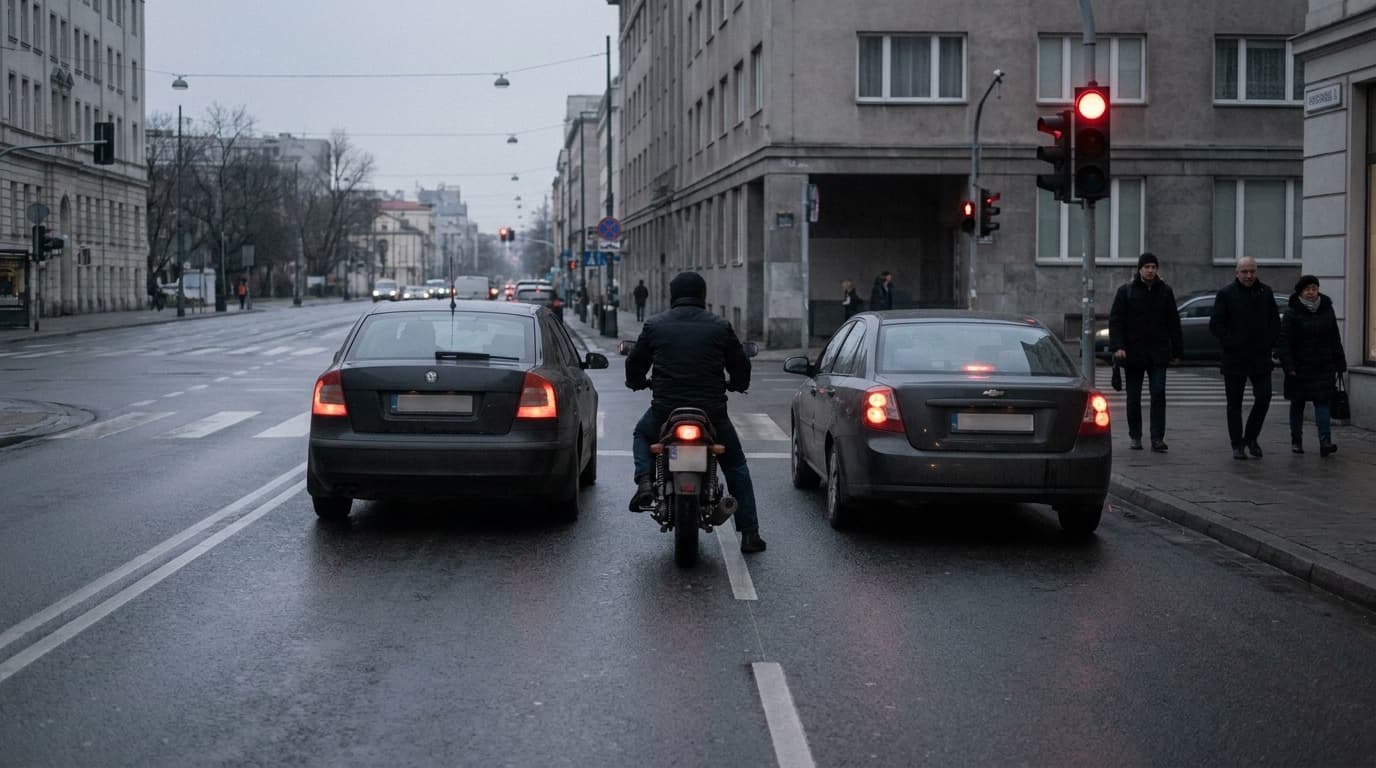
North Carolina's General Statutes do not mention lane splitting or lane filtering. No section authorizes a motorcycle to ride between lanes or between rows of vehicles, and none names the practice to forbid it. The motorcycle section, G.S. 20-146.1, gives every motorcycle "full use of a lane" and limits riders to two abreast. A rider who moves between lanes is still bound by the rules for every vehicle: G.S. 20-146(d)(1) requires driving "as nearly as practicable entirely within a single lane," and G.S. 20-150.1 allows passing on the right only in four listed situations. A violation of either is an infraction with a penalty of up to $100 under G.S. 20-176(b). For how other states compare, see our guide to lane splitting laws by state.
Information last verified on 2026-10-09. This article has not been reviewed by a licensed lawyer.
Jurisdiction scope: This article covers North Carolina state law in Chapter 20 of the General Statutes: the motorcycle lane rule in G.S. 20-146.1, the lane-use and keep-right rules in 20-146, passing on the right in 20-150.1, passing on the left in 20-149 and 20-150, HOV and peak-period shoulder lanes in 20-146.2, the roadway and conviction definitions in 20-4.01, the infraction penalty in 20-176, the point schedule in 20-16(c), the speed rules in 20-141, reckless driving in 20-140 and aggressive driving in 20-141.6, together with the misdemeanor sentencing chart in G.S. 15A-1340.23 and court costs in G.S. 7A-304. It does not cover city or county ordinances, insurance consequences, or the law of other states.
What North Carolina's statutes say about riding between lanes
North Carolina has no lane splitting statute. G.S. 20-146.1, titled "Operation of motorcycles," addresses two things: a motorcycle's right to the full lane, and how many may ride side by side. It contains no sentence about riding between lanes of traffic or between rows of vehicles, either to allow it or to ban it.
That silence is not permission. The general lane-use and passing rules apply to motorcycles as they do to every other vehicle, and those are the statutes a ticket would rest on.
| Maneuver | North Carolina rule |
|---|---|
| Lane splitting (riding between lanes of moving traffic) | Not expressly addressed; the single-lane rule in 20-146(d)(1) applies on streets with two or more clearly marked lanes, and 20-150.1 limits passing on the right |
| Lane filtering (riding between rows of stopped vehicles) | Not expressly addressed; same general rules |
| Riding on the shoulder to pass traffic | Not authorized by 20-146, 20-146.1 or 20-150.1; the roadway excludes the shoulder (20-4.01(38)). A shoulder NCDOT has marked as a temporary peak-period travel lane is a travel lane (20-146.2(b)) |
| Riding in an HOV lane | Motorcycles are exempt from occupancy limits; where access is restricted, enter and leave only at designated openings (20-146.2(a)) |
| Two motorcycles side by side in one lane | Allowed, but not more than two abreast (20-146.1(b)) |
| Autocycles side by side | Not more than one abreast in a single lane (20-146.1(b)) |
| A car crowding a motorcycle out of its lane | Barred: no motor vehicle may deprive a motorcycle of the full use of a lane (20-146.1(a)) |
Full use of a lane and riding two abreast
Subsections (a) and (b) of G.S. 20-146.1 read in full:
"(a) All motorcycles are entitled to full use of a lane and no motor vehicle shall be driven in such a manner as to deprive any motorcycle of the full use of a lane. This subsection shall not apply to motorcycles operated two abreast in a single lane. (b) Motorcycles shall not be operated more than two abreast in a single lane. For purposes of this subsection, the term "motorcycle" shall not include autocycles. Autocycles shall not be operated more than one abreast in a single lane."
Subsection (a) protects riders: a driver may not squeeze a motorcycle out of its lane. The protection does not apply when two motorcycles are already sharing a lane side by side. Subsection (b) is the two-abreast limit, which applies to motorcycles riding together, not to a motorcycle sharing a lane with a car.
The single-lane and keep-right rules
North Carolina's single-lane rule is in G.S. 20-146(d):
"(d) Whenever any street has been divided into two or more clearly marked lanes for traffic, the following rules in addition to all others consistent herewith shall apply. (1) A vehicle shall be driven as nearly as practicable entirely within a single lane and shall not be moved from such lane until the driver has first ascertained that such movement can be made with safety."
Under 20-146(d)(4), official traffic-control devices may prohibit changing lanes on sections of streets, and "drivers of vehicles shall obey the directions of every such device."
Subsection (b) of the same section is the keep-right rule for slower traffic: "Upon all highways any vehicle proceeding at less than the legal maximum speed limit shall be driven in the right-hand lane then available for thru traffic, or as close as practicable to the right-hand curb or edge of the highway, except when overtaking and passing another vehicle proceeding in the same direction or when preparing for a left turn."
Passing on the right and riding on the shoulder
G.S. 20-150.1 sets the only situations in which a driver may pass on the right:
"The driver of a vehicle may overtake and pass upon the right of another vehicle only under the following conditions: (1) When the vehicle overtaken is in a lane designated for left turns; (2) Upon a street or highway with unobstructed pavement of sufficient width which have been marked for two or more lanes of moving vehicles in each direction and are not occupied by parked vehicles; (3) Upon a one-way street, or upon a highway on which traffic is restricted to one direction of movement when such street or highway is free from obstructions and is of sufficient width and is marked for two or more lanes of moving vehicles which are not occupied by parked vehicles; (4) When driving in a lane designating a right turn on a red traffic signal light."
The section contains no clause about driving off the pavement or roadway, so the shoulder answer has to come from the definitions. G.S. 20-4.01(38) defines the roadway as "That portion of a highway improved, designed, or ordinarily used for vehicular travel, exclusive of the shoulder." None of the lane-use and passing sections discussed here (20-146, 20-146.1 and 20-150.1) authorizes a motorcycle to use the shoulder to pass stopped or slow traffic.
The exception is a shoulder that NCDOT has marked as a temporary travel lane for peak traffic periods under G.S. 20-146.2(b). The same section exempts motorcycles from HOV-lane occupancy limits, but where an HOV lane has marked access restrictions, vehicles "shall only cross into or out of an HOV lane at designated openings." A violation of 20-146.2 is an infraction under 20-176(a1)(4).
Passing on the left
A rider moving between two lanes passes one vehicle on its right and the other on its left. Passing on the left has its own rules. Under G.S. 20-149(a), a driver overtaking a vehicle going the same direction "shall pass at least two feet to the left thereof, and shall not again drive to the right side of the highway until safely clear of such overtaken vehicle." That clearance rule does not apply to passing done under 20-150.1 or 20-150(e).
G.S. 20-150 bars passing a vehicle going the same direction on the crest of a grade or on a curve where the view is obstructed within 500 feet, at a railway grade crossing, or at an intersection (one NCDOT has marked with signs, or any street intersection in a city or town) unless a traffic or police officer permits it, and where signs or markings indicate that passing should not be attempted. A violation of 20-149 or 20-150 is the "illegal passing" listed in the aggressive-driving statute, 20-141.6(b)(3).
What happens if you are stopped
The infraction penalty
The lane-use rule (20-146), the motorcycle lane rule (20-146.1) and the passing-on-the-right rule (20-150.1) sit in Part 10 of Article 3, "Operation of Vehicles and Rules of the Road," and none of them carries its own penalty clause. G.S. 20-176 sets the result:
"(a) Violation of a provision of Part 9, 10, 10A, or 11 of this Article is an infraction unless the violation is specifically declared by law to be a misdemeanor or felony. ... (b) Unless a specific penalty is otherwise provided by law, a person found responsible for an infraction contained in this Article may be ordered to pay a penalty of not more than one hundred dollars ($100.00)."
For an offense committed in North Carolina, G.S. 20-4.01(4a) defines a conviction to include "A determination that a person is responsible for an infraction, including a no contest plea."
Court costs are a separate charge. G.S. 7A-304 lists them item by item, and subsection (e) applies the district-court costs to infractions. For a Chapter 20 infraction decided in district court, the listed items are $5 for serving the citation, $12 for the courtroom, $4 for court technology, $6.25 and $1.25 for law-enforcement and sheriffs' benefit funds, $5 for indigent defense, $10 for Chapter 20 offenses and $147.50 for support of the General Court of Justice, $191 in all.
Session Law 2026-37 raises the $147.50 item to $177.50 for costs assessed on or after December 1, 2026, which brings that total to $221. Other cost items in 7A-304 apply only in particular cases, such as a missed court date. The amount due on a particular citation comes from the court named on it.
Points on a North Carolina license
The point schedule in G.S. 20-16(c) has no line that names lane splitting, lane use or 20-150.1. These are its lines most relevant to a rider:
| Offense (G.S. 20-16(c)) | Points |
|---|---|
| Aggressive driving | 5 |
| Reckless driving | 4 |
| Illegal passing | 4 |
| Following too close | 4 |
| Driving on wrong side of road | 4 |
| Failure to yield right-of-way to bicycle, motor scooter, or motorcycle | 4 |
| All other moving violations | 2 |
The statute does not say whether a 20-146(d)(1) or 20-150.1 conviction is entered as "illegal passing" (4 points) or under "all other moving violations" (2 points). When a driver is convicted of two or more offenses committed on a single occasion, the same subsection provides that points are assessed "for one offense only," and if the point values differ, for "the offense having the greater point value."
Speed, reckless driving and aggressive driving
Each of the following is a separate charge with its own elements; whether a particular ride meets them depends on the facts.
| Charge | What the statute prohibits | Classification |
|---|---|---|
| Speed too fast for conditions, G.S. 20-141(a) | Driving "at a speed greater than is reasonable and prudent under the conditions then existing." Under 20-141(m), a speed below the limits does not relieve a driver of "the duty to decrease speed as may be necessary to avoid colliding" with any person or vehicle | Infraction; penalty up to $100 under 20-176(b) |
| Speeding more than 15 mph over the limit or over 80 mph, G.S. 20-141(j1) | Driving "more than 15 miles per hour more than the speed limit established by law for the highway where the offense occurred or over 80 miles per hour" | Class 3 misdemeanor; fine up to $200 under 15A-1340.23(b) |
| Reckless driving, G.S. 20-140(a) and (b) | Driving "carelessly and heedlessly in willful or wanton disregard of the rights or safety of others," or "without due caution and circumspection and at a speed or in a manner so as to endanger or be likely to endanger any person or property" | Class 2 misdemeanor (20-140(d)); Class 1 if it "causes serious injury" (20-140(g)); Class A1 if it "causes serious bodily injury as defined in G.S. 14-32.4" (20-140(h)) |
| Aggressive driving, G.S. 20-141.6 | Violating the speed statutes (20-141 or 20-141.1) and driving "carelessly and heedlessly in willful or wanton disregard of the rights or safety of others," shown by two or more listed offenses | Class 1 misdemeanor (20-141.6(c)); 5 points under 20-16(c) |
The Class 1 and Class A1 reckless driving levels apply to offenses committed on or after December 1, 2025, under section 6 of Session Law 2025-71. Section 20-140 contains no separate careless or inattentive driving offense; its subsection (b) "without due caution and circumspection" language is the closest North Carolina wording.
For aggressive driving, 20-141.6(b) lists the offenses that can prove the careless-and-heedless element: running a red light or stop sign, "Illegal passing in violation of G.S. 20-149 or G.S. 20-150," failing to yield right-of-way, and following too closely in violation of G.S. 20-152. The list does not name 20-146 or 20-150.1. Reckless driving under 20-140 is a lesser-included offense of aggressive driving (20-141.6(d)).
Speeding in a highway work zone carries an extra charge. Under 20-141(j2), a person who exceeds the posted work-zone limit "shall be required to pay a penalty of two hundred fifty dollars ($250.00)," in addition to the other penalties in Chapter 20. That subsection is written for speeding, not for lane or passing violations.
Misdemeanor sentencing ranges
The punishment for a misdemeanor depends on its class and the person's prior conviction level under G.S. 15A-1340.23. That statute caps the fine for a Class 2 misdemeanor at $1,000 "Unless otherwise provided for a specific offense"; for Class 1 and Class A1 misdemeanors, the fine "is in the discretion of the court."
| Class | Prior conviction level I | Level II | Level III |
|---|---|---|---|
| Class 2 (reckless driving) | 1 to 30 days | 1 to 45 days | 1 to 60 days |
| Class 1 (aggressive driving; reckless driving causing serious injury) | 1 to 45 days | 1 to 45 days | 1 to 120 days |
| Class A1 (reckless driving causing serious bodily injury) | 1 to 60 days | 1 to 75 days | 1 to 150 days |
Federal law and lane splitting
We found no federal statute or regulation that addresses lane splitting; the rules come from state traffic law. The federal motorcyclist safety grant regulation, 23 CFR 1300.25, sets criteria for rider training and motorist-awareness programs and says nothing about lane use, and NHTSA's motorcycle safety guidance does not address lane splitting.
If a crash happens while splitting or filtering
How a lane or passing violation bears on fault and an injury claim is covered in our guide to North Carolina motorcycle accident laws. For the crash rules that apply to every driver, see North Carolina car accident laws.
Related pages
- Lane splitting laws by state
- North Carolina motorcycle accident laws
- North Carolina car accident laws
This article provides general legal information about North Carolina law, not legal advice. For advice about a specific situation, contact a lawyer licensed in North Carolina or the court named on your citation.
Last updated: 2026-10-09.
Frequently Asked Questions
Is lane splitting legal in North Carolina?
No North Carolina statute expressly allows or bans it. The general rules still apply: G.S. 20-146(d)(1) requires a vehicle on a marked multi-lane street to stay as nearly as practicable within a single lane, and G.S. 20-150.1 limits passing on the right to four listed situations.
Is lane filtering legal in North Carolina?
North Carolina has no lane filtering statute. Riding between rows of stopped vehicles falls under the same general lane-use and passing rules, G.S. 20-146(d)(1) and 20-150.1, as riding between moving lanes.
Can two motorcycles ride side by side in one lane in North Carolina?
Yes, up to two. G.S. 20-146.1(b) says motorcycles shall not be operated more than two abreast in a single lane, and autocycles shall not be operated more than one abreast.
Can motorcycles ride on the shoulder in North Carolina?
None of North Carolina's lane-use and passing sections (20-146, 20-146.1, 20-150.1) authorizes passing on the shoulder. G.S. 20-4.01(38) defines the roadway as the part of a highway used for vehicular travel, exclusive of the shoulder. A shoulder NCDOT has marked as a temporary travel lane for peak traffic periods under G.S. 20-146.2(b) is a travel lane during those periods.
What is the fine for an unsafe lane change in North Carolina?
A violation of G.S. 20-146 is an infraction, and unless a specific penalty is provided, G.S. 20-176(b) caps the penalty at $100. Court costs under G.S. 7A-304 are a separate charge.
How many points is a lane violation in North Carolina?
G.S. 20-16(c) assigns 4 points for illegal passing, 5 for aggressive driving and 2 for all other moving violations. The statute does not name the lane-use or passing-on-the-right sections, so it does not say which line applies.
Updates
Independently fact-checked against the cited primary sources
The Law Behind This Article
This article rests on the statutory provisions below, held in our own legal record and retrieved from the official source. Tap a section to read the operative text.
North Carolina General Statutes, Chapter 20: Motor Vehicles.
§ 20-146.1Operation of motorcyclesIn forcecited in 2 of our articles
(a) All motorcycles are entitled to full use of a lane and no motor vehicle shall be driven in such a manner as to deprive any motorcycle of the full use of a lane. This subsection shall not apply to motorcycles operated two abreast in a single lane. (b) Motorcycles shall not be operated more than two abreast in a single lane. For purposes of this subsection, the term "motorcycle" shall not include autocycles. Autocycles shall not be operated more than one abreast in a single lane.
Official text (excerpt) · last checked 2026-07-29 · Read the full text in our law library · Verify at ncleg.gov
Cited in 2 court opinions in our collectionLatest citing opinion in our collection: 2007
Opinions citing this section in our collection:
- Fortson v. McClellan (Court of Appeals of North Carolina 1998, 131 N.C. App. 635)“…s. N.C. Gen. Stat. § 115D-72 (1997); see also N.C. Gen. Stat. § 20-146.1 (1997) (Operation of Motorcycle); N.C…”
- Barnard v. N.C. Department of Transportation (North Carolina Industrial Commission 2007)“…709 , 365 S.E.2d 898 , 900 (1988). *Page 12 2. N.C. Gen. Stat. § 20-146.1 (a) provides that "[a]ll motorcycles ar…”
Identified automatically from the court opinions citing this section — not a ranking of which case controls.
Also relied on in: Motorcycle Accident Laws in North Carolina (2026): Deadlines
§ 20-146Drive on right side of highway; exceptionsIn force
(a) Upon all highways of sufficient width a vehicle shall be driven upon the right half of the highway except as follows: (1) When overtaking and passing another vehicle proceeding in the same direction under the rules governing such movement; (2) When an obstruction exists making it necessary to drive to the left of the center of the highway; provided, any person so doing shall yield the right-of-way to all vehicles traveling in the proper direction upon the unobstructed portion of the highway within such distance as to constitute an immediate hazard; (3) Upon a highway divided into three marked lanes for traffic under the rules applicable thereon; or (4) Upon a highway designated and signposted for one-way traffic. (a1) Self-propelled grain combines or other self-propelled farm equipment shall be operated to the right of the centerline except as provided in G.S. 20-116(j)(4).
Official text (excerpt) · last checked 2026-07-29 · Read the full text in our law library · Verify at ncleg.gov
§ 20-150.1When passing on the right is permittedIn force
The driver of a vehicle may overtake and pass upon the right of another vehicle only under the following conditions: (1) When the vehicle overtaken is in a lane designated for left turns; (2) Upon a street or highway with unobstructed pavement of sufficient width which have been marked for two or more lanes of moving vehicles in each direction and are not occupied by parked vehicles; (3) Upon a one-way street, or upon a highway on which traffic is restricted to one direction of movement when such street or highway is free from obstructions and is of sufficient width and is marked for two or more lanes of moving vehicles which are not occupied by parked vehicles; (4) When driving in a lane designating a right turn on a red traffic signal light.
Official text (excerpt) · last checked 2026-07-29 · Read the full text in our law library · Verify at ncleg.gov
Search our full record of US law — 2.1 million sections, every state + federal →
Sources and References
- N.C. Gen. Stat. 20-146.1, Operation of motorcycles(www.ncleg.gov).gov
- N.C. Gen. Stat. 20-146, Drive on right side of highway; exceptions(www.ncleg.gov).gov
- N.C. Gen. Stat. 20-150.1, When passing on the right is permitted(www.ncleg.gov).gov
- N.C. Gen. Stat. 20-149, Overtaking a vehicle(www.ncleg.gov).gov
- N.C. Gen. Stat. 20-150, Limitations on privilege of overtaking and passing(www.ncleg.gov).gov
- N.C. Gen. Stat. 20-146.2, Rush hour traffic lanes authorized(www.ncleg.gov).gov
- N.C. Gen. Stat. 20-176, penalties for Article 3 violations(www.ncleg.gov).gov
- N.C. Gen. Stat. 20-4.01, Definitions (conviction; roadway)(www.ncleg.gov).gov
- N.C. Gen. Stat. 7A-304, court costs(www.ncleg.gov).gov
- N.C. Session Law 2026-37 (House Bill 1173), section 1 (district court General Court of Justice fee)(www.ncleg.gov).gov
- N.C. Gen. Stat. 20-16(c), schedule of point values(www.ncleg.gov).gov
- N.C. Gen. Stat. 20-141, speed rules (including work-zone penalty)(www.ncleg.gov).gov
- N.C. Gen. Stat. 20-140, Reckless driving(www.ncleg.gov).gov
- N.C. Gen. Stat. 20-141.6, Aggressive driving(www.ncleg.gov).gov
- N.C. Session Law 2025-71, section 6 (reckless driving causing serious injury)(www.ncleg.gov).gov
- N.C. Gen. Stat. 15A-1340.23, misdemeanor punishment limits(www.ncleg.gov).gov
- 23 CFR 1300.25, Motorcyclist safety grants(www.ecfr.gov).gov
- NHTSA, Motorcycle Safety(www.nhtsa.gov).gov