
New York
Is Lane Splitting Legal in New York? (2026 Law)
Independently fact-checked against primary sources (last audited October 10, 2026). · 14 primary sources cited on this page. How we verify our legal content
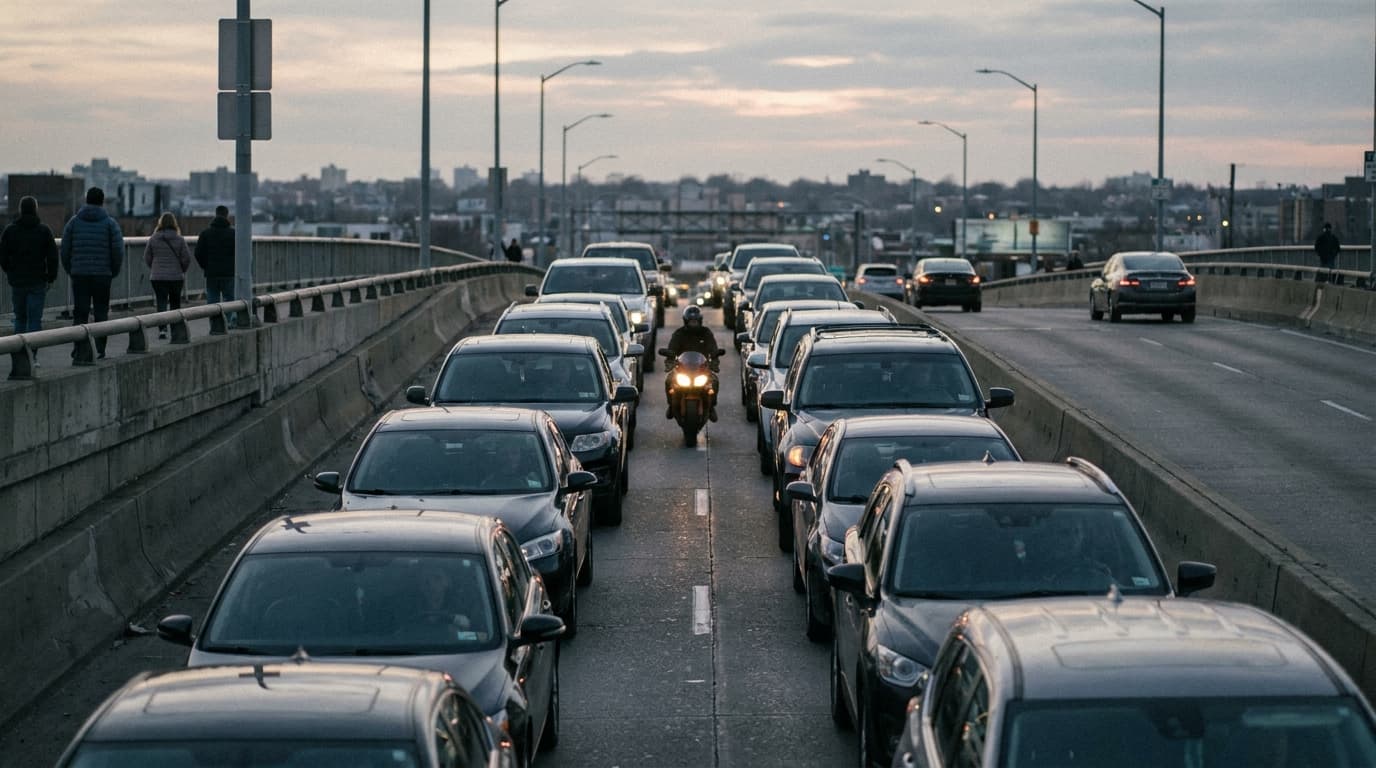
Lane splitting and lane filtering are both illegal in New York. Vehicle and Traffic Law (VTL) 1252(c) says "No person shall operate a motorcycle between lanes of traffic or between adjacent lines or rows of vehicles," and the section has no exception for stopped or slow traffic; only police officers performing official duties are exempt. A violation is a traffic infraction, punishable on a first conviction by a fine of up to $150, up to 15 days in jail, or both, under VTL 1800(b)(1), plus a mandatory surcharge. For how other states compare, see our guide to lane splitting laws by state.
Information last verified on 2026-10-09. This article has not been reviewed by a licensed lawyer.
Jurisdiction scope: This article covers New York State's Vehicle and Traffic Law: the motorcycle lane rule in VTL 1252, the overtaking, lane and shoulder rules in 1122, 1123, 1128 and 1131, the roadway definition in 140, the basic speed rule in 1180(a), reckless driving in 1212, the penalty and surcharge provisions in 1800, 1801 and 1809, due care toward pedestrians and bicyclists in 1146, the driver responsibility assessment in 503(4), and the Department of Motor Vehicles (DMV) point system in 15 NYCRR 131.3. It does not cover New York City or other local traffic rules, a particular court's or Traffic Violations Bureau's fine amounts, insurance consequences, or the law of other states.
What VTL 1252 says about riding between lanes
New York's motorcycle lane rule is VTL 1252, "Operating motorcycles on roadways laned for traffic." It reads in full:
"(a) All motorcycles are entitled to full use of a lane and no motor vehicle or motorcycle shall be driven in such a manner as to deprive any motorcycle of the full use of a lane. However, this subsection shall not be construed to prevent motorcycles from being operated two abreast in a single lane. (b) The operator of a motorcycle shall not overtake and pass in the same lane occupied by the vehicle being overtaken. (c) No person shall operate a motorcycle between lanes of traffic or between adjacent lines or rows of vehicles. (d) Motorcycles shall not be operated more than two abreast in a single lane. (e) Subsections (b) and (c) shall not apply to police officers in the performance of their official duties."
Subsection (c) reaches both practices. Riding "between lanes of traffic" is lane splitting; riding "between adjacent lines or rows of vehicles" covers filtering past stopped or slow cars to the front of a light. The text sets no speed limit and no stopped-traffic exception. Subsection (b) separately bars a rider from passing a car inside that car's own lane.
| Maneuver | New York rule |
|---|---|
| Lane splitting (riding between lanes of moving traffic) | Prohibited by VTL 1252(c) |
| Lane filtering (riding between rows of stopped or slow vehicles) | Prohibited by VTL 1252(c), which reaches riding "between adjacent lines or rows of vehicles" |
| Passing a car inside its own lane | Prohibited by VTL 1252(b) |
| Two motorcycles side by side in one lane | Allowed under VTL 1252(a); more than two abreast is barred by 1252(d) |
| Riding on the shoulder to pass | Barred by VTL 1123(b) except as 1131 permits; 1131 bars shoulder driving on state controlled-access highways except at posted, authorized locations |
| Police officers on duty | Exempt from 1252(b) and (c) under 1252(e) |
Subsection (a) also protects riders: no motor vehicle "or motorcycle" may be driven so as to deprive a motorcycle of the full use of a lane.
The general lane rules
On roads with marked lanes, VTL 1128 applies to every driver:
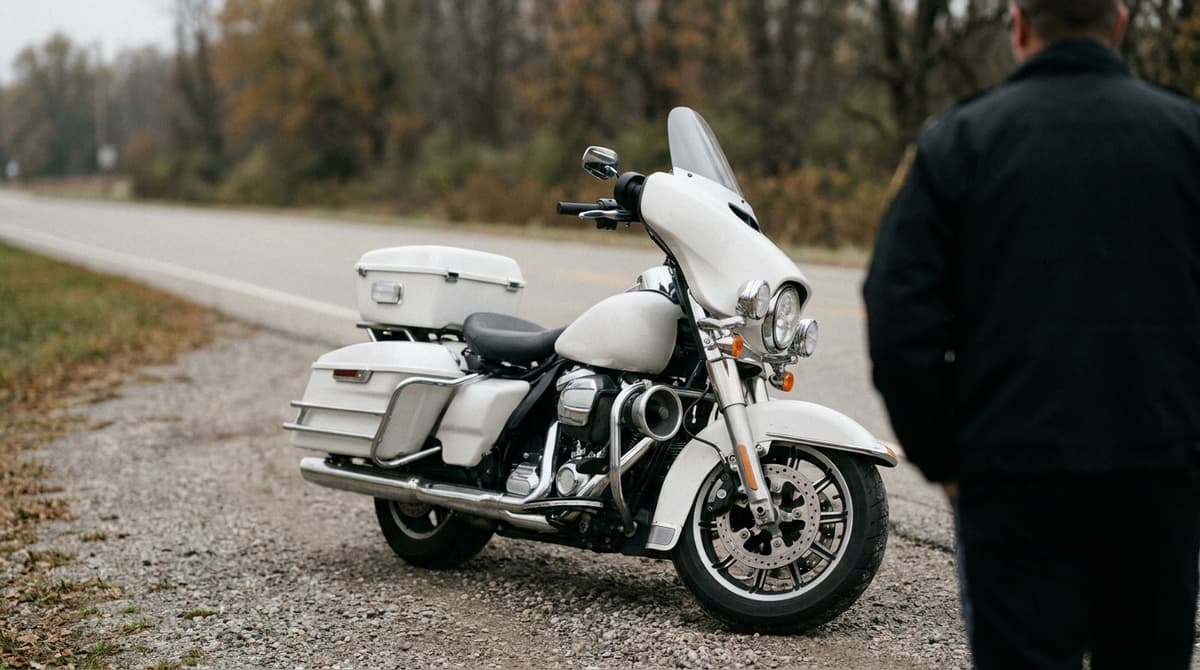
"Whenever any roadway has been divided into two or more clearly marked lanes for traffic the following rules in addition to all others consistent herewith shall apply: (a) A vehicle shall be driven as nearly as practicable entirely within a single lane and shall not be moved from such lane until the driver has first ascertained that such movement can be made with safety."
Under 1128(d), where official markings show "those portions of any roadway where crossing such markings would be especially hazardous, no driver of a vehicle proceeding along such highway shall at any time drive across such markings."
For passing on the left, VTL 1122(a) requires a driver overtaking a vehicle going the same way to "pass to the left thereof at a safe distance and shall not again drive to the right side of the roadway until safely clear of the overtaken vehicle."
Riding on the shoulder
Start with the definition. Under VTL 140, the roadway is "That portion of a highway improved, designed, marked, or ordinarily used for vehicular travel, exclusive of the shoulder and slope." The shoulder is not part of the roadway.
Then the passing rule. VTL 1123 reads:
"(a) The driver of a vehicle may overtake and pass upon the right of another vehicle only under the following conditions: 1. When the vehicle overtaken is making or about to make a left turn; 2. Upon a street or highway with unobstructed pavement not occupied by parked vehicles of sufficient width for two or more lines of moving vehicles in each direction; 3. Upon a one-way street, or upon any roadway on which traffic is restricted to one direction of movement, where the roadway is free from obstructions and of sufficient width for two or more lines of moving vehicles. (b) The driver of a vehicle may overtake and pass another vehicle upon the right only under conditions permitting such movement in safety. Such movement shall not be made by driving off the pavement or main-traveled portion of the roadway, except as permitted by section eleven hundred thirty-one of this article."
The exception points to VTL 1131, which limits shoulder use on one class of road: "Except for bicycles and those classes of vehicles required to travel on shoulders or slopes, no motor vehicle shall be driven over, across, along, or within any shoulder or slope of any state controlled-access highway except at a location specifically authorized and posted by the department of transportation." The section also does not prevent motor vehicles "from using shoulders or slopes when directed by police officers or flagpersons," or from "stopping, standing, or parking on shoulders or slopes where such stopping, standing, or parking is lawful." Section 1131 by its terms covers state controlled-access highways; on other roads the passing limit in 1123(b) still applies.
What happens if you are stopped
VTL 1252 has no penalty clause of its own, and neither do 1123, 1128 or 1131. Under VTL 1800(a), "It is a traffic infraction for any person to violate any of the provisions of this chapter ... unless such violation is by this chapter or other law of this state declared to be a misdemeanor or a felony."
The default penalty in 1800(b)(1) applies to a violation "for which another penalty is not provided":
| Conviction | Maximum fine | Maximum jail | Or both |
|---|---|---|---|
| First | $150 | 15 days | Yes |
| Second, both within 18 months | $300 | 45 days | Yes |
| Third or subsequent, all within 18 months | $450 | 90 days | Yes |
These are statutory maximums. The amount on a particular ticket comes from the court or Traffic Violations Bureau handling it.
Surcharge and fee
VTL 1809 adds money on top of the fine. Under 1809(1)(c), a conviction for a traffic infraction under the VTL, other than a parking, standing or stopping infraction or a pedestrian or bicyclist violation, and except as subdivision one-a provides, brings "a crime victim assistance fee in the amount of five dollars and a mandatory surcharge, in addition to any sentence required or permitted by law, in the amount of fifty-five dollars." Paragraph (a)'s lower $25 surcharge covers "a traffic infraction pursuant to article nine," the equipment article; VTL 1252 is in article 34-A, so paragraph (c) applies. The published section marks this version "Effective until September 1, 2027"; the version that follows sets a $25 mandatory surcharge.
Points on a New York driving record
The DMV's driver point system page assigns 3 points for "Improper passing, unsafe lane change, drove left of center, or drove wrong direction" and 2 points for "Any other moving violations." It adds: "If you get 11 points in 24 months, your driver license may be suspended." The page does not list VTL 1252 by section number, so which row a 1252(c) conviction falls in is not stated there.
The regulation behind the chart, 15 NYCRR 131.3, says "All traffic violations shall be assigned a point value of two points" unless a listed exception applies. It assigns three points to "any violation involving improper passing, changing lanes unsafely, driving to left of center of roadway, or driving in the wrong direction," and five points to reckless driving. It does not name VTL 1252.
Separately, under VTL 503(4), a driver who accumulates six or more points for acts committed within an 18-month period owes a driver responsibility assessment of $100 a year for three years, plus $25 a year for each point above six.
Speed and reckless driving
Each of the following is a separate charge with its own elements, and whether a particular ride meets them depends on the facts.
Basic speed rule. Under VTL 1180(a), "No person shall drive a vehicle at a speed greater than is reasonable and prudent under the conditions and having regard to the actual and potential hazards then existing."
Reckless driving. VTL 1212 defines reckless driving as "driving or using any motor vehicle, motorcycle or any other vehicle propelled by any power other than muscular power or any appliance or accessory thereof in a manner which unreasonably interferes with the free and proper use of the public highway or any parking lot, or unreasonably endangers users of the public highway or any parking lot." The section says "Reckless driving is prohibited" and makes a violation a misdemeanor. Under VTL 1801(1), the penalties are:
| Reckless driving conviction | Maximum fine | Maximum jail | Or both |
|---|---|---|---|
| First | $300 | 30 days | Yes |
| Second, both within 18 months | $525 | 90 days | Yes |
| Third or subsequent, all within 18 months | $1,125 | 180 days | Yes |
Section 1801(1) also says any fine for a 1212 violation "shall be not less than one hundred dollars." Unlike the traffic infractions above, reckless driving is a misdemeanor, which is a crime.
Failure to exercise due care. VTL 1146 requires every driver to "exercise due care to avoid colliding with any bicyclist, pedestrian, or domestic animal upon any roadway." A driver who causes physical injury to a pedestrian or bicyclist while failing to do so commits a traffic infraction punishable by a fine of up to $500, up to 15 days in jail, or both; for serious physical injury, the penalty is a fine of up to $750, up to 15 days in jail or a required accident-prevention course, or a combination, plus a license or registration suspension. A repeat violation within five years is a class B misdemeanor with a fine of up to $1,000 (VTL 1146(c) and (d)). Under 15 NYCRR 131.3, a 1146 violation carries five points.
Where New York's rule comes from
VTL 1252 closely follows section 11-1303 of the 1968 Uniform Vehicle Code, a national model law whose subsection (c) also reads "No person shall operate a motorcycle between lanes of traffic or between adjacent lines or rows of vehicles." New York's 1123 likewise tracks the model code's passing-on-the-right section, 11-304, adding the reference to its shoulder statute.

If a crash happens
How a lane violation can bear on fault and an injury claim is covered in our guide to New York motorcycle accident laws. For reporting and insurance rules that apply to every driver, see New York car accident laws.
Gaps in the public record
- Neither the DMV chart nor 15 NYCRR 131.3 names VTL 1252, so whether a 1252(c) conviction is scored at two or three points is not stated.
- Fine amounts set by local courts or New York City's Traffic Violations Bureau are not covered here.
- Whether New York has a separate aggressive-driving offense, and any work-zone fine increase for lane or passing violations, are not covered here.
- The New York Senate's published text of 1252, 1123 and 1128 shows no revision after 2014. Bills introduced in the 2025-2026 session that would amend 1252 are not covered here.
Related pages
This article provides general legal information about New York law, not legal advice. For advice about a specific situation, contact a lawyer licensed in New York or the court named on your ticket.
Last updated: 2026-10-09.
Frequently Asked Questions
Is lane splitting legal in New York?
No. VTL 1252(c) says no person shall operate a motorcycle between lanes of traffic or between adjacent lines or rows of vehicles. Only police officers performing official duties are exempt under 1252(e).
Is lane filtering legal in New York?
No. VTL 1252(c) covers riding between adjacent lines or rows of vehicles and has no exception for stopped traffic or a red light.
What is the fine for lane splitting in New York?
VTL 1252 sets no penalty of its own, so the traffic-infraction default in VTL 1800(b)(1) applies: up to $150, up to 15 days in jail, or both for a first conviction, with higher maximums for repeat convictions within 18 months. A $55 mandatory surcharge and a $5 crime victim assistance fee under VTL 1809(1)(c) are added.
Can two motorcycles ride side by side in one lane in New York?
Yes. VTL 1252(a) does not prevent motorcycles from being operated two abreast in a single lane, and 1252(d) bars more than two abreast.
Can motorcycles ride on the shoulder in New York?
Not to pass, except as VTL 1131 permits. VTL 1123(b) bars passing on the right by driving off the pavement or main-traveled portion of the roadway, and 1131 bars shoulder driving on state controlled-access highways except at locations the Department of Transportation authorizes and posts, when directed by police or flagpersons, or for lawful stopping, standing or parking.
How many points is a lane splitting ticket in New York?
The DMV point page assigns 3 points for improper passing or unsafe lane change and 2 points for any other moving violation, but it does not list VTL 1252 by section number. Eleven points in 24 months may lead to a license suspension.
Is lane splitting reckless driving in New York?
Reckless driving under VTL 1212 is a separate charge with its own elements; whether a particular ride meets them depends on the facts. It is a misdemeanor punishable on a first conviction by a fine of $100 to $300, up to 30 days in jail, or both.
Updates
Independently fact-checked against the cited primary sources
The Law Behind This Article
This article rests on the statutory provisions below, held in our own legal record and retrieved from the official source. Tap a section to read the operative text.
New York Vehicle and Traffic Law
§ 1252Operating motorcycles on roadways laned for trafficIn forcecited in 2 of our articles
Operating motorcycles on roadways laned for traffic. (a) All motorcycles are entitled to full use of a lane and no motor vehicle or motorcycle shall be driven in such a manner as to deprive any motorcycle of the full use of a lane. However, this subsection shall not be construed to prevent motorcycles from being operated two abreast in a single lane. (b) The operator of a motorcycle shall not overtake and pass in the same lane occupied by the vehicle being overtaken. (c) No person shall operate a motorcycle between lanes of traffic or between adjacent lines or rows of vehicles. (d) Motorcycles shall not be operated more than two abreast in a single lane. (e) Subsections (b) and (c) shall not apply to police officers in the performance of their official duties.
Official text (excerpt) · last checked 2026-07-29 · Read the full text in our law library · Verify at legislation.nysenate.gov
Cited in 2 court opinions in our collectionLatest citing opinion in our collection: 2025
Opinions citing this section in our collection:
- Collet v. Ortiz (Appellate Division of the Supreme Court of the State of New York 2025, 2025 NY Slip Op 05789)“…ligence was the sole proximate cause of the accident ( see Vehicle and Traffic Law § 1252[b]; Rosenberg v Kotsek , 41 AD3d at…”
- People v. Kachalsky (Alan) (Appellate Terms of the Supreme Court of New York 2021, 73 Misc. 3d 138(A))“…fendant was charged with riding a motorcycle between lanes (Vehicle and Traffic Law § 1252 [c]). It provides that, on December 18,…”
Identified automatically from the court opinions citing this section — not a ranking of which case controls.
Also relied on in: Motorcycle Accident Laws in New York (2026): Deadlines
§ 1123When overtaking on the right is permittedIn force
When overtaking on the right is permitted. (a) The driver of a vehicle may overtake and pass upon the right of another vehicle only under the following conditions: 1. When the vehicle overtaken is making or about to make a left turn; 2. Upon a street or highway with unobstructed pavement not occupied by parked vehicles of sufficient width for two or more lines of moving vehicles in each direction; 3. Upon a one-way street, or upon any roadway on which traffic is restricted to one direction of movement, where the roadway is free from obstructions and of sufficient width for two or more lines of moving vehicles. (b) The driver of a vehicle may overtake and pass another vehicle upon the right only under conditions permitting such movement in safety. Such movement shall not be made by driving off the pavement or main-traveled portion of the roadway, except as permitted by section eleven hundred thirty-one of this article.
Official text (excerpt) · last checked 2026-07-29 · Read the full text in our law library · Verify at legislation.nysenate.gov
§ 1122Overtaking a vehicle on the leftIn force
Overtaking a vehicle on the left. The following rules shall govern the overtaking and passing of vehicles proceeding in the same direction, subject to those limitations, exceptions, and special rules hereinafter stated: (a) The driver of a vehicle overtaking another vehicle proceeding in the same direction shall pass to the left thereof at a safe distance and shall not again drive to the right side of the roadway until safely clear of the overtaken vehicle. (b) Except when overtaking and passing on the right is permitted, the driver of an overtaken vehicle shall give way to the right in favor of the overtaking vehicle on audible signal and shall not increase the speed of his vehicle until completely passed by the overtaking vehicle.
Official text (excerpt) · last checked 2026-07-29 · Read the full text in our law library · Verify at legislation.nysenate.gov
§ 1212Reckless drivingIn force
Reckless driving. (a) Reckless driving shall mean driving or using any motor vehicle, motorcycle or any other vehicle propelled by any power other than muscular power or any appliance or accessory thereof in a manner which unreasonably interferes with the free and proper use of the public highway or any parking lot, or unreasonably endangers users of the public highway or any parking lot. Reckless driving is prohibited. Every person violating this provision shall be guilty of a misdemeanor. (b) As used in this section, "parking lot" shall mean any area or areas of private property, including a driveway, near or contiguous to and provided in connection with premises and used as a means of access to and egress from a public highway to such premises and having a capacity for the parking of four or more motor vehicles. The provisions of this section shall not apply to any area or areas of private property comprising all or part of property on which is situated a one or two family residence.
Official text (excerpt) · last checked 2026-07-29 · Read the full text in our law library · Verify at legislation.nysenate.gov
Search our full record of US law — 2.1 million sections, every state + federal →
Sources and References
- N.Y. Vehicle and Traffic Law 1252, Operating motorcycles on roadways laned for traffic(www.nysenate.gov).gov
- N.Y. Vehicle and Traffic Law 1128, Driving on roadways laned for traffic(www.nysenate.gov).gov
- N.Y. Vehicle and Traffic Law 1122, Overtaking a vehicle on the left(www.nysenate.gov).gov
- N.Y. Vehicle and Traffic Law 140, Roadway(www.nysenate.gov).gov
- N.Y. Vehicle and Traffic Law 1123, When overtaking on the right is permitted(www.nysenate.gov).gov
- N.Y. Vehicle and Traffic Law 1131, Driving on shoulders and slopes(www.nysenate.gov).gov
- N.Y. Vehicle and Traffic Law 1800, penalties for traffic infractions(www.nysenate.gov).gov
- N.Y. Vehicle and Traffic Law 1809, mandatory surcharge and crime victim assistance fee(www.nysenate.gov).gov
- NYS DMV, The New York State Driver Point System(dmv.ny.gov).gov
- N.Y. Vehicle and Traffic Law 1180, Basic rule and maximum limits(www.nysenate.gov).gov
- N.Y. Vehicle and Traffic Law 1212, Reckless driving(www.nysenate.gov).gov
- N.Y. Vehicle and Traffic Law 1801, penalties for misdemeanors(www.nysenate.gov).gov
- N.Y. Vehicle and Traffic Law 1146, Drivers to exercise due care(nysenate.gov).gov
- N.Y. Vehicle and Traffic Law 503, driver responsibility assessment (subdivision 4)(nysenate.gov).gov
- Uniform Vehicle Code (1968 revision), sections 11-304 and 11-1303(law.resource.org)