
Indiana
Is Lane Splitting Legal in Indiana? Lane Filtering Rules (2026)
Independently fact-checked against primary sources (last audited October 10, 2026). · 7 primary sources cited on this page. How we verify our legal content
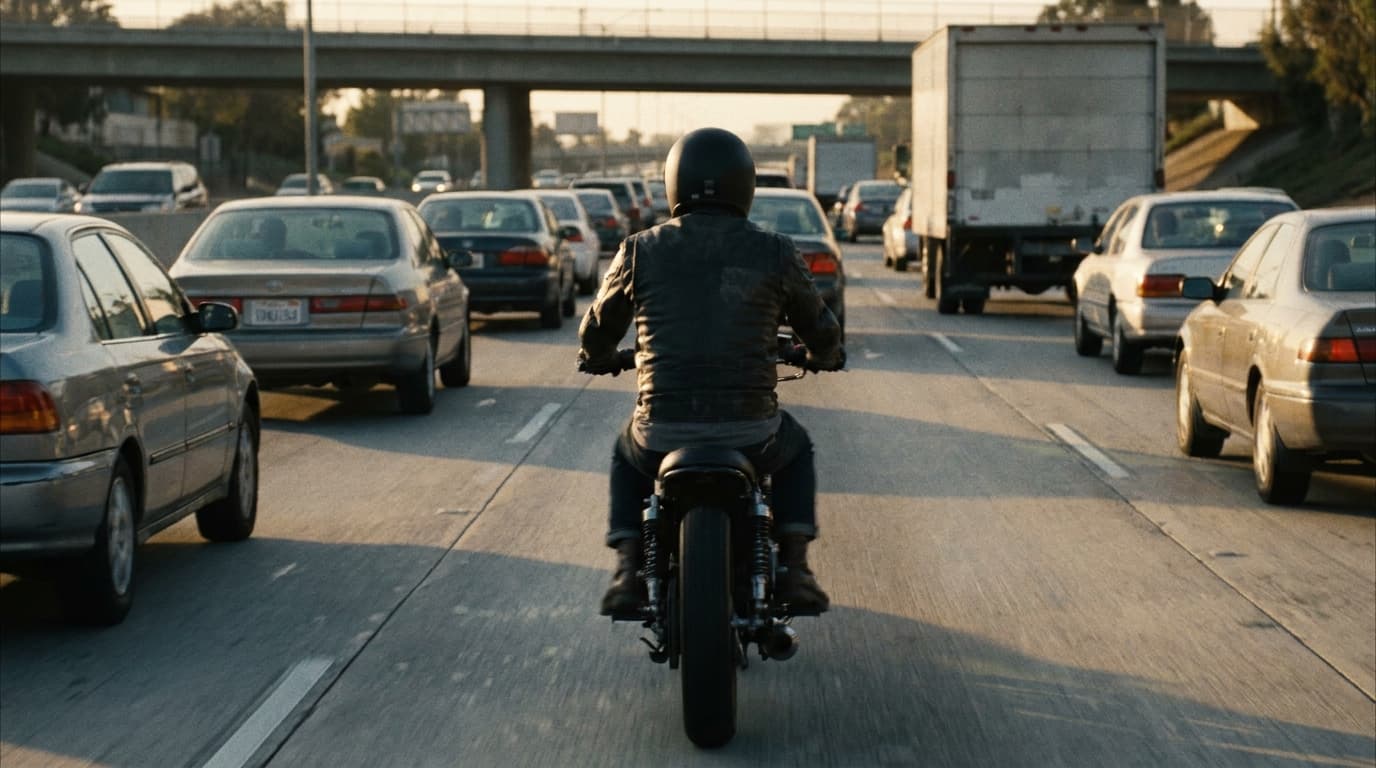
Indiana has no law that names lane splitting or lane filtering, and none that expressly allows or bans it. The rules that apply are general ones: IC 9-21-8-11.5 requires a vehicle on a roadway with two or more marked lanes to "be driven as nearly as practicable entirely between the lines marking the single lane," IC 9-21-10-7 applies traffic rules like that one to motorcycle riders, and IC 9-21-10-6 gives each motorcycle "the full use of a traffic lane." No section creates an exception for riding between lanes or between rows of stopped cars. For how other states handle the same maneuvers, see our guide to lane splitting laws by state.
Information last verified on 2026-10-09. This article has not been reviewed by a licensed lawyer.
Jurisdiction scope: This article covers Indiana state law in the 2026 Indiana Code: the motorcycle chapter (IC 9-21-10), the vehicle operation chapter (IC 9-21-8, including the lane, passing, reckless driving and aggressive driving sections), the speed rule in IC 9-21-5-1, the motorcycle definition in IC 9-13-2-108, the infraction judgment limits in IC 34-28-5-4, and the misdemeanor sentences in IC 35-50-3. It does not cover city or town ordinances, court fee schedules, license points, insurance consequences, or the law of other states.
What the Indiana Code says
Indiana's motorcycle chapter, IC 9-21-10, covers passengers, seating, handlebars, headlamps, lane use, rentals and penalties. Its one lane rule, section 6, reads in full:
"Sec. 6. A motorcycle is entitled to the full use of a traffic lane and a vehicle may not be driven or operated in a manner that deprives another vehicle of the full use of a traffic lane. Motorcycles, other than autocycles, may, with the consent of both persons who operate the motorcycles, be operated with not more than two (2) abreast in a single traffic lane."
Section 6 does not mention riding between lanes. Its first sentence protects riders from being crowded out of a lane. The second clause of that sentence is written generally, "a vehicle" and "another vehicle," so by its words it is not limited to cars and trucks.
The motorcycle chapter then makes the general traffic rules apply to riders. IC 9-21-10-7(a) says that "all traffic regulations and all rights and duties inured from the traffic regulations that apply to a person who drives or operates a motor vehicle apply to a person who operates a motorcycle or motor driven cycle," except "(1) Regulations that expressly do not apply to motorcycles or motor driven cycles" and "(2) Regulations that by their nature have no application."
The single-lane rule
The general lane rule is IC 9-21-8-11.5, added in 2018:
"Sec. 11.5. Whenever a roadway has been divided into two (2) or more clearly marked lanes for traffic, a vehicle: (1) shall be driven as nearly as practicable entirely between the lines marking the single lane; and (2) may not be moved from the lane until the person who drives the vehicle has first ascertained that the movement can be made with safety."
Section 11.5 contains no exception for motorcycles or for stopped traffic. A rider on the line between two lanes of cars is not "entirely between the lines marking the single lane."
Changing lanes
IC 9-21-8-24(a) adds that a person may not "change from one (1) traffic lane to another" unless "the movement can be made with reasonable safety," and subsection (b) requires "an appropriate stop or turn signal" before the movement.
Splitting, filtering, shoulders and riding two abreast
| Maneuver | What it means | Indiana rule |
|---|---|---|
| Lane splitting | Riding between lanes of moving traffic | Not addressed by name; IC 9-21-8-11.5 requires driving as nearly as practicable entirely between the lines marking a single lane |
| Lane filtering | Riding between rows of stopped cars to the front | Not addressed by name; 9-21-8-11.5 has no stopped-traffic exception |
| Passing in another lane on the right | Ordinary passing on a multi-lane road | Allowed under IC 9-21-8-6 on a roadway wide enough for two or more lanes in the rider's direction, only in safety |
| Passing on the shoulder | Getting past traffic by leaving the roadway | Barred by IC 9-21-8-6(b) |
| Riding two abreast | Two motorcycles side by side in one lane | Allowed with both riders' consent, not more than two, not for autocycles (IC 9-21-10-6) |
Passing on the right and using the shoulder
Indiana allows passing on the right in two situations only. IC 9-21-8-6 reads:
"Sec. 6. (a) A person who drives a vehicle may overtake and pass upon the right of another vehicle only under the following conditions: (1) When the vehicle overtaken is making or about to make a left turn. (2) Upon a roadway with unobstructed pavement of sufficient width for two (2) or more lanes of vehicles moving lawfully in the direction being traveled by the overtaking vehicle. (b) A person who drives a vehicle may overtake and pass another vehicle upon the right only under conditions that permit overtaking upon the right in safety. Overtaking upon the right may not be made by driving off the roadway."
Subdivision (a)(2) permits ordinary passing in another lane on a multi-lane road, if it can be done safely. It does not change the single-lane rule in 11.5, so it is not an authorization to ride on the line between lanes. The last sentence of subsection (b) rules out using the shoulder to get past traffic on the right.
Passing on the left follows IC 9-21-8-5(1): a driver "shall pass to the left of the other vehicle at a safe distance and may not again drive to the right side of the roadway until safely clear of the overtaken vehicle."
Riding two abreast and autocycles
Two motorcycles may share a lane side by side in Indiana, but only on the terms in IC 9-21-10-6: both riders must consent, no more than two may ride abreast, and the permission does not extend to autocycles. Indiana's definition of motorcycle, IC 9-13-2-108, covers a motor vehicle with a seat or saddle that is "designed to travel on not more than three (3) wheels in contact with the ground" and says "The term includes an autocycle, but does not include a farm tractor, an electric bicycle, or a motor driven cycle."
Smaller motor driven cycles have their own placement rule. Under IC 9-21-8-2(c), "a motor driven cycle shall be driven as close as practicable to the right-hand curb or edge of the roadway except when overtaking and passing another vehicle proceeding in the same direction or when preparing for a left turn."
What happens if you are caught lane splitting in Indiana
There are three levels of consequence: an infraction for breaking a lane or passing rule, a misdemeanor if the riding meets the elements of reckless driving, and a separate misdemeanor for aggressive driving. Neither the reckless driving nor the aggressive driving statute names lane splitting; each has its own required elements.

| Offense | What the statute requires | Penalty |
|---|---|---|
| Lane, lane-change or passing violation (IC 9-21-8-11.5, 9-21-8-24, 9-21-8-6; IC 9-21-10) | Breaking the rule | Class C infraction: judgment up to $500, or court costs plus no more than $35.50 on an admitted moving violation; Class A infraction (up to $10,000) if a chapter 8 violation results in bodily injury |
| Unreasonable speed (IC 9-21-5-1) | Driving faster than is reasonable and prudent for the conditions | Class C infraction |
| Reckless driving (IC 9-21-8-52(a)) | Recklessly doing a listed act, such as driving in and out of a line of traffic except as otherwise permitted | Class C misdemeanor (up to 60 days in jail and $500); Class B (up to 180 days and $1,000) if it damages another person's property; Class A (up to one year and $5,000) if it causes bodily injury |
| Aggressive driving (IC 9-21-8-55) | At least three listed acts in one episode of continuous driving, done knowingly or intentionally with intent to harass or intimidate a person in another vehicle | Class A misdemeanor (up to one year in jail and $5,000) |
The infraction
A violation of the motorcycle chapter is a Class C infraction: "A person who violates this chapter commits a Class C infraction" (IC 9-21-10-13). The vehicle operation chapter, which holds the single-lane, lane-change and passing rules, works the same way under IC 9-21-8-49:
"Sec. 49. (a) Except as provided in subsection (b) or as provided in sections 35, 50, 52, 55, 56, and 58 of this chapter, a person who violates this chapter commits a Class C infraction. (b) Except as provided in sections 35, 50, 52, 55, 56, 58, and 59 of this chapter, a person who violates this chapter in a manner that results in bodily injury to a person commits a Class A infraction."
Under IC 34-28-5-4(c), "a judgment of up to five hundred dollars ($500) may be entered for a violation constituting a Class C infraction." Subsection (f) of the same section caps a Class C moving violation much lower. A person who admits the violation or pleads nolo contendere, by mailing or delivering the admission before the appearance date or in person on that date, pays court costs plus a judgment of no more than $35.50. A person who contests it in court and is found to have committed it pays court costs plus a judgment of up to $35.50 if the person had no moving violation found by a court in the county in the five years before the appearance date, up to $250.50 with one, and up to $500 with two or more. A Class A infraction, which applies when a chapter 8 violation results in bodily injury, can bring a judgment of up to $10,000 (IC 34-28-5-4(a)).
Speed rules apply on top of the lane rules. IC 9-21-5-1(a) says a person "may not drive a vehicle on a highway at a speed greater than is reasonable and prudent under the conditions, having regard to the actual and potential hazards then existing," even under the posted limit. Under 9-21-5-1(b), a person who drives at a speed greater than is reasonable and prudent for the given weather or road conditions commits a Class C infraction.
Reckless driving
IC 9-21-8-52(a) makes it reckless driving for a person who operates a vehicle to recklessly do any of several things. Two of them bear on lane splitting:
"(1) drives at such an unreasonably high rate of speed or at such an unreasonably low rate of speed under the circumstances as to: (A) endanger the safety or the property of others; or (B) block the proper flow of traffic; ... (3) drives in and out of a line of traffic, except as otherwise permitted"
The required mental state is recklessness, and each subdivision has its own conduct element. Reckless driving under subsection (a) is a Class C misdemeanor, and "the offense is a Class A misdemeanor if it causes bodily injury to a person." Under IC 35-50-3, a Class C misdemeanor carries up to 60 days in jail and a fine of up to $500, a Class B misdemeanor up to 180 days and $1,000, and a Class A misdemeanor up to one year and $5,000. Under subsection (c), if the offense "results in damage to the property of another person, it is a Class B misdemeanor and the court may recommend the suspension of the current driving license" of the person convicted "for a fixed period of not more than one (1) year." Under subsection (d), when the offense causes bodily injury, the court may recommend suspension of driving privileges for a fixed period of not more than one year.
Aggressive driving
IC 9-21-8-55 defines aggressive driving as committing at least three listed acts "during one (1) episode of continuous driving of a vehicle." The list includes:
- following a vehicle too closely in violation of IC 9-21-8-14;
- "Unsafe operation of a vehicle in violation of IC 9-21-8-24," the lane-change rule;
- "Overtaking another vehicle on the right by driving off the roadway in violation of IC 9-21-8-6";
- unsafe stopping or slowing in violation of IC 9-21-8-26;
- unnecessary sounding of the horn in violation of IC 9-19-5-2;
- failure to yield in violation of IC 9-21-8-29 through IC 9-21-8-34;
- failure to obey a traffic control device in violation of IC 9-21-8-41;
- "Driving at an unsafe speed in violation of IC 9-21-5"; and
- repeatedly flashing the vehicle's headlights.
Three acts are not enough on their own. Under 9-21-8-55(c), the offense requires that the person, "with the intent to harass or intimidate a person in another vehicle, knowingly or intentionally engages in aggressive driving." It is a Class A misdemeanor. IC 9-21-8-56 sets separate rules for highway worksites, where the offense can become a Level 6 or Level 5 felony in the circumstances that section lists. Section 9-21-8-55 does not apply to a law enforcement official engaged in official duties.
In a highway work zone
IC 9-21-8-56 adds penalties near a highway worksite when workers are present. Recklessly operating a vehicle in the immediate vicinity of the worksite is a Class A misdemeanor under subsection (b), and under subsection (i), knowingly, intentionally or recklessly committing one of the first six aggressive-driving acts there, including an unsafe lane change under 9-21-8-24, is a Class B infraction, with a judgment of up to $1,000 (IC 34-28-5-4(b)).
Federal law and lane splitting
Lane use is set state by state. The federal motorcyclist safety grant rule, 23 CFR 1300.25, sets criteria for rider training and motorist awareness programs and says nothing about lane splitting or filtering, so the Indiana Code controls.
If a crash happens
Whether a rider was splitting or filtering can come up after a collision, but it is one fact among many in a fault and injury claim. For how fault, insurance and filing deadlines work, see our guide to Indiana motorcycle accident laws. For crash rules that apply to every driver, see Indiana car accident laws.
Related pages
- Lane splitting laws by state
- Indiana motorcycle accident laws
- Indiana car accident laws
- Illinois lane splitting laws
- Ohio lane splitting laws
This article provides general legal information about Indiana law, not legal advice. For advice about a specific situation, contact a lawyer licensed in Indiana.
Last updated: 2026-10-09.
Frequently Asked Questions
Is lane splitting legal in Indiana?
No Indiana statute authorizes it, and none bans it by name. IC 9-21-8-11.5 requires a vehicle on a marked multi-lane roadway to be driven as nearly as practicable entirely between the lines marking a single lane, and IC 9-21-10-7 applies that rule to motorcycle riders.
Is lane filtering legal in Indiana?
The Indiana Code does not address filtering by name, and the single-lane rule in IC 9-21-8-11.5 has no exception for stopped traffic.
Can two motorcycles ride side by side in Indiana?
Yes, with the consent of both riders and no more than two abreast in a single lane, under IC 9-21-10-6. The permission does not apply to autocycles.
Can motorcycles ride on the shoulder in Indiana?
Not to pass. IC 9-21-8-6(b) says overtaking on the right may not be made by driving off the roadway.
What is the fine for lane splitting in Indiana?
A violation of the lane, lane-change or passing rules is a Class C infraction (IC 9-21-8-49), with a judgment of up to $500 under IC 34-28-5-4(c), but under subsection (f) a rider who admits the violation pays court costs plus no more than $35.50, and a rider who contests it and loses pays court costs plus up to $35.50, $250.50 or $500 depending on moving violations found in that county in the prior five years. It is a Class A infraction if the violation results in bodily injury.
Can lane splitting be reckless driving in Indiana?
It can if a rider recklessly drives in and out of a line of traffic, except as otherwise permitted, or recklessly drives at an unreasonably high or low speed that endangers the safety or property of others, under IC 9-21-8-52(a). That is a Class C misdemeanor (up to 60 days in jail and a $500 fine), a Class B misdemeanor (up to 180 days and $1,000) if it damages another person's property, and a Class A misdemeanor (up to one year and $5,000) if it causes bodily injury.
Updates
Independently fact-checked against the cited primary sources
The Law Behind This Article
This article rests on the statutory provisions below, held in our own legal record and retrieved from the official source. Tap a section to read the operative text.
Indiana Code, TITLE 9. MOTOR VEHICLES
§ 9-21-10-6Traffic lanes; restrictions on useIn forcecited in 2 of our articles
Sec. 6. A motorcycle is entitled to the full use of a traffic lane and a vehicle may not be driven or operated in a manner that deprives another vehicle of the full use of a traffic lane. Motorcycles, other than autocycles, may, with the consent of both persons who operate the motorcycles, be operated with not more than two (2) abreast in a single traffic lane. [Pre-1991 Recodification Citation: 9-8-9-2(f).]
Official text (excerpt) · last checked 2026-07-29 · Read the full text in our law library · Verify at iga.in.gov
Also relied on in: Motorcycle Accident Laws in Indiana (2026): Deadlines & Helmets
§ 9-21-8-11.5Roadways divided into two or more clearly marked lanes; rulesIn force
Sec. 11.5. Whenever a roadway has been divided into two (2) or more clearly marked lanes for traffic, a vehicle: (1) shall be driven as nearly as practicable entirely between the lines marking the single lane; and (2) may not be moved from the lane until the person who drives the vehicle has first ascertained that the movement can be made with safety.
Official text (excerpt) · last checked 2026-07-29 · Read the full text in our law library · Verify at iga.in.gov
§ 9-21-8-6Overtaking and passing on the right; conditionsIn force
Sec. 6. (a) A person who drives a vehicle may overtake and pass upon the right of another vehicle only under the following conditions: (1) When the vehicle overtaken is making or about to make a left turn. (2) Upon a roadway with unobstructed pavement of sufficient width for two (2) or more lanes of vehicles moving lawfully in the direction being traveled by the overtaking vehicle. (b) A person who drives a vehicle may overtake and pass another vehicle upon the right only under conditions that permit overtaking upon the right in safety. Overtaking upon the right may not be made by driving off the roadway. [Pre-1991 Recodification Citation: 9-4-1-67.]
Official text (excerpt) · last checked 2026-07-29 · Read the full text in our law library · Verify at iga.in.gov
Search our full record of US law — 2.1 million sections, every state + federal →
Sources and References
- IC 9-21-8, Vehicle Operation (Indiana Code 2026), including 9-21-8-11.5, 9-21-8-6, 9-21-8-24, 9-21-8-49, 9-21-8-52, 9-21-8-55 and 9-21-8-56(iga.in.gov).gov
- IC 9-21-10, Motorcycles (Indiana Code 2026), including 9-21-10-6, 9-21-10-7 and 9-21-10-13(iga.in.gov).gov
- IC 9-13-2-108, Motorcycle (definition)(iga.in.gov).gov
- IC 34-28-5, Infraction judgments, including IC 34-28-5-4 (Indiana Code 2026)(iga.in.gov).gov
- IC 35-50-3, Misdemeanor sentences (Indiana Code 2026)(iga.in.gov).gov
- IC 9-21-5, Speed limits, including 9-21-5-1 (Indiana Code 2026)(iga.in.gov).gov
- 23 CFR 1300.25, Motorcyclist safety grants(ecfr.gov).gov