
Connecticut
Is Lane Splitting Legal in Connecticut? (2026 Law)
Independently fact-checked against primary sources (last audited October 8, 2026). · 7 primary sources cited on this page. How we verify our legal content
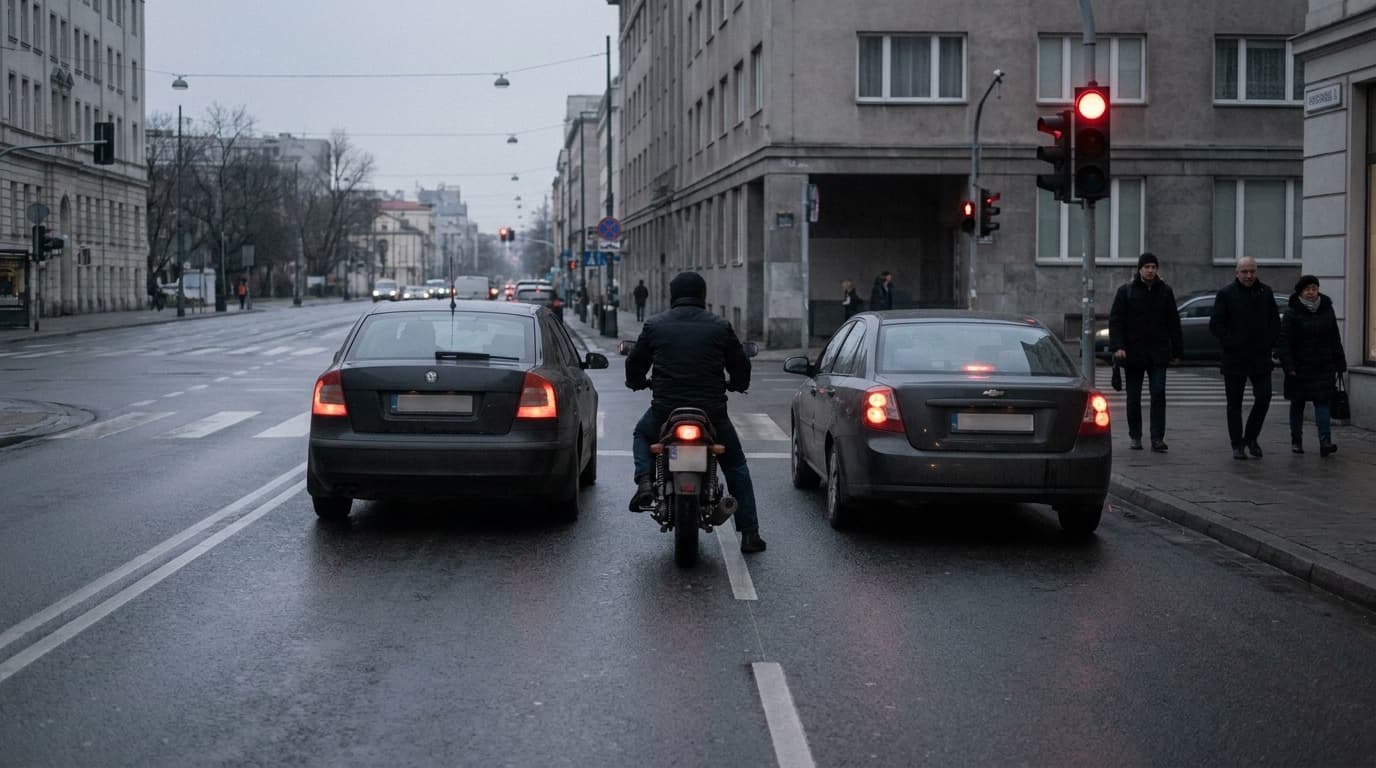
Lane splitting is illegal in Connecticut. Conn. Gen. Stat. 14-289b(b)(2) says the operator of a motorcycle shall not "operate a motorcycle between lanes of traffic," and the section has no exception for stopped traffic, so lane filtering is not authorized either. A violation is an infraction. For how other states handle the same question, see our guide to lane splitting laws by state.
Information last verified on 2026-10-08. This article has not been reviewed by a licensed lawyer.
Jurisdiction scope: This article covers Connecticut state law: the motorcycle operation rules in Conn. Gen. Stat. 14-289b, the single-lane rule in 14-236, the definition of motorcycle in 14-1(61), the passing-on-the-right rule in 14-233, and the infraction fine rules in 51-164m. It does not cover municipal ordinances, license suspension or insurance consequences, or the law of other states.
What Connecticut's statute says
Section 14-289b(b) is the controlling text. It reads:
"(b) The operator of a motorcycle shall not (1) overtake and pass, in the same single traffic lane occupied by such motorcycle, any motor vehicle other than a motorcycle, or (2) operate a motorcycle between lanes of traffic. An autocycle shall not overtake and pass any motor vehicle operating in the same single traffic lane occupied by such autocycle."
The two clauses are joined by "or," so each is a separate prohibition. Clause (2) covers riding between lanes. Clause (1) covers squeezing past a car, truck or other non-motorcycle vehicle within a single lane.
Connecticut's wording is shorter than some states' rules. It bans operating "between lanes of traffic" and does not add language about rows of vehicles, but it also contains no carve-out for traffic that is stopped or crawling.
Splitting, filtering and riding two abreast
| Maneuver | What it means | Connecticut rule |
|---|---|---|
| Lane splitting | Riding between lanes of moving traffic | Prohibited by 14-289b(b)(2) |
| Lane filtering | Riding between lanes of stopped or slow traffic | No exception in 14-289b; the between-lanes ban in (b)(2) contains no speed or stopped-traffic condition |
| Passing in the same lane | Passing a car inside its own lane | Prohibited by 14-289b(b)(1) when the vehicle being passed is not a motorcycle |
| Shoulder passing | Riding on the shoulder to get past traffic | Restricted by 14-233: passing on the right may not be made by driving off the pavement or main-traveled portion of the highway unless lane designations, signs, signals or markings provide for it |
| Riding two abreast | Two motorcycles side by side in one lane | Allowed; more than two abreast is prohibited by 14-289b(a) |
Section 14-289b(a) also protects a rider's lane: "The operator of a motorcycle shall be entitled to the full use of any single traffic lane, but the operation of more than two motorcycles abreast in any single traffic lane is prohibited."

The only exception in 14-289b is for police. Under subsection (d), "No provision of this section shall apply to a police officer during the performance of his official duties."
The general single-lane rule
Connecticut's general rule for marked multi-lane roads is written for every vehicle. Conn. Gen. Stat. 14-236 provides that on a highway divided into two or more clearly marked lanes, "a vehicle shall be driven as nearly as practicable entirely within a single lane and shall not be moved from such lane until the driver has ascertained that such movement can be made with safety." A violation of that subdivision is also an infraction. Section 14-236 contains no motorcycle carve-out.
Passing on the right is governed by Conn. Gen. Stat. 14-233. It allows passing on the right only when conditions permit it in safety and in listed situations, including when lines of vehicles in adjoining lanes have stopped or slowed, and it provides: "Such movement shall not be made by driving off the pavement or main-traveled portion of the highway except where lane designations, signs, signals or markings provide for such movement." A violation of 14-233 is an infraction. Section 14-233 does not authorize riding between lanes, which 14-289b(b)(2) still bars.
Which vehicles the ban covers
Section 14-1(61) defines a motorcycle as "(A) an autocycle, as defined in this section, or (B) a motor vehicle, with or without a side car, that has (i) not more than three wheels in contact with the ground, (ii) a saddle or seat which the rider straddles or a platform on which the rider stands, and (iii) handlebars with which the rider controls the movement of the vehicle." The same definition states that "Motorcycle" does not include a motor-driven cycle, an electric bicycle or an electric foot scooter. Riders of e-scooters can find the rules that apply to them in our guide to Connecticut e-scooter laws.
Penalty for lane splitting
Under 14-289b(e), "Any person who violates the provisions of this section shall have committed an infraction." The statute does not state a dollar amount for this section.
Infraction fines are set on a schedule kept by the Chief Court Administrator. Conn. Gen. Stat. 51-164m(c)(2) provides that no fine established for a title 14 infraction "may be less than fifty dollars or more than ninety dollars," apart from parking tags. If no fine has been established for a title 14 infraction, 51-164m(e) sets it at $50 until the Chief Court Administrator sets a different fine. On the Judicial Branch infraction schedule effective October 1, 2026, operating a motorcycle between lanes of traffic under 14-289b(b)(2) carries a $50 fine and a total amount due of $117, or $167 in a construction, utility, traffic or fire station work zone. The same $117 total applies to passing within a lane under 14-289b(b)(1) and to riding more than two abreast under 14-289b(a). The schedule treats payment of the total amount due as a plea of nolo contendere and states that no points are assessed against the operator's license when the total amount due is paid to the Centralized Infractions Bureau.
Has Connecticut tried to change the law?
Section 14-289b was last amended in 2015, when P.A. 15-46 added the autocycle sentence. In the 2025 session, Senate Bill 1083 was referred to the Joint Committee on Transportation on January 22, 2025, and the General Assembly's bill status page lists no later action.
If a lane maneuver leads to a crash
Whether a rider followed 14-289b is one fact in a crash claim; it does not settle fault by itself. For how fault, insurance and deadlines work after a motorcycle crash, see our guide to Connecticut motorcycle accident laws, and for crashes generally, Connecticut car accident laws.
Related pages
- Lane splitting laws by state
- Connecticut motorcycle accident laws
- Connecticut car accident laws
- Connecticut e-scooter laws
This article provides general legal information about Connecticut law, not legal advice. For advice about a specific situation, contact a lawyer licensed in Connecticut or the Connecticut Judicial Branch.
Last updated: 2026-10-08.
Frequently Asked Questions
Is lane splitting legal in Connecticut?
No. Conn. Gen. Stat. 14-289b(b)(2) provides that the operator of a motorcycle shall not operate a motorcycle between lanes of traffic, and a violation is an infraction under 14-289b(e).
Is lane filtering legal in Connecticut?
No. Section 14-289b has no exception for stopped or slow-moving traffic; its only exception covers police officers performing official duties. Riding between lanes of stopped cars still falls under the ban in 14-289b(b)(2).
What is the fine for lane splitting in Connecticut?
Lane splitting is an infraction under Conn. Gen. Stat. 14-289b(e). Under 51-164m, a fine the Chief Court Administrator sets for a title 14 infraction must be between $50 and $90, and the Judicial Branch infraction schedule effective October 1, 2026 lists operating between lanes under 14-289b(b)(2) at a $50 fine and a $117 total amount due ($167 in a construction, utility, traffic or fire station work zone).
Can two motorcycles ride side by side in Connecticut?
Yes. Conn. Gen. Stat. 14-289b(a) prohibits more than two motorcycles abreast in a single traffic lane, so two abreast is allowed.
Can a motorcycle pass a car in the same lane in Connecticut?
No. Conn. Gen. Stat. 14-289b(b)(1) bars a motorcycle operator from overtaking and passing, in the same single traffic lane, any motor vehicle other than a motorcycle.
Does Connecticut's lane splitting ban apply to autocycles?
Connecticut's definition of motorcycle in Conn. Gen. Stat. 14-1(61) includes an autocycle. Section 14-289b(b) also says an autocycle shall not overtake and pass any motor vehicle operating in the same single traffic lane.
Is Connecticut changing its lane splitting law?
Section 14-289b was last amended in 2015. A 2025 bill, SB 1083, was referred to the Joint Committee on Transportation on January 22, 2025, and the legislature's status page lists no later action.
Updates
Independently fact-checked against the cited primary sources
The Law Behind This Article
This article rests on the statutory provisions below, held in our own legal record and retrieved from the official source. Tap a section to read the operative text.
Connecticut General Statutes, Title 14 (Motor Vehicles. Use of the Highway By Vehicles. Gasoline), Chapter 248
§ 14-289bOperation of motorcycles and autocycles.In force
(a) The operator of a motorcycle shall be entitled to the full use of any single traffic lane, but the operation of more than two motorcycles abreast in any single traffic lane is prohibited. (b) The operator of a motorcycle shall not (1) overtake and pass, in the same single traffic lane occupied by such motorcycle, any motor vehicle other than a motorcycle, or (2) operate a motorcycle between lanes of traffic. An autocycle shall not overtake and pass any motor vehicle operating in the same single traffic lane occupied by such autocycle. (c) Any person operating a motorcycle manufactured after January 1, 1980, on a highway, shall illuminate the head lamp of such motorcycle at all times it is being operated. (d) No provision of this section shall apply to a police officer during the performance of his official duties. (e) Any person who violates the provisions of this section shall have committed an infraction.
Official text (excerpt) · last checked 2026-07-29 · Read the full text in our law library · Verify at cga.ct.gov
Connecticut General Statutes, Title 14 (Motor Vehicles. Use of the Highway By Vehicles. Gasoline), Chapter 246
§ 14-1Definitions.In forcecited in 3 of our articles
Terms used in this chapter shall be construed as follows, unless another construction is clearly apparent from the language or context in which the term is used or unless the construction is inconsistent with the manifest intention of the General Assembly: (1) “Activity vehicle” means a student transportation vehicle that is used to transport students in connection with school-sponsored events and activities, but is not used to transport students to and from school; (2) “Agricultural tractor” means a tractor or other form of nonmuscular motive power used for transporting, hauling, plowing, cultivating, planting, harvesting, reaping or other agricultural purposes on any farm or other private property, or used for the purpose of transporting, from one farm to another, agricultural implements and farm products, provided the agricultural tractor is not used on any highway for transporting a pay load or for some other commercial purpose; (3) “Antique, rare or special interest motor vehicle” means a motor vehicle twenty years old or older which is being preserved because of historic interest and which is not altered or modified from the original manufacturer's specifications; (4)…
Official text (excerpt) · last checked 2026-07-29 · Read the full text in our law library · Verify at cga.ct.gov
Cited in 102 court opinions in our collectionLatest citing opinion in our collection: 2025
Opinions citing this section in our collection:
- Beloff v. Progressive Casualty Insurance (Supreme Court of Connecticut 1987, 203 Conn. 45)“…38-175a itself would appear to resolve the issue before us. General Statutes § 14-1 (7), 7 however, defines only “commerci…”
- State v. Kluttz (Connecticut Appellate Court 1987, 9 Conn. App. 686)“…for purposes of General Statutes § 14-222a, by reference to General Statutes § 14-1 (41). That statute, in turn, defines “p…”
- Dias v. Adams (Supreme Court of Connecticut 1983, 189 Conn. 354)“…not a “motor vehicle” as *357 delineated in General Statutes § 14-1 (26), 2 to which § 31-293a…”
Identified automatically from the court opinions citing this section — not a ranking of which case controls.
Also relied on in: Connecticut E-Scooter Laws: Sidewalk, Helmet & Age Rules (2026), Connecticut Lemon Law (2026): How to Qualify & Get a Refund
Search our full record of US law — 2.1 million sections, every state + federal →
Sources and References
- Conn. Gen. Stat. 14-289b, Operation of motorcycles and autocycles(cga.ct.gov).gov
- Conn. Gen. Stat. 14-236, single-lane rule on marked multi-lane highways(cga.ct.gov).gov
- Conn. Gen. Stat. 14-233, Passing on right(cga.ct.gov).gov
- Conn. Gen. Stat. 14-1(61), Definition of motorcycle(cga.ct.gov).gov
- Conn. Gen. Stat. 51-164m, fines for infractions set by the Chief Court Administrator(cga.ct.gov).gov
- Connecticut General Assembly, 2025 SB 1083 bill status(cga.ct.gov).gov
- Connecticut Judicial Branch, Mail-In Violations and Infractions Schedule effective October 1, 2026(jud.ct.gov).gov