EU Self-Driving Car Regulation: Rules and Tesla FSD (2026)
Independently fact-checked against primary sources (last audited October 1, 2026). · 19 primary sources cited on this page. How we verify our legal content
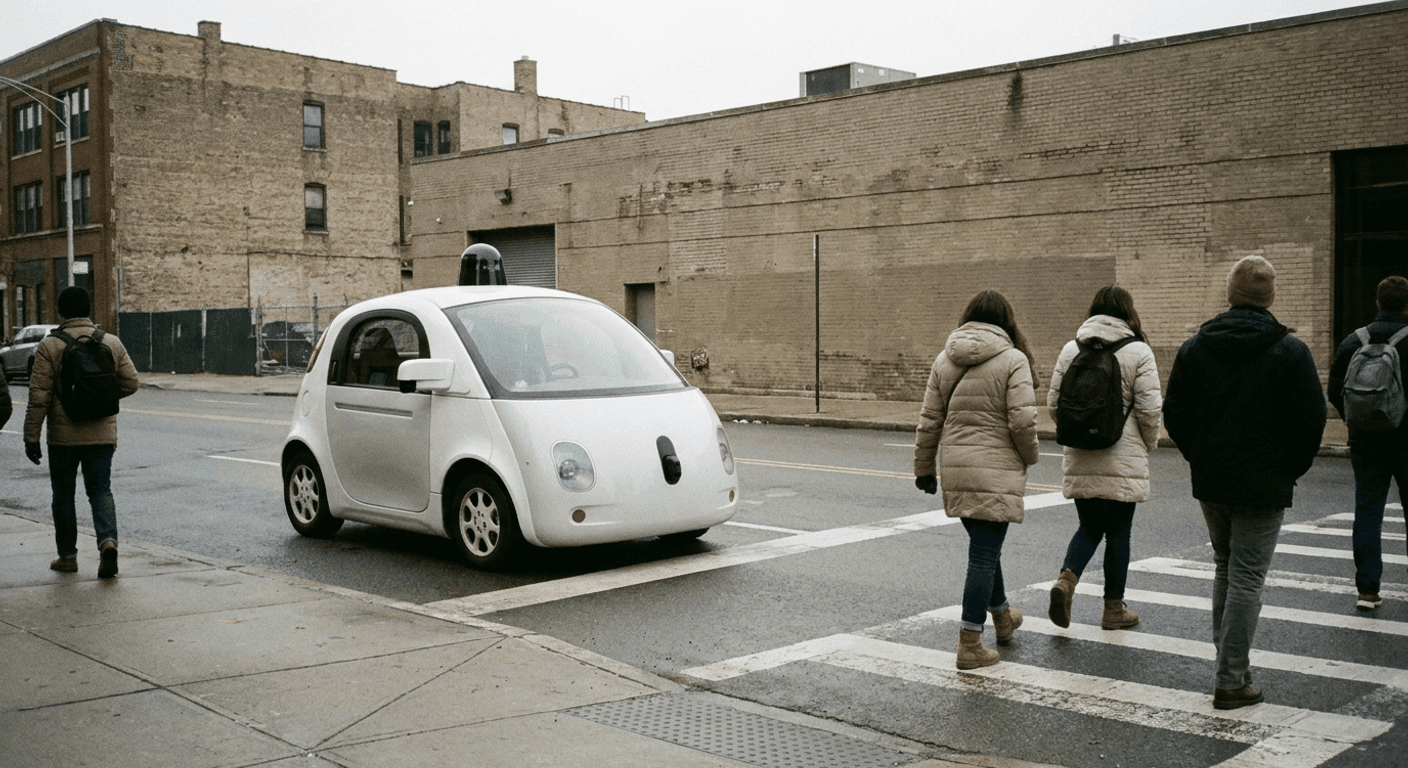
The EU does not have a single law that lets self-driving cars onto the road. What the EU decides is whether a vehicle and its automated system may be sold: it sets the type-approval rules, through the General Safety Regulation (EU) 2019/2144, Implementing Regulation (EU) 2022/1426 for driverless vehicles, and UN vehicle regulations such as R157 (Level 3) and R171 (Level 2 driver assistance). Each member state still decides how those vehicles may be used on its roads, who counts as the driver, which permits an operator needs, and who pays when something goes wrong.
That split explains why Tesla's FSD (Supervised) is usable in some EU countries and not others as of 30 September 2026. It holds a provisional Dutch approval that other member states may choose to accept, and an EU-wide decision is not expected before December 2026.
What does the EU decide, and what do member states decide?
The cleanest way to read EU self-driving car law is to ask two separate questions. First: may this vehicle, with this automated system, be approved and sold? That is EU law. Second: may it be driven, or drive itself, on this road, and who is responsible? That is mostly national law.
The EU's own driverless-vehicle regulation says so. Recital 7 of Implementing Regulation (EU) 2022/1426 states that it is "without prejudice to the right of Member States to regulate the circulation and the safety of operation of fully automated vehicles in traffic." Member states are also not obliged to designate the areas or routes where such vehicles may run.
| Question | Who decides | Main rules |
|---|---|---|
| Can the vehicle or system be type-approved and sold in the EU? | EU (applied by national approval authorities) | Regulation (EU) 2018/858; General Safety Regulation 2019/2144; Implementing Regulation 2022/1426 |
| Technical rules for Level 2 and Level 3 systems | UN regulations applied in the EU | UN R171 (DCAS, Level 2); UN R157 (ALKS, Level 3) |
| New technology that does not fit the existing rules | One member state provisionally, then the EU by committee vote | Article 39 of Regulation 2018/858 |
| Where a driverless vehicle may operate, and with what permit | Member state | National road traffic law (for example Germany's StVG) |
| Who counts as the driver, phone and drink-driving rules | Member state | National road traffic codes |
| Liability for a crash | Member state, with an EU floor for defective products | National liability law; Product Liability Directive 2024/2853 |
| Compulsory motor insurance | Member state, under an EU directive | Directive 2009/103/EC |
The General Safety Regulation (EU) 2019/2144
The General Safety Regulation is the EU law that brought automated vehicles into the type-approval system. It has applied since 6 July 2022 and draws the line that the rest of EU law builds on:
- An automated vehicle is one "designed and constructed to move autonomously for certain periods of time without continuous driver supervision but in respect of which driver intervention is still expected or required." This is the Level 3 territory.
- A fully automated vehicle is one "designed and constructed to move autonomously without any driver supervision." This covers driverless (Level 4) vehicles.
Article 11 requires both kinds to meet technical specifications in implementing acts covering, among other things, systems that replace the driver's control of steering, accelerating and braking, systems that give the vehicle real-time information about its surroundings, driver availability monitoring, and event data recorders for automated vehicles. The Commission must review the regulation by 7 July 2027 and every five years after that.
Driver-assistance features, where the driver keeps supervising the driving, are not "automated vehicles" in this sense. Systems of that kind are covered by a separate UN rule, Regulation 171.
Level 2, Level 3 and driverless: which rule covers what
The levels below follow the SAE scale explained in levels of driving automation.
| Level | What the system does | Approval rule | Who is responsible while it runs |
|---|---|---|---|
| Level 2 (driver assistance) | Assists with steering, braking and acceleration on a sustained basis while the driver supervises | UN Regulation 171 (DCAS), in force since 30 September 2024 | The driver, who must monitor the road and vehicle at all times |
| Level 3 (conditional automation) | Drives itself in limited conditions, such as on motorways, and can ask the driver to take back control | UN Regulation 157 (ALKS) | Set by national law; the driver must respond to a takeover request |
| Level 4 (driverless) | Drives with no driver in a defined area or on a defined route | Implementing Regulation 2022/1426 (the new UN ADS regulation adopted June 2026 is due to be added to EU type-approval law by a Commission delegated act planned for late 2026) | Set by national law (operators, supervisors, keepers) |
Level 2: UN Regulation 171 (DCAS)
UN Regulation 171 covers driver control assistance systems, which UNECE describes as systems that help the driver control the vehicle "while not taking over the entire driving task." UNECE says they correspond to SAE Level 2 and that the driver "retains responsibility for the control of the vehicle." The regulation entered into force on 30 September 2024.
It also targets overreliance. Manufacturers must warn drivers who are not engaged and must explain the system's limits and the driver's responsibility to buyers, including in advertising and at dealerships. Tesla's FSD (Supervised) is a Level 2 system of this kind; the regulators that have assessed it describe it that way.
Level 3: UN Regulation 157 (ALKS)
UN Regulation 157 on Automated Lane Keeping Systems was, in UNECE's words, the first binding international regulation on "level 3" vehicle automation, adopted in June 2020. An amendment adopted in June 2022 raised the maximum speed for cars and light vans to 130 km/h on motorways and allowed automated lane changes, entering into force in January 2023 for contracting parties that apply it.
The conditions are narrow. UNECE says these systems can be activated only on roads where pedestrians and cyclists are prohibited and where a physical separation divides opposing traffic, and that the system can ask the driver to retake control at any moment. When the Commission adopted the driverless regulation in 2022, it explained that automated (Level 3) driving systems would be covered through a reference to UN Regulation 157 in the General Safety Regulation rather than in 2022/1426.
What a Level 3 driver may do while the system drives (look away, use a screen) is not set by R157. It is a question of national traffic law; Germany's answer is in Germany's self-driving car laws.
Driverless vehicles: Implementing Regulation (EU) 2022/1426
Implementing Regulation (EU) 2022/1426 is the EU's approval regime for the automated driving system of fully automated vehicles in categories M (passenger) and N (goods). As adopted in 2022, it covers three use cases:
- Predefined area: vehicles carrying passengers or goods within a predefined area.
- Hub-to-hub: vehicles on a predefined route with fixed start and end points.
- Automated valet parking (AVP): vehicles that park themselves within parking facilities.
The small-series limit
From 2022, driverless vehicles reached the market through a small-series scheme. As the Commission explains in Implementing Regulation (EU) 2026/481, the exemptions under that scheme apply only on condition that "the number of registrations of a vehicle type in the Union per year does not exceed 1 500 registrations." When adopting 2022/1426, the Commission said it would continue work on requirements for EU whole-vehicle approval of fully automated vehicles "produced in unlimited series."
What changed in 2026: Regulations (EU) 2026/481 and 2026/1188
Commission Implementing Regulation (EU) 2026/481 of 3 March 2026 amends 2022/1426. It was published in the Official Journal on 4 March 2026 and entered into force on the twentieth day after publication, 24 March 2026.
Its recitals explain the purpose: technology has moved on, and the Commission considered it "possible and appropriate to lift the small series limitation starting with the ('AVP') use case." Before allowing AVP vehicles in unlimited numbers, it adds technical requirements on safety performance and validation, given that AVP operates in parking areas at very low speed. The new rules sit in a new Annex V, and the definition of AVP was rewritten.
A companion act, Commission Delegated Regulation (EU) 2026/1188 of 23 March 2026 (published 2 June 2026, in force 22 June 2026), then added automated valet parking to the list in Annex II to Regulation (EU) 2018/858 so that AVP vehicles can receive EU whole-vehicle type-approval in unlimited series.
So the change in 2026 concerns automated valet parking only. Neither act lifts the 1,500-registration limit for driverless vehicles in a predefined area or on hub-to-hub routes.
An EU approval still needs a national green light
An EU approval under 2022/1426 does not by itself put a driverless vehicle on a public road. Germany's Road Traffic Act shows how the layers fit. Under § 1e(1) StVG, operating a vehicle with an autonomous driving function is lawful only if, among other conditions, it has a national operating permit "oder eine Typgenehmigung nach der Durchführungsverordnung (EU) 2022/1426" (or a type-approval under Implementing Regulation (EU) 2022/1426), and it is used in an operating area approved by the competent authority. The EU approval covers the vehicle; the national authority approves where it runs.
The UN regulation on automated driving systems (June 2026)
On 24 June 2026, UNECE announced that its World Forum for Harmonization of Vehicle Regulations (WP.29) had adopted the first global regulatory framework for fully driverless automated driving systems. In that 24 June 2026 announcement, UNECE said the regulation "enters into force in about a month."

According to UNECE, the regulation requires:
- an audited safety management system covering the whole life of the system;
- credible testing, including virtual test tools;
- a safety case showing the system poses no unreasonable risk;
- in-service monitoring and reporting; and
- a data storage system that records safety-relevant data.
It also requires the system's performance to match or exceed that of "a competent human driver." UNECE lists the EU among the markets that endorsed it, alongside Canada, China, Japan, the UK and the US. WP.29 also amended around ninety existing UN regulations so they can apply to vehicles without traditional driver controls.
In the EU, the Commission plans to add the new UN ADS regulation to the annexes of the General Safety Regulation by a delegated act; as of September 2026 that act was still in preparation, with adoption planned for the fourth quarter of 2026.
A UN regulation sets technical approval requirements. It does not by itself decide where a driverless vehicle may operate in any EU country; that remains a national question, as described above.
Tesla FSD in Europe: the Article 39 route
Tesla's FSD (Supervised) did not fit neatly into the existing approval rules, so it reached Europe through the exemption for new technologies in Article 39 of Regulation (EU) 2018/858. This is the route behind every "Tesla FSD approved in Europe" headline, and it explains why approval is country by country.
How Article 39 works
- A manufacturer may apply for an EU type-approval for technology "incompatible with one or more regulatory acts" in the EU rules, if it shows at least an equivalent level of safety.
- Granting it requires authorisation by the Commission, through an implementing act adopted under the examination procedure, with the Technical Committee on Motor Vehicles (TCMV).
- While that is pending, the national approval authority "may grant a provisional EU type-approval, valid only in the territory of the Member State of that approval authority."
- Other member states "may accept the provisional EU type-approval" within their territory, by telling the issuing authority in writing.
- If the Commission refuses the authorisation, the provisional approval "shall be revoked six months after the date of the implementing act." Vehicles manufactured in conformity with it before then may still be placed on the market, registered or enter into service in member states that accepted it.
In the TCMV, member states vote under the examination procedure by the qualified majority defined in the EU Treaty: at least 55% of member states, at least 15 of them, representing at least 65% of the EU population.
The Dutch approval and national recognitions (as of 30 September 2026)
On 10 April 2026, the Netherlands Vehicle Authority (RDW) issued a type approval for FSD (Supervised). RDW's announcement says it is "currently valid only in the Netherlands," that the driver "remains responsible," and that an EU-wide approval requires a majority in the responsible committee. RDW's page also notes that Ford's BlueCruise hands-off motorway system has an approval via Article 39.
Several member states have since accepted the Dutch approval on their own territory:
| Member state | Status | Source |
|---|---|---|
| Netherlands | Provisional approval issued 10 April 2026 | RDW announcement |
| Estonia | Recognised, announced 29 May 2026; describes FSD as an SAE Level 2 system | Transpordiamet |
| Denmark | Recognised, announced 9 June 2026 | Færdselsstyrelsen |
| Czechia | Recognised 21 September 2026 under Article 39 of Regulation 2018/858 | Ministry of Transport |
| Slovenia | Recognised 7 September 2026 | AVP (Slovenian Traffic Safety Agency) |
| Others | Lithuania and Belgium reported by other member states' authorities (Estonia, Slovenia, Czechia); Croatia's recognition reported 29 September 2026 | Regulator pages and press reports |
When Czechia recognised it on 21 September 2026, its ministry said it had joined the Netherlands and five other European states. Germany, France and most other member states had not recognised the approval as of 30 September 2026; Germany's KBA said in July 2026 that it was still examining it and could not give a decision date. Country-by-country detail, including Germany's and Sweden's positions, is on where Tesla FSD is legal.
When will the EU vote on Tesla FSD?
Not on 6 October 2026, according to press reports of the TCMV's draft agenda. Reports in late September 2026 said the 6 October meeting lists the Dutch request only for a 25-minute continuation of the discussion, with no vote, and that the committee does not meet again until December. So the earliest EU-wide decision is December 2026, and that date comes from press reports, not a published Commission decision.
Two outcomes follow from Article 39:
- If the committee gives a positive opinion, the Commission adopts the authorisation, and the approval can then apply across the EU.
- If the Commission refuses, the Dutch provisional approval is revoked six months after the refusing act. Denmark's authority says Danish recognition would lapse at the same time. Nothing lapses automatically on a fixed date before that.
Whatever happens, FSD (Supervised) remains a Level 2 system: the driver is responsible.
What member states decide for themselves
Because EU law stops at the vehicle, the rules people meet on the road are national. In practice member states decide:
- Traffic rules and driver duties, including whether a Level 3 driver may look away, and phone and drink-driving rules.
- Permits for driverless operation, such as Germany's approved operating areas and technical supervisor rules.
- Civil and criminal liability for crashes and traffic offences, and how keepers, drivers and operators share it.
- Insurance, within the EU's compulsory motor insurance framework.
- Testing and pilots on public roads.
- Whether to accept a provisional Article 39 approval issued by another member state.
National pages: Germany, France and the Netherlands. The UK left the EU type-approval system, so EU approvals and recognitions do not apply there; it has its own Automated Vehicles Act 2024. For how countries outside Europe compare, see the world self-driving car laws hub.
Who is liable for a self-driving car crash in the EU?
There is no EU-wide self-driving liability regime. Liability starts with national law, with two EU layers on top.
The driver, for Level 2
For driver-assistance systems such as FSD (Supervised), the driver is responsible for the driving. RDW, the Danish and Czech authorities and UNECE all say so. A speeding offence or collision while the system is engaged is treated under the country's ordinary traffic, criminal and insurance rules.
Motor insurance
Directive 2009/103/EC requires each member state to ensure that "civil liability in respect of the use of vehicles normally based in its territory is covered by insurance." The extent of that liability, and so who an injured person claims against first, is set by national law.
Product liability: Directive (EU) 2024/2853
The new Product Liability Directive matters for automated driving because it treats software as a product. Its definition of "product" expressly "includes electricity, digital manufacturing files, raw materials and software."
Key points:
- Transposition deadline: member states must bring their laws into line "by 9 December 2026."
- Which products: it applies to products "placed on the market or put into service after 9 December 2026." The 1985 directive it replaces continues to apply to products placed on the market or put into service before that date.
- Software updates: an economic operator (such as the manufacturer) cannot escape liability by arguing a defect arose after sale where the defect is due to software, "including software updates or upgrades," or "a lack of software updates or upgrades necessary to maintain safety," as long as that is within the manufacturer's control.
- National rules survive: it does not affect an injured person's rights under national rules on contractual liability, or on non-contractual liability on grounds other than a product defect (which includes national strict keeper liability as well as fault-based claims).
The directive sets rules on liability for defective products. Whether a particular crash involved a defect, and how fault is shared with a driver or operator, depends on the facts and on national law. For how the same questions play out in the US, see who is liable in a self-driving car accident.
This page is general legal information, not legal advice. EU and national rules on automated driving are changing quickly; check the regulator before relying on any single status.
Frequently Asked Questions
Are self-driving cars legal in the EU?
There is no single EU answer. EU law decides whether an automated vehicle or system can be type-approved and sold; each member state decides whether and where it may be used on its roads. Level 3 systems can be approved under UN Regulation 157 and driverless vehicles under Implementing Regulation (EU) 2022/1426, but a driverless vehicle still needs national permission to operate, such as an approved operating area in Germany.
What is the EU regulation for autonomous vehicles?
The core rules are the General Safety Regulation (EU) 2019/2144, which defines automated and fully automated vehicles, and Implementing Regulation (EU) 2022/1426, which sets approval rules for driverless vehicles in a predefined area, on hub-to-hub routes and for automated valet parking. Implementing Regulation (EU) 2026/481 amended it in 2026. Level 2 and Level 3 systems are approved under UN Regulations 171 and 157.
Is Tesla FSD approved in the EU?
Not EU-wide, as of 30 September 2026. The Dutch authority RDW granted a provisional approval on 10 April 2026 under Article 39 of Regulation (EU) 2018/858, valid in the Netherlands. Other member states may accept it on their territory; Denmark, Estonia, Czechia and Slovenia have done so on their regulator pages, and others have been reported. An EU-wide authorisation needs a qualified majority in the Technical Committee on Motor Vehicles.
When will the EU vote on Tesla FSD?
Press reports of the draft agenda say the 6 October 2026 TCMV meeting lists the Dutch request for discussion only, with no vote, and that the next meeting is in December 2026. So December 2026 is the earliest reported date for a vote. No Commission decision has been published.
What happens to FSD in Europe if the EU says no?
Under Article 39(7) of Regulation (EU) 2018/858, the provisional approval is revoked six months after the date of the Commission's refusing implementing act. Denmark's authority says its national recognition would lapse at the same time. Vehicles manufactured in conformity with the approval before it ceased to be valid may still be placed on the market or registered in member states that accepted it.
Did the EU lift the 1,500-vehicle limit for driverless cars?
For automated valet parking only. Implementing Regulation (EU) 2026/481 (in force 24 March 2026) added AVP technical requirements, and Delegated Regulation (EU) 2026/1188 (in force 22 June 2026) allows EU whole-vehicle type-approval of AVP-equipped vehicles produced in unlimited series. Neither act lifts the limit for driverless vehicles in a predefined area or on hub-to-hub routes.
Is there a global law for self-driving cars?
On 24 June 2026, UNECE announced that WP.29 had adopted the first global regulation for fully driverless automated driving systems, requiring a safety management system, a safety case, credible testing, in-service monitoring and data recording. In that announcement UNECE said it would enter into force in about a month. It sets vehicle approval requirements; countries still decide where such vehicles may operate.
Who is liable if a self-driving car crashes in the EU?
It depends on national law. For Level 2 systems such as Tesla FSD (Supervised), the driver is responsible. Motor insurance is compulsory under Directive 2009/103/EC. The new Product Liability Directive (EU) 2024/2853 treats software as a product and, once transposed by 9 December 2026, applies to products placed on the market or put into service after that date.
Does the Product Liability Directive cover software updates?
Yes. Under Directive (EU) 2024/2853, an economic operator (such as the manufacturer) is not exempt from liability where a defect is due to software, including software updates or upgrades, or to a lack of updates needed to maintain safety, if that is within the manufacturer's control. It applies to products placed on the market or put into service after 9 December 2026.
Updates
Independently fact-checked against the cited primary sources
Sources and References
- Regulation (EU) 2019/2144 (General Safety Regulation): definitions of automated and fully automated vehicle (Art. 3), Article 11 requirements, application from 6 July 2022, Article 14 review by 7 July 2027(eur-lex.europa.eu).gov
- Commission Implementing Regulation (EU) 2022/1426: ADS type-approval of fully automated vehicles, three use cases (Art. 1), recital 7 on member states' right to regulate circulation(eur-lex.europa.eu).gov
- Commission Implementing Regulation (EU) 2026/481 of 3 March 2026 amending 2022/1426 (OJ 4 March 2026): small series limit of 1,500 registrations, lifting the limit starting with automated valet parking, new Annex V(eur-lex.europa.eu).gov
- Regulation (EU) 2018/858: Article 39 exemptions for new technologies (provisional approval, acceptance by other member states, revocation after refusal), Article 83 TCMV(eur-lex.europa.eu).gov
- Regulation (EU) No 182/2011, Article 5: examination procedure voting by qualified majority(eur-lex.europa.eu).gov
- Treaty on European Union, Article 16(4): definition of qualified majority(eur-lex.europa.eu).gov
- Directive (EU) 2024/2853 on liability for defective products: software as a product, scope from 9 December 2026, software-update liability, transposition by 9 December 2026; Art. 2(4)(b) national rules preserved; Art. 11(2) economic operator(eur-lex.europa.eu).gov
- Directive 2009/103/EC (Motor Insurance Directive), Article 3: compulsory insurance of vehicles(eur-lex.europa.eu).gov
- UNECE, 24 June 2026: WP.29 adopts first-ever global rules allowing fully autonomous vehicles (ADS regulation)(unece.org).gov
- UNECE, 4 October 2024: UN Regulation No. 171 on Driver Control Assistance Systems in force (SAE Level 2; driver retains responsibility)(unece.org).gov
- UNECE, 22 June 2022: amendment to UN Regulation No. 157 (ALKS) extends automated driving up to 130 km/h; conditions of use(unece.org).gov
- RDW (Netherlands Vehicle Authority), 10 April 2026: type approval of Tesla FSD Supervised with provisional validity in the Netherlands(rdw.nl).gov
- Czech Ministry of Transport, 21 September 2026: recognition of the RDW provisional approval under Article 39 of Regulation (EU) 2018/858(md.gov.cz).gov
- Faerdselsstyrelsen (Danish Road Traffic Authority), 9 June 2026: FSD Supervised provisionally approved in Denmark; effect of an EU rejection(fstyr.dk).gov
- Transpordiamet (Estonian Transport Administration), 29 May 2026: recognition of the Dutch type approval of Tesla's driver assistance system(transpordiamet.ee).gov
- AVP (Slovenian Traffic Safety Agency): Slovenia recognised the provisional approval on 7 September 2026; also lists Lithuania, Estonia, Denmark and Belgium as recognising states(avp-rs.si).gov
- HRT (Croatian Radiotelevision), 29 September 2026: recognition of the provisional approval in Croatia (report)(magazin.hrt.hr)
- electrive, 28 September 2026: 6 October TCMV agenda lists Tesla FSD for discussion only; earliest vote December (report)(electrive.com)
- KBA reply of 8 July 2026 to a freedom-of-information request on the Tesla FSD Supervised approval (republished by FragDenStaat)(fragdenstaat.de)
- Strassenverkehrsgesetz (StVG) section 1e: operation of vehicles with autonomous driving function; EU type-approval under 2022/1426 plus approved operating area(gesetze-im-internet.de).gov
- Commission Delegated Regulation (EU) 2026/1188 of 23 March 2026 (OJ 2 June 2026, in force 22 June 2026): automated valet parking added to Annex II of Regulation (EU) 2018/858, enabling EU whole-vehicle type-approval in unlimited series(eur-lex.europa.eu).gov
- European Commission, Have your say initiative 18732: annual update of references in the General Safety Regulation annexes (delegated act to add the new UNECE automated driving systems regulation, in preparation, adoption planned Q4 2026)(ec.europa.eu).gov