
Vermont
Vermont Ring Doorbell Laws: What You Need to Know in 2026
Independently fact-checked against primary sources (last audited August 17, 2026). · Reviewed by the RecordingLaw editorial team. · Law checked current as of August 17, 2026. · 8 primary sources cited on this page. How we verify our legal content
Ring doorbells are legal in Vermont. Vermont has no state wiretapping statute, so federal law under 18 U.S.C. 2511 supplies the audio-consent rule: recording is lawful when you participate in the conversation. Video of your porch and public areas is permitted under state law.
Ring doorbells capture video and audio of activity at your front door. In Vermont, the legality of those recordings depends on where the camera points and whether you participate in recorded conversations. Vermont occupies a unique position among all 50 states: it has never enacted its own wiretapping or eavesdropping statute. Federal law fills that gap, making Vermont a one-party consent state by default.
This guide covers how federal and Vermont state law apply to Ring doorbells, explains the video surveillance rules that protect privacy in residential settings, and provides practical guidance on HOA restrictions, landlord-tenant rights, and law enforcement access to footage.

Audio Recording Laws and Ring Doorbells
Vermont is the only state in the nation without a comprehensive wiretapping statute. While every other state has enacted at least one law restricting eavesdropping or recording of private conversations, Vermont residents rely on federal wiretap law (18 U.S.C. 2511), Vermont Supreme Court case law, and the Vermont Constitution's Article 11 privacy protections.
One-Party Consent Under Federal Law
Under 18 U.S.C. 2511, a person may lawfully intercept a wire, oral, or electronic communication if that person is a party to the communication or if one of the parties has given prior consent. The interception cannot be for the purpose of committing a criminal or tortious act.
For Ring doorbell owners in Vermont, this federal standard means audio recording is legal when you participate in a conversation through Ring's two-way talk feature. Your consent as one party to the conversation satisfies the federal requirement.
When Audio Recording Gets Risky
The one-party consent exception requires that a consenting party actually participate in the communication. If your Ring doorbell picks up a private conversation between two visitors on your porch while you are not involved, no party to that conversation may have consented to the recording. Capturing that audio could violate the federal wiretap act.
The federal law also prohibits intercepting wire communications (phone calls) without the consent of at least one party. If your Ring microphone picks up someone's phone call near your doorbell, that interception raises concerns under 18 U.S.C. 2511.
Vermont Constitution Article 11
The Vermont Constitution provides broader privacy protections than many states. Article 11 protects the right of people to be secure in their persons, houses, papers, and possessions. Vermont courts have interpreted this provision to provide stronger privacy rights than the Fourth Amendment in some contexts, though no Vermont court has directly applied Article 11 to Ring doorbell recordings as of April 2026.
Managing Audio on Your Ring Device
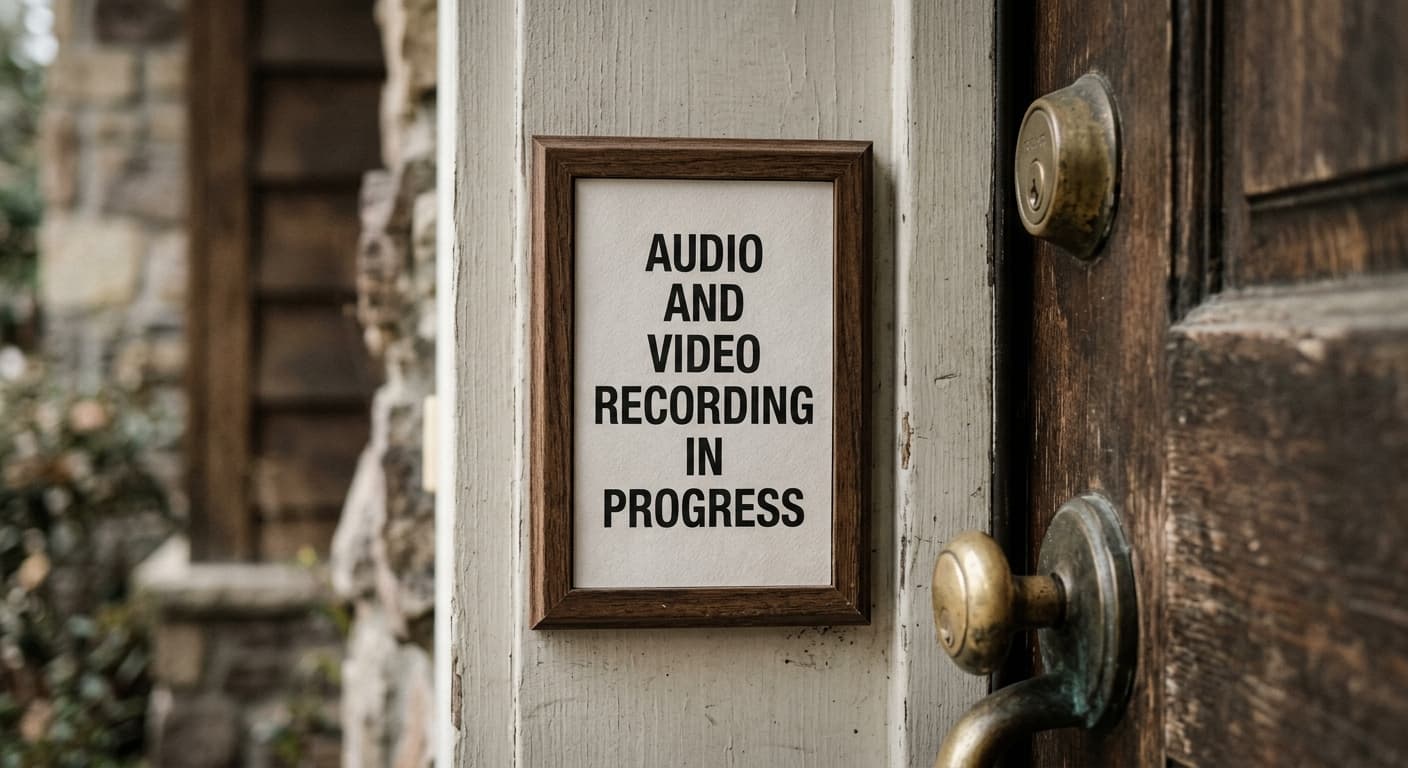
Ring doorbells allow users to disable audio recording through the app settings. Vermont residents who want to avoid any potential wiretap issues can turn off the microphone entirely. Posting a visible notice near the doorbell stating that audio and video recording is in progress provides additional protection by informing visitors that recording is taking place.

Video Recording Laws and Ring Doorbells
Vermont has no general statute prohibiting outdoor video surveillance on residential property, and recording video from a Ring doorbell pointed at your own porch, driveway, walkway, or public areas like sidewalks and streets is legal. One narrower restriction does apply. Since June 6, 2024, 13 V.S.A. 3835 has regulated where a camera may be placed, barring placement on privately owned real property without the owner's prior written consent.
Voyeurism and Surveillance: 13 V.S.A. 2605
13 V.S.A. 2605 is Vermont's primary statute governing surveillance privacy. This law prohibits several specific types of recording without consent.
Surveillance within a home or residence. No person may intentionally conduct surveillance or photograph, film, or record another person without that person's knowledge and consent while the person is in a place where they have a reasonable expectation of privacy within a home or residence. The statute defines "surveillance" as secret observation of another person's activities for the purpose of spying upon and invading their privacy.
Recording intimate areas. No person may intentionally view, photograph, film, or record the intimate areas of another person without consent while the person is in a place where they have a reasonable expectation of privacy.
Recording during sexual conduct. No person may photograph, film, or record another person without consent while that person is in a private place and engaged in sexual conduct.
How This Applies to Ring Doorbells
A standard Ring doorbell installation facing outward toward a porch and public area does not violate 13 V.S.A. 2605. The statute targets recording within private spaces, not outdoor areas visible from public vantage points. The risk arises only if a Ring camera angle captures through a neighbor's window into a private interior space.
Where You Put the Camera: 13 V.S.A. 3835
Vermont's newest camera-specific law took effect on June 6, 2024. 13 V.S.A. 3835 provides that a person "shall not place a camera or other surveillance device on any privately owned real property with the intent to conduct surveillance on a person or the property unless the person has obtained prior written consent from the property owner." A violation is a civil penalty of up to $50 for a first violation and up to $250 for a second or subsequent violation. Law enforcement officers acting for legitimate law enforcement purposes are exempt.
This statute governs placement, not camera angle. Mounting your own Ring doorbell on your own house does not run into it, because you are the property owner whose consent the statute asks for. It matters when the camera goes up on land or a building someone else owns: a neighbor's fence or tree, a shared structure in a condominium, or a rental unit owned by a landlord.
Two features of the text limit its reach for ordinary doorbell cameras. First, it covers a device placed "with the intent to conduct surveillance," which 3835(d)(2) defines as observation with enough visual clarity to obtain information about a person's identity, habits, conduct, movements, or whereabouts, or to determine unique identifying features of the property. Second, 3835(d)(3) defines a "surveillance device" as "a device hidden or obscured from plain view" that invades a reasonable expectation of privacy. A doorbell camera mounted openly beside a front door is not hidden or obscured, which is a strong argument that it sits outside the definition. The statute is new and that reading has not been tested, so when the camera is going on property you do not own, the safe course is to get the owner's written consent first.
Where the Line Falls
Vermont courts apply the reasonable expectation of privacy standard. A Ring doorbell that records:
- Your own porch, driveway, and walkway: Legal
- The public sidewalk and street: Legal
- A neighbor's front yard visible from public areas: Generally legal
- Through a neighbor's window into private rooms: Potentially illegal under 13 V.S.A. 2605
- Mounted on a neighbor's property or a shared structure without the owner's prior written consent: Restricted by 13 V.S.A. 3835
Positioning your Ring doorbell to avoid capturing interior views of neighboring homes keeps you within safe legal boundaries.

HOA and Ring Doorbells in Vermont
Vermont's approach to HOA regulation of security cameras differs from states like Texas or Utah that have specific statutory protections for camera installation.
Vermont Common Interest Ownership Act
Vermont's Common Interest Ownership Act (27A V.S.A.) governs condominiums, planned communities, and cooperatives created after January 1, 1999. This statute gives associations the authority to adopt and enforce rules through declarations and bylaws, including rules about exterior modifications and devices.
No Specific Camera Protection Statute
Unlike some states, Vermont does not have a statute specifically preventing HOAs from restricting security camera installation. This means a Vermont HOA or condominium association can adopt rules that limit or regulate Ring doorbell installation if those rules are included in the declaration, bylaws, or duly adopted community rules.
What HOAs Typically Regulate
Common restrictions that Vermont HOAs may impose include:
- Requiring architectural review approval before installing exterior devices
- Limiting camera placement on common elements or shared structures
- Restricting camera angles that capture common areas or neighboring units
- Specifying aesthetic requirements for visible devices
Practical Approach
Before installing a Ring doorbell in a Vermont HOA community, review your association's governing documents, including the declaration, bylaws, and any adopted rules regarding exterior modifications. If the documents are silent on security cameras, requesting approval from the board or architectural review committee creates a record and prevents potential disputes.
If your association attempts to ban security cameras entirely, consider raising the issue at a board meeting and pointing to the safety benefits. While Vermont law does not prohibit such a ban, many associations adopt reasonable compromises that allow cameras within certain guidelines.

Landlord and Tenant Rights
Vermont's residential rental law under 9 V.S.A. Chapter 137 provides a strong framework for tenant rights but does not specifically address doorbell camera installation.
Tenant Installation
Tenants in Vermont who want to install a Ring doorbell should:
- Get written landlord approval before making any exterior modifications. This is more than good practice. Under 13 V.S.A. 3835, placing a camera on privately owned real property to conduct surveillance requires the property owner's prior written consent, and the statute defines "property owner" to include a person who owns, leases, licenses, or otherwise controls ownership or use of the land. A landlord plainly fits that definition, and a tenant who leases the unit arguably fits it too, so written permission from the landlord settles the question either way.
- Agree to restore the property to its original condition when the lease ends, including removing the Ring doorbell and repairing any mounting holes.
- Ensure the camera does not capture areas beyond the tenant's leased space in ways that could violate other tenants' privacy under 13 V.S.A. 2605.
Landlord Obligations
9 V.S.A. 4460 governs a landlord's right of entry, generally requiring at least 48 hours' notice before entering a rental unit for inspections, repairs, or showings. While a Ring doorbell is not a required security device, landlords who choose to install them on rental property exteriors should:
- Disclose the presence of recording devices to all tenants
- Avoid pointing cameras at areas where tenants have a reasonable expectation of privacy
- Be aware that audio recording without tenant consent raises concerns under federal wiretap law
Vermont Tenant Protections
Vermont has some of the strongest tenant protections in the country. Landlords must provide reasonable notice before entering a rental unit (generally 48 hours under 9 V.S.A. 4460). A Ring doorbell does not change this requirement, but footage from the device could document whether a landlord complied with notice provisions.

Law Enforcement Access to Ring Footage
How police in Vermont access Ring doorbell footage involves constitutional protections, Vermont's electronic privacy law, and Amazon's corporate policies.
Vermont Electronic Communication Privacy Act
The Vermont Electronic Communication Privacy Act (13 V.S.A. Chapter 232) enacted in 2015 provides protections against compelled production of electronic information. Under 13 V.S.A. 8102, law enforcement cannot compel the production of electronic information from a service provider or subscriber without a warrant, court order, or other authorized legal process.
This statute provides Vermont residents with stronger protections than many other states when it comes to government access to digital records, including Ring doorbell footage stored on Amazon's servers.
Constitutional Protections
The Fourth Amendment and Vermont's Article 11 protect against unreasonable searches and seizures. Vermont courts have historically interpreted Article 11 to provide broader privacy protections than the federal standard. Police in Vermont generally need:
- A valid search warrant issued by a Vermont court based on probable cause
- Homeowner consent to voluntarily share footage
- A court order meeting the requirements of 13 V.S.A. 8102
Amazon Ring's Current Policy
As of 2024, Amazon discontinued the Request for Assistance feature that allowed police to request Ring footage through the Neighbors app. Law enforcement must now obtain footage through:
- A legally binding warrant or court order served to Amazon through the Amazon Law Enforcement Request Tracker (ALERT)
- Direct requests to the homeowner, who can voluntarily share
- Emergency disclosure requests for imminent threats to life, evaluated case by case
Ring does not produce video content in response to subpoenas alone. A search warrant is typically required for actual footage.
Ring Footage as Court Evidence
Ring doorbell footage is admissible as evidence in Vermont courts when it meets standard authentication requirements. Because homeowners own the device and control the recordings, footage from a private Ring doorbell does not constitute a government search. Courts evaluate whether the footage was obtained legally, whether the recording system functioned properly, and whether the chain of custody is intact.

Penalties for Illegal Recording in Vermont
Vermont imposes both criminal and civil penalties for illegal surveillance and recording.
Federal Wiretap Penalties (18 U.S.C. 2511)
Because Vermont lacks its own wiretapping statute, federal penalties apply to illegal interception of communications. Under 18 U.S.C. 2511, violations carry:
| Penalty | Details |
|---|---|
| Prison | Up to 5 years in federal prison |
| Fine | Up to $250,000 |
| Civil liability | Victim can sue for damages |
Civil Remedies Under Federal Law (18 U.S.C. 2520)
Under 18 U.S.C. 2520, victims of illegal interception can bring a civil lawsuit for:
- Actual damages and lost profits, or statutory damages of whichever is greater between $100 per day of violation or $10,000
- Punitive damages at the court's discretion
- Reasonable attorney's fees and litigation costs
Voyeurism and Surveillance Penalties (13 V.S.A. 2605)
Violations of Vermont's voyeurism and surveillance statute carry:
| Offense | Penalty |
|---|---|
| First offense | Up to 2 years in prison, up to $1,000 fine, or both |
| Second or subsequent offense | Up to 3 years in prison, up to $5,000 fine, or both |
Additionally, displaying or disclosing to a third party any image recorded in violation of 13 V.S.A. 2605 is a separate offense, and it carries a steeper penalty than the recording offense itself: up to 5 years in prison and a $5,000 fine.
Camera Placement Penalties (13 V.S.A. 3835)
Placing a camera or other surveillance device on privately owned real property without the owner's prior written consent is a civil violation rather than a crime. The penalty is a civil fine of not more than $50 for a first violation and not more than $250 for a second or subsequent violation.
How to Use a Ring Doorbell Legally in Vermont
Following these guidelines helps Vermont residents operate Ring doorbells within the bounds of federal and state law.
1. Point the camera at your property and public areas. Keep the Ring doorbell focused on your porch, driveway, and walkway. Avoid angles that capture through neighbors' windows or into private interior spaces.
2. Consider your audio settings. One-party consent under federal law makes audio recording legal when you participate in conversations through Ring's two-way talk. If you rarely use two-way talk, disabling audio in the Ring app eliminates wiretap concerns.
3. Post a visible notice. A sign near your Ring doorbell stating "Audio and Video Recording in Progress" informs visitors and reduces the argument that any recording was covert.
4. Check your HOA or condo rules. Vermont does not have a statute protecting camera installation against HOA restrictions. Review your community's governing documents before installation and request approval if required.
5. Get landlord permission if renting. Vermont has strong tenant protections, but exterior modifications still require landlord approval, and 13 V.S.A. 3835 makes the property owner's prior written consent the statutory condition for placing a camera on privately owned real property. Get permission in writing.
6. Secure your Ring account. Enable two-factor authentication, use a strong unique password, and consider enabling end-to-end encryption. The FTC's 2023 settlement with Ring highlighted security vulnerabilities that led to unauthorized access to customer footage.
7. Understand your rights with police. Vermont's Electronic Communication Privacy Act provides stronger protections than many states for digital records. Sharing Ring footage with law enforcement is voluntary unless compelled by a warrant or court order.
More Vermont Laws
Vermont has additional laws covering related topics that affect residents:
- Vermont Recording Laws cover the full scope of audio and video recording rules across the state.
- Vermont Hit and Run Laws explain reporting requirements and penalties for leaving the scene of an accident.
- Vermont Lemon Law outlines protections for consumers who purchase defective vehicles.
This article provides general legal information about Vermont Ring doorbell laws as of April 2026. Laws and their interpretations can change. Consult an attorney licensed in Vermont for advice specific to your situation.
Frequently Asked Questions
Is it legal to record audio with a Ring doorbell in Vermont?
Vermont has no state wiretapping statute, so federal law (18 U.S.C. 2511) governs audio recording. Under the federal one-party consent standard, audio recording is legal when you participate in the conversation through Ring's two-way talk feature. Recording conversations between other people without any participant's consent could violate federal wiretap law.
Can my Vermont HOA ban Ring doorbells?
Potentially, yes. Vermont does not have a statute specifically protecting homeowners' rights to install security cameras against HOA restrictions. Whether your HOA can restrict Ring doorbells depends on your community's declaration, bylaws, and adopted rules. Review your governing documents before installation.
Do Vermont police need a warrant to access my Ring footage?
Generally, yes. Vermont's Electronic Communication Privacy Act (13 V.S.A. Chapter 232) requires law enforcement to obtain a warrant, court order, or other authorized legal process before compelling production of electronic information. Amazon's policy also requires a warrant or court order for footage requests.
What are the penalties for illegal surveillance with a Ring doorbell in Vermont?
Federal wiretap violations carry up to 5 years in prison and fines up to $250,000. Vermont's voyeurism and surveillance law (13 V.S.A. 2605) imposes up to 2 years in prison and a $1,000 fine for first offenses, increasing to 3 years and $5,000 for repeat violations. Civil damages of $10,000 or more are also available.
Can I point my Ring doorbell at a neighbor's property in Vermont?
You can record video of areas visible from public spaces, including a neighbor's front yard. Pointing your Ring doorbell through a neighbor's windows or into private areas within their home could violate 13 V.S.A. 2605, which prohibits surveillance in places where a person has a reasonable expectation of privacy within a residence. A separate law, 13 V.S.A. 3835, addresses where the camera is mounted rather than where it points: placing a camera on someone else's property to conduct surveillance without the owner's prior written consent is a civil violation carrying up to $50 for a first offense.
Updates
Added Vermont's camera-placement statute, 13 V.S.A. 3835, effective June 6, 2024, which requires the property owner's prior written consent before placing a camera on privately owned real property, and explained why an openly mounted doorbell camera likely falls outside its definition of a hidden surveillance device.
Independently fact-checked against the cited primary sources; governing law re-checked for recent changes
Corrected the Vermont voyeurism disclosure penalty (up to 5 years, not "similar" to the 2-3 year recording tiers), fixed a mismatched citation that attributed a habitability duty to the landlord entry-notice statute, and corrected the federal civil statutory-damages figure to reflect its per-day alternative.
Governing law re-checked for recent changes
Reviewed and approved by an editor
The Law Behind This Article
This article rests on the statutory provisions below, held in our own legal record and retrieved from the official source. Tap a section to read the operative text.
Vermont Statutes Annotated, Title 13: Crimes and Criminal Procedure, Chapter 59: Lewdness and Prostitution, Subchapter: LEWD AND INDECENT CONDUCT
§ 2605VoyeurismIn forcecited in 15 of our articles
(a) As used in this section: (1) “Bona fide private investigator or bona fide security guard” means an individual lawfully providing services, whether licensed or unlicensed, pursuant to 26 V.S.A. §§ 3151 and 3151a. (2) “Female breast” means any portion of the female breast below the top of the areola. (3) “Circumstances in which a person has a reasonable expectation of privacy” means circumstances in which a reasonable person would believe that his or her intimate areas would not be visible to the public, regardless of whether that person is in a public or private area. This definition includes circumstances in which a person knowingly disrobes in front of another, but does not expect nor give consent for the other person to photograph, film, or record his or her intimate areas. (4) “Intimate areas” means the naked or undergarment-clad genitals, pubic area, buttocks, or female breast of a person.
Official text (excerpt) · last checked 2026-09-24 · Read the full text in our law library · Verify at legislature.vermont.gov
Cited in 6 court opinions in our collectionLatest citing opinion in our collection: 2022
In the courts (editorial summary, independently checked):In State v. DEVOID (2010) the Vermont Supreme Court reversed an attempted voyeurism conviction under section 2605(b)(1), holding the evidence could not show the defendant, on the ground, was able to see the complainant's intimate areas as the statute defines them, so looking at her window was not an overt act.
Opinions citing this section in our collection:
- State v. DEVOID (Supreme Court of Vermont 2010, 188 Vt. 445)✓A man stared up at a second-floor shower window from the parking lot; a photograph taken inside the bathroom showed the complainant's intimate areas, as the statute defines them, were below the sill, so the court reversed his attempted-voyeurism conviction as unsupported.
- State v. Squiers (Supreme Court of Vermont 2006, 179 Vt. 388)“…r any object into the genital or anal opening of another”); 13 V.S.A. § 2605(a)(4) & (b) (prohibiting the viewing or…”
- State v. Beaudoin (Supreme Court of Vermont 2008, 185 Vt. 164)“…ter 1 includes §§ 2601 and 2602 and a section on voyeurism, 13 V.S.A. § 2605. Section 2601 makes it a felony to enga…”
Identified automatically from the court opinions citing this section — not a ranking of which case controls.
Also relied on in: Vermont Medical Recording Laws, Vermont Laws on Recording in Public, Vermont School Recording Laws
United States Code Title 18
§ 2511Interception and disclosure of wire, oral, or electronic communications prohibitedIn forcecited in 441 of our articles
Except as otherwise specifically provided in this chapter any person who— intentionally intercepts, endeavors to intercept, or procures any other person to intercept or endeavor to intercept, any wire, oral, or electronic communication; intentionally uses, endeavors to use, or procures any other person to use or endeavor to use any electronic, mechanical, or other device to intercept any oral communication when— such device is affixed to, or otherwise transmits a signal through, a wire, cable, or other like connection used in wire communication; or such device transmits communications by radio, or interferes with the transmission of such communication; or such person knows, or has reason to know, that such device or any component thereof has been sent through the mail or transported in interstate or foreign commerce; or such use or endeavor to use (A) takes place on the premises of any business or other commercial establishment the operations of which affect interstate or foreign commerce; or (B) obtains or is for the purpose of obtaining information relating to the operations of any business or other commercial establishment the operations of which affect interstate or foreign…
Official text (excerpt) · last checked 2026-09-17 · Read the full text in our law library · Verify at uscode.house.gov
Cited in 2,045 court opinions in our collectionLatest citing opinion in our collection: 2026
In the courts (editorial summary, independently checked):Griggs-Ryan v. Smith (1990) applied the Section 2511(2)(d) prior-consent exception, treating a tenant repeatedly told that all incoming calls were taped as having impliedly consented. United States v. United States District Court (1972) read the then-current Section 2511(3) as conferring no presidential surveillance power.
Opinions citing this section in our collection:
- Mitchell v. Forsyth (Supreme Court of the United States 1985, 472 U.S. 511)✓The Attorney General authorized a warrantless 1970 national security wiretap that caught the plaintiff's calls; the Court held the since-repealed Section 2511(3) disclaimer left the tap lawful under Title III, and that Mitchell had qualified immunity.
- United States v. United States District Court for the Eastern District of Michigan (Supreme Court of the United States 1972, 407 U.S. 297)✓The Attorney General approved warrantless wiretaps on members of a domestic group accused of bombing a CIA office; the Court read Section 2511(3) as a congressional disclaimer conferring no surveillance power, then held the Fourth Amendment required prior judicial approval.
- Forsyth v. Barr (Court of Appeals for the Fifth Circuit 1994, 19 F.3d 1527)✓Dallas police used, in an internal affairs probe of an officer, calls private parties allegedly intercepted illegally; assuming that was unlawful, the Fifth Circuit held Section 2517(1) and (2) allowed the disclosure and use, defeating the Section 2511(1)(c) and (d) claims.
Identified automatically from the court opinions citing this section — not a ranking of which case controls.
Also relied on in: Connecticut Recording Laws (2026): Hybrid Consent Rules Explained, Oregon Recording Laws (2026): Hybrid One-Party and All-Party Rules, US Recording Laws by State (2026): All 50 States Explained
§ 2520Recovery of civil damages authorizedIn forcecited in 130 of our articles
Except as provided in section 2511(2)(a)(ii), any person whose wire, oral, or electronic communication is intercepted, disclosed, or intentionally used in violation of this chapter may in a civil action recover from the person or entity, other than the United States, which engaged in that violation such relief as may be appropriate. In an action under this section, appropriate relief includes— such preliminary and other equitable or declaratory relief as may be appropriate; damages under subsection (c) and punitive damages in appropriate cases; and a reasonable attorney’s fee and other litigation costs reasonably incurred.
Official text (excerpt) · last checked 2026-07-28 · Read the full text in our law library · Verify at uscode.house.gov
Cited in 860 court opinions in our collectionLatest citing opinion in our collection: 2026
In the courts (editorial summary, independently checked):Walker v. Darby (1990) held a 2520 plaintiff need not prove the contents of intercepted conversations, only interception and a justified expectation against it. Bartnicki v. Vopper (2001) barred 2520 damages against defendants who took no part in the interception, obtained the tape lawfully, and disclosed a matter of public concern.
Opinions citing this section in our collection:
- Jessie Walker v. Thomas E. Darby, Hugh L. Robinson, Jr., and Kenneth Day (Court of Appeals for the Eleventh Circuit 1990, 911 F.2d 1573)✓A postal letter carrier said three supervisors wired an intercom near his workstation to listen in. Reversing summary judgment, the Eleventh Circuit held a section 2520 plaintiff can show interception without proving the contents of specific conversations.
- Gelbard v. United States (Supreme Court of the United States 1972, 408 U.S. 41)“…disclosure, or use is entitled to recover civil damages, 18 U. S. C. § 2520 . Title III also bars the use as eviden…”
- DirecTV, Inc. v. Hoa Huynh (Court of Appeals for the Ninth Circuit 2007, 503 F.3d 847)“…7 U.S.C. § 605 (e)(4), or alternatively, for violations of 18 U.S.C. § 2520 (a), or alternatively, for violations o…”
Identified automatically from the court opinions citing this section — not a ranking of which case controls.
Also relied on in: Alabama Audio Recording Laws: Consent Rules and Penalties, Alabama Phone Call Recording Laws: What You Need to Know, Alaska Phone Call Recording Laws: Rules for Landline, Cell, and VoIP (2026)
Vermont Statutes Annotated, Title 13: Crimes and Criminal Procedure, Chapter 232: Vermont Electronic Communication Privacy Act
§ 8102Limitations on compelled production of electronic informationIn force
(a) Except as provided in this section, a law enforcement officer shall not compel the production of or access to protected user information from a service provider. (b) A law enforcement officer may compel the production of or access to protected user information from a service provider: (1) pursuant to a warrant; (2) pursuant to a judicially recognized exception to the warrant requirement; (3) with the specific consent of a lawful user of the electronic communication service; (4) if a law enforcement officer, in good faith, believes that an emergency involving danger of death or serious bodily injury to any person requires access to the electronic device information without delay; or (5) except where prohibited by State or federal law, if the device is seized from an inmate’s possession or found in an area of a correctional facility, jail, or lock-up under the jurisdiction of the Department of Corrections, a sheriff, or a court to which inmates have access and the device is not in the possession of an individual and the device is not known or believed to be in the possession of an authorized visitor.
Official text (excerpt) · last checked 2026-08-01 · Read the full text in our law library · Verify at legislature.vermont.gov
Cited in 1 court opinions in our collectionLatest citing opinion in our collection: 2018
Opinions citing this section in our collection:
- United States v. Coyne (District Court, D. Vermont 2018, 387 F. Supp. 3d 387)“…nd obtained a search warrant addressed to Yahoo pursuant to 13 V.S.A. § 8102(b)(1). Yahoo produced additional eviden…”
Identified automatically from the court opinions citing this section — not a ranking of which case controls.
Vermont Statutes Annotated, Title 9: Commerce and Trade, Chapter 137: Residential Rental Agreements, Subchapter: RESIDENTIAL RENTAL AGREEMENTS
§ 4460AccessIn forcecited in 3 of our articles
(a) A landlord may enter the dwelling unit with the tenant’s consent, which shall not be unreasonably withheld. (b) A landlord may also enter the dwelling unit for the following purposes between the hours of 9:00 A.M. and 9:00 P.M. on no less than 48 hours’ notice: (1) when necessary to inspect the premises; (2) to make necessary or agreed repairs, alterations, or improvements; (3) to supply agreed services; or (4) to exhibit the dwelling unit to prospective or actual purchasers, mortgagees, tenants, workers, or contractors. (c) A landlord may only enter the dwelling unit without consent or notice when the landlord has a reasonable belief that there is imminent danger to any person or to property. (Added 1985, No. 175 (Adj. Sess.), § 1.)
Official text (excerpt) · last checked 2026-08-01 · Read the full text in our law library · Verify at legislature.vermont.gov
Cited in 5 court opinions in our collectionLatest citing opinion in our collection: 2026
Opinions citing this section in our collection:
- Willard v. PARSONS HILL PARTNERSHIP (Supreme Court of Vermont 2005, 178 Vt. 300)“…its unless they are responding to a tenant's complaint. See 9 V.S.A. § 4460 (establishing notice and consent requir…”
- Kaitlin Barry v. Chris C. Khamnei (Supreme Court of Vermont 2013)“…e court agreed that the entry should not have occurred. See 9 V.S.A. § 4460 (providing circumstances under which la…”
- Tender Loving Homecare v. Baldwin (Vermont Superior Court 2026)“…ing Ms. Baldwin to comply with her access obligations under 9 V.S.A. § 4460(b). The Court found that Tender Loving…”
Identified automatically from the court opinions citing this section — not a ranking of which case controls.
Also relied on in: Vermont Landlord-Tenant Laws (2026): Deposits, Notice, and Tenant Rights, Vermont Landlord-Tenant Recording Laws
Vermont Statutes Annotated, Title 13: Crimes and Criminal Procedure, Chapter 81: Trespass and Malicious Injuries to Property, Subchapter: MISCELLANEOUS PROVISIONS
§ 3835Surveillance devices; placement on private property without consent of owner; civil penaltyIn forcecited in 3 of our articles
(a) A person shall not place a camera or other surveillance device on any privately owned real property with the intent to conduct surveillance on a person or the property unless the person has obtained prior written consent from the property owner. (b) A person who violates this section shall be assessed a civil penalty of not more than: (1) $50.00 for a first violation; or (2) $250.00 for a second or subsequent violation. (c) This section shall not apply to the use of a camera or other surveillance device by a law enforcement officer for legitimate law enforcement purposes. (d) As used in this section: (1) “Property owner” means a person who owns, leases, licenses, or otherwise controls ownership or use of land, or an employee or agent of that person.
Official text (excerpt) · last checked 2026-08-01 · Read the full text in our law library · Verify at legislature.vermont.gov
Also relied on in: Vermont Recording Laws (2026): No Wiretap Statute, One-Party Default, Vermont Surveillance Camera Laws (2026 Guide)
Search our full record of US law — 2.1 million sections, every state + federal →
Sources and References
- 18 U.S.C. 2511 - Federal Wiretap Act, Interception of Communications(law.cornell.edu)
- 18 U.S.C. 2520 - Federal Civil Remedies for Illegal Interception(law.cornell.edu)
- 13 V.S.A. 2605 - Voyeurism and Surveillance(legislature.vermont.gov).gov
- 13 V.S.A. Chapter 232 - Vermont Electronic Communication Privacy Act(legislature.vermont.gov).gov
- 13 V.S.A. 8102 - Limitations on Compelled Production of Electronic Information(legislature.vermont.gov).gov
- 27A V.S.A. Chapter 3 - Vermont Common Interest Ownership Act(legislature.vermont.gov).gov
- 9 V.S.A. Chapter 137 - Vermont Residential Rental Agreements(legislature.vermont.gov).gov
- 9 V.S.A. 4460 - Landlord Right of Entry (Notice Requirements)(legislature.vermont.gov).gov
- Vermont Agency of Commerce - Resources for Renters and Landlords(accd.vermont.gov).gov
- Ring Law Enforcement Information Requests(ring.com)
- FTC Settlement with Ring - Privacy and Security Violations(ftc.gov).gov
- 13 V.S.A. 3835 - Surveillance Devices; Placement on Private Property Without Consent of Owner; Civil Penalty(legislature.vermont.gov)