
Indiana
Leyes de Montaje en el Parabrisas de Indiana (Guía 2026)
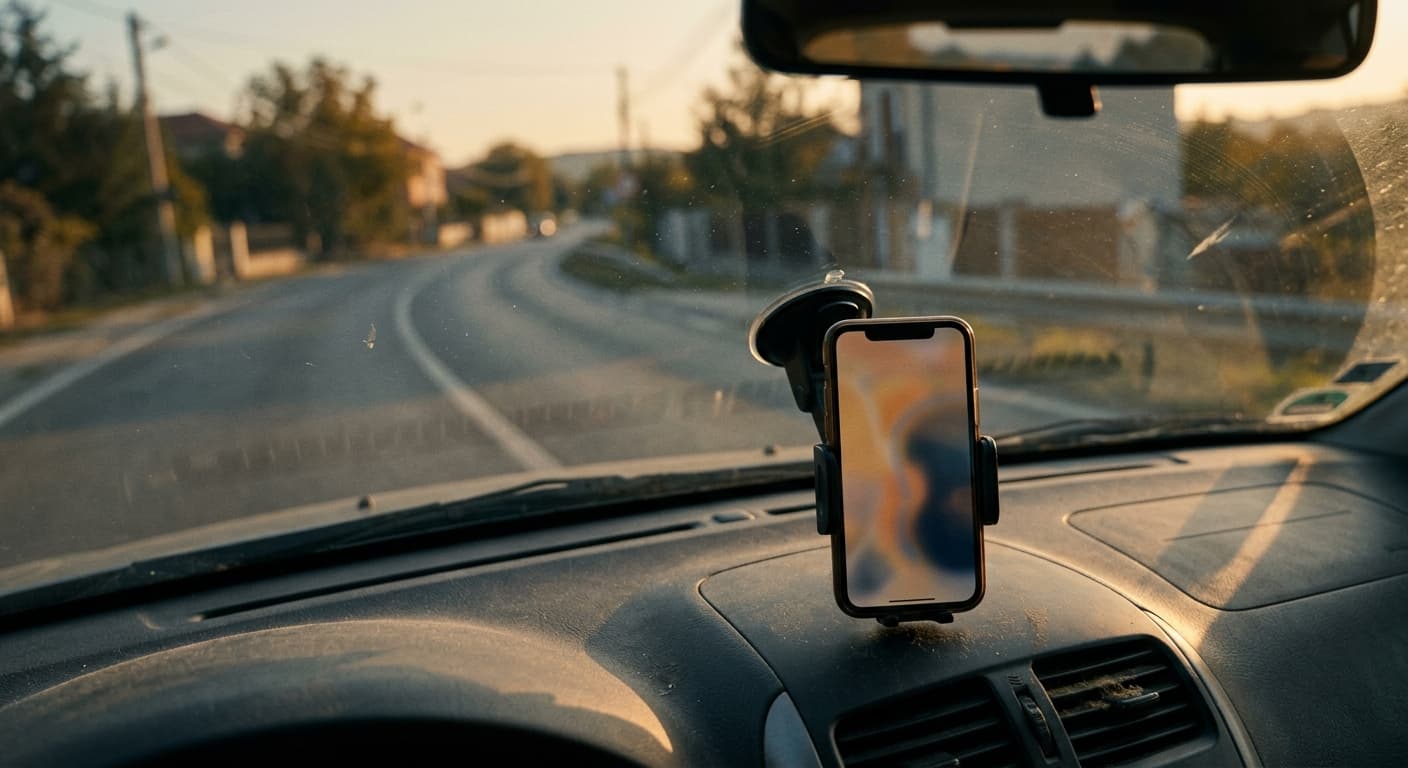
Indiana permite unidades de GPS, dashcams y soportes de teléfono montados en el parabrisas siempre que no obstruyan la vista clara del conductor según el Código de Indiana 9-19-19-3. Se permiten expresamente artículos de hasta cuatro pulgadas cuadradas en la esquina inferior del lado del pasajero. Los soportes de tablero quedan completamente fuera del estatuto.
Los conductores de Indiana que deseen montar un GPS, una dashcam, un soporte de teléfono o un transpondedor de peaje en su parabrisas deben comprender los límites establecidos por el Código de Indiana 9-19-19-3. Este estatuto controla qué materiales se pueden colocar en las ventanas del vehículo y bajo qué condiciones.
A diferencia de los estados que reservan zonas de montaje específicas para dispositivos electrónicos, Indiana utiliza un estándar general de obstrucción combinado con una excepción estrecha de tamaño y ubicación. El resultado es una regla sencilla, pero que ha producido decisiones judiciales notables que interpretan exactamente lo que la ley cubre.
Qué Dice el Código de Indiana 9-19-19-3
El Código de Indiana 9-19-19-3, titulado "Calcomanías, Letreros, Carteles, Parasoles u Otro Material No Transparente", contiene dos incisos.
El inciso (a) establece una exención militar. La sección no se aplica a la exhibición de una calcomanía requerida por el Departamento de Defensa de los Estados Unidos en vehículos militares, vehículos motorizados propiedad de personas que sirven en las fuerzas armadas, vehículos motorizados propiedad de personas empleadas por las fuerzas armadas, o vehículos motorizados autorizados a exhibir la calcomanía por la policía militar.
El inciso (b) es la regla principal. Establece: "Una persona no puede conducir un vehículo motorizado con un letrero, cartel, material de protección solar u otro material no transparente sobre el parabrisas delantero, las ventanillas laterales o las ventanas laterales o traseras del vehículo que obstruya la vista clara del conductor de la carretera o de una carretera que se cruce".
El inciso (b) luego añade una excepción: "Los letreros, carteles u otro material no transparente que no exceda las cuatro (4) pulgadas cuadradas pueden colocarse sobre el parabrisas delantero, las ventanillas laterales o las ventanas laterales o traseras en la esquina inferior más alejada de la posición del conductor".
El estatuto se promulgó originalmente mediante la P.L.2-1991 y se encuentra bajo el Título 9, Artículo 19, Capítulo 19 del Código de Indiana, que cubre Ventanas y Limpiaparabrisas.
La Excepción del Cuadro de 4 Pulgadas Explicada
La excepción en el Código 9-19-19-3(b) es una de las reglas de colocación en el parabrisas más específicas de cualquier estatuto estatal. Permite material no transparente en el parabrisas o las ventanas bajo tres condiciones, todas las cuales deben cumplirse simultáneamente:
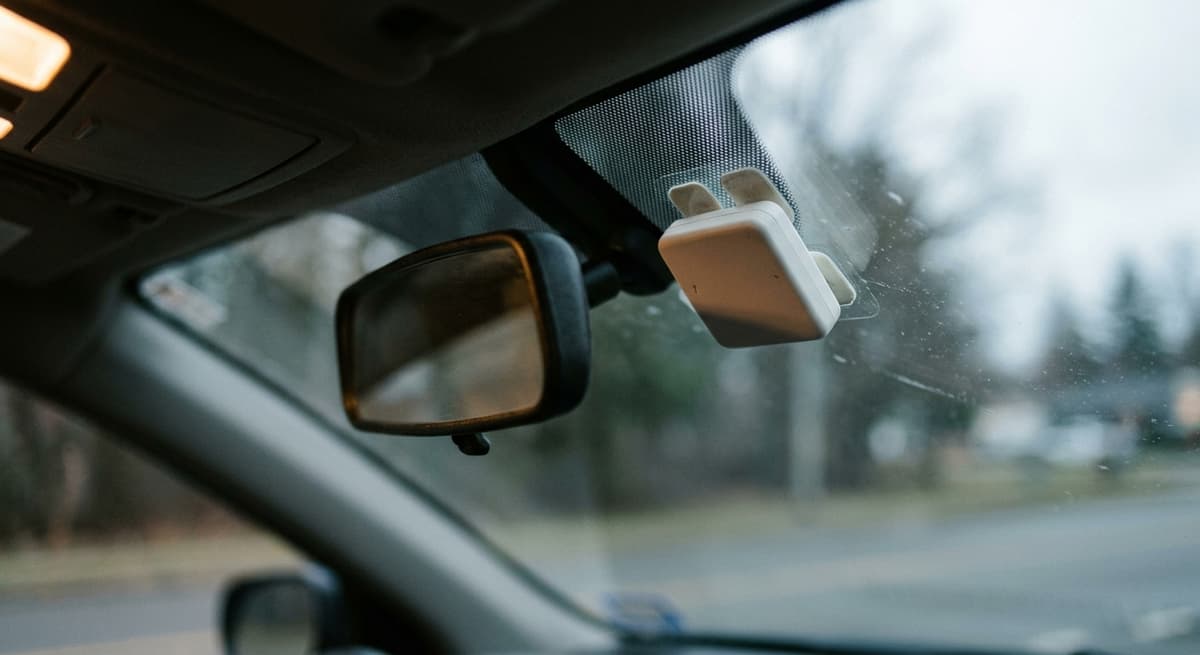
-
Límite de tamaño. El artículo no debe exceder las cuatro pulgadas por cuatro pulgadas (4 pulgadas cuadradas).
-
Ubicación. El artículo debe colocarse en la esquina inferior del parabrisas o la ventana.
-
Posición. La esquina debe ser la más alejada de la posición del conductor. En un vehículo estándar con volante a la izquierda, esto significa la esquina inferior derecha del parabrisas (lado del pasajero).
Esta excepción se aplica a artículos como calcomanías de registro, permisos de estacionamiento, transpondedores de peaje y pequeñas etiquetas de inspección. No crea una autorización general para dispositivos más grandes.
Un transpondedor E-ZPass estándar, que mide aproximadamente 3 por 3 pulgadas, cabe dentro del límite del cuadro de 4 pulgadas. La Indiana Toll Road indica a los conductores que monten los transpondedores en el parabrisas detrás del espejo retrovisor, que es una ubicación distinta de la excepción de la esquina inferior. Sin embargo, los transpondedores montados en esta posición generalmente no se cuestionan porque no obstruyen la vista del conductor.
El Significado de la Palabra "Sobre" en el Estatuto
La palabra "sobre" en el Código 9-19-19-3 tiene un peso legal específico en Indiana. El estatuto no prohíbe una "vista obstruida" en términos generales. Prohíbe el material no transparente colocado "sobre" el parabrisas o las ventanas que obstruya la vista del conductor.
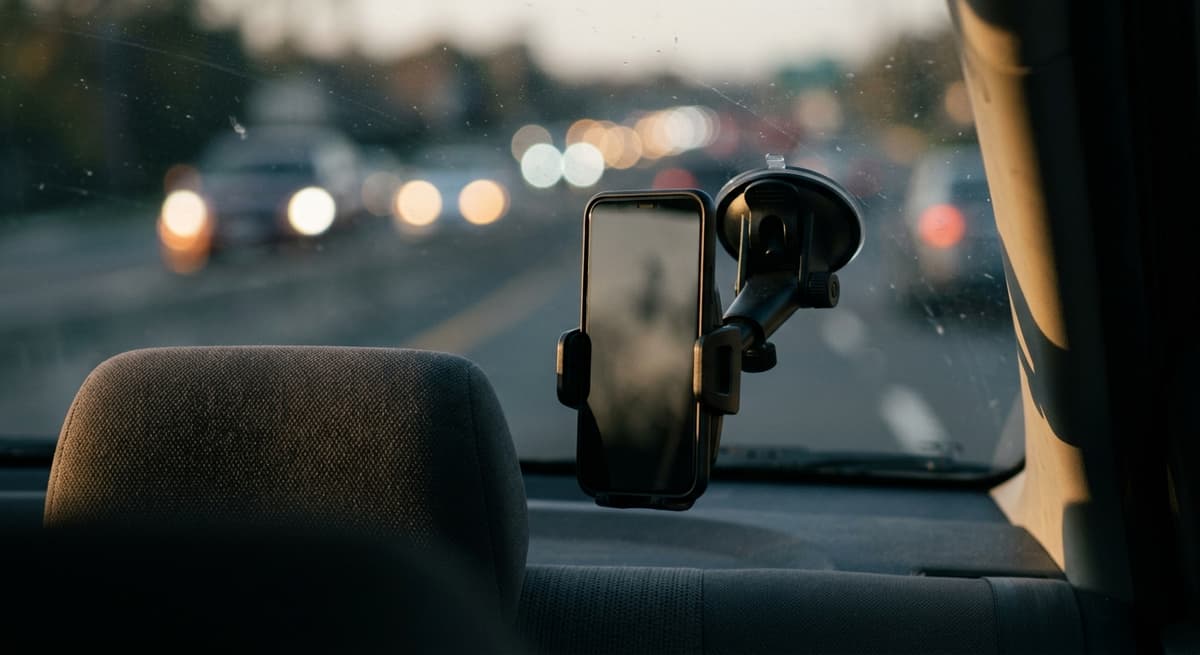
Esta distinción se convirtió en el tema central de una decisión de la Corte de Apelaciones de Indiana en 2018.
Anthony v. State (2018)
En el caso John W. Anthony v. State of Indiana, Caso N.º 49A02-1712-CR-2859, la Corte de Apelaciones de Indiana revocó una determinación de que un conductor había violado el Código 9-19-19-3. El caso fue un procedimiento de infracción de tránsito, no una acusación penal. Como reiteró el tribunal, las infracciones de tránsito en Indiana son de naturaleza civil y no penal, por lo que lo que estaba en juego era una multa, no un antecedente penal.
Los hechos eran sencillos. El 25 de julio de 2017, el oficial Kenneth Greer del Departamento de Policía Metropolitana de Indianápolis observó a Anthony conduciendo un automóvil lleno de bolsas de plástico con basura, alimentos enlatados y ropa apilada desde el piso hasta el techo. Los artículos cubrían el tablero y bloqueaban la vista a través de las ventanas laterales y trasera. El oficial Greer solo podía ver el interior del vehículo a través de la ventana del conductor. Emitió una citación por violar el Código 9-19-19-3.
El tribunal de primera instancia determinó que Anthony había cometido la infracción y le impuso una multa. Anthony pagó la multa y apeló. La Corte de Apelaciones, en una decisión redactada por la jueza Melissa May, coincidió con Anthony y revocó la determinación.
El razonamiento del tribunal se centró en el lenguaje del estatuto. El Código 9-19-19-3 prohíbe material "sobre el parabrisas delantero, las ventanillas laterales o las ventanas laterales o traseras". Los artículos en el vehículo de Anthony no estaban adheridos a las ventanas ni dependían de las ventanas para su sujeción. Estaban apoyados en el piso, los asientos y el tablero.
El tribunal señaló que un estatuto diferente, el Código 9-21-8-43, aborda la situación en la que un vehículo está "cargado de manera que obstruye la vista de la persona que conduce el vehículo hacia el frente o los costados". Ese estatuto habría aplicado a la situación de Anthony, pero el Estado lo acusó bajo la sección equivocada.
Qué Significa Esto para los Soportes en el Parabrisas
La decisión de Anthony aclara un punto importante para los conductores que usan dispositivos montados en el parabrisas. El Código 9-19-19-3 se aplica específicamente a los artículos colocados "sobre" el vidrio. Un GPS, dashcam o teléfono adherido al parabrisas con un soporte de ventosa o adhesivo está colocado "sobre" el parabrisas y cae dentro del alcance de este estatuto.
Los artículos que descansan sobre el tablero, sujetos a una rejilla de ventilación o que de otra manera no están en contacto con el vidrio del parabrisas no están regulados por el Código 9-19-19-3. Un GPS o soporte de teléfono montado en el tablero evita por completo el estatuto de obstrucción del parabrisas.
Reglas de Soportes de GPS y Teléfono en Indiana
Indiana no cuenta con un estatuto separado que aborde específicamente los soportes de GPS o teléfono en el parabrisas. Estos dispositivos están regulados por el estándar general de obstrucción del Código 9-19-19-3 y la ley estatal de manejo con manos libres.
Dónde Montar un GPS o Teléfono
Debido a que la excepción del cuadro de 4 pulgadas solo cubre la esquina inferior más alejada del conductor, la mayoría de las unidades de GPS y soportes de teléfono para consumidores no caben dentro de la excepción. Un soporte de teléfono típico con un teléfono inteligente instalado mide bastante más de 4 pulgadas en cualquier dirección.
Sin embargo, un dispositivo que excede las 4 pulgadas no es automáticamente ilegal. La prohibición principal en el Código 9-19-19-3(b) se aplica al material "que obstruya la vista clara del conductor". Si un dispositivo no obstruye la vista, no viola el estatuto, sin importar su tamaño.
Esto crea un marco práctico para elegir una ubicación de montaje:
| Ubicación de Montaje | Nivel de Riesgo | Notas |
|---|---|---|
| Tablero (no en el parabrisas) | El más bajo | Queda completamente fuera del Código 9-19-19-3 |
| Detrás del espejo retrovisor | Bajo | Impacto mínimo en la línea de visión del conductor |
| Esquina inferior del lado del pasajero | Bajo a moderado | Dentro de la zona de excepción de 4 pulgadas si el dispositivo es lo suficientemente pequeño |
| Esquina inferior del lado del conductor | Moderado | No es la esquina "más alejada" del conductor |
| Centro del parabrisas | Alto | Es lo más probable que obstruya la vista clara del conductor |
La Ley de Manos Libres de Indiana (Código 9-21-8-59)
El Código de Indiana 9-21-8-59, titulado "Uso de un Dispositivo de Telecomunicaciones Mientras se Opera un Vehículo Motorizado en Movimiento", entró en vigor el 1 de julio de 2020. La ley cambió fundamentalmente la manera en que los conductores pueden interactuar con teléfonos y otros dispositivos mientras conducen.
El estatuto prohíbe que una persona sostenga o use un dispositivo de telecomunicaciones mientras opera un vehículo motorizado en movimiento, a menos que el dispositivo se use junto con tecnología de manos libres o activada por voz.
Un teléfono montado en el parabrisas o el tablero usado como navegador GPS es legal, siempre que:
- El conductor no sostenga el teléfono en la mano
- El conductor use comandos de voz o activación de un solo toque para operar el dispositivo
- El conductor no escriba manualmente direcciones ni envíe mensajes de texto mientras el vehículo está en movimiento
- El conductor establezca el destino antes de comenzar a conducir o mientras el vehículo está estacionado
La ley incluye una excepción para llamar al 911 y reportar una emergencia genuina. En esa situación, un conductor puede sostener y usar el teléfono.
Sanciones de la Ley de Manos Libres
Una infracción del Código 9-21-8-59 se clasifica como una infracción de Clase C. Las multas pueden llegar hasta $500.
A partir del 1 de julio de 2021, la Oficina de Vehículos Motorizados de Indiana comenzó a asignar cuatro puntos a la licencia del conductor por cada infracción a la ley de manos libres. Acumular demasiados puntos dentro de un período de dos años puede llevar a la suspensión de la licencia.
Un agente del orden público no puede confiscar, registrar o descargar información del teléfono de un conductor únicamente para investigar una infracción a la ley de manos libres sin causa probable para creer que el dispositivo se usó en la comisión de un delito.
Leyes sobre Dashcams en Indiana
Las dashcams son legales en Indiana. El estado no prohíbe la grabación de video desde una cámara montada en el vehículo. Sin embargo, la colocación de la dashcam está sujeta a las mismas reglas de obstrucción del parabrisas según el Código 9-19-19-3.
Posiciones de Montaje Recomendadas
La mejor posición para una dashcam en Indiana es directamente detrás del espejo retrovisor. La mayoría de las dashcams compactas caben en esta ubicación, y el área ya está parcialmente bloqueada por el propio espejo.
Si la dashcam es lo suficientemente pequeña para caber dentro del límite del cuadro de 4 pulgadas, la esquina inferior del lado del pasajero del parabrisas también es una ubicación conforme según la excepción del estatuto.
Evite montar una dashcam en el centro del parabrisas, cerca de la línea de visión directa del conductor, o en cualquier posición que bloquee su vista de la carretera, las intersecciones o los semáforos.
Consideraciones sobre la Grabación de Audio
Indiana es un estado de consentimiento de una sola parte para la grabación de audio. Según el Código de Indiana 35-33.5-5-5, es legal interceptar una comunicación cuando una de las partes de la comunicación ha dado su consentimiento previo.
Si su dashcam graba audio, es legal en Indiana siempre que usted esté presente en el vehículo y consienta la grabación. No es necesario informar a los pasajeros que se está grabando audio, aunque hacerlo es una cortesía común.
Reglas de Polarizado de Ventanas
El Código de Indiana 9-19-19-4, titulado "Polarizado, Vidriado o Protección Solar de las Ventanas del Vehículo", establece estándares separados para el polarizado de ventanas. Aunque el polarizado aborda un tema diferente al montaje de dispositivos, interactúa con los requisitos generales de visibilidad del parabrisas.
Polarizado del Parabrisas
El polarizado no reflectante solo está permitido por encima de la línea AS-1 del fabricante en el parabrisas delantero. No se permite polarizado alguno por debajo de esa línea.
Estándares de Ventanas Laterales y Traseras
El Código 9-19-19-4(c) regula únicamente el parabrisas, las ventanillas laterales (side wings), la ventana lateral que forma parte de una puerta delantera y la ventana trasera fija (rear back window). No menciona en absoluto las ventanas laterales de las puertas traseras y no crea ninguna excepción según el tipo de vehículo, como SUV o camioneta van.
| Ventana | VLT Mínimo (Transmisión de Luz Visible) | Reflectancia Máxima |
|---|---|---|
| Ventanas delanteras laterales | 30% o más | No más del 25% |
| Ventanas traseras laterales | No reguladas según el Código 9-19-19-4 | No reguladas según el Código 9-19-19-4 |
| Ventana trasera | 30% o más | No más del 25% |
Exención Médica
La ley de Indiana ofrece una exención médica de las restricciones de polarizado. La exención se aplica a vehículos propiedad de personas que, por razones médicas, deben protegerse de los rayos directos del sol, o a vehículos en los que dicha persona sea pasajera habitual.
Para calificar, la necesidad médica debe ser certificada por un médico u optometrista con licencia para ejercer en Indiana. La certificación del médico u optometrista debe llevarse en el vehículo en todo momento.
Sanciones por Polarizado
Una infracción del estatuto de polarizado según el Código 9-19-19-4 generalmente es una infracción de Clase C. La única excepción es el Código 9-19-19-8, que establece que una persona que viole la sección 4(e) comete una infracción de Clase A. La sección 4(e) está dirigida a quien realiza el trabajo de polarizado, no al conductor: prohíbe polarizar, cubrir o tratar con material de protección solar las ventanas descritas en el Código 9-19-19-4(c) o (d) de manera que, al operar el vehículo después, se infrinjan esos incisos. No constituye una infracción si el trabajo se realiza para una persona que presenta la certificación del médico u optometrista descrita en el Código 9-19-19-4(b). Una infracción de Clase A conlleva un fallo de hasta $10,000 según el Código de Indiana 34-28-5-4.
Sanciones por Infracciones de Montaje en el Parabrisas
Obstrucción según el Código 9-19-19-3
Una infracción del Código de Indiana 9-19-19-3 se clasifica como una infracción de Clase C según el Código 9-19-19-7. La multa máxima para una infracción de Clase C según el Código de Indiana 34-28-5-4 es de $500.
En la práctica, las multas por infracciones de tránsito de primera vez suelen ser más bajas. Si un conductor admite la infracción o se declara sin oponerse antes de la fecha de la audiencia, el fallo puede no exceder los $35.50 más los costos judiciales. Si la infracción se disputa y se determina que el conductor la cometió, las multas se escalonan según las infracciones de tránsito previas en los últimos cinco años:
| Infracciones de Tránsito Previas (Últimos 5 Años) | Multa Máxima |
|---|---|
| Ninguna | $35.50 |
| Una | $250.50 |
| Dos o más | $500.00 |
Los costos judiciales y las tarifas se suman al monto de la multa base.
Vista Obstruida según el Código 9-21-8-43
Si la vista de un conductor está obstruida por artículos que no están colocados "sobre" el parabrisas (como artículos apilados en el tablero o los asientos), puede aplicarse en su lugar el Código 9-21-8-43. Este estatuto prohíbe conducir un vehículo "cargado de manera que obstruya la vista de la persona que conduce el vehículo hacia el frente o los costados".
Como demostró la decisión de Anthony v. State, los fiscales deben presentar cargos bajo el estatuto correcto según los hechos específicos. El Código 9-19-19-3 cubre el material colocado "sobre" las ventanas. El Código 9-21-8-43 cubre las vistas obstruidas causadas por la forma en que se carga un vehículo.
Requisitos de Condición del Parabrisas
Parabrisas Requerido
El Código de Indiana 9-19-19-2 exige que todo vehículo motorizado (excepto motocicletas y ciclomotores) registrado ante la Oficina de Vehículos Motorizados esté equipado con un parabrisas delantero.
Limpiaparabrisas
El Código de Indiana 9-19-19-6 exige que todo parabrisas de vehículo motorizado esté equipado con limpiaparabrisas que el conductor pueda controlar. Todo limpiaparabrisas debe mantenerse en buen estado de funcionamiento.
Conducir con limpiaparabrisas rotos o faltantes es una infracción de Clase C independiente según el mismo capítulo.
Vidrio de Seguridad
El Código de Indiana 9-19-19-5 exige materiales de vidrio de seguridad en todos los vehículos motorizados tipo pasajero y en el compartimento del conductor de camiones y tractocamiones. Un vehículo motorizado nuevo no puede venderse ni registrarse a menos que esté equipado con material de vidrio de seguridad aprobado en cualquier lugar donde se use vidrio en puertas, ventanas y parabrisas.
Consideraciones para Vehículos Comerciales
Los vehículos motorizados comerciales que operan en las carreteras de Indiana deben cumplir tanto con la ley estatal como con las regulaciones federales. La Administración Federal de Seguridad de Transportistas Motorizados (FMCSA) enmendó el 49 CFR 393.60(e), vigente desde el 6 de mayo de 2022, ampliando el área de montaje autorizada para la tecnología de seguridad vehicular en los parabrisas de vehículos motorizados comerciales.
Según la regla federal, los dispositivos pueden montarse dentro de un área de hasta 8.5 pulgadas por debajo del borde superior del área barrida por los limpiaparabrisas. Los dispositivos cubiertos incluyen:
- Sistemas de cámara para el conductor
- Sistemas de advertencia y asistencia de frenado
- Sistemas de advertencia de salida de carril
- Sistemas de GPS y navegación
- Sistemas de reconocimiento de señales de tránsito
Para los vehículos comerciales, el estándar general de obstrucción de Indiana según el Código 9-19-19-3 se aplica junto con las reglas federales de montaje. Cuando ambos estándares aplican, prevalece la regla más restrictiva.
Consejos para Mantenerse en Cumplimiento en Indiana
Debido a que Indiana combina un estándar general de obstrucción con la excepción específica del cuadro de 4 pulgadas, seguir estas pautas le ayudará a evitar una citación:
-
Use un soporte de tablero cuando sea posible. Un dispositivo montado en el tablero en lugar del parabrisas queda completamente fuera del Código 9-19-19-3, como lo confirma el razonamiento en Anthony v. State.
-
Si usa un soporte de parabrisas, coloque el dispositivo detrás del espejo retrovisor. Esta ubicación causa la menor obstrucción a la vista frontal del conductor.
-
Mantenga las calcomanías y etiquetas pequeñas en la esquina inferior del lado del pasajero. Esta es la única ubicación donde se aplica la excepción del cuadro de 4 pulgadas en un vehículo estándar con volante a la izquierda.
-
Establezca el destino de su GPS antes de comenzar a conducir. La ley de manos libres de Indiana prohíbe ingresar información manualmente en un dispositivo mientras el vehículo está en movimiento.
-
Asegure el soporte firmemente. Un dispositivo que se cae del parabrisas mientras conduce crea una distracción repentina y un peligro potencial para la seguridad.
-
Limpie su parabrisas de toda nieve, hielo y escombros antes de conducir. Un parabrisas despejado reduce la posibilidad de cualquier problema de obstrucción y respalda el cumplimiento de los requisitos generales de equipo.
Más Leyes de Indiana
- Leyes de Grabación de Indiana
- Ley del Limón de Indiana
- Leyes de Choque y Fuga de Indiana
- Leyes de Asientos de Auto para Niños de Indiana
- Leyes sobre Mordeduras de Perro de Indiana
- Leyes de Sexting de Indiana
Preguntas frecuentes
¿Puedo poner el GPS o el teléfono en el parabrisas en Indiana?
Sí, con limitaciones. El Código de Indiana 9-19-19-3 prohíbe el material no transparente en el parabrisas que obstruya la vista clara del conductor. Existe una excepción específica para artículos de no más de 4 pulgadas cuadradas colocados en la esquina más alejada del conductor (la esquina inferior del lado del pasajero en la mayoría de los vehículos). Un soporte de GPS o teléfono que exceda las 4 pulgadas no es automáticamente ilegal, pero no debe obstruir su vista. La opción más segura es un soporte de tablero, que evita por completo el estatuto del parabrisas. Si usa un soporte en el parabrisas, coloque el dispositivo detrás del espejo retrovisor o en la esquina inferior del lado del pasajero.
¿Cuál es la multa por una infracción de obstrucción del parabrisas en Indiana?
Una infracción del Código de Indiana 9-19-19-3 es una infracción de Clase C según el Código 9-19-19-7. La multa máxima es de $500, pero los infractores primerizos que admiten la infracción antes de la fecha de la audiencia pueden pagar tan solo $35.50 más los costos judiciales. Las multas se escalonan según el número de infracciones de tránsito previas en los últimos cinco años. Los costos judiciales y las tarifas se suman a la multa base.
¿Son legales las dashcams en Indiana?
Sí. Indiana no prohíbe las dashcams. La cámara debe montarse de manera que no obstruya la vista clara del conductor según el Código 9-19-19-3. La posición recomendada es detrás del espejo retrovisor. Indiana es un estado de consentimiento de una sola parte para la grabación de audio, por lo que el audio de la dashcam es legal siempre que usted esté presente en el vehículo y consienta la grabación.
¿Puedo sostener mi teléfono mientras conduzco en Indiana?
No. El Código de Indiana 9-21-8-59, vigente desde el 1 de julio de 2020, prohíbe sostener o usar un dispositivo de telecomunicaciones mientras se opera un vehículo motorizado en movimiento, a menos que se use con tecnología de manos libres o activada por voz. Puede usar la activación de un solo toque para contestar o finalizar llamadas, y puede usar comandos de voz para la navegación. Las infracciones conllevan multas de hasta $500 y cuatro puntos en su licencia de conducir. La única excepción es llamar al 911 para reportar una emergencia genuina.
¿Qué decidió el caso Anthony v. State sobre la ley del parabrisas de Indiana?
En Anthony v. State (2018), Caso N.º 49A02-1712-CR-2859, la Corte de Apelaciones de Indiana revocó una determinación de que un conductor había violado el Código 9-19-19-3. El acusado tenía basura, ropa y comida apiladas por todo su auto, bloqueando la vista a través de las ventanas. El tribunal dictaminó que, como esos artículos descansaban en el piso, los asientos y el tablero en lugar de estar colocados 'sobre' las ventanas, el estatuto no aplicaba. La decisión estableció que el Código 9-19-19-3 requiere específicamente que el material esté adherido o dependa del vidrio. Un estatuto separado, el Código 9-21-8-43, cubre las vistas obstruidas causadas por la forma en que se carga un vehículo. El caso fue un procedimiento de infracción civil y no una acusación penal, por lo que lo que estuvo en juego fue una multa y no una condena penal.
Actualizaciones
Se corrigió la descripción del Código 9-19-19-8 (es una infracción de Clase A polarizar ilegalmente bajo el Código 9-19-19-4(e), no tener ventanas por las que los ocupantes no puedan ser identificados); se ajustó la clave de conclusiones sobre el polarizado a las cuatro superficies de vidrio que enumera el Código 9-19-19-4(c) y se corrigió el umbral del 30% de transmisión de luz para que exactamente 30% sea legal; y se aclaró que Anthony v. State revocó una determinación de infracción de tránsito civil, no una condena penal.
La ley detrás de este artículo
Este artículo se apoya en las disposiciones legales a continuación, conservadas en nuestro propio registro jurídico y obtenidas de la fuente oficial. Toque una sección para leer el texto vigente.
Indiana Code, TITLE 9. MOTOR VEHICLES
§ 9-19-19-3Decals, signs, posters, sunscreens, or other nontransparent materialVigentecitada en 2 de nuestros artículos
Sec. 3. (a) This section does not apply to the display of a decal required by the United States Department of Defense on the following: (1) A military vehicle. (2) A motor vehicle owned by a person in the service of the armed forces of the United States. (3) A motor vehicle owned by a person employed by the armed forces of the United States. (4) A motor vehicle authorized to display the decal by the military police of the armed forces of the United States. (b) A person may not drive a motor vehicle with a sign, poster, sunscreening material, or other nontransparent material upon the front windshield, side wings, or side or rear windows of the vehicle that obstructs the driver's clear view of the highway or an intersecting highway. However, signs, posters, or other nontransparent material not larger than four (4) inches square may be placed upon the front windshield, side wings, or side or rear windows in the lower corner farthest removed from the driver's position. [Pre-1991 Recodification Citation: 9-8-6-38(b).]
Texto oficial (extracto) · verificado el 2026-09-07 · Lea el texto completo en nuestra biblioteca legal · Verifique en iga.in.gov
Citada en 1 resoluciones judiciales de nuestra colecciónResolución más reciente que la cita en nuestra colección: 2018
Resoluciones que citan esta sección en nuestra colección:
- John W. Anthony v. State of Indiana (Indiana Court of Appeals 2018, 103 N.E.3d 696)“…dows . . . that obstructs the driver’s clear view.” Ind. Code § 9-19-19-3. The State did not present such…”
Identificado automáticamente a partir de las opiniones judiciales que citan esta sección; no es un ranking de qué caso prevalece.
§ 9-21-8-43Loaded vehicles; passengers; obstruction of view; interference with control of vehicleVigente
Sec. 43. (a) A person may not drive a vehicle when any of the following conditions exist: (1) The vehicle: (A) is loaded in a manner; or (B) has more than three (3) persons in the front seat; so as to obstruct the view of the person who drives the vehicle to the front or sides of the vehicle. (2) The vehicle: (A) is loaded in a manner; or (B) has more than three (3) persons in the front seat; so as to interfere with the person's control over the driving mechanism of the vehicle. (b) A passenger in a vehicle may not do the following: (1) Ride in a position that interferes with the view ahead or to the sides of the person who drives the vehicle. (2) Interfere with the person's control over the driving mechanism of the vehicle. [Pre-1991 Recodification Citation: 9-4-1-117.]
Texto oficial (extracto) · verificado el 2026-07-29 · Lea el texto completo en nuestra biblioteca legal · Verifique en iga.in.gov
§ 9-21-8-59Use of telecommunications device while operating a moving motor vehicleVigente
Sec. 59. (a) Except as provided in subsections (b) and (c), a person may not hold or use a telecommunications device while operating a moving motor vehicle. (b) A telecommunications device described in IC 9-13-2-177.3(a)(1) may be used in conjunction with hands free or voice operated technology. (c) A telecommunications device may be used or held to call 911 to report a bona fide emergency. (d) A police officer may not, without the consent of the person: (1) confiscate a telecommunications device for the purpose of determining compliance with this section; (2) confiscate a telecommunications device and retain it as evidence pending trial for a violation of this section; or (3) extract or otherwise download information from a telecommunications device for a violation of this section unless: (A) the police officer has probable cause to believe that the telecommunications device has been used in the commission of a crime; (B) the information is extracted or otherwise downloaded under a valid search warrant; or (C) otherwise authorized by law.
Texto oficial (extracto) · verificado el 2026-07-29 · Lea el texto completo en nuestra biblioteca legal · Verifique en iga.in.gov
Citada en 1 resoluciones judiciales de nuestra colecciónResolución más reciente que la cita en nuestra colección: 2016
Resoluciones que citan esta sección en nuestra colección:
- United States v. Gregorio Paniagua-Garcia (Court of Appeals for the Seventh Circuit 2016, 813 F.3d 1013)“…smit, or read a text message or an electronic-mail message, Ind. Code § 9-21-8-59(a)—in short it prohibits “tex- ting” (s…”
Identificado automáticamente a partir de las opiniones judiciales que citan esta sección; no es un ranking de qué caso prevalece.
§ 9-19-19-4Tinting, glazing, or sunscreening vehicle windowsVigentecitada en 2 de nuestros artículos
Sec. 4. (a) This section does not apply to a manufacturer's tinting or glazing of motor vehicle windows or windshields that is otherwise in compliance with or permitted by FMVSS205 as promulgated in 49 CFR 571.205. Proof from the manufacturer, supplier, or installer that the tinting or glazing is in compliance with or permitted by FMVSS205 must be carried in the vehicle. (b) This section does not apply to the driver of a vehicle: (1) that is owned by an individual required for medical reasons to be shielded from the direct rays of the sun; or (2) in which an individual required for medical reasons to be shielded from the direct rays of the sun is a habitual passenger. The medical reasons must be attested to by a physician or optometrist licensed to practice in Indiana, and the physician's or optometrist's certification of that condition must be carried in the vehicle. The physician's or optometrist's certificate must be renewed annually.
Texto oficial (extracto) · verificado el 2026-09-01 · Lea el texto completo en nuestra biblioteca legal · Verifique en iga.in.gov
Citada en 9 resoluciones judiciales de nuestra colecciónResolución más reciente que la cita en nuestra colección: 2022
En los tribunales (resumen editorial, verificado de forma independiente):Los tribunales de Indiana han aplicado la sección 9-19-19-4 a detenciones en que los agentes no podían identificar a los ocupantes a través de una ventana. Gregory Johnson v. State of Indiana (2013) confirmó una detención así aun suponiendo que el polarizado fuera legal, y Clayton Doctor v. State of Indiana (2016) sostuvo que probar el cumplimiento después no anula la sospecha razonable.
Resoluciones que citan esta sección en nuestra colección:
- Erving Sanders v. State of Indiana (Indiana Court of Appeals 2013, 981 N.E.2d 616)“…id basis to stop Sanders’s vehicle. The State asserts that Ind. Code § 9-19-19-4 does not require an officer to conclus…”
- Abbott v. State (Indiana Supreme Court 2012, 961 N.E.2d 1016)“…separate opinion in which DICKSON, J., concurs. . See Ind.Code § 9-19-19-4. . The trial court also sentenced…”
- Gregory Johnson v. State of Indiana (Indiana Court of Appeals 2013, 992 N.E.2d 955)✓Un agente detuvo una minivan cuyo polarizado trasero de fábrica no le permitía ver ni identificar a los ocupantes; el tribunal sostuvo que su error de buena fe igual daba sospecha razonable bajo el estatuto de polarizado y que la parada fue razonable bajo la Constitución de Indiana.
Identificado automáticamente a partir de las opiniones judiciales que citan esta sección; no es un ranking de qué caso prevalece.
§ 9-19-19-7United States Department of Transportation regulations; classification of violationsVigentecitada en 2 de nuestros artículos
Sec. 7. (a) This section does not apply to a person who owns or operates a vehicle or combination of vehicles that: (1) contains parts and accessories; and (2) is equipped; as required under regulations of the United States Department of Transportation. (b) Except as provided in section 8 of this chapter, a person who violates this chapter commits a Class C infraction. [Pre-1991 Recodification Citation: 9-8-6-2(a).]
Texto oficial (extracto) · verificado el 2026-07-29 · Lea el texto completo en nuestra biblioteca legal · Verifique en iga.in.gov
§ 9-19-19-8Action of tinting or applying sunscreening so vehicle occupants not easily identified; classification of offenseVigentecitada en 2 de nuestros artículos
Sec. 8. A person who violates section 4(e) of this chapter commits a Class A infraction.
Texto oficial (extracto) · verificado el 2026-07-29 · Lea el texto completo en nuestra biblioteca legal · Verifique en iga.in.gov
§ 9-19-19-2Front windshieldVigente
Sec. 2. A motor vehicle, except a motorcycle or a motor driven cycle, required to be registered with the bureau must be equipped with a front windshield. [Pre-1991 Recodification Citation: 9-8-6-38(a).]
Texto oficial (extracto) · verificado el 2026-07-29 · Lea el texto completo en nuestra biblioteca legal · Verifique en iga.in.gov
§ 9-19-19-6Windshield wipersVigente
Sec. 6. (a) The windshield on a motor vehicle must be equipped with a device for cleaning rain, snow, or other moisture from the windshield. The device must be constructed to be controlled or operated by the driver of the vehicle. (b) A windshield wiper upon a motor vehicle must be maintained in good working order. [Pre-1991 Recodification Citation: 9-8-6-38(c); (d).]
Texto oficial (extracto) · verificado el 2026-07-29 · Lea el texto completo en nuestra biblioteca legal · Verifique en iga.in.gov
§ 9-19-19-5Sale or registration of new vehicles not equipped with approved safety glazing; application of sectionVigente
Sec. 5. (a) This section applies to all passenger-type motor vehicles, including passenger buses and school buses. With respect to trucks, including truck-tractors, the requirements for safety glazing material in this section apply to all glazing material used in doors, windows, and windshields in the driver's compartment of a vehicle. (b) A person may not sell a new motor vehicle and a new motor vehicle may not be registered unless the vehicle is equipped with safety glazing material of a type approved by the director of traffic safety wherever glazing material is used in doors, windows, and windshields. [Pre-1991 Recodification Citation: 9-8-6-40(a) part.]
Texto oficial (extracto) · verificado el 2026-07-29 · Lea el texto completo en nuestra biblioteca legal · Verifique en iga.in.gov
Indiana Code, TITLE 34. CIVIL LAW AND PROCEDURE
§ 34-28-5-4Costs; deposit of funds; findings required for judgment; special provisions for moving violationsVigentecitada en 3 de nuestros artículos
Sec. 4. (a) A judgment of up to ten thousand dollars ($10,000) may be entered for a violation constituting a Class A infraction. (b) A judgment of up to one thousand dollars ($1,000) may be entered for a violation constituting a Class B infraction. (c) Except as provided in subsection (f), a judgment of up to five hundred dollars ($500) may be entered for a violation constituting a Class C infraction. (d) A judgment of up to twenty-five dollars ($25) may be entered for a violation constituting a Class D infraction. (e) Subject to section 1 of this chapter, a judgment: (1) up to the amount requested in the complaint; and (2) not exceeding any limitation under IC 36-1-3-8; may be entered for an ordinance violation.
Texto oficial (extracto) · verificado el 2026-07-29 · Lea el texto completo en nuestra biblioteca legal · Verifique en iga.in.gov
Citada en 5 resoluciones judiciales de nuestra colecciónResolución más reciente que la cita en nuestra colección: 2024
Resoluciones que citan esta sección en nuestra colección:
- John Doe 1 v. Indiana Department of Child Services (Indiana Supreme Court 2017, 81 N.E.3d 199)“…ine of up to $10,000. See I.C. § 5-14-3-10(a) (Supp. 2012); I.C. § 34-28-5-4(a) (Supp. 2012). Second, that employee…”
- State v. Jackson (Indiana Court of Appeals 2007, 864 N.E.2d 431)“…s, and instead a judgment of only up to $500 may be issued. Ind.Code § 34-28-5-4. Also, the OWHTV statute makes no refer…”
- Rory Kerwood v. Elkhart County Sheriff's Department (Indiana Court of Appeals 2024)“…ine of up to $10,000. See Ind. Code § 5-14-3-10(a); Ind. Code § 34-28-5-4(a). [12] The Indiana legislature, i…”
Identificado automáticamente a partir de las opiniones judiciales que citan esta sección; no es un ranking de qué caso prevalece.
Code of Federal Regulations Title 49
§ 393.60Glazing in specified openings.Vigentecitada en 15 de nuestros artículos
(a) Glazing material. Glazing material used in windshields, windows, and doors on a motor vehicle manufactured on or after December 25, 1968, shall at a minimum meet the requirements of Federal Motor Vehicle Safety Standard (FMVSS) No. 205 in effect on the date of manufacture of the motor vehicle. The glazing material shall be marked in accordance with FMVSS No. 205 (49 CFR 571.205, S6). (b) Windshields required. Each bus, truck and truck-tractor shall be equipped with a windshield. Each windshield or portion of a multi-piece windshield shall be mounted using the full periphery of the glazing material. (c) Windshield condition. With the exception of the conditions listed in paragraphs (c)(1), (c)(2), and (c)(3) of this section, each windshield shall be free of discoloration or damage in the area extending upward from the height of the top of the steering wheel (excluding a 51 mm (2 inch) border at the top of the windshield) and extending from a 25 mm (1 inch) border at each side of the windshield or windshield panel.
Texto oficial (extracto) · verificado el 2026-07-28 · Lea el texto completo en nuestra biblioteca legal · Verifique en ecfr.gov
Citada en 3 resoluciones judiciales de nuestra colecciónResolución más reciente que la cita en nuestra colección: 2021
En los tribunales (resumen editorial, verificado de forma independiente):El mínimo de 70 por ciento de transmisión de luz del 49 CFR 393.60(d) cubre el parabrisas y las ventanas inmediatamente a la derecha e izquierda del conductor. Grooms Hauling, LLC v. Robinson (2020) lo aplicó mediante la adopción de Pensilvania y rechazó reclamos de discriminación racial por las multas de polarizado; State v. Ford (2021) señaló que Kansas también lo adopta.
Resoluciones que citan esta sección en nuestra colección:
- United States of America, Government v. Robert L. Pierre, Defendant (District Court, D. New Hampshire 2015, 2015 DNH 083)“…rallel luminous transmittance of not less than 70 percent.” 49 C.F.R. 393.60(c). Neither the Government nor the defe…”
- GROOMS HAULING, LLC v. ROBINSON (District Court, E.D. Pennsylvania 2020)✓Agentes citaron repetidamente a una empresa de acarreo de dueños afroamericanos cuyas ventanas dejaban pasar solo del 17 al 20 por ciento de la luz; al tomar el estándar de 70 por ciento de 49 CFR 393.60 como regla aplicable, el tribunal otorgó juicio sumario a los agentes.
- State v. Ford (Court of Appeals of Kansas 2021)“…Relevant to this appeal are regulations on window tinting (49 C.F.R. § 393.60[d]), medical examiner certificates (49…”
Identificado automáticamente a partir de las opiniones judiciales que citan esta sección; no es un ranking de qué caso prevalece.
Fuentes y referencias
- Código de Indiana 9-19-19-3: Calcomanías, Letreros, Carteles, Parasoles u Otro Material No Transparente(iga.in.gov).gov
- Código de Indiana 9-19-19-4: Polarizado, Vidriado o Protección Solar de las Ventanas del Vehículo(iga.in.gov).gov
- Código de Indiana 9-21-8-59: Uso de un Dispositivo de Telecomunicaciones Mientras se Opera un Vehículo Motorizado en Movimiento(iga.in.gov).gov
- Código de Indiana 9-21-8-43: Vehículos Cargados; Pasajeros; Obstrucción de la Vista(iga.in.gov).gov
- Código de Indiana 9-19-19-7: Clasificación de Infracciones (Capítulo de Ventanas y Limpiaparabrisas)(iga.in.gov).gov
- Código de Indiana 9-19-19-8: Acción de Polarizar de Manera que los Ocupantes del Vehículo No Sean Fácilmente Identificados; Clasificación de la Infracción(iga.in.gov).gov
- Código de Indiana 9-19-19-2: Requisito del Parabrisas Delantero(iga.in.gov).gov
- Código de Indiana 9-19-19-5: Materiales de Vidrio de Seguridad(iga.in.gov).gov
- Código de Indiana 9-19-19-6: Limpiaparabrisas(iga.in.gov).gov
- Código de Indiana 34-28-5-4: Fallo para una Infracción de Clase C(iga.in.gov).gov
- Oficina de Vehículos Motorizados de Indiana: Infracciones de Tránsito Comunes y Valores en Puntos(in.gov).gov
- Hoja Informativa de la Ley de Manos Libres de Indiana, INDOT(in.gov).gov
- Regla Final de la FMCSA: Área de Parabrisas Autorizada para Tecnología de Seguridad Vehicular (49 CFR 393.60)(federalregister.gov).gov
- Anthony v. State (2018): Corte de Apelaciones de Indiana, Caso N.º 49A02-1712-CR-2859(courtlistener.com)