
New Hampshire
New Hampshire Ring Doorbell Laws: What You Need to Know in 2026
Independently fact-checked against primary sources (last audited August 17, 2026). · Reviewed by the RecordingLaw editorial team. · Law checked current as of August 17, 2026. · 9 primary sources cited on this page. How we verify our legal content
Ring doorbells are legal in New Hampshire for video recording, but enabling audio creates serious legal risk. New Hampshire requires all-party consent under RSA 570-A:2, making audio capture without every participant's permission a Class B felony. Disabling the microphone through the Ring app is the safest approach for NH homeowners.
New Hampshire has one of the strictest recording consent laws in the country. Under RSA 570-A:2, intercepting any oral communication without the consent of all parties is a Class B felony. This all-party consent requirement creates significant legal exposure for Ring doorbell owners, because Ring devices record audio by default whenever they detect motion or someone presses the doorbell button.
A Strafford County case involving Ring doorbell audio recordings has already tested whether these devices violate New Hampshire's wiretapping law: in March 2020 a Superior Court judge admitted the audio, reasoning that speech exposed to the general public's naked ear is not an oral communication under the statute. That is a trial-court evidentiary ruling, not a New Hampshire Supreme Court precedent, so the broader question is not fully settled and this remains a high-risk state for doorbell cameras with audio capabilities. This guide explains exactly where the law draws the line and how to reduce your legal exposure.
Audio Recording Laws and Ring Doorbells
New Hampshire's wiretapping and eavesdropping statute is among the most restrictive in the nation. Ring doorbell owners need to understand every aspect of this law before enabling audio recording.
RSA 570-A:2: The All-Party Consent Requirement
RSA 570-A:2 states that a person is guilty of a Class B felony if, without the consent of all parties to the communication, the person "willfully intercepts, endeavors to intercept, or procures any other person to intercept or endeavor to intercept, any telecommunication or oral communication."
Paragraph I(b) separately reaches the wilful use of "any electronic, mechanical, or other device to intercept any oral communication," but only "when" one of three conditions is met: the device is affixed to or otherwise transmits a signal through a wire, cable, or like connection used in telecommunication; the device transmits communications by radio or interferes with such transmission; or the use takes place on the premises of a business or other commercial establishment, or seeks information relating to the operations of such a business. A residential doorbell camera will often sit outside all three, which is why a homeowner's exposure rests on paragraph I(a), where a wilful interception of an oral communication without the consent of all parties is enough by itself.
For Ring doorbell owners, this means:
- Recording a conversation between you and a visitor requires that visitor's consent
- Recording conversations between two people on your porch requires both of their consent
- A Ring doorbell that captures a conversation is intercepting an oral communication under paragraph I(a), which attaches no further conditions
- Simply having the microphone enabled while it captures conversations could constitute an interception

The Strafford County Ring Doorbell Case
In a closely watched New Hampshire case, a defense attorney argued that audio from a neighbor's Ring doorbell should be excluded from evidence in a shooting trial at Strafford County Superior Court. The defendant, Timothy Burke, faced charges including first-degree assault with a deadly weapon. Public defender Carl Swenson contended that the audio captured by the Ring camera violated RSA 570-A:2 because none of the people recorded consented to the recording.
In March 2020, Judge Mark Howard of the Strafford County Superior Court ruled for the prosecution and admitted the Ring audio. He reasoned that when speech is exposed to the general public's naked ear it is not an oral communication under the wiretap statute, which protects only communications made with a reasonable expectation of privacy, and he noted that testimony surrounding a 2012 amendment to the statute's definition of oral communication reflected the same understanding for people acting openly in public. The ruling is a trial-level evidentiary decision in one criminal case, not an appellate precedent, so it does not establish that Ring doorbell audio recording is categorically legal in New Hampshire; it addressed admissibility in that proceeding, and the safest course for homeowners is still to treat audio capture of others' conversations as governed by the all-party consent rule.
Why Audio Recording Is Especially Risky in New Hampshire
Several factors make New Hampshire particularly hazardous for Ring doorbell audio:
The statute covers "oral communications." Unlike states that limit their wiretapping laws to telephone or electronic communications, RSA 570-A covers any oral communication where a person has an expectation of privacy. A conversation on someone's porch could qualify.
Ring devices record automatically. The microphone activates with motion detection, meaning the device captures audio before anyone has an opportunity to consent.
The penalty is severe. A Class B felony in New Hampshire carries up to 7 years in state prison and fines up to $4,000 under RSA 651:2.
No established safe harbor. No New Hampshire court has issued a definitive ruling that Ring doorbells with audio are legal. The legal question remains open as of April 2026.
The Safest Approach: Disable Audio
Given the all-party consent requirement and the severity of the penalties, the most legally protective step for New Hampshire Ring doorbell owners is to disable audio recording entirely through the Ring app settings. This eliminates any risk of violating RSA 570-A:2 while preserving the device's video surveillance capabilities.
Video Recording Laws and Ring Doorbells
New Hampshire's restrictions on video recording are less severe than its audio rules, but they still carry meaningful boundaries.
RSA 644:9: Violation of Privacy
RSA 644:9 makes it a Class A misdemeanor to install or use any device to observe, photograph, record, amplify, or broadcast images or sounds of a person in any "private place" without consent. The statute also prohibits using a device from outside a private place to capture images, sounds, location, or movement that "would not ordinarily be audible, visible, or comprehensible outside such place."
For Ring doorbell cameras, this means:
- Recording your porch, walkway, and driveway: Legal (not a private place)
- Recording the public sidewalk or street: Legal (publicly visible)
- Capturing video through a neighbor's window: Potentially illegal under RSA 644:9(I)(c), which prohibits recording from outside a private place what would not ordinarily be visible from outside
Reasonable Expectation of Privacy
New Hampshire courts interpret RSA 644:9 through the lens of reasonable privacy expectations. Areas visible from public spaces carry diminished privacy protections. A Ring doorbell mounted at a front door and pointed toward the street or sidewalk records activity that anyone walking by could observe, which generally does not implicate the privacy statute.
The risk increases when a Ring doorbell's wide-angle lens captures areas that a passerby would not normally see, such as interior rooms through windows or enclosed side yards shielded by fencing.

HOA and Ring Doorbells in New Hampshire
New Hampshire's condominium statute (RSA 356-B) governs condominium associations, while common-interest communities follow varying organizational frameworks. Neither statute specifically addresses security cameras or doorbell cameras.
HOA Authority Over Exterior Devices
HOAs and condominium associations in New Hampshire derive their regulatory authority from their governing documents: the declaration, bylaws, and any adopted rules and regulations. These documents may include:
- Architectural review requirements for exterior modifications
- Aesthetic restrictions on device color, size, or mounting
- Rules about camera placement relative to common areas
- Provisions addressing neighbor privacy concerns
Working Within HOA Rules
Homeowners planning to install a Ring doorbell in an HOA or condominium community in New Hampshire should:
- Review the declaration and bylaws for provisions on exterior devices or modifications
- Submit an architectural review application if required
- Document that the camera is positioned to avoid capturing common areas in ways that raise privacy concerns
- Keep audio recording disabled to avoid complications with RSA 570-A:2 in shared living environments
HOA disputes over doorbell cameras in New Hampshire can be resolved through the dispute resolution mechanisms outlined in the association's governing documents or through civil court proceedings.
Landlord and Tenant Rights
New Hampshire's landlord-tenant law (RSA 540-A) addresses prohibited practices and security deposits but does not specifically mention security cameras or doorbell cameras.
Tenant Rights to Install Ring Doorbells
Tenants in New Hampshire should consider:
- Lease terms: Most leases require landlord approval for exterior modifications. Installing a Ring doorbell without permission could violate the lease
- Property restoration: Tenants may be responsible for restoring the property to its original condition upon move-out, including patching holes from mounting hardware
- Audio recording: The all-party consent requirement under RSA 570-A:2 applies equally to tenants. Audio recording of visitors, delivery workers, or neighbors without their consent carries the same felony risk
Under RSA 540-A:3, landlords cannot enter a tenant's dwelling without prior consent except for emergency repairs. Ring doorbell footage could document landlord entry patterns, though the audio component raises the same consent issues described above.
Landlord Responsibilities
Landlords who install security cameras or Ring doorbells on multi-unit rental properties in New Hampshire should:
- Disclose the presence of all recording devices to tenants
- Ensure cameras do not capture private areas within rental units
- Disable audio recording to avoid violating RSA 570-A:2
- Avoid using footage for purposes beyond security, such as monitoring tenant behavior

Law Enforcement Access to Ring Footage
New Hampshire has taken active steps to regulate surveillance technology, which affects how police interact with Ring doorbell footage.
Warrant and Court Order Requirements
Law enforcement in New Hampshire generally needs a warrant or court order to compel access to Ring doorbell footage. The Fourth Amendment's protections against unreasonable searches apply, and New Hampshire courts recognize strong privacy protections for the home and its immediate surroundings.
RSA 570-A:2, II does list exceptions to the interception ban, but they are narrower and more varied than a blanket "court order" rule, and none of them is a route to a homeowner's stored footage.
Paragraphs II(a) and II(b) cover communication common carriers acting in the normal course of employment or providing assistance to an officer already authorized to intercept. Paragraph II(c) lets any law enforcement officer investigating or making arrests for offenses enumerated in the chapter carry a device that intercepts oral communications and transmits them by radio, with no consent or prior authorization requirement written into that subsection. Paragraph II(d) permits one-party-consent interception in investigations of organized crime, enumerated offenses, certain solid waste violations, or harassing or obscene telephone calls, and it requires a determination by the attorney general, the deputy attorney general, or a designated assistant attorney general that reasonable suspicion exists that evidence of criminal conduct will be derived. That is prosecutorial approval, not a judge's order.
Those exceptions govern when police may themselves intercept a live communication. They do not authorize police to take a homeowner's Ring recordings, which still calls for a warrant, a subpoena, or the owner's voluntary cooperation.
Amazon Ring Policy
Amazon's current policy requires law enforcement to obtain a legally valid warrant or court order to access Ring footage. The company discontinued its "Request for Assistance" tool in 2024, ending the practice of police directly requesting footage from Ring users through the Neighbors app.
Homeowners can voluntarily share Ring footage with police, but they are under no obligation to do so without a warrant or subpoena.
Facial Recognition Restrictions
New Hampshire's facial recognition limits apply to state government, not to consumer doorbell cameras. RSA 5-D:3, II prohibits state agencies from using artificial intelligence for "[r]eal-time and remote biometric identification systems used for surveillance in public spaces, such as facial recognition, except by law enforcement with a warrant."
No New Hampshire statute regulates facial recognition features on privately owned cameras such as Ring doorbells. The state-agency prohibition still matters as context: it shows how New Hampshire treats biometric identification in public spaces and is the kind of provision that shapes future rules on consumer devices.
Penalties for Illegal Recording in New Hampshire
New Hampshire imposes harsh penalties for wiretapping and eavesdropping violations, and the separate privacy statute adds additional criminal exposure.
Criminal Penalties Under RSA 570-A:2
| Offense | Classification | Maximum Prison | Maximum Fine |
|---|---|---|---|
| Willful interception without all-party consent | Class B felony | Up to 7 years | Up to $4,000 |
| Interception with one-party consent but without the approval required by RSA 570-A:2, II(d) | Misdemeanor, presumed class B | No term of imprisonment | Up to $1,200 |
RSA 570-A:2, I-a designates that second offense simply as "a misdemeanor" without naming a class. Under RSA 625:9, IV(c), a misdemeanor left unclassified is presumed to be a class B misdemeanor unless an element involves an act or threat of violence, the state files notice of intent to seek class A penalties on or before arraignment, or the charge is filed directly in superior court. A class B misdemeanor carries no term of imprisonment and a maximum fine of $1,200 under RSA 651:2, IV(a). The class A ceiling of one year and $2,000 applies only if the state takes one of those steps.
Criminal Penalties Under RSA 644:9
Recording in a private place without consent is a Class A misdemeanor, punishable by up to one year in jail and fines up to $2,000.
Civil Damages Under RSA 570-A:11
RSA 570-A:11 authorizes victims of illegal interception to file civil lawsuits and recover:
- Actual damages, with a minimum of $100 per day of violation or $1,000, whichever is higher
- Punitive damages at the court's discretion
- Reasonable attorney's fees and litigation costs
A Ring doorbell that records audio continuously could accumulate significant per-day damages. If a neighbor's private conversations are captured over several months, the statutory minimum alone could reach tens of thousands of dollars.
Evidence Suppression
Under RSA 570-A:6, any telecommunication or oral communication intercepted in violation of the wiretapping statute is generally inadmissible as evidence in any trial, hearing, or other proceeding. This means illegally recorded Ring doorbell audio may not be usable even if it captures evidence of criminal activity.
How to Use a Ring Doorbell Legally in New Hampshire
New Hampshire's all-party consent law demands extra caution. These steps help Ring doorbell owners minimize legal risk.
1. Disable audio recording immediately. This is the single most important step for New Hampshire Ring doorbell owners. The all-party consent requirement under RSA 570-A:2 makes audio recording extremely risky. Turn off the microphone through the Ring app settings.
2. Position the camera to avoid private areas. Point your Ring doorbell at your own property and publicly visible areas. Avoid capturing views through neighbors' windows or into enclosed private spaces. RSA 644:9 prohibits recording in or into private places without consent.
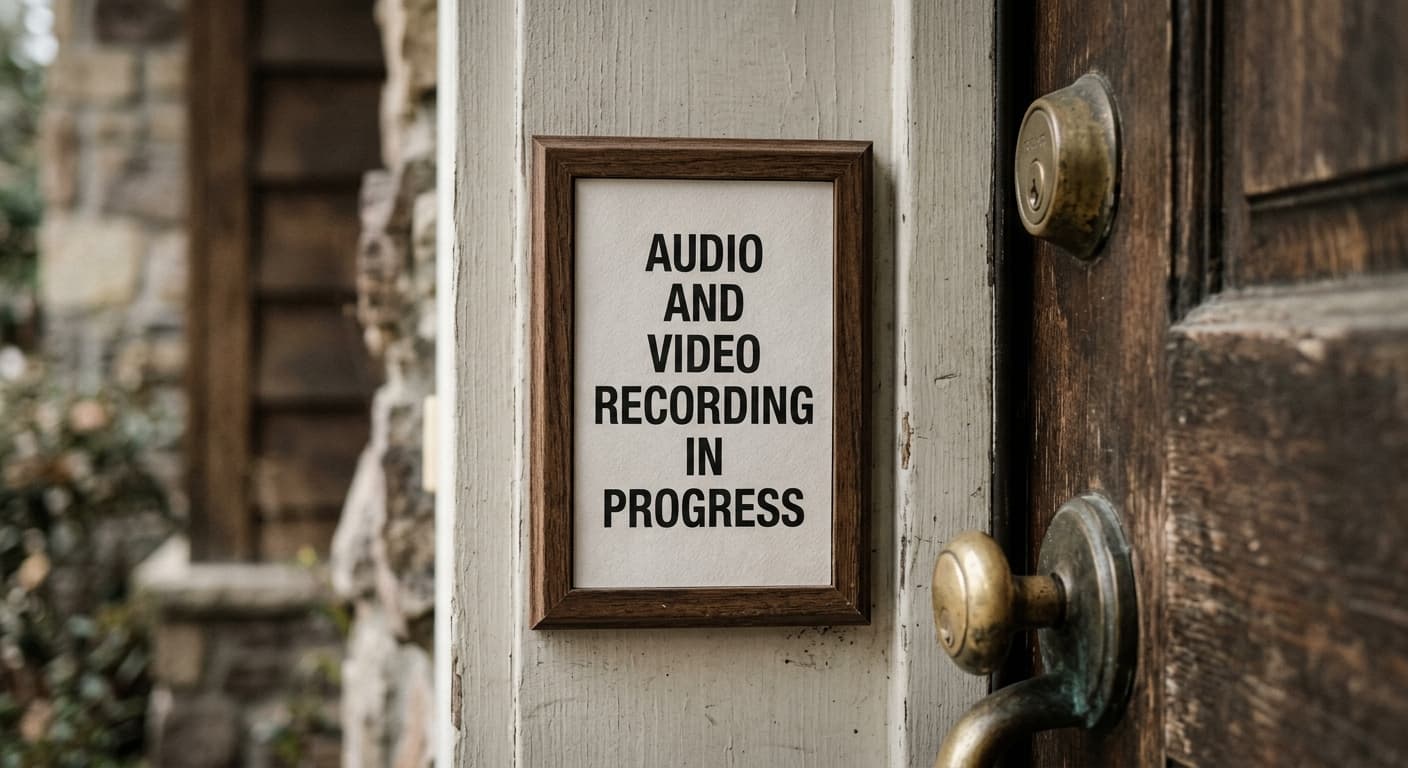
3. Post a visible notice. A sign stating "Video Recording in Progress" near your doorbell serves two purposes: it informs visitors that they are being recorded, and it weakens any argument that surveillance was done surreptitiously.
4. Review your HOA or condo documents. Check governing documents for restrictions on exterior devices before installation. Submit required applications to avoid fines or removal orders.
5. Get written landlord approval. Tenants should obtain explicit written permission before installing any Ring device on a rental property's exterior.
6. Secure your account. Use strong passwords and enable two-factor authentication. The FTC's 2023 enforcement action against Ring demonstrated that account security vulnerabilities can lead to unauthorized access to footage.
7. Do not share footage without legal guidance. If police request your Ring footage, you have the right to require a warrant. Sharing footage voluntarily is your choice, but consult an attorney if the footage contains audio that may have been captured in violation of RSA 570-A:2.
More New Hampshire Laws
New Hampshire has additional laws covering related topics:
- New Hampshire Recording Laws provide the full breakdown of the state's all-party consent wiretapping statute.
- New Hampshire Hit and Run Laws cover the requirements for reporting accidents and penalties for leaving the scene.
- New Hampshire Lemon Law explains consumer protections for defective vehicle purchases.
This article provides general legal information about New Hampshire Ring doorbell laws as of April 2026. New Hampshire's all-party consent wiretapping law creates significant legal risk for audio-enabled doorbell cameras. Consult an attorney licensed in New Hampshire for advice specific to your situation.
Frequently Asked Questions
Is it legal to use a Ring doorbell in New Hampshire?
Video recording from a Ring doorbell is generally legal when pointed at public areas or your own property. However, audio recording is extremely risky because New Hampshire requires all-party consent under RSA 570-A:2. Disabling the microphone through the Ring app is the safest approach.
Can I go to jail for recording audio with my Ring doorbell in New Hampshire?
Yes. Intercepting oral communications without all parties' consent is a Class B felony under RSA 570-A:2, carrying up to 7 years in state prison and fines up to $4,000. Ring doorbells record audio automatically when motion is detected, which could constitute an interception under the statute.
Has a New Hampshire court ruled on whether Ring doorbells violate the wiretapping law?
Yes, at the trial level: in March 2020 a Strafford County Superior Court judge ruled that Ring doorbell audio of a conversation exposed to the general public was not an oral communication under the wiretap statute and admitted it as evidence in a shooting case. No New Hampshire appellate court has issued a definitive decision, so whether Ring doorbell audio recording is categorically legal remains unsettled.
Can my neighbor sue me for recording them with a Ring doorbell in New Hampshire?
If your Ring doorbell records audio of a neighbor's conversations without their consent, they can sue under RSA 570-A:11 for actual damages of no less than $100 per day of violation or $1,000, whichever is higher, plus punitive damages and attorney's fees. Video-only recording of publicly visible areas typically does not create civil liability.
Do I have to share my Ring doorbell footage with New Hampshire police?
No. You are not required to share Ring footage with law enforcement without a valid warrant or court order. Sharing is voluntary. Amazon also requires police to obtain a legally binding order before releasing footage directly from Ring's servers.
Updates
Corrected the FAQ description of civil damages under RSA 570-A:11: the statutory minimum is $100 per day of violation or $1,000, whichever is higher, not both added together.
Corrected the New Hampshire wiretap discussion: removed a wrong citation that attributed facial recognition rules to RSA 644:8-a (an animal-fighting statute) and replaced it with RSA 5-D:3, quoted RSA 570-A:2, I(b) with its limiting conditions, described the law-enforcement exceptions in RSA 570-A:2, II accurately, and corrected the unclassified-misdemeanor penalty to the presumed class B maximum of no imprisonment and a $1,200 fine.
Removed an invented judicial ruling (a named judge and a '2012 amendment' rationale) from the description of a real Strafford County Ring-doorbell wiretapping dispute; the page now describes the case only as a documented pending dispute, since no published ruling resolving it could be found.
Independently fact-checked against the cited primary sources; governing law re-checked for recent changes
Governing law re-checked for recent changes
Governing law re-checked for recent changes
Reviewed and approved by an editor
The Law Behind This Article
This article rests on the statutory provisions below, held in our own legal record and retrieved from the official source. Tap a section to read the operative text.
New Hampshire Revised Statutes Annotated, TITLE LVIII PUBLIC JUSTICE, CHAPTER 570-A WIRETAPPING AND EAVESDROPPING
§ 570-A:2Interception and Disclosure of Telecommunication or Oral Communications Prohibited.In forcecited in 34 of our articles
I. A person is guilty of a class B felony if, except as otherwise specifically provided in this chapter or without the consent of all parties to the communication, the person: (a) Wilfully intercepts, endeavors to intercept, or procures any other person to intercept or endeavor to intercept, any telecommunication or oral communication; (b) Wilfully uses, endeavors to use, or procures any other person to use or endeavor to use any electronic, mechanical, or other device to intercept any oral communication when: (1) Such device is affixed to, or otherwise transmits a signal through, a wire, cable, or other like connection used in telecommunication, or (2) Such device transmits communications by radio, or interferes with the transmission of such communication, or (3) Such use or endeavor to use (A) takes place on premises of any business or other commercial establishment, or (B) obtains or is for the purpose of obtaining information relating to the operations of any business or other commercial establishment; or (c) Wilfully discloses, or endeavors to disclose, to any other person the contents of any telecommunication or oral communication, knowing or having reason to know that…
Official text (excerpt) · last checked 2026-09-24 · Read the full text in our law library · Verify at gc.nh.gov
Cited in 35 court opinions in our collectionLatest citing opinion in our collection: 2025
In the courts (editorial summary, independently checked):New Hampshire courts read the felony offense in RSA 570-A:2, I as requiring more than intent to record. Fischer v. Hooper (1999) held wilfully means intentional or reckless disregard for the lawfulness of the conduct, so a good faith belief is a defense. State of New Hampshire v. Adam Mueller (2014) reversed on that mens rea.
Opinions citing this section in our collection:
- State v. Kilgus (Supreme Court of New Hampshire 1986, 128 N.H. 577)✓A murder-for-hire middleman agreed to wear a hidden recorder and got the defendant to confirm paying $1,000 to have a man killed; the court held the taping was lawful under RSA 570-A:2, II(d) because one party consented and homicide is an enumerated offense.
- Fischer v. Hooper (Supreme Court of New Hampshire 1999, 143 N.H. 585)✓A father secretly taped his ex-wife's calls with their daughter though a guardian ad litem had said both parents must agree; the court held wilfully in RSA 570-A:2, I requires intentional or reckless disregard for the lawfulness of the conduct, and reversed for a new trial.
- State of New Hampshire v. Adam Mueller (Supreme Court of New Hampshire 2014, 166 N.H. 65)✓A police-accountability activist recorded three phone calls with a police captain and two school officials without telling them; the court held that instructing the jury on purposely rather than the statute's wilfully was plain error and reversed his wiretapping convictions.
Identified automatically from the court opinions citing this section — not a ranking of which case controls.
Also relied on in: New Hampshire Security Camera Laws, New Hampshire Video Recording Laws, New Hampshire Voyeurism Laws
§ 570-A:11Recovery of Civil Damages Authorized.In forcecited in 15 of our articles
Any person whose telecommunication or oral communication is intercepted, disclosed, or used in violation of this chapter shall have a civil cause of action against any person who intercepts, discloses, or uses, or procures any other person to intercept, disclose or use such communications, and be entitled to recover from any such person: (a) actual damages but not less than liquidated damages computed at the rate of $100 a day for each day of violation or $1,000, whichever is higher; (b) punitive damages; and (c) a reasonable attorney's fee and other litigation costs reasonably incurred. Good faith reliance on a court order or on a representation made by the attorney general, deputy attorney general or a county attorney shall constitute a complete defense to any civil or criminal action brought under this chapter.
Official text (excerpt) · last checked 2026-07-29 · Read the full text in our law library · Verify at gc.nh.gov
Cited in 6 court opinions in our collectionLatest citing opinion in our collection: 2021
In the courts (editorial summary, independently checked):Courts have applied RSA 570-A:11 as the chapter's private damages remedy. Desilets v. Wal-Mart Stores (1997) awarded fees and costs under 570-A:11(c) after a jury found statutory damages for secret workplace recording; Lath v. Manchester PD, et al. (2017) entered judgment for the defendant where no interception was shown.
Opinions citing this section in our collection:
- Karen Warrington, individually, and as m/n/f of J.W. v. P John Edward Warrington (District Court, D. New Hampshire 2021, 2021 DNH 070)✓A father secretly recorded a call with his son at a New Hampshire boarding school and later used it in divorce proceedings; the court dismissed the mother's 570-A:11 damages claim because the complaint never alleged he was in New Hampshire when he recorded.
- Sanjeev Lath v. Oak Brook Condominium Owners’ Association, Gerard Dufresne, and Betty Mullen (District Court, D. New Hampshire 2018, 2018 DNH 013)“…upport dogs. Count 9: an eavesdropping claim under RSA 570-A:11 against Mullen, for installing came…”
- Lath v. Manchester PD, et al. (District Court, D. New Hampshire 2017, 2017 DNH 164)✓A condominium owner claimed a neighbor drilled holes in their shared wall and installed listening devices in his unit; on her unrebutted affidavit denying it, the court granted summary judgment against his 570-A:11 eavesdropping claim.
Identified automatically from the court opinions citing this section — not a ranking of which case controls.
Also relied on in: New Hampshire Smart Glasses Recording Laws (2026), New Hampshire Audio Recording Laws, New Hampshire Dashcam Laws
§ 570-A:6Prohibition of Use as Evidence of Intercepted Telecommunications or Oral Communications.In forcecited in 19 of our articles
Whenever any telecommunication or oral communication has been intercepted, no part of the contents of such communication and no evidence derived therefrom may be received in evidence in any trial, hearing, or other proceeding in or before any court, grand jury, department, officer, agency, regulatory body, legislative committee, or other authority of the state, or a political subdivision thereof, if the disclosure of that information would be in violation of this chapter.
Official text (excerpt) · last checked 2026-07-29 · Read the full text in our law library · Verify at gc.nh.gov
Cited in 16 court opinions in our collectionLatest citing opinion in our collection: 2025
Opinions citing this section in our collection:
- State v. McLeod (Supreme Court of New Hampshire 2013, 165 N.H. 42)“…dio-recording of a one-party telephonic interception, see RSA 570-A:6 (2001). We reverse in part, vacate in p…”
- State v. MacMillan (Supreme Court of New Hampshire 2005, 152 N.H. 67)“…sion of Detective Warchol’s testimony is not required under RSA 570-A:6 (2001) because the detective’s knowledg…”
- State v. Telles (Supreme Court of New Hampshire 1995, 139 N.H. 344)“…ions that she had overheard. The defendant objected, citing RSA 570-A:6, which prohibits the admission of evide…”
Identified automatically from the court opinions citing this section — not a ranking of which case controls.
Also relied on in: New Hampshire Phone Call Recording Laws, New Hampshire Recording Laws (2026): All-Party Consent Rules, Recordings as Evidence: US Court Rules by State
New Hampshire Revised Statutes Annotated, TITLE LXII CRIMINAL CODE, CHAPTER 644 BREACHES OF THE PEACE AND RELATED OFFENSES
§ 644:9Violation of Privacy.In forcecited in 17 of our articles
I. A person is guilty of a class A misdemeanor if such person unlawfully and without the consent of the persons entitled to privacy therein, installs or uses: (a) Any device for the purpose of observing, photographing, recording, amplifying, broadcasting, or in any way transmitting images or sounds of the private body parts of a person including the genitalia, buttocks, or female breasts, or a person's body underneath that person's clothing; or (b) In any private place, any device for the purpose of observing, photographing, recording, amplifying or broadcasting, or in any way transmitting images or sounds in such place; or (c) Outside a private place, any device for the purpose of hearing, recording, amplifying, broadcasting, observing, or in any way transmitting images, location, movement, or sounds originating in such place which would not ordinarily be audible, visible, or comprehensible outside such place. II.
Official text (excerpt) · last checked 2026-08-31 · Read the full text in our law library · Verify at gc.nh.gov
Cited in 4 court opinions in our collectionLatest citing opinion in our collection: 2023
Opinions citing this section in our collection:
- State v. McLellan (Supreme Court of New Hampshire 1999, 144 N.H. 602)“…pposite. Finally, we reject the defendant’s argument that RSA 644:9 (1996) supports his claim that he had a…”
- State of New Hampshire v. Justin M. Lamontagne (Supreme Court of New Hampshire 2023)“…assault and a case involving dissemination of an image. See RSA 644:9- a, II(c). We fail to see such a distin…”
- State v. Richard Lucas (Supreme Court of New Hampshire 2018)“…(1) an intent to commit a violation of privacy pursuant to RSA 644:9, III-a or IV (2016) does not satisfy th…”
Identified automatically from the court opinions citing this section — not a ranking of which case controls.
Also relied on in: New Hampshire Landlord-Tenant Recording Laws, New Hampshire Medical Recording Laws, New Hampshire Laws on Recording in Public
New Hampshire Revised Statutes Annotated, TITLE LXII CRIMINAL CODE, CHAPTER 651 SENTENCES
§ 651:2Sentences and Limitations.In forcecited in 19 of our articles
I. A person convicted of a felony or a Class A misdemeanor may be sentenced to imprisonment, probation, conditional or unconditional discharge, or a fine. II. If a sentence of imprisonment is imposed, the court shall fix the maximum thereof which is not to exceed: (a) Fifteen years for a class A felony, (b) Seven years for a class B felony, (c) One year for a class A misdemeanor, (d) Life imprisonment for murder in the second degree, and, in the case of a felony only, a minimum which is not to exceed 1/2 of the maximum, or if the maximum is life imprisonment, such minimum term as the court may order. II-a. A person convicted of murder in the first degree shall be sentenced as provided in RSA 630:1-a. II-b. A person convicted of a second or subsequent offense for the felonious use of a firearm, as provided in RSA 650-A:1, shall, in addition to any punishment provided for the underlying felony, be given a minimum mandatory sentence of 3 years imprisonment.
Official text (excerpt) · last checked 2026-07-29 · Read the full text in our law library · Verify at gc.nh.gov
Cited in 147 court opinions in our collectionLatest citing opinion in our collection: 2025
In the courts (editorial summary, independently checked):State v. Russell (2009) found plain error where the jury was never asked whether the deadly weapon was a firearm, as RSA 651:2, II-g requires, but affirmed the extended term because that evidence was overwhelming. State v. Elbert (1984) held the minimum and maximum term rule of RSA 651:2, II applies only if a defendant is parole eligible.
Opinions citing this section in our collection:
- State v. Kousounadis (Supreme Court of New Hampshire 2009, 159 N.H. 413)“…rder, see RSA 173-B:9, III (2002). He was sentenced under RSA 651:2, II-g (2007). We affirm in part, revers…”
- State v. Russell (Supreme Court of New Hampshire 2009, 159 N.H. 475)✓A jury convicted Russell of armed robbery but was never instructed it had to find the deadly weapon was a firearm; the court called the resulting RSA 651:2, II-g enhanced sentence plain error yet declined to disturb it given overwhelming, undisputed firearm evidence.
- Duquette v. Warden, New Hampshire State Prison (Supreme Court of New Hampshire 2007, 154 N.H. 737)✓A prisoner serving consecutive sexual assault terms argued no statute allowed them; the court found RSA 651:2 silent on consecutive sentences except its firearm provision in II-b, but held trial courts retain common law authority to impose them and rejected a vagueness challenge.
Identified automatically from the court opinions citing this section — not a ranking of which case controls.
Also relied on in: New Hampshire Laws on Recording Police, New Hampshire Workplace Recording Laws, New Hampshire Surveillance Camera Laws (2026 Guide)
New Hampshire Revised Statutes Annotated, TITLE I THE STATE AND ITS GOVERNMENT, CHAPTER 5-D USE OF ARTIFICIAL INTELLIGENCE BY STATE AGENCIES
§ 5-D:3Prohibition.In forcecited in 2 of our articles
The following uses of AI by state agencies shall be prohibited: I. Classifying persons based on behavior, socio-economic status, or personal characteristics resulting in unlawful discrimination against any individual person or group of persons. II. Real-time and remote biometric identification systems used for surveillance in public spaces, such as facial recognition, except by law enforcement with a warrant. III. Deepfakes when used for any deceptive or malicious purpose.
Official text (excerpt) · last checked 2026-07-29 · Read the full text in our law library · Verify at gc.nh.gov
Also relied on in: New Hampshire AI Laws and Regulation (2026)
New Hampshire Revised Statutes Annotated, TITLE LV PROCEEDINGS IN SPECIAL CASES, CHAPTER 540-A PROHIBITED PRACTICES AND SECURITY DEPOSITS
§ 540-A:3Certain Specific Acts Prohibited.In forcecited in 2 of our articles
I. No landlord shall willfully cause, directly or indirectly, the interruption or termination of any utility service being supplied to the tenant including, but not limited to water, heat, light, electricity, gas, telephone, sewerage, elevator or refrigeration, whether or not the utility service is under the control of the landlord, except for such temporary interruption as may be necessary while actual repairs are in process or during temporary emergencies. II. No landlord shall willfully seize, hold, or otherwise directly or indirectly deny a tenant access to and possession of such tenant's rented or leased premises, other than through proper judicial process. II-a. Notwithstanding paragraph II, and subject to the notice requirements of paragraph II-b: (a) A landlord may remove, at the expense of the item's owner, any vehicle, motorcycle, trailer, ATV, or other property that blocks vehicular access to a common driveway, fire lane, parking area, or travel lane, or blocks access to a dumpster. (b) A landlord may remove, at the expense of the item's owner, any property that is leaking fluids that are damaging the parking surface or creating an environmental hazard.
Official text (excerpt) · last checked 2026-07-29 · Read the full text in our law library · Verify at gc.nh.gov
Cited in 46 court opinions in our collectionLatest citing opinion in our collection: 2025
Opinions citing this section in our collection:
- Simpson v. Young (Supreme Court of New Hampshire 2006, 153 N.H. 471)“…ot, J.) found the defendant, Daniel Young, in violation of RSA 540-A:3,1-III (Supp. 2005), and awarded damages…”
- Miller v. Slania Enterprises, Inc. (Supreme Court of New Hampshire 2004, 150 N.H. 655)“…the court erred in finding that it violated RSA 540-A:2 or RSA 540-A:3 because the evidence does not support a…”
- Crowley v. Frazier (Supreme Court of New Hampshire 2001, 147 N.H. 387)“…40-A:2 is entitled “General Prohibition.” The next section, RSA 540-A:3, is entitled “Certain Specific Acts Pro…”
Identified automatically from the court opinions citing this section — not a ranking of which case controls.
New Hampshire Revised Statutes Annotated, TITLE LXII CRIMINAL CODE, CHAPTER 625 PRELIMINARY
§ 625:9Classification of Crimes.In forcecited in 17 of our articles
I. The provisions of this section govern the classification of every offense, whether defined within this code or by any other statute. II. Every offense is either a felony, misdemeanor or violation. (a) Felonies and misdemeanors are crimes. (b) A violation does not constitute a crime and conviction of a violation shall not give rise to any disability or legal disadvantage based on conviction of a criminal offense. III. A felony is murder or a crime so designated by statute within or outside this code or a crime defined by statute outside of this code where the maximum penalty provided is imprisonment in excess of one year; provided, however, that a crime defined by statute outside of this code is a felony when committed by a corporation or an unincorporated association if the maximum fine therein provided is more than $200. (a) Felonies other than murder are either class A felonies or class B felonies when committed by an individual. Felonies committed by a corporation or an unincorporated association are unclassified.
Official text (excerpt) · last checked 2026-07-29 · Read the full text in our law library · Verify at gc.nh.gov
Cited in 65 court opinions in our collectionLatest citing opinion in our collection: 2026
Opinions citing this section in our collection:
- State v. Samuel Pennock (Supreme Court of New Hampshire 2015, 168 N.H. 294)“…shall not include incarceration or probation”); see also RSA 625:9, IV(b) (2007) (defining a class B misde…”
- State v. Morrill (Supreme Court of New Hampshire 1983, 123 N.H. 707)“…ed the sum of $500. In 1971, the legislature enacted RSA 625:9, under which every offense defined with…”
- State v. Woods (Supreme Court of New Hampshire 1995, 139 N.H. 399)“…es that his violation is not a “criminal” act because under RSA 625:9, 11(b) (1986), a violation is not a “cr…”
Identified automatically from the court opinions citing this section — not a ranking of which case controls.
Also relied on in: New Hampshire School Recording Laws, New Hampshire AI Meeting Recording Laws (2026), New Hampshire Pepper Spray and Stun Gun Laws (2026)
Search our full record of US law — 2.1 million sections, every state + federal →
Sources and References
- RSA 570-A:2 - Interception and Disclosure of Telecommunication or Oral Communications Prohibited(gc.nh.gov).gov
- RSA 570-A:11 - Recovery of Civil Damages Authorized(gc.nh.gov).gov
- RSA 570-A:6 - Prohibition of Use as Evidence of Intercepted Communications(gencourt.state.nh.us).gov
- RSA 644:9 - Violation of Privacy(gc.nh.gov).gov
- RSA 644:8-a - Use of Facial Recognition Technology(gc.nh.gov).gov
- RSA 651:2 - Sentences and Limitations(gc.nh.gov).gov
- RSA 540-A - Prohibited Practices and Security Deposits(gc.nh.gov).gov
- FTC - Ring employees illegally surveilled customers, failed to stop hackers(ftc.gov).gov
- NH Law Library - Recording Conversations Guide(courts-state-nh-us.libguides.com).gov
- Union Leader - Defense fights admission of Ring doorbell video in Rochester shooting trial(unionleader.com)
- Union Leader: Judge rules Ring doorbell audio admissible in Rochester shooting case (March 2020)(unionleader.com)
- RSA 5-D:3 - Prohibition (state agency use of AI, including biometric identification in public spaces)(gc.nh.gov)
- RSA 625:9 - Classification of Crimes(gc.nh.gov)