
Maine
Maine Nursing Home Camera Laws: No Statute, Private-Place Risk
Independently fact-checked against primary sources (last audited August 14, 2026). · 4 primary sources cited on this page. How we verify our legal content
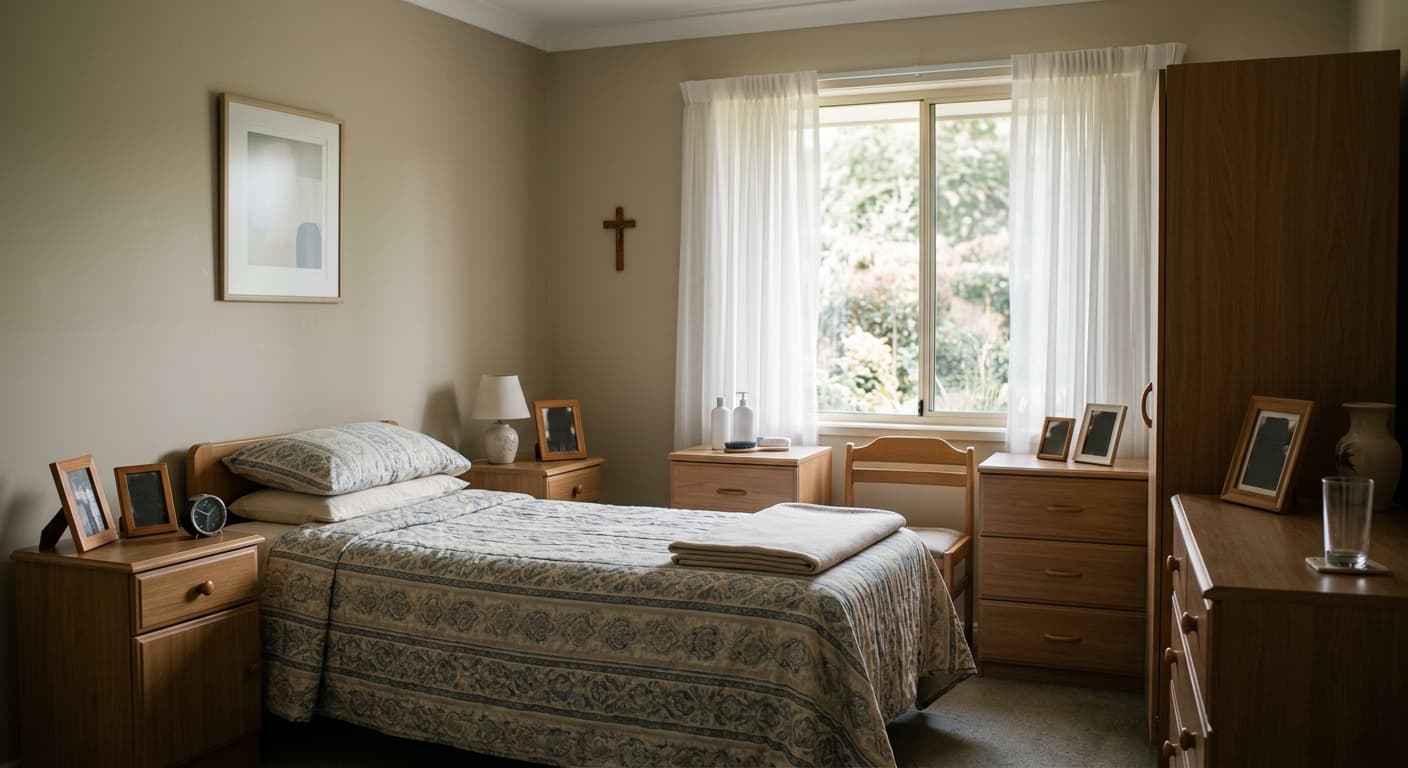
Maine has no statute or rule giving a nursing home resident or family a right to install a camera in a resident's room. This article covers the two Maine statutes most often mistaken for addressing it, the state's own recording-consent rules that apply instead, and where to turn if a facility interferes.
This page addresses Maine specifically. For the 18 states with an enacted electronic-monitoring statute, see the nursing home camera laws hub and the state-by-state comparison.
Does Maine Have a Nursing Home Camera Law?
No. Maine's nursing home licensing chapter, 22 M.R.S. Chapter 405, was reviewed section by section and has no provision on electronic monitoring or cameras. The chapter does include Section 1827, titled "Photographs of Nursing Home Residents," which sounds like the closest match, but its text is narrower than the title suggests: a nursing home may take an identification photograph of a resident, and that photograph cannot be used for any other purpose without the resident's permission for each specific use. It says nothing about a resident's or family's own camera or monitoring device.
A second section that initially looks promising, 24-A M.R.S. Section 6227, is also titled "Rights of Residents," but it sits inside Maine's Insurance Title, not a facility-licensing chapter, because Maine regulates continuing care retirement communities there rather than in Title 22. It is a direct resident bill of rights for people living in a CCRC, not a nursing-home-specific statute, and it covers organizational rights, outside advice, dignity and privacy in a general sense, visitor autonomy, and freedom from abuse and restraints. It has no monitoring or camera content either. A search of the Maine Legislature's own bill-text search tool across the two most recent Legislatures found no pending nursing-home electronic-monitoring bill, though the tool's own reliability for one session tested was inconsistent, so this negative is corroborated rather than airtight.
Maine's Recording and Consent Law: What Applies to a Camera
With no nursing-home-specific statute, the general recording-consent law governs a camera installed without the facility's agreement. Maine is a one-party consent state: 15 M.R.S. Section 709(4) defines "intercept" to exclude the sender or receiver of a communication and a person given prior authority by the sender or receiver, so a participant in a conversation may record it without telling the others. 15 M.R.S. Section 710 is the offense provision, making an unlawful interception a Class C crime.
But 17-A M.R.S. Section 511(1)(B) creates a separate, stricter rule. It is a Class D crime to use "any device for observing, photographing, recording" in "a private place... without the consent of the person or persons entitled to privacy in that place," and the statute's own examples of a private place include changing or dressing rooms, bathrooms, and similar places. A resident's own bedroom or living space in a nursing home is a strong real-world candidate for the same category, which matters most for a hidden camera capturing a roommate or staff member who never learned it was there. See our Maine recording laws guide for the full framework.
Facility Policy Decides Whether a Camera Is Allowed
Because no Maine statute grants a resident a right to a camera, the facility's admission agreement is what actually governs day to day. A facility can permit a camera, condition it on notice or a roommate's agreement, or prohibit one outright as a matter of its own contract terms. Federal nursing home rules under 42 CFR 483.10 protect resident privacy and dignity broadly but say nothing about cameras, so no federal law fills the gap either.
The Practical Risk of a Hidden Camera
A family considering a camera without the facility's knowledge should weigh Maine's private-place rule carefully. An audio-capable or otherwise undisclosed device capturing a roommate or staff conversation without their consent risks the Class D charge under Section 511, separate from any question about the resident's own recording. Openly disclosing the camera to the facility and any roommate, and getting written acknowledgment where possible, is the more defensible path in a state with no statutory right either way.

Using Camera Footage as Evidence of Abuse or Neglect
Footage that appears to show abuse or neglect can support a report to Adult Protective Services or the ombudsman, and it can support a civil claim, though it is typically reviewed alongside medical and staffing records rather than on its own. For a broader look at how a nursing home abuse or neglect claim works, see Nursing Home Abuse & Neglect.
Harmed by a product or exposure? Speak with an attorney about your options
If you or a loved one may have been harmed, you can speak with an attorney about your legal options at no cost. Whether you have a claim depends on the specific facts. This is attorney advertising, not a guarantee that you qualify or of any particular outcome.
Where to Turn: Maine's Long-Term Care Ombudsman
The Maine Long-Term Care Ombudsman Program investigates complaints affecting the health, safety, welfare, and rights of residents in nursing homes and residential care, under authority tracing to the federal Older Americans Act, 42 U.S.C. Section 3058g. A camera dispute, a facility's refusal to discuss monitoring, or a suspected retaliation concern are all within its scope.
Information last verified on 2026-08-14, drawn from 22 M.R.S. Chapter 405, 24-A M.R.S. Section 6227, 15 M.R.S. Sections 709 and 710, 17-A M.R.S. Section 511, and a Maine Legislature bill-text search. This article has not yet been reviewed by a licensed lawyer and is general legal information, not legal advice for your specific situation.
Related Resources
- Nursing Home Camera Laws by State covers every state's regime, including the 18 states with an enacted statute.
- Nursing Home Camera Laws: State-by-State Comparison breaks down the 18 states with a full statutory right.
- Maine Recording Laws covers Maine's one-party consent framework and private-place exception in full.
- Nursing Home Abuse & Neglect covers how an abuse or neglect claim works once evidence, including camera footage, is in hand.
- US Recording Laws by State covers the general consent framework nationwide.
Last updated: 2026-08-14.
Frequently Asked Questions
Is it legal to put a camera in a nursing home room in Maine?
Maine has no statute addressing the question either way. Whether a camera is allowed depends on the facility's own admission agreement and policy, since no state law grants or forbids the right.
Does 22 M.R.S. Section 1827 let me put a camera in a Maine nursing home room?
No. That section only covers facility-taken identification photographs of residents. It does not address a resident's or family's own recording device.
Is the Maine 'Rights of Residents' statute about nursing home cameras?
No. 24-A M.R.S. Section 6227 is titled Rights of Residents but is a bill of rights for residents of continuing care retirement communities, codified in Maine's Insurance Title because that is where Maine regulates CCRCs. It says nothing about cameras or monitoring devices.
Can a hidden camera in a Maine nursing home room break the law?
Possibly. 17-A M.R.S. Section 511 makes it a Class D crime to install a recording device in a private place without the consent of the people entitled to privacy there, and a resident's own room is a plausible private place under that section.
What can I do if a Maine facility refuses to let me install a camera?
Contact the Maine Long-Term Care Ombudsman Program, which investigates complaints affecting resident rights at nursing homes and residential care facilities and covers monitoring disputes.
Updates
Corrected the citation for Maine's one-party consent rule: the participant exception is in 15 M.R.S. Section 709(4), while Section 710 is the criminal penalty provision.
Independently fact-checked against the cited primary sources
The Law Behind This Article
This article rests on the statutory provisions below, held in our own legal record and retrieved from the official source. Tap a section to read the operative text.
Maine Revised Statutes, Title 17-A: MAINE CRIMINAL CODE, Part 2: SUBSTANTIVE OFFENSES, Chapter 21: OFFENSES AGAINST PUBLIC ORDER
§ 511Violation of privacyIn forcecited in 15 of our articles
1. A person is guilty of violation of privacy if, except in the execution of a public duty or as authorized by law, that person intentionally: A. Commits a civil trespass on property with the intent to overhear or observe any person in a private place; [PL 1997, c. 467, §1 (AMD).] B. Installs or uses in a private place without the consent of the person or persons entitled to privacy in that place, any device for observing, photographing, recording, amplifying or broadcasting sounds or events in that place; [PL 1997, c. 467, §1 (AMD).] C. Installs or uses outside a private place without the consent of the person or persons entitled to privacy therein any device for observing, photographing, hearing, recording, amplifying or broadcasting images or sounds originating in that place that would not ordinarily be visible, audible or comprehensible outside that place; [PL 2023, c. 227, §1 (AMD).] D.
Official text (excerpt) · last checked 2026-08-31 · Read the full text in our law library · Verify at legislature.maine.gov
Cited in 6 court opinions in our collectionLatest citing opinion in our collection: 2026
In the courts (editorial summary, independently checked):In State of Maine v. Mark W. Strong Sr. (2013) the Maine Supreme Judicial Court read section 511(1)(B) to require an objectively reasonable expectation of being safe from surveillance, and held that people who entered a place solely to engage a prostitute were not persons entitled to privacy there.
Opinions citing this section in our collection:
- State of Maine v. Mark W. Strong Sr. (Supreme Judicial Court of Maine 2013, 60 A.3d 1286)✓A man faced 45 counts of violation of privacy for recording the clients of a Kennebunk prostitute; the Law Court held that people present solely to engage a prostitute were not 'persons entitled to privacy' there, so the indictment failed to charge the offense.
- Friedman v. Public Utilities Commission (Supreme Judicial Court of Maine 2012, 48 A.3d 794)“…statutes: 17-A M.R.S. § 402(1) (2011) (criminal trespass), 17-A M.R.S. § 511 (2011) (criminal violation of privacy),…”
- Cuso Mortgage Corp. v. Gauthier (Superior Court of Maine 2012)“…e counts of criminal invasion of privacy, presumably under 17-A M.R.S. § 511(1)(B), for allegedly filming sexual act…”
Identified automatically from the court opinions citing this section — not a ranking of which case controls.
Also relied on in: Maine Recording Laws (2026): One-Party Consent, § 710 and § 511, Maine Audio Recording Laws: One-Party Consent Rules and Penalties (2026), Maine Laws on Recording in Public: Your Complete Guide (2026)
Maine Revised Statutes, Title 15: COURT PROCEDURE -- CRIMINAL, Part 2: PROCEEDINGS BEFORE TRIAL, Chapter 102: INTERCEPTION OF WIRE AND ORAL COMMUNICATIONS
§ 710OffensesIn forcecited in 18 of our articles
1. Interception, oral communications prohibited. Any person, other than an employee of a communication common carrier, a law enforcement officer, an investigative officer, another employee of the Department of Corrections authorized to exercise law enforcement powers as described in Title 34‑A, section 3011 or a jail investigative officer or a jail employee acting at the direction of a jail investigative officer, carrying out practices otherwise permitted by this chapter, who intentionally or knowingly intercepts, attempts to intercept or procures any other person to intercept or attempt to intercept any wire or oral communication is guilty of a Class C crime. 2. Editing of tape recordings in judicial proceedings prohibited. Any person who knowingly or intentionally edits, alters or tampers with any tape, transcription or other sound recording, or knows of such editing, altering or tampering, and presents that recording in any judicial proceeding or proceeding under oath, without fully indicating the nature of the changes made and the original state of the recording, is guilty of a Class C crime. 3. Disclosure or use of wire or oral communications prohibited.
Official text (excerpt) · last checked 2026-09-23 · Read the full text in our law library · Verify at legislature.maine.gov
Cited in 5 court opinions in our collectionLatest citing opinion in our collection: 2022
In the courts (editorial summary, independently checked):Williams v. Poulos (1993) affirmed section 710(1) liability for intercepting employee calls and held section 710(3)(A) and (B) require only knowledge the information came through interception. Glenn A. Griffin v. Cristie J. Griffin (2014) allowed a parent's vicarious consent for a young child only on a good faith best-interest belief.
Opinions citing this section in our collection:
- Glenn A. Griffin v. Cristie J. Griffin (Supreme Judicial Court of Maine 2014, 92 A.3d 1144)✓A father recorded his six-year-old daughter's nightly calls with her mother after overhearing abusive remarks; the court held a parent with a good faith, objectively reasonable best-interest belief may vicariously consent under section 709(4)(C), so section 710 was not violated.
- Archer v. Androscoggin County (Superior Court of Maine 2022)✓An attorney sought recordings of another inmate's jail calls under Maine's public records law; the court applied the wiretap chapter that makes interception a crime under section 710 and held a court-appointed defense lawyer is not within the section 712(4) disclosure exception.
- Williams v. Poulos (Court of Appeals for the First Circuit 1993)✓Company owners secretly recorded employee phone calls using alligator clips wired to a VCR, and their lawyers then used the tapes; the First Circuit affirmed liability under section 710, holding subsection 3 requires only knowledge that the material came from an interception.
Identified automatically from the court opinions citing this section — not a ranking of which case controls.
Also relied on in: Maine Dashcam Laws: Mounting Rules, Audio Recording, and Evidence (2026), Maine Landlord-Tenant Recording Laws: Cameras, Audio, and Privacy Rights (2026), Maine Phone Call Recording Laws: Consent Rules for Cell, Landline, and VoIP (2026)
§ 709DefinitionsIn forcecited in 13 of our articles
The following words and phrases as used in this chapter, unless the context otherwise indicates, shall have the following meanings. [PL 1973, c. 561 (NEW).] 1. Communication common carrier. "Communication common carrier" means any telephone or telegraph company. 1-A. Administration of criminal justice. 1-B. Administration of juvenile criminal justice. 1-C. Administration of juvenile justice. "Administration of juvenile justice" has the same meaning as in section 3003, subsection 1‑A. 2. Contents. "Contents," when used with respect to any wire or oral communication, means any information concerning the identity of the parties to such communication or the existence, contents, substance, purport or meaning of that communication. 3. Intercepting device. "Intercepting device" means any device or apparatus which can be used to intercept a wire or oral communication other than: A. Any telephone or telegraph instrument, equipment or facility or any component thereof being used by a communication common carrier in the ordinary course of its business or extension telephones used by a subscriber to telephone service; or [PL 1973, c. 561 (NEW).] B.
Official text (excerpt) · last checked 2026-07-30 · Read the full text in our law library · Verify at legislature.maine.gov
Cited in 8 court opinions in our collectionLatest citing opinion in our collection: 2021
Opinions citing this section in our collection:
- Glenn A. Griffin v. Cristie J. Griffin (Supreme Judicial Court of Maine 2014, 92 A.3d 1144)“…nterception of Wire and Oral Communications Act (the Act), 15 M.R.S. §§ 709-713 (2012),1 and (2) whether the court…”
- State v. Kehling (Supreme Judicial Court of Maine 1991, 601 A.2d 620)“…e Maine’s Interception of Wire and Oral Communications Act, 15 M.R.S.A. §§ 709-713 (Supp.1991). As to the sentence, we…”
- State v. Cyran (Supreme Judicial Court of Maine 1991, 586 A.2d 1238)“…versations. Nevertheless, both Maine’s wiretap regulations, 15 M.R.S.A. §§ 709-712, and the applicable federal provisi…”
Identified automatically from the court opinions citing this section — not a ranking of which case controls.
Also relied on in: Maine Smart Glasses Recording Laws: What You Need to Know, Maine Surveillance Camera Laws (2026 Guide), Maine Medical Recording Laws: Patient Rights, HIPAA, and Consent (2026)
Maine Revised Statutes, Title 22: HEALTH AND WELFARE, Part 4: HOSPITALS AND MEDICAL CARE, Chapter 405: LICENSING OF HOSPITALS AND INSTITUTIONS
§ 1827Photographs of nursing home residentsIn force
A nursing home may require an identification photograph of each resident. Photographs may not be used for any other purpose without the permission of the resident for each specific use. The permission must indicate the specific purpose which the pictures are to be used for and, except for the identification photograph, may not be contained in the admission contract or agreement. [PL 1985, c. 291, §1 (NEW).]
Official text (excerpt) · last checked 2026-07-30 · Read the full text in our law library · Verify at legislature.maine.gov
Maine Revised Statutes, Title 24-A: MAINE INSURANCE CODE, Chapter 73: CONTINUING CARE RETIREMENT COMMUNITIES
§ 6227Rights of residentsIn force
1. Individual rights. All residents of continuing care retirement communities have the following rights: A. The right to self-organize; [PL 1995, c. 452, §33 (NEW).] B. The right to be represented by an individual of their own choice; [PL 1995, c. 452, §33 (NEW).] C. The right to engage in concerted activities for their own purposes; [PL 1995, c. 452, §33 (NEW).] D. The right, individually and severally, to obtain outside advice, consultation and services of their own choosing and at their own expense on any matter, including, but not limited to, medical, legal and financial matters; and [PL 1995, c. 452, §33 (NEW).] E. The right to independence, dignity, individuality, privacy, choice and a home-like environment.
Official text (excerpt) · last checked 2026-07-30 · Read the full text in our law library · Verify at legislature.maine.gov
Code of Federal Regulations Title 42
§ 483.10Resident rights.In forcecited in 19 of our articles
(a) Residents rights. The resident has a right to a dignified existence, self-determination, and communication with and access to persons and services inside and outside the facility, including those specified in this section. (1) A facility must treat each resident with respect and dignity and care for each resident in a manner and in an environment that promotes maintenance or enhancement of his or her quality of life, recognizing each resident's individuality. The facility must protect and promote the rights of the resident. (2) The facility must provide equal access to quality care regardless of diagnosis, severity of condition, or payment source. A facility must establish and maintain identical policies and practices regarding transfer, discharge, and the provision of services under the State plan for all residents regardless of payment source. (b) Exercise of rights. The resident has the right to exercise his or her rights as a resident of the facility and as a citizen or resident of the United States.
Official text (excerpt) · last checked 2026-07-28 · Read the full text in our law library · Verify at ecfr.gov
Cited in 85 court opinions in our collectionLatest citing opinion in our collection: 2026
In the courts (editorial summary, independently checked):Courts reviewing CMS penalties have applied the notice duty then codified at section 483.10(b)(11). Claiborne-Hughes Health Center v. Sebelius (2010) upheld noncompliance where a facility did not promptly consult the physician or notify family after a resident's decline; Senior Rehabilitation (2010) sustained a similar finding.
Opinions citing this section in our collection:
- Roudachevski v. All-American Care Centers, Inc. (Court of Appeals for the Eighth Circuit 2011, 648 F.3d 701)✓A doctor cut off from his nursing home patients sought an injunction, arguing residents' right under Section 483.10(d)(1) to choose a physician made the public interest favor him; the Eighth Circuit affirmed the denial, finding that interest not presently ascertainable.
- CLAIBORNE-HUGHES HEALTH CENTER v. Sebelius (Court of Appeals for the Sixth Circuit 2010, 609 F.3d 839)✓A resident's food intake fell sharply for three weeks and he lost 18.5 pounds before the nursing home called his doctor or family; the Sixth Circuit upheld findings that it violated Section 483.10(b)(11)'s immediate-notification duty and that the lapse was immediate jeopardy.
- Gray Panthers Advocacy Committee v. Louis W. Sullivan, M.D., Secretary, Department of Health and Human Services (Court of Appeals for the D.C. Circuit 1991, 936 F.2d 1284)“…how to apply for and use Medicare and Medicaid benefits.” 42 C.F.R. § 483.10 (b)(9) (1990). On the topic of property…”
Identified automatically from the court opinions citing this section — not a ranking of which case controls.
Also relied on in: Alabama Nursing Home Camera Laws: No Statute, What Applies, Colorado Nursing Home Camera Laws: No Statute, What Applies, Massachusetts Nursing Home Camera Laws: All-Party Consent Risks
United States Code Title 42
§ 3058gState Long-Term Care Ombudsman programIn forcecited in 12 of our articles
In order to be eligible to receive an allotment under section 3058b of this title from funds appropriated under section 3058a of this title and made available to carry out this subpart, a State agency shall, in accordance with this section— establish and operate an Office of the State Long-Term Care Ombudsman; and carry out through the Office a State Long-Term Care Ombudsman program. The Office shall be headed by an individual, to be known as the State Long-Term Care Ombudsman, who shall be selected from among individuals with expertise and experience in the fields of long-term care and advocacy. The Ombudsman shall be responsible for the management, including the fiscal management, of the Office.
Official text (excerpt) · last checked 2026-07-28 · Read the full text in our law library · Verify at uscode.house.gov
Cited in 18 court opinions in our collectionLatest citing opinion in our collection: 2022
In the courts (editorial summary, independently checked):Rackley v. Fairview Care Centers, Inc. (2001) held 42 U.S.C. 3058g(a)(3) and (5) govern the ombudsman office's duties and do not state a public policy clear enough to support a wrongful discharge claim. Northwestern Illinois Area Agency on Aging v. Basta (2022) applied 3058g(f) to uphold a state conflict of interest form.
Opinions citing this section in our collection:
- Puerto Rico Office of the Ombudsman for the Elderly Ex Rel. Leon v. Puerto Rico (District Court, D. Puerto Rico 2009, 665 F. Supp. 2d 74)“…an enforceable right under § 1983). PROOE also cites 42 U.S.C. § 3058g(j), in support of its proposition that…”
- Newman v. Kelly (District Court, District of Columbia 1994, 848 F. Supp. 228)“…uant to the federal Older Americans Act Amendments of 1992, 42 U.S.C. § 3058g, Pub.L. No. 102-375, § 712 , 106 Stat…”
- Northwestern Illinois Area Agency on Aging v. Basta (Appellate Court of Illinois 2022, 468 Ill. Dec. 773)✓An area agency on aging argued a state ombudsman conflict-of-interest form was a rule needing rulemaking. Reading 42 U.S.C. 3058g(f) as putting the duty to identify conflicts on the state agency, the court held the form merely exercised that duty, so no rulemaking was required.
Identified automatically from the court opinions citing this section — not a ranking of which case controls.
Also relied on in: Nursing Home Camera Laws by State, Arkansas Nursing Home Camera Laws: SB616 and What Applies Today, Hawaii Nursing Home Camera Laws: No Statute, Private-Place Risk
Search our full record of US law — 2.1 million sections, every state + federal →
Sources and References
- 22 M.R.S. § 1827, Photographs of Nursing Home Residents(legislature.maine.gov).gov
- 24-A M.R.S. § 6227, Rights of Residents (Continuing Care Retirement Communities)(mainelegislature.org).gov
- 15 M.R.S. § 710, Interception of Wire or Oral Communications(legislature.maine.gov).gov
- 17-A M.R.S. § 511, Violation of Privacy(legislature.maine.gov).gov
- 42 CFR § 483.10, Resident Rights(law.cornell.edu)
- 42 U.S.C. § 3058g, State Long-Term Care Ombudsman Program(law.cornell.edu)
- Maine Long-Term Care Ombudsman Program, Residents' Rights(maineombudsman.org)
- 15 M.R.S. § 709(4), Definitions (participant exception to "intercept")(legislature.maine.gov)