
Maine
Maine Landlord-Tenant Recording Laws: Cameras, Audio, and Privacy Rights (2026)
Independently fact-checked against primary sources (last audited August 15, 2026). · Reviewed by the RecordingLaw editorial team. · Law checked current as of August 7, 2026. · 6 primary sources cited on this page. How we verify our legal content
In Maine, both landlords and tenants may record any conversation they personally participate in without notice, because Maine follows one-party consent under 15 M.R.S.A. sections 709 and 710. A landlord cannot install hidden cameras or audio devices inside a tenant's rental unit, where tenants hold a reasonable expectation of privacy.
Recording interactions between landlords and tenants in Maine is governed by the state's one-party consent wiretapping law, landlord-tenant statutes, and general privacy principles. Whether you are a tenant documenting a maintenance dispute, a landlord recording a lease negotiation, or either party trying to preserve evidence for court, understanding the legal rules is essential.
This guide covers when and how tenants and landlords can legally record in Maine, security camera rules for rental properties, and how recordings are used as evidence in housing disputes.
Can Tenants Record Their Landlord in Maine?
Yes. Maine is a one-party consent state under 15 M.R.S.A. section 710, which criminalizes unauthorized interception, and section 709, which defines "intercept" to exclude the sender or receiver of a communication. As a tenant participating in a conversation with your landlord, your presence and knowledge of the recording satisfies the consent requirement.
What Tenants Can Record
Under Maine's one-party consent framework, tenants can legally:
- Audio record in-person conversations with their landlord about rent, repairs, or lease terms
- Record phone calls with the landlord or property manager
- Record interactions during property inspections or walkthroughs
- Capture conversations with maintenance workers sent by the landlord
- Record video and audio during move-in and move-out inspections
- Use a smartphone, voice recorder, or wearable device for any of these recordings
What Tenants Cannot Record
Tenants in Maine cannot legally:
- Plant a recording device to capture conversations between the landlord and other people when the tenant is not present
- Record conversations between other tenants and the landlord
- Install hidden cameras in common areas shared with other tenants without their knowledge
- Record in areas where others have a reasonable expectation of privacy (under 17-A M.R.S.A. section 511)
Can Landlords Record Tenants in Maine?
Landlord Recording of Conversations
Maine's one-party consent law applies equally to landlords. A landlord who is a participant in a conversation with a tenant can record that conversation without informing the tenant. This includes:
- Conversations about lease terms, rent payments, or property rules
- Discussions about maintenance requests or complaints
- Move-in and move-out inspections where the landlord is present
- Phone calls with tenants about any property-related matter
Landlord Security Cameras
Landlords in Maine can install security cameras on their rental property, but there are important limitations:
Where landlords can place cameras:
- Building exterior (entrances, parking lots, exterior walkways)
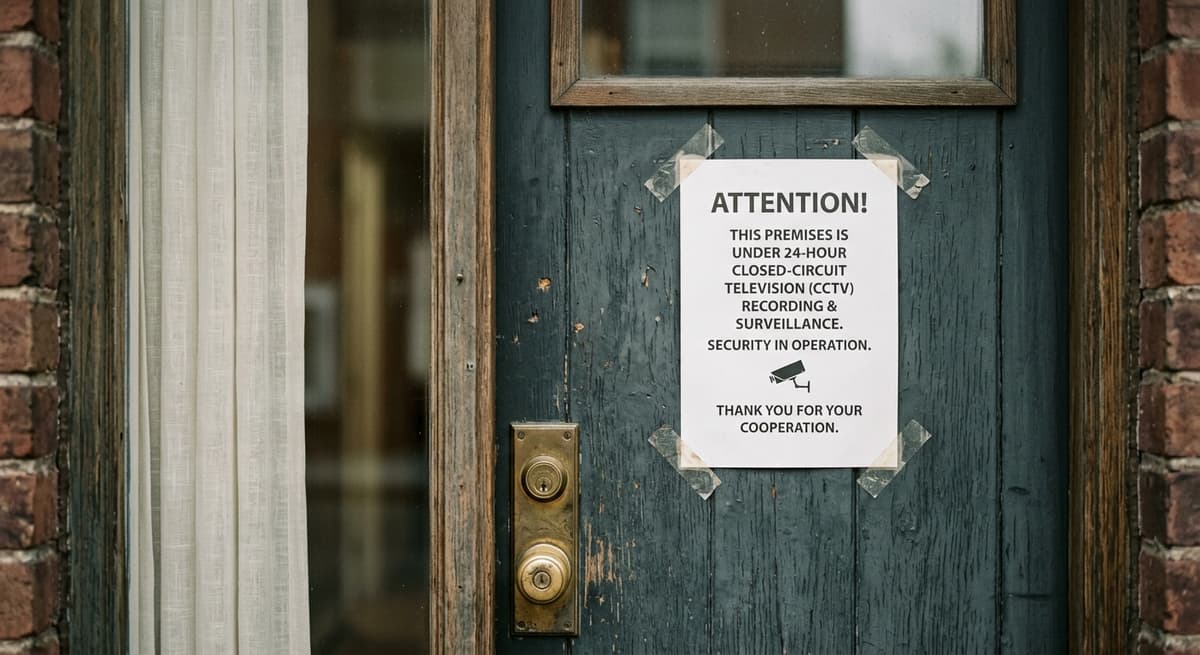
- Common hallways and lobby areas (with notice to tenants)
- Laundry rooms and other shared utility spaces
- Building exterior perimeter
Where landlords cannot place cameras:
- Inside individual rental units (this would violate tenant privacy)
- In bathrooms, whether private or shared
- Aimed directly into tenant windows
- In any location where tenants have a reasonable expectation of privacy
Installing a hidden camera inside a tenant's rental unit could result in criminal charges under Maine's wiretapping statute (15 M.R.S.A. section 710) or the voyeurism statute (17-A M.R.S.A. section 511), as well as civil liability.
Audio Recording on Security Cameras
If a landlord's security cameras include audio recording capabilities, additional legal considerations apply. Audio recording of conversations in common areas where tenants have conversations could violate one-party consent requirements if the landlord is not a participant in those conversations. Landlords should either:
- Disable audio recording on security cameras in common areas
- Post prominent notices that audio recording is in effect
- Limit cameras to video-only recording
Maine Landlord Entry and Notice Requirements
The 24-Hour Notice Rule
Maine landlord-tenant law (14 M.R.S.A. section 6025) requires landlords to provide reasonable notice before entering a rental unit, and to enter only at reasonable times. The statute itself creates the presumption: "Twenty-four hours is presumed to be a reasonable notice in the absence of evidence to the contrary." That presumption can be rebutted with contrary evidence in either direction, but 24 hours is the statutory starting point, not just a judge-made rule of thumb.
Landlords may enter a rental unit for:
- Making necessary repairs
- Inspecting the premises
- Showing the unit to prospective tenants or buyers
- In case of emergency (no notice required)
Recording Landlord Entry
Tenants can record when a landlord enters their unit. This is useful for documenting:
- Whether the landlord provided proper notice before entry
- The condition of the unit during inspections
- Conversations about repairs, lease violations, or other disputes
- Unauthorized or unannounced entries that may violate tenant rights
A video recording of a landlord entering without proper notice can serve as evidence in a complaint to the Maine Attorney General's Office or in court.
Security Cameras in Maine Rental Properties

Tenant Security Cameras
Tenants in Maine have the right to install security cameras inside their own rental units, subject to lease terms. Common tenant camera uses include:
- Doorbell cameras (like Ring or Nest) at the unit entrance
- Interior cameras to monitor pets, children, or property while away
- Cameras to document the condition of the unit
Lease considerations:
- Some leases prohibit modifications to the property, which could include drilling holes for camera mounts
- Wireless, adhesive-mounted cameras generally do not require lease modifications
- Tenants should check their lease before installing any device that requires permanent installation
- Cameras should not point into other tenants' units or common areas where others expect privacy
Landlord Notification Requirements
Maine does not have a specific statute requiring landlords to notify tenants about security cameras on the property exterior or in common areas. However, best practices and industry standards recommend:
- Including security camera information in the lease or rental agreement
- Posting visible signs indicating that surveillance cameras are in use
- Informing tenants at lease signing about the location of cameras
- Not using cameras to monitor tenant behavior beyond legitimate security purposes
Recording as Evidence in Maine Housing Disputes
Eviction Proceedings
Maine handles evictions through the Forcible Entry and Detainer (FED) process. Recordings can be valuable evidence in eviction cases to:
- Document lease violations such as noise, unauthorized occupants, or property damage
- Prove that proper notice was given (or not given) before eviction
- Record conversations where the landlord admits to illegal retaliation
- Show the condition of the property at specific points in time
Security Deposit Disputes
Maine security deposit law (14 M.R.S.A. section 6032) limits security deposits to two months' rent and requires landlords to return deposits within 30 days after the tenancy ends (or 21 days if the landlord maintains the property). Video recordings of the unit's condition at move-in and move-out are powerful evidence in security deposit disputes.
Tips for documenting with video:
- Record a complete walkthrough of every room at move-in, narrating the date and any existing damage
- Repeat the walkthrough at move-out, comparing conditions
- Include close-ups of any areas of concern (walls, floors, appliances, fixtures)
- Save the recordings in multiple locations for safekeeping
Habitability Complaints
Under Maine law, landlords must maintain rental units in habitable condition. The implied warranty of habitability requires:
- Working heating systems
- Hot and cold running water
- Functioning plumbing and electrical systems
- Structural integrity
- Compliance with building and housing codes
Tenants who record evidence of habitability violations (leaking roofs, broken heating, mold, pest infestations) can use those recordings when filing complaints with local code enforcement or the Maine Bureau of Building Codes and Standards.
Discrimination and Retaliation Claims
Maine's Human Rights Act (5 M.R.S.A. section 4581-A) prohibits housing discrimination based on race, sex, disability, familial status, and other protected categories. If a tenant suspects discriminatory treatment, recordings of discriminatory statements by a landlord can be powerful evidence in complaints filed with the Maine Human Rights Commission.
Maine law also prohibits landlord retaliation against tenants who exercise their legal rights, such as filing complaints about habitability or joining a tenants' union. Recordings that document retaliatory actions (threats of eviction, sudden rent increases, or reduced services) can support retaliation claims.
Penalties for Illegal Recording in Landlord-Tenant Situations
| Violation | Statute | Penalty |
|---|---|---|
| Recording conversations without being a party | 15 M.R.S.A. section 710 | Class C crime: up to 5 years prison, $5,000 fine |
| Hidden camera in private areas | 17-A M.R.S.A. section 511 | Class D crime: up to 1 year jail, $2,000 fine |
| Selling interception devices | 15 M.R.S.A. section 710 | Class B crime: up to 10 years prison |
Civil damages are also available under 15 M.R.S.A. section 711, including actual damages (or liquidated damages of $100 per day, whichever is greater) and attorney fees. Section 711 does not provide for punitive damages.
More Maine Recording Laws
Audio Recording | Video Recording | Voyeurism Laws | Workplace Recording | Recording Police | Phone Call Recording | Security Cameras | Recording in Public | Landlord-Tenant Recording | Dashcam Laws | School Recording | Medical Recording
More Maine Recording Topics
More Maine Laws
Frequently Asked Questions
Can I record a conversation with my landlord in Maine without telling them?
Yes. Maine is a one-party consent state under 15 M.R.S.A. sections 709 and 710. As a participant in the conversation, you can record without informing your landlord. This applies to in-person conversations, phone calls, and video calls.
Can my landlord put security cameras inside my apartment in Maine?
No. A landlord cannot install cameras inside your rental unit. This would violate your privacy rights and could result in criminal charges under Maine wiretapping law (15 M.R.S.A. section 710) or voyeurism law (17-A M.R.S.A. section 511). Landlords can place cameras in exterior areas and common spaces.
Can I install a security camera at my apartment door in Maine?
Generally, yes. You can install a doorbell camera or security camera at your unit entrance, provided it does not require permanent modification to the property (unless your lease allows it). The camera should be aimed at your own doorway and not into other tenants' units or shared private spaces.
Can I use recordings in a Maine eviction case?
Yes. Recordings made legally under one-party consent are generally admissible in Maine courts, including eviction proceedings. You must be able to authenticate the recording as genuine and unaltered. Video evidence of property conditions, lease violations, or improper landlord conduct can be valuable in FED cases.
Does my landlord have to tell me about security cameras on the property in Maine?
Maine does not have a specific statute requiring landlords to disclose security cameras in common areas or building exteriors. However, best practices recommend including this information in the lease agreement and posting visible signs. Audio recording on cameras in common areas raises additional one-party consent concerns.
Updates
Corrected the one-party-consent citation (the real basis is 15 M.R.S. section 709, not 712, which only covers carrier/law-enforcement interception) and clarified that Maine's 24-hour landlord-entry-notice figure is a statutory presumption written into 14 M.R.S. section 6025, not a judge-made rule.
Independently fact-checked against the cited primary sources
Corrected a claim that Maine's civil wiretapping remedy (15 M.R.S.A. section 711) includes punitive damages; the statute authorizes only actual/liquidated damages and attorney fees.
Governing law re-checked for recent changes
Cross-spoke accuracy check: corrected the one-party-consent citation from 15 M.R.S. section 712 (the carrier/law-enforcement exceptions provision, not a consent source) to 15 M.R.S. sections 709 and 710. 17-A M.R.S. section 511 (private-place all-party) confirmed current.
Reviewed and approved by an editor
The Law Behind This Article
This article rests on the statutory provisions below, held in our own legal record and retrieved from the official source. Tap a section to read the operative text.
Maine Revised Statutes, Title 15: COURT PROCEDURE -- CRIMINAL, Part 2: PROCEEDINGS BEFORE TRIAL, Chapter 102: INTERCEPTION OF WIRE AND ORAL COMMUNICATIONS
§ 710OffensesIn forcecited in 17 of our articles
1. Interception, oral communications prohibited. Any person, other than an employee of a communication common carrier, a law enforcement officer, an investigative officer, another employee of the Department of Corrections authorized to exercise law enforcement powers as described in Title 34‑A, section 3011 or a jail investigative officer or a jail employee acting at the direction of a jail investigative officer, carrying out practices otherwise permitted by this chapter, who intentionally or knowingly intercepts, attempts to intercept or procures any other person to intercept or attempt to intercept any wire or oral communication is guilty of a Class C crime. 2. Editing of tape recordings in judicial proceedings prohibited. Any person who knowingly or intentionally edits, alters or tampers with any tape, transcription or other sound recording, or knows of such editing, altering or tampering, and presents that recording in any judicial proceeding or proceeding under oath, without fully indicating the nature of the changes made and the original state of the recording, is guilty of a Class C crime. 3. Disclosure or use of wire or oral communications prohibited.
Official text (excerpt) · last checked 2026-08-28 · Read the full text in our law library · Verify at legislature.maine.gov
Cited in 5 court opinions in our collectionLatest citing opinion in our collection: 2022
In the courts (editorial summary, independently checked):Williams v. Poulos (1993) affirmed section 710(1) liability for intercepting employee calls and held section 710(3)(A) and (B) require only knowledge the information came through interception. Glenn A. Griffin v. Cristie J. Griffin (2014) allowed a parent's vicarious consent for a young child only on a good faith best-interest belief.
Opinions citing this section in our collection:
- Glenn A. Griffin v. Cristie J. Griffin (Supreme Judicial Court of Maine 2014, 92 A.3d 1144)✓A father recorded his six-year-old daughter's nightly calls with her mother after overhearing abusive remarks; the court held a parent with a good faith, objectively reasonable best-interest belief may vicariously consent under section 709(4)(C), so section 710 was not violated.
- Archer v. Androscoggin County (Superior Court of Maine 2022)✓An attorney sought recordings of another inmate's jail calls under Maine's public records law; the court applied the wiretap chapter that makes interception a crime under section 710 and held a court-appointed defense lawyer is not within the section 712(4) disclosure exception.
- Williams v. Poulos (Court of Appeals for the First Circuit 1993)✓Company owners secretly recorded employee phone calls using alligator clips wired to a VCR, and their lawyers then used the tapes; the First Circuit affirmed liability under section 710, holding subsection 3 requires only knowledge that the material came from an interception.
Identified automatically from the court opinions citing this section — not a ranking of which case controls.
Also relied on in: Maine Dashcam Laws: Mounting Rules, Audio Recording, and Evidence (2026), Maine Phone Call Recording Laws: Consent Rules for Cell, Landline, and VoIP (2026), Maine Laws on Recording in Public: Your Complete Guide (2026)
§ 709DefinitionsIn forcecited in 10 of our articles
The following words and phrases as used in this chapter, unless the context otherwise indicates, shall have the following meanings. [PL 1973, c. 561 (NEW).] 1. Communication common carrier. "Communication common carrier" means any telephone or telegraph company. 1-A. Administration of criminal justice. 1-B. Administration of juvenile criminal justice. 1-C. Administration of juvenile justice. "Administration of juvenile justice" has the same meaning as in section 3003, subsection 1‑A. 2. Contents. "Contents," when used with respect to any wire or oral communication, means any information concerning the identity of the parties to such communication or the existence, contents, substance, purport or meaning of that communication. 3. Intercepting device. "Intercepting device" means any device or apparatus which can be used to intercept a wire or oral communication other than: A. Any telephone or telegraph instrument, equipment or facility or any component thereof being used by a communication common carrier in the ordinary course of its business or extension telephones used by a subscriber to telephone service; or [PL 1973, c. 561 (NEW).] B.
Official text (excerpt) · last checked 2026-07-30 · Read the full text in our law library · Verify at legislature.maine.gov
Cited in 8 court opinions in our collectionLatest citing opinion in our collection: 2021
Opinions citing this section in our collection:
- Glenn A. Griffin v. Cristie J. Griffin (Supreme Judicial Court of Maine 2014, 92 A.3d 1144)“…nterception of Wire and Oral Communications Act (the Act), 15 M.R.S. §§ 709-713 (2012),1 and (2) whether the court…”
- State v. Kehling (Supreme Judicial Court of Maine 1991, 601 A.2d 620)“…e Maine’s Interception of Wire and Oral Communications Act, 15 M.R.S.A. §§ 709-713 (Supp.1991). As to the sentence, we…”
- State v. Cyran (Supreme Judicial Court of Maine 1991, 586 A.2d 1238)“…versations. Nevertheless, both Maine’s wiretap regulations, 15 M.R.S.A. §§ 709-712, and the applicable federal provisi…”
Identified automatically from the court opinions citing this section — not a ranking of which case controls.
Also relied on in: Maine Smart Glasses Recording Laws: What You Need to Know, Maine Surveillance Camera Laws (2026 Guide), Maine Recording Laws (2026): One-Party Consent, § 710 and § 511
§ 712ExceptionsIn forcecited in 8 of our articles
1. Switchboard operators, communication common carrier agent. It is not a violation of this chapter for an operator of a switchboard or an officer, employee or agent of any communication common carrier, as defined in this chapter, to intercept, disclose or use that communication in the normal course of employment while engaged in any activity which is a necessary incident to the rendition of service or to the protection of the rights or property of the carrier of the communication, provided that the communication common carriers shall not utilize service for observing or random monitoring, except for mechanical or service quality control checks, nor shall any such officer, employee or agent use or disclose to another the contents as defined in this chapter of the communication so intercepted. 2. Investigative officers.
Official text (excerpt) · last checked 2026-07-30 · Read the full text in our law library · Verify at legislature.maine.gov
Cited in 4 court opinions in our collectionLatest citing opinion in our collection: 2014
Opinions citing this section in our collection:
- State v. Desjardins (Supreme Judicial Court of Maine 1979, 401 A.2d 165)“…nd under the circumstances was subject to the provisions of 15 M.R.S.A. § 712, which specifically proscribe the use o…”
- Glenn A. Griffin v. Cristie J. Griffin (Supreme Judicial Court of Maine 2014, 92 A.3d 1144)“…sent of either party to the call, and that no exception to 15 M.R.S. § 712 applied to allow Glenn to consent vica…”
- State v. Cyran (Supreme Judicial Court of Maine 1991, 586 A.2d 1238)“…federal guidelines apply here, he specifically argues that 15 M.R.S.A. § 712 (Supp.1990) should be interpreted as pr…”
Identified automatically from the court opinions citing this section — not a ranking of which case controls.
Also relied on in: Maine Audio Recording Laws: One-Party Consent Rules and Penalties (2026), Maine Laws on Recording Police: Your Rights and Limits (2026), Maine Workplace Recording Laws: Employee and Employer Rights (2026)
Maine Revised Statutes, Title 14: COURT PROCEDURE -- CIVIL, Part 7: PARTICULAR PROCEEDINGS, Chapter 710: RENTAL PROPERTY
§ 6025Access to premisesIn force
1. Tenant obligations. A tenant may not unreasonably withhold consent to the landlord to enter into the dwelling unit in order to inspect the premises, make necessary or agreed repairs, decorations, alterations or improvements, supply necessary or agreed services or exhibit the dwelling unit to prospective or actual purchasers, mortgagees, tenants, workers or contractors. A tenant may not change the lock to the dwelling unit without giving notice to the landlord and giving the landlord a duplicate key within 48 hours of the change. A victim may change the locks to the unit at the victim's expense. If the victim changes the locks to the unit, the victim shall provide the landlord with a duplicate key within 72 hours of changing the locks. For the purposes of this subsection, "victim" has the same meaning as in section 6000, subsection 4. 2. Landlord obligations. Except in the case of emergency or if it is impracticable to do so, the landlord shall give the tenant reasonable notice of the landlord's intent to enter and shall enter only at reasonable times. Twenty-four hours is presumed to be a reasonable notice in the absence of evidence to the contrary.
Official text (excerpt) · last checked 2026-07-30 · Read the full text in our law library · Verify at legislature.maine.gov
Cited in 5 court opinions in our collectionLatest citing opinion in our collection: 2019
Opinions citing this section in our collection:
- State v. Dube (Supreme Judicial Court of Maine 1995, 655 A.2d 338)“…sonable notice in the absence of evidence to the contrary.” 14 M.R.S.A. § 6025(2) (Supp.1993). 2…”
- Francis v. Dana-Cummings (Supreme Judicial Court of Maine 2007, 915 A.2d 412)“…ed by publication of this opinion. 2 . 14 M.R.S. § 6025(3) (2005); 14 M.R.S. § 7751-B (2005).…”
- Clark v. Goodridge (Supreme Judicial Court of Maine 1993, 632 A.2d 125)“…awfully entered her apartment contrary to the provisions of 14 M.R.S.A. § 6025 (Supp.1992). Defendants contend that th…”
Identified automatically from the court opinions citing this section — not a ranking of which case controls.
Maine Revised Statutes, Title 14: COURT PROCEDURE -- CIVIL, Part 7: PARTICULAR PROCEEDINGS, Chapter 710-A: SECURITY DEPOSITS ON RESIDENTIAL RENTAL UNITS
§ 6032Maximum security depositIn forcecited in 2 of our articles
A lease or tenancy at will agreement for a dwelling intended for human habitation may not require a security deposit equivalent to more than the rent for 2 months. [PL 2009, c. 566, §22 (AMD).]
Official text (excerpt) · last checked 2026-09-05 · Read the full text in our law library · Verify at legislature.maine.gov
Cited in 1 court opinions in our collectionLatest citing opinion in our collection: 2008
Opinions citing this section in our collection:
- Nguyen v. DiMarco-Hammond (Superior Court of Maine 2008)“…y deposit held in excess of two months rent in violation of 14 M.R.S.A. § 6032. Mr. Hammond moves to amend his Answer…”
Identified automatically from the court opinions citing this section — not a ranking of which case controls.
Also relied on in: Maine Landlord-Tenant Laws (2026): Deposits, Notice, and Tenant Rights
Search our full record of US law — 2.1 million sections, every state + federal →
Sources and References
- 15 M.R.S.A. section 710 - Interception of Communications (Maine Legislature)(legislature.maine.gov).gov
- 15 M.R.S.A. section 709 - Definitions (One-Party Consent) (Maine Legislature)(legislature.maine.gov).gov
- 14 M.R.S.A. section 6025 - Landlord Access to Premises (Maine Legislature)(legislature.maine.gov).gov
- 14 M.R.S.A. section 6032 - Security Deposits (Maine Legislature)(legislature.maine.gov).gov
- Maine Attorney General - Consumer Protection(maine.gov).gov
- Maine Human Rights Commission(maine.gov).gov