CalPrivacy Fines Hertz $1.55M Over CCPA Opt-Out Signals
Independently fact-checked against primary sources (last audited November 19, 2026). · 14 primary sources cited on this page. How we verify our legal content
California's privacy regulator announced on November 17, 2026 that its board had ordered The Hertz Corporation to pay a $1.55 million administrative fine under the California Consumer Privacy Act and to submit to three years of opt-out testing, in a stipulated order Hertz signed without admitting liability.
Information last verified on November 19, 2026. This is a developing story; we update it as the record changes.
Jurisdiction scope: This article addresses California law: the CCPA as amended by the California Privacy Rights Act, at Civil Code section 1798.100 and following, and its implementing regulations in title 11 of the California Code of Regulations. It does not address any other state's privacy statute, and it does not address the separate enforcement authority of the California Attorney General beyond distinguishing it from the agency's.
What Happened
On November 6, 2026 the board of the California Privacy Protection Agency signed an Order of Decision adopting a Stipulated Final Order in Case No. ENF25-001-V-HE, In the Matter of The Hertz Corporation. Board Chair Jennifer M. Urban signed it, and the order states that the decision "shall become effective immediately." The agency published its announcement eleven days later, on November 17, 2026.
The complainant is the agency's Enforcement Division, not the attorney general. The order records the agency's authority to enforce the CCPA through administrative actions under Civil Code sections 1798.199.40(a) and 1798.199.55, and notes that Government Code section 11415.60(a) lets the agency issue a decision by settlement, by agreement of the parties, without an adjudicative proceeding (paragraphs 3 and 4). Both signature pages are dated October 16, 2026.
Hertz stipulated that it meets the statute's business thresholds, with annual gross revenue above $26.625 million and annual selling or sharing, in combination, of the personal information of 100,000 or more consumers or households (paragraph 5). The order defines the covered digital properties as the Hertz, Dollar and Thrifty websites and their respective mobile applications (paragraph 11), and records more than 600 California locations and 4,000 California employees (paragraph 25).
The three alleged failures
The relevant period runs from July 1, 2023 to August 25, 2026 (paragraph 30).
First, the signal itself. Paragraph 32 lists tracking technologies Hertz installed from Meta, Google, Pinterest, LinkedIn, Microsoft, TikTok, the Trade Desk, LiveRamp, Adobe, Amazon, Sojern, Criteo, Wunderkind and other advertising technology companies, some of them registered data brokers. Paragraph 38 states that for a portion of the relevant period Hertz "failed to configure its digital properties to properly detect and honor consumers' opt-out preference signals." Paragraph 39 is the liability pinpoint: each such sale or sharing "violated section 1798.120(d) of the Civil Code, and sections 7025(c)(1) and 7026(f) of title 11 of the California Code of Regulations."
Second, notice. The regulations require an online business to explain how an opt-out preference signal will be processed and how a consumer can use one. Paragraph 42 finds that for a portion of the period the Hertz privacy policy did neither, in violation of 11 CCR 7011(e)(3)(F).
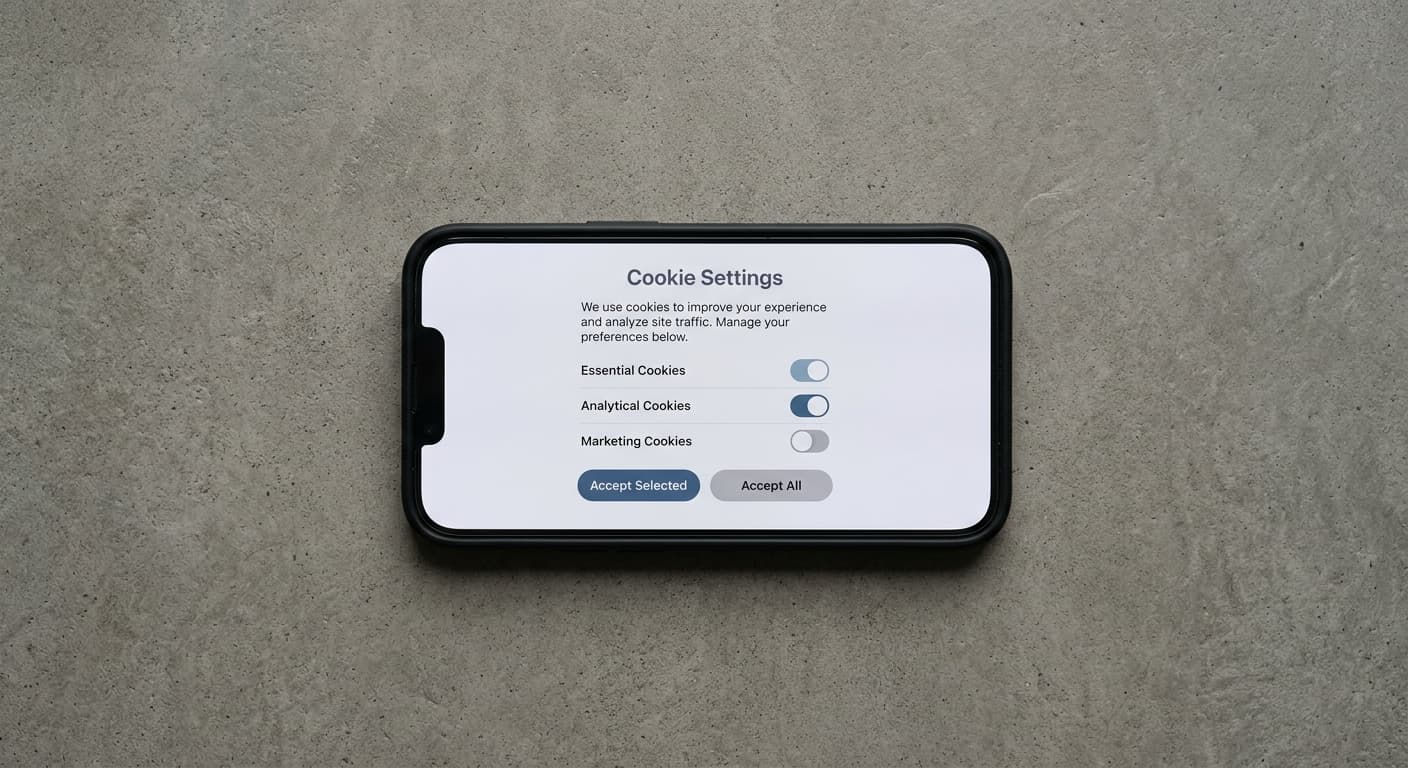
Third, the cookie window, and this count is worded differently from the other two. According to paragraphs 45 and 46, when a consumer opened the Manage Cookies window on Dollar.com or Thrifty.com, the toggles displayed as though every cookie category was already off, but closing the window with the X instead of clicking Save Changes reverted the settings to a default that allowed advertising cookies. Paragraph 49 concludes that by requiring "an additional and non-obvious step for consumer choice to take effect," Hertz used choice architecture "that may have been confusing which would violate section 7004(a)(3)" and (4). That conditional phrasing is the agency's own, and it is narrower than the flat findings on the other two counts.
What Hertz agreed to, and what it did not concede
A stipulated order is an agreement, not an adjudication. Paragraph 68 draws the line precisely: Hertz admits the truth of paragraphs 1 to 5 and 24 to 29, otherwise "neither admits nor denies the truth of the remaining factual findings," and "does not admit liability for any violation of the CCPA, actual or alleged." The admitted block is narrow but not trivial. It includes paragraph 27, in which Hertz admits it sold and shared consumer personal information to third parties for cross-context behavioral advertising through cookies and pixels on its websites, and paragraph 28, in which it admits it knew consumers had the right to opt out of that sale and sharing. It also includes paragraph 29, which records that Hertz cooperated, produced documents, met with the agency repeatedly and "promptly took corrective action during the course of the Agency's investigation." What Hertz did not admit is everything in paragraphs 30 to 49, the alleged failures themselves.
Hertz also waived any hearing, reconsideration or appeal, which is what makes the order final (paragraph 69). Failure to pay or to comply with a term results in enforcement in California Superior Court (paragraph 72), and if the agency prevails in that action it is entitled to its attorneys' fees and costs (paragraph 71).
The operational terms are where this order differs from its predecessors. Hertz must scan its digital properties at least quarterly to keep a current inventory of tracking technologies that sell or share personal information, and must test its opt-out configurations quarterly and whenever a new tracking technology is added, in both staging and production and across browsers, mobile platforms and tag management containers (paragraph 56). Paragraph 61 adds a reporting term: when Hertz posts the request metrics required by 11 CCR 7102, it must separately identify how many opt-out requests arrived as preference signals.
Then there is the vendor term, which has no direct counterpart in the FedEx order of the same date.
"Hertz shall not rely solely on the statements, documents, claims, or representations of any service provider or consent management platform it uses for CCPA compliance and shall independently assess, at least twice per year, whether the service provider or consent management platform is appropriately responding to consumers' CCPA requests." Source: Decision and Stipulated Final Order, In the Matter of The Hertz Corporation, Case No. ENF25-001-V-HE, at paragraph 60
The agency's announcement put the same idea in plainer words. Lara Kehoe Hoffman, the Acting Deputy Director of Enforcement, said businesses "have been on notice for years that we expect them to listen when Californians say no to trackers," and added:
"Companies cannot ignore those choices or shift responsibility to others. They must ensure that consumers' opt-out preferences are passed along and honored." Source: Lara Kehoe Hoffman, Acting Deputy Director of Enforcement, CalPrivacy press release, November 17, 2026
The Filson order, decided the same day
The board adopted a second CCPA order on November 6, 2026, against outdoor clothing maker CC Filson Co., in Case No. ENF25-074-R-FI. Its relevant period is March 2, 2025 to March 31, 2026 (paragraph 29).
The Filson findings are broader than Hertz's. Paragraph 34 finds no "Do Not Sell or Share My Personal Information" link, no "Your Privacy Choices" link and no "Your California Privacy Choices" link on filson.com at all, in violation of Civil Code section 1798.135(a) and 11 CCR 7013. Paragraphs 40 through 43 state that none of the three advertised request channels functioned properly: some consumers who called were not assisted, some emails went unanswered, and the privacy policy's customer care link led to a page reading "PAGE NOT FOUND. We're sorry. We can't find what you're looking for." Paragraph 55 finds a failure to honor opt-out preference signals, covering both browser-based and server-side sharing.
Paragraph 59 is the reason the per-violation arithmetic in these cases escalates so fast: for each opted-out consumer, the order states, Filson made prohibited sales or shares to "at least five AdTech companies," so "every time a consumer visited Filson's website using an opt-out preference signal, Filson violated Civil Code section 1798.120(d) at least five times."
The fine is $217,987, and paragraph 65 explains the size: the Enforcement Division "was prepared to bring an enforcement action seeking a multi-million dollar fine" and reviewed confidential financial information supporting Filson's inability to pay at that level.
The cease-and-desist term needs reading carefully, because the announcement compresses it. Paragraph 67 orders Filson to stop device-based sales and shares of Californians' personal information to advertising technology companies within 30 days of the effective date, which counted from November 6, 2026 is December 6, 2026. Paragraph 68 then provides that if Filson delivers a written certification of compliance with paragraphs 69 to 73, signed under penalty of perjury by an officer or director, within those same 30 days, it "need not cease and desist as required by paragraph 67." The stop order is conditional, not automatic. Filson admits only paragraphs 25 to 28 and does not admit liability (paragraph 80).
What the Law Actually Says
The underlying right is one sentence. Civil Code section 1798.120(a)(1) gives a consumer the right, at any time, to direct a business that sells or shares personal information about them to third parties not to do so. Subdivision (d) then prohibits the business from selling or sharing that consumer's personal information after it receives the direction, unless the consumer later consents. Our explainer on how the Do Not Sell or Share right works in practice walks through the mechanics on the consumer side.
An opt-out preference signal is the version of that right that does not require visiting each site. Under 11 CCR 7025(a), the point of the signal is to let a consumer "opt-out of sale and sharing of their personal information with all businesses they interact with online without having to make individualized requests with each business."
Section 7025(b) sets the two conditions a conforming signal must meet, and section 7025(c)(1) then requires the business to treat one as a valid opt-out under section 1798.120 for that browser or device and any consumer profile associated with it, including pseudonymous profiles.
In practice there is one such signal that matters. The Hertz order names Global Privacy Control, describes it as a browser-based technical standard, and explains the mechanism at paragraph 35: a standardized HTTP header plus a JavaScript property that a site can detect and act on before deciding whether tracking technologies are allowed to run. Both the Hertz and Filson orders make the same point about vintage, stating that California has required businesses to honor these signals since 2020 and tracing the duty through three successive regulation numbers, from the original 11 CCR 999.315(c) to the current section 7025.
Two further rules carried weight here. Section 7011(e)(3)(F) requires the privacy policy to explain how a signal will be processed and how a consumer can use one. Section 7004(a)(3) requires methods for submitting CCPA requests to avoid confusing interactive elements and provides that "[t]oggles or buttons must clearly indicate the consumer's choice," while section 7004(a)(4) bars choice architecture that impairs or interferes with the consumer's ability to make the choice. Section 7026(f)(1) gives a business no more than 15 business days to stop selling and sharing once a valid request arrives.
The fine authority is administrative. Civil Code section 1798.199.55(a) lets the agency, after determining that violations occurred, order the violator to cease and desist and to pay up to $2,500 per violation, or $7,500 for each intentional violation and each violation involving a minor's personal information, raised by the statutory inflation adjustment under Civil Code section 1798.199.95(d), effective January 1, 2025, to the $2,663 and $7,988 the agency publishes. Those are per-violation ceilings, which is why the Filson order's arithmetic at paragraph 59 matters more than the headline figure. For how the CPRA amendments built this agency and this signal duty onto the original 2018 statute, see our side-by-side on the differences between the CCPA and the CPRA.
One point of identity is worth stating plainly, because readers routinely merge the two. California has two CCPA enforcers. The agency here is the California Privacy Protection Agency, created by Proposition 24 in 2020 and now branded CalPrivacy, and it acts administratively through its own board under section 1798.199.55. The California Attorney General sues in superior court under Civil Code section 1798.199.90. Hertz is an agency matter. Our guide to which businesses the CCPA reaches and what it requires of them sets out the scheme both enforcers apply.

The Opt-Out Signal Series, Accurately Counted
This is the fourth California opt-out enforcement action in about three weeks, and they are not interchangeable.
On October 29, 2026 the attorney general announced an $1.8 million stipulated judgment against Lyft in San Francisco County Superior Court, a court action under section 1798.199.90 over the absence of an in-app opt-out, which we covered in the Lyft opt-out judgment. The FedEx and Hertz matters are administrative decisions of CalPrivacy's board under section 1798.199.55, so the Lyft case belongs to a different enforcer and a different statutory track. Our report on the $2.975 million FedEx order covers the one that was adopted at the very same board action as Hertz and Filson, on November 6, 2026, though it was announced a week earlier, on November 10.
The agency's own series is also longer than three. Its board-decisions page lists earlier CCPA orders that turned on opt-out mechanics: American Honda Motor Co. on March 7, 2025 ($632,500, including an amount the order attributes to consumers made to provide more information than necessary to submit opt-out requests), Todd Snyder, Inc. on May 1, 2025 ($345,178, over a privacy portal that failed to process opt-out requests for 40 days plus excessive-information and verification demands), Tractor Supply Company on September 26, 2025 ($1.35 million, with opt-out preference signal findings), 2080 Media d/b/a PlayOn Sports on February 27, 2026 ($1.1 million, also with signal findings) and Ford Motor Company on the same date ($375,703).
Read in order, the figures do not climb steadily and should not be read as a tariff. $345,178, $375,703, $632,500, $1.1 million, $1.35 million, $1.55 million and $2.975 million are negotiated settlement amounts in matters of different size and duration, reached by agreement with cooperating respondents, and Filson's $217,987 was set by an inability to pay.
What Happens Next
Every clock in the Hertz order runs from the effective date, which the Order of Decision fixes at November 6, 2026.
The fine is first. Paragraph 54 gives Hertz 60 days to pay $1,550,000, which falls on January 5, 2027. That is twice the window FedEx got; paragraph 61 of the FedEx order set 30 days.
Paragraph 59 then gives Hertz 180 days, about May 5, 2027, to review its practices for CCPA compliance, and paragraph 62 sets the same 180 days to complete the process and system changes the order requires. Neither paragraph directs Hertz to file anything publicly on those dates.
The recurring duties then run three years, to about November 6, 2029, under paragraph 55, which also states that nothing in the order relieves Hertz of its independent obligation to comply with 11 CCR 7025, 7026, 7053 and 7102 after that. Inside the window, the tracker inventory and the opt-out testing are quarterly (paragraph 56), the request-method testing is quarterly (paragraph 58), the vendor assessment is twice yearly (paragraph 60) and the metrics posting, including the preference-signal subtotal, is annual (paragraph 61). Paragraph 64 releases Hertz from agency claims arising from the order's factual findings once it has complied with paragraphs 54 through 63.
There is no appeal pending in either matter, because both respondents waived review. New board decisions appear on the agency's board-decisions page as they are adopted, which is where these were posted.
One dated change sits just beyond this order. The California Opt Me Out Act, AB 566 (Lowenthal), which the agency sponsored, requires that no later than January 1, 2027 all web browsers, on desktop and mobile, include an opt-out preference signal feature. The agency describes it as the first such law in the country.
Analysis: Why This Matters
The following is analysis from the Recording Law Editorial Team.
The interesting part of this order is not the $1.55 million. It is paragraph 60.
The earlier orders we could read in this series tell the respondent to make its own properties honor signals, and the PlayOn order goes as far as requiring a compliance review that includes its consent management platform. We read the FedEx, Filson, Ford, PlayOn, Tractor Supply and Honda orders looking for a counterpart to paragraph 60 and found none; the agency posts only the cover page of its May 2025 Todd Snyder decision, so we could not check that one. The principle itself is not new to the agency. Announcing Todd Snyder in May 2025, the head of its Enforcement Division said businesses "should scrutinize their privacy management solutions to ensure they comply with the law and work as intended, because the buck stops with the businesses that use them," adding that "[u]sing a consent management platform doesn't get you off the hook for compliance." What is new in paragraph 60 is that the idea is now an express, recurring order term. Paragraph 60 tells Hertz it may not rely solely on what its consent management platform or service provider says about CCPA compliance, and must independently check, twice a year, whether that vendor is actually responding to consumer requests. The agency is treating the vendor's assurance as insufficient evidence of the business's own compliance, which maps onto the enforcement division's public line about shifting responsibility to others.
Paragraph 56(c) points the same direction with more specificity. Testing must cover "all tag management containers or profiles," server-side as well as client-side technologies, different browsers and mobile platforms, staging and production, known and unknown consumers, and first-time visitors with no existing consent state. That is a description of where opt-out handling actually breaks: not in the privacy policy, but in a container someone added a tag to without wiring it to the consent state. On the agency's framing, the configuration of that container is where the legal exposure now sits.
The Dollar and Thrifty cookie-window finding is worth separating out, because the order's own hedge is instructive. The agency did not find a completed violation there. It wrote that the choice architecture "may have been confusing which would violate" section 7004(a)(3) and (4). Compare paragraph 39 on the signals, which states flatly that each sale or sharing violated section 1798.120(d). A reader comparing this order to the press release will find the release does not preserve that distinction, and the order is the document that controls.
Paragraph 61 deserves more notice than it will get. The metrics rule at 11 CCR 7102 already makes larger businesses publish request counts. Requiring Hertz to break out how many opt-outs arrived as preference signals creates a public number that can be compared across years and, eventually, across companies. A business whose signal-sourced count is near zero while its traffic is not is publishing something about its own configuration.
Throughout, we are describing this agency's stated reasoning in these two matters. Neither order purports to decide anything beyond them, and we draw no forecast from them about any other dispute.
How This Affects You
For a California consumer, the practical takeaway is about what the signal does and does not reach. Under 11 CCR 7025(c)(1) a conforming opt-out preference signal counts as a valid opt-out for the browser or device that sent it and any profile the business associates with that browser or device, and for the consumer as well if they are known to the business. It does not travel on its own to a second browser, a different device, or an app that does not read it.
The signal is also an opt-out, not a deletion request. It directs a business to stop selling and sharing personal information with third parties. Deletion is a separate right with separate rules at Civil Code section 1798.105.
Timing is set by regulation rather than by any company's policy. Under 11 CCR 7026(f)(1) a business must stop selling to and sharing with third parties as soon as feasibly possible, and no later than 15 business days after it receives the request.
Neither of these orders creates a payment to consumers. An administrative fine under Civil Code section 1798.199.55 is deposited into the Consumer Privacy Subfund and the Consumer Privacy Grant Subfund in a 95 and 5 percent split. There is no claims process in either matter, and anyone contacted about a Hertz or Filson privacy payout should treat that as a reason for suspicion.
This is general legal information, not legal advice. It covers California and reflects sources verified on November 19, 2026. Laws change and this story is developing; consult a lawyer licensed in your jurisdiction about your specific situation.
Related articles
- CCPA Opt-Out Rights: Do Not Sell or Share My Personal Information
- CCPA: California Consumer Privacy Act Explained
- CCPA vs CPRA: Key Differences Explained
- FedEx to Pay $2.975M CCPA Fine Over Opt-Out Signal Failures
- Lyft to Pay $1.8M in California CCPA Opt-Out Settlement
Last updated: 2026-11-19. This is a developing story; details verified as of 2026-11-19.
Frequently Asked Questions
Did Hertz admit to violating the CCPA?
No. The order is a stipulated agreement, not an adjudication. Paragraph 68 states that Hertz admits the truth of paragraphs 1 to 5 and 24 to 29, which cover the parties, the agency's jurisdiction, Hertz's California operations, its sale and sharing of personal information for cross-context behavioral advertising, its knowledge of the opt-out right, and its cooperation with the investigation, and that Hertz otherwise neither admits nor denies the remaining factual findings and does not admit liability for any CCPA violation, actual or alleged. Hertz did waive any hearing and any right to appeal (paragraph 69). This is California only.
What is an opt-out preference signal, and is Global Privacy Control the same thing?
An opt-out preference signal is a browser or device setting that tells every site a consumer visits that the consumer is exercising the CCPA right to opt out of the sale or sharing of personal information, instead of the consumer clicking an opt-out link at each site. Under 11 CCR 7025(b) a business that sells or shares must process any signal in a format commonly used and recognized by businesses, with an HTTP header field or JavaScript object given as examples, where the sending tool makes clear it is meant to opt the consumer out. Global Privacy Control is the signal that meets that description in practice, and the Hertz order names it and describes its HTTP header and JavaScript mechanism at paragraph 35.
Who fined Hertz, the California Attorney General or a privacy agency?
The California Privacy Protection Agency, which brands itself CalPrivacy. Its board adopted the order on November 6, 2026 under Civil Code section 1798.199.55, which authorizes administrative fines. The California Attorney General is a separate CCPA enforcer who sues in superior court under Civil Code section 1798.199.90; that is the track the attorney general used for the $1.8 million Lyft judgment entered on October 29, 2026. Both enforce the same statute in California.
How much does Hertz have to pay, and by when?
Paragraph 54 of the order requires a $1,550,000 administrative fine under Civil Code section 1798.199.55, payable no later than 60 days after the effective date of the board's decision. The effective date is November 6, 2026, which puts the deadline at January 5, 2027. The order states the 60-day period rather than a calendar date, and it provides for written payment instructions from the Enforcement Division.
Does the Filson order actually require Filson to stop selling Californians' data?
Conditionally. Paragraph 67 orders Filson to cease device-based sales and shares of Californians' personal information to advertising technology companies within 30 days of the effective date, which is December 6, 2026. Paragraph 68 provides that if Filson instead delivers a written certification of compliance with paragraphs 69 to 73, signed under penalty of perjury by an officer or director, within those same 30 days, it need not cease and desist at all. The $217,987 fine is separate and is not conditional.
Will my browser come with this setting?
Under the California Opt Me Out Act, AB 566 (Lowenthal), the agency states that no later than January 1, 2027 all web browsers accessed on a desktop or mobile device must include an opt-out preference signal feature. Some browsers already offer one, and browser extensions that send Global Privacy Control exist for several that do not. The requirement is a California law directed at browsers operating in California.
Updates
Independently fact-checked against the cited primary sources
Sources and References
- Decision and Stipulated Final Order, In the Matter of The Hertz Corporation, Case No. ENF25-001-V-HE (Cal. Privacy Prot. Agency Bd., ordered Nov. 6, 2026), at paragraphs 5, 11, 25, 30, 32, 35, 38, 39, 42, 45, 46, 49, 54 to 64 and 68 to 72(privacy.ca.gov).gov
- CalPrivacy press release, Vehicle Rental Services Company Hertz to Pay $1.55 Million CCPA Fine, Adjust Privacy Practices (Nov. 17, 2026), including the quoted statements of Acting Deputy Director of Enforcement Lara Kehoe Hoffman(privacy.ca.gov).gov
- Decision and Stipulated Final Order, In the Matter of CC Filson Co., Case No. ENF25-074-R-FI (Cal. Privacy Prot. Agency Bd., ordered Nov. 6, 2026), at paragraphs 29, 34, 40 to 43, 55, 59, 65 to 73 and 80(privacy.ca.gov).gov
- CalPrivacy, Board enforcement decisions (listing Hertz, Filson and FedEx under order date November 6, 2026, and the earlier Honda, Tractor Supply, PlayOn Sports and Ford CCPA decisions)(privacy.ca.gov).gov
- California Consumer Privacy Act, Cal. Civ. Code secs. 1798.100 to 1798.199.100 (text effective Jan. 1, 2026), at secs. 1798.105, 1798.120(a)(1) and (d), 1798.135(a) and 1798.199.55(a)(cppa.ca.gov).gov
- CCPA Regulations, Cal. Code Regs. tit. 11 (consolidated final text effective March 29, 2023; secs. 7004, 7011, 7013, 7025 and 7102 as amended effective January 1, 2026 do not change the language quoted here), at secs. 7004(a)(3) and (4), 7011(e)(3)(F), 7013, 7025(a) to (c), 7026(f)(1) and 7102(cppa.ca.gov).gov
- California Privacy Protection Agency, CCPA monetary thresholds and penalty amounts adjusted for inflation, effective January 1, 2025 ($2,663, $7,988 and $26,625,000)(cppa.ca.gov).gov
- CalPrivacy, California's Opt Me Out Act: Your Privacy Just Got Easier (Jan. 15, 2026), stating that AB 566 (Lowenthal) requires all web browsers to include an opt-out preference signal no later than January 1, 2027(privacy.ca.gov).gov
- Decision and Stipulated Final Order, In the Matter of Federal Express Corporation, Case No. ENF25-073-TS-FE (Cal. Privacy Prot. Agency Bd., ordered Nov. 6, 2026), at paragraphs 50 and 61 ($2,975,000 fine payable within 30 days)(privacy.ca.gov).gov
- Decision and Stipulated Final Order, In the Matter of Tractor Supply Company (Cal. Privacy Prot. Agency Bd., ordered Sept. 26, 2025), $1,350,000 administrative fine with opt-out preference signal findings(privacy.ca.gov).gov
- Decision and Stipulated Final Order, In the Matter of 2080 Media, Inc. d/b/a PlayOn Sports (Cal. Privacy Prot. Agency Bd., ordered Feb. 27, 2026), $1,100,000 administrative fine with opt-out preference signal findings(privacy.ca.gov).gov
- Decision and Stipulated Final Order, In the Matter of Ford Motor Company (Cal. Privacy Prot. Agency Bd., ordered Feb. 27, 2026), $375,703 administrative fine(privacy.ca.gov).gov
- Decision and Stipulated Final Order, In the Matter of American Honda Motor Co. (Cal. Privacy Prot. Agency Bd., ordered Mar. 7, 2025), $632,500 administrative fine, at paragraph 75(privacy.ca.gov).gov
- California Privacy Protection Agency, announcement of the Todd Snyder, Inc. decision and order (May 2025), quoting the Head of Enforcement on consent management platforms(cppa.ca.gov).gov