No State Has Joined the Two-Party Consent Group Since 1998

Independently fact-checked against primary sources (last audited November 9, 2026). · 38 primary sources cited on this page. How we verify our legal content
See Recording Law first on Google. Add us as a preferred source to see more of our legal news when you search.
Add on GoogleIn June 1968, a special commission of the Massachusetts legislature finished its report on electronic eavesdropping. It found "that eavesdropping devices are readily available to members of the public from commercially available stores," and it proposed a rule "which would require the consent of all parties to a conversation before that conversation could be recorded." The legislature passed that rule about a month later. Its preamble, still the text of Massachusetts law in 2026, includes the line: "Therefore, the secret use of such devices by private individuals must be prohibited."
On October 19, 2026, the Pew Research Center published its latest count of the devices people carry. About nine in ten American adults, 91%, now own a smartphone, a recorder that fits in a pocket. In 2011, the first year Pew asked, the figure was 35%.
Massachusetts is one of 13 states that, by RecordingLaw.com's count, require every party's consent to record at least one major kind of conversation. That rule is called all-party consent, or often two-party consent. All 13 states had their rules by 1998.
In the 28 years since, as recorders moved from store shelves into nearly every pocket, no state has joined them. The one state whose rule a court struck down in that time, Illinois in 2014, had a rewritten rule in force before the year was out.
The argument has not stopped. In 2020, a federal appeals court ruled that Massachusetts's rule cannot be applied to people who secretly record police doing their jobs in public. Prosecutors in Maryland want crime victims' secret recordings admitted in court.
A New Jersey lawmaker and Alaska's governor proposed joining the all-party states, and the New Jersey sponsor cited scams that use deepfakes. How did rules written for store-bought eavesdropping devices come through the smartphone era unchanged in number? And what is pressing on them now?
Ten states in twelve years
Most of the all-party map was drawn in the dozen years after California and Washington wrote their laws in 1967. Ten states adopted the rule from 1967 through 1978, joining Oregon, which had adopted one in 1959. The last state was added in 1998. How quickly did the list fill, and when did it stop?
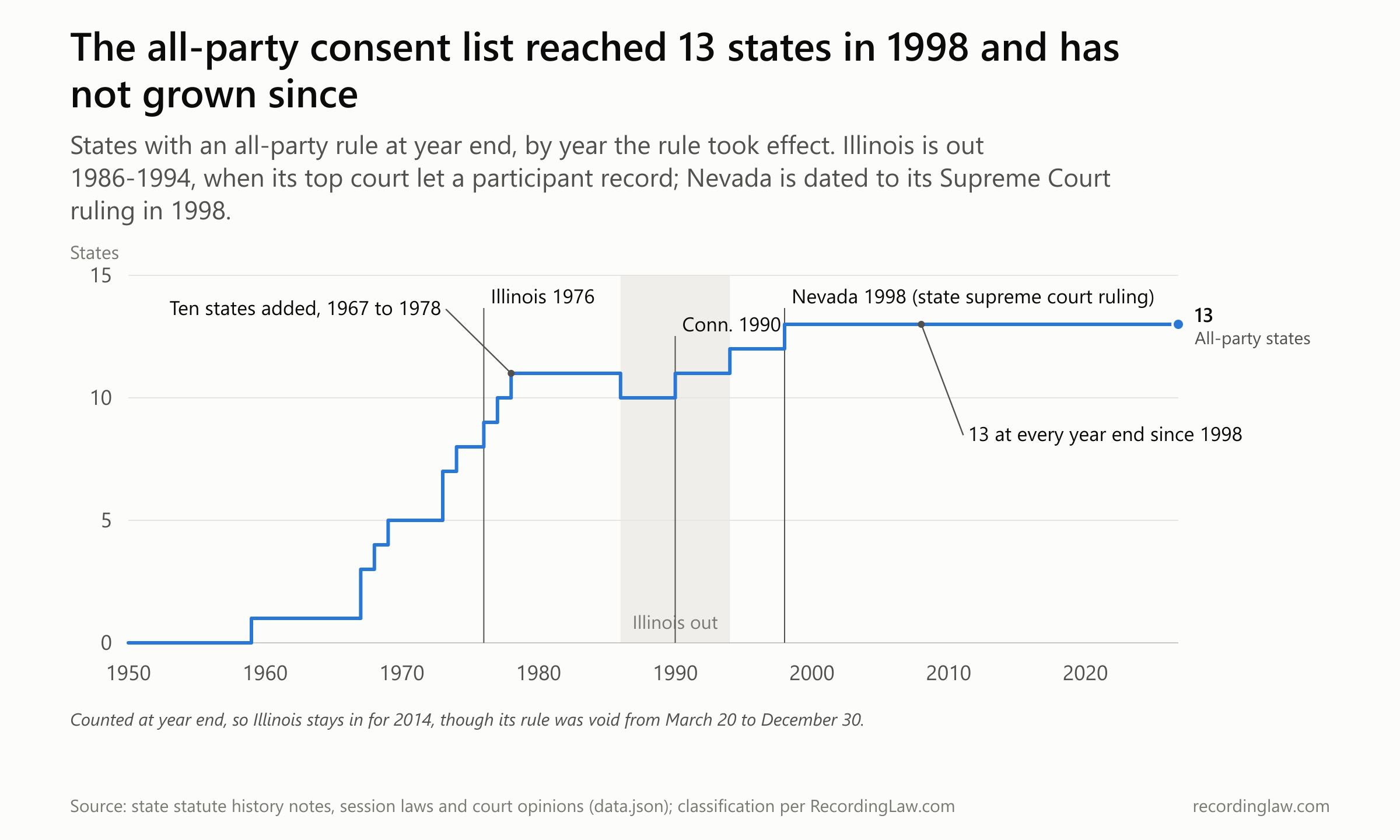
Number of states with an all-party consent rule at year end, by year the rule took effect (13 states per RecordingLaw.com classification; Illinois out from 1986 to 1994, while its Supreme Court read the law to let a participant record; Nevada dated to the Nevada Supreme Court's 1998 ruling). Source: state statute history notes, session laws and court opinions.
| State | Year the all-party rule took effect | Scope |
|---|---|---|
| Oregon | 1959 | In-person conversations and video calls only |
| California | 1967 | Phone and in-person |
| Washington | 1967 | Phone and in-person |
| Massachusetts | 1968 | Phone and in-person |
| New Hampshire | 1969 | Phone and in-person |
| Montana | 1973 | Phone and in-person |
| Delaware | 1973 | Two conflicting statutes |
| Florida | 1974 | Phone and in-person |
| Illinois | 1976 | Phone and in-person (participant could record 1986-1994; private conversations since 2014) |
| Maryland | 1977 | Phone and in-person |
| Pennsylvania | 1978 | Phone and in-person |
| Connecticut | 1990 | Phone calls only (civil) |
| Nevada | 1998 (court reading) | Phone calls only |
Delaware has two statutes that disagree: one requires all parties' consent, and the other only one party's. The line dips from 1986 to 1994, the years Illinois's top court read its law to let a participant record. Otherwise it only rose, and it stopped at 13 in 1998.
The steep part of the climb began in Sacramento. In 1967, California's legislature declared that "advances in science and technology have led to the development of new devices and techniques for the purpose of eavesdropping upon private communications." The invasion of privacy those devices caused, it said, "cannot be tolerated in a free and civilized society."
Oregon had moved first. In 1959 its legislature added a rule that an in-person conversation may be recorded only if every participant is told. Its rule for phone calls is one-party.
Congress went the other way. It passed a federal wiretap law in June 1968, known as Title III and today as the federal Wiretap Act. That law lets a private person record a conversation "where such person is a party to the communication or where one of the parties to the communication has given prior consent."
In wiretap law, capturing a conversation with a device, including recording it, is called an interception. That one-party rule, which lets a participant record without telling anyone, became the floor. The federal law still sets it for private persons, and 37 states and DC follow it today.
Massachusetts followed its commission instead. In 2001 the state's highest court wrote that "[t]he commission clearly designed the 1968 amendments to create a more restrictive electronic surveillance statute than comparable statutes in other States."
New Hampshire adopted its rule in 1969, and Montana and Delaware in 1973. Two states switched from the one-party rule to the all-party rule. Florida's 1969 law matched the federal one-party rule until October 1, 1974, when the legislature replaced it with an exception allowing interception only "when all of the parties to the communication have given prior consent."
Illinois made the same switch. Its 1961 eavesdropping law made it a crime to record "without the consent of any party thereto," which is a one-party rule. A 1976 amendment changed that to the consent of "all of the parties."
Maryland's rule took effect on July 1, 1977, and Pennsylvania's Wiretapping and Electronic Surveillance Control Act followed in October 1978. That made 11 states with an all-party rule.
Connecticut's legislature became the 12th to adopt one, in 1990. Its rule covers phone calls only. It is enforced through civil suits. The law lets a caller record without consent if a device on the line "automatically produces a distinct signal that is repeated at intervals of approximately fifteen seconds."
The 13th came from a court. In December 1998 the Nevada Supreme Court, "with the justices widely divided," ruled on the case of a fired insurance employee who had secretly taped 700 calls with company executives. Justice Bill Maupin, writing for the majority, found the Legislature intended that both parties must consent, absent a court order, the Las Vegas Sun reported.
Nevada's statute speaks of interception "with the prior consent of one of the parties to the communication." Chief Justice Charles Springer, dissenting, wrote that a person could not intercept his own call: "Where there are only two persons, there cannot be an interception no matter how hard we try to stretch the law and the facts."
The Nevada Supreme Court restated that 1998 reading in a 2017 opinion. The rule covers phone calls only.
Not everyone counts 13. Heather Morton of the National Conference of State Legislatures told Maryland lawmakers in 2025 that there were 10. A 2025 Maryland fiscal note, a bill analysis by the legislature's Department of Legislative Services, said "approximately 11."
RecordingLaw.com counts a state when it requires every party's consent for phone calls or for in-person conversations. That brings in the four partial states: Connecticut, Nevada, Oregon and Delaware. Michigan's courts read its statute as letting a participant record, so it is counted with the one-party states.
Then nine in ten adults carried a recorder
By the time Pew first asked Americans about smartphones, in May 2011, the all-party map had not changed for 13 years. The share passed half in early 2013. It reached 77% by late 2016, and it was 90% in 2023.
It has held at 91% in each of the three surveys since, and the latest was taken from January to June 2026. Cellphones of any kind reached 98%.
What did the two lines do over the same years?
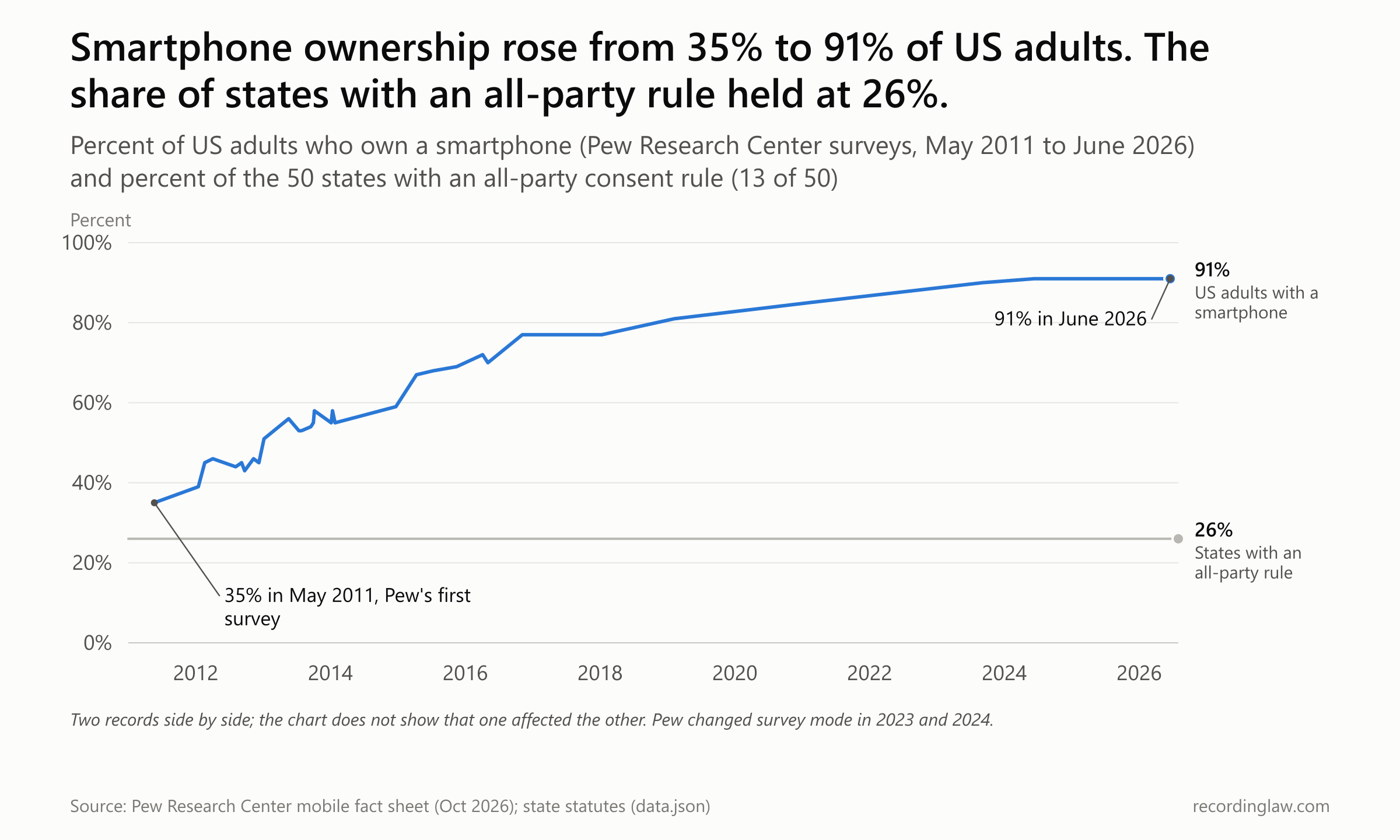
US adults who own a smartphone (Pew Research Center, 2011-2026) and the share of the 50 states with an all-party rule (13 of 50). Source: Pew Research Center mobile fact sheet, Oct 2026; state statutes.
| Pew survey date | US adults with a smartphone | States with an all-party rule (share of 50) |
|---|---|---|
| May 22, 2011 | 35% | 13 (26%) |
| Jan. 6, 2013 | 51% | 13 (26%) |
| Jan. 10, 2018 | 77% | 13 (26%) |
| Feb. 7, 2019 | 81% | 13 (26%) |
| Feb. 8, 2021 | 85% | 13 (26%) |
| Sept. 5, 2023 | 90% | 13 (26%) |
| June 10, 2024 | 91% | 13 (26%) |
| June 18, 2025 | 91% | 13 (26%) |
| June 18, 2026 | 91% | 13 (26%) |
The chart sets two records side by side. It does not show that one affected the other.
Two witnesses before Maryland's legislature described the change in terms of what the law's authors could not have foreseen. "When the wiretap statute was drafted, the only entities that were envisioned to have the capacity to violate the statute were law enforcement or very sophisticated operational entities," Maryland's Office of the State Prosecutor told lawmakers in 2026. "But now, with the advent of personalized cell phones, recording a conversation without the knowledge of another party is literally just a click away, and can be used by nearly everyone, including victims of violent crimes."
David Gray, a law professor at the University of Maryland, told the same lawmakers in 2025 that the state's law "was adopted at a time where video recording was relatively unavailable, and so it just wasn't on the minds of the legislature at the time."
The legal fights did not wait for the smartphone, though. In Illinois and Massachusetts, they began with people recording the police.
When the courts stepped in
In Illinois, courts narrowed or struck down the state's rule twice, and each time the legislature rewrote it. The first round began in 1986, when the Illinois Supreme Court ruled that a driver who taped his own conversation with an officer after a speeding stop had not committed eavesdropping.
In 1994 the same court repeated that reading. It held that a person who is spoken to commits no eavesdropping by recording what is said. For those eight years, a participant in Illinois could record without the other side's consent.
The legislature answered in December 1994. It amended the law to cover "any oral communication between 2 or more persons regardless of whether one or more of the parties intended their communication to be of a private nature." The Illinois Supreme Court later wrote that the purpose was "to make clear" that "the consent of all parties to recording a conversation is required."
That broad version drew a federal challenge from the ACLU of Illinois, which planned to record police officers working in public. The case was ACLU of Illinois v. Alvarez.
On May 8, 2012, before any trial, the Seventh Circuit, a federal appeals court, sided with the ACLU. It ordered a preliminary injunction blocking enforcement of the law against the ACLU's plan to openly record police. Writing for the majority, Judge Sykes said the law reached "recordings of public officials doing the public's business in public," and that "this application of the statute very likely flunks."
Judge Posner dissented. He listed "the inhibiting effect of nonconsensual recording of conversations on the number and candor of conversations," "the baleful effect on privacy" and "the negative effect on law enforcement." He added: "the people who most need police assistance and who most want their conversations kept private are often the people least able to delay their conversation until they reach a private place."
Two months earlier, in another all-party state, the ACLU's Pennsylvania affiliate had told a state Senate committee that the all-party rule was "perhaps the most important provision" of that state's wiretap act. "The importance of this provision cannot be overstated," said Andy Hoover, its legislative director. "It ensures that the presumption of privacy is real."
In Pennsylvania, the affiliate was defending a rule against secretly recording private people. In Illinois, the ACLU was challenging a rule as it applied to openly recording police on duty.
The second round came two years later. On March 20, 2014, a unanimous Illinois Supreme Court struck down the recording provision in a case brought against a Cook County defendant who had taped calls with a court official (2014 IL 114852).
"The statute criminalizes the recording of conversations that cannot be deemed private: a loud argument on the street, a political debate on a college quad, yelling fans at an athletic event, or any conversation loud enough that the speakers should expect to be heard by others," Chief Justice Garman wrote. "Judged in terms of the legislative purpose of protecting conversational privacy, the statute's scope is simply too broad."
The Associated Press called the struck law "one of the nation's toughest measures." Nine months after the ruling, in December, the legislature sent Gov. Pat Quinn a rewrite that "prohibits the secret recording of private conversations without consent from all parties," and he signed it.
His office "didn't offer an explanation," the AP reported. The new law took effect December 30, 2014.
The bill's sponsors said it was "a victory for privacy and free speech" and did not curb the right to record police. Rich Miller of the political newsletter Capitol Fax was less sure when the bill reached the governor: "So, unless we get another top court case, I figure people will still be arrested if they do something like record police officers who are in their homes."
After the rewrite, Illinois was still an all-party state. The rule now covered private conversations only.
Massachusetts faced the same question in federal court. In 2011 the First Circuit, the federal appeals court that hears appeals from Massachusetts, ruled on a case that began with an arrest under the state's wiretap statute for filming police with a cellphone on Boston Common. It held that "a citizen's right to film government officials, including law enforcement officers, in the discharge of their duties in a public space is a basic, vital, and well-established liberty safeguarded by the First Amendment."
In 2020 the same court decided the appeals in two suits together. One suit was brought by two Boston civil rights activists. The other was brought by Project Veritas, a group that describes its work as undercover investigative journalism.
The court held that the 1968 statute could not constitutionally be applied to people who secretly audio record police doing their jobs in public. It sent two of Project Veritas's broader claims back to be dismissed as premature.
"The privacy that we enjoy, even in public, is too important to be taken for granted," it wrote. "But, so, too, is the role that laypersons can play in informing the public about the way public officials, and law enforcement in particular, carry out their official duties."
Massachusetts did not rewrite its statute. Gov. Charlie Baker filed a bill in January 2022 noting that "Our state's wiretap statute was enacted in 1968 yet has not been substantively revised in the past half-century."
His bill mainly widened police wiretap authority. That October it was set aside for further study, through what Massachusetts calls a study order.
Through both rounds of rulings, Illinois and Massachusetts still required everyone's consent. In Maryland, the next fight was over recordings made by crime victims.
Maryland's felony and the victim's phone
Recording someone in Maryland without the consent of everyone in the conversation is a felony punishable by up to five years in prison and a $10,000 fine. On November 18, 2025, the House Judiciary Committee spent two hours on whether that still made sense.
Del. N. Scott Phillips, a Baltimore County Democrat, put it as a single question, Maryland Matters reported. "We don't require consent for video, but we do require consent for audio. Does that make sense?"
Prosecutors argued for change. "Maryland is an outlier," said Joyce King, chief counsel to the Frederick County State's Attorney. "These cases are limited to crimes committed against a person, that the recording is not just to embarrass or to be salacious … not to capture your private conversations at the dinner table. It's a material fact of a crime."
The State Prosecutor's office made the evidence point in writing in 2026. "Under current Maryland law, any unconsented to recording would not be admissible in court for any reason, including impeachment," it said. The office gave an example of what that means: a person "could testify that they never said words that were recorded by a victim" and the recording could not be used to contradict them.
Scott Shellenberger, the Baltimore County State's Attorney, called the provision "a vestige of the past." "Recording visually has never been against the law," he told lawmakers. "While I have been unsuccessful in repealing the statute it seems reasonable to at least take a baby step forward and make it a misdemeanor instead of a felony."
The Baltimore City public defender, Marguerite Lanaux, argued for keeping the rule, citing a newer risk. All-party consent, she said, protects against "fabricated evidence" made with artificial intelligence and audio manipulation, and "helps prevent malicious actors from creating or editing recordings to frame individuals." "Just because we are in the minority [among states] doesn't necessarily mean that we need to move to the majority, where the majority is in a place that doesn't afford protections that the Constitution is truly rooted in," she said.
The felony is charged, but rarely ends in a conviction. Maryland's judiciary told the legislature that in fiscal 2024 there were 42 charges under the interception section across the District and circuit courts, and no convictions. In fiscal 2023 there were 76 charges and one conviction. Those are counts of charges, and one case can carry several.
In March 2026 each chamber passed a bill. The Senate voted 36-2 for SB 661, which would let a judge admit some one-party recordings. The House voted 96-36 for HB 688, which would make the offense a misdemeanor. Each stalled in the other chamber, and neither became law.
Maryland is not the only all-party state where lawmakers have tried to loosen the rule. New Hampshire, also an all-party state, has twice voted against leaving the group. Its House killed one repeal bill in March 2024. It killed another, HB 1508, on February 5, 2026.
HB 1508's sponsor was Rep. Joseph Barton, a first-term Littleton Republican. New Hampshire Public Radio reported that he served as an unpaid director of Project Veritas, according to a 2023 tax filing. He told the House Judiciary Committee: "What this bill is really about is bringing accountability and transparency through the use of recording measures." He added: "If you're an adult, you're responsible for who you talk to."
Pressure from the other side
In three one-party states in 2025 and 2026, lawmakers or a governor proposed rules requiring everyone's consent or knowledge. New Jersey's sponsor pointed to deepfake scams, and Louisiana's legislature to smart glasses.
In New Jersey, Sen. Joe Cryan, a Union County Democrat, filed a bill in 2025 to make the state all-party. New Jersey Monitor reported he called it a bid to blunt scams using audio deepfakes. "I've had life experiences relayed to me about people being taped and that taping being used for nefarious reasons," Cryan said. "As a result of that, protections really should be discussed."
The New Jersey Press Association opposed it. Its general counsel, CJ Griffin, said it could bar domestic violence victims from recording their abusers and that "the bill will still stand in the way of reporting because journalists would lose an important source."
Brett Ainsworth of the association questioned the premise: "Wouldn't the faker just manufacture a deepfake anyway?" The bill was reintroduced as S1508 in the 2026 session (no relation to New Hampshire's HB 1508), and New Jersey remains one-party.
In Alaska, Gov. Mike Dunleavy's SB 85, filed in February 2025, proposed requiring that "all parties to the communication" consent to a recording, while exempting police officers. The legislature's bill record lists no action after its referral to the Senate Labor and Commerce Committee on February 5, 2025, and Alaska remains one-party in our count.
Louisiana's bill began as a rule for any recording device and ended as a rule for one kind of glasses. In March 2026 local TV described HB 410 as a bill that "would prohibit a person from using a device to record or transcribe a direct conversation with another party unless all parties are specifically informed that the conversation is being recorded." The Senate narrowed it to "a wearable eyeglass recording device." On June 1 the House voted 62-27 to accept the Senate's changes.
The enacted findings explain the focus. "Recent incidents have highlighted the misuse of wearable recording devices such as smart glasses for covertly filming individuals without their knowledge," the legislature wrote. HB 410, by Rep. Laurie Schlegel, became Act 965 without the governor's signature on June 25 and took effect August 1, 2026.
It is a civil rule that requires a claimant to "demonstrate actual damages." It also states that it does not change Louisiana's Electronic Surveillance Act, so Louisiana stays one-party.
None of these bills changed the count. In California, the pressure on the state's 1967 privacy law came from lawsuits.
California limits one kind of website privacy suit
California's Invasion of Privacy Act (CIPA) is the 1967 law that holds the state's all-party rule, in Penal Code section 632. It has become a basis for lawsuits against businesses over their websites.
Tracking pixels, the analysis says, are small, invisible image files in a website or email that send information back to a server when they load. RecordingLaw.com has covered suits over tracking pixels, an AI notetaker and repeat filers.
The count of those suits comes from the side that wanted them limited. "When this effort began in early 2025, about 600 lawsuits had been filed against California businesses," the Alliance for Legal Fairness, the sponsor of the 2026 reform bill SB 690, wrote to lawmakers. "Now, just 18 months later, that number has exploded to 4,000."
CalMatters reported that the Alliance was created in 2024 for the sole purpose of changing CIPA and, later, passing SB 690. CalMatters also reported that the Alliance spent more than $234,000 pushing the bill in two legislative quarters of 2026.
The committee analysis described the bill's support as businesses and trade associations from virtually every sector of the economy. It did not describe how the Alliance counted the suits.
The bill's author, Sen. Caballero, said it would "stop abusive shake down lawsuits for standard online business activities." Its opponents were a coalition that included ACLU California Action, the Electronic Frontier Foundation, the Electronic Privacy Information Center (EPIC), Consumer Reports, the California Federation of Labor Unions and the plaintiffs' lawyers of Consumer Attorneys of California. They wrote that the bill as filed "would exempt commercial business purposes" from the act, "fundamentally weakening one of the state's longstanding, strongest privacy and consumer protection laws."
The committee's analysis drew a line between sections. Section 632 applies to the contents of confidential communications. The pen-register section (Penal Code 638.51) covers devices or processes that record dialing, routing, addressing or signaling information, but not the contents of a communication.
The pen-register section is at the center of many of these suits. It "was added in 2015," the analysis noted, and "has become a poster child for abusive lawsuits." Section 632, the all-party rule, "has not been used in these cases nearly as often."
The version the governor approved on September 30, 2026, followed that line. It says that claims against a private actor under the pen-register section over website, app or mobile-app activity "may be brought under this section only by the Attorney General," and that limit is retroactive. It applies to any pending claim in a suit filed in the two years before the law takes effect.
Section 632 is unchanged. The same state consent rules decide whether an AI note-taking tool needs everyone's permission, as RecordingLaw.com's guide to AI meeting recording laws sets out.
The next deadlines
The next change to any of these laws is set for January 1, 2027, when California's SB 690 takes effect. It does not touch an all-party rule.
Maryland's General Assembly returns in January 2027. Bills on admitting secret recordings in court and on the penalty for making them have been filed there before. An earlier companion bill passed the Senate unanimously and stalled in the House, and Del. Robin Grammer Jr. prefiled his version in November 2025. In New Jersey, Cryan's S1508 has been in the Senate Law and Public Safety Committee since its introduction on January 13, 2026.
The firmest date belongs to Pennsylvania. Its wiretap chapter, including the line that allows interception only "where all parties to the communication have given prior consent," says: "This chapter expires December 31, 2029, unless extended by statute." Lawmakers extended it seven times between 1994 and 2023.
In December 2023 the Senate voted 40-8 and the House 181-22 to carry it through 2029. Rep. Russ Diamond, a Lebanon County Republican who said he opposed much of the bill's expansion, voted for it to keep the all-party rule. "That is a critical thing that makes Pennsylvania special and that absolutely needs to be renewed," he said.
When that deadline arrives, Massachusetts's preamble will be 61 years old. It still says the secret use of recording devices "by private individuals must be prohibited." The recorder its commission found on store shelves is now owned by about nine in ten American adults.
How we measured
The all-party count by year. No published source counts all-party states by year, so the year-by-year count in the step chart is our own. It covers the 13 states in RecordingLaw.com's classification (decided September 26, 2026). For each one we took the year the all-party rule took effect where a source shows it, and otherwise the origin of the governing law in the official statute history note: Oregon 1959 (ORS 165.540(1)(c), the in-person rule; its 1955 wiretap provisions cover telecommunications), California 1967 (Stats. 1967, Ch. 1509), Washington 1967 (1967 ex.s. c 93), Massachusetts 1968, New Hampshire 1969 (1969, 403:1), Montana 1973 (Ch. 513, L. 1973), Delaware 1973 (Criminal Code effective July 1, 1973), Florida 1974, Illinois 1976 (Pub. Act 79-1159), Maryland 1977 (effective July 1, 1977), Pennsylvania 1978 (Act 164 of 1978), Connecticut 1990 (P.A. 90-305) and Nevada 1998 (Nevada Supreme Court, 114 Nev. 1176, restated in 2017 at 133 Nev. Adv. Op. 64).
Corrections. On November 6, 2026, before publication, three start years were corrected against primary sources: Illinois from 1961 to 1976 (the 1961 law required the consent of "any party," per the Seventh Circuit's 2012 opinion in ACLU of Illinois v. Alvarez), Florida from 1969 to 1974 (one-party until October 1, 1974), and Oregon's in-person rule from 1955 to 1959. The step chart shown is the corrected version, re-rendered the same day to take Illinois out for 1986 to 1994 (see What counts as a change).
Confidence. Delaware is lower confidence. Its 1973 effective date is confirmed, but whether the all-party wording was in the original text was not established. The state also has two conflicting statutes: 11 Del. C. 1335(a)(4), which is all-party, and 11 Del. C. 2402(c)(4), which is one-party.
For Pennsylvania, the 1978 act is confirmed and the all-party clause's presence in the 1978 text is inferred from amendment notes that list no change to it. Florida's 1974 date comes from a 1984 White House counsel memo quoting the statute and a Florida court opinion, not the 1974 session law itself. Nevada's statute dates from 1957; we date its all-party rule to the 1998 court reading because that is what made participant recording of phone calls unlawful.
What counts as a change. The series counts states at year end. It takes Illinois out from 1986 to 1994. In 1986 the Illinois Supreme Court read the statute to reach only conversations meant to be private, and in 1994 it held that no eavesdropping occurs when the person a statement is made to records it.
Under both rulings a participant could record, the test that keeps Michigan one-party. Illinois rejoins the count on December 15, 1994, when the legislature's amendment requiring the consent of all parties took effect.
Counting at year end keeps Illinois in for 2014, though its recording provision was void from the March 20 ruling until the rewrite took effect on December 30. Court rulings that a rule cannot be applied to recording police in public (Illinois 2012, Massachusetts 2011 and 2020) narrow a rule without removing a state.
Louisiana's Act 965 is a notice rule for one device type, and the classification rule counts a state only when it requires every party's consent for a major category of conversation (phone or in-person), so Louisiana is not added. Michigan is counted as one-party because its courts let a participant record. Apart from Illinois in 1986 to 1994 and its void months in 2014, no state was found to have left the list.
Other counts. NCSL, as reported by Maryland Matters, counted 10 all-party states in 2025. A 2025 Maryland fiscal note said approximately 11. The Digital Media Law Project, as cited by CNHI in 2023, said 11, and so did New Jersey Monitor in 2025.
New Hampshire Public Radio said "about a dozen." The differences come from how partial states are treated.
Smartphones. The smartphone figures come from the Pew Research Center's mobile fact sheet, published October 19, 2026, and cover every survey date from May 2011 to June 2026. The 2026 survey covered 5,511 US adults from January 30 to June 18, 2026, with a margin of error of plus or minus 1.8 percentage points. Pew changed survey mode during the series: by phone through 2021, by web and mail in 2023, and by web, mail and phone from 2024. Small moves between adjacent surveys are within the margin of error.
Arithmetic. 13 of 50 states is 26%. Ten states adopted rules from 1967 through 1978 (California, Washington, Massachusetts, New Hampshire, Montana, Delaware, Florida, Illinois, Maryland, Pennsylvania). Smartphone ownership rose 56 points (91% minus 35%).
Maryland charges: 34 District Court plus 8 circuit court charges is 42 in fiscal 2024, with 0 convictions. In fiscal 2023, 23 plus 53 is 76, with 1 conviction. Year-end counts: 11 in 1978, 10 from 1986, 11 with Connecticut in 1990, 12 with Illinois's return in 1994 and 13 with Nevada in 1998. The years since 1998 are 28 as of 2026; 1968 to 2029 is 61 years.
What the data cannot show. This story sets two records side by side. It does not test whether phone ownership affected any legislature.
We found no peer-reviewed study comparing outcomes, such as prosecutions, evidence use or litigation, between all-party and one-party states. The California lawsuit counts are the sponsor's own figures and are not a court count. Maryland's figures count charges, not defendants or cases.
Frequently Asked Questions
Which states are two-party consent states?
RecordingLaw.com counts 13 all-party consent states, often called two-party consent states: California, Connecticut, Delaware, Florida, Illinois, Maryland, Massachusetts, Montana, Nevada, New Hampshire, Oregon, Pennsylvania and Washington. Four are partial. Connecticut and Nevada require every party's consent only for phone calls, and Connecticut's rule is a civil one. Oregon requires it only for in-person conversations and video calls, and Delaware has two conflicting statutes. The other 37 states and DC follow a one-party rule.
Has any state become a two-party consent state recently?
Not by our count. Connecticut, in 1990, was the last state to enact an all-party rule for the first time. Nevada's rule for phone calls comes from a 1998 Nevada Supreme Court decision. Illinois's legislature restored its rule in 1994 and again in 2014 after court rulings. Bills to add an all-party rule were filed in New Jersey in 2025 and Alaska in 2025, and Louisiana's 2026 bill was narrowed to wearable eyeglass recorders before it became law.
Did Louisiana become a two-party consent state in 2026?
No. Act 965 of 2026, in force since August 1, 2026, requires notice to everyone in a direct conversation only when someone uses a wearable eyeglass recording device. It is a civil rule that requires proof of actual damages, and it states that it does not change Louisiana's Electronic Surveillance Act. Louisiana remains a one-party state in our count.
Is Michigan a one-party or two-party consent state?
RecordingLaw.com counts Michigan as one-party. Its eavesdropping statute reads as if it requires all parties' consent. But Michigan courts have held since 1982 that a participant may record a conversation, a reading followed by the Sixth Circuit in 2022 and a federal district court in Michigan in March 2026.
Why do sources disagree on how many two-party consent states there are?
They draw the line in different places. NCSL told Maryland lawmakers in 2025 that there were 10, a 2025 Maryland fiscal note said approximately 11, and New Hampshire Public Radio wrote about a dozen. RecordingLaw.com counts any state that requires every party's consent for at least one major category of conversation, phone or in-person. That brings in the partial states Connecticut, Nevada, Oregon and Delaware.
Does California's SB 690 change the two-party consent rule?
No. SB 690 was signed September 30, 2026 and takes effect January 1, 2027. It says that claims against a private actor over website activity under the pen-register section of the California Invasion of Privacy Act (Penal Code 638.51) may be brought only by the Attorney General. That section covers addressing or routing information about a communication, not its contents. Section 632, the all-party rule for confidential communications, is unchanged.
When does Pennsylvania's wiretap law expire?
Pennsylvania's Wiretapping and Electronic Surveillance Control Act chapter, which includes its all-party consent provision, expires on December 31, 2029 unless extended by statute. Lawmakers last extended it in December 2023, by votes of 40-8 in the Senate and 181-22 in the House.
Is it a crime to record a phone call without consent in Maryland?
Yes. Maryland requires the consent of every party, and an unlawful interception is a felony punishable by up to five years in prison and a $10,000 fine. In 2026 the Senate passed a bill to let judges admit some one-party recordings, and the House passed a bill to make the offense a misdemeanor. Neither became law.
Updates
Corrected: SB 690's Attorney-General-only rule covers pen-register website claims against private actors, and the 1998 Nevada ruling, as reported, required both parties' consent absent a court order.
Restructured as a feature: chart titles state the finding, side details moved to How we measured. Every figure and quote was re-checked against its source.
Independently fact-checked against the cited primary sources
Independently fact-checked against the cited primary sources
Sources and References
- Pew Research Center, Mobile Fact Sheet (Oct. 19, 2026)(pewresearch.org)
- Mass. Gen. Laws ch. 272, s. 99 (Interception of wire and oral communications)(malegislature.gov).gov
- First Circuit, Project Veritas Action Fund v. Rollins (Nos. 19-1586, 19-1629, 19-1640, Dec. 15, 2020), consolidated appeals on Mass. Gen. Laws ch. 272, s. 99(media.ca1.uscourts.gov).gov
- First Circuit, No. 10-1764 (Aug. 26, 2011), right to film police in public(media.ca1.uscourts.gov).gov
- Massachusetts H.4347 (2022), Gov. Baker filing letter(malegislature.gov).gov
- Massachusetts H.4347 bill history(malegislature.gov).gov
- Cal. Penal Code 630 (legislative findings, Stats. 1967, Ch. 1509)(leginfo.legislature.ca.gov).gov
- Cal. Penal Code 632(leginfo.legislature.ca.gov).gov
- Wash. Rev. Code 9.73.030(app.leg.wa.gov).gov
- Oregon Revised Statutes ch. 165 (ORS 165.540)(oregonlegislature.gov).gov
- 18 U.S.C. 2511 (Title III, Pub. L. 90-351, June 19, 1968)(law.cornell.edu)
- N.H. Rev. Stat. 570-A:2(gencourt.state.nh.us).gov
- Mont. Code Ann. 45-8-213(mca.legmt.gov).gov
- Delaware session law amending 58 Del. Laws c. 497 (effective July 1, 1973)(legis.delaware.gov).gov
- 11 Del. C. 1335(delcode.delaware.gov).gov
- 11 Del. C. 2402(delcode.delaware.gov).gov
- Reagan Library, White House counsel file (J. Roberts, Jan. 1984) on Florida interception law(reaganlibrary.gov).gov
- Seventh Circuit, ACLU of Illinois v. Alvarez, 679 F.3d 583 (2012) (govinfo)(govinfo.gov).gov
- Seventh Circuit, ACLU of Illinois v. Alvarez opinion and dissent (May 8, 2012) (RCFP copy)(rcfp.org)
- Laws of Maryland 1977, Ch. 692 (Senate Bill 175), effective July 1, 1977 (Archives of Maryland)(msa.maryland.gov).gov
- Pennsylvania Act 164 of 1978 (Wiretapping and Electronic Surveillance Control Act)(legis.state.pa.us).gov
- 18 Pa.C.S. 5704(palegis.us).gov
- 18 Pa.C.S. 5781 (expiration of chapter)(palegis.us).gov
- Conn. Gen. Stat. ch. 925 (52-570d)(cga.ct.gov).gov
- Nev. Rev. Stat. ch. 200 (NRS 200.620)(leg.state.nv.us).gov
- Nevada AB 127 (2007), legislative digest on the 1998 Nevada Supreme Court ruling(archive.leg.state.nv.us).gov
- Las Vegas Sun, Court: No wiretap without consent (Dec. 10, 1998)(lasvegassun.com)
- Illinois Supreme Court, 2014 IL 114852 (Mar. 20, 2014)(illinoiscourts.gov).gov
- Illinois Supreme Court, 2014 IL 115776 (Mar. 20, 2014)(illinoiscourts.gov).gov
- 720 ILCS 5/14-2(ilga.gov).gov
- Associated Press via WCBU, New eavesdropping limits for Illinois (Dec. 31, 2014)(wcbu.org)
- Capitol Fax, eavesdropping bill heads to governor (Dec. 4, 2014)(capitolfax.com)
- ACLU of Pennsylvania, Senate Judiciary testimony on the Wiretap Act (Mar. 13, 2012)(aclupa.org)
- CNHI, Pennsylvania Wiretap Act renewal (Dec. 13, 2023)(cnhinews.com)
- Maryland Matters, Lawmakers look to make old laws on recording relevant (Nov. 18, 2025)(marylandmatters.org)
- Maryland Office of the State Prosecutor, testimony on SB 661 (2026)(mgaleg.maryland.gov).gov
- Baltimore County State's Attorney, testimony on HB 688 (2026)(mgaleg.maryland.gov).gov
- Maryland Department of Legislative Services, fiscal and policy note, SB 61 (2025)(mgaleg.maryland.gov).gov
- Maryland SB 661 (2026) legislative history(mgaleg.maryland.gov).gov
- Maryland HB 688 (2026) legislative history(mgaleg.maryland.gov).gov
- New Jersey Monitor, two-party consent bill (Nov. 13, 2025)(newjerseymonitor.com)
- New Jersey Legislature, S1508 (2026-2027 session) bill history(njleg.state.nj.us).gov
- Alaska Beacon (via Yahoo News), Dunleavy proposes all-party consent (Feb. 2025)(yahoo.com)
- KPLC, Louisiana bill would require two-party consent (Mar. 30, 2026)(kplctv.com)
- Louisiana HB 410 (2026) bill history(legis.la.gov).gov
- Louisiana Act 965 of 2026, enrolled text(legis.la.gov).gov
- Alaska Legislature, SB 85 (34th Legislature) bill history(akleg.gov).gov
- New Hampshire Public Radio, HB 1508 hearing (Jan. 14, 2026)(nhpr.org)
- Citizens Count, NH HB 1508 (2026) status(citizenscount.org)
- Citizens Count, NH HB 1097 (2024) status(citizenscount.org)
- California Assembly Privacy and Consumer Protection Committee, SB 690 analysis (July 1, 2026 hearing)(leginfo.legislature.ca.gov).gov
- CalMatters, How Silicon Valley used Main Street's outrage against California privacy law (Sept. 3, 2026)(calmatters.org)
- California SB 690 bill history (Chapter 976, Statutes of 2026)(leginfo.legislature.ca.gov).gov
- California SB 690 chaptered text(leginfo.legislature.ca.gov).gov