How Many Court-Ordered Wiretaps Can't Be Read? None Reported Through 2011. 486 in 2025.

Independently fact-checked against primary sources (last audited November 1, 2026). · 29 primary sources cited on this page. How we verify our legal content
On June 19, 1968, Lyndon Johnson signed a crime bill. "Over the past 10 days, I have given full consideration to this intricate, 110-page bill," his statement began. Part of it, Title III, allowed federal, state and local police to tap phones with a judge's order.
Johnson did not like that part. Congress, he wrote, "has taken an unwise and potentially dangerous step by sanctioning eavesdropping and wiretapping by Federal, State, and local law officials in an almost unlimited variety of situations." He warned of "a nation of snoopers bending through the keyholes of the homes and offices in America." Then, in the same statement, he asked Congress to undo part of what he had just signed: "I call upon the Congress immediately to reconsider the unwise provisions of Title III and take steps to repeal them."
Congress never did. Title III is still the legal basis for court-ordered wiretaps, and it came with a requirement that has run ever since: every judge who approves a tap and every prosecutor who runs one has to report it. Each year the Administrative Office of the U.S. Courts (the AO) adds up those reports and sends Congress a count.
The latest count, published June 30, 2026, covers 1,735 wiretaps that judges approved in 2025. In 486 of them, officials reported that encryption kept them from reading the messages' plain text, the readable content. Ten years earlier, judges approved 4,148 taps, and encryption kept officials from the plain text in 11.
That encryption count was not in the original law. Congress added it in 2000 so the argument over encryption would rest on a yearly number instead of on stories. For more than a decade the number was zero. By 2025 the count of unreadable taps equaled more than a quarter of all the taps judges approved that year.
Law enforcement and its critics each cite it in support of their own case. What has the count actually recorded since then, and what has it never been able to see?
A law signed under protest
The bill Johnson signed grew out of a presidential crime commission that had split over wiretapping a year earlier. A majority of its members, the commission's February 1967 report said, believed that "the availability of such specific authority would significantly reduce the incentive for, and the incidence of, improper electronic surveillance."
The report quoted New York County District Attorney Frank S. Hogan on why prosecutors wanted it. Electronic surveillance, Hogan had testified, was "the single most valuable weapon in law enforcement's fight against organized crime."
The rest of the commission disagreed. Without further inquiry by Congress, those members wrote, "there is insufficient basis to strike this balance against the interests of privacy." Johnson's signing statement echoed their concern.
He also spoke to the states: "I call upon the State and local authorities in the other States to apply the utmost restraint and caution if they exercise the broad powers of Title III. We need not surrender our privacy to win the war on crime."
What survived the argument was the reporting rule, now 18 U.S.C. 2519 in the Federal Wiretap Act. Under its current deadlines, judges report the orders they approved in January, prosecutors report what each tap produced in March, and the courts' Administrative Office sends the combined report to Congress in June. For three decades it was simply a count of how often police used the tool.
How many taps did judges approve?
For its first two decades, the count barely moved. Judges approved 728 taps in 1974, the earliest year in our series, and the record at the time, 864 in 1973, stood until 1990.
In 1986 the Electronic Communications Privacy Act (what the ECPA is) extended the law to electronic communications, and the report started counting those too. Another change came in the phones themselves. When the report added a "portable device" location category in 2000, 719 of 1,190 approved taps fell in it. By 2015 it was 96 percent.
How did the count move over five decades?
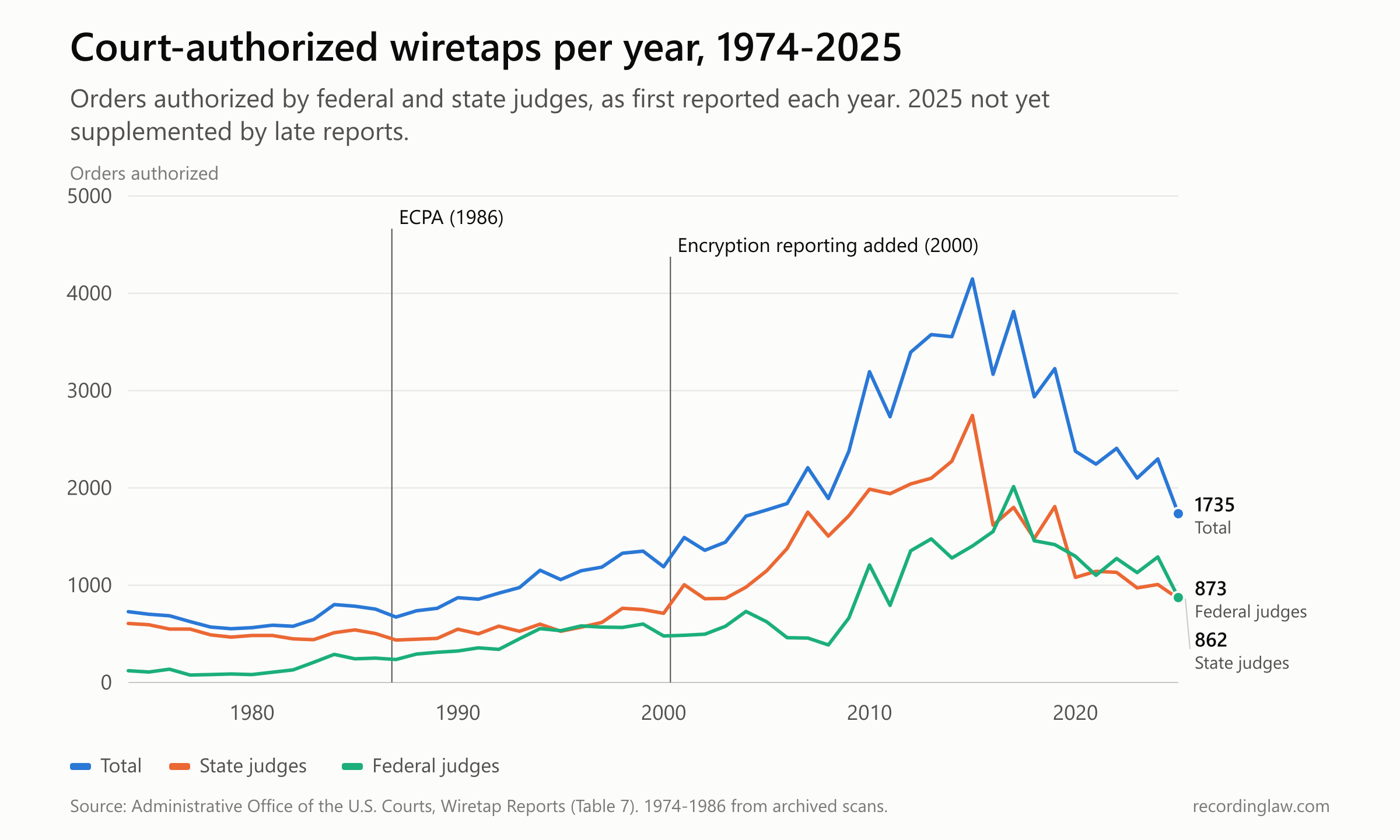
Source: Administrative Office of the U.S. Courts, Wiretap Reports, Table 7, as first reported each year. 1974-1986 from archived scans.
| Year | Federal judges | State judges | Total approved |
|---|---|---|---|
| 1974 | 121 | 607 | 728 |
| 1980 | 81 | 483 | 564 |
| 1990 | 324 | 548 | 872 |
| 2000 | 479 | 711 | 1,190 |
| 2010 | 1,207 | 1,987 | 3,194 |
| 2015 | 1,403 | 2,745 | 4,148 |
| 2020 | 1,297 | 1,080 | 2,377 |
| 2024 | 1,290 | 1,007 | 2,297 |
| 2025 | 873 | 862 | 1,735 |
The count climbed, with dips, through the 1990s and 2000s to a peak in 2015, then turned down.
At the 2015 peak, judges approved about 11 taps a day, and 79 percent of applications named narcotics as the most serious offense. They rarely said no. From 2012 through 2018, the reports list eight denied applications against 24,591 approved.
By then the argument about whether those phones could still be heard had been running for more than 20 years.
Why Congress started counting encryption
"New Phones Stymie FBI Wiretaps," the Christian Science Monitor's headline read on April 29, 1992. The FBI was pressing Congress on its Digital Telephony proposal, and Rep. Don Edwards, the California Democrat who chaired the House Judiciary Subcommittee on Civil and Constitutional Rights, called the proposal unprecedented, the Monitor reported.
An FBI unit had already gone further. In 1992, according to a later paper by 15 security researchers, "the FBI's Advanced Telephony Unit warned that within three years Title III wiretaps would be useless." Judges approved 919 taps that year. The count kept rising, to 4,148 by 2015.
Encryption was the next worry. In September 1997, FBI Director Louis Freeh told the House intelligence committee: "Law enforcement is in unanimous agreement that the widespread use of robust unbreakable encryption ultimately will devastate our ability to fight crime and prevent terrorism."
Sen. Patrick Leahy, the Vermont Democrat, and Sen. Orrin Hatch proposed a count. Their bill, S. 1769, made prosecutors report each tap where they encountered encryption and whether it kept them from the plain text. "Adding a requirement that reports be furnished on the number of occasions when encryption is encountered by law enforcement is a far more reliable basis than anecdotal evidence on which to assess law enforcement needs and make sensible policy in this area," Leahy said on the Senate floor on April 13, 2000.
In the same speech, Leahy described what encryption did for ordinary users and what it did for criminals. "Encryption technology is critical to protect sensitive computer and online information," he said. "Yet, the same technology poses challenges to law enforcement when it is exploited by criminals to hide evidence or the fruits of criminal activities."
The encryption count rode into law on a bill whose main job was keeping a set of federal reports from expiring on May 15, 2000. President Bill Clinton signed it on May 2 and stated how narrowly he read the new requirement.
The reporting, he wrote, "is limited to general aggregate data concerning the total number of times law enforcement encountered encryption and the total number of instances in which encryption prevented access to plain text." He added that it did not require case-by-case or order-by-order reporting. The reports have never named an app, a phone or a product.
Eleven years of zero
The first readings were quiet. Prosecutors reported encryption on 16 taps that ended in 2002, and "in none of these cases was encryption reported to have prevented law enforcement officials from obtaining the plain text of communications intercepted."
In 2010 encryption showed up on six state taps, and in 2011 on 12, and none were unreadable. Then the 2012 report counted four, and the courts said it was the first such report since collection began in 2001. "This is the first time that jurisdictions have reported that encryption prevented officials from obtaining the plain text of the communications since the AO began collecting encryption data in 2001," the courts wrote.
"For the first time, encryption is thwarting government surveillance efforts through court-approved wiretaps, U.S. officials said today," Wired reported in June 2013. The same article read the count against Freeh's 1997 forecast: "Sixteen years later, and judging by the government’s own accounting, we’re not even close to Freeh’s fears becoming reality, despite the government’s continued push for a backdoor into virtually everything."
The FBI's director by then, James Comey, did not accept that reading. In an October 2014 speech at the Brookings Institution, Comey said "encryption threatens to lead all of us to a very dark place," and asked for a legal fix. "We aren’t seeking a back-door approach," he said. "We want to use the front door, with clarity and transparency, and with clear guidance provided by law."
The 2015 report gave critics a number. "That means that in 2015, out of 4,148 total wiretaps, only 11 encountered a form of encryption law enforcement could not break. That’s about one quarter of 1 percent," The Intercept wrote in June 2016, in an article that argued the tally undercut the government's warnings.
A year before that article, at a Senate intelligence committee hearing in July 2015, Sen. Mazie Hirono asked Comey in how many cases encryption had completely thwarted a warrant. He said he did not know and that the FBI would try to collect data on it, but he was "not confident it's going to be very reliable for you, though, because what our investigators do is if they see someone is on an app that we know is encrypted, they're not going to bother seeking a wiretap for that. So we won't be able to count that, I don't think, as a wiretap thwarted."
Critics took 11 unreadable taps to mean the problem was small. Comey's account ran the other way: agents did not apply for taps on apps they knew were encrypted, so the hardest cases never reached a judge and never entered the count.
The next year, the number of unreadable taps was 101.
When the unreadable taps started to climb
In 2016, prosecutors reported encryption on 125 taps, up from 13 the year before. The courts' June 2018 release on the 2017 report put it this way: "The number of state wiretaps in which encryption occurred continued to rise sharply, with 102 such reports in 2017, compared with 57 in 2016 and just seven in 2015."
How far did it go?
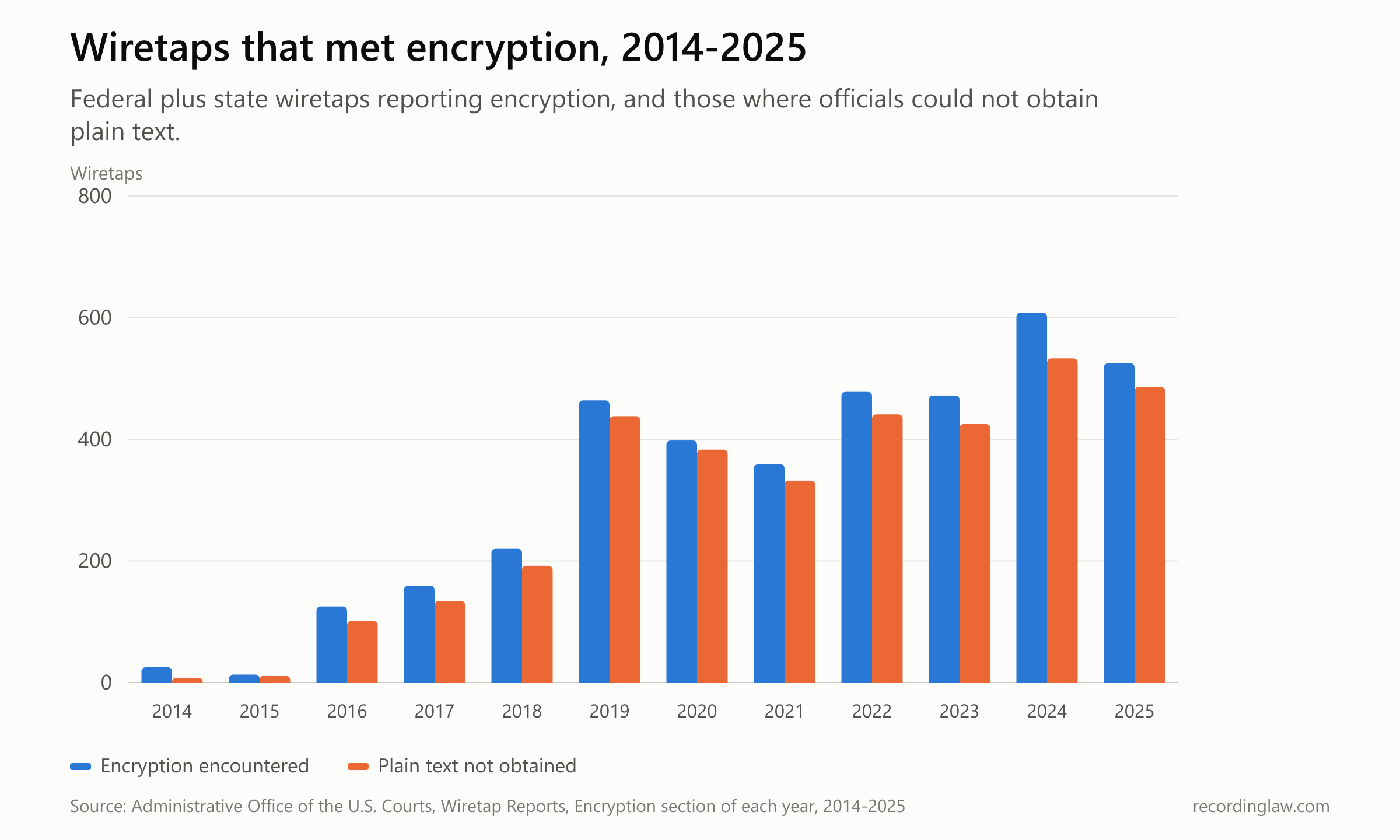
Source: Administrative Office of the U.S. Courts, Wiretap Reports, encryption section of each year's report, 2014-2025. Federal plus state, as first reported.
| Year | Encryption encountered | Plain text not obtained |
|---|---|---|
| 2014 | 25 | 4 |
| 2015 | 13 | 11 |
| 2016 | 125 | 101 |
| 2017 | 159 | 134 |
| 2018 | 220 | 192 |
| 2019 | 464 | 438 |
| 2020 | 398 | 383 |
| 2021 | 359 | 332 |
| 2022 | 478 | 441 |
| 2023 | 472 | 425 |
| 2024 | 608 | 533 |
| 2025 | 525 | 486 |
Taps that met encryption rose more than fortyfold from 2015 to 2024, and in most of them officials could not get the plain text.
In 2025, officials could not obtain the plain text on more than nine in ten of the taps where they reported encryption. Federal taps accounted for 296 of the 525 encrypted taps that year and state taps for 229.
The reports do not say why the line rose when it did. They carry only totals, as Clinton read the law: no app, no device, no service. Any explanation of the 2016 jump, such as wider use of encrypted messaging apps, comes from outside the count.
The loudest public fights of those years were about something the count does not cover. In February 2016, Apple's chief executive, Tim Cook, refused a court order to help the FBI unlock a phone, writing: "Once created, the technique could be used over and over again, on any number of devices." That case concerned data stored on a phone, not a live wiretap, so it never entered this report.
Two years later, the FBI's figure for locked phones turned out to be wrong. "The bureau claimed that investigators were locked out of about 7,800 mobile devices connected to criminal investigations, however, the correct number is likely between 1,000 to 2,000 devices," CNBC reported in May 2018, following The Washington Post. Paul Abbate, an FBI associate deputy director, said "each one of those devices represents a potential terrorist attack that could have been prevented or a child who could have been protected from a predator."
Leahy had wanted the encryption debate to rest on a yearly count instead of on anecdotes. The locked-phone figure came from the FBI's own tally of devices, outside that count, and it was not part of the wiretap report.
Over the same years, the number of taps judges approved was falling, and a smaller total makes each unreadable tap a larger share of it. How far the total fell depends on which edition of the report you read.
Did wiretapping fall by half?
As first published, approved taps went from 4,148 in 2015 to 2,297 in 2024, a drop of about 45 percent. But a year's first count is never its last.
Prosecutors often file their reports late. "Some prosecutors may have delayed filing reports to avoid jeopardizing ongoing investigations," the 2025 report says. Each edition's main table of approvals, Table 7, adds a row for taps "terminated in a given year but not reported until the current reporting period because they were part of ongoing investigations."
The row grows for years. For 2015, it read zero in the 2015 edition, 1,458 a year later, 1,988 in the 2023 edition and 2,020 in the 2024 edition. With those late reports added, the 2025 edition puts 2015 at 6,168 approved taps and 2024 at 4,851.
What does the decline look like when the same years are counted both ways?
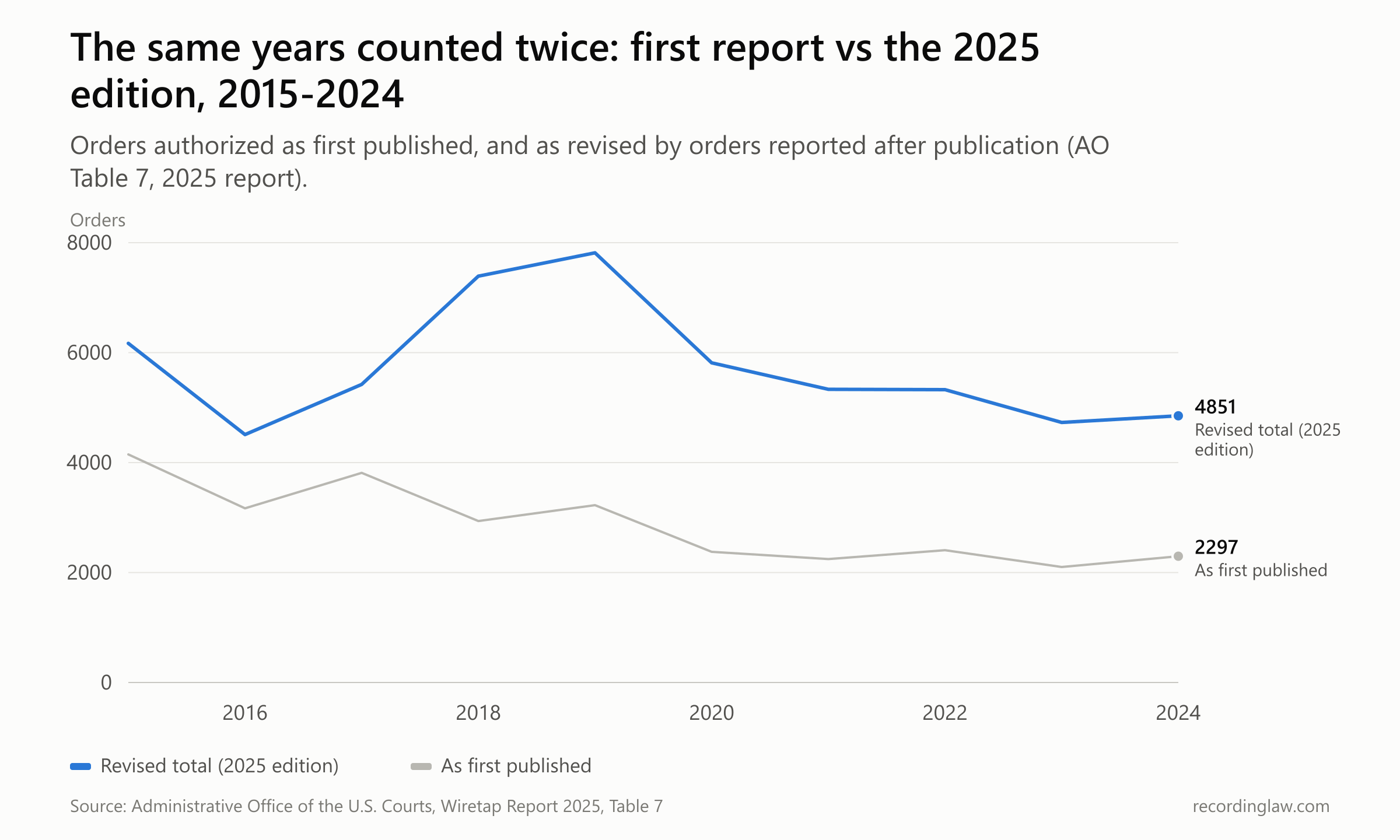
Source: Administrative Office of the U.S. Courts, Wiretap Report 2025, Table 7.
| Year | As first published | Reported after publication (2025 edition) | Revised total (2025 edition) |
|---|---|---|---|
| 2015 | 4,148 | 2,020 | 6,168 |
| 2016 | 3,168 | 1,342 | 4,510 |
| 2017 | 3,813 | 1,609 | 5,422 |
| 2018 | 2,937 | 4,455 | 7,392 |
| 2019 | 3,225 | 4,590 | 7,815 |
| 2020 | 2,377 | 3,438 | 5,815 |
| 2021 | 2,245 | 3,088 | 5,333 |
| 2022 | 2,406 | 2,920 | 5,326 |
| 2023 | 2,101 | 2,630 | 4,731 |
| 2024 | 2,297 | 2,554 | 4,851 |
On the revised count the decline from 2015 to 2024 is about a fifth, not almost half, and the peak year is 2019, not 2015. That still sets a 2015 total carrying ten years of late reports against a 2024 total carrying one. Counted one year after each, 2015 stood at 5,606 and 2024 at 4,851, a drop of about 13 percent, and 2024 will keep rising.
Late reports for 2018 through 2024 run far above those for 2016 and 2017, and the report does not say why. The encryption figures, meanwhile, are first-report counts, so they are compared here with first-report totals.
The 2025 figure, 1,735, has no late reports added yet. The courts put the fall from 2015 at 58 percent, comparing first counts with first counts, and the fall from 2024 at 24 percent, with federal approvals down 32 percent and state approvals down 14 percent.
The largest single decrease came from one agency. The Drug Enforcement Administration "reported the largest decrease in wiretap authorizations, a drop from 1,157 in 2024 to 416 in 2025," the report says, and the DEA told the courts it "had resolved a historic backlog of wiretap cases during 2024, so this year’s total reflects a return to that agency’s operational baseline."
The Homeland Security Department's investigations office reported 23 taps in 2025, down from 133. It cited "operational delays arising from government shutdowns in 2025, and changes in administration enforcement and prosecutorial priorities, and staffing attrition and reorganization pursuant to administrative guidance." Judges also reported 329 approved taps in 2025 for which prosecutors had not yet sent any report, 249 federal and 80 state.
Who still taps phones?
Forty-eight jurisdictions now have wiretap laws: the federal government, the District of Columbia, Puerto Rico, the Virgin Islands and 44 states. Only 25 reported using one in 2025.
Johnson asked the states for "the utmost restraint and caution." A handful of them account for most state taps.
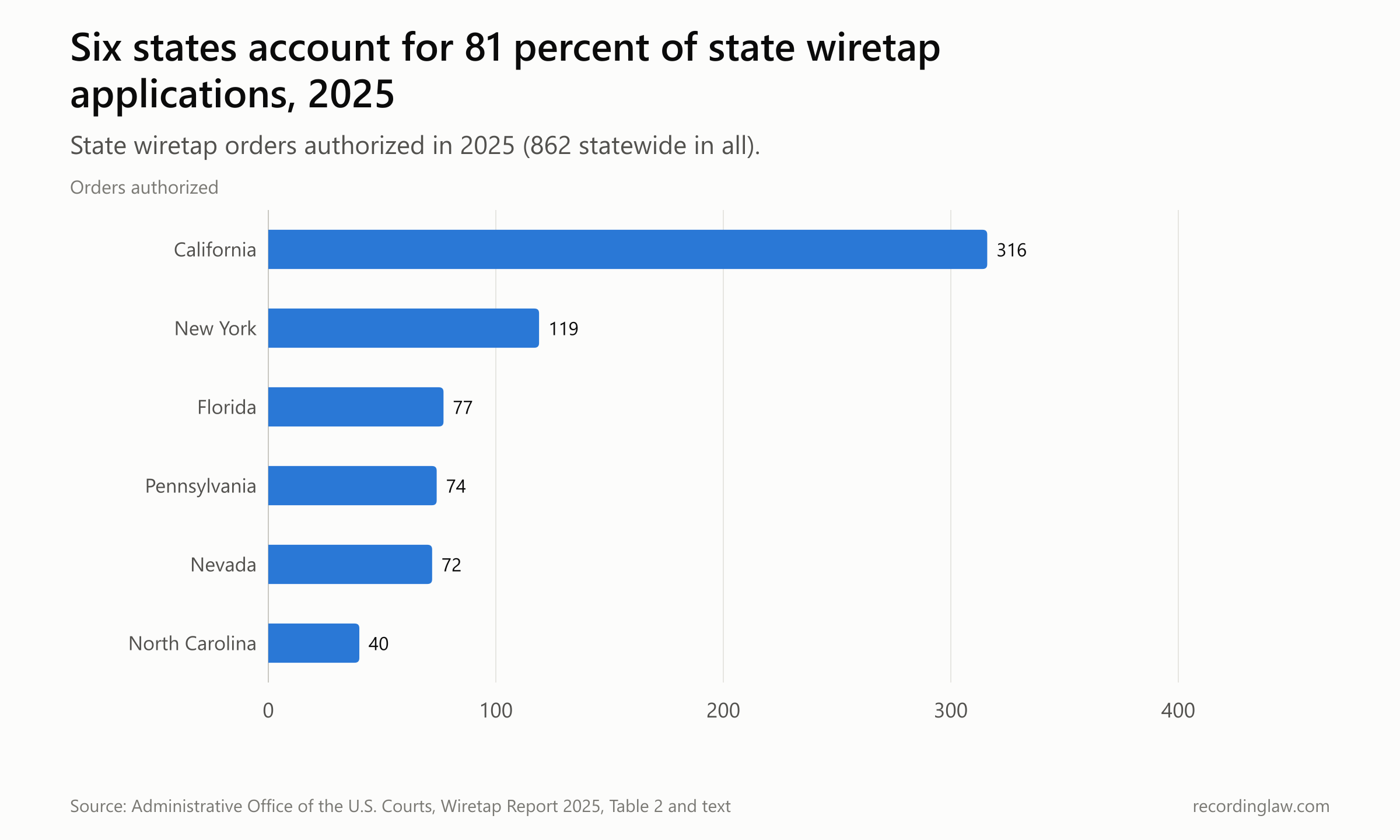
Source: Administrative Office of the U.S. Courts, Wiretap Report 2025, Table 2 and report text.
| State | State wiretap orders, 2025 |
|---|---|
| California | 316 |
| New York | 119 |
| Florida | 77 |
| Pennsylvania | 74 |
| Nevada | 72 |
| North Carolina | 40 |
| Six states combined | 698 of 862 (81 percent) |
California alone approved more than a third of all state taps in 2025. That concentration is not new. In each year from 2015 to 2025, the handful of states the courts named as busiest accounted for between 74 and 89 percent of state applications, though the list of states changes.
California also saw the sharpest change in the first big fall after the 2015 peak. State taps dropped 41 percent in 2016, and the courts reported: "The largest reduction in reported state wiretap applications occurred in California, where 50 percent fewer applications were reported."
On the federal side, the District of Colorado approved the most taps in 2025, about 6 percent of the federal total. Drugs remain the main target, though a smaller share than before: narcotics was the most serious offense on 51 percent of 2025 applications, down from 79 percent in 2015, and narcotics plus other offenses, including other drug-related ones, made up 83 percent.
Original orders averaged 30 days in 2025, and judges granted 1,242 extensions. Installed taps ran an average of 47 days. As of December 31, 2025, 5,633 people had been arrested and 503 convicted in cases involving the taps in that year's report.
All of that describes one tool. Much of what police now collect never passes through this count.
What the count cannot see
The report leaves out entire categories by design. "No report to the AO is needed when an order is issued with the consent of one of the principal parties to the communication," the courts' FAQ says. That excludes informants who wear a microphone and officers who record their own calls, the same one-party consent idea that governs private recording in many US states.
It also excludes pen registers, devices that log the numbers a phone dials, when they are used without a wiretap. And it receives nothing on surveillance under the Foreign Intelligence Surveillance Act (FISA), including the program known as Section 702. The Brennan Center for Justice, which advocates a warrant requirement for Section 702, wrote in an Oct. 16, 2026 update: "Although the statute expired in June, Section 702 surveillance is authorized to continue until March 17, 2027." Congress had last extended the statute to June 12, 2026, in Public Law 119-87, and no public law enacted from then through Oct. 22, 2026 renewed it.
Warrants for stored data and location records, such as the geofence warrants the Supreme Court took up in Chatrie, are outside the count as well. Comey's 2015 caveat is one more gap: the count sees only taps someone applied for.
Researchers who looked at the problem from outside the count described other routes. A 2016 Harvard Berkman Center working group, supported by the William and Flora Hewlett Foundation and including U.S. intelligence officials, wrote: "Metadata is not encrypted, and the vast majority is likely to remain so." It listed "location data from cell phones and other devices, telephone calling records, header information in e-mail."
A 2018 CSIS study, based on interviews and a commissioned survey of law-enforcement officers, found the biggest reported obstacle was getting data from service providers, much of it unencrypted.
The FBI also found a way around encryption that the count would never record. In June 2021 it announced Operation Trojan Shield, in which it "launched its own encrypted communications platform and supplied more than 12,000 devices to hundreds of criminal organizations that operate around the globe."
By then, the systems that carry out wiretaps had become a target of their own.
When the wiretap system became the target
In July 2015, the same month Comey testified, 15 security researchers published "Keys Under Doormats," arguing against building government access into encrypted systems. "The complexity of today's Internet environment, with millions of apps and globally connected services, means that new law enforcement requirements are likely to introduce unanticipated, hard to detect security flaws," they wrote.
In October 2024, Sen. Ron Wyden, an Oregon Democrat, responded to reports of a hack aimed at telecom networks. "If the government wants to get court orders to listen in on Americans’ calls and read their texts, it has an obligation to keep its surveillance system secure against foreign hacks," he told Nextgov/FCW. Matthew Green, a Johns Hopkins cryptographer, wrote that "hostile nation-states systematically target and successfully exploit these systems."
On November 13, 2024, the FBI and the Cybersecurity and Infrastructure Security Agency confirmed that hackers affiliated with China had compromised networks at multiple telecom companies. Among what the hackers did, the agencies said, was "the copying of certain information that was subject to U.S. law enforcement requests pursuant to court orders."
CISA then issued guidance for highly targeted people in senior government, military and political roles, first in December 2024 and again, updated, in November 2025. Its first instruction: "Only use end-to-end encrypted communications. Adopt a free messaging application for secure communications that guarantees end-to-end encryption, such as Signal or similar apps."
Ten years after Comey warned of "a very dark place," a federal security agency was telling highly targeted officials to use the kind of app that leaves a wiretap unreadable.
The next count
The next Wiretap Report, covering taps that ended in 2026, is expected in June 2027. It will show whether federal approvals stay near the DEA's "operational baseline" and whether unreadable taps stay near the 425 to 533 a year of the last three reports.
It will also revise 2025. Late reports will push the 1,735 figure up, as they pushed up every year before it, by an amount no one can know yet.
What it cannot do is settle the argument Leahy wanted a number for. A low count can mean encryption rarely stops a tap, or, as Comey told the Senate, that agents do not ask for taps on apps they know are encrypted. The report counts the taps judges approved, under the law Johnson signed in 1968 while asking Congress to repeal parts of it.
How we measured
Source. All wiretap counts come from the Administrative Office of the U.S. Courts' annual Wiretap Reports, required by 18 U.S.C. 2519. The reports cover wire, oral and electronic intercepts concluded in each calendar year. Approved ("authorized") taps come from Table 7: 1987-1997 from the 1997 report, 1998-2005 from the 2005 report, 2006-2015 from the 2015 report and 2016-2025 from the 2025 report spreadsheet, whose 2015-2024 values equal the figures first published. Values for 1974-1986 were read from scans of the 1984 and 1991 reports held by the National Criminal Justice Reference Service; federal plus state sums match the printed totals, but they are scan-derived.
Years covered. Title III dates from 1968, but our series starts in 1974. Reports for 1968-1973 are not on uscourts.gov, and the scans we found were too garbled to read for 1970-1972; the only figure used from that period is the 1973 total of 864, stated as the record in the 1980 report.
First published vs revised. Every year's count is later supplemented by orders "reported after publication." Chart 1 and the encryption figures use first-published counts throughout. Chart 2 compares those with the 2025 edition's revised totals. The 2025 total (1,735) has no late reports yet, so it should be compared only with other first-published counts. The equal-lag comparison gives each year one year of late reports: 2015 is 4,148 plus the 1,458 reported after publication in the 2016 edition (5,606), and 2024 is 2,297 plus the 2,554 in the 2025 edition (4,851). "Fewest since 2004" compares 1,735 with first-published totals: 2004 was 1,710 and 2005 was 1,773.
Encryption. The counts are reported by prosecuting officials and exclude encryption reported for prior-year taps. We took federal and state figures from each report's text for 2014-2025; 2010-2013 figures cover state taps only, and no text figures for 2001-2009 were retrieved beyond the 2002 report. The 2025 "more than a quarter" compares 486 unreadable taps with all 1,735 approved (28.0 percent). Encryption can only occur on a tap that was installed, and only 1,396 taps were reported as installed in 2025, so on that smaller base the share is higher, about 35 percent. The 2015 share is 11 of 4,148, about 0.27 percent. "More than nine in ten" is 486 of 525.
Other arithmetic. About 11 taps a day in 2015 is 4,148 divided by 365. "More than fortyfold" is 533 unreadable taps in 2024 against 11 in 2015 (48 times) and 608 encountered against 13 (47 times). The 2015-2024 declines are 4,148 to 2,297 (minus 44.6 percent) and 6,168 to 4,851 (minus 21.4 percent); at equal one-year lag, 5,606 to 4,851 is minus 13.5 percent. California's share is 316 of 862 (36.7 percent). The eight denials are the counts stated in the 2012 through 2018 reports; the 24,591 approvals are the first-published totals for those years. Later reports do not state a denial count.
Series breaks. The 1986 ECPA amendment, effective in January 1987, added electronic communications. Location categories were revised in 2000, when "portable device" first appears; from 2016 the tables use "no location specified in order" instead (94 percent in 2025, mostly cell phones), so the two are not chained. Offense categories were regrouped in 2017, so the narcotics share for 2015 is 3,367 applications in the original report and 3,292 as regrouped (79 percent).
Per-state 2025 figures. The six states' counts come from Table 2 and reconcile to the report's stated 81 percent (698 of 862). The table's state rows sum to 874, 12 more than the stated state total; we did not resolve the difference and used only the six named states.
Costs. Average reported cost per tap was $92,963 in 2025. Single outliers distort the average: in 2023, one Suffolk County, New York, tap reported a cost of $354,940,034, which lifted the national average to $1,711,436 from $97,752 the year before. We did not chart costs.
What the data cannot show. The report counts court-approved interceptions only, so it cannot show how much surveillance happens overall or whether police have shifted to other tools. It cannot show why approvals fell or why encryption reports rose; the courts name no cause beyond what agencies tell them, and the reports name no apps or devices. As the FBI has said, it cannot count taps never sought because agents expected encryption. It cannot show whether court-approved taps reduced improper surveillance, as the 1967 commission majority expected.
Frequently Asked Questions
How many wiretaps were approved in the US in 2025?
Federal and state judges approved 1,735 wiretaps in 2025, 873 by federal judges and 862 by state judges, according to the 2025 Wiretap Report published June 30, 2026. That was 24 percent fewer than in 2024. The figure will rise in later editions as prosecutors file late reports.
How often does encryption stop a court-ordered wiretap?
In 2025, prosecutors reported encryption on 525 wiretaps, and on 486 of them officials could not obtain the plain text. That was 217 state and 269 federal taps. In 2015 the number was 11, and no tap was reported as unreadable from 2001, when the courts began collecting encryption data, until 2012.
What is the Wiretap Report?
It is an annual report to Congress by the Administrative Office of the U.S. Courts, required by 18 U.S.C. 2519. Judges report each wiretap order they approve, prosecutors report what each tap produced, including whether encryption was encountered, and the courts publish the combined counts each June.
Does the Wiretap Report include FISA or consent recordings?
No. It excludes interceptions under the Foreign Intelligence Surveillance Act, recordings made with the consent of one party to the conversation, such as an informant wearing a microphone, and pen registers used without a wiretap. It also cannot count taps that agents chose not to seek.
Which states use the most wiretaps?
In 2025, six states accounted for 81 percent of state wiretap applications: California (316), New York (119), Florida (77), Pennsylvania (74), Nevada (72) and North Carolina (40). Forty-eight jurisdictions have wiretap laws, but only 25 reported using one in 2025.
Why did wiretaps drop in 2025?
The courts reported that the Drug Enforcement Administration went from 1,157 wiretaps in 2024 to 416 in 2025, which the DEA described as a return to its baseline after resolving a backlog in 2024. The Homeland Security Department's investigations office went from 133 to 23 and cited government shutdowns, changed enforcement priorities and staffing changes. Part of the drop may also be reporting timing, since late reports have not yet been added for 2025.
When is the next Wiretap Report?
The law sets a June deadline for the report to Congress. The 2025 edition was published June 30, 2026, so the report covering 2026 is expected in June 2027.
Updates
Independently fact-checked against the cited primary sources
Sources and References
- Administrative Office of the U.S. Courts, Wiretap Report 2025 (published June 30, 2026), including Tables 2 and 7(uscourts.gov).gov
- U.S. Courts news release on the 2025 Wiretap Report (June 30, 2026)(uscourts.gov).gov
- Administrative Office of the U.S. Courts, Wiretap Report 2024(uscourts.gov).gov
- Administrative Office of the U.S. Courts, Wiretap Report 2023 (Suffolk County cost outlier)(uscourts.gov).gov
- Administrative Office of the U.S. Courts, Wiretap Report 2018(uscourts.gov).gov
- Administrative Office of the U.S. Courts, Wiretap Report 2017(uscourts.gov).gov
- Administrative Office of the U.S. Courts, Wiretap Report 2016(uscourts.gov).gov
- Administrative Office of the U.S. Courts, Wiretap Report 2015(uscourts.gov).gov
- Administrative Office of the U.S. Courts, Wiretap Report 2014(uscourts.gov).gov
- Administrative Office of the U.S. Courts, Wiretap Report 2013(uscourts.gov).gov
- Administrative Office of the U.S. Courts, Wiretap Report 2012(uscourts.gov).gov
- Administrative Office of the U.S. Courts, 2011 Wiretap Report (PDF)(uscourts.gov).gov
- Administrative Office of the U.S. Courts, 2010 Wiretap Report (PDF)(uscourts.gov).gov
- Administrative Office of the U.S. Courts, 2002 Wiretap Report text (PDF)(uscourts.gov).gov
- Administrative Office of the U.S. Courts, Wiretap Report 2005, Table 7(uscourts.gov).gov
- Administrative Office of the U.S. Courts, Wiretap Report 2015, Table 7(uscourts.gov).gov
- Administrative Office of the U.S. Courts, FAQs: Wiretap Reports(uscourts.gov).gov
- U.S. Courts, 2017 Wiretap Report: Orders and Convictions Rise (June 28, 2018)(uscourts.gov).gov
- 18 U.S.C. 2519, Reports concerning intercepted wire, oral, or electronic communications (GovInfo)(govinfo.gov).gov
- Wiretap report for calendar year 1980 (NCJRS scan)(ojp.gov).gov
- Wiretap report for calendar year 1991, Table 7 (NCJRS scan)(ojp.gov).gov
- President's Commission on Law Enforcement and Administration of Justice, The Challenge of Crime in a Free Society (1967)(ojp.gov).gov
- Lyndon B. Johnson, Statement upon signing the Omnibus Crime Control and Safe Streets Act (June 19, 1968), American Presidency Project(presidency.ucsb.edu)
- William J. Clinton, Statement on signing S. 1769 (May 2, 2000), American Presidency Project(presidency.ucsb.edu)
- Congressional Record, Sen. Patrick Leahy statement on S. 1769 (April 13, 2000)(congress.gov).gov
- FBI Director Louis J. Freeh, statement to the House Permanent Select Committee on Intelligence (September 9, 1997), FAS copy(irp.fas.org)
- FBI Director James B. Comey, Going Dark: Are Technology, Privacy, and Public Safety on a Collision Course? (October 16, 2014)(fbi.gov).gov
- Senate Select Committee on Intelligence hearing transcript (July 8, 2015), GovInfo(govinfo.gov).gov
- Abelson et al., Keys Under Doormats, MIT CSAIL technical report (July 7, 2015)(schneier.com)
- Berkman Center for Internet & Society, Don't Panic: Making Progress on the Going Dark Debate (February 1, 2016)(cyber.harvard.edu)
- Carter, Daskal and Crumpler, CSIS, Low-Hanging Fruit: Evidence-Based Solutions to the Digital Evidence Challenge (July 25, 2018)(csis.org)
- Tim Cook, A Message to Our Customers, Apple (February 16, 2016)(apple.com)
- Christian Science Monitor, New Phones Stymie FBI Wiretaps (April 29, 1992), scan(simson.net)
- Wired, Threat Level (June 2013), via mailing-list repost(attrition.org)
- The Intercept, Official tally of wiretaps belies government scare stories about encryption (June 30, 2016)(theintercept.com)
- CNBC, FBI reportedly provided inaccurate encryption threat stats to Congress (May 23, 2018)(cnbc.com)
- Nextgov, FBI stands firm on going dark problem while acknowledging inflated data (May 23, 2018)(nextgov.com)
- FBI, Global partners announce results of Operation Trojan Shield (June 8, 2021)(fbi.gov).gov
- Nextgov/FCW, It's time to rethink how wiretaps work after Chinese hack, experts say (October 11, 2024)(nextgov.com)
- FBI and CISA, Joint statement on PRC targeting of commercial telecommunications infrastructure (November 13, 2024)(cisa.gov).gov
- CISA, Mobile Communications Best Practice Guidance (updated November 2025)(cisa.gov).gov
- Brennan Center for Justice, Section 702 of the Foreign Intelligence Surveillance Act (updated October 16, 2026)(brennancenter.org)
- Public Law 119-87, extending FISA title VII (Section 702) authorities to June 12, 2026 (Congress.gov)(congress.gov).gov