Congress Rewrote the Definition of Hemp in 2025. Most of It Waits Until Dec. 11, 2026.

Independently fact-checked against primary sources (last audited November 12, 2026). · 22 primary sources cited on this page. How we verify our legal content
On May 19, 2022, three federal appeals judges in the Ninth Circuit ruled on a fight over counterfeit vapes. AK Futures, which sold "Cake"-branded vaping products containing delta-8 THC, one of several chemical forms of THC, said a wholesaler called Boyd Street Distro was selling knockoffs. Boyd Street's main defense was that no one could own a trademark on the products "because federal law forbids possession and sale of delta-8 THC."
The court disagreed. It held that the 2018 farm law had legalized delta-8, and it handed the question back to the lawmakers who wrote it. "If Boyd Street is correct, and Congress inadvertently created a loophole legalizing vaping products containing delta-8 THC, then it is for Congress to fix its mistake," Judge D. Michael Fisher wrote for the panel.
Congress acted three and a half years later. On November 12, 2025, inside the bill that ended a 43-day government shutdown, it rewrote the federal definition of hemp. The 2018 test had measured only delta-9 THC, a different form of the compound. The new definition counts total THC, meaning all forms of THC plus the acid form known as THCA, and excludes finished products with more than 0.4 milligrams of THC and similar cannabinoids per container.
Most of it has not taken effect yet. A second funding law, signed September 2, 2026, held most of the change until December 11, 2026, the same day that law's money for the federal government runs out. In the months between the two laws, sponsors promised that CBD and industrial hemp would stay legal, and the industry warned that most of its products would not.
The data that could show what followed, from poison centers and from USDA's farm survey, stop before any of the new rules took effect. What did Congress change, what did each side say it would do, and what can the numbers say before the first harvest planted under the new law is counted? The law described here is current as of November 12, 2026.
A door in the 2018 farm law
The door opened on December 20, 2018, when the Agriculture Improvement Act (Public Law 115-334) became law. Section 10113 set the federal definition of hemp, and the test turned on one compound, delta-9 THC.
"'hemp' means the plant Cannabis sativa L. and any part of that plant, including the seeds thereof and all derivatives, extracts, cannabinoids, isomers, acids, salts, and salts of isomers, whether growing or not, with a delta-9 tetrahydrocannabinol concentration of not more than 0.3 percent on a dry weight basis."
The definition took in "derivatives, extracts, cannabinoids, isomers" and capped delta-9 THC only. It did not name other THC compounds, such as delta-8 THC. The Centers for Disease Control and Prevention later described how that gap could be used: "CBD can be synthetically converted into delta-8 THC, as well as delta-9 THC and other THC isomers, with a solvent, acid, and heat to produce higher concentrations of delta-8 THC than those found naturally in the cannabis plant."
Whether the 2018 text covered delta-8 was the question the Ninth Circuit heard argued in Las Vegas on March 18, 2022. Two months later, the panel held that it did. "Regardless of the wisdom of legalizing delta-8 THC products, this Court will not substitute its own policy judgment for that of Congress," the panel wrote.
What came through the door
Poison centers were the first to count what came through. They began coding delta-8 THC exposures separately in late 2020. Each exposure is a call to a poison center about a person exposed to the product.
In a September 14, 2021 health advisory, the CDC reported 660 delta-8 exposures under the new code from January 1 to July 31, 2021, plus one older case recoded as delta-8. It noted that the products were "sometimes marketed as 'weed light' or 'diet weed.'"
Of those 661 cases, 18% (119) required hospitalization. Another 39% (258) involved patients under 18.
A study by Smith and colleagues, published in the Journal of Medical Toxicology in 2024, followed the first two full years of National Poison Data System (NPDS) records. It counted 4,925 exposures with delta-8 THC as the primary substance in 2021 and 2022. Of those, 69.8% were reported in the South. The national rate, measured as exposures for every 100,000 people, rose 79.2%, from 0.53 in 2021 to 0.95 in 2022.
In the study's data, 30.4% of exposures involved children under 6. Another 24.4% involved people aged 6 to 19, and 40.5% involved people aged 20 to 59. Ingestion accounted for 94.3% of exposures.
The authors were careful about what two years could show. "Because product codes for ∆8-THC were introduced into the NPDS in late 2020, increasing familiarity with the new codes may have contributed to the observed increase in reported exposures," they wrote. "In addition, two years of data cannot truly define a trend, so this awaits future study."
The states that moved first
Many states had not waited for Congress. The Smith study reported that 15 states had banned delta-8 THC and 9 more had restricted it. The authors then grouped states by their delta-8 policy before January 1, 2023, and averaged each group's state rates. Did the states with bans see fewer calls?
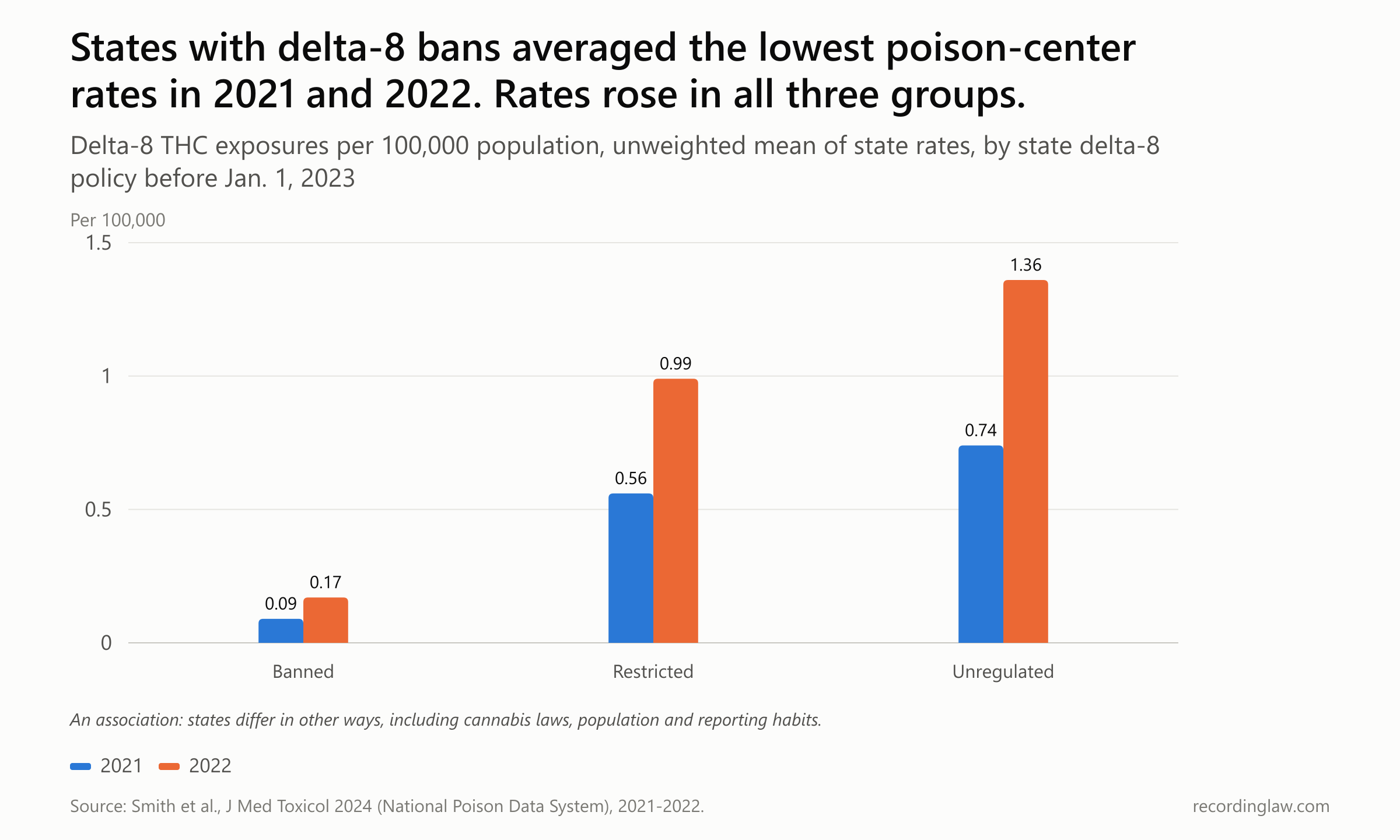
Delta-8 THC poison-center exposures per 100,000 population, mean of state rates, by state delta-8 policy before Jan. 1, 2023. Source: Smith et al., Journal of Medical Toxicology, 2024 (National Poison Data System). An association; states differ in other ways.
| State delta-8 policy | 2021 | 2022 |
|---|---|---|
| Banned | 0.09 | 0.17 |
| Restricted, not banned | 0.56 | 0.99 |
| Unregulated | 0.74 | 1.36 |
States that had banned delta-8 had lower average rates in both years. But the rates climbed in every group. The study found "The rate of ∆8-THC exposures increased from 2021 to 2022 among all three state groups irrespective of their ∆8-THC regulation status."
The same study found a similar gap by cannabis policy. In 2022, states where cannabis was illegal averaged 1.64 delta-8 exposures per 100,000 people, and states where it was legal averaged 0.52.
State policies on delta-8 and on cannabis overlap, and states differ in population, reporting habits and regional markets. Because of that, the comparison does not show that a ban caused a lower rate. The authors said their analyses "did not take into account that some states have both ∆8-THC regulations as well as legalization of cannabis."
State action did not always run one way. In Texas, late on June 22, 2025, less than an hour before his veto deadline, Gov. Greg Abbott vetoed SB 3, a THC ban, "preserving the legal THC market and signaling a rare conflict with" Lt. Gov. Dan Patrick, public radio station KETR reported. A month later, Sen. Mitch McConnell brought federal language to the Senate.
McConnell's first try
In July 2025, Sen. Mitch McConnell of Kentucky, a Republican who says he led the 2014 hemp pilot program and the 2018 legalization, tried to close the door himself. His language in a Senate spending bill would have outlawed any "quantifiable amounts" of THC in hemp products, Spectrum News reported.
The language was dropped from the Senate's agriculture funding bill, WUKY reported, and it had an outspoken opponent in Sen. Rand Paul, McConnell's fellow Kentucky Republican. In August, McConnell spoke on the Senate floor in front of images of delta-8 products that looked like candy, The Gazette in Colorado Springs reported. "The packaging on these snacks is nearly identical to a pack of Oreos, Doritos, or Skittles," he said.
He described the problem in terms of the 2018 law he had championed. "Unfortunately, some companies looking to make a quick buck have been exploiting a loophole in the 2018 Farm Bill by taking legal amounts of THC from hemp and turning it into intoxicating substances," he said.
He also made two promises the record can later test. "Under my language, industrial hemp and CBD would have remained legal. Period," he said. On farm income: "Some predicted there would be widespread economic downturn for farmers should this language have become law. Wrong again." He went on to cite hemp's share of all U.S. farmed acres, a figure we did not check.
The language was still in the House version of the bill, WUKY noted. On September 26, Rep. Tim Moore (R-NC) and 26 other House members wrote to Speaker Mike Johnson that the language "would deal a fatal blow to American farmers supplying the regulated hemp industry and small businesses, and jeopardize tens of billions of dollars in economic activity around the country."
The same day, McConnell's office told Spectrum News that "Under the language, industrial hemp and CBD products remain legal." On October 27, Illinois Attorney General Kwame Raoul joined a bipartisan coalition of 39 attorneys general asking Congress to act. "I join my fellow attorneys general in urging Congress to close this loophole, and protect children and consumers from these potentially dangerous, largely-unregulated products," Raoul said. Two weeks later, the bill to reopen the government carried the hemp language.
The shutdown night
On the night of Monday, November 10, 2025, the Senate took up the deal to end the shutdown, with the hemp language inside. A summary prepared by the staff of Senate Appropriations Chair Susan Collins (R-Maine) said it would prevent "the unregulated sale of intoxicating hemp-based or hemp-derived products, including Delta-8, from being sold online, in gas stations, and corner stores, while preserving non-intoxicating CBD and industrial hemp products," States Newsroom reported.
Paul offered an amendment to strip it. "This bill's per-serving THC content limit would make illegal any hemp product that contains more than point four milligrams," Paul said. "That would be nearly 100% of the existing market. That amounts to an effective ban, because the limit is so low that the products intended to manage pain or anxiety will lose their effect." He said the change to the plant definition meant "every plant in the country will have to be destroyed."
Sen. Jeff Merkley (D-Ore.) agreed with the goal and opposed the text. "I support my other colleague from Kentucky who doesn't want intoxicated products produced from hemp," he said. "But the definition that is in this bill does far more than that, and it has to be fixed."
McConnell moved to table Paul's amendment. "Unfortunately, companies have exploited a loophole in the 2018 legislation by taking legal amounts of THC from hemp and turning it into intoxicating substances, and then marketing it to children in candy-like packaging and selling it in easily accessible places, like gas stations and convenience stores all across our country," he said. Of his opponents: "While some may masquerade as advocates for hemp farmers, even sometimes threatening to hold up government funding over this issue, I'll continue to work on behalf of Kentucky's farmers while protecting our children."
Groups on both sides weighed in around the vote. Smart Approaches to Marijuana, an advocacy group that opposes marijuana commercialization and that The Gazette said helped craft the language, said hemp-derived delta-8 and delta-9 THC "are linked to horrific physical and mental health consequences." The U.S. Hemp Roundtable, an industry coalition, said the language "threatens to eliminate America's $28.4 billion hemp industry and jeopardizes more than 300,000 American jobs." Brian Swensen of Hemp Industry & Farmers of America, a trade group, said: "Congress legalized hemp, Americans built an industry, and now Washington wants to pull the rug out from under hardworking farmers and small business owners."
The Senate voted 76-24 to table Paul's amendment, which kept the hemp language in the bill, with 22 Democrats and one other Republican joining Paul, Kentucky Public Radio reported. The full bill then passed 60-40 that night.
On November 12, as the House took it up, Rep. Tim Moore said in a statement that Congress should proceed "through regular order before taking any action that could potentially impact the entire hemp industry and affect more than 220,000 American jobs." The bill became Public Law 119-37 that day. It funded most of the government through January 30, 2026, and gave agriculture, the legislative branch and military construction-veterans affairs full-year budgets; the hemp language sits in the agriculture division.
What the new definition says
The text Congress passed changed hemp in two ways: what counts in the plant, and which products are no longer hemp at all. Section 781 sits in Division B of Public Law 119-37 (H.R. 5371). It amends the hemp definition in Section 297A of the Agricultural Marketing Act of 1946 (7 U.S.C. 1639o).
The amended definition caps total THC rather than delta-9 alone. It covers plants and products "with a total tetrahydrocannabinols concentration (including tetrahydrocannabinolic acid) of not more than 0.3 percent on a dry weight basis."
It also lists products that are not hemp. Paragraph (iv) excludes any final hemp-derived cannabinoid product containing:
"(I) cannabinoids that are not capable of being naturally produced by a Cannabis sativa L. plant; (II) cannabinoids that-- (aa) are capable of being naturally produced ... and (bb) were synthesized or manufactured outside the plant; or (III) greater than 0.4 milligrams combined total per container of-- (aa) total tetrahydrocannabinols (including tetrahydrocannabinolic acid); and (bb) any other cannabinoids that have similar effects (or are marketed to have similar effects) on humans or animals as a tetrahydrocannabinol (as determined by the Secretary of Health and Human Services)."
A "container" is "the innermost wrapping, packaging, or vessel in direct contact with a final hemp-derived cannabinoid product in which the final hemp-derived cannabinoid product is enclosed for retail sale to consumers, such as a jar, bottle, bag, box, packet, can, carton, or cartridge." So the 0.4 milligram limit counts the whole container, not each serving. Paul had called it a "per-serving" limit on the floor, but under the text a bag holding several servings shares one 0.4 milligram allowance. The section also excludes intermediate products "which are marketed or sold as a final product or directly to an end consumer for personal or household use."
Section 781 directed the Food and Drug Administration to publish, within 90 days of enactment, a list of cannabinoids known to FDA to be capable of being naturally produced by the plant, among other items. As of September 28, 2026, the Congressional Research Service (CRS), which writes nonpartisan analysis for Congress, reported, "such a list has not been published." The missing list would matter later, when a 2026 law made the first stage of the new definition turn on which cannabinoids the plant can produce.
Does it reach CBD?
The promise that mattered most to the hemp business was about CBD. McConnell, his office and the Collins summary all said non-intoxicating CBD would stay legal. The text has no separate CBD exception. Once the 0.4 milligram limit takes effect, a final CBD product is excluded from hemp if it contains more than 0.4 milligrams of total THC and similar cannabinoids per container.
The industry said most of them do not. "Despite misleading claims this language protects non-intoxicating CBD products, the reality is that more than 90% of non-intoxicating hemp-derived products contain levels of THC that are greater than the proposed cap of .4 mg per container," the Hemp Roundtable said on November 10. That is the industry's own figure, and we found no independent count of products above the cap.
Five weeks after signing the law, on December 18, 2025, President Donald Trump issued Executive Order 14370 on medical marijuana and CBD research. It stated: "some full-spectrum CBD products will once again be controlled as marijuana under the CSA when section 781 of Public Law 119-37 goes into effect because they contain THC levels above the per-container threshold set by that law." The order did not define full-spectrum CBD; the reason it gave was the THC those products contain.
The order said a senior White House aide "shall work with the Congress to update the statutory definition of final hemp-derived cannabinoid products to allow Americans to benefit from access to appropriate full-spectrum CBD products while preserving the Congress's intent to restrict the sale of products that pose serious health risks." So by the administration's own reading, the answer is yes for some CBD products. The next fight was over the date.
About 3:30 a.m., August 8
By summer 2026, the argument had moved from what the definition said to when it would apply. As the Senate took up the next stopgap funding bill, H.R. 6500, its version carried Section 2019, a short delay in when the new definition would apply. It was based on the Hemp Planting Predictability Act from Sens. Amy Klobuchar (D-Minn.) and Rand Paul, Northern News Now reported.
On August 4, Indiana Attorney General Todd Rokita, co-leading a bipartisan group of attorneys general, urged Congress not to delay. "Congress should not bow to the special interests that exploited a loophole in federal law to profit from selling unregulated intoxicating THC products that have harmed communities, jeopardized public safety, and put young people at risk," Rokita said. Their letter said many states had already updated or were updating their laws to the new definition, Indiana Public Media reported.
The administration pulled the other way. Dr. Mehmet Oz, who runs the Centers for Medicare & Medicaid Services, wrote to senators that striking the delay "would undo significant gains that have been made to make clinically-appropriate full-spectrum hemp-derived CBD accessible to the senior citizens and individuals with disabilities that rely on the Medicare program." His agency's pilot lets eligible Medicare beneficiaries at participating providers buy $500 worth of hemp-derived products a year, the Washington Examiner reported.
Sen. Ted Budd (R-N.C.) offered Senate Amendment 6747, "To strike section 2019." On the floor he displayed examples of candy-like packages. "The resemblance here is absolutely outrageous," he said, WUKY reported.
He reminded colleagues of the shutdown vote: "That is exactly why, just nine months ago, 76 members of this body voted to close the hemp loophole that allowed these dangerous substances to be sold in unregulated retail stores." He had 14 cosponsors, McConnell among them, Carolina Journal reported.
The stores the sponsors kept naming lobbied too. NACS, the convenience-store trade group, said the industry sent more than 1,200 letters to senators through its call to action, asking them to oppose the amendment. In an August 6 letter to Senate leaders, 105 organizations said they supported the hemp language in the funding bill and opposed Budd's effort to remove it, Carolina Journal reported.
At about 3:30 a.m. Eastern on Saturday, August 8, the Senate voted 61-32 to table Budd's amendment, which kept the delay, NACS reported. The 32 votes against tabling came from 21 Republicans and 11 Democrats, Carolina Journal reported. The Senate then passed the bill 90-6.
In November 2025, 76 senators had voted to keep the hemp language in the shutdown bill. In August 2026, 61 voted to keep the delay.
"The delay will give Congress more time to get a long term fix and I'm working on that too, or to get another delay. Whatever it is, we cannot allow this to go into effect," Klobuchar said, WUKY reported. At a lunch with senators that grew tense, White House legislative affairs official James Braid said the administration would not seek another extension beyond the one in the bill, Carolina Journal reported, citing Axios.
The House agreed to the Senate's changes on September 1 by 370-48, under a procedure that needs a two-thirds majority. Republicans voted 193-19, Democrats 176-29 and one independent voted yes, the House Clerk's roll call shows. The President signed it the next day, September 2. "The initial ban set to take place was ill-advised and would have hurt both hemp farmers and Minnesota breweries alike," Sen. Tina Smith (D-Minn.) said that day.
How the September 2026 law passed
| Step | Date | Vote |
|---|---|---|
| Senate tables Sen. Ted Budd (R-NC) amendment "to strike section 2019" | Aug. 8, 2026 (Record Vote 227) | 61-32 |
| Senate passes H.R. 6500 with an amendment | Aug. 8, 2026 | 90-6 |
| House agrees to Senate amendments (two-thirds required) | Sept. 1, 2026 | 370-48 |
| Signed by the President | Sept. 2, 2026 |
The votes were on the whole appropriations bill except the 61-32 vote, which was on the motion to table the Budd amendment. Budd's amendment would have removed Section 2019.
Two start dates
The September 2026 law split the start of the redefinition into two dates. Section 781 opens: "Effective 365 days after the enactment of this Act." Counting from November 12, 2025, that date is November 12, 2026.
The Continuing Appropriations and Extensions Act, 2027 (Public Law 119-103) changed what happens on that date. Its Section 2019 says that until December 11, 2026, the 2025 law's amendments apply only to products described in two listed sub-items. It reads in full:
"Until December 11, 2026, the amendments made by section 781 of division B of Public Law 119-37 (7 U.S.C. 1639o note) shall only apply with respect to products described in paragraphs (1)(C)(ii)(I) and (1)(C)(iv)(I) of section 297A of the Agricultural Marketing Act of 1946 (7 U.S.C. 1639o) (as amended by such section 781)."
Paragraph (1)(C)(iv)(I) is the final-product item quoted above, covering cannabinoids "not capable of being naturally produced by a Cannabis sativa L. plant." Paragraph (1)(C)(ii)(I) is the parallel item for intermediate hemp-derived cannabinoid products containing cannabinoids "not capable of being naturally produced by a Cannabis sativa L. plant." Section 2019 does not describe the products in plain terms beyond those cross-references.
CRS reads it as two stages. The exclusion of products with cannabinoids not capable of being naturally produced by the plant, "(i.e., certain synthetic cannabinoids)," is to go into effect on November 12, 2026, CRS wrote in September, and "Starting November 12, 2026, cannabis products that fit within this exclusion are to be classified as marijuana under the CSA. The other portions of the new hemp definition do not take effect until December 11, 2026." The total-THC test and the 0.4 milligram limit are among those other portions. NACS read it the same way: "Synthetic products would still be prohibited as of the original November 12 date."
Section 2019 does not list the items that cover cannabinoids the plant can produce but that were synthesized or manufactured outside it: item (iv)(II) and its intermediate-product twin, (ii)(II). CRS does not say on which date those items apply, or which item covers delta-8 converted from CBD. Ian Stewart, co-chair of the cannabis law practice at the firm Wilson Elser, wrote in Insurance Journal on October 19 that "synthetic and lab-converted cannabinoids like delta-8 and HHC remain excluded regardless of dose and are subject to the Nov. 12 ban as scheduled."
The first stage turns on whether a cannabinoid is "capable of being naturally produced" by the plant, and the FDA list meant to say which ones are had not been published as of CRS's September report. How these provisions apply to a particular product, and on which date, is a question for the agencies and the courts. If you sell or buy hemp-derived THC products, check current USDA and FDA guidance, and your state's rules, before relying on any date. Congress can change these dates again, and this article will be updated if it does.
That leaves the question both sides argued about from the start, the farms. McConnell said farmers would not see a downturn, and Paul said every hemp plant in the country would have to be destroyed.
What the farms were worth
USDA's farm survey has not yet counted a crop grown under the new law. USDA's National Agricultural Statistics Service (NASS) began its National Hemp Report with the 2021 crop. Its figures cover all hemp, whether grown for flower, fiber, grain or seed, and they measure value at the farm, not retail sales. What were the farms growing before Congress voted?
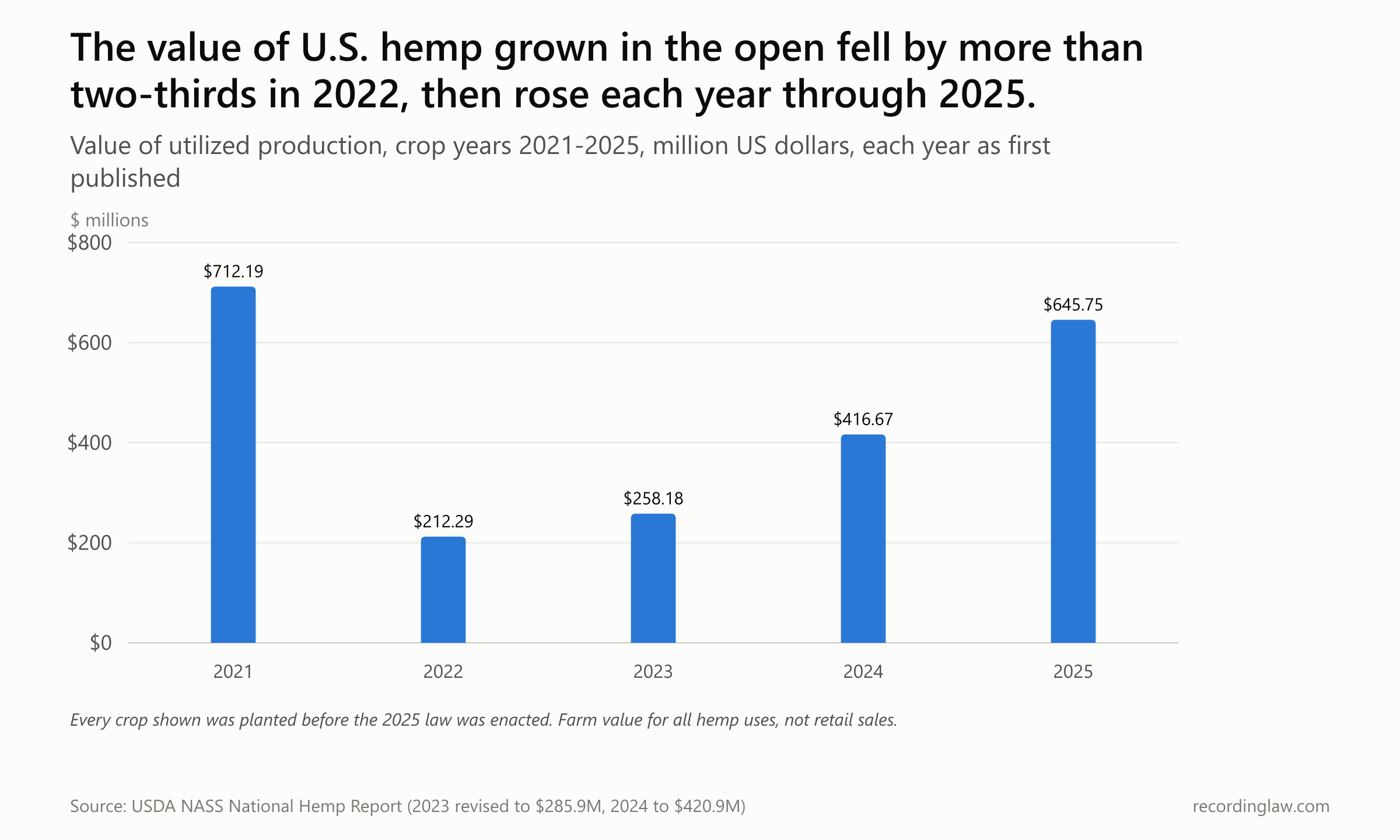
Value of U.S. industrial hemp utilized production grown in the open, as first published each year. Source: USDA NASS National Hemp Report (2023 later revised to $285.9 million, 2024 to $420.9 million).
| Crop year | Value, grown in the open | Change from prior year (NASS) |
|---|---|---|
| 2021 | $712.2 million | first year of the report |
| 2022 | $212.3 million | down 70.2% |
| 2023 | $258.2 million (revised to $285.9 million) | |
| 2024 | $416.7 million (revised to $420.9 million) | up 45.7% from the revised 2023 figure |
| 2025 | $645.8 million | up 53% from the revised 2024 figure |
The crop's value fell by more than two-thirds in 2022, then climbed for three years. The latest report, released April 16, 2026, covers the 2025 crop, which was planted before the law was enacted on November 12, 2025. Section 781 had not taken effect during that season, so the 2025 figures cannot be read as a response to the law.
Most of that value was flower, the part of the plant cannabinoids come from. NASS put the value of floral hemp grown in the open at $574 million in 2025, almost nine-tenths of the open-field total, and fiber at $13.5 million. The reports do not split hemp by end product, so they cannot show how much of the crop went into delta-8 or other intoxicating products.
The 2023 value was first published as $258.2 million in April 2024. The April 2025 report revised it to $285.9 million, and NASS measured the 2024 increase against that revised figure. The April 2026 report revised the 2024 value from $416.7 million to $420.9 million and measured the 2025 increase against that revised figure. This article shows each year as first published and gives the revised figures alongside.
Hemp grown under protection, such as in greenhouses, is reported separately. NASS put its value at $111.9 million in 2021, $32.9 million in 2023, $28.7 million in 2024 and $93.3 million in 2025.
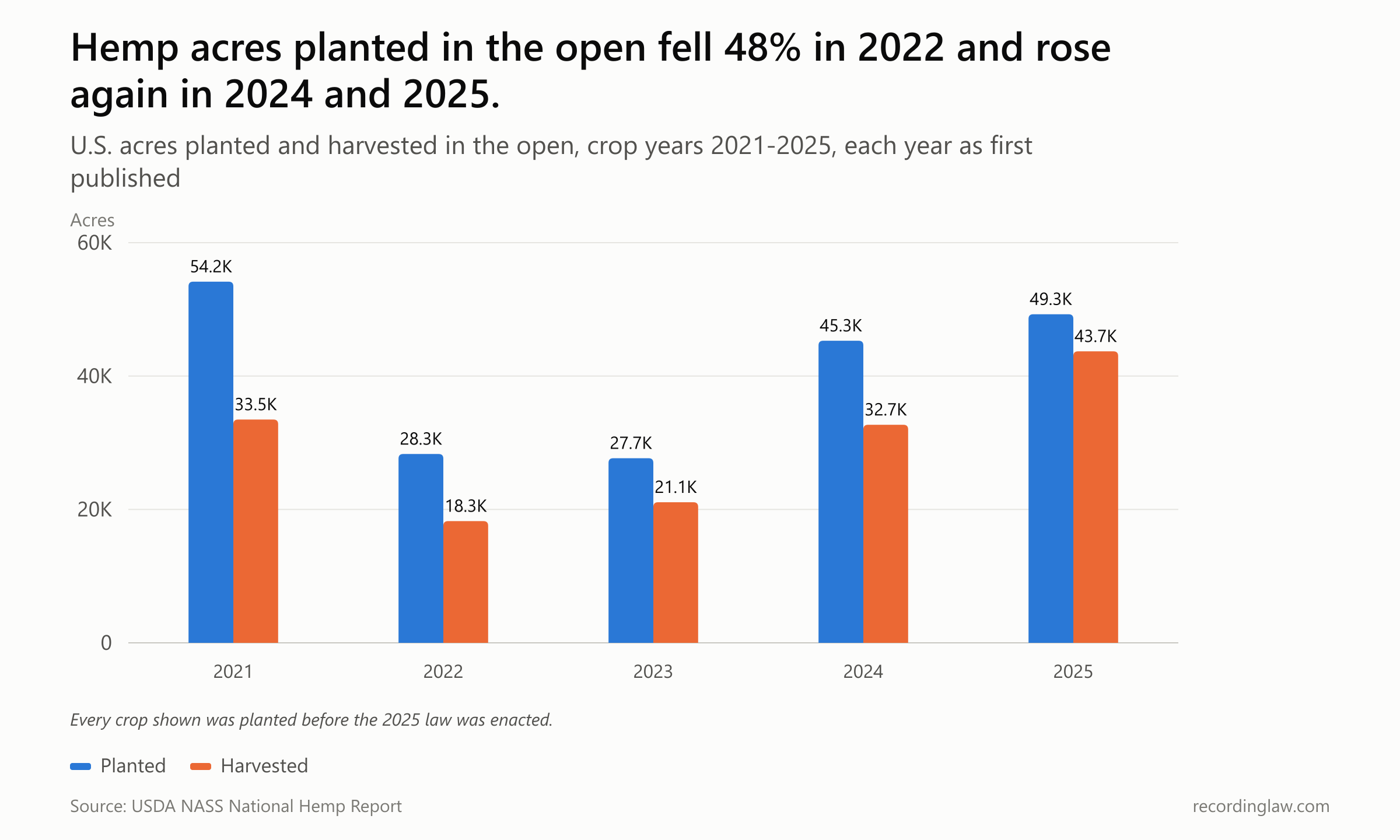
U.S. hemp acres planted and harvested in the open, as first published each year. Source: USDA NASS National Hemp Report.
| Crop year | Acres planted | Acres harvested |
|---|---|---|
| 2021 | 54,152 | 33,480 |
| 2022 | 28,314 | 18,251 |
| 2023 | 27,680 | 21,079 |
| 2024 | 45,294 | 32,694 |
| 2025 | 49,267 | 43,707 |
Acreage followed a similar path. Planted acres fell 47.7% from 2021 to 2022. They rose 63.6% from 2023 to 2024, then rose 9% from 2024 to 2025. The 2021 through 2024 crops predate the 2025 law.
The money figures in the debate came from outside USDA. The Hemp Roundtable cited a $28.4 billion industry. The same figure appears in a 2023 analysis by Whitney Economics, a firm that analyzes the cannabis industry, which put hemp-derived cannabinoid sales at that level, The Gazette reported. We did not open that report, and we found no audited estimate of the retail delta-8 or intoxicating-hemp market.
The job counts also differed: more than 300,000 (Hemp Roundtable), over 325,000 (Hemp Industry & Farmers of America) and more than 220,000 (Moore). We found no audited count behind any of them.
December 11
In early October, five weeks before the first date, the bills meant to change the law had not moved. Congress had seen "upward of five legislative proposals aimed at protecting the hemp sector," Quartz reported on October 5, citing NPR, and "None of the bills has come to a vote." The House-passed agriculture spending bill for fiscal 2027 "does not contain provisions that would delay the effective date of the new hemp definition," CRS wrote.
Rep. Morgan Griffith (R-Va.) has a bill that would task the FDA with developing limits within three years, with defaults of 5 milligrams per serving and 30 milligrams per package if it cannot, Roll Call reported. On October 26 he said a Republican reconciliation package in the lame-duck session could carry it. "I truly believe if we don't do something before that Dec.11th deadline, that it's going to create all kinds of issues," he said.
The first date has arrived, and the second is fixed for now. On November 12, 2026, by CRS's reading, the exclusion for cannabinoids that are not capable of being naturally produced by the plant took effect. On December 11, by CRS's reading, the rest of the definition takes effect, and government funding under Public Law 119-103 expires. Whatever Congress passes to keep the government open past that date is the next bill that could carry hemp language, or leave it out.
The data will lag behind. NASS has published its hemp report each spring, and its next edition, likely around April 2027, would cover the 2026 crop, the first planted after the law was enacted.
School surveys add a second view, in aggregate. In the 2023 Monitoring the Future survey, a national survey of 8th, 10th and 12th graders, 11.4% of 12th graders reported using delta-8 in the past year, against 30.4% for marijuana, according to a research letter in JAMA. Nora Volkow, director of the National Institute on Drug Abuse, described that as "at least one or two students in every average-sized high school class who may be using delta-8."
The 2025 survey asked a broader question, about cannabis products made from hemp, including delta-8. Two percent of 8th graders, 6% of 10th graders and 9% of 12th graders said they had used one in the past year, the National Institutes of Health reported. Because the questions differ, the 2023 and 2025 figures are not a trend. Monitoring the Future released its 2025 results in December 2025, and a 2026 release would give a second year of the hemp-product question.
In May 2022, the Ninth Circuit said that any mistake in the 2018 law was for Congress to fix. Congress rewrote the definition, and by CRS's reading all of it is due to apply by December 11, 2026, more than four and a half years after that ruling and on the same day Congress has to fund the government again.
How we measured
Law. Statute text comes from the enrolled public laws on congress.gov and govinfo.gov (Public Law 119-37, Public Law 119-103 and Public Law 115-334). Vote counts and dates for H.R. 6500 come from the Congress.gov pages for H.R. 6500 and Senate Amendment 6747 and the House Clerk's record of Roll Call 286, which also gives the party totals. The November 10, 2025 Senate votes (76-24 to table the Paul amendment, 60-40 on passage) come from Kentucky Public Radio's reporting; we did not open the Senate roll calls. We quote the operative text rather than summarize which products fall under which date, because that application is not settled by the text alone; the two-stage reading (cannabinoids not capable of being naturally produced by the plant from November 12, the other portions of the definition from December 11) is attributed to the Congressional Research Service (In Focus IF13136, version current as of September 28, 2026, read through the EveryCRSReport mirror). From November 12 to December 11, 2026 is 29 days. The Ninth Circuit quotes come from the opinion in AK Futures LLC v. Boyd Street Distro, LLC, No. 21-56133.
Quotes. Floor remarks and statements are quoted as published by the outlets named in the text (States Newsroom, Kentucky Public Radio, the Northern Kentucky Tribune, Spectrum News, The Gazette, Carolina Journal, WUKY, KAXE, Indiana Public Media, the Washington Examiner, Roll Call, Quartz) or by the office that issued them. Advocacy and industry groups are identified as such. Figures they cite, including market size and job counts, are their figures; we did not verify them. McConnell's statement about hemp's share of U.S. farmed acres was not checked because we did not retrieve a farmland total to compare it with.
Farm data. Hemp acreage and value come from the USDA NASS National Hemp Reports for crop years 2021 through 2025, published February 2022, April 2023, April 2024, April 2025 and April 2026. We use each year's figure as first published, and note the revisions to the 2023 value (April 2025) and the 2024 value (April 2026). The survey design changed between years: the 2021 report drew on a sample of 20,501 surveyed in October to December 2021, and the 2024 report on a sample of 8,153 surveyed in February and March 2025. Values are farm-gate value of utilized production for all hemp uses. They are not retail sales and do not separate delta-8 or other intoxicating products. The floral share is $574 million divided by $646 million, both as rounded in the April 2026 report text, or about 89%. NASS data before the 2021 crop were not used.
Poison-center data. Exposure figures come from the CDC's 2021 health advisory, from Smith et al. (2024), which analyzed National Poison Data System records for 2021 and 2022, and from the America's Poison Centers tracking page. Poison-center counts are calls about exposures, not a measure of how many people use delta-8. The delta-8 product code began in late 2020, so there is no earlier baseline. The policy-group rates are unweighted averages of state rates, and the policy groups reflect state law before January 1, 2023. The study also reports percentage increases by policy group, which we do not use here because the groups start from very different bases. The later record is thinner. America's Poison Centers states on its tracking page that poison centers managed 10,434 delta-8 THC related exposure cases from 2021 to 2025, a total the page does not date more precisely and that may cover only part of 2025. That count covers delta-8-related cases and is not on the same basis as the study's primary-substance count, and year-by-year counts after 2022 were not available in a form we could verify.
Survey data. The 2023 delta-8 figure is from Harlow, Miech and Leventhal's research letter in JAMA (2024), a weighted national estimate from 2,186 12th graders in the Monitoring the Future survey. The 2025 figures are from the NIH release of December 17, 2025, which asked about hemp-derived cannabis products as a group. The two are different questions and are not compared as a trend.
What the data cannot show. No audited estimate of the retail delta-8 or intoxicating-hemp market was found, so none is given here. We did not retrieve a current state-by-state count of delta-8 bans and restrictions, or poison-center comparisons by state policy for 2023 or later. The farm data end with the 2025 crop, which was planted before the law was enacted on November 12, 2025. The poison-center study data end with 2022. None of these series can show an effect of the 2025 law, which had not taken effect by the end of any of them.
Frequently Asked Questions
When does the federal hemp redefinition take effect?
Section 781 of Public Law 119-37 says it is effective 365 days after enactment; the law was signed November 12, 2025, so that date is November 12, 2026. Section 2019 of Public Law 119-103, signed September 2, 2026, says that until December 11, 2026, the amendments shall only apply with respect to products described in two listed sub-items of the amended definition: final and intermediate products containing cannabinoids not capable of being naturally produced by the plant. The Congressional Research Service reads this as: products with cannabinoids not capable of being naturally produced by the plant, which CRS calls certain synthetic cannabinoids, are excluded from November 12, 2026, and the other portions of the new definition take effect December 11, 2026. Check current USDA and FDA guidance for how this applies to a specific product.
What is the 0.4 milligram limit?
The amended definition excludes from hemp any final hemp-derived cannabinoid product containing more than 0.4 milligrams combined total per container of total THC (including THCA) and other cannabinoids with similar effects, as determined by the Secretary of Health and Human Services. A container is the innermost packaging in direct contact with the product, such as a jar, bottle, bag, packet or cartridge. The limit is per container, not per serving.
Is CBD still legal under the new hemp definition?
The law has no separate exception for CBD. A CBD product remains hemp only if it meets the new definition, including the 0.4 milligram per container limit once that part takes effect. Sponsors said non-intoxicating CBD would remain legal. The U.S. Hemp Roundtable, an industry coalition, said more than 90% of non-intoxicating hemp products exceed the cap, and a December 18, 2025 executive order said some full-spectrum CBD products will be controlled as marijuana when Section 781 goes into effect.
How did the 2018 Farm Bill define hemp?
Public Law 115-334, signed December 20, 2018, defined hemp as Cannabis sativa L. and its derivatives, extracts, cannabinoids and isomers with a delta-9 THC concentration of not more than 0.3 percent on a dry weight basis. In 2022 the Ninth Circuit held in AK Futures v. Boyd Street Distro that this legalized delta-8 THC. The 2025 law changes the measure to total THC, including THCA.
How big is the delta-8 market?
We did not find an audited figure for retail sales of delta-8 or other intoxicating hemp products, so this article does not give one. Opponents of the law cited $28.4 billion, which matches a 2023 estimate of hemp-derived cannabinoid sales by Whitney Economics, an industry analyst; we did not verify it. USDA reports farm-gate value for all hemp grown: $645.8 million for hemp grown in the open in 2025, as first published. That figure covers every hemp use, not only delta-8.
Do state delta-8 bans reduce poison-center calls?
A 2024 study in the Journal of Medical Toxicology found that, in 2022, states that had banned delta-8 averaged 0.17 exposures per 100,000 people and states with no delta-8 rules averaged 1.36. Rates rose from 2021 to 2022 in all three groups of states. That is an association. States differ in many ways, including cannabis laws and population, and the study design does not show that the bans caused the lower rates.
Could Congress change the dates again?
Yes. The December 11, 2026 date was set by a September 2026 appropriations law, and Congress can amend it. December 11 is also the day government funding under that law expires. As of early October 2026, Quartz reported, none of the hemp bills in Congress had come to a vote. This article reflects the law as of November 12, 2026 and will be updated if the dates change.
Updates
Restructured as a feature: chart titles state the finding, side details moved to How we measured. Every figure and quote was re-checked against its source.
Independently fact-checked against the cited primary sources
Rewritten with added reporting: what lawmakers and opponents said at the time, and how the rollout unfolded. Every figure and quote was re-checked against its source.
Independently fact-checked against the cited primary sources
Independently fact-checked against the cited primary sources
Sources and References
- Public Law 119-37 (H.R. 5371), Division B, Section 781, amending 7 U.S.C. 1639o(congress.gov).gov
- Public Law 119-103 (H.R. 6500), Continuing Appropriations and Extensions Act, 2027, Section 2019(congress.gov).gov
- Congress.gov, H.R. 6500 (119th Congress), all actions(congress.gov).gov
- Congress.gov, Senate Amendment 6747 to H.R. 6500 (motion to table, Record Vote 227)(congress.gov).gov
- Office of the Clerk, U.S. House, Roll Call 286, H.R. 6500, Sept. 1, 2026(clerk.house.gov).gov
- Public Law 115-334, Agriculture Improvement Act of 2018, Section 10113(govinfo.gov).gov
- USDA NASS, National Hemp Report, February 2022 (2021 crop)(nass.usda.gov).gov
- USDA NASS, National Hemp Report, April 2023 (2022 crop)(nass.usda.gov).gov
- USDA NASS, National Hemp Report, April 2024 (2023 crop)(nass.usda.gov).gov
- USDA NASS, National Hemp Report, April 2025 (2024 crop, revised 2023)(nass.usda.gov).gov
- USDA NASS, National Hemp Report, April 16, 2026 (2025 crop, revised 2024)(usda.gov).gov
- CDC Health Alert Network advisory on delta-8 THC exposures, Sept. 14, 2021(cdc.gov).gov
- Smith et al., delta-8 THC exposures reported to U.S. poison centers, 2021-2022, Journal of Medical Toxicology, 2024(nih.gov).gov
- America's Poison Centers, Delta-8 THC tracking page(poisoncenters.org)
- U.S. Court of Appeals for the Ninth Circuit, AK Futures LLC v. Boyd Street Distro, LLC, No. 21-56133 (May 19, 2022)(ca9.uscourts.gov).gov
- Public Law 119-103 on govinfo.gov (Section 2019 and the December 11, 2026 funding expiration date)(govinfo.gov).gov
- Congressional Research Service, In Focus IF13136 on the new federal hemp definition (version current as of Sept. 28, 2026), EveryCRSReport mirror(everycrsreport.com)
- The White House, Executive Order 14370, Increasing Medical Marijuana and Cannabidiol Research, Dec. 18, 2025(whitehouse.gov).gov
- Northern Kentucky Tribune, Sen. Mitch McConnell's August 2025 Senate floor remarks on hemp(nkytribune.com)
- Spectrum News 1 Kentucky, Legislators pick sides on hemp loophole, Sept. 26, 2025(spectrumnews1.com)
- WUKY, Despite legislative setback, McConnell vows to close hemp loophole, Aug. 6, 2025(wuky.org)
- Office of Rep. Tim Moore, statement and Sept. 26, 2025 letter on the hemp language(house.gov).gov
- Illinois Attorney General, Raoul and 39-attorney-general coalition letter on hemp-derived THC, Oct. 2025(illinoisattorneygeneral.gov).gov
- States Newsroom (Missouri Independent), Deal ending government shutdown includes restrictions on intoxicating hemp products, Nov. 11, 2025(missouriindependent.com)
- Kentucky Public Radio via Hoptown Chronicle, McConnell, Paul clash over Senate hemp provision, Nov. 2025(hoptownchronicle.org)
- The Gazette (Colorado Springs), Senate votes to ban intoxicating hemp products nationally, Nov. 11, 2025(gazette.com)
- U.S. Hemp Roundtable (industry coalition), statement, Nov. 10, 2025(businesswire.com)
- Reason Foundation commentary on the November 2025 shutdown bill and Section 781(reason.org)
- KETR, Gov. Abbott vetoes Texas THC ban in break with Lt. Gov. Patrick, June 23, 2025(ketr.org)
- Northern News Now, Congress passes bipartisan bill to delay federal hemp ban, Sept. 1, 2026(northernnewsnow.com)
- Indiana Public Media, Rokita and bipartisan group urge Congress not to delay hemp restrictions, Aug. 4, 2026(ipm.org)
- Washington Examiner, CMS Administrator Oz letter to the Senate on the hemp delay, Aug. 2026(washingtonexaminer.com)
- Carolina Journal, Federal hemp fight puts Budd at center of debate, Aug. 12, 2026(carolinajournal.com)
- WUKY, Opponents of new federal hemp regulations score a one-month reprieve, Aug. 12, 2026(wuky.org)
- NACS (convenience-store trade association), Senate votes to delay hemp ban, Aug. 10, 2026(convenience.org)
- KAXE, Looming federal hemp ban delayed by 4 weeks, Sept. 2, 2026(kaxe.org)
- Quartz, Federal hemp THC ban threatens drink market by December, Oct. 5, 2026(qz.com)
- Roll Call, Backer of hemp regulation looks to reconciliation process, Oct. 26, 2026(rollcall.com)
- Harlow, Miech and Leventhal, delta-8 THC use among US 12th graders, JAMA research letter, 2024(nih.gov).gov
- NIDA news release, Delta-8 THC use reported by 11% of 12th graders in 2023, March 2024(nih.gov).gov
- NIH news release, Monitoring the Future 2025 results, Dec. 17, 2025(nih.gov).gov
- USDA ESMIS, National Hemp Report publication listing (latest edition Apr. 16, 2026)(usda.gov).gov
- Insurance Journal, "How Federal Ban on Intoxicating Hemp Products Will Reshape Risk, Coverage" (Ian Stewart, Oct. 19, 2026)(insurancejournal.com)
- Congressional Research Service, Delay in Changes to Hemp Definition: Cannabinoids Not Capable of Being Naturally Produced by the Cannabis Plant (LSB11496), Oct. 28, 2026(everycrsreport.com)