Massachusetts Votes on Ending Its $1.65 Billion Adult-Use Cannabis Market
Independently fact-checked against primary sources (last audited October 26, 2026). · 16 primary sources cited on this page. How we verify our legal content
Massachusetts voters will decide in the November 3, 2026 state election whether to end the retail sale of adult-use marijuana, a market that reported $1,651.9 million in gross sales in 2025. Question 8 would also change possession penalties, and the official summary says it would take effect on January 1, 2028.
Over the years the market grew, the average retail price per gram reported by the Cannabis Control Commission (CCC) went from $14.17 in November 2018 to $3.78 in September 2026. State marijuana excise collections went from $51.68 million in fiscal 2020 to $181.09 million in fiscal 2026.
This article sets out what the official ballot materials say a yes and a no vote would do, what the state's own data show about sales, prices, taxes and licences, and what those numbers cannot tell you. It reflects data retrieved on October 26, 2026. It makes no prediction about the result.
What Question 8 would do
Question 8 is titled "An Act to restore a sensible marijuana policy" (Initiative Petition 25-10, House 5002). The official statement of what each vote does was written jointly by the Attorney General and the Secretary of the Commonwealth.
"A YES VOTE would prohibit the legalization, regulation, and taxation of the retail sale of adult recreational use marijuana, and change the penalties for possession of marijuana."
"A NO VOTE would make no change to the law relative to marijuana."
According to the Attorney General's summary, if the measure passes:
- People 21 and older could still possess one ounce or less, with no more than 5 grams of concentrate, and could give the same amount to another person 21 or older.
- Possessing more than one ounce and up to two ounces would carry a $100 civil penalty and forfeiture of the marijuana.
- For people 21 years of age and younger (the summary's wording; the full text says under 21) with two ounces or less, it would be a civil infraction with a $100 fine, forfeiture and a drug awareness program. The summary also lists community service and notice to a parent or guardian. In the full text, community service is part of the drug awareness program, which the measure extends to offenders under 21, and parental notice applies to offenders under 18.
- Licensed adult-use businesses could apply on an expedited basis to become licensed medical marijuana dispensaries, and could sell remaining adult-use inventory to medical dispensaries.
- The CCC would remain, but would regulate only the medical market.
The full text repeals Chapter 64N (the marijuana retail tax) and Chapter 94G (adult-use regulation) of the General Laws. It keeps and amends Chapter 94I, which covers medical marijuana. The summary states: "The proposed law would take effect on January 1, 2028."
The question reached the ballot without legislative action. On May 4, 2026, a majority of the Legislature's Special Joint Committee on Initiative Petitions recommended that the General Court take no action. The ballot heading says neither the House nor the Senate voted on it before May 6, 2026.
Massachusetts voters approved adult-use legalization as Question 4 in November 2016, 1,769,328 to 1,528,219, or 53.7 percent of yes and no votes (blank ballots excluded), according to the Secretary of the Commonwealth's election statistics. The first two adult-use stores opened in Northampton and Leicester in November 2018, according to the CCC.
For the state's current rules on sealing criminal records, see Massachusetts expungement and record sealing. For the current impaired-driving rules, see Massachusetts OUI laws.
Sales: fast growth through 2021, smaller annual changes since
Gross adult-use sales reported to the CCC rose from $433.0 million in 2019, the first full year, to $1,333.8 million in 2021. Annual totals then rose by smaller amounts each year, reaching $1,651.9 million in 2025, $3.3 million more than in 2024.
The CCC's own 2025 release describes the same pattern. It says sales ended the year "approximately $3 million higher compared to 2024 as average cannabis prices continued to ebb." It also says retailers recorded 46.3 million transactions in 2025, about 3.4 million more than in 2024.
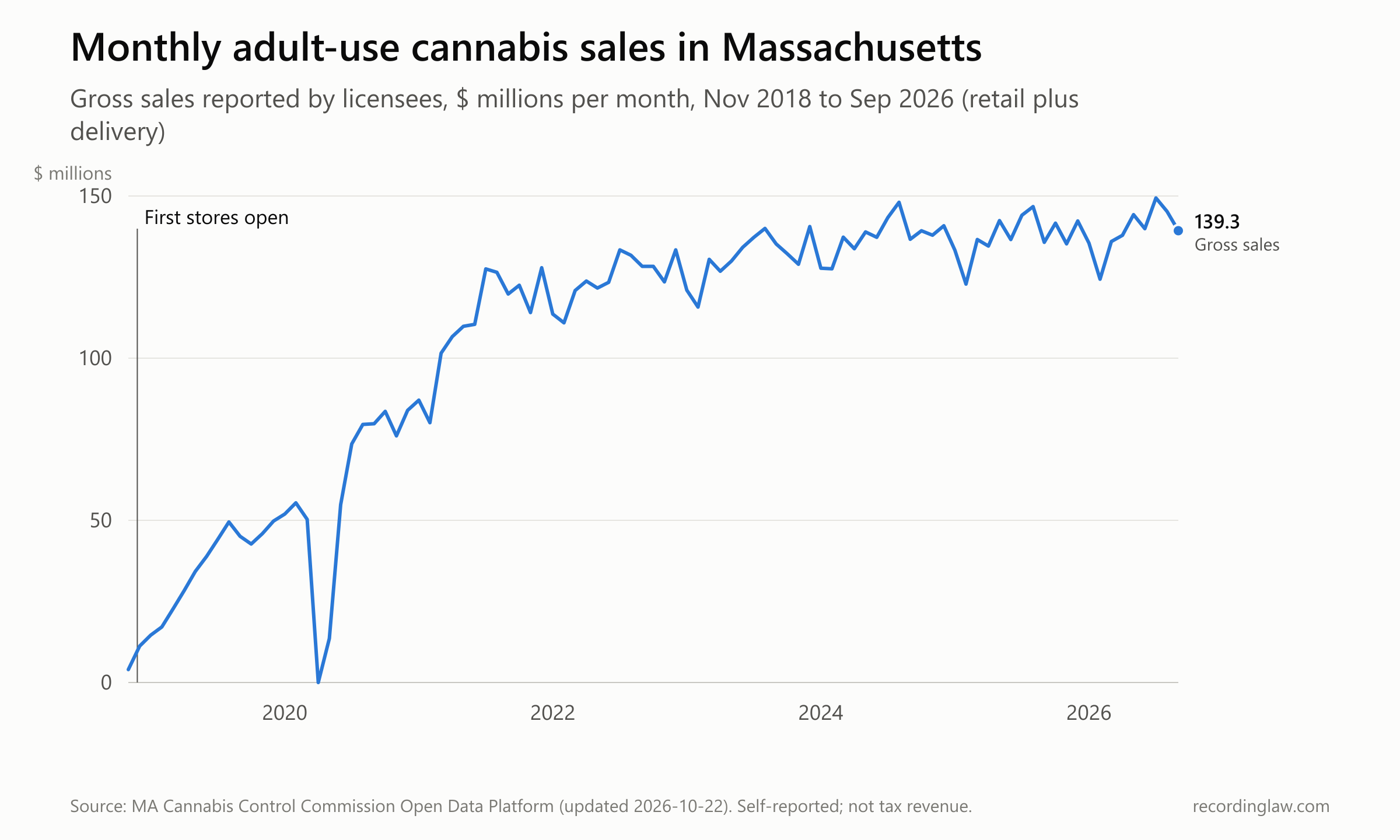
Source: Massachusetts Cannabis Control Commission Open Data Platform, adult-use gross sales (retail plus delivery), updated October 22, 2026. Self-reported; not tax revenue.
| Calendar year | Gross adult-use sales |
|---|---|
| 2019 | $433.0 million |
| 2020 | $702.4 million |
| 2021 | $1,333.8 million |
| 2022 | $1,492.7 million |
| 2023 | $1,572.3 million |
| 2024 | $1,648.6 million |
| 2025 | $1,651.9 million |
For 2026, the file runs through September. Sales from January to September were $1,251.8 million, compared with $1,232.7 million over the same months of 2025, a difference of 1.5 percent.
| January to September | Gross adult-use sales |
|---|---|
| 2022 | $1,107.5 million |
| 2023 | $1,170.6 million |
| 2024 | $1,230.6 million |
| 2025 | $1,232.7 million |
| 2026 | $1,251.8 million |
The CCC says cumulative gross sales passed $10 billion on September 5, 2026, reaching $10,008,567,111. In the same release, CCC Chair Chris Harding said the adult-use industry employs nearly 15,000 people.
Two notes on the series. Delivery sales are included and were under 1.5 percent of 2025 sales; a state law change in April 2026 allowed cannabis delivery in every city and town unless a community opts out, according to the CCC. Adult-use stores were ordered closed from noon on March 24, 2020, when the CCC applied the Governor's COVID-19 Order No. 13; medical sales continued. The file shows about $2,800 in adult-use sales in April 2020 and daily sales resuming on May 25, 2020. The closure lowers the 2020 sales total and fiscal 2020 excise, and the price series dips for that one month.
Prices: 73 percent lower per gram than at launch
The CCC publishes an average monthly retail price per gram for adult-use sales. It was $14.17 in November 2018 and $14.68 in January 2020, the highest month in the series. It began falling in 2021, fell fastest in 2022 and early 2023, and kept falling more slowly to $3.78 in September 2026, 73 percent below the launch month. The one-month dip to $10.15 in April 2020 falls in the COVID-19 store closure, when the file records almost no adult-use sales. These are nominal dollars, not adjusted for inflation.
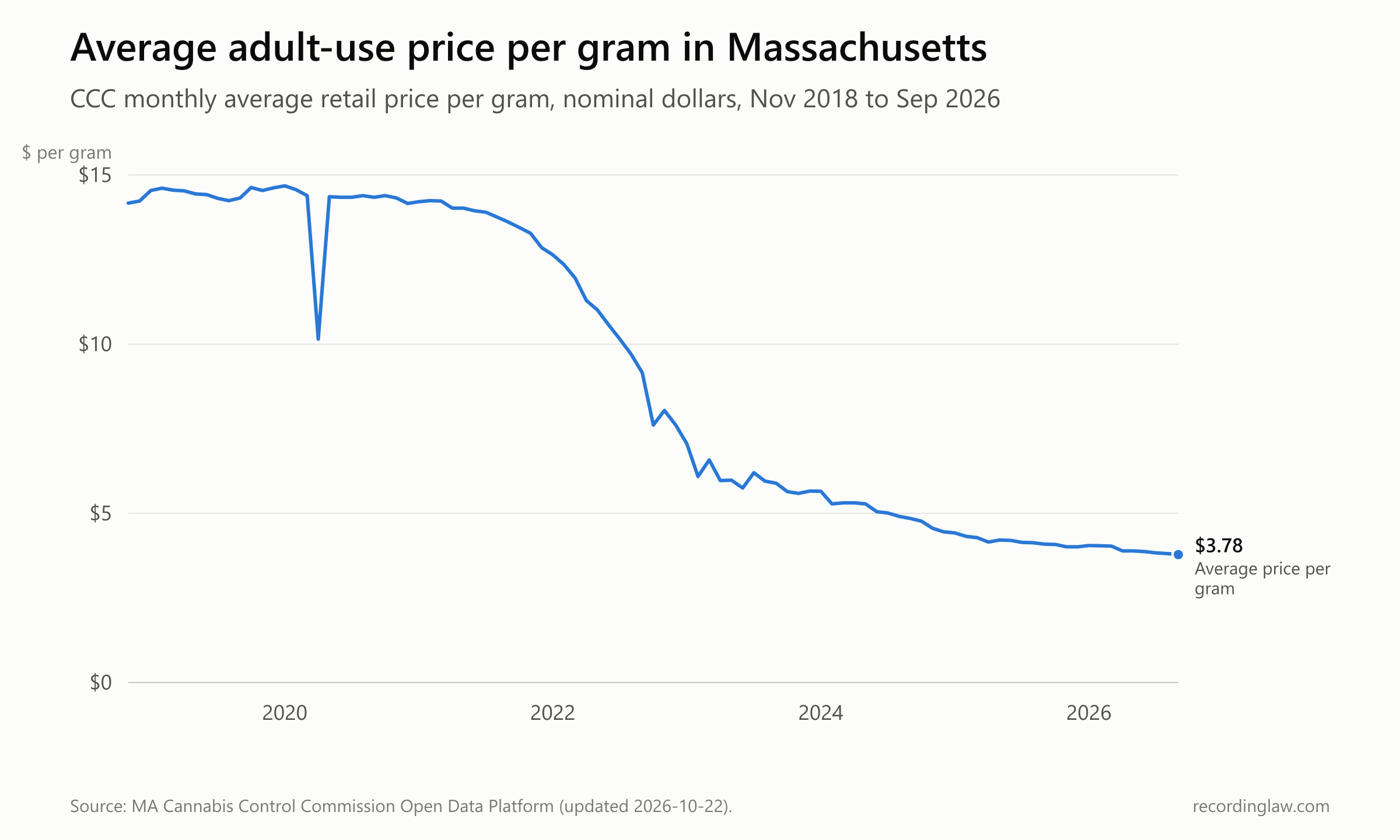
Source: Massachusetts Cannabis Control Commission Open Data Platform, average retail price per gram, nominal dollars. The CCC does not specify the product mix.
| Month | Average price per gram |
|---|---|
| November 2018 | $14.17 |
| January 2020 | $14.68 |
| January 2022 | $12.64 |
| January 2023 | $7.06 |
| January 2024 | $5.65 |
| January 2025 | $4.42 |
| September 2026 | $3.78 |
The CCC file does not say which product categories this average includes, so it should not be read as a flower price. For the same reason, dividing sales by price does not give a reliable measure of how much cannabis was sold.
Tax revenue: two official figures for fiscal 2025
Massachusetts taxes adult-use sales three ways, according to the CCC: a 6.25 percent state sales tax, a 10.75 percent state excise tax, and a local option tax of up to 3 percent for cities and towns.
The 10.75 percent excise is reported on its own Department of Revenue line. Net excise collections were $51.68 million in fiscal 2020, $183.27 million in fiscal 2025 and $181.09 million in fiscal 2026, a change of minus 1.19 percent between the last two years. The state fiscal year ends June 30, so fiscal 2020 includes the spring 2020 closure of adult-use stores.
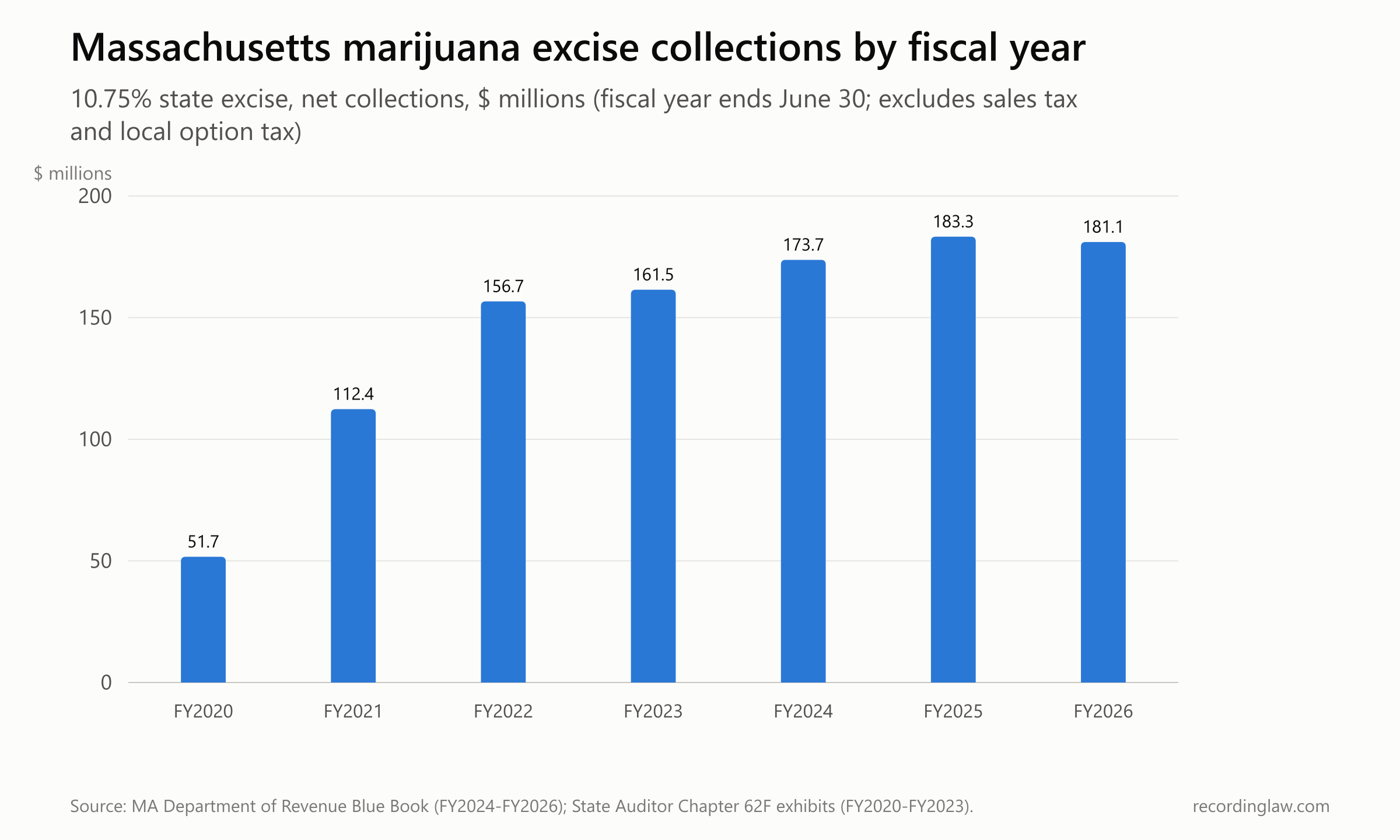
Source: Massachusetts Department of Revenue Blue Book (fiscal 2024 to 2026) and State Auditor Chapter 62F reports (fiscal 2020 to 2023). Excise only; the sales tax on marijuana is a separate line.
| State fiscal year | Marijuana excise, net |
|---|---|
| FY2020 | $51.68 million |
| FY2021 | $112.37 million |
| FY2022 | $156.67 million |
| FY2023 | $161.47 million |
| FY2024 | $173.74 million |
| FY2025 | $183.27 million |
| FY2026 | $181.09 million |
Total state revenue is reported in two ways. The fiscal statement printed in the Question 8 voter information, from the Executive Office of Administration and Finance, says: "In fiscal year 2025, taxation of the retail sale of adult recreational use marijuana raised approximately $280 million in state revenue and $50 million in local revenue."
The CCC, citing Department of Revenue data, says adult-use sales generated $289 million in state tax revenue in fiscal 2025. The Department of Revenue lines for the excise ($183,268,729) and for sales tax on marijuana ($106,194,390) add to $289.46 million. The Department of Revenue notes that its sales tax line includes amounts dedicated to the MBTA, the school building (SMART) fund and convention center funding. The fiscal statement does not say how its figure was calculated, and this article does not choose between them.
For fiscal 2026, the same two Department of Revenue lines add to $285.55 million. Local option marijuana tax was $50.95 million in fiscal 2025 and $50.51 million in fiscal 2026.
Licences: 445 retail licences have started operating
The CCC lists 445 Marijuana Retailer licences that have commenced operations since 2018. The chart counts them cumulatively by the year operations began.
It is not a count of stores open at the end of each year, because some licences have since ended. Of the 445, 408 are listed as Active, 25 as Expired, 10 as Surrendered and 2 as Revoked.
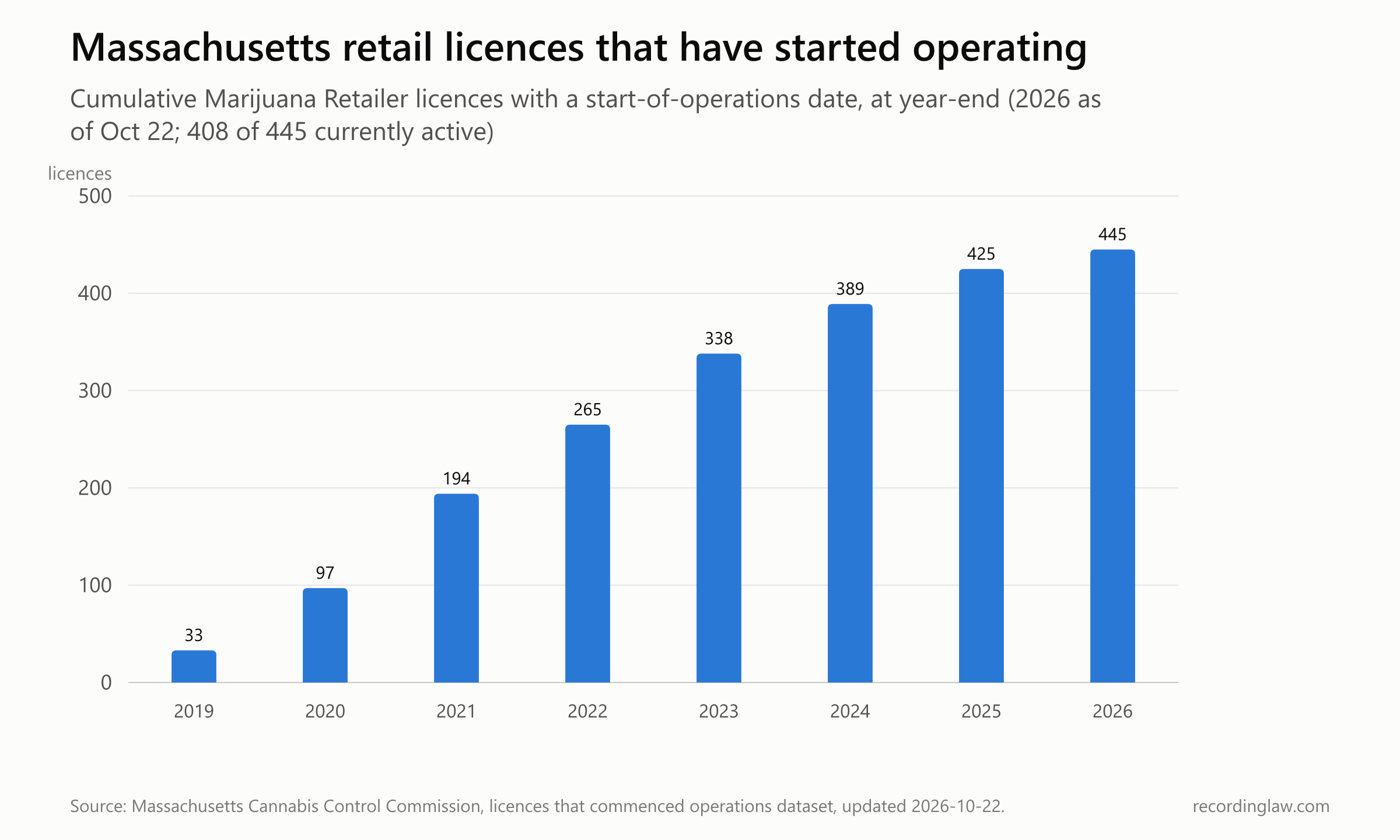
Source: Massachusetts Cannabis Control Commission, licences that commenced operations dataset, updated October 22, 2026. Cumulative; excludes delivery operators and microbusinesses.
| Year-end | Cumulative retailer licences commenced |
|---|---|
| 2019 | 33 |
| 2020 | 97 |
| 2021 | 194 |
| 2022 | 265 |
| 2023 | 338 |
| 2024 | 389 |
| 2025 | 425 |
| 2026 (to Oct 22) | 445 |
The CCC's 2025 release uses a broader count: 416 Marijuana Retailers, Delivery Operators and Microbusinesses with delivery endorsements as of November 2025, compared with 406 at the same point in 2024.
The arguments in the official voter guide
The Secretary of the Commonwealth's voter information prints one 150-word argument for and one against Question 8. It says the arguments "are written by proponents and opponents of each question, and reflect their opinions," and that the Commonwealth "does not endorse these arguments, and does not certify the truth or accuracy of any statement made in these arguments." Each is summarized below in the order the guide prints it, as the statements of its authors.
For Question 8. The argument in favor was written by Dr. Jeffrey Morgan of the Coalition For a Healthy Massachusetts. The argument states that:
- Question 8 would keep personal possession and medical marijuana legal and stop commercial marijuana stores.
- Since commercial legalization, marijuana is the most common drug found in fatal car accidents in Massachusetts, and 85 percent of marijuana users admit to driving after use.
- Business owners have higher costs from workplace injuries, healthcare and turnover.
- Concentrates and edibles have been linked to mental health conditions, and emergency-room visits by teenagers with psychiatric conditions have increased.
- "For every $1 gained in tax revenue, taxpayers spend $4.50 to mitigate the effects of legalization."
Against Question 8. The argument against was written by Ryan Dominguez of the Massachusetts Cannabis Coalition. The argument states that:
- Question 8 would create public health and safety problems by repealing the rules that control the production and sale of marijuana.
- For ten years, Massachusetts has regulated marijuana so that products are tested, packaged and labelled, and sold in licensed businesses to adults 21 and over.
- Question 8 would return marijuana to the illicit market, where there are no safeguards.
- Law enforcement would spend time and resources on marijuana arrests instead of serious crime, and those arrests have historically fallen disproportionately on communities of color.
- "Question 8 would shut down hundreds of small businesses, kill thousands of jobs, and eliminate billions of dollars in state tax revenue."
This article has not tested the figures in either argument against primary data.
How we measured
Sales. Monthly gross sales are the sum of the Retail, Delivery Operators and Delivery Couriers rows in the CCC open dataset of adult-use gross sales, by sale month, November 2018 to September 2026. October 2026 is a partial month and is left out, as are the partial years 2018 and 2026 in the annual table. Our sum reproduces the CCC's published total for 2025 and its February 2026 cumulative milestone. The series has one break: adult-use stores were closed under a CCC order from noon on March 24, 2020, and the file shows daily sales resuming on May 25, 2020.
The CCC says "all data is self-reported and adjusted for voided transactions" and that the datasets "do not represent the Commonwealth's tax earnings."
A disagreement we did not resolve. The CCC's September 2026 release says June 2026 sales were $156 million and that 2026 sales reached $1.09 billion by the end of August; the open-data file of October 22, 2026 gives $139.9 million for June and $1,112.5 million for January to August. We used the file for every chart and table and make no claim about a record month.
Prices. The price series is the CCC average retail price per gram, in nominal dollars. The CCC data catalog describes the dataset as a price per ounce while the file field is per gram, and the product mix is not stated.
Taxes. Excise figures are net collections by state fiscal year (July to June), from the Department of Revenue Blue Book for fiscal 2024 to 2026 and from State Auditor Chapter 62F reports for fiscal 2020 to 2023. The Auditor reports the line as Controlled Substances and Marijuana Excise; for fiscal 2024 it equals the Department of Revenue marijuana excise line ($173,742,923). Sales are calendar years, so the tax and sales tables do not line up month for month. We did not retrieve a primary-source figure for fiscal 2019, the first partial year.
Licences. The licence count is cumulative Marijuana Retailer licences by commence-operations date, from the CCC file of October 22, 2026. Closure dates were not built into a series.
What the data cannot show. These figures describe the licensed market only. They do not measure consumption, illicit sales or purchases made in other states. Nothing retrieved for this article projects what would happen to the market, tax revenue or employment after January 1, 2028, and no polling is used.
Frequently Asked Questions
What does a yes vote on Massachusetts Question 8 do?
The official ballot statement, written jointly by the Attorney General and the Secretary of the Commonwealth, says a yes vote would prohibit the legalization, regulation, and taxation of the retail sale of adult recreational use marijuana, and change the penalties for possession of marijuana. The Attorney General's summary says the proposed law would take effect on January 1, 2028.
What does a no vote on Question 8 do?
The official ballot statement says a no vote would make no change to the law relative to marijuana.
Would possession stay legal if Question 8 passes?
According to the Attorney General's summary, people 21 and older could still possess one ounce or less, including no more than 5 grams of concentrate, and could give the same amount to another person 21 or older. Possessing more than one ounce and up to two ounces would carry a $100 civil penalty and forfeiture. For people 21 years of age and younger (the summary's wording; the full text says under 21) with two ounces or less, it would be a civil infraction with a $100 fine, forfeiture and a drug awareness program. The summary also lists community service and notice to a parent or guardian. In the full text, community service is part of the drug awareness program, which the measure extends to offenders under 21, and parental notice applies to offenders under 18.
What happens to licensed cannabis businesses if Question 8 passes?
The Attorney General's summary says licensed adult-use businesses could apply on an expedited basis to become licensed medical marijuana dispensaries and could sell remaining adult-use inventory to medical dispensaries. The Cannabis Control Commission would remain but would regulate only the medical market.
How much tax does Massachusetts collect from adult-use cannabis?
Two official figures exist for fiscal 2025. The fiscal statement in the Question 8 voter information says about $280 million in state revenue and $50 million in local revenue. The Cannabis Control Commission, citing the Department of Revenue, says $289 million in state tax revenue. The Department of Revenue lines for the marijuana excise ($183.27 million) and sales tax on marijuana ($106.19 million) add to $289.46 million. The fiscal statement does not say how its figure is defined.
How big is the Massachusetts legal cannabis market?
Gross adult-use sales reported to the Cannabis Control Commission were $1,651.9 million in calendar 2025. The CCC says cumulative gross sales passed $10 billion on September 5, 2026. These figures are self-reported by licensees, adjusted for voided transactions, and are not the state's tax earnings.
Does this article predict how the vote will go?
No. It reports the state's market and tax data and the official description of the ballot question. It does not use polling and makes no forecast of the result or of what would happen to the market after January 1, 2028.
Updates
Independently fact-checked against the cited primary sources
Sources and References
- Secretary of the Commonwealth of Massachusetts, 2026 Information for Voters: Question 8 (ballot statement, Attorney General summary, full text, fiscal statement, arguments)(sec.state.ma.us).gov
- Massachusetts Cannabis Control Commission Open Data: adult-use gross sales(masscannabiscontrol.com).gov
- Massachusetts Cannabis Control Commission Open Data: average adult-use retail price per gram(masscannabiscontrol.com).gov
- Massachusetts Cannabis Control Commission Open Data: licences that have commenced operations(masscannabiscontrol.com).gov
- Massachusetts Cannabis Control Commission: Sales and Product Distribution open data (tax rates and data notes)(masscannabiscontrol.com).gov
- Cannabis Control Commission: Massachusetts adult-use cannabis sales generated $1.65 billion in 2025(masscannabiscontrol.com).gov
- Cannabis Control Commission: Massachusetts marijuana establishments hit $10 billion in gross sales(masscannabiscontrol.com).gov
- Massachusetts Department of Revenue, June 2026 Blue Book (net collections, marijuana excise and sales tax lines)(mass.gov).gov
- Secretary of the Commonwealth of Massachusetts, 2026 State Election Ballot Questions(sec.state.ma.us).gov
- Secretary of the Commonwealth of Massachusetts, PD43+ election statistics: 2016 Statewide Question 4(electionstats.state.ma.us).gov
- Cannabis Control Commission, Summary Cease and Desist Order closing adult-use retail under COVID-19 Order No. 13 (issued March 23, 2020)(masscannabiscontrol.com).gov
- Office of the State Auditor, Chapter 62F determination FY2021, Exhibit VI (net state tax revenues FY2021 and FY2020)(mass.gov).gov
- Office of the State Auditor, Chapter 62F determination FY2023, Exhibit VI (FY2023 and FY2022)(mass.gov).gov
- Office of the State Auditor, Chapter 62F determination FY2024, Exhibit VI(mass.gov).gov
- Massachusetts Department of Revenue, June 2025 Blue Book (FY2024 and FY2025 net collections)(mass.gov).gov
- Massachusetts General Laws, Chapter 94C, Section 32M (drug awareness program, including ten hours of community service)(malegislature.gov).gov