In NYC, 96% of Airbnb Listings With 30-Plus-Night Minimums Are Set at Exactly 30 Nights
Independently fact-checked against primary sources (last audited October 26, 2026). · 4 primary sources cited on this page. How we verify our legal content
In the newest snapshot of New York City Airbnb listings from Inside Airbnb, dated October 4, 2026, 23,921 listings set a minimum stay of 30 nights or more, and 22,988 of them, 96.1 percent, set it at exactly 30 nights. Another 5,656 listings allowed stays shorter than 30 nights, and 3,731 of those were private rooms.
Thirty nights is the line in the city's short-term rental rules. Under Local Law 18, hosts who rent for under 30 days must register with the Mayor's Office of Special Enforcement (OSE), and rentals of 30 consecutive days or more are exempt. OSE's annual reports count 3,338 active registrations at June 30, 2026.
What Local Law 18 requires
New York City adopted Local Law 18 on January 9, 2022, according to OSE. OSE began accepting registration applications on March 6, 2023, and on September 5, 2023 it began enforcement by working with booking platforms to verify that short-term listings carry a valid registration.
The law sits on top of an older rule. OSE says that since the late 1960s, city law has limited rentals of under 30 days in homes to two guests staying with a permanent occupant.
Registration applies to stays under 30 days. OSE says rentals of 30 consecutive days or more are exempt, as are Class B multiple dwellings. That 30-day boundary is the number the listings data below keeps returning to.
Most longer-stay listings sit at exactly 30 nights
Inside Airbnb publishes snapshots of Airbnb listings for New York City, including each listing's minimum-nights setting. We grouped every listing in 15 snapshots into three buckets: under 30 nights, exactly 30 nights and over 30 nights.
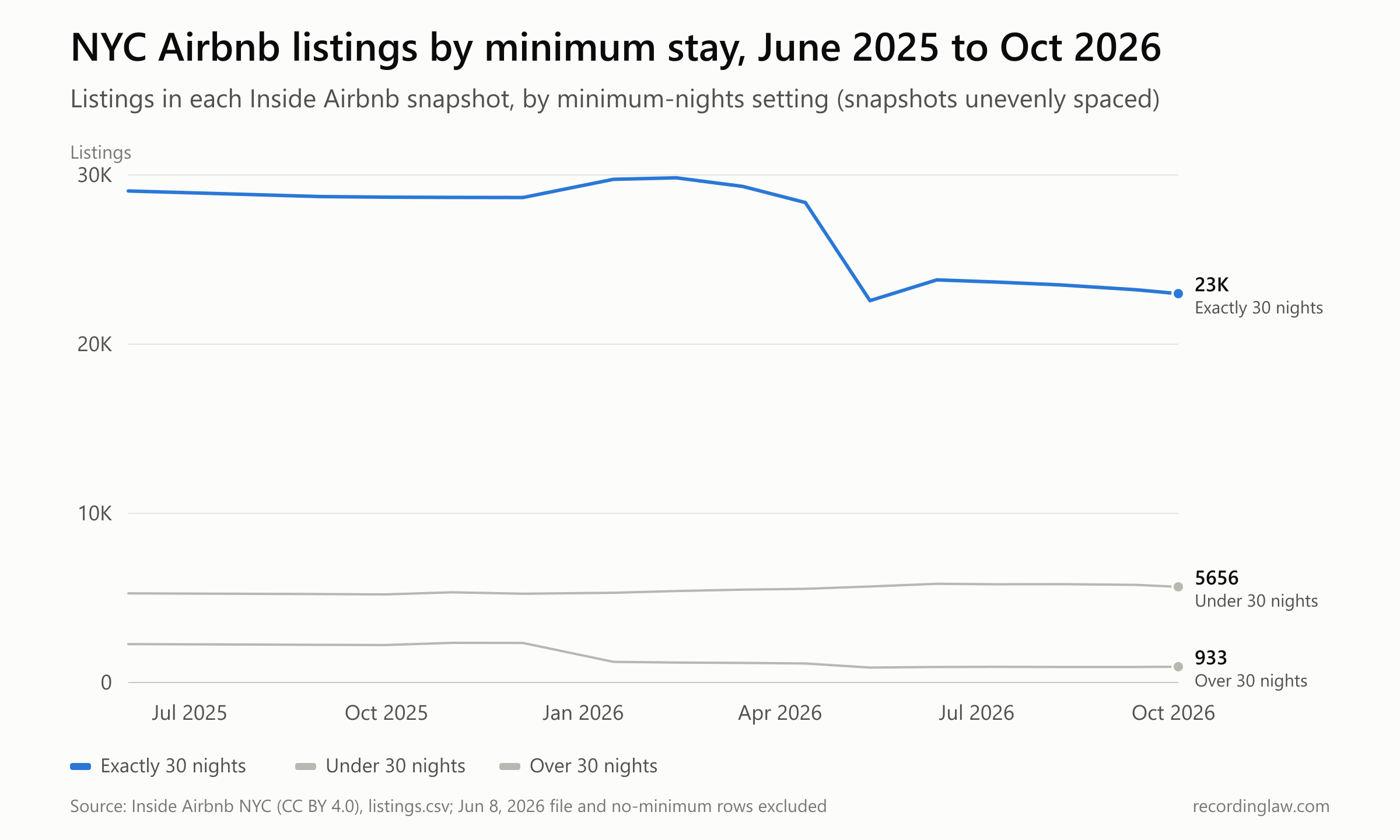
Source: Inside Airbnb NYC snapshots, licensed CC BY 4.0, computed by recordinglaw.com from each snapshot's listings.csv. The incomplete June 8, 2026 file is excluded, as are listings with no minimum stay recorded. Snapshots are not evenly spaced: June to September 2025 is a three-month gap, the rest are about a month apart.
| Snapshot | Under 30 nights | Exactly 30 nights | Over 30 nights | Total |
|---|---|---|---|---|
| June 4, 2025 | 5,266 | 29,052 | 2,269 | 36,587 |
| December 4, 2025 | 5,248 | 28,672 | 2,341 | 36,261 |
| January 15, 2026 | 5,302 | 29,748 | 1,223 | 36,286 |
| April 14, 2026 | 5,539 | 28,372 | 1,122 | 35,036 |
| May 14, 2026 | 5,676 | 22,575 | 880 | 29,135 |
| September 14, 2026 | 5,771 | 23,222 | 917 | 29,918 |
| October 4, 2026 | 5,656 | 22,988 | 933 | 29,577 |
The total column counts every listing in the file. In some 2026 files a few listings (13 in January, 3 in April, 4 in May, 8 in September) have no minimum stay recorded, so they sit in no bucket.
In June 2025, 29,052 of the 31,321 listings with a minimum of 30 nights or more were set at exactly 30, or 92.8 percent. By October 2026 the share was 96.1 percent. Nearly all of that change came between the December 2025 and January 2026 snapshots (see Two breaks in the series). In an August 2024 article citing Inside Airbnb data as of July 2024, Sherwood News reported a similar pattern: 93 percent of 32,721 longer-term listings had a minimum of exactly 30 nights.
The data shows the setting a host chose. It does not show how long guests actually stayed, whether a listing was booked at all, or whether a 30-night listing is ever rented for fewer nights.
Two breaks in the series
Two changes in the snapshots are large enough to see on the chart. We report them without an explanation, because none is documented.
Between December 4, 2025 and January 15, 2026, over-30-night listings fell from 2,341 to 1,223 while exactly-30-night listings rose from 28,672 to 29,748.
Between April 14 and May 14, 2026, total listings fell from 35,036 to 29,135. Exactly-30-night listings account for almost all of it, falling from 28,372 to 22,575. Under-30-night listings rose over the same month, from 5,539 to 5,676. Inside Airbnb has not said whether the drop reflects listings leaving Airbnb, a change in how the site was collected, or something else.
Who still lists stays under 30 nights
The 5,656 listings that allowed stays under 30 nights in October 2026 were 19.1 percent of all listings in that snapshot. Private rooms made up 66.0 percent of them.
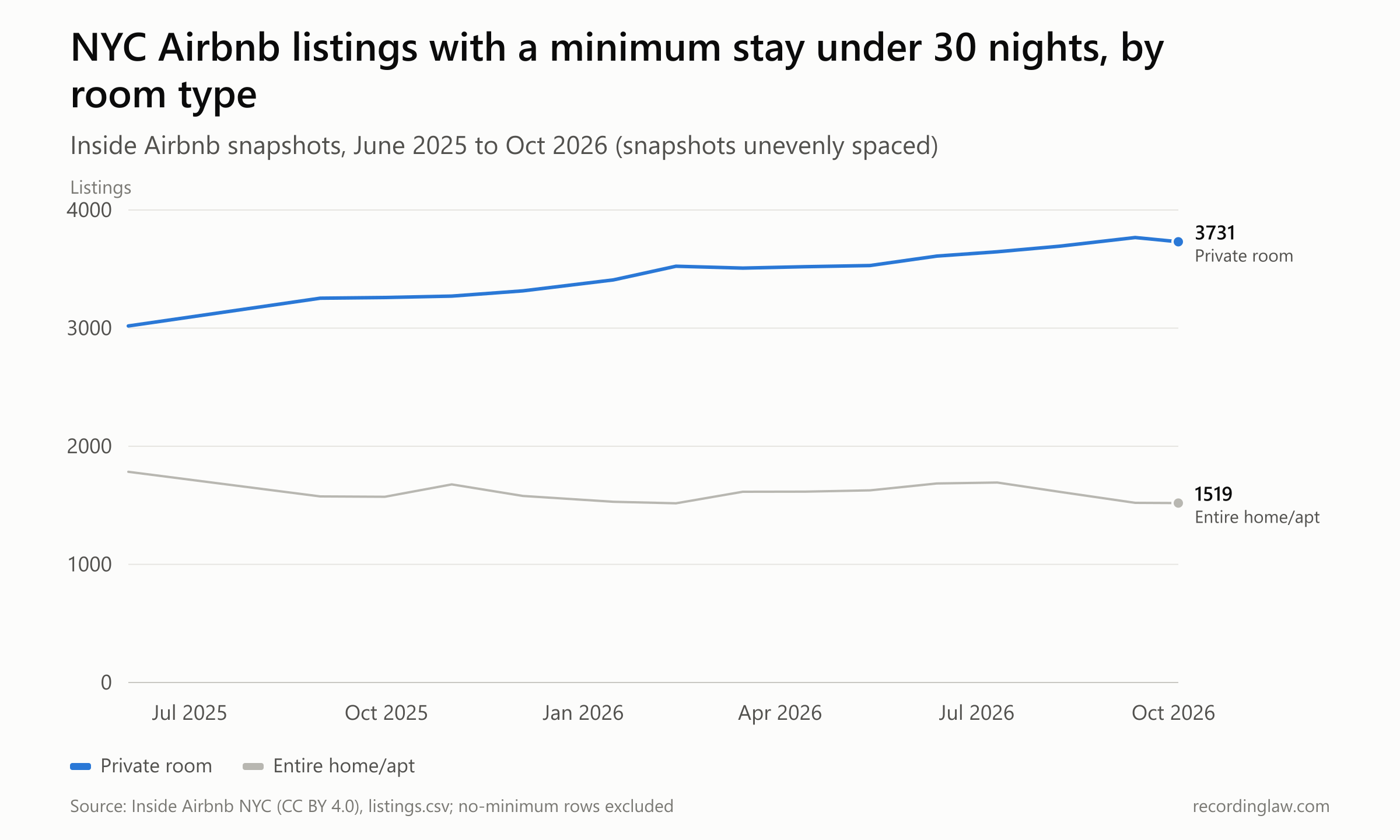
Source: Inside Airbnb NYC snapshots, licensed CC BY 4.0, computed by recordinglaw.com from each snapshot's listings.csv. Listings with no minimum stay recorded are excluded. Snapshots are not evenly spaced.
| Room type, under 30 nights | June 4, 2025 | October 4, 2026 |
|---|---|---|
| Private room | 3,018 | 3,731 |
| Entire home/apt | 1,784 | 1,519 |
| Hotel room | 440 | 366 |
| Shared room | 24 | 40 |
| All under 30 nights | 5,266 | 5,656 |
The older rule OSE describes allows stays under 30 days for up to two guests staying with a permanent occupant, an arrangement a private-room listing can match. The listings data cannot show whether a host is present, or whether any listing complies with the law. Some buildings, such as Class B multiple dwellings, are exempt from registration.
Inside Airbnb's files also carry the license text a listing displays. In the October 2026 snapshot, 2,258 listings showed an OSE registration number, 2,736 showed "Exempt" and 24,583 were blank. Among the 5,656 under-30-night listings, 779 had a blank license field. The field records what the listing shows, not what OSE has on file, so it cannot tell you how many listings are unregistered.
What the city's registration numbers show
OSE publishes an annual Local Law 18 report with registration and application counts. Active registrations at the end of each reporting period went from 105 to 3,338.
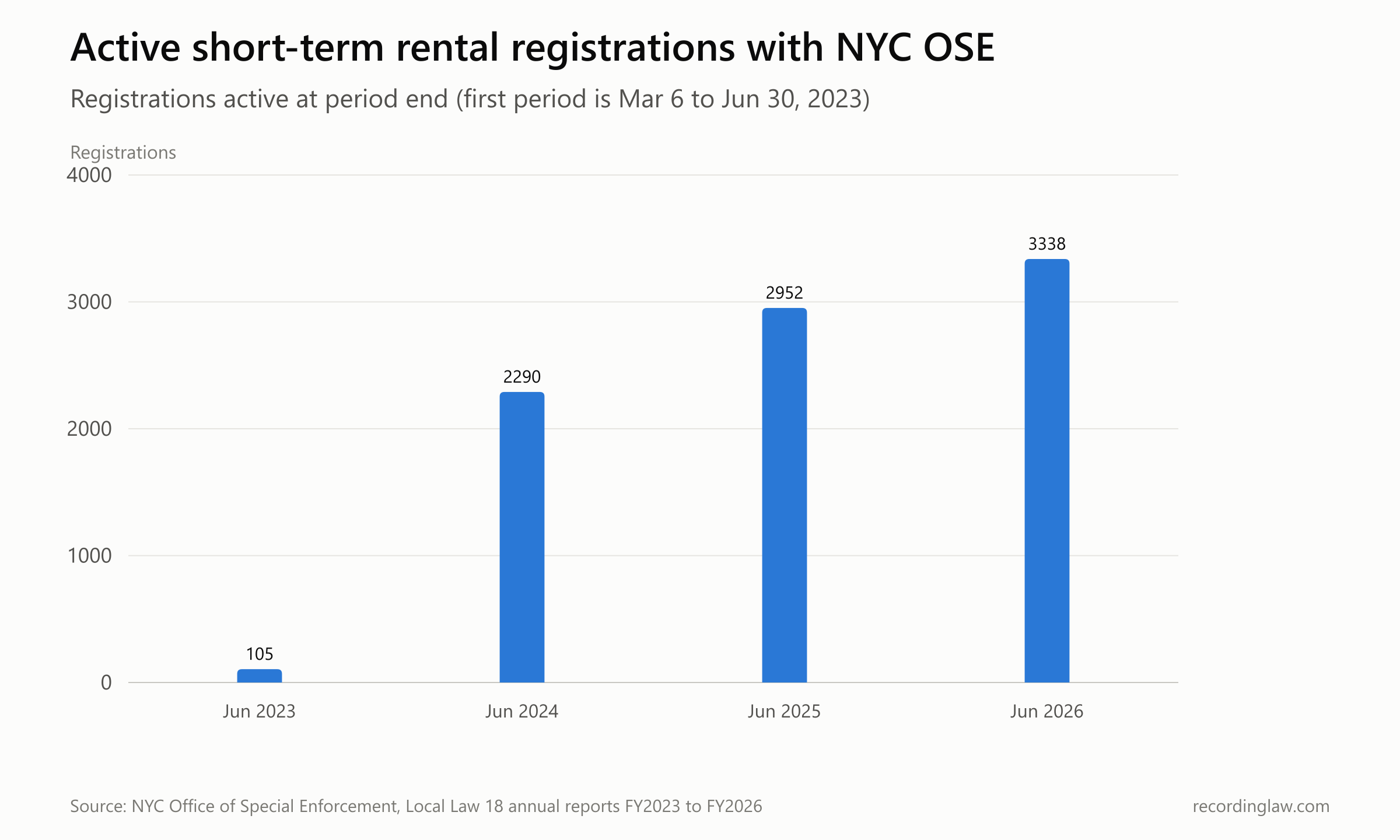
Source: NYC Office of Special Enforcement, Local Law 18 annual reports for fiscal years 2023 to 2026.
| Period end | Active registrations | Applications received in period |
|---|---|---|
| June 30, 2023 (from March 6, 2023) | 105 | 1,337 |
| June 30, 2024 | 2,290 | 6,425 (cumulative from March 6, 2023) |
| June 30, 2025 | 2,952 | 1,582 |
| June 30, 2026 | 3,338 | 1,187 |
From March 6, 2023 to June 30, 2024, OSE received 6,425 applications. It granted 2,323 and denied 1,829, and the rest were pending a denial, awaiting more information, or pending review.
For fiscal year 2026 (July 2025 through June 2026), OSE said it granted more than 460 new registrations and that active approved hosts passed 3,500. The same report counts 3,522 registrations active at some point during fiscal 2026, against 3,338 still active on June 30, 2026; OSE's "over 3,500" refers to the full-year figure.
The fiscal year 2026 report says 749 applications were denied, and that about 82 percent of those (613) were denied only after the applicant had at least 90 days to correct problems. OSE also reported 65 attempts to register rent-regulated units in fiscal year 2026, down from 86 the year before. More than 14,000 property owners and managers have put their buildings on the city's prohibited-buildings list, according to OSE.
Earlier counts, as others reported them
No public Inside Airbnb file for New York City is available from before June 2025, so we could not compute listings before registration enforcement began. The figures below come from other sources, use different definitions, and should not be read as one series.
- OSE, 2018 and early 2023: A September 3, 2025 release from the Mayor's Office of Criminal Justice, reporting OSE figures, compared "an estimated 60,000 illegal listings on major booking platforms in 2018 and over 38,000 active listings at the beginning of 2023 on a single site" with about 3,000 active registrations.
- THE CITY, September 2023: In a story republished by the Amsterdam News and citing Inside Airbnb data, THE CITY reported that before Labor Day 2023, over 10,000 entire-apartment or entire-home listings in New York City offered availability for stays under one month.
- Sherwood News, August 2024 (July 2024 data): Citing Inside Airbnb data, Sherwood reported 5,044 short-term listings and 32,721 long-term listings.
Each figure measures something different: illegal listings across platforms, active listings on one site, entire-home listings with short-stay availability, and listings by minimum-nights setting. None can be subtracted from our 2026 counts to produce a change.
For the rules that apply to renting a home in the state more broadly, see New York landlord-tenant laws.
How we measured
Listings data. We downloaded every New York City listings.csv summary file we could find on Inside Airbnb's public data server: 16 files from June 4, 2025 to October 4, 2026. When we checked on October 26, 2026, Inside Airbnb's download page listed September 14, 2026 as its latest New York City edition; the October 4, 2026 file was downloadable from the same server but not yet listed. An automated check of every date from January 1, 2019 to October 26, 2026 found no earlier public files. Inside Airbnb says older data is available by archive request, which we did not make.
Excluded file. The June 8, 2026 file has 4,650 rows, none with a minimum stay of 30 nights or more, so we treated it as incomplete and left it out. The charts use the remaining 15 snapshots.
Buckets. Each listing was counted once per snapshot by its minimum_nights value: under 30, exactly 30, or over 30. Listings with an empty minimum_nights field (none in 2025 or October 2026, between 2 and 27 in other 2026 files) are left out of all three buckets. Room type and license text come from the same file. The license column is blank in the June 2025 file and populated from September 2025.
Registration data. Active registrations and application counts come from OSE's Local Law 18 annual reports. The fiscal year 2023 report covers March 6 to June 30, 2023 only. The fiscal year 2024 application count is cumulative from March 2023. The fiscal year 2025 and 2026 counts cover single fiscal years.
What the data cannot show. A listing count is not a count of bookings, nights stayed, or homes returned to long-term use. Without a pre-enforcement snapshot, this data cannot measure how much listings changed when enforcement began. We found no primary data on rents or hotel prices tied to the law and make no claim about either. We did not use percentage-drop figures that circulate for the law, because we could not trace them to a primary file.
Licence. Inside Airbnb data is published under a Creative Commons Attribution 4.0 International License. The calculations here are ours.
Frequently Asked Questions
What is NYC Local Law 18?
Local Law 18, adopted January 9, 2022, requires New York City hosts who rent for under 30 days to register with the Mayor's Office of Special Enforcement. OSE began taking applications on March 6, 2023 and began enforcement through booking platforms on September 5, 2023. Rentals of 30 consecutive days or more are exempt.
How many NYC Airbnb listings have a 30-night minimum?
In Inside Airbnb's October 4, 2026 snapshot, 22,988 of the 23,921 listings with a minimum of 30 nights or more were set at exactly 30. The listings data does not record why a host picks a minimum. Thirty days is the line in city rules: OSE says city law has restricted rentals of less than 30 days in homes since the late 1960s, and Local Law 18 registration covers rentals under 30 days. The data shows the setting, not how long guests actually stay.
How many NYC Airbnb listings allow stays under 30 nights?
5,656 in Inside Airbnb's October 4, 2026 snapshot, or 19.1 percent of 29,577 listings. Of those, 3,731 were private rooms, 1,519 entire homes or apartments, 366 hotel rooms and 40 shared rooms.
How many short-term rental registrations are active in New York City?
OSE's annual report counts 3,338 active registrations at June 30, 2026, up from 105 at June 30, 2023. The same report counts 3,522 registrations active at some point during fiscal year 2026, which is the basis for OSE's statement that over 3,500 hosts had active registrations during the year.
How much did NYC Airbnb listings drop after Local Law 18?
This article cannot answer that from primary data, because public Inside Airbnb files for New York City start in June 2025. OSE has cited over 38,000 active listings on one site at the start of 2023, and THE CITY reported over 10,000 entire-home listings with short-stay availability before Labor Day 2023. Those figures use different definitions from each other and from our 2026 counts.
Why did NYC Airbnb listings fall in May 2026?
Inside Airbnb's total fell from 35,036 on April 14, 2026 to 29,135 on May 14, 2026, almost all in exactly-30-night listings. The cause is not documented, so we do not attribute it to the law or to any other change.
Updates
Independently fact-checked against the cited primary sources
Sources and References
- NYC Office of Special Enforcement, Short-Term Rental Registration (Local Law 18 adoption, enforcement date, 30-day exemption)(nyc.gov).gov
- NYC Office of Special Enforcement, Local Law 18 annual reports, FY2023 to FY2026(nyc.gov).gov
- NYC Office of Special Enforcement, New Yorkers registered to host surpassed 3,500 for first time (FY2026)(nyc.gov).gov
- Mayor's Office of Criminal Justice, LL18 report sheds light on eliminated illegal rentals in NYC (September 3, 2025)(criminaljustice.cityofnewyork.us).gov
- Inside Airbnb, Get the Data: New York City listings snapshots (CC BY 4.0)(insideairbnb.com)
- Inside Airbnb, New York City listings.csv, October 4, 2026 snapshot (CC BY 4.0)(insideairbnb.com)
- THE CITY via Amsterdam News, Airbnbs sidelined in NYC (September 5, 2023)(amsterdamnews.com)
- Sherwood News, Local Law 18: short-term Airbnbs disappeared and have not come back(sherwood.news)