Who Kept Itemizing Under the $10,000 SALT Cap?

Independently fact-checked against primary sources (last audited November 1, 2026). · 16 primary sources cited on this page. How we verify our legal content
At 12:55 p.m. on December 20, 2017, the House of Representatives passed the final version of the Tax Cuts and Jobs Act, 224 to 201. Every yes vote came from a Republican. So did 12 of the no votes, and 11 of those 12 came from three states: New York, New Jersey and California.
Starting in 2018, the federal deduction for state and local taxes, known as SALT, would be capped at $10,000 per return. One of the New York Republicans who voted no, Rep. Elise Stefanik, had said in a statement before the vote that the bill "does not adequately protect the State and Local Tax deduction that so many in our district and across New York rely on."
Then the returns came in. In tax year 2017, 47.1 million federal returns itemized their deductions instead of taking the standard deduction. In tax year 2018, 17.6 million did. Congress's own tax scorekeepers had projected 18.0 million.
Since then the $10,000 line has been fought over in a federal lawsuit, routed around by state workarounds, targeted by a Democratic House bill that died in the Senate, and raised to $40,000 in 2025 by a one-vote House margin. For tax years starting in 2030, it goes back to $10,000, while the standard deduction, which the 2017 law also enlarged, keeps its larger size. So who kept itemizing under the $10,000 line, how much of the collapse came from the cap rather than the rest of the law, and how did each side's 2017 predictions hold up?
A postcard and a $10,000 line
The people who wrote the 2017 law were selling simplicity. "We will consolidate the existing seven brackets into three, double the standard deduction, and simplify things to the point that you can do your taxes on a form the size of a postcard," House Speaker Paul Ryan said at a manufacturing summit in Washington in June 2017. "Wouldn't that be nice?"
The House Ways and Means Committee's September 2017 pitch promised a code so "straightforward that 9 out of 10 Americans will be able to file on a form as simple as a postcard." On the deduction for state and local taxes, the same document said, "Republicans are currently filling in many policy details when it comes to itemized deductions." A week before final passage, President Donald Trump described Americans being able to "file their taxes on a single, little beautiful sheet of paper," CNBC reported.
There was a second argument for the cap, and it was about the states. Ryan said the deduction had created a disparity in which "[p]eople in states that have balanced budgets, whose state governments have done their job and kept their books balanced and don't have massive pension liabilities, they're effectively paying for states that don't," as the federal appeals court in New York later quoted him. Treasury Secretary Steven Mnuchin, the same court wrote, "hope[d]" the cap would "send[] a message to the state governments that, perhaps, they should try to get their budgets in line."
The warnings came from the real estate industry and from the high-tax states. "Make no mistake: Middle-class homeowners will see their home values fall if this proposal moves forward, while large corporations walk away with the bulk of the tax cuts," said Elizabeth Mendenhall, president of the National Association of Realtors, the industry's trade group, after the House passed its first version in November. RISMedia reported that Evan Liddiard, an NAR policy representative, expected the changes to lower home values "by more than 10 percent." The president of the California Association of Realtors wrote: "Tax reform shouldn't hurt Californians, but this proposal does, in a big way."
Stefanik warned that families could leave. "Failure to maintain SALT could lead to more families leaving our region," she said. New York Gov. Andrew Cuomo said Republicans "have committed fraud against the American people." In upstate New York, Rep. Claudia Tenney, who voted yes, blamed Albany, WSKG reported: "This bill will provide relief on the federal level while finally taking a step to encourage fiscal responsibility from Albany."
Itemizing means listing deductions such as state and local taxes, mortgage interest and charitable gifts on Schedule A instead of taking the flat standard deduction. A filer only itemizes when the list adds up to more than the standard amount.
The law the president signed on December 22, 2017, changed both sides of that comparison at once. It capped the SALT deduction at $10,000 a return ($5,000 for a married person filing separately), and it raised the base standard deduction for a single filer to $12,000. Both started in tax year 2018, and that pairing matters for everything that follows.
Five days later, the IRS put out an advisory. It had "received a number of questions from the tax community concerning the deductibility of prepaid real property taxes," as homeowners looked to pay 2018 bills in 2017, before the cap applied. In the IRS's own hypothetical example, "County B has revised its computer systems to accept prepayment of property taxes for the 2018-2019 property tax year."
How many people stopped itemizing?
Before the vote, the forecasts were already large. The Heritage Foundation, a conservative think tank that supported the bill, estimated in November 2017 that "doubling the standard deduction alone would reduce the percentage of taxpayers who itemize from 30 percent to 16 percent." The Institute on Taxation and Economic Policy, a left-leaning think tank, estimated that the bigger standard deduction and the SALT limit together "would mean that about 29 million people would no longer benefit from itemizing," CNBC reported.
In April 2018, the Joint Committee on Taxation, Congress's nonpartisan tax-scoring staff, put a number on it: 46.5 million itemizers in 2017 and 18.0 million in 2018. How close did that come?
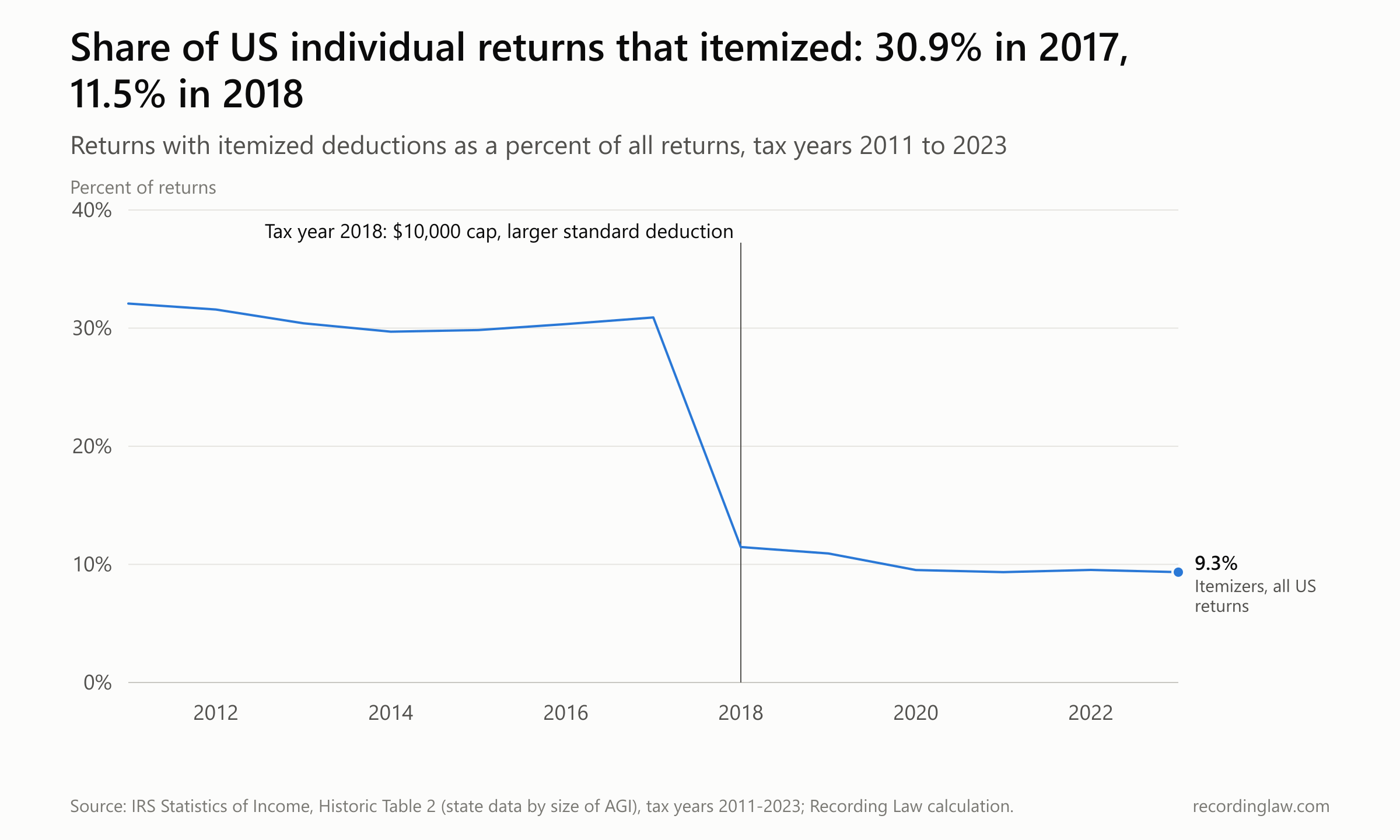
Share of US individual returns that itemized deductions, tax years 2011 to 2023, with the 2018 start of the $10,000 cap and larger standard deduction marked. Source: IRS Statistics of Income, Historic Table 2.
| Tax year | Returns that itemized | Share of all returns |
|---|---|---|
| 2011 | 46,983,000 | 32.08% |
| 2016 | 45,473,000 | 30.34% |
| 2017 | 47,103,650 | 30.90% |
| 2018 | 17,599,150 | 11.47% |
| 2019 | 17,224,000 | 10.92% |
| 2020 | 15,610,000 | 9.52% |
| 2021 | 14,893,000 | 9.34% |
| 2022 | 15,211,000 | 9.53% |
| 2023 | 14,941,000 | 9.34% |
The share of returns that itemized had moved between about 30% and 32% for years. In 2018 it fell to about 11%, or about one return in nine. About 29.5 million fewer returns itemized than the year before, and 133.8 million returns took the standard deduction.
The scorekeepers' 2018 projection came within half a million of the IRS count. Their 2017 baseline was also close: 46.5 million against 47.1 million counted. When the first IRS figures came out in 2020, a CPA quoted by CNBC put it plainly: "The reduction in people claiming itemized deductions worked out the way it was expected; it's down from about 30% of taxpayers to 10%."
The count did not recover. By 2023, 14.9 million returns itemized, 9.3% of the total, while 142.7 million took the standard deduction. The data do not say why the share kept slipping after 2018; incomes, prices and the standard deduction all changed over those years, and the pandemic years of 2020 and 2021 moved incomes sharply. That leaves the question the forecasts and the count cannot answer by themselves: which of the two changes did it?
The cap, or the bigger standard deduction?
The IRS tables cannot split the drop between the two changes, because both arrived on the same return in the same year. The estimates that try come from microsimulations, computer models that apply the tax rules to large samples of returns, and they measure different things.
The Tax Policy Center, a joint project of the Urban Institute and the Brookings Institution, counted people. Writing the day after final passage, it said the law "will reduce the number of itemizers by about 27 million in 2018, mostly because it will substantially increase the standard deduction. But about 3.5 million of those households will no longer itemize because of the TCJA's new limits on the state and local tax (SALT) deduction." By that estimate, the cap alone accounts for roughly one lost itemizer in eight.
The Tax Foundation, a think tank that favors broad-based, low-rate taxes, counted dollars. Looking at how much SALT was actually deducted, it concluded: "The decline from 2016 to 2018 was driven by the SALT deduction cap and, to a lesser extent, the drop in itemization due to the doubling of the standard deduction." The Tax Policy Center's count includes only households that stopped itemizing. The Tax Foundation's dollars also include households that kept itemizing but could now deduct no more than $10,000.
The dollar side is visible in the IRS data. How much did the deduction shrink in the states that used it most?
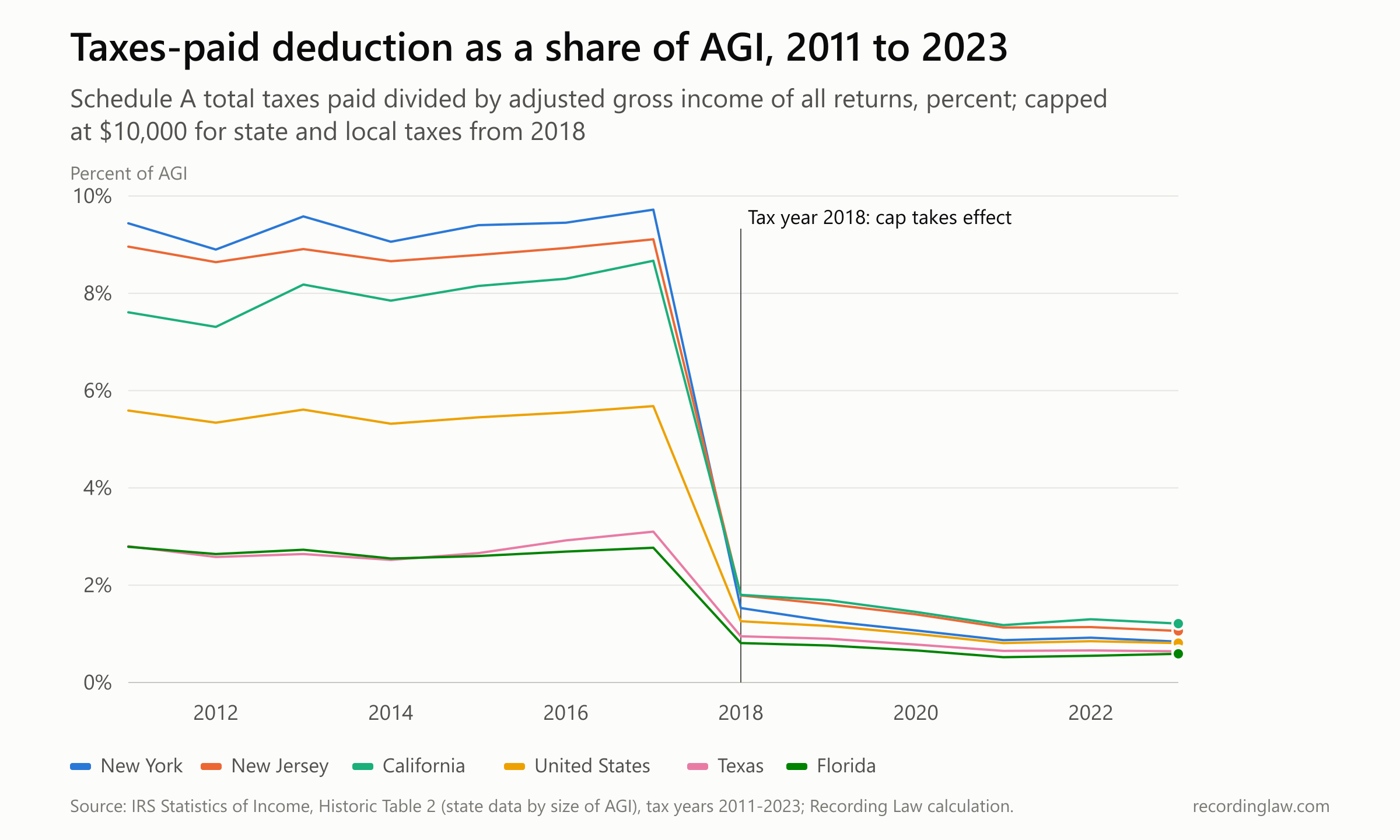
Schedule A total taxes paid as a percent of AGI, United States and five states, 2011 to 2023. Source: IRS Statistics of Income, Historic Table 2; calculation by Recording Law.
| Filer state | 2016 | 2017 | 2018 | 2023 |
|---|---|---|---|---|
| New York | 9.45% | 9.72% | 1.53% | 0.84% |
| New Jersey | 8.93% | 9.11% | 1.79% | 1.06% |
| California | 8.30% | 8.67% | 1.80% | 1.21% |
| Texas | 2.92% | 3.10% | 0.95% | 0.64% |
| Florida | 2.69% | 2.77% | 0.81% | 0.59% |
| United States | 5.55% | 5.68% | 1.26% | 0.81% |
Nationwide, the taxes-paid deduction on Schedule A fell from $624 billion in 2017 to $147 billion in 2018, a drop of about three-quarters. Measured against everyone's adjusted gross income (income before the standard or itemized deduction), it went from almost 6% to just over 1%.
The fall was steepest where state and local taxes are highest. In New York, the deduction went from almost 10% of income to about 1.5%. In Texas and Florida, it was already only about 3% of income and fell to under 1%. The Tax Policy Center put the share of taxpayers who got any tax benefit from the SALT deduction at about 25% in 2017 and 10% in 2018.
By those estimates, the bigger standard deduction accounts for most of the people who stopped itemizing, and the cap for most of the dollars. Which filers were left?
Who still itemizes?
Before 2018, most households with income above $75,000 itemized. In 2017, three in four returns with income between $100,000 and $200,000 itemized, and more than nine in ten above $200,000.
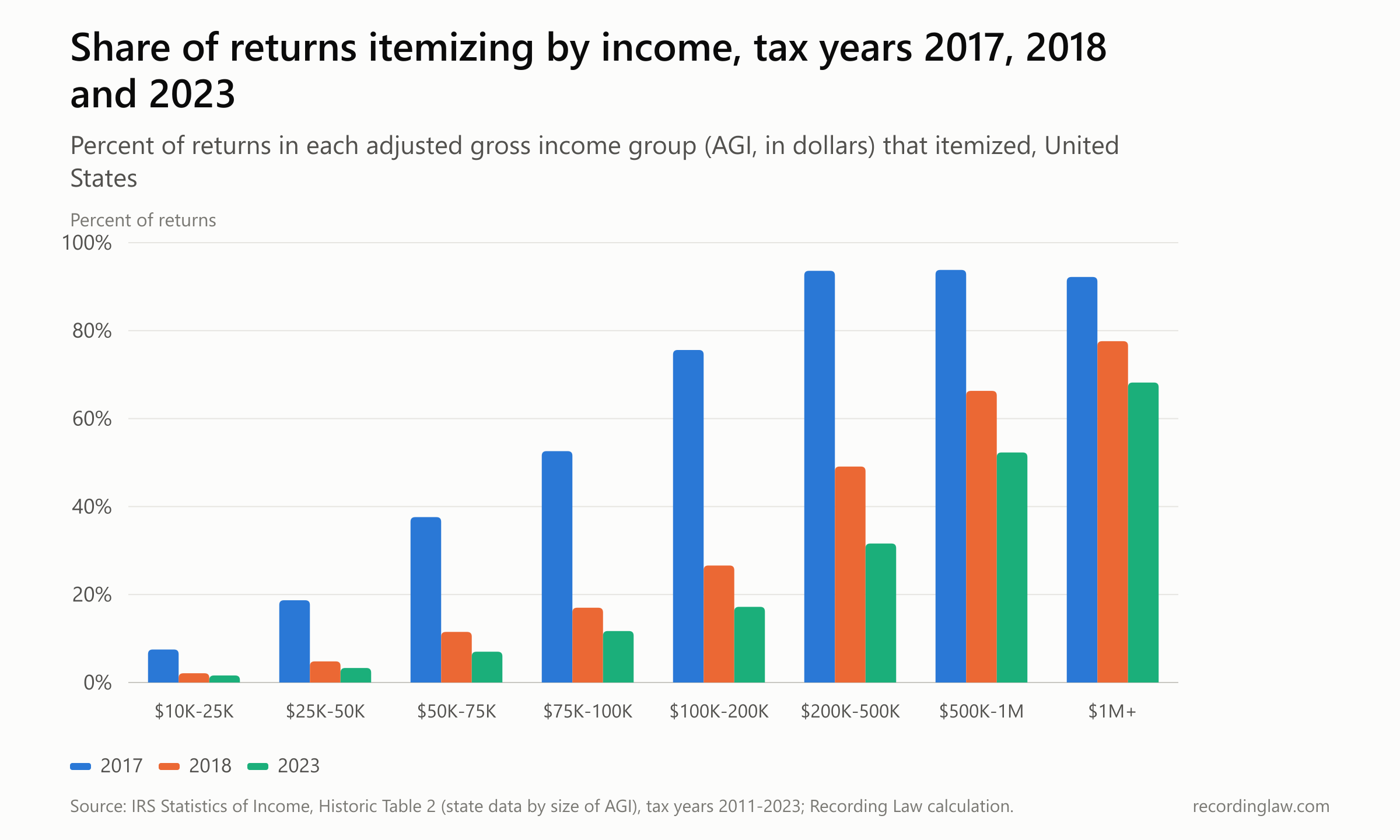
Share of returns that itemized by AGI group, United States, tax years 2017, 2018 and 2023. Source: IRS Statistics of Income, Historic Table 2.
| Adjusted gross income | 2017 | 2018 | 2023 |
|---|---|---|---|
| $10,000 under $25,000 | 7.5% | 2.1% | 1.6% |
| $25,000 under $50,000 | 18.7% | 4.8% | 3.3% |
| $50,000 under $75,000 | 37.6% | 11.5% | 7.0% |
| $75,000 under $100,000 | 52.6% | 17.0% | 11.7% |
| $100,000 under $200,000 | 75.6% | 26.6% | 17.2% |
| $200,000 under $500,000 | 93.6% | 49.1% | 31.6% |
| $500,000 under $1,000,000 | 93.8% | 66.3% | 52.3% |
| $1,000,000 or more | 92.2% | 77.6% | 68.2% |
Itemizing fell in every income group, and in proportion it fell least at the top. By 2023, about two-thirds of returns reporting $1 million or more still itemized. Between $100,000 and $200,000, it was about one in six.
In dollars, the top of the income scale gave up the most. The Joint Committee on Taxation projected that the SALT deduction's tax benefit to returns with income of $1 million or more would fall from $34.2 billion in 2017 to $1.3 billion in 2018, while the number of those returns getting any SALT benefit would fall only from about 490,000 to 418,000. Those filers kept itemizing; their deduction stopped at $10,000. The Tax Policy Center estimated that "more than 96 percent of the tax increases would be paid by those in the top 20 percent of the income distribution."
Itemizing also held up better in some states than in others. Where did it hold up best?
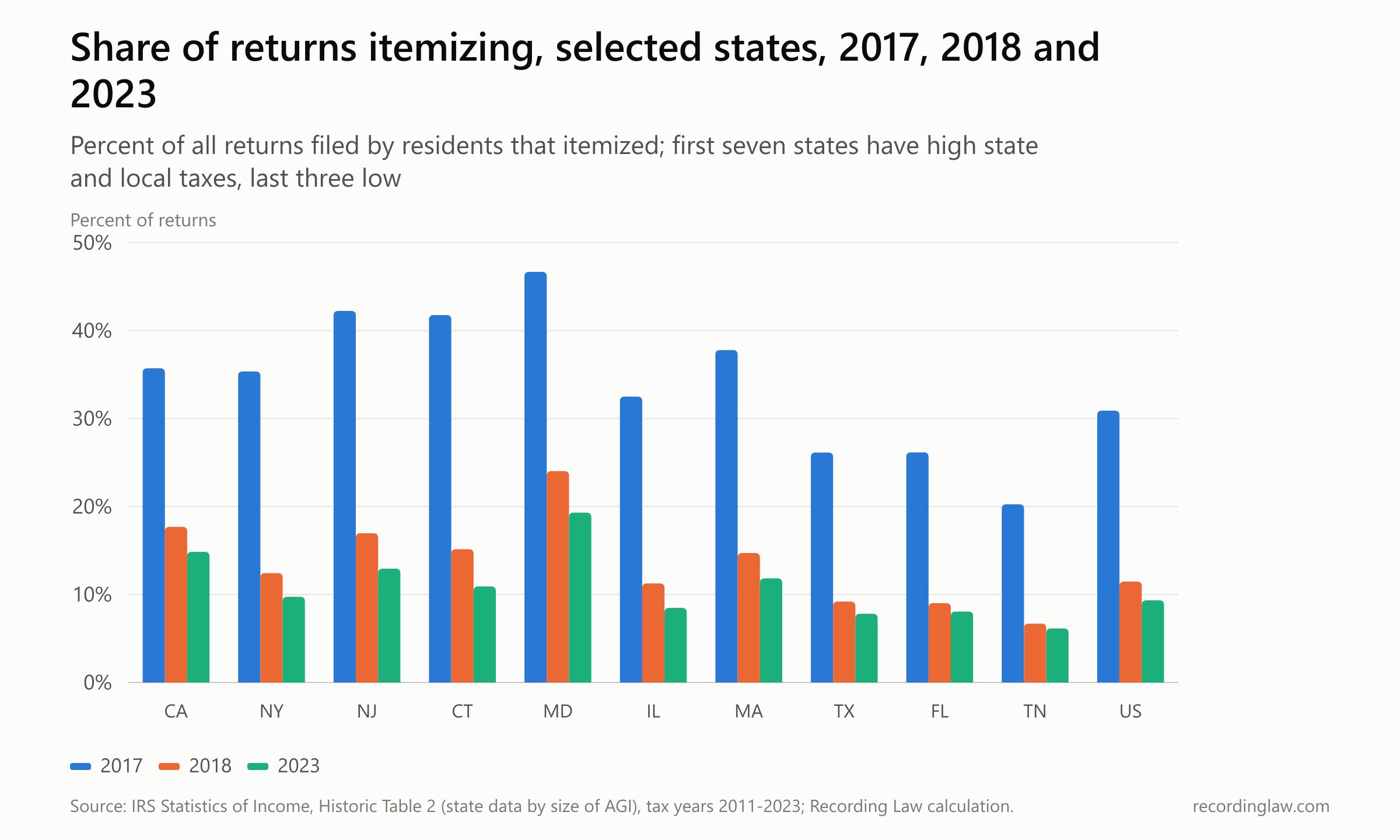
Share of returns that itemized in ten states and the US, tax years 2017, 2018 and 2023. Source: IRS Statistics of Income, Historic Table 2.
| Filer state | 2017 | 2018 | 2023 |
|---|---|---|---|
| Maryland | 46.68% | 24.03% | 19.31% |
| New Jersey | 42.24% | 16.97% | 12.94% |
| Connecticut | 41.77% | 15.15% | 10.92% |
| Massachusetts | 37.79% | 14.72% | 11.84% |
| California | 35.72% | 17.69% | 14.85% |
| New York | 35.36% | 12.43% | 9.74% |
| Illinois | 32.50% | 11.26% | 8.48% |
| Texas | 26.14% | 9.20% | 7.81% |
| Florida | 26.16% | 9.02% | 8.06% |
| Tennessee | 20.26% | 6.69% | 6.14% |
| United States | 30.90% | 11.47% | 9.34% |
Maryland had the highest itemizing share of any state in all three years; in 2023 it was about one return in five. In 2023 the District of Columbia was slightly higher still.
California was second among states in 2023 at about 15%. New York, home to five of the 12 Republican no votes in 2017, had dropped below 10%, close to the national figure. At the other end, West Virginia's share was 3.3%.
Supporters of the cap pointed to how few filers paid more. In December 2019, Rep. Kevin Brady of Texas, who had chaired the Ways and Means Committee in 2017, told colleagues: "According to the liberal Tax Policy Center, only 1 percent of taxpayers in America paid more taxes last year due to the reasonable SALT cap. In California, only 2 percent; New York, a mere 3 percent."
He added, "The SALT cap of $10,000 is higher than the national average of SALT deductions." Those percentages are Brady's attribution to the Tax Policy Center; we did not open the underlying estimate. By then, the high-tax states had already taken the fight to court.
The states sue, and lose
On July 17, 2018, New York, Connecticut, Maryland and New Jersey sued the Treasury and the IRS in federal court in Manhattan to strike the cap down. Their argument was that Congress had aimed it at them.
Their predictions of harm were specific. They said the cap "could cause home equity values in New York State alone to plummet by over $60 billion, in-state spending to decrease by $1.26 to $3.15 billion, and the economy to lose between 12,500 and 31,300 jobs," in the federal appeals court's summary. In February 2019, during the first filing season under the cap, Cuomo said the cap was prompting wealthy residents to flee New York and contributing to a drop of more than $2 billion in tax receipts, the Associated Press reported. Brady disputed the revenue argument that December: "California Governor Gavin Newsom wrongly predicted capping the SALT deduction would result in lower revenues for California."
On September 30, 2019, U.S. District Judge J. Paul Oetken dismissed the suit. "But the bare fact that an otherwise valid federal law necessarily affects the decisional landscape within which states must choose how to exercise their own sovereign authority hardly renders the law an unconstitutional infringement of state power," he wrote. Cuomo had called the cap "economic civil war," The Bond Buyer reported.
The Second Circuit affirmed on October 5, 2021. The judges weighed the states' figures against their size. "They argue that New Jersey, for example, is likely to lose over $100 million in property and real estate transfer taxes in 2019 and 2020," the court wrote. "But New Jersey's budget in 2019 alone was $37.3 billion."
Of the projections overall, it said: "Without baseline figures to put these numbers in context, however, we are not convinced by the argument." The court ruled on what the states had shown; it made no finding on whether the harms happened. The Supreme Court declined to hear the case on April 18, 2022.
The home-value warnings are the hardest part of the record to test with the material behind this story. We did not build a home-price comparison, and we did not find, among the sources we opened, a study that measured how much the cap moved home prices.
The one peer-reviewed housing study we read, published in Regional Science and Urban Economics in 2025, looked at something narrower: how school spending shows up in house values depending on how many residents deduct property taxes. In districts where no resident deducts property taxes, it found "a one-standard-deviation increase in school spending corresponds to a 1.2% decrease in house value," against "a 2.8% rise in values in districts where 25% of the residents take advantage of the property tax deduction." While the lawsuit was moving through the courts, the states had already found a different route.
The workaround the IRS accepted
Connecticut moved first. In April 2018, months into the cap's first year, it "became the first state to enact a PTE tax as a workaround for the SALT cap," according to the Tax Policy Center. PTE stands for pass-through entity: a partnership or S corporation whose profits flow to its owners' personal returns.
The idea is simple in outline. The state taxes the business instead of the owner, and a business can deduct state taxes it pays without the $10,000 limit that applies to individuals.
On November 9, 2020, the Treasury and the IRS said they would allow it. They announced plans to clarify that "State and local income taxes imposed on and paid by a partnership or an S corporation on its income are allowed as a deduction by the partnership or S corporation."
States followed quickly. By January 2023, the Tax Policy Center reported, "California and New York have each collected over $22 billion from PTE taxes so far." It described who bears the cost: "It cuts taxes for their residents and businesses without reducing state tax revenue. It's the feds who get charged for the workaround." By 2026, according to the Congressional Research Service, 38 of the 42 states with pass-through income taxes had enacted laws limiting the cap's reach over those payments.
The workaround covered taxes paid by pass-through businesses. On a personal return, the cap was still $10,000, and the next attempt to change that came in Congress.
A repeal that passed the House and stopped there
On December 19, 2019, two years after the 2017 vote, the Democratic House passed a bill to lift the cap for 2020 and 2021, paid for by raising the top income tax rate to 39.6%. The vote was 218 to 206. House Speaker Nancy Pelosi of California said Republicans had imposed the cap "to punish blue states."
The vote did not split cleanly by party. Five Republicans voted yes, "all hailing from northeastern states with higher tax burdens," Roll Call reported, and 16 Democrats voted no. Rep. Peter King, a New York Republican who had voted against the 2017 law, accused his own party of "class warfare." From the other side, Roll Call noted, "Left-leaning groups including the Center for American Progress, Center on Budget and Policy Priorities and Institute on Taxation and Economic Policy have all panned the measure as tilted to the rich."
Their reason was in the numbers. A Joint Committee on Taxation estimate, reported by Roll Call, found that about 59% of the combined tax cut from lifting the cap and raising the top rate would have gone to households earning more than $500,000 in 2021. A spokesman for Senate Finance Committee Republicans, Michael Zona, had made the same point in an Associated Press report that February: "It's ironic that the same Democrats who criticized the Tax Cuts and Jobs Act for supposedly benefiting only the wealthy are now advocating for a change to the law that would primarily benefit the wealthy."
The Republican Senate never took up the bill. The cap stayed at $10,000 for seven tax years, from 2018 through 2024, until the next big tax bill gave the New York Republicans leverage.
$40,000, by one vote
In the spring of 2025, House Republicans were writing a second big tax bill for President Trump. A group of New York Republicans made the cap their price.
Rep. Chip Roy of Texas, a member of the House Freedom Caucus, stated the opposing case in April. "Maybe it's just because I don't want to subsidize high-tax, blue-state jurisdictions," he told The Hill. "Maybe it's because I can do math… If you lift the cap to $100,000 that'll be how much? Over a trillion dollars."
Speaker Mike Johnson and the Ways and Means Committee offered $30,000. On May 8, four New York Republicans, Stefanik, Andrew Garbarino, Nick LaLota and Mike Lawler, answered in a joint statement: "A higher SALT cap isn't a luxury. It's a matter of fairness. We reject this offer." Johnson then raised his offer to $40,000, "although only for households making under $500,000 a year," The Daily Signal reported.
On May 22, 2025, the House passed the bill 215 to 214, with one member voting present. "The taxpayers of New York State will soon receive huge relief thanks to the deal the SALT Caucus brokered with Speaker Johnson and President Trump," Lawler said. LaLota said in a release, "Raising it to $40,000 means 92% of the families I represent will finally be made whole," a figure his office did not source.
Critics pointed to who would benefit. "Any changes to lift the cap would primarily benefit higher earners," wrote Garrett Watson of the Tax Foundation in an analysis before the vote; for a version with an income phaseout above $400,000, he said, the top 20% of taxpayers "would be the only group to meaningfully benefit."
According to The Daily Signal, the Joint Committee on Taxation's re-score of the changes made to win House passage, the SALT deal among them, added $140 billion to the bill's projected revenue loss over ten years, and Politico reported that the SALT change "cost an additional $129 billion." In the Senate, Majority Leader John Thune of South Dakota described the fight as the House's problem: "It's not an issue that gains or loses votes here in the Senate. This is purely a House play designed to deal with the political challenge they have to get 218."
Lawler drew a line for the Senate: "That is the deal, and I will not accept a penny less. If the Senate reduces the SALT number, I will vote NO, and the bill will fail in the House."
The Senate kept $40,000 but cut the higher cap from the House's ten years to five, and kept the pass-through workaround that the House bill would have partly closed. Chye-Ching Huang, executive director of the Tax Law Center at NYU School of Law, said the Senate version "preserves (and lessens) a limit on deductions for wealthy taxpayers while ignoring a loophole that allows the wealthiest of those taxpayers to avoid the limit entirely." The House passed the Senate version on July 3, 218 to 214, and the President signed it on July 4, 2025. What did the final law set, year by year?
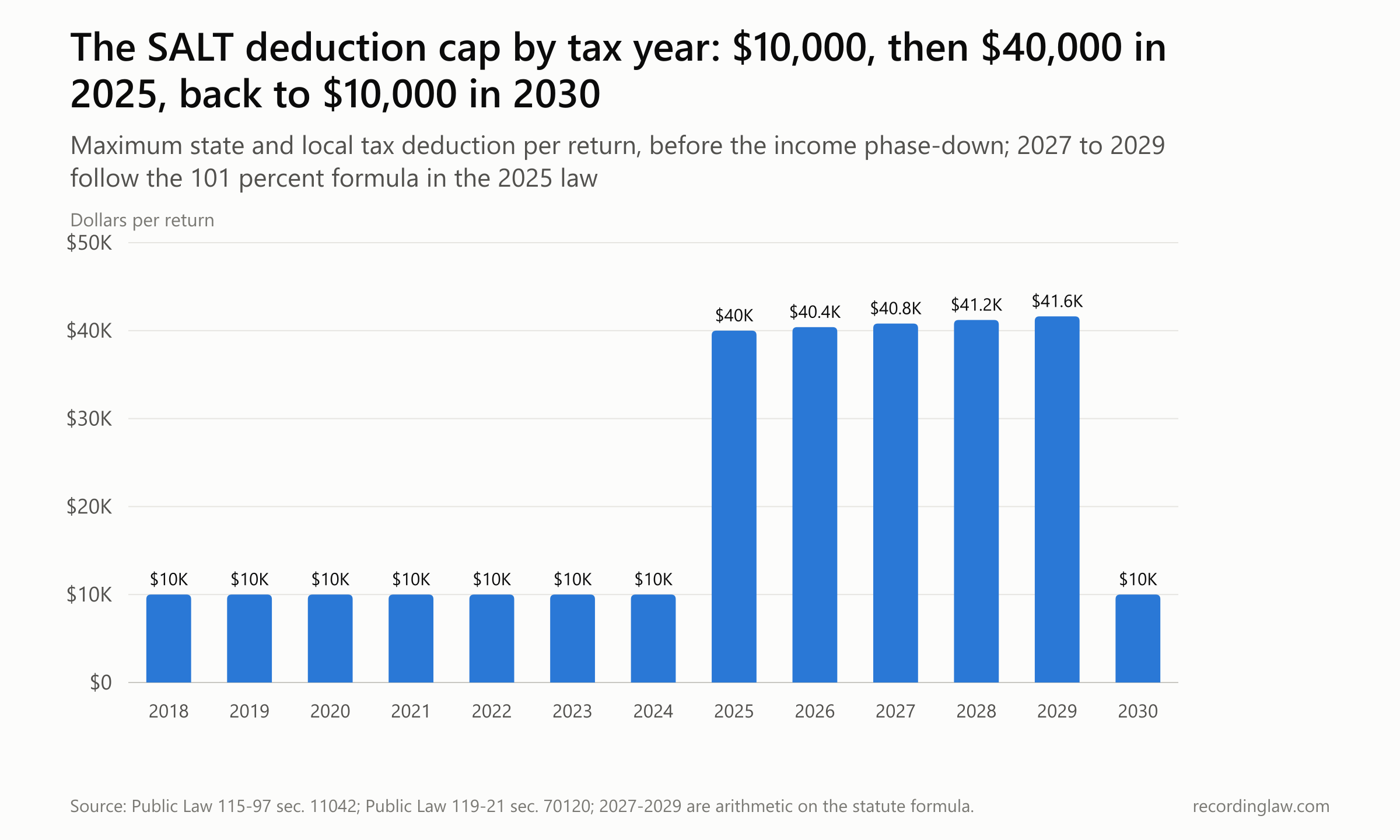
Statutory cap on the state and local tax deduction by tax year, 2018 to 2030. Source: Public Law 115-97 and Public Law 119-21.
| Tax year | Cap per return, before the income phase-down |
|---|---|
| 2018 to 2024 | $10,000 |
| 2025 | $40,000 |
| 2026 | $40,400 |
| 2027 | $40,804 (statute formula) |
| 2028 | $41,212 (statute formula) |
| 2029 | $41,624 (statute formula) |
| 2030 and after | $10,000 |
The cap shrinks for higher incomes. For 2025 it is reduced by 30% of modified adjusted gross income above $500,000, and it never falls below $10,000. That means a return with modified adjusted gross income of about $600,000 or more in 2025 is back at the old $10,000 limit.
For 2026 the threshold is $505,000, and both the cap and the threshold rise 1% a year through 2029. A married person filing separately gets half.
The same law made the larger standard deduction permanent and raised its base for a single filer to $15,750. The National Association of Realtors, which had fought the 2017 law, listed the "Quadrupling of the state and local tax (SALT) deduction cap for five years beginning with the 2025 tax year" among its wins in the final bill.
What happens in 2030?
The $40,000 cap is on returns now. Returns for tax year 2025 were filed in 2026, and tax year 2026, with its $40,400 cap and $505,000 threshold, will be filed in 2027.
How many filers it brings back to itemizing is not yet known. The IRS statistics behind every chart above run through tax year 2023, and the IRS has not published a release date for the next year. Tax year 2024, the last year at $10,000, comes next; tax year 2025, the first at $40,000, comes after it. Until then, the only figure is a projection: the Joint Committee on Taxation expects 12% of returns to claim a SALT deduction in tax year 2025, against 31% in 2017, the Congressional Research Service reported in September 2026.
The cost projections move in one direction until the deadline. The Joint Committee's estimate of revenue lost to the deduction rises from $49.1 billion in fiscal 2025 to $65.5 billion in fiscal 2029, which CRS calls "more than three times the estimated effect in FY2024, the last full year before those changes took effect."
Then the higher cap ends. For tax years beginning after December 31, 2029, the statute sets the cap at $10,000 for every filer, the same unindexed amount the Tax Policy Center flagged in 2017 when it noted that "the limit is not indexed for inflation." The bigger standard deduction will still be in place.
So 2030 brings back the pairing that was in force when the itemizer count fell from 47 million to under 18 million returns, with the cap no higher than it was in 2018. Stefanik, who voted no in 2017 over the cap, helped win a higher one for five years. Whether Congress revisits the cap before January 1, 2030, and what the first IRS data on the $40,000 years show, are the next two dates on this story's clock.
How we measured
Itemizers and deductions. All itemizing counts, shares, income groups, state figures and taxes-paid amounts come from IRS Statistics of Income (SOI) Historic Table 2, state data by size of adjusted gross income, tax years 2011 to 2023, retrieved October 31, 2026. Tax year 2023 is the latest the IRS has published. The itemizing share is returns with total itemized deductions divided by all returns. Taxes paid as a share of income is the Schedule A "total taxes paid" amount divided by the adjusted gross income of all returns, not only itemizers, so it measures how much of everyone's income the deduction covered. State figures use the filer's state of residence. Tax year 2012 comes from the state CSV file; other years from the Excel tables.
Arithmetic in the prose. The drop in itemizing returns is 47,103,650 minus 17,599,150, or about 29.5 million. "About one return in nine" is 11.47%. The taxes-paid deduction fell from $624.1 billion to $147.0 billion, to about 24% of its 2017 level, a drop of about three-quarters. "One lost itemizer in eight" is the Tax Policy Center's 3.5 million divided by its 27 million. The $600,000 phase-down point is $500,000 plus the $30,000 between the $40,000 cap and the $10,000 floor, divided by 30%. The 2027 to 2029 caps apply the statute's 101% formula to the prior year; the statute states no rounding rule, so the IRS figures may differ by a few dollars.
Series breaks. Tax year 2018 is a break in both the law and the form. The cap and the larger standard deduction started together, so the IRS data cannot assign the drop in itemizing to either one; the split comes from the Tax Policy Center and Tax Foundation estimates, which use different measures. From 2018 the table adds a "limited state and local taxes" line ($130.0 billion in 2018, $120.6 billion in 2023); the 2018 gap between that line and total taxes paid is not explained in the footnotes we read, so we do not interpret it. Tax years 2020 and 2021 include pandemic effects on income and filing.
Forecasts versus counts. The Joint Committee on Taxation figures (46.5 million and 18.0 million itemizers) are from its April 2018 table JCX-32R-18, which counts nonfilers and excludes dependent filers and returns with negative income, so the comparison with the IRS count is approximate. The JCT figures for $1 million-plus returns are projections from the same table. CNBC's 2020 article used earlier IRS counts (46.2 million and 16.7 million) than the final tables used here.
Quotes and claims. Ryan's statement about balanced-budget states and Mnuchin's statement are quoted as the Second Circuit quoted them in New York v. Yellen; we did not open the original transcripts. The states' economic projections, Cuomo's revenue claim, Brady's Tax Policy Center percentages, LaLota's 92% and NAR policy representative Evan Liddiard's "more than 10 percent" are the speakers' own claims; we did not open the studies behind them. Lawler's statements were read from a mirror of his official House releases. The JCT re-score of the 2025 bill is as reported by The Daily Signal; we did not open the JCT document, and we did not find a JCT score of the final enacted SALT provision.
What the data cannot show. There is no control group: every state got the same cap and the same standard deduction in the same year. This story does not measure home prices, migration between states or state tax revenue, so it cannot test the warnings about those effects. It has no IRS data for tax years 2024 or 2025 and so cannot show any effect of the $40,000 cap.
This article reports historical tax data and is general information, not tax advice.
Frequently Asked Questions
What is the SALT deduction cap for 2025 and 2026?
Under Public Law 119-21, signed July 4, 2025, the cap is $40,000 per return for tax year 2025 and $40,400 for 2026 ($20,000 and $20,200 for a married person filing separately). It is reduced by 30% of modified adjusted gross income above $500,000 in 2025 and $505,000 in 2026, but not below $10,000.
When does the SALT cap go back to $10,000?
For tax years beginning after December 31, 2029. The cap and the income threshold rise 1% a year from 2027 through 2029, and then the cap returns to $10,000 for all filers, with no adjustment for inflation.
How many people itemized after the 2017 tax law?
IRS Statistics of Income counted 47.1 million returns with itemized deductions in tax year 2017 and 17.6 million in 2018, a fall from 30.9% to 11.5% of all returns. In 2023, the latest year published, 14.9 million returns itemized, 9.3% of the total.
Did the SALT cap cause the drop in itemizing?
Partly, and the IRS data cannot say how much, because the cap and a much larger standard deduction started in the same year. The Tax Policy Center estimated that about 3.5 million of roughly 27 million lost itemizers stopped because of the SALT limits. The Tax Foundation said the fall in SALT dollars deducted came mainly from the cap.
Which states have the most itemizers?
In tax year 2023, Maryland had the highest share of returns that itemized of any state, 19.3%, followed by California at 14.9%. The District of Columbia was 19.8%. West Virginia was lowest at 3.3%. The national figure was 9.3%.
Is the SALT cap constitutional?
Federal courts upheld it. New York, Connecticut, Maryland and New Jersey sued in 2018; a federal district judge dismissed the case in 2019, the Second Circuit affirmed in October 2021, and the Supreme Court declined to hear it on April 18, 2022.
What is the pass-through entity SALT workaround?
A state tax paid by a partnership or S corporation on its income, which the business can deduct without the $10,000 limit. Connecticut enacted the first one in April 2018, the IRS said in November 2020 that such payments are deductible by the business, and by 2026, according to the Congressional Research Service, 38 of the 42 states with pass-through income taxes had enacted one.
When will IRS data show the effect of the $40,000 cap?
Not yet. IRS Statistics of Income tables run through tax year 2023, and the IRS has not published release dates for tax years 2024 or 2025. Tax year 2025 is the first year with the $40,000 cap.
Updates
Independently fact-checked against the cited primary sources
Sources and References
- IRS Statistics of Income, Historic Table 2: individual income and tax data by state and size of adjusted gross income, tax years 2011-2023(irs.gov).gov
- IRS Statistics of Income, Publication 1304 (Individual Income Tax Returns Complete Report), tax years available(irs.gov).gov
- Public Law 115-97 (Tax Cuts and Jobs Act), sections 11021 and 11042, approved December 22, 2017(congress.gov).gov
- Public Law 119-21, sections 70102 and 70120, approved July 4, 2025(congress.gov).gov
- 26 U.S.C. 164, current text as amended by Pub. L. 119-21 (Cornell Legal Information Institute)(law.cornell.edu)
- Office of the Clerk, U.S. House, Roll Call 699, December 20, 2017(clerk.house.gov).gov
- Office of the Clerk, U.S. House, Roll Call 145, May 22, 2025(clerk.house.gov).gov
- Office of the Clerk, U.S. House, Roll Call 190, July 3, 2025(clerk.house.gov).gov
- IRS advisory IR-2017-210: prepaid real property taxes may be deductible in 2017 if assessed and paid in 2017 (December 27, 2017)(irs.gov).gov
- IRS Notice 2020-75, state and local income taxes paid by partnerships and S corporations (November 9, 2020)(irs.gov).gov
- Joint Committee on Taxation, JCX-32R-18, Tables Related to the Federal Tax System as in Effect 2017 through 2026 (revised April 24, 2018)(jct.gov).gov
- Congressional Research Service, RL32781, Federal Deductibility of State and Local Taxes (updated September 25, 2026)(everycrsreport.com)
- Tax Policy Center, How Changes To SALT Will Affect Itemizers (December 21, 2017)(taxpolicycenter.org)
- Tax Policy Center Briefing Book, How did the TCJA and OBBBA change the standard deduction and itemized deductions?(taxpolicycenter.org)
- Tax Policy Center, Understanding Revenue Implications For State Pass-Through-Entity Taxes (January 19, 2023)(taxpolicycenter.org)
- Tax Foundation, SALT Deduction: Who Benefits from Repealing the Cap (January 25, 2021)(taxfoundation.org)
- Tax Foundation, Who Benefits from the State and Local Tax Deduction?(taxfoundation.org)
- Rachel Greszler, Heritage Foundation, How Tax Reform Would Simplify Taxes for Tens of Millions (The Daily Signal, November 13, 2017)(dailysignal.com)
- The Daily Signal, Ryan shares vision for tax reform, pledges action in 2017 (June 20, 2017)(dailysignal.com)
- House Ways and Means Committee, Tax Reform for Middle-Class Americans: Charge and Response (September 2017)(waysandmeans.house.gov).gov
- House Ways and Means Committee Republicans, statement of Rep. Kevin Brady on H.R. 5377 (December 2019)(waysandmeans.house.gov).gov
- CNBC, Don't expect a postcard-sized tax return from the Republican plan, experts say (December 14, 2017)(cnbc.com)
- CNBC, About 30 million people lost these tax breaks when they filed last year (April 9, 2020)(cnbc.com)
- RISMedia, House Republicans Pass Tax Bill, Real Estate Industry Continues Fight for Homeowners (November 16, 2017)(rismedia.com)
- WSKG/WRVO, Three of the region's four Congress members vote for final GOP tax overhaul bill (December 20, 2017)(wskg.org)
- CBS New York (Associated Press), Gov. Cuomo urges President Trump to rethink tax changes (February 2019)(cbsnews.com)
- New York, Connecticut, Maryland and New Jersey, petition for a writ of certiorari, New York v. Yellen, No. 21-966(ag.ny.gov).gov
- The Bond Buyer, Federal judge throws out 4-state lawsuit challenging the 2017 SALT tax-cap law (September 30, 2019)(bondbuyer.com)
- New York v. Yellen, No. 19-3962 (2d Cir. October 5, 2021), via CourtListener(courtlistener.com)
- Supreme Court of the United States, docket No. 21-966 (petition denied April 18, 2022)(supremecourt.gov).gov
- Roll Call, House passes restored SALT deduction bill (December 19, 2019)(rollcall.com)
- The Hill (via Yahoo News), SALT Republicans and leadership (April 30, 2025)(yahoo.com)
- Joint statement from Reps. Elise Stefanik, Andrew Garbarino, Nick LaLota and Mike Lawler on SALT negotiations (May 8, 2025)(stefanik.house.gov).gov
- Rep. Mike Lawler release on House passage of H.R. 1 (May 22, 2025), mirrored by Capitol Releases(capitolreleases.com)
- Rep. Mike Lawler release on the SALT deal and the Senate (2025), mirrored by Capitol Releases(capitolreleases.com)
- Rep. Nick LaLota, LaLota brokers SALT deal (2025)(lalota.house.gov).gov
- CNBC via NBC Los Angeles, House Republican tax bill passes SALT deduction cap of $40,000 (May 22, 2025)(nbclosangeles.com)
- The Daily Signal, Changes to Big, Beautiful Bill to cost extra $140B over 10 years, tax panel estimates (May 29, 2025)(dailysignal.com)
- NBC News, Senate Republican tax bill passes SALT deduction cap of $40,000 (July 1, 2025)(nbcnews.com)
- National Association of Realtors, Landmark tax reform brings major wins for real estate (July 2025)(nar.realtor)
- Regional Science and Urban Economics, vol. 114 (2025): school spending, the property tax deduction and house values (abstract via IDEAS/RePEc)(ideas.repec.org)