Overdraft Fee Revenue at Banks Halved Before the CFPB Rule and Its Repeal
Independently fact-checked against primary sources (last audited October 26, 2026). · 6 primary sources cited on this page. How we verify our legal content
Banks with more than $1 billion in assets reported $11.96 billion in overdraft and nonsufficient funds (NSF) fee revenue in 2019. In 2023 they reported $5.83 billion, a decline of 51 percent, according to the Consumer Financial Protection Bureau's tabulation of bank Call Reports.
That decline came before the CFPB proposed a rule on overdraft fees in January 2024 and before it published the final rule on December 30, 2024. Congress then disapproved the rule under the Congressional Review Act in a joint resolution, S.J.Res. 18, approved on May 9, 2025, before the rule's October 1, 2025 effective date. The data show the order of events. They do not show what caused the decline.
This article covers U.S. federal rules and federal bank data. The overdraft-specific series ends in 2023; data on all deposit service charges run through June 2026. It reflects data published as of October 26, 2026.
Overdraft and NSF revenue, 2015 to 2023
Banks with more than $1 billion in assets have reported overdraft and NSF fee revenue on their Call Reports since 2015. The CFPB added up that line for the banks that reported each year, adjusting for mergers so each bank's history is assigned to its owner as of December 31, 2023. Because some banks do not report in all years, the CFPB notes, "some of the year-to-year variation in overdraft revenue reflects changes in the set of reporting banks." Its 2019 and 2023 totals match its table of the 617 banks that reported in 2023.
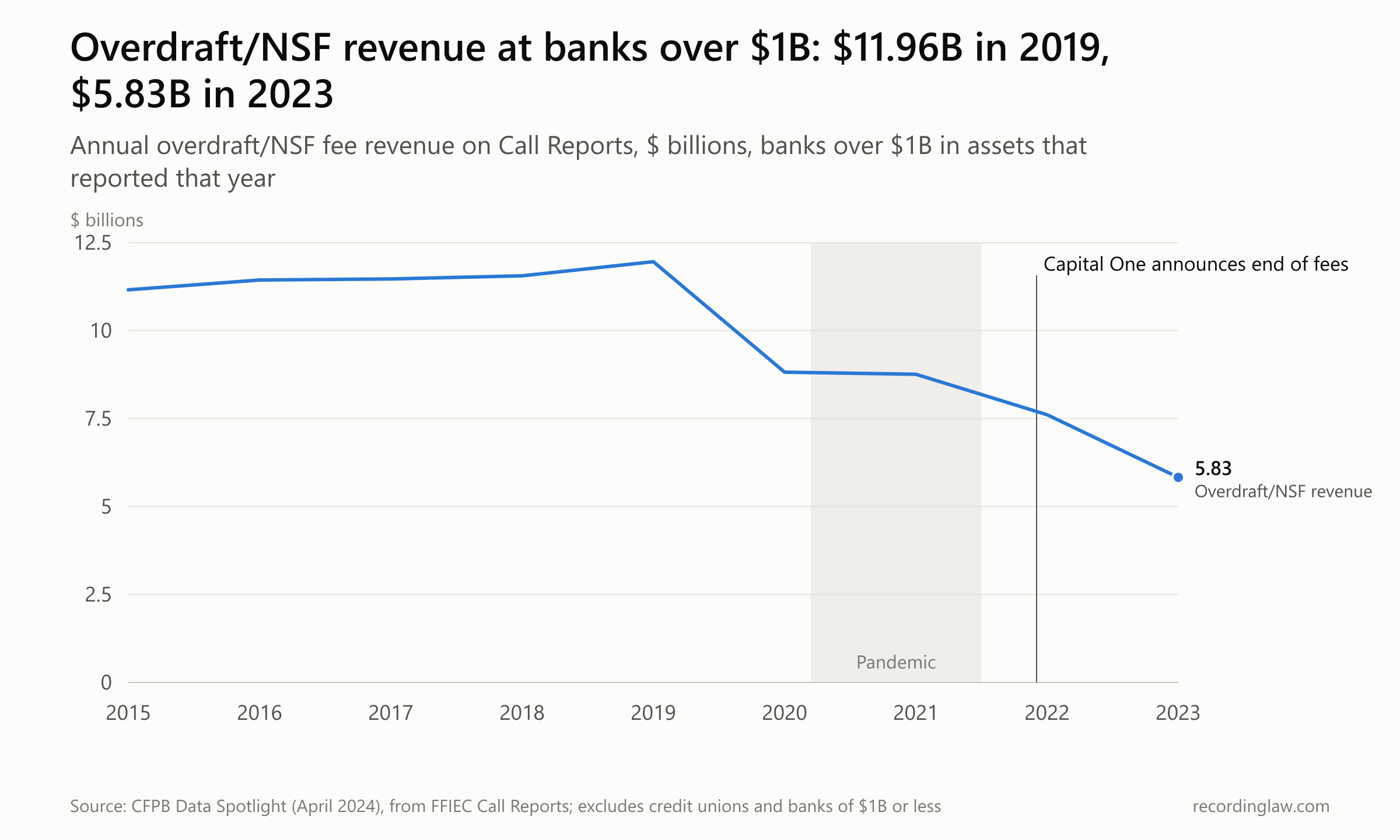
Overdraft and NSF revenue, banks over $1 billion in assets that reported each year, $ billions. The marked line is Capital One's December 2021 announcement that it would end overdraft and NSF fees. Source: CFPB Data Spotlight, from FFIEC Call Reports.
| Year | Overdraft/NSF revenue ($ billions) |
|---|---|
| 2015 | 11.16 |
| 2016 | 11.44 |
| 2017 | 11.47 |
| 2018 | 11.56 |
| 2019 | 11.96 |
| 2020 | 8.82 |
| 2021 | 8.76 |
| 2022 | 7.61 |
| 2023 | 5.83 |
Revenue rose each year from $11.16 billion in 2015 to $11.96 billion in 2019. It fell to $8.82 billion in 2020 and $8.76 billion in 2021, then to $7.61 billion in 2022 and $5.83 billion in 2023. The gap between 2019 and 2023 is $6.13 billion.
The CFPB's final rule gives its reading of the 2020 drop: it "was likely primarily due to pandemic-related stimulus payments," which pushed up account balances, along with temporarily lower debit card use. The CFPB also notes that regulators encouraged institutions to be lenient during the pandemic.
Other fees did not follow the same path. The CFPB reports that the same banks' revenue from other listed fees, such as monthly maintenance and ATM fees, was $5.99 billion in 2019 and $6.04 billion in 2023, a change of about 1 percent.
Which banks' revenue fell most
The CFPB listed the eight banks that collected the most overdraft and NSF revenue in 2021, each more than $200 million. Every one reported a decline from 2019 to 2023, ranging from 43 percent to 91 percent.
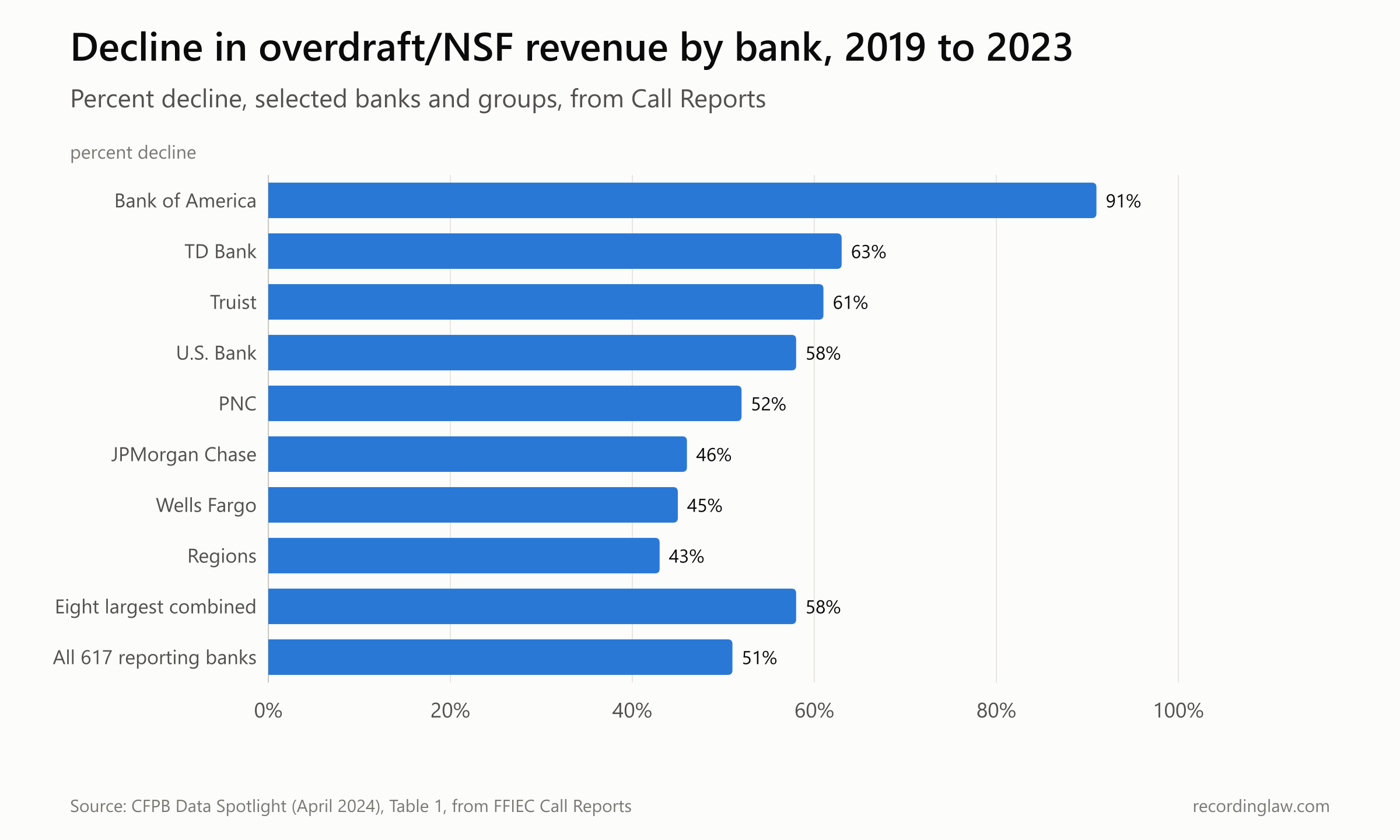
Percent decline in overdraft and NSF revenue, 2019 to 2023; each bar shows a decline. Source: CFPB Data Spotlight, Table 1, from FFIEC Call Reports.
| Bank or group | 2019 ($ millions) | 2023 ($ millions) | Decline, 2019 to 2023 |
|---|---|---|---|
| Bank of America | 1,563 | 140 | 91% |
| TD Bank | 565 | 210 | 63% |
| Truist | 585 | 231 | 61% |
| U.S. Bank | 505 | 214 | 58% |
| PNC | 540 | 258 | 52% |
| JPMorgan Chase | 2,061 | 1,104 | 46% |
| Wells Fargo | 1,696 | 937 | 45% |
| Regions | 373 | 211 | 43% |
| Eight largest combined | 7,889 | 3,305 | 58% |
| All 617 reporting banks | 11,963 | 5,831 | 51% |
The eight banks reported $7.89 billion of the $11.96 billion total in 2019. Their combined revenue fell by $4.58 billion, about three-quarters of the $6.13 billion decline across all 617 banks.
Some banks announced fee changes during this period. In December 2021, CNN reported that Capital One was getting rid of all overdraft and NSF fees. On January 11, 2022, Bank of America announced it would eliminate NSF fees beginning in February, end ATM overdrafts, and cut its overdraft fee from $35 to $10 beginning in May. The bank projected that its overdraft fee revenue would be reduced by 97 percent from 2009 levels.
The CFPB describes the wider pattern in its final rule: "Beginning in late 2021, a number of large banks began announcing and implementing changes to their overdraft policies." The rule says some banks eliminated overdraft fees altogether or reduced them to $10 or $15 per transaction. It also states: "Since the CFPB focused substantial enforcement and supervision attention on overdraft fees in 2021, overdraft fee revenue has contracted somewhat."
That is the agency's account of its own role. The Call Report data do not separate the effect of bank announcements, enforcement attention, customer balances or other factors.
The rule and its repeal
The CFPB proposed its overdraft rule on January 17, 2024, after the full 2019 to 2023 decline shown above had already happened. The final rule was published in the Federal Register on December 30, 2024.
| Date | Event |
|---|---|
| January 17, 2024 | CFPB proposes overdraft rule |
| December 30, 2024 | Final rule published, 89 FR 106768 |
| February 13, 2025 | S.J.Res. 18 introduced in the Senate |
| March 27, 2025 | Senate passes S.J.Res. 18, 52-48 |
| April 9, 2025 | House passes S.J.Res. 18, 217-211 |
| May 9, 2025 | S.J.Res. 18 approved as Public Law 119-10 |
| October 1, 2025 | Date the rule was scheduled to take effect |
The rule applied only to insured depository institutions and credit unions with more than $10 billion in assets. Under it, overdraft credit at those institutions would be covered by Regulation Z, the Truth in Lending rules, unless the fee was at or below the institution's costs and losses. An institution could calculate its own costs and losses or rely on a $5 benchmark fee.
The proposal had presented benchmark alternatives of $3, $6, $7 and $14. The final rule raised the $3 benchmark to $5.
Public Law 119-10 states that Congress disapproves the rule and that "such rule shall have no force or effect." The rule's reach was narrower than the revenue series above: it covered institutions over $10 billion, while the CFPB revenue figures include all banks over $1 billion.
For scale, the rule cites CFPB estimates of marketwide overdraft revenue, including credit unions and smaller banks: $11.8 billion in 2015, $12.6 billion in 2019, and more than $9 billion in each of 2020 and 2021. The CFPB estimated that banks over $1 billion account for about 77 percent of that market, credit unions about 15 percent and banks of $1 billion or less about 7 percent.
The Financial Health Network notes that those shares come from 2019 data and that the CFPB assumed they held in later years. Using credit-union data first reported in 2024, it estimated in March 2025 that credit unions accounted for about 45 percent of overdraft and NSF fees in 2023, and said the CFPB may have underestimated the credit-union share.
After 2023: what the data can and cannot show
We did not find an official overdraft-only total for 2024 or later. The closest official series available through the FDIC's public data is the total of all service charges on deposit accounts at FDIC-insured institutions. That total includes overdraft and NSF fees but also monthly maintenance, ATM and other deposit fees, so it is not an overdraft series.
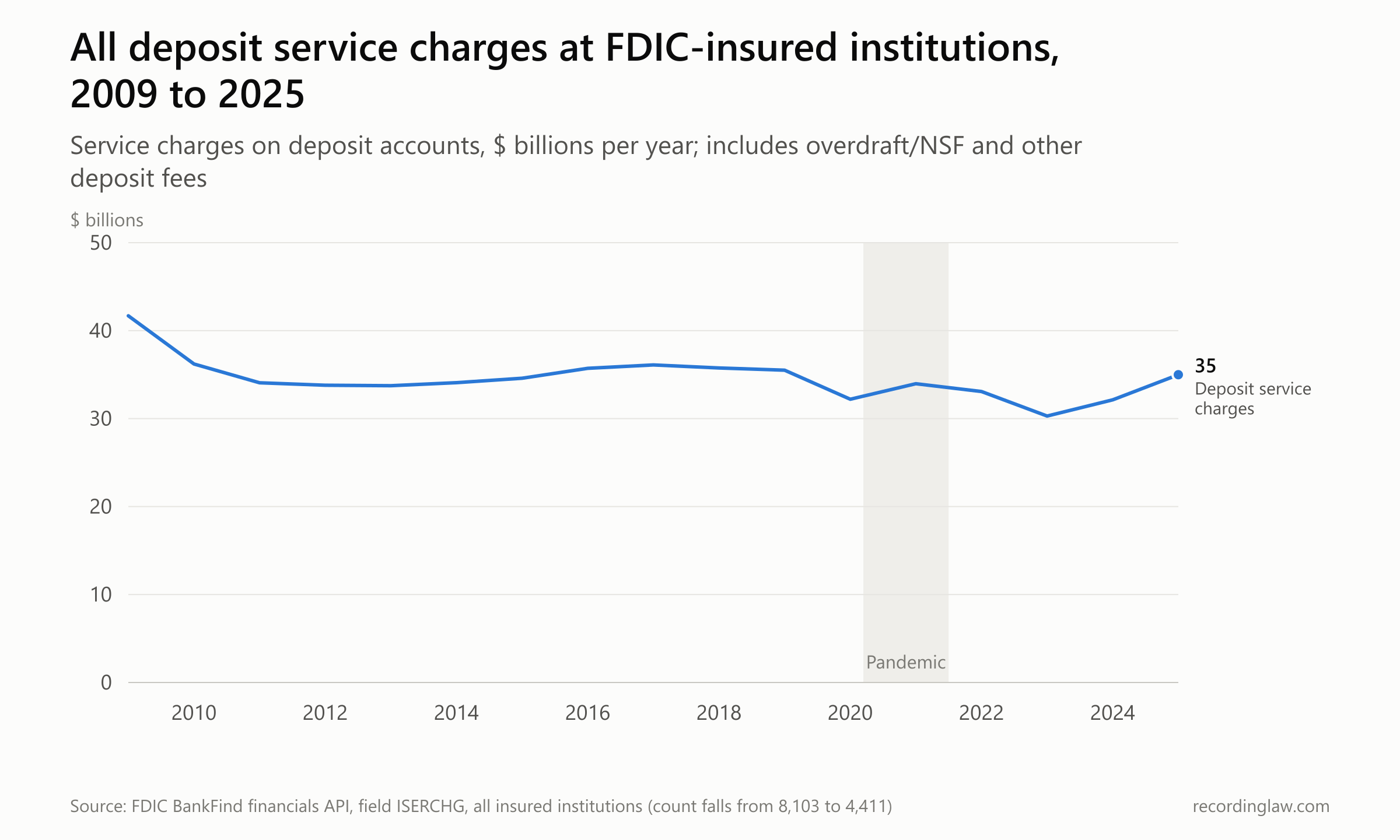
All service charges on deposit accounts at FDIC-insured institutions, $ billions, 2009 to 2025. Includes overdraft/NSF and other deposit fees; not an overdraft-only measure. Source: FDIC BankFind financials, field ISERCHG.
| Year | All deposit service charges ($ billions) | Reporting institutions |
|---|---|---|
| 2009 | 41.68 | 8,103 |
| 2019 | 35.50 | 5,244 |
| 2023 | 30.29 | 4,658 |
| 2024 | 32.14 | 4,560 |
| 2025 | 34.99 | 4,411 |
The total fell from $41.68 billion in 2009 to $35.50 billion in 2019 and $30.29 billion in 2023. It was $32.14 billion in 2024 and $34.99 billion in 2025. For the first half of 2026 it was $18.37 billion, a half-year figure that is not comparable to full years. Because the total mixes overdraft revenue with other fees, the rise after 2023 cannot be assigned to overdraft fees from this series.
Two outside groups have published overdraft estimates for later years. Their scopes differ from the CFPB bank series, so they are not continuations of it.
- Financial Health Network, a nonprofit research organization, estimated overdraft and NSF revenue at banks and credit unions combined at $11.8 billion for 2023, revised from an earlier $7.9 billion, and $12.1 billion for 2024. It put credit unions at $5.3 billion and $5.4 billion. The revision followed a National Credit Union Administration requirement, starting in the first quarter of 2024, that credit unions over $1 billion report overdraft and NSF revenue separately. The NCUA has since said it will no longer publish individual credit unions' overdraft revenue beginning in 2025, so, as the Financial Health Network notes, only one year of that data is available.
- National Consumer Law Center, a consumer advocacy organization, reported in June 2026 that overdraft revenue at the 20 largest consumer banks, as NCLC selected them, was about $4 billion in 2025, up 6.2 percent from 2023. It extrapolated about $12.4 billion for all banks and credit unions by assuming the top-20 growth applied industry-wide, and said the actual figure could be more or less.
We did not re-derive either estimate from Call Reports. Overdraft practices at individual banks have also been the subject of private lawsuits; one example is the SunTrust overdraft fee settlement.
How we measured
Overdraft and NSF series. Annual figures for 2015 to 2023 and the per-bank table come from the CFPB's Data Spotlight on overdraft and NSF revenue in 2023, built from FFIEC Call Reports. It covers banks with more than $1 billion in assets that reported in each year, merger-adjusted to owners as of December 31, 2023; the per-bank table covers the 617 banks that reported in 2023. It excludes credit unions and banks of $1 billion or less. Percent declines are the CFPB's; dollar differences are our arithmetic from its figures.
The CFPB notes that some year-to-year variation reflects changes in the set of reporting banks, and that fee revenue also depends on how many accounts a bank holds, which Call Reports do not capture.
Deposit service charges. The FDIC series is field ISERCHG from the FDIC BankFind financials API, summed across all insured institutions at December 31 each year and converted from thousands to billions. It covers every deposit service charge, not only overdraft. The number of reporting institutions fell from 8,103 in 2009 to 4,411 in 2025, so the totals cover a shrinking set of institutions.
Rule and repeal. Dates, coverage and the benchmark fee come from the Federal Register text of the final rule (89 FR 106768). Votes and dates for S.J.Res. 18 come from Congress.gov, and the disapproval language from the text of Public Law 119-10.
Confounders. The 2020 and 2021 figures overlap the pandemic, stimulus payments and regulator encouragement of leniency. Bank fee announcements, CFPB enforcement attention, and changes in customer balances and card use all overlap 2021 to 2023. This story compares years; it does not use a method that can separate those factors, so it makes no causal claim.
What the data cannot show. We could not retrieve an overdraft-only Call Report total for 2024, 2025 or 2026, so this article does not say whether overdraft revenue rose or fell after 2023. Only Capital One's and Bank of America's fee changes are described, because those were the announcements we could source; other banks' policy changes are not covered. Because the rule never took effect, there is no post-rule period to measure.
Frequently Asked Questions
Did the CFPB overdraft rule ever take effect?
No. The rule was published December 30, 2024 with an effective date of October 1, 2025. Public Law 119-10, approved May 9, 2025, disapproved it and provides that the rule shall have no force or effect.
Which banks would the rule have covered?
Insured depository institutions and credit unions with more than $10 billion in assets. Those institutions would have had to treat overdraft credit as covered by Regulation Z unless the fee was at or below their costs and losses, which they could calculate themselves or meet by relying on a $5 benchmark fee.
Did overdraft revenue start falling because of the rule?
The bank series fell from $11.96 billion in 2019 to $5.83 billion in 2023, before the rule was proposed in January 2024. The data cannot say what caused the decline. The CFPB attributes the 2020 drop mainly to pandemic stimulus balances and says that beginning in late 2021 a number of large banks began announcing and implementing changes to their overdraft policies. It also says overdraft fee revenue contracted somewhat after the CFPB focused enforcement and supervision attention on overdraft fees in 2021.
Have overdraft fees gone back up since 2023?
We did not find an official overdraft-only total for 2024 or later. The FDIC's total for all deposit service charges rose from $30.29 billion in 2023 to $34.99 billion in 2025, but that total also includes maintenance, ATM and other deposit fees. The National Consumer Law Center, an advocacy organization, estimated that overdraft revenue at the 20 largest consumer banks, as it selected them, was about $4 billion in 2025, up 6.2 percent from 2023; we did not re-derive that figure.
Do the CFPB figures include credit unions?
No. The $11.96 billion and $5.83 billion figures cover 617 banks with more than $1 billion in assets. They exclude credit unions and smaller banks. The CFPB separately estimated, from 2019 data, that banks over $1 billion account for about 77 percent of marketwide overdraft revenue, credit unions about 15 percent and smaller banks about 7 percent. The Financial Health Network, using credit-union data first reported in 2024, estimated credit unions at about 45 percent of overdraft and NSF fees in 2023.
How big was the overdraft market before 2015?
The CFPB estimated marketwide overdraft revenue at about $25 billion in 2009 and about $12 billion in 2011, after the 2010 implementation of the Regulation E opt-in rule. Those are CFPB estimates, not Call Report line items; banks over $1 billion have reported overdraft and NSF revenue as a separate line only since 2015.
Updates
Independently fact-checked against the cited primary sources
Sources and References
- CFPB Data Spotlight: Overdraft/NSF revenue in 2023 down more than 50% versus pre-pandemic levels(consumerfinance.gov).gov
- Overdraft Lending: Very Large Financial Institutions, final rule, 89 FR 106768 (Dec. 30, 2024)(federalregister.gov).gov
- S.J.Res. 18, 119th Congress: actions and votes(congress.gov).gov
- Public Law 119-10 (S.J.Res. 18), approved May 9, 2025(congress.gov).gov
- FDIC BankFind financials API, service charges on deposit accounts (ISERCHG)(fdic.gov).gov
- Bank of America press release on overdraft changes (Jan. 11, 2022)(bankofamerica.com)
- CNN via WTOP: Capital One is the first big bank to get rid of overdraft fees (Dec. 2021)(wtop.com)
- Financial Health Network: overdraft and NSF fees a bigger burden than previously estimated (Mar. 2025)(finhealthnetwork.org)
- National Consumer Law Center brief on 2025 overdraft revenue (June 2026)(nclc.org)
- 5 U.S.C. 802, Congressional Review Act disapproval procedure(govinfo.gov).gov