FTC Do Not Call Complaints Fell by Half From FY2019 to FY2025; YouMail's Robocall Estimate Fell 10%
Independently fact-checked against primary sources (last audited October 26, 2026). · 9 primary sources cited on this page. How we verify our legal content
Consumer complaints about unwanted calls and the estimated number of robocalls have moved differently since 2019. Complaints to the Federal Trade Commission's Do Not Call program fell from 5,422,298 in fiscal year 2019 to 2,085,410 in fiscal year 2024, then rose to 2,618,077 in fiscal year 2025. Over calendar years 2019 to 2025, YouMail, a private call-blocking company, estimated 58.5 billion US robocalls in 2019, 45.9 billion in 2020 and 52.5 billion in 2025.
The TRACED Act, the federal anti-robocall law, was signed on December 30, 2019. This article sets out what three data series show before and after that date, and why the numbers cannot tell you how much of any change came from the law. The figures are current to the FTC's fiscal year 2025 Data Book (released December 2025, covering the year to September 30, 2025) and YouMail's estimate for September 2026.
What the TRACED Act required, and when
The TRACED Act, Public Law 116-105, was approved on December 30, 2019. It added to the federal rules on robocalls that sit under the older Telephone Consumer Protection Act (TCPA).
Section 4 of the TRACED Act directed the FCC, not later than 18 months after enactment, to require voice providers to implement STIR/SHAKEN, a caller ID authentication framework.
The FCC acted in stages, which matters for reading any chart. Its March 31, 2020 order (FCC 20-42) required all voice service providers to implement STIR/SHAKEN in the Internet Protocol portions of their networks by June 30, 2021. A September 2020 order (FCC 20-136) exempted providers with 100,000 or fewer lines through June 30, 2023. A December 2021 order (FCC 21-122) moved the deadline for non-facilities-based small providers up to June 30, 2022; facilities-based small providers kept June 30, 2023.
On February 2, 2024, the FCC adopted a declaratory ruling (FCC 24-17, released February 8) confirming that the TCPA's limits on calls using an "artificial or prerecorded voice" cover current AI technologies that generate human voices.
| Date | Event |
|---|---|
| Dec 30, 2019 | TRACED Act signed (Public Law 116-105) |
| Mar 31, 2020 | FCC adopts STIR/SHAKEN mandate (FCC 20-42) |
| June 30, 2021 | STIR/SHAKEN deadline for IP networks |
| June 30, 2022 | Deadline for non-facilities-based small providers (FCC 21-122) |
| June 30, 2023 | End of exemption for facilities-based small providers (FCC 20-136, FCC 21-122) |
| Feb 8, 2024 | FCC AI-voice ruling released (FCC 24-17) |
Estimated robocalls per month
YouMail publishes a monthly estimate of US robocalls, extrapolated from calls to users of its app. The estimate counts legal robocalls as well as illegal ones.
By YouMail's count, monthly robocalls rose from under 1 billion in late 2015 to a single-month high of 5.665 billion in October 2019. By annual total, 2019 was the highest year in YouMail's series. Monthly robocalls fell to 2.861 billion in April 2020, during the first months of the COVID-19 pandemic, and from 2021 onward ranged between about 3.6 billion and 5.1 billion a month.
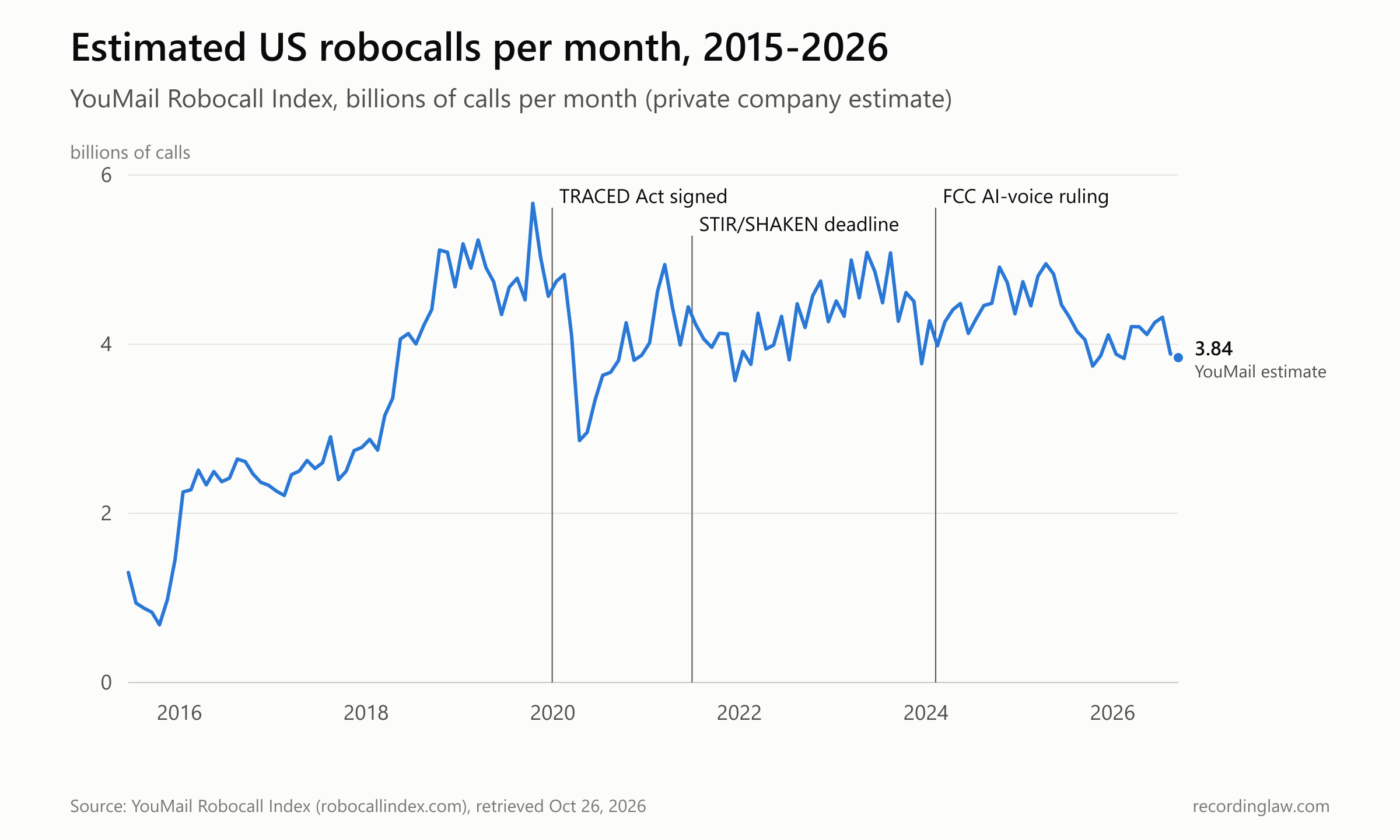
Source: YouMail Robocall Index, monthly estimates June 2015 to September 2026, retrieved October 26, 2026.
| Calendar year | Estimated robocalls (billions) |
|---|---|
| 2016 | 29.1 |
| 2017 | 30.5 |
| 2018 | 47.8 |
| 2019 | 58.5 |
| 2020 | 45.9 |
| 2021 | 50.5 |
| 2022 | 50.4 |
| 2023 | 55.0 |
| 2024 | 52.8 |
| 2025 | 52.5 |
For 2026, YouMail estimated 36.5 billion robocalls from January through September. Adding YouMail's monthly figures for the same nine months of 2025 gives about 40.8 billion.
Complaints to the FTC
The FTC reports Do Not Call complaints each fiscal year, which runs October through September. Total complaints peaked at 7,157,313 in fiscal year 2017. They were 5,422,298 in fiscal year 2019 and 5,008,987 in fiscal year 2021.
From fiscal year 2021 to fiscal year 2024, total complaints fell 58.4 percent, to 2,085,410. Robocall complaints fell from 3,427,949 to 1,099,229 over the same three years.
In fiscal year 2025, complaints rose. The total reached 2,618,077, up 25.5 percent from fiscal year 2024, and robocall complaints reached 1,601,611, up 45.7 percent. The FTC's fiscal year 2025 Data Book reports the increase without giving a reason, and this article does not offer one.
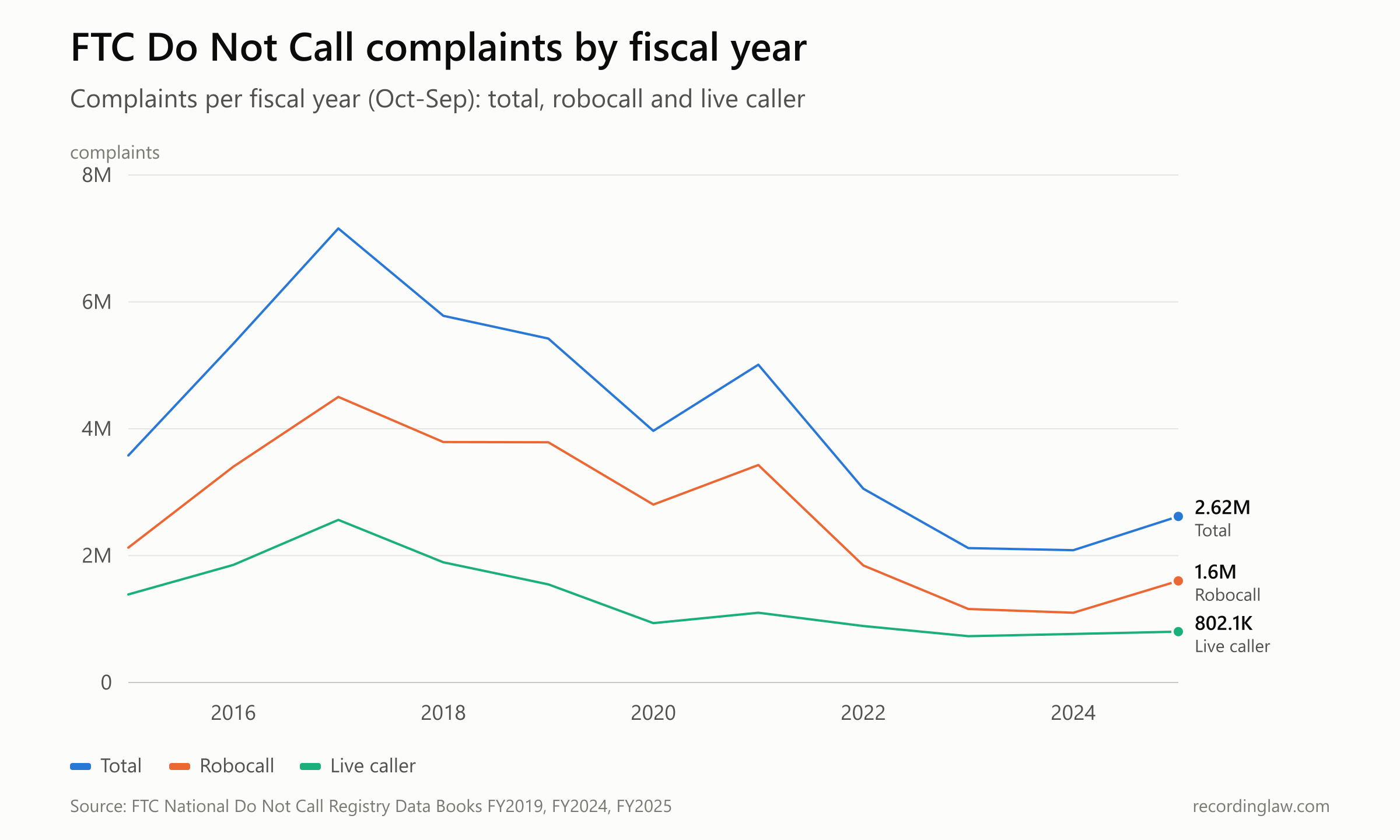
Source: FTC National Do Not Call Registry Data Books for fiscal years 2019, 2024 and 2025.
| Fiscal year | Total complaints | Robocall | Live caller |
|---|---|---|---|
| 2015 | 3,578,658 | 2,125,933 | 1,388,453 |
| 2016 | 5,340,178 | 3,401,597 | 1,854,679 |
| 2017 | 7,157,313 | 4,501,954 | 2,563,037 |
| 2018 | 5,780,141 | 3,790,602 | 1,894,308 |
| 2019 | 5,422,298 | 3,786,771 | 1,546,234 |
| 2020 | 3,966,397 | 2,805,032 | 935,456 |
| 2021 | 5,008,987 | 3,427,949 | 1,100,066 |
| 2022 | 3,054,237 | 1,844,210 | 889,891 |
| 2023 | 2,118,808 | 1,157,748 | 730,159 |
| 2024 | 2,085,410 | 1,099,229 | 764,138 |
| 2025 | 2,618,077 | 1,601,611 | 802,144 |
Robocall and live-caller complaints do not always add up to the total. In fiscal year 2025, the FTC counted 214,322 complaints where the call type was not reported. The number with no call type was larger in fiscal year 2021, about 481,000.
The two categories are counted under different rules. The FTC says robocalls that are sales calls are illegal whether or not a number is on the Registry, unless the caller has written permission. For live callers, the FTC takes a complaint only after checking that the consumer's number was on the Registry.
Complaints to the FCC
The FCC also takes informal complaints about unwanted calls through its Consumer Help Center, and publishes them as open data. That gives a second complaint series, kept by a different agency on a calendar year basis.
FCC complaints peaked at 230,184 in 2018. They were 192,142 in 2019, fell to a low of 96,731 in 2023, and rose to 120,402 in 2024 and 124,819 in 2025. The FCC dataset combines several issue categories (robocalls, telemarketing and unwanted calls) and includes complaints about texts.
The mix of complaint types changed over these years. The "Abandoned Calls" type, 34,651 complaints in 2019 and 26,444 in 2021, does not appear after 2021 (one complaint in 2023). Text-message complaints grew from 5,752, about 3 percent of the 2019 total, to 29,855, about 25 percent of the 2024 total. Of the rise of 23,671 complaints from 2023 to 2024, 17,717 were about text messages.
The table below also shows every complaint type except text messages. On that count, FCC complaints were 186,390 in 2019, 84,593 in 2023, 90,547 in 2024 and 106,372 in 2025.
| Calendar year | FCC unwanted call and text complaints | Excluding text messages |
|---|---|---|
| 2018 | 230,184 | 219,814 |
| 2019 | 192,142 | 186,390 |
| 2020 | 156,318 | 141,921 |
| 2021 | 161,737 | 146,756 |
| 2022 | 118,081 | 99,240 |
| 2023 | 96,731 | 84,593 |
| 2024 | 120,402 | 90,547 |
| 2025 | 124,819 | 106,372 |
The three series side by side
The three measures sit on very different scales: billions of calls, millions of FTC complaints, and hundreds of thousands of FCC complaints. The chart below sets each to 100 in 2019 so their direction can be compared.
By 2025, YouMail's call estimate stood at 89.6 percent of its 2019 level. FTC complaints stood at 48.3 percent and FCC complaints at 65.0 percent. After 2021, both complaint series fell, while the call estimate stayed between 86.1 and 94.0. Part of the FCC rise after 2023 is text-message complaints, which the call estimate does not cover; excluding texts, FCC complaints in 2025 stood at 57.1 percent of their 2019 level.
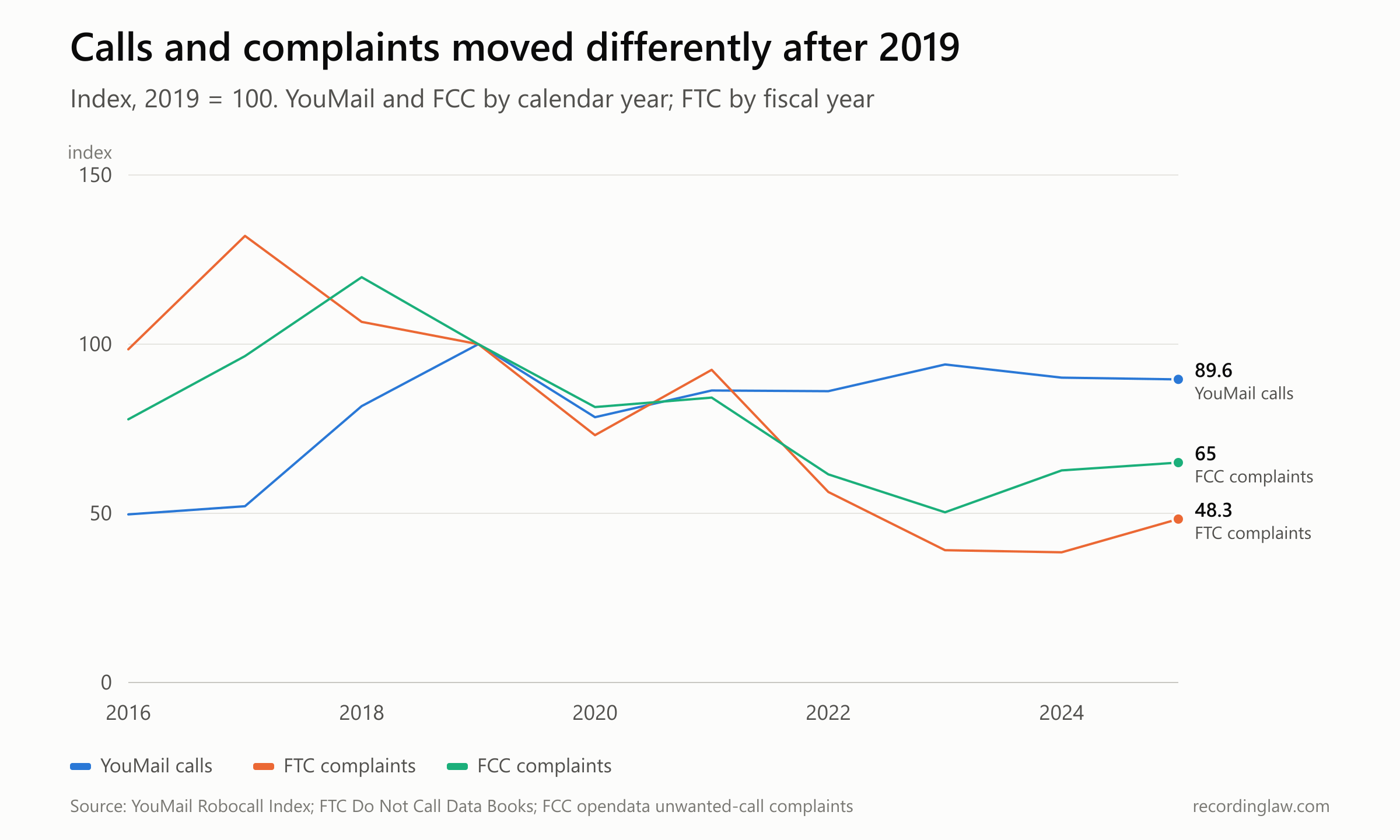
Source: YouMail Robocall Index; FTC Do Not Call Data Books; FCC unwanted call and text complaints open data. YouMail and FCC are calendar years; FTC is fiscal years.
| Year | YouMail calls | FTC complaints | FCC complaints |
|---|---|---|---|
| 2016 | 49.7 | 98.5 | 77.8 |
| 2017 | 52.1 | 132.0 | 96.5 |
| 2018 | 81.7 | 106.6 | 119.8 |
| 2019 | 100.0 | 100.0 | 100.0 |
| 2020 | 78.4 | 73.1 | 81.4 |
| 2021 | 86.3 | 92.4 | 84.2 |
| 2022 | 86.1 | 56.3 | 61.5 |
| 2023 | 94.0 | 39.1 | 50.3 |
| 2024 | 90.1 | 38.5 | 62.7 |
| 2025 | 89.6 | 48.3 | 65.0 |
These numbers show that the measures moved differently. They do not show why. Several things changed over the same years:
- Carrier and app tools. Besides the STIR/SHAKEN mandate, carriers and app makers offer call blocking and spam labels. This article has no data on how many calls were blocked or labeled, or when those tools spread.
- The pandemic. YouMail's estimate dropped sharply in spring 2020, months before the main STIR/SHAKEN deadline.
- Reporting behavior. Complaints depend on whether people know where to report and decide it is worth doing. A change in that habit moves the complaint count without any change in calls.
- What is counted. YouMail includes legal robocalls; the complaint series count only what consumers chose to report, and neither agency verifies the reports.
The Registry kept growing
The National Do Not Call Registry has existed since 2003. Active registrations rose every year in the period covered here, from 222.8 million at the end of fiscal year 2015 to 239.5 million in fiscal year 2019 and 258.5 million in fiscal year 2025, an increase of 7.9 percent since 2019.
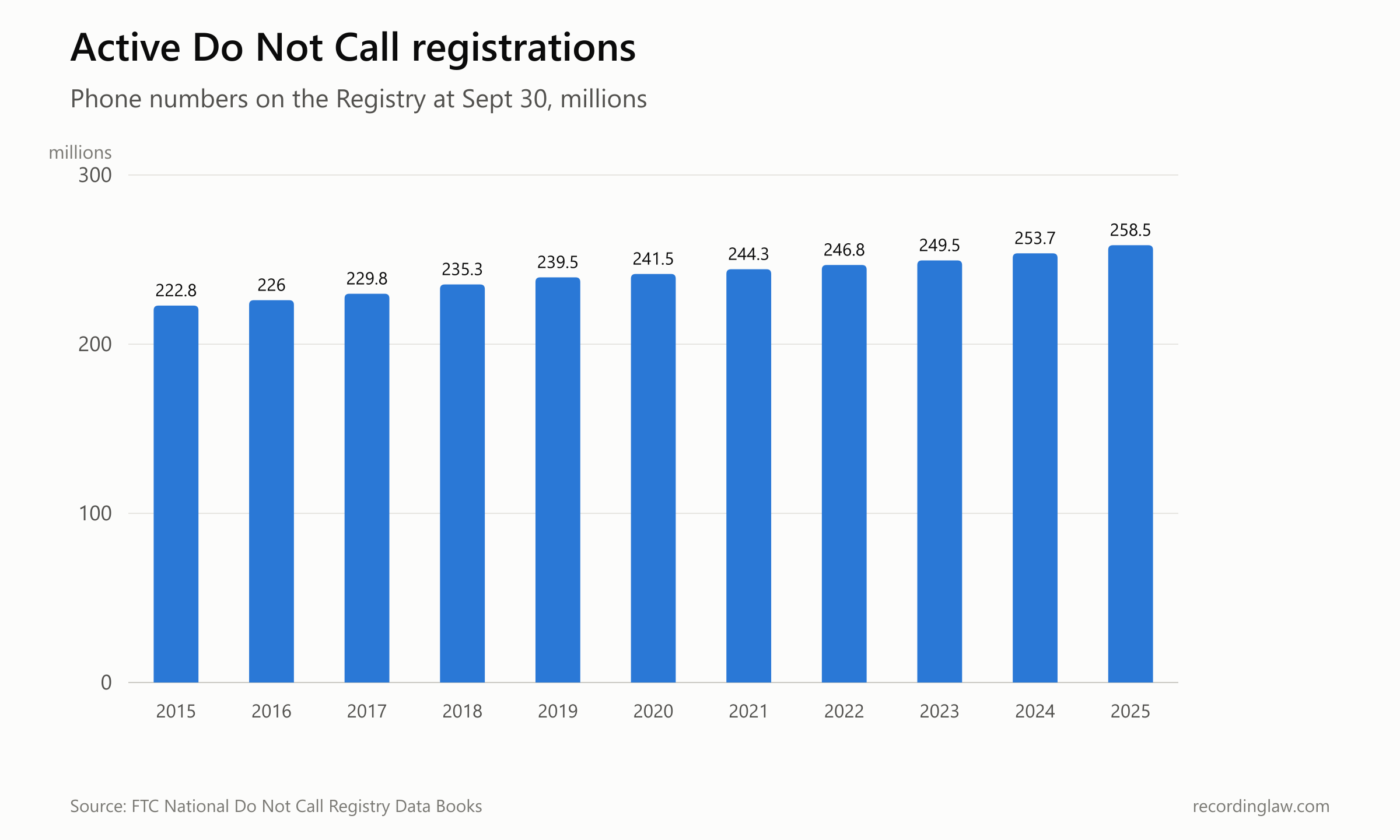
Source: FTC National Do Not Call Registry Data Books. The table shows selected fiscal years.
| Fiscal year | Active registrations (millions) |
|---|---|
| 2015 | 222.8 |
| 2019 | 239.5 |
| 2021 | 244.3 |
| 2023 | 249.5 |
| 2025 | 258.5 |
A registration count is not a count of people. The FTC removes numbers that have been disconnected and reassigned, but numbers that have been disconnected and not reassigned stay on the Registry.
If you are getting calls you believe are illegal, the TCPA allows private lawsuits in some situations, and our news coverage explains the FCC's order on revoking consent to calls and texts. If a call led to a loss of money or personal information, see our guide to scams and fraud.
How we measured
Call volume. YouMail Robocall Index monthly and annual tables, June 2015 to September 2026, retrieved October 26, 2026. YouMail is a private company; its figures are modeled from calls to its app users and include legal robocalls. Any changes to its method or restatements of earlier months are not visible in the published table. Annual comparisons use full calendar years 2016 to 2025. No second call-volume estimate was used.
FTC complaints. National Do Not Call Registry Data Books. Fiscal years 2015 to 2019 come from the five-year chart in the fiscal year 2019 book, fiscal year 2020 from the fiscal year 2024 book, and fiscal years 2021 to 2025 from the fiscal year 2025 book. The FTC revises earlier years between editions (the fiscal year 2024 total, for example, went from 2,085,133 to 2,085,410); this article uses the most recent book that reports each year. The FTC documents were read from archived copies of the ftc.gov files because ftc.gov did not respond to scripted requests. The FTC describes the data as unverified complaints reported by consumers, not a survey.
A gap in fiscal year 2019. The FTC's complaint intake portals were unavailable from December 28, 2018 to January 26, 2019, during the government shutdown. The fiscal year 2019 total, the base of the index chart, reflects about 11 months of normal intake.
FCC complaints. FCC Consumer Help Center unwanted-calls dataset on opendata.fcc.gov, counted by calendar year of the issue date, 2015 to 2025. Rows with invalid dates were excluded. The FCC says it does not verify the facts alleged in these complaints. The mix of complaint types is not stable: the "Abandoned Calls" type stops appearing after 2021, and text-message complaints rose from about 3 percent of the total in 2019 to about 25 percent in 2024, so the FCC table also shows a count excluding text messages.
Comparison. The index chart sets each series to 100 in 2019. FTC years run October to September and the other two run January to December, so each point compares overlapping but different 12-month windows. All percentage changes in this article were computed from the figures above.
What the data cannot show. None of these series isolates the TRACED Act. There is no comparison group of phone users the law did not cover, and the law's main requirement took effect in stages alongside voluntary carrier blocking, call-labeling apps and the pandemic. The data also cannot say what share of calls were illegal, how many were blocked before reaching a phone, or why complaints rose in fiscal year 2025.
Frequently Asked Questions
Have robocalls gone down since the TRACED Act?
By YouMail's estimate, US robocalls were 58.5 billion in 2019 and 52.5 billion in 2025, about 10 percent lower, with every year from 2021 to 2025 between 50.4 billion and 55.0 billion. YouMail is a private company and its estimate includes legal robocalls. The data does not show how much of any change came from the law rather than carrier blocking, the pandemic or other factors.
How many Do Not Call complaints does the FTC receive?
The FTC received 2,618,077 Do Not Call complaints in fiscal year 2025 (October 2024 through September 2025), including 1,601,611 about robocalls and 802,144 about live callers. The total was 5,422,298 in fiscal year 2019 and 2,085,410 in fiscal year 2024.
Why did robocall complaints go up in 2025?
Robocall complaints to the FTC rose 45.7 percent from fiscal year 2024 to fiscal year 2025. The FTC Data Book reports the figures without giving a reason, and this article does not suggest one.
When did STIR/SHAKEN become mandatory?
The TRACED Act, signed December 30, 2019, told the FCC to require STIR/SHAKEN within 18 months. The FCC's March 2020 order required voice service providers to implement it in the IP portions of their networks by June 30, 2021. A September 2020 order gave providers with 100,000 or fewer lines an exemption through June 30, 2023. A December 2021 order moved the deadline for non-facilities-based small providers up to June 30, 2022, and facilities-based small providers kept June 30, 2023.
How many numbers are on the Do Not Call Registry?
The FTC reported 258,515,050 active registrations at September 30, 2025, up from 239,472,857 in 2019. Numbers that are disconnected but not reassigned remain on the Registry, so the count is not a count of people.
Are AI voice robocalls covered by the TCPA?
Yes. In a declaratory ruling adopted February 2, 2024 and released February 8, 2024, the FCC confirmed that the TCPA's restrictions on artificial or prerecorded voice calls cover current AI technologies that generate human voices.
Updates
Independently fact-checked against the cited primary sources
Sources and References
- Public Law 116-105, TRACED Act (approved December 30, 2019)(govinfo.gov).gov
- FCC 20-42 (adopted March 31, 2020), STIR/SHAKEN mandate for IP networks by June 30, 2021(fcc.gov).gov
- FCC 20-136 (adopted September 29, 2020), STIR/SHAKEN small-provider exemption(fcc.gov).gov
- FCC 21-122 (adopted December 9, 2021), STIR/SHAKEN deadline of June 30, 2022 for non-facilities-based small providers(fcc.gov).gov
- FCC 24-17 (adopted February 2, 2024), declaratory ruling on AI-generated voices under the TCPA(fcc.gov).gov
- FTC, National Do Not Call Registry Data Book, Fiscal Year 2025(ftc.gov).gov
- FTC, National Do Not Call Registry Data Book, Fiscal Year 2024(ftc.gov).gov
- FTC, National Do Not Call Registry Data Book, Fiscal Year 2019(ftc.gov).gov
- FCC, CGB Consumer Complaints Data: Unwanted Calls (open data)(opendata.fcc.gov).gov
- YouMail Robocall Index, historical robocalls by time(robocallindex.com)