Chicago Started Ticketing at 6 mph Over in 2021. Its Camera Safety Study Ends in 2017.

Independently fact-checked against primary sources (last audited November 12, 2026). · 5 primary sources cited on this page. How we verify our legal content
On Sunday, February 28, 2021, Chicago's speed cameras recorded 1,451 violations. On Monday, March 1, they recorded 12,036, about eight times as many. The Chicago Department of Transportation (CDOT) had said it expected 140 cameras to be tracking speeds across the city that day.
The difference was the rule. From that Monday, a driver going 6 to 10 mph over the limit in one of the city's Children's Safety Speed Enforcement Zones, near a park or a school, got a $35 ticket, after a warning for a first offense in the zone. Until then the $35 ticket applied only at exactly 10 mph over, and $100 at 11 mph or more.
The city had held the power to ticket at 6 mph over since its cameras began in 2013, NBC 5 Chicago reported, and had never used it. Mayor Lori Lightfoot switched it on in a budget meant to close a $1.2 billion deficit, and said the change was about safety. Her transportation commissioner put the promise in one line: "The goal is not to issue tickets."
In the two years that followed, the cameras recorded about 6.0 million violations, against 1.6 million in the two years before. Among 69 cameras that operated throughout both periods, the increase was about threefold. Those counts come from the City of Chicago's open data portal, which runs through August 2026, and according to the city they include violations that did not become a citation.
What came next was an argument that has not stopped over whether the rule was a safety measure or a revenue line: two council votes, a mayoral race, a second wave of cameras and several competing tallies of the money. The city's data and the public record can show how the dormant rule became part of the budget. They cannot yet show whether it prevented crashes, which was the case made for it.
A power on the books since 2013
Chicago's first automated speed cameras switched on in August 2013, near parks and schools. Mayor Rahm Emanuel had lobbied for them two years earlier as a child-safety measure. "My goal is only one thing, the safety of our kids," he said in 2011, as ProPublica later reported.
The city ordinance allowed $35 tickets for drivers going 6 to 9 mph over the limit from the start, NBC 5 reported in 2021. "The city has never enforced it, however, until now," it wrote. For almost eight years the cameras ticketed only at 10 mph over and above.
Because a driver at exactly 10 mph over already got a $35 ticket, the new band was in practice 6 to 9 mph. The city and most coverage call it 6 to 10, and this article follows the city's wording.
A violation is a speed a camera recorded over the threshold, the speed over the limit at which tickets begin. A ticket, also called a citation, is a fine mailed to the vehicle's owner, and a warning notice is mailed with no fine. The city's data counts violations and does not say how many of them became tickets.
Under the old rule, the count was falling. Recorded violations across all cameras went from about 1.2 million in 2015 to about 863,000 in 2019. Then the pandemic emptied the streets. By the fall of 2020 the city faced a budget hole and a rising death toll on its roads, and the unused power came back into view.
A budget hole and emptier, deadlier streets
In October 2020, Lightfoot proposed the lower threshold as part of her plan to close a $1.2 billion deficit, the Chicago Tribune reported. At the time, CDOT said 73 of the city's speed cameras were switched off because of COVID-19, with 88 still running near parks and schools.
There were fewer cars on the road and more deaths on it. City officials said 100 people had died on the roads through September 2020, against 72 in the same months of 2019.
The Tribune's own analysis of city crash reports looked at serious crashes blamed on driving recklessly, over the speed limit, too fast for conditions or too fast to avoid a crash. Over the same months, the Tribune found, those crashes fell from 356 to 286. City officials said the cameras were registering drivers about 2 mph faster on average than the year before, and argued that most of the drop in serious crashes came earlier in the pandemic, when traffic was far lighter.
"This is about making sure that we keep communities safe," Lightfoot said. Asked about her campaign pledge to end the city's reliance on fines and fees, she drew a line between those fines and speeding: "Unlike fines for nonmoving violations that did fall disproportionately on Black and brown Chicagoans, and drove people into bankruptcy, people have control over whether or not they speed or not."
CDOT Commissioner Gia Biagi told aldermen at a budget hearing that the city was "using all the tools in our tool box to combat unsafe driving," including "using our automated speed enforcement program to deter speeding."
Critics heard a revenue measure. Ald. Anthony Beale (9th Ward) told Biagi the lower threshold seemed like "a tail wagging the dog situation," the Tribune reported, with the city raising money from struggling residents. Ald. Samantha Nugent (39th Ward) wondered aloud how it would look next to tax increases: "if we're also asking folks to increase their taxes and now we're saying 'If you go 6 miles over the limit we're going to flag you there,' I'm just kind of curious how this is going to look."
Mari Castaldi of the Chicago Jobs Council, which advocates for fines-and-fees reform, said: "If this policy change was about safety, it would ensure that enforcement mechanisms for speed camera tickets came down the hardest on people who commit the most offenses, not those who can't pay."
The Illinois Policy Institute, which describes itself as a nonpartisan research organization and "the strongest voice for taxpayers in the state," and says it believes the best policies limit the power of government, wrote: "She said the move is about safety, but Chicago is seeking cash."
Doubt also came from the side that usually backs cameras. The Active Transportation Alliance, a road-safety advocacy group, asked the city "to delay implementing changes to the ticketing threshold until the equity impacts are understood and addressed." Streetsblog Chicago, which calls itself a defender of automated cameras, warned in an editorial that the change was "sure to be perceived, right or wrong, by many Chicagoans as an unfair money grab."
The City Council never voted on the threshold by itself. It approved the change inside Lightfoot's 2021 budget package in late November 2020. Beale was among more than 20 aldermen who voted against the budget. The tickets would not start until March, and before them came six weeks of warnings.
Six weeks of warnings, then an eightfold day
On January 15, 2021, the city announced that drivers caught at 6 to 10 mph over would get warning notices by mail, with $35 tickets from March 1. "Faced with an unacceptable increase in speeding and traffic fatalities, we are taking action to save lives and prevent serious injuries," Biagi said in a statement. "The goal is not to issue tickets, but to encourage safer driving behavior and discourage speeding that is correlated with more severe injuries and deaths in traffic crashes."
The city's case rested on the death count. Citywide, traffic deaths had risen to 139 in 2020, 43 more than in 2019, according to CDOT figures reported by Streetsblog Chicago. A city statement later said the change applied to 68 Children's Safety Zones, which are enforced near schools when they are in session and children are present, and in parks during opening hours.
Outside experts expected drivers to adapt fast. "The data shows people respond to these monetary incentives," Joe Schwieterman, a DePaul University transportation professor, told NBC 5 the day before tickets began. "They change their behavior."
The warning letters, which began in mid-January, did not move the daily count. Monthly violations were 45,415 in January 2021 and 27,289 in February, near pandemic lows. Daily counts dipped to 138 on February 15, 2021, when far fewer cameras reported, and were back near December 2020 levels by late February.
Then the tickets started, and the daily count jumped eightfold overnight. For March 2021 as a whole the cameras recorded 326,083 violations, and the monthly total peaked at 362,063 in May. Was that a one-time shock, and how much of it lasted?
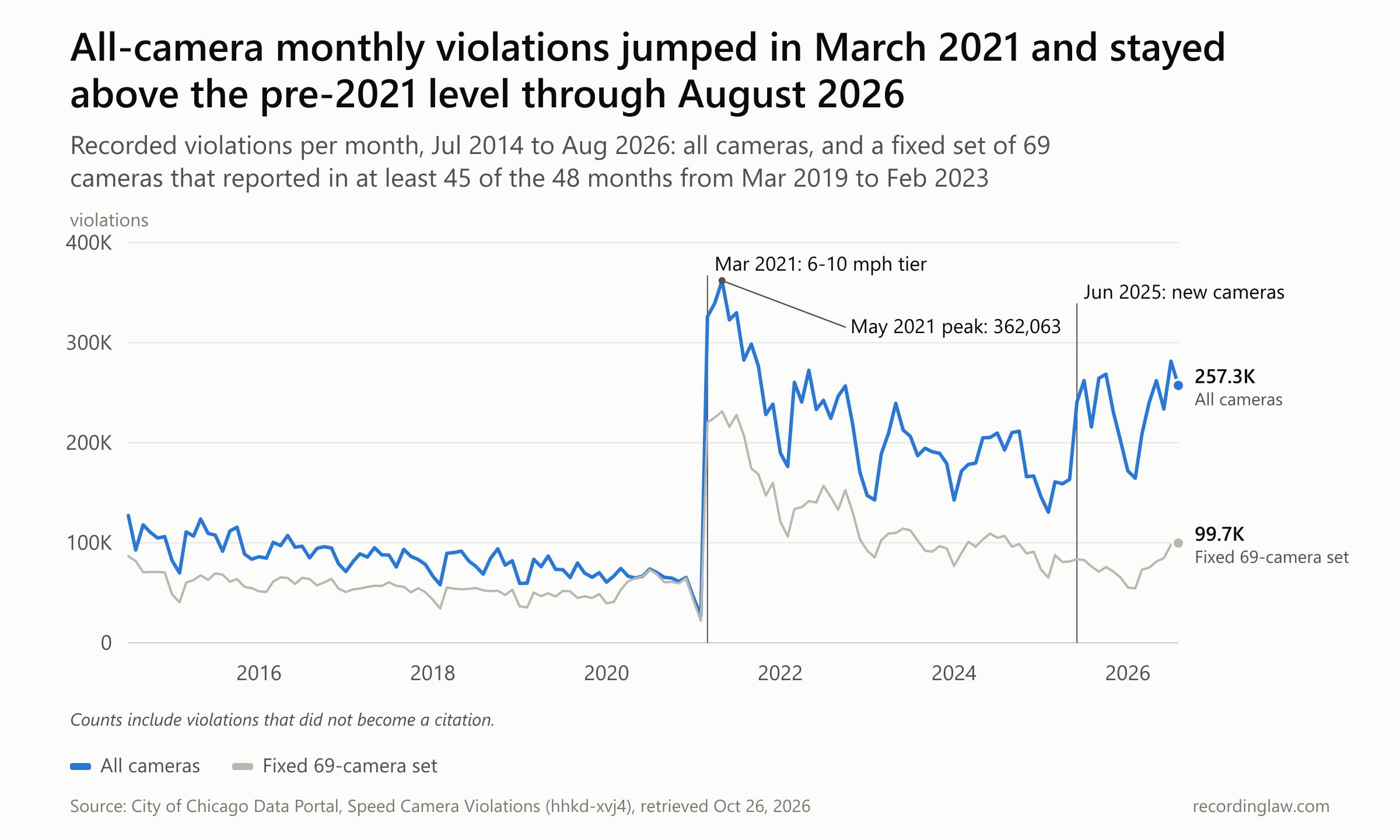
Source: City of Chicago Data Portal, Speed Camera Violations (dataset hhkd-xvj4), retrieved October 26, 2026. Violations include events that did not result in a citation.
The jump in March 2021 is the largest break in the series, and the counts stayed well above their pre-2021 level through August 2026. The table's second column is a fixed set of 69 long-running cameras, which operated throughout both comparison periods, March 2019 to February 2023, so it holds the count of cameras steady.
| Year | All cameras | Fixed 69-camera set |
|---|---|---|
| 2015 | 1,201,698 | 715,171 |
| 2019 | 862,596 | 552,854 |
| 2020 | 800,594 | 713,000 |
| 2021 | 3,077,604 | 2,042,486 |
| 2022 | 2,731,585 | 1,601,722 |
| 2023 | 2,288,983 | 1,202,466 |
| 2024 | 2,239,667 | 1,163,330 |
| 2025 | 2,444,752 | 914,804 |
Single cameras showed the break more starkly. CBS 2 Chicago found that a camera at 3200 S. Archer Ave. flashed 257 times in the five weeks before March 1 and 11,016 times in the five weeks after. Citywide, by CBS's count, tickets went from 35,784 to 398,233 over the same weeks.
ProPublica later reported that in 2021 the city issued more than 1.4 million tickets for 6 to 10 mph over. That was more tickets of that kind than in the previous eight years of the program combined, and those tickets "had the potential to bring in some $50 million in revenue" if paid.
Over two full years, the 24 months from March 2021 recorded 6,026,692 violations, against 1,616,812 in the 24 months before, about 3.7 times as many. The number of cameras also changed over those years, and that moves the citywide total by itself.
Those 69 long-running cameras held the count of cameras steady. They recorded 1,258,354 violations before and 3,757,580 after, about 3 times as many.
Safety or revenue: sixteen months of council fights
Three weeks after tickets began, Beale filed to repeal them. His repeal statement, reported on March 24, 2021, framed the fight as money against safety, and he kept making that case for 16 months.
"Frankly, we don't even know for certain whether the cameras reduce crashes and fatalities. But what we do know is that the City's speed cameras function as a cash cow," he said, adding that the system was "generating one ticket every 12 seconds." Earlier that month he had tied it to the pandemic: "People are hurting right now," he said. "We're in a crisis. We're in a pandemic."
His ordinance never got a committee hearing at first. In September 2021 he tried to force a floor vote. Lightfoot ruled the motion out of order because it had not been filed with the City Clerk at least five business days before the meeting, as council rules require.
The council upheld her ruling 35-9. "This has nothing to do with safety. This has everything to do with revenue, revenue, and revenue," Beale said on the floor. In April 2022 the council voted 30-17 to table another attempt.
Meanwhile the money and the equity questions piled up. In January 2022, ProPublica reported on racial disparities in Chicago's camera tickets and recalled Lightfoot's 2019 campaign words: "We cannot accept a system that has such a devastating impact on low-income people and people of color." Asked why the city had expanded the program anyway, her policy chief, Dan Lurie, said traffic fatalities were "at epidemic levels." "We feel strongly," he said, "that cameras are a tool in the toolkit to help alleviate that."
Stacey Sutton, a University of Illinois Chicago (UIC) researcher who co-wrote a city-commissioned study of the cameras, described the tickets to ProPublica as "the same cycle" of drivers' "interaction with the state and with the justice system," entered "not through a police officer, but through this supposedly unbiased technology." She added: "I don't think there's a technological fix to an unjust system."
The ticket counts kept growing. The city's Department of Finance told CBS 2 that from March 1, 2021, through April 27, 2022, the cameras issued more than two million tickets. The department said those tickets carried fines totaling more than $105 million. WBEZ counted more than 2.34 million tickets in the first full year, about 400 percent more than in March 2018 to March 2019.
On June 21, 2022, Beale finally won a vote. The Finance Committee advanced his repeal 16-15, and six of the 16 votes came from aldermen Lightfoot had picked for council leadership posts (committee chairs and president pro tem). Lightfoot listed all 16 names in a statement. "Residents need to remember these names," she said.
Her statement also made the money part of her case: "It is simply unconscionable that, after losing 173 Chicagoans to speed-related traffic fatalities in 2021, some Aldermen are acting with so little regard for public safety. By state law, the revenues generated by these fines help pay for public safety, infrastructure, after-school programming in parks and schools, Safe Passage workers, and many more vital programs."
At the hearing, Biagi said 174 traffic deaths in 2021 were the most in a decade. Lightfoot's own statement before the vote had also used 174, for all traffic deaths in 2021. The 173 in her statement after the vote was the number she called speed-related.
"Anything we can do to get folks to slow down is something that we want to make sure happens in our city. It's going to save lives," Biagi said. She cited the UIC study, but acknowledged, as WTTW reported, that it did not isolate changes in crashes due to the 6 mph threshold.
Aldermen on both sides pointed to that gap. "We're mixing apples and oranges in trying to make the case for whether or not this actually directly correlates to what has gone on," said Ald. Raymond Lopez (15th Ward). Ald. Michele Smith (43rd Ward), who opposed the repeal, answered from the other side: "It's too early to evaluate that." Ald. Susan Sadlowski-Garza (10th Ward), who backed the repeal, said: "It's hard for us to legislate people's driving habits, because we have no control over people once they get behind the wheel."
Before the full council vote, Lightfoot put a number on what repeal would cost. "Passage of this ordinance would mean cutting these vital programs by nearly $45 million," she said in a statement to WBEZ. Two days before the vote she said: "It makes no sense for us to increase the speed around the parks and schools when we know what the horrific consequences are for pedestrians and for other drivers."
One road-safety group had changed position. The Active Transportation Alliance, which had asked for a delay in 2020, now wanted to keep the lower threshold, ProPublica reported. Olatunji Oboi Reed of Equiticity, which works on racial equity in transportation, backed the repeal because it would cut the number of tickets to Black and Latino drivers. Instead of a punitive strategy, he said, "what the city should be doing is reengineering our streets to reduce traffic violence and reduce the need for automated enforcement."
On July 20, 2022, the full City Council rejected the repeal, with 18 votes for and 26 against. Beale needed 26 votes to pass it. "I can't stand here in good conscience and cast a vote that would add more names to that list," said Ald. Daniel La Spata (1st Ward), after reading the names of people killed in recent crashes. Ald. Michelle Harris (8th Ward), the mayor's floor leader, said: "I'm not willing to turn back the clock, because my community is saying you'd better do something about the speed in which cars are driving."
Beale's closing argument was about who pays. "My people cannot afford to pay these fines and fees," he said. Two Democratic Socialist aldermen did not vote.
The 6 mph threshold stayed in place. The counts it produced had peaked in May 2021, more than a year before the vote.
Fewer flashes at the same cameras
After the 2021 peak, the same cameras recorded fewer violations each year. At the 69 long-running cameras, yearly violations went from 2,042,486 in 2021 to 1,163,330 in 2024, a 43 percent decline. Citywide totals also fell each year after the 2021 peak, from about 3.1 million to about 2.2 million in 2024.
Each side read the decline its own way. Streetsblog Chicago noted that daily tickets "hit a peak of 13,889 citations on May 7" in 2021 and fell to 5,683 by October 23, and wrote that this "may indicate that the new threshold had the intended effect of encouraging safer speeds." CDOT told ProPublica in July 2022 that the average recorded speed of all vehicles passing cameras had dropped about 1 mph and that tickets for 11 mph or more over had also dropped. The city also said there was preliminary evidence that injury crashes near cameras had decreased since the threshold took effect, and described the changes as a "collective slowing down of vehicles."
In May 2023, ABC7 Chicago's I-Team reported that the city said tickets for 11 mph or more over fell 15 percent in the first year. The city also said tickets for 6 to 10 mph over fell 2 percent in the second year.
Using city records, ABC7 counted 5,783,898 notices from March 1, 2021, to April 5, 2023. ABC7 called them tickets, but that total included warnings carrying no fine.
A later I-Team report, also using records obtained under the Freedom of Information Act, put the city's speed camera revenue at about $77 million in the two years before the 6 to 10 mph rule and about $185.2 million in the two years after. Of the notices in the later period, ABC7 reported, 60 percent were for 6 to 10 mph over, 11 percent for 11 mph or more, and 29 percent were warnings with no cost.
In this report ABC7 again attributed a 15 percent drop in tickets for 11 mph or more over to CDOT, this time measured since the rule took effect. It also reported CDOT's statement that drivers overall were slowing down. And it reported that CDOT declined to comment for its story.
Fewer tickets meant less money. The Illinois Policy Institute later reported that camera revenue fell about $26 million from 2022 to 2024. By then the city had a new mayor, and both candidates in his runoff had campaigned against the cameras.
Two candidates against the cameras, then 50 more
At the final televised debate of the 2023 runoff, on March 28, both candidates promised to phase speed cameras out. "I'm for phasing them out if the Constitution allows us to," Brandon Johnson said. "And if we can't, wherever a speed ticket has been accumulated, or acquired, that ZIP code should get the revenue." Paul Vallas said after the debate that the cameras, "with some exceptions, should be phased out," and that "we should go back to the old speed cap threshold."
Johnson won. In his 2025 budget, his team proposed new speed cameras to raise about $11 million for Police Department positions tied to the federal consent decree, the Tribune reported. The paper said his administration estimated $11.43 million in new revenue from the new cameras.
His first budget proposal had cut those 162 police positions tied to the consent decree, and he restored them after objections from police reform experts and the Illinois attorney general. The plan became 50 new cameras, one of the largest installation waves since the program began in 2013, according to the Tribune.
His office said the money was not the point. "The City of Chicago does not rely on speed cameras to balance its budget," a spokesperson said in February 2025. "Mayor Johnson believes that speed cameras should be utilized to promote traffic safety in an equitable way, not as a revenue source for the City."
The spokesperson said 136 people were killed in traffic crashes in 2023 and that speed was a factor in nearly 70 percent of those crashes. Johnson said the camera revenue would make up less than one-tenth of one percent of the 2025 budget.
Lopez, who had long asked for cameras on 47th and 63rd streets, saw it differently: "The answer has always been, 'No, no, no.' Now that the mayor needs money, the answer is, 'Yes, yes, yes.'"
The new cameras issued warnings first. CBS reported that 16 new cameras near parks and schools were activated on April 1, 2025, and began issuing tickets after a warning period.
In the city's violations data, though, none of the new camera IDs appears before June 1, 2025, the go-live date in its location file. So in the open data, a new camera appears to start when its tickets begin, not when its warnings do. The location file lists 48 current locations that went live in 2025. Cameras recording at least one violation went from 162 in May 2025 to 211 in December 2025.
The new cameras were busy. As the first batch went live in June, the Tribune reported, the city issued more tickets than in any month in nearly three years. Drivers ticketed on June 1 alone at one new camera on South Ashland Avenue had paid the city more than $60,000 by September.
By the Tribune's count, the new devices collected about $5,000 a day each in paid fines, against about $900 for older cameras over the same period. CDOT said it typically sees "an initial adjustment period followed by a steady decline in violations."
Ald. Nicole Lee (11th Ward), who had two of the new cameras in her ward, said: "If you don't want to give the city your money then there's ways for you to do that: By obeying the traffic laws."
The Illinois Policy Institute reported that Johnson's 50 cameras led to a nearly 26 percent increase in tickets. The city's location file shows 48 locations with a 2025 go-live date. That file lists current locations only, so the two figures may count differently.
Citywide, recorded violations rose about 9 percent in 2025, to 2,444,752. At the 69 long-running cameras they fell again, to 914,804, about 21 percent below 2024. For January through August 2026 the city recorded 1,820,537 violations, compared with 1,478,814 in the same months of 2025. Was the citywide rise about drivers, or about the number of cameras watching them?
More speeding, or more cameras?
Part of the answer is the size of the network. From 2015 through May 2025, the number of cameras recording violations held at roughly 143 to 162 in most months. When the city switches on more cameras, the citywide total rises even if every driver keeps the same speed. When cameras go dark, the total falls, even if no driver slows down.
Dividing each month's violations by the number of cameras that reported that month takes the size of the network out of the count. It gives a rough per-camera rate.
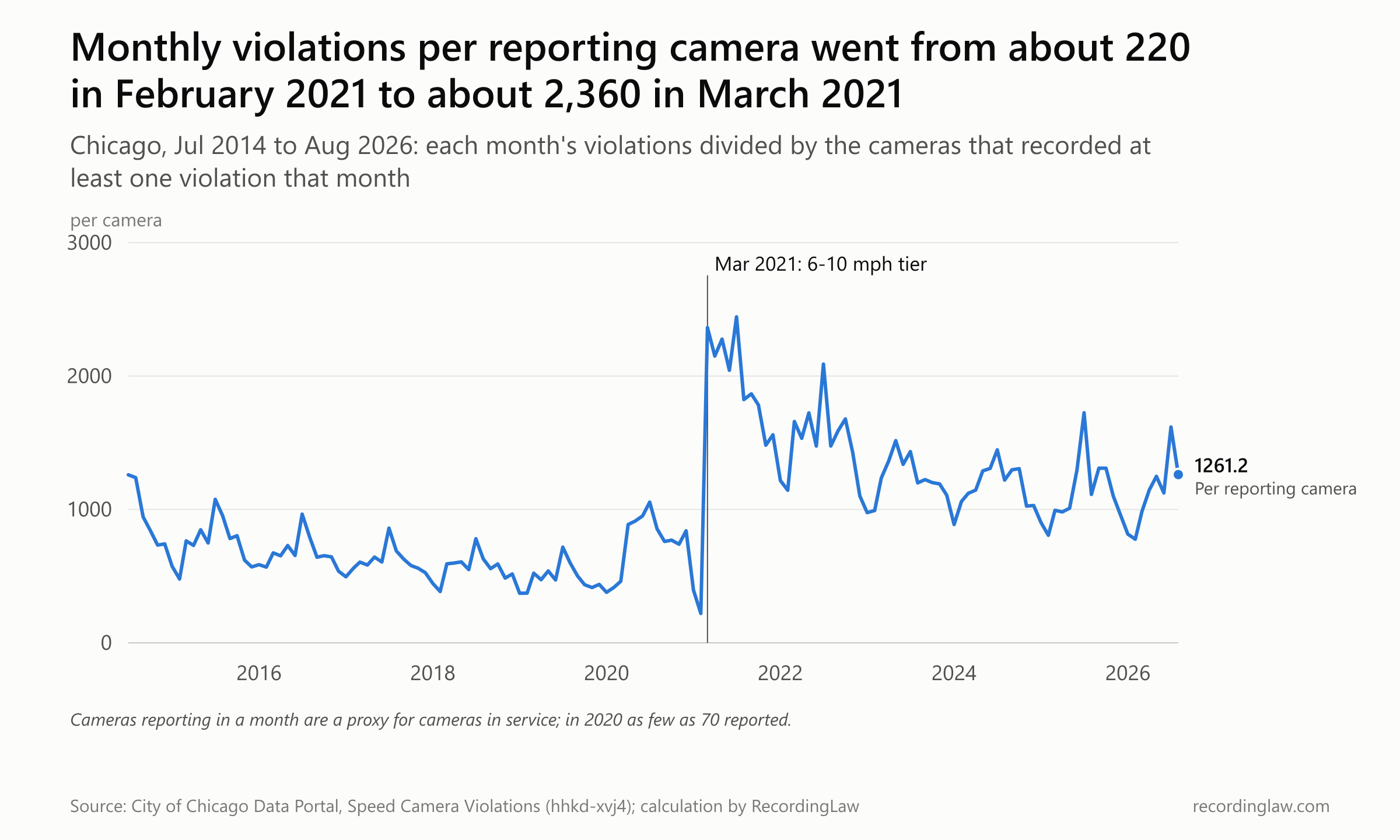
Source: City of Chicago Data Portal, Speed Camera Violations (hhkd-xvj4); calculation by RecordingLaw. Cameras reporting in a month are a proxy for cameras in service.
Per camera, the rate has not returned to its 2021 level. From 2023 through August 2026 it ran between about 780 and 1,720 a month.
| August of each year | Violations per reporting camera |
|---|---|
| 2019 | 599.4 |
| 2021 | 1,823.6 |
| 2023 | 1,198.9 |
| 2025 | 1,112.4 |
| 2026 | 1,261.2 |
Per-camera violations went from 220.1 in February 2021 to 2,362.9 in March 2021. The rate had also risen in 2020, before the change, for a different reason. During the pandemic fewer cameras reported, as few as 70 a month, and each of those recorded more violations than before.
Summer months run higher in most years, so the table compares August with August. Before 2021, though, fewer cameras recorded violations in summer: 96 to 110 in August from 2015 to 2019, versus 146 to 161 in April and May. So the 2019 figure divides by a smaller set of cameras than later years.
More cameras meant more money. How much more depends on whose count you read.
How much money, and by whose count
The money has been counted many times, and the counts do not agree. The open data does not separate warnings from tickets, does not split violations into the 6 to 10 mph and 11 mph-plus bands, and does not include revenue. Those figures come from secondhand sources, attributed here by name. They are not published city datasets.
The Illinois Policy Institute is the most frequent publisher of these counts. In September 2026 it reported that Chicago issued 529,529 tickets for 6 to 10 mph over in 2025, up from 424,754 in 2024. It reported 123,786 tickets for 11 mph or more in 2025, up from 94,906 in 2024.
The Institute reported revenue of $64.2 million in 2025, up from $59.6 million in 2024. Of the 2025 revenue, it said, $43.2 million came from the 6 to 10 mph band and $21.1 million from the 11 mph-plus band.
By that count, revenue across all cameras rose about $4.6 million in 2025. That is a net figure across all cameras, including the 69 long-running ones, whose recorded violations fell 21 percent that year. The 50 new cameras had been budgeted to raise about $11.4 million on their own, and none of the 2025 locations in the city's file went live before June 1, so each could ticket for seven months of the year at most.
In September 2025 the Tribune reported that tickets from the new cameras were "quickly hurtling toward the $11.4 million benchmark Johnson counted on for 2025," and that the early returns were "likely to decline as drivers figure out where the cameras are busting them and slow down." No source we found reports the new cameras' revenue separately for the full year.
The Institute's 2025 ticket counts total 653,315, about 27 percent of the 2,444,752 violations in the city's open data for that year. Neither the Institute nor the city dataset explains the difference.
The Institute's own figures for 2024 also differ from article to article. In March 2025 it wrote that the city collected "at most $70 million from fines" in 2024. In June 2025 it reported $90.9 million in tickets and fees for 2024.
That June 2025 article counted 1.84 million violations in 2024. Of those, it said, 1.32 million carried a fine and 523,044 were warnings.
In September 2026 the Institute put 2024 revenue at $59.6 million, from 519,660 tickets. The articles describe different measures (money collected in some, tickets and fees issued in another) and do not reconcile them.
The city's open data records 2,239,667 violations for 2024. The Institute's June 2025 count of 1.84 million violations is much closer to that figure than its September 2026 count of 519,660 tickets is. RecordingLaw did not obtain the city's own Department of Finance figures, so these numbers have not been checked against a primary source.
Bryce Hill, the Institute's senior director of fiscal and economic research, said: "If speed cameras make streets safer, fewer tickets should be a success, not a budget problem." That leaves the question the cameras were sold on.
Did the 6 mph line prevent crashes?
The only study we found that tries to estimate what Chicago's crash counts would have been without the cameras covers 2015 to 2017, more than three years before the 6 mph threshold took effect. The city commissioned it from Stacey Sutton, the UIC researcher quoted earlier, and Nebiyou Tilahun of UIC, who compared 101 camera locations with similar zones that did not get cameras. "On aggregate we estimate a 12% reduction in fatal and injury crashes at treated locations within a 250-meter buffer from 2015-2017," the authors wrote. "The estimate for serious injuries and fatalities is about 15%."
The study also found that 16 sites had more crashes than its model expected without cameras, by more than one standard deviation. It also found that tickets per household were highest in majority-Black areas, followed by majority-Latino areas. "The cameras do improve safety," Sutton told ProPublica, "but they don't all improve safety all of the time."
For the threshold itself, ProPublica concluded in July 2022: "There has been no extensive analysis of the safety benefits of the lowered threshold for issuing speeding tickets." A search for a later study that isolates the threshold found none. An earlier CDOT before-and-after count, comparing 2012-13 with 2017-18, found serious or fatal crashes up 1 percent in camera zones and 19 percent citywide, as Streetsblog reported. That count also predates the change.
After the change, the comparisons have been simple before-and-after counts, and they point in different directions. CBS 2 counted fatal crashes near cameras rising from 9 in the 12 months before the change to 13 in the 12 months after, while citywide traffic deaths rose from 142 to 181. Axios Chicago compared March 2018 to June 2019 with March 2021 to June 2022. It found all crashes down 12.7 percent near cameras and 8.2 percent citywide, but fatal crashes up 114 percent near cameras and 44 percent elsewhere.
CDOT's own count, which state law requires, points the other way, with fewer serious crashes near cameras. The city's analysis counted crashes within one-eighth of a mile (660 feet) of 115 camera locations in 2012-13, before the cameras were installed, and in 2022-23, using Illinois Department of Transportation crash data. "Fatal or serious injury crashes dropped by 11% near speed cameras between 2012-13 and 2022-23, as compared to a 19% increase city-wide," it said. It also said speed-related crashes fell 24 percent near cameras while rising 9 percent citywide.
The analysis also has a summary table of counts. Its column labelled "Fatal and Injury Crashes" shows 1,508 crashes near cameras in 2012-13 and 1,363 in 2022-23, a drop of about 10 percent, where the summary sentence gave 11 percent. The table's speed-related counts near cameras went from 848 to 683, a drop of about 19 percent, where the summary sentence gave 24 percent.
The analysis does not explain why its near-camera percentages differ from its own counts. Its citywide percentages match them. Because its before period comes before the cameras existed, it measures the cameras over a decade, not the 6 mph threshold.
The Illinois Policy Institute reported in 2023 that 43 percent of school cameras and 51 percent of park cameras showed more crashes nearby. The city disputed it. "Crash data show the opposite, with a decrease in injury crashes and total crashes near parks and schools where speed cameras are located," a spokesperson, Erica Schroeder, said.
The table sets side by side the seven comparisons of crashes near the cameras that this page reports: only the UIC study estimates what would have happened without the cameras, and none isolates the 6 mph threshold.
| Who did it | Crashes counted | Cameras or area, and period | Result | Significance or caveat |
|---|---|---|---|---|
| UIC (Sutton and Tilahun), report to the city, 2022 | Fatal and injury crashes; serious injury and fatal crashes | 101 camera locations within a 250-meter buffer, against similar zones without cameras; after period 2015 to 2017 | 12% fewer; about 15% fewer | Model estimate. Significance not reported in the passage quoted. After period predates the 2021 change. |
| CDOT, as reported by Streetsblog, 2022 | Serious or fatal crashes | Camera zones against citywide; 2012-13 against 2017-18 | Up 1% in camera zones; up 19% citywide | Before-and-after count that predates the change. Significance not reported. |
| CBS 2, 2022 | Fatal crashes near cameras; traffic deaths citywide | Near cameras against citywide; 12 months before against 12 months after March 1, 2021 | 9 to 13 near cameras; 142 to 181 citywide | Simple before-and-after count. Significance not reported. |
| Axios Chicago, 2022 | All crashes; fatal crashes | Near cameras against elsewhere; March 2018 to June 2019 against March 2021 to June 2022 | All crashes down 12.7% near cameras and 8.2% citywide; fatal crashes up 114% near cameras and 44% elsewhere | Simple before-and-after count. Significance not reported. |
| CDOT, state-required analysis | Fatal or serious injury crashes; speed-related crashes | Within one-eighth of a mile of 115 camera locations, against citywide; 2012-13, before the cameras, against 2022-23 | Fatal or serious injury down 11% near cameras, up 19% citywide; speed-related down 24% near cameras, up 9% citywide | Its summary table's "Fatal and Injury Crashes" column shows 1,508 to 1,363 near cameras (about 10%) and its speed-related counts 848 to 683 (about 19%). Measures the cameras over a decade, not the threshold. |
| Illinois Policy Institute, 2023 | Crashes nearby | Each school and park camera; period not reported | 43% of school cameras and 51% of park cameras showed more crashes | The city disputed it. Significance not reported. |
| RecordingLaw, 2026 | Crashes with a fatal or incapacitating injury | Within 250 meters of the 69 long-running cameras, within 250 meters of any camera (236 IDs), and citywide; March 2019 to February 2021 against March 2021 to February 2023 | 92 to 99 near the 69 cameras; 373 to 394 near any camera; 4,055 to 4,327 citywide | Counts near cameras are small, so a change of a few crashes is within normal variation. Not a matched comparison group. |
RecordingLaw ran its own count from the city's traffic crash dataset, which records police-reported crashes with injury counts and locations. We counted crashes with at least one fatal or incapacitating injury within 250 meters of the 69 long-running cameras, the same radius the UIC study used, and compared them with all other located serious crashes in the city, which include crashes near the other cameras. The chart below sets each line's 2019 count to 100. Did crashes near the long-running cameras move differently from the rest of the city?
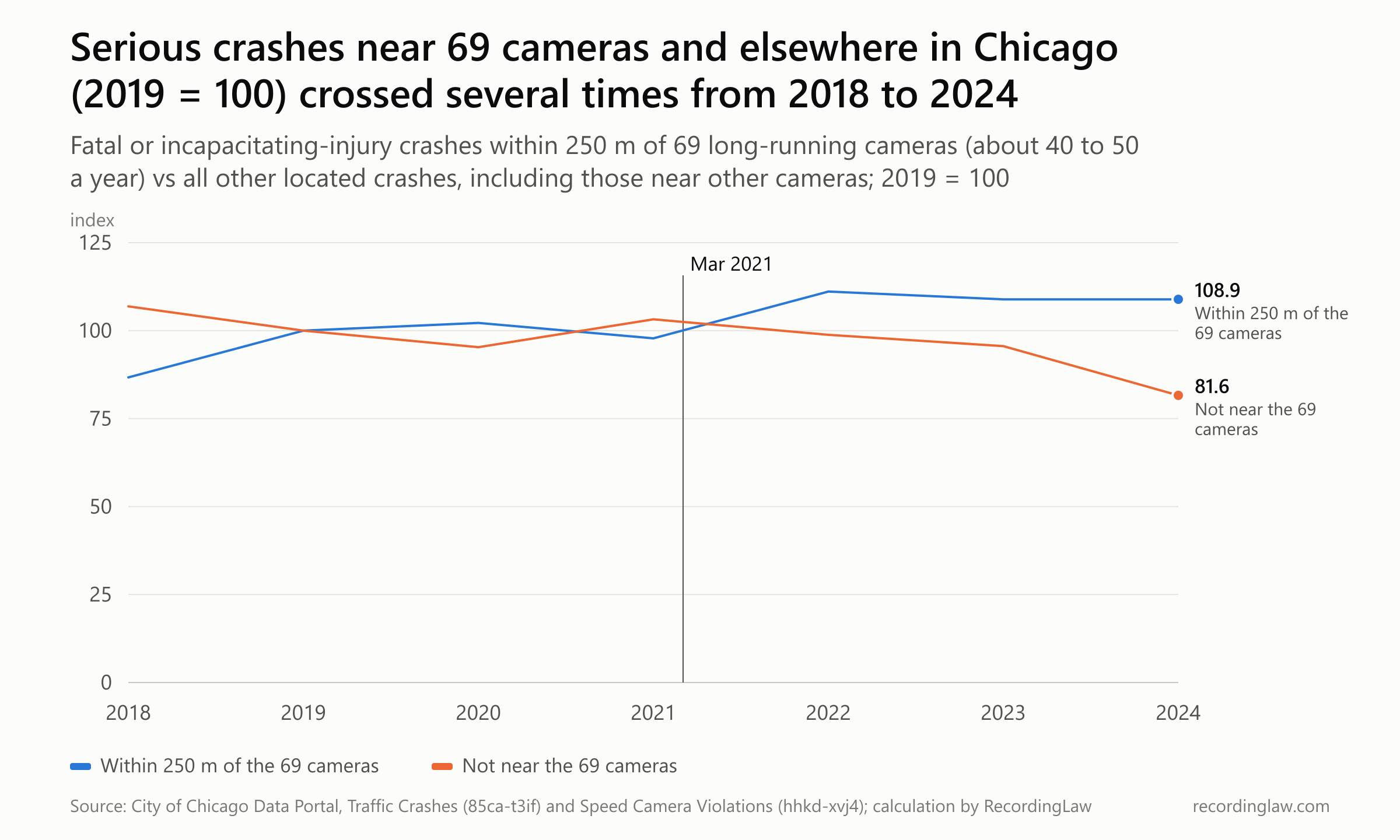
Source: City of Chicago Data Portal, Traffic Crashes (85ca-t3if) and Speed Camera Violations (hhkd-xvj4); calculation by RecordingLaw. Indexed to 2019 = 100. Near-camera counts are about 40 to 50 a year.
That way a line of about 45 crashes a year and a line of about 2,000 can share one scale. The two lines cross several times, and near the cameras the counts are too small for the gap in 2024 to mean much on its own.
| Year | Near 69 cameras | Not near the 69 cameras (includes areas near other cameras) |
|---|---|---|
| 2018 | 39 | 2,202 |
| 2019 | 45 | 2,059 |
| 2020 | 46 | 1,962 |
| 2021 | 44 | 2,125 |
| 2022 | 50 | 2,034 |
| 2023 | 49 | 1,969 |
| 2024 | 49 | 1,680 |
Over the same two-year windows used for violations, serious crashes within 250 meters of the 69 cameras went from 92 (March 2019 to February 2021) to 99 (March 2021 to February 2023). Within 250 meters of any camera in the violations data (all 236 camera IDs), they went from 373 to 394. Citywide, they went from 4,055 to 4,327.
These numbers cannot show whether the lower threshold changed crash outcomes. The counts near cameras are small, around 40 to 50 a year, so a change of a few crashes is within normal variation. Cameras sit in children's safety zones near schools and parks, chosen for reasons that may differ from the rest of the city, so the rest of the city is not a matched comparison group. Traffic volumes, pandemic-era driving and other street changes all shifted over the same period.
ABC7 published its own crash comparison, with larger counts near cameras than RecordingLaw found. ABC7 did not publish its method or camera list, and RecordingLaw could not reproduce its figures, so this article does not present them as a finding.
As of October 28, 2026, CDOT's program page linked a newer before-and-after safety analysis covering 2024 and 2025, dated October 2026. This article does not include its findings.
The next budget, and a newer city analysis
The power Chicago held unused for almost eight years has now been in use for more than five and a half years. The argument over it has moved to the next budget. On October 21, 2026, Johnson presented a $17.6 billion proposal for 2027 that adds $18 million from expanded use of automated cameras to ticket drivers who block bus and bike lanes. WTTW's account of the proposal does not mention speed cameras.
The city projected an $882.4 million gap for 2027, which WTTW called "a smaller than expected gap during an election year." A separate push to lower the citywide default speed limit from 30 mph to 25 mph failed in the City Council on February 19, 2025, with 21 votes for and 28 against. Because the camera threshold is measured from the posted limit, a lower limit would lower the speed at which tickets begin.
Three things were pending when we last checked, on October 28, 2026. The 2027 budget was before the City Council. CDOT's 2024-25 crash analysis had been posted, and its findings were not yet part of this article. And the city's daily count, which showed 12,036 violations on the first day of the rule, was still being filled in for September 2026.
None of those three yet answers the question Biagi's January 2021 statement set up. That question is whether the lower threshold changed how many people were hurt in crashes, not only how many drivers were counted.
How we measured
The rule. CDOT says that effective March 1, 2021, the city began issuing $35 tickets to motorists driving 6 to 10 mph over the speed limit in all active Children's Safety Speed Enforcement Zones, and that drivers going 11 mph or more over are subject to a $100 fine. CDOT's page also says a vehicle owner's first violation in a zone gets a warning notice. Before the change, according to Streetsblog Chicago, the penalty was $35 for going exactly 10 mph over and $100 for 11 mph and above. WBEZ reported that Lightfoot introduced the $35 tickets as part of her 2021 budget and that in July 2022 a City Council effort to return the threshold to 10 mph over did not pass. The City Council journal and the Municipal Code section for the 2021 change were not retrieved; only the March 1, 2021 effective date is from a city source, and the late-November 2020 budget approval rests on NBC 5 and CBS 2 reports.
Violations. Daily violations by camera from the City of Chicago's Speed Camera Violations dataset (hhkd-xvj4), summed by month, July 2014 through August 2026. When retrieved on October 26, 2026, the dataset ended September 9, 2026, with the latest 14 days withheld, so September 2026 is excluded. A check on October 28 found it extended to September 11, with monthly totals for January 2025 through August 2026 unchanged. The city describes the dataset as containing all violations regardless of whether a citation was issued, so these are not ticket or revenue counts. The city does not say whether warning notices are counted. For ABC7's window, March 1, 2021 to April 5, 2023, the dataset records 6,245,467 violations (queried October 28, 2026), about 8 percent more than ABC7's 5,783,898 notices, warnings included; neither source explains the gap.
Comparison windows. "Before" is March 2019 through February 2021; "after" is March 2021 through February 2023. These match the windows ABC7 used. The "before" window includes the pandemic, when traffic patterns changed, and January to February 2021, when warning notices for the new band had begun, though the daily counts show no increase when they began. In the narrative, about 6.0 million and 1.6 million are the two-year citywide counts rounded; 3.7 times is 6,026,692 divided by 1,616,812, and about 3 times is 3,757,580 divided by 1,258,354. The one-day ratio is 12,036 divided by 1,451, about 8.3.
Fixed camera set. The 69 cameras that recorded at least one violation in at least 45 of the 48 months from March 2019 to February 2023. This holds the camera count roughly constant but leaves out cameras installed or removed in other years, including the 2025 additions.
Cameras reporting. The count of distinct cameras with at least one violation in a month. It is a proxy for cameras in service, not an official installed count, and it dips when cameras are offline or seasonally inactive (116 in July 2022, 174 in July 2026). New 2025 cameras appear in the data from their ticketing start, not from their warning period. As of October 28, 2026, 27 of the 236 camera IDs in the violations data did not appear in the city's current location file (4i42-qv3h), which lists 209 locations; five daily rows in the violations data carry no camera ID.
Revenue and ticket counts. From ABC7 Chicago (FOIA records), CBS 2 (Department of Finance), WBEZ, ProPublica and the Illinois Policy Institute, attributed where used. The $4.6 million rise is $64.2 million minus $59.6 million, both Institute figures; the $11.4 million budget estimate is from the Tribune and the Institute. None was checked against Finance Department records.
Crashes. From the city's Traffic Crashes dataset (85ca-t3if), crashes with at least one fatal or incapacitating injury and a recorded location, measured by straight-line distance to each camera. The dataset covers police-reported crashes, has citywide data beginning in September 2017, and excludes interstates and some boundary roads. Recent years may be revised as reports are finalized, so 2025 is left out of the chart and table. "Any camera" means all 236 camera IDs in the violations data at every coordinate recorded for them (three IDs carry two nearby coordinates), including cameras installed or removed outside the comparison windows; that set gave 373 and 394 on October 26 and again on October 28, 2026, and using a single coordinate per ID gives 372 and 394. The CBS, Axios, Institute and CDOT crash comparisons used their own windows and methods, described where cited. The CDOT 2022-23 analysis was read from an Internet Archive copy.
The UIC study. Sutton and Tilahun, final report to the City of Chicago Mayor's Office and CDOT, January 30, 2022. The report was read from a copy hosted by the Illinois Policy Institute. Its after period is 2015 to 2017, before the threshold change.
What the data cannot show. It cannot separate warnings from tickets, the 6 to 10 mph band from the 11 mph-plus band, or show revenue. It cannot attribute any change in crashes to the threshold, because placement is not random and there is no matched control group.
For the current rules, fines and how to contest a ticket, see our guide to Chicago camera tickets. The state law that governs automated enforcement is covered in Illinois traffic camera ticket laws. For how other states and cities run speed and red-light cameras, see traffic camera ticket laws by state.
Frequently Asked Questions
When did Chicago start ticketing at 6 mph over?
CDOT says that effective March 1, 2021, the city began issuing $35 tickets to drivers going 6 to 10 mph over the speed limit in active Children's Safety Speed Enforcement Zones. Warning notices for that band were mailed starting in mid-January 2021. The city's ordinance had allowed those tickets since the program began in 2013, NBC 5 Chicago reported, but the city had never used that power.
How much is a Chicago speed camera ticket?
According to CDOT, the fine is $35 for 6 to 10 mph over the posted limit and $100 for 11 mph or more over. A vehicle owner's first violation in a zone gets a warning notice.
How many more violations did cameras record after the change?
City data shows 1,616,812 recorded violations from March 2019 to February 2021 and 6,026,692 from March 2021 to February 2023, about 3.7 times as many. At 69 cameras that operated throughout, the increase was about 3 times. These counts include violations that did not become tickets.
Did the City Council try to repeal the 6 mph threshold?
Yes. Ald. Anthony Beale introduced a repeal in March 2021. It passed the Finance Committee 16-15 on June 21, 2022, over Mayor Lori Lightfoot's objection, and failed in the full City Council on July 20, 2022, with 18 votes for and 26 against. Beale needed 26 votes.
How much revenue do Chicago speed cameras bring in?
The city's open data does not include revenue. ABC7 Chicago, using records obtained under the Freedom of Information Act, reported about $77 million in the two years before March 2021 and about $185.2 million in the two years after. The Illinois Policy Institute, a group that says it favors policies that limit the power of government, reported $64.2 million in 2025 and $59.6 million in 2024, but its articles have given different figures for 2024. RecordingLaw did not verify these against city Finance records.
Why did Mayor Brandon Johnson add speed cameras?
Johnson's 2025 budget added 50 speed cameras, estimated to raise about $11.4 million, to help cover police positions tied to the federal consent decree, the Chicago Tribune reported. As a 2023 candidate he had said he was for phasing cameras out. His office said the city does not rely on speed cameras to balance its budget.
Did serious crashes go down near speed cameras?
Near 69 long-running cameras, fatal or incapacitating-injury crashes went from 92 in the two years before the change to 99 in the two years after. Citywide they went from 4,055 to 4,327. The counts near cameras are small and the comparison does not control for road type, traffic or where cameras were placed, so it cannot show whether the change affected safety. A city-commissioned University of Illinois Chicago study estimated about 15 percent fewer fatal and serious-injury crashes near camera sites, but it covers 2015 to 2017, before the 6 mph threshold. CDOT's own before-and-after analysis reported fatal or serious injury crashes down 11 percent near cameras from 2012-13 to 2022-23, against a 19 percent rise citywide; its before period predates the cameras, so it does not isolate the threshold.
Why did violations rise in 2025?
The number of cameras recording violations went from 162 in May 2025 to 211 in December 2025, and the city's location file lists 48 locations that went live in 2025. Among 69 cameras that operated throughout, violations fell about 21 percent from 2024 to 2025.
Updates
Restructured as a feature: chart titles state the finding, side details moved to How we measured. Every figure and quote was re-checked against its source.
Independently fact-checked against the cited primary sources
Rewritten with added reporting: what lawmakers and opponents said at the time, and how the rollout unfolded. Every figure and quote was re-checked against its source.
Independently fact-checked against the cited primary sources
Independently fact-checked against the cited primary sources
Sources and References
- Chicago Department of Transportation, Children's Safety Zone Program and Automatic Speed Enforcement(chicago.gov).gov
- City of Chicago Data Portal, Speed Camera Violations (hhkd-xvj4)(data.cityofchicago.org).gov
- City of Chicago Data Portal, Speed Camera Locations (4i42-qv3h)(data.cityofchicago.org).gov
- City of Chicago Data Portal, Traffic Crashes (85ca-t3if)(data.cityofchicago.org).gov
- Streetsblog Chicago, city issuing warnings for 6 mph speed camera violations, $35 tickets after March 1 (Jan. 21, 2021)(chi.streetsblog.org)
- WBEZ Chicago, Chicago aldermen vote to keep speed cameras (July 20, 2022)(wbez.org)
- ABC7 Chicago I-Team, speed camera tickets and revenue before and after the 6-10 mph rule (FOIA records)(abc7chicago.com)
- Illinois Policy Institute, Chicago speed camera revenue in 2025(illinoispolicy.org)
- City of Chicago Data Portal, Speed Camera Violations dataset description (hhkd-xvj4 metadata)(data.cityofchicago.org).gov
- NBC 5 Chicago, Chicago drivers can be fined for going 6 mph over starting Monday (Feb. 2021)(nbcchicago.com)
- NBC 5 Chicago, Stricter Chicago speed camera rules go into effect Monday (Feb. 28, 2021)(nbcchicago.com)
- NBC 5 Chicago, Chicago begins issuing warnings for driving 6 mph over (Jan. 15, 2021)(nbcchicago.com)
- Chicago Tribune via Governing, Chicago mayor defends speed camera tickets as safety issue (Oct. 2020)(governing.com)
- Chicago Tribune via Yahoo News, Lightfoot administration official defends speed camera plan (Oct. 30, 2020)(news.yahoo.com)
- Streetsblog Chicago, COVID is not a good time to lower the threshold for speed camera tickets to 6 mph (Oct. 27, 2020)(chi.streetsblog.org)
- Illinois Policy Institute, Chicago traffic cameras to ticket drivers going 6 mph over (Oct. 2020)(illinoispolicy.org)
- CBS News Chicago, Ald. Anthony Beale seeks to return speed camera threshold to 10 mph (Mar. 24, 2021)(cbsnews.com)
- CBS News Chicago, Chicago speed cameras churn out hundreds of thousands of tickets after change (June 14, 2021)(cbsnews.com)
- CBS News Chicago, Beale proposal to repeal lower threshold rejected (Sept. 14, 2021)(cbsnews.com)
- CBS News Chicago, City Council tables Beale speed camera motion (April 2022)(cbsnews.com)
- ProPublica, Chicago's race-neutral traffic cameras ticket Black and Latino drivers the most (Jan. 11, 2022)(propublica.org)
- ProPublica, Chicago speed cameras, safety and racial disparities (July 2022)(propublica.org)
- CBS News Chicago, Aldermen defy Lightfoot, advance plan to raise speed camera threshold (June 21, 2022)(cbsnews.com)
- WTTW News, Finance Committee votes 16-15 to advance speed camera rollback (June 21, 2022)(news.wttw.com)
- WBEZ Chicago, Chicago speed cameras issue many more tickets (June 27, 2022)(wbez.org)
- CBS News Chicago, Lightfoot on council bid to raise speed camera threshold (July 18, 2022)(cbsnews.com)
- WTTW News, City Council rejects speed camera rollback 18-26 (July 20, 2022)(news.wttw.com)
- CBS News Chicago, Aldermen reject bid to raise speed camera threshold back to 10 mph (July 20, 2022)(cbsnews.com)
- Axios Chicago, Speed camera data offers mixed picture (July 19, 2022)(axios.com)
- Streetsblog Chicago, on the Illinois Policy Institute and the 6 mph rule (Jan. 4, 2022)(chi.streetsblog.org)
- Streetsblog Chicago, on CDOT before-and-after camera study (Jan. 6, 2022)(chi.streetsblog.org)
- Sutton and Tilahun (UIC), final report to the City of Chicago Mayor's Office and CDOT on traffic cameras, Jan. 30, 2022 (copy hosted by the Illinois Policy Institute)(files.illinoispolicy.org)
- NBC 5 Chicago, Study questions effectiveness of Chicago speed cameras; city contests findings (Mar. 21, 2023)(nbcchicago.com)
- Block Club Chicago, Johnson and Vallas say they will phase out speed cameras (Mar. 29, 2023)(blockclubchicago.org)
- ABC7 Chicago I-Team, Speed camera tickets for 6-10 mph over rake in millions (May 17, 2023)(abc7chicago.com)
- Chicago Tribune via Yahoo News, on balancing Mayor Johnson's 2025 budget with new speed cameras(yahoo.com)
- WGN via Yahoo News, Chicago drivers face an additional 50 speed cameras (Feb. 27, 2025)(yahoo.com)
- CBS News Chicago, New Chicago speed cameras (2025)(cbsnews.com)
- Chicago Tribune via Yahoo News, Mayor Brandon Johnson's new speed cameras see big early revenue (Sept. 7, 2025)(yahoo.com)
- Illinois Policy Institute, Our story (self-description)(illinoispolicy.org)
- Illinois Policy Institute, Chicago mayor adds 50 speed cameras to put $11.4M in his budget (Mar. 5, 2025)(illinoispolicy.org)
- Illinois Policy Institute, Chicago speed cameras take $90.9 million from drivers in 2024 (June 10, 2025)(illinoispolicy.org)
- Illinois Policy Institute press release, 2025 speed camera tickets (Sept. 16, 2026)(illinoispolicy.org)
- WTTW News, Johnson presents $17.6B proposed 2027 budget (Oct. 21, 2026)(news.wttw.com)
- WTTW News, Chicago faces $882M budget gap for 2027 (Sept. 3, 2026)(news.wttw.com)
- Chicago Department of Transportation, Automated Speed Enforcement Camera Before and After Safety Impact Analysis, 2012-13 vs. 2022-23 (Internet Archive copy)(web.archive.org)
- WTTW News, City Council votes 21-28 to reject push to lower Chicago's default speed limit to 25 mph (Feb. 19, 2025)(news.wttw.com)