TikTok Went Dark in the U.S. for 14 Hours in January 2025. ByteDance Kept 19.9% of the Venture That Took Over.

Independently fact-checked against primary sources (last audited November 9, 2026). · 23 primary sources cited on this page. How we verify our legal content
At about 10:30 p.m. Eastern on Saturday, January 18, 2025, TikTok stopped working in the United States. Users who opened the app saw a pop-up: "Sorry, TikTok isn't available right now." Apple and Google pulled it from their stores the same day.
Cloudflare watched it happen through 1.1.1.1, its DNS resolver, the service a phone asks to turn an app's web address into the numeric address it connects to. Lookups for TikTok's domains fell by as much as 85% against the same time a week before. TikTok announced at about 12:30 p.m. Eastern on Sunday that it was restoring service, "after 14 hours of the shutdown," as Cloudflare put it.
Those 14 hours are the only time the app has stopped working for American users under a federal law written to force TikTok's sale or shut it down.
Its lead sponsor, Rep. Mike Gallagher, told TikTok to "break up with the Chinese Communist Party or lose access to your American users." TikTok told a federal court a sale was "simply not possible." The Supreme Court upheld the law without a dissent, and then President Trump ordered it not enforced, five times, for a year.
In January 2026 a new joint venture took over TikTok's U.S. business, majority-owned by American investors, as the Justice Department later described it, with ByteDance, TikTok's Beijing-based owner, keeping 19.9%.
What did the law's deadline actually move, and is the sale that ended the standoff the one Congress required? President Trump determined that it is; a court and a House committee are still asking.
Measured against the calendar, the blackout was a sliver. Congress gave ByteDance 270 days to sell. The sale that ended the standoff closed 368 days after that deadline passed, while five presidential orders kept the law unenforced.
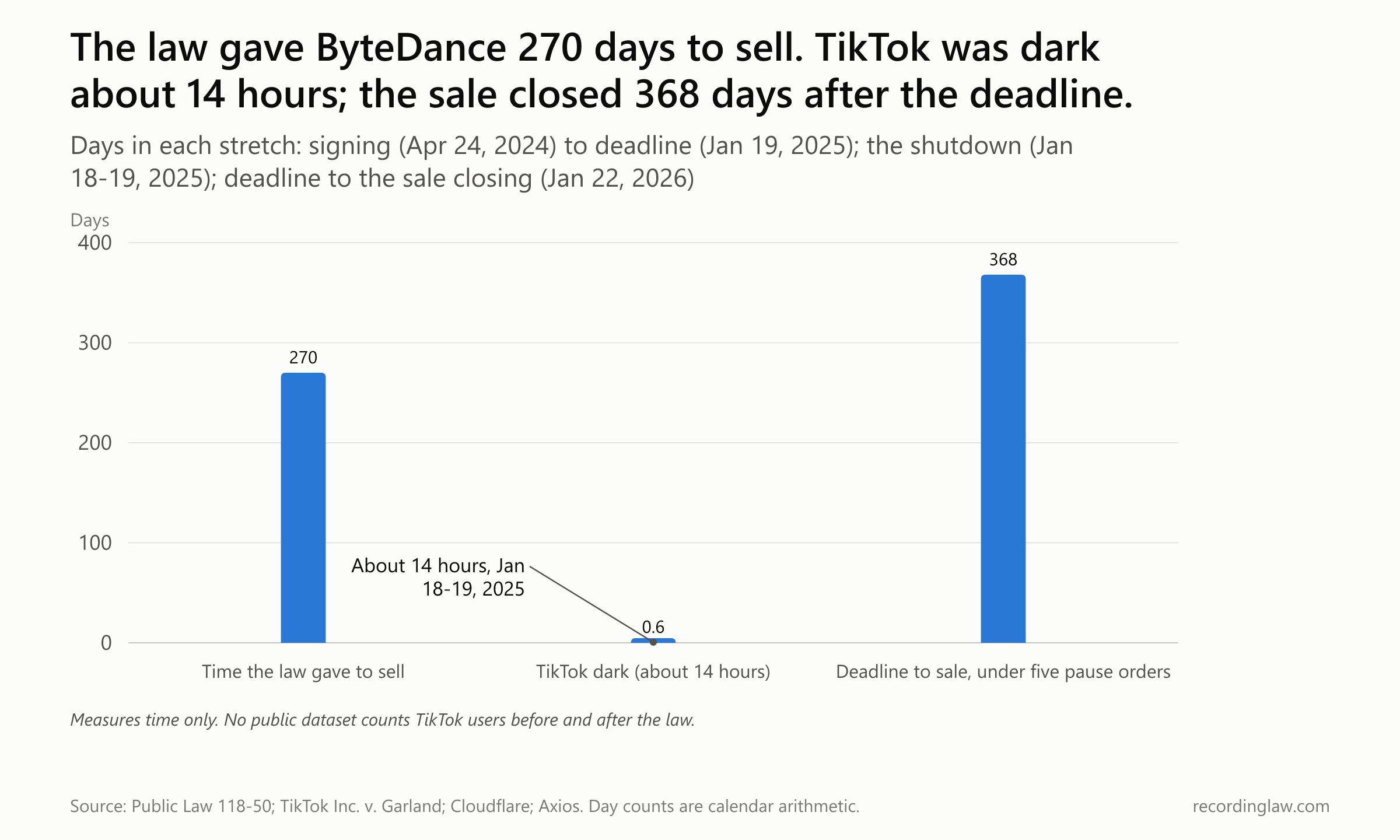
Day counts are calendar arithmetic on the dates shown. Source: Public Law 118-50; TikTok Inc. v. Garland; Cloudflare; Axios.
| Stretch | From | To | Length |
|---|---|---|---|
| Time the law gave ByteDance to sell | Apr 24, 2024 (signed) | Jan 19, 2025 (deadline) | 270 days |
| TikTok dark in the U.S. | about 10:30 p.m. ET, Jan 18, 2025 | about 12:30 p.m. ET, Jan 19, 2025 | about 14 hours |
| Deadline to sale closing | Jan 19, 2025 | Jan 22, 2026 | 368 days |
The chart measures time, not users. No public dataset counts TikTok's American audience before and after the law, so what the deadline moved has to be read from votes, court papers, app stores and a year of executive orders.
Eight days in March
The House needed eight days to pass the bill that set up that blackout. Rep. Mike Gallagher, a Wisconsin Republican who chaired the House select committee on China, introduced it on March 5, 2024, with the committee's top Democrat, Rep. Raja Krishnamoorthi of Illinois.
Two days later the Energy and Commerce Committee approved it 50-0. On March 13 the full House passed it 352-65.
The sponsors framed it as a choice for ByteDance, not a ban. "This is my message to TikTok: break up with the Chinese Communist Party or lose access to your American users," Gallagher said. Krishnamoorthi said the bill would protect users "by driving the divestment of foreign adversary-controlled apps."
The committee's summary put the mechanism in one line: "The bill provides ByteDance with a window of time to divest, and the bill's prohibitions do not apply if it completes a qualified divestment." The enacted law calls that exit a "qualified divestiture." If ByteDance completed one in time, the prohibitions would not apply.
Rep. Seth Moulton, a Massachusetts Democrat and co-lead, made the promise that the next two years would test. The bill, he said, "does so in a responsible way, that doesn't take away Americans' favorite social media apps."
In the same release, Rep. Elise Stefanik, the House Republican Conference chair, described what she was voting for differently. She was proud, she said, to introduce the bill "to finally ban TikTok in the United States."
The opposition called it a ban from the first week. After the committee vote, Jenna Leventoff, senior policy counsel at the American Civil Liberties Union, said the bill "would silence over 170 million people around the country who use TikTok every day." After the House vote she went further: "Make no mistake: the House's TikTok bill is a ban, and it's blatant censorship."
The case against TikTok had been made before. In August 2020, President Donald Trump's first-term executive order against the app said it "automatically captures vast swaths of information from its users, including Internet and other network activity information such as location data and browsing and search histories."
One opponent of the 2024 bill was the man who had signed that order. Two days before the House vote, Trump, then the presumptive Republican nominee, told CNBC: "Without TikTok, you can make Facebook bigger, and I consider Facebook to be an enemy of the people."
Meta's stock closed that Monday at about $484, down 4.4% from the previous Friday, and was back near $500 the next day. CNN reported the drop came "after Trump called into CNBC." Six weeks later the same provisions came back inside something much larger.
Signed without a mention of TikTok
On Saturday, April 20, 2024, the House passed the TikTok provisions again, 360-58, this time as part of a foreign-aid package. The Senate cleared it 79-18 on April 23. President Joe Biden signed it the next morning as Public Law 118-50, inside a $95 billion national security bill with aid for Ukraine, Israel and Taiwan.
His remarks in the State Dining Room began at 10:57 a.m. "I just signed into law the national security package that was passed by the House of Representatives this weekend and by the Senate yesterday," he said. The word TikTok does not appear in the transcript.
NBC News described what had been signed: "The law has a built-in delay of nine months, giving TikTok's Beijing-based parent company, ByteDance, a chance to sell the app rather than face a nationwide prohibition." The deadline fell 270 days after enactment, on January 19, 2025.
TikTok's chief executive, Shou Chew, answered shortly after the signing in a video on the company's account. "Make no mistake. This is a ban: a ban on TikTok and a ban on you and your voice," he said. "Many who sponsored the bill admit a TikTok ban is the ultimate goal."
The company's court challenge, filed in May, made two predictions that can now be checked. A sale, it said, is "simply not possible: not commercially, not technologically, not legally," and "certainly not on the 270-day timeline required by the Act."
The second prediction was about the algorithm. Separating the recommendation algorithm, the software that chooses which videos each user sees, from ByteDance "would leave TikTok without access to the recommendation engine that has created a unique style and community that cannot be replicated on any other platform today."
Eight creators sued separately, saying they "rely on TikTok to express themselves, learn, advocate for causes, share opinions, create communities, and even make a living." A TikTok spokesperson told the Associated Press that the company was paying their legal costs.
On the morning of the Senate vote, before the roll was called, the ACLU, which later filed a friend-of-the-court brief in the case, made a forecast a court could test. The law, Leventoff said, "will almost certainly be struck down in court."
Upheld, twice
The courts did not strike it down. On December 6, 2024, a panel of the U.S. Court of Appeals for the D.C. Circuit denied the petitions from TikTok and the creators. Writing for the court, Senior Judge Ginsburg ended the opinion this way: "Here the Government acted solely to protect that freedom from a foreign adversary nation and to limit that adversary's ability to gather data on people in the United States."
TikTok went to the Supreme Court and put a number on the stakes. "Applicants estimate that a one-month shutdown would cause the platform to lose approximately one third of its daily users in the United States," its December 16 application said.
The justices heard argument on January 10, 2025, and ruled on January 17, two days before the deadline. The judgment was unanimous. "There is no doubt that, for more than 170 million Americans, TikTok offers a distinctive and expansive outlet for expression, means of engagement, and source of community," the Court wrote. "But Congress has determined that divestiture is necessary to address its well-supported national security concerns regarding TikTok's data collection practices and relationship with a foreign adversary."
Justice Neil Gorsuch joined the judgment and added a doubt. "Whether this law will succeed in achieving its ends, I do not know," he wrote. "A determined foreign adversary may just seek to replace one lost surveillance application with another." By the time he wrote that, TikTok users had already gone looking for a replacement, and the app that topped the download chart was Chinese.
Where did the users go before the deadline?
That app, RedNote, known in China as Xiaohongshu, had been a small presence in American app stores. AppMagic estimates compiled by the Atlantic Council's Digital Forensic Research Lab (DFRLab) put its U.S. downloads at 150,000 to 275,000 a quarter from mid-2022 into 2024. They rose to more than 350,000 in the third quarter of 2024 and more than 500,000 in the fourth.
Then came the week of the Supreme Court argument. "After the justices seemed inclined to let the law stand, masses of TikTok users began creating accounts on Xiaohongshu," the AP reported on January 15. "Since Monday, Xiaohongshu has become the top downloaded free app on Apple's App Store in the U.S."
How many people arrived depends on which analytics firm's estimate you use. DFRLab, citing Reuters and Similarweb, describes the surge as nearly 3 million U.S. users gained on January 13; for downloads through January 16, it reports estimates from 700,000 (AppMagic) to about 3 million (Similarweb). Cloudflare's resolver saw DNS traffic for TikTok alternatives, led by RedNote, up as much as 116% on January 15 against the week before.
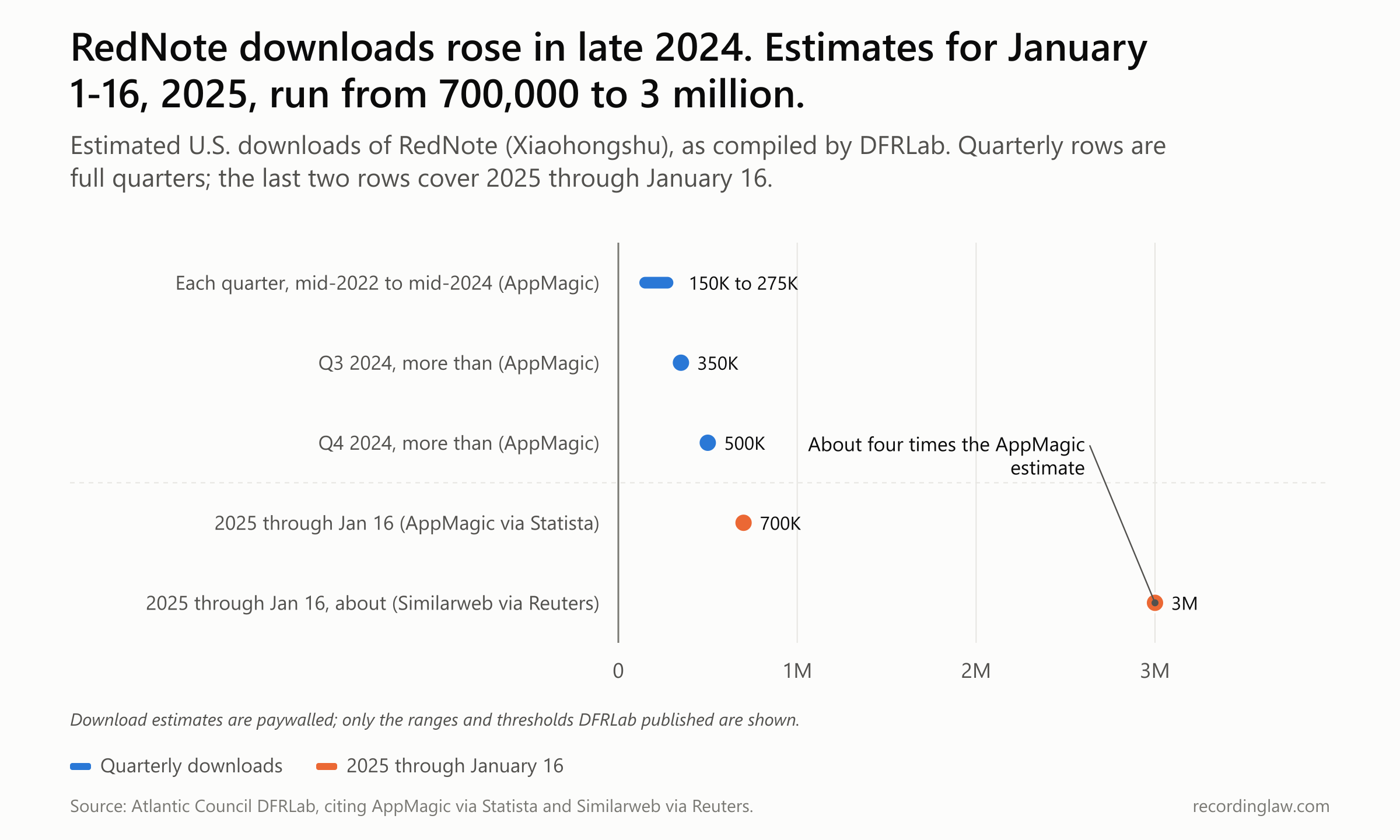
Estimates of U.S. downloads; the analytics firms' own series are paywalled. Source: Atlantic Council DFRLab, citing AppMagic via Statista and Similarweb via Reuters.
| Period | Estimated U.S. downloads | Estimator |
|---|---|---|
| Each quarter, Q2 2022 to H1 2024 | 150,000 to 275,000 | AppMagic |
| Q3 2024 | more than 350,000 | AppMagic |
| Q4 2024 | more than 500,000 | AppMagic |
| 2025 through Jan 16 | 700,000 | AppMagic via Statista |
| 2025 through Jan 16 | about 3 million | Similarweb via Reuters |
The AP called it "a rare wave of U.S.-China camaraderie." New arrivals tagged their posts #tiktokrefugee. The tag gathered almost 33 million posts and more than 2.3 billion views in total, by a New York Times count that DFRLab cites.
DFRLab did its analysis with Two Six Technologies, a company the researchers' article says is owned by the Carlyle Group; the article names no funder for the project. DFRLab is part of the Atlantic Council, which lists Meta among its $100,000 to $249,999 contributors in its 2024 and 2025 honor rolls. The researchers looked for signs that the move was orchestrated. "We did not detect evidence of a coordinated inauthentic campaign using bot accounts to encourage TikTok users to move to Xiaohongshu," they wrote.
Some users chose the app as a protest, they found, "despite the risks associated with adopting another China-owned app that stores its data in China and that arguably could provide much more unfettered access to user data than TikTok." The surge peaked before the law took effect. Engagement with the #tiktokrefugee tag, which DFRLab measured with the Chinese analytics platform Newrank, topped out on January 15, three days before the blackout.
Fourteen hours
On Friday, January 17, the outgoing administration said it would leave enforcement to its successor. "The outgoing Biden Administration said Friday that it was leaving enforcement of the TikTok ban in the hands of the Trump administration," NBC reported. TikTok said that was not enough. "Unless the Biden Administration immediately provides a definitive statement to satisfy the most critical service providers assuring non-enforcement, unfortunately TikTok will be forced to go dark on January 19," it said.
President-elect Trump posted the same day: "The Supreme Court decision was expected, and everyone must respect it. My decision on TikTok will be made in the not too distant future, but I must have time to review the situation. Stay tuned!"
Saturday night the app went dark. Its message continued past the apology: "A law banning TikTok has been enacted in the U.S. Unfortunately, this means you can't use TikTok for now," it said. "We are fortunate that President Trump has indicated that he will work with us on a solution to reinstate TikTok once he takes office. Please stay tuned!"
Sen. Rand Paul, a Kentucky Republican who opposed the law, joined TikTok that Saturday. "Why am I joining TikTok just as the government ban begins? Because I don't like being told what to do," he said in a video posted that night.
On Sunday morning Trump posted that he would pause the law and shield companies that served TikTok. Hosting providers including Oracle and Akamai brought the site and app back, NPR reported. "We thank President Trump for providing the necessary clarity and assurance to our service providers that they will face no penalties providing TikTok to over 170 million Americans and allowing over 7 million small businesses to thrive," the company said.
Sen. Tom Cotton of Arkansas, chairman of the Senate Intelligence Committee, warned the same companies off. "Any company that hosts, distributes, services, or otherwise facilitates communist-controlled TikTok could face billions of dollars of ruinous liability under the law," he wrote. Apple and Google kept the app out of their stores; it did not return for new downloads until February 13, DFRLab reported.
Traffic came back faster than the stores did. By 11 a.m. Eastern on Monday, January 20, Cloudflare measured DNS traffic to TikTok's domains at "only 14% lower than the same time last week."
TikTok had told the Supreme Court that a month dark would cost it a third of its daily users. The shutdown lasted about 14 hours.
RedNote's moment faded on the same schedule. By the end of January, DFRLab found, engagement with the #tiktokrefugee tag was "less than 0.2 percent of the peak."
A law on pause
By January 2025, the candidate who had warned that a ban would make Facebook bigger held the power to enforce it. On his first day back in office, January 20, Trump signed an executive order: "I hereby order the Attorney General not to take any action on behalf of the United States to enforce the Act for 75 days from the date of this order." It described TikTok as "a platform used by 170 million Americans."
Legal experts told NPR that the tech companies "may be waiting to see if Trump follows the letter of the law, which requires the White House to certify to Congress that a deal to sell TikTok is in progress before it can halt enforcement of the ban."
The orders kept coming. On April 4 the pause was extended to June 19. On June 19 it was extended to September 17, and on September 16 to December 16. A petition filed in 2026 by investors in TikTok's rivals later summed up the year: "In the subsequent months, President Trump issued four more extensions, all contrary to the plain text of the law."
Public opinion had moved too. A Pew Research Center survey of 5,123 adults in late February and early March 2025 found support for a ban at 34%, "down from 50% in March 2023." Opposition rose from 22% to 32%. Americans who do not use TikTok were far more likely to back a ban than those who do, 45% against 12%.
On September 25, 2025, Trump signed an order approving a framework for a sale. The Act leaves it to the President to determine whether a sale is a qualified divestiture, and the order made that call: "I have determined that the divestiture outlined in the Framework Agreement constitutes a 'qualified divestiture' under the Act." Under the framework, the order said, "the divestiture puts the operation of the algorithms and code, as well as content-moderation decisions, under the control of the new joint venture."
It set one more window: "the Attorney General shall not take any action on behalf of the United States to enforce the Act for 120 days from the date of this order." Vice President JD Vance said he expected the new U.S. company to be valued at about $14 billion. Daniel Keum, a management professor at Columbia University's business school, called that "surprisingly low."
Doubts also came from the law's own side. Rep. John Moolenaar, the Michigan Republican who succeeded Gallagher as chairman of the China committee, set out the test the next day. "The law also set firm guardrails that prohibit cooperation between ByteDance and any prospective TikTok successor on the all-important recommendation algorithm, as well as preclude operational ties between the new entity and ByteDance," he said.
Craig Singleton, a senior China fellow at the Foundation for Defense of Democracies, a Washington national security think tank, put it more sharply to the AP. "The law is clear: divestiture means severance, not supervision," he said. "A board seat for ByteDance or any continued role in maintaining the algorithm would flout Congress's mandate."
The sale
The deal closed on January 22, 2026, day 119 of that last 120-day pause, Axios reported; the investors' petition also dates the announcement to January 22. The joint venture's announcement on TikTok's newsroom is dated January 23.
TikTok USDS Joint Venture LLC "has three managing investors, Silver Lake, Oracle and MGX, each holding 15%," the announcement said. "ByteDance retains 19.9% of the Joint Venture." MGX is an Abu Dhabi-based investment firm, Axios reported.
A seven-member, majority-American board took charge, and it includes Shou Chew. The board named Adam Presser chief executive.
The announcement described what the joint venture would do with the recommendation algorithm. "The Joint Venture will retrain, test, and update the content recommendation algorithm on U.S. user data," it said, and the algorithm "will be secured in Oracle's U.S. cloud environment."
Who owns the algorithm is a separate matter. Tech Times reported in July 2026 that "ByteDance retained ownership of TikTok's recommendation algorithm as intellectual property, licensing it to the joint venture for a fee." The investors' petition says the same: ByteDance "would continue to own the app's essential recommendation algorithm, and would license it to the new American TikTok entity."
In 2024 TikTok said a sale was "simply not possible," and certainly not within 270 days. A sale to a majority-American company did close, 21 months after the signing and a year after the 270 days ran out.
Moulton said the law would not take away Americans' favorite app. Apart from 14 hours, it did not.
Gallagher told TikTok to break up with the Chinese Communist Party or lose access. TikTok kept access, while ByteDance kept a minority stake and, by these accounts, ownership of the algorithm.
The new company now claims a larger audience, "now enabling more than 200 million Americans and 7.5 million businesses to continue to discover, create, and thrive." The executive order, the Supreme Court and TikTok itself had all cited 170 million users in 2024 and 2025.
Did investors treat the law as a gift to TikTok's rivals?
Trump's March 2024 remark had assumed that Facebook would gain if TikTok went away, and Meta, Snap and Pinterest are three of TikTok's rivals whose shares trade publicly. Investors had two chances to bet on it: the week the law was signed and the week it took effect.
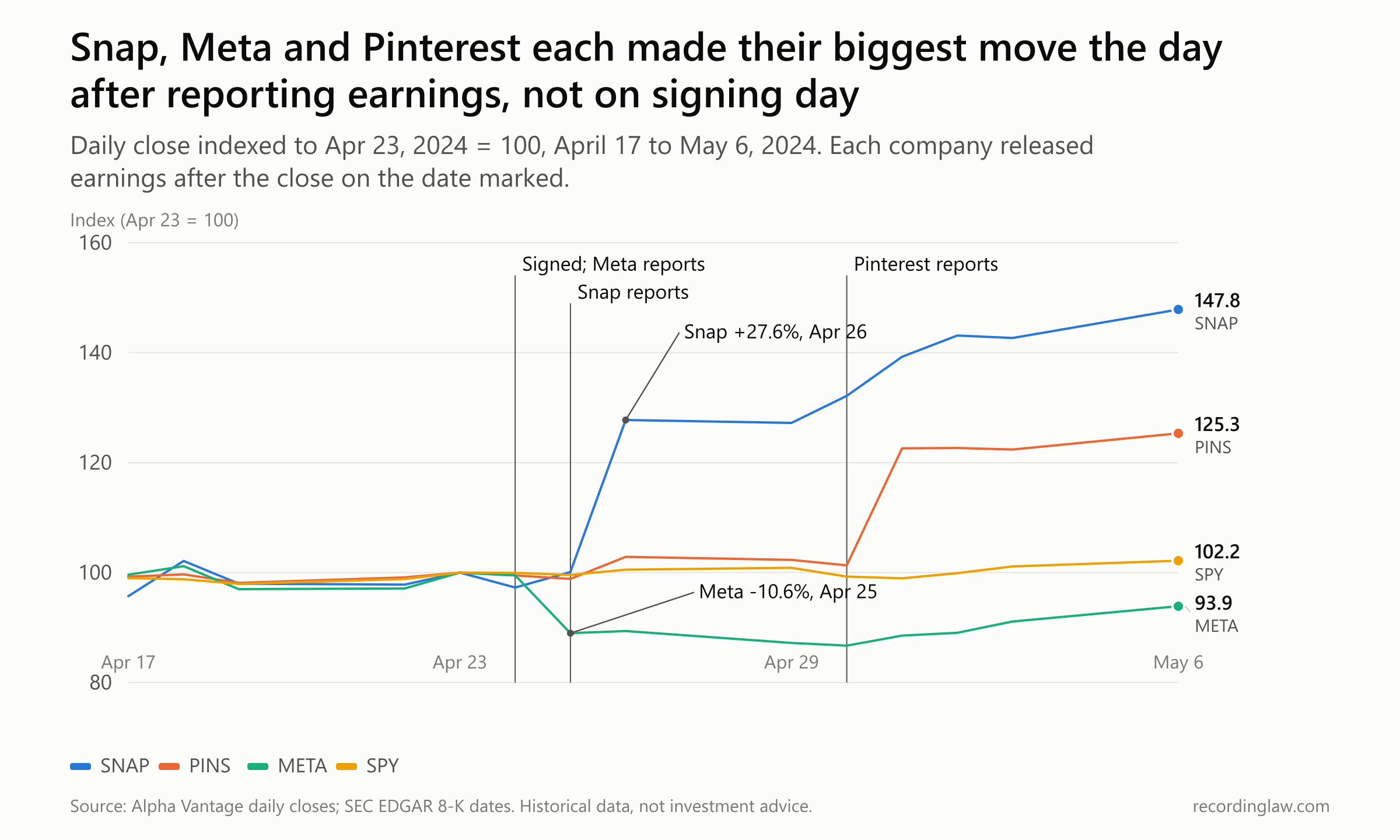
Daily closes indexed to April 23, 2024 = 100, with the signing and each company's earnings release marked. Source: Alpha Vantage daily closes; SEC EDGAR 8-K filing dates.
| Ticker | Close Apr 23, 2024 | Close Apr 24 (signing day) | Close Apr 26 | Change Apr 23-26 | Earnings released (after close) | Next-day move |
|---|---|---|---|---|---|---|
| SNAP | $11.39 | $11.08 | $14.55 | +27.74% | Apr 25 | +27.63% (Apr 26) |
| PINS | $33.02 | $32.85 | $33.96 | +2.85% | Apr 30 | +21.02% (May 1) |
| META | $496.10 | $493.50 | $443.29 | -10.65% | Apr 24 | -10.56% (Apr 25) |
| SPY | $505.65 | $505.41 | $508.26 | +0.52% | not applicable | not applicable |
Over the three trading days after the Senate vote, Snap rose 27.7% while Meta fell 10.6% and the broad market barely moved. Almost all of each move came on a single day, and that day was not the signing.
Meta reported first-quarter earnings after the close on April 24, the day Biden signed, and fell 10.6% the next session. Snap reported after the close on April 25 and rose 27.6% the next session. Pinterest reported on April 30 and jumped 21% on May 1.
On the signing day itself, before any of the three had reported, Snap closed down 2.7%, and Pinterest and Meta each closed down 0.5%. SPY, the index fund that tracks the S&P 500 and stands in here for the broad market, was flat. The second window, around the ruling and the blackout, had no earnings in it.
Daily closes around the ruling, the blackout and the pause order. January 20 was a market holiday. No company in the table reported earnings between January 16 and 21; Meta's next report came on January 29. Source: Alpha Vantage daily closes.
| Ticker | Close Jan 16, 2025 | Close Jan 17 (ruling) | Close Jan 21 (after blackout and pause) | Change Jan 16-21 |
|---|---|---|---|---|
| SNAP | $11.22 | $10.86 | $10.56 | -5.88% |
| PINS | $30.39 | $30.53 | $32.07 | +5.53% |
| META | $611.30 | $612.77 | $616.46 | +0.84% |
| SPY | $591.64 | $597.58 | $603.05 | +1.93% |
From the close before the ruling to the first session after the pause order, Pinterest gained 5.5%, Meta 0.8% and Snap lost 5.9%, while the market rose 1.9%. Two rivals moved in opposite directions over the same days, and Meta, the largest of the three, moved less than the market.
Side by side, the two windows show the large moves in 2024 lining up with earnings dates and the 2025 moves small and mixed. These are raw price changes against one benchmark, not a statistical event study, the method that estimates what each stock would have done without the news, so they cannot say what the law did to any company's value.
In the record we examined, the one sharp Meta move on a day of TikTok news with no earnings release was the March 11, 2024 drop after Trump's remark about Facebook. Other news may have moved it too.
Rival shareholders did come back into the story, in court. The petition quoted above was filed in March 2026 by two individual investors who say they have invested in companies that compete with TikTok, represented by the Public Integrity Project, asking the D.C. Circuit to declare unlawful both the president's pauses of the law and the sale that followed them. An amended petition in April added a third petitioner, who proceeds under a pseudonym.
"When the illegal sale was announced, Petitioners suffered financially," their petition says. That is their claim; the Justice Department has moved to dismiss, arguing in part that they lack standing, the legal right to bring the case.
This article reports historical market data and is not investment advice.
Still open
The question Moolenaar asked on January 23, 2026, the date of the joint venture's announcement, is still before his committee. "Does this deal ensure China does not have influence over the algorithm? Can the parties involved assure Americans their data is secure?" he asked. "Those are questions that need to be answered as the Select Committee does oversight of this deal."
TikTok agreed to send its chief security officer to a committee roundtable on September 15, 2026, and withdrew on August 27. "TikTok has backed out of its commitment to appear at the Committee's September roundtable to answer questions on China's influence over TikTok's algorithm and its access to Americans' data," the committee said. According to Moolenaar, TikTok cited unrelated child-safety litigation; he said no part of the roundtable was meant to focus on children. The committee is trying to schedule another meeting before the end of 2026 and plans to invite Presser.
In court, the petitioners' case, D.C. Circuit No. 26-1047, is still pending. "The law was clear, but it was never enforced," their petition says.
On July 20, 2026, the court sent the Justice Department's motion to dismiss to the merits panel, the judges who will decide the case itself. The government's index to the record, the list of documents the court will review, was due October 20, 2026. On November 6, 2026, acting on the parties' joint motion to defer a briefing schedule, the clerk ordered them to file a status report by December 7, 2026. As of November 6, 2026, the public docket showed no merits ruling.
The next dates to watch are the parties' December 7 status report in No. 26-1047, which we will check by December 15, 2026, and the House committee's rescheduled TikTok meeting, promised before December 31.
The executive branch has given its answer. The President determined in September 2025 that the framework deal is a qualified divestiture. The open question is whether a court or Congress accepts that determination for a deal in which ByteDance licenses the algorithm.
In 2022 Congress banned TikTok from federal government devices. On July 16, 2026, the Justice Department's Office of Legal Counsel concluded that "the version of TikTok operated by the TikTok U.S. Data Security Joint Venture does not fall within this prohibition because the Joint Venture functions independently of ByteDance, is majority-owned by American investors," and has revised the recommendation algorithm and cybersecurity program ByteDance built. The question it answered was whether federal employees may use TikTok on government devices "now that a 'qualified divestiture' will allow the application to continue operating in the United States."
Federal employees may now download TikTok on official devices, at their agency's discretion.
How we measured
Dates of the law. The signing date (April 24, 2024) is from Public Law 118-50 on govinfo.gov; the vote counts are from Congress.gov's action records for H.R. 7521 and H.R. 815 and the House Clerk's roll calls. The effective date (January 19, 2025, 270 days after enactment) and the Supreme Court's dates (argued January 10, decided January 17, 2025) are from the Court's opinion in TikTok Inc. v. Garland. The 2025 orders and their dates are from the White House presidential actions pages.
The joint venture's closing date rests on Axios (January 22, 2026); the investors' petition dates the announcement to January 22, and the joint venture's announcement on TikTok's newsroom is dated January 23. Counting from the September 25 order, day 120 was January 23, 2026, so the January 22 closing fell on day 119. The day-120 arithmetic: 5 days left in September, plus 31, 30, 31 and 23 days, is 120.
The calendar chart. The 270 days run from the signing (April 24, 2024) to the effective date (January 19, 2025), as the Act sets them. The 368 days run from January 19, 2025 to the January 22, 2026 closing Axios reported: 365 days to January 19, 2026, plus 3. Signing to closing is 270 plus 368, or 638 days, about 21 months. The shutdown bar is about 14 hours, or 0.6 of a day, from Cloudflare's timing.
The blackout. The timing (DNS traffic falling after 10:30 p.m. Eastern on January 18, a restoration announcement at about 12:30 p.m. Eastern on January 19) and the traffic changes (down as much as 85%, then 14% below the prior week on January 20) come from Cloudflare's published analysis of its 1.1.1.1 resolver, which compares each period with the same time a week earlier. DNS lookups are a proxy for use, not a count of users, and cover only people who use Cloudflare's resolver. The February 13 return to the app stores rests on DFRLab.
Downloads and the hashtag. We could not obtain an app-download time series: AppMagic, Sensor Tower and Similarweb data are paywalled. Every download figure here is a range or threshold reported by DFRLab (AppMagic via Statista, and Similarweb via Reuters), and the estimators disagree by a factor of about four for January 2025.
DFRLab's hashtag engagement series (from Newrank) is published only as an image, so we report its two stated points, the January 15 peak and "less than 0.2 percent of the peak" by the end of January, and do not chart it. The downloads chart shows only the ranges and thresholds DFRLab published; its last two rows cover 2025 through January 16, not a full quarter, so they are not directly comparable with the quarterly rows. The 33 million posts and 2.3 billion views are The New York Times's cumulative count as cited by DFRLab, not a daily peak.
Stock prices. Daily closes for Snap (SNAP), Pinterest (PINS), Meta (META) and the SPDR S&P 500 ETF (SPY) come from Alpha Vantage's daily series, which is not adjusted for splits or dividends; none of the four split in either window. Window returns are close to close: April 23 to April 26, 2024, and January 16 to January 21, 2025 (January 20 was a market holiday).
Earnings dates are the filing dates of each company's SEC Form 8-K with item 2.02, the filing a public company uses to release its quarterly results. In April 2024 all three were filed after the market close, so the price reaction is the next trading day: Meta April 24, Snap April 25 and Pinterest April 30. The next releases, Meta January 29, Snap February 4 and Pinterest February 6, 2025, all fall outside the January 16-21 window.
Signing-day changes are April 23 to April 24 closes: SNAP $11.39 to $11.08 (-2.72%), PINS $33.02 to $32.85 (-0.51%), META $496.10 to $493.50 (-0.52%), SPY $505.65 to $505.41 (-0.05%). The March 2024 Meta figures are the March 8, 11 and 12 closes ($505.95, $483.59, $499.75).
We did not fit an abnormal-return model with an estimation window, the event-study method that predicts each stock's normal move from its own past behavior; SPY is the only benchmark. A single-day move can reflect other news, and nothing here measures the law's effect on any company.
Survey. Pew's figures come from its American Trends Panel, a probability-based panel of 5,123 U.S. adults surveyed February 24 to March 2, 2025, compared with Pew's March 2023 survey.
Other figures. The new company is also spending in Washington and planning to spend on computing. It spent more than $2.5 million on lobbying in 2026 through September, $1.2 million of it in the third quarter, The Washington Sun reported from federal disclosures, the first quarter in which it outspent ByteDance. One source told CNBC in October 2026 that it is looking for four gigawatts of computing power by the early 2030s.
What the data cannot show. No public dataset counts TikTok's U.S. users before and after the law on a consistent basis; the 170 million and 200 million figures are claims by the parties. The ownership and algorithm terms come from TikTok's announcement, the framework order and secondary reporting; the licensing agreement itself has not been published.
Frequently Asked Questions
When was the TikTok ban law signed, and when did it take effect?
President Biden signed the Protecting Americans from Foreign Adversary Controlled Applications Act on April 24, 2024, as part of a $95 billion national security package. Its prohibitions took effect on January 19, 2025, 270 days after enactment. It barred app stores and hosting companies from serving TikTok after January 19, 2025, unless ByteDance completed a qualified divestiture.
How long was TikTok actually banned in the United States?
TikTok went dark at about 10:30 p.m. Eastern on January 18, 2025, and announced it was restoring service about 14 hours later, on January 19, according to Cloudflare. Apple and Google kept it out of their app stores for new downloads until February 13, 2025, according to DFRLab.
Did the Supreme Court uphold the TikTok law?
Yes. In TikTok Inc. v. Garland, decided January 17, 2025, one week after argument, the Court affirmed the D.C. Circuit and upheld the law without a dissent. Justice Gorsuch concurred in the judgment and wrote that he did not know whether the law would achieve its ends.
Why was the law not enforced after it took effect?
On January 20, 2025, President Trump ordered the Attorney General not to enforce it for 75 days. He extended that pause on April 4, June 19 and September 16, 2025, and on September 25, 2025, approved a sale framework with a further 120-day non-enforcement period. Two investors and a third, pseudonymous petitioner have challenged the extensions as unlawful in the D.C. Circuit.
Who owns TikTok in the United States now?
Since January 2026, TikTok's U.S. business has been run by TikTok USDS Joint Venture LLC. According to its announcement, Silver Lake, Oracle and MGX, an Abu Dhabi-based firm, each hold 15% and ByteDance retains 19.9%. Reporting and a court petition say ByteDance kept ownership of the recommendation algorithm and licenses it to the joint venture.
Did RedNote replace TikTok?
Briefly. RedNote became the most-downloaded free app in the U.S. Apple App Store in the week of January 13, 2025, but DFRLab found engagement with its #tiktokrefugee hashtag peaked on January 15 and fell below 0.2% of that peak by the end of January.
Did Meta, Snap or Pinterest stock rise because of the TikTok ban?
The large moves around the April 2024 signing came the day after each company reported quarterly earnings: Meta fell 10.6% on April 25 and Snap rose 27.6% on April 26. In the January 2025 window around the ruling and blackout, with no earnings, Pinterest rose 5.5%, Meta 0.8% and Snap fell 5.9% while the S&P 500 fund rose 1.9%. These are raw price changes, not a measure of the law's effect, and not investment advice.
Is the TikTok joint venture a qualified divestiture under the law?
President Trump determined in his September 25, 2025 order that the divestiture in the deal framework is a qualified divestiture, a call the Act assigns to the President, and the Justice Department's Office of Legal Counsel concluded in July 2026 that the joint venture's app falls outside the federal-device ban. House China committee chairman John Moolenaar has asked whether the deal keeps China away from the algorithm, and three petitioners are challenging it in the D.C. Circuit, case No. 26-1047, with no merits ruling as of November 6, 2026.
Updates
Restructured as a feature: chart titles state the finding, side details moved to How we measured. Every figure and quote was re-checked against its source.
Independently fact-checked against the cited primary sources
Independently fact-checked against the cited primary sources
Sources and References
- Public Law 118-50 (H.R. 815), including the Protecting Americans from Foreign Adversary Controlled Applications Act, April 24, 2024(govinfo.gov).gov
- U.S. Supreme Court, TikTok Inc. v. Garland, No. 24-656 (January 17, 2025), per curiam and Gorsuch concurrence(supremecourt.gov).gov
- TikTok Inc. and ByteDance Ltd., application for injunction, Supreme Court docket 24A587 (December 16, 2024)(supremecourt.gov).gov
- U.S. Court of Appeals for the D.C. Circuit, TikTok Inc. v. Garland, No. 24-1113 (December 6, 2024)(media.cadc.uscourts.gov).gov
- Congress.gov, H.R. 7521 all actions (introduction, 50-0 committee vote, 352-65 House vote)(congress.gov).gov
- Congress.gov, H.R. 815 all actions (Senate vote 79-18, record vote 154, April 23, 2024)(congress.gov).gov
- Office of the Clerk, U.S. House, Roll Call 86 (H.R. 7521, 352-65), March 13, 2024(clerk.house.gov).gov
- Office of the Clerk, U.S. House, Roll Call 145 (H.R. 8038, 360-58), April 20, 2024(clerk.house.gov).gov
- Daily Compilation of Presidential Documents, Biden remarks on signing the national security package, April 24, 2024(govinfo.gov).gov
- House Select Committee on the CCP, introduction of the Protecting Americans from Foreign Adversary Controlled Applications Act, March 5, 2024(chinaselectcommittee.house.gov).gov
- House Select Committee on the CCP, Moolenaar statement on the TikTok deal, January 2026(chinaselectcommittee.house.gov).gov
- House Select Committee on the CCP, statement on TikTok's withdrawal from the September 2026 roundtable(chinaselectcommittee.house.gov).gov
- House Select Committee on the CCP, plans to reschedule a TikTok meeting before the end of 2026(chinaselectcommittee.house.gov).gov
- Executive Order 13942, Addressing the Threat Posed by TikTok (August 6, 2020)(trumpwhitehouse.archives.gov).gov
- White House, executive order pausing enforcement for 75 days, January 20, 2025(whitehouse.gov).gov
- White House, extending the TikTok enforcement delay, April 4, 2025(whitehouse.gov).gov
- White House, further extending the TikTok enforcement delay, June 19, 2025(whitehouse.gov).gov
- White House, further extending the TikTok enforcement delay, September 16, 2025(whitehouse.gov).gov
- White House, Saving TikTok While Protecting National Security, September 25, 2025(whitehouse.gov).gov
- U.S. Department of Justice, Office of Legal Counsel opinion on TikTok and the No TikTok on Government Devices Act, July 16, 2026(justice.gov).gov
- CourtListener, D.C. Circuit docket No. 26-1047(courtlistener.com)
- D.C. Circuit No. 26-1047, clerk's order directing a status report by December 7, 2026 (filed November 6, 2026)(storage.courtlistener.com)
- Petition for review, D.C. Circuit No. 26-1047, filed March 5, 2026 (Public Integrity Project)(static1.squarespace.com)
- TikTok Newsroom, announcement from the new TikTok USDS Joint Venture LLC, January 23, 2026(newsroom.tiktok.com)
- Axios, TikTok closes deal to divest U.S. entity, January 23, 2026(axios.com)
- Atlantic Council DFRLab and Two Six Technologies, TikTok users and Xiaohongshu (RedNote), February 24, 2025(dfrlab.org)
- Atlantic Council, 2025 honor roll of contributors(atlanticcouncil.org)
- Atlantic Council, 2024 annual report honor roll(atlanticcouncil.org)
- Cloudflare, TikTok ban traffic decline and the rise of alternatives, January 2025(blog.cloudflare.com)
- Pew Research Center, support for a TikTok ban, March 25, 2025(pewresearch.org)
- ACLU statement on the Energy and Commerce committee vote, March 7, 2024(aclu.org)
- ACLU statement after House passage, March 13, 2024(aclu.org)
- ACLU statement before the Senate vote, April 23, 2024(aclu.org)
- CNBC, Trump says a TikTok ban would empower Meta, March 11, 2024(cnbc.com)
- CNN Business, Meta shares fall after Trump remark, March 11, 2024(edition.cnn.com)
- NBC News, TikTok CEO Shou Chew says fight will head to court, April 24, 2024(nbcnews.com)
- NPR via GPB, TikTok challenges U.S. ban in court, May 7, 2024(gpb.org)
- Associated Press via ClickOrlando, TikTok creators sue, May 14, 2024(clickorlando.com)
- Associated Press via WABE, U.S. TikTok users flock to RedNote, January 15, 2025(wabe.org)
- Associated Press via WAFB, TikTok refugees and RedNote, January 19, 2025(wafb.com)
- NBC, TikTok says it will go dark unless given assurances, January 17, 2025(nbcbayarea.com)
- ABC News, TikTok restoring service, January 19, 2025(abcnews.go.com)
- NPR via OPB, TikTok is back online, January 19, 2025(opb.org)
- WBKO, Sen. Rand Paul joins TikTok, January 18, 2025(wbko.com)
- Associated Press via News4JAX, House China committee chair on the TikTok deal, September 26, 2025(news4jax.com)
- Tech Times, ByteDance kept the algorithm after the split, July 23, 2026(techtimes.com)
- The Washington Sun, TikTok USDS Joint Venture lobbying, October 21, 2026(washingtonsun.com)
- CNBC, TikTok U.S. compute capacity, October 23, 2026(cnbc.com)
- Alpha Vantage, TIME_SERIES_DAILY for SNAP, PINS, META and SPY (retrieved October 31, 2026)(alphavantage.co)
- SEC EDGAR, Meta Platforms filings (8-K item 2.02 dates)(data.sec.gov).gov
- SEC EDGAR, Snap Inc. filings (8-K item 2.02 dates)(data.sec.gov).gov
- SEC EDGAR, Pinterest filings (8-K item 2.02 dates)(data.sec.gov).gov