How Many of 2025's 1,200 State AI Bills Became Law? Five Counts Say 73 to 227.

Independently fact-checked against primary sources (last audited November 6, 2026). · 15 primary sources cited on this page. How we verify our legal content
At about 4:24 in the morning Eastern time on July 1, 2025, the U.S. Senate voted 99-1 to cut one section out of the budget bill it was working through overnight. The section would have put a 10-year moratorium, or pause, on the enforcement of state laws on artificial intelligence.
The House had passed the same bill with the moratorium in it about six weeks earlier, 215-214 with one member voting present, at 6:54 a.m. on May 22. Hours after the Senate's early vote, the full bill passed the Senate 51-50, without it.
The moratorium's backers had leaned on a number. "More than 1,000 AI-related bills have already been introduced at the state and local level this year," a coalition led by the U.S. Chamber of Commerce wrote to senators on June 9, 2025. "Without a federal moratorium there will be a growing patchwork of state and local laws that will significantly limit AI development and deployment."
The count was real, and it kept climbing. MultiState, a government-relations firm that tracks bills for clients, counted fewer than 200 AI bills in state legislatures in 2023, 1,208 in 2025 and 1,561 by March 2026. What the count did not say was how many of those bills became law, or what kind of law. Depending on whose tracker you read, somewhere between about one in eight and just under one in five of 2025's AI bills was enacted, and the published counts of what passed that year run from 73 to 227.
By the count of the National Conference of State Legislatures (NCSL), only two comprehensive AI bills were enacted in 2026, meaning broad laws on AI transparency and consumer safety rather than laws aimed at one use such as deepfakes. Both came from states that had tried before. Connecticut's attempts died in 2024 and 2025. Colorado's first law drew a federal lawsuit that the U.S. Justice Department moved to join, and it was rewritten before it ever took effect.
The moratorium fight was a fight over preemption, the power of a federal law to override state laws on the same subject. So what did more than 1,000 bills a year turn into, and how does that record compare with what each side of that fight said it would be?
Where did 1,000 bills a year come from?
Two years before the Senate vote, the count was small. In 2023, MultiState counted fewer than 200 state AI bills in all the legislatures combined. In 2024, lawmakers in 45 states introduced 635, which MultiState called "more than three times the volume seen in 2023."
In 2025 it nearly doubled, to 1,208, and it was the first year every state introduced at least one. By March 2026, MultiState's count for the year already stood at 1,561, more than its total for all of 2025. In 23 of the 44 states in the second year of a two-year session, though, 2025 bills could carry over into 2026, and MultiState does not say whether those are counted again.
How fast did state AI bills multiply?
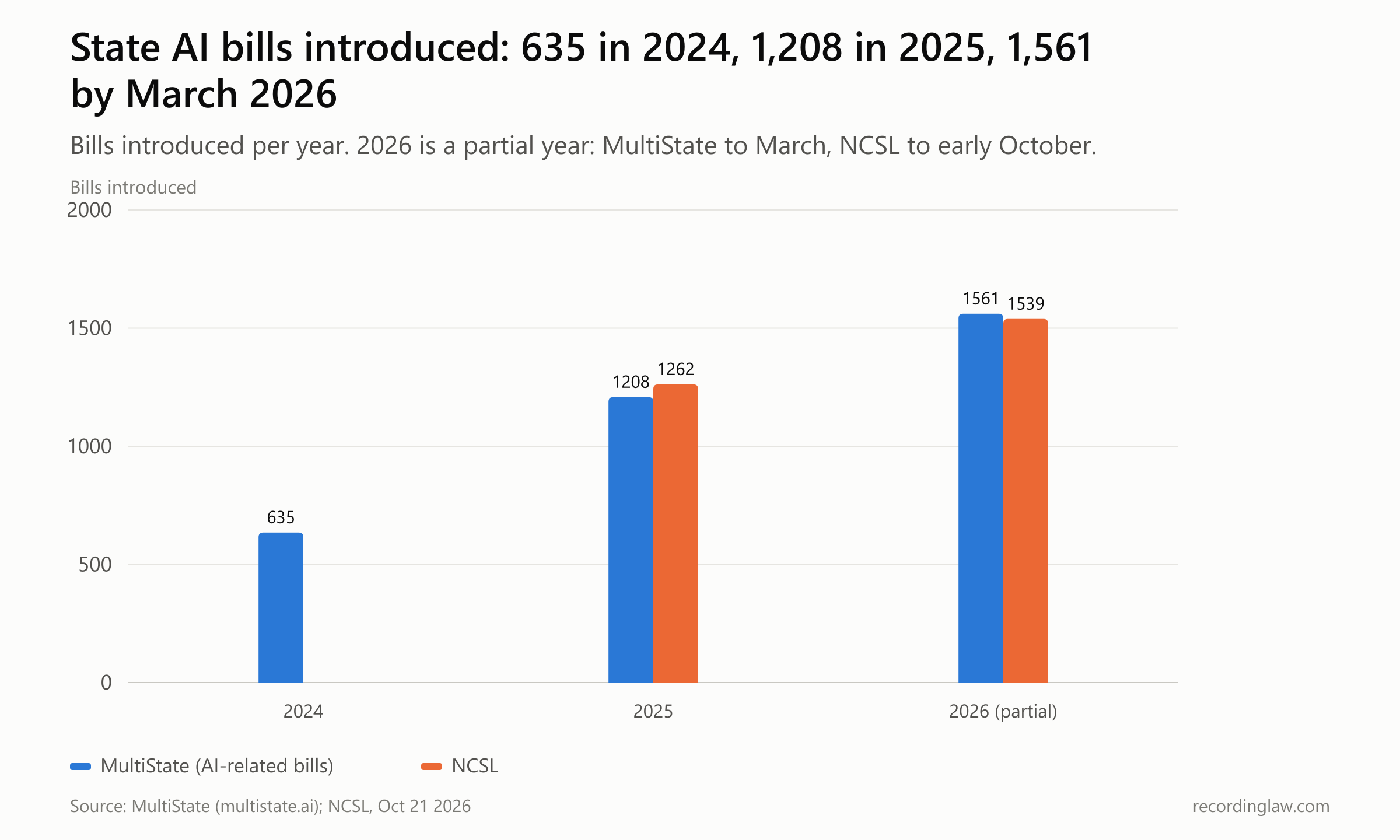
Source: MultiState; National Conference of State Legislatures (NCSL), October 21, 2026. 2026 figures are partial years with different cutoffs.
| Year | MultiState (AI-related bills introduced) | NCSL (bills introduced) |
|---|---|---|
| 2023 | fewer than 200 | not counted in bills |
| 2024 | 635 | not counted in bills |
| 2025 | 1,208 | 1,262 |
| 2026 (partial) | 1,561 (to March) | 1,539 (to early October) |
MultiState's count nearly doubled from 2024 to 2025, and both trackers had 2026 above 1,500 bills before the year was over.
What counts as an AI bill is a choice each tracker makes. MultiState says its definition is broad on purpose. It includes task forces and study committees, "right to compute" and regulatory sandbox bills, "budget items to incentivize AI-related investment in a state or boost education on using AI," deepfake bills, and bills on related technologies such as autonomous vehicles.
Steven Adler, an independent writer who publishes on Substack, went through one list behind the 1,000-bill figure in mid-2025. He took the 1,033 bills on NCSL's 2025 list through late April, ran a keyword scan and had GPT-4o score each one. He reported that about 40% barely mention AI, and that "Roughly 90% of the truly AI-related bills still don’t seem to impose specific requirements on AI developers."
The first bill on the list, he wrote, was Alabama's House Bill 169, a standard bill funding public universities and schools. "As far as I can tell, this bill is counted as AI-related among the 1,000 bills because it says “artificial intelligence” exactly once, when granting $125K of Alabama’s 5.5 billion dollar public education budget (0.002%)," he wrote. His method relies on a language model's scoring and has not been peer reviewed.
Connecticut Sen. James Maroney turned the argument around. "Saying AI should only be regulated federally is to say it shouldn’t be regulated at all," he said, in a line NCSL highlighted in its October 2026 write-up of a session with legislators. Whichever way the count was read, it measured bills filed. The next question is how many became law.
How many became law?
Most of them did not, at least not in the year they were introduced. By MultiState's count, 99 of the 635 AI bills introduced in 2024 were enacted that year, about 16%. In 2025, 145 of 1,208 were, about one in eight.
NCSL counts differently and gets a higher share. Will Clark, an NCSL fellow, speaking at the group's Base Camp 2026 conference, said states introduced 1,262 AI bills in 2025 and that 227 were "enacted and adopted," about 18%. By early October 2026, he said, 1,539 had been introduced and 280 enacted.
How much of what states introduce becomes law?
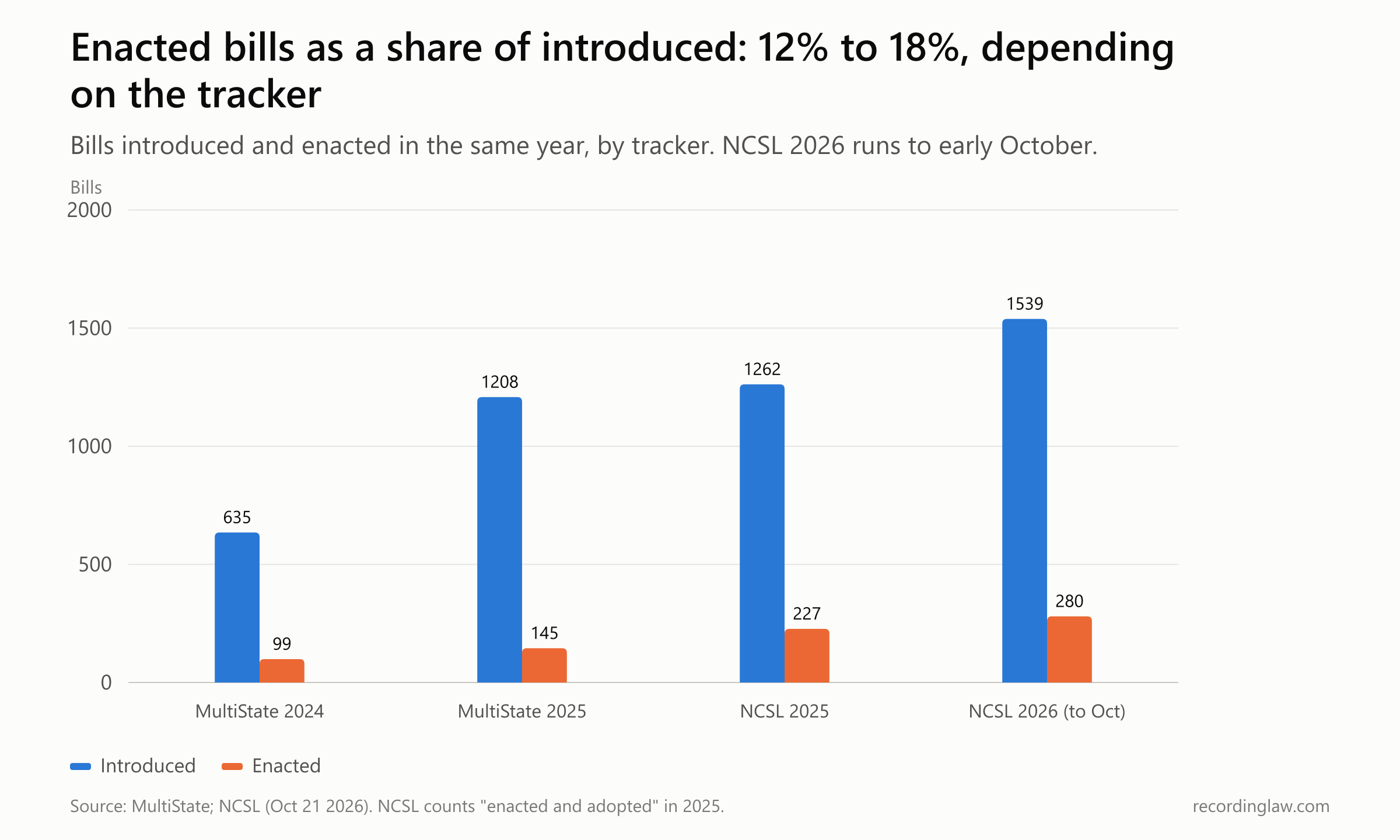
Source: MultiState; NCSL, October 21, 2026. NCSL's 2025 figure is "enacted and adopted." Shares are calculated within each tracker.
| Tracker and year | Introduced | Enacted | Share enacted |
|---|---|---|---|
| MultiState 2024 | 635 | 99 | 15.6% |
| MultiState 2025 | 1,208 | 145 | 12.0% |
| NCSL 2025 | 1,262 | 227 | 18.0% |
| NCSL 2026 (to early October) | 1,539 | 280 | 18.2% |
In each tracker's own numbers, fewer than one in five AI bills became law in the year it was introduced.
The harder question is the size of the enacted count itself. For 2025 alone there are five published figures, and they do not agree.
How many state AI bills were enacted in 2025?
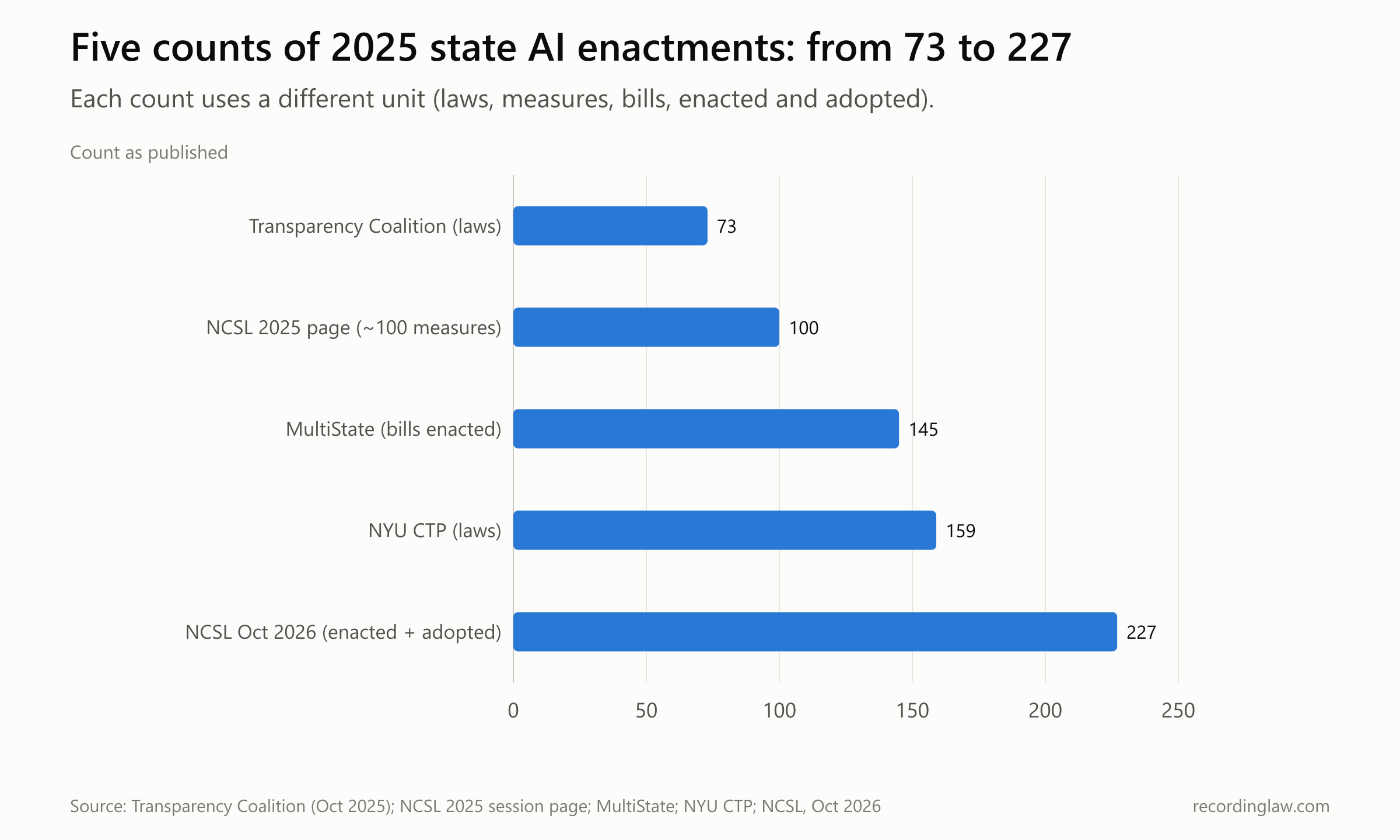
Source: Transparency Coalition, October 30, 2025; NCSL 2025 legislation page; MultiState; NYU Center on Technology Policy, December 2025; NCSL, October 21, 2026. Each count uses a different unit.
| Source | What it counts | 2025 count |
|---|---|---|
| Transparency Coalition 2025 report | AI-related laws, in 27 states | 73 |
| NCSL 2025 session page | measures adopted or enacted, in 38 states | around 100 |
| MultiState | AI-related bills enacted | 145 |
| NYU Center on Technology Policy | AI laws passed, in 46 states | 159 |
| NCSL (Will Clark, October 2026) | bills "enacted and adopted" | 227 |
The highest count for 2025, NCSL's 227, is about three times the lowest, the 73 laws in the Transparency Coalition's 2025 report. The Transparency Coalition is a nonprofit that says it advances policies prioritizing AI safety and transparency; an affiliated Action Fund advocates for AI legislation.
NCSL's 2025 session page says 38 states "adopted or enacted around 100 measures." Its October 2026 figure for the same year is 227. Neither source explains the difference. The 2025 page does say that bills "related solely to specific AI technologies, such as facial recognition, deepfakes or autonomous vehicles" are tracked separately, but NCSL does not say whether that accounts for the gap.
NYU's Center on Technology Policy counts laws rather than bills, and notes that "some laws fit into more than one category." By its count, 41 states passed 107 AI laws in 2024 and 46 states passed 159 in 2025, a 48% increase.
Whatever the unit, more states were passing something each year. NCSL's session pages put the number of states that adopted resolutions or enacted AI legislation at 18 in 2023, 31 in 2024 and 38 in 2025. The next question is what those laws did.
What kind of laws passed?
The category that kept coming up was deepfakes. In 2024, MultiState wrote, nonconsensual explicit deepfake laws were "among the most widely enacted category, passing in 22 states." In 2026, NCSL reported, deepfake bills were again "the most common type of AI legislation enacted," typically covering explicit content, political advertising and the use of digital likenesses. Our state-by-state deepfake law guide tracks those statutes.
Two other categories stood out in NCSL's counts. It counted about 250 measures on government use of AI introduced in more than 40 states in 2025. In 2026, NCSL's write-up reported "nearly a threefold increase" in notification bills, which it described as "letting a user know that they’re engaging with AI."
California showed the split between narrow and broad in a single month. On September 29, 2024, Gov. Gavin Newsom vetoed SB 1047, a bill aimed at the largest AI models, and noted in his veto message that he had signed more than a dozen bills on specific, known AI risks in the previous 30 days.
Critics, Newsom among them, had called the bill overly burdensome, TechCrunch noted. In the veto message, part of his stated reason was that it covered too few models. "By focusing only on the most expensive and large-scale models, SB 1047 establishes a regulatory framework that could give the public a false sense of security about controlling this fast-moving technology," he wrote. "A California-only approach may well be warranted - especially absent federal action by Congress - but it must be based on empirical evidence and science."
"I’ve never had a bill with this level of misinformation," the bill's author, Sen. Scott Wiener, told TechCrunch afterward. "There was a whole propaganda campaign."
In 2025, NCSL reported, "California, New York and Texas joined the list of states enacting comprehensive laws on AI transparency and consumer safety." Texas got there by narrowing. NYU's Center on Technology Policy wrote that Rep. Giovanni Capriglione's first draft "was heralded as the Republican version" of Colorado's law, and that "After significant opposition, Rep. Capriglione radically revised the bill."
Gov. Greg Abbott signed the Texas Responsible AI Governance Act, HB 149, on June 22, 2025, effective January 1, 2026. NYU found that legislators "in at least 12 other states introduced similar legislation. However, not a single one of these bills was enacted." Virginia's Gov. Glenn Youngkin vetoed a version that reached his desk.
California came back with SB 53, the Transparency in Frontier Artificial Intelligence Act, also by Wiener, and Newsom signed it on September 29, 2025. "California has proven that we can establish regulations to protect our communities while also ensuring that the growing AI industry continues to thrive. This legislation strikes that balance," he said. His office's release added: "This legislation is particularly important given the failure of the federal government to enact comprehensive, sensible AI policy."
The industry split over it. AI developer Anthropic endorsed SB 53 while saying it believed "frontier AI safety is best addressed at the federal level instead of a patchwork of state regulations," adding that "powerful AI advancements won’t wait for consensus in Washington." Industry groups including the Chamber of Progress and the Consumer Technology Association criticized it, NBC News reported. Collin McCune, head of government affairs at the venture firm Andreessen Horowitz, said it "includes some thoughtful provisions that account for the distinct needs of startups" but that it "misses an important mark by regulating how the technology is developed," calling that "a move that risks squeezing out startups, slowing innovation, and entrenching the biggest players."
More on both California laws is in our California AI law guide.
By then Colorado's comprehensive AI law had been on the books for more than a year. It had not taken effect.
Colorado went first, alone, in 2024
Colorado's law was never supposed to be alone. In the spring of 2024, Colorado and Connecticut moved bills in the same form at the same time. A joint industry letter later called it "a valiant attempt to avoid imposing a patchwork of state-level regulations on a burgeoning technology and industry."
Connecticut's half failed first. On April 24, 2024, the state Senate passed SB 2 by a 24-12 party-line vote over the objections of Gov. Ned Lamont, whose office said "the governor remains concerned that this is a fast moving space and that we need to make sure we do this right and don’t stymie innovation." Maroney, the bill's sponsor, told the chamber: "Today we’re doing our piece to make sure the world is changing for the good." The House never took it up, and it died when the session ended May 8.
The same day, May 8, the Colorado House passed SB 24-205, 41-22. Gov. Jared Polis approved it on May 17, 2024. Its sponsor, Senate Majority Leader Robert Rodriguez, a Denver Democrat, had argued that "AI systems are evolving faster than we can write and pass policy on them – which is why we need to act now." He said the bill would set "foundational guardrails" and was "just a first step."
The law's central duty was reasonable care against "algorithmic discrimination." Developers and deployers of high-risk AI systems, those that make or are a substantial factor in a consequential decision such as hiring or housing, would have had to use reasonable care to protect consumers from known or reasonably foreseeable risks of it. The act defined it as unlawful differential treatment or impact that disfavors people on the basis of a protected trait such as age, race, disability or sex. "Many system’s algorithms have biases baked in and can easily result in discriminatory outcomes when it comes to housing applications, hiring practices, and more," Rodriguez said in a statement.
A week after the signing, trade associations representing member companies, including the American Financial Services Association, the Chamber of Progress, CCIA, TechNet and the Colorado Hospital Association, wrote to Polis that "we remain concerned that this bill creates unacceptable risk for businesses that may be considering locating or investing in our state," warning the result would "make Colorado an outlier for AI policy in the United States."
The law was due to take effect February 1, 2026. After a special session, Polis signed SB 25B-004 on August 28, 2025, pushing that date to June 30, 2026.
Two projections of the law's cost followed, both built on assumptions rather than measured effects. The Common Sense Institute, a Colorado free-market think tank whose funders are not stated on the report page, modeled an assumed 1% increase in production costs across six industries and projected up to roughly 30,000 lost tech-sector jobs in 2030. It said that "For the most part, it does not analyze potential consumer impact."
The U.S. Chamber of Commerce, which advocates for federal preemption, then extrapolated those assumptions nationwide. It estimated that applying Colorado's requirements across the country could cost 92,000 jobs through slower small-business AI investment, and up to 713,000 jobs and $53.7 billion in GDP by 2030 if a 1% productivity decline applied nationally. Both used the REMI economic model, and the law they modeled had not taken effect.
At least one company wrote the law into its risk disclosures. Palantir Technologies, in its annual report filed with the SEC, compared Colorado's "state-level oversight" to the European Union's AI Act and said, "Compliance with such obligations may be difficult, onerous, and costly." Our Colorado AI law guide covers the law's requirements. Before it could apply, Washington moved.
Could Washington override the states?
The first federal attempt at preemption was the moratorium. Sen. Ted Cruz, a Texas Republican and chairman of the Senate Commerce Committee, defended it, arguing that it "preserves the rights of states to protect consumers and content creators without giving the Left a backdoor to push their woke social agenda through AI regulation."
After the House vote in May, Sen. Marsha Blackburn, a Tennessee Republican, negotiated a five-year version with Cruz in the Senate, then led the amendment to strike the section entirely. "While I appreciate Chairman Cruz’s efforts to find acceptable language that allows states to protect their citizens from the abuses of AI, the current language is not acceptable to those who need these protections the most," she said.
The amendment's cosponsors included Sen. Maria Cantwell, the top Democrat on the Commerce Committee, and Sens. Susan Collins, Jeff Merkley, Roger Marshall, Richard Blumenthal, Amy Klobuchar, Lisa Murkowski and Andy Kim. The moratorium had been "getting less and less popular with state and federal lawmakers, state officials and advocacy groups since it was introduced in May," States Newsroom reported.
Opponents of the moratorium read the predawn vote as a verdict. "This 99-1 vote sent a clear message that Congress will not sell out our kids and local communities in order to pad the pockets of Big Tech billionaires," said Sen. Ed Markey, a Massachusetts Democrat.
"States can fight robocalls, deepfakes and provide safe autonomous vehicle laws," Cantwell said. Alexandra Reeve Givens, chief executive of the Center for Democracy & Technology, an advocacy group whose funding the statement does not describe, said the vote "reflects just how unpopular it is among voters and state leaders of both parties."
Five months later the White House tried another route. On December 11, 2025, President Trump signed Executive Order 14365. It argued that "State-by-State regulation by definition creates a patchwork of 50 different regulatory regimes that makes compliance more challenging, particularly for start-ups," and named Colorado: "a new Colorado law banning “algorithmic discrimination” may even force AI models to produce false results."
The order told the attorney general to set up, within 30 days, "an AI Litigation Task Force (Task Force) whose sole responsibility shall be to challenge State AI laws inconsistent with the policy set forth in section 2 of this order." The attorney general's memo establishing it is dated January 9, 2026. The order also directed the Commerce Department to explore withholding federal broadband money, known as BEAD, from states that enact "onerous" AI laws, Tech Policy Press reported.
Industry groups welcomed it. Patrick Hedger of NetChoice, a tech industry trade association, said "startups and small businesses will greatly struggle to create and compete with a 50-state patchwork of red tape." The U.S. Chamber's Jordan Crenshaw said the Chamber "commends President Trump for working to address the growing challenge posed by a patchwork of state-level AI regulations."
Critics questioned both the policy and the legal basis. Alan Butler of the Electronic Privacy Information Center (EPIC), an advocacy group that says it is funded by individual supporters, called it "exactly the opposite of what our country needs right now." EPIC's John Davisson said the order "does not contain any specific AI policy positions or identify any legal authority that would allow the Executive to preempt state laws." Ruth Whittaker of Third Way, a center-left think tank, said it would "slow innovation by miring AI policy in legal disputes."
On March 20, 2026, the White House released a National AI Legislative Framework, saying the framework "can succeed only if it is applied uniformly across the United States. A patchwork of conflicting state laws would undermine American innovation and our ability to lead in the global AI race."
The Commerce Department's evaluation of "onerous" state laws under the order was due by March 11, 2026. As of an April 6 law-firm review by Proskauer, the latest source we found, it "has not been made available to the public." The first state law the federal government moved against was Colorado's.
The lawsuit and the rewrite
On April 9, 2026, xAI, Elon Musk's AI company, sued to block Colorado from enforcing its law. "Government regulation that is applied at the state level in a patchwork across the country can have the effect to hamper innovation and deter competition in an open market," the company said, according to Reuters.
On April 24, the Justice Department moved to intervene. The law firm Proskauer wrote that this "appears to be the first time" the federal government had sought to invalidate a state AI law since the executive order.
"Laws that require AI companies to infect their products with woke DEI ideology are illegal," said Assistant Attorney General Harmeet K. Dhillon. "Laws like Colorado’s that force AI models to produce false results or promote ideological bias threaten national and economic security and must be stopped," said Assistant Attorney General Brett A. Shumate.
On April 27, Magistrate Judge Cyrus Y. Chung entered an order under which Colorado Attorney General Phil Weiser would not begin enforcement until 14 days after the court ruled on xAI's request for a preliminary injunction, a court order that would block the law while the case went on. The Center for Democracy & Technology said "once again Colorado officials have decided to delay protecting their constituents from the real and documented harms of AI."
The legislature was already rewriting the law. SB 26-189, introduced May 1, passed the Senate 34-1 six days later and the House 57-6 two days after that. The Colorado Springs Gazette's editorial board, in an opinion piece calling it a flawed bill, wrote that Polis "has painted himself into a corner. If he doesn’t sign the bill, the far worse 2024 measure will take effect."
Polis signed it on May 14, 2026, 47 days before the 2024 law would have applied. The new act "repeals and reenacts" the 2024 provisions "with new requirements regarding the use of automated decision-making technology in consequential decisions," the legislature's summary says. The Denver Post described it as legislation that "rewrites and softens" the original.
"We were able to reach consensus, at long last, and get to a place where we can offer consumers meaningful protections and avenues for redress without hampering innovation for developers of AI," Rodriguez said before the signing. He also said: "We got a bill across the finish line that nobody’s happy with, but everyone can live with."
EPIC listed what the rewrite removed: "the duty of care for developers and deployers to avoid algorithmic discrimination, the requirement that deployers establish risk management programs, the requirement that deployers conduct impact assessments, and reporting requirements to the Attorney General." EPIC also noted that Polis had "publicly supported GOP efforts to pass a 10-year moratorium on state AI regulation."
Connecticut finished its third attempt the same month. A 2025 version, SB 2, had passed the state Senate on May 14, 2025, and never came to a vote in the House. In 2026, SB 5 passed the Senate 32-4 and, on May 1, the House 131-17, with bipartisan support in both chambers.
"I don't want to wait for the federal government," said Rep. Joe Hoxha, a Bristol Republican. Another House member, Rep. Buckbee, said he had used AI to generate the questions he asked during the House debate, CT Mirror reported.
"Parents should be in control of aspects of social media and AI that carry real risks for children’s mental health," said Lamont's spokesperson, Cathryn Vaulman. Attorney General William Tong said "Neither state nor federal law has kept pace with these developments." Lamont signed it on May 27, 2026. Our Connecticut AI law guide has the details.
NCSL later wrote that "Only two comprehensive AI bills were enacted in 2026, one in Colorado ( SB 189 ) and the other in Connecticut ( SB 5 )." They were the same two states that had tried to move in step in 2024.
Illinois added a law aimed at the largest AI developers. On July 6, 2026, Gov. JB Pritzker signed Illinois's Artificial Intelligence Safety Measures Act, which the law firm Skadden described as making Illinois the third state, after California and New York, to put transparency, safety and reporting obligations on large AI developers.
Skadden wrote that it goes further than those laws by requiring developers to retain an independent third party "to audit their compliance annually." The open question by midsummer was whether the federal pressure had slowed the states at all.
Did the pressure slow the states?
By the middle of 2026, fewer states were passing AI laws, and the ones that did were passing more of them apiece. By July 1, 2026, NYU's Center on Technology Policy counted 29 states with a new AI law, down from 39 by the same date in 2025. Those 29 states had enacted 109 AI laws between them, 12 fewer than the 121 that 39 states had enacted by July 1 a year earlier.
Did fewer states mean fewer laws?
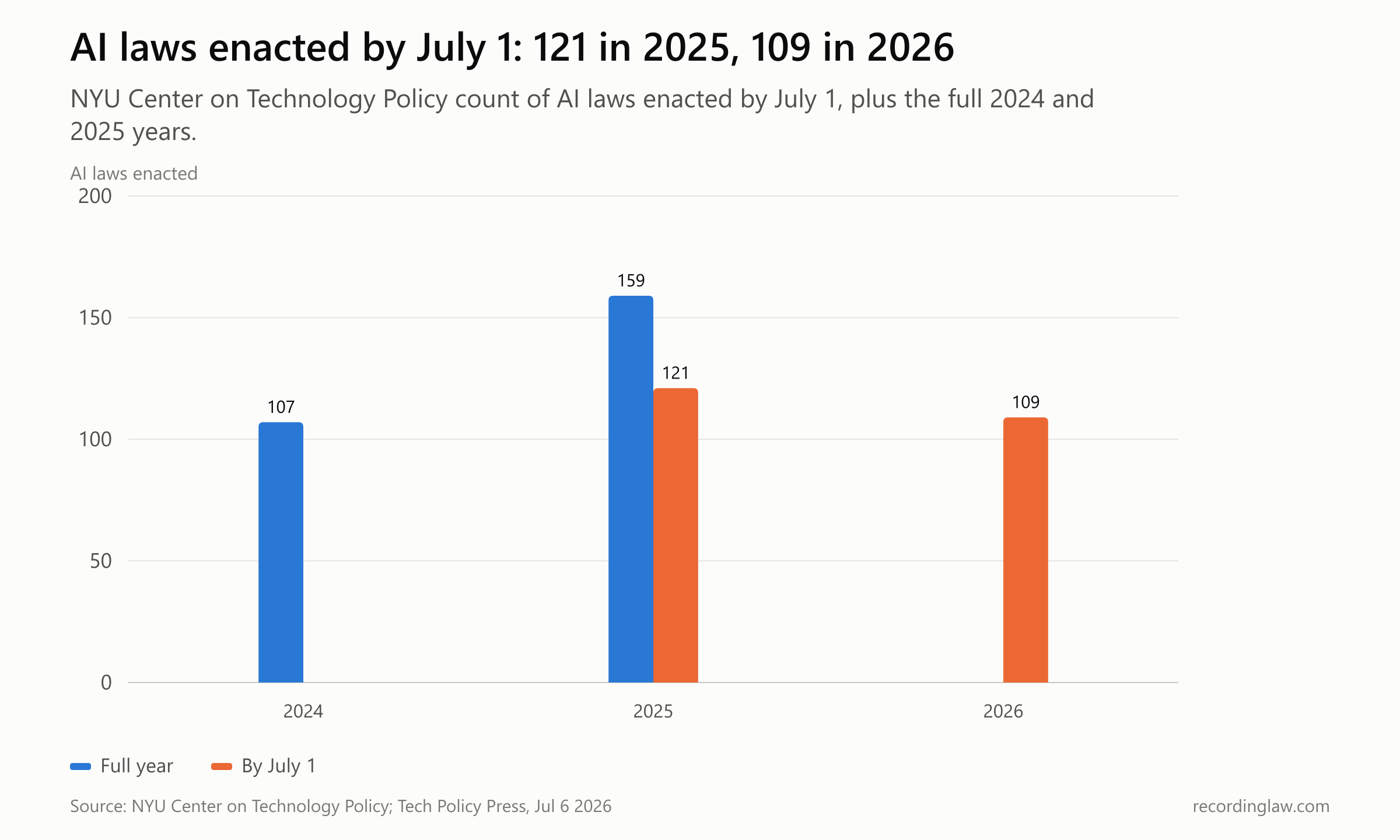
Source: NYU Center on Technology Policy; Tech Policy Press, July 6, 2026. 2026 has no full-year count yet.
| Year | AI laws by July 1 | States with AI laws by July 1 | AI laws, full year | States, full year |
|---|---|---|---|---|
| 2024 | not published | not published | 107 | 41 |
| 2025 | 121 | 39 | 159 | 46 |
| 2026 | 109 | 29 | due December 2026 | due December 2026 |
At the midpoint of 2026, the count was 10 states and 12 laws behind the 2025 pace.
Scott Babwah Brennen, the center's director, wrote that "Federal preemption efforts may have limited the number of states enacting AI regulation, even if they have not dramatically reduced the total number of enacted AI laws." His comparison was descriptive, not a test of cause.
As of July 1, states with 2026 AI laws averaged $742.2 million in BEAD funding and states without averaged $920.9 million. He noted that once California enacted an AI law, as it was widely expected to, the averages would become $873.7 million for states with AI laws and $779.6 million for states without. He wrote that "we can not yet see a simple partisan or BEAD-driven pattern as to which states are most impacted." The share of enacted AI laws with sponsors from both parties barely changed, 32% in 2025 and 31% in 2026.
NCSL's count runs about three months later than NYU's, and it points the other way. By early October 2026, Clark said, states had enacted 280 AI bills. That was already more than the 227 NCSL counted for all of 2025, but the 2025 figure is "enacted and adopted," which may include resolutions, so the two years may not be counted in the same unit.
The Transparency Coalition's count also rose. Its October 27, 2026 report found 115 AI-related laws passed or enacted in 30 states between January 1 and October 15, 2026, up from 73 laws in 27 states in its 2025 report.
The push for preemption also split Republicans. In March 2026, more than 50 Republican state lawmakers wrote to Trump that they were "deeply concerned" by the administration's efforts to interfere with state AI legislation, Tech Policy Press reported.
Utah Rep. Doug Fiefia, a Republican who once worked in sales at Google, put the state legislator's case at NCSL's session. "Today, I’m on the other side of the table as a legislator, and my job is to ask the question that nobody asked during the demo, which is, ‘What happens when it fails? Who gets hurt, and who’s responsible?’" His own Companion Chatbot Safety Act did not become law in 2026.
What lands on January 1
The next fixed dates belong to the states. Colorado's attorney general must adopt rules on the new law's disclosures after adverse decisions by January 1, 2027, the same day developers' documentation duties begin. Under the agreement in the xAI case, the company will file its motion for a preliminary injunction within 28 days after Colorado finalizes rulemaking for the 2024 law "or any new legislation that amends or replaces it, including this year’s Senate Bill 189." No source we found shows a ruling on whether the rewrite ends the case.
Illinois's Artificial Intelligence Safety Measures Act takes effect on January 1, 2027, the same day, and its annual third-party audits begin January 1, 2028. The 2027 legislative sessions start in January, and the count starts again. More on what each state has passed is in our guide to AI laws in the United States.
Congress was not expected to act on AI safety this year. When lawmakers returned in September 2026, they had agreed to fund the government through December 11, and States Newsroom reported they were not expected to make "any progress on how to place guardrails on artificial intelligence." Rejecting an emergency moratorium on the technology itself, House Speaker Mike Johnson said on CNN, "We cannot put a moratorium on this because China will overlap us, and that’s the challenge." Senate Minority Leader Chuck Schumer, calling for "serious guardrails" on AI, said, "if Trump does not act, Congress must."
That outlook was reported before the November 3, 2026 election. The outgoing Congress returns for a lame-duck session in November and December, with government funding set to run out December 11. No source we found shows Congress enacting a federal preemption law, including Blackburn's 2026 bill, the TRUMP AMERICA AI Act.
In December, before any of those January dates, NYU's Center on Technology Policy is due to publish its full-year count of 2026 AI laws, one tracker's answer for the year. The Senate struck the moratorium 99-1 in July 2025, and the states kept passing laws. Sixteen months later, there is still no single answer to how many AI laws they have passed.
How we measured
Bill counts. MultiState's figures come from its state AI legislation page, retrieved October 31, 2026, which still carries its "As of March 2026" snapshot. MultiState defines "AI-related" broadly, including task forces, budget items, sandboxes, deepfakes and autonomous vehicles. Its 2023 figure is published only as "less than 200." The Transparency Coalition's counts come from its report announcements of October 30, 2025 (73 AI-related laws in 27 states; the page does not state a cutoff date) and October 27, 2026 (115 laws in 30 states, January 1 to October 15, 2026). NCSL's 2025 and 2026 counts come from remarks by NCSL's Will Clark at its Base Camp 2026 conference, as reported in an NCSL article dated October 21, 2026.
NCSL's 2023 and 2024 session pages give counts of states, not bills. NCSL's AI Legislation Database (2025 to present, updated monthly, last updated October 1, 2026) has no totals on its static page, so its per-status counts could not be read.
Partial years. 2026 figures cut off on different dates: MultiState in March 2026, NYU on July 1, 2026, NCSL in early October 2026. They are not full-year totals. MultiState notes that 23 of the 44 states starting the second year of a two-year session in 2026 allow bills to carry over from 2025; its page does not say how carried-over bills are counted.
Units. MultiState counts bills enacted; NCSL's 2025 figure is "enacted and adopted," which may include resolutions; its 2026 figure is "enacted"; NYU counts laws, and a law can fall in more than one category; the Transparency Coalition counts "AI-related laws" under its own definition, which leaves out data center measures. NCSL's 2025 session page ("around 100 measures" in 38 states) and its October 2026 figure for 2025 (227) are not reconciled in any source we found.
Our arithmetic: 99 / 635 = 15.6%; 145 / 1,208 = 12.0%; 227 / 1,262 = 18.0%; 280 / 1,539 = 18.2%. We compare shares only within one tracker. About one in eight is 12.0%; about three times is 227 / 73 = 3.1.
The NYU mid-year gap is 121 minus 109, or 12 laws, and 39 minus 29, or 10 states. Per state with a new law by July 1, that is 121 / 39 = 3.1 laws in 2025 and 109 / 29 = 3.8 in 2026. NCSL's early-October cutoff is about three months after NYU's July 1 cutoff.
Dates. The Senate vote time comes from the Congress.gov record of SA 2814 (Record Vote 363, logged 08:24:31 UTC on July 1, 2025, which is 4:24 a.m. Eastern daylight time). The House vote (Roll Call 145, 6:54 a.m., May 22, 2025) comes from the House Clerk.
We did not open the Senate's own roll-call page, which blocked automated access, so we do not name the senator who voted no. Colorado bill dates and votes come from the Colorado General Assembly's bill pages; 47 days is May 14 to June 30, 2026. Connecticut's signing date and the 2025 SB 2 history come from the General Assembly's bill status pages.
Studies. Steven Adler's review is an independent Substack analysis that used keyword scanning and GPT-4o scoring on 1,033 bills; it is not peer reviewed. The Common Sense Institute and U.S. Chamber estimates are REMI model projections that start from an assumed 1% cost or productivity effect; they are not measurements of the law's effects. NYU's BEAD comparison is a descriptive average, not a causal test.
What the data cannot show. A bill count measures legislative activity and attention, not what a law does. None of these figures shows whether any state AI law changed how AI is built or used, how often a law is enforced, or what a federal preemption law would have changed. Comparing 2026 with 2025 cannot separate federal pressure from other reasons a state might pass fewer laws in a given year.
Frequently Asked Questions
How many AI bills did states introduce in 2025?
MultiState counted 1,208 AI-related bills introduced in all 50 states in 2025, up from 635 in 2024 and fewer than 200 in 2023. NCSL counted 1,262 in 2025. In 2026, MultiState counted 1,561 by March and NCSL counted 1,539 by early October.
How many state AI bills became law in 2025?
It depends on the tracker. The Transparency Coalition, a nonprofit that advocates AI safety and transparency policies, counted 73 AI-related laws in 27 states; NCSL's 2025 session page says 38 states adopted or enacted around 100 measures; MultiState counted 145 bills enacted; NYU's Center on Technology Policy counted 159 laws in 46 states; and an NCSL fellow said in October 2026 that 227 bills were enacted and adopted. Each counts a different unit.
What share of state AI bills become law?
Between about 12% and 18% in the same year, depending on the tracker. MultiState: 99 of 635 in 2024 and 145 of 1,208 in 2025. NCSL: 227 of 1,262 in 2025 and 280 of 1,539 in 2026 through early October.
What is the most common type of state AI law?
Deepfake laws. MultiState reported that nonconsensual explicit deepfake laws passed in 22 states in 2024, and NCSL reported that deepfake bills were the most common type of AI legislation enacted in 2026, typically covering explicit content, political advertising and digital likenesses.
Did Congress ban states from regulating AI?
No. The House passed a budget bill with a 10-year moratorium on enforcing state AI laws, 215-214, on May 22, 2025, but the Senate struck the moratorium 99-1 on July 1, 2025. As of the sources we reviewed, no federal law preempting state AI laws had been enacted.
What does Executive Order 14365 do about state AI laws?
Signed December 11, 2025, it directed the attorney general to create an AI Litigation Task Force to challenge state AI laws that conflict with the order's policy, and directed the Commerce Department to evaluate onerous state AI laws and explore withholding BEAD broadband funds from states that enact them. An executive order does not itself repeal state laws.
What happened to the Colorado AI Act?
Colorado's SB 24-205, signed May 17, 2024, was delayed from February 1 to June 30, 2026, challenged in federal court by xAI with the Justice Department moving to intervene, and repealed and reenacted by SB 26-189, signed May 14, 2026. The attorney general must adopt rules on the new law's disclosures after adverse decisions by January 1, 2027.
Which states have passed comprehensive AI laws?
NCSL reported that California, New York and Texas enacted comprehensive laws on AI transparency and consumer safety in 2025, and that the only two comprehensive AI bills enacted in 2026 were Colorado SB 189 and Connecticut SB 5. Illinois's Artificial Intelligence Safety Measures Act, signed July 6, 2026, takes effect January 1, 2027.
Updates
Independently fact-checked against the cited primary sources
Sources and References
- MultiState, Artificial Intelligence (AI) Legislation tracker (as of March 2026)(multistate.ai)
- NCSL, As Congress Deliberates, States Lead the Way on AI Regulation (October 21, 2026)(ncsl.org)
- NCSL, Artificial Intelligence 2025 Legislation(ncsl.org)
- NCSL, Artificial Intelligence 2024 Legislation(ncsl.org)
- NCSL, Artificial Intelligence 2023 Legislation(ncsl.org)
- NCSL, New Trends Emerge as States Refine AI Legislation (January 2026)(ncsl.org)
- NCSL, Artificial Intelligence Legislation Database(ncsl.org)
- NYU Center on Technology Policy, state technology policy report 2025 (December 2025)(techpolicynyu.org)
- NYU Center on Technology Policy, state technology policy report 2024(techpolicynyu.org)
- Tech Policy Press (Scott Babwah Brennen), Where State AI Legislation Stands Half Way Into 2026 (July 6, 2026)(techpolicy.press)
- Steven Adler, Mythbusting the supposed 1,000 AI bills (July 1, 2025)(stevenadler.substack.com)
- U.S. Chamber of Commerce, coalition letter to the Senate supporting the moratorium (June 9, 2025)(uschamber.com)
- Congress.gov, S.Amdt. 2814 to H.R. 1 (119th Congress)(congress.gov).gov
- Congress.gov, H.R. 1 (119th Congress), all actions(congress.gov).gov
- Office of the Clerk, U.S. House, Roll Call 145 (May 22, 2025)(clerk.house.gov).gov
- Route Fifty, Senate overwhelmingly passes amendment removing state AI moratorium (July 2025)(route-fifty.com)
- States Newsroom via Wisconsin Examiner, Senate votes 99-1 to remove AI moratorium from megabill (July 1, 2025)(wisconsinexaminer.com)
- Federal Register, Executive Order 14365, Ensuring a National Policy Framework for Artificial Intelligence(federalregister.gov).gov
- U.S. Department of Justice, Attorney General memorandum establishing the AI Litigation Task Force (January 9, 2026)(justice.gov).gov
- NetChoice statement on the AI executive order (December 11, 2025)(netchoice.org)
- U.S. Chamber of Commerce statement on the AI executive order (December 11, 2025)(uschamber.com)
- EPIC, on the executive order on a national framework for AI regulation (December 12, 2025)(epic.org)
- Third Way statement on the executive order on state AI laws (December 11, 2025)(thirdway.org)
- FedScoop, White House national policy framework for artificial intelligence (March 2026)(fedscoop.com)
- Proskauer, What Executive Order 14365 means for employers (April 6, 2026)(proskauer.com)
- Tech Policy Press, Trump and GOP lawmakers push for new national AI legislation(techpolicy.press)
- States Newsroom via Wisconsin Examiner, Congress returns before midterms, no action expected on AI (September 14, 2026)(wisconsinexaminer.com)
- Office of the Governor of California, SB 1047 veto message (September 29, 2024)(gov.ca.gov).gov
- TechCrunch, on the SB 1047 veto and Sen. Wiener (October 2024)(techcrunch.com)
- Office of the Governor of California, Governor Newsom signs SB 53 (September 29, 2025)(gov.ca.gov).gov
- TechCrunch, Anthropic endorses California AI safety bill SB 53 (September 8, 2025)(techcrunch.com)
- Tech Policy Press, What to know about SB 53 (September 30, 2025)(techpolicy.press)
- NBC News, on the SB 53 signing (September 29, 2025)(nbcnews.com)
- Texas Legislature Online, HB 149 (89th Legislature) bill history(capitol.texas.gov).gov
- CT Public, Senate Democrats pass AI bill over Lamont objections (April 25, 2024)(ctpublic.org)
- Joint industry letter to Gov. Polis on Colorado SB 24-205 (May 24, 2024), via American Financial Services Association(afsaonline.org)
- Colorado General Assembly, SB 24-205(leg.colorado.gov).gov
- Colorado General Assembly, SB 25B-004(leg.colorado.gov).gov
- Colorado General Assembly, SB 26-189(leg.colorado.gov).gov
- Colorado Politics, Court order delays enforcement of state AI law (April 28, 2026)(coloradopolitics.com)
- Colorado Politics, Updated AI regulation bill clears Colorado House and Senate (May 11, 2026)(coloradopolitics.com)
- Common Sense Institute, Unintended Costs: The Economic Impact of Colorado’s AI Policy (August 20, 2025)(commonsenseinstituteus.org)
- U.S. Chamber of Commerce, The hidden cost of 50-state AI laws (November 18, 2025)(uschamber.com)
- Reuters via Insurance Journal, xAI sues to block Colorado AI law (April 10, 2026)(insurancejournal.com)
- U.S. Department of Justice, Justice Department intervenes in xAI lawsuit challenging Colorado law (April 24, 2026)(justice.gov).gov
- Proskauer, Federal government intervenes in case seeking to invalidate Colorado AI law(proskauer.com)
- The Gazette (Colorado Springs) editorial board, A flawed AI bill Polis might have to sign (May 13, 2026, opinion)(gazette.com)
- The Denver Post via Tribune News Service, Polis signs new law rewriting Colorado AI regulations (May 14, 2026)(thebrunswicknews.com)
- EPIC, Colorado legislature again amends landmark AI law (May 14, 2026)(epic.org)
- CT Mirror, Connecticut House passes SB 5 (May 1, 2026)(ctmirror.org)
- Connecticut General Assembly, SB 5 (2026) bill status(cga.ct.gov).gov
- Skadden, Illinois enacts AI safety law (July 2026)(skadden.com)
- Transparency Coalition, 2026 AI Legislation Report finds 115 new laws in 30 states (October 27, 2026)(transparencycoalition.ai)
- Transparency Coalition, 2025 State AI Legislation Report: 73 new AI laws in 27 states (October 30, 2025)(transparencycoalition.ai)
- Connecticut General Assembly, bill status, SB 2 (2025), An Act Concerning Artificial Intelligence(cga.ct.gov).gov
- Colorado General Assembly, SB 24-205 as signed (Consumer Protections for Artificial Intelligence)(leg.colorado.gov).gov