California Cities Approved 19 to 47 ADUs for Every SB 9 Unit, 2023 to 2025

Independently fact-checked against primary sources (last audited November 6, 2026). · 26 primary sources cited on this page. How we verify our legal content
Between 1993 and 2016, the City of Santa Barbara approved 16 applications for accessory dwelling units, the backyard cottages and garage apartments Californians call ADUs or granny flats. The count comes from Sen. Bob Wieckowski, who wrote the state law that took effect the next January.
By July 2017, the city's chief planner, Renee Brooke, reported that 122 ADU applications had been submitted since the first of the year. The Santa Barbara Independent ran the story under the headline "Granny Flat Applications Explode."
Five years later, a second state housing law reached the town of Woodside, in the hills of San Mateo County. On Jan. 27, 2022, its planning director wrote that the whole town was habitat for mountain lions, a candidate for threatened-species status, and so "no parcel within Woodside is currently eligible for an SB 9 project." Attorney General Rob Bonta called it "a deliberate and transparent attempt to avoid complying with SB 9," and the town began accepting applications again after the state Department of Fish and Wildlife said the entire town could not be considered habitat.
SB 9 lets owners in single-family zones split a lot in two and build up to four homes on what had been one single-family parcel, with the same fast-track approval the ADU laws had required of cities. Its author, Senate leader Toni Atkins, pitched it as building "off the well-documented success of accessory dwelling units." In 2024, California cities reported approving about 18,500 ADUs and about 980 SB 9 units in the same state table, about 19 for every one.
The two laws used the same tool in the same neighborhoods. Why did one bring tens of thousands of homes a year onto the state's books and the other a few hundred, and how much of the gap can the record explain?
What the first ADU law took away from cities
The fast track began with ADUs. Gov. Jerry Brown signed SB 1069 on Sept. 27, 2016, a month after it cleared the Assembly on Aug. 29 and the Senate on Aug. 30. Its key sentence told cities their ADU rules "shall provide an approval process that includes only ministerial provisions" and "shall not include any discretionary processes."
Ministerial means city staff check the application against fixed standards. There is no hearing, and no neighbor gets a vote.
Wieckowski, a Fremont Democrat, carried the bill for the Bay Area Council, a business association funded by its member companies. His case to lawmakers was that backyard units were "the only source of housing that can be added within a year at an affordable price," and that "action by the State on a few issues will make this possible for tens of thousands of owners to immediately benefit and help their communities."
Opponents included the League of California Cities, about 40 cities, the Association of California Water Agencies and the California State Association of Counties, which asked for amendments. "Opponents argue that the bill is so prescriptive that it removes any local land use flexibility and limits the public engagement process in regards to ADUs," the Assembly housing committee's analysis summarized. The City of Roseville warned that if units were allowed by right and left out of its water plan, "it may impact existing residences especially in a drought situation."
A year later, Wieckowski told a committee that ADU permit applications "skyrocketed." The City of Los Angeles, he said, "has received as many ADU permit applications since the signing of SB 1069 as they have in the past five years combined." The Terner Center for Housing Innovation at UC Berkeley later counted ADU permits in the largest metro areas rising from 654 in 2016 to 3,126 in 2017, and in Los Angeles from 80 to 1,980.
The Legislature was not done. In 2019 it went after the rules cities still had.
The second round, and the warnings about services and parking
On Oct. 9, 2019, Gov. Gavin Newsom signed 18 housing bills. Three of them, AB 68 by Assemblymember Philip Ting of San Francisco, AB 881 by Assemblymember Richard Bloom of Santa Monica and SB 13 by Wieckowski, rewrote ADU law again. "Now, we are removing some key local barriers to housing production," Newsom said.
The package barred cities from setting a minimum lot size for ADUs and stopped them from requiring the owner to live on the property for units approved from 2020 through 2024. Ting, whose bill was sponsored by the advocacy group California YIMBY, told a committee AB 68 "will remove remaining barriers to the widespread adoption of ADUs as low-cost, energy efficient, affordable housing that can go from policy to permit in 12 months." The Bay Area Council's chief executive, Jim Wunderman, put it more briefly. "Sometimes small can be big," he said.
The 2019 warnings came mostly from local agencies. A joint letter from the Fire Districts Association of California, the California Fire Chiefs Association and the California Special Districts Association said that if barring fees spurred ADU building, "the families inhabiting the new ADUs and their neighbors would suffer from inadequate public safety, parks, and other fundamental services." "We would be trading one crisis for another," it said. The League of California Cities and the state chapter of the American Planning Association objected to more units on multifamily lots and to dropping replacement parking.
Every year, cities and counties report their housing activity to the state Department of Housing and Community Development, HCD, in an annual progress report, or APR. The report's Table A2 lists building permits starting in 2018, so it shows how many ADUs cities permitted after the second round.
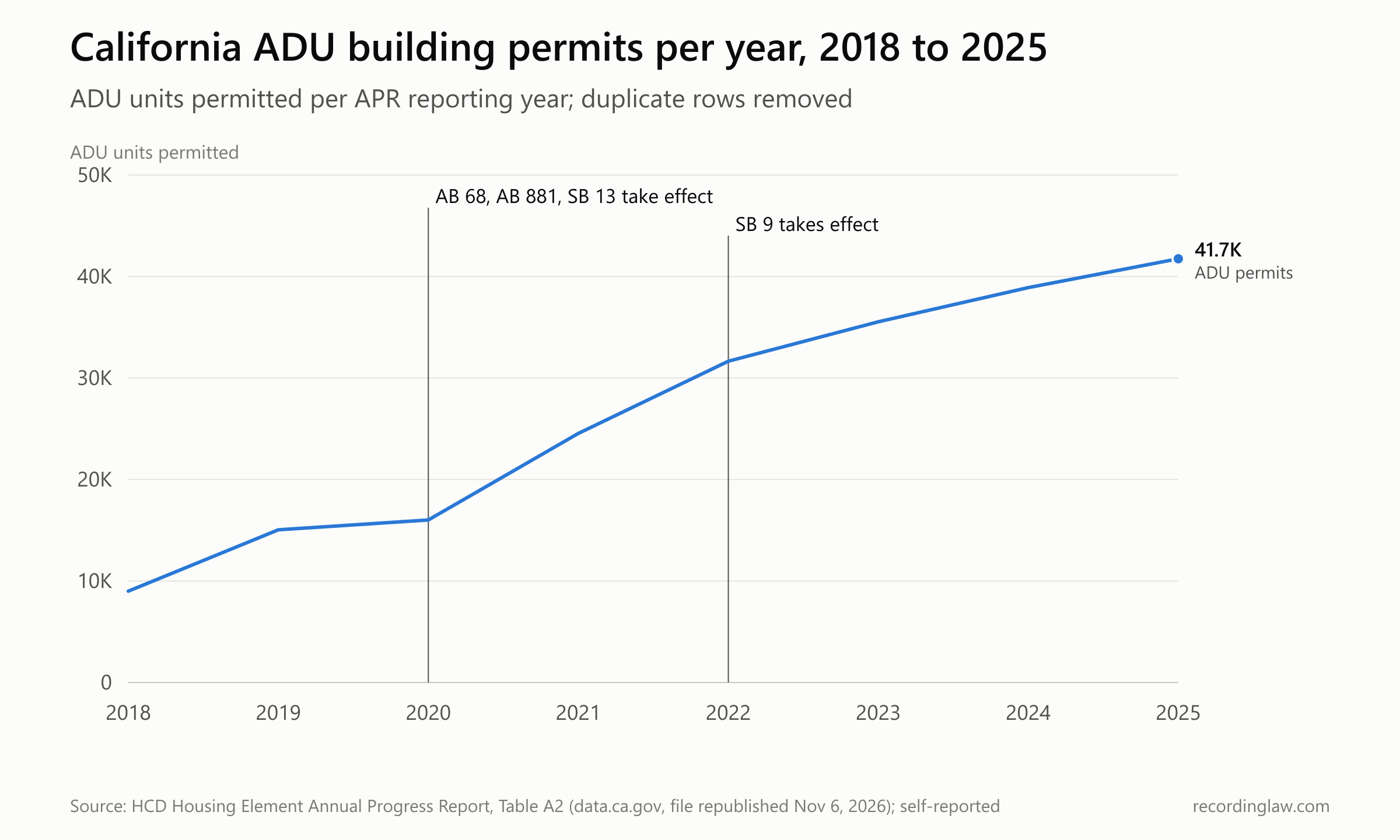
California ADU building permits per APR reporting year, 2018 to 2025. Source: HCD Housing Element APR Table A2 (self-reported), file republished and retrieved Nov. 6, 2026.
| Year | ADU units permitted |
|---|---|
| 2018 | 9,003 |
| 2019 | 15,051 |
| 2020 | 16,013 |
| 2021 | 24,542 |
| 2022 | 31,658 |
| 2023 | 35,543 |
| 2024 | 38,907 |
| 2025 | 41,747 |
Cities reported more than four times as many ADU permits in 2025 as in 2018. The biggest one-year jump came in 2021, the year after the 2019 package took effect and the first full year of the pandemic.
HCD's own ADU handbook covers a longer span. "Between 2016-2024, the number of ADUs permitted annually in the state grew from 1,336 to 30,354, a 20-fold increase," its ADU handbook says. Our sum of the state's own file for 2024 comes to 38,907, and the handbook does not say how it counted, so we report its endpoints but do not splice them onto our line.
Every figure here is reported by cities and counties to the state, and HCD does not verify it. Some of the early rise may be better reporting rather than more building, and there is no comparison state in this data, so the line shows what happened after the laws, not how much the laws caused. By 2021, the Legislature wanted to try the same tool on the main house.
Could the fast track work on the lot itself?
SB 9 requires cities to approve, ministerially, up to two homes on a single-family lot, a split of that lot into two, or both. Atkins, then president pro tempore of the Senate, called it "building off the successes of ADU law." Her fact sheet said that "in just two years, ADUs grew to comprise one-fifth of all new housing stock in Los Angeles," citing an outside analysis, and that the bill "will generate affordable rental units."
It also came with a condition the 2019 ADU laws had just lifted for ADUs. An applicant for a lot split must sign an affidavit promising to live in one of the units "as their principal residence for at least three years," unless the applicant is a community land trust or a nonprofit. Rentals must also run longer than 30 days.
Opponents included Livable California, a nonprofit of community leaders, activists and local elected officials that raises money from donors. It told members in January 2021 that SB 9 would let "speculators jam 4 to 8 costly rental homes where 1 home stands now, leaving just 4-foot setbacks with no yards or garages. Yes, on your street." Rolling Hills Mayor Bea Dieringer, who hosted a virtual town hall rallying opposition that summer, said, "I personally don’t see anyone who’s being helped other than real estate developers and investors."
The League of California Cities said the bill "will not spur much needed housing construction in a manner that supports local flexibility, decision making, and community input." Sen. Steve Glazer, an Orinda Democrat who skipped the May Senate vote and voted no on final passage, wrote that he supported state efforts to get more housing approved but that projects "should be approved after local officials have held public hearings."
One forecast came from the bill's own side. The Terner Center, listed among SB 9's supporters, modeled about 7.5 million single-family parcels in counties of more than 45,000 people and found 714,000 new units that would be financially feasible under the law. It also wrote that "relatively few new single-family parcels are expected to become financially feasible for added units as a direct consequence of this bill," and its researcher David Garcia told CalMatters there was "just no financial basis" for fears of "the wholesale bulldozing of single-family homes."
The Senate passed SB 9 28-6 in May 2021, the Assembly 45-19 in August with 15 members not voting, and the Senate concurred 28-7 on Aug. 30. Among the Assembly's 19 no votes was Bloom, author of two of the ADU laws SB 9 said it was building on; we found no public explanation of his vote.
On Sept. 16, two days after winning a recall election, Newsom signed it, over pleas from cities to veto it; more than 200 cities and neighborhood groups had opposed the bill. "SB 9 will open up opportunities for homeowners to help ease our state’s housing shortage, while still protecting tenants from displacement," Atkins said in the governor's signing announcement.
The law took effect on Jan. 1, 2022. Within four weeks, Woodside had written its mountain lion memo.
Year one: 53 unit approvals in 13 cities
A year in, the Terner Center asked 13 cities, picked because SB 9 projects were feasible there and they already permitted many ADUs, how many SB 9 applications had come in through November 2022. Together they reported 282 applications for new units and 53 approvals. "One year in, we find that the impact of SB 9 has been limited so far," the center wrote. Where did the applications go?
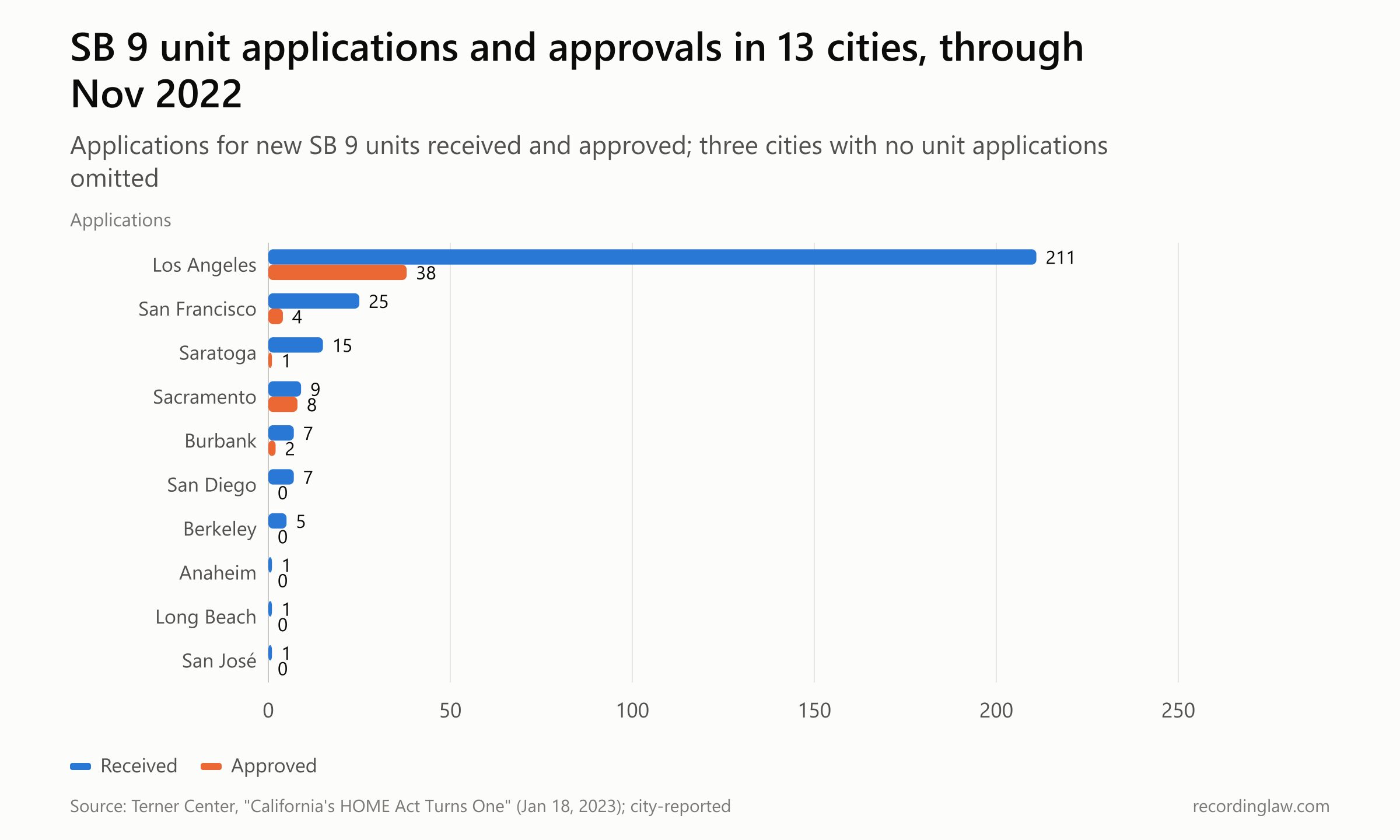
SB 9 unit applications received and approved in 13 cities through November 2022 (three cities with none omitted from the chart). Source: Terner Center, Jan. 18, 2023 (city-reported).
| City | Lot-split applications | Lot splits approved | SB 9 unit applications | Unit applications approved |
|---|---|---|---|---|
| Los Angeles | 28 | 0 | 211 | 38 |
| San Francisco | 4 | 2 | 25 | 4 |
| Saratoga | 21 | 2 | 15 | 1 |
| Sacramento | 9 | 6 | 9 | 8 |
| Burbank | 1 | 0 | 7 | 2 |
| San Diego | 3 | 0 | 7 | 0 |
| Berkeley | 1 | 0 | 5 | 0 |
| Anaheim | 2 | 0 | 1 | 0 |
| Long Beach | 1 | 0 | 1 | 0 |
| San José | 10 | 5 | 1 | 0 |
| Danville | 20 | 13 | 0 | 0 |
| Bakersfield | 0 | 0 | 0 | 0 |
| Santa Maria | 0 | 0 | 0 | 0 |
| Total | 100 | 28 | 282 | 53 |
Los Angeles accounted for three of every four unit applications in the 13 cities. Across all of them, about one unit application in five had been approved by November 2022.
San Diego received seven applications for new SB 9 units in 2022, in a city that had permitted 871 ADUs in 2021. Santa Maria, which permitted 401 ADUs in 2021, reported none. Planners in high-ADU cities told the Terner researchers they suspected "more prescriptive state ADUs laws are likely pushing homeowners interested in creating new units towards ADUs."
A wider count by KQED found the same pattern in 2022 and 2023. Sixteen cities of varying sizes approved 75 lot-split applications and 112 applications for new SB 9 units, against more than 8,800 ADUs permitted in the same cities and period.
At those numbers, neither the 4 to 8 rentals per lot that opponents had warned of nor a surge of new homes was visible. "So far, neither prediction seems clairvoyant," the planning site Planetizen wrote in January 2023. By then, five cities had already gone to court.
The lawsuit and the rewrite
The five were Redondo Beach, Carson, Torrance, Whittier and Del Mar, and on March 29, 2022, they asked the Los Angeles Superior Court to strike SB 9 down. All five are charter cities, which can make their own land-use decisions except on matters of statewide concern. Torrance had opposed the first ADU law in 2016, and four of the five had been on the opposition list for SB 9.
On April 22, 2024, Judge Curtis Kin ruled for them. Kin found that the law did not serve its stated purpose of affordable housing, because SB 9 projects "would not necessarily be below market rate or accessible to people with lower financial means, especially in economically prosperous cities." Atkins called the ruling "sadly misguided" and promised to "remedy any loopholes biased city governments might utilize."
The Legislature passed her follow-up, SB 450, in August 2024. Atkins said it addressed "explicit attempts by some local governments to either ignore the law in its entirety or impose local standards that seek to discourage the creation of new units and lot splits." It limited what cities could require of SB 9 projects and restated the law's purpose as adding to the housing supply. The only registered opponent in the committee analysis, a San Mateo County association of governments, said it "will further reduce local flexibility, decision making, and community input."
HCD also wrote to cities about their SB 9 ordinances, as it had to Pasadena in April 2022. Its April 2026 fact sheet lists five recent letters, sent between July 2024 and March 2025, to Menlo Park, Long Beach, Laguna Beach, Fort Bragg and Riverside. It told Laguna Beach on Sept. 19, 2024, that its ordinance had "incorrectly imposed an owner-occupancy requirement for SB 9 developments, which SB 9 does not allow."
On Nov. 12, 2025, the Second District Court of Appeal sent the charter-city case back to Kin. "We agree that the amended language of SB 450 is an intervening change in law that is entitled to consideration by the trial court in determining the constitutionality of the statute," the court wrote, and it overturned Kin's award of $270,000 in attorney's fees and sent that back to him as well. Meanwhile, the state's own reporting system had started counting SB 9 projects city by city.
Three years in the state's own table
While the case ran, cities and counties kept filing their required APRs with HCD. From reporting year 2023, the report's Table A, which lists applications and approvals, carried a standard label for SB 9 projects that more than 100 jurisdictions a year used. That makes it possible to count SB 9 and ADU approvals in the same table and the same column.
Table A measures a different step from the permit chart above: the approval of an application, not the issue of a building permit. The two come from different parts of the report, which is why ADU approvals in Table A run lower than the ADU building permits on the earlier chart. How do the two compare?
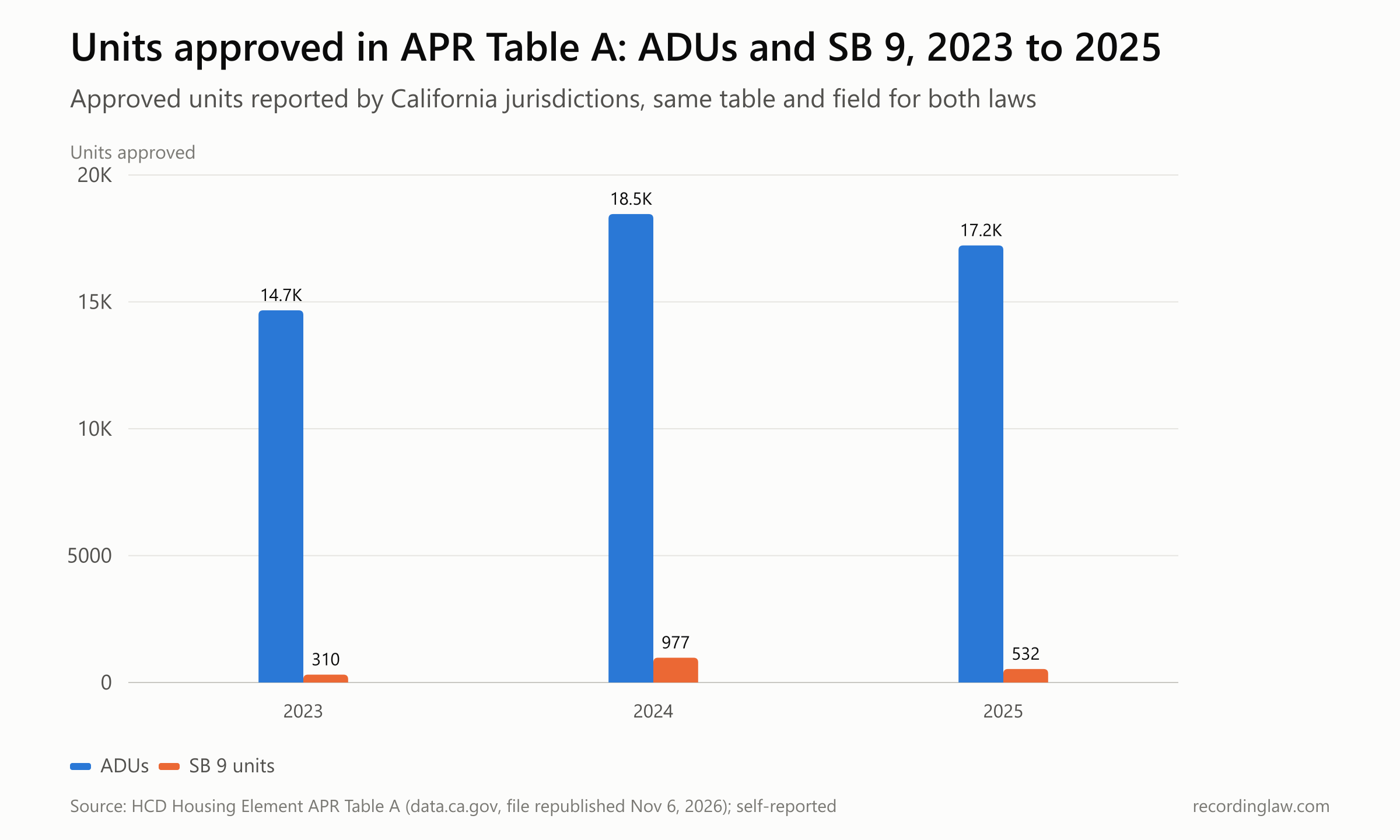
Units approved in HCD APR Table A, ADUs and SB 9, 2023 to 2025. Source: HCD APR Table A (self-reported), file republished and retrieved Nov. 6, 2026.
| Year | ADU units approved | SB 9 units approved | SB 9 application records |
|---|---|---|---|
| 2023 | 14,667 | 310 | 412 |
| 2024 | 18,461 | 977 | 1,410 |
| 2025 | 17,224 | 532 | 803 |
The 19-to-1 ratio in the opening comes from 2024, the busiest SB 9 year in the file. In 2023 cities reported about 47 ADUs approved for every SB 9 unit, and in 2025 about 32.
Three cautions apply to the SB 9 column. Only between 107 and 123 jurisdictions a year used the SB 9 labels, out of about 470 with any record in the table, so projects elsewhere may be missing. A lot split and a duplex on the same property can each be recorded, so some units may be counted twice, which would make the SB 9 count too high rather than too low. And the figures can still change; when HCD republished the file on Nov. 6, 2026, the 2024 and 2025 counts moved slightly from the version posted a week earlier.
HCD also keeps a separate count on its online dashboard, using a different definition. As of June 2026, according to a Senate committee analysis, the dashboard showed 1,671 SB 9 projects submitted statewide, 862 of them in the City of Los Angeles. "Uptake in recent years has increased," that analysis said. Projects submitted are not units approved, so the dashboard figure and the table above cannot be added or compared.
Where the two laws still part ways
Today California bars cities from requiring an ADU owner to live on the property, and it still requires an SB 9 lot-split applicant to sign the three-year affidavit. The ADU ban became permanent in 2023, when the Legislature passed AB 976, also by Ting and sponsored by California YIMBY. "Owner occupancy requirements threaten the existing financing market for ADU construction," Ting said. The committee analysis listed the arguments in opposition as "None on file."
SB 9 also leaves homeowner associations a power that ADU law takes away. HOAs "are allowed to ban SB 9 lot splits," the Terner Center found in a 2022 review of 10 city ordinances, "a practice outlawed for statewide ADU standards." In the same review, six of the 10 cities capped SB 9 homes under 20 feet tall, and many set the maximum size close to the 800-square-foot minimum the state requires them to allow.
Developers generally supported SB 9, KQED reported in 2024, but criticized the three-year residency rule and argued that fees and other city barriers kept the law from working as intended. In November 2025, William Fulton wrote in the California Planning & Development Report that "the general consensus is most single-family homeowners find it easier to add an accessory dwelling unit." These are explanations from planners, researchers, builders and trade press. No study in the record measures how much of the gap any one of them accounts for.
In 2026, Assemblymember Patrick Ahrens, a Sunnyvale Democrat, introduced AB 2005 to let lot-split applicants who hold property through common estate-planning tools such as trusts use the law, while "maintaining strong protections against investor speculation." "In my district, I still need to rent because the average price of a first-time home exceeds $ 1 million," he said. As last amended on Aug. 28, 2026, the bill would have let an applicant either live in one of the units for three years or sell both parcels on the condition that one unit on each stays owner-occupied for three years, with each such buyer signing a sworn statement of intent to live there. It would also have let a trustee of a person's living trust, or a limited liability company of a natural person, apply, except LLCs on parcels inside the boundaries of the 2025 Palisades and Eaton fires.
The owner rule has defenders, including a group that backed earlier fast-track laws. The California Association of Realtors, the real estate agents' trade group, which had supported SB 1069 in 2016 and SB 450 in the 2023-24 session, opposed AB 2005. The Senate committee analysis summarized its argument that speculative investors would view penalties for violating the bill's owner-occupancy provisions as the cost of doing business. Sam Uretsky, president of the Larchmont United Neighborhood Association in Los Angeles, wrote that "AB 2005 will allow LLCs to buy properties in single-family neighborhoods and split them under SB9" and that a single-family lot "can quickly morph into six or more units when you include primary residences, ADUs, and junior ADUs: a developer’s dream; our neighborhoods destabilized."
The Assembly passed AB 2005 66-1 on May 14, 2026. It was never brought to a vote in the Senate, and the Legislature adjourned on Aug. 31 without taking it up.
Three questions still open
As of Nov. 6, 2026, three things are unsettled.
The first is in court. The charter-city case is back before Kin to decide whether SB 9, with SB 450's rewritten purpose, can bind charter cities, and we found no ruling on remand. The outcome could matter beyond the five plaintiffs, because California has 121 charter cities. General-law cities follow the state's rules, and the suit does not apply to them.
The second is in the Legislature. AB 2005 died with the session, so any change to SB 9's owner-occupancy rule would have to start over as a new bill in the next legislative session.
The third is in the data. Cities' reports for calendar 2026 are due to HCD on April 1, 2027, and HCD says a year's figures are not complete until June 30, 2027. Those reports will show whether SB 9 approvals return to their 2024 level or stay near 2025's, and whether ADU numbers keep climbing. Santa Barbara, where 16 ADU approvals in 23 years gave way to 122 applications in six months of 2017, will file its count by the same date.
How we measured
ADU building permits. From HCD's Housing Element Annual Progress Report (APR) Table A2 on data.ca.gov, file republished and downloaded Nov. 6, 2026, summing all building-permit unit columns for rows with unit category ADU, by reporting year. Rows repeating the same jurisdiction, year, tracking ID, street address, parcel number and permit date were counted once; that removed between 5 and 228 units a year. Without that step the totals are 9,008 (2018) to 41,975 (2025). Table A2 starts with reporting year 2018, so we have no statewide series of our own for 2016 and 2017.
HCD's handbook figures. HCD's March 2026 ADU handbook gives 1,336 ADUs permitted in 2016 and 30,354 in 2024, and says ADUs were "more than 26.6 percent of all homes permitted statewide" in 2024. Its 2024 figure is below our Table A2 sum (38,907), and it does not state its data pull or method. We could not reproduce the 26.6% share: 30,354 divided by the Census Bureau's count of 101,545 homes authorized in California in 2024 is 29.9%. We quote HCD's figures as HCD's and do not combine them with ours. The Terner Center, in an August 2020 brief, gave 5,911 ADU permits in 2018 and 15,571 in 2019; those also differ from the current file.
SB 9 and ADU approvals. From APR Table A (applications), file republished and downloaded Nov. 6, 2026. SB 9 records are those whose project type begins with "SB 9", including the standard labels "SB 9 (2021) - Residential Lot Split" and "SB 9 (2021) - Duplex in SF Zone", one or both of which every counted record carries; units are the total approved units on those records. ADU approvals are total approved units on records with unit category ADU in the same table. Records for 2021 and 2022 carry the standard labels from only one or two jurisdictions (48 units on 49 records in 2022), so we compare 2023 onward, when more than 100 jurisdictions used them. Jurisdictions using a standard label: 107 in 2023, 118 in 2024 and 123 in 2025 (lot-split label 63 to 78, duplex label 64 to 69, both labels on one record 6 to 10), out of 469 to 476 jurisdictions with any record in Table A each year. Ratios are ADU units approved divided by SB 9 units approved in the same year (18,461 / 977 = 18.9; 14,667 / 310 = 47.3; 17,224 / 532 = 32.4).
Year-one and survey counts. The Terner Center's 13-city table (Jan. 18, 2023) is city-reported through November 2022; the cities were chosen for SB 9 feasibility and high ADU output, not at random. The totals (100 lot-split applications, 28 approved; 282 unit applications, 53 approved) are our sums of its table, and "about one in five" is 53 of 282. Los Angeles's share is 211 of 282. KQED's 16-city figures are a news survey, not a peer-reviewed study. The Terner Center was a registered supporter of SB 9; the funders of its SB 9 work are not stated on the pages we read.
The dashboard count. HCD's APR dashboard figure of 1,671 SB 9 projects submitted as of June 2026 is reported second-hand in the Senate analysis of AB 2005. It counts projects submitted, not units approved, over a different span, so it is not combined with Table A counts.
What the data cannot show. All APR figures are self-reported by local governments and not verified by HCD, and reporting improved over these years. There is no comparison state, and the period includes the pandemic, changing interest rates and construction costs, and fee changes. The ADU line shows what happened after the 2016 and 2019 laws, not how much they caused. The SB 9 counts show how little the law was used in reported approvals, not why: the owner-occupancy affidavit, HOA bans, local ordinances and the ADU alternative are documented differences, and none has been measured as a cause in the sources here. Completions, as distinct from permits and approvals, were not pulled.
Frequently Asked Questions
What is California SB 9?
SB 9, the California HOME Act (Chapter 162, Statutes of 2021), requires cities to approve, without a discretionary hearing, up to two homes on a lot in a single-family zone, a split of that lot into two parcels, or both. Gov. Gavin Newsom signed it on Sept. 16, 2021, and it took effect on Jan. 1, 2022. SB 450 (2024) and AB 1061 (2025) later amended it.
How many ADUs does California permit each year?
In the state's Annual Progress Report data (Table A2), cities and counties reported 41,747 ADU building permits in 2025 and 38,907 in 2024, up from 9,003 in 2018, after removing duplicate rows. HCD's ADU handbook gives a lower 2024 figure, 30,354, without stating its method.
How many homes have been built under SB 9?
No statewide count of completed SB 9 homes was found. In the state's Annual Progress Report data, cities reported 310 SB 9 units approved in 2023, 977 in 2024 and 532 in 2025. HCD's dashboard, by a different definition, counted 1,671 SB 9 projects submitted statewide as of June 2026, 862 of them in Los Angeles.
Does SB 9 require the owner to live on the property?
For a lot split, yes. The applicant must sign an affidavit stating an intent to live in one of the units as a principal residence for at least three years from approval, unless the applicant is a community land trust or nonprofit. Cities may not add other owner-occupancy requirements; HCD told Laguna Beach in 2024 that its ordinance did so improperly. AB 2005, which would have changed the rule for some applicants, died on Aug. 31, 2026.
Can a city require an ADU owner to live on the property?
No. The 2019 ADU laws barred owner-occupancy requirements for ADUs approved from 2020 through 2024, and AB 976 (2023) made that ban permanent.
Can an HOA ban SB 9 lot splits in California?
According to a 2022 Terner Center review, homeowner associations are allowed to ban SB 9 lot splits, a practice state law prohibits for ADUs.
Is SB 9 still in effect in charter cities?
SB 9 remains state law. In 2024 a Los Angeles Superior Court judge ruled it unconstitutional as applied to five charter cities (Redondo Beach, Carson, Torrance, Whittier and Del Mar). On Nov. 12, 2025, the Court of Appeal sent the case back for the judge to reconsider in light of SB 450. The suit does not apply to general-law cities.
When will 2026 ADU and SB 9 numbers be released?
Cities' Annual Progress Reports for calendar 2026 are due to HCD on April 1, 2027. HCD says a year's data is not complete until June 30 of the following year, so full 2026 figures should be available after June 30, 2027.
Updates
Independently fact-checked against the cited primary sources
Sources and References
- California HCD, Housing Element Annual Progress Report data, Table A2 (building activity), data.ca.gov, retrieved Oct. 31, 2026(publish.data.ca.gov).gov
- California HCD, Housing Element Annual Progress Report data, Table A (housing development applications), data.ca.gov, retrieved Oct. 31, 2026(publish.data.ca.gov).gov
- California Open Data Portal, Housing Element Annual Progress Report (APR) data by jurisdiction and year(data.ca.gov).gov
- California HCD, Housing Element Implementation and APR Dashboard(hcd.ca.gov).gov
- California HCD, Housing Element Annual Progress Reports(hcd.ca.gov).gov
- California HCD, Accessory Dwelling Unit Handbook (March 2026)(hcd.ca.gov).gov
- California HCD, Housing Law Fact Sheet: Duplexes and Lot Splits (SB 9), April 2026(hcd.ca.gov).gov
- U.S. Census Bureau, Building Permits Survey, annual state file 2024(www2.census.gov).gov
- California Legislative Information, SB 1069 (2016), chaptered text(leginfo.legislature.ca.gov).gov
- SB 1069, Chapter 720, Statutes of 2016, chaptered bill with vote and approval dates(leginfo.ca.gov).gov
- Assembly floor analysis, SB 1069 (Wieckowski), as amended Aug. 19, 2016(leginfo.ca.gov).gov
- Assembly Housing and Community Development Committee analysis, SB 1069, June 15, 2016(leginfo.ca.gov).gov
- Assembly Local Government Committee analysis, SB 1069 (2016)(alcl.assembly.ca.gov).gov
- Assembly Local Government Committee analysis, SB 229 (Wieckowski), July 12, 2017(alcl.assembly.ca.gov).gov
- Assembly Local Government Committee analysis, AB 68 (Ting), April 10, 2019(alcl.assembly.ca.gov).gov
- Assembly Local Government Committee analysis, SB 13 (Wieckowski), July 10, 2019(alcl.assembly.ca.gov).gov
- Assembly Local Government Committee analysis, AB 976 (Ting), April 19, 2023(alcl.assembly.ca.gov).gov
- Assembly Local Government Committee analysis, SB 450 (Atkins), June 28, 2023(alcl.assembly.ca.gov).gov
- Senate Housing Committee analysis, SB 9 (Atkins), April 15, 2021(shou.senate.ca.gov).gov
- California Legislative Information, SB 9 (2021-2022) floor votes(leginfo.legislature.ca.gov).gov
- CalMatters Digital Democracy, AB 2005 (2025-26), with Senate committee and floor analyses(calmatters.digitaldemocracy.org)
- Office of the Governor, Oct. 9, 2019, Governor Gavin Newsom Signs 18 Bills to Boost Housing Production(gov.ca.gov).gov
- Office of the Governor, Sept. 16, 2021, SB 9 signing announcement(gov.ca.gov).gov
- Office of the Attorney General, Feb. 6, 2022, press release on letter to the Town of Woodside(oag.ca.gov).gov
- City of Santa Monica, City Attorney update on SB 9, May 2, 2024(santamonica.gov).gov
- Office of Sen. Toni G. Atkins, SB 9 fact sheet, April 5, 2021 (hosted by California YIMBY)(cayimby.org)
- Bay Area Council press release, Oct. 9, 2019(bayareacouncil.org)
- Bel-Air Association, January 2021, reprint of a Livable California newsletter(belairassociation.org)
- Terner Center for Housing Innovation, UC Berkeley, ADU brief (2020)(ternercenter.berkeley.edu)
- Terner Center, July 2021, Will Allowing Duplexes and Lot Splits on Parcels Zoned for Single-Family Create New Homes?(ternercenter.berkeley.edu)
- Terner Center, June 8, 2022, State Law, Local Interpretation: How Cities Are Implementing Senate Bill 9(ternercenter.berkeley.edu)
- Terner Center, Jan. 18, 2023, California's HOME Act Turns One(ternercenter.berkeley.edu)
- Santa Barbara Independent, July 20, 2017, Granny Flat Applications Explode(independent.com)
- The American Prospect / Capital & Main, Aug. 19, 2021(prospect.org)
- CalMatters, August 2021 (updated after the Sept. 16, 2021 signing)(calmatters.org)
- Local News Matters (Bay City News), Feb. 8, 2022(localnewsmatters.org)
- Planetizen, Jan. 22, 2023(planetizen.com)
- KQED, April 25, 2024 (updated Sept. 9, 2024)(kqed.org)
- Times of San Diego, Sept. 1, 2024(timesofsandiego.com)
- California Planning & Development Report, Nov. 16, 2025, Constitutionality of SB 9 Will Be Reconsidered(cp-dr.com)
- Palo Alto Daily Post, May 21, 2026, Court upholds law allowing 4 homes on a lot(padailypost.com)
- Larchmont Buzz, Sept. 2, 2026, Lot-Split Bill AB2005 Dies, Again(larchmontbuzz.com)
- HCD, letter of technical assistance to the City of Pasadena (April 22, 2022)(hcd.ca.gov).gov
- AB 2005 (2025-26), bill text as amended in Senate Aug. 28, 2026(leginfo.legislature.ca.gov).gov