Did California's $20 Fast-Food Wage Cost Jobs? Estimates Run From 3.5% Fewer to Slightly More

Independently fact-checked against primary sources (last audited November 1, 2026). · 16 primary sources cited on this page. How we verify our legal content
On September 28, 2023, Gov. Gavin Newsom signed Assembly Bill 1228 in a Service Employees International Union hall in Los Angeles. As he signed it, some of the workers and labor leaders in the room chanted "Sí, se puede!", KQED reported.
The law set a $20 hourly minimum wage for workers at large fast-food chains, starting April 1, 2024. It also created a Fast Food Council inside the state Department of Industrial Relations, with the power to raise that floor once a year by up to 3.5% or the rate of inflation, whichever was lower.
The last meeting the department lists for the council was a subcommittee session on February 26, 2025. That day the subcommittee voted to put a cost-of-living raise on the next meeting's agenda, as an item for discussion only. A raise of the maximum 3.5% would have taken the wage to $20.70.
The department's meeting list, checked on October 31, 2026, shows nothing after that date. The council's chair stepped down in May 2025, and in May 2026 the state Labor and Workforce Development Agency confirmed to CalMatters that there was no chair and that meetings were on hold.
So the wage is still $20. Since it took effect, economists using the same federal job counts reached different answers about what it did. One team estimates California's fast-food sector has about 3.5% fewer jobs than it would have had, roughly 20,000; another puts the effect close to zero.
Most of the gap comes from what each team compares California with: the rest of the country, or a blend of other states weighted to match California's trend before the law. The record now holds two years of pay, job and price data to set against what each side predicted in 2023, and a council that stopped meeting before it acted on any of it.
What each side said $20 would do
The $20 wage was the second try. In 2022 the Legislature passed AB 257, which would have let a state council set a fast-food minimum wage of up to $22 an hour. As it headed to Newsom's desk, Joe Erlinger, president of McDonald's USA, wrote in an open letter that economists said it "could drive up the cost of eating at a quick service restaurant in California by 20%."
The industry answered with a referendum on AB 257, which qualified for the ballot. By June 30, 2023, its campaign, Save Local Restaurants, had raised $21.5 million, according to Ballotpedia. Chipotle and In-N-Out gave $2.8 million each, and Starbucks gave $2 million.
AB 1228 was the deal that ended that fight. It passed on September 14, 2023, by 32-8 in the Senate and 53-17 in the Assembly, along party lines. It set the wage at $20 in the statute itself, and the industry campaign withdrew its referendum. "With this referendum behind us and the work of setting up a fast food council ahead of us, we are ushering in a new era of worker power and worker voice in California," Tia Orr, executive director of SEIU California, said on December 29, 2023, the day it was withdrawn.
The promise came at the signing. "California is home to more than 500,000 fast-food workers who – for decades – have been fighting for higher wages and better working conditions," Newsom said. His office put the average fast-food wage in 2022 at $16.21.
The bill's author, Assemblymember Chris Holden, a Pasadena Democrat, said: "We did not just raise the minimum wage to $20 an hour for fast food workers. We helped a father or mother feed their children, we helped a student put gas in their car, and helped a grandparent get their grandchild a birthday gift."
Mary Kay Henry, president of SEIU, which negotiated the deal, called it "a true David and Goliath story." Two weeks earlier she had told CNBC what the council model would do: "This groundbreaking, sector-wide approach is the path to making fast-food jobs safer and the industry more sustainable for everyone."
The warnings came from inside the industry, though the industry did not speak with one voice. The National Owners Association, a group of more than 1,000 McDonald's franchise owners, projected in a memo reported by CNBC that the bill would cost each California restaurant $250,000 a year, costs that "simply cannot be absorbed by the business model." The same memo said McDonald's, the National Restaurant Association and the International Franchise Association had negotiated the deal with SEIU "independently w/o franchisee involvement."
Those trade groups saw the deal differently. "Signature of AB 1228 preserves the franchise business model in the state and solidifies the best possible outcome for workers, local restaurant owners, and brands," said Matt Haller, president and CEO of the International Franchise Association. Sean Kennedy of the National Restaurant Association said "There are significant challenges created by this law," but that restaurants "will do it with stable and predictable regulation that they wouldn’t have had under the FAST Act."
Michaela Mendelsohn, a franchise owner, was quoted in the franchise association's statement. "The sudden minimum wage increase to $20 an hour will add to the cost of operating a restaurant at a time when margins are already stressed, though this agreement puts a stop to the repeated attacks on local restaurant owners like me," she said. Five months later she was on the council that could raise the wage.
The first thing the record can test is whether pay went up.
Did paychecks rise?
They did, and faster than elsewhere. The clearest public measure is the federal Quarterly Census of Employment and Wages (QCEW). In California's limited-service restaurants, the industry category that includes fast food, average weekly pay was $521 in the third quarter of 2023, before the law took effect.
A year later it was $586, up 12.5%. In the rest of the country, the same measure rose 3.9%. The chart below shows that gap open in the second quarter of 2024, the first quarter under the $20 floor, and stay wide through early 2025.
From mid-2025, each quarter was being compared with a quarter already under $20, so the yearly gap narrowed, and in late 2025 the rest of the country's pay grew faster. The gap widened again in the first quarter of 2026. California's pay level did not fall back: in that quarter its average weekly pay was about 15% above the third quarter of 2023, against about 4% for the rest of the country.
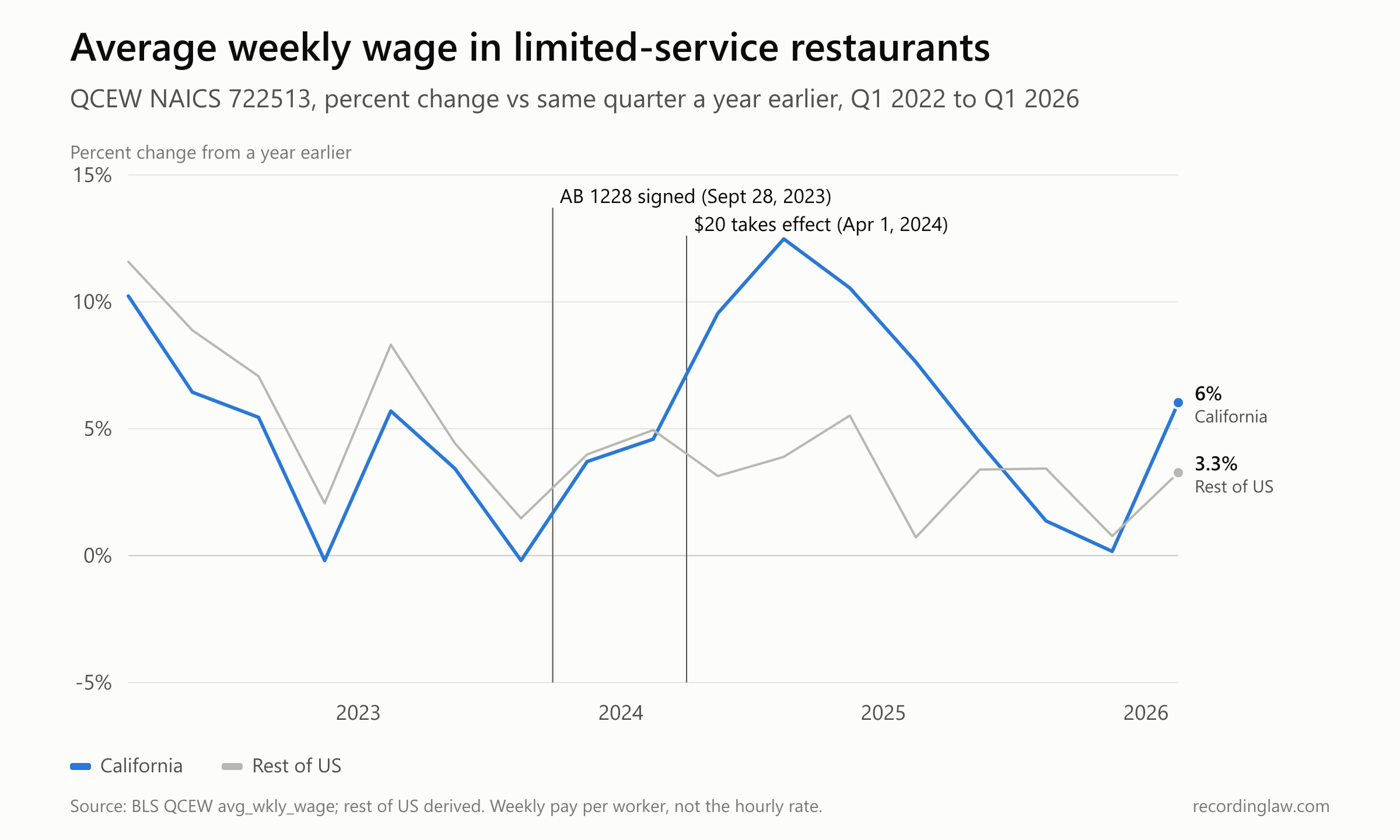
Year-over-year change in average weekly wage, limited-service restaurants, California vs the rest of the US, Q1 2022 to Q1 2026. Source: BLS QCEW.
| Quarter | California weekly wage | California change from a year earlier | Rest of US weekly wage | Rest of US change from a year earlier |
|---|---|---|---|---|
| Q3 2023 | $521 | -0.19% | $427.0 | +1.47% |
| Q1 2024 | $524 | +4.59% | $428.3 | +4.95% |
| Q3 2024 | $586 | +12.48% | $443.6 | +3.89% |
| Q1 2025 | $564 | +7.63% | $431.4 | +0.72% |
| Q3 2025 | $594 | +1.37% | $458.8 | +3.43% |
| Q1 2026 | $598 | +6.03% | $445.5 | +3.27% |
Weekly pay mixes the hourly rate with hours worked and tips, and it covers every limited-service restaurant, not only the large chains the law reaches. The studies that focused on covered workers also found pay rising, by different amounts. Arindrajit Dube of the University of Massachusetts Amherst estimated the law raised fast-food wages by about 7%. Denis Sosinskiy and Michael Reich of UC Berkeley's Institute for Research on Labor and Employment (IRLE) put the rise in weekly wages for covered workers at about 11%.
A survey by the Shift Project at Harvard Kennedy School and UC San Francisco found hourly wages for California fast-food workers "increased by at least $2.50" right after the law took effect. Dube describes that sample as recruited online through Facebook and Instagram ads. Whether the higher pay came at the cost of jobs is where the argument started, and it started within months.
What happened to the jobs?
The first numbers arrived in the summer of 2024, and each side read a different series. In August, preliminary federal data showed a record 750,500 fast-food jobs in California in July, KQED reported. "What’s good for workers is good for business, and as California’s fast food industry continues booming every single month, our workers are finally getting the pay they deserve," Newsom said.
Critics pointed to the seasonally adjusted version of the federal jobs data, the version that strips out the usual swings from month to month, which, KQED wrote, showed "gains of just hundreds of jobs in the industry since April." Rebekah Paxton, research director of the Employment Policies Institute, which KQED described as "a nonprofit research organization funded partly by the restaurant industry," said: "Fast-food restaurant employment is stagnating and even going down."
The QCEW count arrives months later; its figures for the first quarter of 2026 came out on August 28, 2026. It can answer the question both sides were arguing about: did California's fast-food job count fall behind the rest of the country?
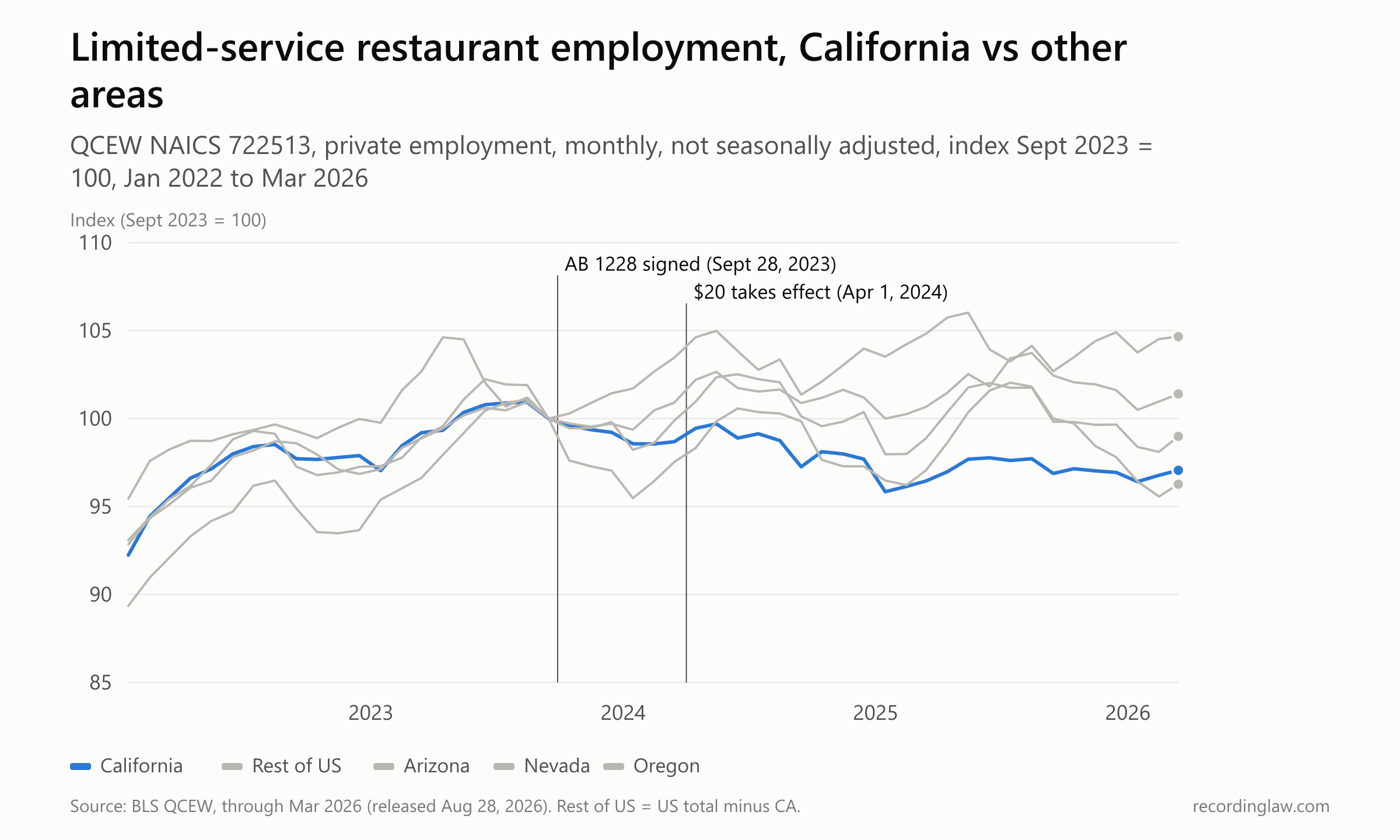
California limited-service restaurant employment indexed to Sept 2023 = 100, against the rest of the US, Arizona, Nevada and Oregon, Jan 2022 to Mar 2026. Source: BLS QCEW.
| Month | California jobs | California index | Rest of US index | Arizona index | Nevada index | Oregon index |
|---|---|---|---|---|---|---|
| Sept 2023 | 570,909 | 100.00 | 100.00 | 100.00 | 100.00 | 100.00 |
| Mar 2024 | 563,434 | 98.69 | 99.89 | n/a | n/a | n/a |
| Sept 2024 | 555,273 | 97.26 | 100.13 | 101.36 | 100.89 | 99.85 |
| Sept 2025 | 553,092 | 96.88 | 99.83 | 102.69 | 102.45 | 100.00 |
| Mar 2026 | 554,137 | 97.06 | 98.99 | 104.66 | 101.40 | 96.27 |
From September 2023 to September 2024, California's limited-service restaurants went from about 571,000 jobs to about 555,000, a drop of 2.7%. Over the same months the rest of the country rose 0.1%. A year later California was about where it had been, and the rest of the country had dipped slightly.
California had started losing ground before April 2024. Its count was already 1.3% below the September 2023 level by March 2024, the month before the wage took effect, while the rest of the country was 0.1% below. Employers had known the date since September, and the team led by Jeffrey Clemens, whose estimate appears below, also measures from September 2023.
The count of restaurants did not fall. California had 33,364 limited-service establishments in the third quarter of 2023 and 35,009 in the first quarter of 2026, about 5% more.
By then the industry's trade group had changed its tone. "Every day you see headlines of restaurant closures, employee job losses and hours cut, and rising food prices for consumers," an International Franchise Association spokesperson said in August 2024, eleven months after its chief executive called the law the best possible outcome. The raw numbers show California fell behind. Whether the $20 wage is the reason depends on what California is compared with.
Why do economists with the same data disagree?
To say what a law did, an economist has to estimate what would have happened without it. Nobody can observe a California that skipped AB 1228, so each study builds one, and the studies built different ones.
Jeffrey Clemens of UC San Diego and three co-authors compared California with the rest of the United States, using the QCEW and a second federal dataset, the Census Bureau's Quarterly Workforce Indicators (QWI). After one year, they estimate, employment was 3% lower in the QCEW and 1.5% lower in the QWI than it would have been. After two years both datasets show about 3.5%. "In QCEW data, the median one- and two-year estimates translate into job losses of roughly 18,000 and 20,000, respectively," they wrote.
Dube, writing in May 2026, ran 32 versions of the analysis. A conventional comparison, called difference-in-differences, asks how much more California's job count changed than other states' counts did over the same months. It gives a loss of about 1.4%.
His preferred method, synthetic difference-in-differences, instead weights other states so that their combined trend matched California's before the law. The California it builds is 61% Idaho, 22% Utah, 7% Pennsylvania, 7% Texas and 4% Georgia. Against that comparison, the estimated effect shrinks to about 0.3% fewer jobs.
Clemens and his co-authors argue the reweighting is not needed, "as California's fast food employment evolved similarly to that of the remainder of the United States between the pandemic and the enactment of AB 1228." In October 2026 they built 1,440 synthetic comparisons of their own. "While over 96 percent of the estimated employment effects are negative, the range is vast," they wrote, and simpler comparisons "lie near the centers" of those results.
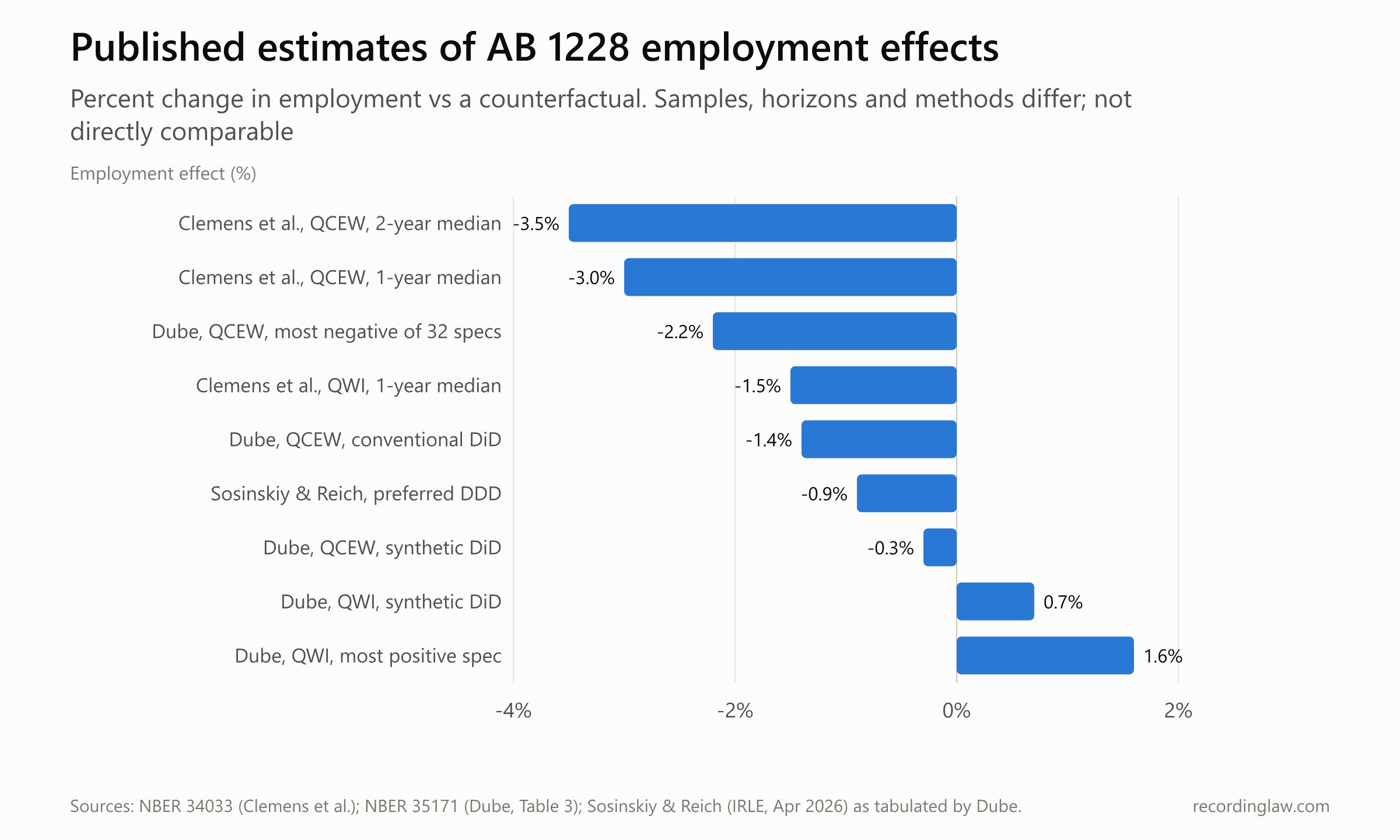
Published estimates of the AB 1228 employment effect from Clemens et al., Dube and Sosinskiy and Reich. Methods and horizons differ. Source: NBER 34033, NBER 35171, IRLE.
| Study and specification | Data | Employment effect |
|---|---|---|
| Clemens et al., 2-year median | QCEW | -3.5% |
| Clemens et al., 1-year median | QCEW | -3.0% |
| Dube, most negative of 32 specifications | QCEW | -2.2% |
| Clemens et al., 1-year median | QWI | -1.5% |
| Dube, conventional difference-in-differences | QCEW | -1.4% |
| Sosinskiy and Reich, preferred specification (as tabulated by Dube) | QCEW, deseasonalized | -0.9% |
| Dube, synthetic difference-in-differences | QCEW | -0.3% |
| Dube, synthetic difference-in-differences | QWI | +0.7% |
| Dube, most positive specification | QWI | +1.6% |
Dube reports his results as an own-wage elasticity, the percent change in jobs for each 1% rise in pay. Across his 32 versions it runs from -0.29 to +0.26. He notes that this range takes in the median of -0.02 he computes for 27 state minimum-wage increases since 2010.
Which California jobs serve as the comparison matters too. Against full-service restaurants the elasticity is -0.05; against all other California employment it is -0.29.
Sosinskiy and Reich, using job postings, payroll records, cellphone-based visit data and prices scraped from more than 2,000 restaurants, found the law "did not reduce employment." Their estimate "centers around zero and is not statistically significant."
The authors on each side have ties worth knowing. Clemens thanks the Hoover Institution for support as an adjunct senior fellow. Dube thanks Reich and Ben Zipperer, a co-author of the Economic Policy Institute report cited below, for feedback, and Sosinskiy and Reich credit IRLE for research support.
The Employment Policies Institute and the California Globe have called the IRLE work SEIU-funded; the paper credits only IRLE, and we found no document showing union funding. All three are working papers, not yet peer reviewed.
Other estimates come with their own sponsors. A white paper by Christopher Thornberg of Beacon Economics for Pepperdine University's School of Public Policy, a school that describes itself as rooted in "free markets, limited and responsive government," found California's limited-service sector "lost 3.2% of its employment - over 23,100 jobs" in the 12 months through January 2025, while the US sector grew 0.8%. That is a direct comparison with the national total, without a modeled counterfactual. Edgeworth Economics, a consulting firm, estimated 9,600 to 19,300 jobs lost by September 2024.
The Berkeley Research Group, retained by Save Local Restaurants, reported 10,700 jobs lost from June 2023 to June 2024, according to Fox News, a window that begins nearly ten months before the wage took effect. Reich wrote in a February 2025 IRLE brief that the report "cherry picks its numbers and does not use modern causal identification methods."
One limit runs under all of them. The law covers chains with "more than 60 establishments nationally," in the statute's words, and the federal data cannot see chain size. As the CalMatters columnist Dan Walters put it, "the rival researchers had to extrapolate."
A September 2026 paper by Vitor Melo, David Neumark, Liam Sigaud and Gary Wagner used establishment-level data that can see the threshold: the YourEconomy Time Series, built from Data Axle business files, which lets them identify chains by name and count their locations nationwide. Melo is affiliated with the Archbridge Institute, a think tank, and RAND; Sigaud with West Virginia University's Knee Regulatory Research Center. "We find evidence of negative employment effects, but they are concentrated among small chains, among which the policy also slowed entry and increased exit," they wrote, with "modest overall employment effects thus far."
What the job counts miss
A headcount says nothing about how long people stay or how many hours they work. On how long people stay, the evidence points one way. On hours, it splits.
Dube found that quarterly separations in California fast food, the count of workers leaving jobs, fell "sharply by 13 to 25 log points" across his 16 specifications using QWI data, roughly 12% to 22%. Reich had made a related argument in 2024. "I don’t think minimum wage (increases) kill jobs; I think they kill job vacancies," he told KQED.
On hours, the findings split. The Shift Project survey found no change in hours or scheduling. Hitanshu Pandit, a postdoctoral fellow at Northeastern University, used cellphone data on long visits to just over 10,000 restaurants as a stand-in for staffing and found an average 8% decline in on-site staffing, which Northeastern said "could have meant fewer workers on the floor, fewer hours offered or a mix of both." Dube notes that Sosinskiy and Reich used the same cellphone data source more broadly and found no reduction.
A case study by Stephen Owen of UC Santa Cruz and undergraduate researchers, based on interviews with restaurant managers in Santa Cruz, reported "higher menu prices for consumers, reductions in employee working hours, widespread elimination of overtime, and loss of benefits for employees." Reich told Capital & Main, in an article republished by Stocktonia, that it was "not at all informative," saying the authors made no attempt to check the managers' accounts against interviews with workers, a control group or government data.
That leaves the other half of the 2022 warning, the one about prices, and the question of who paid for the raise.
Who paid for the raise?
The industry's predictions on prices ranged widely. Erlinger's 20% was for the $22 bill. In January 2025, an open letter from more than 1,000 restaurant owners organized by Save Local Restaurants blamed the $20 wage for food prices "up by 13% overall," as quoted by the management-side law firm Fisher Phillips.
Three weeks later the Berkeley Research Group report put the rise at 14.5%, according to Fox News. "Californians are bearing the cost of the minimum wage increase through fewer available jobs and higher food cost," the report said, as quoted by Fox.
The economists found less. Sosinskiy and Reich estimate prices at covered chains rose 1.5% compared with controls, "equivalent to 6 cents for a $4 item," and that employers passed about half of the higher wage costs to customers. Dube wrote in early 2025 that "a substantial portion (majority, but not all) of the labor cost increase has been passed through to prices."
Did restaurant prices in California rise faster than elsewhere? The government's price index cannot isolate the chains, but it can answer that for restaurants as a whole.
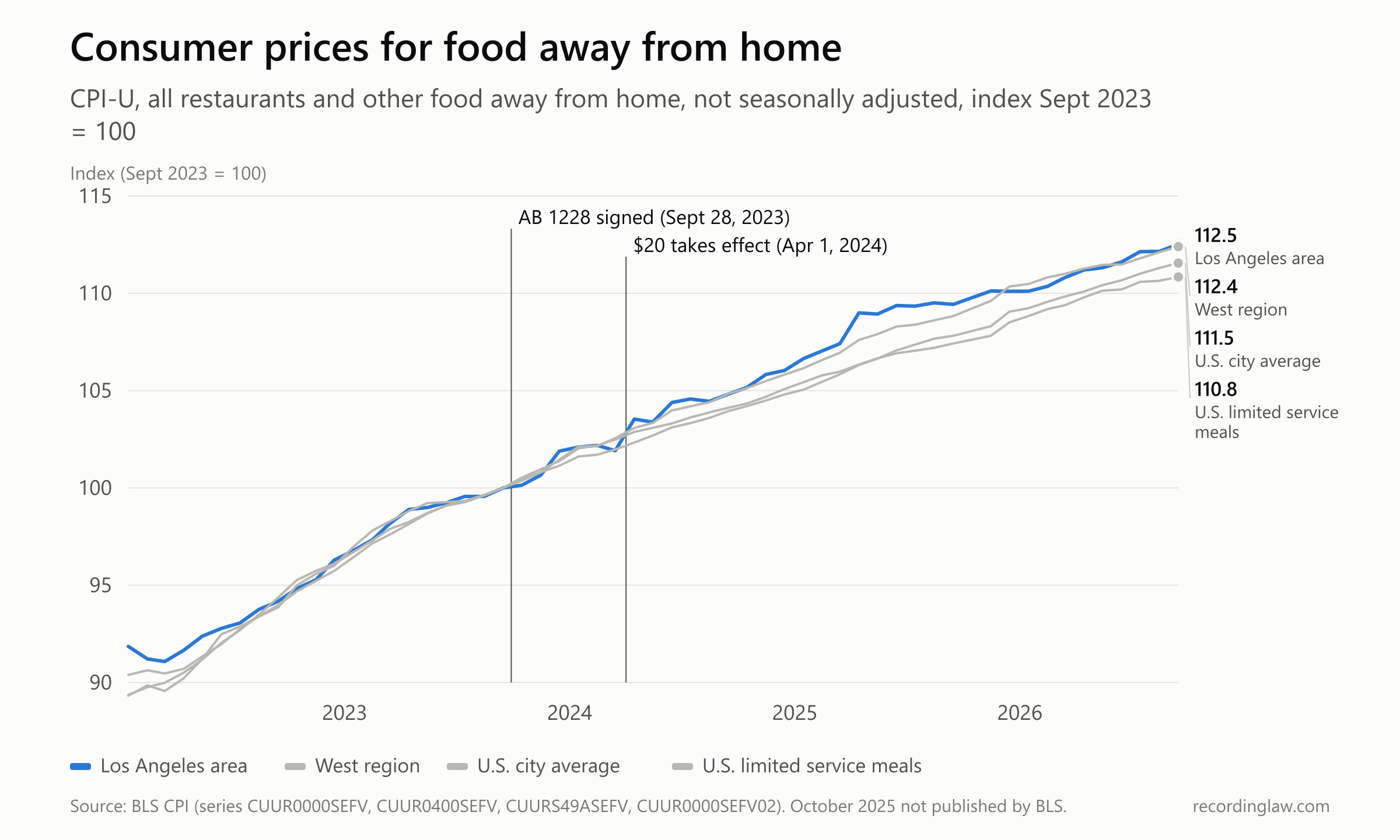
CPI for food away from home, Los Angeles, West region, US, plus US limited-service meals, indexed to Sept 2023 = 100. Source: BLS CPI.
| Series (index, Sept 2023 = 100) | Mar 2024 | Sept 2024 | Mar 2026 | Sept 2026 |
|---|---|---|---|---|
| Los Angeles area, food away from home | 101.91 | 104.82 | 110.81 | 112.52 |
| West region, food away from home | 102.56 | 104.84 | 111.00 | 112.40 |
| U.S. city average, food away from home | 101.97 | 103.95 | 109.84 | 111.55 |
| U.S. limited-service meals and snacks | 102.48 | 104.12 | 109.39 | 110.84 |
From September 2023 to March 2026, restaurant prices in the Los Angeles area rose 10.8%, against 9.8% for the nation and 11.0% across the West. By September 2026 the Los Angeles index was 12.5% above its September 2023 level and the national one 11.5%.
The index covers every restaurant, sit-down places included, and restaurant costs other than wages moved over the same period. It shows Los Angeles about one percentage point ahead of the nation; it cannot say how much of that came from the law.
Prices also rose for the workers earning $20, and the statute ties any raise the council grants to inflation.
The council that stopped meeting
The council was the sector-wide model Henry had praised. Newsom appointed its members on March 1, 2024. They included Anneisha Williams, a Jack in the Box shift leader who had held up the signed bill at the 2023 ceremony, and Mendelsohn, the franchisee who had warned that $20 would add costs. Nick Hardeman, a former chief of staff to Senate President pro Tem Toni Atkins, was named chair.
The council met for the first time on March 15, 2024, in the Elihu M. Harris State Building in Oakland; afterward, workers rallied outside. "I want you to know that we're here to learn," said Rich Reinis, a member representing employers.
It moved slowly. "Putting together the groundwork so that we would be able to move toward substantive conversations on policy took a lot of time," Hardeman told CalMatters in March 2025. "It is hard to come to decisions." CalMatters noted that corporate representatives for McDonald's, Burger King and the other large chains were absent from the discussions.
On February 26, 2025, at what the department lists as a subcommittee meeting, the council reached what CalMatters called the closest it had come to a policy decision. Its members voted to consider a cost-of-living raise at an upcoming meeting. Restaurant Business noted that a 3.5% increase "would increase it by 70 cents to $20.70."
Both sides lobbied. Save Local Restaurants' letter warned that another raise would "cripple thousands of small business owners like us." Paxton of the Employment Policies Institute said the council "should immediately halt discussions on increasing the fast-food minimum wage further." The Pepperdine paper asked it "to pause any further changes until more thorough, unbiased research is conducted."
A year later, on the other side, the Economic Policy Institute, a labor-aligned think tank that is unrelated to the Employment Policies Institute despite the similar name, urged a 3.5% raise in 2026.
The council never took the vote. "The Council was preparing to discuss a wage adjustment in June 2025 when the chair resigned," the Economic Policy Institute wrote. Hardeman stepped down in May 2025 after being appointed to the board of the California Housing Finance Agency.
Under the statute, the chair convenes the council. "The Council cannot meet without a designated chair to convene its meetings," a department spokesperson told Restaurant Business in December 2025.
The statute also says the council "shall hold meetings or hearings no less than every six months that are open to the public." As of October 31, 2026, the department's list showed none in more than 20 months.
Workers marked the gap their own way. On April 16, 2026, about two years after the first meeting, they delivered a 96-page book to the governor's office describing more than 100 complaints alleging wage theft and poor working conditions, CalMatters reported.
The governor's office, meanwhile, promoted the Berkeley findings. Six days after the book arrived, it issued a release on the April 2026 Berkeley update headlined "What Fox News won’t report: California’s fast food minimum wage increase helped 730K workers with ZERO job loss." "There is no job loss resulting from increasing the fast-food minimum wage," it said. Its quote from the governor opened with the same sentence the governor had used on the first version of the study in October 2024: "This study reaffirms that our commitment to fair wages for fast-food workers is not only lifting up working families but also strengthening our economy."
Council members described the stall from opposite seats. "The sky didn’t fall on the California fast food industry," said Angelica Hernandez, a McDonald's cook trainer who represents workers. Reinis, who wants the council to order its own study of prices and jobs, said: "The staff will have to write a report without having any meetings. How the hell are we supposed to do that?"
Holden, now out of the Assembly, called the council "groundbreaking" and said it "needs to address the challenges that were the genesis of the council in the first place."
Meanwhile, the $20 has bought less each year. Consumer prices nationally rose 7.3% from September 2023 to March 2026, so $20 in March 2026 bought about what $18.64 did when the bill was signed. California's general minimum wage rose to $16.90 on January 1, 2026, leaving the fast-food floor $3.10 above it, a gap that, as Restaurant Business wrote, "continues to narrow." (The general rate is covered on our California minimum wage page.)
Where does the job count stand now?
By early 2026 the federal count had turned. In January 2026, for the first time since April 2024, California's limited-service employment was higher than a year earlier, and it stayed that way through March.
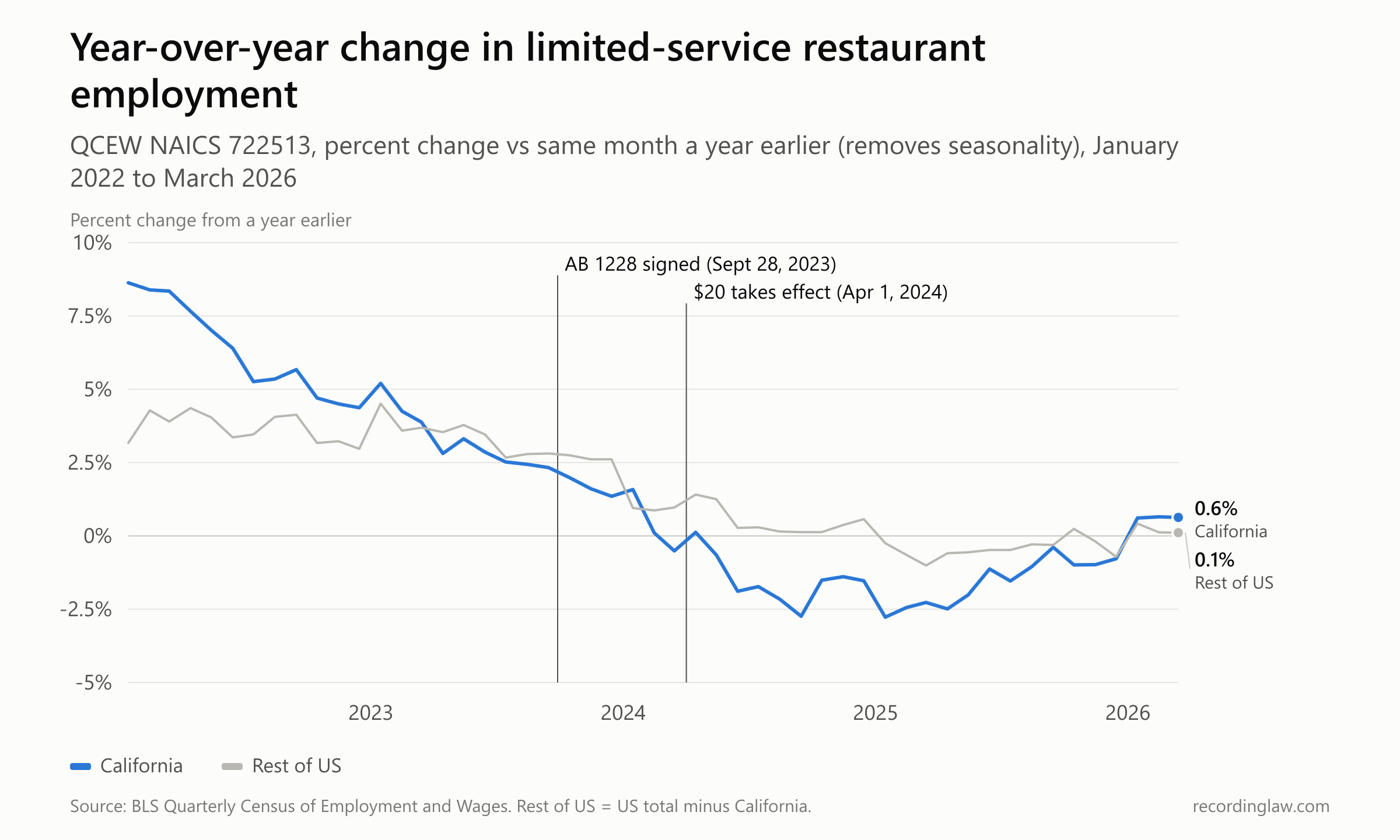
Year-over-year change in limited-service restaurant employment, California vs the rest of the US, Jan 2022 to Mar 2026. Source: BLS QCEW.
| Month | California change from a year earlier | Rest of US change from a year earlier |
|---|---|---|
| Mar 2024 | -0.51% | +0.97% |
| Sept 2024 | -2.74% | +0.13% |
| Jan 2025 | -2.77% | -0.25% |
| Sept 2025 | -0.39% | -0.31% |
| Jan 2026 | +0.61% | +0.42% |
| Mar 2026 | +0.63% | +0.11% |
That growth started from a lower base. In March 2026 California had 554,137 limited-service jobs, 1.7% fewer than in March 2024, the last month before the $20 wage; the rest of the country had 0.9% fewer.
The next QCEW release, covering April to June 2026, is scheduled for December 2, 2026. It will show whether California's job count kept growing into the third year of the $20 wage.
No date has been set for the council. In July 2026, in a post reproduced by the California Globe, a KCRA reporter wrote that Newsom said he "hopes to appoint the council's next leader before he leaves office." Under Labor Code 1475, the council can approve no raise that takes effect after 2029, and its powers end on January 1, 2029, when "the council shall cease operations."
The law signed in that Los Angeles union hall let the council start raising the wage on January 1, 2025. Two Januaries have now passed with the wage at $20, and the next is two months away with no meeting on the department's list.
How we measured
Jobs and pay. Employment and weekly wages come from the Bureau of Labor Statistics Quarterly Census of Employment and Wages (QCEW), industry code NAICS 722513 (limited-service restaurants), private ownership, monthly employment from the quarterly files through the first quarter of 2026 (released August 28, 2026). "Rest of US" is the US total minus California.
The QCEW is not seasonally adjusted, and California fast-food employment is less seasonal than the national industry, so the index lines in the employment chart diverge seasonally; the year-over-year chart removes that. The index base, September 2023, is the month the law was signed and is also a seasonal high. Rest-of-US weekly wages are derived as total wages divided by average employment divided by 13 weeks.
Indexed to the third quarter of 2023 (= 100), average weekly pay in the first quarter of 2026 was 114.8 in California and 104.3 in the rest of the US.
What the code covers. The law defines a limited-service restaurant as including NAICS 722513 but not limited to it, and covers only chains with more than 60 establishments nationally, with exemptions for some bakeries and grocery establishments; AB 610, chaptered March 25, 2024, amended the definitions. The state labor department's FAQ and the economists' papers describe the threshold as "at least 60" or "60 or more"; we use the statute's wording.
Sosinskiy and Reich estimate that about 70% of California fast-food employees work at establishments of chains with at least 60 locations. QCEW counts include workers at smaller chains and independents the law does not cover.
Monthly survey data. The BLS monthly survey (CES) does not publish limited-service restaurants by state. For all California restaurants, full-service included, it shows 1,357,300 jobs in September 2023 and a preliminary 1,344,900 in September 2026. CES figures are revised each year; the Pepperdine paper used the January 2025 vintage from California's Employment Development Department, which we did not re-pull.
Prices. The Consumer Price Index for food away from home (series CUUR0000SEFV, CUUR0400SEFV, CUURS49ASEFV) and for US limited-service meals and snacks (CUUR0000SEFV02), not seasonally adjusted, indexed to September 2023. BLS did not publish October 2025 because of the lapse in federal appropriations; the chart bridges September to November. San Francisco's index is published every other month and has no September 2023 value, so it is excluded.
Arithmetic. California's QCEW count fell from 570,909 to 555,273 between September 2023 and September 2024 (-15,636, -2.74%); Clemens and co-authors report the same -2.74%. Establishments rose from 33,364 to 35,009 (+4.9%).
National CPI for all items rose 7.29% from September 2023 to March 2026; $20 divided by 1.0729 is $18.64. The gap to the general minimum is $20.00 minus $16.90.
March 2026 against March 2024: California 554,137 vs 563,434 (-1.65%); rest of US 3,998,520 vs 4,034,827 (-0.90%). Dube's separation drop of 13 to 25 log points converts to 12.2% to 22.1%. The council's sunset rests on Labor Code 1475(m). Section 1477 made the law operative only if the referendum was withdrawn by January 1, 2024; it was withdrawn on December 29, 2023.
How big the raise was. Dube puts $20 at about 77% of California's median hourly wage; Sosinskiy and Reich put it at 69% of the median full-time wage. Newsom's office cited 500,000 fast-food workers in 2023 and 730,000 in 2026; Sosinskiy and Reich count about 750,000 in fast food plus snack and beverage bars. The counts use different definitions.
The studies. Clemens, Edwards, Meer and Nguyen (NBER Working Paper 34033, revised October 2026, and 35931, October 2026) use difference-in-differences against the rest of the US and a triple-difference against non-minimum-wage-intensive private employment. Dube (NBER 35171, May 2026) uses conventional and synthetic difference-in-differences on QCEW data through the third quarter of 2025 and QWI data through the fourth quarter of 2024. Sosinskiy and Reich (UC Berkeley IRLE, April 1, 2026 version) use difference-in-differences and triple-difference event studies on Glassdoor, Square, Advan and scraped price data, plus QCEW data; their preferred employment specification is a triple-difference on deseasonalized QCEW data.
Melo, Neumark, Sigaud and Wagner (NBER 35749, September 2026) use synthetic difference-in-differences on YourEconomy Time Series establishment data, built from Data Axle files, identifying covered chains by name and by their nationwide location count in 2023. Hamdi and Sovich (Equifax payroll data, large employers) are cited by Dube as finding a 12% wage rise and 2% employment rise; we did not open their paper.
Pandit's finding, published in the journal Applied Economics Letters, comes from Northeastern's news story and Dube's description; we did not open the paper. The Berkeley Research Group report was not found in a primary copy; its figures come from Fox News. The NBER and IRLE working papers are not peer reviewed.
What the data cannot show. No public government dataset separates covered chains from the rest of the industry, and no randomized comparison exists. The window includes the recovery from COVID, minimum-wage increases in other states, and changes in tipping and hours that weekly pay does not separate.
Clemens and co-authors report -2.89% against all other states and -3.23% against states with no wage increase at September 2024. Arizona, Nevada and Oregon are shown for context, not as controls; we did not research their own wage changes in the window. The figures here show what happened in California after the law, beside other places; they do not by themselves show what the law caused.
Frequently Asked Questions
When did California's $20 fast-food minimum wage start?
On April 1, 2024. Gov. Gavin Newsom signed AB 1228 on September 28, 2023. The law added sections 1474 to 1477 to the California Labor Code.
Who is covered by the $20 fast-food minimum wage?
Workers at limited-service restaurants that belong to a national chain of more than 60 establishments, in the statute's wording. The state labor department's FAQ says at least 60. Some bakeries and restaurants inside grocery establishments are excluded.
Has the California fast-food minimum wage gone up since 2024?
No. It has stayed at $20 an hour. The Fast Food Council can raise it once a year by the lesser of 3.5% or the change in the CPI-W inflation index. Its planning subcommittee voted on February 26, 2025, to put a raise, which Restaurant Business noted would be up to $20.70, on the next agenda for discussion, but the department has listed no council meeting since, and the council has had no chair since May 2025.
Did the $20 fast-food wage cost California jobs?
Economists disagree. California's limited-service restaurant employment fell 2.7% from September 2023 to September 2024 while the rest of the country was flat. Clemens and co-authors estimate about 3.5% fewer jobs than otherwise after two years, roughly 20,000. Dube's preferred estimate is about 0.3% fewer, and Sosinskiy and Reich find no reduction. The difference largely comes from what each study uses as California's comparison.
Did fast-food prices go up in California after the $20 wage?
Sosinskiy and Reich estimate prices at covered chains rose 1.5% compared with controls, about 6 cents on a $4 item. Industry-backed reports cited 13% and 14.5%. The federal Consumer Price Index for food away from home, which covers all restaurants, rose 10.8% in the Los Angeles area and 9.8% nationally from September 2023 to March 2026.
What is the California Fast Food Council?
A council in the Department of Industrial Relations created by AB 1228, with nine voting members, including representatives of workers and of employers. It can raise the fast-food minimum wage each year and set health, safety and employment standards. The statute requires public meetings at least every six months. Its powers end on January 1, 2029.
Can a California city set a higher minimum wage just for fast-food workers?
No. According to the state labor department, a city or county cannot pass an ordinance setting a higher minimum wage only for covered fast-food workers, but it can set a higher general minimum wage that applies to them.
How does the fast-food wage compare with California's general minimum wage?
California's general minimum wage is $16.90 an hour in 2026, so the fast-food floor is $3.10 higher.
Updates
Independently fact-checked against the cited primary sources
Sources and References
- California Labor Code section 1474 (definitions, added by AB 1228)(leginfo.legislature.ca.gov).gov
- California Labor Code section 1475 (Fast Food Council, meetings, wage adjustments, sunset)(leginfo.legislature.ca.gov).gov
- AB 1228 (Chapter 262, Statutes of 2023), bill text(leginfo.legislature.ca.gov).gov
- AB 610 (Chapter 4, Statutes of 2024), bill status(leginfo.legislature.ca.gov).gov
- California Department of Industrial Relations, Fast Food Minimum Wage FAQ(dir.ca.gov).gov
- California Department of Industrial Relations, Fast Food Council(dir.ca.gov).gov
- California Department of Industrial Relations, Fast Food Council public meetings(dir.ca.gov).gov
- California Department of Industrial Relations, Minimum Wage FAQ(dir.ca.gov).gov
- Office of the Governor, California increases minimum wage protections for fast-food workers (Sept 28, 2023)(gov.ca.gov).gov
- Office of the Governor, appointments (Mar 1, 2024)(gov.ca.gov).gov
- Office of the Governor, release on the UC Berkeley IRLE study (Oct 3, 2024)(gov.ca.gov).gov
- Office of the Governor, release on the April 2026 IRLE update (Apr 22, 2026)(gov.ca.gov).gov
- U.S. Bureau of Labor Statistics, QCEW industry file, NAICS 722513 (quarterly files 2019 to 2026 Q1)(data.bls.gov).gov
- U.S. Bureau of Labor Statistics, QCEW release calendar(bls.gov).gov
- U.S. Bureau of Labor Statistics, CPI food away from home, Los Angeles area (CUURS49ASEFV)(data.bls.gov).gov
- U.S. Bureau of Labor Statistics, CPI food away from home, U.S. city average (CUUR0000SEFV)(data.bls.gov).gov
- Arindrajit Dube, NBER Working Paper 35171 (May 2026)(nber.org)
- Jeffrey Clemens, Olivia Edwards, Jonathan Meer and Joshua D. Nguyen, NBER Working Paper 34033 (revised Oct 2026)(nber.org)
- Clemens et al., synthetic control estimates, NBER Working Paper 35931 (Oct 2026)(nber.org)
- Vitor C. Melo, David Neumark, Liam Sigaud and Gary A. Wagner, NBER Working Paper 35749 (Sept 2026)(nber.org)
- Denis Sosinskiy and Michael Reich, UC Berkeley IRLE working paper (Apr 1, 2026 version)(irle.berkeley.edu)
- The Shift Project, early effects of California's $20 fast food minimum wage (Oct 9, 2024)(shift.hks.harvard.edu)
- Northeastern Global News on Hitanshu Pandit's staffing study (Apr 24, 2026)(news.northeastern.edu)
- Economic Policy Institute, Bivens and Zipperer on the Fast Food Council (Mar 23, 2026)(epi.org)
- Christopher Thornberg (Beacon Economics) for Pepperdine School of Public Policy, Jumping the Gun on the Fast Act (Mar 2025)(publicpolicy.pepperdine.edu)
- Edgeworth Economics, California fast food job loss estimate (2024)(edgewortheconomics.com)
- UC Santa Cruz Institute for Social Transformation, Santa Cruz case study(transform.ucsc.edu)
- KQED (with AP), signing coverage (Sept 28, 2023)(kqed.org)
- KQED, Newsom touts fast-food job growth (Aug 21, 2024)(kqed.org)
- NBC San Diego / CNBC, McDonald's franchisee group memo (Sept 15, 2023)(nbcsandiego.com)
- Ballotpedia News, Newsom signs compromise; campaign to withdraw referendum (Oct 2, 2023)(news.ballotpedia.org)
- International Franchise Association, statement on the signing of AB 1228 (Sept 2023)(franchise.org)
- McDonald's USA, open letter by Joe Erlinger on AB 257 (Aug 30, 2022)(corporate.mcdonalds.com)
- SEIU Local 2015, statement on the referendum withdrawal (Dec 29, 2023)(seiu2015.org)
- CBS News Bay Area, first Fast Food Council meeting (Mar 16, 2024)(cbsnews.com)
- CalMatters, the Fast Food Council at one year (Mar 3, 2025)(calmatters.org)
- CalMatters commentary, Dan Walters on the fast food wage studies (Feb 19, 2025)(calmatters.org)
- CalMatters, Fast Food Council has no chairperson (May 18, 2026)(calmatters.org)
- Restaurant Business, Fast Food Council to debate another wage hike (Feb 2025)(restaurantbusinessonline.com)
- Restaurant Business, California's Fast Food Council has fallen dormant (Dec 4, 2025)(restaurantbusinessonline.com)
- Fisher Phillips, on the Save Local Restaurants letter (Jan 30, 2025)(fisherphillips.com)
- Fox News, on the Berkeley Research Group report (Feb 27, 2025)(foxnews.com)
- California Globe, opinion piece reproducing a KCRA reporter's post (July 13, 2026)(californiaglobe.com)
- Nation's Restaurant News, Employment Policies Institute statement on the Fast Food Council (Mar 7, 2025)(nrn.com)
- Capital & Main, republished by Stocktonia, on the UC Berkeley findings and the Santa Cruz study (Apr 14, 2026)(stocktonia.org)