The Tribe That Won Indian Gaming's 1987 Bingo Case Wants the Supreme Court to Hear a Kalshi Case

Independently fact-checked against primary sources (last audited November 1, 2026). · 19 primary sources cited on this page. How we verify our legal content
On Tuesday, October 6, 2026, a small tribe in southern California filed a brief at the U.S. Supreme Court. Its lawyer, Glenn M. Feldman, had argued for the same tribe in the same court in December 1986.
Back then it was the Cabazon Band of Mission Indians, and it ran a bingo hall and a card club on its reservation in Riverside County. The Court ruled for it in February 1987. Now named the Cabazon Band of Cahuilla Indians, it describes itself in the new brief as "the tribe whose actions 'opened the door' for tribal gaming," and it argues that a prediction-market company, Kalshi, is taking mobile sports bets on its reservation. The same Tuesday, four tribes from California and Oklahoma launched prediction apps in partnership with Kalshi.
Between the 1987 ruling and those two filings sits the Indian Gaming Regulatory Act, or IGRA. In the Cabazon Band's words, the ruling "prompted Congress to enact" it the following year. When it passed, a Senate committee reported that tribal bingo games brought in "more than $100 million" a year. In fiscal 2025, the National Indian Gaming Commission (NIGC), the federal regulator the law created, counted $46.2 billion in gross gaming revenue from 545 tribal gaming operations, the highest on record.
The law was a bargain. Tribes kept their games, a federal commission got oversight, and states got a seat at the table through compacts. Reservation incomes rose on the measures the main studies use, and most of the money landed at a small share of large casinos.
Now tribes that earn little or nothing from gaming have joined the fight over whether that bargain covers a bet placed from a phone. How did a compromise that some of its own supporters voted for "with great reluctance" grow into a $46 billion industry, who got the money, and does the 1988 law still decide who runs gambling on a reservation?
What did the Cabazon tribes win?
The case began with games California called illegal. The Cabazon and Morongo bands ran high-stakes bingo on their reservations in Riverside County, and the Cabazon Band also opened a card club. The Court described the business plainly: "The games are open to the public and are played predominantly by non-Indians coming onto the reservations. The games are a major source of employment for tribal members, and the profits are the Tribes' sole source of income."
The two bands were not alone. The Seminole Tribe of Florida had entered the bingo business in 1979, the first tribe to do so, according to the Senate committee that later wrote IGRA. In June 1984, John Fritz, an Interior Department official, told a House committee that around 80 tribes were running bingo or could be expected to, and that nearly a third of those games were "high stakes," grossing from $100,000 to more than $1 million a month.
California argued that it could ban "high stakes, unregulated bingo, the conduct which attracts organized crime." On February 25, 1987, the Court ruled 6-3 for the tribes. Its opinion quoted President Ronald Reagan's 1983 Indian policy statement: "It is important to the concept of self-government that tribes reduce their dependence on Federal funds by providing a greater percentage of the cost of their self-government."
Justice John Paul Stevens, joined by Justices Sandra Day O'Connor and Antonin Scalia, dissented. "Unless and until Congress exempts Indian-managed gambling from state law and subjects it to federal supervision," he wrote, "I believe that a State may enforce its laws prohibiting high-stakes gambling on Indian reservations within its borders." Accepting the majority's reasoning, he warned, "would require exemptions for cockfighting, tattoo parlors, nude dancing, houses of prostitution, and other illegal but profitable enterprises." Twenty months later, Congress acted.
A compromise passed with reluctance
The bill was already waiting. Sen. Daniel Inouye of Hawaii, chairman of the Senate Select Committee on Indian Affairs, had introduced S. 555 on February 19, 1987, six days before the Court ruled.
His committee's report, filed August 3, 1988, made the case in the tribes' terms. "As established in testimony presented to the Committee," it said, "it was determined that collectively, these games generate more than $100 million in annual revenues to tribes." Tribal officials had shown that bingo money let tribes "provide a wider range of government services to tribal citizens and reservation residents than would otherwise have been possible."
The report then explained the price. The bill sorted games into three classes, and for the top one, Class III, a tribe would need a compact, a negotiated agreement, with its state. The committee asked states and tribes to negotiate "within the context of the mutual benefits that can flow to and from tribe and States," and it promised that it did not intend compacts to be used as "a subterfuge for imposing State jurisdiction on tribal lands." In NIGC's own later summary, "The states were offered a voice in determining the scope and extent of tribal gaming by requiring tribal-state compacts for Class III gaming, but tribal regulatory authority over Class II gaming was preserved in full."
Two committee members who voted yes put their doubts in writing. Sen. John McCain of Arizona said, "It is with great reluctance that I am supporting S. 555," because "a different and more favorable result for Tribes could have been achieved."
He blamed both sides. Tribes, he wrote, "never banded together and offered their own gaming proposal." The states and the gaming industry, he wrote, cared about more than crime: "Their true interest was protection of their own games from a new source of economic competition."
McCain also wrote that in 15 years of gaming on reservations there had never been one clearly proven case of organized crime. The bill kept the concern anyway: its second stated purpose was to shield tribal gaming "from organized crime and other corrupting influences."
Sen. Daniel Evans of Washington, who also filed reluctant views, said he was "troubled by the potential implications S. 555 may have for the fundamental legal relationship between the United States and the several Indian tribes."
In the House, the Interior Committee chairman, Rep. Morris Udall of Arizona, had written a rival bill. His committee counsel later testified that Udall personally opposed gambling, especially government gambling, but strongly backed tribal sovereignty. Udall called S. 555 "a solution which is minimally acceptable to me" and supported it.
The Senate passed the bill by voice vote on September 15, 1988. The House followed on September 27, 323 to 84. President Reagan signed it on October 17, 1988, as Public Law 100-497.
The statute's first purpose was "promoting tribal economic development, self-sufficiency, and strong tribal governments." It also tried to ensure "that the Indian tribe is the primary beneficiary of the gaming operation," and it limited net gaming revenue to five uses: tribal government operations or programs, the general welfare of the tribe and its members, economic development, charity, and local government agencies.
How big did tribal gaming get?
When the law passed, about 70 tribal casinos and bingo halls were operating in 16 states, according to the National Gambling Impact Study Commission, a federal commission Congress created to study gambling. By 1998 there were about 260, in 31 states.
The 1988 dollar figure is shakier than that count. The Senate report's "more than $100 million" came from testimony. NIGC's chairman, Philip Hogen, said in 2008 that the industry "saw revenues of $200 million" in 1988, and Sen. Daniel Akaka, chairing the Indian Affairs Committee in 2011, called it "a $100 million dollar industry."
The federal gambling commission's 1999 report used $212 million, an inflation-adjusted figure that traces back to trade-magazine estimates. No audited national total for 1988 turned up in any source we opened.
NIGC's own count begins in 1995. What did the growth look like once someone was counting?
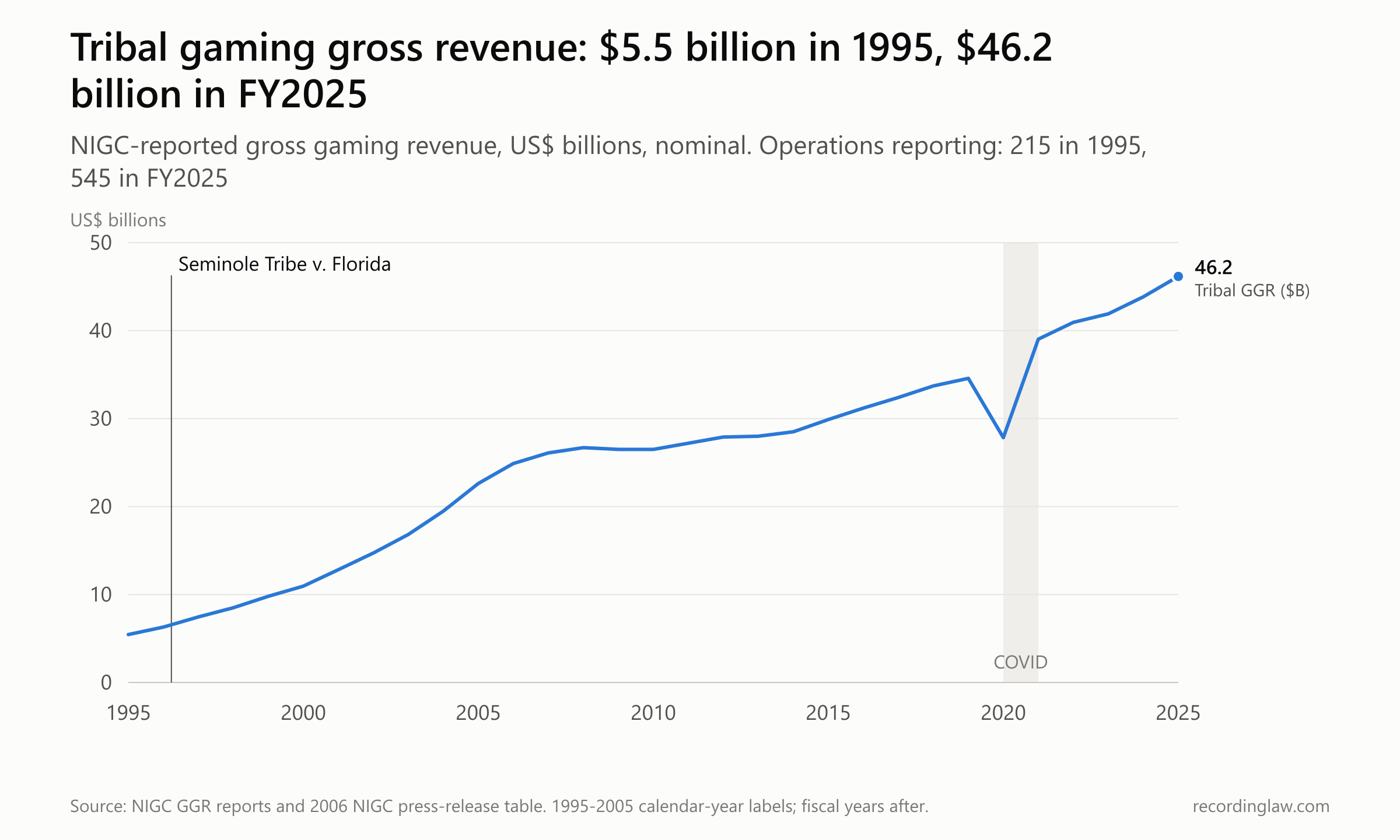
Tribal gaming gross gaming revenue, 1995 to fiscal 2025, US$ billions, not adjusted for inflation. Source: NIGC gross gaming revenue reports and NIGC 2006 revenue table.
| Year | Gross gaming revenue ($ millions) | Operations reporting |
|---|---|---|
| 1995 | 5,455 | 215 |
| 2000 | 10,959 | 311 |
| 2005 | 22,630 | 391 |
| 2008 | 26,700 | not pulled |
| 2010 | 26,500 | not pulled |
| 2015 | 29,900 | not pulled |
| 2019 | 34,579 | not pulled |
| 2020 | 27,832 | not pulled |
| 2021 | 39,026 | not pulled |
| 2024 | 43,852 | 532 |
| 2025 | 46,163 | 545 |
The line rose every year for a decade, from $5.5 billion in 1995 to $22.6 billion in 2005, then barely moved from 2008 to 2010. Some of that climb reflects more casinos, not only more play at existing ones. The number of operations in NIGC's totals rose from 215 in 1995 to 391 in 2005 and 545 in fiscal 2025. The figures are also in dollars of each year, not adjusted for inflation.
In fiscal 2020 revenue fell by about a fifth, to $27.8 billion, a drop NIGC attributes to casinos closing during the COVID-19 pandemic. By fiscal 2022 it was 18% above the pre-pandemic level. In fiscal 2025 it reached $46.2 billion, or about $126 million a day.
California shows how far apart the predictions ran. Days before a March 7, 2000, vote on Proposition 1A, a tribal gaming measure tied to the governor's compacts with tribes, the Christian Science Monitor reported a University of Nevada study for the state attorney general that projected California tribal gaming would triple, from $1.5 billion to about $4.7 billion a year.
The tribal chairs who signed the ballot argument for the measure wrote that "Indian gaming on tribal lands has replaced welfare with work, despair with hope and dependency with self-reliance." They claimed nearly 50,000 jobs and $120 million a year in state and local taxes. Their opponents, including former Lt. Gov. Leo McCarthy, wrote that the measure "will trigger a massive explosion of gambling in California" and that "Slot machines in California could jump to some 50,000-100,000." Neither side's claims were checked by any official agency, the voter guide noted.
Nevada had money riding on it too. The Monitor reported that "Thirty-five percent of Nevada's annual $7.7 billion gambling income comes from Californians." In fiscal 2025, NIGC's Sacramento region, which covers California and northern Nevada, reported $12.6 billion in tribal gaming revenue.
What did the states get?
McCain had written in 1988 that states and the gaming industry came to the table with the position "that what is theirs is theirs and what the Tribe have is negotiable." The law gave tribes a way to answer that: they could sue a state that refused to negotiate a compact in good faith.
On March 27, 1996, the Supreme Court took that tool away. In Seminole Tribe of Florida v. Florida, the Court held that the Eleventh Amendment bars Congress from authorizing suits by tribes against states to enforce laws passed under the Indian Commerce Clause.
States had their own complaint about the good-faith rule. Tom Gede, a special assistant attorney general in California, told the federal gambling commission that "any legitimate difference of opinion results in somebody hoist[ing] the bad faith flag, and it only goes against one party, the state."
Then there was money. IGRA, as economists Randall Akee, Katherine Spilde and Jonathan Taylor put it in 2015, "forbids states from requesting a share of tribal gaming revenue as a condition of signing a compact." The statute itself says it gives states no authority to impose "any tax, fee, charge, or other assessment" on a tribe, and the Ninth Circuit held in 2010 that a state may ask for a share only if it is bargained for in exchange for a "meaningful concession." Compacts that do include a share are written as payment for something the state gives in return, such as exclusivity.
Connecticut set the template. In 1992, the Mashantucket Pequot Tribe agreed to pay the state "$100 million annually or 25 percent of gross revenues on slot machines," whichever was greater, if the state allowed slot machines at Foxwoods, the tribe's casino, as economists William Evans and Julie Topoleski described the deal. Over 22 years, Connecticut received $6.7 billion from the Mashantucket Pequot and Mohegan tribes, by the 2015 review's count. Nationwide, revenue sharing with states was estimated at $1.5 billion in 2012.
Florida's 2021 compact with the Seminole Tribe took the arrangement onto phones. It guaranteed the state $2.5 billion over its first five years and allowed sports bets placed anywhere in Florida as long as they ran through servers on tribal land. Gov. Ron DeSantis said it "expands economic opportunity, tourism, and recreation, and bolsters the fiscal success of our state in one fell swoop for the benefit of all Floridians and Seminoles alike."
In November 2021, U.S. District Judge Dabney Friedrich threw out the statewide betting. "When a federal statute authorizes an activity only at specific locations," she wrote, "parties may not evade that limitation by deeming their activity to occur where it, as a factual matter, does not." On June 30, 2023, the D.C. Circuit reversed her, approving what Florida Phoenix described as a "hub and spoke" arrangement.
John Sowinski of No Casinos, a group that opposes gambling expansion in Florida, said then that "This decision will not be the final word on this issue." On June 17, 2024, the Supreme Court declined to hear the challenge. Florida's fight had turned on a question that would come back: where does a bet placed on a phone happen?
At the law's 25th anniversary in 2013, the head of the tribes' own trade group looked back on the bargain. "I don't celebrate IGRA," said Ernest Stevens Jr., chairman of the National Indian Gaming Association. "I celebrate what the leadership did to champion that reduced sovereignty and make the best of their conditions."
Did life on reservations change?
The baseline was low and had not moved in 20 years. In the 1970 Census, per capita income for Indians on major reservations was 32% of the U.S. average. It rose to 41% in 1980 and fell back to 32% by 1990, according to Akee, Spilde and Taylor's 2015 review in the Journal of Economic Perspectives.
Then it moved. Real per capita income for Indians living on reservations in the lower 48 states grew 33.3% in the 1990s, against 11.4% nationally, and 11.5% in the 2000s, when the national figure fell 3.3%. The authors reported "larger gains" on reservations that ran a casino or bingo hall by 2000.
They also noted that incomes for most American Indians on tribal lands "still lag far behind national averages," in the American Economic Association's summary of the article. Spilde holds an endowed chair at San Diego State University's Sycuan Institute on Tribal Gaming, named for a gaming tribe; the article lists no funder in the text we read.
A Census Bureau working paper by Maggie Jones, Randall Akee and Emilia Simeonova, described in a November 2025 Census Bureau story, found a 46.5% rise in real per capita income for American Indians on reservations in the first two decades after IGRA, against 7.8% for the country. Over the same period it found about an 11% drop in childhood poverty on reservations, a roughly 7% rise in labor force participation among American Indian women, and a 4% drop in unemployment. Those figures cover reservations with and without casinos, and the Census Bureau notes that its working papers have not gone through its standard review.
Those studies describe what happened on reservations over two decades. A more direct comparison came earlier, from William Evans and Julie Topoleski, in a 2002 National Bureau of Economic Research working paper funded by the Smith-Richardson Foundation. They compared tribes before and after they opened casinos with tribes that did not or could not.
Four years after opening, they found, tribal employment was up 26% and tribal population about 12%, and the share of adults who worked but were poor had fallen 14%. In the surrounding county, jobs per adult rose by about 5% of the median, mostly among non-Native workers, and mortality fell 2%.
"Casinos do, however, come at some cost," they wrote. "Four years after a casino opens, bankruptcy rates, violent crime, and auto thefts and larceny are up 10 percent in counties with a casino." Tribes did not choose casino sites at random, so the comparison cannot fully separate the effect of a casino from the effect of where it was built.
Two later studies looked at narrower questions. Laurel Wheeler, writing in 2023 for the Federal Reserve Bank of Minneapolis's Center for Indian Country Development, whose stated mission is supporting the economic objectives of tribal communities, found "sustained improvements in employment and wages on reservations" and rents that rose less than wages. A study of per capita payments to Eastern Cherokee families, summarized in the 2015 review, found that "For each additional $1,000 in unearned income at the household level, there was an increase of about 6 to 7 percentage points in high school graduation rates for children from previously poverty-stricken households."
Who got the money?
The averages hide how unevenly the money fell, and every count we found since the 1990s shows the same shape. In 1995, the U.S. General Accounting Office (now the Government Accountability Office) found that 8 of 178 tribal gaming facilities produced about 40% of gaming revenue. Of the $1.6 billion those operations transferred to 106 tribes, more than half went to 10 tribes. NIGC's own 1995 table shows the same pattern: 8 of 215 operations, each over $100 million, produced 36.9% of revenue.
In its 1999 final report, the federal gambling commission found that the 20 largest tribal revenue generators accounted for 50.5% of revenue. In 2002, TIME magazine counted 39 casinos that took in $8.4 billion the year before: "In short, 13% of the casinos accounted for 66% of the take."
Ernest Stevens Jr., who also chaired the National Indian Gaming Association at the time, answered TIME the same month. "Jobs in Indian Country are precious," he wrote, "whether its 80 jobs on the Pine Ridge reservation, located in the poorest county in the United States, or 3,000 jobs at the Oneida Nation of New York, outside of Syracuse."
Since then, the largest operations have taken a bigger share. How much of the revenue now comes from them?
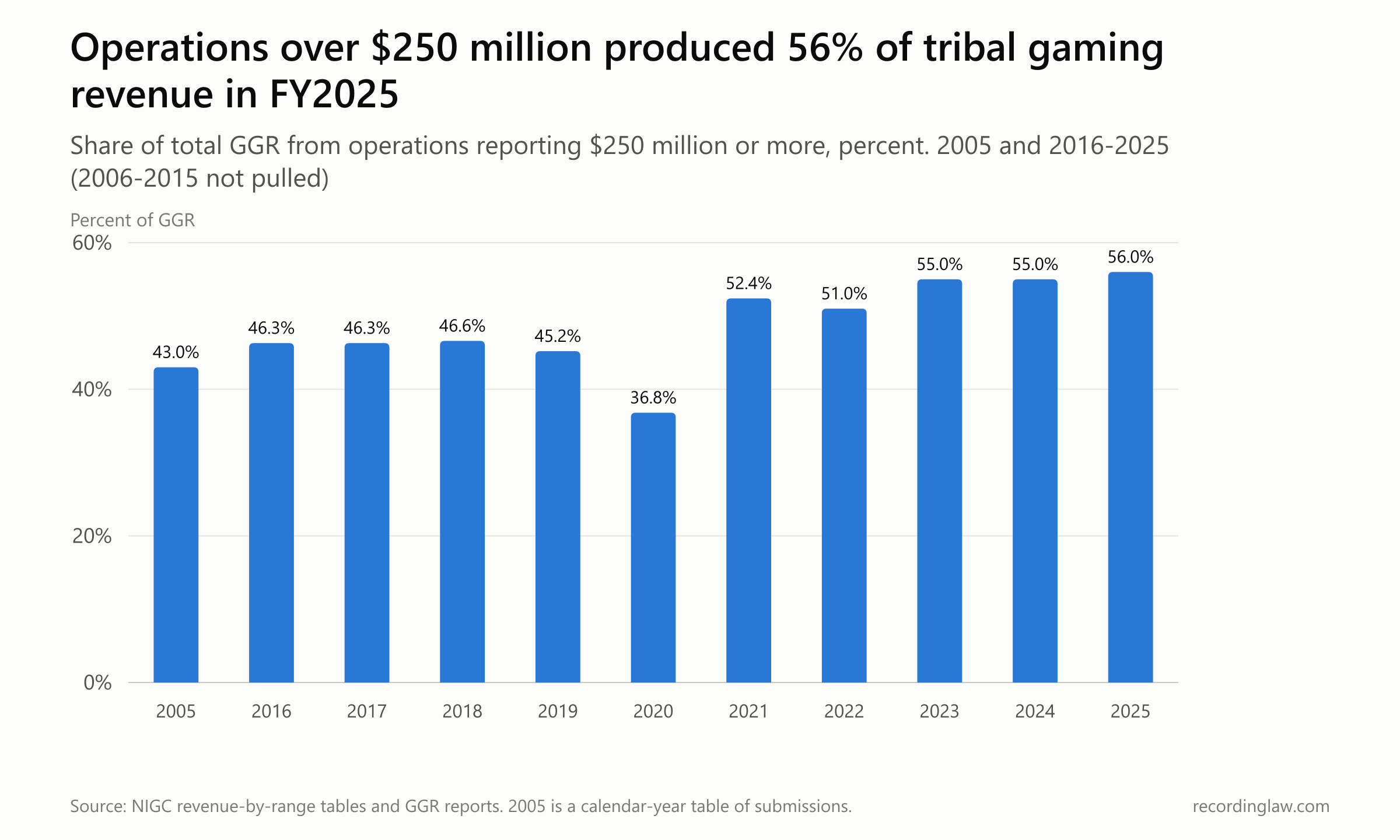
Share of tribal gross gaming revenue from operations reporting $250 million or more. 2005 and 2016 to 2025; 2006 to 2015 not available in the tables we used. Source: NIGC.
| Year | Share of revenue from operations over $250M |
|---|---|
| 2005 | 43% |
| 2016 | 46.3% |
| 2017 | 46.3% |
| 2018 | 46.6% |
| 2019 | 45.2% |
| 2020 | 36.8% |
| 2021 | 52.4% |
| 2022 | 51% |
| 2023 | 55% |
| 2024 | 55% |
| 2025 | 56% |
The biggest operations' share rose from 43% in 2005 to 56% in fiscal 2025, after a one-year drop during the pandemic closures. In fiscal 2025 that top group was about 9% of operations, each reporting more than $250 million. At the other end, just over 54% reported less than $25 million, and that group shared about 5%. Akee, Spilde and Taylor, looking at similar figures for 2013, wrote that "A skewed distribution is not surprising, arising as it does from access to urban population centers."
Where in the country does the money come from? NIGC's regional totals give a rough answer.
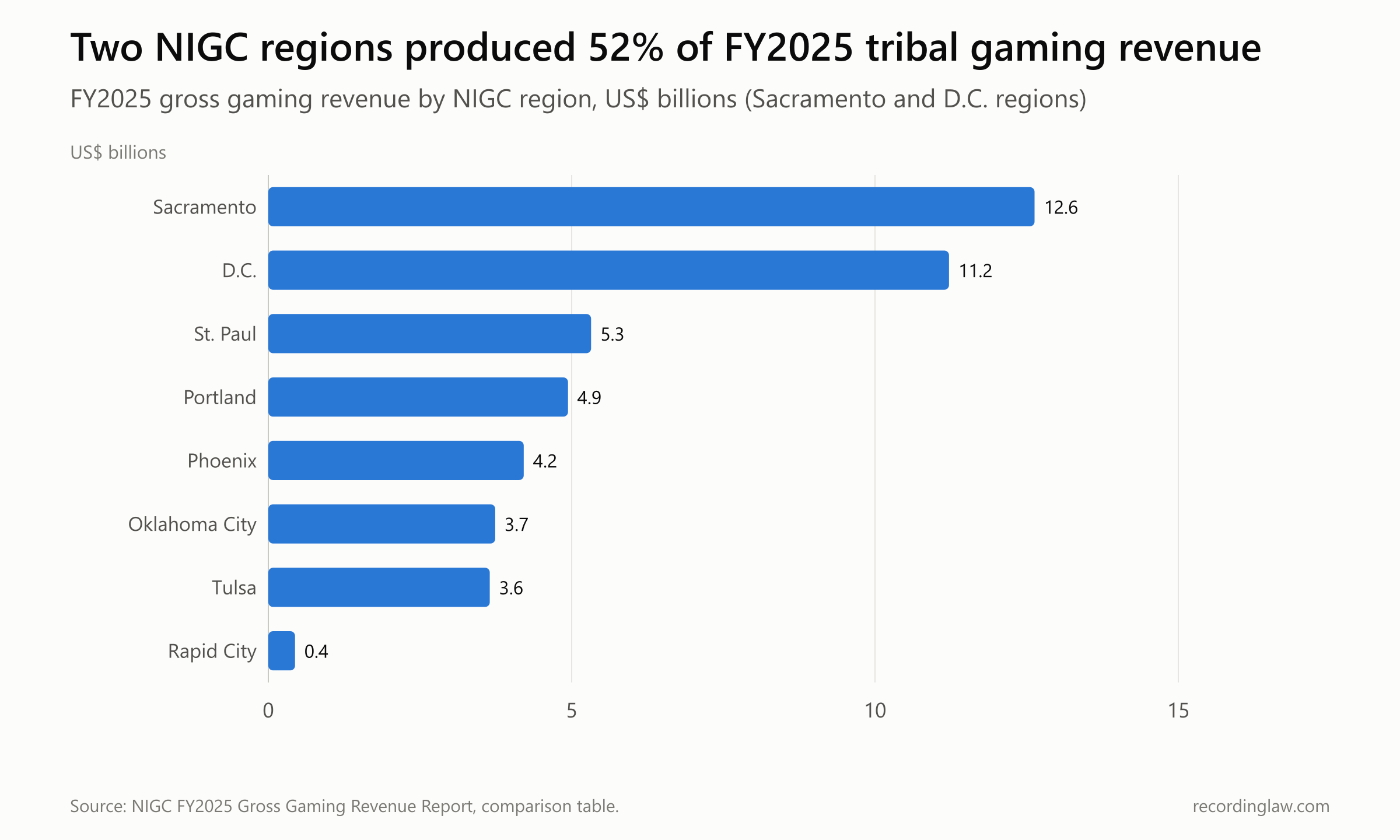
Fiscal 2025 tribal gross gaming revenue by NIGC region, US$ billions. Source: NIGC FY2025 Gross Gaming Revenue Report.
| NIGC region | FY2025 gross gaming revenue ($ millions) |
|---|---|
| Sacramento | 12,631 |
| D.C. | 11,218 |
| St. Paul | 5,320 |
| Portland | 4,944 |
| Phoenix | 4,211 |
| Oklahoma City | 3,745 |
| Tulsa | 3,653 |
| Rapid City | 440 |
Two of NIGC's eight regions, Sacramento and D.C., took in about half of fiscal 2025 revenue. The Rapid City region took in about 1%.
Some of the money reaches tribal members directly. As of 2009, 120 tribes had filed plans with the Bureau of Indian Affairs to pay gaming revenue out per person, a step IGRA requires before such payments. Totals are usually not disclosed; payments that tribes announce range "from a few hundred to thousands of dollars per person annually," according to the 2015 review.
Those payments are also at the center of fights over tribal membership. In 2005, an NPR commentary reported that hundreds of members of more than 20 tribes had been stripped of their citizenship, and that "virtually all of the disenfranchised members claim it's because of per-capita payments." Tribal officials, the commentary said, insisted the members "should have never been allowed as citizens in the first place."
In 2012, KUNM public radio reported that the Pala Band of Mission Indians in California had disenrolled 154 members; the tribes involved said the reason was bloodlines. The 2015 review, by authors who found broad gains from gaming, called disenrollment "One controversial outcome."
Where is a bet placed from a phone?
The tribes at the bottom of those tables are now part of the newest fight over IGRA. Kalshi sells event contracts, which let customers trade on the outcome of events, including games, under the oversight of the Commodity Futures Trading Commission. Its position is that the CFTC "has exclusive jurisdiction over our exchange," as spokeswoman Jackie McGavick put it, so state and tribal gaming law does not reach its contracts. The Third Circuit agreed with Kalshi in a New Jersey case on April 6, 2026.
The Ninth Circuit went the other way twice, according to the Cabazon Band's brief: on August 28, and again on September 16 for two tribes, Blue Lake Rancheria and Chicken Ranch Rancheria. In the second ruling it found, in a trade-press summary, that the tribes were likely to succeed in showing Kalshi's sports contracts were Class III gaming on tribal lands, and that a contract entered by a user on tribal territory could count as located on Indian lands. That ruling reached the question Florida's case raised; the Third Circuit's New Jersey ruling turned instead on whether federal commodities law overrides state sports-betting law.
Tribal gaming leaders described the stakes this way. "Not to mince words, but prediction markets are the single largest threat that we have seen to Tribal government gaming since the industry's been created," said James Siva, chairman of the California Nations Indian Gaming Association, who cited early projections that about 5% of tribal gaming revenue could be lost. Tribal governments are also wary of a proposed CFTC rule that would, in Route Fifty's description, "assert CFTC's exclusive role in regulating event contracts traded as swaps or futures contracts." David Bean, chairman of the Indian Gaming Association, criticized the CFTC chairman, Michael Selig, for "prepping the industry for the Supreme Court."
States have revenue at stake as well. In New Mexico, 13 tribes generated $896 million in adjusted net win in fiscal 2025 (machine revenue minus prizes paid and regulatory fees, before operating costs), and tribal gaming put more than $151 million into the state's general fund over the same period, the Albuquerque Journal and New Mexico In Depth reported.
The tribes that joined Kalshi described the same numbers differently. Fortune reported that they "see these apps as a way to earn money without needing to build a gaming facility," and pointed to NIGC's figures: "Just 9% of operations bring in 56% of all industry revenue." Michael Stopp, vice president for economic development of the Alabama-Quassarte Tribal Town, said the markets "offer tribes a chance to participate in an emerging industry, especially those whose geography has limited revenue generation."
The Cabazon Band's brief points to the industry's growth. IGRA, it says, "has led to the development of the Indian gaming industry which in 2025 pumped more than $46 billion of desperately needed funding into Indian Country." Two days later, 145 tribes and tribal organizations filed their own brief in the same case.
What the Court does next
The tribes' briefs went into Flaherty v. KalshiEX, No. 26-299, New Jersey's petition asking the Supreme Court to decide whether federal commodities law overrides state bans on sports event contracts. The tribes are not parties; they filed as friends of the court.
Kalshi's response is due December 7, 2026. After that, the justices will consider the petition at a conference and grant or deny review. The next national revenue count, NIGC's report for fiscal 2026, is expected around July 2027.
In 1987, Justice Stevens wrote that states could enforce their gambling bans on reservations "Unless and until Congress" said otherwise, and Congress answered with IGRA. The tribe Feldman represented then is now urging the Court to take up whether a different act of Congress, a federal commodities law, reaches a bet placed on the reservation where its card club opened.
How we measured
Revenue series. National tribal gross gaming revenue for 1995 to 2005 comes from an NIGC table titled "Growth of Tribal Gaming Revenues 1995 to 2005," dated 2006 and hosted at indianz.com, which uses calendar-year labels. Figures for 2006 to 2015 are read from NIGC's "GGR Trending FY00-FY20" chart, which shows one decimal place in billions; 2016 onward are exact totals from NIGC's revenue-by-range tables and annual reports through the fiscal 2025 report published July 21, 2026. Tribes have different fiscal year-ends, so a fiscal year can include revenue earned up to 16 months before publication. All dollars are nominal, not adjusted for inflation.
What changed in the series. The number of operations in NIGC's totals grew from 215 in 1995 to 545 in fiscal 2025, so growth mixes new facilities with more revenue at existing ones. The fiscal 2020 drop (from $34,579 million to $27,832 million, about 19.5%) is attributed by NIGC to pandemic closures.
Arithmetic. About $126 million a day is $46,163 million divided by 365. The fall of about a fifth in fiscal 2020 is $6,747 million divided by $34,579 million. Sacramento and D.C. regions together ($23,850 million) are 51.7% of $46,163 million; Rapid City ($440 million) is about 1%.
The 1988 figure. We use the Senate Select Committee on Indian Affairs report on S. 555 (S. Rept. 100-446, August 3, 1988), which says "more than $100 million in annual revenues," because it is the only contemporaneous official figure we found. Other official sources give $200 million (NIGC chairman Hogen, 2008), $100 million (Sen. Akaka, 2011) and $212 million (National Gambling Impact Study Commission, 1999, in constant 1997 dollars, sourced to a GAO figure built on International Gaming and Wagering Business estimates). An Indian Country Today retrospective put revenue in the decade before IGRA at an estimated $100 million to $500 million a year. The 1988 and NIGC figures are not the same measure and are not compared as a ratio.
Concentration. The share of revenue from operations over $250 million comes from NIGC revenue-by-range tables (2005, 2016 to 2021) and the headline text of the fiscal 2022 to 2025 reports; 2006 to 2015 were not pulled. The 2005 row counts submitted financial statements and uses calendar-year labels. Earlier concentration figures use different thresholds and universes: GAO 1995 (178 facilities, revenue measured as dollars wagered minus payouts, about $4.5 billion, not comparable to NIGC totals), the 1999 gambling commission (top 20 tribes), TIME (its own count of 290 casinos for 2001, read from a copy hosted by Stop Predatory Gambling, an anti-gambling advocacy group) and Akee, Spilde and Taylor (NIGC fiscal 2013 data).
Research. Evans and Topoleski (NBER Working Paper 9198, 2002) is a difference-in-differences comparison of tribes that opened casinos with tribes that did not or could not, measured four years after opening; casino locations were not random. Akee, Spilde and Taylor (2015) is a review of Census-based evidence; we read the full text from a copy filed as testimony with the Maine Legislature. The Census Bureau's 2025 figures are from its story on a working paper by Jones, Akee and Simeonova and cover all reservation residents, with or without a casino. None of these studies isolates IGRA itself from other changes after 1988.
Quotes. Quotes from the 1988 Senate report come from a scanned copy; we joined words split by line-break hyphens and quote only passages free of scanning errors. The Ninth Circuit's Blue Lake Rancheria ruling and the D.C. Circuit's Florida ruling are described from news and trade-press accounts and the Cabazon Band's brief, not from the opinions. We did not retrieve California's official result for Proposition 1A or a presidential signing statement for IGRA.
What the data cannot show. NIGC does not publish revenue by tribe, so the figures cannot show which tribes earn what. Per capita payment totals and disenrollment counts are not published by any neutral source we found.
Frequently Asked Questions
What is the Indian Gaming Regulatory Act?
The Indian Gaming Regulatory Act (IGRA) is the federal law, signed October 17, 1988, as Public Law 100-497, that governs gambling on Indian lands. It sorts games into three classes, requires a tribal-state compact for Class III gaming, created the National Indian Gaming Commission, and limits how tribes may spend net gaming revenue.
How much money do tribal casinos make?
The National Indian Gaming Commission reported $46.2 billion in gross gaming revenue for fiscal 2025 from 545 tribal gaming operations, the highest on record and 5.3% more than the $43.9 billion reported for fiscal 2024.
How much did tribal gaming make in 1988?
The Senate committee report on the bill that became IGRA said tribal bingo games generated more than $100 million a year, based on testimony. Later official sources gave $100 million, $200 million and $212 million, the last an inflation-adjusted estimate. No audited 1988 total was found.
What was California v. Cabazon Band of Mission Indians?
A Supreme Court case decided February 25, 1987, by a 6-3 vote. The Court held that California could not enforce its gambling rules against bingo and card games run by the Cabazon and Morongo bands on their reservations in Riverside County. Congress passed IGRA the following year.
Do states get a share of tribal casino revenue?
IGRA gives states no power to tax tribal gaming, and the Ninth Circuit has held that a state may not insist on a revenue share unless it offers the tribe a meaningful concession in return, such as exclusivity. Many compacts include payments made in exchange for something from the state. Revenue sharing with states was estimated at $1.5 billion nationwide in 2012, and Florida's 2021 Seminole compact guaranteed the state $2.5 billion over five years.
Did tribal casinos reduce poverty on reservations?
Studies find reservation incomes rose faster than the national average after 1990, with larger gains where tribes ran casinos, and one 2002 study found tribal employment up 26% four years after a casino opened. The same study found bankruptcy, violent crime, auto theft and larceny up 10% in casino counties. Incomes on most reservations still lag national averages.
Why are tribes fighting Kalshi at the Supreme Court?
Kalshi says federal commodities law gives the CFTC exclusive jurisdiction over its sports event contracts. Many tribes say those contracts are gambling that IGRA lets tribes regulate on their lands. The Third and Ninth Circuits have split, and the Cabazon Band and 145 tribes and tribal organizations filed briefs urging the Supreme Court to hear New Jersey's petition in Flaherty v. KalshiEX, No. 26-299. Kalshi's response is due December 7, 2026.
When is the next tribal gaming revenue report?
The National Indian Gaming Commission publishes its gross gaming revenue report each summer. The fiscal 2025 report came out July 21, 2026, and the fiscal 2026 report is expected around July 2027.
Updates
Independently fact-checked against the cited primary sources
Sources and References
- National Indian Gaming Commission (NIGC), Gross Gaming Revenue Reports (FY2016-FY2025 reports and revenue-by-range tables)(nigc.gov).gov
- NIGC, FY2025 Gross Gaming Revenue Report (July 2026)(nigc.gov).gov
- NIGC news release, NIGC Announces $46.2 Billion in FY 2025 Gross Gaming Revenues (July 21, 2026)(nigc.gov).gov
- NIGC, GGR Trending FY00-FY20 chart(nigc.gov).gov
- NIGC, Growth of Tribal Gaming Revenues 1995 to 2005 (2006 table, hosted by Indianz.com)(indianz.com)
- NIGC, History of the Commission and IGRA(nigc.gov).gov
- NIGC, Reflecting on 30 Years of IGRA history timeline (Internet Archive copy)(web.archive.org)
- NIGC press release, NIGC Announces 2007 Indian Gaming Revenues (June 18, 2008; Internet Archive copy)(web.archive.org)
- Senate Select Committee on Indian Affairs, S. Rept. 100-446 on S. 555, with additional views of Sens. McCain and Evans (August 3, 1988; NIGC-hosted copy, Internet Archive)(web.archive.org)
- Congress.gov, S. 555 (100th Congress), Indian Gaming Regulatory Act, all actions(congress.gov).gov
- Public Law 100-497, Indian Gaming Regulatory Act, 102 Stat. 2467 (October 17, 1988)(govinfo.gov).gov
- 25 U.S.C. chapter 29, Indian Gaming Regulation (U.S. Code, 2022 edition)(govinfo.gov).gov
- Rincon Band of Luiseno Mission Indians v. Schwarzenegger, 602 F.3d 1019 (9th Cir. 2010), Ninth Circuit opinion(cdn.ca9.uscourts.gov).gov
- California v. Cabazon Band of Mission Indians, 480 U.S. 202 (1987)(law.cornell.edu)
- Seminole Tribe of Florida v. Florida, 517 U.S. 44 (1996), syllabus(law.cornell.edu)
- Testimony of Franklin Ducheneaux before the House Committee on Resources (May 1, 1997)(naturalresources.house.gov).gov
- Senate Committee on Indian Affairs, opening statement of Chairman Daniel K. Akaka (July 28, 2011)(indian.senate.gov).gov
- National Gambling Impact Study Commission, Final Report, Chapter 6: Native American Tribal Gambling (1999)(govinfo.library.unt.edu).gov
- U.S. General Accounting Office, Tax Policy: A Profile of the Indian Gaming Industry, GAO/GGD-97-91 (May 1997)(govinfo.gov).gov
- Indian Country Today, The Great Compromise: 25th Anniversary of IGRA Is a Chance to Reflect (September 27, 2013)(ictnews.org)
- California Secretary of State, March 2000 voter guide, Argument in Favor of Proposition 1A(vigarchive.sos.ca.gov).gov
- California Secretary of State, March 2000 voter guide, Argument Against Proposition 1A(vigarchive.sos.ca.gov).gov
- Christian Science Monitor, California poised to give big boost to gambling (March 1, 2000)(csmonitor.com)
- Florida Phoenix, U.S. judge strikes down Florida Seminole gaming compact (November 23, 2021)(floridaphoenix.com)
- Florida Phoenix, Federal ruling could allow sports betting in Florida by fall (July 11, 2023)(floridaphoenix.com)
- AP via CBS12, U.S. Supreme Court refuses to take up challenge to Florida online sports betting compact (June 17, 2024)(cbs12.com)
- TIME, Indian Casinos: Wheel of Misfortune, by Donald L. Barlett and James B. Steele (December 16, 2002; copy hosted by Stop Predatory Gambling)(stoppredatorygambling.org)
- Kalihwisaks, Oneida Nation newspaper (December 20, 2002)(oneida-nsn.gov)
- NPR All Things Considered, commentary by Harlan McKosato on tribal disenrollment (May 20, 2005)(npr.org)
- KUNM, Cashing In By Kicking Out (February 10, 2012)(kunm.org)
- Evans and Topoleski, The Social and Economic Impact of Native American Casinos, NBER Working Paper 9198 (2002)(nber.org)
- Akee, Spilde and Taylor, The Indian Gaming Regulatory Act and Its Effects on American Indian Economic Development, Journal of Economic Perspectives 29(3), 2015 (copy filed with the Maine Legislature)(legislature.maine.gov).gov
- American Economic Association, Has tribal gaming been a boon for American Indians? (summary of the 2015 JEP article)(aeaweb.org)
- U.S. Census Bureau, Tribally Owned Casinos May Improve Economic Conditions on Reservations (November 2025)(census.gov).gov
- Laurel Wheeler, More than Chance: The Local Labor Market Effects of Tribal Gaming, Federal Reserve Bank of Minneapolis CICD Working Paper 2023-02(minneapolisfed.org)
- U.S. Supreme Court docket No. 26-299, Flaherty v. KalshiEX, LLC(supremecourt.gov).gov
- Brief of Amicus Curiae Cabazon Band of Cahuilla Indians, No. 26-299 (October 6, 2026)(supremecourt.gov).gov
- Route Fifty, Tribes join pushback against prediction markets (August 10, 2026)(route-fifty.com)
- CDC Gaming Reports via Public Gaming Research Institute, Tribes expect Supreme Court intervention after Kalshi ordered to block Washington bets (August 2026)(publicgaming.com)
- Fortune, Four tribes partner with Kalshi to launch prediction apps (October 7, 2026)(fortune.com)
- Focus Gaming News, Four Native American tribes to launch prediction market apps with Kalshi (October 2026)(focusgn.com)
- Albuquerque Journal and New Mexico In Depth, New Mexico tribes warn prediction markets threaten gaming revenue (October 2026)(abqjournal.com)