Tariff Revenue After the Supreme Court Ruling: Refunds Exceeded Receipts for Three Months
Independently fact-checked against primary sources (last audited October 26, 2026). · 8 primary sources cited on this page. How we verify our legal content
U.S. customs duties ran between $6.2 billion and $7.9 billion a month in 2024, before refunds. In October 2025 the Treasury booked $33.1 billion in gross customs receipts in a single month. On February 20, 2026, the Supreme Court held that the International Emergency Economic Powers Act (IEEPA) does not authorize the President to impose tariffs. Gross receipts then settled between $21.9 billion and $25.3 billion a month from March through September 2026.
Refunds changed more. Treasury booked $134.4 billion in customs refunds from May through September 2026, against $14.2 billion in the 13 months from April 2025 through April 2026. In May, June and July 2026, refunds exceeded gross receipts, so net customs receipts were negative: minus $0.04 billion, minus $25.6 billion and minus $8.5 billion. This article sets out what the Court decided, how U.S. Customs and Border Protection (CBP) says refunds work, and what the Treasury figures can and cannot show. It reflects data published as of October 26, 2026.
Three numbers, not one
The Treasury reports customs duties three ways, and this story depends on keeping them apart. Gross receipts are duties collected in the month, before any refunds. Refunds are money paid back to importers in the month. Net receipts are gross minus refunds.
For most of the past decade the three moved together, because refunds were small. From 2019 through 2024, monthly customs refunds ranged from $0.03 billion to $0.94 billion. That changed in May 2026.
What the Supreme Court decided
The case is Learning Resources, Inc. v. Trump, No. 24-1287, decided together with Trump v. V.O.S. Selections, Inc., No. 25-250. It was argued November 5, 2025, and decided February 20, 2026.
According to the syllabus, the tariffs at issue came in two sets, both imposed under IEEPA after national-emergency declarations. The drug-trafficking tariffs put a 25% duty on most Canadian and Mexican imports and a 10% duty on most Chinese imports. The trade-deficit ("reciprocal") tariffs, set by Executive Order 14257 (signed April 2, 2025), put a duty of at least 10% on imports from all trading partners, with dozens of countries facing higher rates.
The holding: "IEEPA does not authorize the President to impose tariffs." The Court affirmed the Federal Circuit in the V.O.S. Selections case. In Learning Resources, it vacated the lower-court judgment and sent the case back with instructions to dismiss for lack of jurisdiction.
How the Justices divided
The judgment was 6-3. Chief Justice Roberts wrote the opinion of the Court for Parts I, II-A-1 and II-B, joined by Justices Sotomayor, Kagan, Gorsuch, Barrett and Jackson. Part II-B rests on the text of IEEPA: the syllabus says that when Congress grants the power to impose tariffs, "it does so clearly and with careful constraints. It did neither in IEEPA."
Parts II-A-2 and III were joined only by Justices Gorsuch and Barrett. Part II-A-2 applies the major questions doctrine. Because only three Justices joined those parts, they are a plurality opinion, not a holding of the Court.
Justice Kagan, joined by Justices Sotomayor and Jackson, concurred in part and in the judgment, concluding that the ordinary tools of statutory interpretation decide the case without the major questions doctrine. Justice Jackson also wrote separately, and Justices Gorsuch and Barrett each filed concurrences. Justice Thomas dissented. Justice Kavanaugh dissented, joined by Justices Thomas and Alito.
What the opinion did not decide
The opinion of the Court does not address refunds. In the slip opinion, the word "refund" appears only in Justice Kavanaugh's dissent, which says: "The Court says nothing today about whether, and if so how, the Government should go about returning the billions of dollars that it has collected from importers."
The same dissent notes that it was acknowledged at oral argument that the refund process was likely to be a "mess." That is a dissent's prediction, not a finding of the Court.
Gross receipts: up in 2025, lower but still elevated in 2026
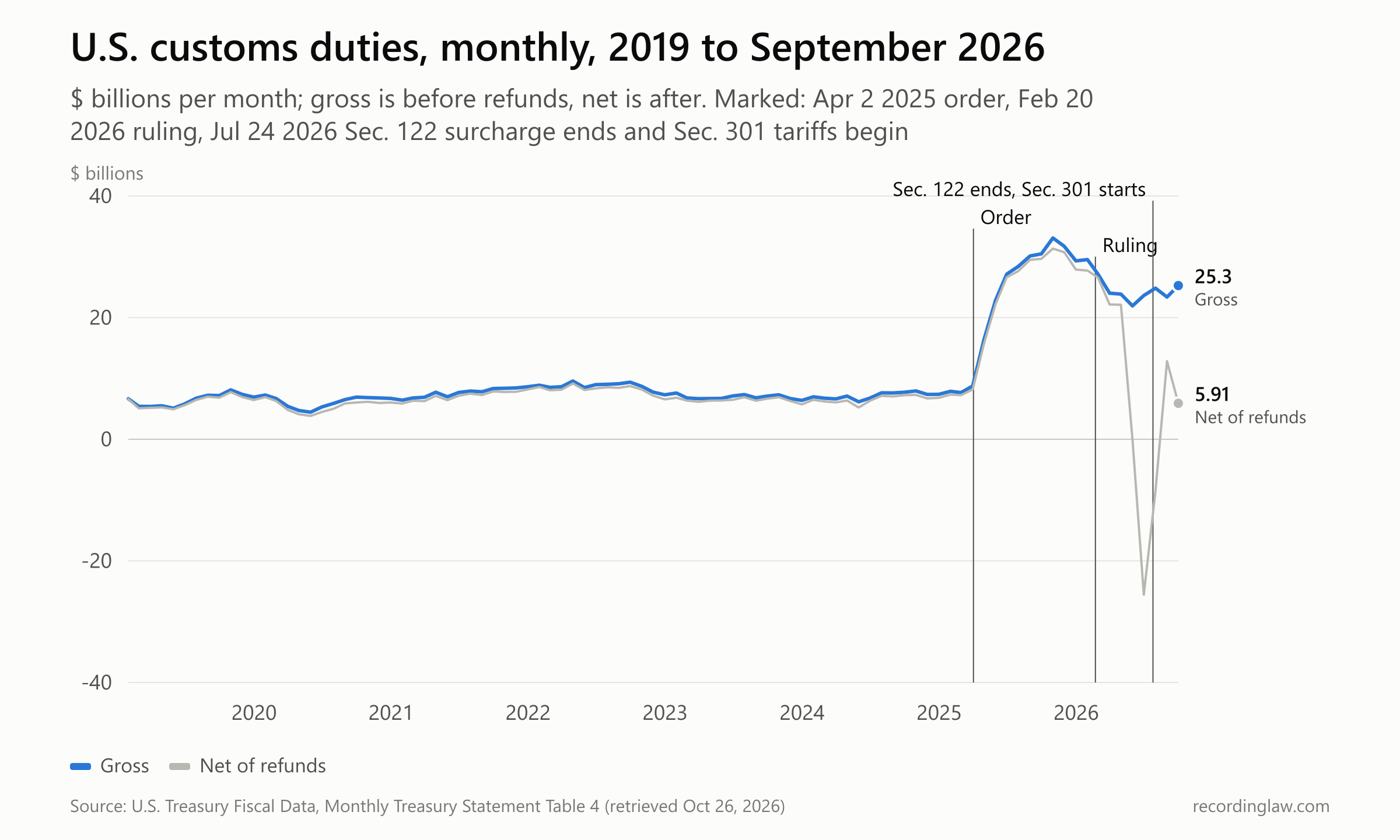
Source: U.S. Treasury Fiscal Data, Monthly Treasury Statement Table 4, retrieved October 26, 2026. July 24, 2026: scheduled end of the Section 122 surcharge (Proclamation 11012) and start of the Section 301 forced-labor tariffs (USTR notice, 91 FR 47318).
| Month | Gross ($B) | Refunds ($B) | Net ($B) |
|---|---|---|---|
| Dec 2024 | 7.39 | 0.57 | 6.81 |
| Mar 2025 | 8.75 | 0.58 | 8.17 |
| Apr 2025 | 16.30 | 0.67 | 15.63 |
| Jun 2025 | 27.16 | 0.52 | 26.63 |
| Oct 2025 | 33.09 | 1.74 | 31.35 |
| Feb 2026 | 27.17 | 0.58 | 26.59 |
| Mar 2026 | 24.02 | 1.86 | 22.16 |
| Sep 2026 | 25.27 | 19.36 | 5.91 |
Gross receipts were $8.7 billion in March 2025 and $16.3 billion in April 2025, the month Executive Order 14257 was signed. They rose each month to $30.5 billion in September 2025 and peaked at $33.1 billion in October 2025.
After the February 2026 ruling, gross receipts fell to $24.0 billion in March and $21.9 billion in May, then ranged from $23.4 billion to $25.3 billion from June through September. That is lower than the late-2025 peak and about 3 to 3.5 times the 2024 monthly average of $7.2 billion.
The Treasury figures do not break customs receipts down by tariff authority. They cannot show how much of the post-ruling revenue came from tariffs under other statutes, how much reflects payments on entries made before IEEPA collection stopped, or how much reflects shifts in import volume or payment timing.
Tariffs under laws other than IEEPA continued after the ruling. The same day as the ruling, Executive Order 14389 declared the IEEPA duties no longer in effect and directed agencies to stop collecting them as soon as practicable.
On February 20, 2026, the President also signed Proclamation 11012 under Section 122 of the Trade Act of 1974. It imposed a temporary 10% import surcharge on goods entered from February 24, 2026, through 12:01 a.m. July 24, 2026, a 150-day period, with exceptions listed in the proclamation.
A July 2026 U.S. Trade Representative fact sheet announced a Section 301 action imposing a 10% or 12.5% tariff on 60 trading partners that USTR says account for 99.4% of U.S. imports, excluding articles subject to Section 232 tariffs. A USTR notice in the Federal Register makes those duties apply to goods entered on or after July 24, 2026, the date the Section 122 surcharge ended. The Treasury data do not show how much of any month's receipts came from either action.
Refunds: from under $2 billion a month to $49 billion
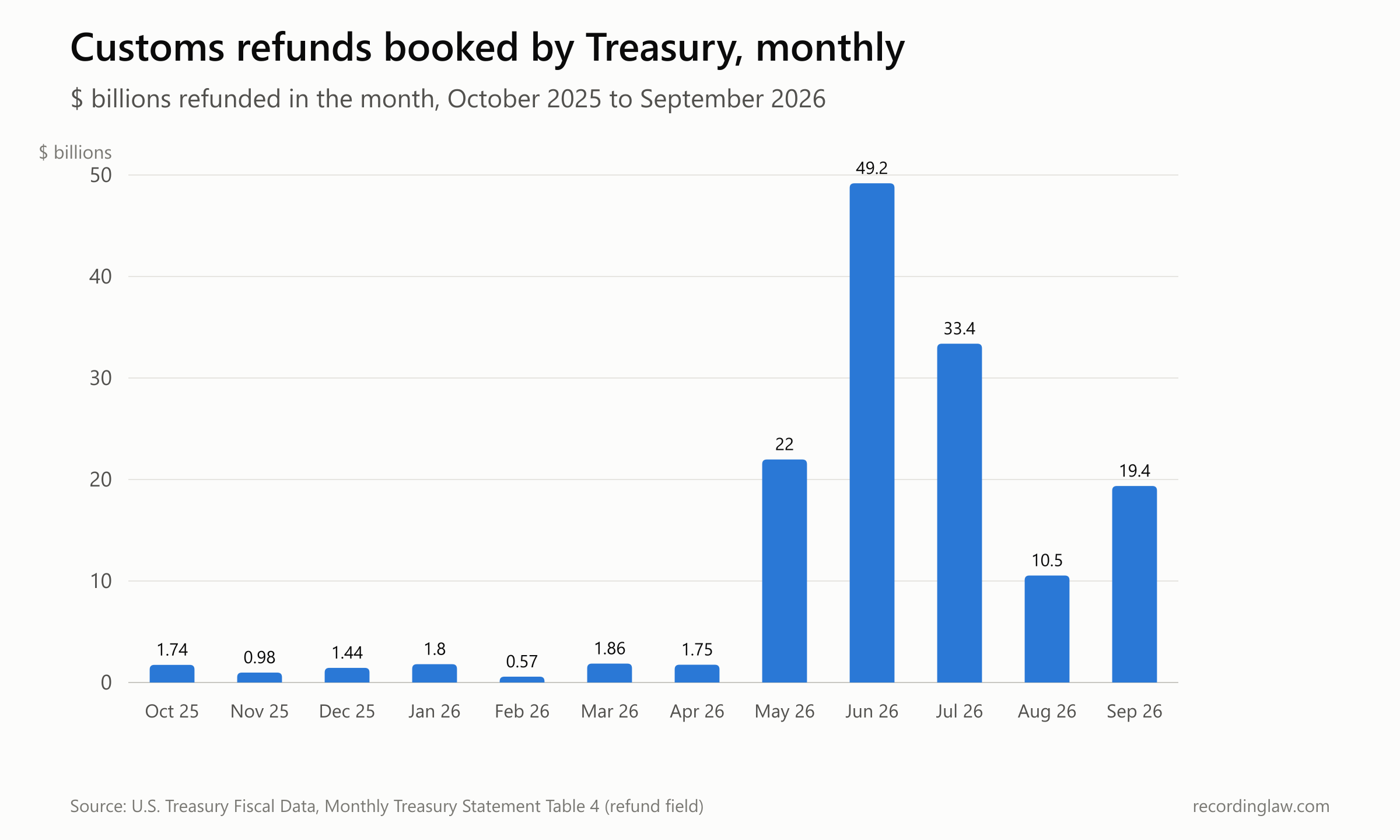
Source: U.S. Treasury Fiscal Data, Monthly Treasury Statement Table 4, refund field, retrieved October 26, 2026.
| Month (2026) | Refunds ($B) | Gross ($B) | Net ($B) |
|---|---|---|---|
| April | 1.75 | 23.88 | 22.12 |
| May | 21.97 | 21.93 | -0.04 |
| June | 49.18 | 23.63 | -25.56 |
| July | 33.38 | 24.84 | -8.55 |
| August | 10.54 | 23.38 | 12.84 |
| September | 19.36 | 25.27 | 5.91 |
From October 2025 through April 2026, monthly refunds ranged from $0.57 billion to $1.86 billion. In May 2026 they were $22.0 billion, and in June $49.2 billion, more than double that month's gross receipts.
Refunds booked from May through September 2026 total $134.4 billion. In three of those months refunds exceeded gross receipts, and net customs receipts were negative.
The Treasury refund field covers all customs refunds. It includes routine refunds as well as IEEPA refunds. From April 2025 through April 2026, before the jump, the field ran at $0.5 billion to $1.9 billion a month. The published data do not split the two, so this page does not state an IEEPA refund total. CBP's refund page, as of its September 30, 2026 update, also gives no aggregate figure for refunds issued.
How CBP says refunds work
CBP runs IEEPA refunds through a process it calls CAPE (Consolidated Administration and Processing of Entries) in its ACE electronic system. Everything in this section comes from CBP's IEEPA refund page, last modified September 30, 2026.
- Who files. Only the importer of record or the licensed customs broker who filed the entries may file a CAPE Declaration. CBP says an attorney cannot file one on an importer's behalf.
- What is filed. A CSV list of entries. A broker may include up to 9,999 entries on a single declaration. An accepted declaration cannot be amended or cancelled.
- Which entries qualify now. The first deployment, which CBP's notices tie to April 20, 2026, covers unliquidated entries and entries liquidated within the preceding 80 days, so CBP can reliquidate them within its 90-day voluntary reliquidation window. Effective June 29, 2026, CAPE also accepts entries flagged for reconciliation where the reconciliation entry has not yet been filed.
- Court case. CBP says that for these first-phase entries, an importer does not need to file a case at the Court of International Trade to receive a refund. It offers no guidance on other entries.
- Timing. CBP says valid refunds are generally issued within 60 to 90 days after a declaration is accepted, unless a compliance concern requires further review.
- Payment. Refunds are paid by electronic transfer (ACH) to the importer of record or its designated notify party, and include interest under 19 U.S.C. 1505. CBP first applies any refund to outstanding debts the importer owes it.
- Who does not get paid directly. CBP says it can refund IEEPA duties only to the importer of record or notify party, not to consumers who may have paid higher prices.
- Not yet covered. CBP says it is evaluating later deployments for entries on a drawback claim, warehouse entries, entries under an open protest, entries not filed in ACE, certain antidumping and countervailing duty entries, and entries whose liquidation is final.
CBP also says it charges no fee to process tariff refunds, and that anyone asking for a fee or financial information while claiming to be CBP is running a scam.
The month refunds jumped, May 2026, was the first full month after CBP's April 20 deployment. The Treasury data cannot confirm how much of that month's refunds came through CAPE.
The calendar-year picture
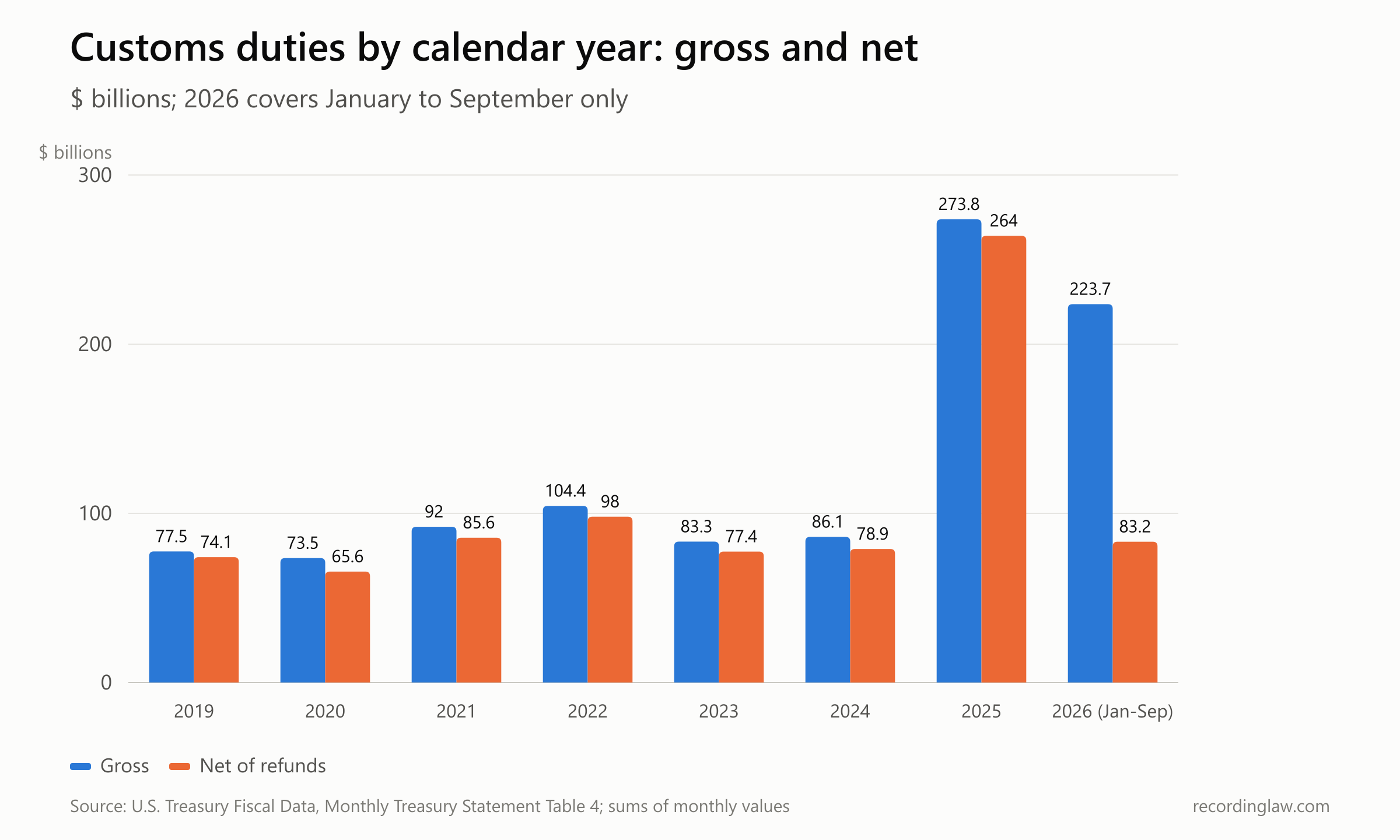
Source: U.S. Treasury Fiscal Data, Monthly Treasury Statement Table 4, sums of monthly values. 2026 covers January through September only.
| Year | Gross ($B) | Refunds ($B) | Net ($B) |
|---|---|---|---|
| 2019 | 77.48 | 3.38 | 74.10 |
| 2020 | 73.55 | 7.98 | 65.57 |
| 2021 | 92.05 | 6.46 | 85.59 |
| 2022 | 104.40 | 6.38 | 98.02 |
| 2023 | 83.28 | 5.89 | 77.39 |
| 2024 | 86.08 | 7.16 | 78.92 |
| 2025 | 273.81 | 9.76 | 264.04 |
| 2026 (Jan-Sep) | 223.65 | 140.43 | 83.22 |
Through nine months, 2026 gross receipts of $223.7 billion are higher than any full year from 2019 through 2024 (the largest was $104.4 billion in 2022). Net receipts for the same nine months, $83.2 billion, are close to the full-year net totals for 2023 ($77.4 billion) and 2024 ($78.9 billion), because of the refunds booked from May onward.
How we measured
Source. All dollar figures come from the Monthly Treasury Statement, Table 4, line "Customs Duties," pulled from the Treasury's Fiscal Data API on October 26, 2026. We used three fields: current-month gross receipts, current-month refunds and current-month net receipts. Calendar-year figures are sums of the monthly values. The latest month available was September 2026.
Legal sources. The holding, vote breakdown and refund language come from the Supreme Court's slip opinion. The signing date of Executive Order 14257 comes from the Federal Register. The CAPE process comes from CBP's IEEPA refund page. The Section 122 surcharge comes from Proclamation 11012 and the end of IEEPA collection from Executive Order 14389, both in the Federal Register. The Section 301 action comes from a USTR fact sheet, and its effective date from the USTR notice in the Federal Register.
What the data cannot show.
- Which law produced the revenue. Treasury reports customs duties as one line. It does not separate IEEPA duties from Section 232, Section 301 or other duties.
- IEEPA refunds alone. The refund field mixes routine customs refunds with IEEPA refunds, and cannot be split.
- Tariff rates. Gross receipts reflect tariff rates, import volumes and the timing of duty payments together. Importers' decisions to buy ahead of or delay shipments move receipts, so receipts are not a measure of the tariff rate.
- Who bore the cost. The data show what importers paid and were refunded. They do not show how much of the tariff cost was passed on to consumers, and this page makes no claim about prices.
- The total refund exposure. No primary-source figure for the total IEEPA duties eligible for refund was opened for this article, so none is stated.
Frequently Asked Questions
Did the Supreme Court order the government to refund IEEPA tariffs?
No. The opinion of the Court held that IEEPA does not authorize the President to impose tariffs, but it did not address refunds. Justice Kavanaugh's dissent says the Court says nothing about whether, and if so how, the Government should return the money collected from importers.
What was the vote in Learning Resources v. Trump?
The judgment was 6-3. Chief Justice Roberts wrote for the Court in Parts I, II-A-1 and II-B, joined by Justices Sotomayor, Kagan, Gorsuch, Barrett and Jackson. Parts II-A-2 and III were joined only by Justices Gorsuch and Barrett, so they are a plurality. Justices Thomas, Alito and Kavanaugh dissented.
How much has the Treasury refunded in customs duties?
Treasury booked $134.4 billion in customs refunds from May through September 2026, and $140.4 billion from January through September 2026. These figures include routine customs refunds as well as IEEPA refunds, and the published data do not separate the two.
Why were net customs receipts negative?
Net receipts are gross receipts minus refunds. In May, June and July 2026, refunds booked in the month were larger than gross customs receipts, so net receipts were minus $0.04 billion, minus $25.6 billion and minus $8.5 billion.
Who can get an IEEPA tariff refund?
According to CBP, refunds go only to the importer of record or its designated notify party, paid electronically with interest. A CAPE Declaration may be filed only by the importer of record or the licensed customs broker who filed the entries. CBP says it cannot send refunds to consumers who may have paid higher prices.
How long does a CAPE refund take?
CBP says valid IEEPA refunds are generally issued within 60 to 90 days after a CAPE Declaration is accepted, unless a compliance concern requires further review. Entries that are extended, suspended or under review keep their status, and refunds on them are issued at liquidation.
Does CBP charge a fee for tariff refunds?
No. CBP says it charges no fee to process tariff refunds, and that a request for a fee or financial information from someone claiming to be CBP is a scam.
Why are customs receipts still higher than in 2024 after the ruling?
The Treasury data do not say. They report customs duties as a single line, so they cannot show how much revenue came from tariffs under other laws (including the Section 122 surcharge from February 24 to July 24, 2026 and Section 301 duties from July 24, 2026), from payments on entries made before IEEPA collection stopped, or from changes in import volumes and payment timing.
Updates
Independently fact-checked against the cited primary sources
Sources and References
- U.S. Treasury, Monthly Treasury Statement Table 4, Customs Duties (gross receipts, refunds, net receipts), via Fiscal Data API(api.fiscaldata.treasury.gov).gov
- Learning Resources, Inc. v. Trump, No. 24-1287 (with Trump v. V.O.S. Selections, Inc., No. 25-250), slip opinion, decided February 20, 2026(supremecourt.gov).gov
- U.S. Customs and Border Protection, International Emergency Economic Powers Act (IEEPA) Duty Refunds (last modified September 30, 2026)(cbp.gov).gov
- Executive Order 14257, Regulating Imports With a Reciprocal Tariff, 90 Fed. Reg. 15041 (signed April 2, 2025)(federalregister.gov).gov
- USTR fact sheet: Section 301 action in response to the failure of 60 economies to ban imports produced with forced labor (July 2026)(ustr.gov).gov
- Proclamation 11012, Imposing a Temporary Import Surcharge To Address Fundamental International Payments Problems, 91 Fed. Reg. 9339 (signed February 20, 2026)(federalregister.gov).gov
- Executive Order 14389, Ending Certain Tariff Actions, 91 Fed. Reg. 9437 (signed February 20, 2026)(federalregister.gov).gov
- USTR, Notice of Actions in Section 301 Investigations (forced-labor import prohibitions), 91 Fed. Reg. 47318 (July 28, 2026)(federalregister.gov).gov