Illinois Video Gaming Machines Now Out-Earn Its Casinos: The Record From 2009 to 2026
Independently fact-checked against primary sources (last audited October 27, 2026). · 12 primary sources cited on this page. How we verify our legal content
Around 11:30 in the morning on October 9, 2012, the three video gaming terminals at Chino's Pizzeria in Justice, a suburb of Chicago, switched on. The manager had just finished mopping, the Associated Press reported. The pizzeria was one of 65 bars and restaurants that went live that Tuesday, with 278 machines between them.
Gambling officials had estimated that up to 75,000 machines could be installed statewide within a year. It took nearly 14 years to pass 50,000. The Illinois Gaming Board counted 50,141 in September 2026.
In the fiscal year that ended in June 2026, the machines took in $3.3 billion from players after paying out their wins. The state's casinos took in $2.1 billion.
Lawmakers approved the machines in 2009 to help pay for a $31 billion construction program. Supporters said legal machines would bring the video poker already paying out illegally in bars into the open, and the bill's House sponsor said the law would "actually reduce the number of machines." An anti-gambling group warned of "mini-casinos" in "neighborhoods statewide."
How did a funding source for roads and schools come to out-earn every casino in Illinois combined, and how does the record compare with what each side said?
The bill that came back from the Senate
On the afternoon of May 21, 2009, the crowd in the Illinois House gallery grew loud enough that the presiding officer, Rep. Art Turner, a Chicago Democrat, asked the guests to "tone down the noise" and to stop clapping and shouting.
The bill on the floor, HB 255, had passed the House in March as a change to estate tax law. Less than 48 hours before this session, ProPublica Illinois later reported, the five-page proposal had "morphed into the 280-page bill now before the House." It was now the revenue bill for Gov. Pat Quinn's Illinois Jobs Now! capital program, and the Video Gaming Act was inside it.
Rep. Lou Lang, a Skokie Democrat, carried it. Rep. Paul Froehlich asked whether the Gaming Board, which then inspected nine casinos, could handle what he estimated as "maybe 20 thousand more locations." Lang answered that the machines were already licensed. "What hasn't been legal is paying out on them," he said, adding: "this Bill will actually reduce the number of machines that are out there in the world, because we're going to limit them."
He closed the debate on the whole package. "This is the Bill that will put thousands of our people to work, repair the infrastructure of our state, and do great things moving forward for the citizens and the economy of the State of Illinois," Lang said. The House concurred, 86-30-1.
Quinn had opposed large-scale gambling expansion. In a 2007 letter to Gov. Rod Blagojevich, who was pushing new casinos, he wrote, "We should ask for (the voters') guidance before we take steps to make Illinois the Las Vegas of the Midwest."
Sen. Mike Jacobs, an East Moline Democrat, put it in fewer words to Illinois Issues in 2010. "We already have video gaming in Illinois," he said. "It's just run by the mob."
Quinn signed the bill on July 13, 2009. Years later he told ProPublica Illinois that the downturn outweighed his reservations. "I wasn't particularly excited about video gambling," he said. "It's very hard to get legislators to vote for funding. I had to make a decision, and it was imperative to get people back to work."
How much the machines would raise depended on who was counting. In May 2009, proponents said the machines "could bring the state as much as $369 million," according to the Daily Herald. State bond documents, ProPublica later reported, "claimed video gambling machines would raise $300 million each year to help cover the debt payments."
The legislature's own forecasters, the Commission on Government Forecasting and Accountability (COGFA), estimated room for 45,000 to 60,000 machines earning $70 to $90 a day each, according to a Civic Federation summary that fall.
What the opponents predicted
Six days before Quinn signed, Illinois Church Action on Alcohol and Addiction Problems, an anti-gambling advocacy group, published an open letter asking him to strike the video gaming language with an amendatory veto. "These mini-casinos would be located in neighborhoods statewide," the group wrote. "There is no limit to the number of establishments that can apply for a license."
The same letter made a second prediction that can be checked. "Legalizing video gambling will not eliminate illegal gambling," it said. "Video gambling machines will be difficult to regulate and monitor at so many locations statewide."
Eight days after the House vote, Stop Predatory Gambling, an advocacy group, hosted a news conference in which experts argued that more than 45,000 machines "will only mire the state in bankruptcies and foreclosures while deepening corruption," as the Daily Herald summarized it.
The Civic Federation, a nonpartisan government research group, raised a narrower fiscal concern that October. "If video gaming is banned in much of the state and/or does not live up to its projected income per machine, additional revenues would be needed or the state might be forced to spend general funds to meet debt service that comes with the program," it wrote.
The towns that said no
The law let each town and county keep the machines out, and Quinn later said he had insisted on that opt-out. Evanston banned them in a unanimous vote on September 14, 2009. Naperville, the state's third-largest city, followed the next day, and then Rosemont and Country Club Hills.
On October 1, a Cook County Board committee voted 11-1 to ban the machines in unincorporated areas. In DuPage County, board member Brien Sheahan, who introduced that county's ban, described "a visceral reaction to the idea of having a little casino on every corner in DuPage County."
Rockford went the other way. Ald. Ann Thompson-Kelly pointed to the money already leaving town. "We have buses leaving Rockford every day … going to places that have the machines," she told Illinois Issues.
The largest no was Chicago, which already had a ban. Mayor Richard Daley indicated the City Council was not considering repealing it, and COGFA estimated that video poker revenue could drop by $95 million to $177 million if Chicago did not participate, Illinois Issues reported in April 2010.
The state did not wait for the machines to borrow against them. By the time play began in September 2012, ProPublica Illinois reported, it had borrowed more than $5 billion. "Debt payments reached about $340 million that year," it wrote. "Yet video gambling brought in just $30 million to cover them."
How did 278 machines become 50,000?
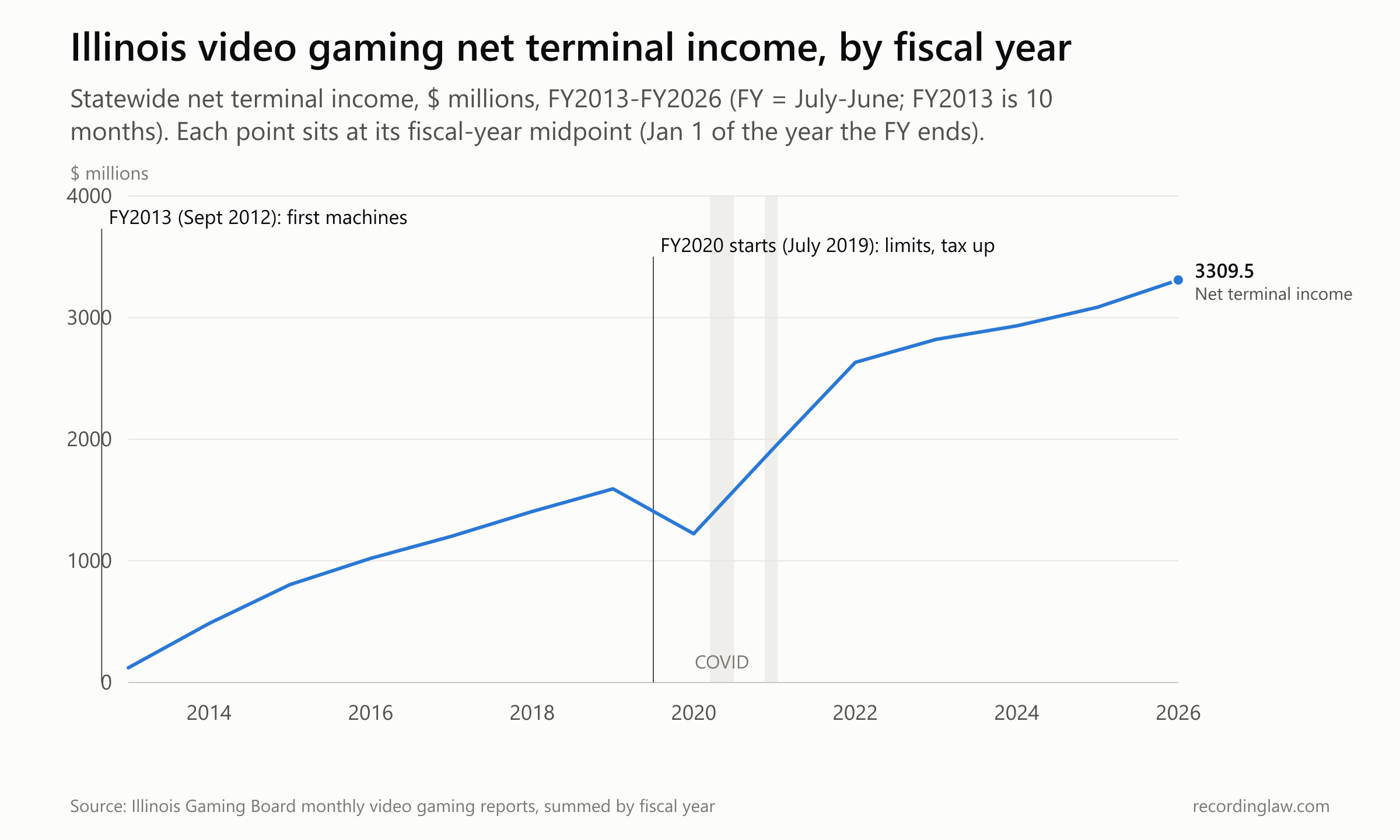
Source: Illinois Gaming Board monthly video gaming reports, summed by fiscal year (July to June). FY2013 covers 10 months.
| Fiscal year | Net terminal income ($M) | Terminals in operation in June |
|---|---|---|
| FY2013 (10 months) | 121.1 | 7,821 |
| FY2015 | 804.8 | 20,730 |
| FY2018 | 1,406.5 | 29,283 |
| FY2019 | 1,592.5 | 32,033 |
| FY2020 | 1,222.6 | 0 (suspended) |
| FY2021 | 1,934.0 | 40,157 |
| FY2023 | 2,821.1 | 45,987 |
| FY2025 | 3,086.3 | 49,276 |
| FY2026 | 3,309.5 | 49,738 |
The machines took in more money every fiscal year except 2020, when the state shut them down for months.
They spread into places nobody would mistake for a casino. By the fall of 2013, the machines in bars, restaurants and truck stops outnumbered the machines and table seats in the state's 10 casinos combined, Illinois Issues reported. A Road Ranger truck stop on Interstate 55 at the northeast edge of Springfield routinely topped the state's revenue list; in February 2014 its machines sent $24,761 to the state.
Describing one gaming location in 2014, Illinois Issues wrote: "But make no mistake, this isn't Las Vegas. Or even one of Illinois' 10 riverboat casinos. This is a strip mall in central Illinois, just a few storefronts away from a Chuck E. Cheese restaurant, a nail salon and a dollar store."
Lang, by 2017, said the storefront parlors were not what he had in mind. "What they're doing is perfectly legal, but it was never the intent to expand gaming to places that are not bars and restaurants, per se," he told Global Gaming Business.
The bans also gave way. In 2013, COGFA calculated, 63.3% of Illinoisans lived where video gaming was banned. Its 2026 report says about 89% of Illinoisans now live in a municipality that allows it. In June 2018, Cook County commissioners approved the machines in unincorporated areas, nearly nine years after the committee vote to ban them.
One town moved the other way that year. On November 6, 2018, voters in Forest Park, where 16 bars and restaurants were licensed, removed machines that were already running. "Forest Park was the first village to get a vote on the practice after the machines had been installed," the Forest Park Review wrote.
In 2019 the legislature expanded the program. Public Act 101-0031 allowed more machines per location and bigger bets and prizes. It also raised the tax and authorized six new casinos.
| Limit | 2009 law | 2019 law |
|---|---|---|
| Machines per location | 5 | 6 (10 at large truck stops) |
| Top bet | $2 | $4 |
| Top prize | $500 | $1,199 |
On March 16, 2020, the state suspended video gaming for the pandemic. Income fell to $1.2 billion that fiscal year. It reached $1.9 billion in fiscal 2021, a year that included a second shutdown that winter.
The daily total ended up above the 2009 forecast. COGFA's 2009 analysis, as the Civic Federation summarized it, projected $3.2 million to $5.9 million in receipts a day statewide. In fiscal 2026 the machines averaged about $9 million a day, in dollars not adjusted for inflation and after the 2019 law allowed more machines per location and bigger bets.
When did the bars pass the casinos?
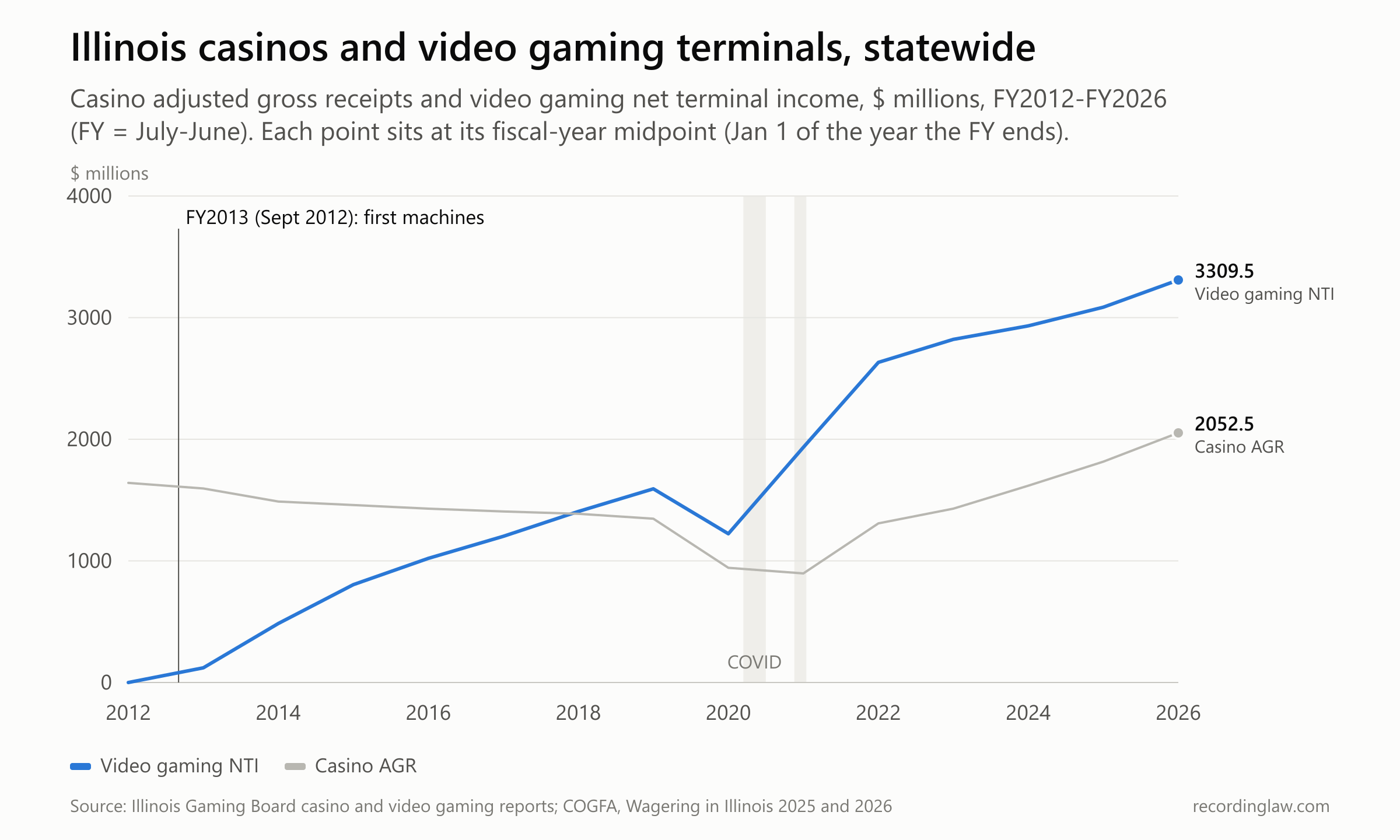
Source: Illinois Gaming Board casino and video gaming reports; COGFA, Wagering in Illinois 2025 and 2026. The machines were not yet live in FY2012, so the chart shows video gaming at zero that year.
| Fiscal year | Casino AGR ($M) | Video gaming NTI ($M) |
|---|---|---|
| FY2012 | 1,641 | 0 (machines not yet live) |
| FY2015 | 1,459 | 804.8 |
| FY2017 | 1,406 | 1,202.0 |
| FY2018 | 1,387 | 1,406.5 |
| FY2019 | 1,347 | 1,592.5 |
| FY2021 | 897 | 1,934.0 |
| FY2023 | 1,429 | 2,821.1 |
| FY2025 | 1,816 | 3,086.3 |
| FY2026 | 2,052.5 | 3,309.5 |
The lines crossed in fiscal 2018, and the machines have stayed ahead every year since.
Casino receipts fell each year from $1.6 billion in fiscal 2012 to $1.3 billion in fiscal 2019, while the machines grew. Tom Swoik, executive director of the Illinois Casino Gaming Association, described what he saw in 2017. "It's just so much more convenient," he told Global Gaming Business. "I have friends in Springfield who would go to Peoria once or twice a month for the casino. Now they're just going to the local bar."
Casino receipts then climbed, over the same years that the 2019 law's new casinos opened in Rockford, Waukegan, Danville, Carterville, a temporary Chicago site at the Medinah Temple and the south suburbs, between November 2021 and November 2024. By fiscal 2026 they reached $2.1 billion.
Counted together, casino receipts and video gaming income came to $1.6 billion in fiscal 2012 and $5.4 billion in fiscal 2026, by COGFA's figures.
One peer-reviewed study tried to measure how much the machines drew from casinos. Erin Hazel Phipps, Mark W. Nichols and Federico Guerrero, using regression and time-series models on Illinois data, found that "casino slot revenues decrease by about 0.05 percent for each 1 percent increase in VGT revenues." Total gambling tax revenue rose, they wrote in Public Finance Review in 2020, but "local communities where casinos are located have experienced declines in casino tax revenue that have exceeded the gains from VGT revenue."
What happened across the state line?
Four Indiana casino towns sit just across the state line inside the Chicago metro area: Gary, Hammond, East Chicago and Michigan City. What happened to gambling money in the region as a whole?
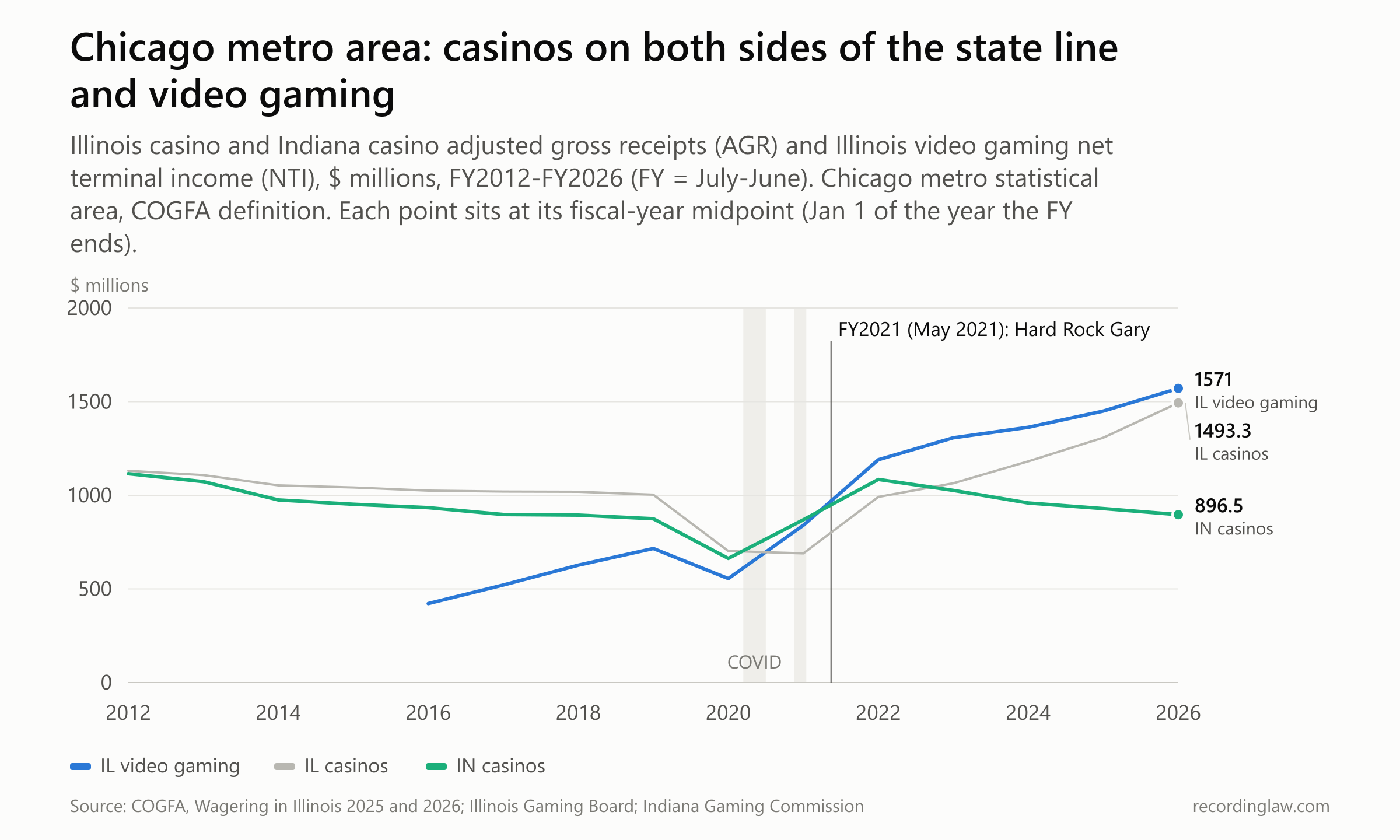
Source: COGFA, Wagering in Illinois 2025 (Figure 33) and 2026 (Figures 10 and 57), from Illinois Gaming Board and Indiana Gaming Commission data. Chicago-area video gaming figures start in FY2016.
| Fiscal year | Illinois casinos, Chicago area ($M) | Indiana casinos, Chicago area ($M) | Illinois video gaming, Chicago area ($M) |
|---|---|---|---|
| FY2012 | 1,131 | 1,115 | not shown |
| FY2016 | 1,025 | 934 | 422 |
| FY2019 | 1,003 | 875 | 716 |
| FY2022 | 991 | 1,085 | 1,190 |
| FY2025 | 1,308 | 929 | 1,450 |
| FY2026 | 1,493.3 | 896.5 | 1,571 |
Since fiscal 2022, video gaming has been the largest of the three streams in the Chicago area. In fiscal 2026 it reached $1.6 billion, all of it from outside the city itself.
COGFA counted more than 3,500 businesses with over 20,000 machines in the Illinois counties of the metro area that year. The Indiana casinos were already naming them as competition by 2015. Dan Nita, general manager of Horseshoe Hammond, told Global Gaming Business that year, "The consistent dollar value is just chopped up in different ways."
The Indiana casinos went from $1.1 billion in fiscal 2012 to about $900 million in fiscal 2026. The one rise, in fiscal 2021 and 2022, spans the pandemic reopening and the May 2021 opening of a Hard Rock casino that replaced Gary's Majestic Star casinos.
COGFA's reading of the decline names two contributors. "While the Rivers Casino likely contributed to this downturn, competition from Illinois' video gaming machines no doubt contributed as well," it wrote in 2026. To some extent, the commission added, "it appears that video gaming simply 'reshuffled the deck chairs.'"
The figures alone cannot test that judgment. The Rivers Casino in Des Plaines opened in 2011, so its receipts are already inside the fiscal 2012 starting point. Over the same years Illinois opened seven new casino operations, Hard Rock arrived in Gary, and pandemic closures hit casinos and video gaming on different schedules.
Did the money arrive?
For the capital plan, the answer changed with the year you asked. ProPublica Illinois reported in 2019 that the state did not come close to collecting the projected amount until 2017. "By then, video gambling had brought in less than $1 billion to pay the bond debt, $1.3 billion short of what lawmakers anticipated," it wrote.
"The way the General Assembly constructed the capital program, by relying on video gambling revenue that failed to materialize, accelerated the state's financial crisis," Laurence Msall, then president of the Civic Federation, told ProPublica.
Lang saw it differently in 2017. "We helped fund a huge infrastructure bill that created a lot of jobs, we expanded small businesses throughout the state of Illinois that also created jobs and we brought in some needed revenue for the state of Illinois," he told Global Gaming Business. "I think, despite the fact that some are not huge fans of the concept, it generally seems like it has been a success."
In fiscal 2026 the tax raised $1.2 billion, according to COGFA, about $1 billion of it for the state.
A 2023 industry report hosted by J&J Gaming, an Illinois terminal operator, put the jobs the machines supported at 35,900 in 2022. Its input-output model counts gross activity and does not subtract spending moved from other businesses.
The 2009 floor debate also promised money for treatment. Rep. Mulligan, a Cook County supporter of the set-aside, said "video gaming is one of the most addictive forms of gaming," and Lang estimated fees would put "1.5 million into compulsive gaming programs annually."
ProPublica Illinois reported in February 2019 that the fees had never topped $4.2 million and that "the legislature has never appropriated more than $1.03 million." That year's budget raised gambling-addiction funding to $6.8 million.
In 2022 the state published its first assessment of problem gambling. The study for the Department of Human Services found that "almost 4% have a gambling problem," about 383,000 adults. Because it was the first, it cannot show whether that share changed after the machines arrived.
Where the machines are
Ethan Grumstrup and Mark W. Nichols looked at who lives near the machines. Using 2017 Gaming Board data by ZIP code, they found that "a 1 percentage point higher poverty rate is associated with 1.47% higher VGT expenditures per capita." That is a correlation; the authors conclude it implies the tax on the machines is regressive.
ProPublica Illinois's 2019 analysis put it in place names. "Devices can be found in Berwyn but not Oak Park, Waukegan but not Lake Forest, Harvey but not Palos Park," it reported.
The densest counties are rural. COGFA's 2026 report ranks Greene County first, with 15.1 machines per 1,000 people, against 1.7 in Cook County, home to Chicago, which had no machines.
Chicago, the largest holdout
Chicago, home to about one in five Illinoisans, kept its ban for 16 years after the state law passed. On October 9, 2025, Ald. Anthony Beale, sponsor of the city ordinance, told a meeting of the City Council's License Committee: "We have over 3,000 illegal machines in the city of Chicago that we're not getting anything from." He had estimated that legal machines could bring the city $60 million to $100 million a year.
The case echoed Rockford's in 2010. "I border the suburbs," Ald. Nicholas Sposato said in December 2025. "You could go to a pizza place in my ward, and right across the street, you could go to the same pizza place, and you could play video games. So, my businesses have been crying for it."
Bally's, which runs Chicago's casino, warned of the opposite. "We estimate that the legalization of VGTs in Chicago could result in a yearly total tax loss of $260 million from Bally's Chicago Casino. Of that, the city of Chicago stands to lose roughly $70 million in tax revenue yearly," Elizabeth Suever, its vice president of government relations, said, as quoted by CasinoBeats from the Chicago Sun-Times.
On December 20, 2025, the City Council passed an alternative 2026 budget 30-18 that legalized the machines, over the opposition of Mayor Brandon Johnson. It became law without his signature.
The mayor's finance team, citing a study by a city consultant, warned that legalization would cost the city $3 million in 2026 and nearly 400 casino jobs. The Civic Federation, describing the Christiansen Capital Advisors report the city commissioned, which has not been made public, said it found city revenue from the machines "would likely just barely exceed the revenue lost from Bally's and the cancellation of the $4 million annual payment."
On June 11, 2026, the Gaming Board approved the first six Chicago establishments, among them three taverns in Mount Greenwood: Bar 106, Lawlor's Bar and Hippo's Bar. None could offer gambling until the city issued its own licenses. That month, Johnson and his allies called off an effort to have the Council reverse the decision.
By August 20, 2026, the Civic Federation reported, "hundreds of applications remain unprocessed by the IGB," and the mayor's office had indicated it would not issue city licenses. "It is increasingly unlikely that Chicago will see any of the projected $6.8 million in net revenue from VGTs in 2026," the group wrote.
Waiting for a Chicago line
Outside Chicago, the state's forecasters see little room left. "While video gaming in Illinois is still experiencing growth, it appears that it is approaching a saturation point," COGFA wrote in October 2026, noting that around 89% of the state's population lives in a municipality that allows video gaming.
The Gaming Board's municipality list, checked October 26, 2026, shows the City of Chicago as allowing video gaming. Its monthly revenue reports through September 2026 list Chicago Heights, Chicago Ridge, North Chicago, South Chicago Heights and West Chicago, and no City of Chicago.
Bally's permanent Chicago casino in River West is due to open in early 2027, and its temporary site at the Medinah Temple is authorized to run until September 2027. Whether the machines stay in the city's 2027 budget is still open, and the Civic Federation has called for the consultant's report to be made public.
Fourteen years after three terminals switched on in a pizzeria in Justice, the number to watch is the first month a City of Chicago line appears in the Gaming Board's file.
How we measured
Sources for the numbers. Statewide video gaming income and terminal counts come from the Illinois Gaming Board's monthly video gaming reports (statewide summary file), summed by fiscal year; our FY2013 to FY2025 sums equal COGFA's published figures, and FY2016 to FY2026 match COGFA's 2026 tables. Statewide casino receipts come from COGFA's Wagering in Illinois reports (2025 edition and the October 2026 edition, the newest on October 26, 2026), with FY2026 summed from the Gaming Board's casino summary file ($2,052.5 million, matching COGFA). Chicago-area figures come from COGFA's Chicago-area charts and tables. Indiana figures for FY2012 to FY2024 rest on COGFA, which cites the Indiana Gaming Commission; FY2025 ($929.3 million) and FY2026 ($896.5 million) were summed from the Commission's monthly reports for Ameristar, Blue Chip, Hard Rock Northern Indiana and Horseshoe Hammond and match COGFA.
What the two measures are. Net terminal income is "money put into a video gaming terminal minus credits paid out to players" (Video Gaming Act, 230 ILCS 40/5). Casino adjusted gross receipts are "gross receipts less winnings paid to wagerers" (Illinois Gambling Act, 230 ILCS 10/4). Both are what players lose, before tax; neither is operator profit. COGFA's casino receipts exclude sports wagering and include the Fairmount Park racino from April 2025 ($21.7 million in FY2026). Indiana figures are casino win only.
Where the money goes. The 2009 law allowed up to five machines per establishment and taxed net terminal income at a flat 30%, five-sixths of the tax to the state's Capital Projects Fund and one-sixth to local governments, according to COGFA. The rate rose to 33% on July 1, 2019, 34% on July 1, 2020, and 35% on July 1, 2024. COGFA's 2026 report says the untaxed 65% is split evenly between the business hosting the machines and the terminal operator, 32.5% of net terminal income each. FY2026 tax: $1,158.3 million, of which $997.3 million went to the state and $161.0 million to local governments.
Fiscal years. Every figure is a July-to-June fiscal year labelled by the year it ends. Calendar-year totals differ a lot (Gaming Board data: $1,676.7 million for calendar 2019 against $1,592.5 million for FY2019). FY2013 covers only 10 months, September 2012 to June 2013. All dollar figures are nominal, not adjusted for inflation.
Launch dates. The Gaming Board's file shows 13 establishments and 61 terminals in September 2012, the test period; the AP dates the public launch to October 9, 2012, with 65 locations and 278 terminals. We do not identify any single location as the first. "Nearly 14 years" runs from October 2012 to September 2026, when the Gaming Board counted 50,141 terminals; the June 2026 count was 49,738.
Derived figures. The FY2018 crossover ($1,406.5 million in video gaming income against $1,387 million in casino receipts) is our year-by-year comparison of the two series; neither source states it. "About $9 million a day" is FY2026 net terminal income of $3,309.5 million divided by 365 days ($9.07 million). COGFA's 2026 report gives average income per terminal per day of $117.06 in FY2016 and $171.60 in FY2025, and two inconsistent FY2026 figures ($182.30 and $172.27), so we use neither. "About one in five Illinoisans" is COGFA's 21.4% (Chicago's 2024 population estimate of 2,747,231). "Nearly nine years" for Cook County runs from the October 2009 committee vote to the June 2018 approval, and Chicago's "16 years" from the 2009 law to the December 2025 vote.
The 2009 projections disagree. No single figure was "the" promise, so each is attributed: $369 million (proponents, Daily Herald, May 2009); $300 million a year (state bond documents, as reported by ProPublica Illinois); about $375 million a year (lawmakers' estimate as described by the AP in 2012). The COGFA machine forecast is 45,000 to 60,000 in the Civic Federation's October 2009 summary and 45,000 to 65,000 in a 2014 NPR Illinois account; we did not open COGFA's 2009 analysis itself. ProPublica's "$1.3 billion short" is its comparison with lawmakers' projections, not ours.
Chicago's legalization date. NBC Chicago and the Civic Federation date the City Council's vote to December 2025, and a footnote in COGFA's 2026 report says video gaming was approved in Chicago in December 2025 and the city notified the Gaming Board in February 2026. The report's body text dates the ordinance to February 2026. We use December 2025. Chicago developments after August 20, 2026, were checked only against the Gaming Board's municipality list and its revenue reports.
Series breaks. Video gaming was suspended from March 16 to June 30, 2020, and from November 19, 2020, to January 15, 2021, according to COGFA (the Gaming Board's page gives November 20 to January 16); the Gaming Board's file shows zero machines and zero income for April to June 2020 and December 2020. Casinos closed on overlapping but different schedules. The 2019 law changed machine limits, bets and prizes. The Illinois and Indiana casino series change composition as casinos open, close and move, including the Hollywood Casino Joliet and Aurora moves from riverboats to land in August 2025 and June 2026. For Illinois Chicago-area casinos in FY2023, COGFA's chart label shows $1,094 million while its own table and the Gaming Board's file give $1,064.3 million; we use $1,064.3 million. COGFA's "+30.8%" video gaming change for FY2021 does not reproduce from Gaming Board data and is not used.
The studies. Phipps, Nichols and Guerrero (Public Finance Review, 2020) used ordinary least squares and vector autoregressive models with a Granger causality test; we read the abstract, not the full paper. Grumstrup and Nichols (Annals of Regional Science, 2021) used ZIP-code regressions on 2017 Gaming Board data and 2016 Census survey data; the result is a correlation. ProPublica Illinois's analysis is journalism, not peer-reviewed. The 2022 problem-gambling figures come from news coverage of the Department of Human Services study; we did not open the report. The jobs estimate is from an industry-hosted report whose author and funder are not stated in the text we retrieved.
What the data cannot show. There is no control group. Indiana casinos far from Chicago would be a natural comparison, but that series could not be built for FY2012 to FY2019 from the files we retrieved. The figures show what each revenue stream did after the machines arrived and alongside other changes. They do not show how much of any casino's change the machines caused.
Frequently Asked Questions
When did video gaming terminals become legal in Illinois?
Gov. Pat Quinn signed the Video Gaming Act, part of Public Act 96-0034, on July 13, 2009. A test run began in September 2012, and the machines went live publicly on October 9, 2012, at 65 bars and restaurants with 278 terminals.
How much money do Illinois video gaming terminals make?
Statewide net terminal income, the money put into the machines minus credits paid out to players, was $3,309.5 million in fiscal 2026 (July 2025 to June 2026), according to Illinois Gaming Board reports. That is before tax and is not operator profit.
Do video gaming terminals take in more than Illinois casinos?
Yes, statewide, every fiscal year since 2018. In fiscal 2026, video gaming net terminal income was $3,309.5 million and casino adjusted gross receipts were $2,052.5 million. Both measure what players lose, before tax.
How many video gaming terminals are there in Illinois?
The Illinois Gaming Board counted 49,738 terminals in June 2026 and 50,141 in September 2026. COGFA counted 9,271 video gaming establishments in fiscal 2026.
What is the tax rate on Illinois video gaming?
35% of net terminal income since July 1, 2024. It was 30% until June 30, 2019, 33% from July 1, 2019 and 34% from July 1, 2020. In fiscal 2026 the tax raised $1,158.3 million: $997.3 million for the state and $161.0 million for local governments.
Is video gaming legal in Chicago?
The City Council legalized it in December 2025 as part of the 2026 budget. The Illinois Gaming Board approved the first six Chicago establishments on June 11, 2026, but they also need city licenses. The Board's monthly revenue reports through September 2026 have no City of Chicago entry.
Did Illinois video gaming cause the decline at Indiana casinos near Chicago?
The data cannot show that. Indiana casinos in Gary, Hammond, East Chicago and Michigan City went from $1.115 billion in fiscal 2012 to $896.5 million in fiscal 2026. COGFA wrote that the Rivers Casino in Des Plaines likely contributed and video gaming no doubt contributed. New Illinois casinos, a replacement casino in Gary and pandemic closures fall in the same period.
Updates
Corrected where Ald. Anthony Beale made his October 9, 2025 remarks: a City Council License Committee meeting.
Rewritten with added reporting: what lawmakers and opponents said at the time, and how the rollout unfolded. Every figure and quote was re-checked against its source.
Independently fact-checked against the cited primary sources
Independently fact-checked against the cited primary sources
Sources and References
- Illinois Commission on Government Forecasting and Accountability (COGFA), Wagering in Illinois: 2026 Update (October 2026)(cgfa.ilga.gov).gov
- COGFA, 2025 Wagering in Illinois(cgfa.ilga.gov).gov
- Illinois Gaming Board, video gaming monthly reports (statewide summary and municipality menu)(igbapps.illinois.gov).gov
- Illinois Gaming Board, casino monthly reports (casino summary)(igbapps.illinois.gov).gov
- Illinois Gaming Board, video gaming reports page (COVID suspension dates)(igb.illinois.gov).gov
- Illinois Gaming Board, municipalities and video gaming status (City of Chicago, checked October 26, 2026)(igb.illinois.gov).gov
- Video Gaming Act, 230 ILCS 40/5 (definition of net terminal income)(ilga.gov).gov
- Illinois Gambling Act, 230 ILCS 10/4 (definition of adjusted gross receipts)(ilga.gov).gov
- Public Act 101-0031 (2019 video gaming and casino expansion)(ilga.gov).gov
- Illinois General Assembly, bill status of HB 255 (96th General Assembly)(ilga.gov).gov
- Illinois House of Representatives, transcript of the 59th legislative day, May 21, 2009(ilga.gov).gov
- Indiana Gaming Commission, monthly revenue reports(in.gov).gov
- ProPublica Illinois, January 16, 2019, on the video gambling revenue shortfall and the capital program(features.propublica.org)
- ProPublica Illinois and WBEZ, February 20, 2019, on problem-gambling funding(features.propublica.org)
- ProPublica Illinois and WBEZ, June 4, 2019, on the 2019 gambling expansion(propublica.org)
- ProPublica Illinois and WBEZ, May 28, 2019, on Cook County's 2018 approval of video gambling(propublica.org)
- Daily Herald, May 2009, on Gov. Quinn and the video poker proposal(dailyherald.com)
- Daily Herald, May 29, 2009, on the Stop Predatory Gambling news conference(dailyherald.com)
- The Daily Illini, July 7, 2009, open letter from Illinois Church Action on Alcohol and Addiction Problems (advocacy group)(dailyillini.com)
- Civic Federation, October 2, 2009, Video Poker a Gamble for Capital Funding(civicfed.org)
- Civic Federation, summary of COGFA figures on the Des Plaines casino(civicfed.org)
- Civic Federation, August 20, 2026, on Chicago video gaming terminal revenue(civicfed.org)
- Illinois Issues (NPR Illinois), April 1, 2010, Video Poker: Controversial Funding Source Could Prove a Shaky Foundation for State's Capital Plan(nprillinois.org)
- Illinois Issues (NPR Illinois), June 1, 2014, Video Gaming: Illinoisians Get a Piece of the Action(nprillinois.org)
- Associated Press via CNBC, October 9, 2012, Video gambling goes live at 65 Ill. bars, eateries(cnbc.com)
- Global Gaming Business, July 2017, on Illinois video gaming five years after launch(ggbnews.com)
- Global Gaming Business, March 2015, Indiana Casinos Adapting To Competition(ggbnews.com)
- WBEZ, 2018, on the Forest Park video gambling referendum(wbez.org)
- Forest Park Review, December 25, 2018, year in review(forestparkreview.com)
- Phipps, Nichols and Guerrero, Public Finance Review 48(5), 2020 (abstract)(ideas.repec.org)
- Grumstrup and Nichols, The Annals of Regional Science 67(2), 2021 (abstract)(ideas.repec.org)
- WGLT, June 16, 2022, on the Illinois Department of Human Services gambling study(wglt.org)
- Economic and Fiscal Impact of Video Gaming Terminals by State and Nationally (July 2023), industry report hosted by J&J Gaming(jjgaming.com)
- CasinoBeats, October 10, 2025, on the Chicago City Council debate and Bally's warning (quoting the Chicago Sun-Times)(casinobeats.com)
- NBC Chicago, December 20, 2025, on the City Council's 2026 budget vote(nbcchicago.com)
- ABC7 Chicago, December 22, 2025, on the budget that would legalize video gaming terminals(abc7chicago.com)
- WTTW News, April 13, 2026, on the city finance team's warning(news.wttw.com)
- WTTW News, June 2026, on the Gaming Board's first six Chicago approvals and the Medinah Temple extension(news.wttw.com)
- WTTW News, June 17, 2026, on the sweepstakes vote and the mayor's called-off reversal(news.wttw.com)