California's Two Prop 36s: Shorter Sentences in 2012, Longer Ones in 2024

Independently fact-checked against primary sources (last audited November 6, 2026). · 24 primary sources cited on this page. How we verify our legal content
In the fall of 2012, the campaign to change California's three-strikes law, which set a life sentence for any third felony after two serious or violent ones, put a shoplifter in its pitch. "People convicted of shoplifting a pair of socks, stealing bread or baby formula don’t deserve life sentences," read its rebuttal in the official voter guide, signed by Los Angeles County District Attorney Steve Cooley, Santa Clara County District Attorney Jeffrey Rosen and Los Angeles police chief Charlie Beck. On November 6, 2012, 8.6 million Californians, 69.3% of those voting on it, agreed. The measure was Proposition 36.
Twelve years later, voters found Proposition 36 on their ballot again, and the shoplifter was back, this time in the opponents' argument. "Prop. 36 is so extreme that stealing a candy bar could lead to felony charges," it said. The supporters' rebuttal took the candy bar head on: no one, it said, would go to prison for "stealing a candy bar." On November 5, 2024, 10.3 million voters, 68.4%, said yes.
The two measures share a number and nearly the same margin, and they point opposite ways. The 2012 Prop 36 shortened prison terms for some people with two serious or violent felonies on their record whose third felony was neither. The 2024 Prop 36 made some shoplifting and drug possession felonies again, ten years after another ballot measure, Proposition 47, had made them misdemeanors.
Each campaign made predictions that the record can now test. The 2012 Prop 36 has 13 years of it. The 2024 Prop 36, in force since December 18, 2024, has one full year of crime data, one year of court data and an open fight over who pays for the treatment it promised. Set side by side, the two records answer the question both campaigns put to voters: what happens after California changes what a shoplifting conviction can cost?
Twenty-five to life for a third felony
When voters took up the 2012 Prop 36, a federal court had ordered California "to reduce the prison population from more than 160,000 to no more than 112,000 prisoners by 2013," KPBS reported that October. Under the three-strikes law, as the Legislative Analyst's Office (LAO), the Legislature's nonpartisan analyst, described it, a person with two or more prior serious or violent felonies who was convicted of any new felony received a life term, with the earliest possible parole after 25 years (how life sentences work in California). As of March 2012, about 9,000 people in state prison were serving those third-strike terms.
The 2012 Prop 36 kept life terms for a third strike that was itself serious or violent. For a third felony that was neither, it set the sentence at twice the usual term. It also let some people already serving life for such a felony ask a court for a new, shorter sentence, a process called resentencing.
Cooley also signed the argument in favor, with San Francisco District Attorney George Gascon and Stanford Law professor David Mills, one of the measure's co-authors. "Prop. 36 will help stop clogging overcrowded prisons with non-violent offenders, so we have room to keep violent felons off the streets," they wrote. "Taxpayers could save over $100 million per year," they added. The LAO's own estimate was around $70 million a year, rising to as much as $90 million a year over the next couple of decades.
Sheriffs, prosecutors and a victims' group led the opposition. The argument against, signed for the California State Sheriffs' Association, the California District Attorneys Association and Crime Victims United of California, asked what the "newly released hardened criminals" would do and answered: "They will commit more crimes, harm or kill more innocent victims, and ultimately end up right where they are today," back in prison. A rebuttal signed for the California Peace Officers Association warned: "A hidden provision in 36 will allow thousands of dangerous criminals to get their prison sentence REDUCED and then RELEASED FROM PRISON early."
In San Diego, County Supervisor Ron Roberts put it more briefly. "There are people who belong in prison," Roberts told KPBS, "We don’t need another victim."
The money ran one way. The Yes campaign raised more than $2.4 million, NBC Los Angeles reported, more than $1 million of it from the business magnate George Soros and just under $1 million from Mills. The largest No donor was the Peace Officers Research Association, at $100,000.
KPBS had noted the possibility of a "last minute barrage of negative ads" funded by the "Prison Guards' Union, as happened in 2004." Once the 2012 Prop 36 passed, the opponents' question became a practical one: who would get out, and what would they do?
Who walked out, and what happened next
The answer started with a count. The state Department of Corrections and Rehabilitation had estimated that about 3,000 people were eligible to ask for resentencing. In the end, 2,217 people serving a third-strike term for a non-serious, non-violent felony were released earlier because of the 2012 Prop 36, the California Policy Lab later counted.
Most left quickly. By the end of 2013, nearly two-thirds of those resentenced had been released, a median of just under a year after the vote. The Stanford Law School Three Strikes Project and the NAACP Legal Defense and Education Fund, both advocates of the measure, titled their progress report that year "1,000 Prisoners Released."
The people leaving were not typical of a prison release. They had served a median of 15 years, and more than two-thirds were 50 or older when they got out. Almost half, 46%, were Black, compared with about 6% of California's residents and 24% of everyone released from prison in fiscal 2018-19.
The first scorecard came from the measure's own camp. "Fewer than 2 percent of the prisoners released under Proposition 36 have been charged with new crimes, according to state and county records," the Stanford and NAACP report said, counting only the first months after release.
The fuller record came in September 2025, from the California Policy Lab at the University of California, in a brief supported by the state's Committee on Revision of the Penal Code. It followed the people released for up to three years after release and set them beside everyone released from state prison in fiscal 2018-19.
How did the people released under the 2012 Prop 36 compare with other people leaving prison?
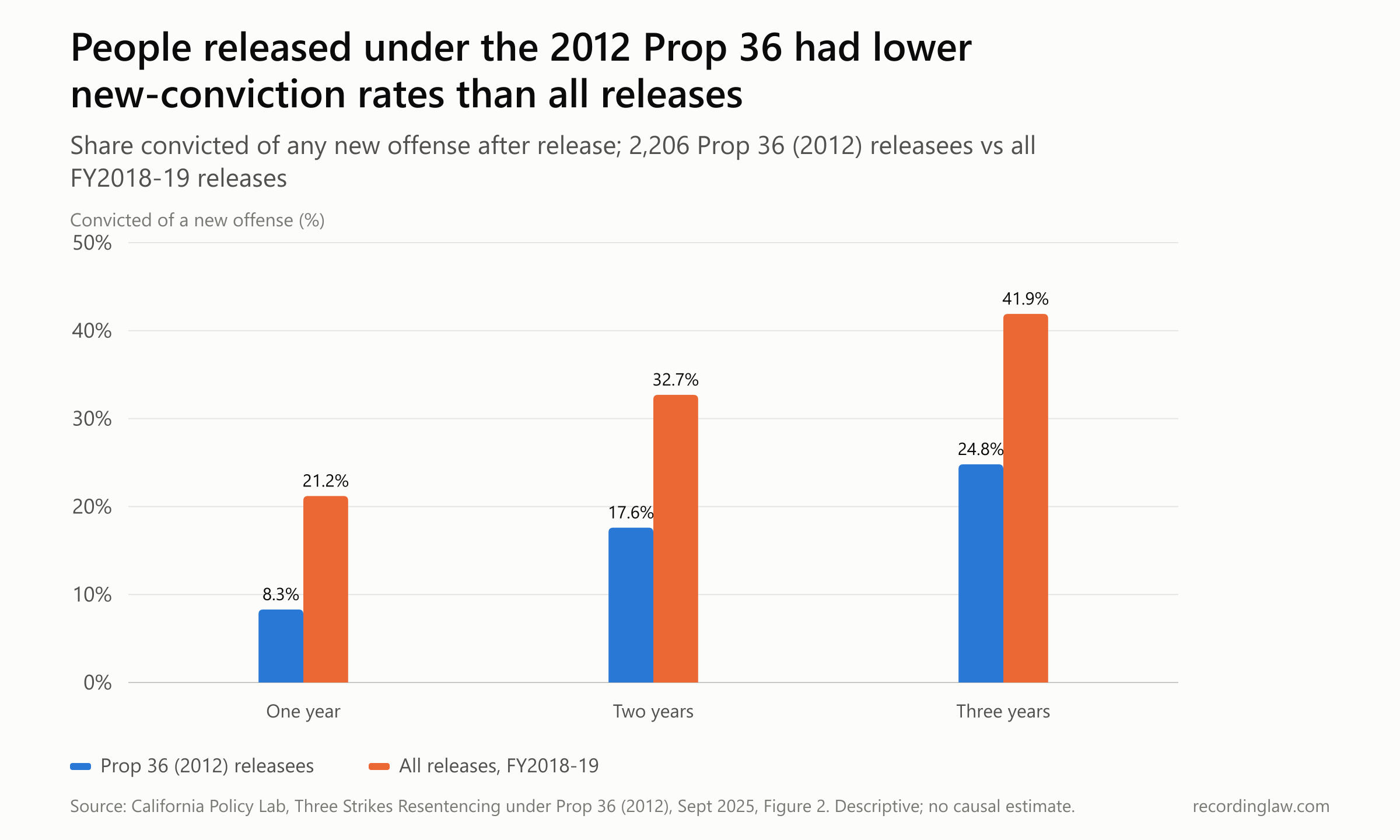
Source: California Policy Lab, Three Strikes Resentencing under Prop 36 (2012), September 2025, Figure 2 and Table 2. Descriptive, not causal.
| Measure | 2012 Prop 36 releasees | All releases, FY2018-19 |
|---|---|---|
| New conviction within 1 year | 8.3% | 21.2% |
| New conviction within 2 years | 17.6% | 32.7% |
| New conviction within 3 years | 24.8% | 41.9% |
| 3-year new conviction, serious or violent | 2.3% | 3.6% |
| 3-year new conviction, other felony | 8.1% | 12.8% |
| 3-year new conviction, misdemeanor | 14.4% | 25.5% |
| New arrest within 3 years | 39.4% | 66.7% |
| Returned to state prison within 3 years | 11.8% | 16.8% |
At every point the brief measured, the people released under the 2012 Prop 36 had lower rates of new arrests, new convictions and returns to prison than the comparison group. About one in four had a new conviction within three years, most of them misdemeanors. The opponents' warning that they would "commit more crimes" was true for some of them; 2.3% had a new serious or violent conviction within three years.
The comparison has a limit the authors state outright: "It does not assess causal impact." The two groups left prison in different years, and they were different people.
Only 4% of the 2018-19 releases had served more than 15 years, and nearly 85% had served less than five. Among the people released under the 2012 Prop 36, the brief found that the chance of a new conviction fell by about one percentage point for each additional year of age at release, and the group was much older than the comparison releases. By the time most of the 2,217 had been home a year or two, voters had already gone further.
Prop 47 and the $950 line
In November 2014, voters turned to crimes far smaller than a third strike. Proposition 47 made shoplifting of items worth $950 or less, and simple drug possession, generally misdemeanors rather than felonies. Other states draw their felony theft lines at different amounts.
Gascon signed the argument for it again, this time with William Lansdowne, a former police chief of San Diego, San Jose and Richmond. Their pitch: "Stops wasting prison space on petty crimes and focuses law enforcement resources on violent and serious crime by changing low-level nonviolent crimes such as simple drug possession and petty theft from felonies to misdemeanors."
The opposition was much the same coalition as in 2012: police chiefs, district attorneys and Crime Victims United, whose founder, Harriet Salarno, signed the argument against. "Proposition 47 is a dangerous and radical package of ill-conceived policies wrapped in a poorly drafted initiative, which will endanger Californians," they wrote. Their rebuttal quoted the president of the California Retailers Association, Bill Dombrowski: "reducing penalties for theft, receiving stolen property and forgery could cost retailers and consumers millions of dollars."
It passed with 59.6%, a smaller margin than either Prop 36. The most immediate change showed up in arrest records.
What happened to felony arrests when the felonies became misdemeanors?
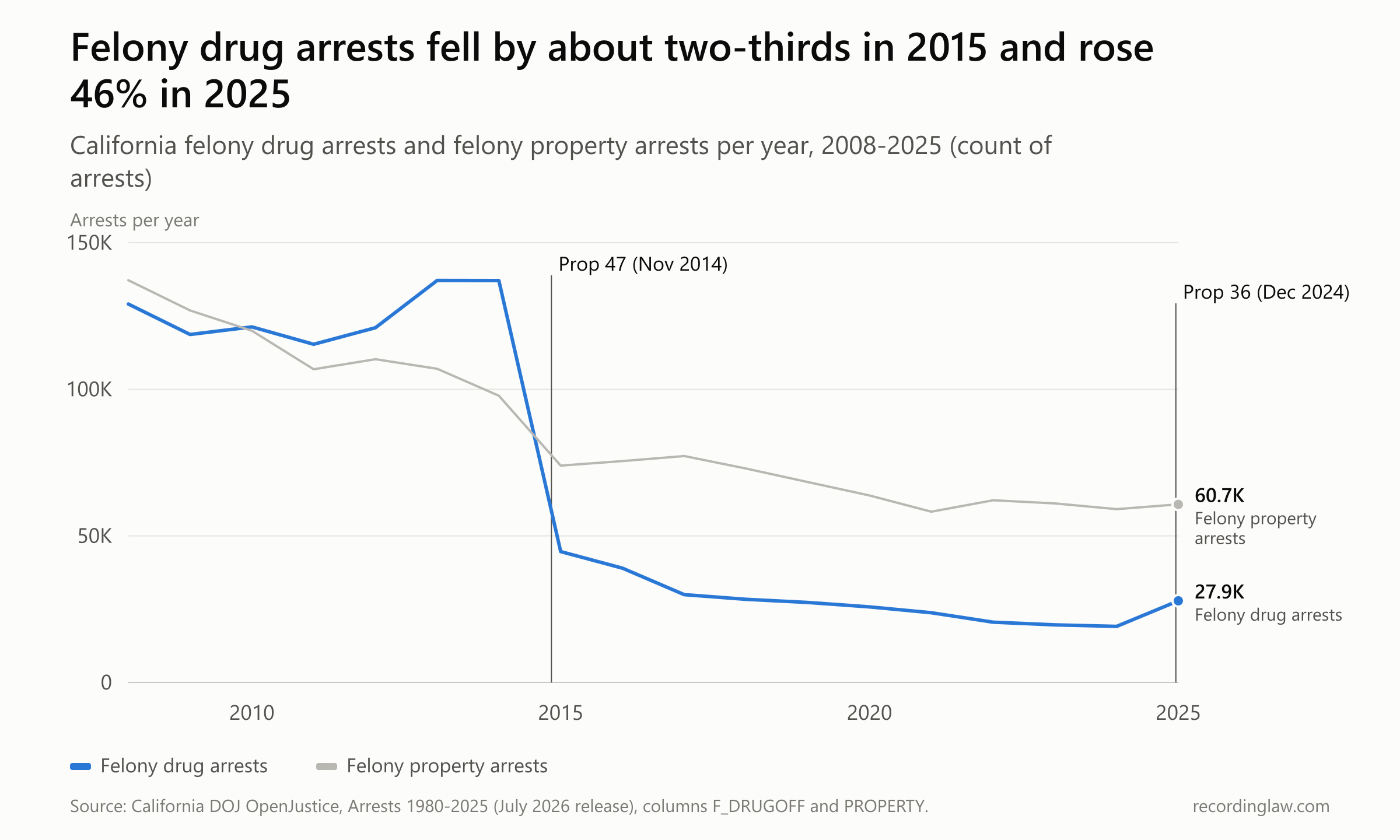
Source: California DOJ OpenJustice, Arrests 1980-2025 (July 2026 release). Prop 47 (Nov 2014) and Prop 36 (Dec 2024) marked.
| Year | Felony drug arrests | Felony property arrests |
|---|---|---|
| 2013 | 137,125 | 106,995 |
| 2014 | 137,054 | 97,806 |
| 2015 | 44,629 | 73,970 |
| 2019 | 27,280 | 68,357 |
| 2024 | 19,120 | 59,116 |
| 2025 | 27,864 | 60,742 |
Felony drug arrests fell by about two-thirds in a single year. Much of the same conduct could now be charged only as a misdemeanor, and the Justice Department's notes on its arrest data caution against comparing felony and misdemeanor arrests across the Prop 47 change.
Reported shoplifting moved too, and then reversed. Statewide shoplifting reports rose about 12% in 2015, to 108,659, then fell to 89,378 in 2018 and 90,309 in 2019, below where they had been in 2014. In a 2025 review, the LAO summarized the research this way: "Researchers found that Proposition 47 increased larceny (a category of crime that includes some forms of retail theft) though they were unable to determine the impact on retail theft specifically." The retailers who had warned about Prop 47 in 2014 would come back to the question a decade later, with money.
What shoplifting did between the votes
By 2024, reported shoplifting in California was 46% above its 2019 rate, while property crime as a whole kept falling. That split is the background to everything that happened next.
Was the rise in shoplifting part of a wider rise in property crime?
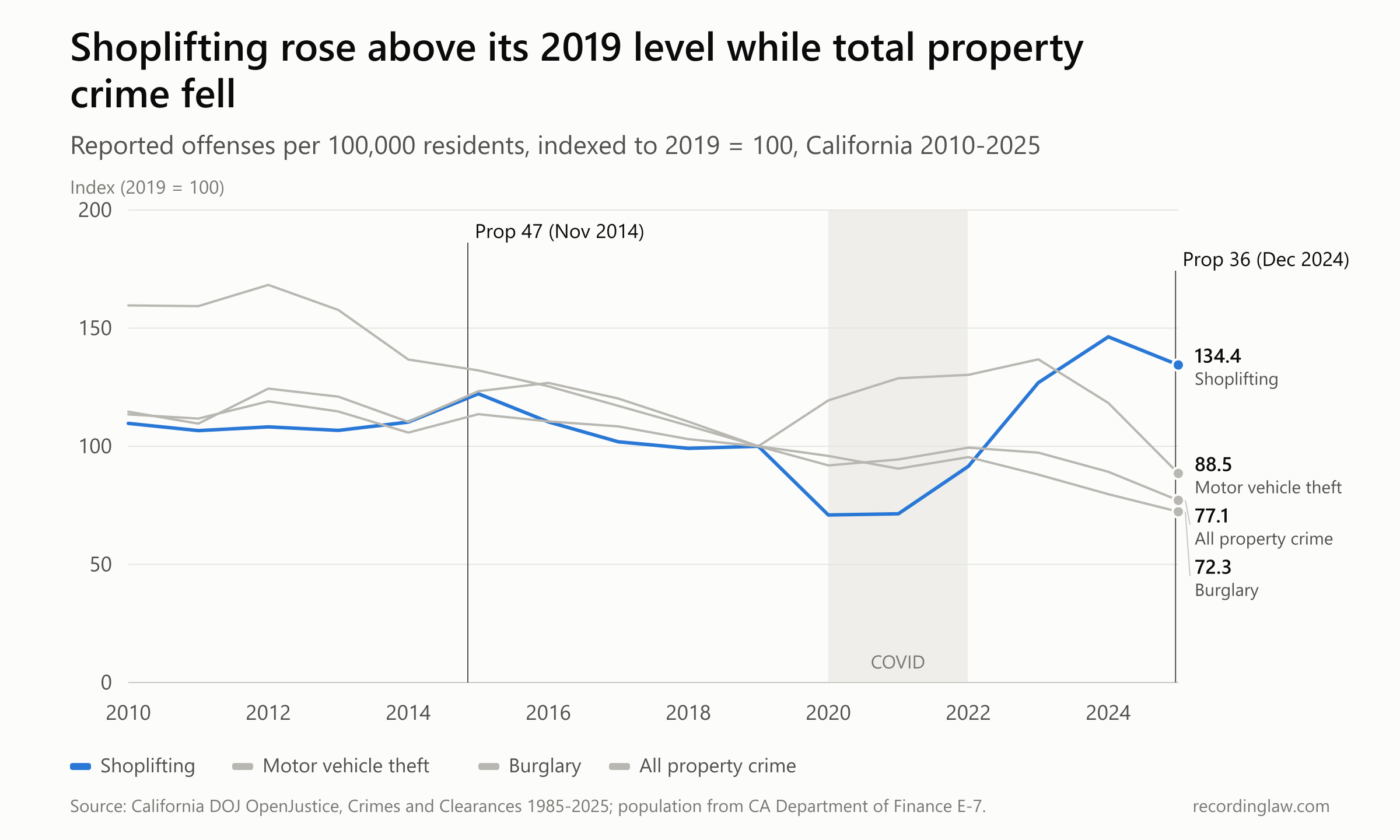
Source: California DOJ OpenJustice, Crimes and Clearances 1985-2025; population from the California Department of Finance (E-7). Index: 2019 = 100.
| Year | Shoplifting rate | Property crime rate | Burglary rate | Vehicle theft rate |
|---|---|---|---|---|
| 2014 | 251.8 | 2,449.7 | 524.1 | 392.8 |
| 2019 | 228.5 | 2,315.2 | 383.5 | 356.0 |
| 2020 | 162.1 | 2,127.3 | 367.7 | 425.0 |
| 2023 | 290.0 | 2,252.7 | 337.5 | 486.9 |
| 2024 | 334.3 | 2,064.9 | 305.5 | 421.0 |
| 2025 | 307.0 | 1,785.8 | 277.3 | 314.9 |
Rates are reported offenses per 100,000 residents.
It was not. Shoplifting reports dropped by about 30% in 2020, the first pandemic year, then climbed from 2022 on, to 132,076 in 2024, the highest rate in the 16 years shown here. The burglary rate in 2024 was a fifth below 2019's. The Public Policy Institute of California, using the 2024 data, reported that the property crime rate was "its lowest level since 1985."
From 2021 on, the state's figures mix data from two reporting systems as police agencies move to a newer incident-based format, so small year-to-year changes after 2020 are less certain than they look. Shoplifting also depends on stores calling the police. The LAO wrote that factors outside the criminal justice system, such as changes in the retail environment, "likely contributed to retail theft trends in California as well." The 2024 campaign was built on the shoplifting line.
The 2024 Prop 36 goes to voters
Supporters of the 2024 Prop 36 described a state in crisis. "California is suffering from an explosion in crime and the trafficking of deadly hard drugs like fentanyl. Prop. 36 will fix the mess our politicians have ignored for far too long," read their argument, signed by Gregory Totten, chief executive of the California District Attorneys Association, along with Salarno for Crime Victims United and the California Small Business Association. Salarno had signed against the 2012 Prop 36 and against Prop 47; now she signed for this one. The measure, "backed by district attorneys and sheriffs," CalMatters later wrote, pledged "a new era of mass treatment for those who need it the most."
The 2024 Prop 36 did what its title said, increasing sentences for certain drug and theft crimes. In the LAO's description (our California theft law guide covers the current penalties), theft of items worth $950 or less became a felony, with up to three years in county jail or state prison, for a person with two or more past convictions for certain theft crimes. Possession of drugs such as fentanyl, heroin, cocaine or methamphetamine by someone with two or more past drug convictions became a "treatment-mandated felony": finish treatment and the charge is dismissed; fail to finish and face up to three years in state prison. "Prop. 36 will allow prosecutors to combine the value of items stolen from multiple thefts and increase accountability for serial thieves," Riverside County District Attorney Mike Hestrin said in the supporters' argument.
The opponents included Contra Costa County District Attorney Diana Becton and, again, Lansdowne, who had signed for Prop 47. "It is a gross overreach that brings back 1980s “drug war” style tactics that packed our state prisons with people convicted of low-level drug offenses, harming public safety and damaging families and communities," their argument said. It called the measure one "that will waste $750 million in taxpayer dollars."
Gov. Gavin Newsom, who opposed it and signed a package of retail-theft bills the Legislature passed instead, went at the treatment promise. "It’s about mass incarceration, not mass treatment," he told reporters, according to a CalMatters commentary citing the San Francisco Chronicle. "What an actual insult it is to say it’s about mass treatment when there’s not a dollar attached to it." The 2024 Prop 36, CalMatters later noted, "included no new funding streams."
Both sides cited the LAO. The No campaign's rebuttal said the analyst had concluded the measure "will require the state to spend billions more on prisons over the next several years." The LAO's ballot analysis put the added state cost as "likely ranging from several tens of millions of dollars to the low hundreds of millions of dollars each year" and said "the prison population could increase by around a few thousand people." The supporters' rebuttal answered: "Prop. 36 won't result in over-incarceration."
This time the money ran the other way. The main Yes committee raised $15.2 million and the measure's opponents $7.7 million, according to the Secretary of State.
Walmart gave $4.08 million to the Yes side, and Target and Home Depot $1 million each. A nonprofit fund of the California Correctional Peace Officers Association, the prison guards' union, gave $300,000 to Yes. The main No committee's largest donors were mostly individual philanthropists, four of whom gave $1 million or more each (the largest $2.5 million), along with SEIU units, the California Nurses Association and the Heising-Simons Action Fund, which gave $645,000.
Walmart called the measure "a balanced approach that will provide local communities with the effective tools they need to help enforce the law and improve safety for all." Capital & Main, a nonprofit outlet whose reporting was critical of the measure, noted that the company's annual report to the Securities and Exchange Commission listed 22 risks to its business: "Nowhere is retail theft mentioned."
Five days before the vote, CBS News Sacramento reported that the state could not say what happened to the people it was already arresting for retail theft: "No one - not the Governor's Office, the attorney general, nor the California Highway Patrol (CHP), which runs California's task force - could tell us how many of the people arrested for retail theft were sentenced, let alone how many showed up to court, went to jail, received treatment, or re-offended." A PPIC survey had found more than 70% of likely voters planning to vote yes, NBC Los Angeles reported.
The 2024 Prop 36 carried all 58 counties. "It’s a clear mandate from the public that we need to take a new approach on public safety issues, specifically hard drugs, retail theft and fentanyl," Yolo County District Attorney Jeff Reisig told CalMatters. San Mateo County District Attorney Steve Wagstaffe told ABC7 that prosecutors he had spoken with wanted to "use this as a tool to try and get a segment of our population into treatment." The ACLU of Northern California, which opposed it, said it was now "up to the mayors, supervisors, prosecutors and law enforcement groups who claimed it would help reduce crime and homelessness, to deliver on their promises."
The 2024 Prop 36 took effect on December 18, 2024. Two weeks later, on January 1, 2025, most of Newsom's retail-theft package took effect too.
The first full year of shoplifting reports
In 2025, the first full year under the 2024 Prop 36, reported shoplifting in California fell 8%, to 121,339 offenses, or about 330 a day. Property crime overall fell faster, by 13.5%, and the vehicle theft rate fell by about a quarter.
When did the monthly count turn?
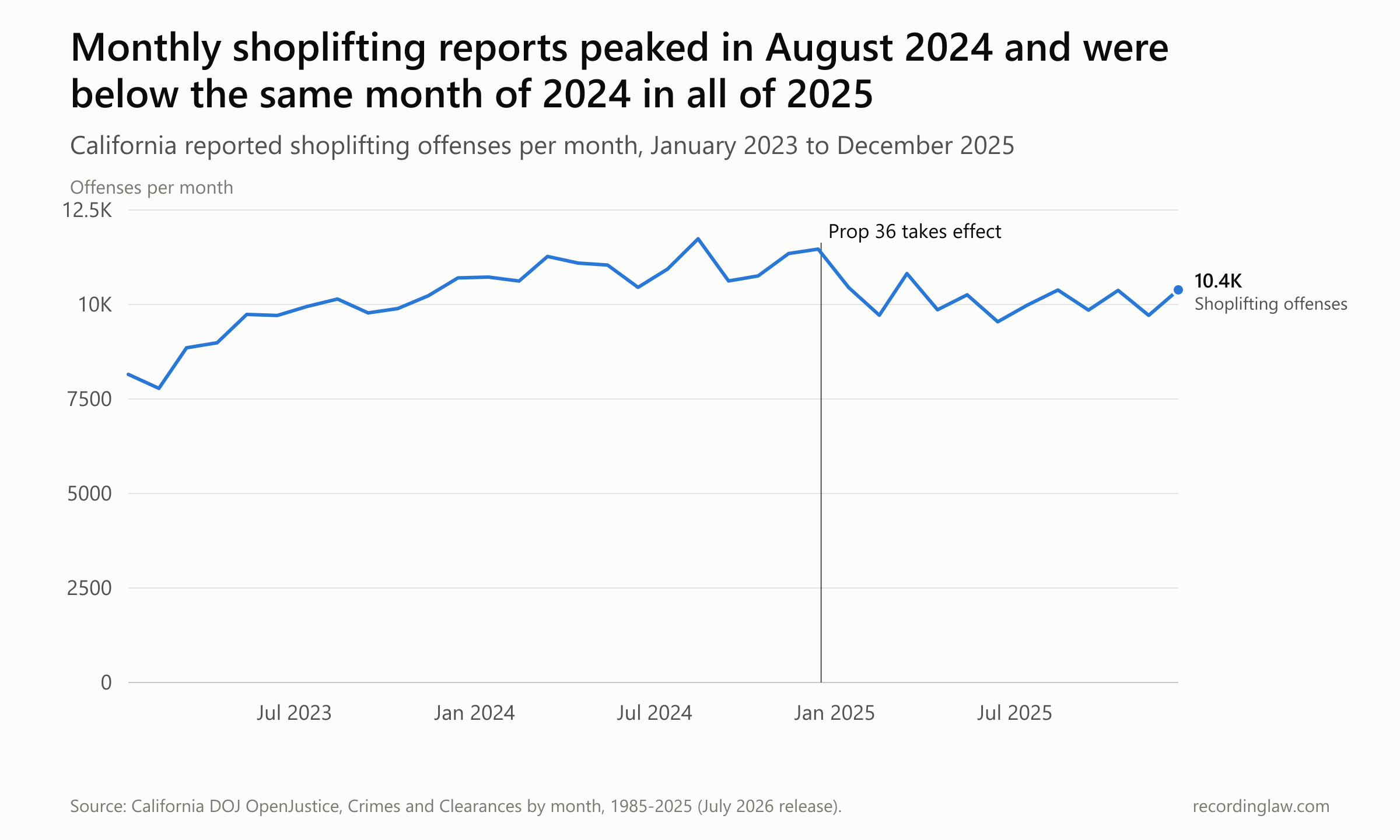
Source: California DOJ OpenJustice, Crimes and Clearances by month, 1985-2025.
| Month | 2023 | 2024 | 2025 |
|---|---|---|---|
| January | 8,151 | 10,724 | 10,449 |
| April | 8,987 | 11,095 | 9,862 |
| August | 10,145 | 11,738 | 10,382 |
| November | 10,233 | 11,350 | 9,713 |
| December | 10,703 | 11,467 | 10,388 |
| Full year | 113,922 | 132,076 | 121,339 |
For the three years charted, the monthly count was highest in August 2024, four months before the 2024 Prop 36 took effect, and every month of 2025 came in below the same month a year earlier. Even so, the 2025 shoplifting rate was still about a third above 2019's.
These numbers cannot say what moved them. The LAO pointed to the overlap: "Proposition 36, approved by the voters in November 2024 became effective on December 18, 2024. In addition, a package of legislation signed into law in fall 2024 generally became effective on January 1, 2025." Burglary and vehicle theft, which the 2024 Prop 36 did not target, fell in 2025 as well.
Supporters measured the first year in arrests and charges. In May 2025, outside a Los Angeles 7-Eleven, Los Angeles County District Attorney Nathan Hochman said, "Since Dec. 18, we have had over a thousand Proposition 36 arrests for thieves alone," and announced bright yellow warning stickers for stores. A year in, San Diego County District Attorney Summer Stephan said, "We have 884 habitual theft offenders facing felony consequences." San Diego police reported retail theft downtown down 23%, and city officials, including Mayor Todd Gloria, called the measure "the driving force behind the decline," Fox 5 San Diego reported.
The state's agency-level counts point in different directions. Shoplifting reports to the Los Angeles Police Department fell from 12,630 in 2024 to 9,712 in 2025. Reports to the San Diego Police Department rose from 2,635 to 4,152, and San Francisco's from 2,888 to 3,482.
The LAO had warned that this could happen. A tougher law, it wrote in 2025, "may cause retailers to be more likely to report crime to law enforcement and/or may cause law enforcement to be more likely (or able) to arrest and prosecute people for the affected crimes," which "could cause reported crime, arrests, or convictions to increase even if the actual underlying level of crime stays the same or declines."
Arrests did rise where the 2024 Prop 36 created new felonies. Felony drug arrests went up 46% in 2025, to 27,864, the first annual increase since 2013, as the arrest chart above shows. Each of those cases then landed in a courtroom that had to decide what to do with it.
Who chose treatment
Treatment was the center of the 2024 promise, and the courts' first annual report showed who took it. In 2025, California's trial courts received 34,612 felony cases under the 2024 Prop 36, according to the Judicial Council, which collected reports from 56 courts covering 99.5% of the state's population. Just over half, 19,104, were the new treatment-mandated drug felony. The other 15,508 were felony theft.
In the 53 courts that reported it, 3,207 of 18,666 drug cases, or 17%, involved people who opted for treatment. How far did those cases get by the end of the year?
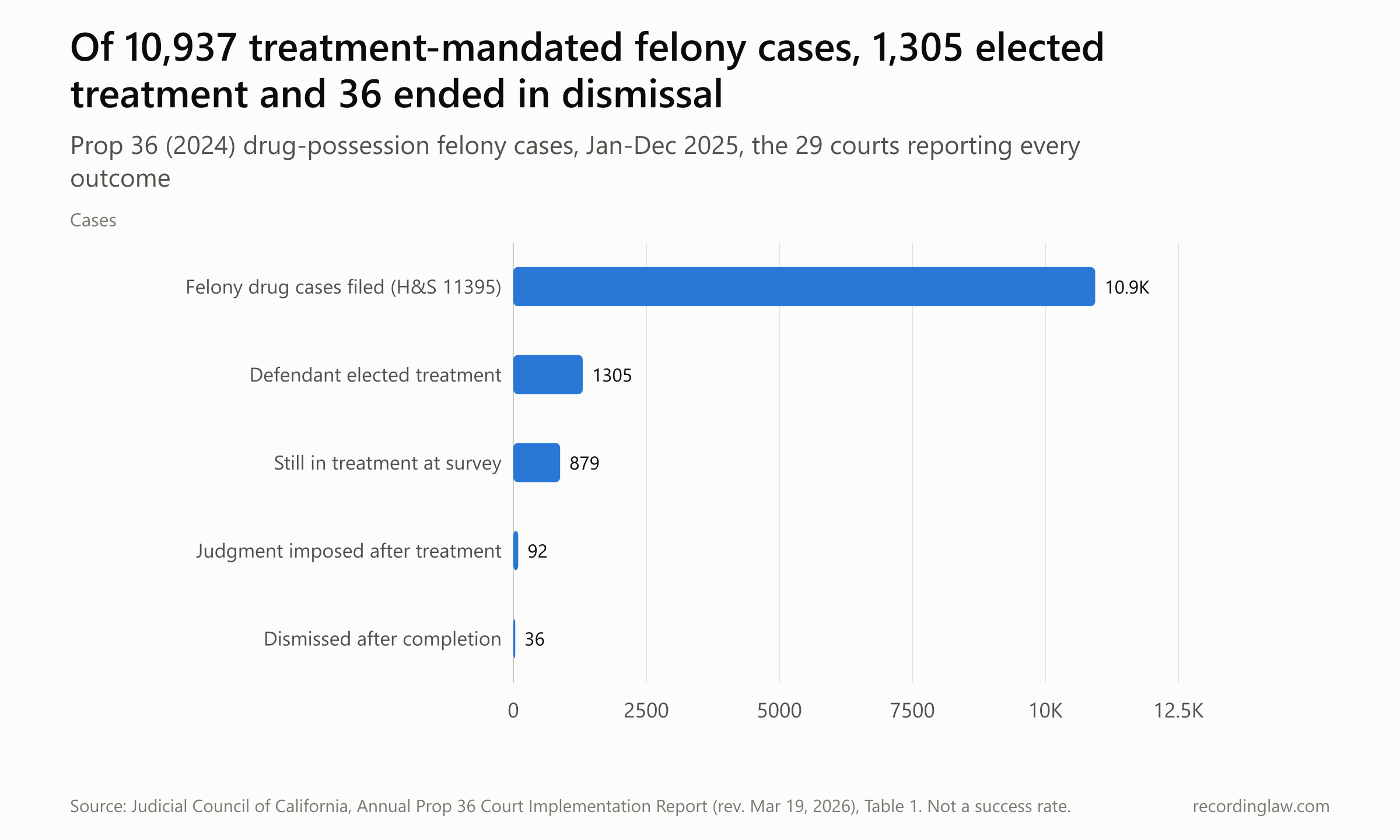
Source: Judicial Council of California, Annual Prop 36 Court Implementation Report (revised March 19, 2026), Table 1. Not a success rate.
| Stage, 29 courts reporting all outcomes, 2025 | Cases |
|---|---|
| Treatment-mandated felony drug cases | 10,937 |
| Defendant elected treatment | 1,305 |
| Still in treatment at the time of the report | 879 |
| Judgment imposed after treatment | 92 |
| Dismissed after completing treatment | 36 |
Across all reporting courts, 57 cases were dismissed after the person completed treatment. The Judicial Council warned against reading that as a scorecard: "it would be premature to assume this figure as a rate of program success," and its data "should not be used to infer program participation, success, or failure rates." Many people were still in treatment when the year closed. "There is a tension between the desire for swift adjudication of these cases and the need to support treatment effectiveness," the report said.
The state's own treatment numbers were not in it. "DHCS was unable to provide treatment data for the calendar year of 2025 in time for this first report," the council wrote, referring to the Department of Health Care Services. On the theft side, 51 courts reported 13,099 felony theft cases, of which 4,999, or 38%, ended in a conviction during the year.
A CalMatters investigation of 15 counties, published in September 2026, found the law applied differently from place to place. "In Orange County, which had the most potential Prop. 36 treatment cases of any county we analyzed, 1,311 people were referred to Prop. 36 on drug charges as of February 2026, but only 314 agreed to treatment. Of those, fewer than half were actively receiving treatment, while just 15 graduated." Required time in treatment ranged from three months to two years, and San Francisco made "hardly any Prop. 36 drug arrests."
Old convictions count, too. "There are no statutory time limitations on prior convictions that qualify a defendant," the Judicial Council noted, and some prosecutors set "wash out" periods while others do not. Public defenders told CalMatters they had seen felony charges "based on priors that date back as far as the 1980s." Totten, of the district attorneys' association, told CalMatters he "would have likely implemented a washout period, but every district attorney has to reflect the values of their constituents."
Opponents had predicted a shortfall. The day after the vote, the ACLU of Northern California said its fear was that the measure, "rather than ushering in an “era of mass treatment” to help people addicted to drugs or alcohol get off the street, as backers claimed," would instead cut funding to the treatment programs that already existed.
Supporters put the blame elsewhere. San Jose Mayor Matt Mahan, one of the measure's most prominent Democratic supporters, blamed the state.
"People are waiting and dying on the streets for lack of a proper treatment system," he told CalMatters. "The fundamental problem remains, which is that the state has refused to take ownership of building a robust treatment system that is going to serve the needs of people." That brought the argument back to Newsom's 2024 line about the dollar.
Who pays for the treatment
The first state money for the 2024 Prop 36 came in the 2025 Budget Act: $100 million, one time, to be spent by June 30, 2028. Of that, $50 million went to the Department of Health Care Services for county treatment and diversion programs, $20 million to the courts for workload, $15 million to the courts for pretrial programs and $15 million to the Office of the State Public Defender for indigent defense. Nothing was set aside for district attorneys or probation departments.
Counties, which run the treatment programs and had asked for more, objected. "This budget deal forces counties to implement Prop 36 for pennies on the dollar," the California State Association of Counties said. The Senate Republican Caucus said the budget provided "less than a quarter of the $344 million funding need identified by the various stakeholders."
In January 2026, the governor's next budget proposal again had no money for the 2024 Prop 36. District attorneys, sheriffs and probation chiefs issued a joint statement: "For the second year in a row, the Governor’s budget fails to provide the funding counties need to implement Proposition 36 as voters intended."
The final 2026-27 budget provided $50 million, one time, over three years: $20 million for pretrial services, $20 million for county behavioral health through the health care services department and $10 million for the courts. The news site California Today, reporting on the Legislature's June 2026 plan before the final deal with the governor, had put it at "roughly $375 million to implement Proposition 36"; the enacted budget summary shows $50 million. The counties' association called the behavioral health line "less than half of last year’s already inadequate $50 million behavioral health investment."
The opponents had also warned about a second pot of money. The state's savings from Prop 47 go by law to mental health and drug treatment, school dropout prevention and victim services, and as the 2024 Prop 36 pulled cases back into state prison, those savings would shrink. They totaled $95 million in the last year the LAO counted before the vote, and the LAO expected the cut to be "in the low tens of millions of dollars annually."
In early 2025, the administration projected Prop 47 savings would drop to $30.5 million in 2025-26 and $24.7 million in 2026-27, the LAO reported. Those projections rested on the larger prison forecasts of early 2025, set out in the next section. The enacted 2026-27 budget estimates "net General Fund savings of $89.1 million in 2026-27." That figure is the 2026-27 transfer to those programs for savings counted in 2025-26, the year the early-2025 projection had put at $30.5 million.
How many went to prison
The prison growth the opponents warned about has moved with every new estimate, starting from the LAO's ballot-guide figure of a few thousand people. An early-2025 state estimate, reported by the LAO, put the increase at 3,300 people in 2025-26. By January 2026, the corrections department had cut that to 562 for 2025-26 and 978 for 2026-27. The enacted 2026-27 budget expects 1,547 more people in prison "upon full implementation."
The LAO cautioned that even the January 2026 estimate "May Be Slightly Low." In the same analysis, it noted that the overall prison population had run about 1,200 people above the department's projection by the end of 2025.
The actual count is published monthly by the California Policy Lab and the Committee on Revision of the Penal Code. As of September 2026, 1,185 of the 89,906 people in state prison were there for one of the two new felonies: 417 for drug possession and 768 for theft. That is about 1.3% of the prison population. Since January 2025, 2,049 of 44,273 prison admissions, about 5%, were for those offenses.
The monthly count tallies people whose main offense is one of the two new felonies. The forecasts instead estimate how many more people are in prison than there would be without the 2024 Prop 36. September's 1,185 is above the department's January 2026 estimate of 978 for this fiscal year and below the 1,547 the budget expects at full implementation.
The sentences are measured in months, not the decades at issue in 2012. The average sentence for both new felonies is about 28 months, and the median is 24. The three-strikes law the 2012 Prop 36 narrowed is still at work in them: 34.2% of people admitted for the new theft felony and 27.2% of those admitted for the drug felony were sentenced as second strikers, which under the three-strikes law doubles the usual term.
What lands next, and when
The 2012 Prop 36 has a record long enough to set beside its campaign's promises and warnings. The 2024 Prop 36 has one year of numbers, and most of the questions its campaign raised are still open.
The next ones have dates. The governor's 2027-28 budget proposal, due by January 10, 2027, will show whether the state puts ongoing money into the 2024 Prop 36, which counties have said they need. "Without sustainable investments and ongoing state support, counties will continue to experience barriers in meeting the will of California voters, who approved the measure in all 58 counties," their association wrote. The May Revision follows in spring.
The Judicial Council's second court report is due by March 1, 2027, and annually after that "for a total of three years or until the funds are exhausted." It may carry the treatment data the health care services department could not supply in time for the first. The state's 2026 crime and arrest data, the second full year under the 2024 Prop 36, are expected in July 2027, a year after the 2025 figures came out. The 2025 money expires on June 30, 2028.
Until someone does a study that can separate the 2024 Prop 36 from everything else that changed, the LAO wrote, "monitoring rates of reported shoplifting and commercial burglary can still provide a helpful indication of whether crime is declining, regardless of cause." In 2012, the shoplifter in the argument stole socks. In 2024, it was a candy bar. The next statewide count of reported shoplifting comes in July 2027.
How we measured
Crime counts and rates. Statewide shoplifting, burglary, motor vehicle theft and total property crime are sums over all 58 counties and reporting agencies in the California Department of Justice OpenJustice file "Crimes and Clearances with Arson 1985-2025" (July 2026 release). Shoplifting is the column for larceny-shoplifting actual offenses. Rates divide those counts by the Department of Finance E-7 July 1 population and multiply by 100,000. The index sets each rate's 2019 value at 100.
Monthly shoplifting comes from the same release's by-month file, and its months add up to the annual totals. Agency figures (Los Angeles, San Diego and San Francisco police departments) are that agency's rows in the same file.
Arithmetic in the text. Shoplifting 46% above 2019 in 2024 = 334.3 / 228.5; about a third above in 2025 = 307.0 / 228.5. The 8% drop in 2025 = 121,339 / 132,076; property crime's 13.5% drop compares 705,925 offenses with 815,854. The vehicle theft rate fell about a quarter (421.0 to 314.9 per 100,000).
About 330 shoplifting reports a day = 121,339 / 365. The pandemic drop of about 30% = 64,105 / 90,309 offenses. The 2015 rise of about 12% = 108,659 / 97,301.
Felony drug arrests fell by about two-thirds from 2014 to 2015 (137,054 to 44,629) and rose 46% from 2024 to 2025 (19,120 to 27,864). The prison share of about 1.3% = 1,185 / 89,906; admissions of about 5% = 2,049 / 44,273.
PPIC and DOJ figures differ slightly. PPIC's published 2024 figures (shoplifting up 14.2% in 2024 and 48.0% above 2019; property crime 2,084 per 100,000) come from an earlier edition of the DOJ data. DOJ revises its series each July, and the current edition shows shoplifting up about 16% in 2024 and 46% above 2019. We use the current edition for every number and chart and cite PPIC only for its finding that property crime was at its lowest level since 1985.
Series breaks. In 2011, California raised the lower limit of felony theft from $400 to $950, and DOJ adjusted property-crime totals back to 2002 to count all larceny. Prop 47 (November 2014) and cannabis legalization (2016) changed what counts as a felony drug arrest, so the arrest drop in 2015 reflects reclassification as well as behavior. From 2021, DOJ crime data combine the older summary system with data converted from the newer incident-based system, and not every agency has switched.
The pandemic depressed shoplifting reports in 2020 and 2021. Reported shoplifting depends on stores reporting and police recording; the LAO has said tougher laws can raise reported crime even when underlying crime does not change.
The 2012 Prop 36. Release counts, demographics and recidivism come from the California Policy Lab brief "Three Strikes Resentencing under Prop 36 (2012)" (September 2025), with recidivism measured through June 30, 2024. Recidivism rates are computed on 2,206 people at one year, 2,200 at two and 2,177 at three (Table 2), because the brief counts only people followed for the full period. The 2012 voter guide prints the Crime Victims United of California president's name as "Harriet Salerno"; the 2014 and 2024 guides print "Harriet Salarno," the spelling used here, for the same organization's signer. The comparison group is all people released from state prison in fiscal 2018-19, a different era and population; the brief says it "does not assess causal impact."
The Stanford and NAACP Legal Defense Fund figure comes from an early 2013 progress report by the measure's authors and covers only the first months. The LAO's $70 million to $90 million a year was a forecast; we did not find a later official accounting of realized savings. Stanford's 2013 report put savings at that point at $10 million to $13 million.
The 2024 Prop 36. Court figures come from the Judicial Council's first annual Prop 36 report to the Legislature (January to December 2025, revised March 19, 2026), a survey of 56 trial courts covering 99.5% of the 2024 population. Different questions were answered by different numbers of courts (53 for treatment uptake, 51 for theft convictions, 29 for full treatment outcomes), and cases are not tracked individually, so the figures are not success rates.
Prison counts and sentences come from the California Policy Lab and Committee on Revision of the Penal Code monthly Prop 36 prison data, September 2026 edition. Prison forecasts come from the LAO, the Assembly budget subcommittee agenda of March 2, 2026, and the enacted 2026-27 budget summary. Funding comes from the enacted 2026-27 budget summary, which also restates the 2025 allocation. Prop 47 savings are labeled by the year they are transferred: the LAO explains that the Department of Finance estimates each year's savings and transfers them to the Prop 47 fund in the following budget year, so the enacted budget's $89.1 million in 2026-27 pairs with the $30.5 million projected for 2025-26, not the $24.7 million projected for 2026-27.
What the data cannot show. No study located for this story estimates the causal effect of the 2024 Prop 36 on crime. Its first full year overlaps a separate retail-theft law package effective January 1, 2025, a statewide decline in other property crimes and changes in how retailers and police report theft. Campaign finance figures for 2012 come from contemporaneous news reports, not final filings. This article covers the 2012 and 2024 measures numbered 36; California also had a Proposition 36 in 2000 (the Substance Abuse and Crime Prevention Act), which is not covered here.
Frequently Asked Questions
What is the difference between Prop 36 in 2012 and Prop 36 in 2024?
They are two unrelated California ballot measures that happen to share a number. The 2012 Proposition 36 narrowed the three-strikes law: a third felony that was neither serious nor violent no longer brought 25 years to life, and some people already serving those terms could ask for shorter sentences. The 2024 Proposition 36 increased penalties for certain theft and drug crimes, undoing parts of Proposition 47 (2014).
How many people were released under the 2012 Prop 36?
The California Policy Lab counted 2,217 people serving third-strike terms for non-serious, non-violent felonies who were released earlier because of the measure. The state had estimated about 3,000 were eligible to ask for resentencing.
Did people released under the 2012 Prop 36 commit new crimes?
Some did. Within three years, 24.8% had a new conviction, most of them misdemeanors, and 2.3% had a new serious or violent conviction. Among all people released from state prison in fiscal 2018-19, 41.9% had a new conviction within three years. The California Policy Lab says this comparison is descriptive and does not measure cause; the Prop 36 group was much older and had served far longer.
What does the 2024 Prop 36 do?
According to the Legislative Analyst's Office, it makes theft of items worth $950 or less a felony for people with two or more past convictions for certain theft crimes, allows the value of multiple thefts to be combined, and creates a treatment-mandated felony for drug possession by people with two or more past drug convictions. Those who finish treatment have the charge dismissed; those who do not can face up to three years in state prison. It took effect on December 18, 2024.
Has shoplifting gone down since the 2024 Prop 36?
Reported shoplifting in California fell 8% in 2025, to 121,339 offenses, after its 2023-2025 monthly high in August 2024. Total property crime fell 13.5% over the same year, and a separate retail-theft law package took effect on January 1, 2025, so the data cannot attribute the change to Prop 36. The 2025 shoplifting rate was still about a third above 2019.
How many people chose treatment under Prop 36?
In 2025, in the 53 courts that reported it, 3,207 of 18,666 treatment-mandated felony drug cases (17%) involved people who opted for treatment, and 57 cases statewide were dismissed after treatment was completed. The Judicial Council says these figures should not be read as success rates, partly because many people were still in treatment at year end.
How much funding did California provide for Prop 36?
The measure included no funding. The 2025 Budget Act provided $100 million one-time, available until June 30, 2028, and the 2026-27 budget added $50 million one-time over three years. Counties, district attorneys, sheriffs and probation chiefs have asked for ongoing funding.
How many people are in prison because of the 2024 Prop 36?
As of September 2026, 1,185 people in state prison (417 for drug possession and 768 for theft) were held for the two new felonies the measure created, about 1.3% of the 89,906 people in state prison. The enacted 2026-27 budget expects the measure to add 1,547 people to the prison population at full implementation.
When is the next Prop 36 data release?
The governor's 2027-28 budget proposal is due by January 10, 2027. The Judicial Council's second annual Prop 36 court report is due by March 1, 2027. The California Department of Justice's 2026 crime and arrest data are expected in July 2027.
Updates
Independently fact-checked against the cited primary sources
Sources and References
- California Secretary of State, Official Voter Information Guide, November 2012: Proposition 36 arguments and rebuttals(vigarchive.sos.ca.gov).gov
- Legislative Analyst's Office, Proposition 36 (2012) ballot analysis: Three Strikes Law(lao.ca.gov).gov
- California Secretary of State, Statement of Vote, November 6, 2012 General Election: ballot measures(elections.cdn.sos.ca.gov).gov
- KPBS, Prop 36 Supporters Say It's Time To Amend 'Three Strikes' Law (October 4, 2012)(kpbs.org)
- NBC Los Angeles, Prop. 36 Passes; Will Modify California Three Strikes Law (November 2012)(nbclosangeles.com)
- California Policy Lab, Three Strikes Resentencing under Prop 36 (2012), September 2025(capolicylab.org)
- Stanford Law School Three Strikes Project and NAACP Legal Defense and Education Fund, Progress Report: Three Strikes Reform (Proposition 36), 1,000 Prisoners Released (2013)(law.stanford.edu)
- Stanford Law School, George Soros gives $500,000 to effort to narrow three-strikes law (2012)(law.stanford.edu)
- California Secretary of State, Official Voter Information Guide, November 2014: Proposition 47 arguments and rebuttals(vigarchive.sos.ca.gov).gov
- California Secretary of State, Statement of Vote, November 4, 2014 General Election(elections.cdn.sos.ca.gov).gov
- California Department of Justice OpenJustice, Crimes and Clearances with Arson, 1985-2025 (July 2026 release)(data-openjustice.doj.ca.gov).gov
- California Department of Justice OpenJustice, Crimes and Clearances with Arson by month, 1985-2025(data-openjustice.doj.ca.gov).gov
- California Department of Justice, Crimes and Clearances data context notes (June 2026)(data-openjustice.doj.ca.gov).gov
- California Department of Justice OpenJustice, Arrests 1980-2025 (July 2026 release)(data-openjustice.doj.ca.gov).gov
- California Department of Justice, Arrests data context notes (2026)(data-openjustice.doj.ca.gov).gov
- California Department of Finance, E-7 population estimates, 1900 to July 2025(dof.ca.gov).gov
- Public Policy Institute of California, Crime Trends in California(ppic.org)
- Legislative Analyst's Office, Retail Theft in California: Looking Back at a Decade of Change (June 2025)(lao.ca.gov).gov
- California Secretary of State, Official Voter Information Guide, November 2024: Proposition 36 arguments and rebuttals(vigarchive.sos.ca.gov).gov
- Legislative Analyst's Office, Proposition 36 (2024) ballot analysis(lao.ca.gov).gov
- California Secretary of State, Statement of Vote, November 5, 2024 General Election(elections.cdn.sos.ca.gov).gov
- California Secretary of State, 2024 ballot measure contribution totals: Proposition 36(sos.ca.gov).gov
- California Fair Political Practices Commission, top 10 contributors, Proposition 36 (2024)(fppc.ca.gov).gov
- CalMatters commentary, Newsom's opposition to Prop 36 (September 2024)(calmatters.org)
- CalMatters, Prop 36 and new California laws (December 27, 2024)(calmatters.org)
- CalMatters, investigation of Prop 36 drug treatment in 15 counties (September 17, 2026)(calmatters.org)
- Capital & Main, on Walmart and Prop 36 (October 11, 2024)(capitalandmain.com)
- CBS News Sacramento, state data on retail theft suspects after arrest (October 31, 2024)(cbsnews.com)
- NBC Los Angeles, Prop 36: California ballot measure aims to toughen retail crime penalties (September 2024)(nbclosangeles.com)
- ABC7 San Francisco, What Prop 36 could mean for California (November 7, 2024)(abc7news.com)
- ACLU of Northern California, statement on Proposition 36 (November 2024)(aclunc.org)
- Westside Current, Hochman, Park Say Prop 36 Is Delivering Results (May 2025)(westsidecurrent.com)
- Fox 5 San Diego, San Diego County leaders credit Prop 36 for decrease in retail thefts (December 11, 2025)(digital-release.fox5sandiego.com)
- Judicial Council of California, Annual Proposition 36 Court Implementation Report to the Legislature (January-December 2025, revised March 19, 2026)(courts.ca.gov).gov
- California Department of Finance, Enacted Budget Summary 2026-27: Criminal Justice and Judicial Branch(ebudget.ca.gov).gov
- California State Association of Counties, statement on Prop 36 funding in the 2025 state budget(counties.org)
- California Senate Republican Caucus, 2025-26 Budget Act highlights and analysis(src.senate.ca.gov).gov
- Chief Probation Officers of California, joint statement on the proposed 2026-27 budget (January 2026)(cpoc.org)
- California Today, report on the 2026-27 budget deal before signing(californiatoday.com)
- California State Association of Counties, statement on the final 2026-27 budget (June 29, 2026)(counties.org)
- California State Association of Counties, budget recommendations to the Senate (2026)(counties.org)
- Judicial Council presentation on Prop 36 court survey, via CSAC (May 2026)(counties.org)
- Legislative Analyst's Office, The 2025-26 Budget: Estimated State Savings From Proposition 47 (February 2025)(lao.ca.gov).gov
- Legislative Analyst's Office, The 2025-26 Budget: California Department of Corrections and Rehabilitation(lao.ca.gov).gov
- California State Assembly Budget Subcommittee No. 6, agenda for March 2, 2026 (CDCR population and Prop 36 estimates, with LAO comments)(abgt.assembly.ca.gov).gov
- Committee on Revision of the Penal Code and California Policy Lab, Prop 36 (2024) prison data (September 2026 edition)(clrc.ca.gov).gov