Between Oregon's 2021 Decriminalization and 2024 Reversal, Overdose Deaths Doubled, Then Fell

Independently fact-checked against primary sources (last audited November 1, 2026). · 15 primary sources cited on this page. How we verify our legal content
The text of Measure 110 made its case to Oregon voters with a death count. "Every day, one or two Oregonians die because of drug overdoses," its findings read in the state's 2020 Voters' Pamphlet.
The federal tally agreed. CDC provisional data count 624 overdose deaths in Oregon in the 12 months ending February 2020, about 1.7 a day. On November 3, 2020, voters approved the measure with 58% of the vote, and on February 1, 2021, possessing small amounts of drugs became a ticket instead of a crime.
Three years later the count had tripled. In the 12 months ending March 2024, about 1,910 Oregonians died of overdoses, a little over five a day. By then the Legislature had voted to make possession a crime again, starting September 1, 2024. In the 12 months ending December 2025, the count was about 1,220, a little over three a day.
Each side has read that curve as a verdict on the other's law. One side points to the climb under decriminalization, the other to a decline that started before recriminalization took effect. The same years also brought fentanyl to Oregon later than to almost any other state, and a national decline that began months before Oregon's. How much of either swing can the record tie to a law?
A ticket instead of an arrest
Backers of Measure 110 outspent its opponents about 36 to 1. Committees supporting the measure raised about $6.03 million, $5.05 million of it from Drug Policy Action, a national drug-policy reform group, and $500,000 from the Chan Zuckerberg Initiative. The No committee raised $167,740, most of it from a single donor.
Voters approved the measure 1,333,268 to 947,313, on the same ballot that carried Measure 109 on psilocybin. Under the new law, most possession offenses dropped from a crime to a Class E violation, punishable by a fine of at most $100, with no jail.
Supporters promised that the measure would "greatly expand access to drug treatment and recovery services for those who want and need them," in the words of a pamphlet argument signed by nurse and physician groups. "It’ll be paid for with existing marijuana tax money," the argument said. Three county prosecutors signed a Yes argument, among them Deschutes County District Attorney John Hummel: "when we make addiction a crime, people often feel too afraid to seek the help they need, which in turn makes our communities less safe."
Twenty-five district attorneys signed the opposing argument. "Decriminalization will lead to an increase in acceptability of dangerous drugs," they wrote. The No committee went further in its own pamphlet argument: "Without court-sponsored treatment, more people suffering addiction will lose jobs, experience homelessness, and fuel their addiction by committing crime. Many will die."
The two sides agreed on one thing. Both described Oregon as nearly last among the states in access to treatment: 48th in the district attorneys' argument, 50th of 50 in one Yes argument. They split over whether a court summons was a route into that treatment or an obstacle to it.
A physician specializing in pain and addiction at Salem Health stated the test plainly in a No argument: "Nor will levying a token $100.00 fine be financial disincentive of sufficient magnitude to coax ambivalent or pre-contemplative people into a life of abstinence or long-term recovery." Mike Marshall of Oregon Recovers, a recovery advocacy group that said it supported decriminalization but opposed Measure 110, warned about capacity instead. "Their goal is to move people out of the criminal justice system into the health care system. But the health care system isn’t ready to receive them," he told KATU.
The state's own forecast, printed in the pamphlet, was about scale. The Oregon Criminal Justice Commission estimated that possession arrests would fall from 6,726 to 615, and convictions from 4,057 to 378.
On February 1, 2021, the Associated Press reported, "Police in Oregon can no longer arrest someone for possession of small amounts of heroin, methamphetamine, LSD, oxycodone and other drugs." Kassandra Frederique of the Drug Policy Alliance called it the day "the first domino of our cruel and inhumane war on drugs has fallen." Something else was arriving in Oregon that spring.
What reached Oregon the same spring
For five years before the vote, Oregon's overdose count rose slowly. It sat near 500 a year from 2015 to 2017 and crept to about 620 by early 2020. Then it turned upward, months before Measure 110 took effect, and kept climbing.
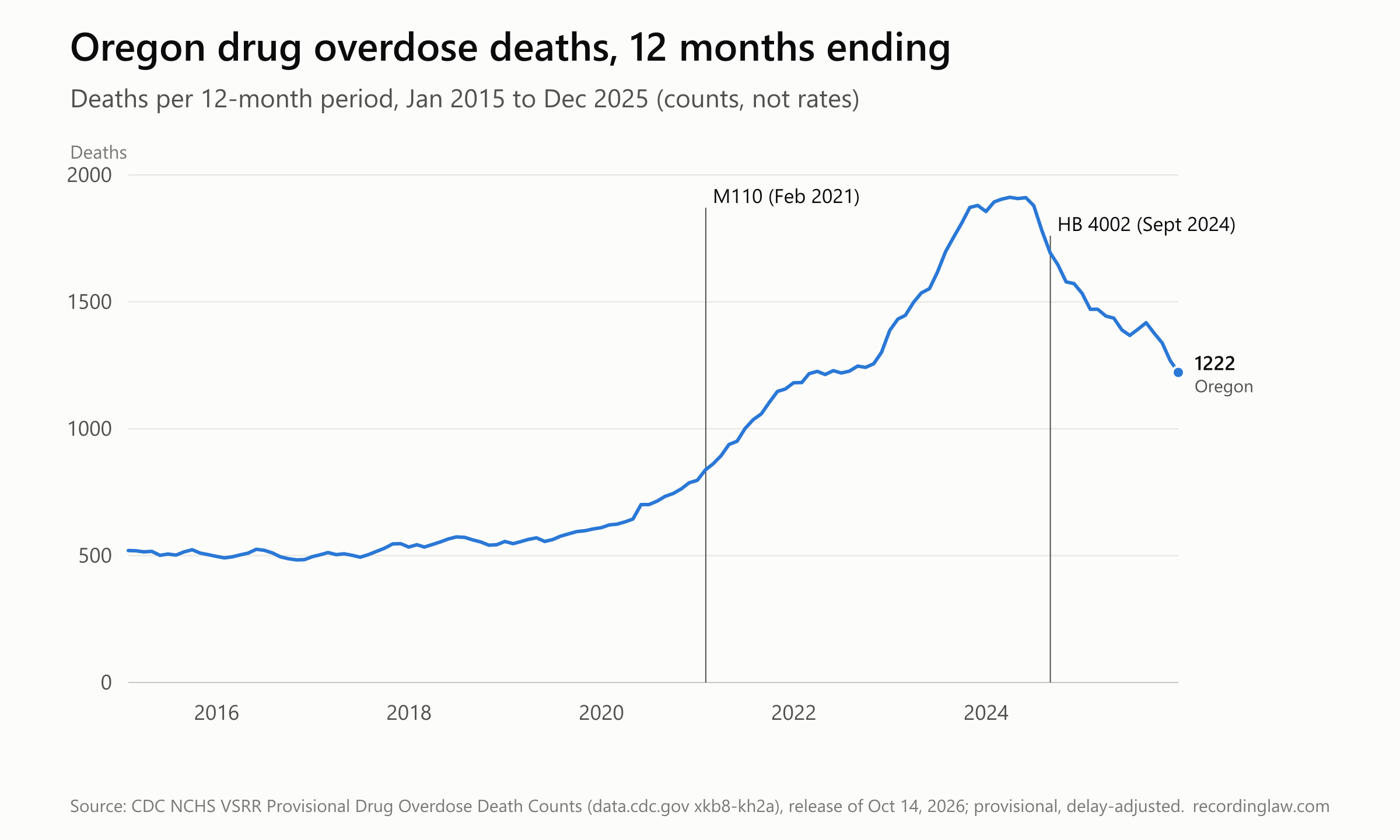
Oregon drug overdose deaths per 12 months ending, January 2015 to December 2025. Source: CDC NCHS VSRR provisional counts (October 14, 2026 release), delay-adjusted.
| 12 months ending | Oregon overdose deaths |
|---|---|
| February 2020 | 624 |
| January 2021 | 838 |
| December 2021 | 1,181 |
| December 2022 | 1,387 |
| March 2024 (peak) | 1,912 |
| August 2024 | 1,694 |
| December 2024 | 1,534 |
| December 2025 | 1,222 |
The count tripled from early 2020 to early 2024. What changed in that period was the drug supply.
Researchers led by Zoorob tracked when fentanyl took over each state's drug seizures, using the share of crime-lab reports identified as fentanyl. The shift came to New England states in the second half of 2014. It reached Washington in the second half of 2020 and Oregon in the first half of 2021, "both after nearly all other states," they wrote in JAMA Network Open.
Oregon's Secretary of State put the timing in a sentence in its December 2025 audit. "The fentanyl crisis started in the U.S. on the east coast and moved westward, hitting Oregon as the M110 program was being implemented."
Did the deaths follow the fentanyl? CDC's counts include a category for synthetic opioids other than methadone, which is mostly fentanyl.
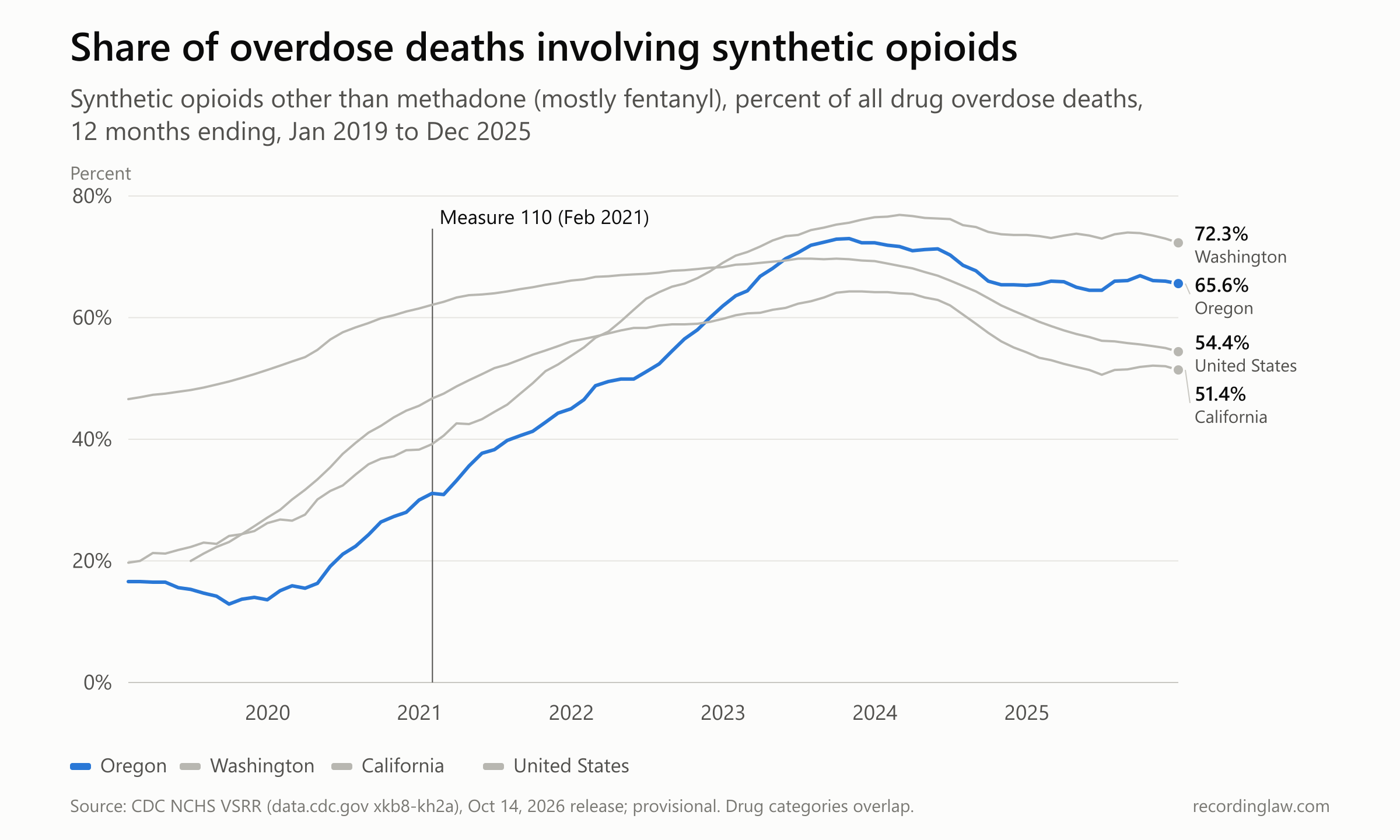
Synthetic opioids other than methadone as a share of all drug overdose deaths, 12 months ending. Source: CDC NCHS VSRR provisional counts; a death can involve more than one drug.
| 12 months ending | Oregon | Washington | California | United States |
|---|---|---|---|---|
| December 2019 | 13.6% | 26.2% | 27.1% | 51.4% |
| February 2021 | 30.9% | 40.6% | 47.5% | 62.6% |
| December 2023 | 72.3% | 76.5% | 64.2% | 69.3% |
| December 2025 | 65.6% | 72.3% | 51.4% | 54.4% |
Oregon started the period far below the national level and passed it in 2023. Fentanyl had been in about one in seven Oregon overdose deaths in 2019, and in nearly three in four by late 2023.
In raw counts, deaths involving synthetic opioids went from 83 in 2019 to 1,338 in 2023. Deaths that did not involve them were about 530 in 2019 and about 510 in 2023, and never went above about 650 in between. Nearly the whole rise came from one category of drug.
That does not settle what the law did. Brian Renauer, a Portland State University criminologist who led a three-year study of Oregon's drug-policy changes, told OPB in 2025 that "the emergence of fentanyl on the drug market, saturating the drug market here in Oregon, exactly corresponds with the implementation of Measure 110." The two arrived together, which is why every study since has had to decide how to pull them apart.
What happened to the tickets?
Five months in, the Legislature rewrote how the ticket worked. Under SB 755-C, in effect from July 19, 2021, a person could get the charge dismissed by completing a treatment screening within 45 days. The minimum fine became $45, the case went to circuit court, and the law barred penalties for failing to appear.
On a downtown Portland sidewalk in November 2023, NPR watched a police officer hand a man using fentanyl a $100 citation and a hotline number. "So far, police have handed out more than 7,000 citations, but as of December, only a few hundred people had called the hotline to get assessed for a substance use disorder," NPR reported. The officer said: "The same people I gave a citation to yesterday, today I see doing the same thing."
The court records show where the cases went.
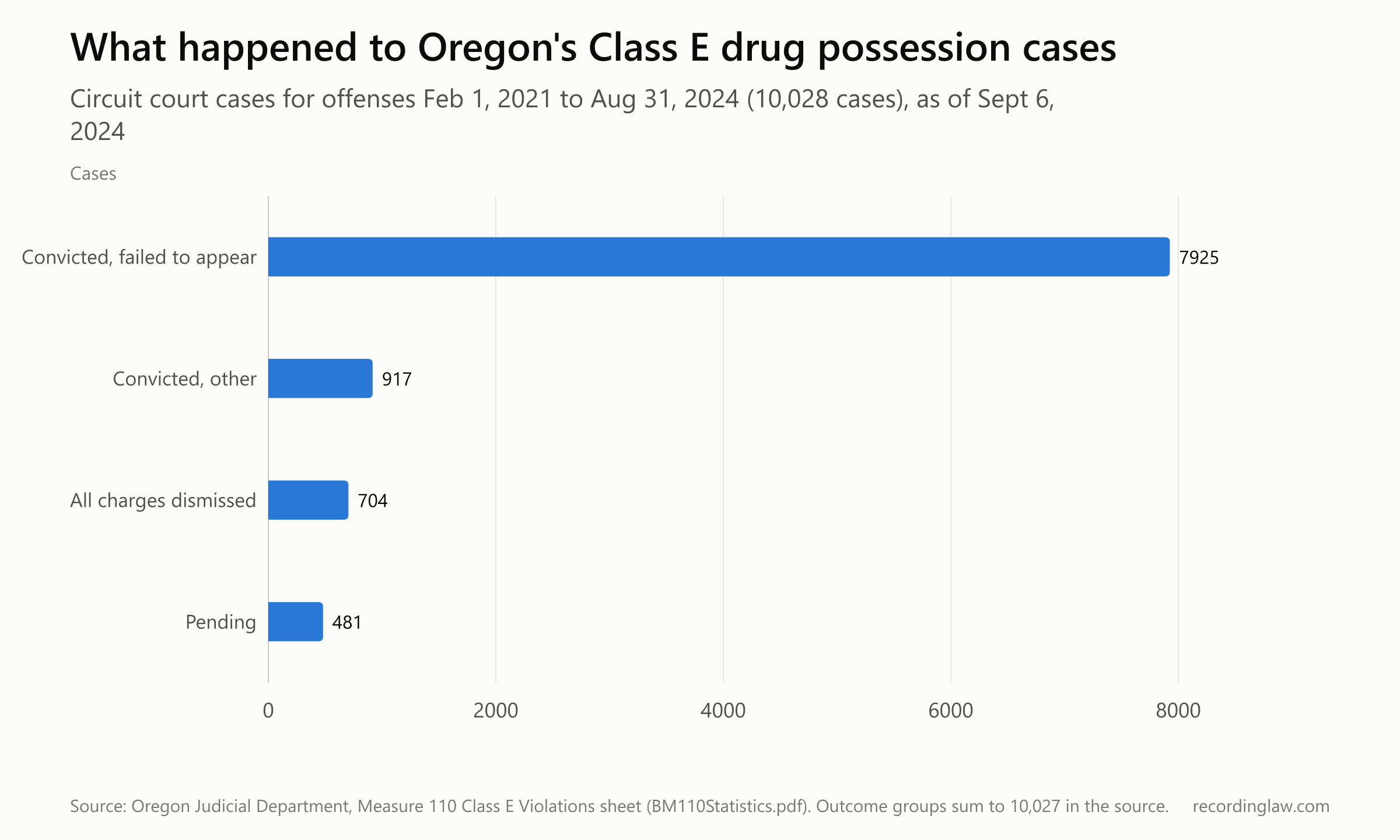
Outcomes of Oregon circuit court Class E possession cases for offenses February 1, 2021 to August 31, 2024, as of September 6, 2024. Source: Oregon Judicial Department.
| Outcome | Cases |
|---|---|
| Convicted, failed to appear | 7,925 |
| Convicted, other | 917 |
| All Class E charges dismissed | 704 |
| Of the dismissed: substance use assessment verification filed | 85 |
| Pending | 481 |
| Total stated by the court | 10,028 |
About four in five cases ended with the person not showing up and a conviction entered. Of the 704 dismissals, 85 had a treatment-assessment verification on file. The court system notes that this "does not reflect all treatment-related activities funded through BM 110," so it counts the ticket's off-ramp, not all treatment.
NPR's scene was in Portland. Multnomah County, which includes Portland, had the most cases, 2,260, but Jackson County in southern Oregon nearly matched it with 2,212, and neighboring Josephine County had 1,609. Most were for methamphetamine (54%) or for other Schedule II drugs (31%), a court category separate from methamphetamine, oxycodone and cocaine, which it counts on their own.
The hotline printed on the tickets drew so few calls that its first contract came to "approximately $7,000 per M110 call," or about $3,000 counting the hotline's other calls, the Secretary of State's auditors found. It closed in June 2025 "due to low engagement and lack of return on investment."
Not every penalty moved with the ticket. While possession carried a ticket of at most $100, fentanyl test strips still counted as drug paraphernalia, which Oregon Business reported carried a fine "between $2,000 and $10,000." The 2023 Legislature removed the strips from the paraphernalia definition in HB 2395.
The treatment side ran on cannabis taxes. In 2021, Sen. Floyd Prozanski, who chaired the Legislature's Measure 110 implementation committee, told the AP that if recreational marijuana were legalized nationally, which he expected within four years, the treatment fund could become "oversaturated with revenue."
By December 2025 the state had awarded about $800 million in Measure 110 grants, $391 million of it in 2025, funded by cannabis tax revenue. The auditors concluded that the vision of replacing criminal penalties with a public health approach "remains unfulfilled."
By 2023, the death count and the ticket count were both public, and the polls on the law were moving.
The vote to make it a crime again
In September 2022, a poll by Data for Progress, a progressive polling firm, found 58% of likely Oregon voters wanted Measure 110 kept and 36% wanted it repealed. In August 2023, an Emerson College poll commissioned by the Foundation for Drug Policy Solutions, which opposes decriminalization, found 56% favored full repeal.
The rollback came in pieces. In July 2023, Gov. Tina Kotek signed a law making possession of 1 to 5 grams of fentanyl a misdemeanor. In September 2023, business leaders pledged $700,000 to an initiative campaign that would make possession of drugs such as fentanyl, meth and heroin a misdemeanor again while keeping the treatment funding, including $300,000 from Columbia Sportswear CEO Tim Boyle and $200,000 from Nike co-founder Phil Knight.
Max Williams, a former Republican lawmaker and former Oregon corrections director who led that coalition, framed the problem as the ticket itself. "Giving somebody a ticket that’s actually less than a parking ticket in most communities isn’t going to motivate a person who is deep in their addiction to try to address this issue," he said.
On January 30, 2024, Kotek, the Multnomah County chair and Portland's mayor declared a 90-day fentanyl emergency in Portland's Central City. "Our country and our state have never seen a drug this deadly and addictive, and all are grappling with how to respond," Kotek said.
The House passed HB 4002 by 51 to 7 on February 29, 2024, and the Senate passed it 21 to 8 the next day, after approving a $211 million funding package 27 to 3. Senate Republican Leader Tim Knopp said Measure 110 had turned into "a free-for-all of public drug use, increased fentanyl, opioid overdose deaths increasing exponentially, and Oregon becoming seen as a national dumpster fire." Senate Majority Leader Kate Lieber, a Democrat and a co-author, said: "With this bill, we are doubling down on our commitment to make sure Oregonians have access to the treatment and care that they need."
The opposition this time came from the measure's defenders. A coalition including the ACLU of Oregon, the Drug Policy Alliance and the Urban League of Portland said the bill "will increase racial disparities in our state and leave Oregon communities without help and support while fentanyl continues to harm our loved ones." The Health Justice Recovery Alliance, created by Measure 110's backers, had warned in 2023 that changing the measure would increase the risk of overdoses, the Oregon Capital Chronicle reported.
Some Democrats voted no. Sen. Lew Frederick, a Portland Democrat, said: "I simply cannot have faith that there will be an equal compassionate treatment given the history of these official anti-drug efforts."
Sen. Michael Dembrow, another Portland Democrat, faulted both laws: "The fundamental flaw with Ballot Measure 110 was that it decriminalized first and only slowly funded, designed and implemented the needed treatment programs." From the other side, House Republican Leader Jeff Helfrich said "this bill is not enough to undo the disaster of Measure 110."
The state's forecasters weighed in again. The Criminal Justice Commission projected 1,333 new convictions a year for people whose only charge was possession. Black Oregonians, about 2.3% of the population, were projected to make up 4.6% of those convictions.
Kotek signed the bill on April 1, 2024. In a letter to legislative leaders, she wrote that it "provides three pathways to avoid incarceration," through pre-arrest deflection, conditional discharge and probation. Possession became a crime again for conduct on or after September 1, 2024.
Both sides had now staked a claim on what would happen to the death count next.
Did the deaths follow either law?
If decriminalization drove the climb, Oregon's line should have pulled away from its neighbors and from the national count. If recriminalization drove the fall, the decline should start after September 2024. The chart below indexes each place to its own February 2020 level, so a reading of 200 means twice as many deaths in 12 months as in the 12 months ending February 2020.
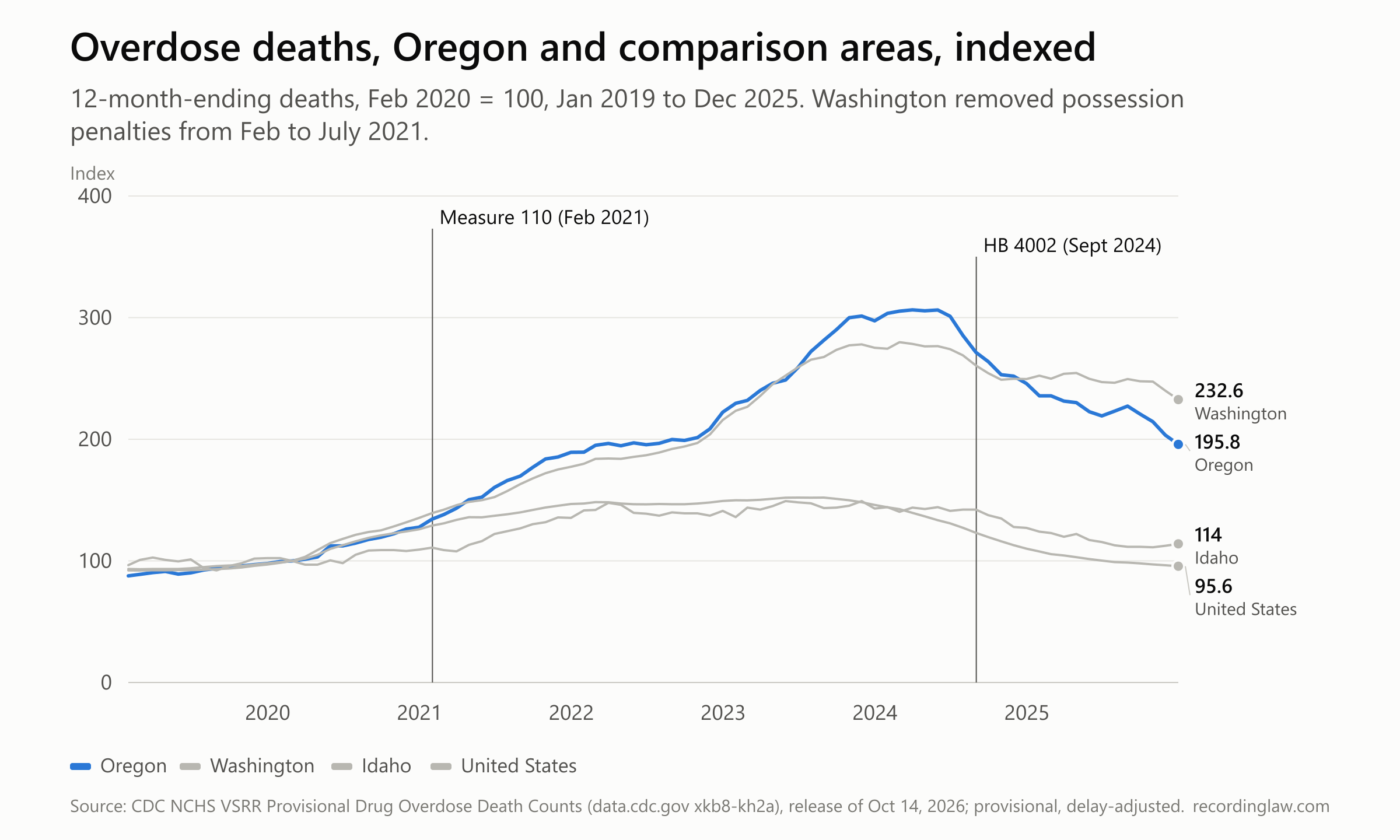
12-month-ending overdose deaths indexed to February 2020 = 100, Oregon, Washington, Idaho and the United States. Source: CDC NCHS VSRR provisional counts (October 14, 2026 release), delay-adjusted.
| Area | Feb 2020 | Own peak (12 months ending) | Dec 2025 | Change, own peak to Dec 2025 |
|---|---|---|---|---|
| Oregon | 624 | 1,912 (Mar 2024) | 1,222 | -36% |
| Washington | 1,276 | 3,570 (Feb 2024) | 2,968 | -17% |
| Idaho | 258 | 385 (May and Nov 2023) | 294 | -24% |
| California | 6,731 | 12,943 (Aug 2023) | 9,109 | -30% |
| United States | 73,952 | 112,418 (Aug 2023) | 70,735 | -37% |
Oregon and Washington rose almost in step. Washington is not a clean comparison: Washington's State v. Blake decision in February 2021 also removed criminal penalties for simple possession, until a misdemeanor law took effect that July, and fentanyl reached it only months before Oregon. The national count, where fentanyl had arrived years earlier, rose by about half.
The turn came first nationally. The US 12-month count leveled off and peaked in mid-2023, seven to nine months before Oregon's peak in the year ending March 2024. Oregon's count then started down while Measure 110 was still the law: by the 12 months ending August 2024, the last full month before recriminalization, it was about 11% below the peak.
The Drug Policy Alliance makes that point in its defense of the measure: "Overdose deaths in Oregon began to fall during the last several months when Measure 110 was still in effect." Because each figure sums a full year of deaths, it reacts slowly to changes in single months.
The decline continued after September 2024. By December 2025, Oregon's count was 36% below its March 2024 peak. Over the same 21 months, the national count fell 32% and Washington's 17%. From August 2024, the last full month before recriminalization, Oregon's count fell 28%, against 22% nationally and 11% in Washington.
The national decline had started earlier, and the drug supply was changing over the same months. Oregon's newest figures also carry the largest adjustment for deaths still under investigation of any area compared here. The statewide count cannot show whether people arrested under the new law faced the higher overdose risk the Health Justice Recovery Alliance had warned of.
Oregon is still far from where it started. Its December 2025 count was about twice its February 2020 level. The national count was slightly below its 2020 level.
The Oregon Health Authority, which runs the Measure 110 grants, credited "a combination of factors, including strengthened substance use treatment infrastructure, naloxone distribution and education, prevention programs, and changes in the illicit drug supply with less fentanyl overall." The Lund Report, in an April 2026 story republished by OPB, wrote that Todd Korthuis, head of the addiction medicine section at Oregon Health & Science University, "and other health experts agree that the biggest contributor to the decline in deaths is the disruption in the illicit fentanyl trade, starting with a crackdown on manufacturers in China."
Enforcement did change after September 2024. From then to August 20, 2025, police made 9,893 drug-possession arrests, most of them also involving other crimes; in 2,595, possession was the only charge, OPB reported. Of 1,727 people who qualified for deflection through August 4, 2025, the pre-arrest route into treatment that Kotek's letter described, 1,308 entered a program, and roughly 48% did not complete it. State officials said it was too early to draw definitive conclusions about whether the county programs were helping connect drug users with treatment, OPB reported.
The raw lines cannot separate the law from the drug supply. That is the job researchers took on, and they did not agree.
Four studies, two answers
All four main studies of Measure 110 use the same basic tool, a synthetic control: they build a stand-in Oregon out of other states and compare it with the real one. Where they differ is in how they handle fentanyl.
The first, by Joshi and colleagues in JAMA Psychiatry in September 2023, covered the first year, through March 2022. It "found no evidence of an association" between the law change and fatal overdose rates in that year. The CDC funded it, and two CDC researchers were co-authors. So was Haven Wheelock of Outside In in Portland, who had been a chief petitioner of Measure 110; the paper reports no conflicts of interest.
A study by Noah Spencer of the University of Toronto, using data through 2021, reached the opposite result. Its 2022 working-paper version concluded that "when Oregon decriminalized small amounts of drugs in February 2021, it caused 181 additional drug overdose deaths during the remainder of 2021," about a 23% increase. The peer-reviewed version, published in the Journal of Health Economics in 2023, puts the figure at 182 additional unintentional overdose deaths in 2021, also a 23% increase.
The Zoorob study added fentanyl's arrival, measured by the crime-lab share, as a confounder over 2008 to 2022. Without it, the authors found a positive association between decriminalization and overdose deaths. "After adjusting for the spread of fentanyl as a confounder, the effect size changed signs," they wrote, "and there was no longer an association between decriminalization and overdose mortality in Oregon." It was funded by the National Institute on Drug Abuse, the National Institute of General Medical Sciences and Arnold Ventures.
A National Bureau of Economic Research working paper by David Hall, Benjamin Hansen and Kyutaro Matsuzawa, issued in July 2026, disputes that adjustment. It estimates "approximately 1,186 excess deaths in Oregon and 1,895 in Washington from 2021 through 2023."
"A fentanyl-share control may partly capture enforcement-driven declines in non-fentanyl NFLIS reports," the authors wrote. Their point is about what reaches the crime labs. If decriminalization meant fewer arrests, fewer seized drugs other than fentanyl would be sent for testing. Fentanyl's share of lab reports could then rise partly for that reason, and a study that adjusts for that share could subtract part of the law's own effect.
Using other measures of fentanyl, the authors still found more deaths. Arnold Ventures funded it too, so one foundation supported work on both sides of the disagreement. It has not been peer reviewed.
The state's auditors did not pick a side. Asked whether the program's investments had changed overdose rates, the Secretary of State's December 2025 audit answered: "Cannot determine with available data." The Oregon Health Authority "has failed to collect data to timely and reliably measure the impact of state investments," it found.
Portland State's three-year study, as described by OPB, concluded "that decriminalization had little to do with rising crime and overdose deaths," pointing to the pandemic and fentanyl. None of these studies covers the period after September 2024.
What would settle it, and when
We found no peer-reviewed study of how Oregon's 2024 recriminalization affected deaths. The Zoorob team, in what it called an ancillary analysis, found that Washington's July 2021 misdemeanor law "was not associated with reductions in overdose death in that state." For Oregon, the evidence that exists is the monthly CDC count, and its newest Oregon months are the least complete. Provisional figures through the 12 months ending May 2026 continue downward, but a larger share of Oregon's recent deaths is still pending investigation than in Washington or the national count.
Four dated pieces are next. CDC updates its provisional counts monthly, with the next release expected in November 2026. The Oregon Health Authority's figure of about 1,100 deaths in 2025 is preliminary and "likely to increase slightly."
The Criminal Justice Commission said in a January 2026 presentation to the Legislature that it would publish a data evaluation of the county deflection programs in November 2026. Those programs then move from a pilot phase (2025 to 2027) to a "perform" phase (2027 to 2029), with grants weighted competitively under HB 3069 starting with the 2027-29 grant cycle.
The measure's authors set their baseline at one or two deaths a day. At the end of 2025 the count stood at a little over three a day, down from five at the peak, under a law that is no longer the one voters passed.
How we measured
Overdose deaths. CDC National Center for Health Statistics, Vital Statistics Rapid Release (VSRR) provisional drug overdose death counts (data.cdc.gov dataset xkb8-kh2a), October 14, 2026 release, 12 months ending January 2015 to May 2026. Each figure is the number of deaths in the 12 months ending in the named month, so it smooths the data and lags single-month changes. Charts, tables and prose use CDC's "predicted" (delay-adjusted) values except where noted. Reported values are used for the raw synthetic-opioid counts (83 in 2019, 1,338 in 2023) and for the counts of deaths without synthetic opioids. Counts are not rates; no population series was used, so the comparison chart indexes each place to its own February 2020 count and shows relative change only.
Recent months. Provisional counts are revised monthly. For the 12 months ending May 2026, Oregon's reported count was 629 and the predicted count 848, with 2.36% of deaths pending investigation (Washington 0.15%, United States 0.24%). For that reason the charts and the main comparisons stop at December 2025 (reported 1,109, predicted 1,222).
That is still the largest adjustment of any area compared here, about 10%, against under 1% for Washington, Idaho, California and the United States, so comparisons ending in December 2025 rest on Oregon's softest figure. On reported values Oregon's December 2025 count is about 1.8 times its February 2020 level, against about twice on predicted values. The Oregon Health Authority's own counts (1,833 in 2023, 1,544 in 2024, about 1,100 preliminary in 2025) come from a different source and vintage and are not mixed with CDC figures.
Per-day figures divide the 12-month count by the days in the window: 624 / 366 = 1.7 (12 months ending February 2020); 1,912 / 366 = 5.2 (ending March 2024); 1,222 / 365 = 3.3 (ending December 2025). Percentage changes in the table run from each area's own peak to December 2025 on predicted values.
The matched-window comparisons in the text use the same months for every area: March 2024 to December 2025, Oregon 1,912 to 1,222 (-36%), United States 103,192 to 70,735 (-32%), Washington 3,553 to 2,968 (-17%); August 2024 to December 2025, Oregon 1,694 to 1,222 (-28%), United States 91,043 to 70,735 (-22%), Washington 3,325 to 2,968 (-11%). On reported values, Oregon fell 42% from March 2024 (1,907 to 1,109) against 31% nationally.
"About 11% below the peak" is 1,694 (August 2024) against 1,912 (March 2024). "Doubled" between the two laws is 1,912 (March 2024) against 861 (12 months ending February 2021), about 2.2 times. The campaign spending ratio is $6,029,290.67 raised by Yes committees against $167,740 by the No committee (Ballotpedia, reports through December 30, 2020), about 36 to 1. "About four in five" Class E cases is 7,925 of 10,028 (79%).
Fentanyl. The synthetic-opioid share is CDC's "synthetic opioids, excluding methadone (T40.4)" count divided by all overdose deaths. A death involving fentanyl and another drug counts in both. Deaths without synthetic opioids are all deaths minus T40.4 deaths, using reported calendar-year values: 527 (2019), 558 (2020), 649 (2021), 528 (2022), 513 (2023), 531 (2024); 2025 is still provisional. Idaho's early synthetic-opioid values are suppressed, so Idaho is not in that chart. Fentanyl arrival dates are from Zoorob et al.'s changepoint analysis of NFLIS crime-lab reports.
Court cases. Oregon Judicial Department, Measure 110 Class E violation statistics, offenses February 1, 2021 to August 31, 2024, as of September 6, 2024. The outcome groups sum to 10,027 against a stated total of 10,028. "Convicted, other" is 8,842 convictions minus 7,925 failures to appear. No later edition was found, and the court sheet does not cover cases after recriminalization.
Laws. Measure 110 effective February 1, 2021 (Oregon Judicial Department). SB 755-C effective July 19, 2021. HB 4002 passed the House February 29 and the Senate March 1, 2024, was signed April 1, 2024, and applies to conduct on or after September 1, 2024 (enrolled bill, sections 73 and 74). We do not list HB 4002's penalty tiers here.
What the data cannot show. There is no untreated comparison state with Oregon's fentanyl timing. Washington removed possession penalties through the Blake decision in the same month, until a misdemeanor law took effect in July 2021, and the national decline from 2023 overlaps both Oregon laws. Pandemic disruption, naloxone distribution, treatment spending and changes in the drug supply all moved over the same years. The charts show what deaths did before and after each law; they do not measure what either law caused. Post-2024 arrest and deflection figures come from OPB's reporting on state data, not from a dataset we opened.
Frequently Asked Questions
What did Oregon Measure 110 do?
Approved by voters in November 2020, it took effect on February 1, 2021. It reduced most drug possession offenses from a crime to a Class E violation punishable by a fine of at most $100, and directed cannabis tax revenue to treatment and recovery services.
Is drug possession illegal in Oregon again?
Yes. HB 4002, signed by Gov. Tina Kotek on April 1, 2024, made possession of controlled substances a criminal offense again for conduct on or after September 1, 2024. The law also created deflection and conditional-discharge pathways to avoid incarceration.
Did overdose deaths rise in Oregon after Measure 110?
Yes. CDC provisional data show 624 deaths in the 12 months ending February 2020 and 1,912 in the 12 months ending March 2024. Over the same period fentanyl reached Oregon, in the first half of 2021 by one study's measure, and nearly all of the increase was in deaths involving synthetic opioids.
Did Measure 110 cause more overdose deaths?
Studies disagree. A 2023 JAMA Psychiatry study found no association in the first year, and a 2024 JAMA Network Open study found none after adjusting for fentanyl's spread. A University of Toronto study, published in the Journal of Health Economics in 2023, estimated about 182 extra deaths in 2021, and a 2026 NBER working paper estimated about 1,186 excess Oregon deaths from 2021 through 2023. Oregon's Secretary of State said in December 2025 that the effect could not be determined with available data.
Have overdose deaths in Oregon gone down since recriminalization?
Yes, but the decline began earlier. Oregon's 12-month count peaked in the year ending March 2024 and was about 11% lower by August 2024, before HB 4002 took effect. By December 2025 it was 1,222, 36% below the peak. Over the same 21 months the national count fell 32%. From August 2024 to December 2025, Oregon's count fell 28% and the national count 22%. Oregon's newest figures carry the largest adjustment for deaths still under investigation.
How many Measure 110 tickets went to court, and what happened to them?
Oregon courts recorded 10,028 Class E possession cases for offenses from February 2021 through August 2024. Of those, 8,842 ended in convictions, 7,925 of them for failure to appear; 704 were dismissed, 85 of them with a substance use assessment verification filed; and 481 were pending as of September 6, 2024.
Where did the Measure 110 money go?
Oregon awarded about $800 million in Measure 110 grants from 2021 through 2025, $391 million in 2025, to Behavioral Health Resource Networks, funded by cannabis tax revenue. The Secretary of State's December 2025 audit found that incomplete data made it impossible to measure the effect on access to care or on overdose deaths.
Are fentanyl test strips legal in Oregon?
The 2023 Legislature passed HB 2395, which removed items designed to reduce the harms of drug use, including test strips, from Oregon's definition of drug paraphernalia.
Updates
Independently fact-checked against the cited primary sources
Sources and References
- CDC NCHS, VSRR Provisional Drug Overdose Death Counts (dataset xkb8-kh2a), October 14, 2026 release(data.cdc.gov).gov
- CDC NCHS, Provisional Drug Overdose Death Counts (release notes)(cdc.gov).gov
- Oregon Judicial Department, Measure 110 Class E Violation Statistics (as of September 6, 2024)(courts.oregon.gov).gov
- Oregon Legislature, HB 4002 (2024), enrolled bill(olis.oregonlegislature.gov).gov
- Oregon Legislature, HB 2395 (2023) measure overview(olis.oregonlegislature.gov).gov
- Oregon Secretary of State, Audit Report 2025-29 on the Measure 110 program (December 2025)(sos.oregon.gov).gov
- Oregon Voters' Pamphlet, November 3, 2020 General Election: Measure 110 text, arguments and Criminal Justice Commission impact statement(multco.us).gov
- Oregon Health Authority, overdose deaths declined in 2024 and 2025 (May 13, 2026)(oregon.gov).gov
- Oregon Health Authority, Oregon overdose deaths are down, CDC data shows(oregon.gov).gov
- Oregon Criminal Justice Commission, deflection program presentation to the Legislature (January 2026)(olis.oregonlegislature.gov).gov
- Zoorob et al., Drug Decriminalization, Fentanyl, and Fatal Overdoses in Oregon, JAMA Network Open (2024)(pmc.ncbi.nlm.nih.gov).gov
- Joshi et al., One-Year Association of Drug Possession Law Change With Fatal Drug Overdose in Oregon and Washington, JAMA Psychiatry (2023), legislative copy(olis.oregonlegislature.gov).gov
- Spencer, Does Decriminalization Cause More Drug Overdose Deaths? University of Toronto Working Paper 745 (2022)(economics.utoronto.ca)
- Hall, Hansen and Matsuzawa, Did Drug Decriminalization Increase Overdoses, NBER Working Paper 35427 (2026)(nber.org)
- Ballotpedia, Oregon Measure 110 (2020): results and campaign finance(ballotpedia.org)
- Associated Press, Oregon 1st state to decriminalize possession of hard drugs (February 1, 2021)(lasvegassun.com)
- KATU, support and opposition build for Oregon drug decriminalization measure (2020)(katu.com)
- NPR, Oregon pioneered a radical drug policy. Now it's reconsidering (February 7, 2024)(npr.org)
- Oregon Business, To the Test (2023)(oregonbusiness.com)
- Data for Progress, Oregon voters want Measure 110 to remain in place (September 12, 2022)(dataforprogress.org)
- KOIN, Emerson College poll on Measure 110 repeal (August 2023)(digital-release.koin.com)
- KPTV, fentanyl misdemeanor law and polling (September 1, 2023)(kptv.com)
- Oregon Capital Chronicle via Washington State Standard, business leaders back Measure 110 rollback effort (September 20, 2023)(washingtonstatestandard.com)
- KPTV, 90-day fentanyl emergency in Portland (January 30, 2024)(kptv.com)
- Oregon Capital Chronicle, House passes HB 4002 (February 29, 2024)(oregoncapitalchronicle.com)
- KLCC/OPB, Senate passes HB 4002 (March 1, 2024)(klcc.org)
- Oregon Capital Chronicle via Washington State Standard, Legislature sends HB 4002 to the governor (March 1, 2024)(washingtonstatestandard.com)
- ACLU of Oregon, coalition statements on Senate passage of HB 4002 (March 1, 2024)(aclu-or.org)
- OPB Think Out Loud, Oregon Senate votes to end drug decriminalization (March 4, 2024)(opb.org)
- OPB via Jefferson Public Radio, governor will sign HB 4002; Criminal Justice Commission projections (March 8, 2024)(ijpr.org)
- KATU via KTXS, Oregon governor signs HB 4002 (April 1, 2024)(ktxs.com)
- CNN, Oregon governor signs drug re-criminalization bill (April 1, 2024)(amp.cnn.com)
- OPB via Jefferson Public Radio, one year of recriminalization (September 4, 2025)(ijpr.org)
- OPB, Portland State University study of Measure 110 (August 14, 2025)(opb.org)
- The Lund Report via OPB, Oregon opioid overdoses decline (April 4, 2026)(opb.org)
- Drug Policy Alliance, statement on Oregon overdose trends (advocacy)(drugpolicy.org)
- Spencer, Does drug decriminalization increase unintentional drug overdose deaths? Early evidence from Oregon Measure 110, Journal of Health Economics 91 (2023) 102798 (PubMed record)(pubmed.ncbi.nlm.nih.gov).gov
- Multnomah County, About Multnomah County (cities in the county)(multco.us).gov
- U.S. Census Bureau, County Adjacency File (2024)(census.gov).gov