Colorado Marijuana Sales Fell 41% From 2021 to 2025
Independently fact-checked against primary sources (last audited October 26, 2026). · 6 primary sources cited on this page. How we verify our legal content
Colorado's licensed marijuana stores reported $1,315.7 million in sales in 2025, down from $2,229.0 million in 2021, a nominal drop of 41 percent. State marijuana tax and fee revenue went from $423.5 million to $236.4 million over the same years, a drop of 44 percent. Both figures come from the Colorado Department of Revenue (CDOR).
Annual sales had risen in every year from 2014, the first year of retail sales, through 2021. They have fallen in every full year since. Figures for the first seven months of 2026 are lower again than the same months of 2025.
This article reports what the state's own sales, tax and wholesale price data show, year by year, and what those numbers cannot explain. All dollar figures are nominal (not adjusted for inflation).
The law and the tax structure
Colorado voters passed Amendment 64 in 2012, according to the state Legislative Council staff. CDOR's sales reports begin in January 2014, the month retail sales started.
In 2013 voters approved Proposition AA, which, in the Legislative Council's words, "allows the state to levy up to a 15 percent excise tax on unprocessed retail marijuana as well as up to a 15 percent retail sales tax on retail marijuana." Medical marijuana is not subject to those two 15 percent taxes.
CDOR describes the current state taxes as:
- the 2.9 percent state sales tax on marijuana sold in stores,
- the 15 percent state retail marijuana sales tax on retail marijuana sold in stores, and
- the 15 percent state retail marijuana excise tax on wholesale sales and transfers of retail marijuana.
The retail marijuana sales tax was 10 percent before Senate Bill 17-267 raised it to 15 percent, effective July 1, 2017, and exempted retail marijuana from the 2.9 percent state sales tax.
The 2.9 percent state sales tax now applies to medical marijuana and to accessories, not to retail marijuana itself, according to CDOR and the Legislative Council staff.
Sales: a peak in 2021, then four years of decline
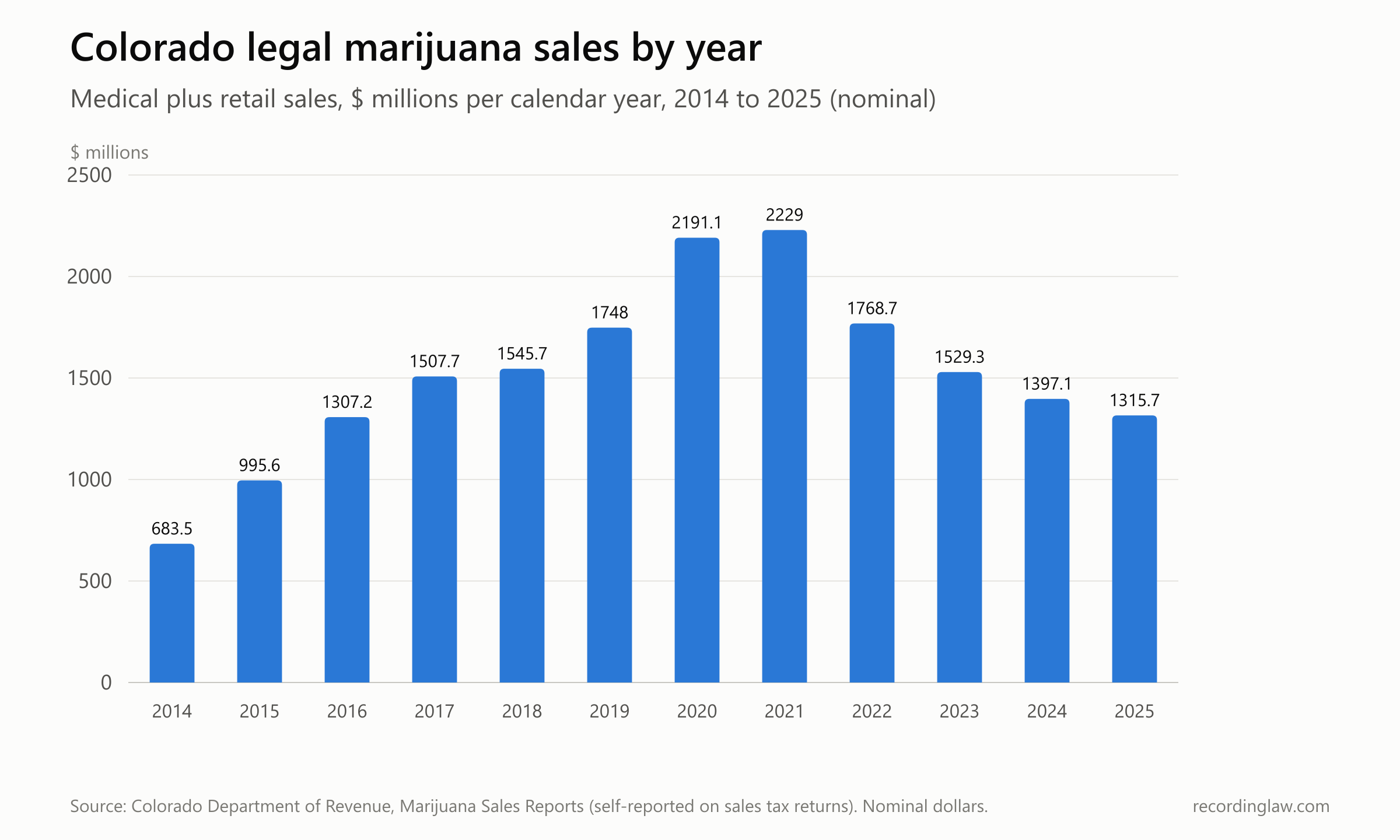
Colorado medical plus retail marijuana sales by calendar year, $ millions, nominal. Source: Colorado Department of Revenue, Marijuana Sales Reports.
| Year | Total sales ($ millions) | Change from prior year |
|---|---|---|
| 2014 | 683.5 | first year |
| 2019 | 1,748.0 | +13.1% |
| 2020 | 2,191.1 | +25.3% |
| 2021 | 2,229.0 | +1.7% |
| 2022 | 1,768.7 | -20.7% |
| 2023 | 1,529.3 | -13.5% |
| 2024 | 1,397.1 | -8.6% |
| 2025 | 1,315.7 | -5.8% |
Sales more than tripled from 2014 to 2021. The largest one-year gain after 2016 came in 2020, when sales rose 25.3 percent during the COVID-19 pandemic. This data set does not separate any pandemic effect from other factors.
The 2022 decline was the largest of the four. Each year after that fell by a smaller percentage than the year before. The 2025 total was below the 2017 total of $1,507.7 million.
From January 2014 through July 2026, CDOR reports cumulative sales of $18.96 billion.
Medical and retail moved differently
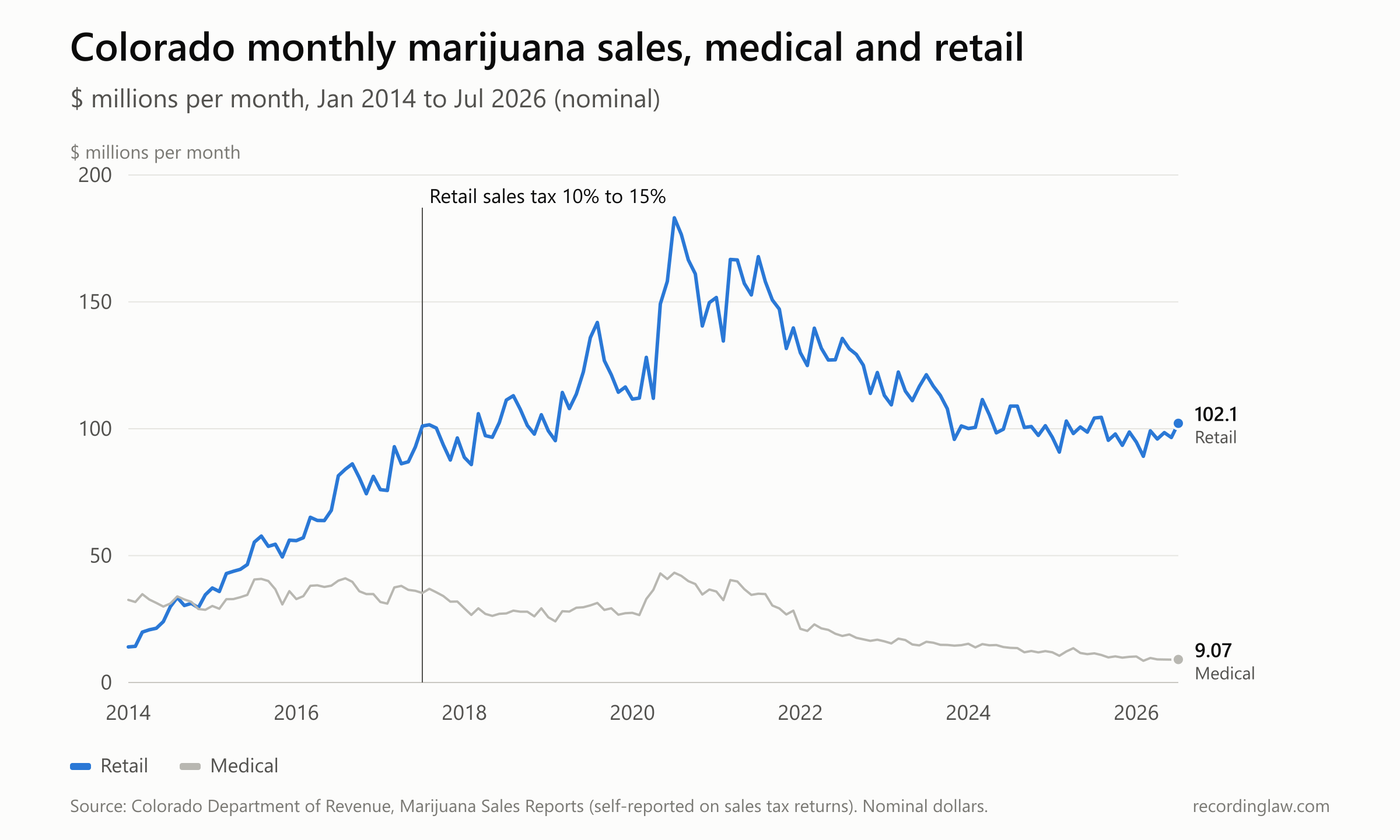
Colorado monthly retail and medical marijuana sales, $ millions, nominal, January 2014 to July 2026. Source: Colorado Department of Revenue, Marijuana Sales Reports.
| Segment | 2014 ($ millions) | 2021 ($ millions) | 2025 ($ millions) | Change 2021 to 2025 |
|---|---|---|---|---|
| Retail | 303.2 | 1,824.6 | 1,182.2 | -35.2% |
| Medical | 380.3 | 404.4 | 133.4 | -67.0% |
| Total | 683.5 | 2,229.0 | 1,315.7 | -41.0% |
Medical stores outsold retail stores in 2014. By 2021 the medical share of sales was 18.1 percent, and by 2025 it was 10.1 percent. (CDOR's medical figures include accessories; its retail figures do not.)
In dollars, most of the 2021 to 2025 decline was in retail: $642.3 million, against $271.0 million in medical. In percentage terms, medical fell further.
The highest single month in the series was July 2020, at $226.4 million in combined sales. July 2026 combined sales were $111.2 million. Monthly retail sales have stayed between $89.2 million and $111.5 million from January 2024 through July 2026, while monthly medical sales went from $15.3 million in January 2024 to $9.1 million in July 2026.
For January to July, retail sales were $692.2 million in 2025 and $676.2 million in 2026. Medical sales were $82.5 million and $64.7 million.
CDOR also counts distinct retailers, but only from January 2025. The number of retail marijuana retailers was 469 in January 2025, reached 498 in March 2026 and was 487 in July 2026. Medical marijuana retailers went from 205 to 181 over January 2025 to July 2026. One retailer can operate more than one store.
Tax and fee revenue
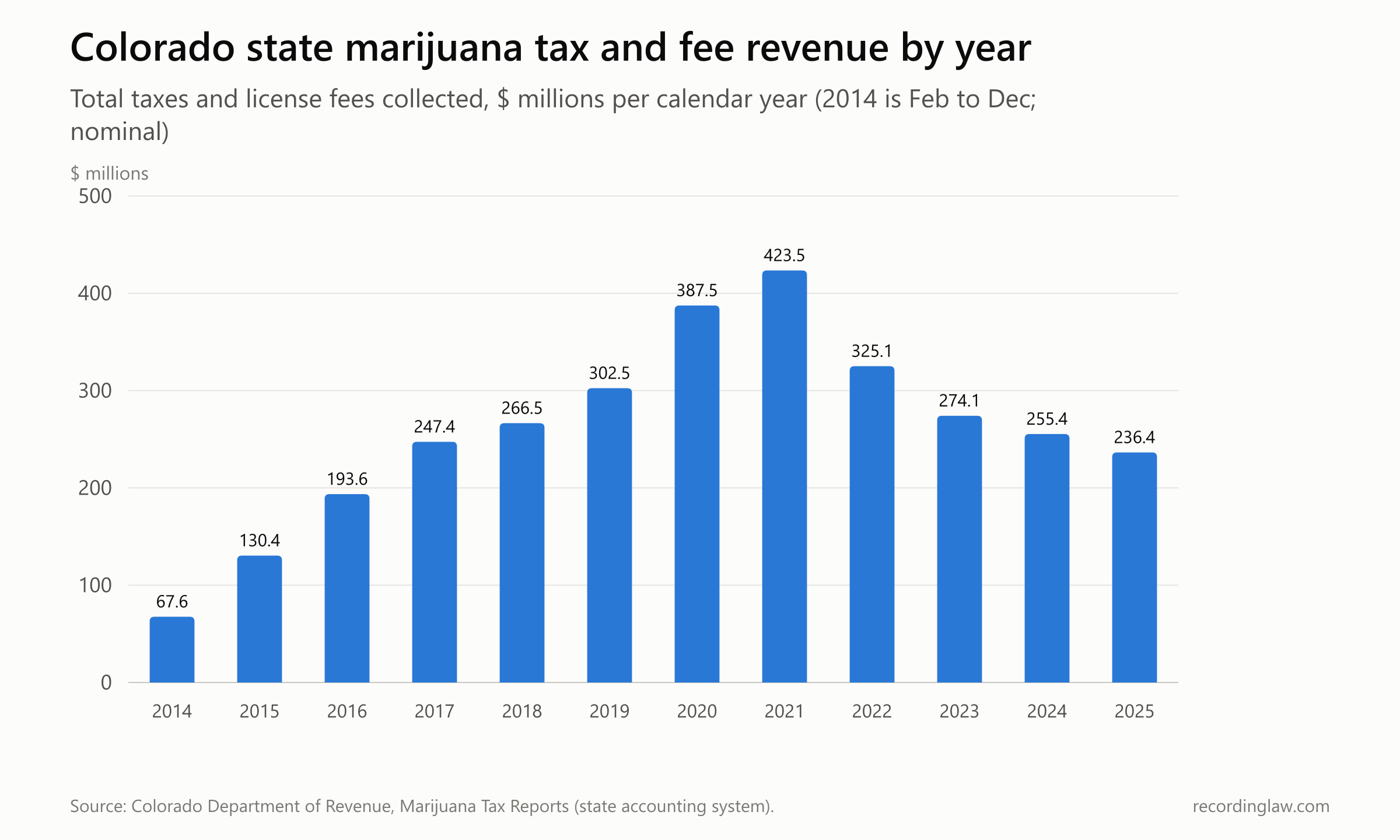
Colorado state marijuana tax and license fee revenue by calendar year of collection, $ millions, nominal (2014 covers February to December). Source: Colorado Department of Revenue, Marijuana Tax Reports.
| Year | Total taxes and fees | Retail marijuana sales tax | Retail excise tax |
|---|---|---|---|
| 2014 (Feb to Dec) | 67.6 | 26.9 | 11.4 |
| 2017 | 247.4 | 131.5 | 72.0 |
| 2021 | 423.5 | 277.6 | 118.5 |
| 2022 | 325.1 | 234.1 | 71.0 |
| 2023 | 274.1 | 204.5 | 52.2 |
| 2024 | 255.4 | 192.0 | 45.4 |
| 2025 | 236.4 | 179.4 | 41.5 |
All figures in $ millions, by month of collection.
Total state marijuana tax and fee revenue fell 44.2 percent from 2021 to 2025. The two largest components fell at different rates: the 15 percent retail marijuana sales tax by 35.4 percent, and the 15 percent excise tax by 65.0 percent.
The total includes license and application fees, which CDOR's figures put at about $11 million to $14 million a year. From February 2014 through August 2026, CDOR reports $3.26 billion in cumulative marijuana taxes and fees. Collections for January to August 2026 were $152.2 million.
The wholesale price benchmark
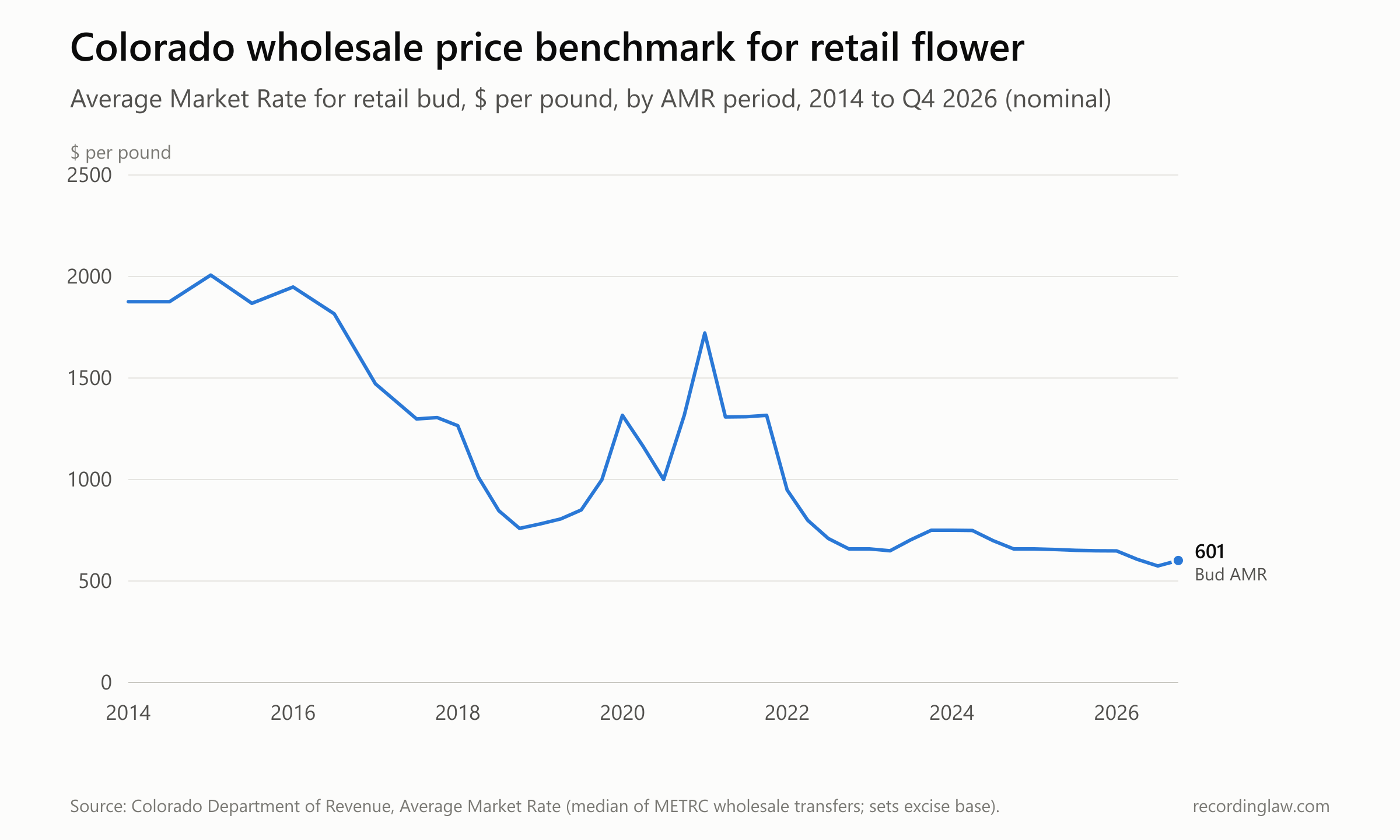
Colorado Average Market Rate for retail bud, $ per pound, nominal, by rate period, 2014 to fourth quarter 2026. Source: Colorado Department of Revenue, from METRC transfer data.
The Average Market Rate (AMR) is not a retail shelf price. CDOR calculates it as the median price per pound of unprocessed retail marijuana transferred from retail cultivators to unaffiliated stores and product manufacturers, using the state's METRC tracking data. It is used to calculate the 15 percent excise tax, generally where a cultivator transfers marijuana to an affiliated store or manufacturer.
| Rate period starting | Retail bud AMR ($ per pound) |
|---|---|
| January 2014 | 1,876 |
| January 2015 | 2,007 |
| October 2018 | 759 |
| January 2021 | 1,721 |
| January 2022 | 948 |
| October 2025 | 649 |
| July 2026 | 574 |
| October 2026 | 601 |
The bud rate reached $2,007 a pound for the period starting January 2015. It fell to $759 by late 2018, rose to $1,721 for the first quarter of 2021 and then fell to $649 by the fourth quarter of 2025, a 62.3 percent decline from the 2021 level. Each rate is set using transfers from earlier months, so a rate period trails the market it measures.
For transfers taxed on the AMR, a lower rate means less excise tax per pound at the same 15 percent rate. The data retrieved for this article include no wholesale volume series, so they cannot show how much of the excise decline came from price and how much from quantity.
What the data do not show
The figures above describe licensed sales in dollars. They do not measure how much marijuana was sold by weight, how much was consumed, or how much was bought outside the licensed market or in other states.
Because there is no volume data here, the decline in sales cannot be divided between lower prices and fewer purchases. The AMR is a wholesale median, so it cannot stand in for the price a shopper paid.
Nothing in these data identifies a cause for the decline after 2021. Dated events in the period include the July 2017 tax rate change, the COVID-19 pandemic in 2020 and 2021, and House Bill 21-1317, signed on June 24, 2021, which set daily purchase limits on marijuana concentrates (8 grams, or 2 grams for most medical patients aged 18 to 20) and added requirements for medical patients aged 18 to 20, including diagnoses by two physicians. The data do not measure the effect of any of these.
How we measured
Sales. Annual sales are the sum of 12 monthly totals in CDOR's monthly state sales report, which match the annual table on CDOR's sales report page. Sales are self-reported by retailers on Colorado sales tax returns and are grouped by sales month. CDOR notes that medical sales include accessories and other products that contain no marijuana, while retail sales exclude accessories. The data run from January 2014 to July 2026; 2026 is a partial year and is left out of the annual chart.
Taxes. Tax and fee figures are "Total Taxes and Fees" as posted in the state accounting system, by month of collection rather than month of sale. Collections began in February 2014, so 2014 covers February to December. Because the tax and sales series use different months, we do not compare tax collected to sales in the same year as a ratio.
Price benchmark. The AMR file is CDOR's current and prior rates workbook covering 2014 to date. Rate periods were six months long until mid-2017 and quarterly after that. The 2014 rate was an initial rate with no transfer count. Early rates were calculated from far fewer transfers (515 for the first half of 2015, against more than 40,000 a quarter in 2025 and 2026). Separate categories for bud and trim allocated for extraction began January 1, 2018; this article uses the main bud rate only.
Retailer counts. Distinct retailer counts come from CDOR's 2025-to-date sales workbook. We did not obtain a consistent count of licensed stores for earlier years, so the article makes no comparison with the peak.
What we left out. All figures are in nominal dollars; we did not publish inflation-adjusted figures. We did not group counties or compare Colorado with other states. The Amendment 64 date rests on the Legislative Council staff's statement that voters passed it in 2012; we did not reach the Secretary of State's official result.
Frequently Asked Questions
How much marijuana did Colorado sell in 2025?
Licensed medical and retail stores reported $1,315.7 million in sales in 2025, according to the Colorado Department of Revenue. That was 41 percent below the 2021 total of $2,229.0 million, in nominal dollars.
How much marijuana tax revenue did Colorado collect in 2025?
The Colorado Department of Revenue reports $236.4 million in state marijuana taxes and fees collected in calendar 2025, compared with $423.5 million in 2021. The total includes license and application fees.
When did Colorado marijuana sales peak?
Annual sales peaked in 2021 at $2,229.0 million. The highest single month in the state data was July 2020, at $226.4 million in combined medical and retail sales.
Is the Average Market Rate the price shoppers pay?
No. The Average Market Rate is the median price per pound in wholesale transfers from retail cultivators to unaffiliated stores and product manufacturers, calculated by the Colorado Department of Revenue from METRC tracking data. It is used to calculate the 15 percent excise tax. It is not a retail price.
What taxes apply to marijuana in Colorado?
The Colorado Department of Revenue lists a 2.9 percent state sales tax on marijuana sold in stores, a 15 percent state retail marijuana sales tax on retail marijuana sold in stores, and a 15 percent state retail marijuana excise tax on wholesale sales and transfers of retail marijuana. Medical marijuana is not subject to the two 15 percent taxes. Retail marijuana itself has been exempt from the 2.9 percent tax since July 1, 2017; the 2.9 percent tax applies to medical marijuana and to accessories.
Why did Colorado marijuana sales fall?
The state sales and tax data do not identify a cause. They report dollar sales and tax collections, not the weight sold, consumption or purchases outside the licensed market, so they cannot separate falling prices from falling quantities or measure the effect of any single event, such as House Bill 21-1317, a 2021 law that set daily purchase limits on marijuana concentrates and added requirements for medical patients aged 18 to 20.
Updates
Independently fact-checked against the cited primary sources
Sources and References
- Colorado Department of Revenue, Marijuana Sales Reports (monthly state sales report, January 2014 to July 2026, and 2025-to-date retailer counts)(cdor.colorado.gov).gov
- Colorado Department of Revenue, Marijuana Tax Reports (state marijuana tax and fee revenue by month of collection, February 2014 to August 2026)(cdor.colorado.gov).gov
- Colorado Department of Revenue, Average Market Rate (current and prior rates, 2014 to date)(tax.colorado.gov).gov
- Colorado Legislative Council Staff, Marijuana Taxes (Amendment 64 and Proposition AA)(content.leg.colorado.gov).gov
- Colorado General Assembly, SB17-267 (retail marijuana sales tax rate change effective July 1, 2017)(leg.colorado.gov).gov
- Colorado General Assembly, HB21-1317, Regulating Marijuana Concentrates (signed June 24, 2021)(leg.colorado.gov).gov