Google Said It Could No Longer Answer Geofence Warrants Before the Supreme Court Ruled in 2026

Independently fact-checked against primary sources (last audited November 10, 2026). · 17 primary sources cited on this page. How we verify our legal content
On June 14, 2019, police officers in Virginia went to a magistrate, the judicial officer who decides whether to issue a warrant, with a warrant aimed at a place rather than a person. It would require Google to hand over data about the cell phones located within a 150-meter radius of a credit union in Midlothian, which a man had robbed on May 20.
A warrant like that, aimed at a place, is called a geofence warrant. That year, Google received 8,396 geofence warrants from law enforcement in the United States, by its own count. The next year it received 11,554, about 32 a day. Then it stopped publishing the number.
Seven years after that warrant, on June 29, 2026, the Supreme Court ruled that police conducted a Fourth Amendment search when they acquired the Midlothian location data, so the Constitution's protection against unreasonable searches applied to it. That did not settle the case, the Court explained, because the Fourth Amendment prohibits only searches that are "unreasonable." By then, Google had told the justices it could no longer answer warrants like it.
The Timeline feature in Google Maps helps users remember places they have been. It is powered by a setting called Location History, and that was the data the warrants reached. "As of July 2025, all Location History data that was previously stored on Google’s servers was deleted or migrated to on-device storage, and all newly collected Timeline data is stored on-device," the company wrote in a March 2026 brief. "Consequently, Google can no longer respond to geofence warrants based on Location History data."
From 2018 to 2020, geofence warrants went from about 6% of the US search warrants Google received to about 30%. Two federal appeals courts reached opposite answers about how the Fourth Amendment applies to them, and the Supreme Court case drew briefs from 31 states, the Justice Department, Google, defense lawyers and civil-liberties groups. Prosecutors said the warrants cracked cold cases. Critics said they searched everyone who happened to be nearby.
The flow of location data from Google to police was shut off by Google itself. It happened through a Google Maps product update, announced in December 2023 in a blog post that never mentioned police. So the Court ruled on a tool whose main source had already closed. What happened to the warrants once the data moved, and how much of that can the public record show?
How fast did the warrants spread?
"Google received its first geofence warrant in 2016," Justice Elena Kagan wrote in the 2026 opinion. "Two years later, it received 982; and two years after that, more than 11,000." Google's own file gives the exact counts, summed across federal agencies, the 50 states and the District of Columbia.
How large a share of Google's warrant work was that? Google's transparency report is the tally it publishes every six months of government demands for user data. Its 2021 supplement to that report said geofence warrants were "recently constituting more than 25% of all warrants we receive in the United States." The table below divides Google's geofence count by its total of US search warrants for each year, and for 2020 that share was about 30%.
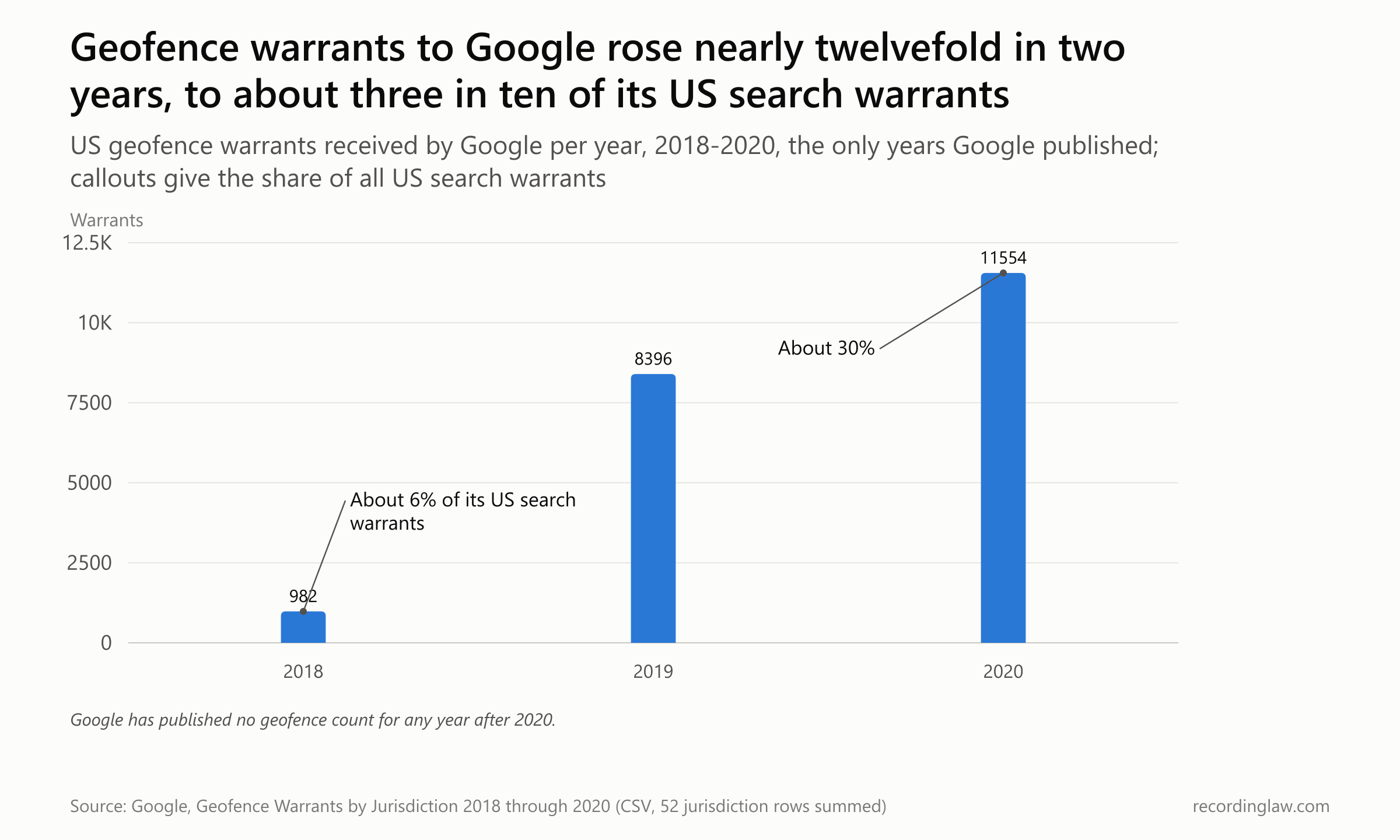
Source: Google, Geofence Warrants by Jurisdiction, 2018 through 2020 (CSV, 52 jurisdiction rows summed), and Google Transparency Report user data requests CSV; share computed by recordinglaw.com.
| Year | Geofence warrants received by Google (US) | All US search warrants | Geofence share |
|---|---|---|---|
| 2018 | 982 | 15,587 | 6.3% |
| 2019 | 8,396 | 29,316 | 28.6% |
| 2020 | 11,554 | 38,132 | 30.3% |
From 2018 to 2020, the count rose nearly twelvefold, from 982 to 11,554. Most of that rise came in 2019, the year of the Midlothian robbery.
The warrants came from across the country, but not evenly. California sent 1,909 in 2020, which was about one in six of the national total. That was more than Texas and Florida sent combined. Federal agencies together sent 521.
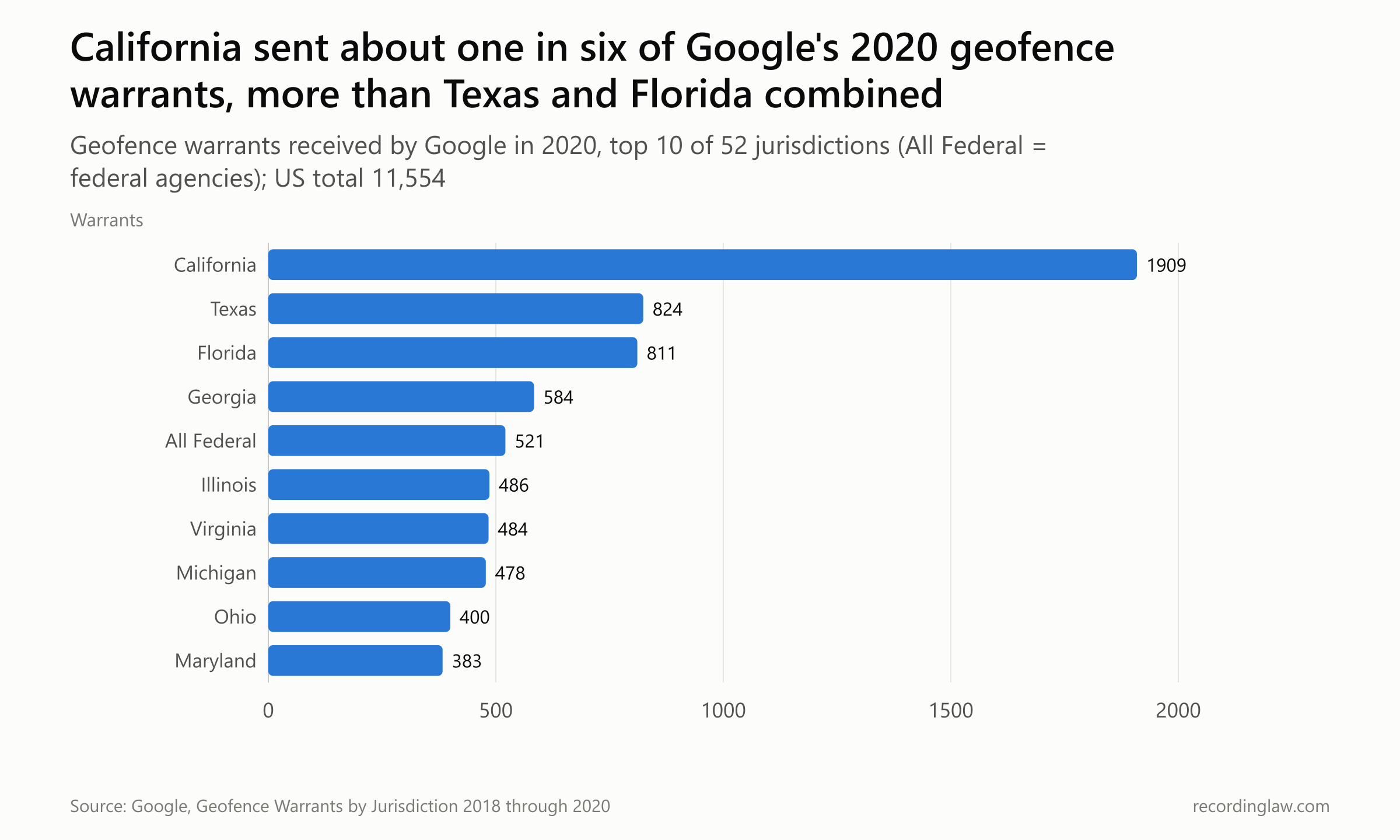
Source: Google, Geofence Warrants by Jurisdiction, 2018 through 2020. All Federal covers federal agencies.
| Jurisdiction | Geofence warrants, 2020 |
|---|---|
| California | 1,909 |
| Texas | 824 |
| Florida | 811 |
| Georgia | 584 |
| All Federal | 521 |
| Illinois | 486 |
| Virginia | 484 |
| Michigan | 478 |
| Ohio | 400 |
| Maryland | 383 |
At street level, the warrants were used for everyday crimes. In January 2020, the TV station KSTP, in a 5 Investigates report, found that several Minnesota agencies obtained more than 40 geofence search warrants in 2019, up from fewer than 20 the year before. The Brooklyn Park Police Department sent at least nine geofence requests to Google in 2019, all for burglaries.
Its deputy chief, Mark Bruley, used the phrase "fishing expedition" himself, the same phrase critics of the warrants use. "I have to acknowledge it would appear this is a fishing expedition for us to look for a suspect and I would acknowledge that’s actually true," he told the station. Bruley also said there are "checks and balances" to ensure police are not treading on people’s rights, KSTP reported. None of the 17 agencies KSTP surveyed reported having policies that specifically addressed geofence warrants.
In Utah, KUTV found in 2022 that the Layton Police Department had used geofence warrants to investigate a stolen wallet, a mall theft, a car break-in and a stolen vehicle. A department spokesperson said in an email, "we are doing the best we can to do right by victims of crimes and operate within the boundaries of the law." Leslie Corbly, a privacy policy analyst with the Utah-based Libertas Institute, told the station, "It is right now more or less the wild west," and added, "I would like to see at least some sort of tally of how often these are being used."
Each of those warrants, whether for a stolen wallet or a credit-union robbery, asked Google the same kind of question.
What does a warrant for a place ask for?
Google's 2021 supplement described the request. Geofence warrants, it wrote, are search warrants "that order Google to identify users, based on their Location History information, who may have been in a given area within a certain timeframe." Location History was a setting users chose to turn on, and Google said in 2023 that "it’s off by default."
Lawyers call this a reverse-location search. An ordinary warrant starts with a suspect and looks for evidence. This one starts with a place and a time and works back to the phones that were there.
In the Midlothian case, the warrant set out a three-step process. At step one, Google would hand over anonymized location data for every phone inside the circle around the time of the robbery. At step two, officers would narrow that list, and Google would give more anonymized data on the phones left on it. At step three, officers would narrow the list again, and Google would turn over identifying information, including names and phone numbers.
The first step returned information on 19 users, the Associated Press reported. In the end, the Supreme Court's syllabus, its official summary of the case, says, "Google ultimately produced three cell-phone users’ identifying information."
The states that later defended the tool described the situation it was built for. "When a crime occurs at a known place and time but the perpetrator is unknown, geofence warrants can be one of the few investigative tools capable of generating leads while remaining subject to judicial supervision from the outset," wrote the attorneys general of Iowa and Michigan, joined by 29 other states and the District of Columbia.
The Fourth Circuit is the federal appeals court handling the Midlothian case. Judge James A. Wynn Jr., one of its judges, was on the other side of the argument and put the same fact as a problem. "Indeed, the very point of a geofence is to generate leads where none exist," he wrote in 2025.
Between 2018 and 2020, police asked Google to run that search more than 20,000 times. The two sides described very different people inside the circle.
What did each side say the circle caught?
Supporters said it found suspects in cases that had stalled. "Prosecutors credit the warrants with helping crack cold cases and other crimes where surveillance cameras did not reveal suspects’ faces or license plates," the AP summarized in April 2026. In December 2023, law professor Orin Kerr wrote on X, as quoted by Police1, that "Geofencing has solved a bunch of really major cases that were otherwise totally cold."
Judge J. Harvie Wilkinson III of the Fourth Circuit warned what would follow if the tool were taken away. "More cold cases would go unsolved," he wrote in 2025. "Taking this tool of last resort out of law enforcement’s hands would leave these case files collecting dust."
The states' brief made the same prediction in legal terms. "A constitutional rule prohibiting geofence warrants would disrupt investigations operating within the warrant framework and force reliance on less precise alternatives," the 31 states and the District of Columbia told the Supreme Court. The Justice Department argued that the defense's position "would rewrite the law of warrants, subpoenas, and third-party agency to render it seemingly impossible for judges to authorize the acquisition of valuable evidence in cases like this."
Opponents said the circle caught everyone else. The Fifth Circuit later recounted what then-Rep. Kelly Armstrong, a North Dakota Republican, said at a House Judiciary hearing in July 2020. Armstrong believed that "people would be terrified to know that law enforcement can grab general warrants and get everybody’s information anywhere," the court wrote, quoting him.
A general warrant is an open-ended order to search without naming who or what is sought. It is the kind the Framers wrote the Fourth Amendment against, and the phrase became the critics' shorthand for geofence warrants.
Google, which received the warrants, gave examples in its own brief. "Many of these overbroad warrants swept in hundreds, sometimes even thousands, of innocent people," the company wrote. In one case, it said, "the warrant sought data from seven search areas spanning 489 acres in Albuquerque, New Mexico. The warrant would have covered over 3,000 users, including over a thousand people attending a funeral service."
Police withdrew that warrant after Google moved to quash it, and Google produced no data, the brief says. Google filed in support of neither party. It had also built the process and handled the requests, so it was describing a process it took part in.
Investigators used one after the events at the Capitol on January 6, 2021. "The first step of the Geofence Warrant procedure produced 5,723 devices," the American Bar Association's criminal justice magazine reported. That count included two control groups of people present well before and after the event, which the magazine said let the FBI reduce the number.
Advocacy groups framed the stakes as constitutional. "A search that ensnares any number of innocent people just because they are nearby when a crime occurs is an unconstitutional fishing expedition that violates the Constitution," said Jennifer Granick, surveillance and cybersecurity counsel at the American Civil Liberties Union. "The Supreme Court should find once and for all that geofence searches are just the kind of impermissible general warrants that the Framers of the Constitution so reviled," said Andrew Crocker, surveillance litigation director at the Electronic Frontier Foundation, a digital-rights advocacy group. Both groups filed briefs on the defendant's side.
Years before those briefs, a court had already ruled on one warrant.
Who first said no?
In March 2022, a federal district court in Virginia ruled on the Midlothian warrant, in the prosecution of the man charged with the credit-union robbery. His case would later reach the Supreme Court as Chatrie v. United States.
The district court found that the warrant "plainly violates the rights enshrined in [the Fourth] Amendment," the Supreme Court later recounted. But the district court still denied the defendant's motion to suppress the information the police obtained from Google, under the good-faith exception, the rule that lets evidence stand when officers reasonably relied on a warrant. Google's brief calls it the first federal court to hold a geofence warrant unconstitutional.
Google began pushing back on the warrants itself. "Since 2022, Google has objected to over 3,000 geofence warrants," it told the Supreme Court. "For over 2,500 such warrants, law enforcement never responded, essentially withdrawing those warrants."
Those figures are Google's own account. Of the rest, the brief says, Google and police agreed in most cases to narrow or withdraw the warrant, and when police refused, Google asked a court to quash it. By that account, most of the warrants Google challenged went no further. Judge Wilkinson described the company's role in 2025: "Google has every incentive to protect the privacy of those who utilize its services."
Then Google changed the product the warrants depended on.
The Maps update, December 2023
On December 12, 2023, Google posted an announcement on its blog under the name of Marlo McGriff of Google Maps. "If you’re among the subset of users who have chosen to turn Location History on (it’s off by default), soon your Timeline will be saved right on your device," it said. The default auto-delete setting for Location History would drop to three months, which means data older than that would be deleted automatically. "Previously this option was set to 18 months," the post said.
The post spoke to users, not police. "Your location information is personal. We’re committed to keeping it safe, private and in your control," it said, and promised: "We’ll automatically encrypt your backed-up data so no one can read it, including Google."
The words warrant, police and law enforcement do not appear in it. "In the announcement, the company didn’t say what prompted the change, which is expected to roll out through 2024," NBC News reported in March 2024.
Others read it as the end of the warrants. Forbes headlined its December 14 story "Google Just Killed Warrants that Give Police Access to Location Data," and Police1, a law-enforcement trade site, relayed the Forbes report that Google would no longer respond to police geofence warrants. The Electronic Frontier Foundation wrote that "we are cautiously optimistic that this will effectively mean the end of geofence warrants."
Andrew Guthrie Ferguson of American University's law school, who studies policing technology, told NBC the change "forecloses the ability to search the entire dataset of digital signals for an unknown suspect." Adam Scott Wandt of John Jay College of Criminal Justice, who has trained investigators on the technique, told NBC, "This is all pretty new still."
The change was not instant. "These changes will gradually roll out through the next year on Android and iOS," Google said in 2023. Its Supreme Court brief puts the finish at July 2025.
A retired civilian police professional, Roland Clee, later wrote in an opinion column for LawOfficer.com: "Police legal advisors understood this was a party that would eventually close. It was an ‘as long as they let you’ policy."
If the warrants stopped working at Google, the next question is whether police stopped sending them.
Did the warrants fall?
The published record cannot answer that directly. After Google's 2021 report covering 2018 to 2020, "it stopped disclosing the number of requests publicly," the AP reported in 2026. Google's transparency pages still point only to that supplement. There is no public count of geofence warrants for any year after 2020.
What Google does publish, every six months, is the total number of US search warrants it receives. Geofence warrants are inside that total, "one subcategory of the total search warrant requests," in Google's words. But so is every other kind of search warrant police serve on the company. Does that total show anything after the December 2023 announcement?
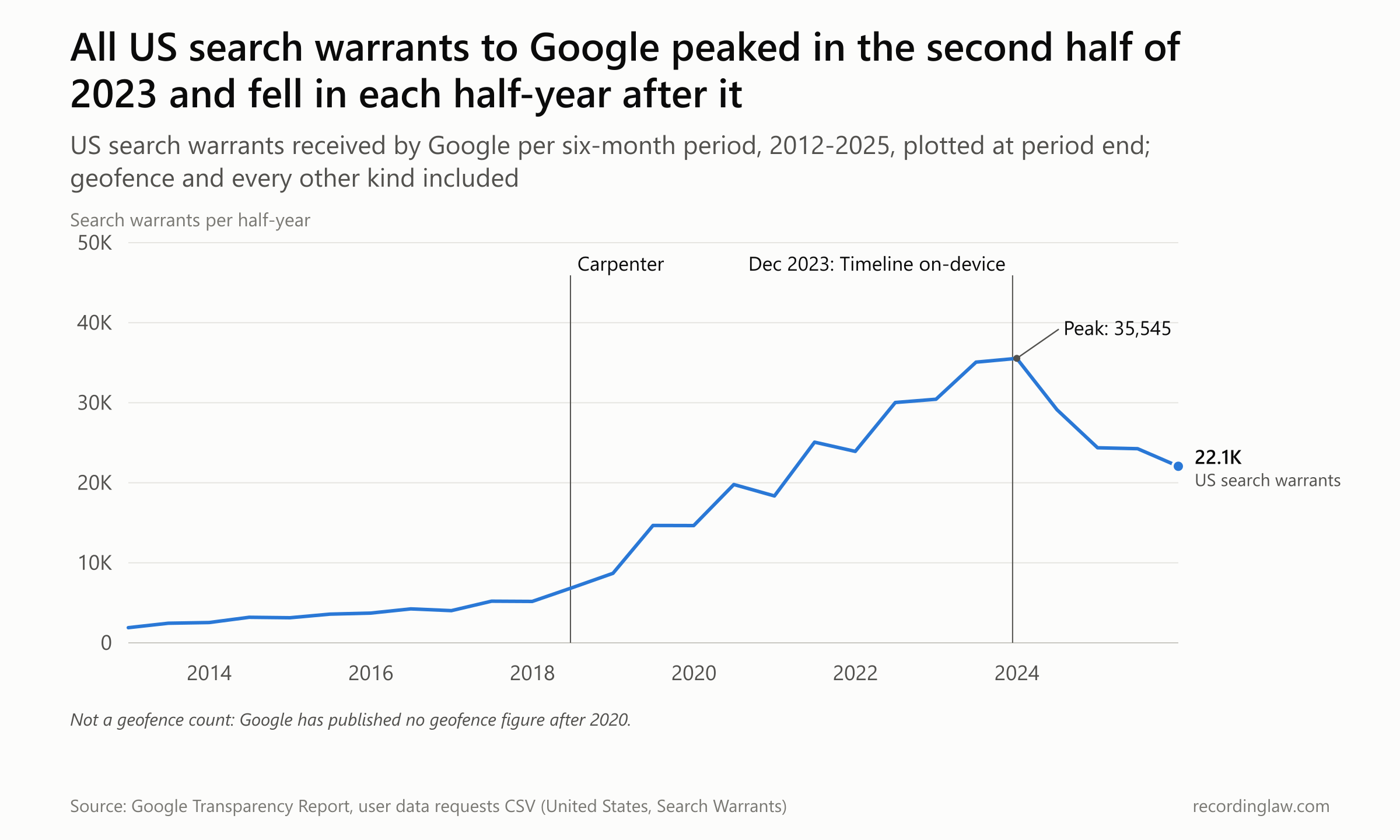
Source: Google Transparency Report, user data requests CSV (United States, Search Warrants). Includes geofence warrants; not a geofence count.
| Six months ending | US search warrants received by Google |
|---|---|
| Dec 2017 | 5,182 |
| Dec 2019 | 14,652 |
| Dec 2021 | 23,924 |
| Jun 2023 | 35,080 |
| Dec 2023 | 35,545 |
| Jun 2024 | 29,129 |
| Dec 2024 | 24,372 |
| Jun 2025 | 24,259 |
| Dec 2025 | 22,060 |
The total peaked in the six months that ended in December 2023 and fell in each of the four half-years after it.
The June 2018 marker on the chart is Carpenter v. United States, in which the Supreme Court held that accessing cell-site location information is a Fourth Amendment search. Cell-site location information is the record a phone generates just by being carried while turned on. The marker shows a date, not a cause of the rise.
By calendar year, the count had risen every year from 2013 through 2023, when it reached about 71,000. It fell to about 54,000 in 2024, the first annual decline in Google's series. In 2025 it fell again, to about 46,000, which is about a third below the 2023 level.
The decline began in the half-year after Google's announcement, while the change was rolling out. That timing is as far as the series goes. It cannot say how much of the fall, if any, was geofence warrants, because Google has not published the geofence share of the total for any year after 2020.
The total also moves with every other kind of search warrant. Between 2018 and 2020, the warrants that were not geofence warrants rose too, from about 14,600 to about 26,600, and nothing in the data separates the two kinds after that. Nor is there a comparison group, such as a second company whose warrant counts cover the same years without a change like Google's.
Whatever the count did, the legal question kept moving through the courts on a timetable of its own.
While Google moved the data, the courts split
A three-judge panel of the Fourth Circuit had held earlier in 2024 that obtaining the location data was not a search at all. On August 9, 2024, the Fifth Circuit, another federal appeals court, broke with the Fourth Circuit. Lawyers call that a circuit split: two federal appeals courts reading the Constitution differently, the kind of conflict the Supreme Court is often asked to settle.
"Accordingly, we hold that geofence warrants are general warrants categorically prohibited by the Fourth Amendment," it wrote in United States v. Smith. In the same opinion it upheld the convictions: "With that said, we agree with the district court that, here, law enforcement acted in good faith in relying on this type of warrant."
The full Fourth Circuit then reheard the Midlothian case en banc, before all 15 of its judges. On April 30, 2025, it affirmed the district court's decision, which means it let that decision, and the evidence, stand. "Fourteen of the 15 judges voted to affirm the district court’s decision, with nine expressly finding that the good-faith exception applied," as the Justice Department later summarized.
On a separate question, whether a Fourth Amendment search had happened at all, the court divided evenly, 7 to 7, the Supreme Court noted. Judge Wilkinson wrote that "Far from a “digital dragnet,” the process used here reflected the reasonable balance between privacy and safety that the Fourth Amendment envisioned."
Three months later, by Google's account, its Location History data was off its servers. On November 10, 2025, the Supreme Court declined to hear the Fifth Circuit case.
When the Midlothian defendant asked the Court to hear his, the government pointed to Google. Any decision "may have limited prospective importance given recent changes to Google’s internal data-storage policy that would make Google unable to respond to such warrants going forward," Solicitor General D. John Sauer wrote in November 2025.
On January 16, 2026, the Court took the case anyway, limited to whether the police violated the Fourth Amendment in obtaining the location data. It declined to take up the good-faith exception, the ground on which the district court had let the evidence stand.
A ruling after Google moved the data
By the time the justices heard the case, a scholar filing on the government's side doubted the tool had often worked. "To be blunt, Location History geofencing may have been mostly a dud," Orin Kerr, the professor who had written in 2023 that geofencing solved major cold cases, told the Court in April 2026.
"My impression is that Location History geofencing rarely worked," he wrote. He noted that "there are surprisingly few prosecutions on the books that appear to involve evidence from geofence warrants." He flagged that this was not in the record and that caution was warranted.
Kerr's brief quoted Richard Salgado, a former Google director of law enforcement and information security, from a private email: "many warrants were abandoned before reaching step 3 and the success stories are rare." Salgado, Kerr wrote, did not see the warrants as "much more than investigative lottery tickets." Neither account is a measurement. No study in the record counted how often geofence warrants solved a case, on either side.
At oral argument on April 27, 2026, Justice Samuel Alito questioned the exercise. "I’m struggling to understand why we are here in this case, other than the fact that at least four of us voted to take it," he said, as CyberScoop reported. "The Supreme Court on Monday seemed inclined to rule that police could use geofence warrants that collect the location history of cellphone users to find people near crime scenes," the AP wrote that day.
Two months later, the Court split the question it had taken in two and answered only the first part. It ruled 6-3 that the acquisition was a search. "Police officers conducted a Fourth Amendment search when they acquired Chatrie's location data from Google because an individual has a reasonable expectation of privacy in his cell-phone location information," the syllabus reads. The majority built that holding on Carpenter, the 2018 cell-site decision marked on the chart above.
Kagan wrote the opinion for Chief Justice John Roberts and Justices Sonia Sotomayor, Brett Kavanaugh and Ketanji Brown Jackson, which made five votes. Justice Neil Gorsuch concurred in the judgment in a separate opinion, which made six. The AP described a vote "that scrambled ideological lines." (Our news report on the Chatrie ruling covers the opinions in more detail.)
The majority addressed Google's change in a footnote. "Except that in July 2025, years after the geofence warrant used in this case, Google made a change: It now stores Location History data on individual users’ devices rather than on its own servers," Kagan wrote. Alito, dissenting, called the decision "an advisory opinion concerning a now-obsolete “geofence” procedure," and wrote that "not one iota of the majority opinion will affect the outcome of this case." Federal courts, Alito wrote, may not issue "advisory opinions" that do not bear on the rights of the parties before them.
Justice Amy Coney Barrett dissented on the core question. "Chatrie had no reasonable expectation of privacy in data about his public movements that he voluntarily disclosed to Google," she wrote. From the other direction, Jackson wrote, "I would have gone further to explain that this search violated the Fourth Amendment."
The Court did not decide whether the Midlothian warrant was reasonable. A magistrate, the Court wrote, may issue a warrant only when "probable cause is properly established and the scope of the authorized search is set out with particularity." It sent that question, whether the warrant met those probable-cause and particularity requirements at each stage of the search, back to the Fourth Circuit, a step called a remand. "The decision does not prohibit geofence warrants altogether," Gray Television's Washington bureau, Gray DC, reported.
Christopher Slobogin of Vanderbilt Law School wrote for Bloomberg Law: "That holding was expected. It’s more surprising that the court didn’t declare the “warrant” in Chatrie unconstitutional."
On decision day, the AP summarized law enforcement's view: "Law enforcement officials, backed by the Trump administration, say the information is critical in helping them solve difficult cases."
"Mass searches of location data have no place in a free society," said Lisa Wayne, executive director of the National Association of Criminal Defense Lawyers, whose Fourth Amendment Center has represented Chatrie since 2019, in a release on the case.
Whether the ruling helps Chatrie is still open. "A ruling for Chatrie, who is serving a prison term of nearly 12 years, might not ultimately help him," the AP had noted at the April argument, because the lower courts had let the evidence stand under the good-faith exception, which the Supreme Court did not review.
Where did investigators go?
The ruling's reach depends on what police use in place of Google's Location History, and that has no count. In December 2023, the EFF had flagged the question: "It remains to be seen whether law enforcement will find a way to access these other stores of location data on a mass basis in the future." By March 2026 it was warning the Court that "Google is not the only company collecting location data, nor the only way for police to access mass amounts of data on people with no connection to a crime."
NBC described investigators "searching for their next source of data in a post-Google world" in March 2024. It also cited a 2022 investigation by the AP and the EFF: "One company bought location information from data brokers and sold it via a subscription to law enforcement agencies, which it had contracts with."
The states' own brief pointed to location techniques beyond Google. It described an Iowa sports-wagering investigation that filtered device data associated with wagering applications at sports facilities, then subpoenaed the identities tied to those devices. The brief said, "Recent experience confirms that States are already employing location-based investigative techniques in precisely this targeted, crime-specific manner."
The courts have started to test the next tools against the 2026 ruling. On August 5, 2026, U.S. District Judge Carlton Reeves in Mississippi ruled that tower dumps, requests for the cell-tower data from around a crime scene, violate the Fourth Amendment, drawing on the Chatrie decision. In that case, investigators had sought cell-tower data near nine crime locations in Jackson. A magistrate judge had twice denied the applications, and Reeves upheld those denials.
"The government cannot have access to an entire haystack because it may contain a needle," he wrote, as reported by WALA in a story carried on WLBT's site.
On October 2, 2026, in State v. Hobbs, a New Jersey appeals court panel found that geofence warrants in a robbery case were not supported by probable cause. "As such, we are constrained to reverse the denial of the suppression motion," the panel wrote in an unpublished opinion, which under the state's court rules binds only the parties.
State legislatures have taken different paths. Utah regulates rather than bans. Under its code, "a law enforcement agency may not obtain reverse-location information for electronic devices within a geofence unless" a warrant and set procedures are met.
New York's S404, the "reverse location and reverse keyword search prohibition act," would ban both geofence warrants and keyword warrants, which work backward from a search term the way a geofence works backward from a place. Its sponsors compared the searches to a building search. "Law enforcement performing blanket reverse data searches is analogous to inspection of every unit in an apartment building under the suspicion that one contains a weapon - a practice the Supreme Court previously ruled is unconstitutional," their 2025 memo said. The bill sits in the Senate Codes Committee.
We found no published national count for any of these routes: tower dumps, keyword searches or purchased data. No public series shows whether one took the place of geofence warrants.
Back to the circle in Midlothian
The Midlothian warrant goes back before the Fourth Circuit first. The Fourth Circuit's court calendar lists the case for argument in Richmond on December 9, 2026. That court will decide whether a 150-meter circle around a credit union, drawn in June 2019, was a reasonable search.
Google answered that warrant in steps, starting with information on 19 users and ending with three users' identifying information. By its own account to the Supreme Court, the Location History data it searched is no longer on its servers, and it can no longer respond to a geofence warrant like the one drawn around the credit union.
How we measured
Geofence counts. Google's "Geofence Warrants by Jurisdiction, 2018 through 2020" CSV, downloaded October 31, 2026, has 52 rows (All Federal, the 50 states and the District of Columbia). We summed each year's column: 982 (2018), 8,396 (2019), 11,554 (2020). Google publishes no geofence count for any other year. Its supplement charts quarterly values without labels, which we did not read off. Google says it received some requests as early as 2016.
Total US search warrants. Google Transparency Report user data requests bundle, file google-global-user-data-requests.csv, rows Country = United States and Legal Process = Search Warrants, retrieved October 31, 2026. Rows begin with the six months ending December 31, 2012, and the latest US period is July to December 2025; we checked the report on October 31, 2026, for a newer US release. Calendar-year totals are the sum of the two half-years, so the annual series starts in 2013: 70,625 in 2023, 53,501 in 2024 and 46,319 in 2025. This total includes geofence warrants and every other kind of search warrant. It is not a geofence count.
Arithmetic in the text. Nearly twelvefold: 11,554 / 982 = 11.8. About 32 a day: 11,554 / 366 days in 2020 = 31.6. Geofence share: geofence count / US search warrants for the same calendar year (982 / 15,587 = 6.3%; 8,396 / 29,316 = 28.6%; 11,554 / 38,132 = 30.3%). California: 1,909 / 11,554 = 16.5%, about one in six; Texas plus Florida = 1,635. Fall from peak half-year: (35,545 - 22,060) / 35,545 = 37.9%. Annual fall: (70,625 - 46,319) / 70,625 = 34.4%, about a third. Non-geofence search warrants: 15,587 - 982 = 14,605 (2018) and 38,132 - 11,554 = 26,578 (2020). More than 20,000 geofence warrants, 2018 to 2020: 982 + 8,396 + 11,554 = 20,932. "About three in ten" is the 2020 share, 30.3%.
What the data cannot show. No public geofence series exists after 2020, so the fall in total search warrants after 2023 cannot be assigned to geofence warrants. Google's change rolled out gradually from December 2023 and, by its account, was complete in July 2025, and there is no control group. The Carpenter marker on the half-year chart is a date reference, not a claimed cause of the rise in warrants.
Google's counts cover only warrants sent to Google, not tower dumps, keyword warrants or data bought from brokers, none of which has a national series we found. No study in the record measures whether geofence warrants changed how many cases were solved. The evidence on both sides about how well they work is the impressions and examples of the people quoted.
Sources read secondhand. The Fifth Circuit, citing a 2022 law review article and the Chatrie district court, later put 2019 in weekly terms: "In 2019, Google was receiving about 180 geofence warrant requests per week from law enforcement around the country, amounting to about 9,000 geofence requests for that year." Google's file says 8,396. Rep. Armstrong's 2020 remark is as quoted by the Fifth Circuit. Kerr's 2023 post is as quoted by Police1, citing Forbes; the Forbes headline is as cited by the Fifth Circuit. The January 6 device count is from the ABA's criminal justice magazine. Salgado's words are from Kerr's brief. The account of Judge Reeves's order is WALA's, as published on WLBT's site. The December 9 argument date is from the Fourth Circuit's December 2026 Richmond session calendar (revised November 5, 2026), and the New Jersey ruling is from the Appellate Division's opinion in State v. Hobbs, No. A-2010-24, posted on njcourts.gov. Google's figures on objections and its examples of overbroad warrants are from its own brief; Google was a party to the process it describes.
What comes next. The Fourth Circuit hears the Chatrie remand in Richmond on December 9, 2026. Two more geofence cases are back in lower courts. On June 30, the day after Chatrie, the Supreme Court granted review in each, vacated the judgment and remanded it for another look in light of the ruling, an order lawyers call a GVR. The two cases are Wells v. Texas, in the Texas Court of Criminal Appeals, and Davis v. United States, in the Eleventh Circuit.
The unpublished New Jersey suppression ruling from October could also draw further review. New York's S404 dies when the legislative session ends on December 31 unless it moves. When WALA's report on Judge Reeves's tower-dump ruling ran on WLBT's site in August, it was unclear whether the government would appeal to the Fifth Circuit.
The next data point will come from Google. Its transparency report covering January to June 2026 had no announced release date when we checked on October 31, 2026, and Google has published no geofence breakdown since 2021. The new figure will show only whether the total kept falling below the 22,060 search warrants of late 2025, the latest count Google has published. It will not say how many of those warrants drew a circle around a place.
Case numbers. Chatrie v. United States is Supreme Court No. 25-112 (argued April 27, 2026; decided June 29, 2026; judgment vacated and remanded; judgment issued July 31, 2026). Wells v. Texas is No. 25-484 and Davis v. United States is No. 25-5189; both were vacated and remanded on June 30, 2026. United States v. Smith (Fifth Circuit No. 23-60321) reached the Supreme Court as No. 24-7237, denied November 10, 2025.
Frequently Asked Questions
What is a geofence warrant?
A geofence warrant, in Google's words, is a search warrant that orders Google to identify users, based on their Location History information, who may have been in a given area within a certain timeframe. Police use it when they know where and when a crime happened but not who did it.
How many geofence warrants did Google receive?
Google reported 982 US geofence warrants in 2018, 8,396 in 2019 and 11,554 in 2020, summed across federal agencies, the 50 states and the District of Columbia. It has not published a geofence count for any later year.
Can police still get geofence warrants from Google?
Google told the Supreme Court in March 2026 that, as of July 2025, all Location History data previously on its servers had been deleted or moved to users' devices. It said that, as a result, it can no longer respond to geofence warrants based on Location History data. Other companies also collect location data, as the Electronic Frontier Foundation and others have pointed out.
What did the Supreme Court decide in Chatrie v. United States?
On June 29, 2026, in No. 25-112, the Court ruled 6-3 that police conducted a Fourth Amendment search when they acquired the defendant's location data from Google, because a person has a reasonable expectation of privacy in cell-phone location information. It vacated the judgment and sent the case back to the Fourth Circuit to decide whether the warrant was reasonable. It did not ban geofence warrants.
Are geofence warrants legal?
After Chatrie, obtaining the data is a Fourth Amendment search, so it needs to meet Fourth Amendment requirements. Whether a particular geofence warrant does is for lower courts to decide, starting with the Fourth Circuit on remand. The Fifth Circuit held in 2024 that geofence warrants are categorically prohibited general warrants. Utah regulates them by statute, and a New York bill, S404, would ban them.
Did geofence warrants decline after Google's 2023 change?
The public data cannot say. Google stopped publishing geofence counts after 2020. Its total of US search warrants, which includes geofence warrants, fell from 70,625 in 2023 to 46,319 in 2025, but that total also includes every other kind of search warrant, so the fall cannot be assigned to geofence warrants.
Has any court ruled on tower dumps after Chatrie?
On August 5, 2026, U.S. District Judge Carlton Reeves in Mississippi ruled that tower dumps violate the Fourth Amendment, drawing on the Chatrie decision, according to a WALA report carried on WLBT's site. It is one district court ruling, and when the station reported it, it was unclear whether the government would appeal.
What happens next in the geofence warrant cases?
The Fourth Circuit is scheduled to hear argument on remand in the Chatrie case on December 9, 2026, according to the court's calendar. Wells v. Texas (No. 25-484) and Davis v. United States (No. 25-5189) were also sent back to lower courts on June 30, 2026. New York's S404 expires with the legislative session on December 31, 2026, unless it moves.
Updates
Reworded for readability. No figures, quotes, sources or findings changed.
Restructured as a feature: chart titles state the finding, side details moved to How we measured. Every figure and quote was re-checked against its source.
Independently fact-checked against the cited primary sources
Independently fact-checked against the cited primary sources
Sources and References
- Google, Geofence Warrants by Jurisdiction, 2018 through 2020 (CSV)(services.google.com)
- Google, Supplemental Information on Geofence Warrants in the United States (2021)(services.google.com)
- Google Transparency Report, user data requests data download (CSV)(storage.googleapis.com)
- Google Transparency Report, Global requests for user information(transparencyreport.google.com)
- Google, Updates to Location History and new controls coming soon to Maps (Dec. 12, 2023)(blog.google)
- Supreme Court of the United States, Chatrie v. United States, No. 25-112 (June 29, 2026)(supremecourt.gov).gov
- Supreme Court docket, No. 25-112, Chatrie v. United States(supremecourt.gov).gov
- Brief of Google LLC as amicus curiae supporting neither party, Chatrie v. United States (Mar. 2, 2026)(supremecourt.gov).gov
- Brief for the United States in opposition, Chatrie v. United States (Nov. 2025)(supremecourt.gov).gov
- Brief for the United States, Chatrie v. United States (Mar. 25, 2026)(supremecourt.gov).gov
- Brief of Iowa, Michigan and 29 other states and the District of Columbia as amici curiae, Chatrie v. United States (Apr. 1, 2026)(supremecourt.gov).gov
- Brief of Professor Orin S. Kerr as amicus curiae, Chatrie v. United States (Apr. 1, 2026)(supremecourt.gov).gov
- Supreme Court of the United States, Carpenter v. United States, No. 16-402 (June 22, 2018)(supremecourt.gov).gov
- U.S. Court of Appeals for the Fourth Circuit, United States v. Chatrie, No. 22-4489 (en banc, Apr. 30, 2025)(ca4.uscourts.gov).gov
- U.S. Court of Appeals for the Fifth Circuit, United States v. Smith, No. 23-60321 (Aug. 9, 2024)(ca5.uscourts.gov).gov
- Supreme Court docket, No. 24-7237, Smith v. United States(supremecourt.gov).gov
- Supreme Court docket, No. 25-484, Wells v. Texas(supremecourt.gov).gov
- Supreme Court docket, No. 25-5189, Davis v. United States(supremecourt.gov).gov
- American Bar Association, Criminal Justice magazine (Summer 2024)(americanbar.org)
- ACLU press release on its Chatrie amicus brief (Mar. 2, 2026)(aclu.org)
- Electronic Frontier Foundation press release on its Chatrie amicus brief (Mar. 2, 2026)(eff.org)
- Electronic Frontier Foundation, Deeplinks (Dec. 2023)(eff.org)
- National Association of Criminal Defense Lawyers, news release on Chatrie v. United States(nacdl.org)
- New York State Senate, S404 (2025-2026 session) and sponsor memo(nysenate.gov).gov
- Utah Code Title 77, Chapter 23f (version effective May 7, 2025)(le.utah.gov).gov
- KSTP 5 Investigates (Jan. 29, 2020)(kstp.com)
- KUTV 2News Investigates (May 16, 2022)(kutv.com)
- Police1 (Dec. 18, 2023)(police1.com)
- NBC News (Mar. 23, 2024)(nbcnews.com)
- Associated Press, Supreme Court preview, via Fox 8 (Apr. 25, 2026)(fox8live.com)
- Associated Press, after oral argument, via WSLS (Apr. 27, 2026)(wsls.com)
- CyberScoop, Supreme Court oral argument in Chatrie (Apr. 2026)(cyberscoop.com)
- Associated Press, decision story, via Anchorage Daily News (June 29, 2026)(adn.com)
- Gray DC, via KY3 (June 30, 2026)(ky3.com)
- Christopher Slobogin, Bloomberg Law (June 30, 2026)(news.bloomberglaw.com)
- Roland Clee, LawOfficer.com opinion column (July 6, 2026)(lawofficer.com)
- WALA Digital Staff, published on WLBT (Aug. 6, 2026)(wlbt.com)
- U.S. Court of Appeals for the Fourth Circuit, Richmond session calendar, December 8-11, 2026 (revised November 5, 2026)(ca4.uscourts.gov).gov
- State v. Hobbs, No. A-2010-24 (N.J. Super. Ct. App. Div. Oct. 2, 2026) (unpublished)(njcourts.gov).gov