175 Local Governments Moved to End Flock Contracts in Aug. and Sept. 2026, Says a Group Backing Lawsuits Over the Cameras

Independently fact-checked against primary sources (last audited November 10, 2026). · 4 primary sources cited on this page. How we verify our legal content
On August 31, 2026, the Knox County Commission in Tennessee voted unanimously to ban the sheriff's 143 Flock license plate cameras. Sixteen days later, on the deadline the commission had set, Flock Safety had taken down all but 10 of them, the Knoxville News Sentinel reported. The other 10 were still up, but covered.
That same Monday, August 31, the Florida Department of Transportation revoked the permits for local plate readers on state roads, and the Jacksonville sheriff switched his off across Duval County. Four days earlier, Texas Gov. Greg Abbott had ordered state agencies to stop paying for Flock cameras.
The Institute for Justice is a libertarian public-interest law firm. It represents plaintiffs suing two cities over automated license plate readers, or ALPRs, which some officials call LPRs. It also keeps a database of local governments that cancelled or declined to renew their contracts for these readers since January 2025.
The database lists 175 such governments in August and September 2026 alone. By October 30 it held 288, and all but one name Flock as the vendor.
Flock's customer list is far longer. NPR reported in February 2026 that the Atlanta company had contracts with more than 5,000 law enforcement agencies. In August, its chief executive, Garrett Langley, said it would add seven new customers this year for every one that left.
Police chiefs and sheriffs say the cameras solve crimes and find missing people. Critics say the network lets officers anywhere track ordinary drivers. After the summer of 2026, the open question is whether the network is shrinking or only changing hands.
How sudden was the summer?
Each entry in the Institute for Justice database carries a month and year. Laid out by month, how much of the list falls in one stretch?
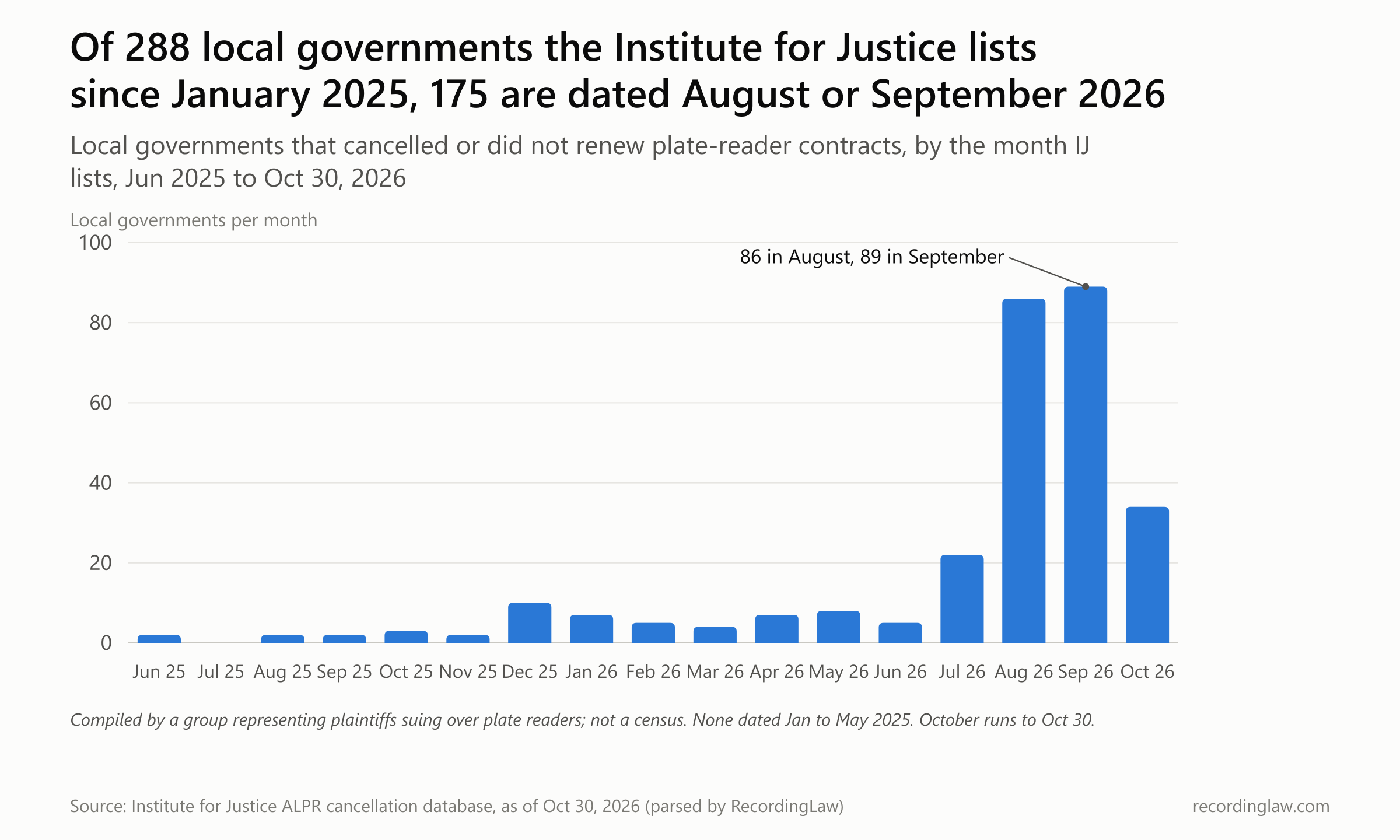
Chart: Institute for Justice ALPR cancellation database as of October 30, 2026, parsed by month by RecordingLaw. Compiled by a group that represents plaintiffs suing over plate readers. Not a census.
| Month listed | Local governments, IJ database |
|---|---|
| Jun 2025 | 2 |
| Jul 2025 | 0 |
| Aug 2025 | 2 |
| Sep 2025 | 2 |
| Oct 2025 | 3 |
| Nov 2025 | 2 |
| Dec 2025 | 10 |
| Jan 2026 | 7 |
| Feb 2026 | 5 |
| Mar 2026 | 4 |
| Apr 2026 | 7 |
| May 2026 | 8 |
| Jun 2026 | 5 |
| Jul 2026 | 22 |
| Aug 2026 | 86 |
| Sep 2026 | 89 |
| Oct 2026 (to Oct 30) | 34 |
| Total | 288 |
August and September together hold 175 of the 288 entries, about six in ten. Of all 288, 202 were early terminations. Another 57 were contracts not renewed after they expired, and 14 were listed as nonrenewals or defunding.
The last 15 were cancelled before any camera went up. Texas had the most entries, 32, followed by Massachusetts with 29.
The list counts decisions, not cameras taken down. It also depends on what the group's researchers could find. The group says it leaves out places that only paused their cameras or switched vendors. The cameras those governments were voting on had been spreading for years before the summer, and so had their reach.
What police bought
The cameras came with reach, and the records of who used that reach became the critics' main evidence.
Bexar County, Texas, has 33 Flock cameras, and its sheriff's office can search more than 1,000 other camera networks beyond the county, News 4 San Antonio reported in October 2026. In Texas, the state itself paid for thousands of the cameras.
In 2023 the Texas Legislature unanimously added $1 to Texans' car insurance policies to fight catalytic converter theft. The Motor Vehicle Crime Prevention Authority is the board that spends the fee. At its August 2023 meeting, its chair, Laredo police chief Miguel Rodriguez, said he hoped to use the money to "cover the entire state" with cameras, The Texas Tribune later reported.
The board, mostly appointed by Abbott, turned the fee into at least 3,200 Flock cameras, the Tribune found. DeFlock, a volunteer project that maps the cameras, had identified about 13,000 Flock cameras across Texas, according to the same report.
Flock describes the product the way its police customers do. "Flock’s technology is an important public safety tool for law enforcement agencies across Texas, helping officers solve serious crimes, find missing people, recover stolen vehicles, and support safer communities," the company said in a statement in August 2026.
The company also puts numbers on it. In an August 2026 blog post, Flock wrote that its technology "assists your officers in more than one million crimes solved annually," and that "In July alone, with your help, we detected over 1,000 missing people and over 20,000 stolen cars." The post does not say how those figures were counted.
Agencies keep their own tallies. The Seminole County Sheriff's Office in Florida said the system helped with more than 800 investigations since mid-2021, contributed to more than 530 arrests and helped locate 34 missing or endangered people, WFTV reported.
In Austin, a city audit reported by KUT found that "75 million scans resulted in 165 arrests, 133 prosecutions and one missing person found." Austin let its program lapse in June 2025, the earliest end in the RecordingLaw file, our research file of 122 US agencies with Flock contracts. To learn how the system works, see our guide to what Flock cameras are.
The same design that gave a 33-camera county the reach of 1,000 networks let people on those networks search back in. Illinois had already tried to fence that off.
Who else was searching Illinois cameras?
In 2023, Illinois lawmakers passed a bill that Secretary of State Alexi Giannoulias had initiated. It bars anyone using plate-reader data from sharing it with another state or local jurisdiction to investigate or enforce a law that interferes with reproductive health care. It also bars sharing it to investigate or enforce a law that permits detaining a person based on immigration status.
Giannoulias made the case at a June 2023 event. "License plate readers are an important tool for law enforcement – especially when apprehending suspects in violent crimes or recovering stolen vehicles in car jackings – but we need to regulate these cameras so they aren’t abused for surveillance, tracking the data of innocent people or criminalizing lawful behavior," he said.
State Sen. Jil Tracy, a Quincy Republican, warned it went too far. "Under this law, a minor girl from Missouri could be brought to Illinois by her abuser to undergo an abortion, and that license plate data couldn't be used to bring him to justice," she said.
The bill passed the House 72-39 and the Senate 39-15, and Gov. J.B. Pritzker signed it on August 11, 2023. It took effect January 1, 2024.
In May 2025, a search from Texas went through anyway. "A Johnson County official ran two searches with the note 'had an abortion, search for female.' The second search probed 6,809 networks, accessing 83,345 cameras across nearly the entire country," the Electronic Frontier Foundation, a digital-rights advocacy group, later wrote. Police had described the search as a missing-person investigation. The EFF said documents it obtained in October 2025 showed it was an abortion case.
Giannoulias's office said the search had reached Illinois cameras through Mount Prospect, a Chicago suburb. His office also found 262 immigration-related searches in Mount Prospect alone between January 14 and April 30, 2025. By June 11, 2025, Flock had "identified 46 individual out-of-state agencies" that violated the law and shut off their access, the office said. "This demonstrates a broader, problematic trend of other states leveraging this emerging technology, extending their reach beyond their jurisdictions to surveil and hunt down law-abiding individuals," Giannoulias said.
Federal agencies were in the records too. A lookup here is a search that reaches past an agency's own cameras to other agencies' cameras across a state or the country. In May 2025, 404 Media published records from Danville, Illinois, showing "more than 4,000 nation and statewide lookups by local and state police done either at the behest of the federal government or as an “informal” favor to federal law enforcement, or with a potential immigration focus."
Flock's CEO, Garrett Langley, had previously denied that the company had federal contracts, NPR reported. In August 2025 Flock acknowledged "limited pilots" with U.S. Customs and Border Protection and Homeland Security Investigations.
Langley then announced a change on the company blog. "Moving forward, federal users will not be added to Statewide or Nationwide lookup," he wrote on August 25, 2025. The same week, Giannoulias said an audit of 12 agencies had found Flock let Customs and Border Protection reach Illinois cameras. The next day, Evanston switched off all 19 of its Flock cameras.
Much of what critics found next came from the audit log, the record Flock's system keeps of every search.
What officers typed in the reason box
The Electronic Frontier Foundation said it obtained "datasets representing more than 12 million searches logged by more than 3,900 agencies between December 2024 and October 2025." Jay Stanley of the ACLU cited one of the EFF's counts. In a set of 11.4 million nationwide searches over six months, he wrote, "more than 14% of the searches fields contained just the word “investigation.”"
Some reason fields named no case at all. A Lake County, Indiana, sheriff's deputy searched "across more than 19,000 cameras in 1,558 cities and towns," 404 Media reported, and the stated reason was "LMAO."
Flock itself gives agencies a way to publish some of this. "More than 1,500 agencies have published a Flock Transparency Portal," the company wrote in August 2026, urging the rest to turn theirs on.
Local logs told the same kind of story at county scale. Over 30 days from August 2 to September 1, 2026, the Bexar County Sheriff's Office ran about 1,800 Flock searches, News 4 San Antonio found from an audit it obtained. "The audit found 72% of Bexar County’s searches in that timespan were broad searches, reaching 1,000 or more networks." More than a dozen used a placeholder such as "12345" instead of a case number.
Police leaders answered in their own terms. "This is a very powerful tool, but with that power comes a lot of responsibility as well," Bexar County Sheriff Javier Salazar said. In Arizona, Casa Grande Police Chief Mark McCrory put it this way: "It’s not the technology that’s been failing here, it’s individual decisions that have been failing."
Langley wrote to customers that the company and its police partners were under "coordinated attack," NPR reported, and called DeFlock "terroristic" in an interview with Forbes. Staunton, Virginia, Police Chief Jim Williams, whose city ended its contract, wrote back to Langley. "What we are seeing here is a group of local citizens who are raising concerns that we could be potentially surveilling private citizens, residents and visitors and using the data for nefarious purposes," he wrote.
Before the summer: the map and the first exits
The DeFlock volunteers kept mapping through all of it. How fast did their map grow?
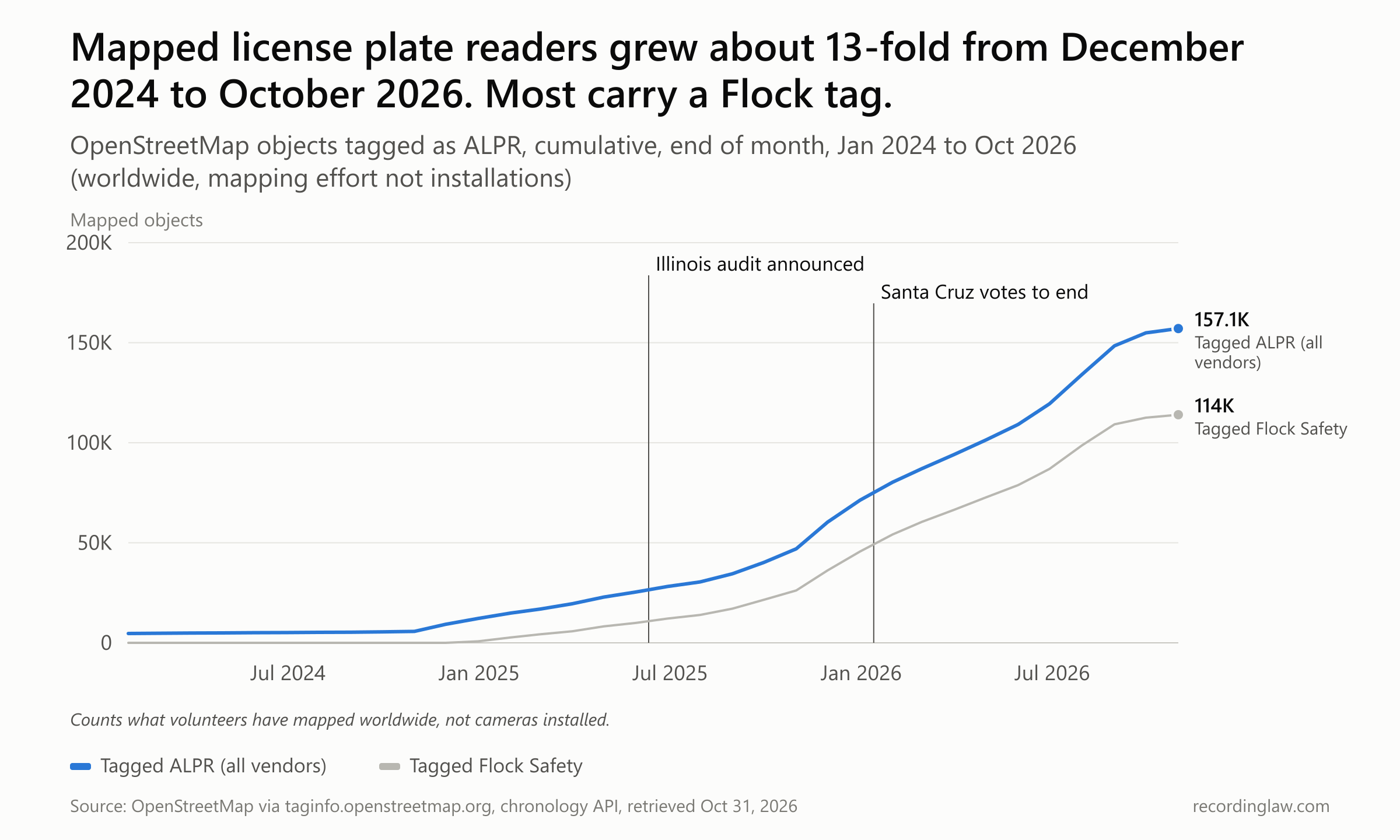
Source: OpenStreetMap via taginfo (chronology API), retrieved October 31, 2026. Counts mapping effort worldwide, not installed cameras. The 71% in the text uses the manufacturer=Flock Safety tag (112,173 objects); the Flock line uses the manufacturer:wikidata tag (114,015).
| End of month | Tagged as plate reader (all vendors) | Tagged Flock Safety |
|---|---|---|
| Dec 2023 | 4,521 | 2 |
| Dec 2024 | 12,168 | 733 |
| Dec 2025 | 71,327 | 45,669 |
| Oct 31, 2026 | 157,072 | 114,015 |
OpenStreetMap is where DeFlock's mappers record the cameras. The objects tagged there as plate readers rose about 13-fold from the end of 2024 to October 31, 2026, from 12,168 to 157,072. About 71% of them now carry a Flock tag.
That line measures how hard volunteers have worked, not how many cameras went up. NPR cited more than 76,000 DeFlock-mapped readers in February 2026 and more than 130,000 in August. Those NPR figures cover the United States only, while the OpenStreetMap count is worldwide.
The exits came more slowly. Through the end of 2025 they were scattered. The Institute for Justice database lists 21 cancellations in 2025, and the RecordingLaw file has 10.
They picked up that winter. In December 2025, Flagstaff, Arizona, voted to end its contract for 36 cameras. On January 13, 2026, the Santa Cruz, California, city council voted to end its contract for eight.
In February NPR counted at least 30 localities that had deactivated Flock cameras or cancelled contracts since the start of 2025, "with much of the activity happening in just the last three months." Flock said then that new agencies "significantly" outpaced those leaving. By August 3, the Washington Examiner counted about 23 city councils that had voted in 2026 to cancel, not renew, reject or deactivate Flock's readers. Each outlet made its own count.
August 13 to August 31
Flock moved first. On August 13, 2026, it said it would "require case codes for all law enforcement searches by the end of the year," meaning an officer would have to enter a case number with each search, and emergency searches would be flagged for an administrator to review. It also cut its default data retention, how long the data is kept, to seven days, saying "over 90% of searches without a full plate are done within a week."
The ACLU answered the same day. "Transforming an exceptionally dangerous mass surveillance system into one that is fully protective of civil rights and civil liberties is a difficult, if not impossible task," said Chad Marlow, its senior policy counsel. He added that Flock's "nearly $1 billion in venture capitalist funding has locked it into an operational model that seeks to trade our privacy for massive profits."
On August 26, Florida Gov. Ron DeSantis spoke at Florida International University. "I’m all about having law enforcement have tools to be able to hold criminals accountable," he said. "But I don’t want to have this become a surveillance state."
The next night in Texas, Abbott ordered a halt to state money for Flock cameras. "To the extent any funding comes from Texas agencies, those agencies are clarifying that those funds cannot be used for Flock cameras," his spokesman, Andrew Mahaleris, said in a statement. The Texas Tribune published its investigation of the $1 fee the following day.
The author of the 2023 fee bill, state Sen. Carol Alvarado, a Houston Democrat, told the Tribune: "I did not have that in mind when we passed the bill." Rep. Mitch Little, a Lewisville Republican, said: "The sheer volume of information captured is not something that is entertained, in my view, by the Fourth Amendment."
Abbott described the goal on a radio show the next morning. "This is something that is easily containable, easily controllable, and we’re ensuring that whether it be through criminal crackdowns, whether it be through cancellation of contracts, whatever the case may be, Flock cameras are being reduced dramatically," he told Glenn Beck. "They’re going to be required to be used responsibly if they’re used at all."
On August 31, the day of the Knox County vote, Florida's transportation department revoked all permits for local plate readers on state rights-of-way and gave agencies 30 days to remove them. "Further, as of the date of this memorandum, the Department will use its discretionary authority to cease the issuance of all future requests for LPR systems within its jurisdictional authority," wrote Will Watts, its chief operating officer. The department cited "concerning reports of misuse, data privacy concerns, and surveillance schemes," WFTV reported. (Our news report on the Florida order has the details.)
The same state had been approving money for plate readers. In the year before the memo, DeSantis approved about $4.6 million in requests from local agencies for plate readers tied to illegal immigration enforcement, WLRN reported. Not all of it had been paid out. One county's request said the cameras would let officers "develop a pattern of life to potentially identify home and work locations and plan enforcement actions."
The order reached hundreds of cameras in Northeast Florida alone, News4Jax reported. By its count, the Jacksonville Sheriff's Office ran 141 fixed cameras and nine mobile readers. Clay County had 157 cameras, St. Johns County 180 and Nassau County 34, by the same count.
Sheriffs said what losing them would cost. Nassau County Sheriff Bill Leeper pointed to an arrest. "That’s a case where we would not have caught him that quickly had it not been for these cameras," he said. "The benefits are just tremendous."
Volusia County Sheriff Mike Chitwood said the cameras would stay off until lawmakers acted. "The LPR has been an incredible tool for public safety," he said. "But until we have clarity, guidance and a legal framework from the Florida Legislature regarding this technology, it’s no longer a tool we can use." The Orange County Sheriff's Office said it would keep using plate readers elsewhere "where permitted by law."
Pasco County's cameras were already coming down for a different reason. Sheriff Chris Nocco had released a letter on August 26 ending his agreement for about 60 cameras, a day after county commissioners agreed to study whether to keep them. He blamed the commissioners and warned that the loss "will impact the solvability of crimes and our ability to locate missing and endangered children and adults, including the victims of human trafficking."
Texas kept going. A Schertz police presentation put the start of a Texas Department of Transportation pause on new plate-reader permits along state roads at September 8. In October, Comptroller Don Huffines barred state grant money he administers from paying for any plate reader, naming Flock, Motorola Solutions and Axon. "The government has no business tracking where law-abiding Texans drive," he said.
Then the local votes came in a rush.
What the September votes said
The votes had different reasons on the record. On September 4, Fond du Lac and Winnebago counties in Wisconsin stopped using Flock after learning that agencies in other states had released their search data under those states' records laws. "The loss of control over our own investigative data, combined with concerns over how quickly Flocks technology has expanded beyond traditional plate-reading systems, has led Fond du Lac County law enforcement agencies to conclude that continuing the program at this time is not appropriate," their statement read.
In a statement to WBAY, Flock said it had already changed the audit log it shares across agencies the year before, removing officer names, plates searched and free-text search reasons after people used released logs to identify undercover officers by name. It said the full records stay with each originating agency.
The Racine County Sheriff's Office said it had understood that camera data would be deleted after 30 days. It said it found Flock was keeping a separate traffic dataset for up to five years. Flock said that data "is aggregated, de-identified traffic information, not individual license plate records." In September, the Wisconsin Institute for Law & Liberty sued Waukesha County and 11 municipalities, seeking a warrant requirement for Flock searches.
On the night of Tuesday, September 15, Arlington County, Virginia, dropped its 41 cameras. In the city of Racine, Mayor Cory Mason broke a 7-7 tie to end the city's contract in 30 days. Oconomowoc voted to end its contract, Waukesha voted to stop funding its cameras after 2026, and Eastpointe, Michigan, voted too. In El Paso, the city council had voted unanimously the week before to remove 150 Flock readers within 90 days.
Some police leaders argued to keep the cameras. In Massachusetts, where the ACLU counted more than 25 municipalities that had ended, suspended or declined to renew Flock contracts in recent weeks, the Barnstable council voted 7-3 in early September to end its cameras. Its president, Craig Tamash, a retired deputy police chief, voted to keep them. He said: "I don't want to throw the baby out with the bathwater… and I think that's exactly what we're doing."
In Arizona, Apache Junction Police Chief Mike Pooley said: "We know these guardrails need to go in. We’re for that. We want this technology. We don’t want it to ever be abused."
Did a second count show the same spike?
No official list of cancellations exists. The Institute for Justice's list is kept by a group that represents plaintiffs suing over the cameras. The RecordingLaw file follows 122 agencies chosen from news coverage and public records, each checked against a council record, press release or news report. Did its endings cluster the same way?
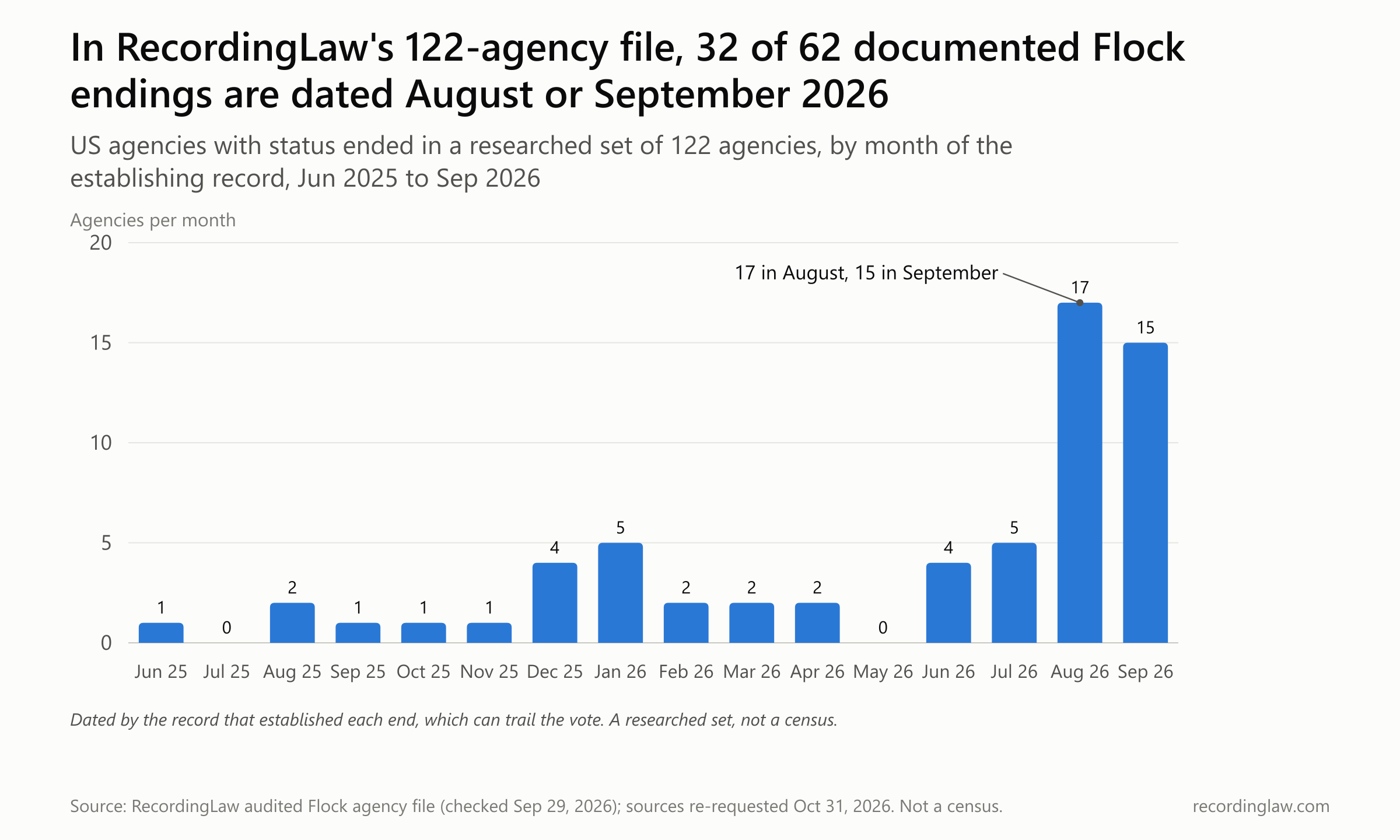
Chart: RecordingLaw audited Flock agency file (checked September 29, 2026; sources re-requested October 31, 2026). The table adds the Institute for Justice database as of October 30, 2026. Neither is a census.
| Month | Ended, RecordingLaw file | Cancelled, IJ database |
|---|---|---|
| Jun 2025 to Dec 2025 | 10 | 21 |
| Jan 2026 | 5 | 7 |
| Feb 2026 | 2 | 5 |
| Mar 2026 | 2 | 4 |
| Apr 2026 | 2 | 7 |
| May 2026 | 0 | 8 |
| Jun 2026 | 4 | 5 |
| Jul 2026 | 5 | 22 |
| Aug 2026 | 17 | 86 |
| Sep 2026 | 15 | 89 |
| Oct 2026 (to Oct 30) | not covered | 34 |
| Total | 62 | 288 |
Yes. Of the 62 endings in the file, 32 carry record dates in August or September 2026, about half. In the Institute for Justice database, the same two months hold about six in ten.
A month in either list partly reflects how much news coverage there was to find. The file also dates each end by the record that established it, which can come later than the vote.
Shrinking, or changing logos?
Both lists are small next to Flock's customer base. Flock says that base is still growing. "We will have added seven times the number of new customers that have left us this year," Langley told NPR in August. No public count of Flock's customers lets anyone check that claim or the critics' counts against a total.
Some agencies that left Flock did not leave plate readers. Denver signed a one-year deal with Axon after dropping Flock. The Bernalillo County Sheriff's Office in New Mexico announced an Axon plate-reader partnership less than two weeks after ending its Flock agreement, the Albuquerque Journal reported. "We're seeing a significant number of agencies want to come over to Axon and convert from existing license plate readers to us, specifically because of the controls and privacy work that we've done around this space," Axon CEO Rick Smith told investors.
Langley answered on NPR. "That company works with ICE. That company has a contract with most federal agencies. That company lacks the guardrails we have," he said.
For critics, the switch changes little. "Sure, the headline changes with a slightly better company. But the innate issues around ALPRs don’t. You still have similar cameras, similar databases, similar mass, warrantless tracking. You just have a different logo on the contract," said Jon McCray-Jones, a policy analyst at the ACLU of Wisconsin.
The RecordingLaw file shows the cases in between. When it was last checked, 62 of its 122 records had ended and 28 were active. Another 19 were approved, 12 were paused and 1 was rejected. The paused ones are not in the Institute for Justice count at all.
That leaves the question the sheriffs raised: what do the cameras do to crime?
Do the cameras reduce crime?
The researchers who have tried to measure the effect on crime tested different setups. The newest study followed Flock's fixed cameras across 216 agencies. An older trial put plate readers on patrol cars in 30 crime hot spots. What did each find?
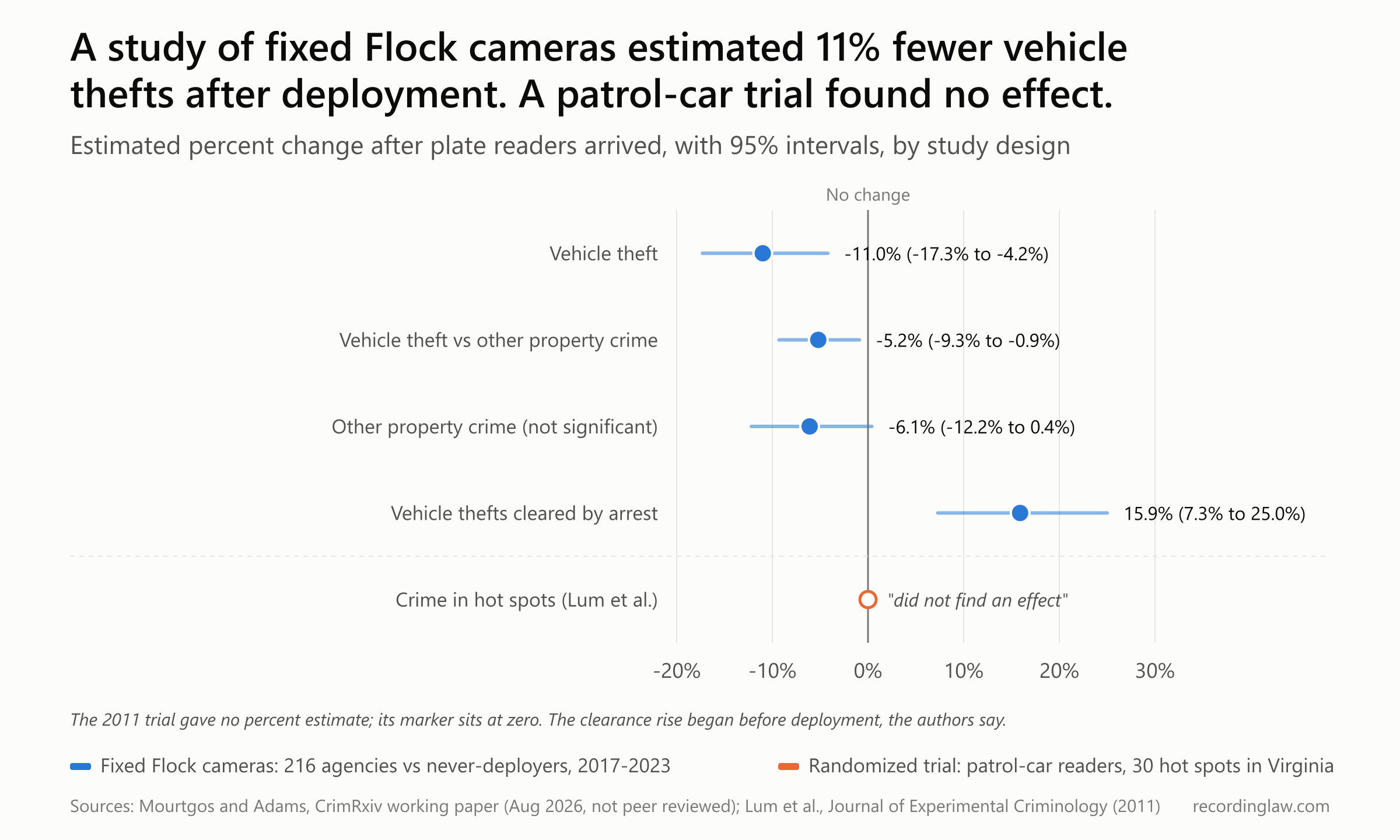
Chart: Mourtgos and Adams, CrimRxiv working paper (August 2026, not peer reviewed); Lum and colleagues, Journal of Experimental Criminology (2011). The 2011 trial gave no percent estimate, so its marker sits at zero.
| Study and measure | Estimate | 95% interval |
|---|---|---|
| Mourtgos and Adams: vehicle theft | down 11.0% | down 17.3% to down 4.2% |
| Mourtgos and Adams: vehicle theft relative to other property crime | down 5.2% | down 9.3% to down 0.9% |
| Mourtgos and Adams: other property crime | down 6.1% | down 12.2% to up 0.4% |
| Mourtgos and Adams: vehicle thefts cleared by arrest | up 15.9% | up 7.3% to up 25.0% |
| Lum and colleagues, 2011: crime in 30 hot spots | no effect found | not given |
Scott M. Mourtgos and Ian T. Adams posted a working paper in August 2026 that tested the cameras against vehicle theft. It has not been peer reviewed. It compared 216 agencies that deployed Flock cameras with agencies that never did, using national crime reports from 2017 to 2023.
The timing of each deployment came from Flock's own operational records. We found no funding statement on the paper's page.
They estimated that "Motor vehicle theft fell 11.0 percent after deployment," while other property crime at the same agencies did not change by an amount they could distinguish from zero. The paper also measured vehicle theft as a ratio to the same agencies' other property crime, and by that measure it fell 5.2%. The share of vehicle thefts cleared by an arrest rose about 16%, "although the increase began during the final three pre-deployment months, weakening causal attribution to the cameras," the authors wrote.
The table gives each Mourtgos and Adams estimate with a 95% confidence interval, the range of values that fit the study's data reasonably well, by a method that would catch the true value in about 95 of 100 repeat studies. For other property crime, that range runs from a fall of 12.2% to a rise of 0.4%.
The Institute for Justice, which represents plaintiffs suing over the cameras, published a critique of the paper. "In other words, the difference in the arrest rate after Flock ALPR deployment might not represent a causal effect of Flock ALPRs," wrote Matthew West, its author.
An older study was a randomized trial, in which chance decides who or what gets the treatment, so that apart from it the groups differ only by luck of the draw. It tested a different setup: patrol cars carrying plate readers in 30 crime hot spots in Fairfax County and Alexandria, Virginia. "All in all, we did not find an effect of the use of LPR in experimental hot spots," the George Mason University researchers wrote in 2011. Fixed networks like Flock's are a different tool.
A larger test is still out. The National Policing Institute said that as of June 2022, 93 agencies in 27 states had committed to a national evaluation of plate readers. We found no published results.
So the evidence on crime is agency and company counts with no comparison group, one working paper with a vehicle-theft estimate and a caveat on arrests, and one 2011 trial of a different setup that found no effect. None of them measures how often a search is misused. That record comes from the logs.
The rules states wrote
Several legislatures took a different route. Before the summer's votes, they wrote rules on how plate-reader data may be used, how long it may be kept and who may receive it.
Virginia passed a 2025 compromise signed by Gov. Glenn Youngkin that keeps data for 21 days and limits sharing. "The data sharing rules basically are a lot more restrictive, so the data just can’t be handed over to ICE when anybody feels like it," said Senate Majority Leader Scott Surovell.
Washington followed in March 2026. Gov. Bob Ferguson signed a law limiting use to felonies, gross misdemeanors, stolen vehicles, warrants and missing persons. The law also bars use for immigration enforcement and requires deletion after 21 days.
Its sponsor, Sen. Yasmin Trudeau, called it "the strongest bill in the country" and said "this is the floor, not the ceiling." The ACLU of Washington's Tee Sannon said the bill "does not provide meaningful protections for peoples' privacy."
Connecticut's law, signed in May 2026, bars sharing plate-reader data for immigration enforcement. "Simply uploading into the Flock system for anyone to access certainly circumvents that, so it’s important that we closed that loophole," said Rep. Steve Stafstrom, a Bridgeport Democrat. Rep. David Rutigliano, a Trumbull Republican, called the provisions "virtue signaling."
In Oregon, a bill restricting plate-reader data passed both chambers in March 2026. "As viable as this tool is, there also needs to be checks and balances," said its chief backer, Sen. Floyd Prozanski. "That’s a major change that we believe vendors are not going to make," said Kevin Campbell of the Oregon Association Chiefs of Police. "This is too important a tool to put that at risk."
The courts have not settled the larger question. On January 27, 2026, U.S. District Judge Mark Davis ruled that Norfolk, Virginia's 176 Flock cameras do not violate the Fourth Amendment, adding: "While a definitive answer to that question is elusive, what is readily apparent to this Court is that, at least in Norfolk, Virginia, the answer is: not today." Two Hampton Roads residents represented by the Institute for Justice appealed to the Fourth Circuit, where, as of June 2026, the appeal was fully briefed and the court had not ruled. (Our report on the appeal.)
On June 29, 2026, the Supreme Court held in Chatrie v. United States that police conducted a Fourth Amendment search when they obtained a phone user's Google Location History. The case did not involve plate readers. Michael Soyfer, an Institute for Justice attorney, has called for "robust safeguards like a warrant requirement," and U.S. Rep. Keith Self, a Texas Republican, proposed in July 2026 that federal agencies get warrants for Flock data.
For each state's rules, see our license plate reader laws by state, and for the legal questions in one place, see our guide Are Flock cameras legal?.
What comes due next
The next test is in El Paso, where the 90-day removal window set by the September vote closes in December 2026. The council also barred new plate-reader contracts with any company.
Flock's own deadline falls on December 31, 2026. By then, it says, every police search will need a case code, and its audit tool, Audit Assistance, which flags abnormal activity for an administrator to review, becomes mandatory for law enforcement customers. Waukesha's funding for its cameras stops after 2026.
In early 2027, Bexar County's contract runs out of money. Salazar said it is funded through early 2027 "and he does not expect it to continue beyond then," News 4 San Antonio reported. Groton, Massachusetts, has promised its spring 2027 town meeting a permanent plan for plate readers.
Legislators in Indiana, Nevada, Ohio, Utah and Virginia have said they will take up the topic in their next sessions, according to MultiState, a government-affairs firm, and Missouri's governor has issued an executive order. DeSantis has said any statewide limits in Florida need the Legislature. By July 1, 2027, Washington's attorney general must publish model policies for plate readers.
In Knox County, the sheriff's office had built its network in small increments, each kept under the price that needed approval from the county mayor or the commission, the Knoxville News Sentinel reported. Ending it took one unanimous vote.
How we measured
Cancellations. We used two lists, and neither is a census. The first is a RecordingLaw research file of 122 US agencies with Flock contracts, built from news coverage and public records and audited on September 29, 2026 (the same file behind our Flock camera map).
Each record has a status (active 28, ended 62, approved 19, paused 12, rejected 1) and a source. On October 31, 2026, we re-requested every source for the 62 ended records. Of those, 47 still contained, word for word, the quote we had saved from that source, and 8 more matched on the first 50 characters. The other 7 were blocked or no longer matched, so those rest on the September audit.
Each end is dated by the record that established it (council minutes, a press release or a news report), which can be later than the vote. Months before June 2025 are not covered.
The second is the Institute for Justice database of local governments that cancelled or did not renew plate-reader contracts since January 2025, as of October 30, 2026. The Institute for Justice is a libertarian public-interest law firm and represents plaintiffs suing Norfolk and San Jose over plate readers. We parsed all 288 entries by month, outcome and state.
Each entry gives a month and year. The database does not say whether that is the month of a vote, a notice or a contract end. One entry does not name a vendor and 287 name Flock. The group excludes places that only paused cameras or switched vendors.
Monthly totals: the database dates 21 entries to 2025: two in June, two in August, two in September, three in October, two in November and 10 in December, with none dated January to May or July. It dates 36 to January to June 2026, 22 to July, 86 to August, 89 to September and 34 to October through the 30th. August plus September is 175 of 288, or 61%. In our file, it is 32 of 62, or 52%.
Both lists depend on what researchers could find, so a month with heavy coverage (Florida after the transportation department's August 31 order, the Wisconsin and Massachusetts clusters) can look larger partly for that reason. Other national tallies we cite are each outlet's own count. They are NPR's "at least 30" localities (February 2026) and the Washington Examiner's "approximately 23" city councils in 2026 (August 3, 2026). We did not use tallies we could not open.
Customer base. Flock does not publish a customer count we could open. We use NPR's February 2026 figure of more than 5,000 law enforcement agencies and the CEO's "seven times" statement, both attributed. A cancellation rate cannot be computed from these sources.
Mapped cameras. OpenStreetMap counts come from taginfo's daily chronology for the tag surveillance:type=ALPR (worldwide, all vendors), summed to month ends. The October 31, 2026 total of 157,072 matches taginfo's overview. Of those, 112,173 (71%) also carry manufacturer=Flock Safety. The Flock line in the chart uses a separate tag (manufacturer:wikidata for Flock Safety), which reached 114,015.
These count what volunteers have mapped, not cameras installed, and include all countries. NPR's DeFlock figures are a US-only cut of a similar effort. The rise from 12,168 at the end of 2024 to 157,072 is about 13-fold.
Crime effects. The Mourtgos and Adams working paper uses a staggered event-study design on 216 Flock-deploying agencies (168 observed before and after) against agencies that never deployed, with FBI NIBRS crime data for 2017 to 2023. In plain terms, it compares each agency's crime before and after its own deployment date with agencies that had no cameras over the same years.
Its estimates, with their 95% intervals in parentheses, were these. Vehicle theft was down 11.0% (minus 17.3 to minus 4.2), and vehicle theft relative to other property crime was down 5.2% (minus 9.3 to minus 0.9). Other property crime was down 6.1% but not distinguishable from zero (minus 12.2 to plus 0.4). Vehicle-theft clearance (thefts closed by an arrest) was up 15.9% (plus 7.3 to plus 25.0).
Agency and Flock figures on arrests, investigations and missing people have no comparison group. The estimates chart shows these four figures and the 2011 Lum trial, which reported no effect without a percent estimate. We placed its marker at zero, not at a value it gave.
What the data cannot show. They cannot show why any one government voted to end a contract, beyond what its own record says. They cannot show how many agencies Flock added, or how many cameras are installed in any state. Nor can they show whether the cameras changed crime in any of the places that dropped them.
Frequently Asked Questions
How many cities have cancelled Flock camera contracts?
There is no official count. The Institute for Justice is a libertarian law firm that represents plaintiffs suing over license plate readers. It listed 288 local governments that cancelled or did not renew plate-reader contracts from January 2025 through October 30, 2026, and 175 of them are dated August or September 2026. A RecordingLaw file of 122 researched agencies had 62 documented ends as of its September 2026 audit. Both lists exclude places that only paused cameras.
How many police agencies use Flock Safety cameras?
NPR reported in February 2026 that Flock had contracts with more than 5,000 law enforcement agencies. Flock's CEO said in August 2026 that new customers that year would be seven times the number that left. Flock does not publish a customer count that can be checked against cancellations.
Why are cities and counties ending Flock contracts?
The reasons on the record vary. One is out-of-state and federal searches of local cameras. An example is the 2025 Texas search that reached Illinois cameras, which police called a missing-person investigation and the Electronic Frontier Foundation said was an abortion case. Others are loss of control over search data released by other states, and disputes over how long data is kept. In Texas and Florida, the reasons include state decisions in August 2026 to stop funding cameras or to revoke permits on state roads. No study has measured which reason drives the votes.
Do Flock license plate cameras reduce crime?
A 2026 working paper by Mourtgos and Adams used Flock deployment records. It estimated 11% fewer vehicle thefts after deployment. The share of thefts closed by an arrest also rose, but that rise began before deployment, which the authors said weakens the case that the cameras caused it. A 2011 randomized trial of patrol-car plate readers in Virginia found no effect. Agencies and Flock report arrests and missing people found, without comparison groups.
Which states have restricted license plate reader data sharing?
Four states passed laws limiting how plate-reader data can be used or shared: Illinois (2023 law, in effect January 2024), Virginia (2025), Washington (signed March 2026) and Connecticut (signed May 2026). An Oregon bill passed both chambers in March 2026. Texas and Florida acted through funding and permits in August 2026 rather than new statutes.
Are Flock cameras legal under the Fourth Amendment?
A federal judge ruled on January 27, 2026 that Norfolk, Virginia's 176 Flock cameras do not violate the Fourth Amendment. The judge noted that the answer could change. The plaintiffs appealed to the Fourth Circuit, where, as of June 2026, the appeal was fully briefed without a ruling. The Supreme Court's June 2026 Chatrie decision on Google location data did not address plate readers.
What happens next with Flock cameras?
El Paso's 90-day window to remove 150 readers closes in December 2026. Flock says case codes become mandatory for all police searches by the end of 2026. Bexar County's contract is funded through early 2027, and Washington's attorney general must publish model plate-reader policies by July 1, 2027.
Updates
Reworded for readability. No figures, quotes, sources or findings changed.
Restructured as a feature: chart titles state the finding, side details moved to How we measured. Every figure and quote was re-checked against its source.
Independently fact-checked against the cited primary sources
Independently fact-checked against the cited primary sources
Sources and References
- Institute for Justice, database of local governments that cancelled or did not renew ALPR contracts (as of Oct. 30, 2026)(ij.org)
- NPR via WLRN, Why some cities are ditching their Flock license plate readers (Feb. 17, 2026)(wlrn.org)
- NPR via KNPR, Flock Safety alternatives (Aug. 23, 2026)(knpr.org)
- Knoxville News Sentinel, Knox County Flock camera removal deadline (Sept. 2026)(yahoo.com)
- News4Jax, Florida pulls the plug on license plate readers (Sept. 2, 2026)(news4jax.com)
- News 4 San Antonio, Bexar County Flock audit log (Oct. 12, 2026)(news4sanantonio.com)
- The Texas Tribune, Texas Flock cameras and the $1 auto insurance fee (Aug. 28, 2026)(texastribune.org)
- KSAT / Texas Tribune, Abbott blocks state agencies from spending money on Flock cameras (Aug. 28, 2026)(ksat.com)
- KBTX / Texas Tribune, Texas freezes installation of Flock cameras along state roads (Sept. 18, 2026)(kbtx.com)
- KBTX, Texas Comptroller bans state grants for license plate readers (Oct. 16, 2026)(kbtx.com)
- Flock Safety blog, privacy, accountability, security and transparency safeguards (Aug. 13, 2026)(flocksafety.com)
- Flock Safety blog, Ensuring Local Compliance on Data Sharing (Aug. 25, 2025)(flocksafety.com)
- WFTV, FDOT orders license plate cameras removed from state rights-of-way (Aug. 31, 2026)(wftv.com)
- WFTV, Orange County Sheriff's Office will keep using license plate readers (Sept. 2, 2026)(wftv.com)
- KUT, Austin license plate reader program (June 4, 2025)(kut.org)
- Alexi Giannoulias statement on HB 3326 (June 2023)(alexiforus.com)
- The Center Square, Illinois license plate reader bill (June 8, 2023)(thecentersquare.com)
- Illinois Public Act 103-0540 (HB 3326)(ilga.gov).gov
- Illinois General Assembly, HB 3326 bill status(ilga.gov).gov
- Electronic Frontier Foundation, Flock Safety investigations: 2025 in review (Dec. 30, 2025)(eff.org)
- Chicago Tribune via Yahoo, Illinois Secretary of State on out-of-state Flock searches (June 12, 2025)(yahoo.com)
- 404 Media, ICE taps into nationwide camera network, data shows (May 2025)(404media.co)
- 404 Media, Flock search reasons in audit logs(404media.co)
- City of Evanston bulletin on deactivating Flock cameras (Aug. 2025)(content.govdelivery.com)
- ACLU, Jay Stanley on police audit logs (Oct. 31, 2025)(aclu.org)
- AZFamily, Arizona police chiefs push back on removal of license plate readers (Sept. 9, 2026)(azfamily.com)
- OpenStreetMap taginfo, surveillance:type=ALPR chronology (retrieved Oct. 31, 2026)(taginfo.openstreetmap.org)
- OpenStreetMap taginfo, surveillance:type=ALPR tag combinations (retrieved Oct. 31, 2026)(taginfo.openstreetmap.org)
- OpenStreetMap taginfo, Flock Safety manufacturer tag chronology (retrieved Oct. 31, 2026)(taginfo.openstreetmap.org)
- Washington Examiner, Flock cancellations count (Aug. 3, 2026)(washingtonexaminer.com)
- ACLU press release responding to Flock updates (Aug. 13, 2026)(aclu.org)
- WCTV, DeSantis calls license plate reader use out of control (Aug. 26, 2026)(wctv.tv)
- WLRN / News Service of Florida, Before DeSantis nixed Flock cameras, he approved funding them (Sept. 2, 2026)(wlrn.org)
- Tampa Bay Beacons, Pasco license plate cameras are coming down (Aug. 31, 2026)(tampabaybeacons.com)
- WBAY, Fond du Lac County law enforcement ceases use of Flock cameras (Sept. 4, 2026)(wbay.com)
- WISN, Three more southeast Wisconsin cities vote to cut ties with Flock (Sept. 16, 2026)(wisn.com)
- Civic Media, Racine council ends Flock contract after mayor breaks tie (Sept. 16, 2026)(civicmedia.us)
- El Paso Inc., City Council orders Flock cameras removed within 90 days (Sept. 18, 2026)(elpasoinc.com)
- Hyannis News, Barnstable council ends Flock cameras in 7-3 vote (Sept. 2026)(hyannisnews.com)
- Boston 25 News, Massachusetts cities and towns that cut ties with Flock (Sept. 17, 2026)(boston25news.com)
- Wisconsin Watch / Bolts, Wisconsin Flock camera backlash (May 15, 2026)(wisconsinwatch.org)
- Mourtgos and Adams, Automated License Plate Readers, Vehicle Theft, and Clearance (CrimRxiv working paper, Aug. 2026)(crimrxiv.com)
- Institute for Justice, explainer on the Mourtgos-Adams working paper (Sept. 17, 2026)(ij.org)
- Lum et al., License plate reader police patrols in crime hot spots, Journal of Experimental Criminology (2011)(link.springer.com)
- National Policing Institute, multi-site evaluation of automated license plate readers(policinginstitute.org)
- WVTF, Youngkin signs compromise measure on license plate readers (May 8, 2025)(wvtf.org)
- The Everett Herald, Washington adds safeguards for Flock cameras (Mar. 31, 2026)(heraldnet.com)
- Police1, Connecticut law bars sharing LPR data for immigration enforcement (May 2026)(police1.com)
- Government Technology, Oregon lawmakers approve bill restricting license plate data (Mar. 6, 2026)(govtech.com)
- WHRO, Federal judge rules on Norfolk Flock cameras (Feb. 11, 2026)(whro.org)
- Faegre Drinker, Supreme Court decides Chatrie v. United States (June 2026)(faegredrinker.com)
- MultiState, Automatic license plate readers face growing state restrictions in 2026 (Sept. 23, 2026)(multistate.us)
- Town of Groton, Mass., notice terminating Flock contract (Aug. 31, 2026)(grotonma.gov).gov
- NBC Chicago, Company violated Illinois law by sharing license plate data with Customs and Border Protection, Giannoulias says (Aug. 25, 2025)(nbcchicago.com)
- Arlington County, County Board directs Manager to discontinue use of Flock technology (Sept. 2026)(arlingtonva.us).gov
- ClickOnDetroit, Eastpointe ends Flock Safety contract after employees misused license plate reader system (Sept. 16, 2026)(clickondetroit.com)
- Albuquerque Journal, BCSO turns to new surveillance provider after parting ways with Flock (Sept. 8, 2026)(abqjournal.com)