Texas's Biometric Law Went 20 Years Without a Suit, Then Meta Agreed to Pay $1.4 Billion

Independently fact-checked against primary sources (last audited November 10, 2026). · 16 primary sources cited on this page. How we verify our legal content
See Recording Law first on Google. Add us as a preferred source to see more of our legal news when you search.
Add on GoogleOn May 30, 2008, the Illinois House took up Senate Bill 2400, a bill about fingerprints and other biometric data. Its sponsor, Rep. Kathleen Ryg, told colleagues that Pay By Touch, "the largest fingerprint scan system in Illinois," had filed for bankruptcy and stopped providing verification services that March. That, she said, left "thousands of customers from Albertson's, Cub Foods, Farm Fresh, Jewel Osco, Shell, and Sunflower Market wondering what will become of their biometric and financial data."
"I know of no opposition to the legislation," Ryg said. The presiding officer asked, "Is there any discussion? Seeing none," and the bill passed 113-0. The Senate had already passed it 58-0, and it accepted the House's changes that July. The governor approved it on October 3, 2008, as the Biometric Information Privacy Act, or BIPA.
Neither Ryg's floor explanation nor that of the Senate sponsor, Sen. Terry Link, mentioned the part of the law that later drew the lawsuits. Section 20 lets any person "aggrieved by a violation" sue, for $1,000 per negligent violation or $5,000 per reckless one. Texas had written nearly the same consent rule seven years earlier, but there only the attorney general can sue, for up to $25,000 per violation.
Over the next two decades, the two laws produced very different court records. In Illinois, a few suits a year turned into a flood. A court ruling led one restaurant chain to estimate its exposure at more than $17 billion, and the legislature capped damages in 2024.
In Texas, the attorney general's office says no one sued under the law for more than 20 years. Then Meta agreed to pay the state $1.4 billion, and Google agreed to pay $1.375 billion in a broader privacy settlement.
How did one idea, enforced two ways, end in a damages cap in one state and billion-dollar settlements in the other, and how does the record compare with what each side said would happen?
What Illinois said it was guarding against
Illinois wrote its law around a specific worry, finger-scan payments at grocery stores. The legislature's findings noted that "major national corporations" had chosen Chicago and other Illinois sites to pilot "finger-scan technologies at grocery stores, gas stations, and school cafeterias." Unlike a password, the findings said, biometrics "are biologically unique to the individual; therefore, once compromised, the individual has no recourse."
The ACLU of Illinois, a civil-liberties advocacy group, says it wrote BIPA and lobbied for it. The clause that set Illinois apart from Texas was the right to sue. For most of a decade, it hardly came up in court.
Eight quiet years, then the Six Flags ruling
For eight years, BIPA barely produced a lawsuit. Duane Morris, a law firm that defends companies in class actions, counted "an average of approximately two total lawsuits filed per year from 2008 through 2016."
One of the few was the biggest. In 2015, Chicago lawyer Jay Edelson sued Facebook, alleging it illegally collected biometric data to identify faces in photos. That case would end in a $650 million settlement for Illinois users.
The turn came in January 2019, in a case against Six Flags. A unanimous Illinois Supreme Court held that a person need not show any actual injury, beyond the violation of the law itself, to sue. Making people wait for harm, the court wrote, "would be completely antithetical to the Act's preventative and deterrent purposes."
How fast did suits come after that? Federal dockets can be searched in CourtListener's RECAP archive, a partial public collection of federal court records. They give one view of the climb. But most BIPA cases are filed in Illinois state courts, which that archive does not cover.
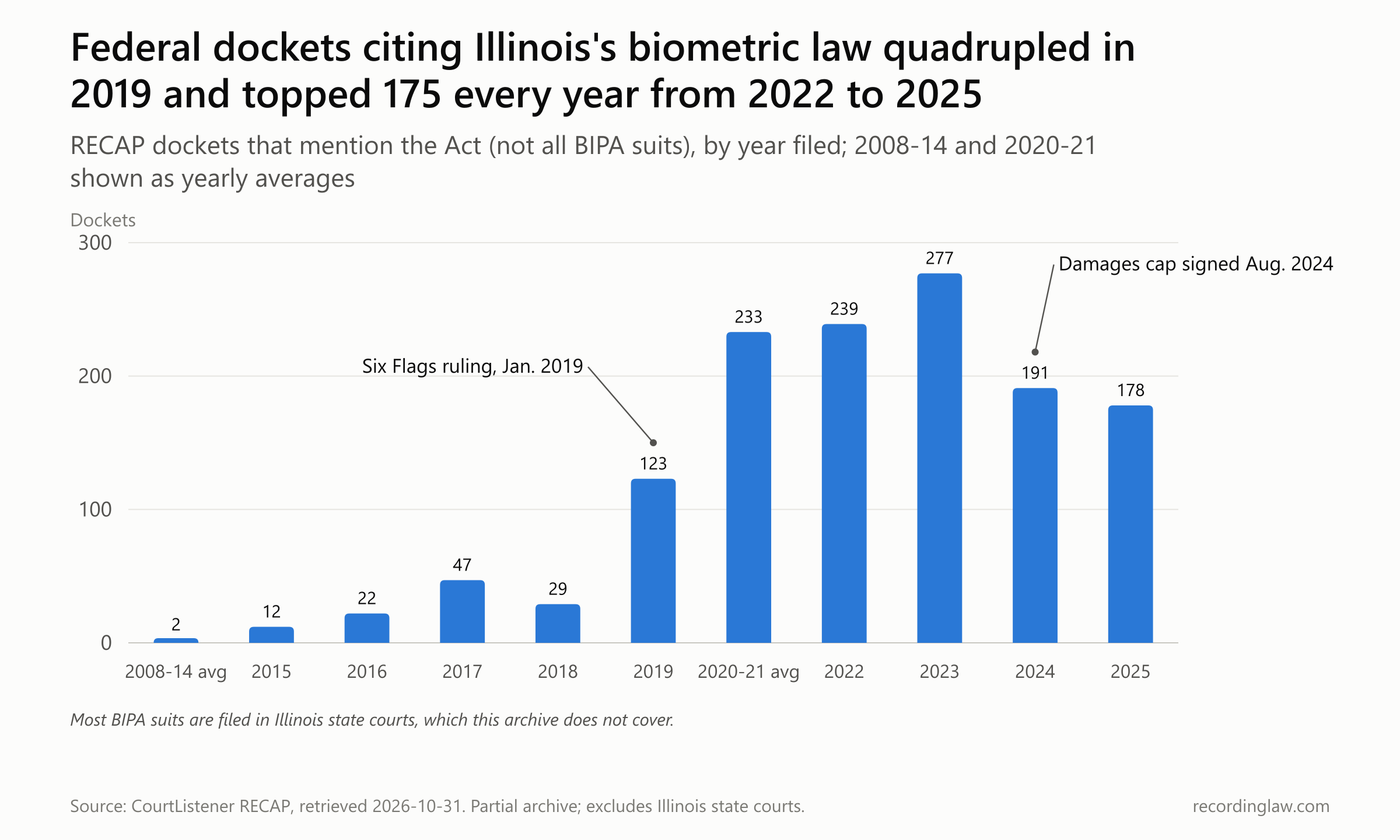
Federal dockets mentioning the Biometric Information Privacy Act in CourtListener RECAP, by year filed. These are dockets that mention the Act, not a count of all BIPA suits, and they exclude Illinois state courts. Source: CourtListener, retrieved Oct. 31, 2026.
| Year filed | RECAP dockets mentioning the Act |
|---|---|
| 2008-2014 (seven years combined) | 16 |
| 2015 | 12 |
| 2016 | 22 |
| 2017 | 47 |
| 2018 | 29 |
| 2019 | 123 |
| 2020-2021 (two years combined) | 466 |
| 2022 | 239 |
| 2023 | 277 |
| 2024 | 191 |
| 2025 | 178 |
Federal dockets mentioning the Act quadrupled from 2018 to 2019, from 29 to 123. The 2020-21 count is one two-year total of 466, which averages 233 a year. Each year from 2022 through 2025 topped 175.
Duane Morris's count of class actions includes state courts, and it shows the same direction. It found more BIPA class filings in 2022 than in 2008 through 2018 combined.
The Six Flags court had also made a prediction. "Compliance should not be difficult," Chief Justice Karmeier wrote; "whatever expenses a business might incur to meet the law's requirements are likely to be insignificant compared to the substantial and irreversible harm that could result if biometric identifiers and information are not properly safeguarded." It noted that the private lawsuit was BIPA's only enforcement tool and that the legislature "intended for this provision to have substantial force."
The ACLU of Illinois, which filed a brief in the case, welcomed the ruling. "The Court recognized that individuals must have the right to sue companies that unlawfully collect their personal information; otherwise, the companies will not be held accountable," said Rebecca Glenberg, its senior staff counsel.
Bigger cases, and a call to copy Texas
The Facebook settlement won final approval in February 2021. U.S. District Judge James Donato approved the settlement, calling it "a landmark result" and a "major win for consumers in the hotly contested area of digital privacy," according to news reports.
That spring, lawmakers took up bills to scale BIPA back. In March 2021 the Chicago Sun-Times editorial board wrote that "under the guise of helping small businesses, lawmakers are trying to repeal or eviscerate" the law. "BIPA doesn't bar anyone from gathering biometric information," the editorial said. "It simply requires that if, for example, a company decides to use thumbprint data to identify customers, the company had better be upfront about it."
In October, the Institute for Legal Reform, a business-funded advocacy arm of the U.S. Chamber of Commerce, called BIPA "a prime example of a misdirected law that has led to more litigation abuse than consumer protection." It counted more than 900 BIPA cases filed through September 2021.
The Chamber's group also proposed a fix. "Exclusive enforcement authority should be vested with the state's attorney general, who is best positioned to enforce complex and technical laws," it wrote. It pointed to Washington, whose biometric law "may be enforced solely by the attorney general," and to Texas, where only "[t]he attorney general may bring an action to recover the civil penalty."
In October 2022, the first BIPA class action went to a jury. Truck drivers and other workers had sued BNSF Railway over biometric scans.
The trial in Chicago federal court lasted five days, and the jurors deliberated for just over an hour. They found 45,600 reckless or intentional violations, and the judge entered a $228 million judgment at $5,000 each.
Fifteen days in February 2023
Two rulings fifteen days apart raised the stakes for pending cases. On February 2, 2023, the Illinois Supreme Court held 5-0 that people have five years to file a BIPA claim. On February 17, ruling 4-3 in a case brought by a White Castle employee, it held that "a separate claim accrues under the Act each time a private entity scans or transmits an individual's biometric identifier."
For workers who scanned a fingerprint to clock in, every scan became a potential claim. White Castle estimated that if the employee won on behalf of as many as 9,500 current and former workers, class-wide damages could exceed $17 billion. Both the majority and the dissent repeated the figure as White Castle's estimate. No court calculated it.
The Seventh Circuit, the federal appeals court that had sent the question to the Illinois court, had flagged the risk in 2021. Because White Castle's employees scan their fingerprints "perhaps even multiple times per shift," the Seventh Circuit had written, the employee's reading of the law "could yield staggering damages awards in this case and others like it."
The majority acknowledged the concerns and handed them back. "We respectfully suggest that the legislature review these policy concerns and make clear its intent regarding the assessment of damages under the Act," it wrote.
White Castle asked for a rehearing, backed by briefs from 16 business groups, including the Illinois Chamber of Commerce, the U.S. Chamber, the National Retail Federation and the Illinois Manufacturers' Association. The court denied it in July 2023. Justice David Overstreet, joined by two colleagues, wrote that under the majority's view, "the legislature intended for Illinois businesses to be subject to cataclysmic, jobs-killing damages, potentially up to billions of dollars."
Overstreet's opinion also relayed the business groups' central claim, which is their assertion, not a court finding. The groups said that in "more than 1700 cases filed since 2019, no case involved a plaintiff alleging that his or her biometric data has been subject to a data breach or led to identity theft." The Littler Workplace Policy Institute, the policy arm of a management-side employment law firm, made a similar claim: "Under BIPA, there has been great financial harm to employers in response to little to no harm to employees."
Filings rose again after the ruling. Duane Morris counted about 61 suits in a window before the decision and 150 in a matched window after, in Illinois state and federal courts combined. The rehearing dissent cited a Bloomberg Law report that BIPA cases jumped 65% in Illinois circuit courts, the state's trial courts, in the two months after the ruling.
The BNSF case showed what the per-scan reading could do to an existing verdict. The drivers had asked in November 2022, before the ruling, to raise the count from 45,600 violations to 136,800, the rehearing dissent noted. After the ruling, the dissent added, they argued that the damages should be multiplied.
How Illinois rewrote the damages
Illinois lawmakers took up the court's invitation in early 2024. "This bill is a response to that invitation," said Sen. Bill Cunningham, a Chicago Democrat, before the Senate vote on Senate Bill 2979.
Cunningham had done what he called "back-of-the-envelope math." Under his proposal, Capitol News Illinois reported, White Castle's estimated $17 billion exposure would fall to "anywhere between $10 million and $50 million." Under the per-scan reading, he said, "It would essentially annihilate the business. It would cease to exist."
Rep. Ann Williams, the House sponsor, whom Capitol News Illinois described as a key backer of BIPA, set her own limit. "My main concern is to ensure that we keep the basic premise of the law intact," she said. "I have no problem reassessing the damage structure to make it more palatable for businesses to comply."
The business lobby split. Littler's institute and TechNet, a technology-industry network, backed the bill. "BIPA has had a drastic impact on employers, who often face costly litigation in cases where there is no actual harm to plaintiffs," said Shannon Meade of the Littler institute. Another coalition of industry groups said it did not go far enough, especially because it would not apply to companies already sued.
Senate Minority Leader John Curran, a Republican, voted yes, though he wanted more. "While I wish there was more in this…to do nothing leaves Illinois businesses subject to really annihilistic judgments," he said.
The ACLU of Illinois took no position on SB 2979 as it stood in May 2024. It said that "Weak enforcement provisions are a bad way to protect fundamental rights," and that opponents had pushed for "entire industry carveouts for data centers and trucking companies."
Edelson, the lawyer who filed the 2015 Facebook suit, told The Record he supported the bill. Companies should not be settling "just because they're scared that they're going to go bankrupt," he said. "We want the cases to win or fail based on their merits."
The Senate passed the bill 46-13 in April 2024 and the House 81-30 in May. Gov. JB Pritzker signed it on August 2, 2024. Now a company that collects the same identifier from the same person by the same method, again and again, has committed one violation, and the person is entitled to "at most, one recovery."
Earlier that year, the BNSF case had settled for $75 million. The settlement replaced the $228 million judgment, which had been vacated.
Federal dockets mentioning the Act fell from 277 in 2023 to 191 in 2024 and 178 in 2025. The federal series cannot separate the 2024 amendment from other changes over the same years. It also leaves out the state courts where most cases are filed.
The amendment's reach was still unsettled. Three federal trial courts had held that it did not reach suits already pending. On April 1, 2026, the Seventh Circuit reversed those rulings, holding that the amendment applies retroactively because it "impacts only the statutory damages available to plaintiffs--it does not change BIPA's substantive standards of liability." The court also observed that "BIPA has become a font of high-stakes litigation."
The Chicagoland Chamber of Commerce called the ruling "a major win for jobs and investment in Illinois and a commonsense protection for businesses against punitive litigation." The industry groups that had said SB 2979 did not go far enough, especially because it was not retroactive, saw a federal appeals court apply it to pending cases two years later.
Texas: two decades without a suit, then two settlements
Texas's law was older than Illinois's, and for two decades it was quieter still. Its 2001 law, now known as CUBI (Capture or Use of Biometric Identifier), came from House Bill 678, carried by Rep. McCall and Sen. Duncan. A Senate analysis explained the reasoning: "It is foreseeable that transactions that now require a password or some other form of identification will utilize biometric technology in the future. Biometric technology is considered by some as the ultimate identifier."
The bill took effect on September 1, 2001. It barred capturing a biometric identifier for a commercial purpose unless the person informed the individual before capturing it and received the individual's consent. It set a civil penalty of up to $25,000 for each violation and authorized only the attorney general to collect it.
Texas tightened the law in 2009, adding a rule that identifiers be destroyed within a reasonable time, and no later than a year after the purpose for collecting them ends. The House committee report on that bill said the bill "will help ensure that biometric identifiers can continue to be used as a tool by law enforcement and businesses to confirm the identity of an individual accurately." Enforcement stayed with the attorney general.
The long wait ended on February 14, 2022. That day Attorney General Ken Paxton sued Meta, Facebook's parent, in state court in Harrison County. The suit was over Meta's use of facial recognition, and it was brought under the biometric law and the Deceptive Trade Practices Act. The Texas Tribune reported that Paxton said penalties could reach hundreds of billions of dollars.
"Facebook will no longer take advantage of people and their children with the intent to turn a profit at the expense of one's safety and well-being," Paxton said. A Meta spokesperson told the Tribune the claims were "without merit" and that the company would defend itself vigorously. In October 2022, Paxton sued Google over voiceprints and face geometry collected through Google Photos, Google Assistant and the Nest Hub Max.
The Meta case lasted about two years. On July 30, 2024, Paxton announced that Meta would pay Texas $1.4 billion over five years, calling it "the first lawsuit brought and first settlement obtained under Texas's 'Capture or Use of Biometric Identifier' Act." Meta, which denied wrongdoing, paid $500 million that August. A Meta spokesperson said the company looked forward "to exploring future opportunities to deepen our business investments in Texas, including potentially developing data centers."
Google followed. Its $1.375 billion settlement, reached in principle in May 2025 and signed on October 31, 2025, resolved two Texas suits covering location tracking, Incognito browsing and biometric identifiers together, so it is not a biometric figure alone. "In Texas, Big Tech is not above the law," Paxton said. "I fought back and won."
How do those amounts compare with what Illinois's private suits produced?
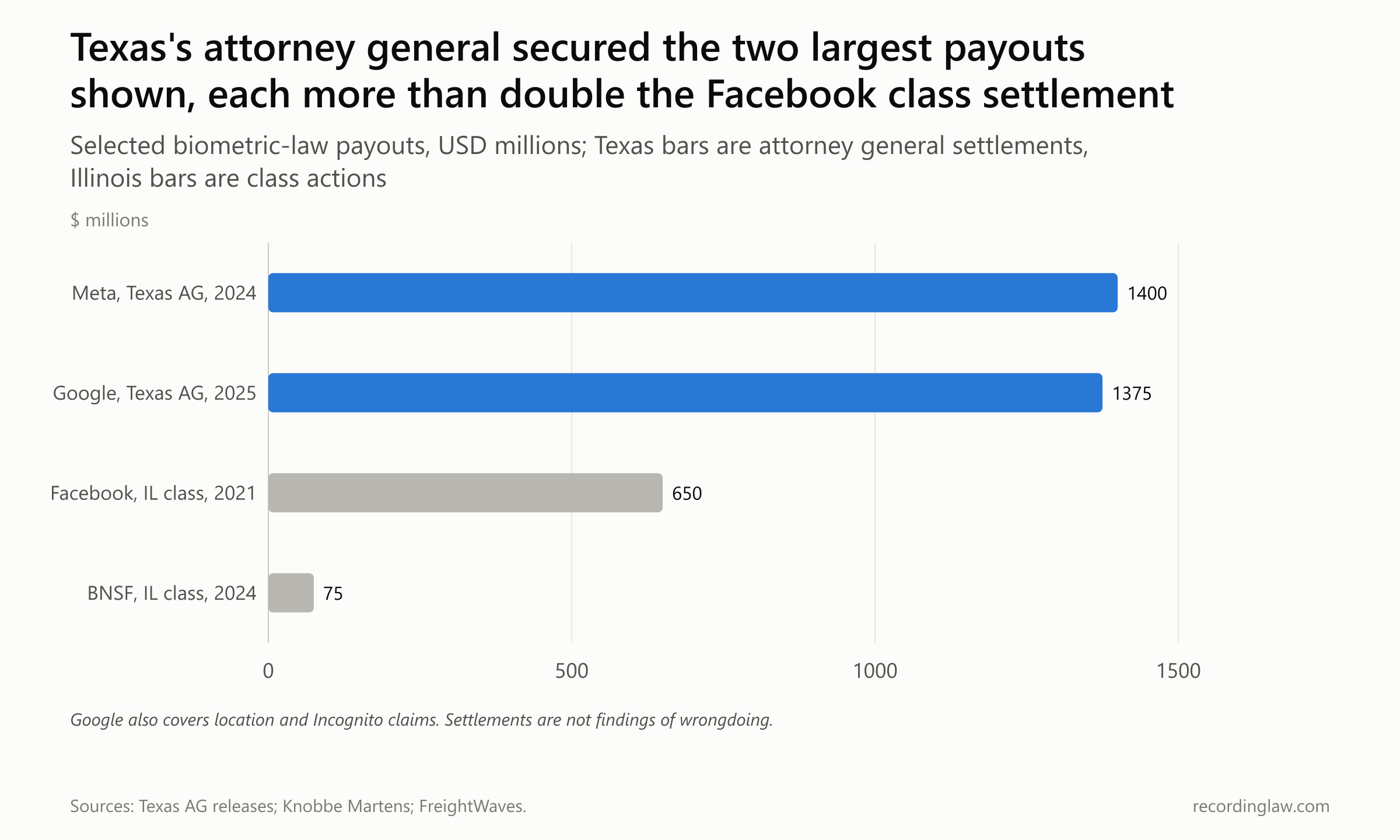
Selected biometric-law payouts by enforcer, in millions of dollars. The Google figure also covers location and Incognito claims, and the Meta suit also alleged deceptive trade practices. Sources: Texas attorney general, Knobbe Martens, FreightWaves.
| Payout | Enforcer | Year | Amount (USD millions) |
|---|---|---|---|
| Meta | Texas attorney general | 2024 | 1,400 |
| Google (biometric, location and Incognito claims) | Texas attorney general | 2025 | 1,375 |
| Illinois class action | 2021 | 650 | |
| BNSF Railway | Illinois class action | 2024 | 75 |
The two largest figures here came from one state's attorney general, and each is more than double the Facebook class settlement. They are not a controlled comparison: different defendants, different years and, in both Texas cases, a mix of claims.
The Meta, Google and Facebook amounts are settlements, not court findings that the companies broke the law. BNSF's settlement replaced a jury verdict that had been vacated. The two Texas settlements came under the arrangement the Chamber's legal-reform group had recommended for state biometric laws in October 2021, with enforcement left to the attorney general alone.
Where the money went
In Illinois, the money went to the people whose data was collected, minus their lawyers' share. Facebook class members were to receive at least $345 each. In the BNSF settlement, legal fees were capped at 35% of the $75 million fund, and drivers and other workers were expected to get about $1,000 apiece.
Texas also paid private lawyers, from the state's recovery. The attorney general hired Keller Postman and McKool Smith on the Meta case.
Their contracts paid the lesser of 11% of the recovery or four times the lawyers' and paralegals' base hourly rates. Under the hourly formula the firms put their combined bill at $136 million, Bloomberg Law reported in December 2024, "far less than the $308 million" the 11% share would have cost. Reuters later reported that they billed Texas $142.6 million. Reuters reported in October 2026 that Norton Rose Fulbright was set to receive more than $156 million for the Google case.
The rest of the Meta money, about $1.26 billion, stayed with the state, and how to spend it was up to the Legislature, Bloomberg Law reported. The Texas law provides only a civil penalty recovered by the state; it has no mechanism for paying the people whose data was captured.
Whether states should hire contingency firms, which are paid from what they recover, is its own argument. Reuters summarized both sides in October 2026: some companies and business groups say it "can put lawyers' financial interests in conflict with public policy concerns," while defenders say "it helps level the playing field for states going up against companies that can afford armies of lawyers."
Not every BIPA case ended in a check. In May 2022 the ACLU settled its BIPA suit against Clearview AI on terms that, once approved, permanently barred the company nationwide from selling its faceprint database to most businesses and other private entities.
What is still open
The bigger question, whether either law reduced the misuse of biometric data, has no answer in these figures. They count lawsuits and dollars, not breaches prevented or scans avoided. The business groups' claim of no breaches in 1,700 cases and the court's 2019 prediction that compliance would not be difficult both remain claims, not measurements.
As of November 2026, the Illinois Supreme Court had not ruled on whether the 2024 cap reaches cases filed before it. The Seventh Circuit's April 2026 decision sent three cases back to federal trial judges, who "may need to reevaluate how this holding affects other aspects of these cases." Whether Illinois state courts will follow it is open.
Texas changed its law again. A 2025 bill, H.B. 149, took effect on January 1, 2026. It exempts training artificial intelligence on biometric data unless the system is used to identify a specific person. It also says an image posted online is not consent unless the person in it posted it.
The attorney general is still the only one who can enforce it. On May 20, 2026, Paxton issued Meta a civil investigative demand, a formal demand for information, over its AI glasses. His office cited the glasses' capture of facial geometry and a reported face-recognition plan, and said it would examine whether Meta "deceptively misrepresents the extent of its use of private data from consumers." As of November 2026, the investigation had no announced deadline.
Meta's payments are scheduled to run five years from 2024. In Illinois, the next thing to watch is whether its Supreme Court takes up retroactivity. In Texas, it is whether the glasses inquiry turns into a suit, and under which law.
In 2008, when the Illinois House was asked whether anyone wanted to discuss the bill, no one did, and it passed 113-0. Sixteen years later, the bill that rewrote its damages passed the Senate 46-13 and the House 81-30.
How we measured
Filings. The federal series counts dockets in CourtListener's RECAP archive whose text matches the exact phrase "Biometric Information Privacy Act," by filing date, retrieved October 31, 2026. It counts dockets that mention the Act, not BIPA suits. The 2015-2024 total is 1,406 dockets, well above the more than 900 federal BIPA cases that Analysis Group, an economic consulting firm, counted for the same years. RECAP is a partial archive whose coverage varies by year, and it excludes Illinois state courts, where most BIPA cases are filed.
The 2008-2014 and 2020-2021 counts are multi-year totals. The yearly averages in the chart are 16 divided by 7 (about 2.3) and 466 divided by 2 (233). 2026 is not included because the year was incomplete on the retrieval date. The 2023-to-2025 decline is 277 to 178, about 36% fewer.
Other filing counts. Duane Morris (a defense firm) counted about two suits a year from 2008 to 2016. It also counted about 61 suits before and 150 after the February 2023 White Castle ruling, in matched windows. The 150 is about 2.5 times the 61, an increase of about 146%.
The firm's post describes the change as 71%, which does not match its own counts. The 146% here is computed from those counts. Other published totals use different windows and definitions, and none is a primary docket count. They come from the Chamber's Institute for Legal Reform (more than 900 through September 2021), business amici in the White Castle case (more than 1,700 since 2019) and Capitol News Illinois (upwards of 2,000 since roughly 2018).
Payouts. Meta and Google figures are from Texas attorney general releases, which are promotional. The Google figure combines biometric, location and Incognito claims.
Facebook's $650 million final approval was on February 26, 2021, in federal court in California. BNSF's $228 million judgment was 45,600 violations times $5,000. It was vacated and replaced by a $75 million settlement.
Meta's $1.4 billion over five years averages $280 million a year. Bloomberg Law reported $500 million paid in August 2024 and arrangements to pay the rest, without a schedule. The Meta outside-counsel bill of $136 million (Bloomberg Law) or $142.6 million (Reuters) is about 10% of $1.4 billion. White Castle's $17 billion estimate, spread over up to 9,500 workers, works out to about $1.8 million per worker.
Law dates. Texas H.B. 678 took effect September 1, 2001. The April 1, 2009, date often cited is a nonsubstantive recodification, which moved the law into Business and Commerce Code 503.001. BIPA is Public Act 95-994, approved October 3, 2008.
The Senate passed SB 2400 58-0 after its sponsor, Sen. Terry Link, said, "I don't know of any opposition to the bill now," and accepted the House's changes 42-0 in July 2008, with no discussion. SB 2979 (Public Act 103-0769) took effect on signing, August 2, 2024. The Texas "first lawsuit" claim is the attorney general's, from the July 2024 release. It is not an independent docket count.
What the data cannot show. Illinois and Texas are not a controlled experiment: different defendants, different decades and different claim mixes. Court rulings (the Six Flags case in 2019, the filing-window and White Castle cases in 2023), the 2024 amendment and changes in RECAP coverage all fall within the filing series, and the data cannot separate their effects. None of the filing or payout counts here measures either law's effect on biometric misuse.
Frequently Asked Questions
What is the difference between Illinois BIPA and the Texas biometric law?
Both require notice and consent before a business captures a biometric identifier such as a fingerprint or face scan. Illinois's Biometric Information Privacy Act (2008) lets any aggrieved person sue for $1,000 per negligent or $5,000 per reckless violation. Texas's Capture or Use of Biometric Identifier law (2001, now Business and Commerce Code 503.001) can be enforced only by the attorney general, with a civil penalty of up to $25,000 per violation.
When was the Texas biometric privacy law passed?
Texas House Bill 678 took effect on September 1, 2001. It was moved into Business and Commerce Code section 503.001 by a nonsubstantive recodification effective April 1, 2009, which is why it is often described as a 2009 law. A 2009 amendment added a rule that identifiers be destroyed within a reasonable time, and no later than a year after the purpose for collecting them ends. The law has been amended since, most recently by H.B. 149, effective January 1, 2026.
How many BIPA lawsuits have been filed?
There is no single primary count. Duane Morris counted about two a year from 2008 to 2016. Business groups told the Illinois Supreme Court there were more than 1,700 cases filed since 2019, and Capitol News Illinois reported upwards of 2,000 since roughly 2018. Federal dockets mentioning the Act in CourtListener's RECAP archive were 277 in 2023 and 178 in 2025. The 2023 count is the highest single year in the series (2020 and 2021 are counted together). But that series excludes Illinois state courts.
What did the Illinois Supreme Court decide in the White Castle BIPA case?
On February 17, 2023, the Illinois Supreme Court held 4-3 that a separate BIPA claim accrues each time a company scans or transmits a person's biometric data in violation of the law. White Castle estimated its class-wide exposure could exceed $17 billion, and the court asked the legislature to clarify damages.
Did Illinois change BIPA damages?
Yes. Senate Bill 2979, signed August 2, 2024, makes repeated collection of the same identifier from the same person by the same method a single violation with at most one recovery. On April 1, 2026, the Seventh Circuit held the change applies to cases already pending. As of November 2026, the Illinois Supreme Court had not ruled on that question.
How much did Meta pay Texas over facial recognition?
Meta agreed on July 30, 2024, to pay Texas $1.4 billion over five years to settle the attorney general's suit under the state biometric law, the first under that law according to the attorney general. Meta denied wrongdoing and paid $500 million in August 2024.
Who gets the money from a Texas biometric settlement?
The state. Bloomberg Law reported that about $1.26 billion of the Meta settlement stays with Texas for lawmakers to allocate, after the bill from the outside law firms the attorney general hired. Bloomberg Law put that bill at $136 million, and Reuters later reported it as $142.6 million. The Texas law provides only a civil penalty recovered by the state and has no mechanism for paying individuals whose data was captured.
Can I sue under the Texas biometric law?
No. Only the Texas attorney general can bring an action to recover the civil penalty under Business and Commerce Code 503.001. In Illinois, a person aggrieved by a BIPA violation can sue in state circuit court or as a supplemental claim in federal court.
Updates
Reworded for readability. No figures, quotes, sources or findings changed.
Restructured as a feature: chart titles state the finding, side details moved to How we measured. Every figure and quote was re-checked against its source.
Independently fact-checked against the cited primary sources
Independently fact-checked against the cited primary sources
Sources and References
- Illinois House transcript, May 30, 2008 (SB 2400 third reading)(www.ilga.gov).gov
- Illinois Senate transcript, April 16, 2008 (SB 2400 third reading)(www.ilga.gov).gov
- Illinois Senate transcript, July 10, 2008 (SB 2400 concurrence in House amendments)(ilga.gov).gov
- Biometric Information Privacy Act, 740 ILCS 14 (as amended by P.A. 103-0769)(www.ilga.gov).gov
- Texas Senate Research Center, bill analysis of H.B. 678 (2001)(capitol.texas.gov).gov
- Texas Legislature Online, H.B. 678 (77th Legislature) bill history(capitol.texas.gov).gov
- Texas House Business and Industry Committee report, C.S.H.B. 3186 (2009)(capitol.texas.gov).gov
- Texas Business and Commerce Code section 503.001 (text and history)(texas.public.law)
- Texas Business and Commerce Code chapter 503, as amended by H.B. 149 (2025)(tcss.legis.texas.gov).gov
- Rosenbach v. Six Flags Entertainment Corp., 2019 IL 123186(www.illinoiscourts.gov).gov
- Cothron v. White Castle System, Inc., 2023 IL 128004 (CourtListener)(www.courtlistener.com)
- Cothron v. White Castle System, Inc., opinion modified upon denial of rehearing, July 18, 2023 (CourtListener)(www.courtlistener.com)
- Clay v. Union Pacific Railroad Co., U.S. Court of Appeals for the Seventh Circuit, April 1, 2026(www.govinfo.gov).gov
- CourtListener RECAP archive, public docket search for the phrase Biometric Information Privacy Act (retrieved Oct. 31, 2026)(www.courtlistener.com)
- Duane Morris Class Action Review, privacy class action trends (Jan. 12, 2024)(blogs.duanemorris.com)
- Duane Morris, on SB 2979 (Aug. 5, 2024)(blogs.duanemorris.com)
- Duane Morris, on the BNSF jury verdict (Oct. 13, 2022)(blogs.duanemorris.com)
- FreightWaves, BNSF biometrics settlement set at $75 million(www.freightwaves.com)
- Knobbe Martens, Facebook $650 million BIPA settlement approved(www.knobbe.com)
- AFP via Gulf News, Facebook settlement final approval (Feb. 2021)(gulfnews.com)
- ACLU of Illinois, statement on the Six Flags ruling (Jan. 25, 2019)(www.aclu-il.org)
- ACLU of Illinois, BIPA campaign page(www.aclu-il.org)
- ACLU of Illinois, Protect BIPA fact sheet (May 8, 2024)(www.aclu-il.org)
- Chicago Sun-Times editorial board, reposted by ACLU of Illinois (March 16, 2021)(www.aclu-il.org)
- ACLU, Clearview AI settlement (May 9, 2022)(www.aclu.org)
- U.S. Chamber Institute for Legal Reform, A Bad Match (Oct. 2021), as filed with the Vermont Legislature(legislature.vermont.gov).gov
- Littler Workplace Policy Institute report (June 27, 2023)(www.littler.com)
- Littler press release, TechNet and Littler WPI support SB 2979 (April 2024)(www.littler.com)
- Capitol News Illinois, Feb. 1, 2024(capitolnewsillinois.com)
- Capitol News Illinois, April 11, 2024(capitolnewsillinois.com)
- The Record (Recorded Future News), May 3, 2024(therecord.media)
- Chicagoland Chamber of Commerce statement (April 2026)(www.chicagolandchamber.org)
- Texas Attorney General, Meta suit announcement (Feb. 14, 2022)(www.texasattorneygeneral.gov).gov
- The Texas Tribune, Feb. 14, 2022(www.texastribune.org)
- Texas Attorney General, $1.4 billion Meta settlement (July 30, 2024)(www.texasattorneygeneral.gov).gov
- Texas Attorney General, Google settlement in principle (May 9, 2025)(www.texasattorneygeneral.gov).gov
- Texas Attorney General, Google settlement signed (Oct. 31, 2025)(www.texasattorneygeneral.gov).gov
- Texas Attorney General, Meta glasses investigation (May 20, 2026)(www.texasattorneygeneral.gov).gov
- Bloomberg Law, Dec. 5, 2024(news.bloomberglaw.com)
- Canadian Lawyer, reporting Reuters (Aug. 2024)(www.canadianlawyermag.com)
- TechCrunch, Meta statement on Texas settlement (July 30, 2024)(techcrunch.com)
- Reuters via Insurance Journal, Oct. 26, 2026(www.insurancejournal.com)
- Analysis Group, empirical analysis of federal BIPA cases 2015-2024 (2025)(www.analysisgroup.com)