
Indiana
Indiana Fireworks Laws (2026): Hours, Ages, Penalties
Independently fact-checked against primary sources (last audited September 18, 2026). · 14 primary sources cited on this page. How we verify our legal content
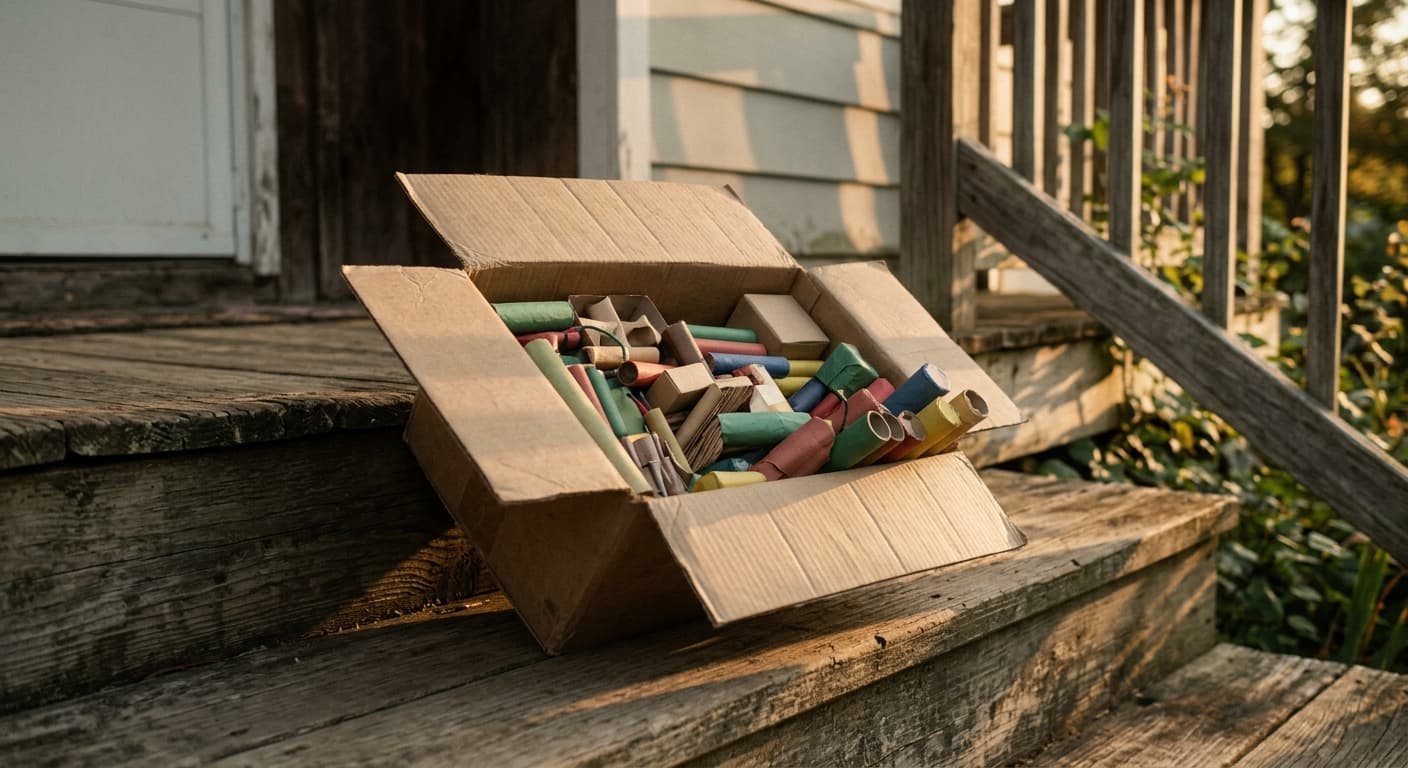
Indiana allows consumer fireworks to be sold at retail statewide through state-fire-marshal-registered retailers and wholesalers. A separate statutory list of lower-power novelty items, sparklers, fountains, snakes, and trick noisemakers among them, is likewise off-limits to a buyer under 18: the same section that sets the consumer-fireworks purchase age also bars selling or delivering any item on that list to someone under 18. Use is confined to three locations and a statewide default hours window, and a county or municipality may restrict further, but only down to a set of protected floors it cannot undercut, under Ind. Code § 22-11-14.
Jurisdiction scope: This article addresses Indiana's statewide consumer fireworks framework under Ind. Code ch. 22-11-14, including device caps, purchase age, use locations and hours, local-ordinance limits, and the penalty ladder. It does not address Indiana's separate manufacturer, distributor, and wholesaler permitting requirements under Ind. Code ch. 22-12-6 in detail.
What's Legal: Consumer Fireworks Statewide
Indiana defines "consumer firework" as "a small firework that is designed primarily to produce visible effects by combustion, and that is required to comply with the construction, chemical composition, and labeling regulations promulgated by the United States Consumer Product Safety Commission." That category is broadly legal for retail sale statewide through registered retailers and wholesalers, whether from a permanent store or a temporary stand permit.
A separate, higher-power category, "special fireworks," is not sold at a consumer retail counter. Indiana treats it as an interstate-wholesale category: its intrastate sale is limited to sales between interstate wholesalers of fireworks not approved for sale in Indiana, and each interstate wholesaler carries its own recordkeeping duty: "Each interstate wholesaler shall keep a record of each sale of special fireworks. This record must include: (1) the purchaser's name; (2) the purchaser's address; and (3) the date of the sale." The chapter also exempts from its restrictions the use of fireworks by railroads or transportation agencies for signal or illumination purposes, blank cartridges used for a show, theater, athletic, or military purpose, the possession, sale, or disposal of Class B fireworks incidental to a public display by an ATF-permitted person, and indoor pyrotechnic special-effects material used before a proximate audience.
Sparkler and Novelty Items: The Same Under-18 Sale Ban
Indiana Code 22-11-14-8 is titled "Sale of fireworks; sales to minors prohibited," and its opening subsection is a prohibition covering sparklers and novelties, not a permissive list separate from the age rule: "A person shall not sell at retail, offer for sale at retail, or deliver the following items to a person less than eighteen (18) years of age," followed by a ten-item list. The first item sets a specific composition cap: "Dipped sticks or wire sparklers. However, total pyrotechnic composition may not exceed one hundred (100) grams per item. Devices containing chlorate or perchlorate salts may not exceed five (5) grams in total composition per item." The remaining nine items, cylindrical and cone fountains, illuminating torches, wheels, ground spinners, flitter sparklers, snakes and glow worms, smoke devices, and six named trick noisemakers (party poppers, booby traps, snappers, trick matches, cigarette loads, and auto burglar alarms), carry no separate numeric weight cap in the statute beyond the general federal CPSC and DOT compliance requirement that applies to consumer fireworks generally, but every one of them is subject to the same under-18 sale prohibition as sparklers. In practice, this means the 18-and-older purchase rule described below covers sparklers and every item on this list exactly as it covers consumer fireworks, not just the higher-power category.
Purchase Age
A buyer must be at least 18 to be sold consumer fireworks: "A retailer or wholesaler of consumer fireworks may sell consumer fireworks to a person at least eighteen (18) years of age," under IC 22-11-14-8(b). The same section sets a separate age floor for the seller: "An individual who sells consumer fireworks must be at least eighteen (18) years of age," while "an individual who sells an item set forth in subsection (a)," meaning sparklers or any of the other novelty items described above, "must be at least sixteen (16) years of age," under IC 22-11-14-8(c) and (d). The fire prevention and building safety commission may adopt rules to ensure compliance with these age limits.
Where and When You Can Use Fireworks
Use is confined to three locations: a special discharge location sponsored under a permit from a municipal or township fire department chief, the user's own property, or another person's property with that owner's permission.
Indiana also sets its own statewide default hours, and violating them is a listed offense in its own right: "A person who ignites, discharges, or uses consumer fireworks: (1) after 11 p.m. except on a holiday (as defined in IC 1-1-9-1(a)) or December 31, on which dates consumer fireworks may not be ignited, discharged, or used after midnight; or (2) before 9 a.m.; commits a Class C infraction." So the statewide baseline is 9:00 a.m. to 11:00 p.m. on an ordinary day, extended to midnight on a statutory holiday or December 31, and using fireworks outside that window is itself a Class C infraction independent of any local ordinance.
Local Ordinances: A Floor Local Governments Cannot Undercut
A county or municipality may adopt its own ordinance narrowing the days and hours consumer fireworks may be used within its boundaries, on top of the statewide framework above. That local power has a hard limit built into the statute itself: "An ordinance adopted under this section: (1) may limit the use of consumer fireworks in the county or municipality; (2) may not be more lenient than a rule adopted by a state agency concerning the use of fireworks; and (3) may not limit the use of consumer fireworks: (A) between the hours of 5:00 p.m. and two (2) hours after sunset on June 29, June 30, July 1, July 2, July 3, July 5, July 6, July 7, July 8, and July 9; (B) between the hours of 10:00 a.m. and 12:00 midnight on July 4; and (C) between the hours of 10:00 a.m. on December 31 and 1:00 a.m. on January 1." A local government can shorten Indiana's default hours on an ordinary day, but it cannot touch those three protected windows around July 4 and New Year's.

Licensing and Fees
A retailer must file a location-specific application and obtain a certificate of compliance with the state fire marshal before selling consumer fireworks, and a temporary fireworks stand needs its own retail sales permit from the fire marshal. Public displays run through a separate permit track: the state fire prevention and building safety commission adopts rules "for the granting of permits for supervised public displays of fireworks by municipalities, fair associations, amusement parks, and other organizations or groups of individuals," and a permit must issue in writing before the display date. Manufacturers, distributors, wholesalers, and importers separately need a permit under IC 22-12-6, and purchasers pay a public safety fee on retail fireworks transactions.
Several sections in this chapter, and in the related manufacturer and wholesaler permit chapter, carry an already-enrolled amended version taking effect July 1, 2027: IC 22-11-14-2 (the definitions section), IC 22-11-14-4.5, IC 22-11-14-8 itself, the sales-to-minors section quoted throughout this page, IC 22-11-14-15, IC 22-12-6-1, IC 22-12-6-3, IC 22-12-6-6, IC 22-12-6-7, and IC 22-12-6-8. The version described on this page is the one currently in force; check the 2027 successor version of these sections closer to that date.
Penalties
Indiana runs a full penalty ladder rather than one flat classification. Violating specified administrative provisions of the chapter is a Class C infraction, escalating to a Class A misdemeanor if the person has an unrelated prior judgment or conviction within the preceding 5 years. Using consumer fireworks at a location other than a special discharge location, the user's own property, or another person's property with permission is a Class C infraction, escalating to a Class C misdemeanor on a repeat violation within 5 years, regardless of whether the earlier instance resulted in a judgment. A person under 18 who possesses or uses consumer fireworks without a responsible adult present commits a Class C infraction, escalating to a delinquent act under IC 31-37 on a repeat instance. Violating the statewide hours rule described above is a Class C infraction, escalating to a Class C misdemeanor on a repeat violation within 5 years.
Above that infraction tier, the chapter sets out harm-based felonies: "A person who recklessly, knowingly, or intentionally uses consumer fireworks and the violation causes harm to the property of a person commits a Class A misdemeanor. ... A person who recklessly, knowingly, or intentionally uses consumer fireworks and the violation results in serious bodily injury to a person commits a Level 6 felony. ... A person who recklessly, knowingly, or intentionally uses consumer fireworks and the violation results in the death of a person commits a Level 5 felony." Knowingly or intentionally failing to collect or remit the public safety fee described above is also a Level 6 felony.
Crossing State Lines
Federal law adds a layer on top of Indiana's own rules, and Indiana is a major source state for cross-border buying, so this cuts against Indiana buyers more than most. Under 18 U.S.C. § 836, it is a federal offense, punishable by a fine, up to one year in prison, or both, to transport fireworks into a state whose law specifically prohibits or regulates their use, or to deliver them for that transportation, knowing they will be delivered, possessed, stored, sold, or otherwise dealt with in a manner that state's law forbids; the statute excludes fireworks merely passing through a state in continuous interstate transportation, and it does not apply to common or contract carriers, to water carriers engaged in interstate commerce, or to transportation for the use of a federal agency. Separately, the U.S. Postal Service bans all fireworks from the mail entirely, for both international and domestic shipment (USPS Publication 52 § 341.22); federal consumer-product-safety rules set the device and packaging standards fireworks must meet to be sold anywhere in the country (16 C.F.R. § 1500.17 and Part 1507); and a federal explosives-licensing exemption (27 C.F.R. § 555.141(a)(7)) covers only the importation, distribution, and storage of consumer fireworks, not their manufacture. Since Indiana is already broadly permissive for consumer fireworks bought through a registered retailer, this matters most for special fireworks, or for an Indiana buyer driving a legally purchased device back into a neighboring state, such as Illinois, that bans it.
For a neighboring state that bans consumer fireworks outright, see Illinois fireworks laws. For the complete state-by-state picture, see the fireworks laws by state comparison. Indiana also maintains a separate open container law worth knowing if fireworks and holiday drinking overlap.
Disclaimer: This article provides general legal information about fireworks laws in the United States as of September 2026. It is not legal advice. Fireworks statutes, local ordinances, sale and use windows, and penalties change frequently and are often further restricted by county or city ordinance beyond what state law requires; verify the current rule for your specific city and county before buying, selling, or using fireworks, and consult a lawyer licensed in your state for advice about a specific situation.
Statutes cited reflect their in-force version as of 2026-09-17. Last updated: 2026-09-17.
Frequently Asked Questions
Are fireworks legal in Indiana?
Yes. Consumer fireworks are broadly legal for retail sale statewide through state-fire-marshal-registered retailers and wholesalers, under IC 22-11-14-1. A separate, higher-power "special fireworks" category is an interstate-wholesale category, not a consumer retail item; its intrastate sale is limited to sales between interstate wholesalers of fireworks not approved for sale in Indiana.
How old do you have to be to buy fireworks in Indiana?
18. "A retailer or wholesaler of consumer fireworks may sell consumer fireworks to a person at least eighteen (18) years of age," under IC 22-11-14-8(b). The same section bars selling sparklers, fountains, snakes, and the other listed novelty items to anyone under 18 too, so the 18-and-older rule is not limited to consumer fireworks. A seller of consumer fireworks must also be at least 18, and a seller of a novelty item must be at least 16.
What time can you legally use fireworks in Indiana?
9:00 a.m. to 11:00 p.m. by statewide default, extended to midnight on a statutory holiday or December 31, under IC 22-11-14-6(d). A local ordinance may narrow that further, but it cannot restrict use during three protected windows: the days flanking July 4, July 4 itself (10:00 a.m. to midnight), and New Year's Eve into New Year's Day (10:00 a.m. to 1:00 a.m.).
Where can you legally use fireworks in Indiana?
At a special discharge location sponsored under a fire department chief's permit, on your own property, or on someone else's property with that owner's permission, under IC 22-11-14-6.
What is the penalty for a fireworks violation in Indiana?
It scales with the violation. Using fireworks at an unauthorized location or outside legal hours is a Class C infraction, escalating to a Class C misdemeanor on a repeat violation within 5 years. Reckless, knowing, or intentional use causing property harm is a Class A misdemeanor, serious bodily injury is a Level 6 felony, and a death is a Level 5 felony, under IC 22-11-14-6.
Updates
Independently fact-checked against the cited primary sources
Sources and References
- IC 22-11-14-1 - Definition of consumer fireworks (CPSC-compliant)(iga.in.gov).gov
- IC 22-11-14-8 - Sale of fireworks; sales to minors prohibited. Subsection (a): under-18 sale/delivery ban on sparklers and 9 other novelty items, incl. the 100g/5g composition caps; (b): 18+ consumer-fireworks buyer age; (c): consumer-fireworks seller must be 18+; (d): subsection-(a)-item seller must be 16+; (e): commission rulemaking authority. Version effective until 2027-07-01(iga.in.gov).gov
- IC 22-11-14-10 - Interstate-wholesaler recordkeeping duty for special-fireworks sales (does NOT itself bar sale to the general public; see IC 22-11-14-4(a)(4) for the actual intrastate-sale limit)(iga.in.gov).gov
- IC 22-11-14-4 - Exemptions: railroad/transportation signal use, blank cartridges for shows/athletics/military, intrastate special-fireworks sale limited to interstate-wholesaler-to-interstate-wholesaler transactions, ATF-permitted Class B display incidental sale, indoor proximate-audience pyrotechnics(iga.in.gov).gov
- IC 22-11-14-6 - Use restrictions, statewide default hours, and penalty ladder(iga.in.gov).gov
- IC 22-11-14-10.5 - County or municipal ordinance authority and protected-window floor(iga.in.gov).gov
- IC 22-11-14-2 - Public display permits; definitions cross-references. Version effective until 2027-07-01(iga.in.gov).gov
- IC 22-11-14-4.5 - Retailer certificate-of-compliance and temporary-stand permit requirements. Version effective until 2027-07-01(iga.in.gov).gov
- IC 22-11-14-15 - Fire prevention and building safety commission and department of state revenue rulemaking. Version effective until 2027-07-01(iga.in.gov).gov
- IC 22-12-6-6, IC 22-12-6-8 - Manufacturer/distributor/wholesaler permit requirements under the companion fire-safety permit chapter. Both versions effective until 2027-07-01(iga.in.gov).gov
- 18 U.S.C. § 836 - Transportation of fireworks into a state that specifically prohibits or regulates their use; carrier and federal-agency exclusions; one-year maximum penalty(uscode.house.gov).gov
- USPS Publication 52 § 341.22 - All fireworks are nonmailable explosives, prohibited from domestic and international mail(pe.usps.com).gov
- 16 C.F.R. § 1500.17 - CPSC banned-hazardous-substance device standards for fireworks(ecfr.gov).gov
- 27 C.F.R. § 555.141(a)(7) - ATF explosives-licensing exemption for the importation, distribution, and storage (not manufacture) of consumer fireworks(ecfr.gov).gov