
Alabama
Alabama Disorderly Conduct Laws: Penalties, Trespass and Purple Paint
Independently fact-checked against primary sources (last audited October 18, 2026). · 30 primary sources cited on this page. How we verify our legal content
Alabama makes disorderly conduct a Class C misdemeanor under Ala. Code 13A-11-7, punishable by up to 3 months in jail and a fine of up to $500. The offense requires intent to cause public inconvenience, annoyance or alarm, or recklessly creating a risk of it, and covers fighting, unreasonable noise, abusive or obscene language in public, disrupting a meeting, blocking traffic and refusing a lawful order to disperse.
Criminal trespass has three degrees: third degree (13A-7-4) is a violation, second degree (13A-7-3) is a Class C misdemeanor, and first degree (13A-7-2), covering dwellings and licensed cannabis grow and processing sites, is a Class A misdemeanor. None of the three degrees is a felony in itself; the felony forms are damaging or interfering with critical infrastructure, an armed drone at a critical infrastructure facility, burglary, and third-degree domestic violence, an offense that includes third-degree trespass against a current or former spouse, a listed relative, a co-parent, an intimate household member or a dating partner, on a third or later conviction or after a listed prior domestic violence conviction (13A-6-132). For other states, see our guide to disorderly conduct and trespass laws by state.
Information last verified on 2026-10-18. This article has not been reviewed by a licensed lawyer.
Jurisdiction scope: This article covers Alabama's state criminal statutes on disorderly conduct and related public-order offenses (Ala. Code Title 13A, Chapter 11, Article 1), criminal trespass and related entry offenses (Title 13A, Chapter 7, Article 1), the false-report and second-degree perjury sections of Chapter 10 (13A-10-9, 13A-10-102), and the hunting-trespass sections of Title 9. It does not cover local noise ordinances and quiet hours (see Alabama noise laws), the civil procedure for removing squatters (see Alabama squatters' rights), use of force against an intruder (see Alabama self-defense laws), civil trespass suits, city or county ordinances, or federal property rules. Federal law separately governs federal property and the U.S. Capitol; our disorderly conduct and trespass hub covers that layer.
What is disorderly conduct in Alabama?
Under Ala. Code 13A-11-7(a), a person commits disorderly conduct if, "with intent to cause public inconvenience, annoyance, or alarm, or recklessly creating a risk thereof," he or she does any of the following:
- "Engages in fighting or in violent tumultuous or threatening behavior."
- "Makes unreasonable noise."
- "In a public place uses abusive or obscene language or makes an obscene gesture."
- "Without lawful authority, disturbs any lawful assembly or meeting of persons."
- "Obstructs vehicular or pedestrian traffic, or a transportation facility."
- "Congregates with other person in a public place and refuses to comply with a lawful order of law enforcement to disperse."
The mental state applies to every clause: the person must act with intent to cause public inconvenience, annoyance or alarm, or recklessly create a risk of it. The noise clause is one line in the statute; quiet hours and decibel limits are mostly local, and our Alabama noise laws page covers them. Where a fight causes injury, the assault statutes may also apply; see Alabama assault laws.
Two subsections limit the statute. Subsection (c) provides that "The mere carrying of a pistol, holstered or otherwise secured on or about one's person, without brandishing the weapon, in a public place, in and of itself, is not a violation of this section," and defines brandishing as waving, flourishing, displaying or holding an item in a manner that is threatening or would appear threatening to a reasonable person, or in a wanton or reckless manner. Subsection (d) states that nothing in Act 2013-283 prohibits officers with reasonable suspicion from acting to prevent a breach of the peace or to preserve public safety.
Key definitions
Section 13A-11-1 supplies the definitions for the article:
- Public place: "A place to which the public or a substantial group of persons has access," including highways, transportation facilities, schools, places of amusement, parks, playgrounds, and the hallways and lobbies of apartment houses. A private dwelling, and a place engaged for a private gathering, is not a public place "with respect to any person specifically invited therein."
- Obstruct: "to render impassable without unreasonable inconvenience or hazard." The statute adds: "A gathering of persons to hear a person speak or otherwise communicate does not constitute an obstruction."
- Transportation facility: any conveyance, premises or place used for public passenger transportation, including aircraft, buses, railroad cars and their terminals and stations.
Penalty
Disorderly conduct "is a Class C misdemeanor" (13A-11-7(b)). A Class C misdemeanor carries "not more than three months" in the county jail or at hard labor for the county (13A-5-7(a)(3)) and a fine of not more than $500 (13A-5-12(a)(3)). Section 13A-11-7 has no felony or violation form.
Public intoxication, riot, loitering and other public-order offenses
Article 1 of Chapter 11 contains the disorderly conduct statute and several companion offenses, among them the ones below.
Harassment (13A-11-8). With intent to harass, annoy or alarm another person, striking, shoving, kicking or otherwise touching the person, or directing abusive or obscene language or an obscene gesture toward the person, is harassment, a Class C misdemeanor. It includes a threat, verbal or nonverbal, made with the intent to carry it out, that would cause a reasonable target to fear for his or her safety. Unlike disorderly conduct, it has no public-place or public-alarm element. Harassing communications by telephone, mail or written or electronic means, with intent to harass or alarm, is also a Class C misdemeanor.
False reports and false alarms. Knowingly initiating or circulating a false report or warning of a fire, bomb, explosion, crime, catastrophe, emergency or hazardous-substance release, under circumstances likely to cause the evacuation of a building, place of assembly or transportation facility or to cause public inconvenience or alarm, is falsely reporting an incident (13A-11-11), a Class A misdemeanor. A false report of a bomb, explosion or hazardous-substance release is a Class C felony, and when the aim is to interfere with a public or private school, college, university or other educational institution, no part of the sentence may be probated, deferred, suspended or withheld. Knowingly making a false report of a crime to local, state or federal law enforcement (13A-10-9) is a Class A misdemeanor, or a Class C felony if the report alleges imminent danger to a person or the public; where the report results in an emergency response or investigation, the court must order restitution of the agencies' expenses.
Disrupting a funeral or memorial service (13A-11-17). With the intention of disrupting a funeral or memorial service, during the 60 minutes before a scheduled service, during it or immediately after it: protesting with singing, chanting, whistling, yelling or horn-honking within 1,000 feet of the entrance to the funeral home, church or cemetery; blocking access to the facility; or impeding vehicles known to be part of the procession. A first conviction is a Class A misdemeanor; each later conviction is a Class C felony.
Public intoxication (13A-11-10). A person commits public intoxication "if he appears in a public place under the influence of alcohol, narcotics or other drug to the degree that he endangers himself or another person or property, or by boisterous and offensive conduct annoys another person in his vicinity." It is a violation: up to 30 days in the county jail and a fine of up to $200.
Open house parties (13A-11-10.1). An adult in control of a residence who authorized and attends an open house party, and who allows it to continue knowing that people under 21 are illegally possessing or consuming alcohol or controlled substances there and failing to take reasonable action to stop it, commits a Class B misdemeanor.
Riot (13A-11-3). A person commits riot if, "with five or more other persons, he wrongfully engages in tumultuous and violent conduct and thereby intentionally or recklessly causes or creates a grave risk of public terror or alarm." Class A misdemeanor.
Inciting to riot (13A-11-4). Commanding, soliciting, inciting or urging another person to engage in tumultuous and violent conduct of a kind likely to cause or create a grave risk of public terror or alarm. Class A misdemeanor.
Unlawful assembly (13A-11-5). Assembling with five or more other persons for the purpose of rioting, or remaining at an assembly that has or develops that purpose "with intent to advance that purpose." Class B misdemeanor.
Failure of a disorderly person to disperse (13A-11-6). Participating "with five or more other persons in a course of disorderly conduct likely to cause substantial harm or serious inconvenience, annoyance or alarm," and intentionally refusing or failing to disperse when ordered by a peace officer or other public servant lawfully enforcing the law. Class B misdemeanor.
Loitering (13A-11-9). The statute lists eight forms:
- loitering, remaining or wandering in a public place to beg;
- loitering or remaining in a public place to gamble;
- loitering or remaining in a public place to engage in or solicit prostitution or sodomy;
- "Being masked, loiters, remains, or congregates in a public place";
- loitering or remaining at a school, college or university building or grounds after being told to leave by an authorized official, without a legitimate reason or written permission;
- loitering in a transportation facility, unless authorized, to solicit business;
- loitering with others to unlawfully use or possess a dangerous drug; and
- loitering or remaining on a state-maintained public roadway or its right-of-way, or within 30 feet of a controlled-access or limited-access highway interchange.
The mask clause does not apply to a person going to, coming from or attending a masquerade party, or taking part in a public parade or educational, religious or historical presentation, or in an event as defined in Section 13A-11-140 (13A-11-9(b)). "Loitering is a violation. A second or subsequent violation of this section in the same jurisdiction is a Class C misdemeanor" (13A-11-9(e)). For the roadway clause, the statute provides that an officer "may instruct" the person to exit the roadway or right-of-way before making an arrest and, for an initial violation, "may offer to transport" the person to a location offering emergency housing, if applicable (13A-11-9(f)).
Criminal trespass in Alabama
Alabama grades criminal trespass in three degrees. Each requires that the person "knowingly enters or remains unlawfully"; what differs is the place.
- Third degree (13A-7-4): knowingly entering or remaining unlawfully "in or upon premises." This is a violation: up to 30 days and up to $200.
- Second degree (13A-7-3): knowingly entering or remaining unlawfully "in a building or upon real property which is fenced or enclosed in a manner designed to exclude intruders." Class C misdemeanor: up to 3 months and up to $500.
- First degree (13A-7-2): knowingly entering or remaining unlawfully "in a dwelling or on the premises of any cultivator or processor," as defined in the medical cannabis law (Section 20-2A-3), or on a cultivation or processing operation that is part of an integrated facility. Class A misdemeanor: up to 1 year and up to $6,000.
Trespass as domestic violence (13A-6-132). Third-degree trespass, harassment or harassing communications under 13A-11-8, and several other listed offenses are domestic violence in the third degree when the victim is a current or former spouse, a listed relative or step-relative, a person with whom the defendant has a child in common, a present household member (other than a non-romantic co-resident) or a current or former dating partner. That is a Class A misdemeanor, but "A third or subsequent conviction under subsection (a) is a Class C felony," and so is a conviction after a prior first- or second-degree domestic violence conviction, a strangulation conviction or a substantially similar out-of-state conviction (13A-6-132(d), (e)). Municipal court convictions count toward the number (13A-6-132(f)).
Section 13A-7-1 defines the terms. "Premises" includes any building and any real property. A "building" is a structure used for business, public use, lodging or storing goods, and includes vehicles, aircraft and watercraft used for lodging or business, rail equipment and trailers. A "dwelling" is a building "used or normally used by a person for sleeping, living or lodging therein."
When entering or staying is unlawful, and being told to leave
Under 13A-7-1(3), a person "enters or remains unlawfully" when "he is not licensed, invited or privileged to do so." The definition then sets three rules:
- Places open to the public. A person who "enters or remains in or upon premises which are at the time open to the public does so with license and privilege unless he defies a lawful order not to enter or remain, personally communicated to him by the owner of such premises or other authorized person."
- Areas not open to the public. A license to be in a building that is partly open to the public "is not a license or privilege to enter or remain in that part of the building which is not open to the public."
- Unfenced, unused land. A person on "unimproved and apparently unused land, which is neither fenced nor otherwise enclosed in a manner designed to exclude intruders," is there with license "unless notice against trespass is personally communicated to him by the owner of such land or other authorized person, or unless such notice is given by posting in a conspicuous manner."
No trespassing signs and purple paint
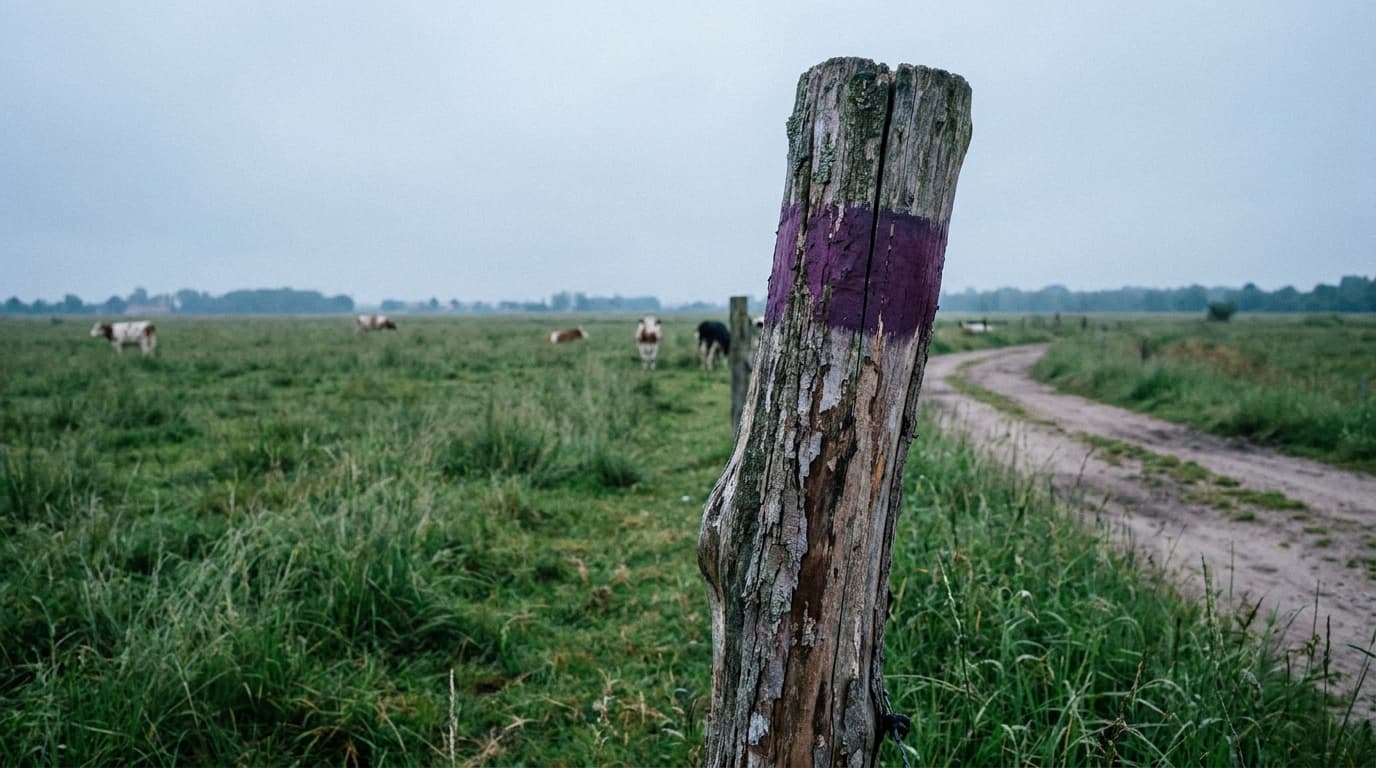
"Posting in a conspicuous manner" is defined in 13A-7-1(4) as "A sign or signs posted on the property, reasonably likely to come to the attention of intruders, indicating that entry is forbidden or the placement of identifying purple paint marks on trees or posts on the property, provided that the marks satisfy all of the following:" The three conditions are:
"a. Are vertical lines of not less than eight inches in length and not less than one inch in width. b. Are placed so that the bottom of the mark is not less than three feet from the ground or more than five feet from the ground. c. Are placed at locations that are readily visible to any person approaching the property and are no more than 100 feet apart on forest land or 1,000 feet apart on land other than forest land." (Ala. Code 13A-7-1(4))
Special trespass offenses
Criminal trespass by motor vehicle (13A-7-4.1). After being asked not to by a uniformed officer or the identified owner or agent, a person commits this offense by parking or standing a vehicle in, or repeatedly driving through, a private merchant or shopping-center customer lot posted with the sign the statute prescribes (at least one sign, and one per 150 spaces in larger lots), for a purpose other than the listed ones, such as dropping someone off at a business, using a phone or ATM, or a vehicle that can no longer travel. It is a misdemeanor punished by a fine of not more than $50 for a first offense, $100 for a second and $150 for a third or later offense.
Trespass on a school bus in the first degree (13A-7-4.2). This covers intentionally damaging a public school bus; entering one without a lawful purpose while its door is open for students, at a railroad grade crossing, or after being forbidden by the driver or a school official; refusing to leave a bus on demand; and intentionally stopping or delaying a school bus with intent to commit a crime on it. It is a Class A misdemeanor. The entering, refusing and stopping clauses do not apply to a child under 12 or to school personnel boarding as part of their job.
Unauthorized entry of a critical infrastructure facility (13A-7-4.3). A person commits this offense by intentionally entering without authority a critical infrastructure facility that is "completely enclosed by any type of physical barrier or clearly marked with a sign or signs that are posted in a conspicuous manner and indicate that unauthorized entry is forbidden"; using a fraudulent identification document to enter; remaining after being forbidden orally or in writing; or entering a marked or fully enclosed restricted area without authorization. Covered facilities include chemical and rubber plants, pipelines, refineries, power plants, transmission towers and substations, water and wastewater systems, natural gas facilities, mines, ports, airports, railroad operating facilities, communications infrastructure, regulated dams, defense contractor facilities and pulp and paper mills.
- Unauthorized entry is a Class A misdemeanor (13A-7-4.3(c)).
- A person who "intentionally, recklessly, or with criminal negligence injures, removes, destroys, or breaks critical infrastructure property, or otherwise interrupts or interferes with the operations of a critical infrastructure asset" is guilty of a Class C felony (13A-7-4.3(d)).
- Unauthorized entry "while possessing or operating an unmanned aircraft system with an attached weapon, firearm, explosive, destructive device, or ammunition" is a Class C felony (13A-7-4.3(e)). See Alabama drone laws for the state's other drone rules.
The section states that it does not prevent "lawful assembly and peaceful and orderly petition for the redress of grievances," including labor disputes, does not bar lawful government action on rights-of-way, and that subsections (b) and (d) do not apply to acts within the scope of a person's employment (13A-7-4.3(f)-(h)).
Hunting on another's land without permission (9-11-241 and 9-11-242). Hunting, trapping, capturing, injuring, killing or destroying wild game, or attempting to, on the lands of another "without the written permission of or accompanied by the landowner or person in possession or control of the lands" is a misdemeanor. Section 9-11-241 covers daylight to sunset and 9-11-242 covers sunset to daylight. A first offense is punished by a fine of not less than $1,000, and the court may revoke hunting privileges for up to one year. Under both sections, a second or later offense carries a fine of not less than $2,000, revocation of hunting privileges for one year, and 10 to 30 days in the county jail. Neither section applies to the landowner's family, guests, servants or agents, and 9-11-242 does not apply to fox hunting with dogs exclusively or to raccoon and opossum hunting with dogs only. These sections turn on written permission rather than on posting. Hunting or trapping fur-bearing animals in or on waters running through another's property, within 10 feet of the banks, without written permission or the owner's company is a separate misdemeanor with a fine of $10 to $50 per offense (9-11-243).
Squatting and the burglary line
Burglary in the third degree (13A-7-7) is knowingly entering or remaining unlawfully in a dwelling, an occupied building or an unoccupied building "with the intent to commit a crime therein," and, under subdivision (a)(4), knowingly entering or remaining unlawfully in a dwelling and intentionally causing "one thousand dollars ($1,000) or more in damage to the dwelling." It is a Class C felony. Act 2024-237 is the latest amendment in the section's history. The same act made it perjury in the second degree, a Class A misdemeanor, to knowingly present a false document purporting to be a lease, deed or other instrument giving a right to real property, with intent to civilly detain or remain on the property (13A-10-102(a)(2)). The civil process for removing an unauthorized occupant is covered on our Alabama squatters' rights page, and the rules on force against an intruder on our Alabama self-defense laws page.
Alabama disorderly conduct and trespass penalties at a glance
| Offense | Statute | What it prohibits | Class | Statutory penalty |
|---|---|---|---|---|
| Disorderly conduct | 13A-11-7 | Fighting, unreasonable noise, abusive or obscene language in public, disrupting a meeting, blocking traffic, refusing to disperse, with intent to cause (or reckless risk of) public inconvenience, annoyance or alarm | Class C misdemeanor | Up to 3 months; fine up to $500 |
| Public intoxication | 13A-11-10 | Appearing in public under the influence to the degree of endangering self, others or property, or annoying others by boisterous and offensive conduct | Violation | Up to 30 days; fine up to $200 |
| Riot | 13A-11-3 | With 5 or more others, tumultuous and violent conduct creating a grave risk of public terror or alarm | Class A misdemeanor | Up to 1 year; fine up to $6,000 |
| Inciting to riot | 13A-11-4 | Urging others to tumultuous and violent conduct likely to create a grave risk of public terror or alarm | Class A misdemeanor | Up to 1 year; fine up to $6,000 |
| Unlawful assembly | 13A-11-5 | Assembling with 5 or more others to riot, or staying to advance that purpose | Class B misdemeanor | Up to 6 months; fine up to $3,000 |
| Failure of a disorderly person to disperse | 13A-11-6 | Disorderly conduct with 5 or more others and refusing an order to disperse | Class B misdemeanor | Up to 6 months; fine up to $3,000 |
| Open house party | 13A-11-10.1 | Adult in control of a residence allowing a party to continue while knowing people under 21 are illegally drinking or using drugs there | Class B misdemeanor | Up to 6 months; fine up to $3,000 |
| Harassment; harassing communications | 13A-11-8 | Touching, abusive or obscene language or gestures, or threats aimed at a person with intent to harass, annoy or alarm; harassing calls or messages | Class C misdemeanor | Up to 3 months; fine up to $500 |
| Falsely reporting an incident | 13A-11-11 | Knowingly reporting a false fire, bomb, crime or emergency likely to cause evacuation or public alarm | Class A misdemeanor; Class C felony for a false bomb, explosion or hazardous-substance report | A: up to 1 year, fine up to $6,000; C felony: 1 year and 1 day to 10 years, fine up to $15,000; no probation when a school is the target |
| False reporting to law enforcement | 13A-10-9 | Knowingly making a false report of a crime to police | Class A misdemeanor; Class C felony if the report alleges imminent danger | A: up to 1 year, fine up to $6,000; C felony: 1 year and 1 day to 10 years, fine up to $15,000; restitution for an emergency response |
| Disrupting a funeral or memorial service | 13A-11-17 | Protesting within 1,000 feet, blocking access or impeding a procession, around the time of a service, to disrupt it | Class A misdemeanor; Class C felony for each later conviction | A: up to 1 year, fine up to $6,000; C felony: 1 year and 1 day to 10 years, fine up to $15,000 |
| Loitering | 13A-11-9 | Begging, gambling, prostitution, masked in public, school grounds after told to leave, drug use, state roadways | Violation; Class C misdemeanor for a second or later violation in the same jurisdiction | Violation: up to 30 days, up to $200; Class C: up to 3 months, up to $500 |
| Criminal trespass, third degree | 13A-7-4 | Knowingly entering or remaining unlawfully on premises | Violation | Up to 30 days; fine up to $200 |
| Criminal trespass, second degree | 13A-7-3 | Knowingly entering or remaining unlawfully in a building or on fenced or enclosed land | Class C misdemeanor | Up to 3 months; fine up to $500 |
| Criminal trespass, first degree | 13A-7-2 | Knowingly entering or remaining unlawfully in a dwelling or on licensed cannabis cultivator or processor premises | Class A misdemeanor | Up to 1 year; fine up to $6,000 |
| Criminal trespass by motor vehicle | 13A-7-4.1 | Parking or repeatedly driving in a posted private customer lot after being asked not to | Misdemeanor (fine only) | Fine up to $50 first, $100 second, $150 third or later |
| Trespass on a school bus, first degree | 13A-7-4.2 | Damaging, entering without lawful purpose or after being forbidden, refusing to leave, or stopping a school bus to commit a crime | Class A misdemeanor | Up to 1 year; fine up to $6,000 |
| Unauthorized entry of a critical infrastructure facility | 13A-7-4.3(b), (c) | Entering an enclosed or posted facility, fake ID, remaining after being forbidden, restricted areas | Class A misdemeanor | Up to 1 year; fine up to $6,000 |
| Damaging or interfering with critical infrastructure; armed drone | 13A-7-4.3(d), (e) | Injuring, removing or breaking critical infrastructure property or interfering with operations; unauthorized entry with a weaponized drone | Class C felony | 1 year and 1 day to 10 years; fine up to $15,000 |
| Hunting on another's land without permission | 9-11-241, 9-11-242 | Hunting or trapping wild game without the landowner's written permission or company | Misdemeanor | First offense: fine of at least $1,000, possible license revocation; second or later (either section): at least $2,000, revocation and 10 to 30 days |
| Perjury, second degree (false lease or deed) | 13A-10-102(a)(2) | Knowingly presenting a false lease, deed or similar document to remain on real property | Class A misdemeanor | Up to 1 year; fine up to $6,000 |
| Domestic violence, third degree | 13A-6-132 | Third-degree trespass, harassment or another listed offense against a current or former spouse, a listed relative, a co-parent, an intimate household member or a dating partner | Class A misdemeanor; Class C felony on a third or later conviction or after a listed prior domestic violence conviction | A: up to 1 year; fine up to $6,000; C felony: 1 year and 1 day to 10 years; fine up to $15,000 |
| Burglary, third degree | 13A-7-7 | Unlawful entry of a dwelling or building with intent to commit a crime, or of a dwelling causing $1,000 or more in damage | Class C felony | 1 year and 1 day to 10 years; fine up to $15,000 |
The class ranges come from Alabama's sentencing sections. Misdemeanor jail terms are set by 13A-5-7 (Class A not more than one year, Class B not more than six months, Class C not more than three months, violations not more than 30 days), and misdemeanor and violation fines by 13A-5-12 (Class A up to $6,000, Class B up to $3,000, Class C up to $500, violations up to $200, or in each case any amount up to double the defendant's gain or the victim's loss). A Class C felony carries "not more than 10 years or less than one year and one day" (13A-5-6(a)(3)) and a fine of up to $15,000 (13A-5-11(a)(3)). If a firearm or deadly weapon was used or attempted to be used in a Class C felony, the term is not less than 10 years (13A-5-6(a)(6)). For the full class table, see Alabama felony classes and misdemeanor penalties.

Recent changes
- Act 2024-237 is the most recent amendment to the third-degree burglary statute, 13A-7-7, which now includes knowingly entering or remaining unlawfully in a dwelling and intentionally causing $1,000 or more in damage. The same act added the false-lease or false-deed form of second-degree perjury (13A-10-102(a)(2)).
- Act 2025-64 is the most recent amendment to the critical infrastructure statute, 13A-7-4.3, which was also amended by Acts 2022-34 and 2024-395.
- Act 2024-345 is the most recent amendment to false reporting to law enforcement, 13A-10-9.
- Act 2024-326 is the most recent amendment to the loitering statute, 13A-11-9, which covers state-maintained roadways, their rights-of-way and areas within 30 feet of a controlled-access highway interchange (also amended by Act 2023-245).
- Act 2022-133 is the most recent amendment to the disorderly conduct statute, 13A-11-7. Its history also lists Act 2013-283, the act named in subsection (d).
- Act 2021-450 is the most recent amendment to first-degree criminal trespass, 13A-7-2, which now covers licensed cannabis cultivator and processor premises.
Related Alabama laws
- Disorderly conduct and trespass laws by state
- Alabama noise laws: quiet hours, loud neighbors and penalties
- Alabama felony classes and misdemeanor penalties
- Alabama squatters' rights
- Alabama self-defense laws
- Alabama assault laws
- Alabama drone laws
- Alabama expungement laws
This article provides general legal information about Alabama statutes, not legal advice. For advice about a specific situation, contact a lawyer licensed in Alabama.
Last updated: 2026-10-18.
Frequently Asked Questions
Is disorderly conduct a misdemeanor in Alabama?
Yes. Disorderly conduct under Ala. Code 13A-11-7 is a Class C misdemeanor, punishable by up to 3 months in jail (13A-5-7) and a fine of up to $500 (13A-5-12).
What counts as disorderly conduct in Alabama?
Section 13A-11-7 covers fighting or violent or threatening behavior, unreasonable noise, abusive or obscene language or gestures in a public place, disturbing a lawful meeting, obstructing traffic, and refusing a lawful order to disperse. Each requires intent to cause public inconvenience, annoyance or alarm, or recklessly creating a risk of it.
Is cursing in public disorderly conduct in Alabama?
Clause (a)(3) of 13A-11-7 covers using abusive or obscene language or making an obscene gesture in a public place, but only when done with intent to cause public inconvenience, annoyance or alarm, or recklessly creating a risk of it. Directing abusive or obscene language or an obscene gesture at a particular person with intent to harass, annoy or alarm that person is harassment under 13A-11-8, also a Class C misdemeanor.
Is public intoxication a crime in Alabama?
Public intoxication under 13A-11-10 is a violation, the lowest grade, punishable by up to 30 days and a fine of up to $200. It applies when a person in public is under the influence to the degree of endangering self, others or property, or annoys others by boisterous and offensive conduct.
What are the degrees of criminal trespass in Alabama?
Third degree (13A-7-4), entering or remaining unlawfully on premises, is a violation. Second degree (13A-7-3), a building or fenced or enclosed land, is a Class C misdemeanor. First degree (13A-7-2), a dwelling or licensed cannabis grow or processing site, is a Class A misdemeanor, up to 1 year and $6,000.
Is trespassing a felony in Alabama?
None of the three degrees of criminal trespass is a felony in itself, but third-degree trespass against a current or former spouse, a listed relative, a co-parent, an intimate household member or a dating partner is third-degree domestic violence under 13A-6-132, a Class C felony on a third or later conviction or after a listed prior domestic violence conviction. Damaging or interfering with critical infrastructure, or entering a critical infrastructure facility with a weaponized drone, is a Class C felony under 13A-7-4.3, and so is third-degree burglary under 13A-7-7.
Does Alabama have a purple paint law?
Yes. Section 13A-7-1(4) counts purple paint marks as posting in a conspicuous manner if they are vertical lines at least 8 inches long and 1 inch wide, 3 to 5 feet off the ground, readily visible, and no more than 100 feet apart on forest land or 1,000 feet apart on other land.
Do I need a no trespassing sign in Alabama?
For unimproved, apparently unused land that is not fenced or enclosed, a person is there with license unless the owner or an authorized person personally gives notice or the land is posted in a conspicuous manner, by signs or purple paint (13A-7-1(3), (4)). That posting rule appears in the definition for unimproved, apparently unused land that is neither fenced nor enclosed.
What happens if a store tells you to leave in Alabama?
Under 13A-7-1(3), a person in a place open to the public is there with license unless they defy a lawful order not to enter or remain, personally communicated by the owner or another authorized person. Knowingly remaining unlawfully in a building is second-degree criminal trespass, a Class C misdemeanor (13A-7-3).
What is the fine for hunting without permission in Alabama?
Hunting wild game on another's land without the owner's written permission or company is a misdemeanor with a fine of at least $1,000 for a first offense and possible loss of hunting privileges for up to a year (9-11-241, 9-11-242). A second or later offense under either section carries at least $2,000, license revocation and 10 to 30 days in jail.
Updates
Independently fact-checked against the cited primary sources
The Law Behind This Article
This article rests on the statutory provisions below, held in our own legal record and retrieved from the official source. Tap a section to read the operative text.
Code of Alabama 1975, Title 13A: Criminal Code.
§ 13A-11-7Disorderly Conduct.In forcecited in 2 of our articles
(a) A person commits the crime of disorderly conduct if, with intent to cause public inconvenience, annoyance, or alarm, or recklessly creating a risk thereof, he or she does any of the following: (1) Engages in fighting or in violent tumultuous or threatening behavior. (2) Makes unreasonable noise. (3) In a public place uses abusive or obscene language or makes an obscene gesture. (4) Without lawful authority, disturbs any lawful assembly or meeting of persons. (5) Obstructs vehicular or pedestrian traffic, or a transportation facility. (6) Congregates with other person in a public place and refuses to comply with a lawful order of law enforcement to disperse. (b) Disorderly conduct is a Class C misdemeanor. (c) The mere carrying of a pistol, holstered or otherwise secured on or about one’s person, without brandishing the weapon, in a public place, in and of itself, is not a violation of this section. For purposes of this subsection, “brandishing” shall mean the waving, flourishing, displaying, or holding of an item in a manner that is threatening or would appear threatening to a reasonable person, with or without explicit verbal threat, or in a wanton or reckless manner.
Official text (excerpt) · last checked 2026-07-29 · Read the full text in our law library · Verify at alison.legislature.state.al.us
Also relied on in: Alabama Noise Laws: Quiet Hours, Loud Neighbors and Penalties (2026)
§ 13A-7-2Criminal Trespass in the First Degree.In forcecited in 2 of our articles
(a) A person is guilty of criminal trespass in the first degree if he knowingly enters or remains unlawfully in a dwelling or on the premises of any cultivator or processor, as those terms are defined in Section 20-2A-3, or on the premises of any cultivation or processing operation that is part of an integrated facility, as defined in Section 20-2A-3. (b) Criminal trespass in the first degree is a Class A misdemeanor.
Official text (excerpt) · last checked 2026-07-29 · Read the full text in our law library · Verify at alison.legislature.state.al.us
Cited in 1 court opinions in our collectionLatest citing opinion in our collection: 1998
Opinions citing this section in our collection:
- Lanier v. State (Court of Criminal Appeals of Alabama 1998, 733 So. 2d 931)“…f he knowingly enters or remains unlawfully in a dwelling." Ala. Code 1975, § 13A-7-2 (a).…”
Identified automatically from the court opinions citing this section — not a ranking of which case controls.
Also relied on in: Alabama Voyeurism Laws: Hidden Cameras, Penalties, and Victim Rights
§ 13A-7-3Criminal Trespass in the Second Degree.In force
(a) A person is guilty of criminal trespass in the second degree if he knowingly enters or remains unlawfully in a building or upon real property which is fenced or enclosed in a manner designed to exclude intruders. (b) Criminal trespass in the second degree is a Class C misdemeanor.
Official text (excerpt) · last checked 2026-07-29 · Read the full text in our law library · Verify at alison.legislature.state.al.us
§ 13A-7-4Criminal Trespass in the Third Degree.In forcecited in 2 of our articles
(a) A person is guilty of criminal trespass in the third degree when he knowingly enters or remains unlawfully in or upon premises. (b) Criminal trespass in the third degree is a violation.
Official text (excerpt) · last checked 2026-07-29 · Read the full text in our law library · Verify at alison.legislature.state.al.us
Cited in 4 court opinions in our collectionLatest citing opinion in our collection: 2025
Opinions citing this section in our collection:
- Freeman (District Court, N.D. Alabama 2025)“…owingly enters or remains unlawfully in or upon premises.” Ala. Code § 13A-7-4(a). Because Mr. Freeman pleaded the do…”
- George D. Metz, II v. D. Bridges (Court of Appeals for the Eleventh Circuit 2024)“…enters or remains unlawfully in or upon premises.” Ala. Code § 13A-7-4(a). Alabama also has a “stop and…”
- Bobby Edgar v. Marion Brunson (Court of Appeals for the Eleventh Circuit 2024)“…Opinion of the Court 24-10412 Ala. Code § 13A-7-4(a) (“A person is guilty of criminal tre…”
Identified automatically from the court opinions citing this section — not a ranking of which case controls.
Also relied on in: Alabama Drone Laws (2026): Privacy, Prisons & Police Warrants
§ 13A-7-1Definitions.In force
The following definitions are applicable to this article: (1) BUILDING. Any structure which may be entered and utilized by persons for business, public use, lodging or the storage of goods, and such term includes any vehicle, aircraft or watercraft used for the lodging of persons or carrying on business therein, and such term includes any railroad box car or other rail equipment or trailer or tractor trailer or combination thereof. Where a building consists of two or more units separately occupied or secure, each shall be deemed both a separate building and a part of the main building. (2) DWELLING. A building which is used or normally used by a person for sleeping, living or lodging therein. (3) ENTER OR REMAIN UNLAWFULLY. A person “enters or remains unlawfully” in or upon premises when he is not licensed, invited or privileged to do so. A person who, regardless of his intent, enters or remains in or upon premises which are at the time open to the public does so with license and privilege unless he defies a lawful order not to enter or remain, personally communicated to him by the owner of such premises or other authorized person.
Official text (excerpt) · last checked 2026-07-29 · Read the full text in our law library · Verify at alison.legislature.state.al.us
§ 13A-11-10Public Intoxication.In force
(a) A person commits the crime of public intoxication if he appears in a public place under the influence of alcohol, narcotics or other drug to the degree that he endangers himself or another person or property, or by boisterous and offensive conduct annoys another person in his vicinity. (b) Public intoxication is a violation.
Official text (excerpt) · last checked 2026-07-29 · Read the full text in our law library · Verify at alison.legislature.state.al.us
§ 13A-11-9Loitering.In force
(a) A person commits the crime of loitering if he or she does any of the following: (1) Loiters, remains, or wanders about in a public place for the purpose of begging. (2) Loiters or remains in a public place for the purpose of gambling. (3) Loiters or remains in a public place for the purpose of engaging or soliciting another person to engage in prostitution or sodomy. (4) Being masked, loiters, remains, or congregates in a public place. (5) Loiters or remains in or about a school, college, or university building or grounds after having been told to leave by any authorized official of the school, college, or university, not having any reason or relationship involving custody of or responsibility for a pupil or any other specific, legitimate reason for being there, and not having written permission from a school, college, or university administrator. (6) Loiters or remains in any transportation facility, unless specifically authorized to do so, for the purpose of soliciting or engaging in any business, trade, or commercial transactions involving the sale of merchandise or services.
Official text (excerpt) · last checked 2026-07-29 · Read the full text in our law library · Verify at alison.legislature.state.al.us
§ 13A-11-6Failure of Disorderly Persons to Disperse.In force
(a) A person commits the crime of failure of a disorderly person to disperse if he participates with five or more other persons in a course of disorderly conduct likely to cause substantial harm or serious inconvenience, annoyance or alarm, and intentionally refuses or fails to disperse when ordered to do so by a peace officer or other public servant lawfully engaged in executing or enforcing the law. (b) Failure of a disorderly person to disperse is a Class B misdemeanor.
Official text (excerpt) · last checked 2026-07-29 · Read the full text in our law library · Verify at alison.legislature.state.al.us
§ 13A-11-3Riot.In force
(a) A person commits the crime of riot if, with five or more other persons, he wrongfully engages in tumultuous and violent conduct and thereby intentionally or recklessly causes or creates a grave risk of public terror or alarm. (b) Riot is a Class A misdemeanor.
Official text (excerpt) · last checked 2026-07-29 · Read the full text in our law library · Verify at alison.legislature.state.al.us
§ 13A-7-4.3Unauthorized Entry of a Critical Infrastructure Facility.In forcecited in 2 of our articles
(a) For the purposes of this section, the following terms have the following meanings: (1) CRITICAL INFRASTRUCTURE. A system or asset, whether physical or virtual, so vital to the United States that the incapacity or destruction of the system or asset would have a debilitating impact on security, national economic security, national public health, or national public safety. (2) CRITICAL INFRASTRUCTURE FACILITY. The term includes, but is not limited to, any of the following, including any critical infrastructure located on or in any of the following types of facilities: a. A chemical, polymer, or rubber manufacturing facility. b. A pipeline. c. A refinery. d. An electrical power generating facility. e. The area surrounding an electrical power generating facility. f. An electrical transmission tower. g. An electrical substation or distribution substation. h. An electric utility control center. i. Electrical communication equipment. j. An electrical switching station. k. Electric power lines, power storage equipment, or other utility equipment. l. Any portion of a public water system or public wastewater treatment system. m.
Official text (excerpt) · last checked 2026-07-29 · Read the full text in our law library · Verify at alison.legislature.state.al.us
§ 13A-5-7Sentences of Imprisonment for Misdemeanors and Violations.In forcecited in 7 of our articles
(a) Sentences for misdemeanors shall be a definite term of imprisonment in the county jail or to hard labor for the county, within the following limitations: (1) For a Class A misdemeanor, not more than one year. (2) For a Class B misdemeanor, not more than six months. (3) For a Class C misdemeanor, not more than three months. (b) Sentences for violations shall be for a definite term of imprisonment in the county jail, not to exceed 30 days.
Official text (excerpt) · last checked 2026-07-29 · Read the full text in our law library · Verify at alison.legislature.state.al.us
Cited in 9 court opinions in our collectionLatest citing opinion in our collection: 2025
Opinions citing this section in our collection:
- Donley v. City of Mountain Brook (Court of Criminal Appeals of Alabama 1982, 429 So. 2d 603)“…against him is three months' imprisonment as provided under Ala. Code § 13A-5-7 (a)(3) (Supp. 1981). We disagree. Mo…”
- Shirah v. State (Court of Criminal Appeals of Alabama 1989, 555 So. 2d 807)“…for a Class A misdemeanor is for "not more than one year." Ala. Code, § 13A-5-7 (1975). The appellant's sentence did n…”
- R.L.L. v. State (Court of Criminal Appeals of Alabama 1990, 564 So. 2d 474)“…Such a conviction carries a sentence of up to six months. Ala.Code § 13A-5-7(a)(2) (1975). According to the appellan…”
Identified automatically from the court opinions citing this section — not a ranking of which case controls.
Also relied on in: Alabama Audio Recording Laws: Consent Rules and Penalties, Alabama Phone Call Recording Laws: What You Need to Know, Alabama Hit and Run Laws: Penalties, Statutes, and Defenses
§ 13A-5-12Fines for Misdemeanors and Violations.In forcecited in 5 of our articles
(a) A sentence to pay a fine for a misdemeanor shall be for a definite amount, fixed by the court, within the following limitations: (1) For a Class A misdemeanor, not more than $6,000; (2) For a Class B misdemeanor, not more than $3,000; (3) For a Class C misdemeanor, not more than $500; or (4) Any amount not exceeding double the pecuniary gain to the defendant or loss to the victim caused by the commission of the offense. (b) A sentence to pay a fine for a violation shall be for a definite amount, fixed by the court, not to exceed $200, or any amount not exceeding double the pecuniary gain to the defendant or loss to the victim caused by the commission of the offense. (c) As used in this section, “gain” means the amount of money or the value of property derived from the commission of the crime, less the amount of money or the value of property returned to the victim of the crime or seized or surrendered to lawful authority prior to the time sentence is imposed. “Value” shall be determined by the standards established in subdivision (14) of Section 13A-8-1.
Official text (excerpt) · last checked 2026-07-29 · Read the full text in our law library · Verify at alison.legislature.state.al.us
Also relied on in: Alabama Assault Laws: Degrees, Menacing, Felonies and Penalties, Alabama Felony Classes and Misdemeanor Penalties (2026)
Search our full record of US law — 2.1 million sections, every state + federal →
Sources and References
- Ala. Code 13A-11-7, Disorderly conduct(alison.legislature.state.al.us).gov
- Ala. Code 13A-7-4, Criminal trespass in the third degree(alison.legislature.state.al.us).gov
- Ala. Code 13A-7-3, Criminal trespass in the second degree(alison.legislature.state.al.us).gov
- Ala. Code 13A-7-2, Criminal trespass in the first degree(alison.legislature.state.al.us).gov
- Ala. Code 13A-11-1, Definitions (public place; obstruct; transportation facility)(alison.legislature.state.al.us).gov
- Ala. Code 13A-5-7, Sentences of imprisonment for misdemeanors and violations(alison.legislature.state.al.us).gov
- Ala. Code 13A-5-12, Fines for misdemeanors and violations(alison.legislature.state.al.us).gov
- Ala. Code 13A-11-10, Public intoxication(alison.legislature.state.al.us).gov
- Ala. Code 13A-11-3, Riot(alison.legislature.state.al.us).gov
- Ala. Code 13A-11-4, Inciting to riot(alison.legislature.state.al.us).gov
- Ala. Code 13A-11-5, Unlawful assembly(alison.legislature.state.al.us).gov
- Ala. Code 13A-11-6, Failure of disorderly persons to disperse(alison.legislature.state.al.us).gov
- Ala. Code 13A-11-9, Loitering(alison.legislature.state.al.us).gov
- Ala. Code 13A-7-1, Definitions (enter or remain unlawfully; posting in a conspicuous manner)(alison.legislature.state.al.us).gov
- Ala. Code 13A-7-4.1, Criminal trespass by motor vehicle(alison.legislature.state.al.us).gov
- Ala. Code 13A-7-4.2, Trespass on a school bus in the first degree(alison.legislature.state.al.us).gov
- Ala. Code 13A-7-4.3, Unauthorized entry of a critical infrastructure facility(alison.legislature.state.al.us).gov
- Ala. Code 9-11-241, Hunting wild game by day on lands of another without permission(alison.legislature.state.al.us).gov
- Ala. Code 9-11-242, Hunting wild game at night on lands of another without permission(alison.legislature.state.al.us).gov
- Ala. Code 13A-7-7, Burglary in the third degree(alison.legislature.state.al.us).gov
- Ala. Code 13A-5-6, Sentences of imprisonment for felonies(alison.legislature.state.al.us).gov
- Ala. Code 13A-5-11, Fines for felonies(alison.legislature.state.al.us).gov
- Ala. Code 13A-11-8, Harassment or harassing communications(alison.legislature.state.al.us).gov
- Ala. Code 13A-11-11, Falsely reporting an incident(alison.legislature.state.al.us).gov
- Ala. Code 13A-10-9, False reporting to law enforcement authorities(alison.legislature.state.al.us).gov
- Ala. Code 13A-11-17, Disrupting a funeral or memorial service(alison.legislature.state.al.us).gov
- Ala. Code 13A-11-10.1, Open house parties(alison.legislature.state.al.us).gov
- Ala. Code 13A-10-102, Perjury in the second degree(alison.legislature.state.al.us).gov
- Ala. Code 9-11-243, Fur-bearing animals within 10 feet of banks of waters on property of another(alison.legislature.state.al.us).gov
- Ala. Code 13A-6-132, Domestic violence in the third degree(alison.legislature.state.al.us).gov
Paid attorney referral. RecordingLaw may receive compensation when you use an attorney-help link. RecordingLaw is not a law firm. Submitting a request does not guarantee that an attorney will accept your case and does not create an attorney-client relationship.