
United Kingdom
Building Regulations UK: Approval, Completion Certificates and Enforcement by Nation
Independently fact-checked against primary sources (last audited September 28, 2026). · 12 primary sources cited on this page. How we verify our legal content
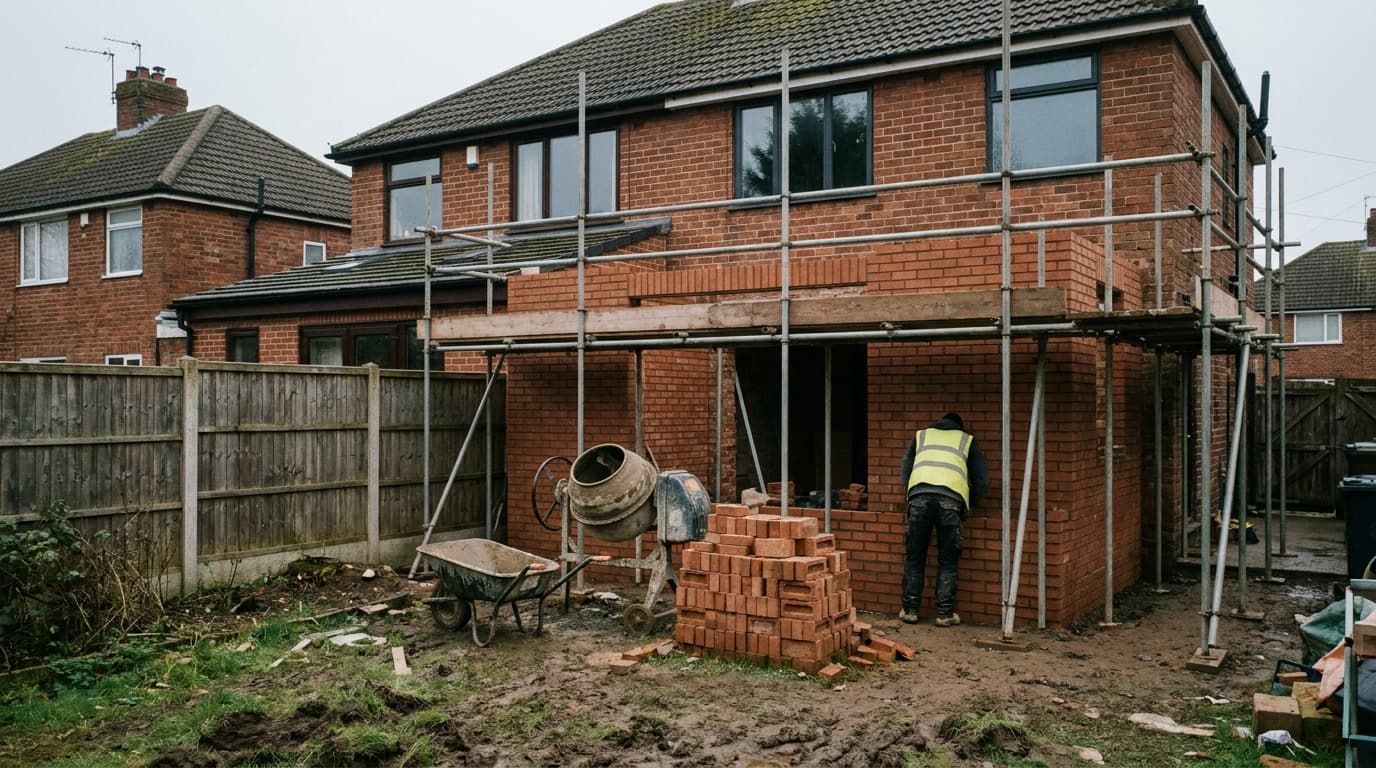
Building regulations approval is a separate requirement from planning permission, and each UK nation runs its own regime: England and Wales share the Building Act 1984 mechanism, Scotland uses a building warrant and completion certificate system under its own 2003 Act, and Northern Ireland runs its own 1979 Order with a shorter enforcement time limit than England or Wales.
Building regulations and planning permission are different approvals
Planning permission controls whether a development is allowed at all: its use, scale, appearance and impact on neighbours. Building regulations approval is a separate, technical check on how the work is actually built, covering matters such as structural safety, fire safety, damp proofing, ventilation, drainage, electrical safety and energy efficiency. A single project, such as a home extension, can need both approvals at once, one without the other, or neither. See planning permission for the separate consent controlling whether the development itself is allowed.
What typically needs building regulations approval
Common homeowner projects that generally need approval include replacing a fuse box and its connected electrics, installing a bathroom that involves new plumbing, changing electrics near a bath or shower, fitting a fixed air conditioning system, replacing windows and doors, replacing roof coverings on a pitched or flat roof, installing or replacing a heating system, and adding extra radiators to an existing heating system. Without approval, a homeowner will not have the compliance certificate that can matter when selling the property later (gov.uk: building regulations approval). You can arrange approval through either your local authority's building control department, or a private registered building control approver, same source. You do not need to get approval yourself if you use someone registered with a competent person scheme (same source).
England and Wales: the Building Act 1984 regime
England and Wales share the Building Act 1984 and the Building Regulations 2010 made under it. The enforcement mechanism is a section 36 notice: the building control authority (the local authority, or the Building Safety Regulator for higher-risk buildings in England), not a private approver, can require the removal or alteration of work that contravenes the regulations. The original 1984 Act gave a 12 month time limit from completion of the work for issuing that notice (legislation.gov.uk: Building Act 1984, section 36).
The Building Safety Act 2022 substituted a 10 year limit for that 12 month figure. Commencement did not happen at the same time in both nations: the change took full effect in England from 1 October 2023, but in Wales the 10 year limit did not fully commence until 1 July 2026, after an earlier partial commencement in September 2023 covered only specified purposes (same source). As of 28 September 2026, both nations are now on the 10 year limit, but they reached it roughly 33 months apart under the same Act.
Scotland: building warrant and completion certificate
Scotland runs an entirely different Act: the Building (Scotland) Act 2003 (legislation.gov.uk: Building (Scotland) Act 2003). Instead of building control approving work after the fact, Scotland requires a building warrant before work starts, and a completion certificate once it finishes, both checked by a verifier, which at present is always the local authority for the area; approved certifiers of design and of construction are a separate role under the Act and are not verifiers (legislation.gov.uk: Building (Scotland) Act 2003, section 7; gov.scot: building standards procedural handbook, section 12).
Occupying or using a building constructed or converted under a warrant (or without one where a warrant was required), other than for construction or conversion purposes, knowing that no completion certificate has been accepted or without any regard for whether one has, and without a temporary permission from the verifier, is its own criminal offence under section 21 of the Act (construction here does not include alteration), carrying a fine up to the statutory maximum on summary conviction, or an unlimited fine on indictment (legislation.gov.uk: Building (Scotland) Act 2003, section 21). There is no equivalent standalone "moving in early is a crime" offence for ordinary homes and extensions in England, Wales or Northern Ireland: their offence is contravening the building regulations themselves, not occupying the building before sign off. The exception is England's higher-risk building regime: the accountable person commits an offence if homes in a newly built or newly created higher-risk building (at least 18 metres or 7 storeys, with at least 2 homes) are occupied before a completion certificate is issued (legislation.gov.uk: Building Safety Act 2022, section 76; section 65).
Northern Ireland: its own regime, and no 10 year extension
Northern Ireland runs the Building Regulations (Northern Ireland) Order 1979, administered by district councils. A contravention notice cannot be served after a prescribed period that is not more than 12 months from the date of completion of the work in question (legislation.gov.uk: Building Regulations (Northern Ireland) Order 1979, Article 18). Unlike England and Wales, this limit was not extended to 10 years by the Building Safety Act 2022, which does not apply to Northern Ireland's Order. Northern Ireland's offence, under Article 21, is also contravention based, breaching the regulations or a contravention notice, and has no standalone occupation offence matching Scotland's section 21 (legislation.gov.uk: Building Regulations (Northern Ireland) Order 1979, Article 21).
A separate civil claim: the Defective Premises Act 1972
The Building Safety Act 2022 also extended the limitation period for a civil claim over a badly built or converted dwelling under the Defective Premises Act 1972. This is a different mechanism from the regulatory enforcement notices above: it is a claim a homeowner can bring in the civil courts, not a council's own enforcement power. The new limitation period is 15 years for a claim accruing on or after 28 June 2022, and 30 years for a claim that had already accrued before that date (legislation.gov.uk: Limitation Act 1980, section 4B). This extension applies in England and Wales only. The longer retrospective period does not reopen a claim that was settled by agreement, or finally decided by a court or arbitration, before 28 June 2022 (legislation.gov.uk: Building Safety Act 2022, section 135).
Related reading
For whether your project needs a separate planning consent as well, see planning permission. For the wider set of property topics, see the UK property law hub.

Frequently Asked Questions
Is building regulations approval the same as planning permission?
No. Planning permission controls whether a development is allowed at all. Building regulations approval is a separate, technical check on how the work is actually built, covering matters such as structure, fire safety and electrics. A project can need one, the other, or both.
How long does a council have to take enforcement action over a building regulations breach in England?
10 years from completion of the work, since 1 October 2023, up from the original 12 month limit. Wales reached the same 10 year limit later, from 1 July 2026.
Is it illegal to move into a property before building control signs it off?
In Scotland, it can be: occupying or using a building constructed or converted under a warrant before its completion certificate is accepted, knowing that none has been accepted or without any regard for whether it has, and without temporary permission from the verifier, is a criminal offence under section 21 of the Building (Scotland) Act 2003. In England, Wales and Northern Ireland there is no equivalent offence for ordinary homes and extensions; the offence there is contravening the regulations themselves. England does make it an offence for the accountable person to let homes in a new higher-risk building (at least 18 metres or 7 storeys, with at least 2 homes) be occupied before a completion certificate is issued.
Does Northern Ireland have a 10 year building regulations enforcement limit like England?
No. Northern Ireland's contravention notice time limit stays capped at not more than 12 months from completion of the work, under the Building Regulations (Northern Ireland) Order 1979. It was not extended by the Building Safety Act 2022, which does not apply to Northern Ireland's Order.
How long can I be sued over defective building work under the Defective Premises Act 1972?
15 years from when the right of action accrued, for a claim accruing on or after 28 June 2022. If the claim had already accrued before that date, the limitation period is 30 years instead. This applies in England and Wales only.
Who checks building work in Scotland instead of building control?
A verifier, which at present is always the local authority for the area, grants the building warrant before work starts and accepts the completion certificate once it finishes; approved certifiers can certify some design or construction work, but the council remains the verifier. This is a different structure from the local authority or registered building control approver model used in England and Wales.
Updates
Independently fact-checked against the cited primary sources
The Law Behind This Article
This article rests on the statutory provisions below, held in our own legal record and retrieved from the official source. Tap a section to read the operative text.
Building (Scotland) Act 2003
s. 21Occupation or use without completion certificatesIn force
(1) This section applies to a building which is being, or has been, constructed or converted— (a) by virtue of a building warrant or, (b) in a case where such a warrant is required under section 8, without such a warrant, if the condition specified in subsection (2) is satisfied. (2) That condition is that no completion certificate has been accepted in respect of the construction or conversion under section 18(1). (3) On an application made to the verifier— (a) where the construction or conversion is being, or has been, carried out otherwise than on behalf of another person, by the person carrying out, or who carried out, the construction or conversion, (b) where the construction or conversion is being, or has been, carried out by a person on behalf of another person, by that other person, (c) in any case, by the owner of the building in question, the verifier may grant permission for the temporary occupation or use of the building during such period as is specified in the permission and must, where it does so, send a copy of the permission to the local authority (unless the verifier is the local authority).
Official text (excerpt) · last checked 2026-08-14 · Read the full text in our law library · Verify at legislation.gov.uk
s. 7Verifiers and certifiersIn force
(1) For the purposes of this Act the Scottish Ministers may appoint persons (whether individuals or bodies corporate or unincorporate and including public bodies and office-holders) as— (a) verifiers, (b) approved certifiers of design, (c) approved certifiers of construction. (2) The Scottish Ministers may approve schemes in accordance with which persons (whether individuals or bodies corporate or unincorporate) who are for the time being members of the schemes are entitled to exercise for the purposes of this Act the functions of (either or both)— (a) an approved certifier of design, (b) an approved certifier of construction, and references in this Act to approved certifiers of design or approved certifiers of construction include (unless the context requires otherwise) any persons who are by virtue of their membership of any such scheme entitled to exercise the functions of such certifiers.
Official text (excerpt) · last checked 2026-08-14 · Read the full text in our law library · Verify at legislation.gov.uk
Limitation Act 1980
s. 4bSpecial time limit for certain actions in respect of damage or defects in relation to buildingsIn force
(1) Where by virtue of a relevant provision a person becomes entitled to bring an action against any other person, no action may be brought after the expiration of 15 years from the date on which the right of action accrued. (2) An action referred to in subsection (1) is one to which— (a) sections 1, 28, 32, 35, 37 and 38 apply; (b) the other provisions of this Act do not apply. (3) In this section “ relevant provision ” means— (a) section 1 or 2A of the Defective Premises Act 1972; (b) section 38 of the Building Act 1984. (4) Where by virtue of section 1 of the Defective Premises Act 1972 a person became entitled, before the commencement date, to bring an action against any other person, this section applies in relation to the action as if the reference in subsection (1) to 15 years were a reference to 30 years. (5) In subsection (4) “ the commencement date ” means the day on which section 135 of the Building Safety Act 2022 came into force.
Official text (excerpt) · last checked 2026-08-14 · Read the full text in our law library · Verify at legislation.gov.uk
Building Act 1984
s. 36Removal or alteration of offending work.In force
(1) If any work to which building regulations are applicable contravenes any of those regulations or a requirement imposed by virtue of any of those regulations , the building control authority , without prejudice to their right to take proceedings for a fine in respect of the contravention, may by notice require the owner— (a) to pull down or remove the work, or (b) if he so elects, to effect such alterations in it as may be necessary to make it comply with the regulations. (2) If, in a case where the building control authority are, by any of sections 19 to 25 , expressly required or authorised to reject an application for building control approval , any work to which building regulations are applicable is executed— (a) without such an application having been made, (b) notwithstanding the refusal of such an application, or (c) otherwise than in accordance with any requirements subject to which the authority granted such an application , the authority may by notice to the owner— (i) require him to pull down or remove the work, or (ii) require him either to pull down or remove the work or, if he so elects, to comply with any other requirements specifed in the notice, being requireme
Official text (excerpt) · last checked 2026-08-14 · Read the full text in our law library · Verify at legislation.gov.uk
Building Safety Act 2022
s. 135Limitation periodsIn force
(1) After section 4A of the Limitation Act 1980 insert— Special time limit for certain actions in respect of damage or defects in relation to buildings (4B) (1) Where by virtue of a relevant provision a person becomes entitled to bring an action against any other person, no action may be brought after the expiration of 15 years from the date on which the right of action accrued. (2) An action referred to in subsection (1) is one to which— (a) sections 1, 28, 32, 35, 37 and 38 apply; (b) the other provisions of this Act do not apply. (3) In this section “ relevant provision ” means— (a) section 1 or 2A of the Defective Premises Act 1972; (b) section 38 of the Building Act 1984. (4) Where by virtue of section 1 of the Defective Premises Act 1972 a person became entitled, before the commencement date, to bring an action against any other person, this section applies in relation to the action as if the reference in subsection (1) to 15 years were a reference to 30 years. (5) In subsection (4) “ the commencement date ” means the day on which section 135 of the Building Safety Act 2022 came into force.
Official text (excerpt) · last checked 2026-08-14 · Read the full text in our law library · Verify at legislation.gov.uk
s. 65Meaning of “higher-risk building” etcIn force
(1) In this Part “ higher-risk building ” means a building in England that— (a) is at least 18 metres in height or has at least 7 storeys, and (b) contains at least 2 residential units. (2) The Secretary of State may by regulations make provision supplementing this section. (3) The regulations may in particular— (a) define “building” or “ storey ” for the purposes of this section; (b) make provision about how the height of a building is to be determined for those purposes; (c) provide that “ higher-risk building ” does not include a building of a prescribed description. (4) Regulations made by virtue of subsection (3) (a) may in particular define “building” so as to provide that it includes— (a) any other structure or erection of any kind (whether temporary or permanent); (b) any vehicle, vessel or other movable object of any kind, in such circumstances as may be prescribed. (5) The Secretary of State may by regulations amend this section (other than subsection (2) or this subsection ). (6) For the meaning of “residential unit” see section 115.
Official text (excerpt) · last checked 2026-08-14 · Read the full text in our law library · Verify at legislation.gov.uk
s. 76Requirement for completion certificate before occupationIn force
(1) This section applies if any of the following works are carried out— (a) the construction of a higher-risk building; (b) the creation of additional residential units in such a building; (c) works to a building that cause it to become a higher-risk building. (2) If a relevant residential unit is occupied before a completion certificate relating to a relevant part of the building is issued, the relevant accountable person commits an offence. (3) It is a defence for a person charged with an offence under this section to prove that the person had a reasonable excuse for the residential unit being occupied before such a completion certificate was issued. (4) A person guilty of an offence under this section is liable— (a) on summary conviction, to imprisonment for a term not exceeding the maximum summary term for either-way offences or a fine (or both); (b) on conviction on indictment, to imprisonment for a term not exceeding two years or a fine (or both). (5) In this section— “ completion certificate ” means a certificate of a prescribed description that is issued under regulations made under section 1(1) of the Building Act 1984 (building regulations);
Official text (excerpt) · last checked 2026-08-14 · Read the full text in our law library · Verify at legislation.gov.uk
Search our record of UK legislation — retrieved from legislation.gov.uk →
Sources and References
- Building regulations approval(gov.uk).gov
- Building Act 1984, section 36(legislation.gov.uk).gov
- Building (Scotland) Act 2003(legislation.gov.uk).gov
- Building (Scotland) Act 2003, section 21(legislation.gov.uk).gov
- Building Regulations (Northern Ireland) Order 1979, Article 18(legislation.gov.uk).gov
- Building Regulations (Northern Ireland) Order 1979, Article 21(legislation.gov.uk).gov
- Limitation Act 1980, section 4B(legislation.gov.uk).gov
- Building (Scotland) Act 2003, section 7(legislation.gov.uk).gov
- Building standards procedural handbook, third edition, section 12: verifiers(gov.scot).gov
- Building Safety Act 2022, section 76(legislation.gov.uk).gov
- Building Safety Act 2022, section 65(legislation.gov.uk).gov
- Building Safety Act 2022, section 135(legislation.gov.uk).gov