Economists Estimated That the 2018 Washer Tariff Raised Dryer Prices Too

Independently fact-checked against primary sources (last audited November 10, 2026). · 16 primary sources cited on this page. How we verify our legal content
See Recording Law first on Google. Add us as a preferred source to see more of our legal news when you search.
Add on GoogleOn June 28, 2017, Samsung executives stood in Washington with Commerce Secretary Wilbur Ross, South Carolina Gov. Henry McMaster and Sen. Lindsey Graham to announce a home appliance factory in Newberry County, S.C. The $380 million plant, the company said, "will generate 954 local jobs by 2020."
Four weeks earlier, Whirlpool had asked the federal government to restrict imports of large residential washing machines, a case aimed at Samsung and LG. The company said its petition was "led by 2,464 of its more than 3,000 Clyde, Ohio, manufacturing employees." Clyde is a town of roughly 6,000 between Toledo and Cleveland.
That fall, McMaster went before the U.S. International Trade Commission (ITC), the federal agency that hears these petitions. He, Rep. Ralph Norman of South Carolina and Tennessee's economic development commissioner, Bob Rolfe, argued that tariffs on Korean washers would hurt the two states where Samsung and LG were building factories.
In January 2018, President Trump imposed a near-worldwide tariff of up to 50 percent on imported washers. It ran until February 7, 2023. By the commission's own count in 2023, imports of the covered washers and parts fell every year and were more than 90 percent lower in value in 2022 than in 2017.
U.S. washer production rose. Most of the increase came from the new South Carolina and Tennessee plants owned by Samsung and LG, while Whirlpool, GE Appliances and Alliance made fewer washers and employed fewer production workers.
Shoppers paid more, including for a machine the tariff never covered. Economists at the Federal Reserve Board and the University of Chicago estimated that washer prices rose nearly 12 percent in 2018. They estimated that prices of dryers, which were never tariffed, rose by about as much. They put the cost to buyers at about $1.55 billion a year, against about $82 million a year in tariffs collected.
How did a tariff Whirlpool sought against Samsung and LG end with both companies making washers in America and with dryers costing more?
Which prices moved? The economists tracked four appliances over the same weeks. The safeguard covered only washers. Dryers, refrigerators and dishwashers were outside it.
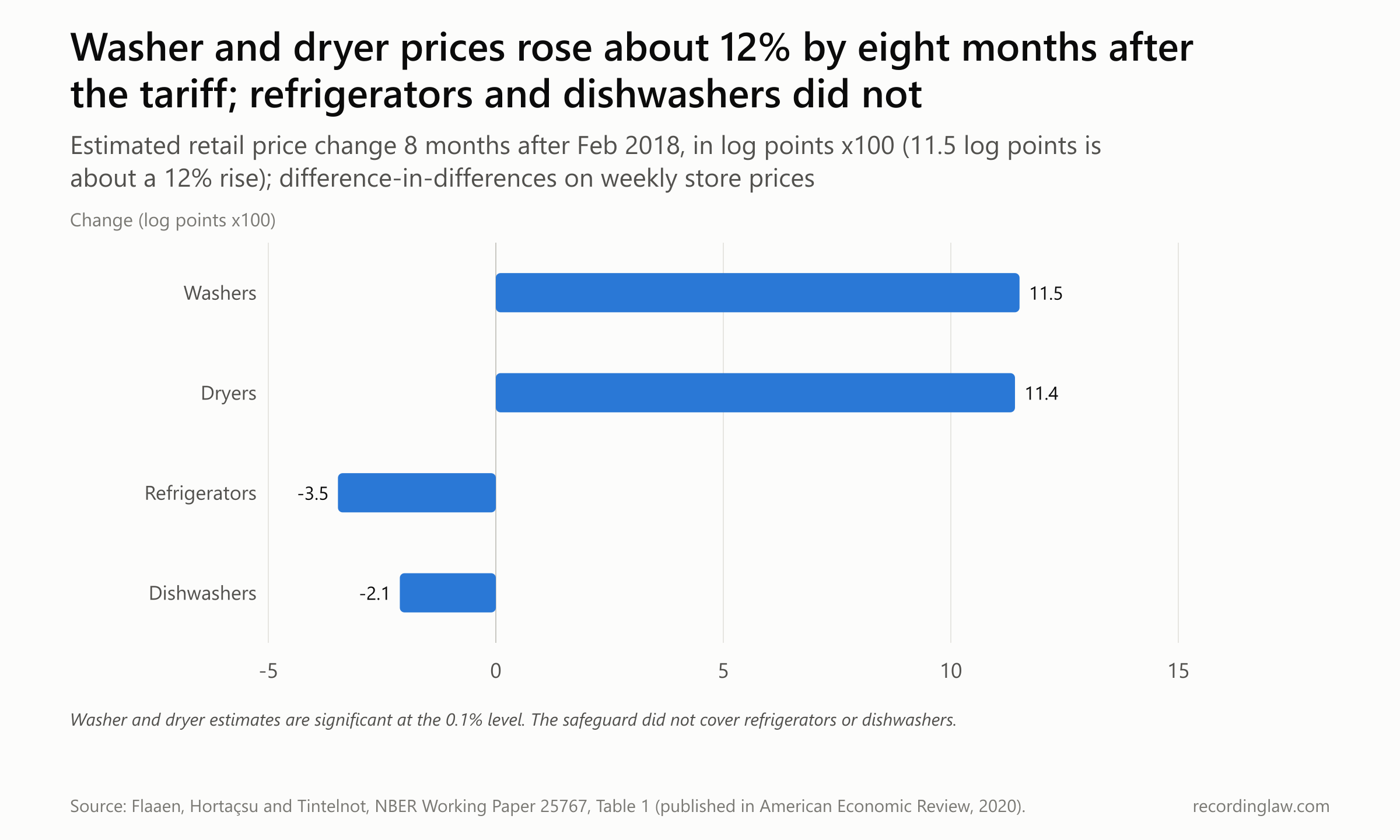
Estimated price change eight months after February 2018, relative to before the tariff, in log points x100 (11.5 is about a 12% rise). Source: Flaaen, Hortaçsu and Tintelnot, NBER Working Paper 25767, Table 1.
The table gives the paper's own estimates in log points, at four months and at eight months. Multiplied by 100, they are close to percent changes, so 0.1151 for washers at eight months is about a 12% rise.
| Appliance | Estimated change, 4 months (log points) | Estimated change, 8 months (log points) |
|---|---|---|
| Washers | 0.1092 | 0.1151 |
| Dryers | 0.1115 | 0.1141 |
| Refrigerators | 0.0014 | -0.0347 |
| Dishwashers | -0.0099 | -0.0211 |
Those estimates cover the first eight months of the tariff. The story of how it came to exist starts with two earlier trade cases that did not hold.
Three cases against the same two companies
The 2017 petition was Whirlpool's third trade case against Samsung and LG since 2011. The first two were antidumping cases, which ask the government to put a duty on goods from a named country that the petitioner says are being sold in the U.S. below fair value. The first case named Korea and Mexico, and the second named China.
Whirlpool's account of what happened next became the argument for the third. "Simply put, beginning in 2013, Samsung and LG replaced their dumped washers from Korea and Mexico with dumped washers from China," Marc Bitzer, then Whirlpool's president and chief operating officer, said when the company filed the China case in December 2015. He became chief executive in 2017. In a 2017 release the company described its next move as an effort to end "this pattern of serial country-hopping to circumvent these trade orders."
Prices kept falling through both cases. The yardstick is the consumer price index (CPI) for laundry equipment, the Bureau of Labor Statistics' monthly measure of what washers and dryers cost, tracked together.
In the 12 months after the Korea and Mexico duties, the Federal Reserve Board and University of Chicago economists later wrote, "the CPI for laundry equipment actually declined by about 5 percent and continued falling thereafter." When the China duties arrived in 2016, their store-price comparison found an increase of "only 1.5 to 3.5 percent" for washers and dryers, and production moved to Thailand and Vietnam.
By 2017 that index averaged about 24 percent below its 2012 level. So Whirlpool asked for something that could not be stepped around by changing countries. It asked for a safeguard under Section 201 of federal trade law. A safeguard is a temporary import restriction that applies to nearly every country at once.
What each side said a tariff would do
Whirlpool said protection would mean more American jobs. On October 5, 2017, after the commission voted unanimously that imports had seriously injured U.S. producers, Whirlpool chairman Jeff M. Fettig said: "This type of corrective action will create U.S. manufacturing jobs." Both of Ohio's senators, Democrat Sherrod Brown and Republican Rob Portman, testified for Whirlpool.
The other side made its own predictions. The Heritage Foundation, a free-market think tank, warned in 2017 that if the petition succeeded, Whirlpool "will greatly reduce the presence of its main foreign competitors in the U.S. market, likely raising prices across the board." At the commission's remedy hearing, an LG representative said, "Safeguard measures will eventually harm U.S. consumers and delay the normal operation of the LG plant in the United States currently under construction."
The commissioners agreed on the core remedy and split on the rest. All four recommended a two-tier tariff on imported washers. Imports above 1.2 million units a year would pay 50 percent, falling five points a year.
That two-tier design is called a tariff-rate quota. A set number of imports, the quota, pays a lower rate or none, and everything above it pays the higher rate. The commissioners divided two to two on whether the first 1.2 million should pay a tariff too. A tariff on those first 1.2 million is called an in-quota tariff.
Commission Chairman Rhonda Schmidtlein and Commissioner Irving Williamson recommended an in-quota tariff of 20 percent, falling to 18 and then 15 percent. They said it "will likely lead to increased import prices and thereby create additional benefits for the domestic industry."
They made that call while noting that the commission's own economic model did not predict higher prices. The model, they wrote, suggested such a tariff would have "an effect on tariff revenues but not on prices or volumes." They added that the model "is not expected to capture the full range of effects from an in-quota tariff."
Vice Chairman David Johanson and Commissioner Meredith Broadbent recommended no in-quota tariff. An in-quota tariff, they wrote, "would exceed the amount necessary to address the serious injury" and would "impede competition in the U.S. market, which is comprised of only four suppliers, and impose an undue burden on consumers and retailers."
The commission, which abbreviates large residential washers as LRWs, also concluded that "imports of LRWs from Korea were not a substantial cause of serious injury," and it made negative findings for imports from Canada and Mexico under the North American Free Trade Agreement. It recommended excluding imports from all three, along with imports from several other free-trade partners. The decision then went to the White House.
Twenty percent, then fifty
On January 23, 2018, President Trump signed a tariff that went past the commission's recommendations. It covered Korea and Mexico, which the commission had recommended excluding. It excluded Canada and developing countries with small shares of imports.
It also added the in-quota tariff the commission had split over, at 20, 18 and 16 percent over three years. The third-year rate was one point above the 15 percent Schmidtlein and Williamson had proposed.
"My administration is committed to defending American companies, and they've been very badly hurt from harmful import surges that threaten the livelihood of their workers, of jobs, actually, all over this country," Trump said at the signing.
Under the President's version, the first 1.2 million imported washers each year paid the lower rate. Everything above that paid 50 percent in the first year, 45 percent in the second and 40 in the third. An extension later added two more years at lower rates.
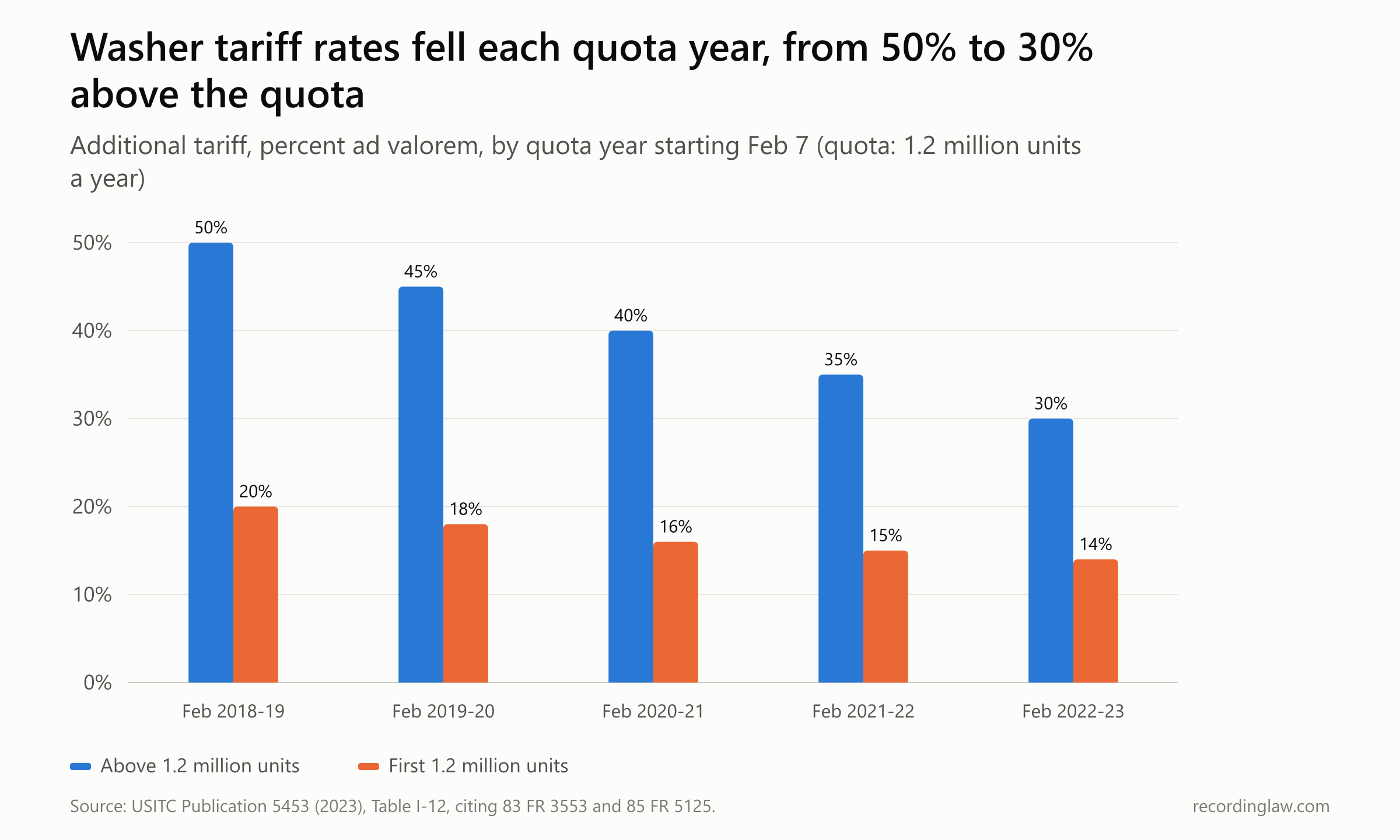
The safeguard's rates fell each quota year. Source: USITC Publication 5453, Table I-12.
| Quota year (from Feb. 7) | First 1.2 million washers | Washers above 1.2 million |
|---|---|---|
| 2018-19 | 20% | 50% |
| 2019-20 | 18% | 45% |
| 2020-21 | 16% | 40% |
| 2021-22 (extension) | 15% | 35% |
| 2022-23 (extension) | 14% | 30% |
The administration's report to Congress explained the in-quota duty in words drawn from both sides of the commission's split. Like Schmidtlein and Williamson, the two commissioners who recommended an in-quota tariff, it said the duty would push importers to raise prices. Like Johanson and Broadbent, who recommended none, it used the phrase "undue burden," but to say the duty would not place one on consumers.
"This duty will provide an impetus for importers to increase their prices, thereby relieving the downward pressure on prices that has led to a decline in domestic washer producers' financial performance," it said. "This action will facilitate the efforts of U.S. producers to adjust to import competition without placing an undue burden on U.S. consumers."
When the decision was announced on January 22, Fettig called it "a victory for American workers and consumers alike," and said it "will result in new manufacturing jobs in Ohio, Kentucky, South Carolina and Tennessee." Whirlpool announced it had added 200 full-time positions at Clyde. "This decision will mean more of these Ohio-made washers in homes across America, more jobs in Clyde, more security for these Ohio workers," Brown said.
Samsung answered the same day. "This tariff is a tax on every consumer who wants to buy a washing machine. Everyone will pay more, with fewer choices," the company said. LG said the result "hinders the ramp-up of the new plant and threatens many new U.S. jobs."
The objections crossed party lines too. "Moms and dads shopping on a budget for a new washing machine will pay for this," said Sen. Ben Sasse, a Nebraska Republican. Korea's trade minister, Kim Hyun-chong, called the decision "excessive."
The Congressional Research Service, in its own analysis, wrote that while such actions may benefit some U.S. domestic producers, they "could also raise prices for U.S. consumers."
Within three days, Reuters reported that LG would raise its U.S. washer prices. The tariff took effect at 12:01 a.m. on February 7, 2018. Importers had brought in washers ahead of it, and Whirlpool and GE later told the commission those stockpiles delayed the remedy. The first year's 1.2 million lower-rate units were used up by the third quarter of 2018, and the second year's by the second quarter of 2019.
What did shoppers pay?
A detailed answer came from three economists: Aaron Flaaen of the Federal Reserve Board staff and Ali Hortaçsu and Felix Tintelnot of the University of Chicago. Using weekly store prices, they compared washers and dryers with refrigerators and dishwashers, appliances the safeguard did not touch, before and after February 2018. Economists call this comparison difference-in-differences. Price changes that hit every appliance cancel out, and what is left is the change in washers and dryers alone.
Their published paper, in the American Economic Review in 2020, found that "the price of washers increased nearly 12 percent." Dryer prices rose by an equivalent amount. Refrigerator and dishwasher prices did not rise.
In dollars, that came to about $86 more per washer and $92 more per dryer, or about $178 for a matched pair. Across roughly 10 million washers and 7.7 million dryers sold a year, the authors calculated an annual cost to consumers of $1.55 billion.
The tariff itself collected about $82 million a year. That is roughly 19 dollars of higher prices for every dollar of tariff revenue.
The paper also set that cost against the jobs reported. Reports attributed roughly 1,800 new U.S. jobs to the policy, the authors wrote. By their calculation, that works out to about $817,000 in consumer cost per job each year, after subtracting the tariff revenue. The figure rests on reported job announcements, not a count of who was hired.
The federal price index pointed the same way. The Bureau of Labor Statistics index for laundry equipment rose 13 percent from December 2017 to December 2018, while prices across the whole economy rose 2 percent. The index draws on a different sample of prices from the paper's store data, so it can confirm that prices rose but cannot measure how much the tariff added.
The dryer estimate needed an explanation of its own.
Why would dryers go up?
Dryers were not on the tariff list, but shoppers often buy one as a pair with the washer it matches. Among electric models, the economists found that "in over 85 percent of our weekly observations, these matched models report the exact same dollar price."
"Given that many consumers buy these goods in a bundle, the price increases were partially hidden by raising the price of dryers," Tintelnot told The New York Times in 2019. "That's very clearly visible."
The domestic brands raised prices along with the importers who paid the tariff. These were the paper's brand-level estimates:
- Whirlpool raised washer prices 13 to 17 percent, with dryers up at least as much.
- Maytag raised washers about 14 percent.
- GE's increases were lower, around 5 percent for washers and 11 percent for dryers.
- LG raised both by about 13 percent over eight months.
- Samsung raised washers 15 to 17 percent.
Tintelnot's reading was that "the price increases are likely due to domestic firms exploiting their market power." That is the authors' interpretation. The price data show what the companies charged, not why.
Fettig, Whirlpool's chairman, had already told the commission how Whirlpool judges its washer business. At the 2017 hearing, he said that in the previous case he had testified "that we evaluate our washer business by itself; that we expect to earn a positive return on investments on our washer investments; and that you cannot subsidize a product business like this with profitability off of other products." He added, "At Clyde, the only appliance that we make is washing machines."
Whirlpool's own costs were changing too. Steel and aluminum tariffs arrived in March 2018. By that summer, Bitzer, by then Whirlpool's chief executive, said "the net impact of all remedies and tariffs has turned into a headwind for us." The washer safeguard remedies on their own, he said, "should be a positive for us" as importers worked off the inventories they had stockpiled.
Higher prices were what buyers paid. What the tariff's supporters had promised in return was factory jobs.
Whose factories grew?
Samsung started making washers in Newberry in January 2018, weeks before the tariff took effect. LG's plant in Clarksville, Tenn., followed in October. LG had announced the Clarksville plant on February 28, 2017, three months before Whirlpool filed.
By the commission's 2023 evaluation, Samsung had "produced over four million washing machines and invested nearly $500 million in its plant, exceeding its $380 million planned investment." LG had "reached an annual production capacity of 1.2 million units and employs over 900 people." When LG announced the plant, it said it expected at least 600 full-time jobs.
The commission's overall verdict listed gains first, then two measures that went the other way. "Since the safeguard measure was put in place in 2018, the domestic industry as a whole has increased capacity, production, U.S. shipments, market share, and employment; its financial performance improved, and prices for LRWs have been generally higher," it wrote. "However, capacity utilization has decreased and unit labor costs have increased."
The gains came mostly from two companies. "Improvements in the domestic industry were largely driven by the two new entrant U.S. producers, LG USA and Samsung," the commission found. Production by the continuous producers, the three companies that had been making washers in the U.S. since before Whirlpool's 2017 petition (Whirlpool, GE Appliances and Alliance), "decreased irregularly," and so did their number of production workers and the wages they paid.
The policy's supporters described the results at Clyde in their own terms. Visiting the plant on August 6, 2020, President Trump recalled, "On January 23, 2018, at my desk in the Oval Office, I proudly signed the order to impose a 50-percent tariff on all foreign-made washing machines." Whirlpool's nine U.S. factories, he said, "were soon thriving like never before, investing in new products, new infrastructure, and hundreds of new American jobs." (The 50 percent rate applied only above the first 1.2 million imports each year.)
Portman wrote that week that the tariffs "have been critical to preserving the thousands of jobs at Clyde, and Whirlpool has taken advantage of this opportunity by investing in new products, in new technology, and in its workers." The commission's 2023 report says Whirlpool and GE Appliances "reported progress on some of the goals they identified in their adjustment plans." When the commission asked Whirlpool to describe its adjustment efforts, the public report prints the company's answer as rows of asterisks, the commission's mark for confidential business information.
Imports of washer types the safeguard did not cover also grew. Their value, which the commission tracks under the label expansion merchandise, "was three times higher in 2022 as compared to 2018."
Those were the 2023 findings. By 2020, with the safeguard due to expire the next February, the argument had already turned back to prices.
Did prices come back down?
In August 2020 the Coalition for a Prosperous America, a pro-tariff group that describes itself as "exclusively representing domestic producers and workers," argued that the price studies were wrong. "Today, washing machine prices are at their lowest levels in the last ten years," it wrote.
The laundry price index partly bears that out. It rose in 2018 and drifted down through 2019. By February 2020 it was about 2 percent above February 2018, when the tariff took effect.
The economists' estimates covered the first eight months. The index shows that by early 2020 most of the 2018 rise had faded.
That same year Whirlpool petitioned to extend the safeguard, asking for up to three more years "with only minimal liberalization" of the rates. GE Appliances supported it, and Samsung and LG opposed it. On December 8, 2020, the commission found relief still necessary. On January 14, 2021, the President extended it two years at lower rates, through February 7, 2023.
By then the pandemic had arrived, and appliance prices climbed. The laundry index peaked in August 2022 at about 48 percent above its December 2017 level.
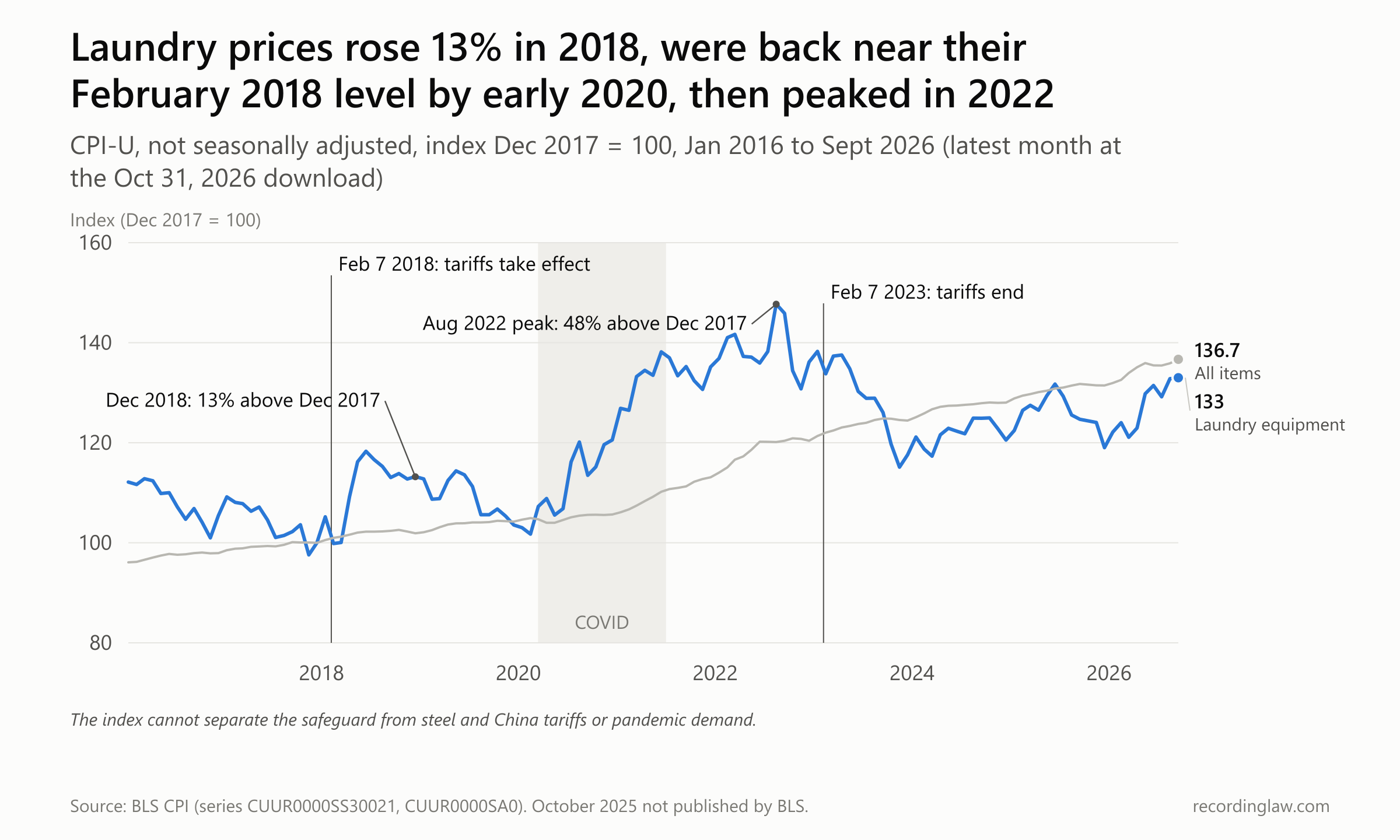
Laundry equipment and all-items consumer prices, December 2017 = 100, through September 2026, the latest month at our October 31, 2026, download. Source: Bureau of Labor Statistics, CPI-U, not seasonally adjusted.
| Month | Laundry equipment (index) | All items (index) | Laundry, Dec 2017 = 100 | All items, Dec 2017 = 100 |
|---|---|---|---|---|
| Dec 2017 | 86.228 | 246.524 | 100.0 | 100.0 |
| Feb 2018 | 86.107 | 248.991 | 99.9 | 101.0 |
| Dec 2018 | 97.637 | 251.233 | 113.2 | 101.9 |
| Feb 2020 | 87.726 | 258.678 | 101.7 | 104.9 |
| Aug 2022 | 127.387 | 296.171 | 147.7 | 120.1 |
| Feb 2023 | 115.364 | 300.840 | 133.8 | 122.0 |
| Feb 2024 | 102.364 | 310.326 | 118.7 | 125.9 |
| Sep 2026 | 114.679 | 336.940 | 133.0 | 136.7 |
Does this chart show what the tariff did after 2018? Not on its own.
From February 2018 to February 2023, the safeguard's full span, laundry equipment prices rose 34 percent. Over the same span, prices of all major appliances rose 27 percent, and prices across the economy rose 21 percent. Other things fall in the same years: COVID-era appliance inflation, the steel and aluminum tariffs and tariffs on Chinese goods. The index cannot separate them.
In the 12 months after the safeguard ended, the laundry index fell 11 percent while overall prices rose 3 percent.
The legal fight outlasted the tariff. Korea had challenged the safeguard at the World Trade Organization.
A panel report circulated on February 8, 2022, agreed with several of Korea's claims. The WTO adopted it on April 28, 2023, nearly three months after the measure had ended. The same day, the United States and Korea said they had reached a mutually agreed solution.
In September 2026, the latest month available when we downloaded the data on October 31, 2026, laundry equipment stood 33 percent above December 2017. Prices across the economy were up 37 percent over the same span, so washers and dryers had, by that measure, risen a little less than everything else.
Tariffed again
By 2025, washers were under a tariff again, under a different law: Section 232, the statute behind the federal steel and aluminum tariffs. A June 2025 Federal Register notice listed washing machines among products covered by the Section 232 steel tariffs, under tariff headings 8450.11.00 and 8450.20.00. Until 2026, that tariff on appliances was charged on the value of the steel inside them.
In April 2026 the rule changed. According to Whirlpool's quarterly filing for the third quarter of 2026, "global home appliance imports are subject to a 25% tariff on the product's full import value, effective April 6th," replacing a 50 percent tariff on the steel content. Whirlpool wrote that the change "is expected to help close long-standing loopholes and help support a level playing field for domestic producers."
Whirlpool's filing also describes a market still contested over trade. In February 2026, the Supreme Court struck down tariffs imposed under an emergency-powers law, and Whirlpool says rivals have been discounting since. "The expectation of tariff refunds following the U.S. Supreme Court decision and potential invalidation of other tariff actions has incentivized and may incentivize further discounting or other go-to-market actions by competitors," the company wrote.
The older country-by-country duties remain. The antidumping order on washers from China was continued, with the continuation taking effect on August 30, 2022, and the order on washers from Mexico was extended in September 2024 for five more years.
From March to September 2025, the laundry equipment index fell 2 percent. Between March 2026 and September 2026, the last month in our October 31 download, it rose about 10 percent, from 104.4 to 114.7. Prices across the economy rose 2 percent from March to September 2026. The index moves sharply month to month and is not seasonally adjusted, so six months cannot say how much of that is the tariff.
In 2017, Whirlpool filed a petition it said was led by 2,464 Clyde workers, asking for a remedy that could not be stepped around by changing countries. Nine years later, its filing for the third quarter of 2026 lists, among the actions it has taken to mitigate the impact of tariffs, "addressing suspected tariff evasion by competitors."
How we measured
Price index. Consumer prices come from the Bureau of Labor Statistics CPI-U, U.S. city average, not seasonally adjusted. We used three series: laundry equipment (series CUUR0000SS30021, washers and dryers together; there is no washer-only series), major appliances (CUUR0000SEHK01) and all items (CUUR0000SA0). We downloaded them on October 31, 2026, through September 2026, the latest month then available.
BLS did not publish October 2025 during the lapse in federal appropriations. The chart bridges September to November 2025. The chart sets each series to 100 in December 2017, the last full month before the January 23, 2018, proclamation.
Percent changes. Laundry equipment: December 2017 86.228 to December 2018 97.637 (+13.2%); February 2018 86.107 to February 2020 87.726 (+1.9%); peak 127.387 in August 2022 (147.7 on the December 2017 base); February 2018 to February 2023 86.107 to 115.364 (+34.0%); February 2023 to February 2024 115.364 to 102.364 (-11.3%); December 2017 to September 2026 86.228 to 114.679 (+33.0%); March 2026 104.418 to September 2026 114.679 (+9.8%); March 2025 109.935 to September 2025 107.522 (-2.2%).
All items: December 2017 to December 2018 +1.9%; February 2018 to February 2023 +20.8%; February 2023 to February 2024 +3.2%; December 2017 to September 2026 +36.7%; March to September 2026, 330.213 to 336.940 (+2.0%). Major appliances: February 2018 to February 2023 +26.7%.
The 2012 and 2017 annual averages for laundry equipment were 117.6 and 89.8, about 24% apart. The index jumped from 86.2 in December 2017 to 90.7 in January 2018, before the tariff took effect, then read 86.1 in February. Single months are noisy.
The price study. Aaron Flaaen, Ali Hortaçsu and Felix Tintelnot, American Economic Review 110(7), 2020; working paper NBER 25767. Method: difference-in-differences on weekly retail scanner prices (1,637,298 observations), comparing the change in washer and dryer prices with the change in refrigerator and dishwasher prices over the same weeks, at 4 and 8 months. The table above shows the paper's baseline coefficients in log points. Multiplied by 100, they are close to percent changes (0.1151 is about a 12.2% rise).
The published paper puts consumer cost at US$1.55 billion a year (footnote: $86 x 9.78 million washers + $92 x 7.72 million dryers = $1.552 billion), tariff revenue at about US$82 million a year, and cost per job at roughly US$817,000 after netting out revenue, using reported announcements of roughly 1,800 jobs. The 2019 working paper gave $1.542 billion. Our "about $178 per pair" is $86 + $92; "roughly 19 dollars per dollar" is $1,550 million / $82 million = 18.9.
How sure: at 8 months the standard errors are 0.0181 for washers and 0.0166 for dryers, and both estimates are significant at the 0.1% level; a 95% interval for washers runs from about 0.080 to 0.151 (0.1151 plus or minus 1.96 x 0.0181). The 8-month refrigerator estimate (-0.0347) is significant at the 5% level and the dishwasher estimate is not.
Hortaçsu and Tintelnot acknowledge support from the University of Chicago's Becker Friedman Institute. Flaaen is Federal Reserve Board staff, and the views are the authors'. The scanner data are not public.
Tariff schedule and trade. Rates come from USITC Publication 5453 (August 2023), Table I-12, which cites Proclamation 9694 (83 FR 3553) and Proclamation 9979 (85 FR 5125); the two extension years were set by Proclamation 10133 (86 FR 6541). Quota years run from February 7. From February 7, 2020, the 1.2 million lower-rate units were allocated at 300,000 a quarter. Import volumes by year are confidential in the public report; the "over 90 percent lower" figure is for the value of covered washers and parts, 2017 to 2022. The commission's evaluation rests on questionnaires from five U.S. producers and five importers.
What the data cannot show. The CPI cannot isolate the safeguard from the 2018 steel and aluminum tariffs, tariffs on Chinese goods, pandemic-era demand and supply problems, or brand and model changes. The price study covers 2018 only. Whirlpool's Clyde employment after 2018 is not in the official record we used; job figures in the text are company announcements, officials' statements or the commission's direction-of-change findings. The 25% Section 232 rate since April 6, 2026, is as Whirlpool reports it in its quarterly filing for the period ending September 30, 2026. The Coalition for a Prosperous America's August 2020 article gives a first-half 2020 index average (90.492) that differs from the BLS figures we downloaded (91.005) and dates the tariff to March 2018; we use BLS data and the proclamation's February 7 date.
What comes next. The 2018 question took economists eight months of store prices to answer. The Bureau of Labor Statistics publishes the laundry equipment index monthly; this page uses data through September 2026, downloaded October 31, 2026, and does not include the October 2026 figures, which the BLS release schedule checked that day listed for November 10, 2026. The November figures were listed for December 10, 2026.
Frequently Asked Questions
When did the washing machine tariff start and end?
The safeguard tariff on large residential washers took effect at 12:01 a.m. on February 7, 2018, under Proclamation 9694, signed January 23, 2018. Proclamation 10133 extended it, and it ended on February 7, 2023.
How high was the 2018 washer tariff?
In the first year, the first 1.2 million imported washers paid an extra 20% and imports above that paid 50%. The rates fell each year, to 14% and 30% in the final year of the extension. Canada was excluded.
Did the washer tariff raise prices?
Economists at the Federal Reserve Board and the University of Chicago compared washer and dryer prices with refrigerator and dishwasher prices, a comparison called difference-in-differences. Their study, published in the American Economic Review in 2020, estimated washer prices rose nearly 12% after the tariff, about $86 per washer. The Bureau of Labor Statistics laundry equipment index rose 13% from December 2017 to December 2018, while all prices rose 2%.
Why did dryer prices go up if dryers were not tariffed?
The same study found dryer prices rose by about as much as washers, about $92 per dryer. Matched washer and dryer models carried the exact same price in over 85% of weekly observations. One author, Felix Tintelnot, said the increases were partially hidden by raising dryer prices. The data show the prices, not the companies' reasons.
How much did the washer tariff cost consumers?
The study estimated about $1.55 billion a year in higher prices, against about $82 million a year in tariff revenue, or roughly $817,000 per reported job after subtracting the revenue.
Did the tariff bring washer manufacturing jobs to the U.S.?
The ITC found in 2023 that the U.S. industry as a whole increased capacity, production, market share and employment from 2018 to 2022. It found the gains were largely driven by new plants run by Samsung in Newberry, S.C., and LG in Clarksville, Tenn. Production, workers and wages at the continuous producers, Whirlpool, GE Appliances and Alliance, decreased.
Are washing machines tariffed now?
Yes, as of Whirlpool's filing for the quarter ended September 30, 2026, under Section 232, the statute behind the federal steel and aluminum tariffs. A June 2025 notice listed washing machines among products covered by the Section 232 steel tariffs, and Whirlpool reports that imported home appliances have faced a 25% tariff on full value since April 6, 2026. Antidumping orders on washers from China and Mexico also remain in place.
How much have washer and dryer prices changed since 2017?
As of the September 2026 reading (downloaded October 31, 2026), the BLS laundry equipment index was 33% higher than in December 2017, while all items rose 37%. The index peaked in August 2022 and fell 11% in the year after the safeguard ended in February 2023.
Updates
Corrected: the page said the "continuous producers" (Whirlpool, GE Appliances, Alliance) made washers before and after the safeguard. The trade commission defines them as making washers in the U.S. since before Whirlpool's 2017 petition.
Restructured as a feature: chart titles state the finding, side details moved to How we measured. Every figure and quote was re-checked against its source.
Independently fact-checked against the cited primary sources
Independently fact-checked against the cited primary sources
Sources and References
- Bureau of Labor Statistics, CPI-U laundry equipment, U.S. city average (series CUUR0000SS30021)(data.bls.gov).gov
- Bureau of Labor Statistics, CPI-U major appliances (series CUUR0000SEHK01)(data.bls.gov).gov
- Bureau of Labor Statistics, CPI-U all items (series CUUR0000SA0)(data.bls.gov).gov
- Bureau of Labor Statistics, Consumer Price Index release schedule(www.bls.gov).gov
- Proclamation 9694, To Facilitate Positive Adjustment to Competition From Imports of Large Residential Washers (83 FR 3553, Jan. 25, 2018)(www.federalregister.gov).gov
- Proclamation 10133, To Continue Facilitating Positive Adjustment to Competition From Imports of Large Residential Washers (Jan. 2021)(www.federalregister.gov).gov
- USITC notice, Large Residential Washers: Evaluation of the Effectiveness of Import Relief (Feb. 2023)(www.federalregister.gov).gov
- USITC Publication 4745, Large Residential Washers (Inv. TA-201-076), injury and remedy determinations (Dec. 2017)(www.usitc.gov).gov
- USITC Publication 5144, Large Residential Washers, report on the extension of action (Dec. 2020)(www.usitc.gov).gov
- USITC Publication 5453, Large Residential Washers: Evaluation of the Effectiveness of Import Relief (Aug. 2023)(www.usitc.gov).gov
- Flaaen, Hortaçsu and Tintelnot, American Economic Review 110(7), 2020 (abstract)(www.aeaweb.org)
- Flaaen, Hortaçsu and Tintelnot, American Economic Review 110(7), 2020 (published article)(pubs.aeaweb.org)
- Flaaen, Hortaçsu and Tintelnot, NBER Working Paper 25767(www.nber.org)
- Congressional Research Service, Insight IN10856 on the washer and solar safeguards (Jan. 2018)(www.congress.gov).gov
- Remarks by President Trump at the Whirlpool plant in Clyde, Ohio, Compilation of Presidential Documents (Aug. 6, 2020)(www.govinfo.gov).gov
- Office of the U.S. Trade Representative, President Trump approves relief for U.S. washing machine and solar cell manufacturers (Jan. 22, 2018)(ustr.gov).gov
- World Trade Organization, DS546: United States, Safeguard Measure on Imports of Large Residential Washers(www.wto.org)
- Federal Register notice listing washing machines among Section 232 steel derivative products (June 16, 2025)(www.govinfo.gov).gov
- Proclamation, Strengthening Actions Taken To Adjust Imports of Aluminum, Steel, and Copper Into the United States (Apr. 9, 2026)(www.federalregister.gov).gov
- Whirlpool Corporation, Form 10-Q for the quarter ended Sept. 30, 2026(www.sec.gov).gov
- Whirlpool Corporation release on the ITC injury vote (Oct. 5, 2017)(whirlpool.mediaroom.com)
- Whirlpool Corporation release on the President's decision (Jan. 22, 2018)(whirlpool.mediaroom.com)
- Whirlpool Corporation release on the safeguard petition and hearing (2017)(s202.q4cdn.com)
- Whirlpool Corporation release quoting Marc Bitzer on imports from China(s202.q4cdn.com)
- Samsung Newsroom, Samsung announces home appliance manufacturing plant in Newberry, S.C. (June 28, 2017)(news.samsung.com)
- LG Electronics release on its Clarksville, Tenn., plant (Feb. 28, 2017)(lg.com)
- The Korea Times, Korea to take US safeguard tariffs to WTO (Jan. 23, 2018)(www.koreatimes.co.kr)
- Korea JoongAng Daily, Samsung, LG protest US tariffs on washers (Oct. 2017)(www.koreajoongangdaily.com)
- The Heritage Foundation issue brief on the washer safeguard petition (2017)(www.heritage.org)
- Associated Press via Manufacturing.net, Trump applies tariffs on solar panels, washing machines (Jan. 2018)(www.manufacturing.net)
- Ideastream Public Media, Whirlpool adds jobs at its Ohio plant (Jan. 24, 2018)(ideastream.org)
- Reuters via Oman Observer, LG hikes washer prices in US (Jan. 25, 2018)(www.omanobserver.om)
- NBC News, Ohio Whirlpool plant runs hot and cold on tariffs (Aug. 1, 2018)(www.nbcnews.com)
- The New York Times (Jim Tankersley) on the washer tariff study, April 2019 (hosted copy)(www.globaltraderelations.net)
- Sen. Rob Portman op-ed via Richland Source (Aug. 2020)(www.richlandsource.com)
- Coalition for a Prosperous America, Washing machine prices put economists through the wringer (Aug. 2020)(prosperousamerica.org)