Michigan's Cannabis Opt-Out List Shrank by a Net 23 From 2021 to 2025 While Retail Licenses Nearly Doubled

Independently fact-checked against primary sources (last audited November 10, 2026). · 23 primary sources cited on this page. How we verify our legal content
On November 5, 2018, the day before Michigan voted on legal marijuana, the city of Monroe opted out. In Michigan, opting out means passing an ordinance that keeps licensed recreational marijuana businesses from opening inside a town's borders. Monroe was partly disappointed with how the state had handled medical marijuana, The Center Square reported.
The next night Proposal 1 passed, 2,356,422 votes to 1,859,675. Scott Greenlee, president of Healthy and Productive Michigan, the committee that had campaigned against it, said his group would now turn to helping communities opt out of having to allow retail pot businesses. "As I understand it, communities wouldn't even be able to look at opting out until 2020," he told Michigan Public.
By September 2019, before the state had taken its first application for an adult-use (recreational) license, 839 Michigan municipalities had told it they were out. They included 13 of the state's 25 most populous communities, among them Sterling Heights, the state's fourth-largest city; together the 13 held about 11% of the state's population, according to the Small Business Association of Michigan.
A cannabis-industry public relations consultant, Mort Meisner, told the Detroit Metro Times that month: "Many of those who have chosen to sit on the sidelines and watch will change their minds soon."
Voters in Michigan, Massachusetts and California legalized cannabis sales statewide, and each law let local governments keep the stores out. In the last monthly report to carry the count, from January 2025, Michigan's regulator listed 1,370 municipalities as opted out and 139 as opted in. In Massachusetts, about three in 10 residents live in a town the state's tracker lists as banning every kind of cannabis business. In California, 56% of cities and counties allowed no retail cannabis business in February 2026.
On November 3, 2026, Massachusetts voters were asked whether to end adult-use stores statewide. In unofficial results, not yet certified as of November 10, 2026, they said no. So who decides where legal cannabis is sold, and how much have those local maps moved in the years since?
Did Michigan's towns change their minds?
Meisner's prediction can be checked against the state's own list. Michigan's Cannabis Regulatory Agency printed a count of opted-in and opted-out municipalities in its monthly reports from at least December 2021 to January 2025. "Opted in" means a town passed an ordinance authorizing marijuana businesses. How much did the list move while the industry grew?
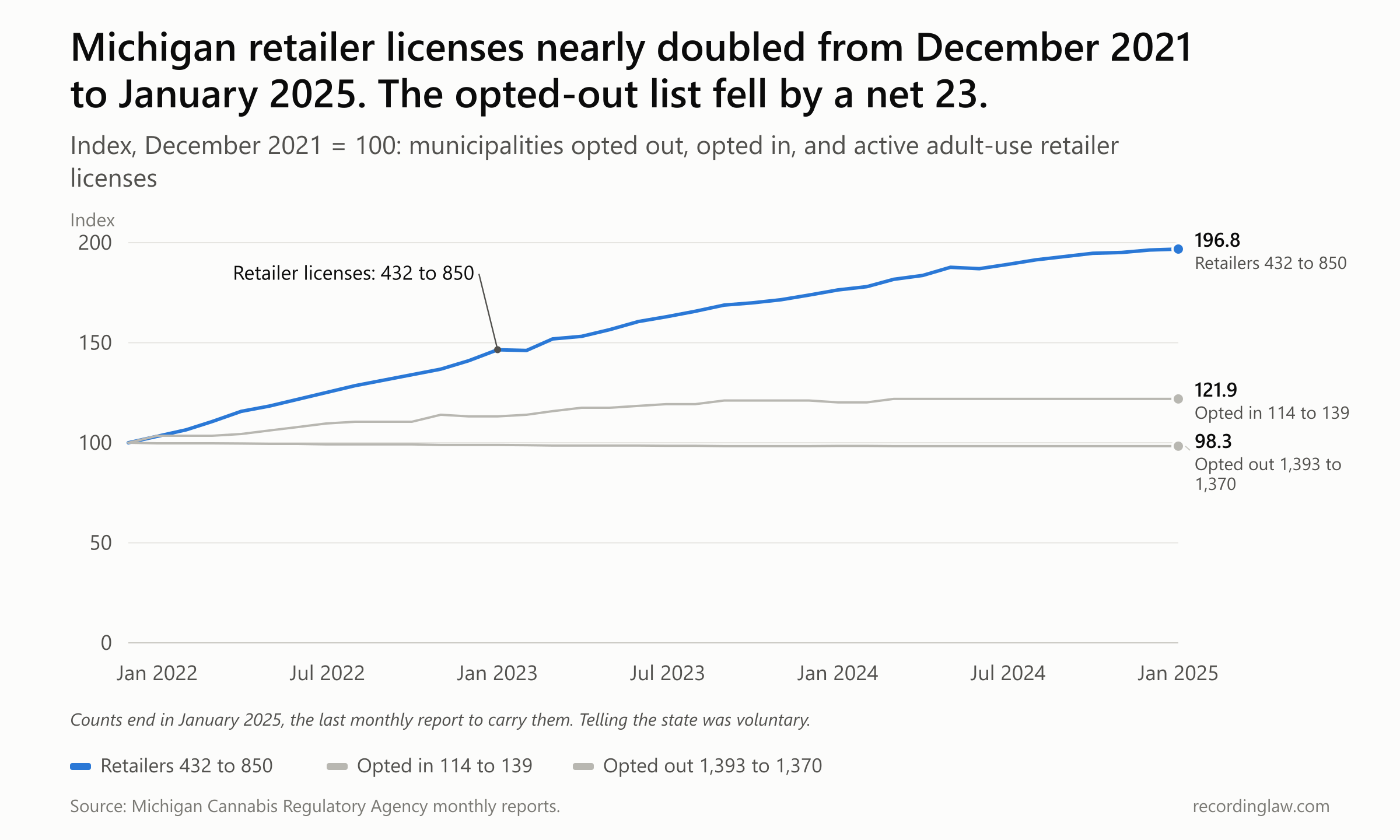
Source: Michigan Cannabis Regulatory Agency monthly reports, December 2021 to January 2025. Index, December 2021 = 100.
| Month | Municipalities opted out | Municipalities opted in | Active adult-use retailer licenses |
|---|---|---|---|
| Dec 2021 | 1,393 | 114 | 432 |
| Dec 2022 | 1,378 | 129 | 609 |
| Dec 2023 | 1,370 | 138 | 751 |
| Feb 2024 | 1,371 | 137 | 769 |
| Jan 2025 | 1,370 | 139 | 850 |
Over three years, from December 2021 to January 2025, the opted-out list shrank by a net 23 municipalities, from 1,393 to 1,370. Over the same months, the number of active retailer licenses nearly doubled, from 432 to 850.
The new stores were going into places that had not opted out. Over the same months, opted-in municipalities rose from 114 to 139. After January 2025, the count no longer appeared in the agency's monthly reports.
Some towns that tried to reverse a ban found few voters interested. Royal Oak Township held Michigan's first referendum to overturn one on May 7, 2019; only 377 voters turned out and it failed, the Metro Times reported. In 2022, in a general election, a majority voted to repeal the township's ban, Michigan Public reported, and in November 2024 a new ban was on the township ballot.
In other towns, officials kept arguing for no. In 2024 the Livingston County sheriff, Michael Murphy, urged voters in Howell to reject a measure allowing two dispensaries. "If the city of Howell residents choose to vote it in then, okay, that's the way it is. But I would just encourage you to really think about voting no for this," he said.
The best-known summary of Michigan's map comes from Cannabis Business Times, a trade publication: "74% (1,371 out of 1,856) local governments have opted out" as of the regulator's February 2024 report. The 1,371 matches the regulator's figure. The 1,856 matches Michigan's count of general-purpose local governments: its cities, villages and townships, plus 83 counties. The law defines a municipality as "a city, village, or township," so counties cannot opt out.
On the regulator's own list for that month, 1,371 of the 1,508 municipalities it listed as opted in or opted out were opted out, or 91%. That list is incomplete. A 2019 count gave Michigan 1,240 townships, 276 cities and 257 villages, so roughly 265 municipalities appear on neither list. The regulator's spokesman, David Harns, said in 2019 that locals "aren't required to tell the state if they've opted out."
The power to say no came from the ballots themselves.
What the three laws promised about local control
The power to say no was in the ballot language from the start, in all three states. Michigan's 2018 ballot wording said the proposal would "create a state licensing system for marijuana businesses and allow municipalities to ban or restrict them." The law that passed lets a municipality "completely prohibit or limit the number of marihuana establishments within its boundaries," and lets residents petition to put a ban, or a limit, on the local ballot.
California voters were told the same thing in 2016. "Cities and counties could also completely ban marijuana-related businesses," the Legislative Analyst wrote in the official voter guide. Massachusetts's 2016 Question 4 summary said cities and towns could "limit the number of marijuana establishments in their communities."
Supporters presented local control as a feature. Answering the opposition in California's voter guide, Rep. Ted Lieu and two other Proposition 64 backers included one line: "64 preserves local control." The Yes argument said sales would be "legal only at highly regulated, licensed marijuana businesses."
Opponents worried about how many shops there would be. "Why is there no limit on the number of pot shops that can be placed in a single neighborhood?" asked the No on 64 argument, signed by Sen. Dianne Feinstein and leaders of the highway patrol officers' and hospital associations.
The argument also quoted Bishop Ron Allen of the International Faith Based Coalition: "We will now have a string of pot shops to go with the two liquor stores on every block, but we still can't get a grocery store." The California Police Chiefs Association, quoted in the same argument, said the measure was "trampling local control" by allowing home growing.
In Massachusetts, Gov. Charlie Baker, who opposed Question 4, predicted in July 2016 that shops would end up near "some of the most disadvantaged communities, where the challenges citizens face are already great," the Boston Globe reported.
Both sides argued about how many stores there would be and where. Once the statewide votes were counted, that question moved to town halls.
The fight moved to town hall
Massachusetts voted 54% to 46% for Question 4 on November 8, 2016. Less than a week later, the Boston Globe reported, a number of cities and towns were "exploring ways to limit or even snuff out marijuana shops."
"I'm dead set against it," said Mayor Stephen N. Zanni of Methuen, where 52% of local voters had opposed the question. "We're essentially forced into this despite the fact that we said 'No,'" said Mayor Joseph Sullivan of Braintree, which voted no 54-46.
The legalization campaign pushed back. "I would not want to see a handful of town officials controvert the vote of the people of Massachusetts," said its spokesman, Jim Borghesani. Geoff Beckwith of the Massachusetts Municipal Association, which had opposed Question 4, predicted that "more and more communities will be looking for these issues to be addressed."
On March 7, 2017, voters in Westborough banned the sale of recreational marijuana, the first Massachusetts town to do so, CBS Boston reported. That July the Legislature drew a line through the state. Towns where most voters had backed Question 4 needed a local ballot vote to ban stores. Towns that had voted no could ban by bylaw, without a vote, until the end of 2019.
By September 2017, advocates had defeated fewer than 10 of more than 100 anti-pot measures, according to a count by the Massachusetts Municipal Association cited by the Globe. "The fight over the legalization of marijuana in Massachusetts isn't over. But one side has already gone home," the paper wrote. Kamani Jefferson of the Mass. Recreational Consumer Council said, "I'm not sure I have the resources to beat these prohibitionists all over the state in time."
Michigan's law flipped the default its local officials were used to. "It's a little bit different than the current medical marijuana law which requires you to opt in rather than opt out," Chris Johnson of the Michigan Municipal League said in November 2018. Under the new law, a town that did nothing could not keep licensed businesses out. It had to pass an ordinance to say no.
Towns did not wait until 2020. Six days after the vote, Niles voted to temporarily opt out of retail sales and the village of Pinckney adopted a ban, the Associated Press reported. In Troy, Councilman Dave Henderson said, "We especially don't want retail facilities sprouting up all over the city. The optics give a bad message for our youth."
Legalization advocates warned about what that would mean. In January 2019, NORML, which advocates for legalization, wrote that opting out "appears to undermine the intent of the initiative and expectations of voters" who expected a legal alternative to replace underground sales.
The opt-outs did not only come from places that had voted no. Tom Ivacko of the University of Michigan's Center for Local, State, and Urban Policy calculated in January 2019 that about half of the jurisdictions that had opted out were in places where most voters had approved the proposal, Wisconsin Watch reported.
Besides the opt-out list, the state keeps one other record of where the stores are. It sends checks to the towns that host them.
The money goes where the stores are
Michigan's ballot wording promised that a 10% tax on retail sales would go partly to "municipalities where marijuana businesses are located." Under the law, 15% of the adult-use fund goes to municipalities with a retailer or microbusiness, "allocated in proportion to the number" of them. Another 15% goes to counties on the same basis. A town that opts out gets nothing from those shares.
For fiscal 2025, the state paid $54,017.10 for every licensed retail store and microbusiness, to each eligible municipality, county and tribe. Nearly $94 million went to 313 recipients, the state announced on March 3, 2026. "Municipalities, counties, and tribes certainly benefit from their local cannabis businesses in many ways," Brian Hanna, executive director of the Cannabis Regulatory Agency, said of the previous year's payments.
The fiscal 2025 payout was "slightly smaller than last and spread across more governments," Bridge Michigan reported. Ann Arbor's share was about $1.2 million, roughly $200,000 less than the year before, Bridge reported. "We're a little disappointed that we're getting less money but we're not shocked by that," said Milton Dohoney Jr., the city administrator.
The payments follow the stores, not the population. Berrien County, the state's 16th largest by population, received the fourth-largest payment because of the 48 licensed businesses in a county that "borders Indiana, where sales are illegal," Bridge reported.
The payment list and the opt-in list do not match. By our count of the state's announcement, 234 municipalities (114 cities, 39 villages and 81 townships) received per-store payments for fiscal 2025, against 139 the regulator listed as opted in. No source we opened explains the gap.
Neighboring towns notice the checks. In 2024, an ad backing dispensaries in Bedford Township, near the Ohio border, claimed that nearby Monroe was "raking in over $945,000 annually in cannabis tax revenue." The ad did not say which Monroe it meant: the city of Monroe, which opted out in 2018, or Monroe Township, a separate jurisdiction south of the city where 13abc counted 11 dispensaries in 2023. The figure is a political committee's, and we could not verify it.
The same argument came up in Massachusetts. West Springfield's council had banned stores in 2018. "Our residents are going to other places, they're buying at other communities, and those other communities are getting the tax revenue," Mayor Will Reichelt said in April 2022.
Councilor Michael Eger urged colleagues to consider voting against the change and "give the voters a chance to make a decision in an open election." On July 18, 2022, the council approved up to three stores.
In Massachusetts the host towns also negotiated their own fees. Foley Hoag, a law firm that represents cannabis licensees, wrote that some towns were quick to demand "annual payments of 3% of gross sales," the legal maximum. A 2022 state law ended those community impact fees after a licensee's first eight years.
How many people in Massachusetts live behind a ban?
Counting towns can mislead, because a ban in a small village and a ban in a large city count the same. Massachusetts is the one state of the three where we could match a town-by-town status list to population counts.
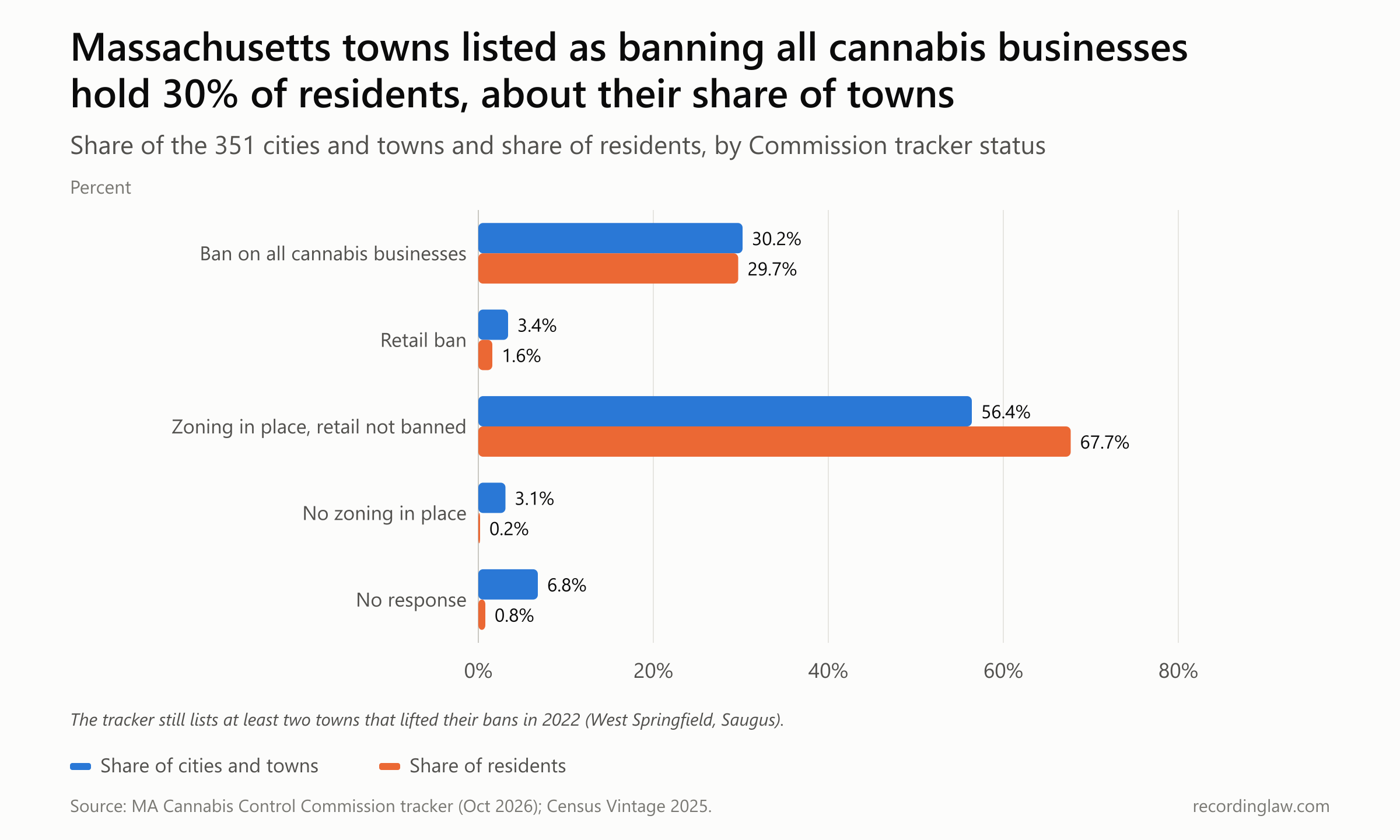
Source: Massachusetts Cannabis Control Commission municipal zoning tracker, read October 31, 2026; Census Bureau Vintage 2025 population estimates. Status groups are ours; see How we measured.
| Tracker status | Cities and towns | Residents | Median town population |
|---|---|---|---|
| Ban on all cannabis businesses | 106 (30.2%) | 2,123,496 (29.7%) | 16,716 |
| Retail ban, other uses zoned | 12 (3.4%) | 115,815 (1.6%) | 9,552.5 |
| Zoning in place, retail not banned | 198 (56.4%) | 4,841,549 (67.7%) | 10,220.5 |
| No zoning in place | 11 (3.1%) | 15,825 (0.2%) | 1,253 |
| No response to the Commission | 24 (6.8%) | 57,399 (0.8%) | 1,091 |
About three in 10 Massachusetts residents, 29.7%, live in a town the tracker lists as banning all cannabis businesses. That is almost the same as the share of towns on that list, 30.2%.
The banning towns are not smaller. The median town listed as banning all cannabis businesses has about 16,700 residents, against about 10,200 for towns with zoning in place and no retail ban. Both figures are the median, the middle value when all are lined up in order.
The tracker has errors that run toward overcounting bans. Nine towns it lists as banning hold 12 active retailer licenses. At least two of them, West Springfield and Saugus, lifted their bans in 2022, through the council vote above and a May 2022 Town Meeting vote. We did not check the other seven.
The Commission says the tracker "does not constitute an official or comprehensive legal determination." Even so, the tracker can be compared with the Commission's licenses file. Do the bans keep stores out in practice?
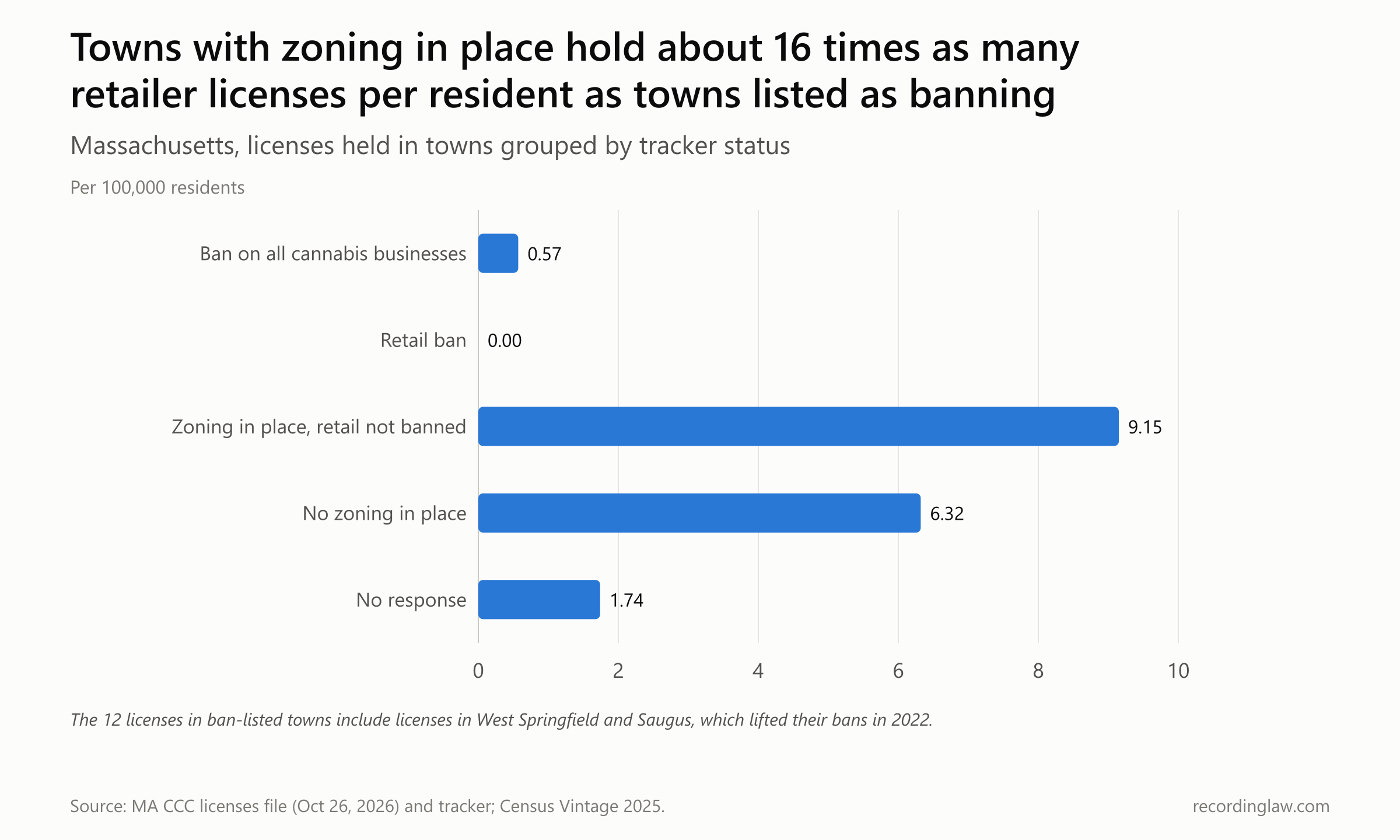
Source: Massachusetts Cannabis Control Commission licenses file (updated October 26, 2026) and municipal zoning tracker; Census Bureau Vintage 2025.
| Tracker status | Active retailer licenses | Licenses per 100,000 residents |
|---|---|---|
| Ban on all cannabis businesses | 12 | 0.57 |
| Retail ban, other uses zoned | 0 | 0 |
| Zoning in place, retail not banned | 443 | 9.15 |
| No zoning in place | 1 | 6.32 |
| No response to the Commission | 1 | 1.74 |
Towns with zoning in place and no retail ban hold 9.15 active retailer licenses per 100,000 residents. Towns listed as banning all cannabis businesses hold 0.57 per 100,000 residents, so the first group has about 16 times as many per resident. About two in three Massachusetts residents, 67.6%, live in a town with at least one active retailer license.
California's numbers come in a different form, from two counters that measure different things.
How California's map moved
In California, where the Yes side had promised local control, the state and its cities argued over how far that control reached. In April 2019, 25 local governments sued the state over a rule allowing deliveries to any address. "What we have seen now is this total and complete usurpation of that authority by the state," said Robert Thompson, police chief of Dixon, one of the plaintiffs.
That spring, Assemblymember Phil Ting was pushing a bill to require licenses where most residents had voted for Proposition 64. Charles Harvey of the League of California Cities said it "would completely erode the local control of cities and counties."
In 2022 the Department of Cannabis Control, the state regulator, published its first map of local rules. It found that 62% of cities and counties prohibited licensing of "any form of cannabis retail." Nicole Elliott, then its director, said the data showed "the work we have ahead of us in realizing the promises of cannabis legalization."
The state narrowed local control once, for patients. Sen. Scott Wiener, whose bill was sponsored by the California Cannabis Industry Association, said in 2022 that "62% of California cities ban people from purchasing legal medicinal cannabis." Since January 1, 2024, cities cannot block delivery of medical cannabis. Local control over adult-use cannabis stays in place.
The Public Health Institute, whose Getting it Right from the Start program writes model local cannabis policies and advocates stricter local rules, has counted since 2019 how many cities and counties allow sales and how many Californians live in them. How much has California's map moved since legal sales began?
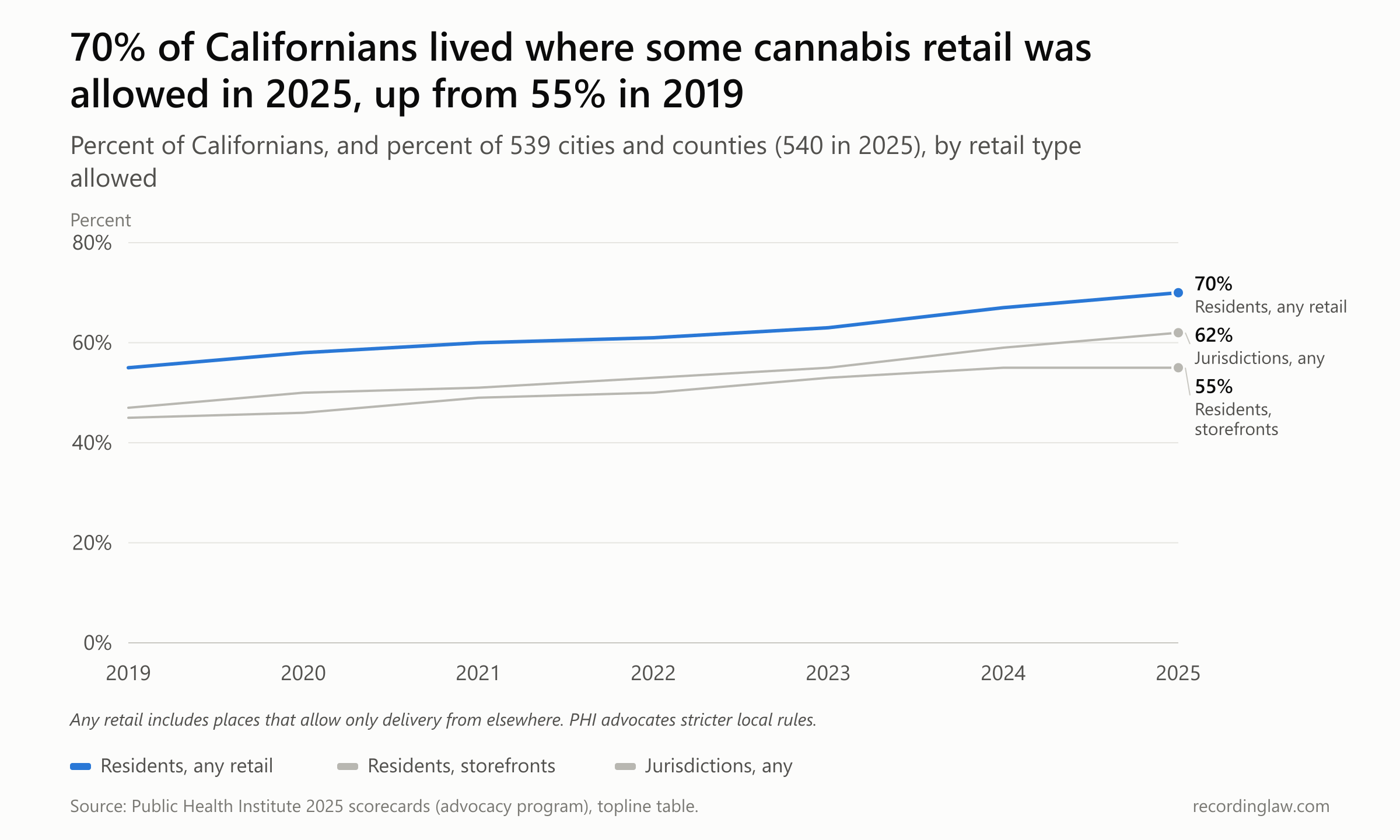
Source: Public Health Institute, Getting it Right from the Start, 2025 scorecards topline table. Out of 539 cities and counties for 2019 to 2024 and 540 for 2025. Any retail includes places that allow only delivery from businesses based elsewhere.
| Year | Californians where any retail allowed | Californians where storefronts allowed | Cities and counties allowing any retail | Cities and counties allowing storefronts |
|---|---|---|---|---|
| 2019 | 55% | 45% | 251 (47%) | 136 (25%) |
| 2021 | 60% | 49% | 277 (51%) | 166 (31%) |
| 2023 | 63% | 53% | 298 (55%) | 196 (36%) |
| 2025 | 70% | 55% | 333 (62%) | 210 (39%) |
Every line rose from 2019 to 2025. But in 2025, about three in 10 Californians still lived where no form of retail was allowed, and 45% lived where no storefront was.
The regulator's own count moved too. In February 2026, its website says, 56% of 540 cities and counties (302) allowed no retail cannabis business, down from 62% in February 2022.
The two sources answer different questions. The Public Health Institute counts a place that only lets outside businesses deliver as allowing retail. The regulator counts whether a place allows a retail business of its own.
| Measure (California Department of Cannabis Control) | February 2022 | February 2026 |
|---|---|---|
| Cities and counties allowing no retail cannabis business | 62% | 56% (302 of 540) |
| Cities and counties allowing no cannabis business of any type | 56% | 53% (284 of 540) |
The No on 64 campaign had warned there was no limit on the number of shops. The limits came through the local control the Yes side had promised. By 2025, 81% of California jurisdictions that allow storefronts capped the number of licenses, up from 76% in 2020, according to the Public Health Institute.
Density still rose. The Institute counts one retailer per 20,000 residents in 2020 and one per 17,000 in 2025, which it says exceeds "recommended public-health thresholds." Fewer residents per retailer means more retailers for the same number of people. The state regulator counted 4.27 retail licenses per 100,000 people in February 2026.
What does a ban change?
Each side of the local-control fight now has its own evidence, and none of it can single out the effect of a ban. California's regulator says bans feed the illicit market.
In July 2026, department data first reported by State Affairs showed that 96.6% of illicit cannabis seized by a state task force in unincorporated areas from October 2022 to August 2025 was found in eight counties, "almost all of which maintain local bans on licensed marijuana cultivators," Marijuana Moment reported. "When local governments deny consumers access to licensed retailers, the illicit market and organized crime benefit, while public health and safety is harmed," said Clint Kellum, the department's director.
Those figures concern cultivation bans, not store bans, and seizures show where enforcement looked as well as where illegal grows were. A 2023 brief from the University of California, Berkeley Cannabis Research Center found that "intensive enforcement consistently pushes cultivators to other regions."
Legalization advocates make the access case for stores. "Local moratoriums banning the establishment of licensed cannabis retailers do nothing to limit local residents' access to cannabis; they only limit their access to legal cannabis," Paul Armentano, deputy director of NORML, wrote in CalMatters in 2022.
Public-health researchers point to young people. A study of California 11th graders by Simard and colleagues, including the Public Health Institute's Lynn Silver, published in the Journal of Adolescent Health in 2025, found that after an increase in 30-day use, "use in retail-banning jurisdictions declined, whereas rates in jurisdictions newly permitting storefronts and delivery remained raised." It matched policy to where schools are, not where students live, and did not account for neighboring jurisdictions.
A 2023 study by Bostean and colleagues, of 534,176 California middle and high school students, funded partly by the American Lung Association, found that "stricter retail environment policies were associated with lower odds of past-month use" of cannabis. It used one year of cross-sectional data, so it shows an association, not an effect.
A third study, by the Public Health Institute and Kaiser Permanente Northern California researchers, linked retail availability to adolescent mental-health outcomes among nearly 96,000 insured teens. It also found that although 49% of the teens lived under local storefront bans, "the median drive time to the nearest retailer was still just 10 minutes." The authors say the cross-sectional design cannot prove causation.
| Study | Design | Sample | Direction of the finding, as the source reports it | Funding stated |
|---|---|---|---|---|
| Simard and colleagues, Journal of Adolescent Health, 2025 | Repeated cross-sections of 11th graders, by the local policy where each school is | Not confirmed (we read a summary, not the paper) | After an increase in 30-day use, "use in retail-banning jurisdictions declined" while rates where storefronts and delivery were newly permitted "remained raised"; the summary we read reports no significance test | Not confirmed |
| Bostean and colleagues, Preventive Medicine Reports, 2023 | Cross-sectional, 2018 statewide data | 534,176 middle and high school students | Stricter retail policies "were associated with lower odds of past-month use" of cannabis | American Lung Association; Chapman University |
| Public Health Institute and Kaiser Permanente Northern California researchers, Substance Use and Misuse, 2025 | Cross-sectional, insured teens | Nearly 96,000, per the Institute's release | Linked retail availability to adolescent mental-health outcomes; 49% lived under local storefront bans, yet median drive time to the nearest retailer "was still just 10 minutes"; the authors say the design cannot prove causation | Not stated in the release |
The statewide question
In Massachusetts, the question then moved above the towns. In April 2026 the state made adult-use delivery legal in every city and town. A town without stores can still keep delivery out, but only with a waiver from the Cannabis Control Commission that lasts no more than two years at a time.
Then Massachusetts voters were asked about the stores themselves. Question 8 on the November 3, 2026 ballot would have repealed the laws allowing adult-use retail sales. "The true purpose of the measure is to eliminate the recreational stores," Caroline Alcock Cunningham, a proponent and member of the Massachusetts Republican State Committee, told the Boston Globe in 2025. "The goal is not to arrest people for simple personal possession."
NORML, which opposed the question, cited polling showing 63% of voters against it and 20% in favor. NORML's page did not identify who paid for the poll. The repeal would have taken effect on January 1, 2028, according to the Secretary of the Commonwealth.
It did not pass. The Associated Press called the result around midnight, with about 48% of votes counted, Boston.com reported. In unofficial results reported by Boston.com and the Boston Globe in early November 2026, about 76% of voters said no and about 24% said yes. As of November 10, 2026, the results had not been certified.
The vote left local control where it was. Towns that ban stores still can, and towns that allow them keep them.
In Michigan, a new 24% wholesale tax on marijuana to pay for roads took effect on January 1, 2026. It is separate from the 10% tax that funds the payments to host towns.
In March 2026, Bridge Michigan reported an ongoing industry lawsuit against the tax. It also reported a bipartisan Senate repeal bill, sent to a committee where leaders often move measures they do not intend to take up. By early April the industry had filed a second lawsuit, Michigan Public reported. On April 22, 2026, the Michigan Supreme Court ordered the Court of Appeals to expedite the original case.
The next count
With the opt-out count gone from Michigan's monthly reports, the closest public record of where its stores are is the list of places the state pays per store. The per-store amount fell from more than $58,200 for fiscal 2024 to $54,017.10 for fiscal 2025.
The fiscal 2026 payments are next. As of November 10, 2026, the state had not announced a date; the last two were announced on February 21, 2025, and March 3, 2026. In California, the Public Health Institute's next scorecards, covering local rules as of January 1, 2026, would follow last year's February release if the pattern holds.
The city of Monroe opted out the day before the vote, ahead of the 2020 date Greenlee had understood towns would have to wait for. By September 2019, 839 Michigan municipalities had told the state they were out. The last monthly report to carry the count, in January 2025, listed 1,370 as opted out.
For fiscal 2025, each licensed store brought the town that hosts it $54,017.10 from the state. A town that opted out got nothing from that share.
How we measured
Michigan. Opted-in and opted-out counts and active adult-use Retailer licenses come from the item "Municipalities Opted In or Out of MRTMA" and the active-licenses table in the Cannabis Regulatory Agency's monthly reports, December 2021 and January 2022 to January 2025. Earlier 2021 reports were not retrievable, and the agency dropped the opt-in/opt-out item after the January 2025 report; its September 2026 report has no such table. Retailer counts are missing for six months where the reports could not be parsed (January, June, July, September and October 2022, and September 2024). "Opted in" means a municipality passed an authorizing ordinance. Reporting to the state was voluntary, the agency said in 2019.
Michigan arithmetic. "Nearly doubled": 850 / 432 = 1.97. The Michigan chart indexes each series to December 2021 = 100. "A net 23": 1,393 minus 1,370. "91%": 1,371 / 1,508 = 90.9% (February 2024). The trade-press 74% is 1,371 / 1,856 = 73.9%; 1,856 is Michigan's count of general-purpose local governments (83 counties, 278 cities, 255 villages, 1,240 townships, per a 2015 University of Michigan presentation), and the law's definition of municipality excludes counties. "Roughly 265 on neither list": 1,240 + 276 + 257 = 1,773 municipalities in a 2019 Small Business Association of Michigan count, minus 1,508 listed. Because the 2015 and 2019 counts differ slightly, treat 265 as approximate. "234 municipalities" is the sum of 114 cities, 39 villages and 81 townships in the state's March 3, 2026 announcement; 313 recipients also include 75 counties and four tribes. We did not compute or estimate a population-weighted Michigan share, so this story does not say how many Michiganders live in an opted-out community. The regulator has kept a town-by-town list of opted-out communities, which it called unofficial and a "working document" that may be revised, ClickOnDetroit reported in 2023. Before sales began, a Senate Fiscal Agency projection reported by the Detroit Metro Times in 2019 put taxes from adult-use businesses at $287.9 million by 2022-23. For fiscal 2024, the Treasury reported more than $331 million available for distribution from the Marihuana Regulation Fund. The first is a projection of taxes and the second is money available for distribution, a different measure, so the two cannot be compared directly.
Massachusetts. Statuses come from the Cannabis Control Commission's municipal zoning tracker for all 351 cities and towns, read October 31, 2026; it has no history and no per-row date. The five groups are ours: "Ban in place" (106); any status containing "retail ban" (12); "No zoning in place" (11); "No response" (24); and all other statuses, zoning in place with or without license caps (198, including one listed as litigation pending). Residents are Census Bureau Vintage 2025 estimates per town (state total 7,154,084). Licenses are active rows of type "Marijuana Retailer" in the Commission's licenses file (updated October 26, 2026), assigned by establishment city; 408 of the 457 have commenced operations. Microbusinesses, couriers and delivery operators are not counted. The tracker lists West Springfield and Saugus as banning although both lifted bans in 2022, according to New England Public Media and the Daily Item; we did not move them, so the ban group slightly overstates bans. "About 16 times": 9.15 / 0.57. A Cannabis Business Times count of the same tracker in April 2024 found 119 towns banning all cannabis businesses and 13 banning retail; the October 2026 reading shows 106 and 12. Different compilers on different dates could account for some of that gap, and we did not confirm any reversal town by town. "Two in three residents": 4,836,596 of 7,154,084 live in the 157 towns with at least one active retailer license (67.6%).
California. The Public Health Institute series comes from the topline table in its 2025 scorecards press kit, out of 539 cities and counties for 2019 to 2024 and 540 for 2025. PHI's 2025 figures describe local rules as of January 1, 2025. Its 2025 any-retail count appears as 333 in the table, 334 in a fact sheet and 298 on a web page carried over from an earlier edition; we use the table. "About three in 10" is 100% minus 70%, and the 45% without a storefront is 100% minus 55%. The Department of Cannabis Control figures for February 2022 come from its 2022 announcement, which gives percentages but no denominator; February 2026 figures come from its "Where cannabis businesses are allowed" page. The 2022 wording is "prohibit the licensing of any form of cannabis retail" and the 2026 wording is "do not allow any retail cannabis business"; we treat them as the same measure. Both count jurisdictions, not people. The Public Health Institute's Getting it Right from the Start program advocates stricter local cannabis rules.
Massachusetts Question 8. The result was unofficial and uncertified as of November 10, 2026, as reported by Boston.com (citing the Associated Press call) and the Boston Globe; we did not obtain vote counts. The NORML poll figures are NORML's; the page did not name the poll's sponsor.
The studies. Simard and colleagues (Journal of Adolescent Health, 2025) used repeated cross-sections of the California Healthy Kids Survey; we read a summary, not the paper, and did not confirm its sample size or funding. Bostean and colleagues (Preventive Medicine Reports, 2023) used structural equation models on 2018 statewide data and report funding from the American Lung Association and Chapman University. The Kaiser Permanente and Public Health Institute study (Substance Use and Misuse, 2025) is cross-sectional; its funder is not stated in the release we read. None of the three youth studies gives, in the sources we read, an effect estimate on a common scale, so they are tabled with their designs and wording rather than charted. The seizure figures are administrative enforcement data reported by Marijuana Moment from records first obtained by State Affairs, not a study, and the department that released them argues against local bans.
What the data cannot show. None of these counts has a control group, and none measures where residents of banning towns buy cannabis. The figures show which places allow stores and how that changed; they do not show what a ban did to use, crime or tax revenue.
Frequently Asked Questions
Can cities and towns ban marijuana stores in states where cannabis is legal?
In Michigan, Massachusetts and California, yes. Michigan's law lets a city, village or township completely prohibit or limit cannabis businesses by ordinance. Massachusetts lets towns ban or limit them, and a ban generally goes to local voters. California's Proposition 64 lets cities and counties ban cannabis businesses, though since 2024 they cannot block delivery of medical cannabis.
How many Michigan communities have opted out of recreational marijuana?
In January 2025, the last monthly report from the Cannabis Regulatory Agency to include the count, it listed 1,370 municipalities as opted out and 139 as opted in. Reporting to the state was voluntary, and roughly 265 municipalities appear on neither list.
Is it true that 74% of Michigan local governments opted out?
That figure, from Cannabis Business Times, divides the regulator's February 2024 count of 1,371 opted-out municipalities by 1,856 local governments, a total that includes 83 counties. Counties cannot opt out under Michigan's law. On the regulator's own list that month, 1,371 of 1,508 listed municipalities, or 91%, were opted out.
How many Massachusetts towns ban marijuana businesses?
The Cannabis Control Commission's tracker, read October 31, 2026, lists 106 of 351 cities and towns as banning all cannabis businesses and 12 more as banning retail. The tracker is not an official legal determination and still lists at least two towns, West Springfield and Saugus, that lifted their bans in 2022.
What percentage of California cities allow cannabis stores?
The Department of Cannabis Control says 56% of 540 cities and counties allowed no retail cannabis business in February 2026, down from 62% in February 2022. The Public Health Institute counts 39% of cities and counties allowing storefronts in 2025, covering 55% of Californians.
Did Massachusetts repeal recreational marijuana sales in 2026?
No. Question 8 on the November 3, 2026 ballot would have repealed adult-use retail sales. Unofficial results reported in early November 2026, not yet certified as of November 10, 2026, showed about 76% voting no and about 24% voting yes.
Do Michigan towns that ban marijuana stores get cannabis tax money?
Not from the shares paid per store. Michigan sends 15% of the adult-use fund to municipalities and 15% to counties in proportion to the retailers and microbusinesses located there. For fiscal 2025 the state paid $54,017.10 per store to 313 local governments and tribes.
Updates
Reworded for readability. No figures, quotes, sources or findings changed.
Restructured as a feature: chart titles state the finding, side details moved to How we measured. Every figure and quote was re-checked against its source.
Independently fact-checked against the cited primary sources
Independently fact-checked against the cited primary sources
Sources and References
- Michigan Cannabis Regulatory Agency, monthly statistical reports (December 2021 to January 2025)(michigan.gov).gov
- Michigan Cannabis Regulatory Agency, February 2024 Monthly Report(michigan.gov).gov
- Michigan Cannabis Regulatory Agency, January 2025 Monthly Report(michigan.gov).gov
- Michigan Cannabis Regulatory Agency, Municipal Guide(michigan.gov).gov
- Michigan Legislature, MCL 333.27956 (MRTMA section 6) and compiler's notes(legislature.mi.gov).gov
- Michigan Legislature, MCL 333.27953 (MRTMA definitions)(legislature.mi.gov).gov
- Michigan Legislature, MCL 333.27964 (Marihuana Regulation Fund)(legislature.mi.gov).gov
- Michigan LARA, Nearly $94 million in adult-use marijuana payments for fiscal year 2025 (March 3, 2026)(michigan.gov).gov
- Michigan Department of Treasury, Adult-use marijuana payments being distributed (February 21, 2025)(michigan.gov).gov
- Michigan Municipal League, Proposal 1 recreational marijuana information, with official ballot wording (October 3, 2018)(mml.org)
- University of Michigan CLOSUP, classroom presentation (March 2015): count of Michigan local governments(closup.umich.edu)
- WCMU Public Media, Communities across Michigan could opt-out of parts of the new marijuana law (November 20, 2018)(radio.wcmu.org)
- Michigan Public, Recreational marijuana ballot proposal passes (November 7, 2018)(michiganpublic.org)
- The Center Square, Michigan communities opting out of recreational marijuana (November 21, 2018)(thecentersquare.com)
- Associated Press via CBS Detroit, Some Michigan communities say no to marijuana businesses (November 13, 2018)(cbsnews.com)
- NORML, Cities across Michigan ban legal marijuana sales (January 8, 2019)(norml.org)
- Wisconsin Watch, Haze abounds as Michigan struggles to regulate recreational cannabis (June 2019)(wisconsinwatch.org)
- Small Business Association of Michigan, Half of state's communities opt out of recreational pot businesses (September 24, 2019)(sbam.org)
- Detroit Metro Times, Nearly half of Michigan's communities have banned recreational pot businesses (September 4, 2019)(metrotimes.com)
- Michigan Public, Marijuana sales remain a sticky topic for some Michigan communities (October 30, 2024)(michiganpublic.org)
- Cannabis Business Times, Michigan municipal opt-out data (2024)(cannabisbusinesstimes.com)
- Cannabis Business Times, Massachusetts municipal opt-out data (April 15, 2024)(cannabisbusinesstimes.com)
- Bridge Michigan, Marijuana tax payouts dip in Michigan amid sales slump (March 3, 2026)(bridgemi.com)
- Massachusetts Cannabis Control Commission, Municipal Zoning Tracker (read October 31, 2026)(masscannabiscontrol.com).gov
- Massachusetts Cannabis Control Commission, licenses file (updated October 26, 2026)(masscannabiscontrol.com).gov
- Massachusetts Cannabis Control Commission, Bylaws and ordinances guidance(masscannabiscontrol.com).gov
- U.S. Census Bureau, Vintage 2025 population estimates, Massachusetts cities and towns(www2.census.gov).gov
- Secretary of the Commonwealth of Massachusetts, 2016 Question 4 summary(electionstats.state.ma.us).gov
- Massachusetts General Court, Chapter 55 of the Acts of 2017(malegislature.gov).gov
- Massachusetts General Court, Chapter 65 of the Acts of 2026(malegislature.gov).gov
- Secretary of the Commonwealth of Massachusetts, 2026 ballot questions(sec.state.ma.us).gov
- The Boston Globe, Not in my backyard: Mass. communities hope to shut out local pot shops (November 14, 2016)(bostonglobe.com)
- The Boston Globe, Baker, Walsh, and DeLeo combine to oppose marijuana legalization (July 8, 2016)(bostonglobe.com)
- CBS Boston, Westboro votes to ban recreational pot shops (March 8, 2017)(cbsnews.com)
- Boston.com / The Boston Globe, The marijuana war has gone local (September 18, 2017)(boston.com)
- Western Mass News, West Springfield mayor wants to bring retail cannabis (April 5, 2022)(westernmassnews.com)
- New England Public Media, West Springfield lifts cannabis business ban (July 19, 2022)(nepm.org)
- Daily Item, Saugus Town Meeting allows recreational marijuana (May 24, 2022)(itemlive.com)
- Foley Hoag, Massachusetts Legislature passes host community agreement reform legislation (August 1, 2022)(foleyhoag.com)
- Massachusetts Municipal Association, on Chapter 180 of the Acts of 2022(mma.org)
- MassLive via Yahoo News, Could Massachusetts repeal legal marijuana? (August 31, 2025)(yahoo.com)
- NORML, Massachusetts state officials affirm marijuana repeal initiative will appear on November ballot (July 21, 2026)(norml.org)
- Boston.com, Question 8 appears to fall short (November 3, 2026, unofficial results)(boston.com)
- The Boston Globe, Question 8 results (November 4, 2026, unofficial)(bostonglobe.com)
- California Secretary of State, 2016 Official Voter Information Guide, Proposition 64 arguments and rebuttals(vigarchive.sos.ca.gov).gov
- California Legislative Analyst, Proposition 64 analysis (2016 voter guide)(vigarchive.sos.ca.gov).gov
- California Department of Cannabis Control, Where cannabis businesses are allowed (data updated February 2026)(cannabis.ca.gov).gov
- California Department of Cannabis Control, local-jurisdiction data tool announcement (February 2022 data)(cannabis.ca.gov).gov
- KQED, 25 local governments sue California over rule allowing marijuana delivery (April 5, 2019)(kqed.org)
- CapRadio, Residents approved adult-use cannabis, but cities and counties banned it anyway (April 26, 2019)(capradio.org)
- Sen. Scott Wiener, SB 1186 press release (May 24, 2022)(sd11.senate.ca.gov).gov
- League of California Cities, FAQ: The Medicinal Cannabis Patients' Right of Access Act(calcities.org)
- Public Health Institute, 2025 State of Cannabis Policy in California's Cities and Counties press kit(phi.org)
- Public Health Institute, State of local cannabis policy in California cities and counties: 2025 scorecards (February 5, 2026)(phi.org)
- Public Health Institute, study linking cannabis retail availability to teen mental-health risks (May 28, 2025)(phi.org)
- PsyPost, summary of Simard et al., Journal of Adolescent Health (December 9, 2025)(psypost.org)
- Bostean et al., Preventive Medicine Reports (2023)(pmc.ncbi.nlm.nih.gov).gov
- UC Berkeley Cannabis Research Center, Consequences of local cannabis cultivation bans on California communities (May 2023)(live-cannabis-research-center.pantheon.berkeley.edu)
- Marijuana Moment, California regulator says local bans benefit illicit market (July 14, 2026)(marijuanamoment.net)
- CalMatters commentary by Paul Armentano, deputy director of NORML (January 5, 2022)(calmatters.org)
- 13abc (WTVG), Monroe Township trustees consider pause on new marijuana dispensaries (March 29, 2023)(13abc.com)
- ClickOnDetroit, Michigan communities opted out of adult-use marijuana sales (December 12, 2023)(clickondetroit.com)
- Michigan Public, Another lawsuit challenges Michigan's new marijuana wholesale tax (April 3, 2026)(michiganpublic.org)
- CPA Practice Advisor, Michigan Supreme Court orders review of state's 24% cannabis tax (April 23, 2026)(cpapracticeadvisor.com)