Marijuana Showed Up in 4.4% of Quest's 2025 General-Workforce Urine Tests and Under 1% of Federal Safety Tests

Independently fact-checked against primary sources (last audited November 10, 2026). · 33 primary sources cited on this page. How we verify our legal content
On February 20, 2019, a bill about marijuana drug tests came before the Nevada Assembly's Committee on Commerce and Labor in Carson City. It met what the Las Vegas Review-Journal called "significant resistance from the business community." The sponsor, Assemblywoman Dina Neal, a Democrat from North Las Vegas, said she was "completely surprised" by the amount of opposition.
Her argument was about time. "We know marijuana stays in the system for 30 days," she told the Nevada Current days before the hearing. "So if you drug test someone (after smoking earlier in the month), you're saying they are no longer eligible for a position they could have legally done 25 days ago?"
Warren Hardy, a former state senator lobbying against the bill for the Nevada Resorts Association and the Associated Builders and Contractors of Nevada, called it "the toughest issue I've looked at in 30 years." When the bill reached a Senate committee that May, Ray Bacon of the Nevada Manufacturers Association, whose group was by then neutral on it, named the problem underneath it and put a number on it. "It could be ten years before we get to a test for impairment," he said.
The bill became law and took effect on January 1, 2020. Over the next four years, New York City, New York State, New Jersey, Washington and California were among the places that limited what employers may do with a positive marijuana test. The federal rules that test truck drivers, pilots and transit operators for marijuana did not change.
Quest Diagnostics is a laboratory company that sells the workplace drug tests it reports on, and its general workforce is its name for routine testing by employers, not counting tests required by federal safety rules. Over the same years, in Quest's data, the share of general-workforce urine tests positive for marijuana rose from 3.1% in 2019 to 4.4% in 2025. In tests run under those federal rules, the share stayed under 1%. And in 2026, a survey of employers by a management-side law firm found more of them testing every job applicant for cannabis than two years before: 46% of those responding, against 40%.
The fight in Carson City was over what a positive test means. Since then, New York's labor department and Quest itself have said in writing that a urine test for marijuana cannot show whether someone is impaired. New Jersey's cannabis regulator says no test for present impairment is perfect yet.
What the sides still dispute is what an employer may do with a positive result. New Jersey's 2021 law called for a certified impairment expert, a trained examiner who would give a tested worker a physical evaluation, and the state rewrote that provision in January 2026. We found no record that it had adopted standards to certify one by November 2026. So since 2019, what has a positive test told employers, and who is still being tested?
Two workforces, two different lines
In 2025, marijuana turned up in about one of every 23 urine tests that Quest Diagnostics ran for employers' general workforce, and in fewer than one in 100 it ran under federal safety rules. Quest publishes those results each year in a Drug Testing Index.
Quest's 2025 edition of the index covered tests from 2024, and it analysed more than 8 million of them. The index counts tests, not people, and Quest's customers change from year to year. "Shifts in customers and testing volume may influence positivity rates over time," Quest notes in its 2026 report.
Quest splits its results into two groups. The general workforce covers routine employer testing, excluding federally mandated, rehabilitation and criminal-justice tests. The federally mandated, safety-sensitive workforce covers truck drivers, pilots, transit operators and others tested under federal rules. How did marijuana positives move in each?
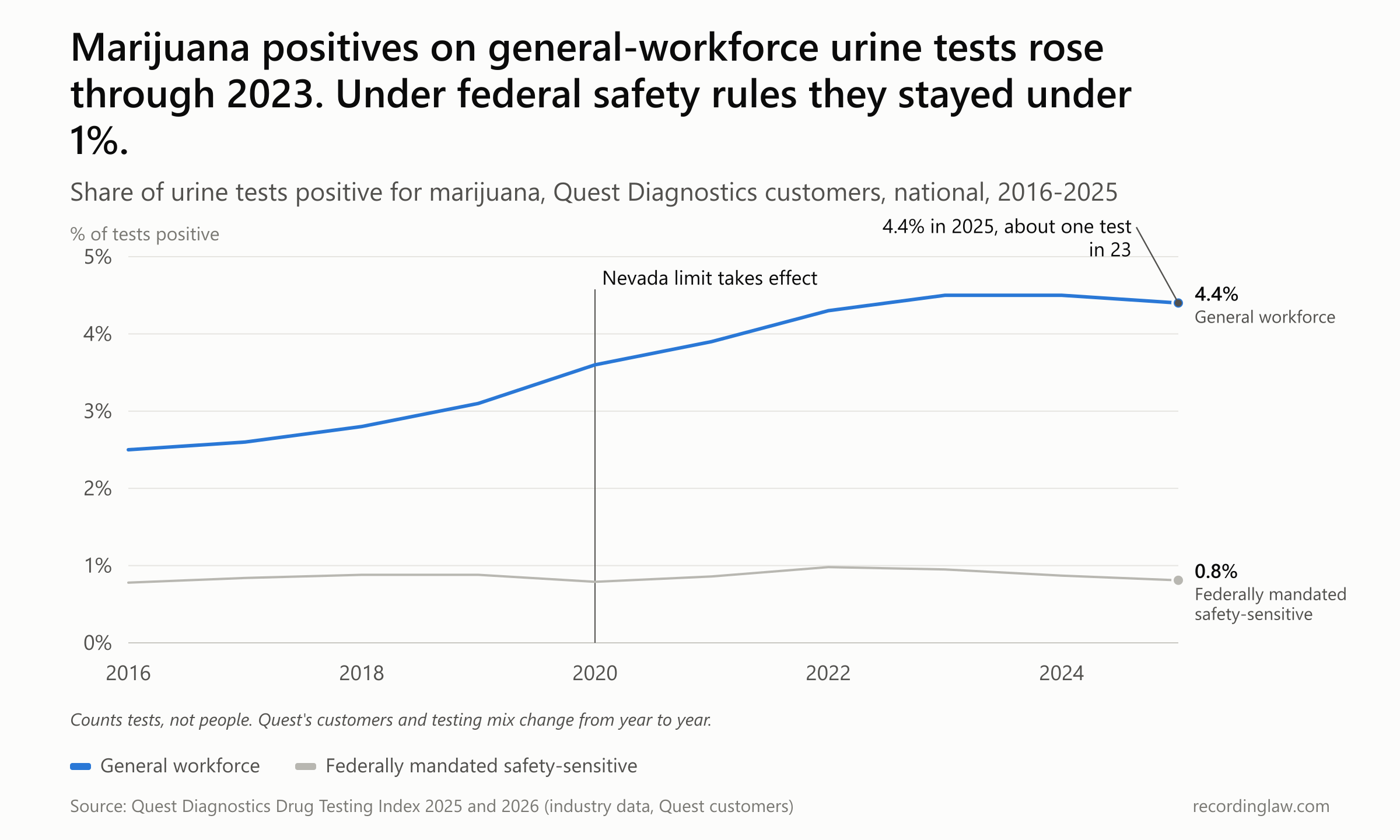
Source: Quest Diagnostics Drug Testing Index, 2025 and 2026 editions (Quest is a drug-testing laboratory; figures are tests of its customers' workers and applicants).
| Year | General workforce, % positive for marijuana | Federally mandated safety-sensitive, % positive |
|---|---|---|
| 2016 | 2.5 | 0.78 |
| 2017 | 2.6 | 0.84 |
| 2018 | 2.8 | 0.88 |
| 2019 | 3.1 | 0.88 |
| 2020 | 3.6 | 0.79 |
| 2021 | 3.9 | 0.86 |
| 2022 | 4.3 | 0.98 |
| 2023 | 4.5 | 0.95 |
| 2024 | 4.5 | 0.87 |
| 2025 | 4.4 | 0.81 |
The general-workforce rate rose every year from 2016 to 2023, held in 2024 and eased slightly in 2025. The federally tested rate never reached 1%.
In 2016 the general workforce tested positive for marijuana about three times as often as the federally tested workforce. By 2025 it was more than five times as often.
Marijuana's rise came while drug positives overall stayed well below their old levels. Counting every drug, not just marijuana, and both workforces together, the share of Quest's urine tests that came back positive was 4.3% in 2025, about half the 8.4% it recorded in 1993, and close to its level in the early 2000s.
The places that changed their laws in those years did something narrower than stop the tests. Nevada's bill shows how narrow.
The weekend user and the safety exemption
Neal's bill did one narrow thing: it made it unlawful for most Nevada employers to refuse to hire an applicant because a screening test found marijuana. "This bill deals only with what happens when a recreational user who smokes only on the weekend is looking for employment," she told the Senate Committee on Commerce and Labor on May 10, 2019. "It does not deal with what happens in the workplace."
She had not come to the issue as a supporter of legal marijuana. "I had my own prejudices; I voted against the ballot question regarding recreational marijuana," she told the senators. "But I brought this bill because I wanted to begin the process of creating policy around this issue."
The stakes, as she put them, were a class of adults shut out of work for something the state allowed. "My fear was and is that we will have a group of people who are unemployable, and that serves no social interest," she said. NORML, the marijuana-law reform group, made the same case in terms of alcohol: "It's about time that employers treat those who consume cannabis legally while away from the workplace in a similar manner," said Carly Wolf, its state policies coordinator.
The business groups put the stakes in terms of safety. "We feel that for us it's a safety issue," Paul Enos, chief executive of the Nevada Trucking Association, said of pre-employment marijuana screening. "We do that for our protection as well as the protection of everybody else we're sharing our roads and highways with."
Hardy described the bill as a collision between two duties. "The challenge here is balancing the rights of the employees, who now clearly have a right to use this substance, with the obligations and responsibility of the business owner, who has an obligation and responsibility to make sure their workplace is safe for both their customers and their other employees," he said.
Ann Silver, chief executive of the Reno + Sparks Chamber of Commerce, told the senators that any list of exempt jobs would be too short. "To suggest there are only designated occupations that should be permitted to refuse employment based on a positive test for marijuana excludes the many jobs that require preparing food, caring for elders, caring for children, serving alcohol and food, using tools or driving one's own car to and from a company assignment," she said. The chamber opposed the bill "on the basis that we are not yet ready to permit marijuana use in almost all employment environments in Nevada."
The law that passed left testing alone and limited what an employer may do with the result. It exempts firefighters, emergency medical technicians, jobs that require driving under federal or state rules, and jobs that could adversely affect the safety of others. Enos was one of several business representatives who testified to shape and revise the law, the Las Vegas Sun reported.
After the bill was signed in June 2019, Enos and Neal both singled out that last exemption. "The bill gives employers a tremendous amount of discretion to determine whether or not the position they are hiring for could impact the safety of others," Enos said. "They can still use positive test for marijuana to deny the job." Neal had her own worry about the same clause: "I'm hoping that it's not abused and they're not going to say a secretary is a safety position."
Of the places this story follows, Nevada's limit was the first to take effect, on January 1, 2020. New York City had passed its own law earlier, in April 2019, but it took effect later. The others drew their lines in different spots.
Who else drew a line, and how far did they go?
New York City went furthest, and without its mayor's signature. The City Council passed Local Law 91 on April 9, 2019. The mayor returned it unsigned on May 9. From May 10, 2020, it barred most employers from testing job applicants at all for THC, the active ingredient in marijuana.
Its sponsor, Public Advocate Jumaane D. Williams, had wanted no exceptions. "I was hesitant to put any exemptions into the original bill language as I believe that no individual should be tested for THC," he testified to the city's Commission on Human Rights, calling marijuana testing "a Reagan era obstacle, preventing talented applicants from applying and accepting positions." The law still carved out, in his words, "certain safety and security sensitive jobs, and those tied to a federal or state contract or grant," including police officers, some construction jobs, positions that require a commercial driver's license, and jobs supervising or caring for children, medical patients or vulnerable persons.
The commission then added exemptions of its own, in the middle of the pandemic. At its online hearing on April 16, 2020, two members of the public attended and no one testified. The commission adopted the exemptions unanimously on June 16, and they took effect July 24, 2020, 75 days after the ban itself.
New York State followed in its legalization law, the Marihuana Regulation and Taxation Act. Liz Krueger sponsored it in the Senate, and it was signed March 31, 2021. It amended Labor Law 201-d to protect legal off-duty "use of consumable products, including cannabis in accordance with state law." By our reading of the bill text, those changes took effect the day it was signed.
New York employers can still act when a worker shows "specific articulable symptoms" of impairment on the job. The state Department of Labor has said a drug test cannot be that symptom: "a test for cannabis usage cannot serve as a basis for an employer's conclusion that an employee was impaired by the use of cannabis, since such tests do not currently demonstrate impairment."
New Jersey took a third route. Its legalization law, approved February 22, 2021, kept testing: "A drug test may also be done randomly by the employer, or as part of a pre-employment screening." But no employee may face adverse action "solely due to the presence of cannabinoid metabolites," the traces of past use that the tests detect.
The law paired the test with a physical evaluation by a Workplace Impairment Recognition Expert, or WIRE, a trained examiner the Cannabis Regulatory Commission was to certify. The credential did not yet exist. The employment section became operative when the commission adopted its first rules, on August 19, 2021, and those same rules set the WIRE evaluation aside until the commission develops standards for the certification.
Washington and California joined on January 1, 2024. Washington's law rests on a legislative finding that many cannabis tests "show only the presence of nonpsychoactive cannabis metabolites from past cannabis use, including up to 30 days in the past," and it covers hiring, not testing after an accident or on suspicion.
California's lets employers keep testing with screens "that do not screen for nonpsychoactive cannabis metabolites," that is, tests that do not look for the traces of past use, and it exempts the building and construction trades. Both exempt federally required tests and jobs that need a federal security clearance.
Not every state that legalized marijuana went this way. Illinois's adult-use law, in effect since June 2019, says the opposite in its employment section: "Nothing in this Act shall prohibit an employer from adopting reasonable zero tolerance or drug free workplace policies, or employment policies concerning drug testing."
Under all of these laws sat one federal rule, for transportation drug tests. It is addressed to the doctors who review those results, called Medical Review Officers. The regulation, 49 CFR 40.151(e), tells them that they "must not verify a test negative based on information that a physician recommended that the employee use a drug listed in Schedule I of the Controlled Substances Act." Schedule I is one of the federal drug classifications under that act.
Several of the state laws defer to those federal rules. Nevada, Washington and California exempt federally required testing or driving jobs under federal rules, and New York City exempts positions that require a commercial driver's license.
The laws set limits on what employers could do. Many employers had already started changing what they did.
Some employers stopped testing, then a survey found more of it
Caesars Entertainment eliminated marijuana screening for prospective applicants in 2018, the Nevada Current reported while Neal's bill was pending. In June 2021 Amazon did the same for jobs the Department of Transportation does not regulate. "We will no longer include marijuana in our comprehensive drug screening program for any positions not regulated by the Department of Transportation, and will instead treat it the same as alcohol use," wrote Dave Clark, CEO of Amazon's Worldwide Consumer business. "We will continue to do impairment checks on the job and will test for all drugs and alcohol after any incident."
One employer-side count comes from Fisher Phillips, a law firm that represents management, which surveys employers in its audience. In its fall 2024 survey, 475 of 989 responses, or 48%, came from organizations that no longer tested applicants for cannabis or never had.
Two years later the firm asked again and got a different answer. "For several years, it appeared that employers were moving towards dropping pre-hire cannabis screening. But that trend reversed in this latest survey," it wrote in August 2026. Of the more than 600 businesses that answered, 40% said they did not test applicants for cannabis.
How did the mix of policies change between the two surveys?
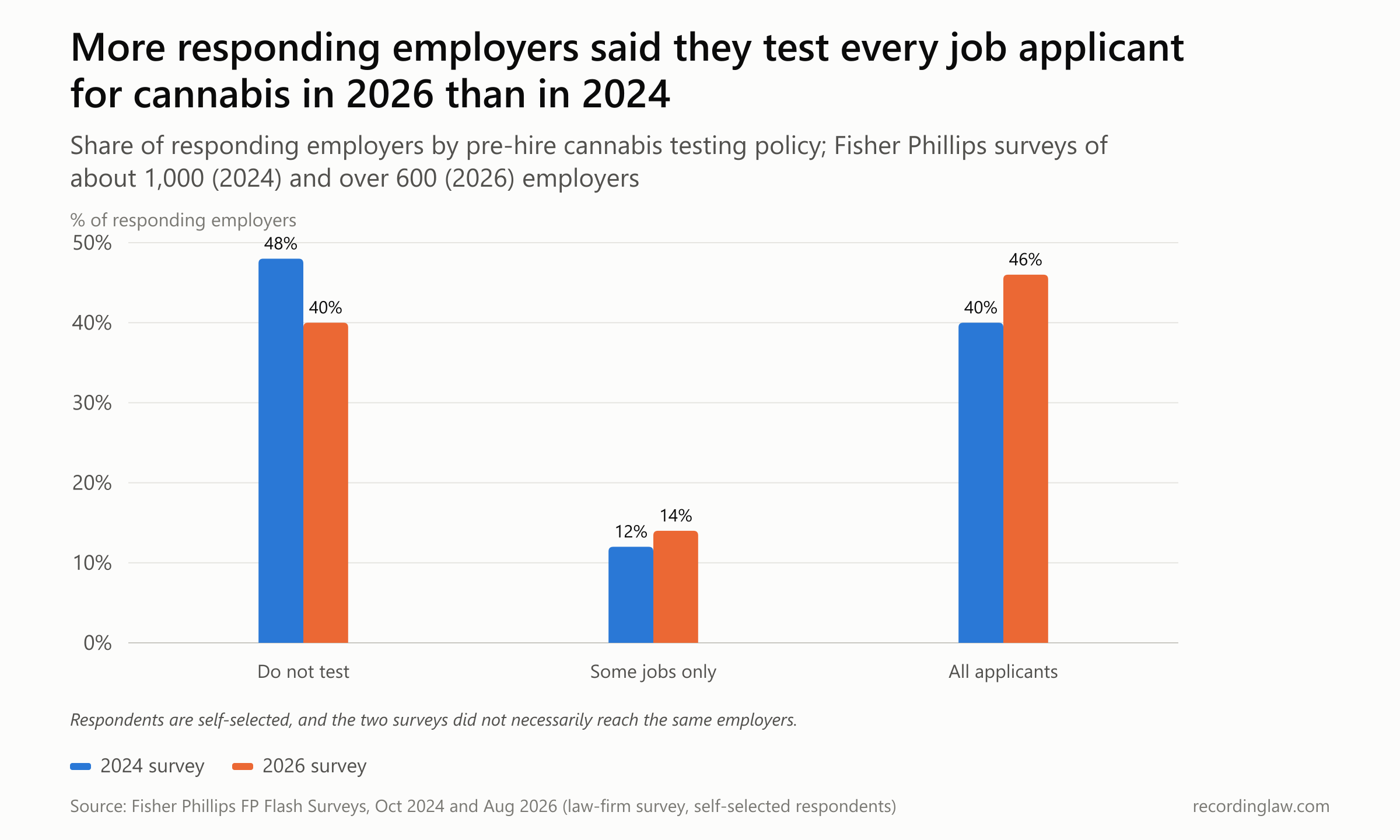
Source: Fisher Phillips FP Flash Surveys, October 2024 (989 responses) and August 2026 (over 600 businesses). Fisher Phillips is a management-side employment law firm; respondents are self-selected.
| Pre-hire cannabis testing policy | 2024 survey | 2026 survey |
|---|---|---|
| Do not test | 48% | 40% |
| Test for some jobs only | 12% | 14% |
| Test all applicants | 40% | 46% |
Among responding employers, the share testing every applicant rose six points and the share testing none fell eight, though the two surveys did not necessarily reach the same employers.
The shift was not even across the country. In 2024 the share of employers not testing applicants ran from 66% in New England to 25% in the South Central region. In 2026 the firm reported that in the South Atlantic, the share not testing fell from 57% to 26%. It said only New England and the Mid-Atlantic had moved further away from testing since 2024.
The firm also asked employers that do not test why they don't. Only 34% cited state or local laws that prohibit or restrict testing. The more common answer, from 47%, was that cannabis legalization in their state "shifted their overall approach." Only 8% pointed to the federal government's recent moves to loosen restrictions.
The firm's own lawyers did not predict the reversal. "I didn't expect this result, and I suspect most employers won't either," said Todd Logsdon, co-chair of its Workplace Safety and Catastrophe Management Practice Group. "Cannabis is becoming increasingly more available now as more and more states legalize it in some way, and perhaps employers are seeing the effects of that in ways they weren't just a few years ago."
Whatever employers decided, the positives in Quest's data kept coming from every kind of state.
Did the rise happen only where marijuana is legal?
Quest also sorts the general workforce by each state's marijuana law. If legalization were the whole story, the rise would show up only in the states that legalized.
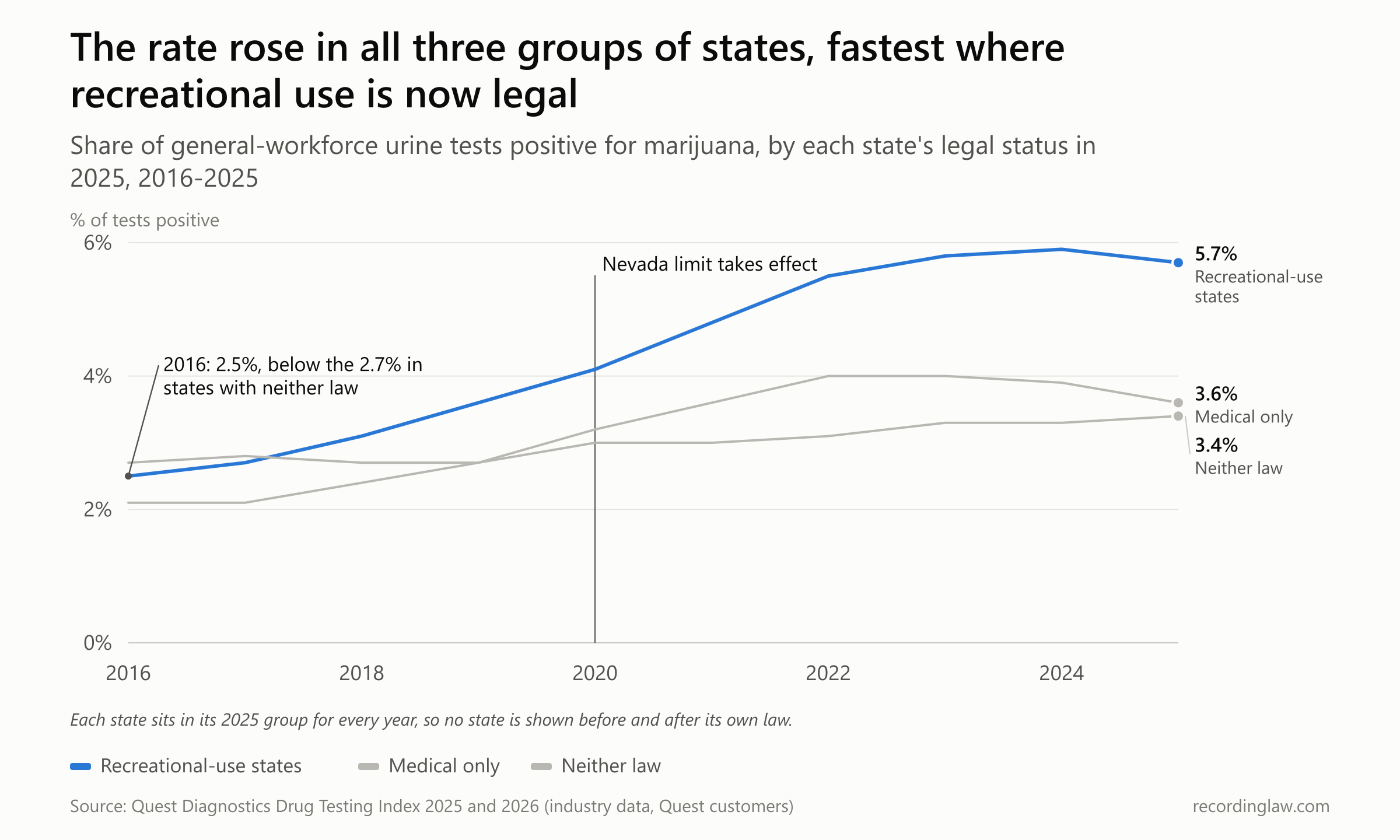
Source: Quest Diagnostics Drug Testing Index, 2025 and 2026 editions. States are grouped by their legal status in 2025 for every year shown.
| Year | Recreational-use states | Medical-only states | Neither | National |
|---|---|---|---|---|
| 2016 | 2.5 | 2.1 | 2.7 | 2.5 |
| 2018 | 3.1 | 2.4 | 2.7 | 2.8 |
| 2019 | 3.6 | 2.7 | 2.7 | 3.1 |
| 2021 | 4.8 | 3.6 | 3.0 | 3.9 |
| 2023 | 5.8 | 4.0 | 3.3 | 4.5 |
| 2024 | 5.9 | 3.9 | 3.3 | 4.5 |
| 2025 | 5.7 | 3.6 | 3.4 | 4.4 |
The rate rose in all three groups, and fastest in the states where recreational use is now legal. In 2016 those states were slightly below the states with neither law (2.5% against 2.7%). By 2025 they were well above them (5.7% against 3.4%).
That chart is easy to over-read. Quest assigns each state to the group it belonged to in 2025. So a state that legalized in 2020 sits in the recreational line for 2016 too, and the line cannot show any one state before and after its law. It also cannot separate two kinds of change: a change in what workers do, and a change in which employers buy Quest's tests and why.
Quest has offered its own readings over the years. In a statement reported in August 2018, Barry Sample, then its senior director of science and technology, said that "while it is too early to tell if this is a trend, our data suggests that the recreational use of marijuana is spilling into the workforce," and asked for outside work: "We encourage policy analysts to track these trends closely to determine whether a correlation between the state legalization of marijuana and increased workforce drug use, as suggested by our data, bears out in other research." In 2021 he added that "it appears that states where medical marijuana use alone is legal are not experiencing much higher rates of increase than states where neither medical nor recreational use is legal."
The rate depends on which test was given, and why
Every Quest figure so far comes from urine tests. Employers can also test oral fluid or hair, which capture different windows of use. How much does the choice of test change the answer?
Source: Quest Diagnostics Drug Testing Index, 2026 edition. Each specimen type comes from a different mix of employers and testing reasons, so the figures are not a like-for-like comparison.
| Specimen, 2025 | % positive for marijuana |
|---|---|
| Urine | 4.4 |
| Oral fluid | 11.1 |
| Hair | 15.1 |
In 2025 a hair test came back positive for marijuana about three and a half times as often as a urine test. That is roughly one hair test in seven.
Hair results have also climbed faster than urine. By Quest's count, pre-employment hair tests positive for marijuana rose from 10.1% in 2021 to 15.1% in 2025. Pre-employment urine tests went from 4.1% to 4.6% over the same years.
Across all drugs, Quest reported that "nearly 1 in 5 workers in the general US workforce (19.1%) tested positive for drug use based on an analysis of hair specimens collected in 2025." Quest sells these tests and promotes them in the same release. "Hair and oral fluid testing not only capture different windows of use but are also more resistant to tampering and substitution than traditional methods. This gives employers more accurate insight into safety risks," said Jason S. Hudson, scientific director and laboratory director of Quest's Workforce Solutions.
The reason for a test also changes the answer. Does a worker tested after an accident look different from an applicant?
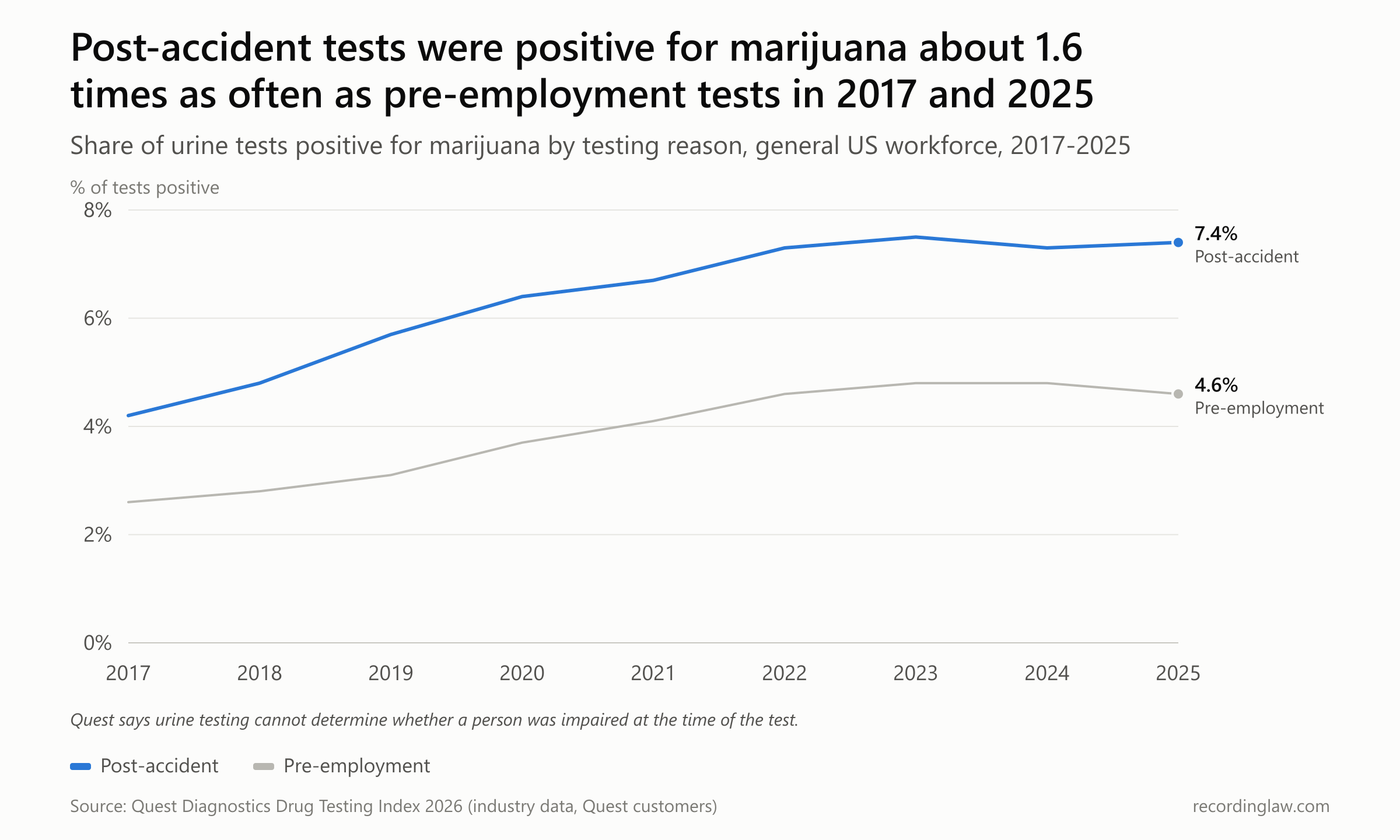
Source: Quest Diagnostics Drug Testing Index, 2026 edition (general US workforce, urine).
| Year | Pre-employment, % positive for marijuana | Post-accident, % positive for marijuana |
|---|---|---|
| 2017 | 2.6 | 4.2 |
| 2019 | 3.1 | 5.7 |
| 2021 | 4.1 | 6.7 |
| 2023 | 4.8 | 7.5 |
| 2024 | 4.8 | 7.3 |
| 2025 | 4.6 | 7.4 |
Post-accident tests were positive for marijuana about 1.6 times as often as pre-employment tests in both 2017 and 2025, and both rates rose over the period.
Quest has read something into the post-accident line, while stating the limit of its own test. In 2021 Sample said that "while urine drug testing cannot determine whether an individual is under the influence or impaired at the time of test, our post-accident data suggests that marijuana use may play a role in those workplace incidents prompting a drug test."
Among federally tested workers, post-accident tests were also positive for marijuana more often than pre-employment tests, though at lower rates. In 2025 the rates were 1.9% for post-accident tests against 1.0% for pre-employment tests.
Random tests of current employees sit at the other end. In September 2025 Quest reported that marijuana positivity in random tests of the general workforce had run 42% below pre-employment positivity over the previous five years.
That mix of reasons sits under every national number in this story, and the mix can change. In August 2018, ASIS International's Security Management magazine reported: "About 70 percent of drug tests in the workplace are for preemployment screening, according to Quest." Quest does not publish how many tests it runs for each reason or in each specimen, so if employers drop pre-hire urine screens, add hair tests or test more after accidents, the national rate can move without any change in what workers do.
Every one of these figures counts a positive. None of them says whether the person tested was impaired.
Does a positive test mean someone was impaired?
On what the test shows, the sources now largely agree. In a 2017 report to Congress, the National Highway Traffic Safety Administration wrote that "the level of THC in the blood and the degree of impairment do not appear to be closely related," and that "while THC can be detected in the blood long after ingestion, the acute psychoactive effects of marijuana ingestion last for mere hours, not days or weeks."
The state agencies that oversee the new rules said the same about workplace tests. Along with New York's labor department, in the guidance quoted earlier, New Jersey's Cannabis Regulatory Commission wrote in 2022 that cannabis "can remain in the bodily fluids of users for a long period of time and although tests are improving in accuracy there is no perfect test for detecting present cannabis impairment." Quest, in Sample's 2021 statement on its post-accident data, said the same of its own urine tests.
On what follows from that, the sides split.
The National Safety Council, a congressionally chartered safety nonprofit, called in 2019 for no cannabis use in safety-sensitive jobs, whatever state law allows. "Research clearly shows that cannabis impacts a person's psychomotor skills and cognitive ability," said its president, Lorraine M. Martin. "We urge employers to implement policies stating no amount of cannabis consumption is acceptable for those who work in safety sensitive positions."
The council's position paper cited a study from the National Institute on Drug Abuse that, as HR Dive reported it, found "employees who tested positive for cannabis had 55% more industrial incidents" than those who tested negative. That figure is the council's citation as HR Dive reported it; we did not review the study itself.
In 2024, in a Quest release, the council's Katie Mueller tied the trend to the rising positives. "As the prevalence of marijuana positives in the workforce rises, our concern grows," Mueller said. "The data show an increasing correlation between marijuana use and adverse workplace effects."
The reform side starts from the same fact, that a test shows past use, and argues against testing workers without suspicion. "Suspicionless marijuana testing in the workplace is not now, nor has it ever been, an evidence-based policy," wrote Paul Armentano, deputy director of NORML, in an op-ed in The Hill that the group republished in May 2026. The ACLU of the District of Columbia told the DC Council in 2019 that random tests "assess past use rather than impairment," and so "allow employers to control what employees do in their spare time even if those activities have no effect on work."
Do the safety studies settle it?
No. Studies that tried to measure what legalization did to workplace safety point in different directions, and they differ by age, by the kind of law and by where people use.
The US studies compare states before and after their laws. The Canadian one follows workers over time.
A 2024 research letter in JAMA Health Forum by Li, Liang, Sabia and Dave used state injury rates from 2006 to 2020. It found that recreational marijuana laws (RMLs) that allowed sales were associated with about 10% to 12% more workplace injuries among workers aged 20 to 34, depending on the measure. In the fully adjusted models, the authors wrote, "RMLs that did not allow sales were not associated with injuries." Sabia disclosed grants from the Charles Koch Foundation, Georgia State University and the Drug Enforcement & Policy Center.
A 2021 National Bureau of Economic Research working paper by Abouk, Ghimire, Maclean and Powell studied adults aged 40 to 62. It found that "WC receipt declines in response to RML adoption," meaning receipt of workers' compensation benefits, along with lower rates of non-traumatic workplace injuries. The authors pointed to "access to an additional form of pain management therapy." Powell acknowledged a National Institute on Drug Abuse grant.
A 2018 study by Anderson, Rees and Tekin looked at medical marijuana laws. It found them "associated with a 19.5% reduction in the expected number of workplace fatalities among workers aged 25-44."
A Canadian study separated where people used. Following 2,745 workers from 2018 to 2020, Carnide and colleagues at Toronto's Institute for Work & Health found "no difference in workplace injury risk for non-workplace cannabis use," while use at work "was associated with an almost two-fold increased risk of experiencing a workplace injury."
Set side by side, with the National Safety Council's citation included, how far apart are the estimates?
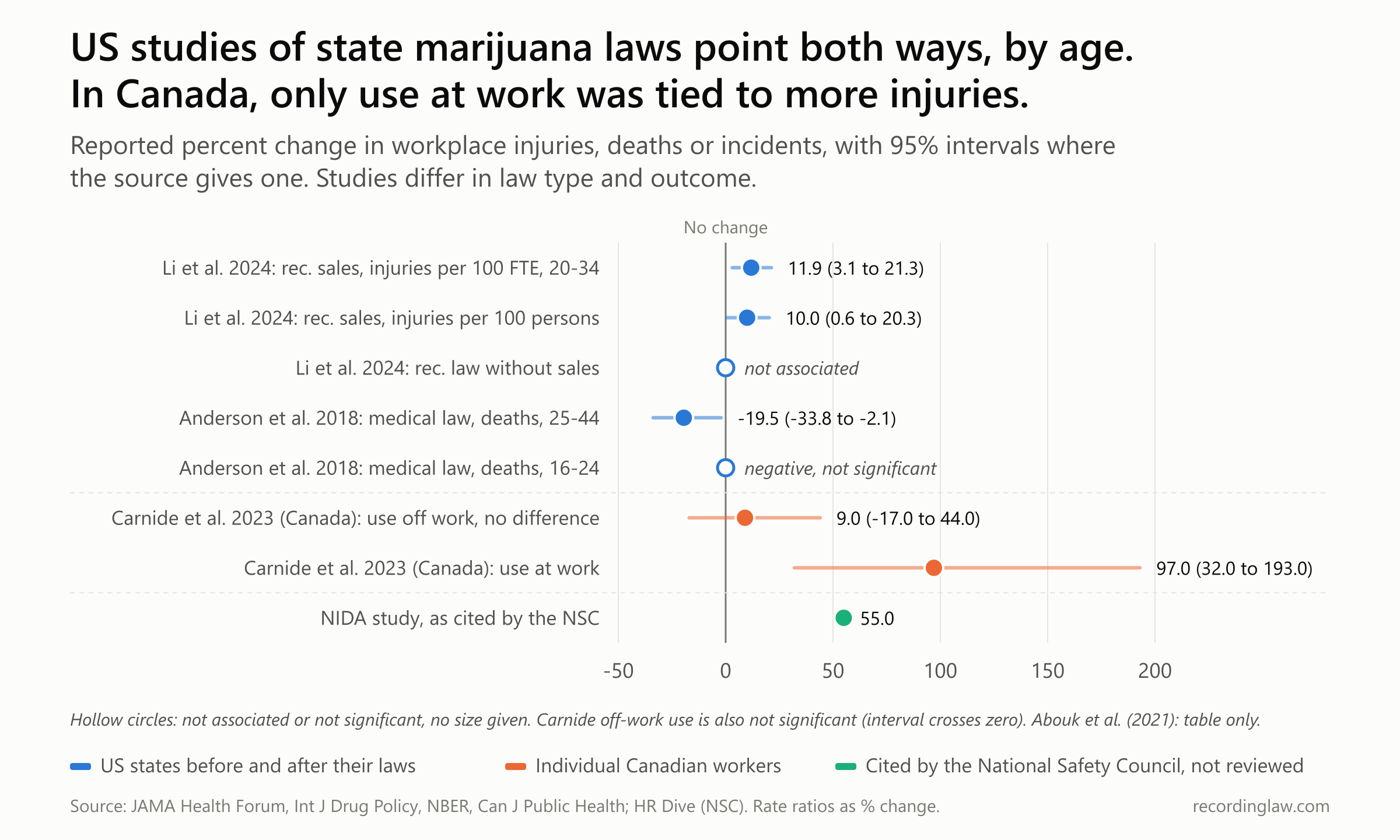
Sources: Li et al., JAMA Health Forum 2024 (full text); Anderson, Rees and Tekin, International Journal of Drug Policy 2018 (abstract); Abouk et al., NBER Working Paper 28471 (2021); Carnide et al., Canadian Journal of Public Health 2023 (abstract); HR Dive (2019) for the NIDA figure as the National Safety Council cited it. Rate ratios are converted to percent change; outcomes and ages differ by study. Abouk et al. (2021) reported declines but no size in the abstract we quote, so the study appears in the table and not on the chart.
| Study | Design | Who | Reported change | 95% interval |
|---|---|---|---|---|
| Li et al. (2024), recreational sales | US states before and after | Workers 20 to 34 | +11.9% injuries per 100 full-time workers; +10.0% per 100 persons | +3.1% to +21.3%; +0.6% to +20.3% |
| Li et al. (2024), recreational law without sales | US states before and after | Workers 20 to 34 | not associated | not given |
| Anderson, Rees and Tekin (2018), medical law | US states before and after | Workers 25 to 44 | -19.5% workplace deaths | -33.8% to -2.1% |
| Anderson, Rees and Tekin (2018), medical law | US states before and after | Workers 16 to 24 | negative, not significant | not given |
| Abouk et al. (2021), recreational law | US states before and after | Adults 40 to 62 | declines in workers' compensation receipt and non-traumatic injuries | not given in the abstract |
| Carnide et al. (2023), use off work | Canadian workers followed over time | 2,745 workers | +9% (no difference) | -17% to +44% |
| Carnide et al. (2023), use at work | Canadian workers followed over time | 2,745 workers | +97% | +32% to +193% |
| NIDA study, as cited by the National Safety Council | not reviewed | not reviewed | +55% industrial incidents | not given |
None of the studies evaluated a drug-testing policy, so the chart cannot say what any of them means for a drug-testing policy.
Quest has cited one of them. Its 2024 release said its data "aligns with other reports associating marijuana legalization with workplace harms," pointing to the JAMA Health Forum finding on younger workers.
If a test cannot show impairment, something else has to. New Jersey wrote that something into its law.
New Jersey's missing impairment expert
New Jersey's regulators set the WIRE evaluation aside in the same first rules that switched on the employment section in August 2021. The rule says that "until such time that the Commission, in consultation with the Police Training Commission ... develops standards for a Workplace Impairment Recognition Expert certification, no physical evaluation of an employee being drug tested ... shall be required."
Employers asked for the standards within a year. "We need some clarity for our employer community," Chrissy Buteas of the New Jersey Business & Industry Association, an employer lobby, told a Senate committee in May 2022. "So, we're in a situation right now where we have a statute that says we need to have these WIREs trained and meet a certain criteria, but we don't have the actual regulations explaining the certification process."
Her colleague Ray Cantor put it to the commission in July 2022. "The issue of workplace impairments, as I am sure you all recognize, is significant not only to the employer community but to the public at large," he said. "We do not want accidents to happen … we need those regulations in place."
In September 2022 the commission issued workplace guidance, which it called "a first step towards formulating and approving standards for Workplace Impairment Recognition Expert certifications." Its executive director, Jeff Brown, framed the goal as familiar. "Striking a balance between workplace safety and work performance and adult employees' right to privacy and to consume cannabis during their off hours is possible," he said. "We have been doing that with alcohol without thought."
The latest public record we found suggests the standards still had not been adopted by 2025. In written public comments for the commission's August 7, 2025 meeting, a member of the public asked whether the commission had "come up with the standards" for the certification, and where employers could get training. The rule suspending the evaluation remains in the version of the state's administrative code we reviewed, last amended in 2024.
In January 2026 the Legislature rewrote the provision. A law signed January 20 renamed the examiner a Workplace Impairment Recognition Evaluator.
The law told the commission to set its standards "in consultation with the Department of Labor and Workforce Development," and it required the commission to certify people who complete a Drug Recognition Evaluator program or an equivalent course, where the 2021 law had left that to the commission's discretion. The physical evaluation stayed in the statute.
In May 2019, Ray Bacon of the Nevada Manufacturers Association had asked the Nevada senators the question underneath this. "When someone does come up with a reliable test for marijuana impairment, who will certify it? The federal government will not touch it, and Nevada has nobody who is technically qualified to approve it, nor does any other state."
Federal transportation rules never waited for an impairment test. They kept testing.
The workers the state laws left out
Federal rules, which several of the state laws defer to, have barred marijuana use by safety-sensitive transportation workers throughout. The Department of Transportation's drug-testing regulation "does not authorize 'medical marijuana' under a state law to be a valid medical explanation for a transportation employee's positive drug test result," its Office of Drug and Alcohol Policy and Compliance says.
Results for commercial driver's license holders go into the Federal Motor Carrier Safety Administration's Drug and Alcohol Clearinghouse, which publishes counts of positive tests but not how many tests were run. How many marijuana positives does it record each year?
Source: FMCSA Drug and Alcohol Clearinghouse, September 2026 monthly report (data as of October 1, 2026). Counts of positive tests, not rates; earlier years are revised between reports.
| Year | Marijuana positives reported | All substance identifications | Marijuana share |
|---|---|---|---|
| 2020 | 28,916 | 52,469 | 55.1% |
| 2021 | 32,016 | 56,623 | 56.5% |
| 2022 | 39,321 | 66,053 | 59.5% |
| 2023 | 37,603 | 61,430 | 61.2% |
| 2024 | 34,901 | 57,622 | 60.6% |
| 2025 | 32,939 | 53,822 | 61.2% |
The table's "All substance identifications" column counts one identification for each substance found, so a test positive for two substances counts under each. Marijuana positives for commercial drivers peaked at about 39,300 in 2022 and fell in each year after, to about 32,900 in 2025.
Substance identifications of all kinds fell faster over those years, from about 66,100 to 53,800. So marijuana made up a larger share of them: 55% in 2020 and about three in five from 2023 on.
Without a count of tests, the Clearinghouse cannot say whether drivers are testing positive more or less often. As of October 1, 2026, it listed 360,759 drivers with at least one violation of any kind and 218,977 drivers in "prohibited" status.
Federal policy on marijuana itself began to move in late 2025. On December 18, 2025, an executive order directed the Department of Justice to complete the rescheduling of marijuana from Schedule I to Schedule III. Rescheduling means changing a drug's federal classification under the Controlled Substances Act. The next day the transportation department answered: "Until the rescheduling process is complete, the Department of Transportation's drug testing process and regulations will not change. Transportation employees in safety-sensitive positions will still be subject to testing for marijuana."
In April 2026, medical marijuana and FDA-approved cannabis products moved to Schedule III. In May the department told the Medical Review Officers, or MROs, that a state-licensed product still cannot explain away a positive: "Currently, there is no instance when the MRO could verify a laboratory-confirmed marijuana positive drug test result as 'negative' when an employee claims the positive was caused by a State licensed marijuana product."
Trucking groups pressed to keep it that way.
"A safe driver is a qualified driver," Brenna Lyles of the American Trucking Associations said in December 2025. "And a qualified driver is drug- and alcohol-free. Motor carriers must retain reliable, enforceable tools to ensure they are not putting unqualified drivers behind the wheel." Dave Heller of the Truckload Carriers Association warned in April 2026 that the change "could carry unintended consequences for an industry that prohibits truck drivers from using marijuana."
NORML argues the federal program tests for the wrong thing: its urinalysis "screens for the presence of the inert carboxy-THC metabolite," the group wrote in May 2026. "This non-psychoactive metabolite is detectable in subjects' urine for weeks or even months following past exposure. By contrast, marijuana's acute effects typically dissipate within hours."
The medical-only step left federal testing untouched. The larger question is still open.
What changes if all marijuana moves to Schedule III?
Nobody has answered that yet. With the April 2026 order, the acting US attorney general also announced an expedited administrative hearing on whether all marijuana should move to Schedule III.
In October the hearing's administrative law judge, Derek Julius, admitted a GAO report and allowed further briefs. Replies were due November 5, 2026, the scheduled end of briefing. As of November 10, 2026, we found no recommended decision from the judge, and a final decision follows after one is issued.
Quest and the National Transportation Safety Board have both flagged what is at stake for workplace tests. Such reclassification "could affect the ability to test for cannabis in federal programs," Quest wrote in July 2026. The NTSB expressed concern in 2024, Commercial Carrier Journal reported, and told the magazine in April 2026 that its position was unchanged: moving marijuana to Schedule III without steps to keep it within pre-employment, random, reasonable-suspicion and post-accident testing would create a safety "blind spot."
Private employers are deciding on their own clock. In the 2026 Fisher Phillips survey, 24% of employers that test applicants for cannabis said they were actively considering softening their stance, and another 26% were unsure.
The next national reading arrives with Quest's 2027 Drug Testing Index, covering 2026, expected between May and September 2027. It will show where the general-workforce urine rate went after its 2023 and 2024 high of 4.5%.
It will not answer the question Bacon put to Nevada's senators in May 2019. "It could be ten years before we get to a test for impairment," he said, and he asked who would certify one when it came. His ten years run to 2029.
New Jersey is the one place in this story that wrote an impairment examiner into its law. Seven years after Bacon spoke, it had renamed the examiner and handed its labor department a part in writing the standards. We found no record that those standards had been adopted by November 2026.
How we measured
Quest Diagnostics Drug Testing Index. Quest is a laboratory company that sells workplace drug tests. The index is its own analysis of tests its laboratories ran for its customers, not a survey of all US workers. Figures are the percentage of tests (specimens), not of people, positive before review by a Medical Review Officer. The general US workforce excludes federally mandated safety-sensitive testing, rehabilitation and criminal-justice testing. Marijuana series by state status (2016 to 2025) come from the 2025 report (2016) and the 2026 report (2017 to 2025). The two editions agree on every overlapping year. Testing-reason series (2017 to 2025), the specimen comparison and hair figures come from the 2026 report. Industry figures come from its industry tables dated March 5, 2026, which exclude industries with under 50,000 average annual urine tests. The 2025 edition reported analysing more than 8 million tests. The newest edition, released July 10, 2026, covers 2025; the next is expected in mid-2027.
Two Quest figures that are easy to mix up. Quest's 2026 release text describes 4.3% as general-workforce all-drug urine positivity, but its table puts 4.3% on the combined row (general plus federally mandated). General-workforce all-drug urine positivity was 5.5% in 2025. Hair figures here are pre-employment hair positivity for marijuana (10.1% in 2021, 15.1% in 2025) and all-drug hair positivity (13.1% in 2021, 19.1% in 2025). Random hair tests ran higher still (18.3% in 2021, 21.0% in 2025), the opposite of the urine pattern, another sign that specimen types come from different employers and reasons.
State groups. Quest's recreational, medical-only and neither groups use each state's legal status in 2025 for every year. They cannot show before-and-after for any single state, and Quest publishes no state-level figures. Nothing in this data can attribute a change in positivity to a state law: the same years saw changes in Quest's customers, in the mix of testing reasons and specimens, and in the COVID-19 pandemic.
Testing reasons and volume. Quest does not publish test counts by reason, specimen or state group, so the share of pre-employment tests (which falls when employers drop pre-hire screening) cannot be tracked. The "about 70 percent" pre-employment share is Quest's statement as reported by ASIS International in August 2018. The 42% random-versus-pre-employment gap is from Quest's September 2, 2025 release. Quest notes that changes in marijuana testing affected its oral-fluid positivity rates in 2020 to 2022.
FMCSA Drug and Alcohol Clearinghouse. Counts of positive tests reported for commercial driver's license and permit holders, from the September 2026 monthly report data file (data as of October 1, 2026). There is no count of tests to divide by, so no rate can be computed. A test positive for two substances counts under each. Earlier years are revised between monthly reports (2024 marijuana positives were 34,636 in the January 2025 report, 34,916 in December 2025 and 34,901 in September 2026). The 2026 year-to-date count (24,078 marijuana positives through October 1) is partial and not charted. FMCSA's "all substances" row counts each time a substance was identified, not unique positive tests, so it equals the sum of the substance rows. Marijuana share is marijuana positives divided by all substance identifications (for example, 32,939 / 53,822 = 61.2% in 2025). The October 2026 report (data as of November 1, 2026) revised 2025 to 32,934 marijuana positives and 53,813 identifications, a change of under 0.1% that leaves the rounded figures unchanged.
Fisher Phillips surveys. Fisher Phillips is a management-side employment law firm; its FP Flash Surveys are of self-selected employers in its audience. The 2024 survey ran September 23 to October 2, 2024 (989 responses). The 2026 survey ran July 20 to 31, 2026 (more than 600 businesses). The two are not the same panel. The 2026 regional percentages were published only as an image; the South Atlantic figures are from the firm's text.
Law dates. Nevada AB 132: approved June 5, 2019 (Statutes of Nevada 2019, chapter 421) and effective January 1, 2020, per section 4 of the enrolled bill. Of the six places this story follows, Nevada's limit took effect first; New York City's law passed earlier. The six are not a complete list: other states, including some that protect registered medical-marijuana patients, such as Arizona, have their own rules. New York City Local Law 91: passed April 9, 2019, returned unsigned May 9, 2019, effective May 10, 2020; Commission on Human Rights exemptions effective July 24, 2020. New York State: MRTA signed March 31, 2021 (chapter 92); that the Labor Law 201-d changes took effect that day is our reading of the act's effective-date section, not an agency statement. New Jersey: P.L.2021, c.16, approved February 22, 2021; the employment section became operative on the Cannabis Regulatory Commission's adoption of initial rules on August 19, 2021. Washington RCW 49.44.240 and California Government Code 12954: January 1, 2024. Illinois 410 ILCS 705/10-50: P.A. 101-27, effective June 25, 2019. New Jersey P.L.2025, c.325, approved January 20, 2026 and effective 90 days later, rewrote N.J.S.A. 24:6I-52, renaming the Workplace Impairment Recognition Expert certification a Workplace Impairment Recognition Evaluator certification. We found no record that the commission had adopted standards for it by November 2026.
Arithmetic. General versus federally mandated: 2.5 / 0.78 = 3.2 (2016) and 4.4 / 0.81 = 5.4 (2025). One test in 23: 1 / 0.044 = 22.7. Hair versus urine: 15.1 / 4.4 = 3.4; one in seven: 1 / 0.151 = 6.6. Post-accident versus pre-employment: 7.4 / 4.6 = 1.6 (2025) and 4.2 / 2.6 = 1.6 (2017). Retail versus education (industry table below): 7.6 / 1.7 = 4.5. Fisher Phillips changes: 46 minus 40 = 6 points; 48 minus 40 = 8 points. All-drug combined: 4.3 / 8.4 = 0.51 (2025 vs 1993). New York City exemptions: May 10 to July 24, 2020 = 75 days. Bacon's "ten years," said in May 2019, runs to 2029. Clearinghouse declines, 2022 to 2025: marijuana positives 32,939 / 39,321 = 0.84 (down 16%); all substance identifications 53,822 / 66,053 = 0.81 (down 19%).
Industries. Quest's industry tables show which industries see the most marijuana positives.
Source: Quest Diagnostics Drug Testing Index 2026, industry tables (industries with fewer than 50,000 average annual urine tests excluded by Quest).
| Industry, 2025 | % positive for marijuana | 2021 |
|---|---|---|
| Retail trade | 7.6 | 6.4 |
| Real estate, rental and leasing | 6.3 | 5.1 |
| Wholesale trade | 5.8 | 4.5 |
| Transportation and warehousing | 5.6 | 5.4 |
| Admin support and waste services | 4.9 | 4.2 |
| Other services | 4.8 | 5.0 |
| Health care and social assistance | 4.2 | 2.9 |
| Information | 4.1 | 3.0 |
| Professional, scientific and technical | 4.0 | 2.8 |
| Finance and insurance | 3.7 | 2.3 |
| Manufacturing | 3.4 | 3.1 |
| Construction | 3.3 | 2.9 |
| Public administration | 2.4 | 1.4 |
| Educational services | 1.7 | 1.2 |
In 2025 a retail worker's urine test was about four and a half times as likely to be positive for marijuana as a test in education.
Study estimates chart. Rate ratios are converted to percent change as (ratio minus 1) times 100: Anderson et al. 25 to 44, IRR 0.805 (95% CI 0.662 to 0.979) = -19.5% (-33.8% to -2.1%); Carnide et al. off-work use, RR 1.09 (0.83 to 1.44) = +9% (-17% to +44%); workplace use, RR 1.97 (1.32 to 2.93) = +97% (+32% to +193%). Li et al. figures are the fully adjusted estimates for recreational sales. Li et al. report log-scale coefficients; percent change and intervals are exp(β) minus 1: β 0.112 (0.031 to 0.193) = +11.9% (+3.1% to +21.3%); β 0.095 (0.006 to 0.185) = +10.0% (+0.6% to +20.3%). Abouk et al. report a decline, but the abstract we quote gives no size, so the study is in the table and not on the chart; a hollow marker at zero would read as no change. Hollow markers on the chart are findings the sources report as not associated or not significant, with no size given. Carnide et al. report "no difference" for off-work use; its interval crosses zero, so that row is not significant either, though it is drawn as a filled point with its interval. The NIDA figure is the National Safety Council's citation as HR Dive reported it. Outcomes differ (injuries, deaths, workers' compensation receipt, industrial incidents), so the rows show direction and rough size, not one comparable effect. The specimen, industry and Clearinghouse figures, charted in an earlier version of this story, now appear as tables only.
Research. Study findings are quoted from their abstracts or working paper; for Li et al. (2024) they are taken from the open-access full text (PMC10891478), which also lists Sabia's research support from the Center for Health Economics & Policy Studies at San Diego State University. Funding is reported where the source stated it; it was not listed in the abstracts we reviewed for Anderson, Rees and Tekin (2018) or Carnide et al. (2023). The NIDA study cited by the National Safety Council is reported as cited; we did not review it.
What comes next. In the DEA hearing on moving all marijuana to Schedule III, replies were due November 5, 2026, the scheduled end of briefing. As of November 10, 2026, we found no recommended decision; the administrative law judge's recommended decision and a final decision follow. Quest's next Drug Testing Index, covering 2026, is expected between May and September 2027. We found no record that New Jersey's Cannabis Regulatory Commission had adopted standards for a Workplace Impairment Recognition Evaluator certification under P.L.2025, c.325 by November 2026.
Frequently Asked Questions
What percentage of workers test positive for marijuana?
In Quest Diagnostics data, 4.4% of general-workforce urine drug tests were positive for marijuana in 2025, down from 4.5% in 2023 and 2024 and up from 3.1% in 2019. Tests under federal transportation safety rules were 0.81% positive. Quest is a testing laboratory, and these are tests of its customers' workers and applicants, not a sample of all US workers.
Can an employer refuse to hire you for testing positive for marijuana?
It depends on the state and the job. Nevada, New York City, New York State, New Jersey, Washington and California are among the places that limit what employers may do with a positive marijuana test, each with exemptions, such as jobs that affect others' safety or that require federal testing. Other states, including some that protect registered medical-marijuana patients, have their own rules, and some, such as Illinois, let employers keep zero-tolerance policies. Jobs covered by federal transportation testing rules treat any marijuana positive as a violation everywhere. This is general information, not legal advice.
Does a positive marijuana drug test prove someone was impaired?
No. New York's Department of Labor says cannabis tests do not currently demonstrate impairment. New Jersey's cannabis regulator says there is no perfect test for present impairment. And Quest Diagnostics says urine testing cannot determine whether someone was impaired at the time of the test. NHTSA reported in 2017 that THC can be detected long after its effects, which last hours, have worn off.
How long does marijuana show up on a workplace drug test?
Washington's law, which took effect January 1, 2024, rests on a legislative finding that many cannabis tests show metabolites from use up to 30 days in the past. NORML says the metabolite can be detectable in urine for weeks or even months. Hair and oral-fluid tests detect use over different windows than urine, and in 2025 Quest found marijuana in 15.1% of hair tests and 11.1% of oral-fluid tests, against 4.4% of urine tests.
Are truck drivers still tested for marijuana after the 2026 rescheduling?
Yes. The April 2026 order moved only medical marijuana and FDA-approved cannabis products to Schedule III. In a May 2026 question-and-answer, the Department of Transportation said a reviewing doctor still cannot treat a marijuana positive as negative because of a state medical marijuana product, and the department says its testing rules will not change until any rescheduling is complete.
Are more employers drug testing for marijuana in 2026?
In a Fisher Phillips survey of more than 600 businesses in July 2026, 46% said they test all job applicants for cannabis, up from 40% in the firm's 2024 survey. The share that said they do not test applicants fell from 48% to 40%. Fisher Phillips is a management-side law firm, and its respondents are self-selected.
When is the next Quest Drug Testing Index released?
Quest publishes the index once a year. The 2026 edition, covering 2025, was released July 10, 2026. The next edition, covering 2026, is expected between May and September 2027.
Updates
Corrected: we described a 2021 working paper by Abouk and colleagues as finding fewer workers' compensation claims. The paper measured receipt of workers' compensation benefits, not claims filed.
Restructured as a feature: chart titles state the finding, side details moved to How we measured. Every figure and quote was re-checked against its source.
Independently fact-checked against the cited primary sources
Independently fact-checked against the cited primary sources
Sources and References
- Quest Diagnostics (drug-testing laboratory), Drug Testing Index 2026 report (2025 data)(questdiagnostics.com)
- Quest Diagnostics, Drug Testing Index 2025 report (2024 data)(questdiagnostics.com)
- Quest Diagnostics, Drug Testing Index 2026 industry tables (March 5, 2026)(questdiagnostics.com)
- Quest Diagnostics press release, July 10, 2026(newsroom.questdiagnostics.com)
- Quest Diagnostics press release, September 2, 2025(s2.q4cdn.com)
- Quest Diagnostics press release, May 15, 2024 (quotes the National Safety Council)(newsroom.questdiagnostics.com)
- Quest Diagnostics press release, May 26, 2021(newsroom.questdiagnostics.com)
- ASIS International, Security Management, "A Screening Minefield," by Lilly Chapa, August 1, 2018(asisonline.org)
- FMCSA Drug and Alcohol Clearinghouse, monthly report archive (September 2026 report)(clearinghouse.fmcsa.dot.gov).gov
- FMCSA Drug and Alcohol Clearinghouse, September 2026 monthly report data (as of October 1, 2026)(clearinghouse.fmcsa.dot.gov).gov
- FMCSA Drug and Alcohol Clearinghouse, October 2026 monthly report data (as of November 1, 2026)(clearinghouse.fmcsa.dot.gov).gov
- Fisher Phillips (management-side employment law firm), FP Flash Survey, October 8, 2024(fisherphillips.com)
- Fisher Phillips, FP Flash Survey, August 3, 2026(fisherphillips.com)
- Nevada Assembly Bill 132 (2019), enrolled text(leg.state.nv.us).gov
- Nevada Revised Statutes 613.132(leg.state.nv.us).gov
- Nevada Senate Committee on Commerce and Labor, minutes of May 10, 2019 hearing on A.B. 132(archive.leg.state.nv.us).gov
- Las Vegas Review-Journal, "Trio wants marijuana removed from pre-employment drug tests in Nevada," February 20, 2019(reviewjournal.com)
- Nevada Current, "Bill would outlaw rejecting job applicants who flunk a pot test," February 14, 2019(nevadacurrent.com)
- Statutes of Nevada 2019, chapter 421 (AB 132, approved June 5, 2019)(leg.state.nv.us).gov
- Las Vegas Sun, "Nevada law prevents most employers from rejecting pot-users," June 12, 2019(lasvegassun.com)
- New York City Local Law 91 of 2019, certified text(nyc.gov).gov
- NYC Public Advocate Jumaane D. Williams, testimony opposing exemptions to Local Law 91(advocate.nyc.gov).gov
- NYC Commission on Human Rights, Official Rules (Title 47 RCNY)(nyc.gov).gov
- New York Senate, S854A (2021), Marihuana Regulation and Taxation Act(nysenate.gov).gov
- New York Labor Law Section 201-D(nysenate.gov).gov
- New York State Department of Labor, "Adult Use Cannabis and the Workplace" FAQ (October 2021)(dol.ny.gov).gov
- New Jersey P.L.2021, c.16 (CREAMMA)(pub.njleg.state.nj.us).gov
- New Jersey Cannabis Regulatory Commission press release, August 19, 2021(nj.gov).gov
- New Jersey Cannabis Regulatory Commission, workplace guidance announcement, September 7, 2022(nj.gov).gov
- New Jersey Cannabis Regulatory Commission, Guidance on Workplace Impairment (September 2022)(nj.gov).gov
- N.J.A.C. 17:30-2.1 (Legal Information Institute)(law.cornell.edu)
- New Jersey Legislature, S4847 (2024-2025 session) bill history(njleg.state.nj.us).gov
- New Jersey P.L.2025, c.325, approved January 20, 2026(pub.njleg.state.nj.us).gov
- New Jersey Cannabis Regulatory Commission, written public comments for August 7, 2025 meeting(nj.gov).gov
- New Jersey Business & Industry Association (employer lobby), May 13, 2022(njbia.org)
- New Jersey Business & Industry Association, July 1, 2022(njbia.org)
- Revised Code of Washington 49.44.240(app.leg.wa.gov).gov
- California Government Code Section 12954(leginfo.legislature.ca.gov).gov
- Illinois Cannabis Regulation and Tax Act, 410 ILCS 705/10-50(ilga.gov).gov
- Arizona Revised Statutes 36-2813 (medical marijuana patient protections)(azleg.gov).gov
- 49 CFR 40.151 (eCFR)(ecfr.gov).gov
- US DOT Office of Drug and Alcohol Policy and Compliance, Medical Marijuana Notice(transportation.gov).gov
- US DOT ODAPC, Notice on Testing for Marijuana (December 19, 2025)(transportation.gov).gov
- US DOT, Part 40 Question and Answer (May 2026)(transportation.gov).gov
- Commercial Carrier Journal, "Marijuana Reclassified to Schedule III, Still Banned for Truck Drivers," April 23, 2026(ccjdigital.com)
- Trucking Dive, "Drug testing will continue for truck drivers despite marijuana downgrade," December 19, 2025(truckingdive.com)
- Business Insurance, "Amazon nixes drug testing for new hires," June 3, 2021(businessinsurance.com)
- National Safety Council press release, October 21, 2019(nsc.org)
- HR Dive, "National Safety Council says no amount of marijuana is OK for safety sensitive jobs," October 30, 2019(hrdive.com)
- NORML (reform advocacy group) blog, May 18, 2026(norml.org)
- NORML news item on the DEA rescheduling hearing, October 22, 2026(norml.org)
- ACLU of the District of Columbia, testimony to the DC Council, September 25, 2019(acludc.org)
- NHTSA, Marijuana-Impaired Driving: A Report to Congress (July 2017)(rosap.ntl.bts.gov).gov
- Abouk, Ghimire, Maclean and Powell, NBER Working Paper 28471 (2021)(nber.org)
- Li, Liang, Sabia and Dave, "Recreational Marijuana Laws and Workplace Injuries," JAMA Health Forum 2024 (open-access full text, PMC)(pmc.ncbi.nlm.nih.gov).gov
- Li, Liang, Sabia and Dave, JAMA Health Forum 2024 (PubMed record)(pubmed.ncbi.nlm.nih.gov).gov
- Anderson, Rees and Tekin, International Journal of Drug Policy 2018 (PubMed abstract)(pubmed.ncbi.nlm.nih.gov).gov
- Carnide et al., Canadian Journal of Public Health 2023 (PubMed abstract)(pubmed.ncbi.nlm.nih.gov).gov