Kentucky's Completely Dry Counties Went From 10 in 2022 to Three by Our Count

Independently fact-checked against primary sources (last audited November 10, 2026). · 21 primary sources cited on this page. How we verify our legal content
On November 5, 2024, three of the last Kentucky counties where no one could legally sell a beer put alcohol sales to a countywide vote. In Morgan County the yes side won by about 1,050 votes, and in Menifee County by about 900. In Clinton County the no side won, 2,402 to 2,309. Ninety-three votes kept it dry.
Two years earlier there had been ten such counties. A July 2022 Lexington Herald-Leader graphic named them, and it was built from the list of the state Department of Alcoholic Beverage Control, or ABC. The ten were Allen, Casey, Clinton, Elliott, Knott, Leslie, McLean, Menifee, Monroe and Morgan.
Under state law, a dry territory bans retail alcohol sales. A wet one allows them. A moist one allows only limited sales, such as at restaurants or a golf course, approved in a narrower vote. News outlets also use "moist" in a looser sense, for a dry county with a wet city, and the Herald-Leader graphic did.
We count a county as completely dry only until a vote anywhere inside it, even in one small town, allows a legal sale. Kentucky has no current official county list online to check our count against, so our count rests on election recaps, ordinances and local news.
By that count from ballot results since July 2022, three counties appear to remain completely dry: Casey, Clinton and Elliott. How did seven of the ten give way in about two years? And what does the record show about what each side said would happen?
Every vote in those two years replayed the same argument in a new county. Supporters talked about jobs, tourism and tax money that residents were spending across the county line. Churches and dry campaigners warned about addiction, families and drunk driving. The wet side argued about drunk driving too, saying that a dry county sends its drinkers onto the roads.
Seven of ten in about two years
The list of ten did not shrink in one night. How fast did it shrink?
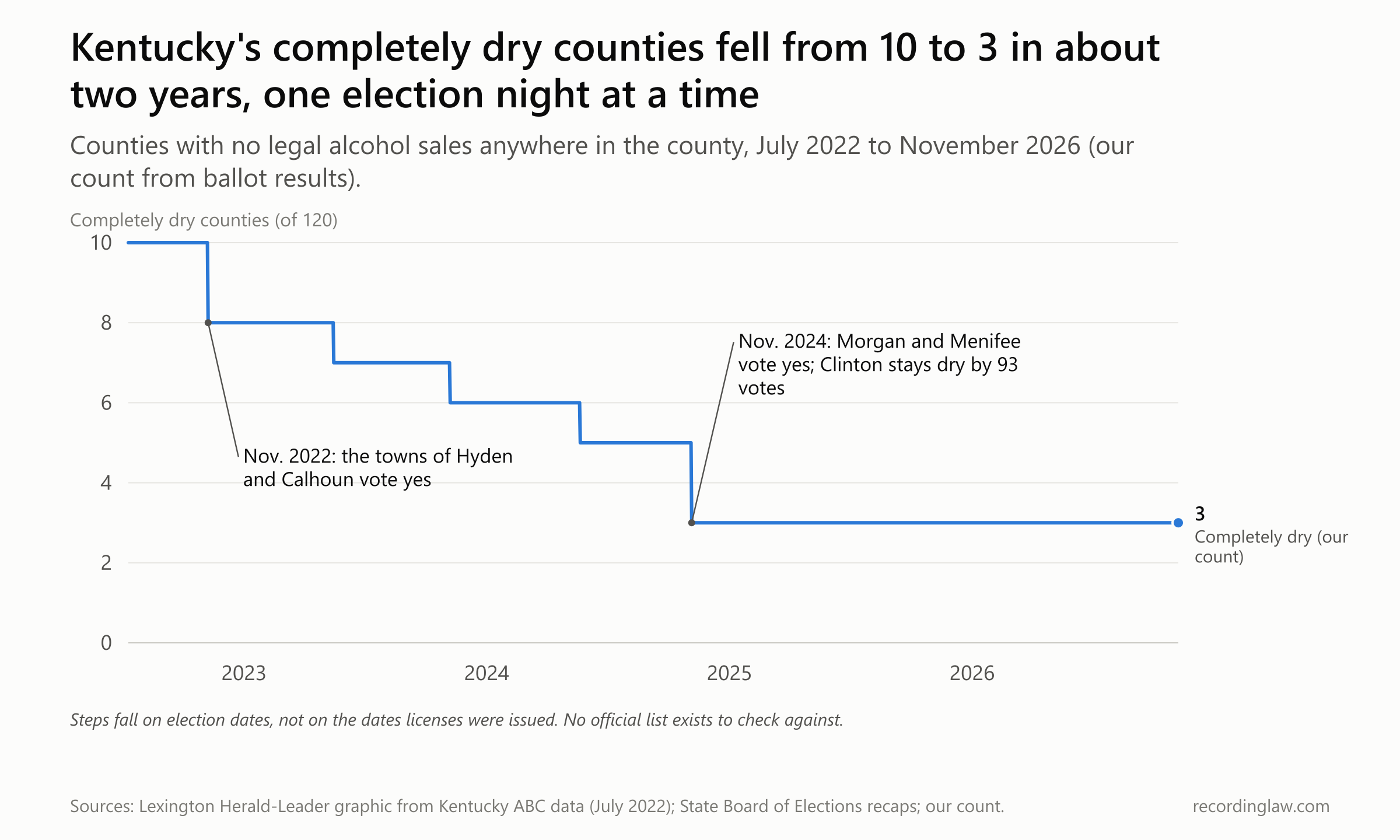
Kentucky counties with no legal alcohol sales, July 2022 to November 2026: 10 on the Herald-Leader's ABC-sourced list, 3 after the 2022-2024 votes. Our reconstruction from ballot results; no official list exists.
| Election | County that left the dry list | Result | Completely dry after |
|---|---|---|---|
| July 2022 list | (starting point) | 10 | |
| Nov 8, 2022 | Leslie (city of Hyden) | 58 yes, 50 no | 8 |
| Nov 8, 2022 | McLean (city of Calhoun) | Approved | 8 |
| May 16, 2023 | Allen (countywide) | 3,053 yes, 2,290 no | 7 |
| Nov 7, 2023 | Monroe (countywide) | 2,162 yes, 1,820 no | 6 |
| May 21, 2024 | Knott (countywide) | 1,447 yes, 995 no | 5 |
| Nov 5, 2024 | Morgan (county question) | 3,083 yes, 2,033 no | 3 |
| Nov 5, 2024 | Menifee (county question) | 2,095 yes, 1,184 no | 3 |
| Nov 5, 2024 | Clinton (countywide, failed) | 2,309 yes, 2,402 no | 3 |
| Nov 7, 2026 | (no change found) | 3 |
It went down in five steps. The first step came in two towns, not in a county. Where two or three votes fell on the same day, the table's last column shows the count after that whole day.
News reports kept using the 2022 figure after it had changed. "Only 10 counties in Kentucky remain completely dry," Spectrum News 1 reported on November 8, 2023. That was six months after Allen voted yes, and a day after Monroe did.
Until a 2016 law struck the rule, KRS 242.125, a section of the Kentucky Revised Statutes, gave a city its own wet-dry vote only if it had at least 3,000 people. Hyden has about 300 residents, about a tenth of that. Under the old rule, smaller cities that had already held such a vote before 2015 kept their wet status.
How a dry state opened, one smaller vote at a time
Kentucky's dry map was drawn county by county. A 2019 post on the University of Kentucky law school's election-law blog says that as early as 1990, "more than half of Kentucky counties were dry." Starting in 2000, the legislature kept letting smaller places vote on alcohol for themselves.
The first opening came in 2000. That year, as the University of Kentucky's Rural Blog summarized it in 2022, "the legislature allowed local referenda to legalize alcohol sales at larger restaurants, golf courses and farm wineries."
The golf-course act was approved April 21, 2000. It opens "To promote economic development and tourism in a county containing a city that has, in whole or in part, voted to discontinue prohibition," so it applied only in counties that already had a wet city. The restaurant statute in force today, KRS 242.1244, begins "In order to promote economic development and tourism," and is open to dry or moist cities and counties.
Before 2000, the Herald-Leader's Bill Estep later wrote, "voters had to choose whether to allow the full range of alcohol sales." "It was more than many could swallow, including people worried about liquor stores and bars changing the character of rural communities and small towns," he wrote. Voters in several cities and counties then approved restaurant sales first and voted later to go fully wet, he wrote.
The second opening came in 2016. Senate Bill 11, with Sen. John Schickel as lead sponsor, was signed on April 9, 2016. It struck the rule that only cities of at least 3,000 people could hold their own wet-dry vote, and that change took effect July 15, 2016.
Under KRS 242.125, a Kentucky city already had "the right to determine its wet" or dry status apart from its county. Now the smallest towns could use it. "Prior to that, there had been a population requirement, so many of these smaller towns could not legally hold a wet-dry vote, and now they can, regardless of their size," Carol Beth Martin, the ABC's malt beverage administrator, told WKU Public Radio that summer.
The state's own counts show the dry column shrinking. But the labels changed from list to list, so the counts are not one series, as How we measured explains. Wikipedia has summaries of ABC lists that are no longer online.
By those summaries, Kentucky had 38 dry counties, 32 wet and 50 "moist" or dry with special circumstances in January 2013. In February 2020 it had 11 dry, 53 wet and 56 moist or special. Each list adds up to Kentucky's 120 counties.
"Dry" in those summaries is closer to our "completely dry." By July 2022 the number of dry counties was ten.
Ten counties left in July 2022
"There are 10 dry counties in Kentucky as of July 2022," the Herald-Leader's graphic said, with the ABC as its source. "A moist or limited county is a dry county with a wet city or cities." Estep's story that month put the change plainly: "the time when many Kentucky residents had to drive an hour or more to legally buy a 12-pack of beer or a bottle of whiskey is gone."
He listed the reasons people gave him. They "include economic concerns, efforts to boost tourism, generational shifts, people moving into rural Kentucky from places where alcohol has long been legal, changes in attitudes," among them "greater acceptance of alcohol among churchgoers," he wrote, "and even rising problems with other drugs such as methamphetamine and fentanyl."
Two Baptist leaders gave their own account. Gene Cole is a Baptist minister who heads the Kentucky League on Alcohol, Gambling Problems and Substance Use Disorder.
He told Estep there was still a great deal of addiction and other problems like fatal wrecks caused by alcohol, but that rising overdose deaths from other drugs made it seem tame by comparison. The perception of alcohol, he said, is that "It's not as bad as some of the other stuff out there."
Nick Catron, director of missions for a regional association of Southern Baptist churches, described the same drift, the Rural Blog reported. "As Baptists, predominantly we frown upon consumption of alcohol," he said. "But again, it just seems as if so many people today don't find any fault in it."
The business case had been made to lawmakers a decade earlier. In June 2012, the president of the Kentucky Travel Industry Association, Laura Cole, testified to the legislature's interim committee on economic development and tourism. The committee minutes record her concern this way: "Also of concern is the lack of alcohol sales in “dry” counties. Counties that sell alcohol are more tourism friendly."
Four months after the Herald-Leader's graphic, the list started to shrink, and the first places to move were towns, not counties.
The towns that voted first
The first openings on the 2022 list came that November, one town at a time. Hyden, the seat of Leslie County, put alcohol sales on its city ballot for the first time on November 8, 2022. "Around 300 people currently reside in Hyden, and around 180 of them are registered voters, so the decision could come down to just a few community members," WYMT reported that day.
Mayor Carol Graham Joseph made the case for yes. "We are a trail town now, and people that come for trail town, they like to drink," she told the station. "The other counties around us already have it, and they certainly have more money to spend on like police officers and activities than we do."
The official county recap from the Kentucky State Board of Elections shows the local question passing 58 to 50, and a WYMT reporter posted the same result the next day. That made Hyden a wet city inside a dry county, which the Herald-Leader's graphic would call moist, in the looser sense.
The same night, the city of Calhoun voted to allow sales. "McLean County had been a historically dry county since 1937 until the city of Calhoun voted in the November 2022 election to allow alcohol sales," the Owensboro Messenger-Inquirer later reported. Two of the ten now had a wet town inside them.
In Clinton County the attempt stalled before it reached a ballot. Kentucky law calls a wet-dry vote a local option election. Under KRS 242.020, the petition for one needs signatures equal to 25% of the votes cast at the last general election.
In September 2022, County Clerk Nathan Collins found 778 valid signatures. The petition needed 1,070, so it was 292 short. "I hereby certify that the petition lacks an adequate number of qualified signatures required to place the question on the November General Election ballot," he wrote.
Two towns had shown that one city's voters could change a county's status. In 2023 the votes went countywide.
Red signs and green signs
In the weeks before Allen County's May 2023 primary, the Bowling Green Daily News described the roadsides: "Miles outside of Scottsville city limits, drivers may begin to notice a series of bright red “Vote No To Alcohol Sales” signs, mixed in with the occasional green “Vote Yes!” sign." The county had voted on the same question in January 2017, and rejected it 2,908 to 2,296. This time both sides organized again. "Local churches have been holding nightly prayer services on the issue, asking their congregations to vote no because of the dangers of alcohol," the Daily News reported.
The yes campaign argued about money. The man who ran the pro-sales Allen County Citizens for Economic Growth Facebook page told the paper the vote was about the economy, not convenience, and that sales could keep money from leaking out of the county. The paper cited a 2021 report by Retail Strategies on that kind of leakage. The report estimated that Allen County lost $5 million to residents spending money outside the county on alcohol, and on other items while they were there.
On May 16, 2023, Allen County voted yes, 3,053 to 2,290, about 57%. WKU Public Radio reported it would be the first time in over 100 years that alcohol would be available for purchase in the county.
The same day, voters in Madison County, home of Richmond, approved countywide sales 9,883 to 4,792, about two to one. Madison was not on the list of ten. Richmond already sold alcohol. But the campaign there drew the clearest statements from both sides of the wider argument.
"And I'm concerned about just the strength of families, the welfare of families, the morals, the building of character," Danny Davis, associational missions strategist for the Tates Creek Baptist Association, told WEKU before the vote. Richmond's tourism director, Lori Murphy-Tatum, backed a yes vote. WEKU reported she said it was about economic development, creating more businesses and tax revenues, and keeping current taxes in check.
One opponent was a business that already sold alcohol. A co-owner of Liquor Mart Three, a liquor store inside Richmond's city limits, opposed expansion. WEKU reported he said "an all-wet Madison County could cut into his sales by 60%." Kentucky Distillers Association President Eric Gregory, meanwhile, said he had recently taken a call about locating a distillery in the county, WEKU reported.
The restaurant owner who organized the Madison petition blamed the legislature for leaving the question to counties. "Our legislature should've addressed this, but it's like a lot of other issues and they're afraid of it," he told Spectrum News 1 in January 2023.
By the fall, Monroe County was the next test. "With the recent inclusion of Allen County, Monroe County is now surrounded on all sides by counties that have legalized alcohol sales," WBKO reported in October 2023.
Darrick Proffitt, president of Monroe County Concerned Citizens, which formed to oppose a 2017 sales vote, gave the dry side's arithmetic. He told WBKO that "we just feel that the problems from alcohol will outweigh the economic gain from alcohol." By his estimate, the station reported, the county would see roughly $50,000 a year from the 5% tax on alcohol sales. His group did not think that would cover the cost of hiring ABC administrators or the potential impact on law enforcement.
On November 7, 2023, Monroe voted yes, 2,162 to 1,820, about 54%. That night Garrard County, which already allowed sales in its seat of Lancaster, voted to go fully wet, 66% to 34%. The Herald-Leader had noted earlier that year that Garrard is known as the "birthplace of Prohibition" because Carrie Nation, one of the movement's champions, was born there.
Ten weeks later, in January 2024, the company Staghorn announced Garrard County Distilling Co. in Lancaster. It was a project of more than $250 million, with more than 60 jobs, Spectrum News 1 reported. Lancaster Mayor Michael Gaffney said the city had been working with the company before the vote. "As recently as three months ago, Garrard County was dry, but we were already working cooperatively with the team at Staghorn on this project," he said.
"Communities across Kentucky have benefited greatly from the recent bourbon boom, and now I am pleased to say Garrard County will as well," said County Judge/Executive Chris Elleman. Gov. Andy Beshear called the investment "a welcome addition to the Lancaster and Garrard County communities, as well as to Kentucky's booming tourism sector."
The fourth try in Knott
By the spring of 2024, Knott County was holding its fourth vote on alcohol sales. In January 2017 its voters had stayed dry, 1,981 to 1,589.
The resident who led the 2024 petition turned the safety argument around. "And the fact that our citizens have to drive 20-plus miles to have something to drink, not only are you losing money you are drastically increasing the risk that one of those people is going to drive home drunk," he told WYMT in February 2024.
A local pastor answered in the same story. "I've seen a lot of things in my years of ministry where alcohol has played a horrible role in affecting the family," he told the station.
On May 21, 2024, Knott voted yes, 1,447 to 995, about 59%. What changed between the losing vote and the winning one? Allen had also voted, and lost, in January 2017, and then voted yes later, so each county's losing and winning votes can be set side by side.
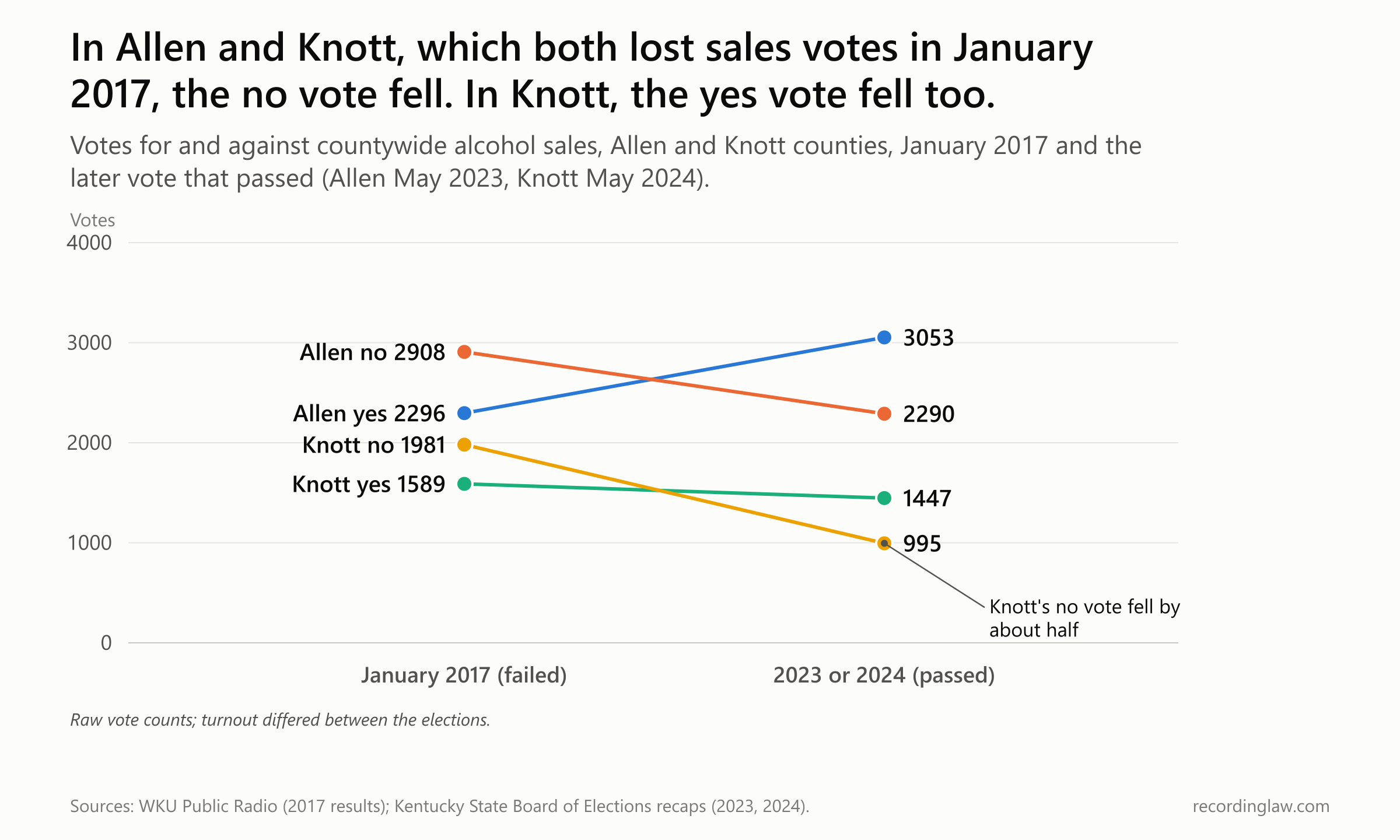
Votes for and against countywide alcohol sales in Allen and Knott counties, January 2017 and the later vote that passed. Sources: WKU Public Radio; Kentucky State Board of Elections recaps.
| County | January 2017 yes | January 2017 no | Later vote | Yes | No |
|---|---|---|---|---|---|
| Allen | 2,296 | 2,908 | May 16, 2023 | 3,053 | 2,290 |
| Knott | 1,589 | 1,981 | May 21, 2024 | 1,447 | 995 |
In Allen, both totals moved. There were about 760 more yes votes than in 2017, and about 620 fewer no votes.
In Knott, the yes total was lower than in the losing 2017 vote. What changed was the no vote, which fell by about half, from 1,981 to 995. Neither county's counts can say who stayed home or switched sides.
"And I've already spoken to them, and they said they can get up to six licenses in this county," County Clerk Reci Cornett said after the count. A week later, Kentucky State Police Trooper Matt Gayheart of Post 13 told WYMT he did not expect a big change in the county, and that troopers would keep patrolling to make sure no one was driving drunk.
Licenses came slowly. In December 2025, 19 months after the vote, El Guerrerense Mexican Restaurant in Hindman became the first reported restaurant in the county to receive an ABC license, WKYT reported.
Election night, November 2024
That left five of the ten counties on the list going into the night this story opened on: Casey, Clinton, Elliott, Menifee and Morgan. Morgan County voted 3,083 to 2,033, about 60% yes, on a ballot question its recap labels only "MORGAN COUNTY QUESTION," and Menifee County voted 2,095 to 1,184, about 64% yes.
Neither county's official recap prints the question's wording. We identify both as alcohol votes from a Licking Valley Courier report that both counties approved sales, from the Morgan County ABC ordinance approved on second reading on December 18, 2024, and from a City of Frenchburg ordinance citing "a local option election held on November 5, 2024." Morgan County Judge/Executive Jim Gazay agreed to serve as the county's ABC administrator on a strictly temporary basis until a permanent officer is hired and the position is funded, the Courier reported.
Clinton was the exception that night, at about 49% yes. In the five countywide votes that passed from May 2023 to November 2024, the yes side took between 54% and 64%. None of those votes came with a measurement of whether the promises or the warnings came true.
Does a dry county have fewer drunk drivers?
Dry campaigners warned that legal sales would bring drunk driving. Wet campaigners, like the Knott petition organizer, said a dry county sends its drinkers onto the roads.
Researchers studying Kentucky have published findings that fit each claim. Most of the studies below compare counties' crash rates. One, from 2003, follows each crash back to the driver's home, and its authors say they reached their conclusion "by considering crash location and driver residence."
None of the studies measures a county before and after a vote. Their published summaries, called abstracts, also do not report results as numbers on one shared scale, with a range around each, which a chart of estimates would need. So we list them here instead of charting them.
| Study | Data | Design | What it found |
|---|---|---|---|
| Wilson, Niva, Nicholson (1993) | All 120 counties, 1988 | Wet vs dry county comparison | Fewer alcohol-related crashes and DUI arrests in dry counties; cirrhosis deaths not significantly different |
| Winn, Giacopassi (1993) | All Kentucky crashes, four years | Wet vs dry county crash rates | Lower alcohol-related fatality rate and significantly lower alcohol-related nonfatal and property-damage crash rates in dry counties (database summary); counties are dry by choice |
| Giacopassi, Winn (1995) | Kentucky's 77 dry counties | Distance to legal alcohol | Distance to legal alcohol significantly and negatively related to the alcohol-related injury crash rate, but not a substantial determinant of crash rates |
| Schulte Gary et al. (2003) | 39,344 alcohol-related crashes, 1991-1997 | Crash location vs driver's home ZIP code | Similar alcohol-related share of crashes in wet and dry counties; a higher share of dry-county residents in alcohol-related crashes, farther from home |
The case for dry counties comes from the county comparisons. Western Kentucky University researchers compared all 120 counties using 1988 data and found: "Dry counties had less alcohol-related auto accidents and DUI arrests. Other alcohol-related variables, such as cirrhosis mortality, were not significantly different between wet and dry counties." For cirrhosis mortality, the result was not statistically significant, meaning by the study's own test chance alone could easily produce a result like this even with no real difference; that does not show there was none. The researchers concluded that "county-level alcohol prohibition is effective in promoting the public's health, by improving highway safety."
A second 1993 study, by Robert Winn and David Giacopassi, looked at four years of Kentucky crashes and found lower alcohol-related crash rates in dry counties. It came with a warning. "The authors caution that the results should not be taken as a general prescription for alcohol regulation since the counties studied are dry by choice," the Transportation Research Board's TRID database summary says. Counties that vote to stay dry may differ from wet ones in ways the comparison cannot separate.
A 1995 study by the same two researchers, of Kentucky's 77 dry counties at the time, found that the farther a dry county was from legal alcohol, the lower its rate of alcohol-related injury crashes. Distance, though, did "not appear to be a substantial determinant of accident rates in dry counties," the abstract says.
The case against comes from where the drivers lived. A 2003 study mapped 39,344 alcohol-related crashes involving Kentucky residents on state roads from 1991 to 1997 against the drivers' home ZIP codes. It found "a similar proportion of crashes in wet and dry counties are alcohol-related but that a higher proportion of dry counties residents are involved in an alcohol-related crash," and that dry-county drivers crashed farther from home. Put another way, the alcohol share of crashes was about the same in both kinds of county, but a larger share of dry-county residents were involved in alcohol-related crashes.
The authors called that "circumstantial evidence that some dry county drivers may be driving to wet counties to consume alcohol thus increasing impaired driving exposure," and concluded that "county-level prohibition is not necessarily effective in improving highway safety." That is the pattern the Knott petition organizer described.
Other research has looked past the roads. University of Louisville economists studied county data on methamphetamine-lab seizures from 2004 to 2010. To separate the effect of the rules from other county differences, they used counties' religious makeup in the 1930s, when most local-option votes took place. They estimated that "the number of meth lab seizures in Kentucky would decrease by 34.5 percent if all counties became wet."
They added that "it's not clear how well our results would generalize to other states or to substances other than alcohol." An earlier draft of the same work found that a county's dry status was influenced by its share of Baptists, "consistent with the bootleggers and Baptists model," as the draft put it. That model is the idea, which the paper credits to economist Bruce Yandle, that Baptists for religious reasons and bootleggers for economic reasons have both supported alcohol bans.
A 2019 study of 944 Kentucky homicide victims from 2005 to 2012 found almost no gap: "About 33.0% of homicide decedents who were residents in wet counties tested positive for alcohol compared to 32.5% of their counterparts in moist/dry counties." The difference was not statistically significant.
After the votes, officials offered expectations and impressions, not measurements. Calhoun Mayor Bruce Cabbage said in an interview that alcohol sales had not had negative effects on crime in his city, the Messenger-Inquirer reported. Trooper Gayheart in Knott County expected no big change. The votes since 2023 are too recent for crash or crime data to show anything county by county.
The three that are left
The argument is still live in the three counties that have not voted yes. Casey County came close in 2016. On election day, August 23, "A marquee outside First Baptist Church in Liberty encourages passing drivers to vote against alcohol legalization in Casey County," the Danville Advocate-Messenger reported.
The countywide vote failed by 127 votes: "2,097 “no” votes and 1,970 “yes” votes," the paper reported, or 51.56% to 48.44%. In May 2023 a single Casey precinct, Creston, voted on sales and said no, 123 to 107. We found no successful wet vote in Casey since, and its sample ballot for the November 2026 general election carries no alcohol question. We have high confidence in Casey's status.
In Clinton County the wet side has fallen short twice in two years: the 2022 petition, 292 signatures short, and the 2024 vote, 93 votes short. The local TV station WBKO first published the wrong result for Clinton and later added a correction. The official recap matches the count at the top of this story, about 49% yes.
Clinton's 2026 sample ballot has no alcohol question. We have high confidence in its status too.
Elliott County is the least documented of the three. It was on the July 2022 list, and we found no alcohol question in its 2022, 2023 or 2024 general-election recaps, its 2024 primary recap, its 2026 sample ballot or the news. The 2022 and 2024 recaps are scanned images we read by eye, and we could not find its 2022 or 2023 primary recaps online, so a missed vote is possible. Our confidence there is medium-high.
Two other counties are close calls in our count. Leslie is out of the dry column on the strength of Hyden's 58-50 vote, reported by two sources but not confirmed by any ABC document. Morgan's December 2024 ordinance ties its county tax to the rate of the city of West Liberty, which suggests the city was already wet before 2024, in conflict with Morgan's place on the 2022 list. Either way, Morgan is no longer completely dry.
What comes up next
The count of three has held since November 2024, but the votes have not stopped. In McLean County, the 2024 votes in the cities of Island (299 yes, 172 no) and Sacramento (438 yes, 267 no) passed. But the ABC said state liquor licenses could not be issued under them, because the ballot defined each territory as a precinct. The ABC treats a territory, the place a wet-dry vote covers, as a city or county.
County Clerk Carol Eaton took responsibility. "I was unaware that the defined 'territory' to be considered for the vote couldn't be the entire precinct, but that votes could only be considered based on a city-wide or county-wide focused petition and subsequent vote," she said.
Both cities voted again on November 3, 2026. Island approved sales 75 to 25 and Sacramento 80 to 40, according to unofficial results the Messenger-Inquirer reported on November 5. McLean was already off the completely dry list because of Calhoun, so the count stays at three. The State Board of Elections had not posted the certified McLean recap as of November 7.
The precinct question is open for the legislature. After the ABC said it would not license a single Edmonson County precinct in 2024, County Attorney Adam Turner told WBKO: "I think there are questions for the legislature to clear up while they put Section Five under 242020, because it conflicts with all the other parts of 242 with respect to the local options." We found no bill on it yet. The legislature's 2027 regular session begins in January.
Clinton's next countywide vote has to wait, under state law. KRS 242.030(3) says no local option election may be held in the same territory more than once in every three years. That keeps a new countywide vote off the ballot until about November 5, 2027; we have not confirmed how officials count the three years.
That date falls three days after Kentucky's November 2, 2027 general election. So the first countywide chance may be a special election paid for by petitioners, or the May 2028 primary.
The city of Albany is not bound by that clock. Under KRS 242.125, a city is not the "same territory" as its county, and it may decide its own wet or dry status. So an Albany vote could come sooner, and a yes there would end Clinton's completely dry status. Any new petition would again need signatures equal to a quarter of the votes cast in that territory at the last general election.
The last countywide vote in Clinton was decided by 93 votes. Two years later, its voters went back to the polls for the November 3, 2026 general election. The sample ballot gave the city of Albany, which the three-year clock does not bind, its own section. There was no alcohol question on it.
How we measured
The completely dry count. Our starting point is the July 2022 Herald-Leader Datawrapper graphic (version 6), which cites the Kentucky ABC and names ten dry counties. We then removed each county on the date of the first election after which any legal alcohol sale was authorized anywhere in it: a countywide vote, a county question identified as an alcohol vote, or a wet city. Results come from the Kentucky State Board of Elections county recaps (our sums of every precinct block for the question), checked against news tallies where they exist. The graphic's coding is not always consistent (it marks Madison wet in July 2022, before its May 2023 countywide vote), so the list of ten is the best available starting point, not an audited ABC table.
This is our reconstruction, not an official count. The ABC's wet-dry pages return "not found," and the agency now offers an address lookup portal instead of a county list. The 2026 general-election sample ballots for Casey, Clinton, Elliott and Leslie carry no alcohol question. We did not exhaustively search for special local-option elections in 2025.
Confidence by county. Casey and Clinton: high. Elliott: medium-high (scanned recaps read by eye; 2022 and 2023 primary recaps not found online). Leslie is counted out of the dry column on Hyden's 2022 vote (58 yes, 50 no, read from a scanned recap and a WYMT reporter's post), with no ABC confirmation and no question wording on the recap.
Morgan's and Menifee's recaps label the questions only "MORGAN COUNTY QUESTION" and "MENIFEE QUESTION"; we identify them as alcohol votes from the Licking Valley Courier report, Morgan's December 2024 ordinance and the Frenchburg ordinance. Morgan's ordinance ties its tax to West Liberty's rate, implying a wet city earlier than the 2022 list suggests; we have not resolved that.
Older counts are not one series. The ABC and news outlets used different labels. The ABC's August 21, 2014 list (our count of its labels) marked 81 counties DRY, 35 WET and 4 MOIST. But a county marked DRY could contain a wet city, golf course, winery or restaurant precinct. WKU Public Radio, quoting the ABC in July 2016, gave 74 dry, 44 wet and 2 moist on that kind of label.
The January 2013 (38 dry, 32 wet, 50 moist or special) and February 2020 (11 dry, 53 wet, 56 moist or special) figures come from Wikipedia summaries of ABC documents that are no longer online. "Dry" in those summaries is closer to our "completely dry." The "more than half" in 1990 is the University of Kentucky election-law blog's figure, and its definition is not stated.
Spectrum News 1 called Garrard the 64th completely wet county in November 2023. We do not chart these as one line.
Derived figures. Yes shares are yes votes divided by yes plus no: Allen 3,053 of 5,343 (57.1%), Monroe 2,162 of 3,982 (54.3%), Knott 1,447 of 2,442 (59.3%), Morgan 3,083 of 5,116 (60.3%), Menifee 2,095 of 3,279 (63.9%), Madison 9,883 of 14,675 (67.3%), Clinton 2,309 of 4,711 (49.0%). Margins: Morgan 1,050, Menifee 911, Clinton 93. Clinton's petition: 1,070 needed minus 778 valid = 292 short.
Knott's no vote fell from 1,981 to 995, which is 50.2% of its 2017 level ("about half"); its yes vote fell from 1,589 to 1,447, or 142 fewer. Allen's yes vote rose from 2,296 (January 2017, reported by WKU Public Radio) to 3,053, or 757 more ("about 760"), and its no vote fell from 2,908 to 2,290, or 618 fewer ("about 620"). These are raw counts; turnout differed between the elections, and the totals cannot show whether individual voters switched sides or stayed home. "Seven of the ten" counts five countywide flips plus the wet cities in Leslie and McLean. "Nineteen months" runs from May 21, 2024, to December 17, 2025.
Clinton's next vote. KRS 242.030(3) bars a repeat local option election in the same territory more than once every three years. Counting from November 5, 2024, that is about November 2027; we have not confirmed how election officials count the three years, so the date is approximate. Kentucky's November 2, 2027 general election falls three days before that mark, and an election on a date other than a primary or regular election day is paid for by the petitioners, who post bond (KRS 242.020). KRS 242.125(1) says a city is not the "same territory" as its county, so the bar does not apply to a vote in the city of Albany.
What the data cannot show. We did not run a crash study. Federal crash files (FARS) can be downloaded. But the recent votes (2023 and 2024) leave too few years of data after them. And a county-level before-and-after design needs a verified, dated list of every county's change, which does not exist in official form.
The studies cited are cross-sections or panels from 1988 to 2012, read from their published abstracts (the meth-lab estimate from the 2016 working paper and a 2014 conference draft). None measures the effect of a vote. Their abstracts do not report crash effects with confidence intervals on a common scale, which is why the crash studies appear in a table rather than on an estimates chart.
Reasons for the votes (tourism, the bourbon industry, attitudes) are the reasons people gave, not measured causes. Revenue projections on both sides, from the $5 million leakage estimate to the $50,000 tax estimate, have not been checked against collections.
Frequently Asked Questions
How many dry counties are in Kentucky in 2026?
By our count from ballot results, three Kentucky counties appear completely dry as of November 7, 2026: Casey, Clinton and Elliott. The state ABC does not publish a current county list online, so this is our reconstruction from election recaps, ordinances and news reports. A July 2022 list based on ABC data named ten.
What is the difference between a dry, wet and moist county in Kentucky?
Under KRS 241.010, a dry territory has voted to prohibit all retail alcohol sales, a wet territory has voted to permit them, and a moist territory has voted to permit only limited sales, such as at larger restaurants, golf courses or farm wineries. News outlets also use moist for a dry county with a wet city or cities, as the Herald-Leader's July 2022 graphic did.
Which Kentucky counties voted to allow alcohol sales since 2022?
Of the ten counties on the July 2022 dry list, Allen (May 2023), Monroe (November 2023), Knott (May 2024), Morgan and Menifee (November 2024) approved countywide sales. The cities of Hyden in Leslie County and Calhoun in McLean County voted for sales in November 2022. Madison and Garrard counties, which already had a wet city, also went fully wet in 2023.
When can Clinton County vote on alcohol sales again?
Clinton County voted to stay dry on November 5, 2024, 2,402 to 2,309. KRS 242.030(3) bars more than one local option election in the same territory in every three years, which keeps a new countywide vote off the ballot until about November 2027. The November 2, 2027 general election falls three days short of that, so the first countywide chance may be a petitioner-paid special election or the May 2028 primary. Under KRS 242.125 a city is not the same territory as its county, so the city of Albany could hold its own vote sooner. A petition needs signatures equal to 25% of the votes cast in the territory at the last general election.
Do dry counties have fewer drunk driving crashes?
Kentucky studies disagree. Two 1993 studies found fewer alcohol-related crashes in dry counties, one cautioning that counties are dry by choice. A 2003 study of 39,344 crashes found a similar alcohol share in wet and dry counties, with dry-county residents more often involved and crashing farther from home. No study has measured the 2023 and 2024 votes.
Can a single precinct in Kentucky vote to go wet?
Not for general sales, in the ABC's reading. In 2024 the ABC said it would not license an Edmonson County precinct regardless of the vote, and it would not license sales under precinct-worded votes in two McLean County cities, which re-voted as cities in November 2026. Separate local-option provisions cover particular kinds of places, such as the golf-course option created in 2000 for counties that already had a wet city.
Updates
Reworded for readability. No figures, quotes, sources or findings changed.
Restructured as a feature: chart titles state the finding, side details moved to How we measured. Every figure and quote was re-checked against its source.
Independently fact-checked against the cited primary sources
Independently fact-checked against the cited primary sources
Sources and References
- Lexington Herald-Leader graphic (Datawrapper), Kentucky dry, wet and moist counties as of July 2022, source Kentucky ABC(datawrapper.dwcdn.net)
- Hoptown Chronicle / The Rural Blog, dry counties increasingly rare in Kentucky (reporting Bill Estep, Lexington Herald-Leader), July 11, 2022(hoptownchronicle.org)
- Kentucky Department of Alcoholic Beverage Control, local option election resources(abc.ky.gov).gov
- University of Kentucky College of Law, Election Law blog, Democracy and drink(electionlaw.uky.edu)
- 2000 Ky. Acts ch. 411 (SB 39), golf-course local option(apps.legislature.ky.gov).gov
- KRS 242.1244, restaurant local option(apps.legislature.ky.gov).gov
- KRS 242.125, city local option(apps.legislature.ky.gov).gov
- KRS 242.020, local option petitions(apps.legislature.ky.gov).gov
- KRS 242.030, timing of local option elections(apps.legislature.ky.gov).gov
- 2016 Ky. Acts ch. 80 (SB 11)(apps.legislature.ky.gov).gov
- Kentucky General Assembly, 2016 SB 11 bill record(apps.legislature.ky.gov).gov
- Interim Joint Committee on Economic Development and Tourism, minutes, June 21, 2012(apps.legislature.ky.gov).gov
- WKU Public Radio, new law sets up wet-dry elections in several Kentucky counties, Aug. 29, 2016(wkyufm.org)
- Wikipedia, Alcohol laws of Kentucky (summary of January 2013 ABC list)(en.wikipedia.org)
- Wikipedia, List of dry communities by U.S. state (summary of February 2020 ABC list)(en.wikipedia.org)
- Kentucky ABC, Wet-Dry-Moist Territories, August 21, 2014 (archived)(web.archive.org)
- WYMT, Hyden includes wet/dry vote on ballot for first time, Nov. 8, 2022(wymt.com)
- WYMT reporter Steve Hensley, post on the Hyden result, Nov. 9, 2022(facebook.com)
- Kentucky State Board of Elections, Leslie County 2022 general election recap(elect.ky.gov).gov
- Messenger-Inquirer, 3 McLean County cities will have wet-dry votes(messenger-inquirer.com)
- Clinton County News, wet/dry petition is short of signatures, Sept. 13, 2022(clintonnews.net)
- Bowling Green Daily News, Allen County faces contentious wet-dry vote, May 2023(bgdailynews.com)
- WKU Public Radio, mixed results for local votes on alcohol sales, Jan. 25, 2017(wkyufm.org)
- Kentucky State Board of Elections, Allen County 2023 primary recap(elect.ky.gov).gov
- WKU Public Radio, Allen County votes to go wet, May 18, 2023(wkyufm.org)
- Lexington Herald-Leader (Aaron Mudd), alcohol sales were on the ballot in 6 Kentucky counties, May 17, 2023 (syndicated)(yahoo.com)
- Kentucky State Board of Elections, Madison County 2023 primary recap(elect.ky.gov).gov
- WKYT, Madison County voters decide wet/dry question, May 16, 2023(wkyt.com)
- WEKU, Madison County primary ballot includes alcohol sales expansion question, May 8, 2023(weku.org)
- Spectrum News 1, Madison County petition for wet county, Jan. 27, 2023(spectrumnews1.com)
- WBKO, Monroe County prepares for wet/dry decision, Oct. 20, 2023(wbko.com)
- WBKO, Monroe County voters approve alcohol sales, Nov. 8, 2023(wbko.com)
- Kentucky State Board of Elections, Monroe County 2023 general recap(elect.ky.gov).gov
- Spectrum News 1, Garrard County wet vote, Nov. 8, 2023(spectrumnews1.com)
- Kentucky State Board of Elections, Garrard County 2023 general recap(elect.ky.gov).gov
- Spectrum News 1, Garrard County Distilling Co. announced, Jan. 17, 2024(spectrumnews1.com)
- WKU Public Radio, alcohol sales measures go 2 for 3, Jan. 18, 2017(wkyufm.org)
- WYMT, Knott County adds wet/dry vote to May ballot, Feb. 1, 2024(wymt.com)
- WYMT, Knott Countians vote on alcohol sales, May 21, 2024(wymt.com)
- Kentucky State Board of Elections, Knott County 2024 primary recap(elect.ky.gov).gov
- WYMT, community members talk about approval of alcohol sales, May 28, 2024(wymt.com)
- WKYT, first restaurant in Knott County receives ABC license, Dec. 17, 2025(wkyt.com)
- Kentucky State Board of Elections, Morgan County 2024 general recap(elect.ky.gov).gov
- Kentucky State Board of Elections, Menifee County 2024 general recap(elect.ky.gov).gov
- Licking Valley Courier, Dec. 26, 2024 (Kentucky public notice archive)(kypublicnotice.com)
- City of Frenchburg alcoholic beverage ordinance (Kentucky ABC)(abc.ky.gov).gov
- Kentucky State Board of Elections, Clinton County 2024 general recap(elect.ky.gov).gov
- WBKO, Grayson and Clinton County wet/dry votes, Nov. 6, 2024(wbko.com)
- Wilson, Niva and Nicholson, Journal of the Kentucky Medical Association, 1993 (abstract)(europepmc.org)
- Winn and Giacopassi, Social Science Quarterly, 1993 (TRID record)(trid.trb.org)
- Giacopassi and Winn, American Journal of Drug and Alcohol Abuse, 1995 (abstract)(europepmc.org)
- Schulte Gary, Aultman-Hall, McCourt and Stamatiadis, Accident Analysis and Prevention, 2003 (abstract)(europepmc.org)
- Fernandez, Gohmann and Pinkston, meth lab seizures and dry counties, MPRA working paper 75544, 2016(mpra.ub.uni-muenchen.de)
- Fernandez, Gohmann and Pinkston, Breaking Bad: Are Meth Labs Justified in Dry Counties?, AEA 2014 conference draft(aeaweb.org)
- Khaleel, Brown, Fleming and Christian, Geospatial Health, 2019 (abstract)(europepmc.org)
- The Advocate-Messenger, Casey County stays dry in close local option election, Aug. 24, 2016(amnews.com)
- Kentucky Secretary of State, Casey County 2026 general election sample ballot(web.sos.ky.gov).gov
- Messenger-Inquirer, two McLean cities not going wet, March 2025 (syndicated)(yahoo.com)
- Kentucky Secretary of State, McLean County 2026 general election sample ballot(web.sos.ky.gov).gov
- Messenger-Inquirer, McLean County election results, Nov. 5, 2026 (unofficial)(messenger-inquirer.com)
- WBKO, Lincoln precinct wet/dry vote does not pass amid Kentucky ABC denial, May 2024(wbko.com)