Washington's 2019 Marijuana Pardon Offer Reached 38 of About 3,500 Eligible People by 2022

Independently fact-checked against primary sources (last audited November 10, 2026). · 18 primary sources cited on this page. How we verify our legal content
In January 2012, Washington courts entered 297 misdemeanor marijuana possession convictions against people aged 21 or older. In January 2013, the first month after Initiative 502 took effect, they entered none, according to the Washington State Institute for Public Policy, the state legislature's research institute.
Arrests fell nationally too. Police agencies reporting to the FBI made about 69% fewer marijuana possession arrests per 100,000 people in 2025 than in 2010. In those same years, marijuana went from about half of all reported drug arrests to about a quarter. Even so, police reported about 200,000 possession arrests in 2025, more than in 2024.
Six years after I-502, Washington turned to the convictions already on file. In January 2019, Gov. Jay Inslee's office offered pardons to people with a single old misdemeanor possession conviction who applied. It estimated that about 3,500 people were eligible. In October 2022, The Seattle Times reported that 38 had received one.
Clearing the old records ran on a different clock in every state. Illinois says that as of July 29, 2026, its State Police had expunged more than 780,000 cannabis charges since 2019, without anyone having to apply. New Jersey's courts expunged more than 362,000 cases in about 11 weeks in 2021.
What did legalization change for the people arrested after it? And for the people already carrying a record from before it, how much depended on whether they had to apply?
Four sources put a share on that last question, how much depended on whether people had to apply. Their units and time windows differ: people in Washington, all offenses (not only marijuana) in Michigan, eligible people for California's petition share and cases for its statewide review.
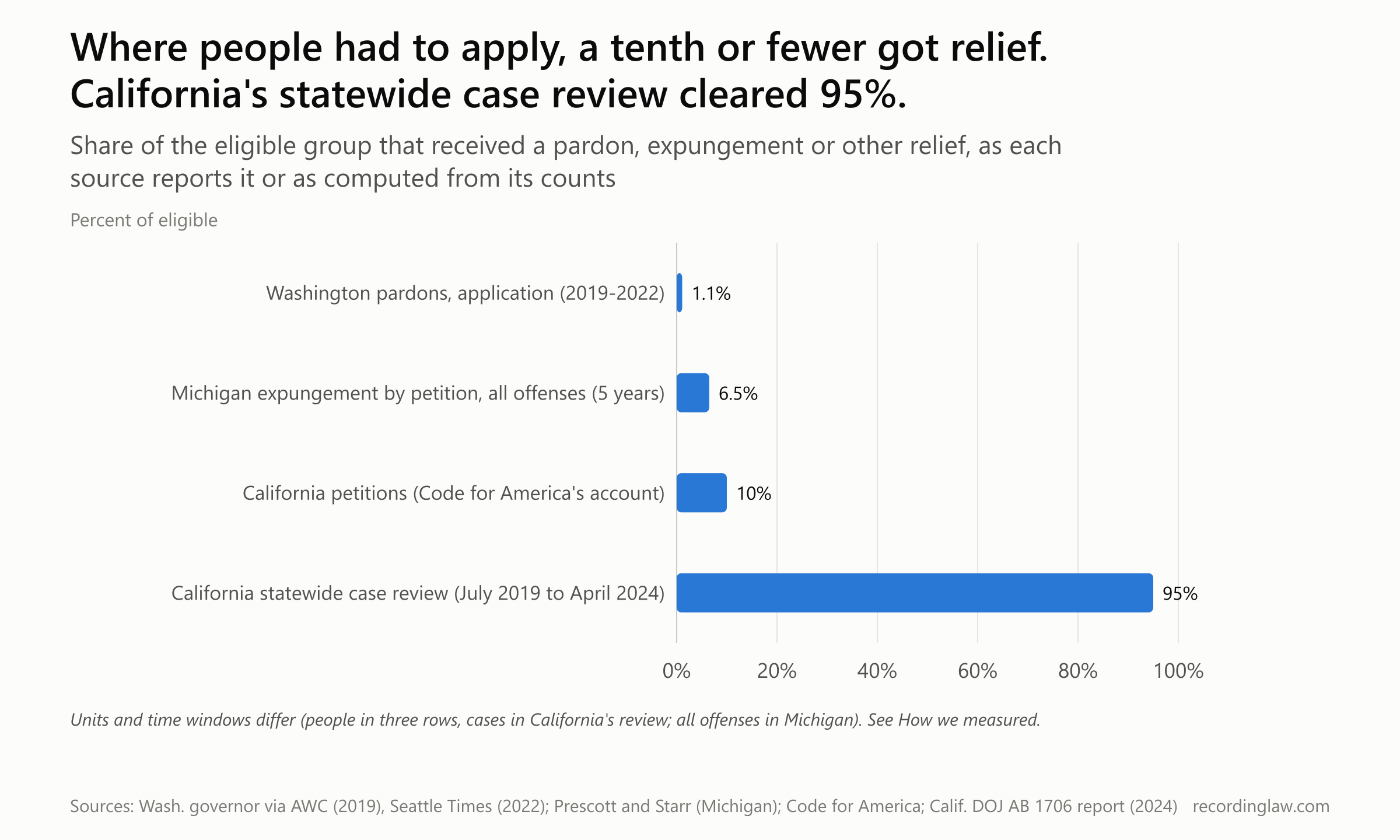
Sources: Washington governor's office via the Association of Washington Cities (2019) and The Seattle Times (2022); J.J. Prescott and Sonja Starr, University of Michigan Law School; Code for America; California Department of Justice and Judicial Council, AB 1706 report (2024).
| Route | Who got relief | Out of | Share |
|---|---|---|---|
| Washington governor's pardons, by application, 2019 to 2022 | 38 people | about 3,500 eligible | 1.1% |
| Michigan expungement by petition, all offenses, within five years of eligibility | share only | people legally eligible | 6.5% |
| California petitions after Prop 64 (Code for America's account) | share only | eligible people | 10% |
| California statewide case review, July 2019 to April 2, 2024 | 216,157 cases | 227,650 potentially eligible cases | 95% |
The two California shares come from different sources and count different things, so they are not a before-and-after of one group. Colorado, Illinois and New Jersey are not plotted. How we measured explains why.
What did the 2012 campaigns say would change?
Both ballot measures put police time first. Colorado's Amendment 64 opened its purpose clause with "THE EFFICIENT USE OF LAW ENFORCEMENT RESOURCES," ahead of revenue and individual freedom. Washington's Initiative 502 said the people intended "to stop treating adult marijuana use as a crime" and to try an approach that "Allows law enforcement resources to be focused on violent and property crimes."
The campaigns made the same case in public. "An overwhelming majority of Washington citizens agree that treating marijuana use as a crime has failed," I-502 campaign manager Alison Holcomb said in an October 2012 statement launching a TV ad. In the ad, Charles Mandigo, a former head of the FBI's Seattle office, said: "We know firsthand that decades of marijuana arrests have failed to reduce use." Former U.S. Attorneys John McKay and Kate Pflaumer appeared with him.
That August, the ACLU of Washington, an advocacy group, released a study estimating what enforcement had cost. The Associated Press reported that it put the statewide cost of "pot prohibition" over the previous decade at "more than $200 million," counting arrests, prosecution, public defense, jail and supervision, with King County spending "nearly $35 million." The study's funding was not stated.
In Colorado, KUNC reported that the NAACP's Colorado Montana Wyoming State Area Conference endorsed Amendment 64, "saying marijuana laws disproportionately impact communities of color and low-income individuals." The ACLU of Colorado and the Colorado Criminal Defense Bar were also on the supporters' list.
When both sides gathered at the Denver convention center that October, proponent Betty Aldworth put it in market terms: "But cartels and drug dealers, they're going to lose." Denver Mayor Michael Hancock argued at the same gathering that the amendment would hurt business recruitment.
Opponents answered that the arrests were a small part of police work. Spokane County Sheriff Ozzie Knezovich told the Spokesman-Review that of some 22,000 bookings into his county jail the year before, only 55 were solely for misdemeanor marijuana possession. Of those 55 people, he said, only six spent more than 48 hours inside. "Tell me that is overcrowding my jail," he said.
The Washington Association of Sheriffs and Police Chiefs and the Washington Council of Police and Sheriffs officially opposed I-502. In Colorado, the County Sheriffs of Colorado and the Colorado District Attorneys Council were on KUNC's list of known opponents of Amendment 64. The International Association of Chiefs of Police had resolved in 2010 that it "continues to oppose any and all efforts to legalize the cultivation, sale and possession of marijuana." Its board reaffirmed in 2018 its "long-standing opposition to the legalization and/or decriminalization of marijuana."
Colorado's official voter guide summarized the fight without mentioning arrests at all. The arguments against warned that "Greater accessibility and acceptance of marijuana may increase the number of children and young adults who use the drug." The arguments for said criminal policies "fail to prevent its use and availability and have contributed to an underground market."
Neither side's official arguments in that guide mentioned criminal records or race. The fiscal analysis offered one line on the justice system: "Although it is not clear how the state's criminal laws would be changed in response to Amendment 64, if the number of prison sentences for marijuana offenses decreases, prison costs will be reduced." What would happen to the records people already carried was not on the ballot.
How fast did the arrests fall?
In Boulder County, the change came faster than the law did. On November 14, 2012, eight days after the vote, Reason reported that District Attorney Stan Garnett "will dismiss all pending marijuana cases involving possession of less than an ounce or possession of marijuana paraphernalia by defendants who are 21 or older." Garnett cited the margin: the amendment had "passed by a more than 2-to-1 margin [in Boulder County]." Boulder's police chief stopped issuing summonses.
Washington's I-502 possession provisions took effect on December 6, 2012. In Colorado, Gov. John Hickenlooper signed Amendment 64 into law on December 10.
In Washington's courts, the change showed up within a year. The ACLU of Washington's count of low-level marijuana filings against adults, from state court data, went from 6,879 in 2011 to 120 in 2013. The group wrote that "Exceeding the one-ounce threshold is a likely explanation for the presence of 120 misdemeanor filings against adults in 2013."
Court filings are not arrests, though. Did police arrest fewer people in the two states, and did the same thing happen in states where marijuana stayed illegal?
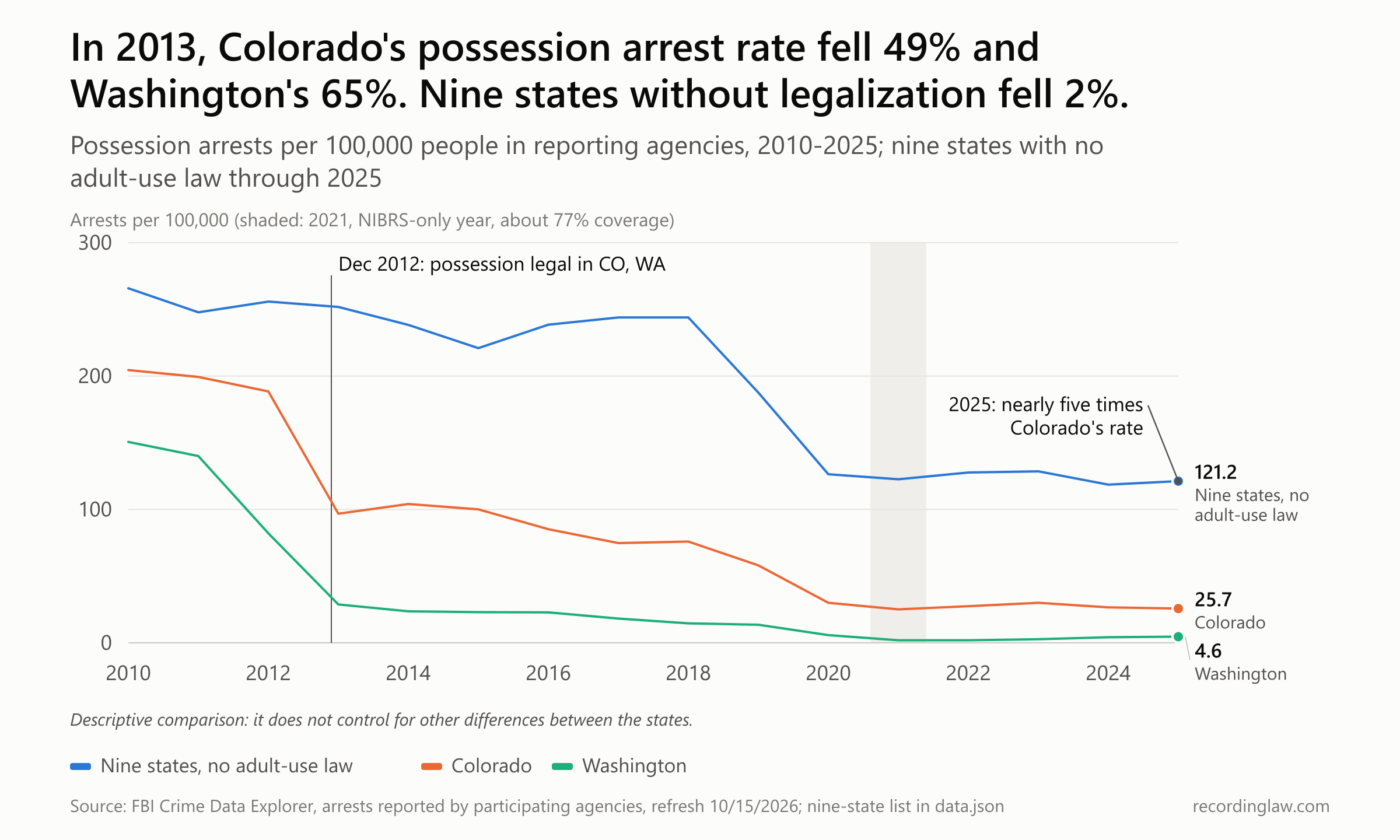
Source: FBI Crime Data Explorer, arrests reported by participating agencies (data refresh October 15, 2026). Nine states: Arkansas, Idaho, Kentucky, North Dakota, Oklahoma, Tennessee, Texas, Utah, Wisconsin.
From 2012 to 2013, Colorado's reported possession arrest rate fell 49% and Washington's fell 65%. Across the nine comparison states, which had not legalized marijuana for adult use through 2025, it fell 2%.
| Possession arrests per 100,000 | 2010 | 2012 | 2013 | 2019 | 2020 | 2025 |
|---|---|---|---|---|---|---|
| Colorado | 204.5 | 188.5 | 96.8 | 58.1 | 30.0 | 25.7 |
| Washington | 150.6 | 82.1 | 28.8 | 13.6 | 5.8 | 4.6 |
| Nine states without adult-use legalization | 265.8 | 255.8 | 251.8 | 187.6 | 126.4 | 121.2 |
Not all of Washington's drop waited for the law. Its rate had already fallen from 140 per 100,000 in 2011 to 82 in 2012. I-502 left the prohibition in place for people under 21. Even so, the state's research institute found that their possession convictions fell too, from 1,015 in the first three months of 2012 to 722 in the first quarter of 2013.
The institute also tested whether the amount of legal retail sales in each county moved drug convictions. Its models "produced no evidence of effects of retail cannabis sales on any of the drug-related charge categories." The test compared counties with more and less legal retail sales, all after legalization. So it did not measure the effect of legalization itself.
Did arrests fall only where marijuana became legal?
Arrests fell in states that kept marijuana illegal too, only more slowly.
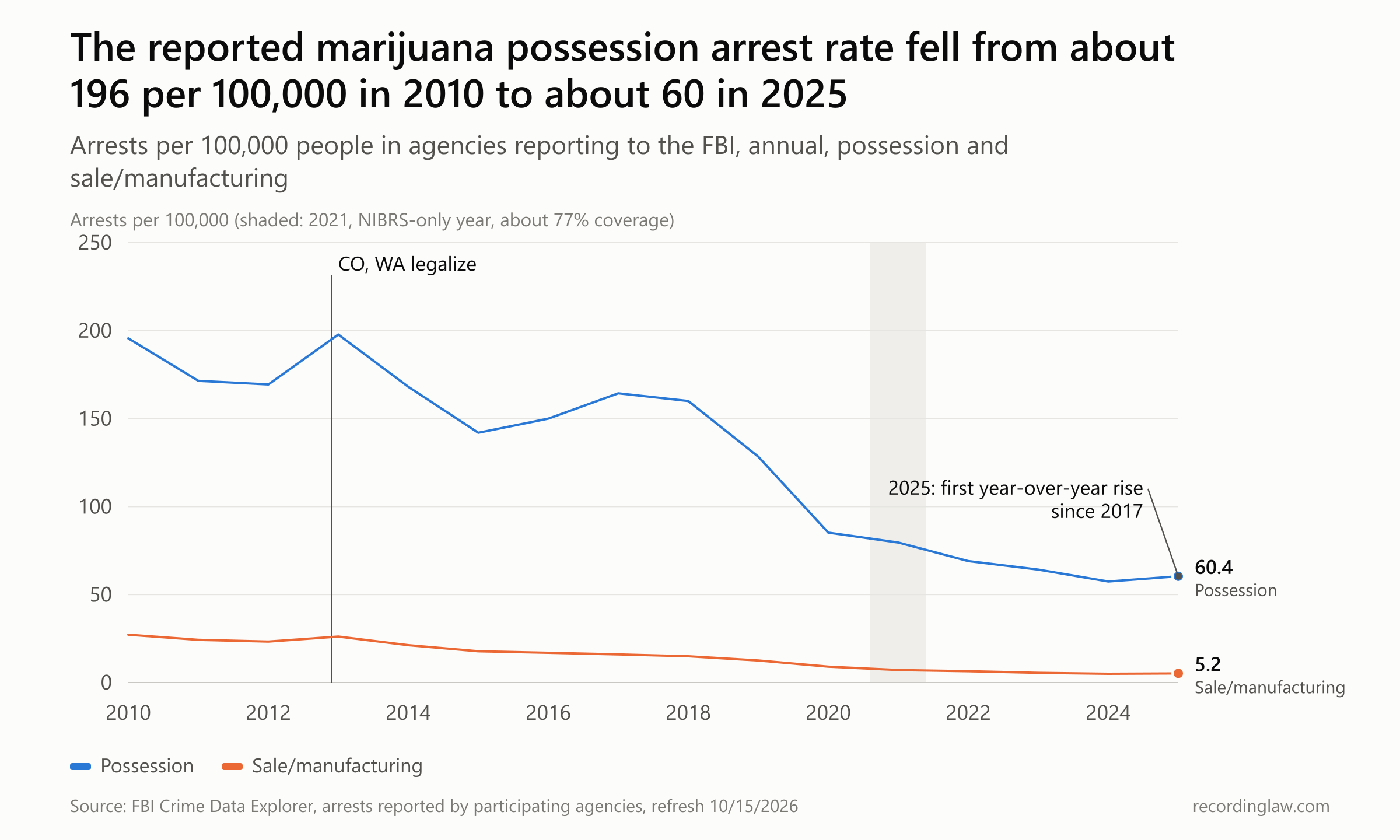
Source: FBI Crime Data Explorer, arrests reported by participating agencies (data refresh October 15, 2026). Rates are per 100,000 people covered by reporting agencies. 2021 was the first year the FBI accepted only incident-based (NIBRS) reports, and agencies covering about 77% of the population reported.
The reported national possession rate fell from about 196 per 100,000 in 2010 to about 60 in 2025.
| Year | Possession arrests per 100,000 | Sale/manufacturing arrests per 100,000 | Possession arrests reported | Population covered |
|---|---|---|---|---|
| 2010 | 195.6 | 27.2 | 591,355 | 97.9% |
| 2012 | 169.4 | 23.3 | 522,094 | 98.1% |
| 2013 | 197.8 | 26.1 | 609,925 | 97.6% |
| 2019 | 128.4 | 12.5 | 410,066 | 96.2% |
| 2020 | 85.2 | 9.0 | 272,115 | 95.9% |
| 2021 | 79.6 | 7.1 | 205,169 | 77.0% |
| 2024 | 57.4 | 5.0 | 190,210 | 96.4% |
| 2025 | 60.4 | 5.2 | 201,518 | 96.6% |
Over the full 15 years, the nine comparison states did much of the falling themselves. From 2010 to 2025 their rate fell 54%. Over the same years, Colorado's fell 87% and Washington's fell 97%.
So the national drop came from states that legalized and also from states that did not legalize but arrested fewer people, including after law changes short of legalization, as in Texas. The nine states started higher and fell less, which left them far apart in 2025. In that year their rate was nearly five times Colorado's and about 26 times Washington's.
The largest of the nine, Texas, made up about half of the group's reported possession arrests from 2010 to 2018. In June 2019 Texas legalized hemp in House Bill 1325. A state police memo noted that hemp and marijuana are "difficult to definitively distinguish" without a laboratory analysis.
The Texas Tribune reported from state court data that Texas prosecutors had filed about 5,900 misdemeanor possession cases a month in 2018. After June 2019, it reported, that number fell by more than half.
The steepest single-year fall came in 2020, and it was almost identical everywhere. It was about 34% nationally and 33% in the nine states. That was the first pandemic year. Katharine Harris of Rice University's Baker Institute noted that arrests for all drugs fell 25% from 2019 to 2020.
Marijuana's place in drug enforcement shrank too. Pew Research Center reported in 2020 that marijuana had been 52% of reported drug arrests in 2010. Using 2018 data, Pew found marijuana at its lowest share "in at least 20 years." FBI arrest data from reporting agencies, run through 2025, puts the share at 27%.
Most of that decline came before 2023.
| Year | Marijuana share of drug arrests | Possession only |
|---|---|---|
| 2010 | 52.2% | 45.8% |
| 2016 | 42.1% | 37.8% |
| 2019 | 35.9% | 32.8% |
| 2020 | 31.9% | 28.9% |
| 2022 | 29.7% | 27.2% |
| 2024 | 26.9% | 24.8% |
| 2025 | 27.3% | 25.2% |
Source: FBI Crime Data Explorer, arrests reported by participating agencies; share computed across eight drug offense categories.
Every one of these lines counts new arrests. None of them touches the arrests and convictions already on file from the decades before. By 2019, governors had started going back for those.
Who had to ask for a clean record?
Washington's governor started with an application. Announcing the Marijuana Justice Initiative on January 4, 2019, Inslee spokesperson Jamie Smith described what an old misdemeanor could do: "For some people, it’s that little barrier that might prevent them from renting an apartment, get housing, apply for a credit card, and even get a job."
The Association of Washington Cities summarized the state's estimate a week later: "There are an estimated 3,500 individuals eligible under this initiative."
Nearly four years later, after President Biden urged governors to pardon state marijuana offenses, The Seattle Times checked the count. "The governor's office had estimated that roughly 3,500 people were eligible for the pardons, but, nearly four years later, only 38 have received pardons under the program," David Gutman wrote. That is about 1% of the estimate.
Inslee spokesperson Mike Faulk said the governor lacked "clear authority" to grant blanket pardons. The same article pointed to other routes, noting that in Washington "the governor, the state Legislature and the state Supreme Court have all taken significant steps in recent years to expunge past drug convictions." After the court's 2021 State v. Blake decision, by some estimates up to 150,000 old drug-possession convictions were to be vacated.
Colorado took the application out. On October 1, 2020, acting under state law HB 20-1424, Gov. Jared Polis signed an executive order. It pardoned 2,732 possession convictions that the Colorado Bureau of Investigation had identified. "The individuals who have these convictions did not need to apply for pardons," his office said.
"We are finally cleaning up some of the inequities of the past by pardoning 2,732 convictions for Coloradans who simply had an ounce of marijuana or less," Polis said. He added: "It’s ridiculous how being written up for smoking a joint in the 1970’s has followed some Coloradans throughout their lives and gotten in the way of their success." The order did not cover municipal convictions or arrests that never led to a conviction.
Researchers have a name for the distance between who qualifies and who gets relief. Colleen Chien of the Paper Prisons Initiative called it the "second chance gap," defined as "the difference between eligibility and delivery of second chance relief." In Michigan, where expungement required a petition, J.J. Prescott and Sonja Starr of the University of Michigan Law School found that "among those legally eligible for expungement, just 6.5% obtain it within five years of eligibility."
That Michigan study covered all offenses, not only marijuana. The authors used statewide data on people who got expungements and comparable people who did not. They found that recipients had very low rates of later crime. They also found that within a year, recipients' wages were more than 22% above their pre-expungement trajectory.
What happened where the state did the work?
Illinois did it at scale. On December 31, 2019, the day before legal sales began, Gov. JB Pritzker announced 11,017 pardons covering people in 92 counties. He announced them at a gathering of hundreds at Trinity United Church of Christ on Chicago's South Side. He said that with legal sales starting the next day, "we are beginning to accomplish four very important things," the first two being "We are ending the 50-year long war on cannabis. We are restoring rights to many tens of thousands of Illinoisans."
His office said that "more than 700,000 records" statewide would be eligible for relief under the new law. That total included "116,000 records eligible for expungement through the Governor’s pardon process." The law also had the State Police clear non-felony cannabis arrest records automatically, with a deadline of January 1, 2025.
A year later the governor's office reported the State Police part finished. "With the expungement of all 492,129 cannabis arrest records, ISP is four years ahead of the January 1, 2025 statutory deadline for completing automatic expungements," the governor's office announced on December 31, 2020. Pritzker said such records were "a burden disproportionately shouldered by communities of color."
The same release noted that "county clerks are still processing expungements at the local level." Only 10 counties had completed local expungements by then.
Illinois now keeps a running tally. It counts criminal charges rather than people, so one arrest for possession and paraphernalia is two records. How large is each route?
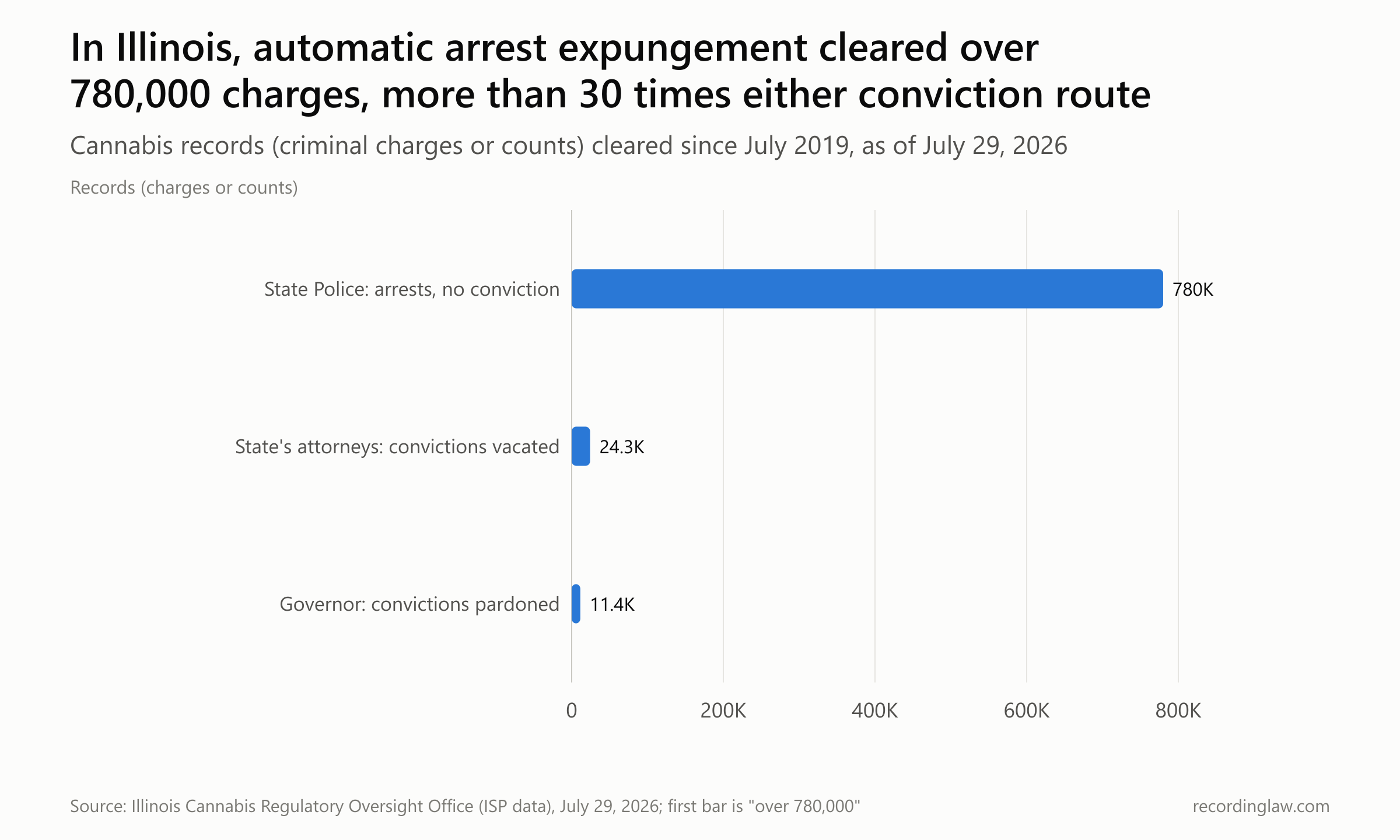
Source: State of Illinois cannabis expungement page (cannabis.illinois.gov), figures as of July 29, 2026. Records are criminal charges or counts.
Automatic arrest expungement by the State Police accounts for most of the cleared records. Its count is more than 60 times the pardoned conviction records and more than 30 times the vacated ones.
| Illinois route (since July 2019) | Records, as of July 29, 2026 |
|---|---|
| Arrest charges expunged by Illinois State Police | over 780,000 |
| Conviction records vacated and expunged through state's attorneys | 24,286 |
| Conviction records pardoned by the governor | 11,430 |
The pardon numbers do not line up across the state's own announcements. The governor's office said in December 2020 that the 9,219 pardons issued that day brought the total to "over 20,000 cannabis convictions now pardoned." The state's cannabis page, which counts charges, lists 11,430 pardoned conviction records as of July 29, 2026. We found no published explanation of the difference.
New Jersey moved through its courts. On July 1, 2021, the day its decriminalization law took effect, a state Supreme Court order from Chief Justice Stuart Rabner directed eligible pending marijuana cases to be dismissed.
The law also made eligible cases subject to automatic expungement. The Judiciary had identified about 360,000 eligible cases. By July 12 it had vacated or dismissed nearly 88,000, with expungement to follow.
By September 16 the count passed 362,000. "More than 362,000 marijuana cases have been expunged from court records since July 1, the New Jersey Judiciary announced today," New Jersey Globe reported. The people whose cases were cleared had not filed anything, so officials set out to tell them. "Now, officials are trying to alert people who benefitted from the automatic expungement," WHYY reported, adding that more than 2,800 certifications had been issued to people who wanted proof.
California tried petitions first. Code for America, a nonprofit that built a record-clearing tool and advocates automatic clearance, says "Only 10% of eligible people got relief from the petition-based process." It says district attorneys using its tool then "reduced or dismissed 144,000 cannabis convictions, representing two-thirds of all eligible cannabis convictions in the state at the time."
Under a state law, AB 1793, the state then flagged every potentially eligible case for review. As of July 2019, there were 227,650 of them. How far did that get?
By April 2024, 216,157 of the 227,650 cases flagged in July 2019 had been recalled, dismissed, resentenced, sealed or redesignated. "This represents a 95% reduction of the total identified in July 2019," the state's sixth and final quarterly report said.
| California (Prop 64 / AB 1793 review) | Cases still potentially eligible | Cases cleared |
|---|---|---|
| July 2019 | 227,650 | not reported |
| April 6, 2023 | 21,598 | 206,052 |
| July 10, 2023 | 15,306 | 212,344 |
| October 2, 2023 | 14,206 | 213,444 |
| January 2, 2024 | 13,571 | 214,079 |
| April 2, 2024 | 11,493 | 216,157 |
Source: California Department of Justice and Judicial Council, AB 1706 report, June 3, 2024 (data as of April 2, 2024).
New York's count is a 2021 projection. In October 2021, minutes of the state's Cannabis Control Board said that "When completed, the actions of these measures will have expunged the records of over 400,000 New Yorkers," about 198,000 under a 2019 law and about 203,000 charges then being suppressed and expunged under the new one.
The court system says expungement means "the arrest, the court case, and the conviction are now treated as if they never happened." We found no final statewide tally.
New Mexico built in a check. Its Department of Public Safety listed 151,640 cases that could potentially qualify for automatic expungement, and, as Cannabis Business Times relayed from KRQE in August 2022, "submitted lists to each district attorney in the state, who can then review and object to the expungement." We found no count of completed expungements.
What did the federal pardon change?
On October 6, 2022, President Biden pardoned federal simple marijuana possession. "As I often said during my campaign for President, no one should be in jail just for using or possessing marijuana," he said. He added that "There are thousands of people who have prior Federal convictions for marijuana possession" and "I am urging all Governors to do the same with regard to State offenses."
The U.S. Sentencing Commission counted who that covered. It found 6,577 U.S. citizens sentenced for marijuana-only simple possession from fiscal 1992 through 2021, plus 1,122 resident or legal alien offenders, and excluded 2,085 cases with missing citizenship data. Its analysis said: "As of January 29, 2022, no offenders remain in BOP custody." BOP is the federal Bureau of Prisons.
Sixteen drug policy reform groups pressed the president on what the pardon left out. "While your recent executive order will help many, it will not release a single one of the nearly 2,800 federal cannabis prisoners," they wrote to the president, as quoted by Reason. Jacob Sullum, writing in Reason, estimated beneficiaries "may exceed 10,000, which nevertheless represents a tiny percentage of Americans with misdemeanor marijuana records, who typically are prosecuted under state law."
A second proclamation followed on December 22, 2023. The pardons were granted by proclamation. But a person who wants proof must apply for a certificate. Under the second proclamation, the Attorney General, acting through the Pardon Attorney, "shall review all properly submitted applications for certificates of pardon and shall issue such certificates of pardon to eligible applicants in due course."
In May 2024, Reason reported that the Justice Department had said "the Office of the Pardon Attorney has issued 205 certificates of pardon" to people covered by the two proclamations. When we checked in early November 2026, the department's page still offered the application and showed no count, and we found no later published figure.
Who is still being arrested?
Pardons and expungements reach arrests already on file. Police kept making new ones, and who those arrests fall on is the question the NAACP raised in 2012.
Using FBI national estimates, Katharine Harris of Rice University's Baker Institute counted 317,793 marijuana possession arrests in 2020. "Black Americans accounted for about 38.8% of marijuana possession arrests in 2020 despite representing just 13.6% of the U.S. population and using marijuana at the same rate as white Americans, according to the National Survey on Drug Use and Health," she wrote. She also wrote: "Despite these declines, racial disparities have not changed over the past decade."
The ACLU, which supports legalization, reached a similar finding in 2020 from FBI data for 2010 to 2018. In 2018, it found, Black people were 3.64 times as likely as white people to be arrested for possession. It found that arrests fell in legalized states but disparities remained.
It also found that legalized states had lower disparities in 2010 too, before any had legalized. "However, it is not clear that this difference is a result of legalization," the group said in the report. The report also states that it had "not performed the requisite statistical controls that would be required to establish a causal link."
The FBI arrest data used for the charts above has no race breakdown, so there is no national trend line to set beside these figures. Colorado's own report, which state law requires the Division of Criminal Justice to produce, gives the closest look at one state.
It found marijuana arrests in Colorado fell 82% from 2012 to 2022, but not evenly by age. Arrests of adults 21 and older fell 91% over those years. Arrests of people under 18 fell 58%. Within that period, from 2020 to 2022, arrests of people under 18 rose 36%.
"In 2022, juveniles accounted for over half (62%) of all marijuana arrests compared to 25% in 2012," the report says. It also says that 44% of the offenses that year were recorded at elementary or secondary schools.
The gap by race narrowed and then widened. The report's disparity ratio compares Black and white arrest rates.
NH stands for non-Hispanic. "The disparity ratio for NH Black versus NH Whites arrests hit a period-low of 1.7 in 2018. Since then, the ratio has increased by approximately 41%, reaching 2.42," the report says. Among juveniles, the Black arrest rate went from 8% above the white rate in 2012 to 73% above it in 2022 (399 versus 233 per 100,000).
| Source | Measure | Figure |
|---|---|---|
| Baker Institute, FBI national estimates | Black share of marijuana possession arrests, 2020 | 38.8% (13.6% of population) |
| ACLU, FBI data | Black vs white possession arrest likelihood, 2018 | 3.64 times |
| Colorado Division of Criminal Justice | Non-Hispanic Black vs white arrest ratio | 1.7 in 2018, later 2.42 |
| Colorado Division of Criminal Justice | Juvenile arrest rate per 100,000, Black vs white, 2022 | 399 vs 233 |
The ACLU and Colorado ratios both compare Black and white arrest rates, but one covers possession arrests nationwide and the other all marijuana arrests in Colorado. Colorado's ratio also compares non-Hispanic residents aged 10 and older. So the two rows measure different things even for 2018, and together they are not a trend line.
The report's authors flagged a limit in their own numbers. Arrests coded as "unspecified" marijuana offenses rose from 10% of the total in 2012 to 30% in 2022, and "This growth in unspecified marijuana arrests could have inflated the declines in each category." The report describes trends and does not test causes.
Opponents had warned about young people early. In October 2016, Smart Approaches to Marijuana, a group that opposes legalization, reported that over 2012 to 2014 the number "of Hispanic and black kids under 18 years old arrested for marijuana-related offenses rose 29 percent and 58 percent, respectively," citing Colorado state data; its chart showed total juvenile arrests up 5%, from 3,234 to 3,400. The report did not state its funding. In 2020 the ACLU, from the other side of the debate, wrote: "Thus far, racial justice has largely been a peripheral or incidental goal of legalization."
A rise in 2025, and the dates ahead
In 2025 the national count turned up. Agencies reported 190,210 marijuana possession arrests in 2024 and 201,518 in 2025, with the share of the population covered nearly unchanged. The rate went from 57.4 to 60.4 per 100,000. That was its first year-over-year rise since 2017, and the rate was still less than a third of the 2010 level.
The figures here come from the FBI's October 15, 2026 data refresh. Figures for calendar 2026 are expected in 2027, on a date not yet announced. One year of increase is not yet enough to say whether the long decline has ended.
On the records side, the next fixed date is in New York. Its Clean Slate Act, which reaches far beyond marijuana, gives the Unified Court System "until November 16, 2027" to set up the processes "to automatically seal eligible conviction records." Readers checking what applies to their own record can start with our state-by-state expungement guide.
In Washington, monthly adult possession convictions went from 297 to none within a year. The records from before that have since been cleared by the hundreds of thousands in states that did it without an application. Washington's apply-first pardon program reached 38 people. For federal pardon certificates, which still require an application, the last published count we found was 205, in May 2024.
How we measured
Arrest data. National and state arrest figures come from the FBI Crime Data Explorer arrest API (data refresh October 15, 2026; calendar 2025 complete), offense codes 158 (marijuana possession) and 153 (marijuana sale/manufacturing). These are arrests reported by participating agencies, not the FBI's national estimates. Pew and the Baker Institute used estimates, which is why Baker's 2020 possession figure (317,793) is higher than the reported count here (272,115). Annual rates are the sum of 12 monthly rates per 100,000 people in participating agencies.
The 2021 break. In January 2021 the FBI moved to NIBRS-only reporting. Agencies covering about 74% to 80% of the population reported each month that year (annual mean 77.0%), against about 96% to 98% in other years. The Baker Institute noted that only 52% of agencies fully reported 2021 data and that New York City and Los Angeles did not report at all. Rates are less distorted than counts, but which agencies report changed.
Comparison group. The nine states (Arkansas, Idaho, Kentucky, North Dakota, Oklahoma, Tennessee, Texas, Utah, Wisconsin) had no adult-use legalization through 2025 and at least 94% reporting coverage in every year 2010 to 2025. Their rate is total arrests divided by mean covered population. Several have medical programs or local decriminalization, and states that legalized from 2021 to 2023 were not candidates. The comparison is descriptive; it does not control for other differences between states and cannot isolate the effect of legalization.
Texas supplied 44% to 53% of the group's reported possession arrests in each year from 2010 to 2018 (41% in 2019). Its own rate went from 220.5 per 100,000 in 2018 to 157.0 in 2019 and 82.1 in 2020, the period after its June 2019 hemp law (House Bill 1325). The Texas Tribune reported that monthly misdemeanor possession filings fell from about 5,900 in 2018 to fewer than 2,000 in November 2019, and the Department of Public Safety told its officers to "cite and release for any misdemeanor amount of marijuana" in July 2019.
Relief-share chart. Washington's 1.1% is 38 pardons (The Seattle Times, October 2022) divided by the governor's office estimate of about 3,500 eligible people (January 2019). Michigan's 6.5% is Prescott and Starr's figure for people legally eligible for expungement of any offense who obtained it within five years of eligibility. California's 10% is Code for America's own account of the petition-based process. California's 95% is the AB 1706 report's own figure (216,157 of 227,650 cases, data as of April 2, 2024).
Colorado is not plotted because the 2020 order pardoned the convictions the Colorado Bureau of Investigation had identified, so a share would be 100% by construction. Illinois (over 780,000 charges, against "more than 700,000 records" the governor's office said in 2019 would be eligible) and New Jersey (more than 362,000 cases, against about 360,000 identified) each report cleared counts above their earlier estimates, made at different times, so no share is computed.
Arithmetic. National possession rate: 195.6 (2010) to 60.4 (2025), down 69%. Nine states: 265.8 to 121.2, down 54%. Colorado: 204.5 to 25.7, down 87%. Washington: 150.6 to 4.6, down 97%.
From 2012 to 2013: Colorado 188.5 to 96.8 (down 49%), Washington 82.1 to 28.8 (down 65%), nine states 255.8 to 251.8 (down 2%). From 2019 to 2020: national 128.4 to 85.2 (down 34%), nine states 187.6 to 126.4 (down 33%).
2025 ratios: 121.2 / 25.7 = 4.7; 121.2 / 4.6 = 26. Washington pardons: 38 / 3,500 = 1.1%. Reported possession arrests 2024 to 2025: up 11,308, or 5.9%. The national rate rose year over year only in 2013, 2016, 2017 and 2025 (164.4 in 2017 against 150.0 in 2016).
Illinois: 780,000 / 11,430 = 68 and 780,000 / 24,286 = 32, so "over 780,000" is more than 60 times and more than 30 times those figures. New Jersey: July 1 to September 16, 2021 is 77 days, 11 weeks.
Drug-arrest share. Marijuana (offenses 158 and 153) divided by the sum of eight leaf drug categories (152, 153, 154, 155, 157, 158, 159, 160). The FBI's drug total (150) collapses after 2016 in this data and two parent categories double-count their children, so they are excluded. The 2010 share (52.2%) matches Pew's published 52%.
Arrests, filings, convictions, charges and cases are different units. Washington's 297-to-zero figures are convictions (WSIPP, from court data); the 6,879-to-120 figures are court filings (ACLU of Washington, from Administrative Office of the Courts data).
Illinois counts records as criminal charges or counts. New Jersey and California count cases. Colorado's 2,732 and Washington's 38 are pardons.
New York's 400,000 is a 2021 projection of people. None of these can be added together.
Illinois counts. The governor's office reported 492,129 arrest records expunged by December 31, 2020 (WTTW reported 492,192), and pardons of 11,017 (2019) and 9,219 (2020), described as "over 20,000" convictions. The state's cannabis page (as of July 29, 2026) lists 11,430 pardoned conviction records and over 780,000 expunged charges. Each figure is reported as published; we did not reconcile them. Illinois is not charted as an arrest series because its reported offense-158 counts before 2020 are near zero (309 in 2019).
California. The June 3, 2024 report (data as of April 2, 2024) was the sixth and final quarterly report under AB 1706; we found no later statewide Justice Department report. Code for America's 10% and 144,000 figures are the organization's own account.
What the data cannot show. It cannot say how many people, as opposed to records, were cleared in any state; whether cleared records also vanished from private background-check databases; or how many federal pardon certificates have been issued since May 2024. Statements that we found no count or report reflect searches through October 31, 2026, and for federal pardon certificates through November 7, 2026. There is no national time series of marijuana arrests by race in the data used here; the race figures are single studies, each attributed. Colorado's Division of Criminal Justice figures come from state NIBRS data and court filings through 2022 and differ from the FBI series in the charts. Its count of all marijuana arrests went from 13,225 in 2012 to 2,235 in 2022. The report dates the 36% rise in juvenile arrests to 2020-2022 in its analysis and to 2021-2022 in its summary; we use the analysis.
Frequently Asked Questions
How many people are arrested for marijuana possession each year in the US?
Police agencies reporting to the FBI recorded 201,518 marijuana possession arrests in 2025, up from 190,210 in 2024. In 2010 they recorded 591,355. Because the set of reporting agencies changes, the rate per 100,000 people is the better comparison. It was 195.6 in 2010 and 60.4 in 2025.
Did legalization reduce marijuana arrests?
From 2012 to 2013, the first year of legal possession, possession arrest rates fell 49% in Colorado and 65% in Washington. In nine states without legalization, the rate fell 2%. From 2010 to 2025 the rate in those nine states also fell by more than half, including in Texas after its 2019 hemp law. So much of the national decline happened outside legalizing states. The comparison is descriptive and does not isolate the effect of the laws.
Are old marijuana convictions automatically expunged when a state legalizes?
It depends on the state. Illinois, New Jersey and California cleared records without requiring applications. Colorado's governor pardoned 2,732 convictions in 2020, also with no application. Washington's 2019 pardon program required an application and reached 38 of about 3,500 eligible people by 2022. Check your own state's expungement rules.
How many cannabis records has Illinois expunged?
The state says Illinois State Police had expunged over 780,000 charges for minor cannabis offenses as of July 29, 2026, with 24,286 conviction records vacated and expunged and 11,430 conviction records pardoned. The state counts records as criminal charges, not people.
Did Biden's marijuana pardon release anyone from federal prison?
The U.S. Sentencing Commission found that as of January 29, 2022, no one convicted only of federal marijuana simple possession remained in Bureau of Prisons custody. The pardon applies to past convictions. People must apply to the Justice Department for a certificate as proof.
Has the racial gap in marijuana arrests changed since legalization?
The Baker Institute reported that Black Americans were 38.8% of possession arrests in 2020. It said disparities had not changed over the past decade. In Colorado, the state found the Black-white arrest ratio fell to 1.7 in 2018 and then rose to 2.42. The FBI arrest data used here has no national race series.
Updates
Corrected: a sentence said both California relief shares count cases. Code for America's 10% counts eligible people, and only the state's 95% review figure counts cases.
Restructured as a feature: chart titles state the finding, side details moved to How we measured. Every figure and quote was re-checked against its source.
Independently fact-checked against the cited primary sources
Independently fact-checked against the cited primary sources
Sources and References
- FBI Crime Data Explorer, marijuana possession arrests (offense 158), national, 2010-2025(cde.ucr.cjis.gov).gov
- FBI Crime Data Explorer, marijuana sale/manufacturing arrests (offense 153), national, 2010-2025(cde.ucr.cjis.gov).gov
- FBI Crime Data Explorer, Colorado marijuana possession arrests, 2010-2025(cde.ucr.cjis.gov).gov
- FBI Crime Data Explorer, Washington marijuana possession arrests, 2010-2025(cde.ucr.cjis.gov).gov
- FBI Crime Data Explorer, state arrest series used for the nine-state comparison group(cde.ucr.cjis.gov).gov
- FBI Crime Data Explorer, data refresh date (October 15, 2026)(cde.ucr.cjis.gov).gov
- Colorado Legislative Council, 2012 State Ballot Information Booklet (Blue Book), Amendment 64(co.elstats2.civera.com)
- Washington Initiative 502, full text(lawfilesext.leg.wa.gov).gov
- The Herald (Everett), Former U.S. attorneys appear in TV ad supporting pot initiative, October 10, 2012(heraldnet.com)
- Associated Press via The Spokesman-Review, Study: Wash. spent $200M on pot enforcement, August 28, 2012(spokesman.com)
- KUNC, Supporters of Amendment 64 have raised $1.4 million, August 26, 2012(kunc.org)
- CBS4 Denver, Pot Legalization Proponents, Opponents Gather At Convention Center, October 15, 2012(cbsnews.com)
- The Spokesman-Review, Opposition to I-502 low on funds, outreach efforts, October 30, 2012(spokesman.com)
- International Association of Chiefs of Police, 2010 resolution opposing marijuana legalization(theiacp.org)
- International Association of Chiefs of Police, 2018 board resolution (expired)(theiacp.org)
- Reason, Will Denver's DA Finally Listen to Voters?, November 14, 2012(reason.com)
- Westword, Amendment 64 is now law, December 10, 2012(westword.com)
- ACLU of Washington, court filings for adult marijuana possession offenses, March 19, 2014(aclu.org)
- Washington State Institute for Public Policy, I-502 Evaluation and Benefit-Cost Analysis, Second Required Report, September 2017(wsipp.wa.gov).gov
- Pew Research Center, Four in ten U.S. drug arrests in 2018 were for marijuana offenses, January 22, 2020(pewresearch.org)
- Katharine Harris, Baker Institute for Public Policy, 317,793 people were arrested for marijuana possession in 2020, November 16, 2022(bakerinstitute.org)
- Spokane Public Radio, Inslee announces initiative to pardon marijuana misdemeanors, January 4, 2019(spokanepublicradio.org)
- Association of Washington Cities, Governor announces initiative to pardon marijuana misdemeanors, January 11, 2019(wacities.org)
- The Seattle Times (David Gutman) via The Chronicle, No Big Changes From Gov. Inslee Following Biden's Call for Marijuana Pardons, October 6, 2022(chronline.com)
- Office of Gov. Jared Polis, Gov. Polis grants historic pardons for marijuana convictions, October 1, 2020(colorado.gov).gov
- Colleen Chien, America's Paper Prisons: The Second Chance Gap (Paper Prisons Initiative)(paperprisons.org)
- J.J. Prescott and Sonja B. Starr, Expungement of Criminal Convictions: An Empirical Study, Harvard Law Review (2020)(repository.law.umich.edu)
- Office of Gov. JB Pritzker, cannabis pardons announcement, December 31, 2019(illinois.gov).gov
- Office of Gov. JB Pritzker, cannabis arrest record expungements and pardons, December 31, 2020(illinois.gov).gov
- NBC Chicago, Illinois expunges nearly half a million cannabis arrest records, December 31, 2020(nbcchicago.com)
- WTTW, Gov. Pritzker clears thousands of marijuana convictions, December 31, 2019(news.wttw.com)
- State of Illinois, cannabis expungement page (figures as of July 29, 2026)(cannabis.illinois.gov).gov
- New Jersey Globe, 362,000 marijuana cases expunged from court records, September 2021(newjerseyglobe.com)
- New Jersey Judiciary release via Insider NJ, expungement of nearly 88,000 marijuana cases, July 2021(insidernj.com)
- WHYY, Was your N.J. weed conviction expunged? The state's court system wants you to find out, September 27, 2021(whyy.org)
- Code for America, Going from pilot to statewide record clearance in California(codeforamerica.org)
- California Department of Justice and Judicial Council, AB 1706 report to the Legislature, June 3, 2024(oag.ca.gov).gov
- New York Cannabis Control Board, meeting minutes, October 21, 2021(cannabis.ny.gov).gov
- New York State Unified Court System, CourtHelp: cannabis and expungement under New York law(nycourts.gov).gov
- New York State Unified Court System, Clean Slate Act(nycourts.gov).gov
- Cannabis Business Times, New Mexico reviews past cannabis-related charges for expungement, August 10, 2022(cannabisbusinesstimes.com)
- President Joe Biden, Statement on Marijuana Reform, October 6, 2022 (American Presidency Project)(presidency.ucsb.edu)
- U.S. Sentencing Commission, analysis of federal marijuana simple possession offenders, October 2022(content.govdelivery.com)
- Reason (Jacob Sullum), Biden's Marijuana Pardons Could Benefit Some 10,000 People With Misdemeanor Records, October 13, 2022(reason.com)
- U.S. Department of Justice, Office of the Pardon Attorney, Apply for Clemency(justice.gov).gov
- ACLU, A Tale of Two Countries: Racially Targeted Arrests in the Era of Marijuana Reform (2020)(assets.aclu.org)
- ACLU, A Tale of Two Countries publication page(aclu.org)
- Colorado Division of Criminal Justice, Impacts of Marijuana Legalization in Colorado, 2025 (revised February 2026)(cdpsdocs.state.co.us).gov
- Smart Approaches to Marijuana, Lessons Learned After 4 Years of Marijuana Legalization, October 2016(secure.in.gov)
- Reason (Jacob Sullum), report of 205 federal marijuana pardon certificates issued, May 17, 2024(reason.com)
- Texas Tribune (Jolie McCullough) via High Plains Public Radio, Marijuana prosecutions in Texas have dropped by more than half since lawmakers legalized hemp, January 5, 2020(hppr.org)
- Texas Tribune (Jolie McCullough) via KUT, Texas DPS officers told not to arrest in low-level marijuana cases after new hemp law, August 1, 2019(kut.org)