Small-Bail Jailing in New Jersey Fell From More Than 1,500 in 2012 to 49 in 2024. In New York, Rearrest Depends on the Comparison

Independently fact-checked against primary sources (last audited November 9, 2026). · 16 primary sources cited on this page. How we verify our legal content
In 2012, a study of New Jersey's county jails found 1,547 people held before trial on bail of $2,500 or less. They were about one in eight of everyone inside.
On Oct. 2, 2024, the state's courts took their own one-day count of the jails. The number held on bail that small was 49.
Between those two counts, New Jersey stopped deciding who waits in jail mostly by whether a defendant could post bail. New York followed in January 2020, and Illinois went further in September 2023, ending cash bail entirely. Each state made the same two-part bet: people would no longer sit in jail only because they could not pay, and the people let out would come back to court and stay out of trouble. Prosecutors, sheriffs and police groups warned that the second half would not hold, and the bail industry and county governments warned about the cost.
The first half shows up in a jail count. The second half depends on which events a state decides to count. New Jersey counts a new criminal charge over about 22 months, New York counts any rearrest within six months, and Illinois has no statewide count at all, because the data its own law required was never funded.
So did the people let out come back to court and stay out of trouble, and why does each state's answer depend on what it counts?
Two promises on the Trenton City Hall steps
On the afternoon of Aug. 11, 2014, Gov. Chris Christie, a Republican, signed New Jersey's bail overhaul on the steps of Trenton's City Hall, with the Democratic leaders of the Legislature beside him. He described a law that would do two things at once.
"Under these reforms, our justice system will be both more effective in protecting our communities from dangerous violent repeat offenders and fairer to those non-violent offenders who do not deserve to sit in what has become the equivalent of debtors' prison because they can't afford to post the bail," he said.
The law raised court fees to pay for it, WHYY reported, including $22 million a year for a risk assessment and release monitoring program. A risk assessment is a scoring tool: it rates a defendant's risk of failing to appear in court, committing another offense and committing a violent offense.
Richard Smith, president of the New Jersey NAACP, described the problem it was meant to fix. "Three quarters of the people who were being warehoused in our jails were there awaiting trial rather than serving a sentence and their average length of stay is about 10 months," he said.
Part of the plan needed voters. The state constitution guaranteed bail, and the plan let judges deny it to some defendants accused of serious violent crimes and hold them in jail until trial, which courts call pretrial detention. On Election Day, Alex Shalom of the ACLU of New Jersey, which backed the ballot question, predicted that thousands of people then held before trial would be released.
Some of the first warnings came from defense lawyers and a civil-rights legislator, not from prosecutors. The Association of Criminal Defense Lawyers of New Jersey opposed the amendment, and its president, Joe Rotella, objected to tying bail to speedy-trial guarantees. State Sen. Ronald Rice, a Democrat in the Legislative Black Caucus, argued that removing the bail guarantee without defining the speedy-trial protection could leave defendants at the mercy of a judge's discretion. "There is a whole other agenda here," he told The Daily Princetonian. "It is feel-good legislation by way of deception." He added that carrying out the act, including a new pretrial agency, was estimated to cost the state $100 million, money he said the state did not have.
Voters approved the question on Nov. 4, 2014, by 891,373 to 550,698, about 62 percent, and it carried all 21 counties.
By the time the system was ready to start, the bail industry's objection was cost. "We are simply sitting back and saying we told in 2014 this would be expensive and difficult to implement. And then the fundamental question of, whatever fairness it is we're buying, is it worth it?" Jeff Clayton of the American Bail Coalition, a bail-bond industry trade group, told NPR in December 2016.
Whether the law was worth its cost was an argument. How many people it let out of jail was something anyone could count.
Who was left in New Jersey's jails?
The new system started on Jan. 1, 2017, with deadlines attached. "Prosecutors have 90 days to indict a defendant. A trial must then be scheduled in 180 days," the Philadelphia Inquirer reported that morning, and jailed defendants would be released if the deadlines were missed.
The jail count had started falling before the start. On the last day of 2015, county jails held about 9,200 people awaiting trial; on the last day of 2016, about 7,300. How far did it fall once the system was running, and did it stay down?
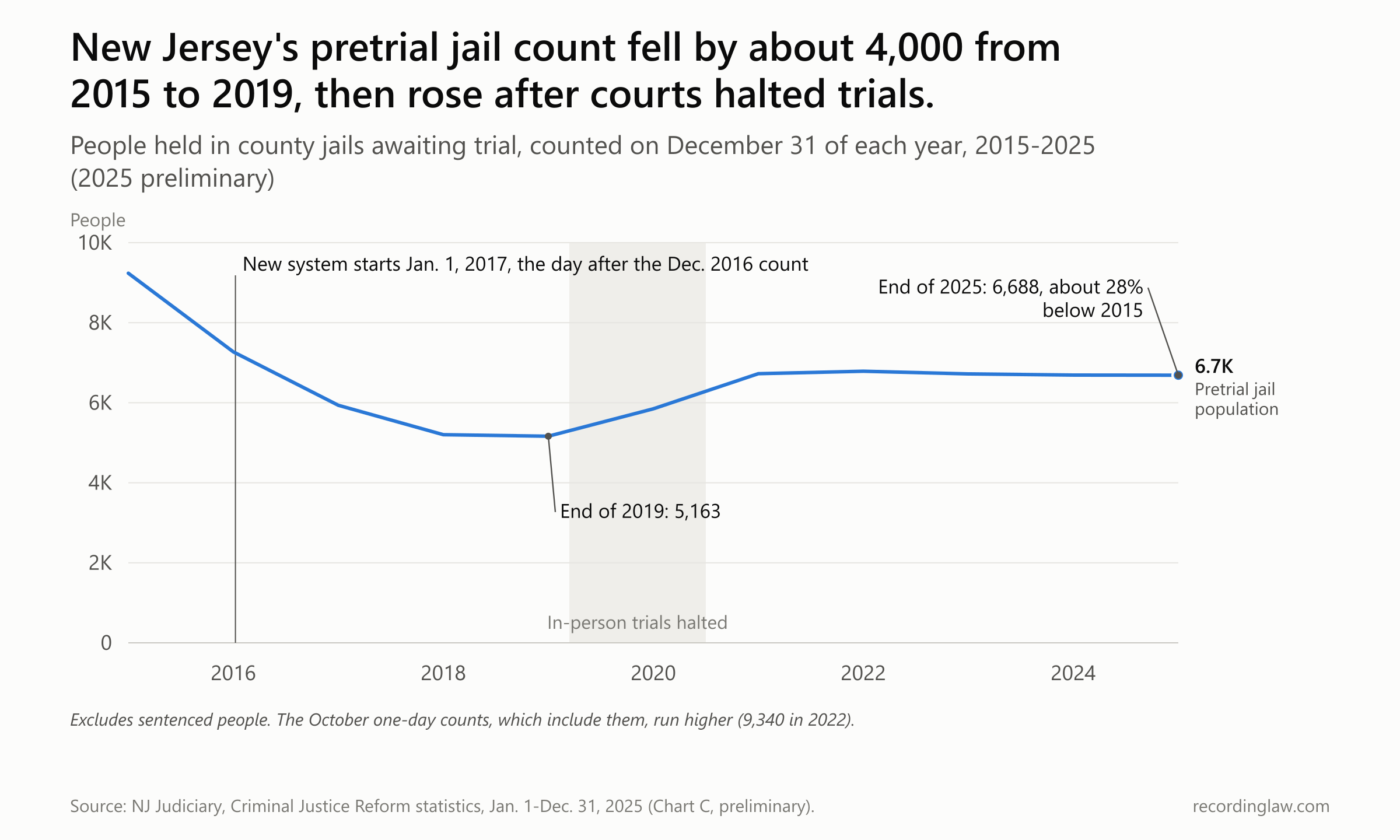
Source: New Jersey Judiciary, Criminal Justice Reform Statistics, Jan. 1-Dec. 31, 2025 (Chart C, preliminary). Nonsentenced people in county jails, counted on December 31 of each year shown; the reform started the day after the 2016 count.
| Count date (December 31 of) | Pretrial jail population |
|---|---|
| 2015 | 9,235 |
| 2016 | 7,271 |
| 2017 | 5,937 |
| 2018 | 5,201 |
| 2019 | 5,163 |
| 2020 | 5,849 |
| 2021 | 6,726 |
| 2022 | 6,788 |
| 2023 | 6,721 |
| 2024 | 6,690 |
| 2025 (preliminary) | 6,688 |
Judge Deborah Katz, the Camden County assignment judge, put the change in one line. "The sea change is we've gone from a bail-setting culture, where we would set bail for a crime," she said, "to a release-setting culture, based on your score, or the assessment whether you pose a risk." The score came from the risk assessment, which was created by the Laura and John Arnold Foundation, a philanthropy.
By the end of 2019 the count was about 5,200, more than 4,000 below 2015. Then it rose by about 1,600 by 2022 and has held near 6,700 since 2021. At the end of 2025 it was about 28 percent below 2015.
The people held on small bail were the first to go. In the courts' October one-day counts, the share of the jail held on bail of $2,500 or less dropped from 12 percent in the 2012 study to under 5 percent in 2018 and under 3 percent in 2019. Since 2020 it has never been more than 1.2 percent.
| Year | Share of jail held on bail of $2,500 or less | People |
|---|---|---|
| 2012 | 12.0% | 1,547 |
| 2018 | 4.6% | 390 |
| 2019 | 2.4% | 187 |
| 2020 | 0.2% | 14 |
| 2021 | 0.4% | 36 |
| 2022 | 0.5% | 49 |
| 2023 | 1.2% | 94 |
| 2024 | 0.6% | 49 |
Source: New Jersey Judiciary, Criminal Justice Reform Report 2022-2024 (Fig. 11). 2012 figure from a study cited by the Judiciary; later years are first-Wednesday-of-October counts.
That was the half of Christie's promise about non-violent defendants. The other half was about who stayed in, and the jail's makeup shifted toward serious charges. In 2018, 75 percent of the people in the one-day count faced at least one serious charge, meaning a first- or second-degree crime or a violent offense. By 2022 it was 82 percent, and from 2022 to 2024 more than half faced a violent charge.
Then the courts closed. In-person criminal trials stopped for most of 2020, and the Judiciary's own report on Criminal Justice Reform, which it abbreviates CJR, describes what followed. "While the jail population declined considerably in the first years of CJR, that trend has reversed since the onset of the Covid-19 pandemic, peaking with a jail population of 9,340 in 2022," it says. "The shift resulted from the inability to conduct in-person trials, which affected the overall resolution of cases and the corresponding amount of time spent in jail pretrial." That 9,340 is an October count that includes sentenced inmates; the December pretrial count in the chart peaked at 6,788.
A jail count shows who stayed in. Whether the people let out came back to court and stayed out of trouble needed a different measure, and the trial halt was about to stretch it.
What happened to the people New Jersey let out?
To judge the people it released, New Jersey's courts follow each one from release until the case ends or until Oct. 31 of the following year, whichever comes first, up to about 22 months. The main measure of failure is a new charge for an indictable offense, a crime serious enough to be prosecuted by indictment, during that time.
For the first three years, the share stayed between 13.7 and 13.8 percent. Under cash bail in 2014 it had been 12.7 percent, by the Judiciary's count, though the Judiciary warns that its 2014 data were hard to compile.
Did more released defendants pick up new charges once the trial halt stretched their cases out?
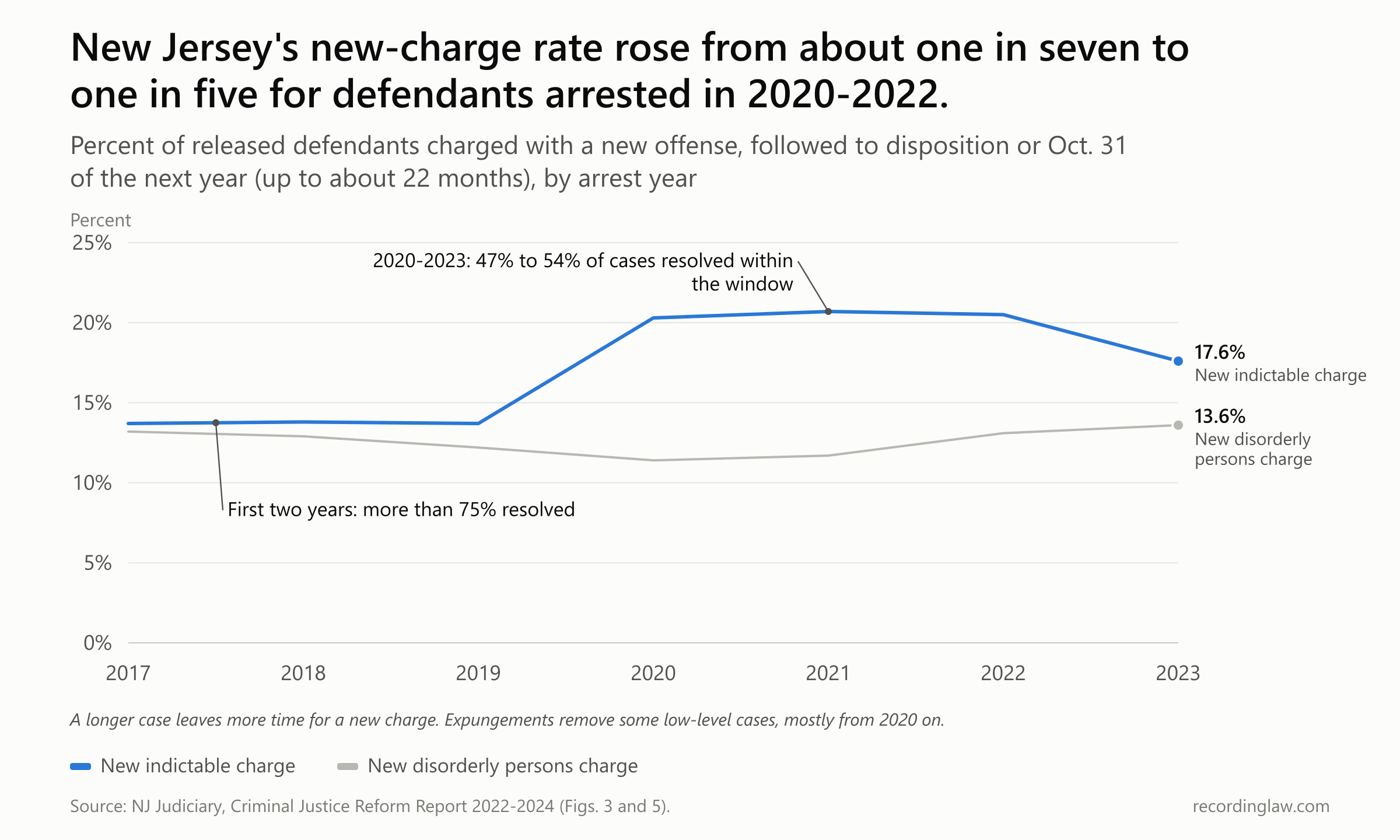
Source: New Jersey Judiciary, Criminal Justice Reform Report 2022-2024 (Figs. 3 and 5). Year of arrest; followed to disposition or Oct. 31 of the next year.
| Arrest year | New indictable charge | New disorderly persons charge |
|---|---|---|
| 2017 | 13.7% | 13.2% |
| 2018 | 13.8% | 12.9% |
| 2019 | 13.7% | 12.2% |
| 2020 | 20.3% | 11.4% |
| 2021 | 20.7% | 11.7% |
| 2022 | 20.5% | 13.1% |
| 2023 | 17.6% | 13.6% |
For defendants arrested in 2020 through 2022, the share charged with a new indictable offense was about one in five. It fell to 17.6 percent for 2023 arrests. The rate for lower-level disorderly persons charges stayed between 11 and 14 percent throughout.
The Judiciary's report links the jump to the court calendar. In the first two years of the reform, more than 75 percent of cases were resolved within the tracking window; from 2020 to 2023, between 46.9 and 53.6 percent were. "This led to longer pretrial periods and contributed to a higher percentage of defendants who were charged with an indictable crime while on pretrial release," the report says. A longer case gives a defendant more time in which a new charge can land.
New charges for the most serious offenses stayed rare. The share of released defendants charged with a crime under the No Early Release Act, which covers the gravest first- and second-degree offenses, was 1.6 percent for 2017 arrests and between 0.4 and 1.1 percent in every year since.
The other half of failure is missing a court date, which courts call a failure to appear. New Jersey tracks the reverse, a court appearance rate for released defendants. It was 92.7 percent in 2014 under cash bail, according to the Judiciary's 2018 report, and 89.4 percent in the reform's first year. It stayed around 90 percent after that, with one outlier: in 2020 it passed 97 percent, and the Judiciary gives remote hearings by phone or video as one partial explanation, since defendants no longer had to travel to a courthouse.
| Year | Court appearance rate |
|---|---|
| 2017 | 89.4% |
| 2018 | 89.9% |
| 2019 | 90.9% |
| 2020 | 97.1% |
| 2021 | 93.9% |
| 2022 | 91.7% |
| 2023 | 90.3% |
Source: New Jersey Judiciary, Criminal Justice Reform Report 2022-2024 (Fig. 6).
New York set out to solve the same problem with a different tool, and it counted failure a different way.
New York takes bail off the table for most charges
On March 31, 2019, Gov. Andrew Cuomo, Senate Majority Leader Andrea Stewart-Cousins and Assembly Speaker Carl Heastie announced a budget agreement that took a different route from New Jersey's. "As part of a groundbreaking plan to modernize New York's bail system, cash bail will be eliminated for misdemeanors and non-violent felonies," their joint announcement said.
The announcement put a number on the goal. "Together, these reforms will ensure approximately 90 percent of people charged, but not yet convicted of a crime, are not sitting in jail awaiting trial solely because they do not have the economic resources to meet bail."
Six weeks before the law took effect, the state's district attorneys, police chiefs and sheriffs asked for a delay. Their joint statement on Nov. 20, 2019, said the bill "fails to provide any mechanism for judges to consider a defendant's danger to the community" and that "Zero dollars were provided by the State for pretrial services to help ensure attendance at trial."
Upstate, the warning was about court dates. "The state is forcing us to release criminals onto our streets without any measures of ensuring that they will return to face their trial and face justice," Chautauqua County Executive George Borrello, a Republican, said that November.
The law took effect on Jan. 1, 2020. How did judges' first decisions at arraignment, a defendant's first appearance before a judge after arrest, change?
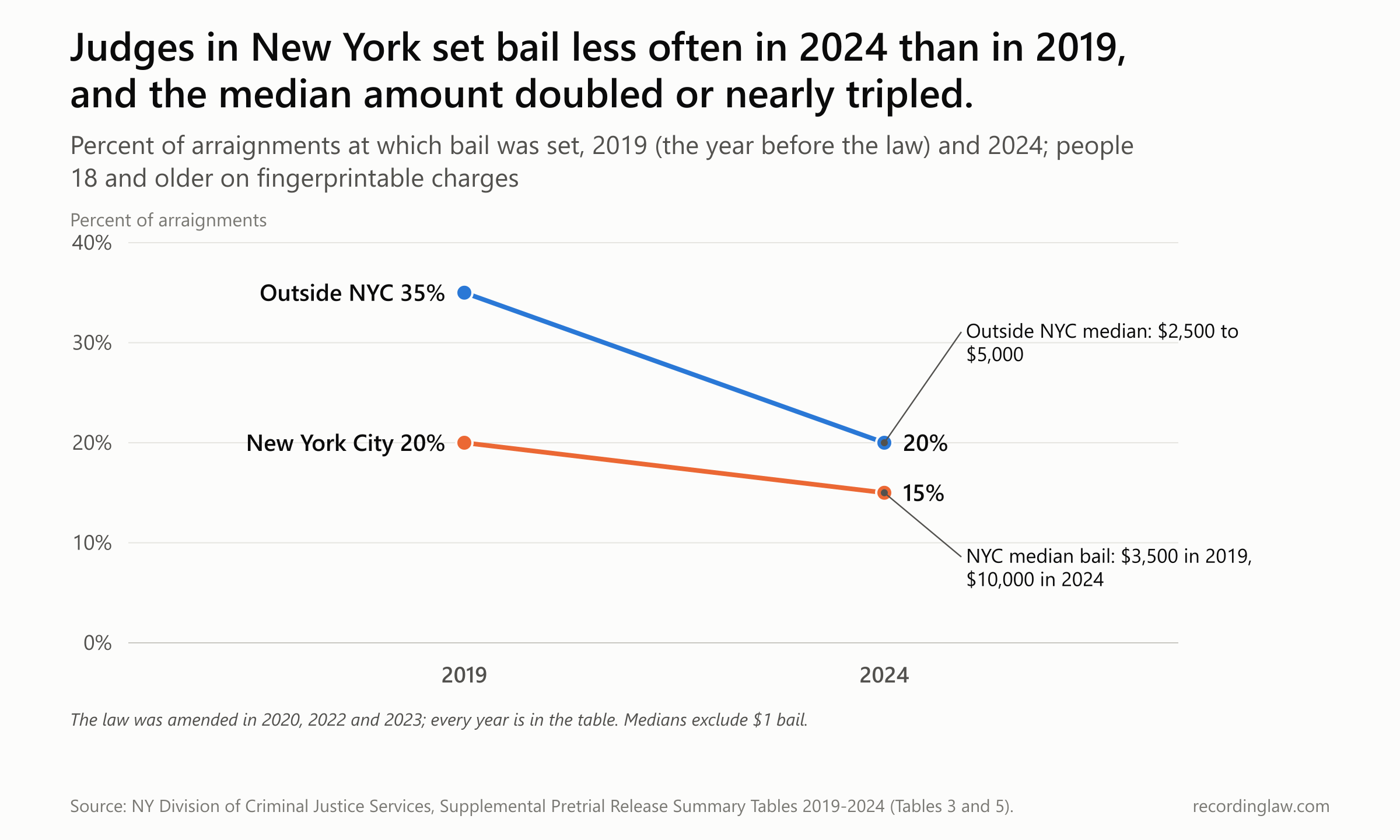
Source: New York State Division of Criminal Justice Services, Supplemental Pretrial Release Summary Tables 2019-2024 (Tables 3 and 5; data as of Aug. 15, 2025). Arraignments of people 18 and older on fingerprintable charges; medians exclude $1 bail.
| Arraignment year | NYC: released on recognizance | NYC: non-monetary conditions | NYC: bail set | Outside NYC: released on recognizance | Outside NYC: non-monetary conditions | Outside NYC: bail set |
|---|---|---|---|---|---|---|
| 2019 | 75% | 4% | 20% | 52% | 7% | 35% |
| 2020 | 72% | 11% | 16% | 65% | 12% | 17% |
| 2021 | 67% | 16% | 16% | 61% | 14% | 19% |
| 2022 | 63% | 20% | 15% | 58% | 16% | 18% |
| 2023 | 62% | 21% | 15% | 57% | 16% | 20% |
| 2024 | 62% | 22% | 15% | 57% | 16% | 20% |
Outside New York City, bail was set at about one in three arraignments in 2019 and about one in five afterward. In the city the drop was smaller, from 20 to 15 percent, and the main change was in how people were released. Release on non-monetary conditions, such as supervised release, grew from 4 to 22 percent of arraignments, while release on a defendant's own recognizance, with no conditions, fell from 75 to 62 percent.
When judges did set bail, they set more of it. The median bail in New York City nearly tripled, from $3,500 to $10,000, and doubled outside the city, from $2,500 to $5,000. In 2019, more than a third of the city's bail-set cases carried bail of $2,500 or less. Since 2021 it has been under one in ten.
| Arraignment year | NYC median bail | Outside NYC median bail | NYC bail-set cases with bail of $2,500 or less |
|---|---|---|---|
| 2019 | $3,500 | $2,500 | 37.5% |
| 2020 | $10,000 | $5,000 | 12.1% |
| 2021 | $10,000 | $5,000 | 9.5% |
| 2022 | $10,000 | $5,000 | 9.8% |
| 2023 | $10,000 | $5,000 | 9.3% |
| 2024 | $10,000 | $5,000 | 9.6% |
The state's tables cannot test the 90 percent promise directly, because they do not record why anyone stayed in jail. The closest measure is the share of cases in which the person was not released, because bail went unpaid or the judge remanded the person to jail. In New York City it was 14 percent in 2019 and 13 to 14 percent every year since. Outside the city it fell from 29 percent in 2019 to 19 percent in 2020, then rose to 24 percent by 2023 and 2024.
By the time those tables existed, the law had already been rewritten. The first rewrite came about three months in.
Three rewrites in four years
City & State later summed up the first months of 2020: "When New York City's crime rate appeared to be rising, the police department and Mayor Bill de Blasio both blamed the state bail reform." Cuomo and Stewart-Cousins soon said the law needed changes. Heastie remained opposed.
The changes came that April and passed the Assembly with one vote to spare. They added 15 new bail-eligible categories, including felonies committed while on probation, and took effect on July 2, 2020. They also required the state to release pretrial data every six months.
The New York Police Department published its own count that July. Of 9,227 people arrested for felonies that were no longer bail-eligible, "19.5% were re-arrested at least once," the department wrote, and it said rearrests for the most serious offenses had risen from 2019. It added: "This is not a comprehensive analysis of all the factors contributing to the increase in violence that we are now experiencing."
In January 2022, the argument turned on a definition. Less than two weeks after posting new figures, the state revised its count of cases in which people were rearrested while earlier charges were pending, from 42,000 to 26,000, THE CITY reported. The 16,000 rearrests it dropped had happened within the first 18 months of the law, but after the defendants' earlier cases had ended. "The previously posted data was accurate but over-inclusive, including rearrests that occurred after a case was concluded instead of only rearrests that occurred while a case was pending," said Janine Kava, a spokesperson for the Division of Criminal Justice Services.
Gov. Kathy Hochul's April 2022 budget made the second set of changes: bail for some gun charges, new factors for judges to weigh in bail-eligible cases, and $90 million for discovery reform and pretrial services. They took effect on May 9, 2022. "New York State's Legislature and governor have clearly acknowledged that changes need to be made to address public safety risks in our communities and to address the uptick in violent crime all over our state," said Tony Jordan, the Washington County district attorney and president of the state district attorneys association.
A coalition of advocacy groups and public defenders, including the Legal Aid Society, VOCAL-NY and the Bronx Defenders, answered: "The facts are clear: bail reform has not caused the increase in gun violence in New York."
The third round followed Hochul's closer-than-expected 2022 election win. On May 3, 2023, Hochul signed the changes in Manhattan with the mayor and the city's district attorneys beside her. They removed the requirement that judges choose the "least restrictive" conditions, in all cases, and took effect on June 3, 2023.
"I support its core premise," Hochul said of the original law that day. "I believe that judges should have the authority to set bail and detain dangerous defendants, full stop."
In the April budget fight, Assembly member Latrice Walker, a Brooklyn Democrat, had accused Hochul of the "wholesale dismantling of bail reform." When the deal was done in early May, Heastie asked for something else. "Part of this is having data collected to keep track of these changes so we don't have to keep making these decisions every year, blaming bail for everything," he said.
So what does the state's own count show now?
Six months after arraignment
The first rewrite had required the state to release pretrial data every six months. Its supplemental file, the only one with a year from before the law, covers people arraigned from 2019 through 2024, with data as of Aug. 15, 2025.
In that file, a released defendant counts as rearrested if the person is arrested on a fingerprintable charge, meaning a misdemeanor or felony that requires fingerprints to be taken, between arraignment and six months later, or before the case ends if it ends sooner. A failure to appear means missing at least one court date before the case ends or before Aug. 15, 2025.
Did released defendants miss court more often? In New York City, the share who missed court dropped in 2020 and 2021 and returned to about its 2019 level, 14 to 15 percent. Outside the city, where Borrello had warned about court dates, it rose from 17 percent to 19 or 20 percent and stayed there.
| Arraignment year | NYC: failed to appear | Outside NYC: failed to appear |
|---|---|---|
| 2019 | 15% | 17% |
| 2020 | 8% | 19% |
| 2021 | 10% | 19% |
| 2022 | 15% | 20% |
| 2023 | 15% | 20% |
| 2024 | 14% | 19% |
Source: New York State Division of Criminal Justice Services, Supplemental Pretrial Release Summary Tables 2019-2024 (Table 11).
Were released defendants rearrested more often? On this measure, yes, in both places. In New York City rearrest went from 19 percent for people arraigned in 2019 to 25 percent for those arraigned in 2024, about one in four. Outside the city it went from 16 to 22 percent. Rearrest for a violent felony rose from 3 to 4 percent in the city and from 1 to 2 percent outside it.
| Arraignment year | NYC: any rearrest | NYC: violent felony rearrest | Outside NYC: any rearrest | Outside NYC: violent felony rearrest |
|---|---|---|---|---|
| 2019 | 19% | 3% | 16% | 1% |
| 2020 | 22% | 5% | 23% | 3% |
| 2021 | 21% | 5% | 21% | 3% |
| 2022 | 24% | 5% | 21% | 3% |
| 2023 | 24% | 5% | 22% | 3% |
| 2024 | 25% | 4% | 22% | 2% |
Source: New York State Division of Criminal Justice Services, Supplemental Pretrial Release Summary Tables 2019-2024 (Table 12).
But the people being released had changed. Inside the city, were the same kinds of people being rearrested more often, or were different people being released?
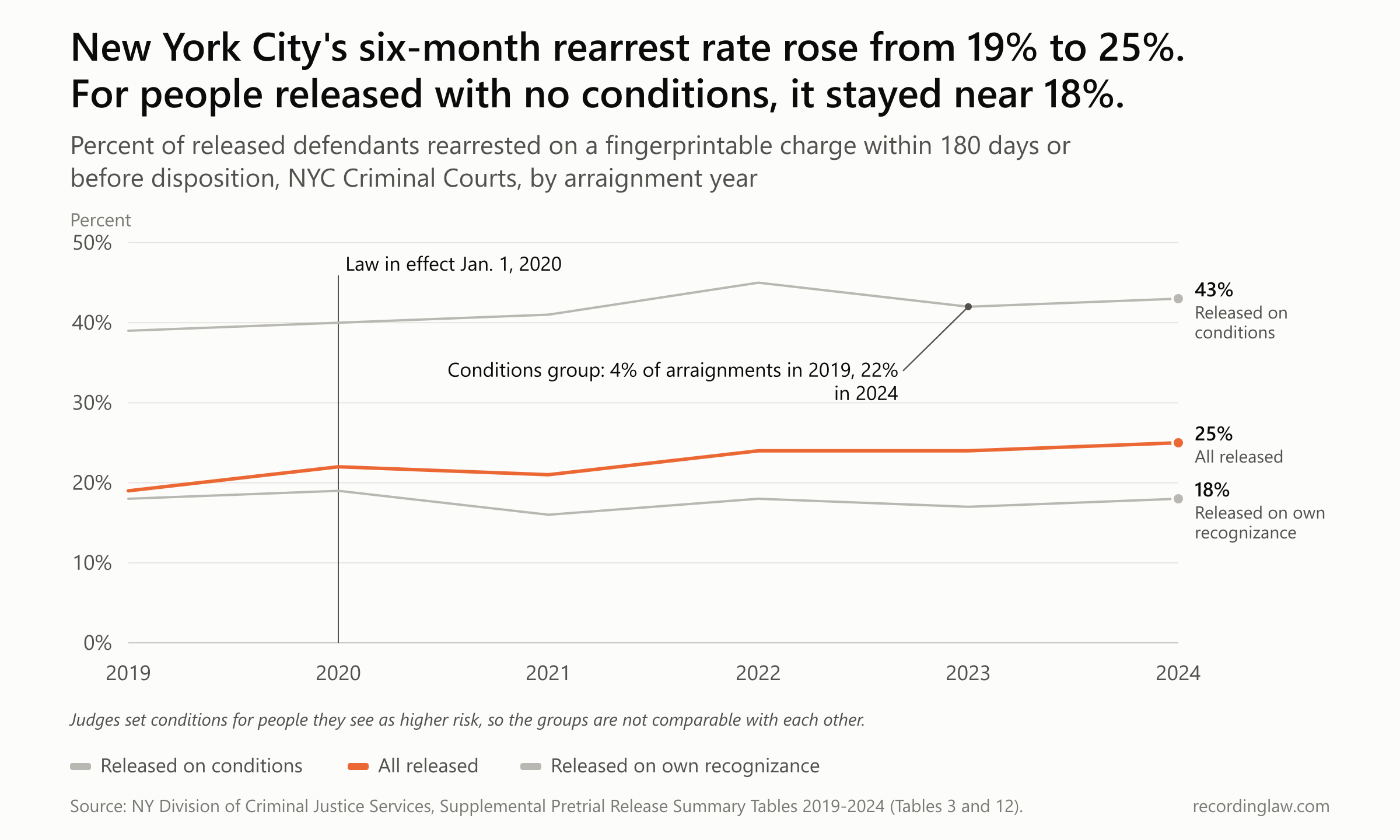
Source: New York State Division of Criminal Justice Services, Supplemental Pretrial Release Summary Tables 2019-2024 (Tables 3 and 12).
| Arraignment year | NYC: all released | Released on own recognizance | Released on non-monetary conditions |
|---|---|---|---|
| 2019 | 19% | 18% | 39% |
| 2020 | 22% | 19% | 40% |
| 2021 | 21% | 16% | 41% |
| 2022 | 24% | 18% | 45% |
| 2023 | 24% | 17% | 42% |
| 2024 | 25% | 18% | 43% |
People released on their own recognizance were rearrested at 18 percent in 2019 and 18 percent in 2024. Judges give non-monetary conditions to people they see as higher risk, and that group was rearrested at 39 percent in 2019 and 43 percent in 2024, more than twice as often.
The second group is also the one that grew, from 4 percent of the city's arraignments to 22 percent. So by 2024 far more of the people in the citywide rate came from the group with the higher rearrest rate than in 2019. These are descriptive groups chosen by judges, so they cannot be compared with each other as if they were alike.
None of these tables can say what would have happened to the same people under the old law. That is the question the fight over New York's numbers kept coming back to.
Who would have been rearrested anyway?
Every reading of New York's record turns on whom the released people are compared with. Compare everyone released in 2019 with everyone released later, and rearrest rose. Compare similar people, or similar offenses, before and after the law, and the answer changes. The window (one month, six months, two years, 50 months) and the region (the city or the suburbs and upstate) move the numbers too.
On Sept. 22, 2022, both sides read the same new state data on the same day. Charles Fain Lehman of the Manhattan Institute, a free-market think tank, wrote in City Journal that "the basic takeaway is that rearrest rose after bail reform," by 3 to 5 percentage points on a constant window, driven by places outside New York City. He also wrote that "the 180-day comparison suggests almost no effect in New York City." The Legal Aid Society, a public defender organization, said city rearrests were roughly 19 percent before the law "and remained statistically the same at 20 percent in 2021."
The comparison-group studies came from one place. In March 2023, René Ropac and Michael Rempel, researchers at John Jay College, weighted people held on bail in New York City in the first half of 2019 against similar people released under the law in the first half of 2020, and compared what happened to each group over two years. Their colleague Stephen Koppel co-wrote later studies at the college's Data Collaborative for Justice, which published a series of studies from 2023 to 2025 comparing people released under the law with similar people from before it. All were funded by Arnold Ventures, whose founders' foundation, the Laura and John Arnold Foundation, created New Jersey's risk assessment.
"We found significant reductions in any re-arrest (44% vs. 50%) and felony re-arrest (24% vs. 27%) over two years. We did not find a difference in either direction in two-year violent felony or firearms re-arrest," Ropac and Rempel wrote. The same study found that bail reform "tended to reduce recidivism for people facing less serious charges and with limited or no recent criminal history, while tending to increase recidivism for people with substantial recent criminal histories."
A second city study compared offenses that lost bail eligibility with offenses that kept it, before and after the law. It found that "Eliminating the option to set bail under the reform was not associated with a change in overall re-arrest, felony re-arrest, or violent felony re-arrest rates within either two years or during the pretrial period (capped at 6 months of tracking)." For people who already had a separate pending case, it found a statistically significant increase in violent felony rearrest during the pretrial period.
The suburbs and upstate came out differently. "We found no statistically significant changes in rates of any re-arrest and felony re-arrest over two years, and only slight increases in violent felony (9.5% vs. 8.1%) and firearm re-arrest (2.7% vs. 2.0%)," Ropac's January 2024 study reported.
A long-term statewide evaluation by the same group followed people for 50 months. In New York City, "people released under reform had significantly lower rates of overall re-arrest (57% vs. 66%), felony re-arrest (33% vs. 40%), and violent felony (VFO) re-arrest (20% vs. 25%)," it found, while in the suburbs and upstate the law "had no effect in any direction."
A November 2025 study by Koppel and Ropac used a different method, comparing counties and months, for the suburbs and upstate. It found that "During the immediate pretrial period, eliminating the option to set bail for most misdemeanors and nonviolent felonies had no overall impact on recidivism," along with statistically significant increases in rearrest among people it classified as high risk, meaning people who already had a pending case. Followed for two years, the reform trended toward lower rearrest on every measure, including a statistically significant drop in felony rearrest for the full population.
The city comptroller's office, using a one-month window, found pretrial rearrest nearly unchanged.
Put on one scale, how far apart are these answers?
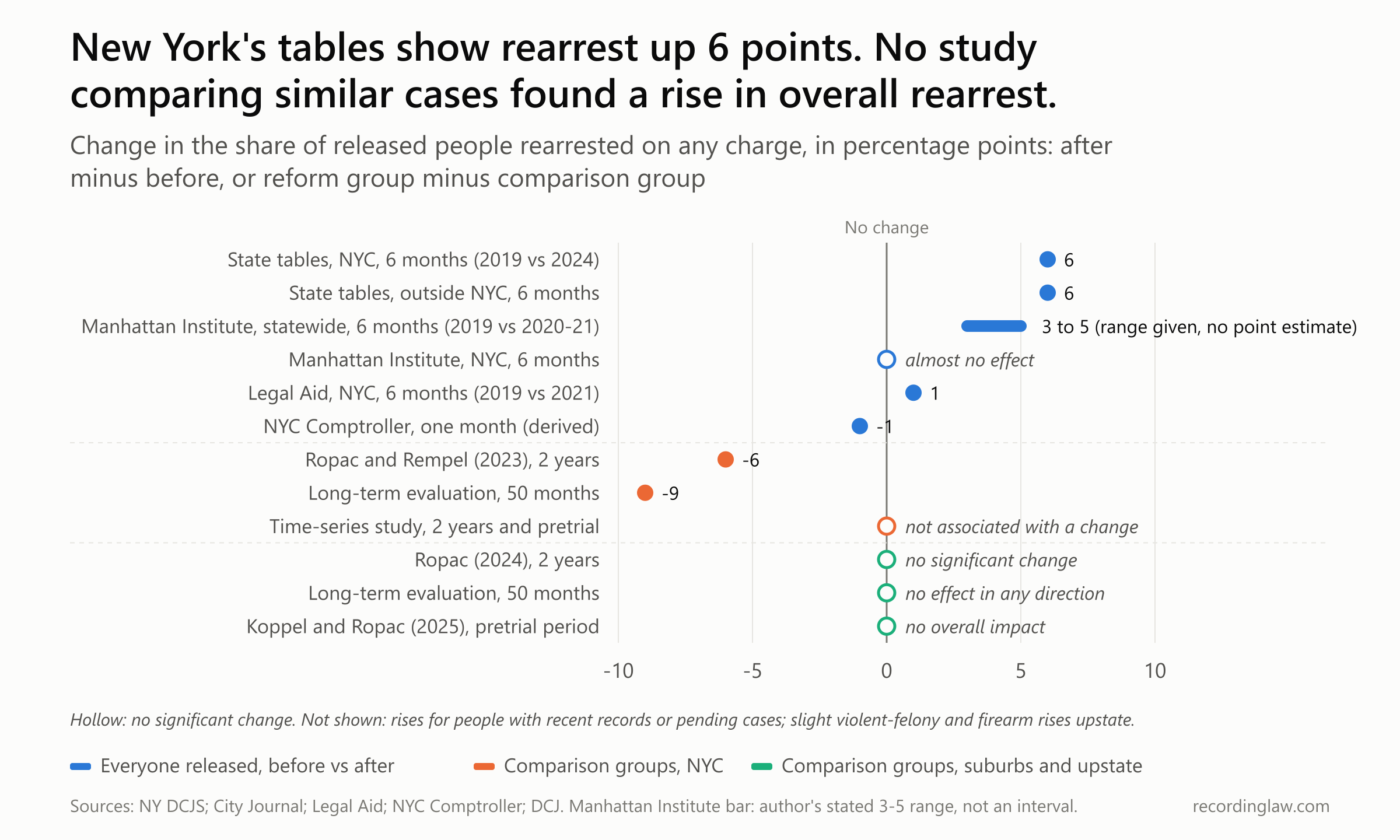
Sources: New York State Division of Criminal Justice Services; City Journal; Legal Aid Society; NYC Comptroller; Data Collaborative for Justice. All rows are overall rearrest on any charge. Derived values are explained in How we measured.
| Source | Who is compared | Window | Change in overall rearrest |
|---|---|---|---|
| State tables, NYC | Everyone released, 2019 vs 2024 | Six months | 19% to 25% (+6 points) |
| State tables, outside NYC | Everyone released, 2019 vs 2024 | Six months | 16% to 22% (+6 points) |
| Manhattan Institute (City Journal) | Everyone released, statewide, 2019 vs 2020-21 | Six months | +3 to +5 points (stated range) |
| Manhattan Institute (City Journal), NYC | Everyone released, NYC, 2019 vs 2020-21 | Six months | "Almost no effect" |
| Legal Aid Society | Everyone released, NYC, 2019 vs 2021 | Six months | 19% to 20% ("statistically the same") |
| NYC Comptroller | People awaiting trial, NYC | One month | 5% to 4% rearrested (derived) |
| Ropac and Rempel (2023), NYC | Similar people, weighted | Two years | 44% vs 50% |
| Long-term evaluation, NYC | Similar people | 50 months | 57% vs 66% |
| Time-series study, NYC | Offenses that lost bail vs kept it | Two years and pretrial | Not associated with a change |
| Ropac (2024), suburbs and upstate | Similar people, weighted | Two years | No significant change |
| Long-term evaluation, suburbs and upstate | Similar people | 50 months | No effect in any direction |
| Koppel and Ropac (2025), suburbs and upstate | Counties and months | Pretrial period | No overall impact |
The chart shows overall rearrest only. It does not show the increases the same studies found among people with substantial recent criminal histories or a pending case, or the slight rise in violent felony and firearm rearrest in the suburbs and upstate. The long-term evaluation's authors put both findings in one passage: "By these measures, the current law can be considered a success. However, the recidivism increases among a relatively small subgroup of individuals with recent criminal histories should not be overlooked."
The tables and the studies are not measuring the same thing. In the city, the tables say more of the people released in 2024 were rearrested than in 2019, and the release-type figures show more of them came from the group judges see as higher risk. The comparison-group studies ask what happened to people like them. In the city most found less rearrest, not more; outside it, the studies found no significant overall change while the tables rose 6 points.
New York produced at least four kinds of rearrest number: six months, two years, 50 months and one month. Illinois ended cash bail for everyone, and it has yet to produce one statewide.
Illinois ends cash bail outright
On Feb. 22, 2021, Gov. JB Pritzker signed House Bill 3653, the SAFE-T Act, at Chicago State University, with members of the Legislative Black Caucus who wrote it. The act was a broad criminal justice bill, and its bail provisions are called the Pretrial Fairness Act, or PFA.
"This legislation marks a substantial step toward dismantling the systemic racism that plagues our communities, our state and our nation and brings us closer to true safety, true fairness and true justice," he said.
The bill followed nine public hearings and 30 hours of testimony, the governor's office said. The final version was introduced after midnight on the last day of the lame-duck session and "received just enough votes to pass both chambers with less-than-an-hour of floor-debate," Capitol News Illinois reported.
Chief Judge Timothy Evans of the Circuit Court of Cook County spoke for it, and Attorney General Kwame Raoul put the test in a sentence. "Our system should not be formulated in a way that holds people simply because they can't afford the bond set," he said. "It should be based on risks to the public safety."
Opponents answered. "It's going to be a catch and release system; when police do catch someone, it's going to be impossible to detain the most violent criminals," said State Sen. John Curran, a Downers Grove Republican. The Illinois Law Enforcement Coalition, a group of police unions and organizations, said the law would put the public and law enforcement at risk. Ed Wojcicki of the Illinois Association of Chiefs of Police also spoke against the bill, which changed policing rules too.
Illinois was going alone. NPR reported that day that bail changes in New York and Alaska had been rolled back or amended and that California voters had kept cash bail. "Illinois is the only state now to strike it completely." One voice from New Jersey's fight was mostly absent: Illinois had abolished commercial bail bondsmen in 1963.
Prosecutors and sheriffs in 64 counties sued, and just before the law was to take effect on Jan. 1, 2023, Kankakee County Circuit Judge Thomas Cunnington ruled for them, and the Illinois Supreme Court put the law on hold while it heard the appeal. Legislators who wanted so sweeping a change, he wrote, "should have submitted the question on the ballot to the electorate at a general election." New Jersey's voters had been asked. Illinois's had not.
On July 18, 2023, the Illinois Supreme Court upheld the law 5-2, with two Republican justices dissenting, and set Sept. 18 as the start date. The dissent called the end of cash bail a "direct violation of the plain language of our constitution's bill of rights and, more specifically, the vested rights of crime victims." Kankakee County State's Attorney Jim Rowe, who brought the suit, called the act "terribly detrimental to public safety," and the Illinois Fraternal Order of Police also criticized the ruling.
On the morning of Sept. 18, 2023, county and state officials and advocacy groups gathered on the steps of the Leighton Criminal Courthouse in Chicago to mark the first day. "What is so fearful of having a system that is fair and just? What is so disarming about making sure people are not detained because they are poor," said Cook County State's Attorney Kim Foxx.
Will County State's Attorney James Glasgow said the same day: "We feel very strongly that it is a serious public safety issue." He added, "At the same time, we want to join in the fight toward reforming bail."
From that morning, Illinois judges could no longer set money bail. What replaced it could be watched in the courtroom.
What Illinois could count, and what it could not
Before the law, the bond hearings Loyola University Chicago's researchers observed lasted a median of 4 to 6 minutes. Under it, hearings where the state sought detention ran a median of 10 to 30 minutes. Detention had become a hearing.
Loyola's Center for Criminal Justice is Illinois's evaluator, funded by the National Institute of Justice, the MacArthur Foundation and Arnold Ventures. Its first-year report, in September 2024, measured how many people the law kept out of jail. In 22 counties it studied closely, about 51 percent of defendants had been detained at their first hearing through bail before the law, and 9 percent after it.
| Loyola first-year measure | Before the law | After the law |
|---|---|---|
| Detained at first hearing (22 counties) | About 51% | 9% |
| Held at least three days (22 counties) | About 33% | 9% |
| Detention rate for offenses judges may still detain for (22 counties) | 77% | 33% |
| Failure-to-appear warrant within six months (22 counties) | 13.6% | 12.5% |
| Any missed hearing, warrant or not (22 counties) | 25.1% | 22.8% |
| Failure-to-appear warrant, felonies judges may not detain for | 13.1% | 16.1% |
Source: Loyola University Chicago Center for Criminal Justice, The First Year of the Pretrial Fairness Act (September 2024). Across 89 counties, prosecutors petitioned to detain in about 39 percent of close to 25,000 eligible cases, and about 24 percent of those cases ended in detention.
Monthly average jail populations fell 14 percent in Cook County and other urban counties in the first year, and 25 percent in rural counties. Loyola's three-year summary, published Oct. 14, 2026, found the jail drop smaller over time. The statewide pretrial jail population fell 13 percent shortly after the law took effect and was still 10 percent lower at 18 months. By December 2025 it averaged about 13,500, 3 percent below December 2022.
At the same time, more people were under some form of pretrial control. The number on pretrial supervision rose by 9,700, or 48 percent, from December 2022 to December 2025, while the jail population fell by 439. In Cook County, the state's largest, the jail population at the end of 2025 was higher than before the law, which Loyola ties in part to more detention petitions after a new State's Attorney took office.
On court dates, Loyola's measure was an arrest warrant for failing to appear within six months. "First, there is no one right way to measure hearing attendance," its authors wrote. In the first year that rate dipped slightly in the 22 counties. The three-year summary found that the likelihood of a failure-to-appear warrant "increased slightly" in the rural counties and the urban county it examined, while over 87 percent of cases had no such warrant within six months, before or after the law.
On crime, it compared trends before and after the law at the 426 of 1,167 police agencies with complete data. It reported that "we found no statistically significant changes in the number of reported crimes associated with the implementation of the PFA," adding: "Does that mean there were no changes at all? Certainly not."
The measure New Jersey and New York lead with, whether released people are charged with new crimes, does not exist statewide for Illinois. The law required the state to collect it. "Unfortunately, no new funding was provided for these new statewide data collections, and for the most part they have not occurred," Loyola wrote. It was the third time the money question had come up: Rice had warned New Jersey of a cost the state did not have, and New York's prosecutors had said zero dollars were provided for pretrial services.
Cook County Board President Toni Preckwinkle said on the law's second anniversary that research had shown no significant change in failures to appear or in new charges while awaiting trial. The evaluators' own heading on the three-year report reads: "The PFA reduced pretrial detention, but not as much as critics feared, or advocates hoped." They also found that in most counties, "when the state seeks detention, it usually gets it," and that "there is no longer such a thing as cash bail in Illinois."
Where the argument stands
New Jersey, nearly a decade into its system, has the longest record of the three, and in the 2025 race to succeed Gov. Phil Murphy, both front-runners wanted changes. Democrat Mikie Sherrill said she supports the system conceptually but has concerns about defendants missing court and those accused of violent crimes not being held. Republican Jack Ciattarelli said, "Cashless bail has created a professional criminal who's learned how to game the system." The New Jersey Monitor noted that "Neither candidate offered data to back up their concerns or specific plans for change."
Sherrill won and is now governor. A Senate bill introduced on Jan. 13, 2026, S764, would create a presumption that people charged with violent crimes be detained before trial. The Legislature's site shows it referred to the Senate Judiciary Committee, with no later action as of November 2026.
The governor who signed the law has defended it against members of his own party. Christie said bail reform had been "mischaracterized by my party" and pointed to the federal courts. "This is not some unusual, lenient way of dealing with people who have been charged with crimes. In fact, it's been done in the federal system in every federal district, all 93 of them across the country, for a very long time," he said.
The next numbers will come on different clocks, and they will not measure the same thing.
| State | New criminal activity | Missing court | Window |
|---|---|---|---|
| New Jersey | New indictable charge | Court appearance rate | Release to disposition or Oct. 31 of the next year (about 22 months) |
| New York | Any fingerprintable rearrest | At least one missed court date | Six months or disposition (rearrest); disposition or Aug. 15, 2025 (missed court) |
| Illinois | No statewide measure | Failure-to-appear warrant, sampled counties (Loyola) | Six months or disposition |
In Illinois, Loyola says it will issue longer reports over the coming year on detention, jail populations, court attendance, crime and sentencing, which would put them out by about October 2027. "We have yet to complete a separate set of analyses that will help us determine whether pretrial defendants released to the community under the PFA are more or less likely to be charged with another crime while on release than those released on bail under the previous system," it wrote.
New Jersey can say that on Oct. 2, 2024, 49 people sat in its jails on bail of $2,500 or less. Illinois cannot yet say whether the people it stopped jailing were charged again more often.
How we measured
New Jersey: jail and outcome figures come from the New Jersey Judiciary's Criminal Justice Reform Report to the Governor and Legislature for 2022-2024 and its preliminary 2025 statistics. Two jail measures appear and are not joined: the December 31 pretrial count (nonsentenced people only, 2015-2025, preliminary for recent years) and the October one-day count (all custody statuses, which is why its 2022 peak of 9,340 is larger).
The 2012 figure of 1,547 people (12 percent) comes from a study the Judiciary cites; the denominator of that study was not opened. The phrase about one in eight in the opening rounds 12 percent. The 27.6 percent decline from December 2015 to December 2025 is the Judiciary's own figure (9,235 to 6,688). "More than 4,000" is 9,235 minus 5,163 (4,072); "about 1,600" is 6,788 minus 5,163 (1,625).
New-charge and appearance rates follow released defendants by year of arrest from release to disposition or Oct. 31 of the next year, so the pandemic trial halt lengthened the window for 2020-2022 arrests. "About one in seven" rounds 13.7 percent; "about one in five" rounds 20.3 to 20.7 percent. The 2014 baseline (12.7 percent new indictable charge, 92.7 percent appearance) comes from the Judiciary's 2018 annual report: "Notably, in 2014, 12.7 percent of defendants were charged with a new indictable crime while on pretrial release, a number that remained consistently low, 13.7 percent, in 2017." Because of problems compiling the 2014 data, it added, "small changes in outcome measures should be interpreted with caution and likely do not represent meaningful differences."
Court backlog: statewide criminal jury trials doubled from 115 in 2021 to 231 in 2022 and reached 325 in 2023, and judicial vacancies grew from 25 when the reform began to 66 by Jan. 1, 2023, figures from the Judiciary's report.
Complaint-warrants: a person charged in New Jersey gets either a complaint-summons, which releases the person at once with a court date, or a complaint-warrant, which holds the person in jail until a risk assessment and a first appearance before a judge. The warrant share rose from 29 percent in 2017 to 45 percent in 2022, then fell to 37 percent in 2023.
| Year | Share issued a complaint-warrant |
|---|---|
| 2017 | 29.0% |
| 2018 | 31.6% |
| 2019 | 32.2% |
| 2020 | 37.1% |
| 2021 | 42.4% |
| 2022 | 44.8% |
| 2023 | 37.0% |
Source: New Jersey Judiciary, Criminal Justice Reform Report 2022-2024 (Fig. 2). Excludes expunged complaints.
The Judiciary's preliminary 2025 tables count defendants a different way, so they do not extend that table. In them, 38,239 of 82,175 defendants, or 46.5 percent, were charged on a warrant. Prosecutors filed motions to detain in 42.2 percent of warrant cases, 16,133 in all, and judges granted 8,176 of them. In all, 9.9 percent of everyone charged was ordered detained.
Expungement: New Jersey's expungement laws erase some complaints from the data, mostly from 2020 on. "While it is not possible to determine the precise impact of expungements on the findings in this report, in general, those whose low-level complaints were expunged were at lower risk for rearrest," the Judiciary wrote.
Risk scores: higher risk scores went with higher rates of new charges. The Judiciary's validation tables for the new-criminal-activity score show 11.6, 13.0 and 10.9 percent charged with a new offense at score 1 in 2021, 2022 and 2023, and 58.2, 58.7 and 66.2 percent at score 6.
Those 2025 figures are preliminary, and the 2025 tables count Criminal Justice Reform eligible defendants, grouping warrants filed within three days of each other. The 2014 vote share is 891,373 divided by 891,373 plus 550,698, or 61.8 percent, from the official county results.
New York: figures come from the Division of Criminal Justice Services' Supplemental Pretrial Release Summary Tables 2019-2024 (data as of Aug. 15, 2025), covering arraignments of people 18 and older on fingerprintable misdemeanor and felony charges. 2019 is the only year before the law. The state's main pretrial release file covers Jan. 1, 2020, through Dec. 31, 2025, with no pre-law year, so it is not used here. Release on non-monetary conditions in 2020-2024 is grouped with release under supervision in 2019.
The share of New York City bail-set cases at $2,500 or less adds the three Table 5 bands ($500 or less, $501 to $1,000, $1,001 to $2,500) and divides by all bail-set cases: 8,272 of 22,035 in 2019 (37.5 percent) and 1,904 of 19,916 in 2024 (9.6 percent).
Rearrest is any fingerprintable misdemeanor or felony arrest within six months of arraignment or before disposition; failure to appear is at least one missed date before disposition or Aug. 15, 2025. Later arraignment years have more cases still open.
Rates by release type are descriptive: judges choose conditions for people they view as higher risk, so the groups are not comparable. The pandemic cut 2020 and 2021 arraignment volumes. Earlier releases of the same data (used by Legal Aid and City Journal in 2022) show slightly different values for 2021. The Daily News editorial board, which described itself as a critic of the law, wrote three days after those two readings that "Recidivism within 180 days of arrest here rose a bit in 2020 but then went right back down to 2019 levels in the first nine months of 2021." The state's updated file now shows 21 percent for the city in 2021.
The estimates chart puts every New York rearrest comparison the story cites on one scale, in percentage points, using overall rearrest on any charge. State tables: 25 minus 19 (NYC) and 22 minus 16 (outside NYC). Manhattan Institute: the author's stated range of 3 to 5 points, drawn as a bar with no point; it is a range, not a statistical interval. His New York City result ("almost no effect") is a hollow marker. Legal Aid: 20 minus 19. Legal Aid did not state a window; its figures match the state's six-month values. NYC Comptroller (derived): 100 minus 95 percent not rearrested in January 2019 is 5 percent rearrested in a month, and 100 minus 96 in December 2021 is 4 percent, a change of minus 1. Ropac and Rempel: 44 minus 50. Long-term evaluation, NYC: 57 minus 66. The five hollow markers are results reported without a point estimate: four studies that found no significant change, and the Manhattan Institute's "almost no effect" for the city. The NYPD's July 2020 count gave a 2020 rate (19.5 percent) with no 2019 rate for the same group, so it is not charted. None of the sources gives a 95 percent interval for these figures.
Illinois: no statewide series on failures to appear or new charges is public. Figures come from Loyola University Chicago's first-year report (22 counties for detention and failure-to-appear warrants, 89 counties for detention petitions, statewide jail data) and its three-year summary (statewide jail and supervision counts; failure-to-appear warrants in 21 rural counties and one urban county; an interrupted time series of reported crime at 426 of 1,167 agencies with complete incident-based data, 2022-2025).
Loyola's first-year crime comparison (reported crimes down 11 percent in six months of 2024 against 2023) was not a causal analysis, in Loyola's words.
Research: the Data Collaborative for Justice studies use weighting to compare similar defendants before and after the law, a controlled interrupted time series, a quasi-experimental 50-month follow-up and a difference-in-differences design; all were funded by Arnold Ventures, whose founders' foundation created the risk assessment New Jersey uses.
The Manhattan Institute and the Legal Aid Society analyses are descriptive readings of state data. The NYC Comptroller's figures are monthly shares, a different window from the state's six months. In March 2022, Comptroller Brad Lander's office, citing monthly figures from the city's Criminal Justice Agency, reported that 95 percent of the roughly 57,000 people awaiting trial in January 2019 were not rearrested that month, and 96 percent in January 2020 and December 2021. "The data indicate that pretrial rearrest rates remained nearly identical pre- and post-bail reform," his office wrote.
What the data cannot show: no state has a clean comparison group, and the pandemic arrived months after New York's law and three years into New Jersey's. Rearrest and failure-to-appear rates are not comparable across the three states because each defines them differently. The tables describe what happened to people released; they cannot say what would have happened to the same people under cash bail, which is what the controlled studies attempt.
What comes next: New Jersey's latest full report follows defendants arrested through 2023, and its 2025 tables are preliminary. New York's summary tables, the ones with a pre-law comparison year, end with cases arraigned in 2024; its main pretrial file runs through December 2025 but has no 2019 baseline. Loyola's longer Illinois reports, including the new-charge analysis, are due over the year after Oct. 14, 2026.
Frequently Asked Questions
How many people does New Jersey still hold on low bail?
Very few. Since Jan. 1, 2017, New Jersey judges have worked from a risk assessment, and prosecutors seek detention through hearings. In the courts' October one-day counts, people held on bail of $2,500 or less were never more than 1.2% of the jail from 2020 to 2024 (49 people in 2024), down from 12% (1,547 people) in a 2012 study.
What did New Jersey's bail reform cost?
The 2014 law raised court fees to pay for it, including $22 million a year for a risk assessment and release monitoring program, WHYY reported. State Sen. Ronald Rice said carrying it out was estimated to cost the state $100 million. The New Jersey Association of Counties put the cost to county taxpayers at $45 million, though the state Council on Local Mandates found it had not shown significant financial hardship.
Did bail reform change the racial makeup of New Jersey's jails?
The share moved by a few points. Black defendants were about 54 percent of the courts' October one-day jail count in 2012, 2018 and 2019, about 60 percent in 2020 and 2021, and 55.9 percent in October 2024. Black residents were 15.2 percent of New Jersey's population in the 2020 census.
Did crime go up after Illinois ended cash bail?
Loyola University Chicago's evaluators compared reported crime before and after Sept. 18, 2023, at 426 police agencies with complete data and found no statistically significant change associated with the law. Their analysis of whether released defendants are charged with new crimes more often than under cash bail is not finished.
How often are people released under New York's bail law rearrested?
In state data, 25% of people released at arraignment in New York City in 2024 were rearrested on a fingerprintable charge within six months or before their case ended, up from 19% in 2019. Outside the city the share went from 16% to 22%. Studies funded by Arnold Ventures that compared similar defendants found lower rearrest in the city and little or no overall change elsewhere, with increases among people with substantial recent criminal histories.
Why do bail reform rearrest numbers disagree?
Each state and study uses a different definition and window. New Jersey counts a new indictable charge over about 22 months, New York counts any fingerprintable rearrest within six months, and other analyses use one month, two years or 50 months. In January 2022, New York revised one count from 42,000 to 26,000 after excluding rearrests that happened after a case had ended.
How many times has New York changed its bail law?
Three times since it took effect on Jan. 1, 2020: amendments effective July 2, 2020, May 9, 2022, and June 3, 2023. They added bail-eligible categories, allowed bail for some gun charges, added factors for judges and removed the least restrictive conditions requirement. The April 2020 bill, A9506-B, passed the Assembly 76-66, one vote over the 75-vote majority needed, City & State reported, with 27 Democrats breaking with their conference, many of them over the bail rollback. The Associated Press reported in April 2023 that Hochul's latest push for bail changes came after her closer-than-expected election victory the previous November.
What does Executive Order 14342 say about cashless bail?
Signed Aug. 25, 2025, it directed the U.S. Attorney General to give the President, within 30 days, a list of states and localities that have 'substantially eliminated cash bail', and directed agencies to identify federal funds that could be suspended for them. ABC7 New York named New Jersey among the jurisdictions that had nearly eliminated or limited cash bail. As of November 2026, we could not find a published version of the list.
Updates
Restructured as a feature: one chart now compares every study of the effect, including those that found none; side details moved to How we measured. Every figure and quote was re-checked against its source.
Independently fact-checked against the cited primary sources
Independently fact-checked against the cited primary sources
Sources and References
- New Jersey Judiciary, Criminal Justice Reform Report to the Governor and Legislature, 2022-2024(njcourts.gov).gov
- New Jersey Judiciary, Criminal Justice Reform Statistics, Jan. 1-Dec. 31, 2025 (preliminary)(njcourts.gov).gov
- New Jersey Judiciary, 2018 Criminal Justice Reform Annual Report (copy hosted by Prison Policy Initiative)(static.prisonpolicy.org)
- New Jersey Division of Elections, 2014 official general election results, Public Question 1(nj.gov).gov
- WHYY, Christie signs NJ bail overhaul (Aug. 11, 2014)(whyy.org)
- WHYY, Voters answer yes to New Jersey ballot questions (Nov. 5, 2014)(whyy.org)
- CBS Philadelphia (KYW), NJ voters deciding on bail reform ballot question (Nov. 4, 2014)(cbsnews.com)
- The Daily Princetonian, Midterm elections accompanied by vote on bail requirement (Nov. 2, 2014)(dailyprincetonian.com)
- NPR via KUER, New Jersey banking on shift from bail money to risk assessment (Dec. 27, 2016)(kuer.org)
- Philadelphia Inquirer, N.J. rethinks bail (Jan. 1, 2017)(inquirer.com)
- Governor Cuomo and Legislative Leaders Announce Agreement On FY 2020 Budget (Office of the Governor, March 31, 2019; archived copy of the governor.ny.gov release)(web.archive.org)
- Brooklyn College journalism blog, Cuomo praises legislators for criminal justice reforms (April 2019)(journalism.blog.brooklyn.edu)
- Orleans Hub, joint statement of the District Attorneys Association, NYS Association of Chiefs of Police and NYS Sheriffs Association (Nov. 20, 2019)(orleanshub.com)
- The Post-Journal (Jamestown), A public safety issue (Nov. 2019)(post-journal.com)
- New York State Division of Criminal Justice Services, Supplemental Pretrial Release Summary Tables 2019-2024 (data as of Aug. 15, 2025)(criminaljustice.ny.gov).gov
- New York State Division of Criminal Justice Services, pretrial release data page(criminaljustice.ny.gov).gov
- City & State New York, How New York changed its bail law (April 2020)(cityandstateny.com)
- New York City Police Department, bail reform analysis (July 10, 2020)(nyc.gov).gov
- THE CITY, Bail reform stats revamped (Jan. 11, 2022)(thecity.nyc)
- Office of the Governor of New York, FY 2023 budget public safety announcement (April 9, 2022)(governor.ny.gov).gov
- Spectrum News, Law enforcement and DAs back criminal justice changes (April 11, 2022)(spectrumlocalnews.com)
- Charles Fain Lehman, City Journal (Manhattan Institute) (Sept. 22, 2022)(city-journal.org)
- The Legal Aid Society, statement on new state bail data (Sept. 22, 2022)(legalaidnyc.org)
- New York Daily News editorial board, via Yahoo News (Sept. 25, 2022)(news.yahoo.com)
- Associated Press via ABC7 New York, Hochul bail changes (April 27, 2023)(abc7ny.com)
- Queens Daily Eagle, Hochul signs bail changes into law (May 5, 2023)(queenseagle.com)
- City & State New York, 2023 bail changes (May 2023)(cityandstateny.com)
- Ropac and Rempel, Data Collaborative for Justice, bail reform and recidivism in New York City (March 2023)(datacollaborativeforjustice.org)
- Ropac, Data Collaborative for Justice, bail reform and recidivism outside New York City (January 2024)(datacollaborativeforjustice.org)
- Data Collaborative for Justice, long-term impact of bail reform across New York State(datacollaborativeforjustice.org)
- Koppel and Ropac, Data Collaborative for Justice, difference-in-differences study (November 2025)(datacollaborativeforjustice.org)
- Office of the New York City Comptroller, NYC bail trends since 2019 (March 2022)(comptroller.nyc.gov).gov
- Office of the Governor of Illinois, HB 3653 signing release (Feb. 22, 2021)(gov.illinois.gov).gov
- Capitol News Illinois, Pritzker signs criminal justice reform bill (Feb. 22, 2021)(capitolnewsillinois.com)
- Circuit Court of Cook County, Chief Judge Evans statement (Feb. 2021)(cookcountycourtil.gov).gov
- Texas Public Radio / Here and Now, Illinois Attorney General on abolishing cash bail (Jan. 28, 2021)(tpr.org)
- ABC7 Chicago, Pritzker signs HB 3653 (Feb. 22, 2021)(abc7chicago.com)
- NPR via WGCU, Illinois becomes first state to eliminate cash bail (Feb. 22, 2021)(wgcu.org)
- Illinois Courts, Illinois courts prepare for the Pretrial Fairness Act(illinoiscourts.gov).gov
- WTTW News, Illinois Supreme Court upholds SAFE-T Act provision (July 18, 2023)(news.wttw.com)
- CBS News, Illinois becomes first state to end cash bail (2023)(cbsnews.com)
- Office of the Governor of Illinois, statement on the Supreme Court ruling (July 18, 2023)(gov.illinois.gov).gov
- ABC7 Chicago, Illinois ends cash bail (Sept. 18, 2023)(abc7chicago.com)
- Loyola University Chicago Center for Criminal Justice, The First Year of the Pretrial Fairness Act (Sept. 2024)(pfa-1yr.loyolaccj.org)
- Loyola University Chicago Center for Criminal Justice, The Pretrial Fairness Act After Three Years (Oct. 14, 2026)(loyolaccj.org)
- Cook County, President Preckwinkle statement on the two-year anniversary of the end of money bond(cookcountyil.gov).gov
- New Jersey Monitor, bail reform in the 2025 governor race (Oct. 29, 2025)(newjerseymonitor.com)
- The White House, Executive Order 14342, Taking Steps to End Cashless Bail to Protect Americans (Aug. 25, 2025)(whitehouse.gov).gov
- ABC7 New York, What to know about cashless bail and the executive order (2025)(abc7ny.com)
- Office of Governor Mikie Sherrill, State of New Jersey(nj.gov).gov
- New Jersey Legislature, Bill S764 (2026-2027 session)(njleg.state.nj.us).gov