Hyundai and Kia Agreed in 2025 to Put Immobilizers in All Their Future US Cars. No Federal Rule Requires Them.

Independently fact-checked against primary sources (last audited November 10, 2026). · 22 primary sources cited on this page. How we verify our legal content
On Monday, July 19, 2021, Milwaukee's police department brought a count to a Common Council committee. Of the 5,144 vehicles stolen in the city that year through July 11, two thirds were made by Kia or Hyundai: 1,720 Kias and 1,714 Hyundais.
Urban Milwaukee reported that neither the department's chief of staff, Nick DeSiato, nor any council member offered an explicit theory of what had happened, but that all of them acknowledged that videos showing how to steal the cars were circulating online. Police had first contacted the two automakers in May. "At first they referenced… that they met the national standards," DeSiato told the committee. By July the companies were supplying steering wheel locks for police to give away, and an initial batch of 2,000 sat at the city's police stations.
The federal safety standard on theft protection, FMVSS 114, has never required an engine immobilizer, the electronic anti-theft device most other automakers fitted anyway. An immobilizer prevents thieves from starting the engine without the car's key, which stores an electronic security code. In the 2015 model year, only about a quarter of Hyundai and Kia vehicle series had one as standard.
Over the next two years the thefts spread from Milwaukee to Chicago, Seattle, St. Louis, Cleveland and Columbus. Between the first half of 2020 and the second half of 2023, insurance theft claims on Hyundais and Kias rose more than elevenfold. The federal regulator, the National Highway Traffic Safety Administration (NHTSA), found no defect or noncompliance that required a recall and called it a matter for police.
The companies, which deny wrongdoing, offered a free software upgrade in February 2023. Others went after the companies directly. Car owners brought a class action, cities filed a string of their own lawsuits, and state attorneys general sent demand letters. In December 2025 a settlement with 35 or 36 attorneys general (the states' own releases do not agree on the count) committed both companies to put immobilizers on every future US vehicle.
Thefts have fallen since their 2023 peak, nationally and for these two brands. Most of the settlement money has not reached owners. The insurers' claims data shows how far these cars climbed above all other makes taken together and what the upgrade did after that. The court and settlement records show who has been paid.
How far above other cars did they go? The Highway Loss Data Institute (HLDI), the research arm of the insurance industry, counts theft claims per 1,000 insured vehicle years, where one car insured for one year counts as one vehicle year. HLDI and its sister organization, the Insurance Institute for Highway Safety (IIHS), say they are "wholly supported by these auto insurers and insurance associations." That phrase refers to the member insurers listed on their site.
On that measure, Hyundai and Kia models from 2003 through 2023 went from 1.0 in the first half of 2020 to 11.7 in the second half of 2023. That is more than 11 times the 2020 level. Other makes peaked at 2.1 and were at 1.4 by the end of 2023.
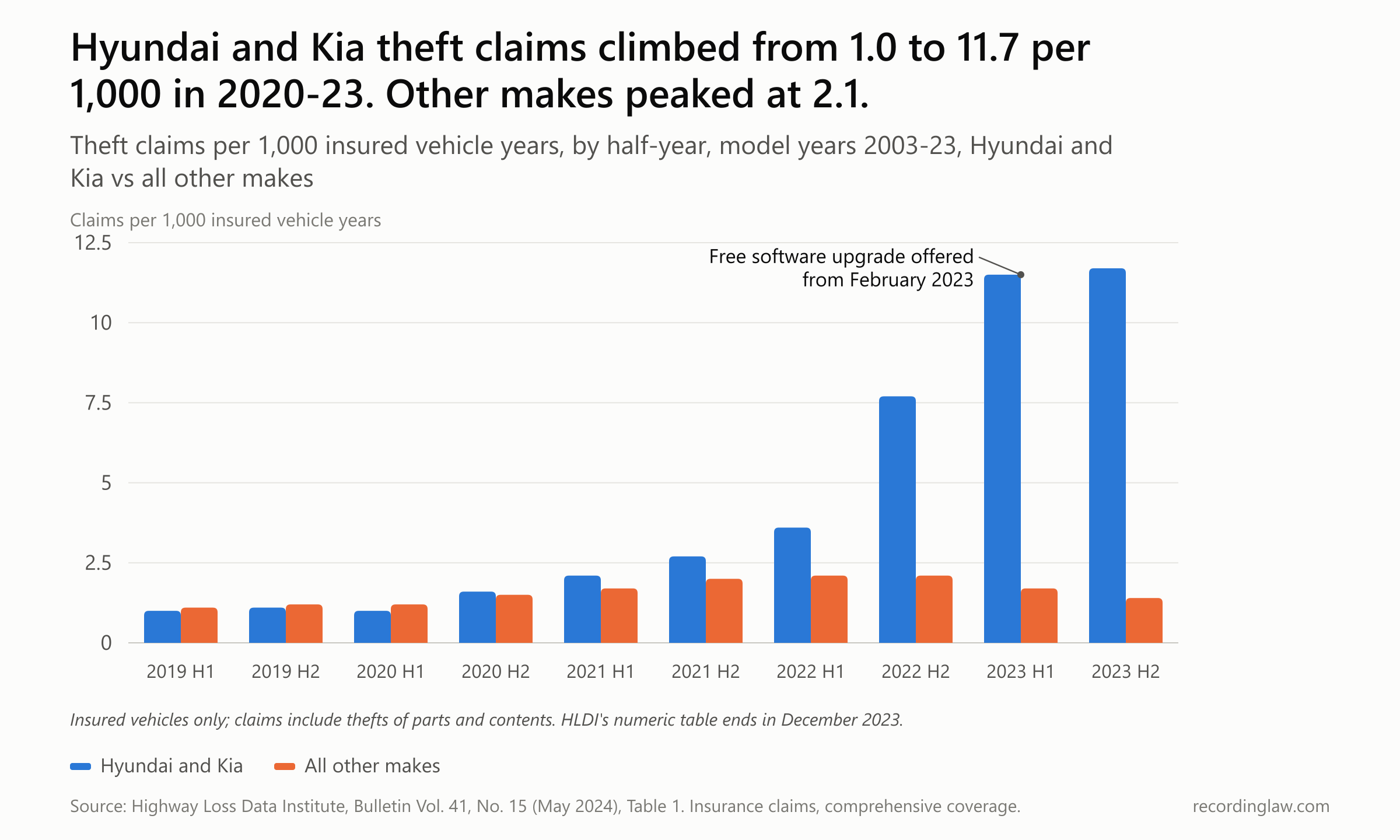
Theft claim frequency, model years 2003-23, Hyundai and Kia vs all other makes. Source: Highway Loss Data Institute, Bulletin Vol. 41, No. 15 (May 2024), Table 1.
| Half-year | Hyundai and Kia | All other makes |
|---|---|---|
| 2019 H1 | 1.0 | 1.1 |
| 2020 H1 | 1.0 | 1.2 |
| 2021 H1 | 2.1 | 1.7 |
| 2021 H2 | 2.7 | 2.0 |
| 2022 H1 | 3.6 | 2.1 |
| 2022 H2 | 7.7 | 2.1 |
| 2023 H1 | 11.5 | 1.7 |
| 2023 H2 | 11.7 | 1.4 |
Those are claims on insured cars, and they count thefts of parts and contents as well as whole cars. The chart cannot show which cities the claims came from, or why the line climbed when it did.
The standard the cars met
DeSiato's account of the companies' first reply pointed to the national standards. The federal standard on theft protection is Federal Motor Vehicle Safety Standard 114, which says its purpose is "to decrease the likelihood that a vehicle is stolen, or accidentally set in motion."
What it requires is a starting system. When the key is removed, that system must prevent the normal activation of the engine, and it must also prevent either steering or forward self-mobility. The word immobilizer does not appear in the standard, and the section was last amended in December 2016.
Most of the industry installed immobilizers anyway. Electronic immobilizers were standard on 92% of 2011 models from other brands and on 17% of 2011 Hyundai and Kia models, according to HLDI. For the 2015 model year, the gap was 26% of Hyundai and Kia vehicle series against 96% for everyone else.
Hyundai made immobilizers standard on all vehicles built after November 1, 2021. Kia installed them on all 2022 models and trims, either at the start of the model year or as a running change, meaning partway through production. HLDI found immobilizers standard on 84% of 2022 Hyundai and Kia models, against 96% of other brands. By 2023 they were standard on all of the companies' models.
Canada had faced the same question twenty years earlier. In 2002, Transport Canada began negotiating a voluntary agreement with manufacturers to raise the share of vehicles fitted with immobilizers from about 80% to 100%. Those "negotiations failed due to the reluctance of some manufacturers to agree to the proposed requirements."
Canada then made immobilizers mandatory on prescribed vehicle classes from September 1, 2007. Minnesota's attorney general later said the same Hyundai and Kia models sold in Canada and Europe carried the devices.
The companies' position, then and later, was that their cars met the rules. "While all of our vehicles meet or exceed Federal Motor Vehicle Safety Standards, unfortunately, our vehicles have been targeted in a coordinated effort on social media," Hyundai Motor America said in 2022. Kia's head of corporate communications, James Bell, told Gizmodo that year that "no car can be made completely theft-proof" and that "criminals are targeting vehicles equipped with a steel key and ‘turn-to-start’ ignition system." Those statements came after the thefts had begun in Milwaukee.
How far did it spread?
Milwaukee was first, and within two years the cars were disappearing across the country. Urban Milwaukee reported that the rise started in the fall of 2020. In its figures, monthly Hyundai thefts in the city went from 23 in September to 56 in October and 99 in November. Over the same three months, Kia thefts went from 16 to 21 to 110.
In June 2021 each brand set a monthly record: 328 Hyundais and 312 Kias. The city closed 2021 with 10,483 auto thefts, a record and more than double the 4,524 of 2020. Under Uniform Crime Reporting standards, a Milwaukee police official told TMJ4, a case counts as cleared when an arrest is made. By that measure, police cleared 490 of those cases, a rate of 4.7%, or fewer than one in 20, according to department data reported by the station.
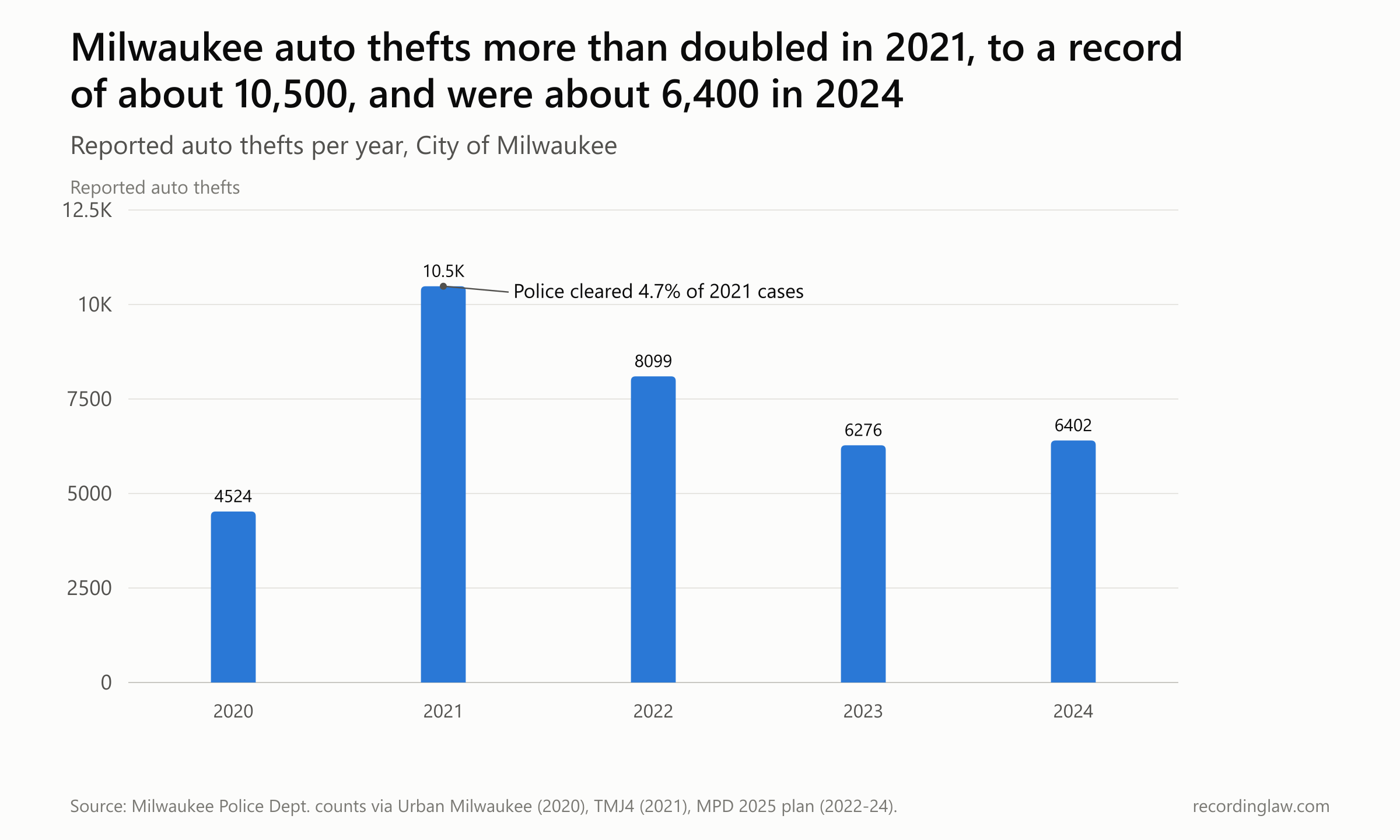
Milwaukee reported auto thefts per year. Source: Milwaukee Police Department counts via Urban Milwaukee (2020), TMJ4 (2021) and the MPD 2025 Violent Crime Reduction Plan (2022-2024).
| Year | Auto thefts, City of Milwaukee |
|---|---|
| 2020 | 4,524 |
| 2021 | 10,483 |
| 2022 | 8,099 |
| 2023 | 6,276 |
| 2024 | 6,402 |
In insurance data the first large increases came in Wisconsin and Colorado. In Wisconsin, insurance losses from Hyundai and Kia thefts, per insured vehicle year, rose to more than 30 times their 2019 level, HLDI reported in September 2022. Its write-up that month said that "bargain-priced vehicles manufactured by Kia and Hyundai now rival muscle cars and luxury SUVs as top targets." In Colorado, theft claim frequency for the two brands, the measure in the chart above, went from 2 claims per 1,000 insured vehicle years in the first half of 2020 to 30 in the second half of 2022.
Chicago's turn came in the summer of 2022. Hyundai and Kia thefts reported to Chicago police, as charted by NBC5 from department data, went from 87 in January 2022 to 1,417 in October.
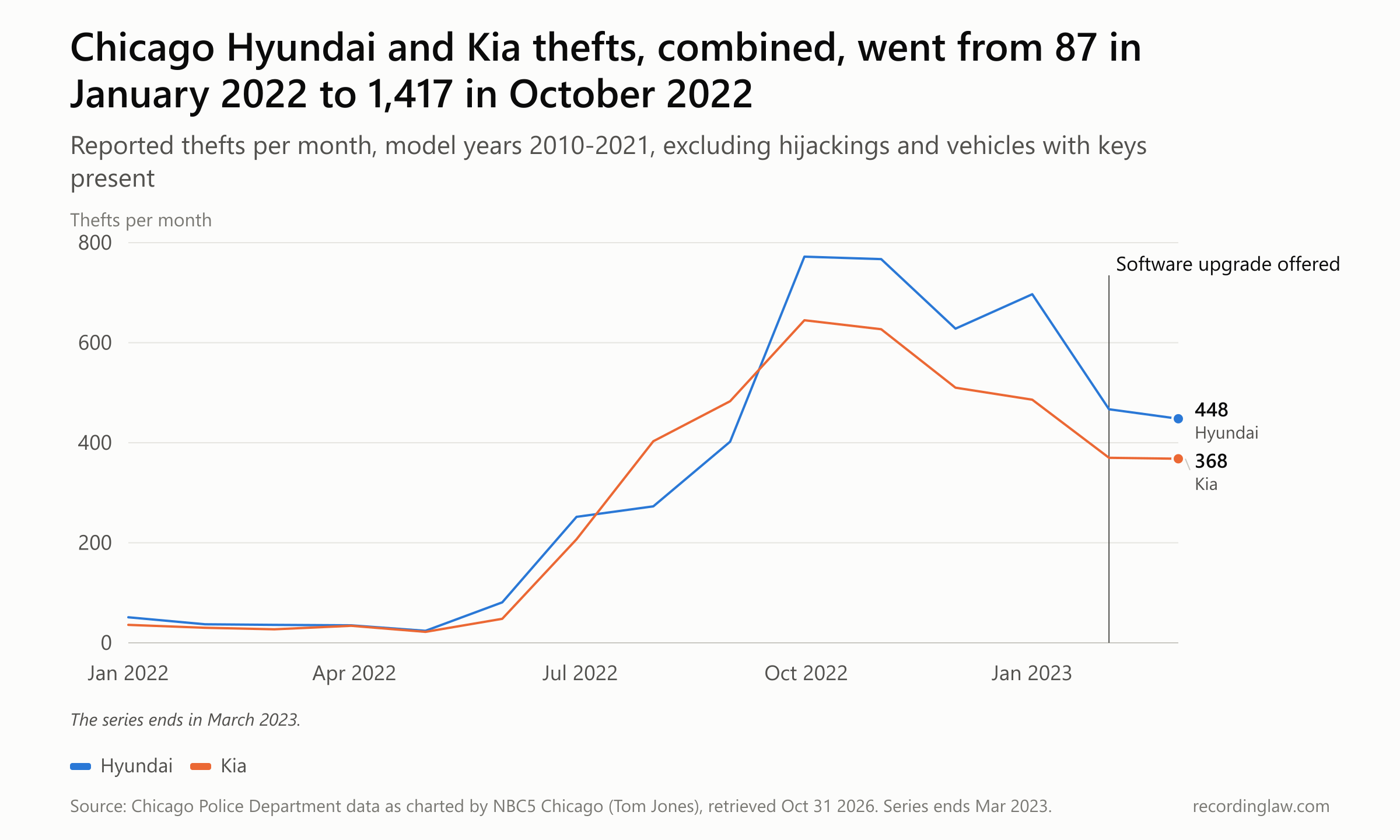
Chicago Hyundai and Kia thefts per month, model years 2010-2021, excluding hijackings and vehicles with keys present. Source: Chicago Police Department data as charted by NBC5 Chicago. The series ends in March 2023.
| Month | Hyundai | Kia | Combined |
|---|---|---|---|
| Jan 2022 | 51 | 36 | 87 |
| Jun 2022 | 81 | 48 | 129 |
| Jul 2022 | 252 | 207 | 459 |
| Oct 2022 | 772 | 645 | 1,417 |
| Nov 2022 | 767 | 627 | 1,394 |
| Jan 2023 | 697 | 486 | 1,183 |
| Mar 2023 | 448 | 368 | 816 |
That October, Chicago police recorded 3,186 motor vehicle thefts of all makes, more than four times the 2019 monthly average of 748. The 1,417 Hyundais and Kias in the NBC5 data for that month equal about 44% of that total. The NBC5 count covers only 2010-2021 models and leaves out hijackings and cars with keys present, so 44% is not a precise share.
Other cities reported the same pattern in their own terms. Seattle's police chief, Adrian Z. Diaz, said thefts of the two brands went "from 48 reported thefts of Hyundais and Kias in August to 197 in December" of 2022.
St. Louis said "61 percent of all vehicles stolen in St. Louis have been Kias and Hyundais." Cleveland reported that 1,203 Hyundais and Kias were stolen there from October through December 2022, and that the two brands made up 65% of all its vehicle thefts in December.
HLDI attributes the escalation "partly to the accessibility of instructional theft videos on social media platforms." NHTSA described it in February 2023 as "a TikTok social media challenge that has spread nationwide and has resulted in at least 14 reported crashes and eight fatalities." Not everyone accepts the label. Know Your Meme, which tracks internet trends, concluded in July 2022 that the thefts and the method were real but that the "Kia Challenge" was "not a real social media trend," and traced the phrase to a news article.
In January 2023, CNN reported that Progressive and State Farm "are refusing to write policies in certain cities for some older Hyundai and Kia models that have been deemed too easy to steal, according to the companies." A spokesman for the Insurance Information Institute, an insurer trade group, called it very unusual for insurers to stop writing new policies on a given make or model.
A software upgrade, not a recall
The companies' upgrade arrived in February 2023, and it was not a recall. On February 14, NHTSA announced that "Hyundai and Kia have developed theft deterrent software for millions of their vehicles that lack an immobilizer and will provide it FREE of charge to vehicle owners." The upgrade extends the alarm "from 30 seconds to one minute and requires the key to be in the ignition switch to turn the vehicle on." It covered about 3.8 million Hyundais and 4.5 million Kias, roughly 8.3 million cars.
Michael Brooks, executive director of the Center for Auto Safety, a consumer advocacy nonprofit, told the Associated Press that a recall comes with quarterly reports and mailed notices, and that a company service campaign does not. "We won't know how many are on the road with the problem," he said.
States pushed for more. In March 2023 Wisconsin Attorney General Josh Kaul led 22 other attorneys general in demanding that the companies "step up to address the scourge of theft of vehicles they manufactured without anti-theft immobilizers." In April, California's Rob Bonta led 18 attorneys general asking NHTSA for a recall. "Instead of taking responsibility with appropriate corrective action, these carmakers have chosen instead to pass this risk onto consumers and our communities," Bonta said.
Their legal theory reached for the federal theft-protection standard. The cars, the coalition argued, "violate federal requirements that vehicles have a starting system that prevents the activation of the engine or motor and steering system when the key is removed." The companies answered that their vehicles complied with federal safety and anti-theft standards and that a recall was not necessary, the AP reported. Kia said more than 165,000 customers had the upgrade installed and more than 2 million had been contacted; Hyundai said it had rolled out the upgrade two months ahead of schedule.
NHTSA did not order a recall. In June 2023 it told the attorneys general it had not found a safety defect or noncompliance requiring one, KSTP reported, and a spokesperson explained: "Generally, matters involving intentional criminal conduct fall under the purview of law enforcement authorities." The agency said it had met repeatedly with the companies and would keep monitoring. Minnesota Attorney General Keith Ellison replied, "I think they’re wrong."
By August 2023, seven attorneys general had urged the federal court handling the owners' class action to strengthen a settlement the companies had announced in that case in May 2023, described in the next section. Minnesota's attorney general's office, summarizing their concerns, said the upgrade "is not feasible for approximately 2.3 million theft-prone vehicles," that it was rolling out in phases, and that owners had to seek it out. In July 2023, they said, Minneapolis alone saw 313 Hyundais and Kias stolen, more than 15 times the 20 stolen in July 2021.
Owners and cities take it to court
The first consumer class action had been filed in June 2021 in Milwaukee County Circuit Court by Barton Cerjak S.C., a plaintiffs' firm, a month before DeSiato's briefing. The case moved to federal court. There it was consolidated with 60 others that followed into one multidistrict litigation, MDL 3052, in which their pretrial proceedings were handled together before U.S. District Judge James V. Selna in Santa Ana, California.
In May 2023 the companies announced a class settlement they said could be valued at $200 million, covering about 9 million 2011-2022 Hyundai and Kia vehicles. "We appreciate the opportunity to provide additional support for our owners who have been impacted by increasing and persistent criminal activity targeting our vehicles," said Jason Erb, Hyundai Motor North America's chief legal officer.
The AP reported that in August 2023 Judge Selna declined to grant preliminary approval to that deal. According to the AP, he said it failed to provide "fair and adequate" relief, and he raised concerns about how payments were calculated and whether the software would prevent future thefts. Six states and the District of Columbia, seven attorneys general in all, had urged him to require immobilizers in all theft-prone models, possibly with a buyback, in place of the upgrade and cash. An amended settlement followed.
Selna granted final approval to the amended settlement on October 1, 2024. Class counsel Hagens Berman, one of the law firms representing the owners, estimated it at up to $145 million or more in cash relief. The firm also said its "Engineering experts also conducted over 100 tests and determined that the software update included in the settlement will resolve the security defect in most impacted vehicles."
Cities sued separately, saying their police and taxpayers were carrying the cost. Seattle went first, on January 23, 2023. "Kia and Hyundai chose to cut corners and cut costs at the expense of their customers and the public," City Attorney Ann Davison said. Hyundai called the suit "improper and unnecessary" and pointed to its November 2021 switch to standard immobilizers.
Columbus followed in February 2023, Cleveland on March 7, Milwaukee on March 22 and St. Louis on March 27. "It is our position the Kia and Hyundai prioritized profit over people by not installing engine immobilizers in these vehicles," said Cleveland Mayor Justin M. Bibb.
Milwaukee's city attorney, Tearman Spencer, called his city "ground zero, the epicenter of the causes and problems that we've been experiencing throughout the country." Kia said lawsuits by municipalities were without merit, WUWM reported. By November 2023, Seattle said, 79 cases from more than two dozen federal districts were in the MDL.
What did the upgrade do to theft claims?
The insurers answered that question with the companies' own vehicle lists. The measure comes from HLDI, the insurance industry's research arm, which matched insurance claims against vehicle identification numbers that Hyundai and Kia supplied, along with whether each car had received the upgrade. Its first answer, in May 2024, with data through December 2023, was a 53% reduction in theft claim frequency for upgraded cars compared with eligible cars that had not been upgraded. For whole-vehicle thefts, where the car itself was taken, the reduction was 64%.
The comparison controls for model year, make and series, state, population density, driver age, gender and marital status, deductible and risk. That means it adjusts for differences in those factors between upgraded and non-upgraded cars. It cannot control for whatever else differs between owners who sought out the upgrade and those who did not.
Upgraded cars also drew 61% more vandalism claims. IIHS said that rise "was almost equivalent to the decrease in whole theft claims," though vandalism costs much less. HLDI reads the extra vandalism as damage from failed theft attempts.
In August 2024, HLDI's senior vice president, Matt Moore, said, "The companies’ solution is extremely effective," and he made a forecast: "we expect claim rates for Hyundai and Kia vehicles to gradually drop back in line with those of other brands, as thieves learn they’re no longer so easy to steal and the fad gets stale." IIHS offered one reason some upgraded cars were still stolen: "the software-based immobilizer only activates if the driver remembers to lock the vehicle with a fob, while many people are in the habit of using the switch on the door handle."
HLDI's later estimates were smaller. In between, an HLDI report that the May 2025 bulletin cites put the reduction at 48%. The May 2025 bulletin itself, with data through December 2024, put it at 46%, with 52% for whole-vehicle theft and a 50% rise in vandalism claims.
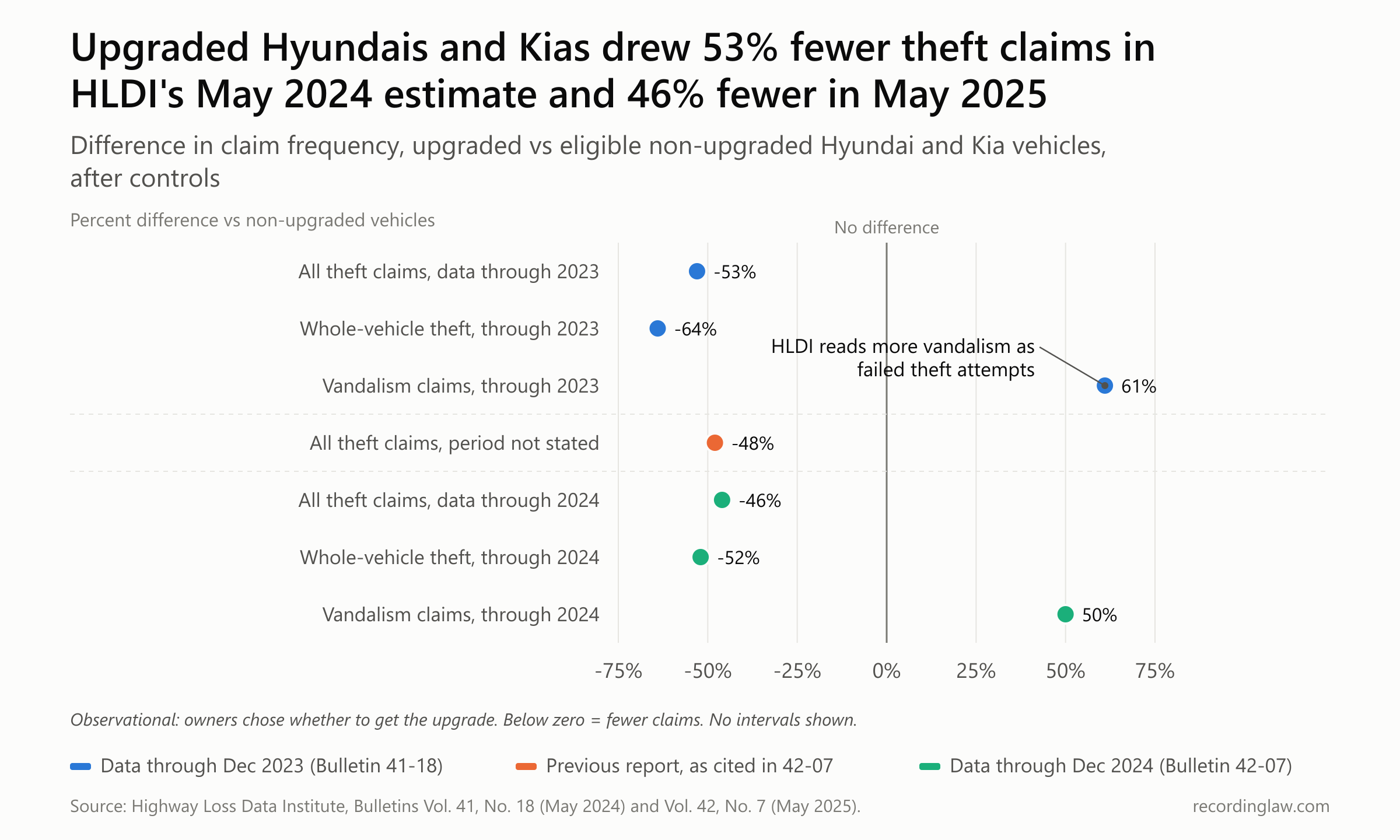
Estimated difference in claim frequency, upgraded vs eligible non-upgraded vehicles, after controls. Source: Highway Loss Data Institute, Bulletins Vol. 41, No. 18 (May 2024) and Vol. 42, No. 7 (May 2025); the 48% is as cited in Vol. 42, No. 7. Observational comparison.
| Estimate | All theft claims | Hyundai | Kia | Whole-vehicle theft | Vandalism claims |
|---|---|---|---|---|---|
| Data through Dec 2023 (Bulletin 41-18) | 53% fewer | 55% fewer | 51% fewer | 64% fewer | 61% more |
| Previous report cited in Bulletin 42-07 (period not stated) | 48% fewer | not given | not given | not given | not given |
| Data through Dec 2024 (Bulletin 42-07) | 46% fewer | 46% fewer | 45% fewer | 52% fewer | 50% more |
The chart cannot show what would have happened to the upgraded cars without the upgrade, because owners chose whether to get it.
HLDI's explanation was that during 2024 theft claims fell for cars without the upgrade as well as for upgraded ones, so the difference between the two groups shrank. HLDI said the smaller reduction "may reflect a positive trend, suggesting that thieves are no longer targeting Hyundai and Kia vehicles as often." Its wording changed with the number, from "effective in deterring theft" in 2024 to "correlated with reductions in theft and appeared to provide some theft protection" in 2025.
The other limit was how many owners got the upgrade. In HLDI's data, 30% of eligible Hyundais and 28% of eligible Kias had it by December 2023, and 41% and 40% by December 2024. The automakers put the figure at about 60% of eligible vehicles by mid-July 2024, as IIHS reported it. The two counts come from different sources and measure different populations.
The states later alleged that "the software update could be, and in fact was, bypassed by thieves." The companies, in the settlement they signed, "expressly deny the State Attorneys General’s allegations and any wrongdoing" and describe "a free software upgrade that addresses the social media theft method."
In August 2025 IIHS published HLDI's figures through December 2024. Its December 2024 theft figures for Hyundai and Kia cover a narrower group of cars than the chart at the top of this story: only the 2011-22 Hyundais and Kias that were eligible for the upgrade, whether or not they got it. In December 2024, theft claim frequency for that group "remained high, at nearly 10 and 11 claims per 1,000 insured vehicle years for Kia and Hyundai, respectively," against fewer than two for 2011-22 vehicles from all manufacturers. HLDI's May 2025 bulletin put those rates for the eligible group down 71% for Hyundai and 68% for Kia from their mid-2023 peak.
The same bulletin cited a companion study of the group the chart shows, all 2003-23 Hyundais and Kias. It found that their theft claim frequency dropped 56% in the second half of 2024 from the second half of 2023.
The same release said "Owners of newer models have less reason for concern": whole-vehicle theft rates for 2022-24 Hyundai and Kia models, "most or all of which have electronic immobilizers as standard equipment, are substantially lower than the all-vehicle average." Moore, by then HLDI's chief insurance operations officer, said, "This intervention showed dramatic results right off the bat, offering owners some peace of mind," and urged owners without the software upgrade to get it. An earlier HLDI bulletin, covering 2019 through 2023 as a whole, had already shown that newer model years, with immobilizers more widely fitted, sat much closer to other makes: 2022 models ran 35% above other makes and 2023 models 19% above, compared with more than four times for 2015-19 models.
The fall, and how much of it was these two brands
By 2024 vehicle thefts were falling nationwide, so the question became how much of the fall belonged to Hyundai and Kia. The National Insurance Crime Bureau, which is "supported by more than 1,200 property and casualty insurance companies and self-insured organizations," counts vehicle thefts reported to police nationwide. Its totals peaked at about 1.02 million in 2023, then fell 17% in 2024 and another 23% in 2025 by NICB's count, to about 660,000.
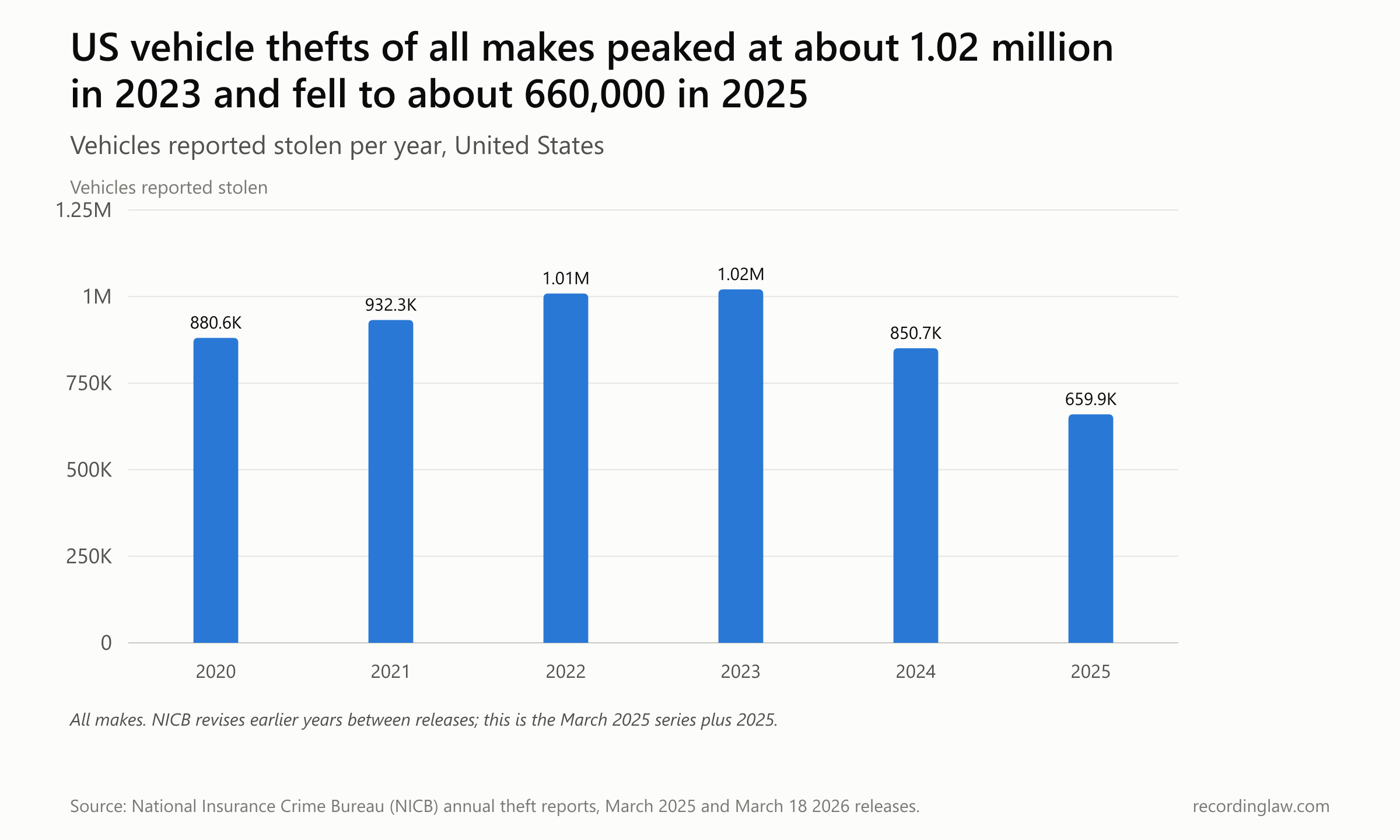
US vehicles reported stolen per year. Source: National Insurance Crime Bureau annual theft reports, March 2025 and March 18, 2026 releases.
| Year | US vehicle thefts |
|---|---|
| 2020 | 880,595 |
| 2021 | 932,329 |
| 2022 | 1,008,756 |
| 2023 | 1,020,729 |
| 2024 | 850,708 |
| 2025 | 659,880 |
Hyundai and Kia fell faster than the total. NICB puts their share of US thefts at 21% in 2023, 16% in 2024 and 14% in 2025. Applied to the national totals, those rounded shares mean the two brands went from roughly 214,000 thefts in 2023 to roughly 92,000 in 2025. That is a drop of more than half, while thefts of all makes fell by more than a third.
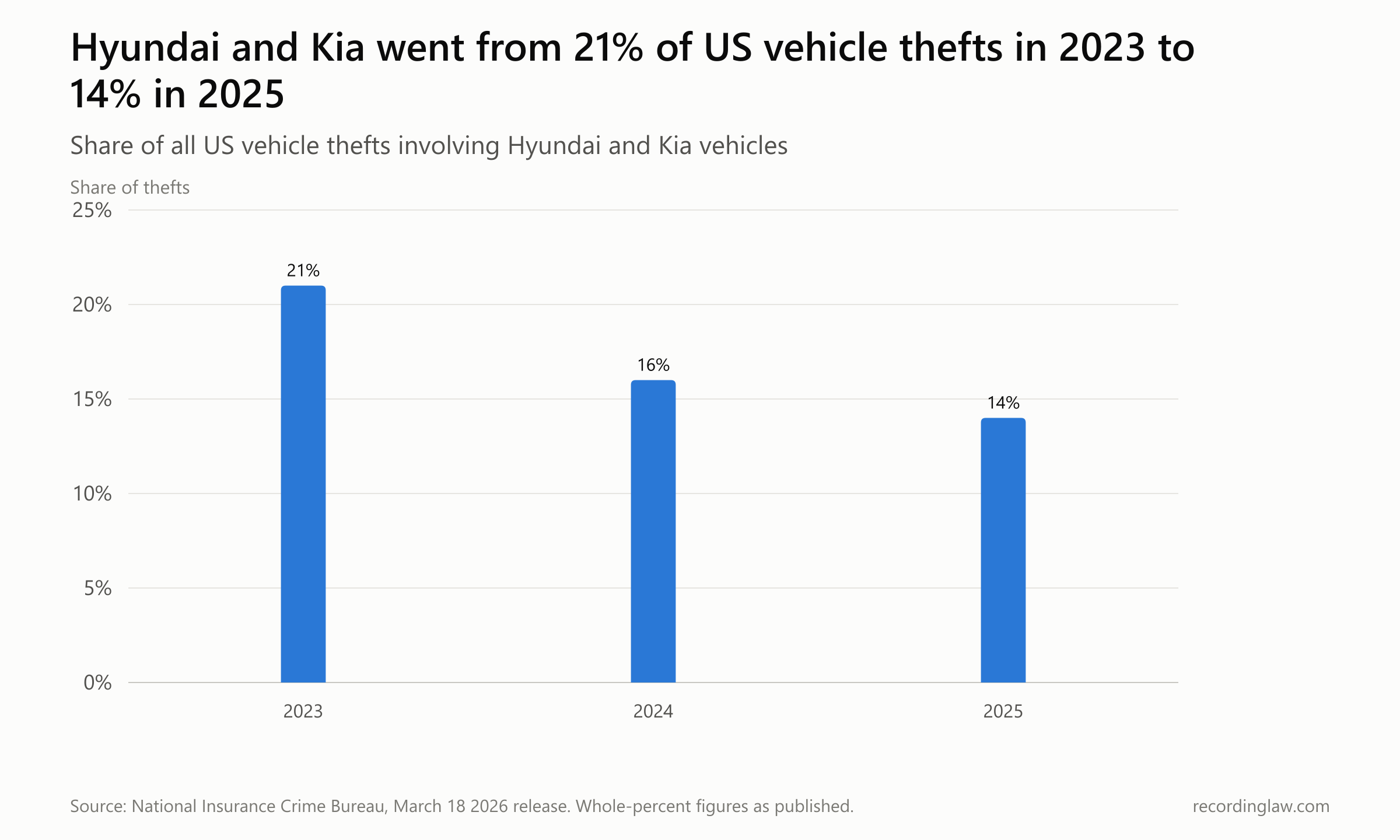
Hyundai and Kia share of all US vehicle thefts. Source: National Insurance Crime Bureau, March 18, 2026 release. Whole percents as published.
| Year | Hyundai and Kia share of US thefts |
|---|---|
| 2023 | 21% |
| 2024 | 16% |
| 2025 | 14% |
The cars have not left the list. In 2025 the Hyundai Elantra was still the most stolen model in the country, with 21,732 thefts; the Sonata was third and the Kia Optima sixth.
NICB says the brands' downward trend "reflects the impact of software updates and theft-prevention measures implemented in response to the theft trend," and its president, David J. Glawe, credited the national decline in thefts of all makes to "Coordinated prevention efforts by law enforcement, auto manufacturers, insurance companies, and the National Insurance Crime Bureau." NICB gives no method for separating those efforts.
Colorado's State Patrol, which compiles the state's reported stolen vehicles, shows the same shape. Hyundai and Kia were 25% of the state's stolen vehicles in 2022 and 15% in 2025, when 2,445 of 16,291 were from the two brands.
Hyundai and Kia share of Colorado reported stolen vehicles. Source: Colorado Auto Theft Intelligence Coordination Center, Colorado State Patrol, annual reports for 2024 and 2025.
| Year | Hyundai and Kia share | Hyundai and Kia stolen | All stolen vehicles |
|---|---|---|---|
| 2022 | 25% | not published | not published |
| 2023 | 23% | not published | 32,976 |
| 2024 | 19% | 4,560 | 24,575 |
| 2025 | 15% | 2,445 | 16,291 |
The Colorado report says the companies' upgrade and its continuation "appear to support the downward trajectory of Hyundai and Kia thefts statewide." For the overall drop, from 37,182 stolen vehicles in 2021 to 16,291 in 2025, it says "a combination of legislative support, focused strategies, public education and outreach, task force operations, intelligence and information-sharing efforts, and various anecdotal factors, such as legislative reforms and the absence of pandemic restrictions, are likely collectively contributing to a positive impact statewide."
Milwaukee's police gave a similar mixed account. Briefing a council committee in September 2023, when thefts were down 31% from the same point in 2022, Assistant Chief Paul Formolo said, "I'd attribute the decrease to messaging, partnerships, getting the clubs out there," and named the manufacturers' changes as one of several factors. The city counted 6,402 auto thefts in 2024. It counted 2,092 in the first half of 2026, against 2,668 in the first half of 2025.
Chicago is the exception. NICB's report for the first half of 2026 found thefts down 21% nationally and in all 50 states, with the Chicago metro area the only one of NICB's top 10 metro areas to rise, by 2%. In the city's own data, motor vehicle thefts from January through September 2026 were 8% above the same months of 2025. The city's 2025 total, about 17,300, was nearly double its 2019 total of about 9,000.
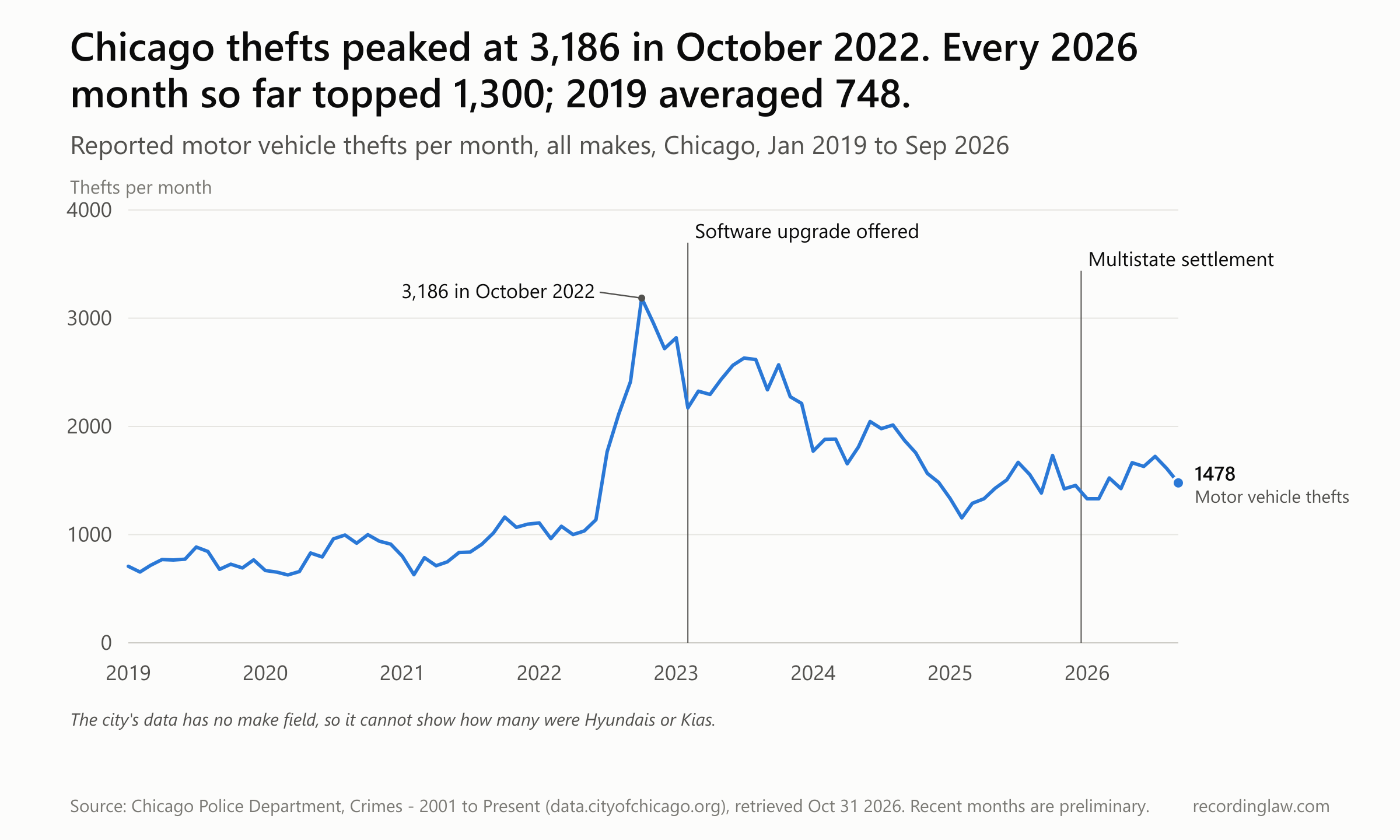
Chicago reported motor vehicle thefts per month, all makes. Source: Chicago Police Department, Crimes - 2001 to Present (data.cityofchicago.org), retrieved October 31, 2026. Recent months are preliminary.
| Year | Chicago motor vehicle thefts |
|---|---|
| 2019 | 8,979 |
| 2020 | 9,962 |
| 2021 | 10,605 |
| 2022 | 21,476 |
| 2023 | 29,256 |
| 2024 | 21,713 |
| 2025 | 17,261 |
| Jan-Sep 2025 | 12,652 |
| Jan-Sep 2026 | 13,719 |
Chicago's public crime data does not record the make of a stolen car, so it cannot say how many of the 2026 thefts are Hyundais or Kias. NICB's mid-2026 report does not mention the brands.
What the attorneys general settled for
The states settled after the fall was well underway. On December 16, 2025, attorneys general in Minnesota, Connecticut, Wisconsin and other states announced a settlement with both companies.
The states' own releases do not agree on how many signed. Some count 36 attorneys general, including Florida and the District of Columbia; others count 35, including DC and without Florida. The state-by-state roster is in How we measured.
Wisconsin listed the terms. The companies will put immobilizers on all future vehicles they sell in the United States, and they will offer free zinc-reinforced ignition cylinder protectors for eligible cars. They will pay up to $4.5 million in restitution to eligible owners whose cars are damaged by thieves, and $4.5 million to the states.
Minnesota said the protectors are available to owners who already had the software upgrade. By the companies' own estimate, installing protectors on every eligible vehicle could cost more than $500 million, against $9 million in settlement cash, which is the two $4.5 million payments added together.
"Today, Hyundai and Kia are paying millions of dollars to states and consumers, and they will finally provide a real fix, free of charge, to stop these thefts," said Connecticut Attorney General William Tong. Connecticut's share was $197,038, for 93,393 affected vehicles sold in the state.
The companies' side is in the agreement they signed. Besides their denial of the states' allegations, quoted earlier, they say they "have taken significant steps to support their customers in response to criminals using methods of theft promoted and popularized on social media," including the class settlement, the software upgrade, free steering wheel locks and the zinc protector. The agreement states it is not an admission of any violation. Nearly four and a half years after Milwaukee's briefing, the companies had promised in writing what the federal standard never asked for.
Who has been paid so far
Most of the money the cases produced has not yet reached car owners. The class settlement has not paid anyone yet. The U.S. Court of Appeals for the Ninth Circuit affirmed final approval on January 8, 2026, which means it upheld the approval. Class counsel Hagens Berman says that in May 2026 an objector to the settlement submitted a petition asking the Supreme Court to take up the case, and that this delays the payout.
The Court returned the petition as noncompliant, with 60 days to correct it. It was resubmitted in late August, and on October 6, 2026, it was returned again for defects, with another 60 days to refile. That second window runs to about December 5, 2026.
No petition has been docketed, meaning none has been accepted onto the Court's docket as properly filed. Class counsel has asked the Court not to grant a further correction period if the next submission does not comply, and says it cannot estimate when the petition will be resolved.
Cities are settling one at a time. Columbus agreed in September 2026 to a $1,002,117.34 settlement, which its city council was set to approve on September 28. The money goes to the city's general fund. "Taxpayers and the City should not foot the bill to pay for the problems these corporations created," said City Attorney Zach Klein.
He told ABC 6 he wished he could be "the lawyer for the entire people of the city of Columbus," "but unfortunately I do not have that authority." Hyundai told the station it "remains committed to supporting customers and communities affected by vehicle thefts linked to social media trends involving certain 2011-2022 Hyundai models."
Nashville's government nets $747,819 after attorneys' fees, and Jackson, Mississippi, settled for $178,556.05. The sources reviewed for this story did not report outcomes for Seattle, Milwaukee, Cleveland or St. Louis.
The states' restitution program is open now, and its administrator sets the terms. An eligible owner whose vehicle had the software upgrade installed, or was scheduled for it, may receive up to $4,500 for a total loss, up to $2,250 for a partial loss, or up to $375 for expenses after a theft attempt. The theft or attempt must have happened on or after April 29, 2025, and before whichever comes first: the protector installation or March 31, 2027.
"Funds are limited and will be disbursed on a rolling basis until the limited fund is exhausted," the administrator says. At the maximum total-loss amount of $4,500 per claim, the $4.5 million fund would cover 1,000 claims.
Claims are filed only through the official administrator's site, hkmultistateimmobilizersettlement.com; our settlement guide explains the eligibility rules and documents. Free protector installation can be requested through March 31, 2027.
What happens next
The next date is the end of the objector's second 60-day window to refile the petition, about December 5, 2026. Class counsel has given no date for payment. March 31, 2027 is the last day for a qualifying theft and for protector requests in the multistate program, unless the limited fund runs out first.
NICB published its 2025 national report on March 18, 2026, and has not announced a date for the full-year 2026 report, which would show whether the Hyundai and Kia share kept falling from 14%. The latest HLDI bulletin on the two brands that we located is from May 2025.
The cars themselves will be around for years. A model by researchers from UCLA and other institutions, funded by the Air Force Office of Scientific Research and published in August 2026, forecasts that thefts of the vulnerable models in Los Angeles "will remain elevated over baseline levels through at least 2042," then fall largely as the cars are scrapped.
When Milwaukee police first contacted them in May 2021, the companies said their cars met the national standards. FMVSS 114, the federal theft-protection standard, still contains no immobilizer requirement. In Milwaukee, where the committee heard the count in 2021, the city recorded 3,253 auto thefts in the first nine months of 2026, down from 4,101 a year earlier.
How we measured
Insurance claims (HLDI). The half-year series is HLDI Bulletin Vol. 41, No. 15 (May 2024), Table 1: theft claims under comprehensive coverage per 1,000 insured vehicle years, model years 2003-23, Hyundai and Kia combined vs all other makes. Claims include theft of parts and contents, not only whole cars, and cover insured vehicles only.
An earlier edition of the data (Bulletin 40-25, December 2023) gave the first half of 2023 as 11.2 vs 1.6; we use the later edition (11.5 vs 1.7) throughout and do not mix them. "More than 11 times" is HLDI's own comparison of the second half of 2023 with the first half of 2020. HLDI publishes no numeric half-year table for 2024; its 2024 levels appear only as charts.
The upgrade estimates. HLDI compared vehicles that received the upgrade with eligible vehicles that did not, using VIN lists and upgrade status supplied by Hyundai and Kia, in a regression with the controls listed above. It is observational: owners chose whether to get the upgrade.
The 53% (whole-vehicle 64%, vandalism +61%) is Bulletin 41-18, data through December 2023. The 46% (whole-vehicle 52%, vandalism +50%) is Bulletin 42-07, data through December 2024. The 48% "previous report" figure and the 56% drop across all 2003-23 Hyundais and Kias (second half of 2024 vs second half of 2023) are HLDI figures as cited inside Bulletin 42-07; the underlying bulletins were not located, and the data period of the 48% estimate is not stated there. Bulletin 42-07 describes itself as adding July to December 2024 to the prior analysis, which suggests the 48% used data through June 2024; the bulletin does not say so directly.
HLDI's figures use different vehicle groups: the December 2024 rates of nearly 10 (Kia) and 11 (Hyundai) per 1,000 are for eligible 2011-22 vehicles, and are not comparable with other groups in the bulletins. The under-2 figure for all manufacturers is for all theft claims on 2011-22 vehicles. The 35% and 19% figures for 2022 and 2023 models, and "more than 4 times" for 2015-19 models, come from Bulletin 41-15's model-year comparison for calendar January 2019 to December 2023, not from the December 2024 data.
Upgrade uptake. The 30%/28% (December 2023) and 41%/40% (December 2024) shares are of eligible vehicles in HLDI's database. The "about 60%" by mid-July 2024 is the automakers' figure as reported by IIHS. They measure different populations.
National thefts (NICB). NICB counts thefts reported to law enforcement, using the FBI's National Crime Information Center (NCIC) data. The 2020-2024 totals are the revised series in its March 2025 release; 2025 is from its March 18, 2026 release. NICB revises earlier years between releases, so 2019 (published on an older basis) is left out. The 23% fall for 2025 is NICB's own figure from the March 18, 2026 release; the 2024 and 2025 totals in our table give 22%.
The Hyundai and Kia shares are whole percents as published. Our estimate of the two brands' thefts multiplies those rounded shares by the totals: 21% of 1,020,729 is about 214,000 and 14% of 659,880 is about 92,000, a fall of about 57% (between 54% and 59% allowing for rounding of the shares), against a 35% fall in the total.
Cities. Chicago's monthly counts are Chicago Police Department motor vehicle thefts from the city's open-data portal, pulled October 31, 2026; recent months are preliminary and the partial October 2026 is excluded. The 2019 monthly average is 8,979 divided by 12. The portal has no make field. The Hyundai and Kia counts come from an NBC5 Chicago chart of department data (model years 2010-2021, excluding hijackings and cars with keys present) that ends in March 2023, so the 44% share for October 2022 (1,417 of 3,186) mixes two definitions and is approximate.
Milwaukee's annual counts come from three publications of police department data (2020 via Urban Milwaukee, 2021 via TMJ4, 2022-2024 from the department's 2025 crime plan); 2026 counts are department figures reported by FOX6 and others. Colorado's counts are from the State Patrol's annual reports; the 2022 statewide count is not printed as a number, so it is left out. Other cities' figures are as each city or police department stated them.
Settlement figures. Wisconsin, Connecticut, Washington and Nevada each describe 36 attorneys general, including Florida and the District of Columbia. Minnesota's release, the Assurance of Discontinuance (the formal settlement document) that Minnesota signed, and the releases from Hawaii and Arizona list 35, including DC and without Florida. Illinois and Delaware describe a coalition of 35. The attorney-general count is reported from each state's release and from the Assurance of Discontinuance signed by Minnesota; we did not locate Florida's release or instrument, and no document we opened says which roster governs.
Restitution terms and dates are from the official administrator's site and the notice letters attached to the Minnesota agreement. The 1,000-claim figure is $4.5 million divided by the $4,500 maximum.
Class settlement status is from class counsel's case page, updated October 26, 2026. The December 5, 2026 date is 60 days from the October 6 return that class counsel reports; we did not see the Court's letter, and a Supreme Court docket search on November 6, 2026 found no docketed petition in the case. The class objector is a private individual and is not named.
The upgrade chart. The three estimates use the same method on eligible 2011-22 vehicles but different data periods, so they are drawn as separate rows, not as a series. Below zero means fewer claims than non-upgraded cars. No intervals are drawn. The per-make estimates are in the table only.
What the data cannot show. None of these sources can separate the software upgrade's effect from the national decline in thefts of all makes, the protectors, steering wheel locks, police and prosecution changes, state laws or the fading of the online trend. The studies of the upgrade are funded by insurers, and the VIN lists came from the companies.
Frequently Asked Questions
Are Hyundais and Kias still being stolen at high rates?
Less than at the peak, but still often. NICB reports that Hyundai and Kia were 14% of US vehicle thefts in 2025, down from 21% in 2023, and the Hyundai Elantra was still the most stolen model in 2025. HLDI found that in December 2024 eligible 2011-22 Hyundai and Kia vehicles had nearly 10 to 11 theft claims per 1,000 insured vehicle years, against fewer than two for all manufacturers' 2011-22 vehicles.
Did the Hyundai and Kia anti-theft software update work?
HLDI, the insurance industry's research arm, found that upgraded vehicles had 53% fewer theft claims than eligible non-upgraded ones in data through 2023 and 46% fewer in data through 2024. The comparison is observational because owners chose whether to get the upgrade, and upgraded cars had more vandalism claims, which HLDI reads as failed theft attempts. The states alleged the update could be bypassed. The companies deny it.
Is an engine immobilizer required by law in the United States?
No federal rule requires one. FMVSS 114, the federal theft-protection standard, requires a starting system that prevents the normal activation of the engine when the key is removed, but it does not mention immobilizers. Canada has required immobilizers on prescribed vehicle classes since September 1, 2007. The December 2025 multistate settlement commits Hyundai and Kia to put immobilizers on all future vehicles they sell in the US.
How many states joined the Hyundai and Kia multistate settlement?
35 or 36 attorneys general including the District of Columbia, depending on the document. Wisconsin, Connecticut, Washington and Nevada describe 36 including Florida; Minnesota's release and signed agreement, Hawaii and Arizona list 35 without Florida.
How do I file a claim in the Hyundai and Kia multistate settlement?
Only through the official settlement administrator, at hkmultistateimmobilizersettlement.com. The administrator lists amounts of up to $4,500 for a total loss, $2,250 for a partial loss and $375 for a theft attempt, for a qualifying theft or attempt on or after April 29, 2025 and before the earlier of the zinc protector installation or March 31, 2027, on vehicles that had the software update installed or scheduled. Funds are limited and paid on a rolling basis until exhausted, so no payment is assured.
When will the Hyundai and Kia class action settlement pay out?
No date has been set. Final approval came on October 1, 2024 and the Ninth Circuit affirmed it in January 2026, but payment is delayed while an objector seeks Supreme Court review. The Court has twice returned the objector's petition for defects and has not docketed it. The latest 60-day period to refile, counted from October 6, 2026, ends about December 5, 2026, and class counsel says it cannot estimate when the Court will resolve it.
Updates
Reworded for readability. No figures, quotes, sources or findings changed.
Restructured as a feature: chart titles state the finding, side details moved to How we measured. Every figure and quote was re-checked against its source.
Independently fact-checked against the cited primary sources
Independently fact-checked against the cited primary sources
Sources and References
- Highway Loss Data Institute, Bulletin Vol. 41, No. 15: Hyundai and Kia theft claim frequency (May 2024)(iihs.org)
- Highway Loss Data Institute, Bulletin Vol. 41, No. 18: effect of the Hyundai and Kia anti-theft software upgrade (May 2024)(iihs.org)
- Highway Loss Data Institute, Bulletin Vol. 42, No. 7: anti-theft software upgrade update (May 2025)(iihs.org)
- Highway Loss Data Institute, Bulletin Vol. 40, No. 25 (December 2023)(iihs.org)
- IIHS news: Hyundais, Kias are easy targets amid boom in vehicle thefts (Sept. 22, 2022)(iihs.org)
- IIHS news: Anti-theft software tamps down viral theft trend targeting Hyundai, Kia vehicles (Aug. 7, 2024)(iihs.org)
- IIHS news: Camaro ZL1 tops chart of most stolen vehicles (Aug. 7, 2025)(iihs.org)
- 49 CFR 571.114, FMVSS No. 114, Theft protection and rollaway prevention (eCFR, current)(ecfr.gov).gov
- Transport Canada, Background: Vehicle immobilizers(tc.canada.ca).gov
- NHTSA, Hyundai and Kia theft deterrent software announcement (Feb. 14, 2023)(nhtsa.gov).gov
- KSTP: NHTSA declines recall; Attorney General Ellison responds (July 2023)(kstp.com)
- Chicago Police Department, Crimes - 2001 to Present (City of Chicago Data Portal)(data.cityofchicago.org).gov
- NBC5 Chicago, 2022 and 2023 Hyundai and Kia thefts in Chicago (Chicago Police Department data)(datawrapper.dwcdn.net)
- Urban Milwaukee: Two-thirds of all Milwaukee auto thefts are Kia and Hyundai vehicles (July 24, 2021)(urbanmilwaukee.com)
- TMJ4: Despite decrease in auto thefts, MPD seldom solve stolen car cases (Sept. 2023)(tmj4.com)
- Milwaukee Police Department, 2025 Violent Crime Reduction Plan(mkepdpio.org).gov
- FOX6 Milwaukee: 2026 Milwaukee crime data, first half of the year(fox6now.com)
- Milwaukee Journal Sentinel: Milwaukee crime sees continued decline in 2026 (Oct. 14, 2026)(jsonline.com)
- FOX6 Milwaukee: Kia, Hyundai class action settlement (May 18, 2023)(fox6now.com)
- Colorado Auto Theft Intelligence Coordination Center, Colorado State Patrol, Auto Theft Annual Report 2025(lockdownyourcar.org).gov
- National Insurance Crime Bureau: Vehicle thefts in the United States fell 17% in 2024(nicb.org)
- National Insurance Crime Bureau: U.S. vehicle thefts experience historic decline (Mar. 18, 2026)(prnewswire.com)
- National Insurance Crime Bureau: U.S. vehicle thefts fall 21% in first half of 2026 (Sept. 30, 2026)(nicb.org)
- City of Seattle: City Attorney files lawsuit against Kia and Hyundai (Jan. 25, 2023)(news.seattle.gov).gov
- City of Seattle: Multidistrict case against Kia, Hyundai continues (Dec. 12, 2023)(news.seattle.gov).gov
- City of Cleveland: City files federal lawsuit against Kia and Hyundai (Mar. 2023)(clevelandohio.gov).gov
- City of St. Louis: Mayor announces federal lawsuit against Kia and Hyundai (Mar. 27, 2023)(stlouis-mo.gov).gov
- WUWM: City of Milwaukee files lawsuit against Kia, Hyundai (Mar. 23, 2023)(wuwm.com)
- Carscoops: Seattle sues Kia and Hyundai (Jan. 2023), quoting Hyundai Motor America(carscoops.com)
- Gizmodo: TikTok Kia challenge (2022), with Kia America statement(gizmodo.com)
- Know Your Meme editorial on the Kia Challenge label (July 27, 2022)(knowyourmeme.com)
- CNN Business (via ABC17): Some auto insurers are refusing to cover some Hyundai and Kia models (Jan. 27, 2023)(abc17news.com)
- CBS News / AP: Kia, Hyundai thefts push states to demand recall (Apr. 21, 2023)(cbsnews.com)
- Minnesota Attorney General: attorneys general ask NHTSA to recall Hyundai and Kia vehicles (Apr. 20, 2023)(ag.state.mn.us).gov
- Minnesota Attorney General: attorneys general letter to the MDL court (Aug. 16, 2023)(ag.state.mn.us).gov
- Associated Press (via KSAT): Kia, Hyundai settle class-action lawsuit (May 19, 2023)(ksat.com)
- Associated Press (via NBC 7 San Diego): Judge declines to approve Hyundai, Kia class-action settlement (Aug. 17, 2023)(nbcsandiego.com)
- Hagens Berman (class counsel), Hyundai and Kia car theft case page (updated Oct. 26, 2026)(hbsslaw.com)
- Wisconsin Department of Justice: multistate settlement with Hyundai and Kia (Dec. 16, 2025)(wisdoj.gov).gov
- Connecticut Attorney General: multistate settlement with Hyundai and Kia (Dec. 16, 2025)(portal.ct.gov).gov
- Washington Attorney General: states settle with Hyundai, Kia (Dec. 16, 2025)(atg.wa.gov).gov
- Nevada Attorney General: settlement with Hyundai and Kia (Dec. 16, 2025)(ag.nv.gov).gov
- Minnesota Attorney General: Hyundai and Kia settlement (Dec. 16, 2025)(ag.state.mn.us).gov
- Minnesota Attorney General: Assurance of Discontinuance with Hyundai and Kia(ag.state.mn.us).gov
- Maui Now, reproducing the Hawaii Office of Consumer Protection release (Dec. 17, 2025)(mauinow.com)
- Arizona Attorney General: multistate settlement with Hyundai and Kia (Dec. 2025)(azag.gov).gov
- Illinois Attorney General: Hyundai and Kia settlement (Dec. 2025)(illinoisattorneygeneral.gov).gov
- Delaware Attorney General: multistate anti-theft settlement with Hyundai and Kia (Dec. 16, 2025)(news.delaware.gov).gov
- Hyundai and Kia Multistate Immobilizer Settlement, official administrator site(hkmultistateimmobilizersettlement.com)
- City of Columbus, City Attorney: Kia and Hyundai to pay Columbus more than $1 million (Sept. 2026)(columbus.gov).gov
- The Asia Business Daily: Columbus settlement with Hyundai and Kia (Sept. 30, 2026)(view.asiae.co.kr)
- ABC 6 / WSYX: Kia, Hyundai agree to $1 million settlement with Columbus (Sept. 28, 2026)(abc6onyourside.com)
- WSMV: Metro Nashville council vote on Kia, Hyundai settlement (Sept. 15, 2026)(wsmv.com)
- WLBT: Jackson settles suit with Kia, Hyundai (Oct. 23, 2026)(wlbt.com)
- The Drive: UCLA-led forecast of Hyundai and Kia thefts in Los Angeles (Oct. 6, 2026)(thedrive.com)
- Brantingham, Uchida, Morstatter and Mohler, Forecasting the impact of the viral Kia Boys social media trend on car thefts to 2050, International Journal of Forecasting (2026)(doi.org)