One in Nine High School Seniors Used Delta-8 THC in 2023, When Their Marijuana Use Sat Near a 30-Year Low

Independently fact-checked against primary sources (last audited November 10, 2026). · 24 primary sources cited on this page. How we verify our legal content
Between February 14 and June 2, 2023, a randomly chosen third of the high school seniors taking Monitoring the Future met a question the survey had never asked. The national school survey is run by the University of Michigan and funded by the National Institute on Drug Abuse (NIDA). It wanted to know whether they had used delta-8 THC, an intoxicating compound synthesized from hemp, in the past year.
The answers came out on December 13, 2023. About one senior in nine, 11.4%, said yes. "We were surprised to see use levels this high among 12th graders," said Richard A. Miech, the study's team lead.
Marijuana was the older question. In 2012, voters in Colorado and Washington legalized it for adults, and both sides of that fight made teenagers the test. Supporters said licensed stores that check ID would make marijuana harder for minors to get. Opponents said legal stores would put more of it within their reach.
For cannabis in general, the same survey showed a line that had held near 36% from 2012 through 2020, then dropped. In 2023, 29% of 12th graders reported past-year use. By 2025, national surveys put teenage marijuana use at or near its lowest in three decades.
The ID check, though, was written for marijuana. Delta-8, made from hemp, had no federal minimum purchase age. What did teenagers' marijuana use do after the stores opened? And why was a hemp product outside the age check more common in states where adult-use marijuana was still illegal?
What each side told voters would happen to teenagers
Colorado's 2012 voter guide, the Blue Book written by the legislature's nonpartisan staff, set the youth question up as a choice. Its summary of the arguments for Amendment 64, the legalization measure, said a regulated market, "by requiring age verification, will restrict underage access to marijuana."
The summary of the arguments against, on the next page, said the opposite. "Allowing state-regulated stores to sell marijuana will make it more accessible, which is likely to increase use," it read. "Greater accessibility and acceptance of marijuana may increase the number of children and young adults who use the drug, which, due to their ongoing brain development, may be especially dangerous."
The campaign made the mechanism explicit. "If we want to make it harder for minors to access marijuana, we need to take sales off the streets where dealers don't ask for ID, and put them behind the counter where proof of age is required," Betty Aldworth, advocacy director of the Campaign to Regulate Marijuana Like Alcohol, told HuffPost in August 2012. "By regulating all marijuana sales, we can further reduce teen access and use," she added.
Gov. John Hickenlooper opposed the measure. "The folks that I know in public safety and especially around youth addictions and social services are very concerned about this and feel that even just legalizing small amounts of marijuana opens the door to much greater usage among young people," he told KUNC in September 2012. "It's almost like telling them it's just fine."
Washington's Initiative 502, approved the same day, wrote youth into its budget. It directed marijuana tax money to a grants program "for the prevention and reduction of marijuana use by youth" and paid to run the state's Healthy Youth Survey.
Voters in both states approved legalization on November 6, 2012. Stores opened in Colorado in January 2014 and in Washington that July. Amendment 64 carried one more line about the plant, and it would matter later. It defined industrial hemp as the same plant as marijuana, with a THC concentration of no more than three-tenths of a percent.
Did teen use rise once the stores opened?
Monitoring the Future (MTF) had asked seniors about marijuana every year since long before the votes. If the stores were going to change what teenagers did, its line was where it should show.
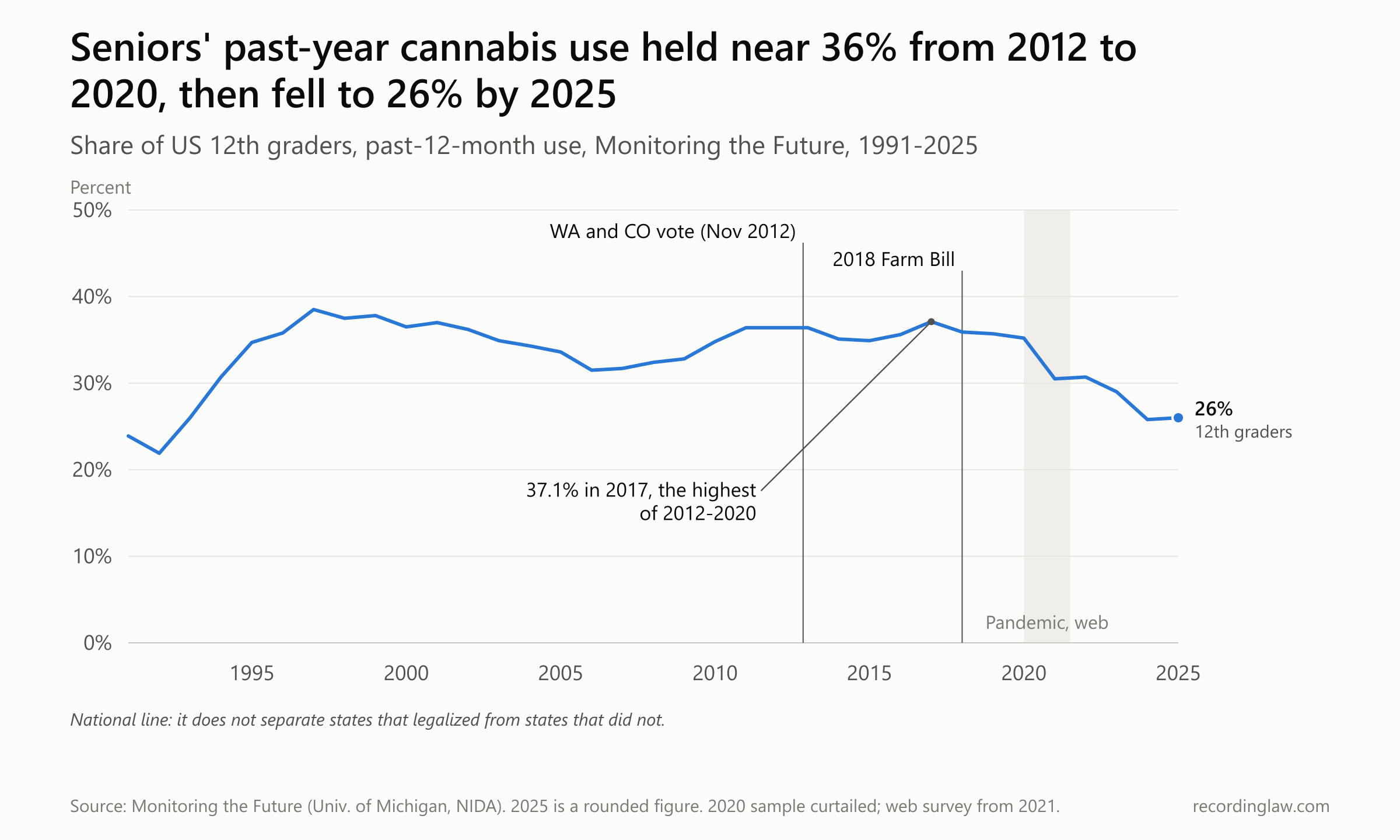
Share of US 12th graders reporting any cannabis use in the past 12 months, 1991-2025 (2025 rounded). Source: Monitoring the Future.
| Year | 12th graders, past-year cannabis use |
|---|---|
| 2012 | 36.4% |
| 2014 | 35.1% |
| 2017 | 37.1% |
| 2019 | 35.7% |
| 2020 | 35.2% |
| 2021 | 30.5% |
| 2023 | 29.0% |
| 2024 | 25.8% |
| 2025 | 26% |
For the first years of legal sales, the line barely moved. Seniors' past-year use (any use in the previous 12 months) was 36% in 2012, 35% in 2014 and 37% in 2017. Those figures were inside the range of roughly 31% to 37% that seniors' use had held since 2000.
The CDC's Youth Risk Behavior Survey (YRBS) asks high school students about past-month use, meaning use in the previous 30 days. It showed a similar flat-to-lower path: 23% in 2013 and 20% in 2017.
US high school students using marijuana in the past 30 days, 1991-2023 (2019-2023 rounded). Source: CDC YRBS.
| Year | High school students, past-30-day marijuana use |
|---|---|
| 2011 | 23.1% |
| 2013 | 23.4% |
| 2015 | 21.7% |
| 2017 | 19.8% |
| 2019 | 22% |
| 2021 | 16% |
| 2023 | 17% |
The pediatricians took their position a year into legal sales in Colorado, before most of the research below appeared. In January 2015 the American Academy of Pediatrics reaffirmed its opposition to legalization. "When you start making it much more available to adults through legal means, inevitably adolescents will have more access," said Dr. Seth Ammerman of Stanford, the lead author of its policy statement.
Supporters read the flat line as the answer. "A lot of marijuana laws have changed over the past five years, but rates of teen marijuana use have not," Mason Tvert, a 2012 campaign co-director who by then spoke for the Marijuana Policy Project, a pro-legalization group, said in December 2015.
By 2017 Hickenlooper, the governor who had warned of "much greater usage," was saying teen use had not risen. He said so on "Meet the Press" in February.
Stuart Gitlow and seven other physicians and addiction experts, whom Colorado Politics described as legalization critics, wrote to him disputing which survey he trusted. They cited the federal household survey, the National Survey on Drug Use and Health. That survey, they wrote, "shows that Colorado now leads the nation among 12 to 17-year-olds" in past-year and past-month use.
The governor kept to his reading. "We haven't seen a spike in teenage use," he told the Denver Post in an interview that Reason quoted at the end of March.
That December, Colorado's chief medical officer, Dr. Larry Wolk, said the newest figures from the federal household survey the physicians had cited now matched the state's own surveys. "Both our in-state surveys, as well as this national survey, are now consistent in that they both show no increase in youth use since legalization," he told KUNC.
What the studies found, and who disputed them
National lines mix states that legalized with states that did not, so researchers turned to comparisons. Their answers did not line up. The studies differ in design, sample and years, as the table below the chart sets out. The dispute in print was over method: how one of the studies below combined and weighted its survey files.
Cerda and nine colleagues, funded by NIDA, used Monitoring the Future data from 2010 to 2015. They compared 253,902 students in Washington, Colorado and states that had not legalized, before and after the 2012 votes.
In Washington, past-month use rose relative to the comparison states, by about 5 percentage points among 8th graders and about 3 among 10th graders. Those are percentage points, the plain difference between two percentages (from 10% to 12% is two points). In Colorado, use changed no differently than in the comparison states, and the same was true of Washington's 12th graders.
In July 2019, D. Mark Anderson, a Montana State University health economist, and co-authors Hansen, Rees and Sabia pooled 1.4 million high school students' Youth Risk Behavior Survey answers from 1993 to 2017. It was a pooled analysis, which puts data from several sources, places or years together and analyzes them as one set. They reported that recreational laws were associated with an 8% decrease in the odds of marijuana use, with seven states contributing data from before and after their laws. The paper disclosed funding that included a Charles Koch Foundation grant to Sabia.
The authors wrote that the result was consistent with the argument that "it is more difficult for teenagers to obtain marijuana as drug dealers are replaced by licensed dispensaries that require proof of age." The source they cited for that argument was Aldworth's 2012 HuffPost interview.
"It sort of defies logic to argue that more liberal recreational marijuana laws somehow help to dissuade young people from using the drug," Linda Richter of the Center on Addiction, which the Associated Press described as a drug use prevention and treatment advocacy group, told the AP. In 2020, two CDC researchers and NIDA's director, Nora Volkow, wrote in the same journal that the analysis had "substantial methodologic flaws." Pooling national and state survey files was inappropriate, they wrote, and the data were used unweighted. Anderson, Rees and Sabia published a reply in the same issue.
The broadest attempt to settle it came in 2024, when Pawar and colleagues pooled 30 studies of adolescents and young adults. It was a meta-analysis, which combines the results of several earlier studies into one overall estimate.
In the studies of recreational laws, the odds of past-month cannabis use were about 13% higher, "more so in young adults than in adolescents." Among the more recent studies, the odds for adolescents were about 9% higher. Medical marijuana laws showed no significant association.
Set side by side, the published estimates for recreational laws point in both directions.
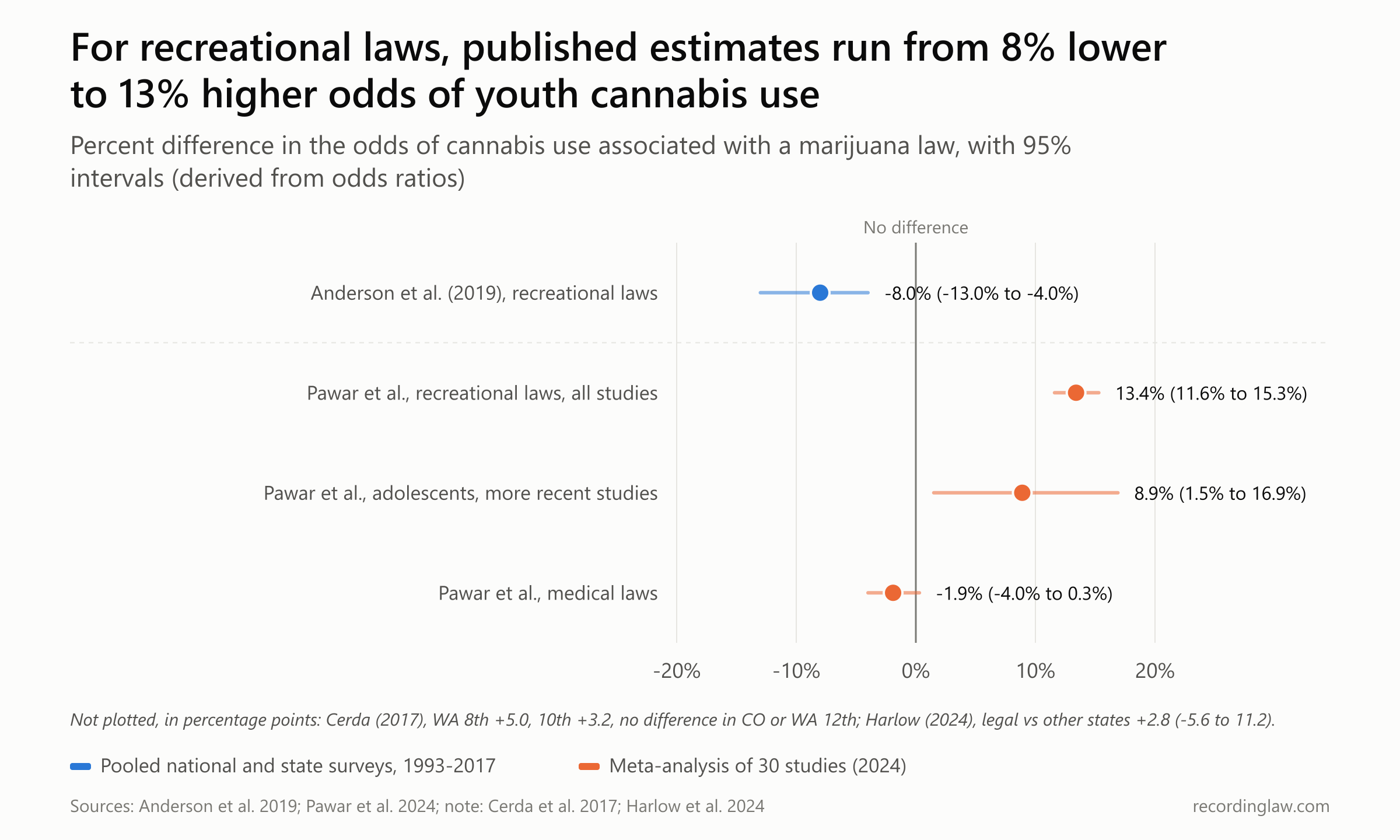
Percent difference in the odds of cannabis use associated with a marijuana law, derived from published odds ratios, with 95% intervals. Cerda et al. and Harlow et al. report percentage points and appear in the chart note and the table. Sources: Anderson et al. 2019; Pawar et al. 2024; Harlow, Miech and Leventhal 2024; Cerda et al. 2017.
| Study | Design | Estimate |
|---|---|---|
| Cerda et al. (2017) | Washington and Colorado vs states without legalization, MTF 2010-2015 | Washington: past-month use up 5.0 points (8th grade) and 3.2 points (10th); no difference for 12th grade or in Colorado |
| Anderson et al. (2019) | Pooled national and state YRBS, 1993-2017 | Odds ratio 0.92 (0.87 to 0.96), about 8% lower |
| Pawar et al. (2024), recreational laws | Meta-analysis of 30 studies, adolescents and young adults | Odds ratio 1.134 (1.116 to 1.153), about 13% higher |
| Pawar et al. (2024), adolescents, more recent studies | Same | Odds ratio 1.089 (1.015 to 1.169), about 9% higher |
| Pawar et al. (2024), medical laws | Same | Odds ratio 0.981 (0.960 to 1.003), no significant association |
| Harlow et al. (2024) | 2,186 12th graders, 27 states, 2023 | Past-year marijuana use 32.0% in states with legal adult use vs 29.2% in states without, a difference of 2.8 points (-5.6 to 11.2), not significant; use "did not differ by cannabis policies" |
None of these comes from an experiment. Each compares places with and without a law. The next comparison shows that the states that legalized were not like the others to begin with.
Higher in legal states before any of them voted
The simplest comparison, legal states against the rest, has a problem. The states that legalized already looked different before they did.
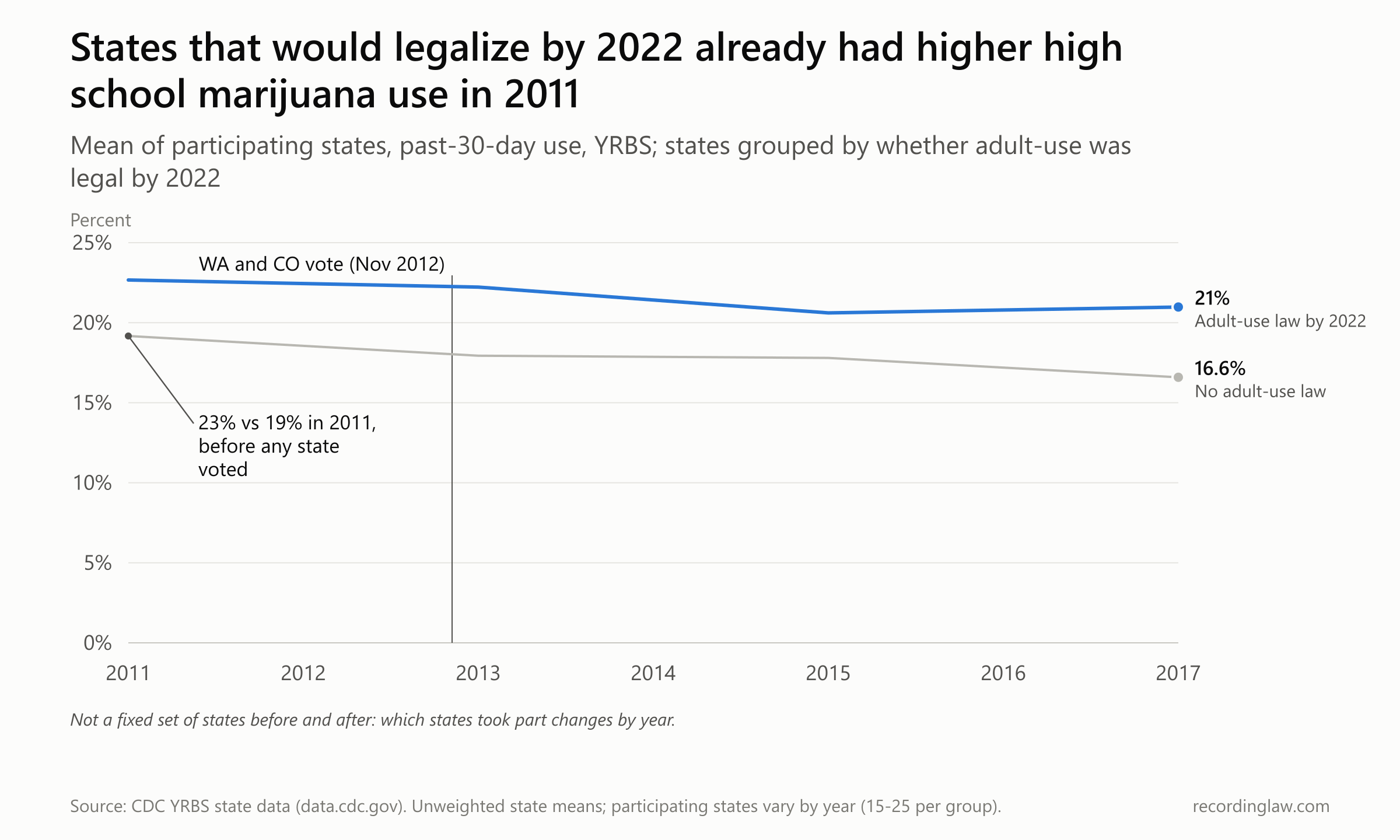
High school past-30-day marijuana use, mean of participating states by later legal status, 2011-2017. Source: CDC YRBS state data.
| Year | States with adult-use law by 2022 | States with no adult-use law |
|---|---|---|
| 2011 | 22.67% (15 states) | 19.17% (25 states) |
| 2013 | 22.22% (16 states) | 17.94% (23 states) |
| 2015 | 20.61% (16 states) | 17.80% (18 states) |
| 2017 | 20.98% (17 states) | 16.59% (20 states) |
In 2011, a year before any state legalized marijuana for adults, the states that would legalize adult use by 2022 averaged 23% past-month use among high school students in the CDC survey. The states that never did averaged 19%. The gap was there first.
It is still there. In the federal household survey's 2023-2024 state estimates for 12- to 17-year-olds, the jurisdictions with adult-use laws by 2022 averaged 7.3% past-month use. The states without averaged 5.4%. Maine and Vermont were near the top, and Hawaii and Utah were at the bottom.
Ages 12-17 marijuana use by state legal status, unweighted state means, NSDUH 2023-2024. Source: SAMHSA.
| Ages 12-17, NSDUH 2023-2024 | Adult-use law by 2022 (21) | No adult-use law (26) | US estimate |
|---|---|---|---|
| Past-month marijuana use | 7.30% | 5.41% | 6.01% |
| Past-year marijuana use | 12.65% | 10.15% | 10.77% |
| See great risk in monthly use | 19.21% | 22.69% | 22.29% |
Teenagers in the legal states were also less likely to see great risk in smoking marijuana once a month: 19% against 23%. A snapshot from one period cannot show whether the laws changed teenagers' attitudes or whether the states that legalized were already places where teenagers worried less about marijuana. The gap in use, at least, was already there in 2011, before any store opened.
The drop in 2021, and no rebound
Then the national lines fell at once. Between 2020 and 2021, seniors' past-year use went from 35% to 31%, and 10th graders' from 28% to 17%.
Past-12-month cannabis use among 8th, 10th and 12th graders, 1991-2025 (2025 rounded). Source: Monitoring the Future.
| Year | 8th grade | 10th grade | 12th grade |
|---|---|---|---|
| 2019 | 11.8% | 28.8% | 35.7% |
| 2020 | 11.4% | 28.0% | 35.2% |
| 2021 | 7.1% | 17.3% | 30.5% |
| 2024 | 7.2% | 15.9% | 25.8% |
| 2025 | 8% | 16% | 26% |
The survey's own researchers put that drop down largely to the pandemic: "disruptions in drug availability and in the social lives of teens," when many were at home with parents and saw friends less. The survey also switched from paper to a web format in 2021, so part of that one-year change could come from the new way of asking.
What surprised them was what came next. "I expected adolescent drug use would rebound at least partially after the large declines that took place during the pandemic onset in 2020," Miech said in December 2024. It did not. That year, past-year use among 12th and 10th graders was the lowest in three decades, at 26% and 16%.
"This trend in the reduction of substance use among teenagers is unprecedented," said Volkow, NIDA's director, in 2024. A year earlier she had pointed to delayed starts: "Research has shown that delaying the start of substance use among young people, even by one year, can decrease substance use for the rest of their lives."
Opponents of legalization read the 2024 release differently. "Kudos to Big Pot: While other drug use is falling, they've kept marijuana use stubbornly high," said Kevin Sabet, president of Smart Approaches to Marijuana (SAM), an anti-legalization group.
The 2025 release reported another measure, which held steady. Two in three seniors, 66%, said they had used no marijuana, alcohol or nicotine in the past 30 days.
The federal household survey is a separate count of 12- to 17-year-olds at home. It shows the same direction since 2021, the first year its current method allows comparison.
Past-year use in that age group fell from 10.9% in 2021 to 8.7% in 2025. That 8.7% was about 2.2 million adolescents. Over the same years, past-year use among adults 26 and older rose from 17.3% to 20.6%, or 47.2 million people.
A THC that came in through the farm bill
By the time these lines turned down, a different product was already in the stores. The 2018 farm bill had made hemp federally legal. Amendment 64 had defined industrial hemp as the same plant as marijuana, with a THC concentration of no more than three-tenths of a percent.
The farm bill defined hemp by a single compound: no more than 0.3% delta-9 THC on a dry-weight basis. That was the same threshold Amendment 64 had written into Colorado's constitution six years earlier.
The Congressional Research Service later wrote that products under that line could contain significant amounts of other psychoactive compounds. It also wrote that some read the definition to mean those products counted as legal hemp. That reading came to be called the "farm bill loophole."
Delta-8 THC, an intoxicating compound, was one of them. "Delta-8 is federally legal," Monitoring the Future's own report said in 2024. "It is synthesized from hemp, which was legalized in the 2018 Agriculture Improvement Act."
"Considering that delta-8-THC has only been on the market since 2018, the fact that we're seeing more than 11% of youth using it is concerning," said Alyssa Harlow of the University of Southern California, who led the analysis of the survey's first delta-8 answers. Her co-author Adam Leventhal compared it to an earlier product. "When a new addictive drug hits the market and is commercialized, youth are the first to be affected if public health protections are not in place," he said. "We saw this with nicotine e-cigarettes and should not let history repeat itself with delta-8-THC or the other hemp products."
In 2024, the survey put the delta-8 question to 8th and 10th graders too. That made it possible to set delta-8 beside any cannabis use in all three grades.
Past-year any cannabis and delta-8 THC use by grade, 2024. Source: NIDA release of Monitoring the Future 2024.
| Grade, 2024 | Any cannabis, past year | Delta-8 THC, past year |
|---|---|---|
| 8th grade | 7.2% | 2.9% |
| 10th grade | 15.9% | 7.9% |
| 12th grade | 25.8% | 12.3% |
Among seniors, delta-8 use was about half as common as any cannabis use: 12.3% against 25.8%. Unlike marijuana in the legal states, there was no federal minimum purchasing age for delta-8 products, Harlow and her co-authors noted, and they were sold online, often without age verification.
Where delta-8 use was highest
The 2012 promise was about where teenagers could buy marijuana. When researchers sorted the 2023 delta-8 answers by state, use was highest where adult-use marijuana was still illegal.
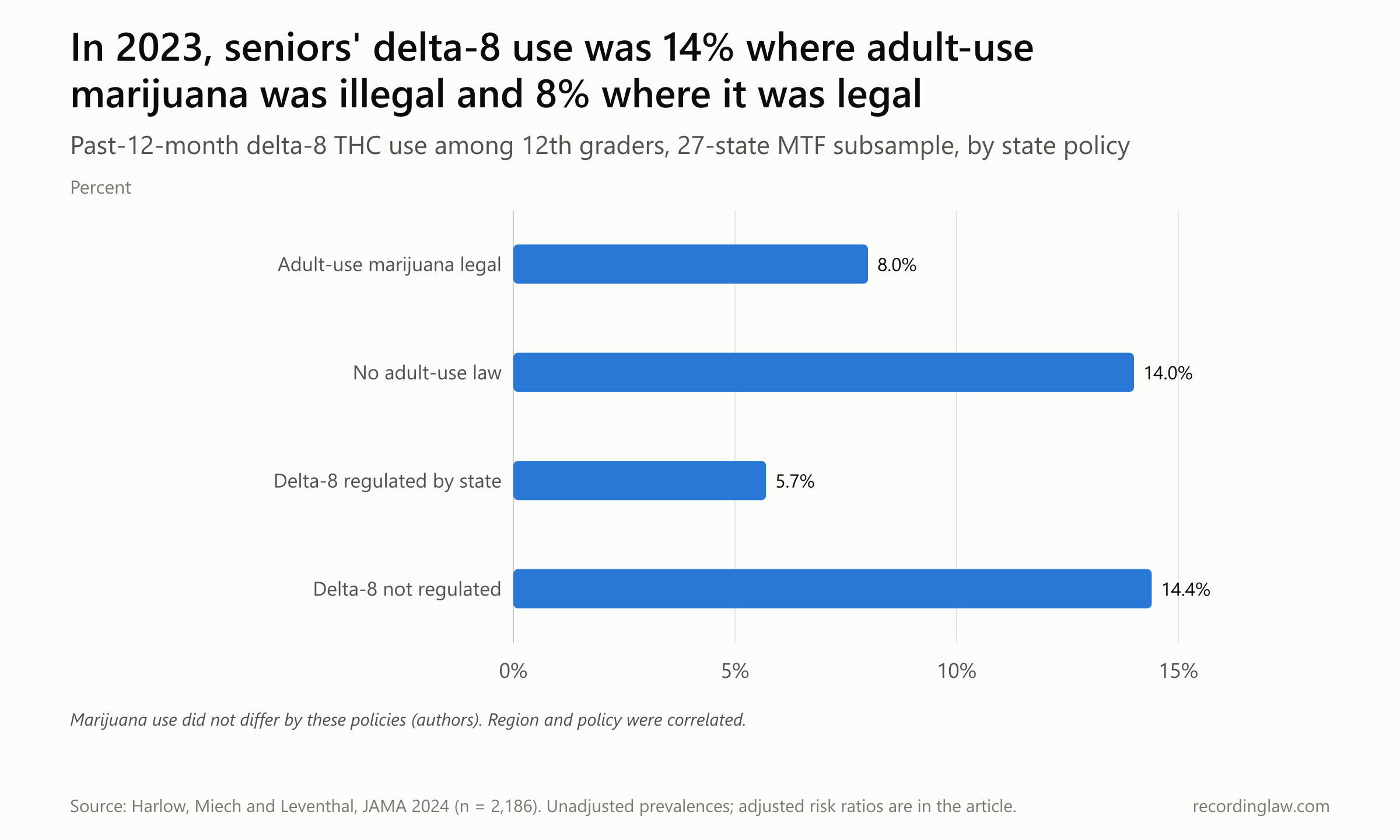
12th-grade past-year delta-8 use by state policy, 2023, 27-state MTF subsample. Source: Harlow, Miech and Leventhal, JAMA 2024.
| 12th graders, 2023, by state policy | Past-year delta-8 use |
|---|---|
| Adult-use marijuana legal | 8.0% |
| No adult-use marijuana law | 14.0% |
| Delta-8 regulated by state | 5.7% |
| Delta-8 not regulated | 14.4% |
In the 2,186 seniors from 27 states that Harlow, Miech and Leventhal analyzed, delta-8 use was 14.0% in states without legal adult-use marijuana and 8.0% in states with it. Marijuana use, by contrast, "did not differ by cannabis policies." Delta-8 use was 14.4% where states did not regulate delta-8 and 5.7% where they did. By region, it was 14.3% in the South against 5.0% in the West.
The authors offered one reading. Delta-8, they wrote, "may be marketed to and/or used by adolescents as a psychoactive cannabis substitute in places in which adult-use marijuana is illegal," and their study provided "preliminary evidence" that state delta-8 rules may be associated with lower use. They also listed its limits: the region and policy variables moved together, the sample did not include every state, and students who were absent or not enrolled were not surveyed.
SAM's statement on the 2023 results took a different angle. Its headline said marijuana use among minors was worse in states with commercial THC. "Normalization and commercialization of THC drugs and marijuana continues to have profound ramifications for the nation's young people," Sabet said. The JAMA team measured delta-8 and marijuana separately in its 27-state sample, so SAM's headline and the study's findings rest on different measures and samples.
Delta-8 use also differed by seniors' plans after school. Among seniors not headed to college, 16% had used delta-8 in the past year, against 9% of those who were.
States put an age on hemp
Without a federal age, states set their own, and their officials described what they found on the shelves. Florida went first among these.
Its 2023 law, SB 1676, took effect on July 1, 2023, and said hemp products for ingestion or inhalation "may not be sold in this state to a person who is under 21 years" of age. That July and August, the state agriculture department carried out a sweep aimed at products marketed to children. It inspected more than 700 businesses in all 67 counties and found more than 83,000 packages of hemp-extract products that, the department said, targeted children.
On October 31, 2023, inspectors issued stop-sale orders on 215,154 products at a Just Brands facility, citing sales of hemp products attractive to children. When they came back in January 2024, the department said, the products had been shipped to Chicago. "Prior to the changes made to Florida law in 2023, Florida's hemp industry was out of control and products were being sold without restrictions, including allowing sales to children," Agriculture Commissioner Wilton Simpson said.
California, which had legalized adult-use marijuana in 2016, set a 21-and-over rule for hemp food and drink products by emergency regulation in September 2024. "We will not sit on our hands as drug peddlers target our children with dangerous and unregulated hemp products containing THC at our retail stores," Gov. Gavin Newsom said.
Texas came at it after a veto. Gov. Greg Abbott vetoed SB 3, a ban on hemp-THC products, on June 22, 2025, saying it "would not have provided legally sustainable prohibition on access to hemp-derived products by children" and "did not respect the liberty of adults."
On September 10, 2025, he issued Executive Order GA-56, on protecting children from hemp and hemp-derived products. The order said minors "have been allowed to purchase these products without any safeguards." Under it, the Department of State Health Services adopted emergency rules on October 3, 2025, barring licensed and registered sellers from selling consumable hemp products to anyone under 21.
In Ohio, which legalized adult-use marijuana by ballot in 2023, Gov. Mike DeWine ordered a 90-day ban on the sale of intoxicating hemp products outside licensed dispensaries in October 2025. A Franklin County judge paused it with a temporary restraining order on October 14, the day it began. At his press conference, DeWine held up Stoner Patch Dummies, Nerdy Bears and Sour Infused Gummies, packaged to resemble Sour Patch Kids, Nerds Gummy Clusters and Gushers. "I think the danger to our children is clear," he said.
The hemp industry said the answer was an age limit, not a ban. "Instead of prohibition, Ohio should pursue regulation," said Jonathan Miller, general counsel of the U.S. Hemp Roundtable, a hemp industry trade group, listing age limits, third-party testing and accurate labeling. Michael Tindall of the Ohio Healthy Alternatives Association, a group of hemp retailers that sued over the order, called it "a gut punch to Ohio farmers and small businesses."
The enforcement figures these agencies published are counts of packages and products. They do not show how often a teenager could buy hemp THC before or after the rules.
Congress rewrites hemp
Congress took up the definition itself. A law enacted on November 12, 2025, Public Law 119-37, rewrote the hemp definition to exclude final products containing more than 0.4 milligrams of total THC and similar cannabinoids per container.
Both sides of the federal fight cited children. A stopgap spending bill carried a delay of the new definition, and Sen. Ted Budd, a North Carolina Republican, offered an amendment to strip it. "The packaging is unmistakably designed to appeal to children, using bright colors and intentionally mimicking popular snack food and candy brands," Budd said in August 2026, describing how easy it was for a child "to walk into a convenience store and pick up what looks like their favorite snack or candy." His amendment was tabled, 61-32.
A coalition of 105 organizations, including the U.S. Hemp Roundtable, the National Association of Convenience Stores and the National Restaurant Association, had asked senators for that delay. They argued, in a news account's summary, that the extra time could let lawmakers pass stronger regulation, "including measures aimed at keeping dangerous products away from children."
A stopgap spending law, a continuing resolution passed on September 2, 2026 (Public Law 119-103), carried the delay. In a report dated October 28, 2026, the Congressional Research Service said the stopgap law moved most of the new definition, including the 0.4 milligram cap, to December 11, 2026. The exclusion of certain synthetic cannabinoids, those a cannabis plant cannot produce naturally, kept its date of November 12, 2026, the report said.
The 2025 law also required the Food and Drug Administration to publish lists of cannabinoids, including those with effects like THC, within 90 days of enactment. As of the same report, FDA had not published them. The legal fight over those dates is told in our story on the federal hemp rewrite.
What the next surveys can show
The 2026 Monitoring the Future survey was fielded in the spring of 2026, before either federal hemp date. NIDA says results come out "each fall"; the last three adolescent releases came in mid-December.
As of November 10, 2026, the 2026 results had not been released. Whenever they appear, they are the last school reading taken before the scheduled federal hemp dates.
SAMHSA, which runs the federal household survey, would build its next state estimates from the 2024 and 2025 surveys. As of November 10, 2026, its state-releases page listed 2023-2024 as the latest and gave no release date for the next set.
In 2023, a third of seniors met a question about a product the 2012 ID check never covered. By 2025 the school survey had changed that question. It asked about "cannabis products made from hemp," a wider category that includes delta-8. In the past year, 9% of 12th graders, about one in 11, said they had used one, along with 6% of 10th graders and 2% of 8th graders.
Because the question changed, those numbers cannot be read as a rise or fall from the delta-8 figures. The one senior in nine who said yes in 2023 has no 2025 number to set beside it.
How we measured
Three surveys, kept apart. Monitoring the Future (MTF) is a school survey of 8th, 10th and 12th graders run by the University of Michigan with NIDA funding. Figures for 1991 to 2023 come from MTF Volume I, Table D-5 (read from a copy of the report hosted on justthinktwice.gov, a federal site). The 2024 figures come from NIDA's December 2024 release, and the 2025 figures are the rounded integers in NIDA's December 2025 release (23,726 surveys in 270 schools, February to June 2025).
The CDC Youth Risk Behavior Survey (YRBS) covers grades 9 to 12 and asks about the past 30 days. Its 1991 to 2017 values come from the CDC dataset on data.cdc.gov, and its 2019 to 2023 values are rounded values from the CDC's 2023 Data Summary and Trends report. The National Survey on Drug Use and Health (NSDUH), run by SAMHSA, is a household survey of people 12 and older. The three differ in population, mode and wording, and we never join them into one series.
Series breaks. MTF's 2020 sample was curtailed by the pandemic, and the survey moved to a web or tablet format from 2021. MTF's report says possible mode effects cannot be ruled out for some attitude estimates after 2020, but it does not flag prevalence.
The NSDUH national series starts in 2021 because SAMHSA says its multimode estimates from 2021 on are not comparable with 2020 or earlier. SAMHSA re-weighted 2021 for comparison. NSDUH's 2025 weighted interview response rate was 39.3% for adolescents and 8.5% overall. Confidence intervals for the 2021 to 2025 national figures are not shown.
YRBS asks students not to count CBD-only or hemp products, and NSDUH's marijuana estimates exclude CBD and hemp products, so neither captures delta-8. The CDC posted 2025 YRBS data in September 2026, but its 2025 report carries no marijuana indicator and the microdata are not analyzed here, so the latest YRBS figure here is 2023.
State groups. "Adult-use law by 2022" means 21 jurisdictions (20 states and the District of Columbia). Another 26 states had no adult-use law. Delaware, Maryland, Minnesota and Ohio, which legalized later, are excluded from both groups.
The classification comes from a tertiary list of state cannabis laws, and effective dates were not checked against each statute. Group figures are unweighted means of state estimates, not population-weighted.
YRBS state participation changes each year (15 to 25 states per group), so each year's means cover different states. NSDUH state figures are model-based two-year averages for 2023-2024. These are cross-sections, not before-and-after comparisons of the same states.
Delta-8 and hemp items. MTF asked 12th graders about delta-8 in 2023 (a random third of them) and added 8th and 10th graders in 2024. In 2025 the item became "cannabis products made from hemp," so the 2025 figures are not part of the delta-8 series.
The state-policy figures come from Harlow, Miech and Leventhal (JAMA, March 2024): a weighted cross-sectional analysis of 2,186 seniors in 27 states, policies coded as of January 1, 2023, without correction for multiple testing. In that subsample, delta-8 use was 11.4% and marijuana use was 30.4%. The adjusted risk ratio for delta-8 in legal versus non-legal states was 0.56 (95% CI 0.35 to 0.91), and for regulated versus unregulated states 0.42 (0.23 to 0.74). The 16% and 9% college-plan figures are from MTF Volume I.
The studies. Cerda and colleagues (JAMA Pediatrics, 2017) used a difference-in-differences design (comparing each legalizing state's change over time with the change in comparison states) on MTF 2010 to 2015, comparing Washington and Colorado with states that had not legalized. The Washington increases were 5.0 points for 8th graders (P = .03) and 3.2 points for 10th graders (P = .007).
Anderson, Hansen, Rees and Sabia (JAMA Pediatrics, 2019) used logistic regression with state and year fixed effects on pooled national and state YRBS data, unweighted (odds ratio 0.92, 95% CI 0.87 to 0.96). The paper says an event study was not included for lack of post-legalization data. Jones, Underwood and Volkow's 2020 letter disputed that method, and Anderson, Rees and Sabia replied in the same issue of JAMA Pediatrics.
Pawar and colleagues (Journal of the American Academy of Child and Adolescent Psychiatry, 2024) meta-analyzed 30 studies of adolescents and young adults: odds ratio 1.134 (95% CI 1.116 to 1.153) for recreational laws, 1.089 (1.015 to 1.169) for adolescents in more recent studies, and 0.981 (0.960 to 1.003) for medical laws. All are observational. None can rule out every other difference between states.
The estimates chart. Each plotted value is a published odds ratio restated as a percent difference in odds, (odds ratio minus 1) times 100, for the estimate and both ends of its 95% interval: 0.92 (0.87 to 0.96) becomes 8% lower (13% to 4% lower); 1.134 (1.116 to 1.153) becomes 13.4% higher (11.6% to 15.3%); 1.089 (1.015 to 1.169) becomes 8.9% higher (1.5% to 16.9%); and 0.981 (0.960 to 1.003) becomes 1.9% lower (4.0% lower to 0.3% higher). Cerda and colleagues report differences in percentage points, not odds, so they are in the table and the chart note rather than on the axis. Harlow and colleagues also report marijuana use by policy in percentage points: in their table, past-year use was 32.0% in states with legal adult use and 29.2% in states without, a risk difference of 2.8 points with a 95% interval of -5.6 to 11.2, not significant, so they too are in the table and the chart note. The outcomes are not identical: Pawar's estimates are for past-month use and Anderson's for marijuana use in the YRBS; in the table, Cerda's are for past-month use and Harlow's for past-year use among 12th graders.
Advocacy sources. The Marijuana Policy Project supports legalization and says it is "100% reliant on donations." Smart Approaches to Marijuana opposes it and says its support comes from family foundations, other organizations and concerned citizens. The U.S. Hemp Roundtable and the Ohio Healthy Alternatives Association represent the hemp industry.
The AP described the Center on Addiction as a prevention and treatment advocacy group. Colorado's Blue Book arguments were written by nonpartisan legislative staff, not by the campaigns. Hickenlooper's 2017 remark is quoted as Reason reported it from a Denver Post interview.
Arithmetic. "About one in nine" is 11.4%; "about one in 11" is 9%; "about two in three" is 66%. "About 8% lower" restates an odds ratio of 0.92. "About 13% higher odds" and "about 9% higher" restate odds ratios of 1.134 and 1.089. The 36% and 26% for seniors are the 2012 value (36.4%) and the 2025 rounded value.
Dates. The federal hemp dates (November 12 and December 11, 2026) and the FDA list status come from the Congressional Research Service's Legal Sidebar LSB11496 of October 28, 2026, and were the scheduled dates as of that report; either could have changed after it. MTF 2026 results had not been released as of November 10, 2026, and no release date had been announced. The NSDUH 2025 release date of July 27, 2026, comes from SAMHSA's press announcement.
What the data cannot show. National survey lines cannot isolate the effect of any one state's law, and the 2021 drop coincides with the pandemic and a change in survey mode. State comparisons start from groups that already differed in 2011. The state enforcement figures cited here are package and product counts, not compliance checks, so they cannot say how often teenagers bought hemp THC in stores before or after the age limits.
What comes next. The federal hemp dates scheduled as of the CRS report, November 12 and December 11, 2026, fall between two Monitoring the Future surveys. The 2026 survey was fielded before both; if the dates hold, the 2027 edition is the first spring survey fielded after them, and if NIDA keeps its schedule, its answers would arrive in late 2027.
Frequently Asked Questions
Did teen marijuana use go up after states legalized?
National surveys do not show a rise. In Monitoring the Future, past-year use among 12th graders was 36.4% in 2012, 37.1% in 2017 and 35.7% in 2019. It then fell to 30.5% in 2021 and 26% in 2025. Studies that compare states disagree. One found increases among 8th and 10th graders in Washington and none in Colorado, one found lower odds of use, and a 2024 meta-analysis found modestly higher odds of past-month use. None of these is a randomized experiment.
Why did teen cannabis use drop in 2021?
Monitoring the Future researchers attribute the 2020 to 2021 drop largely to the pandemic, which disrupted drug availability and teenagers' social lives. The survey also moved to a web format in 2021. Use did not rebound afterward. In 2024, past-year use among 12th and 10th graders was the lowest in three decades.
How many teens use delta-8 THC?
In Monitoring the Future 2024, 12.3% of 12th graders, 7.9% of 10th graders and 2.9% of 8th graders reported past-year delta-8 use. In 2025 the survey asked about cannabis products made from hemp, including delta-8, and 9% of 12th graders, 6% of 10th graders and 2% of 8th graders reported past-year use.
Is delta-8 use higher in states where marijuana is illegal?
In a 2023 subsample of 2,186 12th graders in 27 states, delta-8 use was 14.0% in states without legal adult-use marijuana and 8.0% in states with it. In the same subsample, it was 14.4% where delta-8 was unregulated against 5.7% where it was regulated. Marijuana use did not differ by state policy. The authors called the study exploratory and noted that region and policy were correlated.
Do teens in legal states use more marijuana?
In NSDUH 2023-2024 state estimates, 12- to 17-year-olds in the 21 jurisdictions with adult-use laws by 2022 averaged 7.3% past-month use, against 5.4% in the 26 states without. But the same group of states was already higher in 2011, before any state legalized: 22.7% against 19.2% past-month use among high school students in CDC data.
Is there a minimum age to buy hemp THC products?
There was no federal minimum purchasing age for delta-8 products, according to the 2024 JAMA study. Several states set their own. Florida made hemp products for ingestion or inhalation 21 and over in 2023, and California set 21 and over for hemp food and drink products by emergency rule in 2024. Texas set 21 and over through emergency agency rules adopted in October 2025 under a September 2025 executive order.
When did Congress set the new federal hemp definition to take effect?
The definition enacted on November 12, 2025, in P.L. 119-37 was delayed by a September 2026 stopgap law. According to a Congressional Research Service report dated October 28, 2026, the stopgap moved most of it, including a cap of 0.4 milligrams of total THC per container for final products, to December 11, 2026. According to the same report, the exclusion of certain synthetic cannabinoids, those a cannabis plant cannot produce naturally, kept its date of November 12, 2026.
Did adult marijuana use rise while teen use fell?
In SAMHSA's household survey, past-year marijuana use among adults 26 and older rose from 17.3% in 2021 to 20.6% in 2025. Over the same years, use among 12- to 17-year-olds fell from 10.9% to 8.7%, and use among 18- to 25-year-olds fell from 36.3% to 33.7%. SAMHSA says its estimates from 2021 on are not comparable with earlier years.
Updates
Reworded for readability. No figures, quotes, sources or findings changed.
Restructured as a feature: chart titles state the finding, side details moved to How we measured. Every figure and quote was re-checked against its source.
Independently fact-checked against the cited primary sources
Independently fact-checked against the cited primary sources
Sources and References
- NIDA, Reported use of most drugs remains low among U.S. teens (Monitoring the Future 2025 release, Dec 17, 2025)(nida.nih.gov).gov
- NIDA, Reported use of most drugs among adolescents remained low in 2024 (Dec 17, 2024)(nida.nih.gov).gov
- NIDA, Reported drug use among adolescents continued to hold below pre-pandemic levels in 2023 (Dec 13, 2023)(nida.nih.gov).gov
- NIDA, Monitoring the Future overview and release history(nida.nih.gov).gov
- Monitoring the Future National Survey Results on Drug Use, 1975-2023, Volume I: Secondary School Students (University of Michigan)(justthinktwice.gov).gov
- University of Michigan News, Missing rebound: youth drug use defies expectations, continues historic decline (Dec 17, 2024)(news.umich.edu)
- CDC, Youth Risk Behavior Survey Data Summary and Trends Report, 2013-2023(cdc.gov).gov
- CDC, Youth Risk Behavior Surveillance System high school data, current marijuana use (data.cdc.gov)(data.cdc.gov).gov
- CDC, YRBS data and documentation (2025 Youth Health in Focus report)(cdc.gov).gov
- SAMHSA, 2023-2024 NSDUH state estimates(samhsa.gov).gov
- SAMHSA, 2025 National Survey on Drug Use and Health Annual National Report(samhsa.gov).gov
- SAMHSA, Highlights for the 2025 National Survey on Drug Use and Health(samhsa.gov).gov
- SAMHSA press announcement on the 2025 NSDUH (July 27, 2026)(samhsa.gov).gov
- Congressional Research Service, In Focus IF13136 on the hemp definition (updated Sept 28, 2026)(everycrsreport.com)
- Colorado Legislative Council, 2012 State Ballot Information Booklet (Blue Book), Amendment 64(co.elstats2.civera.com).gov
- Washington State Legislature, text of Initiative 502(lawfilesext.leg.wa.gov).gov
- HuffPost Denver, interview with the Campaign to Regulate Marijuana Like Alcohol (Aug 28, 2012)(huffpost.com)
- KUNC, Amendment 64: to legalize pot or not (Sept 18, 2012)(kunc.org)
- Marijuana Policy Project press release (Dec 16, 2015)(mpp.org)
- Colorado Politics, addiction experts write to Gov. Hickenlooper (March 15, 2017)(coloradopolitics.com)
- Reason, quoting a Denver Post interview with Gov. Hickenlooper (March 31, 2017)(reason.com)
- KUNC, Data says no increase in teen pot use since Colorado legalization (Dec 18, 2017)(kunc.org)
- Cerda et al., recreational marijuana legalization and adolescent marijuana use, JAMA Pediatrics 2017(pmc.ncbi.nlm.nih.gov).gov
- Anderson, Hansen, Rees, Sabia, marijuana laws and youth marijuana use, JAMA Pediatrics 2019(pmc.ncbi.nlm.nih.gov).gov
- Associated Press via MPR News, Teen odds of using marijuana dip with recreational-use laws (July 8, 2019)(mprnews.org)
- Jones, Underwood, Volkow, Challenging the association of marijuana laws with teen marijuana use, JAMA Pediatrics 2020(pmc.ncbi.nlm.nih.gov).gov
- American Academy of Pediatrics news release on its 2015 marijuana policy statement (reprint)(enewspf.com)
- Stanford Medicine, Ammerman on the pediatrics academy's opposition to marijuana legalization (Jan 2015)(med.stanford.edu)
- Pawar et al., systematic review and meta-analysis of cannabis legalization and youth use, J Am Acad Child Adolesc Psychiatry 2024(pubmed.ncbi.nlm.nih.gov).gov
- Harlow, Miech, Leventhal, delta-8 THC use among US 12th graders, JAMA 2024(pmc.ncbi.nlm.nih.gov).gov
- Harlow, Miech, Leventhal, JAMA 2024 (PubMed abstract)(pubmed.ncbi.nlm.nih.gov).gov
- Keck School of Medicine of USC news release on the delta-8 study (March 2024)(keck.usc.edu)
- Smart Approaches to Marijuana press release (Dec 13, 2023)(learnaboutsam.org)
- Smart Approaches to Marijuana press release (Dec 17, 2024)(learnaboutsam.org)
- Smart Approaches to Marijuana, funding statement(learnaboutsam.org)
- Florida Senate, CS/CS/SB 1676 (2023), enrolled text(flsenate.gov).gov
- Florida Department of Agriculture and Consumer Services press release on hemp enforcement (June 24, 2025)(content.govdelivery.com)
- Florida Phoenix, FL Dept. of Agriculture cracks down on two hemp companies (July 11, 2024)(floridaphoenix.com)
- Office of the Governor of California, hemp emergency regulations (Sept 6, 2024)(gov.ca.gov).gov
- FOX 7 Austin, Abbott executive order GA-56 on hemp THC (Sept 10, 2025)(fox7austin.com)
- Ohio Capital Journal, DeWine executive order banning sale of intoxicating hemp products (Oct 9, 2025)(ohiocapitaljournal.com)
- Carolina Journal, Federal hemp fight puts Budd at center of debate (Aug 12, 2026)(carolinajournal.com)
- Ohio Capital Journal, Ohio stores can sell intoxicating hemp products again after judge pauses Gov. DeWine's ban (Oct 15, 2025)(ohiocapitaljournal.com)
- Congressional Research Service, Legal Sidebar LSB11496, Delay in Changes to Hemp Definition (Oct 28, 2026)(everycrsreport.com)
- Anderson, Rees, Sabia, Challenging the Association of Marijuana Laws With Teen Marijuana Use: Reply, JAMA Pediatrics 2020;174(1)(doi.org)
- Texas DSHS, emergency rules prohibiting the sale of consumable hemp products to minors under GA-56 (Oct 3, 2025)(dshs.texas.gov).gov
- Marijuana Policy Project, About MPP (funding statement)(mpp.org)
- SAMHSA, NSDUH state releases index(samhsa.gov).gov