Pennsylvania Has Sealed 57 Million Criminal Cases Since 2019, Nearly All Summary Offenses or Charges Without a Conviction

Independently fact-checked against primary sources (last audited November 9, 2026). · 14 primary sources cited on this page. How we verify our legal content
In March 2020, the pandemic closed courthouses, and clearing old criminal records came to what Community Legal Services of Philadelphia (CLS) called "a standstill" in virtually every jurisdiction in the country. CLS is the legal aid group that conceived and championed Pennsylvania's Clean Slate law. In Pennsylvania, a computer kept clearing records anyway.
"Clean Slate continued to be implemented in all but a few counties in Pennsylvania," the legal aid group wrote that spring. "2.8 million cases were sealed that month." No one filed a petition for any of them.
Before the computer, sealing an old misdemeanor in Pennsylvania, which hides it from public view, meant asking a judge. From November 2016, when state law began to allow it, to the spring of 2020, judges granted 1,463 of those petitions, by CLS's count. By April 2020 the automated process had sealed 75,869 misdemeanor conviction cases, which CLS put at about 52 times as many.
By January 16, 2026, the Administrative Office of Pennsylvania Courts (AOPC) had counted 57.5 million cases sealed under the state's Clean Slate law. The sponsors sold the law as a way back into jobs and housing for people with old, minor records. Nearly all of the 57.5 million are the smallest kind of case: summary convictions, the least serious grade of offense, and charges that never ended in a conviction.
That leaves two questions. How did a law sold on old misdemeanors come to seal mostly something else? And why can Pennsylvania count every case it has hidden but not say whether hiding them helped anyone get hired? The second has a short answer: the state keeps sealed records closed to researchers as well as the public.
What the computer sealed
Most of the count is the smallest kind of case the courts handle. In the courts' January 2026 totals, 34.4 million of the sealed cases, about 60%, were summary convictions. Another 22.8 million, about 40%, were cases that did not end in a conviction.
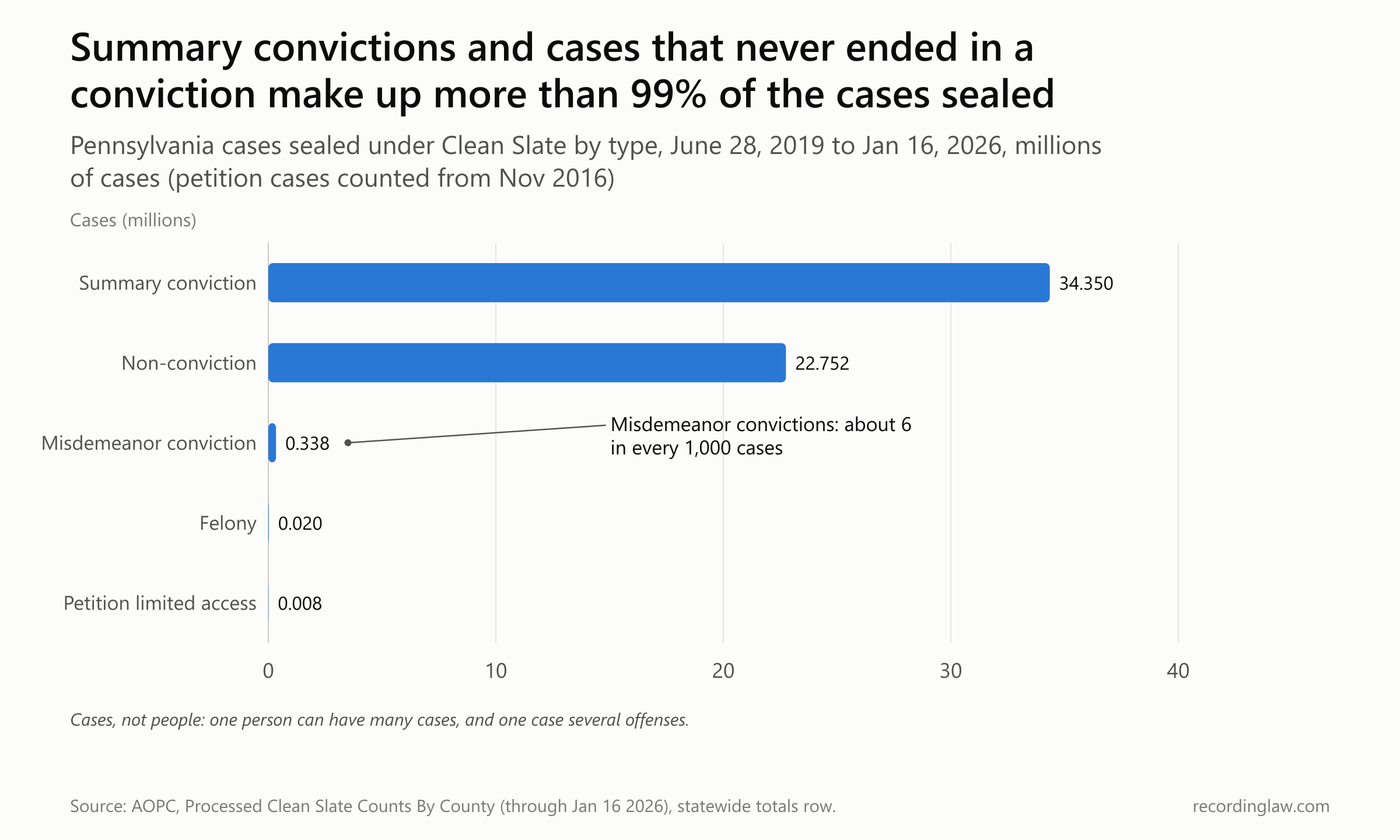
Cases sealed by type, June 28, 2019 to January 16, 2026; petition limited-access cases are counted from November 2016. Source: AOPC, Processed Clean Slate Counts By County, statewide totals row.
Summary and non-conviction cases together make up more than 99 of every 100 cases sealed.
| Type of case | Cases sealed | Offenses sealed |
|---|---|---|
| Summary conviction | 34,350,018 | 34,883,710 |
| Non-conviction | 22,752,042 | 46,686,398 |
| Misdemeanor conviction | 337,649 | 449,484 |
| Felony | 20,145 | 26,135 |
| Petition (limited access) | 8,155 | 15,762 |
| Total | 57,468,009 | 82,061,489 |
Misdemeanor convictions, the old, minor convictions the sponsors talked about most, account for about 6 of every 1,000 sealed cases. Felonies, added later, are fewer than 4 in every 10,000.
Nor is the count a count of people. A single case can carry several charges, which the courts count as offenses, and one person can have many cases. Counted by offense, the sealing through January 2026 comes to 82.1 million. Counted by case, it is 57.5 million. Counted by person, it is far fewer: the figures run from about 950,000 in 2020 to 1.7 million, depending on who counted and when.
| As of | People | Counted by |
|---|---|---|
| April 2020 | 948,162 | State Police, via CLS |
| December 15, 2023 | More than 1.2 million | AOPC, via SEARCH |
| September 27, 2024 | 1,665,187 | State Police, via SEARCH |
| 2025 | More than 1.7 million | Clean Slate Initiative (advocacy) |
These counts come from different agencies and are not one series. Still, every official figure is in the hundreds of thousands or low millions of people, against tens of millions of cases.
The mix goes back to how the law was designed, and to the lawyers who thought it up.
Why hand the job to a computer?
The idea came from lawyers who had been clearing records one client at a time. Clean Slate "is the brainchild of Community Legal Services (CLS) and the Center for American Progress (CAP)," CLS wrote on the day it was signed. "CLS had been filing thousands of expungement petitions each year, but recognized that this filing process could only help the small fraction of people with records whom we could represent."
The fix they proposed was to let the courts find eligible records themselves and seal them without a petition. In June 2017 a Senate version, SB 529, cleared committee in Harrisburg; the Philadelphia Inquirer reported it could be the first law of its type in the nation. "Someone who has committed a minor offense 20 years ago should not still be judged for that crime today," said its Republican cosponsor, Sen. Scott Wagner of York.
The sponsors came in pairs from opposite parties. In the House, CLS noted, Rep. Sheryl Delozier, a Cumberland County Republican, and Rep. Jordan Harris, a Philadelphia Democrat, "often have strongly divergent political viewpoints, but came together on this bill." In the Senate, Wagner worked with Sen. Anthony Williams, a Philadelphia Democrat.
Wagner was also the Republican running against Democratic Gov. Tom Wolf in the 2018 election, and both men supported the bill, Billy Penn reported, as did the Koch-backed group Americans for Prosperity and Philadelphia Eagles players Malcolm Jenkins and Chris Long and former Eagle Torrey Smith.
The businesses that hire had a question first. The Pennsylvania Chamber of Business and Industry, by its own account, came to the bill asking "how are employers impacted? Could there be liability concerns for businesses?"
The Chamber's answer was an amendment. Alex Halper, its director of government affairs, later wrote that the Chamber "worked with employment attorneys and bill advocates to draft targeted liability protections for employers." "This amendment was ultimately added to the legislation, and we agreed to be listed as a supporter of the bill that became Act 56 of 2018." Writing after a 2022 hearing, he added that employers appreciated the protections "even if they’ve not yet cited that provision in litigation."
CLS's list of backers named the Chamber alongside the Pennsylvania AFL-CIO and the Pennsylvania District Attorneys Association. House Bill 1419, the bill that became Act 56 of 2018, passed the House 188-2 on April 11, 2018, and the Senate approved it 49-0 on June 22.
Wolf signed it on June 28, 2018. Afterward Williams, Wolf and Harris posed for pictures. In a conference call with several groups before the signing, Wolf had said that a minor offense is frequently "a life sentence to poverty" for people dogged by decades-old convictions. "It's one strike and you're out," he said.
The sponsors' promises were specific enough to test. "They have shown that they have reformed their lives, and this barrier to employment and housing needs to be removed," Delozier said in a statement from Wolf's office.
Harris described what the law would mean at a hiring desk. "If this person is applying for a job, their answer is no," he said. "And our hope is that folks who have ten years free from crime won’t commit any. Quite honestly, the statistics show that."
Sharon Dietrich, CLS's litigation director, made a promise about price. "Clean Slate will do so much good for so many people, at almost no cost," she said.
The law covered two kinds of records, as the courts later summarized them: offenses with non-conviction dispositions, and "eligible summary and non-violent misdemeanor convictions more than 10 years old for which all court-ordered obligations have been completed." The words about obligations would come up again.
Clean Slate seals records; it does not expunge them. A sealed record still exists, and police and prosecutors can still see it. Landlords and most employers cannot, WHYY explained on the day automated sealing began. The site's guide to Pennsylvania's expungement and sealing rules covers eligibility under the current law.
The computer switched on a year to the day after the signing.
The first year outran the forecast
Automated sealing began on Friday, June 28, 2019.
The courts had made their own forecast. AOPC estimated that more than 30 million cases and 40 million charges would be sealed by automation, "including 41% of all charges and 51% of all cases in its database," CLS reported.
Dietrich predicted a record. She told WHYY that "it is quite possible that in the first week more cases will be sealed by automation than have ever been sealed in the entire history of the United States." Coverage that day projected that about 2.5 million cases would be sealed each month until the process was complete.
March 2020, the month courts closed, came in above that pace at 2.8 million. By May 5, 2020, AOPC said, "over 34 million cases and nearly 47 million offenses have been sealed from public view." The forecast had been passed in less than a year. At the first anniversary, Rebecca Vallas, a senior fellow at the Center for American Progress, the law's other co-originator, said the law had "brought much-needed relief to more than 1 million Pennsylvanians."
How far did the count go after that first rush?
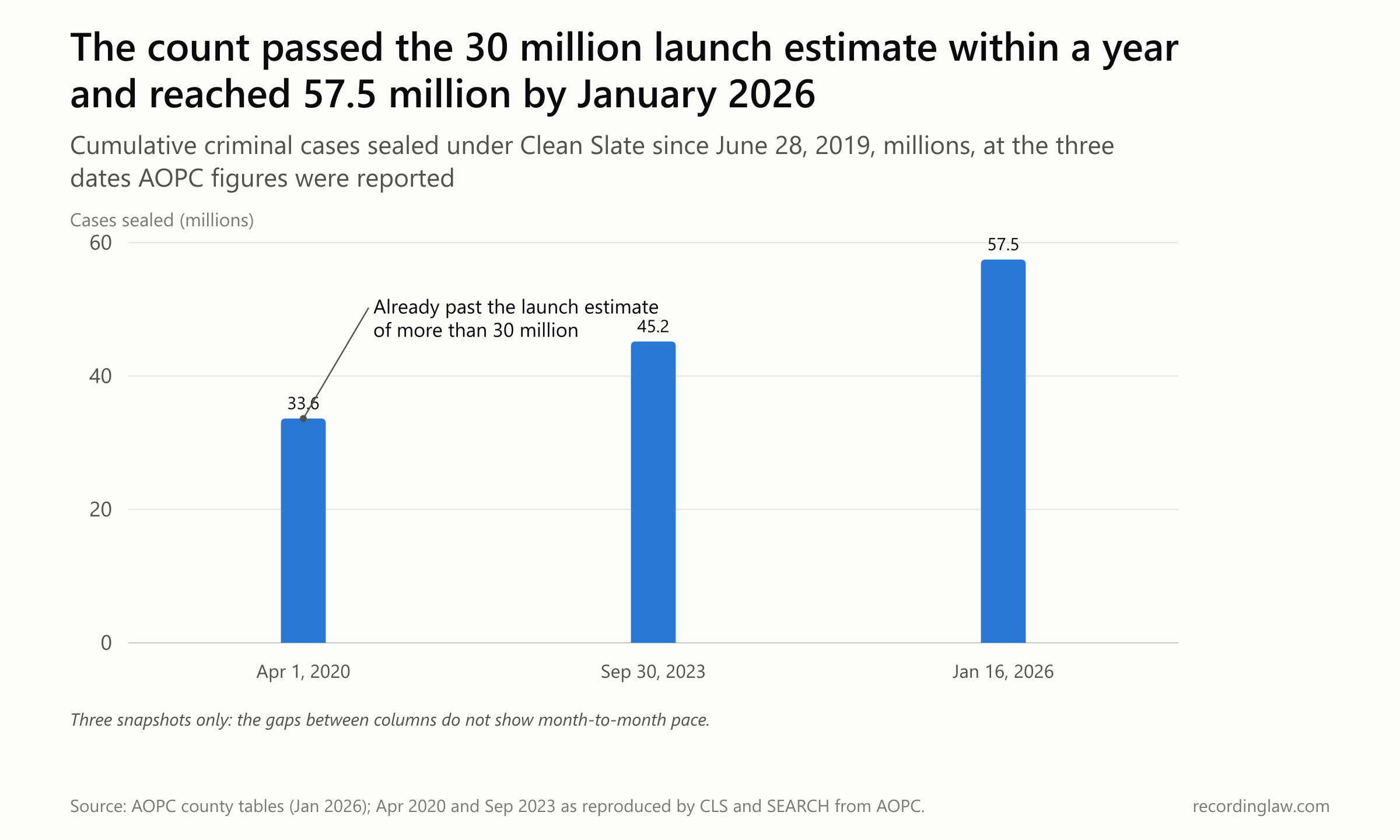
Cumulative cases sealed, three AOPC-reported snapshots; the gaps between them do not show month-to-month pace. Source: AOPC county table (January 2026); April 2020 and September 2023 as reproduced from AOPC by Community Legal Services and SEARCH.
The count kept climbing as new cases became eligible and the law was widened twice, to 45.2 million cases by September 2023 and 57.5 million by January 2026.
| As of | Cases sealed | Offenses sealed | Reported by |
|---|---|---|---|
| April 1, 2020 | 33,631,986 | 45,416,064 | AOPC, via CLS |
| September 30, 2023 | 45,178,422 | 67,458,201 | AOPC, via SEARCH |
| January 16, 2026 | 57,468,009 | 82,061,489 | AOPC county table |
Dietrich's "almost no cost" can be checked too. SEARCH, a national consortium for justice information, reported that the law passed as an unfunded mandate and that, counting implementation costs reported as of January 2021, "its estimated total cost to the state was just under $3 million."
The rush was made of summary offenses and non-convictions. The old misdemeanors the sponsors had talked about came through far more slowly.
Why the misdemeanors came slowly
CLS, the law's chief advocate, explained the lag itself in its May 2020 report. "The numbers of misdemeanors sealed by Pennsylvania Clean Slate have been suppressed for three main reasons," it wrote: "Missing grade data; Outstanding legal financial obligations; and Other policy design choices embedded in the statute." The design choices it named were the 10-year wait, the exclusion of many offenses and other disqualifications.
Missing grades were a records problem, concentrated in Philadelphia. The grade is the entry that marks an offense's class and degree, such as a second-degree misdemeanor or a third-degree felony, and without it the computer could not tell whether a conviction qualified. "The practice of the Philadelphia District Attorney's Office (the PDAO) for years to not enter grade data has exacerbated this problem," CLS wrote. Under a January 2020 court order, AOPC estimated that grades would be inserted for about 1 million offenses in 300,000 Philadelphia cases.
Court debt was a policy choice. The original law required every court-ordered obligation to be paid. The Philadelphia District Attorney's Office later found, according to SEARCH, that court debt had kept half of otherwise eligible misdemeanor convictions statewide out of automated sealing. The median amounts were a few hundred dollars: a 2018 analysis by the same office put the median balance owed at $275 in Philadelphia Municipal Court and $551 in Common Pleas Court, WHYY reported.
The legislature changed that rule. On December 18, 2019, the House unanimously approved House Bill 440, which let cases be sealed despite unpaid fines and costs "unless restitution is owed." It became Act 83 of 2020, signed October 29, 2020, and its automated provisions took effect in December 2021. Unpaid restitution still bars sealing.
How much did the misdemeanor count move after that?
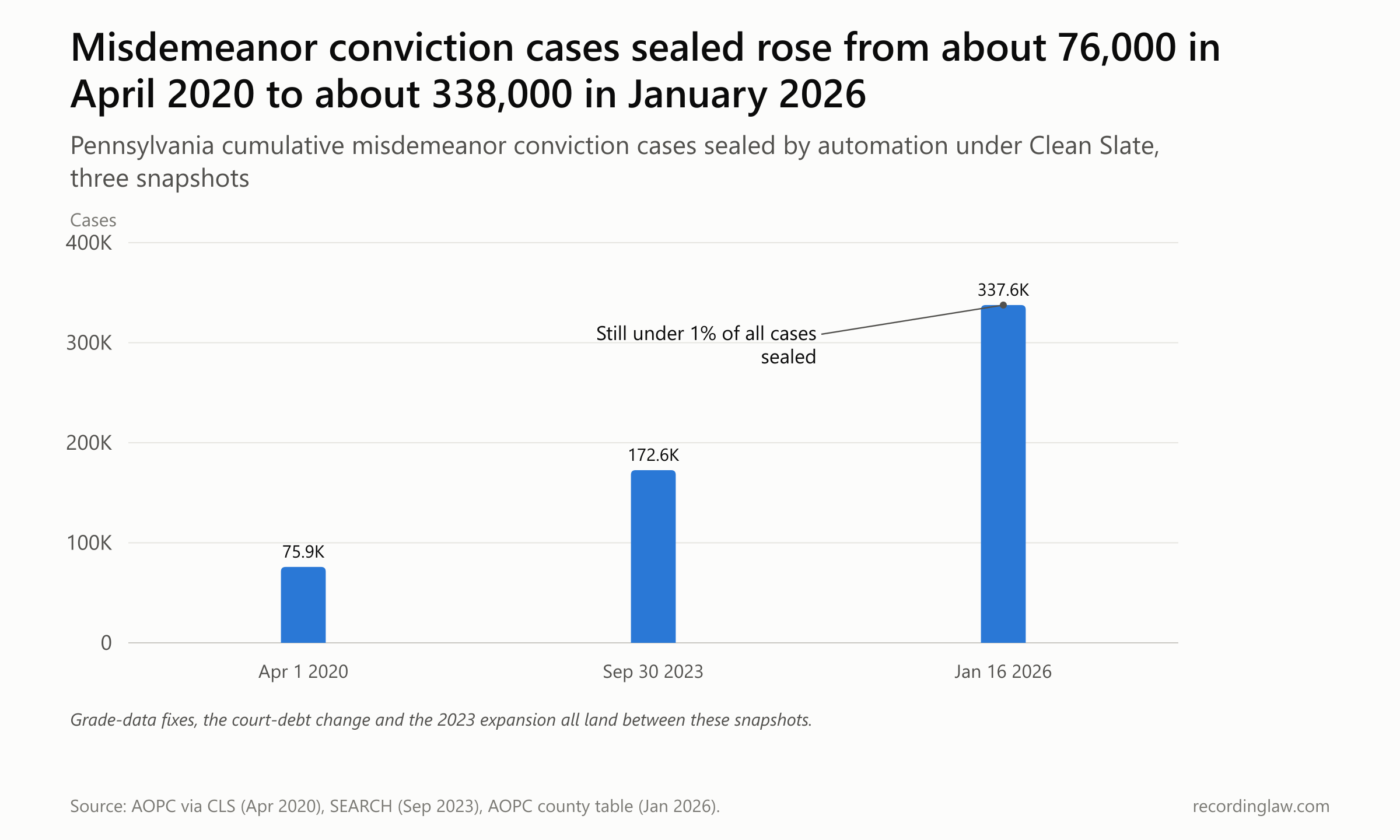
Cumulative misdemeanor conviction cases sealed by automation. Source: AOPC via CLS (April 2020), SEARCH (September 2023) and the AOPC county table (January 2026).
Misdemeanor conviction cases sealed more than quadrupled from April 2020 to January 2026, from about 76,000 to about 338,000. Several changes landed in that window, including the grade-data order, the court-debt fix and the 2023 expansion, so the snapshots cannot separate one from another.
| As of | Misdemeanor conviction cases sealed |
|---|---|
| April 1, 2020 | 75,869 |
| September 30, 2023 | 172,608 |
| January 16, 2026 | 337,649 |
Researchers had warned that automation would leave people behind in exactly these ways. Colleen Chien, a researcher at Santa Clara University School of Law, wrote in the Michigan Law Review in 2020: "Debt-related barriers and dirty data can contribute to incomplete automation, leading to “second second chance gaps.”" Applying the criteria to minor offenses but not major ones, she added, could widen racial disparities among people with records. A study funded by the Clean Slate Initiative (CSI), a national advocacy group, and conducted by RTI International found, in CSI's summary, that Pennsylvania's current eligibility criteria disproportionately exclude Black Pennsylvanians, particularly in misdemeanor cases.
While advocates were pushing to seal more, a newspaper found places that had sealed too much.
When counties sealed too much
In May 2022, a PennLive investigation found criminal records being hidden that the law never meant to hide. That is how Sen. Lisa Baker, a Republican lead sponsor of the later expansion in the Senate, described it in a 2024 handout from her office.
The law required specific offenses that ended without a conviction to be sealed. Many county clerks of courts read that to mean the entire docket, the court's record of a case and every charge in it. "As a result, counties were blocking access to entire cases where defendants were convicted of serious crimes like rape and murder simply because one or two minor charges were withdrawn," the handout says.
A Senate amendment "fixed this misapplication of the law by clarifying the provision in question," the handout says. The fix rode in on the law's biggest expansion.
The 2023 expansion reaches felonies
The push to widen the law reached a House Judiciary Committee hearing on August 31, 2022. Prosecutors, the Chamber and Americans for Prosperity testified for it.
The background-screening industry made its case in writing. The Consumer Data Industry Association, the trade group for credit bureaus and background-check companies, sent written opposition to one section of the bill. It told the committee: "We respectfully believe that employers, property managers and educational institutions should know if a prospective employee, tenant, or student has any form of criminal conviction(s) and have access to such records."
The CDIA also warned about mistakes. A ban on using sealed records for employment, housing or school, it wrote, would "pose issues in the event there was an error on the courts part, or they did not conspicuously note the limited-access order in the docket and records were incorrectly obtained."
Some warnings came from the law's own supporters. The Pennsylvania District Attorneys Association, which backed the law, told legislators in 2022 that sealed records could still leak, because people "can seek criminal records from many different law enforcement agencies that are not tasked with record sealing and often do not receive notice of sealing."
The same association made the public-safety case for widening it. "Recidivism rates are lower among those who are employed after they are released," said Dauphin County District Attorney Fran Chardo, who chaired the association's legislative committee. "Record sealing helps lead to better opportunities for employment, and, therefore, helps to improve public safety."
"This is not a Republican issue. This is not a Democrat issue," Delozier said at a press conference after the hearing. "This is a people issue. This is a jobs issue."
The bill that passed was HB 689, which Delozier promoted as giving people "with certain low-level, nonviolent felonies access to employment and housing opportunities they may otherwise be barred from." The House approved it 189-14 on June 5, 2023. On December 13 the Senate passed an amended version 47-3, and the House concurred 153-50 the same day. Democratic Gov. Josh Shapiro signed it on December 14, 2023, as part of a package of more than a dozen criminal justice changes, Spotlight PA reported.
Shapiro said the package was "going to help Pennsylvanians who want to rebuild their lives and meaningfully contribute to their communities." Harris, now the prime sponsor, called it "about providing opportunities to those who’ve earned second chances."
As Act 36 of 2023, it added automatic sealing of qualifying drug felony convictions after 10 years without a new conviction, and let some property felonies be sealed by petition. It cut the wait for misdemeanors to seven years and for summary convictions from 10 years to five.
It barred use of sealed records for employment, housing or school admission except where federal law requires it, a provision like the one the CDIA had opposed in 2022, and it made expungement automatic after a pardon, a change Lt. Gov. Austin Davis, a Democrat, had sponsored as a state representative. The felony provisions took effect on June 11, 2024.
At a ceremonial signing that month, the Chamber's president and chief executive, Luke Bernstein, gave the business case in the Chamber's own numbers: "Pennsylvania currently has 74 available skilled workers for every 100 available jobs." Shapiro's office said the law "impacts 6 million criminal records involving summary convictions" and that the State Police planned "to test the system in the fall and roll out the program by next year."
Six and a half million records at 24 a minute
The courts identified about 6.5 million newly eligible records, most of them summary offenses, SEARCH reported, and every one of them had to go to the State Police for a check. The police began receiving batches in July 2024.
At first, SEARCH reported, the police system "could only process about 24 records per minute" without slowing the criminal justice information system for its other users. At that rate, 6.5 million records would take about six months of round-the-clock processing; SEARCH said the police later adjusted the speed.
Most of those checks were expected to come back empty. An AOPC analysis, as SEARCH reported it, estimated that only about 200,000 of the newly eligible cases would have a matching State Police record, which SEARCH put at "a little over 3%" of the total, because of the same fingerprint gap between the two record systems. The police expected to finish analyzing the 6.5 million records "by early 2025."
The felony expansion has so far been small in the courts' counts. By January 16, 2026, AOPC had sealed 20,145 felony cases. As of September 27, 2024, the State Police repository had sealed 18 felony conviction charges, against 10,000,790 non-conviction charges.
Every one of these laws was sold on what sealing would do for people afterward. No independent study has measured that part in Pennsylvania.
Did sealing help anyone get a job?
Harris set out the hope in 2018: people with sealed records would answer "no" on job applications, and people ten years clear of crime would stay clear. Pennsylvania cannot run that test on its own data. "No members of the public, including researchers, have access to sealed records in Pennsylvania," SEARCH reported.
So the evidence comes from petition systems, where a person has to apply. Two studies measured how many eligible people those systems actually reach. Neither measured automatic sealing like Pennsylvania's.
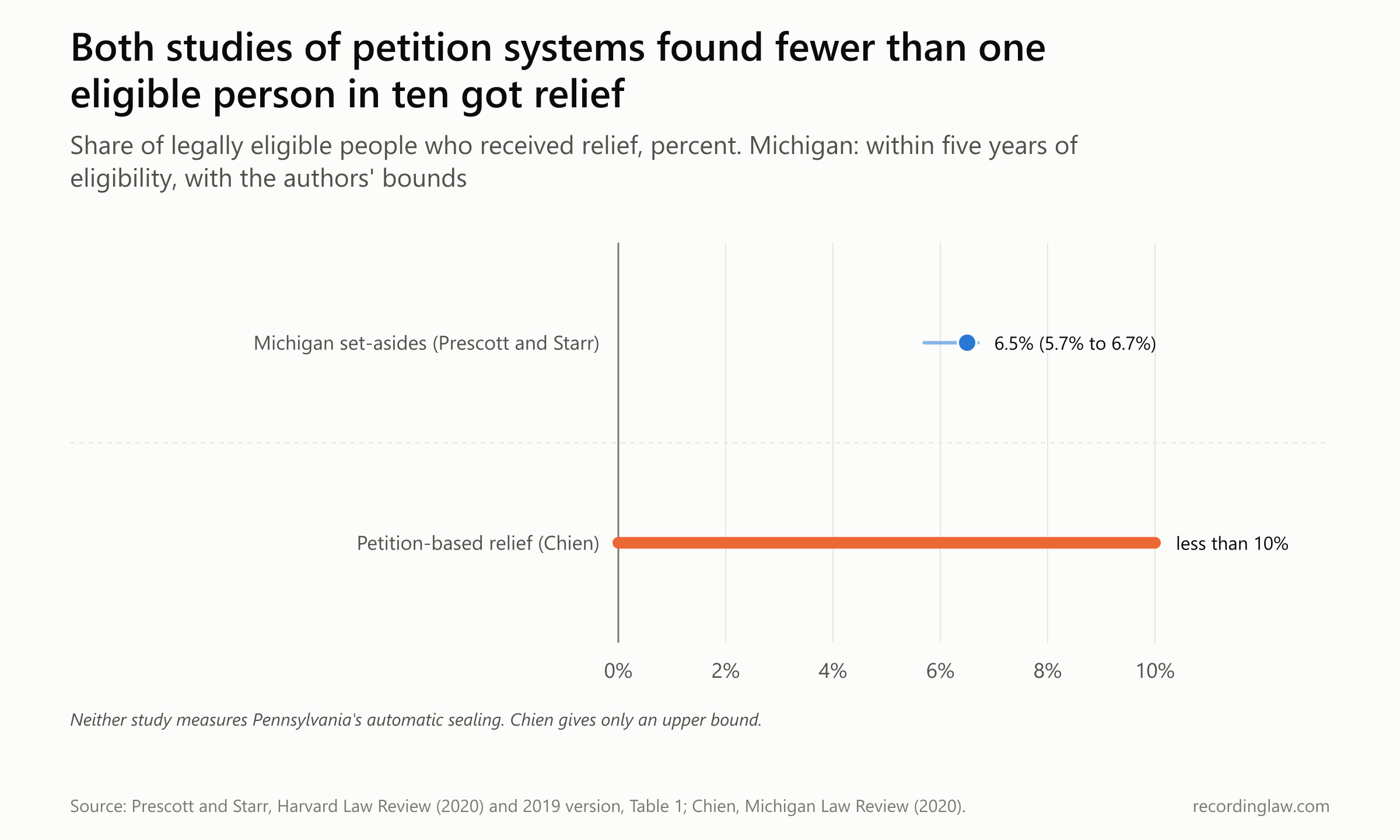
Share of legally eligible people who received relief under petition systems. Source: Prescott and Starr, Expungement of Criminal Convictions: An Empirical Study; Chien, America's Paper Prisons (Michigan Law Review, 2020).
The main outcome study comes from Michigan, and Michigan sealed records by petition, not by computer. J.J. Prescott and Sonja Starr of the University of Michigan Law School, funded by the National Science Foundation, followed statewide records of people who received set-asides (Michigan's form of expungement) and comparable people who did not.
In Michigan, about one eligible person in 15 got a set-aside within five years. "Among those legally eligible for expungement, just 6.5% obtain it within five years of eligibility," the authors wrote.
| Outcome within five years (Michigan) | Share of eligible people |
|---|---|
| Received a set-aside | 6.5% |
| Applied and denied (extrapolated) | 2.3% |
| Did not apply (extrapolated) | 91.2% |
Chien's own research, funded by Santa Clara Law, the Chan Zuckerberg Initiative and the Brin Family Foundation and using data from the background-check company Checkr, covered a wider set of petition programs, from clearing convictions to shortening sentences and restoring the vote. It found that "less than 10 percent" of people eligible for that relief received it.
Michigan also measured what happened next. Of the people who got relief, 7.1% were re-arrested and 4.2% were reconvicted within five years. Their quarterly wages rose, by the authors' before-and-after estimate, about 23% within a year and 25% within two, compared with their own trend before the set-aside. The authors cautioned that some of that gain may reflect people seeking a set-aside when they were already motivated to improve their situation.
The authors warned against reading those results onto everyone. "Expungement recipients are, again, an unrepresentative sample of individuals with criminal records," they wrote. "Primarily, they are self-selected."
Judges also screened them: "we cannot assume that subsequent crime rates for people who are not selected in the same way would be as low." Pennsylvania's automatic sealing has no judge in that role.
They also offered a counterpoint. Results from people who got relief soon after becoming eligible, they wrote, "suggest that similar employment benefits might accrue in states that make expungements automatic after a fixed period of time post-conviction." Their reassurance to employers and landlords was limited to "petition-based expungement laws with comparable requirements and waiting periods."
The Pennsylvania data that do exist were commissioned by the Clean Slate Initiative, the national advocacy group behind the model. The RTI study it funded used state sentencing data on people convicted from 2008 to 2010, not on people whose records were sealed. By CSI's summary, reconviction rates for people with misdemeanor and qualifying drug-felony convictions "drop steadily after one year and fall to 5% or less within five years," which CSI reads as a case for shorter waiting periods.
In a YouGov survey CSI commissioned, using an opt-in online panel of 800 people with records (58% in Pennsylvania), 42% of those with automatically sealed records reported improvements in employment and finances. There was no comparison group, and the outcomes were self-reported.
The same survey asked whether people knew the law existed. Of respondents who thought they might be eligible, "only 24% of this group had heard of their state’s Clean Slate law before taking the survey." Chien had flagged that question in 2020, calling for research on automated clearance "when the defendant is not notified of the relief received."
Meanwhile, other states copied the model.
Where the model went next
Pennsylvania's law became a template, and each state wrote its own eligibility rules (the site's expungement guide by state covers them). Utah and New Jersey followed in 2019, by the Clean Slate Initiative's count.
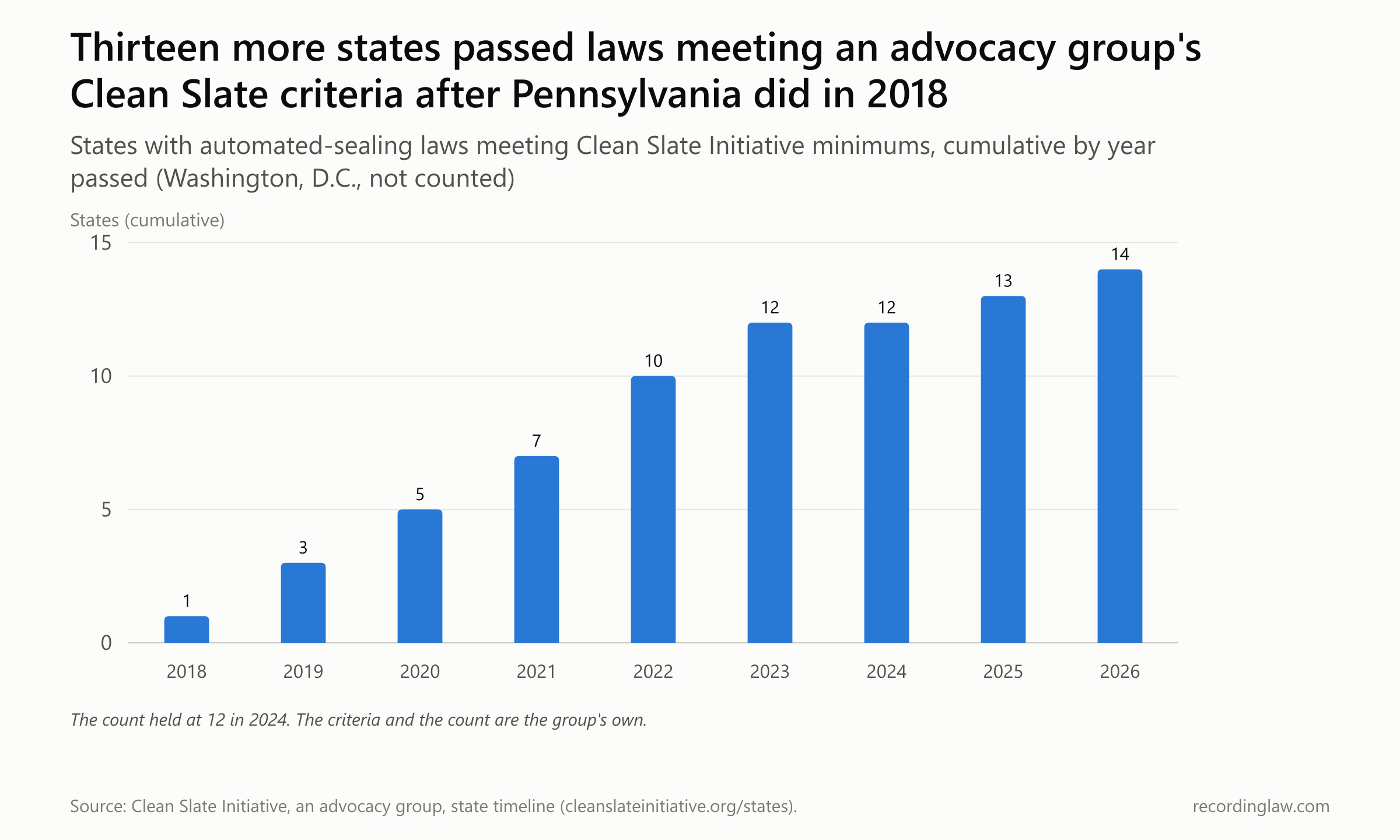
States passing laws that meet the Clean Slate Initiative's minimums, cumulative by year passed; Washington, D.C., not counted. Source: Clean Slate Initiative, an advocacy group.
The count rose every year from 2018 to 2023, paused in 2024 and resumed with Illinois and Missouri.
| Year passed | States added (CSI timeline) | Cumulative |
|---|---|---|
| 2018 | Pennsylvania | 1 |
| 2019 | Utah, New Jersey | 3 |
| 2020 | Connecticut, Michigan | 5 |
| 2021 | Delaware, Virginia | 7 |
| 2022 | California, Oklahoma, Colorado (and D.C.) | 10 |
| 2023 | Minnesota, New York | 12 |
| 2024 | None listed | 12 |
| 2025 | Illinois | 13 |
| 2026 | Missouri | 14 |
The list uses CSI's own criteria: automated sealing upon eligibility, including arrest and misdemeanor records. CSI estimates that more than 18 million people are eligible for full or partial sealing in those states and D.C. The site has covered several of those laws, in New York, Delaware, Virginia, Illinois and Missouri.
The screening industry had made its general case in Missouri. The Professional Background Screening Association, another screening-industry trade group, testified against an automatic-sealing bill there in 2023, saying "we cannot support this legislation as written because it will lead to significant risk for Missouri employers and landlords." It cautioned against sealing records showing escalating crime, "as the potential for harm to coworkers, customers, and tenants greatly increases if an individual should choose to recidivate," and cited a 2010 Justice Department-funded study by Alfred Blumstein and Kiminori Nakamura in support of longer waiting periods. Missouri became the 14th state on CSI's list in 2026.
Federal records are a separate matter. CLS flagged the gap in 2020: Pennsylvania's sealed cases "continue to be reported on FBI background checks," it wrote, because until recently only members of a federal "Compact Council" could keep such cases off those checks, and Pennsylvania had not joined. CLS added that the FBI had recently developed procedures for non-member states and said it was optimistic the flaw would be corrected.
In its January 2025 profile, SEARCH still advised people to review FBI records, "as they may include additional information (e.g., sealed records from Pennsylvania and/or out-of-state records)." The site explains how to check whether a record has been cleared.
In Pennsylvania, the next proposal is cannabis. At a House Democratic policy hearing in Philadelphia on April 20, 2026, CLS attorney Jamie Gullen argued for automatic marijuana expungement built on the Clean Slate model. "You can’t reach that type of scale and scope without having automated mechanisms," she said. A legalization bill that passed the House in 2025, and would have automatically expunged cannabis arrests and convictions, was rejected in the Republican-controlled Senate.
What the tally leaves out
The courts' latest county file runs through January 16, 2026, and AOPC has posted no schedule for the next one. The State Police check of the 6.5 million summary records, due "by early 2025," has no published completion that we could find. The felony count, 20,145 cases at the last tally, is the courts' only published measure of the felony expansion so far, and it will not change until the next file appears.
In March 2020 the computer sealed 2.8 million cases in a month while the courthouses were closed, and no one filed a petition for any of them. It is still running, and the courts can report every case it has hidden, by county and by type. Whether the people behind those cases got the jobs and housing Delozier described, and whether those ten years clear stayed clear as Harris hoped, is not in the tally. Unless the state opens sealed records to researchers, SEARCH wrote, "it will be difficult to determine the intended long-term impacts of Clean Slate, beyond tallies of records sealed."
How we measured
Case and offense counts. Statewide totals come from three AOPC-reported snapshots: April 1, 2020 (AOPC figures reproduced in Community Legal Services' May 2020 implementation report), September 30, 2023 (AOPC table reproduced by the SEARCH Clean Slate Community of Practice) and January 16, 2026 (AOPC's "Processed Clean Slate Counts By County," the primary file, the latest edition found on October 31, 2026). AOPC's May 5, 2020 statement ("over 34 million cases and nearly 47 million offenses") is a lower bound and is not charted. No monthly or annual AOPC series was found, so the cumulative chart shows three snapshots and says nothing about pace between them. Grand totals include petition limited-access cases (8,155 in January 2026, counted from November 2016, when petitions began) and, from mid-2024, felony cases.
Cases, offenses and people. Launch-day coverage did not agree on the unit: the ABA Journal noted that the Morning Call and CLS put the eligible number at 30 million cases, while WHYY and PennLive said 40 million, a count of charges.
Shares. Composition percentages divide each type's case count by the 57,468,009 total in the same January 16, 2026 row: summary 59.8%, non-conviction 39.6%, misdemeanor conviction 0.59%, felony 0.035%, petition 0.014%. Misdemeanor growth is 337,649 divided by 75,869, about 4.5 times. "About 6 of every 1,000" is 337,649 divided by 57,468,009; "fewer than 4 in every 10,000" is 20,145 divided by the same total. The "thirteen more states" in the states chart is CSI's count of 14 minus Pennsylvania. AOPC's launch estimate of "more than 30 million" cases was a minimum for the one-time backlog, so we compare it with the 33.6 million counted by April 1, 2020, not with the 2026 total, which adds 6.5 years of newly eligible cases and two expansions of the law.
People. People counts come from different agencies and counters and are not one series: the State Police counted 948,162 State Identification Numbers with at least one case sealed in April 2020 (via CLS) and 1,665,187 people with at least one charge sealed on September 27, 2024 (via SEARCH); AOPC reported "more than 1.2 million" people on December 15, 2023 (via SEARCH, a lower bound); the Clean Slate Initiative, an advocacy group, says "more than 1.7 million" as of 2025. The courts count cases; the State Police count people in a criminal-history repository that holds only fingerprint-supported records and so, as SEARCH notes, "maintains far fewer records than the courts." When AOPC reported more than 45 million cases sealed in December 2023, it said they involved "more than 1.2 million Pennsylvanians." Rep. Sheryl Delozier, a Republican sponsor of the law, cited the same figure the day Clean Slate 3.0, the 2023 expansion of the law, was signed. We did not divide cases by people, because no single source gives both on the same basis and date.
Cost. SEARCH's "just under $3 million" sums implementation costs reported as of January 22, 2021 (AOPC and the State Police). It was reported before the 2020 law's automated provisions took effect and before the 2023 expansion, so we do not divide it by the 2026 case total.
State Police pace. 6.5 million records at 24 a minute is about 270,800 minutes, or about 188 days of continuous processing. SEARCH reports that the State Police later adjusted the speed, so this is the starting pace only.
Petitions versus automation. The 1,463 granted misdemeanor petitions (November 2016 to spring 2020) and the "around 52 times" comparison are CLS's figures; 75,869 divided by 1,463 is about 52.
Michigan. Prescott and Starr's figures are from Michigan's petition-based set-aside system (main uptake sample of 9,103; the 6.5% has bounds of 5.7% to 6.7%; the 2.3% denied and 91.2% did-not-apply shares are the authors' extrapolation using a 74% grant rate). Wage effects are a before-and-after comparison of recipients with their own prior trend. Recidivism figures are for recipients, who were self-selected and screened by judges. Quoted passages come from the Harvard Law Review version (June 2020); figures come from the March 2019 version filed with the Vermont legislature. None of these findings is a measurement of Pennsylvania's automatic sealing. On the petition-uptake chart, Michigan's 6.5% is drawn with the authors' bounds of 5.7% to 6.7%. Chien's figure, "less than 10 percent," covers a range of petition-based relief (clearing convictions, shortening sentences, restoring the vote) and is an upper bound only, so it is drawn as a range from zero to 10% with no point estimate. The Center for American Progress, a co-originator of Clean Slate, described the Michigan study as finding "that nearly 95 percent of eligible people are unable to get their records cleared if filing a court petition is required." That is its own characterization of the Michigan study, not a separate estimate, so it is not charted.
Advocacy and industry sources. Community Legal Services and the Center for American Progress originated Clean Slate and advocate for it. The Clean Slate Initiative, a project of the New Venture Fund, advocates for automatic record clearing and funded the RTI study and the YouGov survey cited here. The Consumer Data Industry Association and the Professional Background Screening Association represent background-check and consumer-reporting companies; the PBSA testimony quoted here was given in Missouri. Their figures are attributed in the text.
Dates. Act 56 was signed June 28, 2018; automated sealing began June 28, 2019. Act 83 was signed October 29, 2020. Act 36 was signed December 14, 2023, the date given by ACLU-Pennsylvania, the Pennsylvania Legal Aid Network, the Pennsylvania Capital-Star and CSI (one SEARCH profile gives December 4). Its felony provisions took effect June 11, 2024.
What the data cannot show. Whether any person sealed under Clean Slate got a job, kept housing or committed a new crime, because sealed records are closed to researchers. Whether the court-debt fix, the grade-data order or the 2023 expansion drove the rise in misdemeanor sealing, because the counts are three snapshots with several changes in between. How many sealed records still appear in FBI or private background-check data.
What comes next. AOPC has posted no schedule for its next Processed Clean Slate Counts By County file (the latest runs through January 16, 2026). The State Police target of finishing the 6.5 million summary records "by early 2025" has no published completion. A federal Clean Slate Act was reintroduced in the House on April 30, 2025, by Reps. Lucy McBath, a Georgia Democrat, and Nathaniel Moran, a Texas Republican, and in the Senate on May 1 by Sens. Lisa Blunt Rochester, a Delaware Democrat, and Rand Paul, a Kentucky Republican. As of November 2026, Congress's bill records showed both bills still in their chambers' Judiciary committees, with no action since referral. Federal records are outside Pennsylvania's law.
Frequently Asked Questions
How many cases has Pennsylvania's Clean Slate law sealed?
The Administrative Office of Pennsylvania Courts counted 57,468,009 cases and 82,061,489 offenses sealed from June 28, 2019 to January 16, 2026, the latest count it has published. At launch it had estimated that clearing the backlog would seal more than 30 million cases, a figure passed within the first year; the later total also includes cases that became eligible over time and two expansions of the law.
How many people have had records sealed under Clean Slate in Pennsylvania?
Official figures depend on the counter. The courts reported more than 1.2 million people as of December 15, 2023, and the State Police counted 1,665,187 people with at least one charge sealed as of September 27, 2024. The Clean Slate Initiative, an advocacy group, says more than 1.7 million as of 2025.
What records does Pennsylvania seal automatically?
The 2018 law covered non-conviction records and eligible summary and non-violent misdemeanor convictions more than 10 years old with court-ordered obligations completed. Act 36 of 2023 shortened the waits to seven years for misdemeanors and five for summary convictions, and added qualifying drug felony convictions after 10 years conviction-free; some property felonies can be sealed only by court petition. Unpaid restitution still blocks sealing.
Why are so few misdemeanor convictions among the sealed cases?
Community Legal Services cited missing offense grades in old records, unpaid court debt and the law's own exclusions and waiting periods. Misdemeanor convictions were 337,649 of 57,468,009 cases sealed through January 2026, about 0.6%.
Can employers and landlords see a sealed Pennsylvania record?
Sealed records are hidden from the public, including landlords and most employers, while law enforcement can still see them. Act 36 barred using sealed records for employment, housing or school admission, except where federal law requires it. Sealed Pennsylvania cases may still appear in FBI records, SEARCH has advised.
Does record sealing help people get jobs?
No independent study with a comparison group has measured this in Pennsylvania, because sealed records are closed to researchers. In a YouGov survey commissioned by the Clean Slate Initiative, an advocacy group, 42% of respondents with automatically sealed records self-reported improvements in employment and finances. A Michigan study of petition-based set-asides found recipients' wages rose about 25% within two years against their own prior trend, but the authors cautioned that recipients were self-selected and screened by judges.
How many states have Clean Slate laws?
The Clean Slate Initiative, an advocacy group, counts 14 states and Washington, D.C., with laws meeting its criteria, starting with Pennsylvania in 2018 and most recently Missouri in 2026.
Updates
Restructured as a feature: chart titles state the finding, side details moved to How we measured. Every figure and quote was re-checked against its source.
Independently fact-checked against the cited primary sources
Independently fact-checked against the cited primary sources
Sources and References
- Administrative Office of Pennsylvania Courts, Processed Clean Slate Counts By County (June 28, 2019 to January 16, 2026)(pacourts.us).gov
- Unified Judicial System of Pennsylvania, Over 34 Million Cases Sealed From Public View Under Pennsylvania's Clean Slate Law (2020)(pacourts.us).gov
- SEARCH, Clean Slate State Profile: Pennsylvania (January 2025)(cleanslatecop.search.org)
- SEARCH Clean Slate Community of Practice, Pennsylvania Clean Slate Summary (AOPC statistics through September 30, 2023)(cleanslatecop.search.org)
- Community Legal Services of Philadelphia, Clean Slate implementation report (May 2020)(clsphila.org)
- Community Legal Services, Clean Slate Bill Signed by Governor Wolf (June 2018)(clsphila.org)
- Community Legal Services, PA House Passes Clean Slate Expansion (June 2023)(clsphila.org)
- Governing (Beaver County Times), A First in the Nation, Pennsylvania Seals Some Criminal Records (2018)(governing.com)
- WESA, Wolf Signs Law to Seal Certain Criminal Records (June 29, 2018)(wesa.fm)
- WHYY, Wolf signs law to seal certain Pa. criminal records (June 2018)(whyy.org)
- Philadelphia Inquirer, Pa. bill to seal criminal records advances (June 6, 2017)(inquirer.com)
- Billy Penn, The 5 most impactful laws Pennsylvania passed in 2018 (December 27, 2018)(billypenn.com)
- WHYY via NPR Illinois, Historic Pennsylvania law to seal millions of criminal charges automatically (June 28, 2019)(nprillinois.org)
- ABA Journal, Millions of minor criminal cases will be automatically wiped from public databases (June 28, 2019)(abajournal.com)
- Center for American Progress, release on the first anniversary of Pennsylvania's Clean Slate law (2020)(americanprogress.org)
- WHYY, Pa. residents with court debt could have their records automatically sealed under new bill (October 22, 2020)(whyy.org)
- Pennsylvania Chamber of Business and Industry, Alex Halper on Clean Slate (2022)(pachamber.org)
- Consumer Data Industry Association, written testimony to the Pennsylvania House Judiciary Committee on HB 1826 (August 31, 2022)(legis.state.pa.us).gov
- Pennsylvania District Attorneys Association, testimony to the Pennsylvania House Judiciary Committee on HB 1826 (August 31, 2022)(legis.state.pa.us).gov
- Pennsylvania District Attorneys Association, PDAA Supports Expansion of Clean Slate Legislation (2022)(pdaa.org)
- Professional Background Screening Association, testimony to the Missouri House on HB 753 (March 27, 2023)(documents.house.mo.gov).gov
- Pennsylvania Capital-Star, This is a people issue: Pa. lawmakers, advocates push for Clean Slate expansion (2022)(penncapital-star.com)
- Rep. Sheryl Delozier, release on HB 689 (April 26, 2023)(repdelozier.com)
- Pennsylvania Capital-Star, Shapiro signs Clean Slate 3.0 into law (December 14, 2023)(penncapital-star.com)
- Spotlight PA, criminal justice package including Clean Slate expansion and probation changes (December 14, 2023)(spotlightpa.org)
- Pennsylvania Legal Aid Network, Clean Slate 3.0 signed into law (December 2023)(palegalaid.net)
- Office of Gov. Josh Shapiro, ceremonial signing release on Clean Slate expansion (June 11, 2024)(pa.gov).gov
- Sen. Lisa Baker, Clean Slate: Criminal Record Sealing in PA (2024 handout)(senatorbaker.com)
- J.J. Prescott and Sonja B. Starr, Expungement of Criminal Convictions: An Empirical Study, 133 Harvard Law Review 2460 (2020)(harvardlawreview.org)
- Prescott and Starr, Expungement of Criminal Convictions: An Empirical Study (March 2019 version, filed with the Vermont House Judiciary Committee)(legislature.vermont.gov).gov
- Colleen V. Chien, America's Paper Prisons: The Second Chance Gap, 119 Michigan Law Review (2020)(michiganlawreview.org)
- Clean Slate Initiative, Research Brief: Eligibility Criteria and Record Sealing Access in Pennsylvania (RTI International, CSI-funded)(cleanslateinitiative.org)
- Clean Slate Initiative, 2024 YouGov survey report(cleanslateinitiative.org)
- Clean Slate Initiative, Awareness of Clean Slate Laws in Pennsylvania, Utah and Michigan(cleanslateinitiative.org)
- Clean Slate Initiative, Clean Slate in the States(cleanslateinitiative.org)
- Clean Slate Initiative, home page (eligibility estimate)(cleanslateinitiative.org)
- Clean Slate Initiative, Clean Slate in Pennsylvania(cleanslateinitiative.org)
- Clean Slate Initiative, Clean Slate Act and Fresh Start Act Reintroduced in Congress (April 30, 2025)(cleanslateinitiative.org)
- Pennsylvania Capital-Star, On 4/20, Pennsylvania Democrats hear testimony on marijuana legalization, clean slate laws (April 20, 2026)(penncapital-star.com)
- 18 Pa.C.S. 9122.2, Clean slate limited access (Pennsylvania General Assembly)(palegis.us).gov
- 18 Pa.C.S. 9122.5, Effects of expunged records and records subject to limited access (Pennsylvania General Assembly)(palegis.us).gov
- Act 36 of 2023, text as enacted (Pennsylvania General Assembly)(palegis.us).gov
- House Bill 689 of 2023, bill history and votes (Pennsylvania General Assembly)(palegis.us).gov
- House Bill 1419 of 2017-18, bill history and votes (Pennsylvania General Assembly)(palegis.us).gov
- H.R. 3114, Clean Slate Act of 2025, bill status (GovInfo)(govinfo.gov).gov
- S. 1580, Clean Slate Act of 2025, bill status (GovInfo)(govinfo.gov).gov