The Six-Week Divorce Rule Nevada Signed With Legal Gambling in 1931 Is Still Law

Independently fact-checked against primary sources (last audited November 10, 2026). · 18 primary sources cited on this page. How we verify our legal content
On March 19, 1931, Gov. Fred Balzar of Nevada approved two bills from the same legislative session. Assembly Bill 98 legalized gambling and took effect the moment he signed it. Assembly Bill 137 cut the residency requirement, the time a person had to live in Nevada before suing for divorce, to six weeks, starting May 1.
In Reno the first law showed up within days. "The enactment of the gaming statute crowded Reno’s palaces of chance with increased patronage, although no additional halls were opened," TIME reported on March 30. "The famed Bank Club, however, was preparing to knock out a wall to provide larger quarters for the gamesters."
Reno's mayor, Edward Ewing Roberts, welcomed the gambling law and did not expect much from it. "Now we can do lawfully what Nevada has always done under cover," he told TIME. On revenue, he said: "No, I don’t think it will increase revenues much." The city, he said, had been taking about $35,000 a year from card games.
The business Reno was protecting that spring was divorce, which TIME called a "$3,000,000-a-year business." Ninety-five years later, gambling is by far the bigger business. Nevada's casinos won $16.1 billion from players in the twelve months to September 2026.
The six-week divorce rule is still on the books almost word for word. But the state's divorce rate, 21 times the U.S. rate in 1950, was about 1.7 times it in 2024.
Nevada counted 91,058 people in 1930. The laws' backers wanted revenue and visitors. Their opponents warned of gangsters and shame, and the mayor of the state's biggest town expected little money from gambling.
The gambling money came, decades later and mostly in the south. The divorce rule outlived the divorce trade it was written to protect. What happened to that trade, and how did the gambling money end up in Las Vegas?
A divorce bill printed with one week
Nevada had been arguing over both businesses for two decades, and divorce had the longer history of trial and error. Reformers won a one-year residency requirement in 1913. "Almost immediately, the divorce trade crumbled, and business owners and lawyers were up in arms," the University of Nevada, Reno's Reno Divorce History project records. The Legislature went back to six months in 1915 and cut it to three months in 1927.
By early 1931 three months no longer set Nevada apart. Arkansas and Idaho had matched Nevada's 90 days, TIME reported. On February 24 Assemblyman Walts introduced AB 137, the divorce bill, and it was printed with a residency of one week.
The Assembly Judiciary Committee, chaired by Clel Georgetta, reported it back on March 5 with an amendment replacing the words "one week" with "six weeks," according to the 1931 Assembly Journal. On March 6 Assemblyman Cobb moved to change "weeks" to "months" on line 17 of the printed bill. But the committee amendment had just struck that line. A point of order, a procedural objection to the motion, was sustained, and Cobb withdrew the amendment.
The Assembly passed the bill 34-0, with Cobb voting yes. The Senate amended it and passed it 13-1, and the Assembly agreed to the Senate's changes.
The six-week trade at its height
Did six weeks bring more divorces? Start with a number that predates the law. In 1930, under the three-month rule, Nevada already granted 28.7 divorces per 1,000 residents. The U.S. rate was 1.6, so Nevada's rate was about 18 times as high.
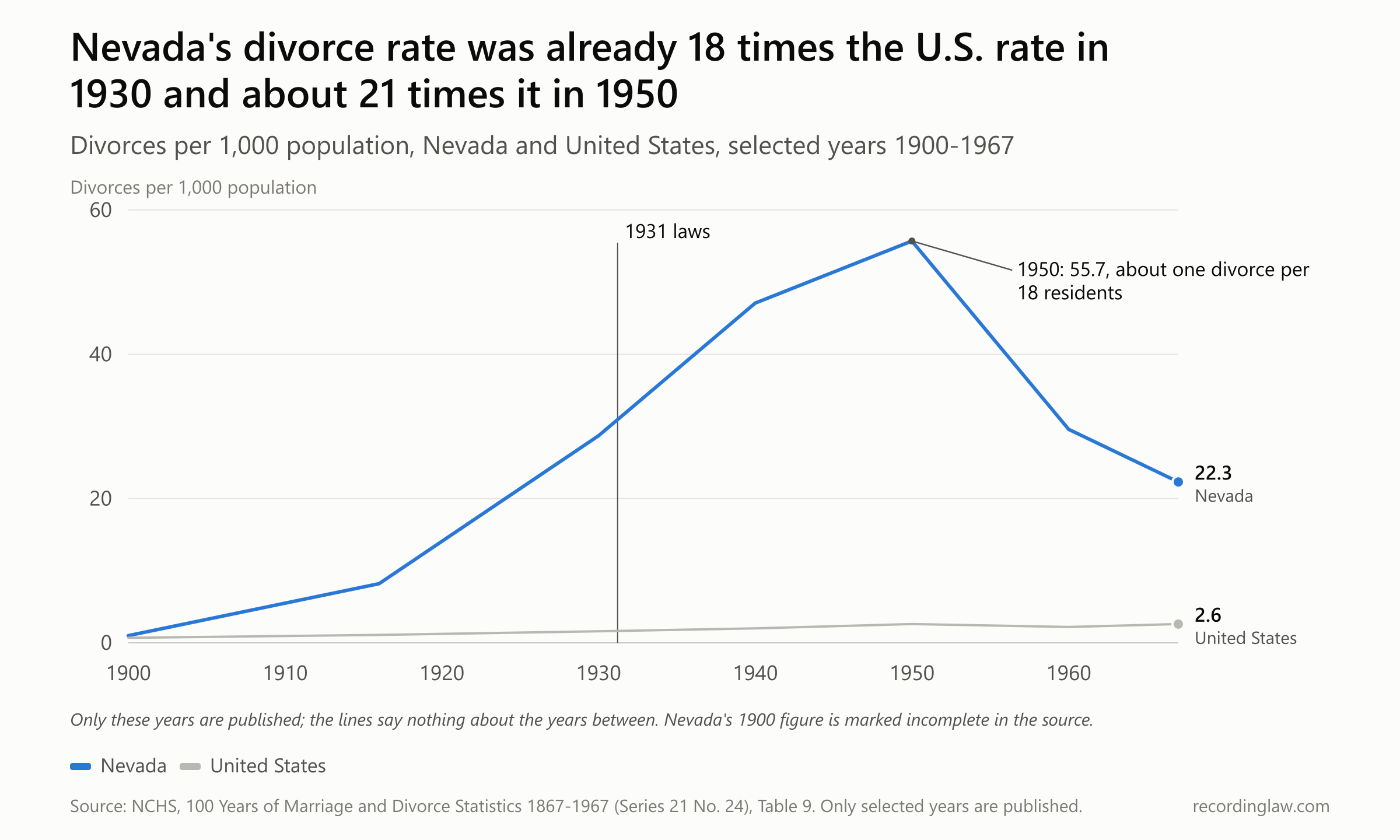
Divorces per 1,000 population, Nevada and United States, selected years. Source: National Center for Health Statistics, Series 21 No. 24 (1973), Table 9.
| Year | Nevada | United States |
|---|---|---|
| 1916 | 8.2 | 1.1 |
| 1930 | 28.7 | 1.6 |
| 1940 | 47.1 | 2.0 |
| 1950 | 55.7 | 2.6 |
| 1960 | 29.6 | 2.2 |
| 1967 | 22.3 | 2.6 |
After 1931 the Nevada line kept climbing, to 47.1 per 1,000 in 1940 and 55.7 in 1950. That 1950 rate works out to about one divorce for every 18 residents. It was about 21 times the national rate of 2.6. The federal tables publish only these selected years, so the chart cannot show what happened year by year in between.
The local figures that exist come from historians, not state tables. The Record-Courier, drawing on earlier histories, reported that Reno divorces peaked at 4,745 in 1931. It reported that they fell to 3,082 in 1932, after other states, among them Florida, Idaho and Texas, cut their own requirements. Reno Divorce History counts more than 30,000 divorces granted in the Washoe County Courthouse during the 1930s.
One judge, Thomas Moran, granted 27,150 divorces during his time on the Washoe County bench from 1911 to 1940, the Record-Courier reported. From the 1930s on, a handful of reporters worked what Reno Divorce History calls the "divorce beat," sending stories from the courthouse town to papers across the country.
Marriage moved even further. In 1930 Nevada recorded 67 marriages per 1,000 residents. In 1940 it recorded 354 per 1,000, more than one for every three people who lived there. The national rate that year was 12.1.
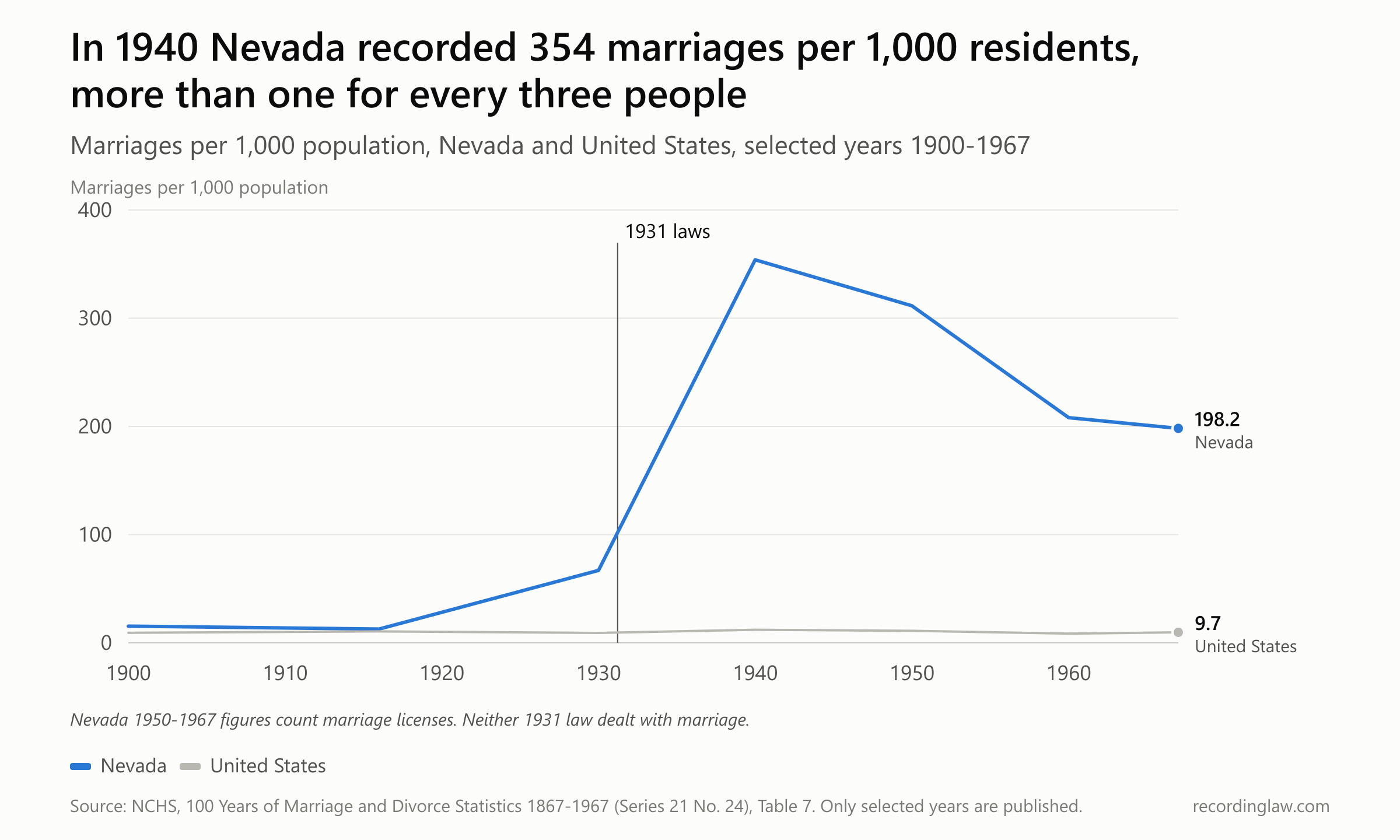
Marriages per 1,000 population, Nevada and United States, selected years. Nevada figures for 1950-1967 count marriage licenses. Source: National Center for Health Statistics, Series 21 No. 24 (1973), Table 7.
| Year | Nevada | United States |
|---|---|---|
| 1930 | 67.0 | 9.2 |
| 1940 | 354.0 | 12.1 |
| 1950 | 311.5 | 11.1 |
| 1960 | 208.1 | 8.5 |
| 1967 | 198.2 | 9.7 |
The National Center for Health Statistics credited the jump to what it called marriage mills. "The growth of the marriage rate in the Mountain Division was due to development of marriage mills, particularly in Nevada, established since the late 1920’s and early 1930’s," it wrote in 1973. The 1931 laws had no marriage provision, so the chart shows what happened around them, not a direct effect of either.
Angela Christine Moor, in a 2023 University of Nevada, Las Vegas history dissertation, argues that none of this was an accident. "Nevada’s liberal laws were not innocent remnants of the state’s frontier past," she writes. Legislators, she writes, "actively protected and, in the case of divorce, liberalized the laws even further."
The case that could undo a six-week decree
A six-week decree was only as good as its standing in the state the couple came from. In December 1942, in Williams v. North Carolina, the U.S. Supreme Court said other states had to give full faith and credit to a Nevada divorce, meaning they had to honor it. But the Court did not decide whether another state could find for itself that the couple had never made Nevada their home. The decrees in that case had come from Clark County, after a stay of barely six weeks at a Las Vegas motor court.
On May 21, 1945, in a second ruling in the same case, the Court let North Carolina refuse to honor the decrees after a jury found the couple had not established a bona fide Nevada domicile, a genuine legal home in the state. Justice Wiley Rutledge dissented. "Every divorce, wherever granted, whether upon a residence of six weeks, six months or six years, may now be re-examined by every other state," he wrote.
In 1950, five years after that ruling, Nevada's rate of 55.7 was still the highest the federal tables record. By 1960 it was 29.6, about half that level.
Other states had been shortening their own waiting periods since 1932. The selected-year tables cannot separate the ruling from that competition, or from anything else that changed in the 1950s.
The gambling bill's harder road
The other bill Balzar signed that day had taken a harder road. Nevada made gambling a felony in 1910, but the state's "unwritten code" was "to permit gambling in all forms but to keep out 'fly-by-night' operators," United Press reported in 1931. A bill to legalize the games in 1927 "passed the Assembly comfortably but lost in the Senate by a single vote," the Las Vegas Sun later wrote.
Phil Tobin, a freshman Republican assemblyman from Humboldt County, introduced AB 98 on Friday, February 13.
On Monday, March 9, fourteen members spoke on it before the roll call. Their words were not recorded. The bill passed 24-11, and the Senate passed it 13-3, according to the Legislature's research staff and the Las Vegas Sun. Ten days later Balzar signed both.
What each side said would happen
Tobin wanted the money that was already changing hands. "The gambling bill was strictly my idea," he said in a 1964 interview quoted by the Record-Courier of Gardnerville. "I felt the revenue should go to the state." The Legislature's research staff, summarizing the 1931 committee debate in 2016, wrote that "the bill’s supporters backed Assemblyman Tobin’s stand that gambling was too common to ignore and that it went untaxed."
The state had few other places to look. "With the federal government owning approximately 86 percent of the land in Nevada, there was little room for further development of agriculture, and the property tax base was limited," the same report says. Jim Hulse, a University of Nevada, Reno historian, put both 1931 bills in that frame: "I think legislators were trying to find some sources of revenue to pump up the state economy."
Business owners had their own reasons. "Owners of restaurants, hotels believed legalization would help bring people in during the Depression and boost the economy," said Eric Moody of the Nevada Historical Society. In Reno, Moody told the Record-Courier, the banker and hotel owner George Wingfield worked behind the scenes because he believed legal gaming would help his banking, ranching and Riverside Hotel business.
The wire story the day after the signing read the gambling law as a green light for investment. The new law meant "the lid is now off, the sky is the limit, and investors can feel safe to place their money in high-class gambling casinos," United Press wrote. It also named the contest to come: "There may be keen rivalry between Reno and Las Vegas for the title, 'Monte Carlo of America.'"
The opponents left no transcript. The Legislature's 2016 summary gives their case in one line: "Antigambling groups argued that gambling was a vice, pure and simple, and would attract gangsters and bring shame to Nevada." Eleven of the 35 assemblymen who voted on AB 98 voted no.
That fear of shame was older than the bill. A 1909 Reno Evening Gazette editorial arguing for the original ban warned that Nevada had become "the butt of ridicule and criticism all over the country," as KTNV later quoted it. The divorce trade had drawn the same complaint before 1913, when "its opponents increasingly denounced the trade as harmful to Nevada’s reputation as well as to society in general," in the words of Reno Divorce History.
The law itself said little about money for the state. County sheriffs issued the licenses, to U.S. citizens only. The fees were $50 a month per game, $25 per card table and $10 per slot machine handle.
The act sent "twenty-five (25%) per cent to the state treasurer for general state purposes" and the other 75% to the county. Inside an incorporated city or town, the county's 75% was divided: the county kept 25% and the city got 50%. In an unincorporated town run by the county commissioners, the 50% went to a town fund instead. The state took no share of the winnings themselves.
Meanwhile, in Las Vegas
When the laws passed, the gambling half of the story belonged mostly to the north. Reno had 12,016 residents in 1920 and Las Vegas had 2,304, about five to one. Las Vegas had been named as a rival for Reno's divorce trade as early as 1911. "The demand for divorces increases yearly, and if the Las Vegas people keep up their courage, advertise freely, and deliver the goods according to advertisement, there is no doubt that they will soon place their city on a thriving basis," the New York Times reported that year, as Reno Divorce History quotes it.
The next arrival in the south was a federal project, Hoover Dam. "The contractors were allowed seven years from April 20, 1931," the Bureau of Reclamation says of the dam, and that date was a month after the signing.
A total of 21,000 men worked on the dam, with an average of 3,500 a day and a monthly payroll of $500,000. A railroad ran 22.7 miles from the Union Pacific main line in Las Vegas to Boulder City. Las Vegas had 5,165 residents in 1930.
The first casino in Las Vegas after legalization, the Meadows, opened in May 1931, the Las Vegas Sun reported. In 1933 the developer Thomas Carrol ran newspaper ads for wide-open gaming; "he kept emphasizing that he wanted to make Las Vegas the Monte Carlo of the west," said Eric Moody of the Nevada Historical Society.
In 1939 Las Vegas took a share of the divorce business itself. Reno Divorce History calls it "a turning point" when "Clark Gable’s second wife, Ria Langham, chose to divorce the actor in Las Vegas rather than the expected Reno," and the Chamber of Commerce used photographs of her stay to promote the town.
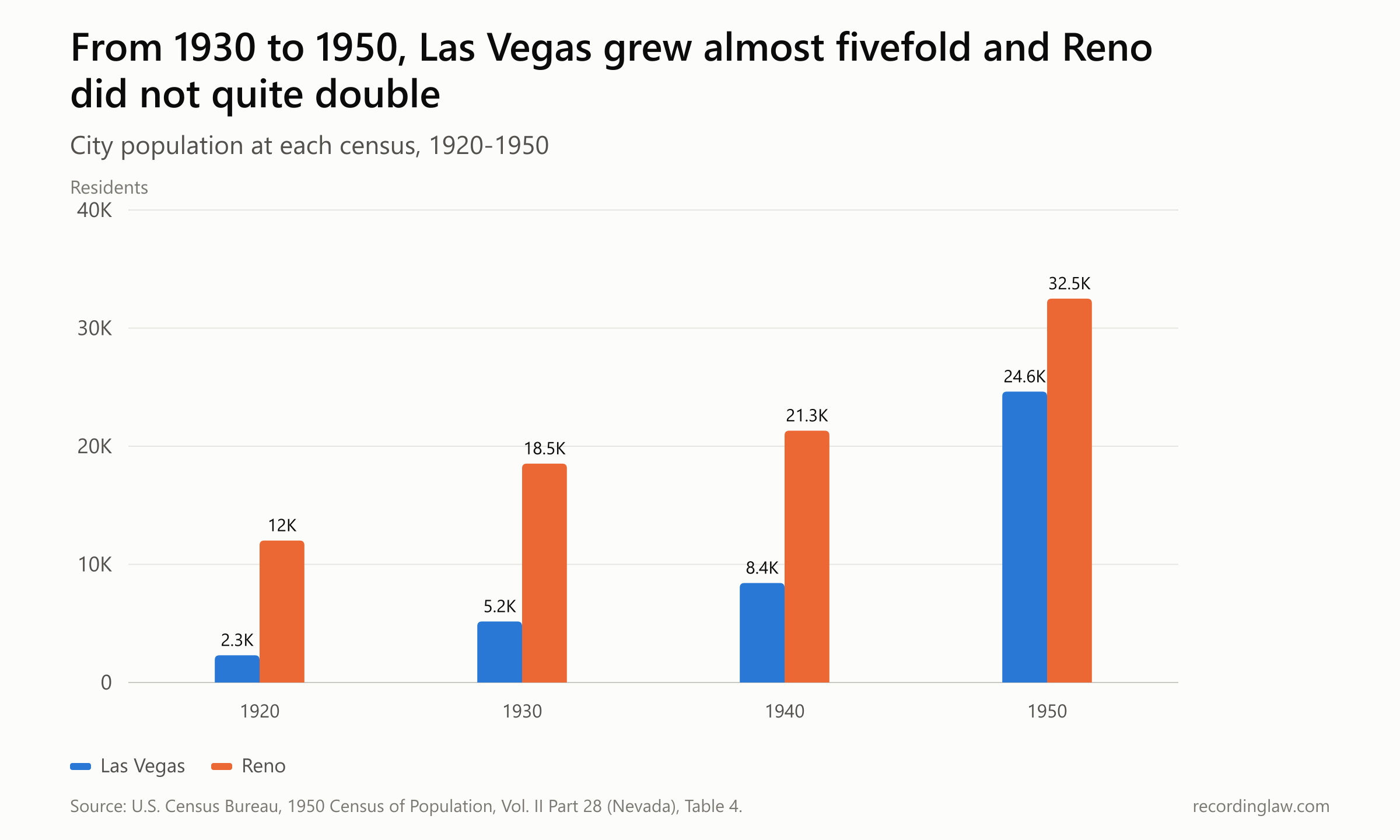
Population of the cities of Las Vegas and Reno at each census, 1920-1950. Source: U.S. Census Bureau, 1950 Census of Population, Vol. II Part 28, Table 4.
| Census | Las Vegas | Reno |
|---|---|---|
| 1920 | 2,304 | 12,016 |
| 1930 | 5,165 | 18,529 |
| 1940 | 8,422 | 21,317 |
| 1950 | 24,624 | 32,497 |
Between 1930 and 1950, Las Vegas grew almost fivefold and Reno did not quite double. The Strip began on the highway to Los Angeles with the El Rancho Vegas in 1941 and the Last Frontier, which opened on October 30, 1942. The dam, the war years and the casinos all landed on the same small town in the same two decades. Census counts cannot say how much of the growth belongs to any one of them.
The county figures show where it went. Clark County, home of Las Vegas, had 8,532 people in 1930 and Washoe County, home of Reno, had 27,158. By 1950 they were close, at 48,289 and 50,205.
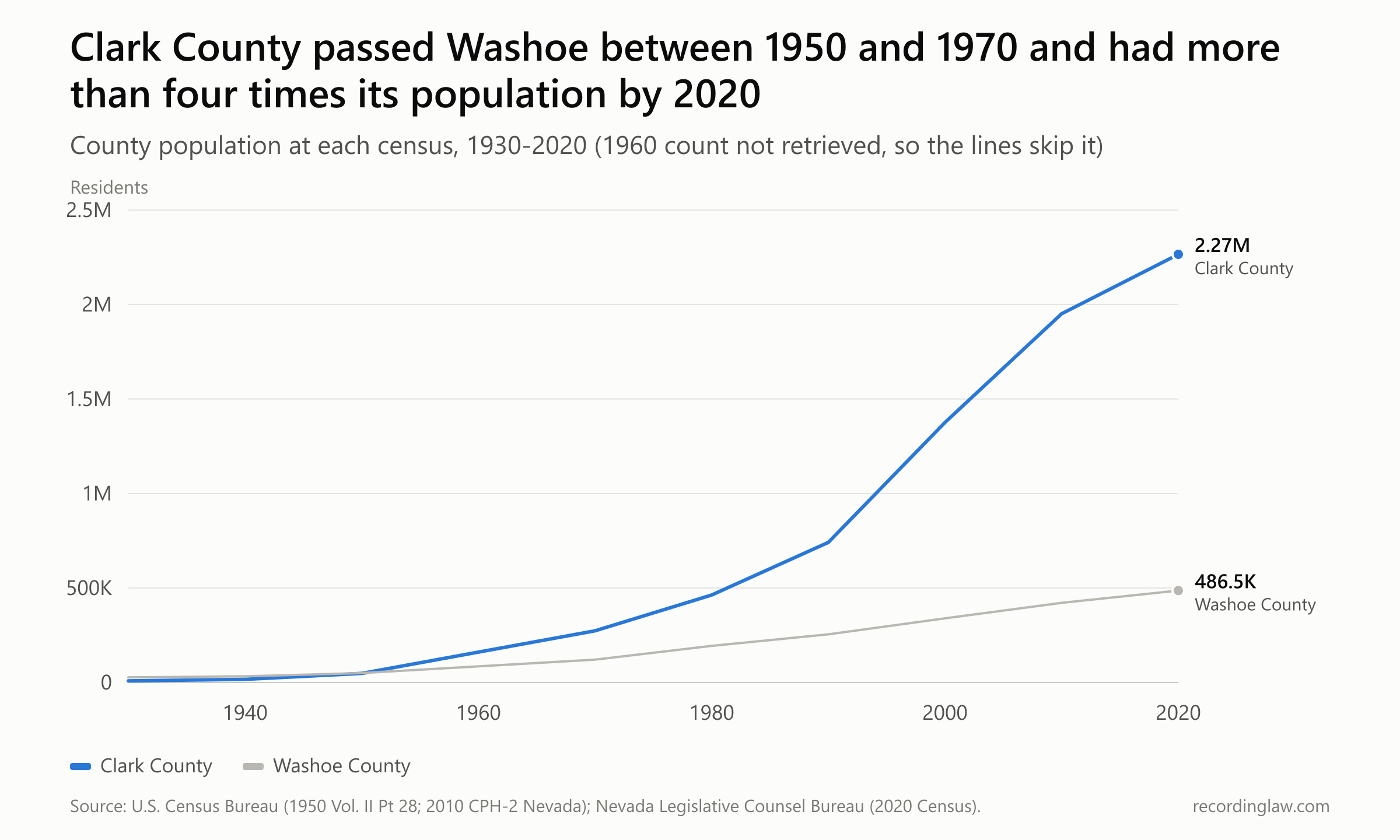
Clark and Washoe county population at each census, 1930-2020; 1960 counts were not retrieved. Sources: U.S. Census Bureau; Nevada Legislative Counsel Bureau.
| Census | Clark County | Washoe County | Clark share of Nevada |
|---|---|---|---|
| 1930 | 8,532 | 27,158 | 9.4% |
| 1950 | 48,289 | 50,205 | 30.2% |
| 1970 | 273,288 | 121,068 | 55.9% |
| 2000 | 1,375,765 | 339,486 | 68.8% |
| 2020 | 2,265,461 | 486,492 | 73.0% |
By 1970 Clark County had more than twice Washoe's population. By 2020 it held 73% of all Nevadans. By population, the rivalry United Press predicted in 1931 had a clear leader.
The warning about gangsters
In 1950 a U.S. Senate committee took the opponents' worry about gangsters on the road. "Kefauver brought his Committee to Las Vegas on November 15, 1950 at the Federal Courthouse, now the site of the Mob Museum," wrote Richard H. Bryan, a former Nevada governor and U.S. senator, in a 2020 history for the State Bar's magazine. Bryan wrote that the committee held hearings in 14 cities and that, with television in its infancy, an estimated 30 million people tuned in.
Bryan also described how the country saw the state after 1931, in terms close to the ones the 1909 editorial and the 1931 opponents had used. "The combination of Nevada's liberalized divorce laws and casino gaming subjected Nevada to harsh criticism," he wrote. "Nevada was branded as a modern-day Sodom and Gomorrah." In 1960, a Christianity Today report on Las Vegas put it this way: "The mainstay business is gambling with the evil yoked to it."
Repeal efforts failed: the 1933 Legislature rejected an anti-gambling bill 24-6, and a 1934 petition for a repeal referendum fell short after its signatures were challenged, according to the gaming-history author Doresa Banning. The Nevada State Journal reported in July 1934, as Banning quotes it, that the repeal group felt "our state was being exploited politically and socially and its good name was being smirched by this evil."
What changed instead was who held the reins. "Between 1931 and 1945, the State left the regulation of gaming up to the local governments and did not attempt to directly tax gaming establishments," the Legislature's research staff wrote. In 1945, the report says, the state "required licenses for casinos and imposed a 1 percent tax on gross revenues." In 1955 it created the State Gaming Control Board, and in 1959 the Gaming Commission.
The business the mayor did not expect
Reno's mayor, Edward Ewing Roberts, had been talking about one city's card-table fees, about $35,000 a year. Full statewide tables of gaming revenue, the money casinos win from players, begin only in 1984. That year Nevada's casinos won $3.1 billion. How far did it go from there?
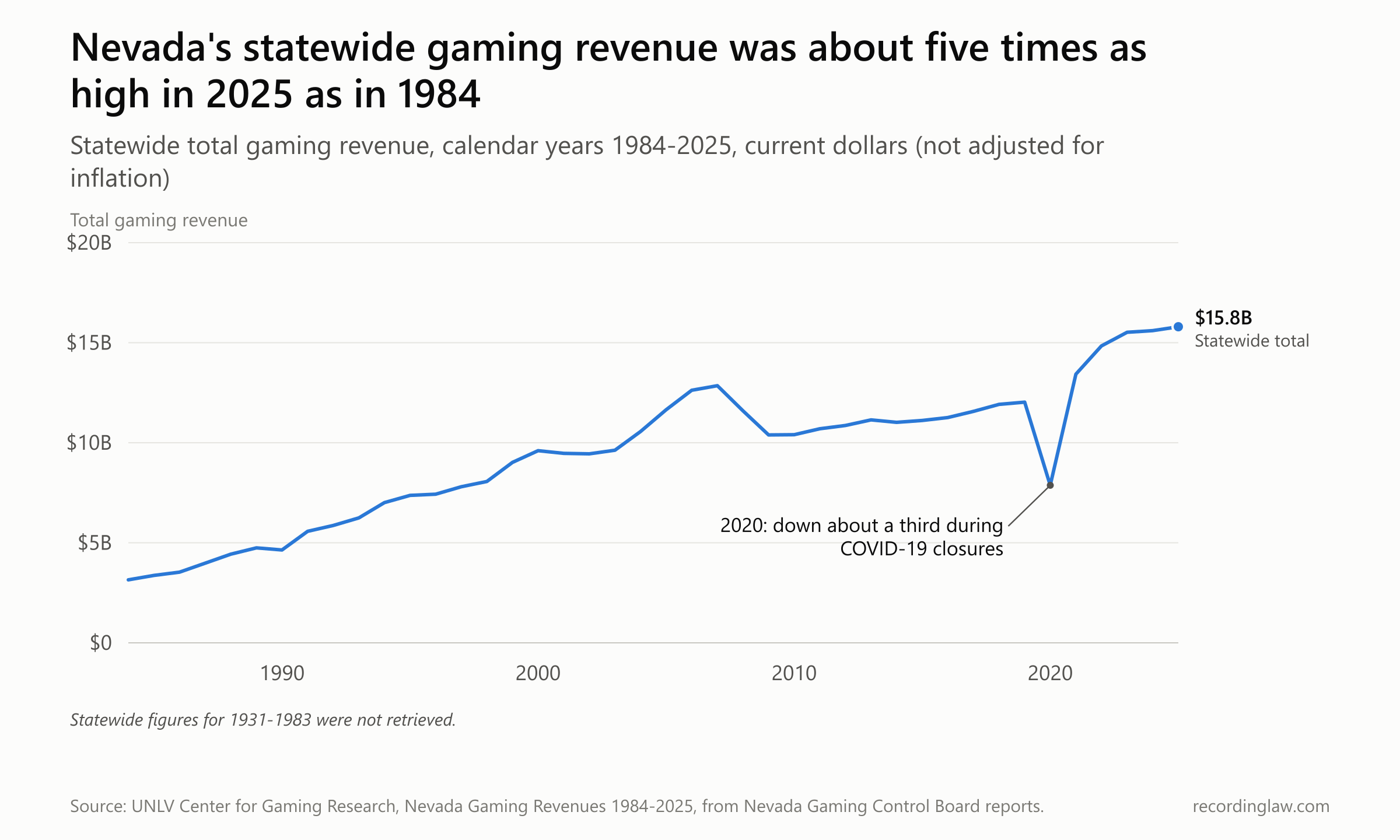
Nevada statewide total gaming revenue, calendar years, current dollars. Source: UNLV Center for Gaming Research, Nevada Gaming Revenues 1984-2025, compiled from Nevada Gaming Control Board reports.
| Year | Total gaming revenue | Slot revenue |
|---|---|---|
| 1984 | $3,146,482,000 | $1,665,212,000 |
| 2000 | $9,602,586,000 | $6,191,018,000 |
| 2007 | $12,849,137,000 | $8,450,908,000 |
| 2009 | $10,392,675,000 | $6,823,039,000 |
| 2019 | $12,031,501,000 | $7,934,710,000 |
| 2020 | $7,873,313,000 | $5,416,294,000 |
| 2025 | $15,798,466,000 | $10,713,837,000 |
The line climbed to $15.8 billion in 2025, about five times the 1984 figure in dollars not adjusted for inflation. It fell by about a third in 2020, when casinos closed for COVID-19. It passed its old high in 2021. The Gaming Control Board's latest monthly report puts the twelve months to September 2026 at $16.1 billion.
Writing in 2020, Bryan, a former Nevada governor, gave the state treasury's share: "The gross revenue collected in the most recent biennium was $1.5 billion and represents 18.5% of the total general fund." The Nevada Resort Association, the casino industry's trade group, funded by its member companies, credits Tobin's bill with the whole enterprise: "The legislation allowed the rise of the gaming industry and the regulated modern casino we know and enjoy today."
Tobin himself had second thoughts about one part of it. "I don’t think it’s right allowing these one-armed bandits in every supermarket … and restaurant in the state," he said late in life, as the Las Vegas Sun quoted him.
Slot machines made up about 53% of statewide gaming revenue in 1984 and about 68% in 2025. Nevada had 22,178 slot machines in 1963. The number peaked at 217,221 in 2001, and it stood at 149,044 at the end of 2025.
The money also settled in the south. In the twelve months to September 2026, the Las Vegas Strip area won $9.0 billion and the Reno area of Washoe County won $834 million. The Strip took in nearly 11 times as much as the Reno area, where the 1931 law first filled the card rooms.
What is left of six weeks
The divorce law is still in force. Today's Nevada Revised Statutes 125.020 still says that, outside a narrow exception for grounds that arose in the county where both spouses lived, a court cannot grant a divorce unless one spouse "has been resident of the State for a period of not less than 6 weeks preceding the commencement of the action," nearly the same words the Legislature passed in 1931.
Its history line still cites the 1931 statute. Our Nevada divorce law guide covers how the rule works now, and the state-by-state divorce guide compares residency rules elsewhere.
The divorce rate around it has fallen far from its 1950 level of 55.7. In 1990 Nevada recorded 11.4 divorces per 1,000 residents. In 2024 it recorded 3.8, against 2.3 nationally. That is about 1.7 times the U.S. rate.
The marriage trade held on longer. Nevada's marriage rate in 2024 was 24.8 per 1,000, about four times the national 6.3.
In Reno, 4,745 divorces were reported in 1931. In the year to June 2025, courts across all of Washoe County recorded 1,937 new marriage dissolution cases, a count that also includes annulments and separate maintenance. The county had about 18 times as many residents in 2020 as in 1930. And it now sees fewer than half as many cases as Reno alone did in 1931.
How we measured
Divorce and marriage rates, 1870-1967. National Center for Health Statistics, 100 Years of Marriage and Divorce Statistics, United States, 1867-1967 (Series 21, No. 24, 1973), Tables 7 and 9. Values were read from the rendered page images because the PDF's text layer is garbled. The tables publish only selected years (1870, 1880, 1890, 1900, 1916, 1930, 1940, 1950, 1960, 1967), so the chart lines connect sparse points and say nothing about the years between. Divorce counts include reported annulments. Nevada marriage figures for 1950, 1960 and 1967 count marriage licenses, not certificates. Nevada's 1870-1900 divorce figures are marked incomplete in the source.
Divorce and marriage rates, 1990-2024. CDC/NCHS state divorce and marriage rate tables for 1990, 1995 and 2000-2024, and the national provisional series (U.S. 2024 divorce rate 2.3 per 1,000, from 662,950 divorces and annulments in reporting areas only). Rates in the 1973 and current tables come from different collection systems, so the comparison across them is approximate.
Ratios. Nevada divorce rate as a multiple of the U.S. rate: 28.7 / 1.6 = 17.9 (1930); 55.7 / 2.6 = 21.4 (1950); 3.8 / 2.3 = 1.65 (2024). One divorce per 18 residents in 1950 is 1,000 / 55.7. Marriage: 354.0 per 1,000 in 1940 is more than one per three residents; 24.8 / 6.3 = 3.9 (2024). Washoe County population 486,492 (2020) / 27,158 (1930) = 17.9. Strip area $8,988,932,000 / Reno area $833,628,000 = 10.8. Reno / Las Vegas population in 1920: 12,016 / 2,304 = 5.2. Clark / Washoe population in 2020: 2,265,461 / 486,492 = 4.7; in 1970, 273,288 / 121,068 = 2.3. Las Vegas 1950 / 1930: 24,624 / 5,165 = 4.8; Reno: 32,497 / 18,529 = 1.8. Slot share of total gaming revenue: $1,665,212,000 / $3,146,482,000 = 52.9% (1984); $10,713,837,000 / $15,798,466,000 = 67.8% (2025). Total revenue 2025 / 1984 = 5.0 (an increase of 402%).
Gaming revenue. UNLV Center for Gaming Research, Nevada Gaming Revenues 1984-2025 (statewide table, "Total Rev" column, reported in thousands of dollars), compiled from Nevada Gaming Control Board reports. All figures are nominal. UNLV's introduction says revenues rose 396%. That figure matches 2024 against 1984, and the 2025 row gives 402%. Total revenue is not always the sum of slot and game revenue (in 1992 it differs by $74.7 million). Statewide win for 1931-1983 was not retrieved, so the series starts more than 50 years after the law. The twelve-month figures to September 2026 ($16,111,020,000 statewide, $8,988,932,000 Strip area, $833,628,000 Washoe County Reno area) are from the Gaming Control Board's September 2026 monthly report and cover nonrestricted licensees.
Slot machine counts. UNLV, Nevada Gaming Footprint 1963-2025, from the fourth-quarter Nevada Gaming Commission report each year; counts include restricted and nonrestricted machines.
Population. U.S. Census Bureau 1950 Census of Population, Vol. II Part 28 (1890-1950 state, county and city counts); 2010 Census CPH-2 Nevada (1970-2010 county counts); Nevada Legislative Counsel Bureau table from the 2020 Census. The 1960 county counts were not retrieved, so the county chart skips that year. Clark County's 1990 count appears as 741,368 in the Census table and 741,459 in the Legislature's revised table.
Local divorce counts. No state series of annual Washoe or Clark County divorces for 1931-1960 was found. The figures of 4,745 (1931), 3,082 (1932) and Judge Moran's 27,150 come from a 2001 Record-Courier history drawing on earlier books; "more than 30,000" in the 1930s is from UNR's Reno Divorce History. The same Record-Courier article places a three-month amendment in March 1931; the 1931 Statutes show the six-week act approved March 19, 1931 and effective May 1, and we follow the statute. The 2025 Washoe figure counts new marriage dissolution filings (divorce, annulment and separate maintenance) in fiscal 2025, a different measure from divorces granted.
The 1931 laws. Statutes of Nevada 1931, Chapter 97 (AB 137, six weeks, "in full force and effect from and after May 1, 1931") and Chapter 99 (AB 98, effective on approval), both approved March 19, 1931. Chapter 99, Section 5 splits license money 25% state and 75% county, except inside an incorporated city or town (25% state, 25% county, 50% city) or an unincorporated town governed by the county commissioners (50% to the town fund); TIME's March 30, 1931 report that 50% would go to the city matches that proviso. Journal of the Assembly, 35th Session (1931), for the committee amendment and roll calls. The Legislature's 2016 research report gives the Assembly vote on AB 98 as 24-1; the 1931 Assembly Journal roll call is 24-11, which we use. The Senate vote of 13-3 comes from that report and the Las Vegas Sun; the 1931 Senate Journal was not opened.
What the data cannot show. No study measuring the economic effect of either 1931 law was found. Nevada's growth after 1931 coincided with Hoover Dam construction, World War II and other changes, and the divorce rate's fall after 1950 coincided with other states' shorter waiting periods and the 1945 Williams ruling. Neither population nor revenue figures can separate those influences.
What comes next. The Gaming Control Board's October 2026 revenue report is next. The board has published no date for it, and the September report was dated October 20. The 84th session of the Nevada Legislature, its next regular session, begins on February 1, 2027.
Both 1931 acts turn 100 on March 19, 2031. The six-week residency's own centennial falls on May 1, 2031, and the sentence that made Reno's courthouse a national story will reach it unchanged in substance unless a legislature acts first.
Frequently Asked Questions
When did Nevada legalize gambling?
Gov. Fred Balzar approved Assembly Bill 98, the gambling act (Chapter 99, Statutes of Nevada 1931), on March 19, 1931. It took effect as soon as he approved it. A 1909 law had banned gambling from October 1, 1910. Apart from a brief repeal in 1911 and some card games that local governments licensed, gambling stayed illegal until 1931.
When did Nevada's six-week divorce residency start?
The six-week act (Chapter 97, Assembly Bill 137) was approved the same day as the gambling act, March 19, 1931, and took effect from and after May 1, 1931. It replaced the three-month requirement set in 1927.
Is Nevada's divorce residency still six weeks?
Yes. Under Nevada Revised Statutes 125.020, unless the grounds arose in the county while both spouses lived there, one spouse must have been a Nevada resident for at least 6 weeks before the case is filed.
How high was Nevada's divorce rate after 1931?
Federal tables give Nevada 28.7 divorces per 1,000 residents in 1930, 47.1 in 1940 and 55.7 in 1950. The U.S. rates for those years were 1.6, 2.0 and 2.6. In 2024 Nevada's rate was 3.8, against 2.3 nationally.
Did the 1931 gambling law tax casinos?
Not directly. The 1931 act set flat monthly license fees collected through the counties, and 25 percent of that money went to the state. Nevada first imposed a 1 percent tax on gross gaming revenue in 1945.
How much does Nevada gaming bring in now?
Statewide gaming revenue was $15.8 billion in calendar 2025 and $16.1 billion in the twelve months to September 2026, according to UNLV and Nevada Gaming Control Board figures, not adjusted for inflation.
Why did Las Vegas overtake Reno?
The record shows several things arriving in Las Vegas in the same period: legal casinos from 1931, Hoover Dam construction from 1931 to 1936, and the first Strip resorts in 1941 and 1942. Census counts show Clark County passing Washoe County in population between 1950 and 1970, but they cannot separate the causes.
Updates
Reworded for readability. No figures, quotes, sources or findings changed.
Restructured as a feature: chart titles state the finding, side details moved to How we measured. Every figure and quote was re-checked against its source.
Independently fact-checked against the cited primary sources
Independently fact-checked against the cited primary sources
Sources and References
- Statutes of Nevada 1931, Chapters 97 (divorce, AB 137) and 99 (gambling, AB 98)(leg.state.nv.us).gov
- Statutes of Nevada 1931, table of contents and approval dates(leg.state.nv.us).gov
- Statutes of Nevada 1927, Chapter 96 (three-month residency)(leg.state.nv.us).gov
- Journal of the Nevada State Assembly, 35th Session (1931)(leg.state.nv.us).gov
- Nevada Revised Statutes Chapter 125 (NRS 125.020, residency for divorce)(leg.state.nv.us).gov
- Nevada Legislative Counsel Bureau, Gaming in Nevada (Policy and Program Report, April 2016)(leg.state.nv.us).gov
- Nevada Legislature, session information (84th Session begins February 1, 2027)(archive.leg.state.nv.us).gov
- Nevada Legislative Counsel Bureau, Population of Counties in Nevada (2020 Census)(leg.state.nv.us).gov
- National Center for Health Statistics, 100 Years of Marriage and Divorce Statistics, United States, 1867-1967 (Series 21, No. 24, 1973)(cdc.gov).gov
- CDC/NCHS, divorce rates by state, 1990, 1995 and 2000-2024(cdc.gov).gov
- CDC/NCHS, marriage rates by state, 1990, 1995 and 2000-2024(cdc.gov).gov
- CDC/NCHS, provisional number of marriages and divorces, United States, 2000-2024(cdc.gov).gov
- U.S. Census Bureau, 1950 Census of Population, Vol. II, Part 28 (Nevada)(www2.census.gov).gov
- U.S. Census Bureau, 2010 Census CPH-2, Nevada(www2.census.gov).gov
- UNLV Center for Gaming Research, Nevada Gaming Revenues 1984-2025(library.unlv.edu)
- UNLV Center for Gaming Research, Nevada Gaming Footprint 1963-2025(library.unlv.edu)
- Nevada Gaming Control Board, Monthly Revenue Report, September 2026(gaming.nv.gov).gov
- Nevada Gaming Control Board, Gaming Revenue Information(gaming.nv.gov).gov
- Supreme Court of Nevada, Annual Report of the Nevada Judiciary FY2025, Appendix(nvcourts.gov).gov
- U.S. Bureau of Reclamation, Hoover Dam FAQs(usbr.gov).gov
- Williams v. North Carolina, 317 U.S. 287 (1942)(law.cornell.edu)
- Williams v. North Carolina, 325 U.S. 226 (1945)(law.cornell.edu)
- United Press, Nevada sets record for liberality (March 20, 1931)(upi.com)
- TIME, States and Cities: Only Free State (March 30, 1931)(content.time.com)
- The Record-Courier, Millenium Countdown: 1931 (December 20, 2001)(recordcourier.com)
- Las Vegas Sun, Bill that transformed a city (May 15, 2008)(lasvegassun.com)
- KTNV, Gambling in Nevada legalized 87 years ago (2018)(ktnv.com)
- Reno Divorce History (University of Nevada, Reno Special Collections), Residency Requirements(renodivorcehistory.org)
- Reno Divorce History (UNR), Competing Colonies(renodivorcehistory.org)
- Reno Divorce History (UNR), Magazines and Newspapers(renodivorcehistory.org)
- Angela Christine Moor, Getting Hitched and Unhitched: The History of Marriage and Divorce in Las Vegas, 1931-1965, UNLV PhD dissertation (History), May 2023(oasis.library.unlv.edu)
- Richard H. Bryan, Nevada's Gaming Odyssey, Nevada Gaming Lawyer (State Bar of Nevada), September 2020(nvbar.org)
- Christianity Today, Christ in Las Vegas (January 18, 1960)(christianitytoday.com)
- Doresa Banning, gaming history post quoting the Nevada State Journal of July 4, 1934(doresabanning.com)
- Nevada Resort Association (casino industry trade group), history timeline(nevadaresorts.org)